Showing posts with label Economics. Show all posts

Sunday, July 30, 2023

How to self annuitize your income for life


I hardly ever write about personal finance, even though I am very interested and reasonably well read in it, being retired. But a recent article in the Wall Street Journal (free link)about QLACs, or Qualified Lifetime Annuity Contracts, started me thinking. 

Millions of Americans have good reason to worry they will outlive their retirement savings. A little known tax-advantaged annuity can help avoid that, providing a guaranteed income in the final years of life.

Starting this year, Americans can use up to $200,000 of their retirement accounts to purchase qualified longevity annuity contracts, or QLACs. ... 

An annuity is an insurance contract that you can buy to provide a steady income like a pension, making it easier to plan for the uncertainty of life expectancy. QLACs have existed for a decade and offer significantly more income for life than a typical immediate annuity, since the payments don’t start until later in life, at, say, age 80 or 85. They also have a special tax benefit. 

The shift from the security of pensions to relying on 401(k)s turned workers into both investors and actuaries, tasked with building a nest egg big enough to last their lifespan. QLACs are a way to remove some of that guesswork. 

Let me be clear: I have no annuities now and no intention of ever getting one. My father was an agent for one the country's largest life insurance companies. Starting near the end of his career, the company began selling brokerage products, including annuities, in addition to insurance. One day I was home visiting and he took me to a seminar at his office on annuities (we were going to the golf course afterward). Everything I heard there convinced me never to buy one. 

The WSJ's article on QLACs made me wonder whether there is a way for individual investors like me to guarantee lifetime income the way that QLACs do, but without simply handing up to $200,000 over the the annuity company, locking it up:

The drawbacks to a QLAC are the upfront cost and that if an emergency occurs and you need money before the beginning of payouts, you can’t touch it. It is locked in. The size of the payout also depends on how long you live. 

My wife is 65. I have promised our kids that I will provide for her until she turns 100, but then she is their problem. This is a very realistic expectation since she comes from a family of Methuselahs, of whom living to very late 90s and beyond is quite common. 

So I thought, how to take, say, a QLAC's $200,000 and self annuitize it until 2058? The first thing I tried was to withdraw annually an amount of money equal to the balance on hand divided by the number of years left to go. And bingo! It worked. So the first year's withdrawal would be $200,000 / 35 = $5,714. And I let Excel do the rest:


Note that the annual balance increases in this case until 2037, then starts to fall. If the Annual Withdrawal Decimal remains equal to 1.0, as here, the Annual W/D Increase will always equal the Annual ROI, in this case, 5 percent. Continuing to the year 2058, my wife would receive $30,019 that year, leaving a balance of zero. Total withdrawals would be $516,116. 

But wait! There's more! What if the Annual W/D is "decimalized"? On the Excel, the annual withdrawal is calculated thus:

Amount withdrawn = balance / (Years to Go * Ann W/D Decimal), or the first year:
5,714 = 200,000 / (35 * 1.0) 

If the Annual W/D Decimal is greater than 1.0, it simply increases the number of each Yr to Go fractionally. It seems counter-intuitive, but the larger that decimal is, the greater is the total amount withdrawn at 2058; here is that table: 


But how to make sure you get a good ROI? Well, if the point is to guarantee income for life, you can do that simply by dropping that $200K (or other amount) into a savings account. You will get an annual withdrawal increase of, say 0.5%. 

But you will also get killed by inflation. After 35 years, your withdrawal of $6,770 will be worth a mere $1,946 in 2023 buying power, using 3.5 percent average annual inflation. So what to do? 

Option One - Fixed-Return Instruments 
Invest the starting balance in fixed-return instruments, such as government or corporate bonds - which as I write the WSJ says is better now than buying stocks (free link). Those rates are fixed for the life of the bond. For example, as I type this, three- and six-month US Treasury Bills can be bought with a yield to mark (maturity rate)  of 5.483 percent. You can set up a "ladder," in which you buy T-bills that mature in three, six, nine and 12 months, rolling them all into three-month bonds as they mature. That means you have bonds maturing every three months as long as you keep that up. You can do the same with other corporate bonds and CDs. 

However, if you do that you cannot sell/redeem them early without taking a loss on the ones you redeem. And profits are taxable, so best to do this in tax-excluded accounts such as a Roth IRA. 

US Treasury Direct, run by the Dept. of Treasury, offers I-Bonds, the return of which are related directly to the inflation rate, adjusted every six months. You can buy up to $10,000 per year per person. They cannot be redeemed at all before the end of 12 months, then if you redeem before the end of five years, you will be docked the previous three months interest. But if your goal is to maintain buying power versus inflation, they can be a good choice

Option Two - High Yield Savings and Money Market Accounts
Ordinary savings accounts, as indicated above, pay practically nothing in interest these days. But there are other savings instruments that offer the same liquidity and pay much higher rates. One example is a money market fund, which is a mutual fund that invests in short-term, high-quality securities. However, since they are designed to provide high liquidity and generate current income with low risk, money market funds do not offer capital appreciation and are generally not suitable as long-term investments. 

That means that your invested principal will itself never be worth more than it began, but you will earn much more in interest or dividends than in an ordinary savings account, in which the amount deposited never gains value, either, it also just earns interest. So, these are not equity investments like buying shares of stocks or Exchange Traded Funds (ETFs) are, in which a share bought for, say, $25 may appreciate to more than that while also (hopefully) paying dividends. 

However, current yields for money market accounts range from 5.0 to just more than 5.2 percent per year, adjusted every week. So, if you think of them as another kind of savings account, they are a very good choice. Also, you can buy tax-exempt MM funds; they pay less in interest but may be an excellent choice for taxable accounts, such as an ordinary brokerage account. 

High Yield Savings Accounts are simply savings accounts that pay a much higher rate than ordinary ones. (This begs the question of why there are ordinary savings accounts at all!) CNBC explains (excerpted):

High-yield savings accounts stand out from traditional savings accounts in that they reward you with a higher interest rate, allowing your money to grow even faster as it sits in your account. 

It’s important to note, however, that the APY that savings accounts offer when you sign up can change at any time. These rates are variable and often go up or down in accordance with the Federal Reserve changing its benchmark interest rate.

Not only does your money earn a better return in a high-yield savings account, but you still have access to your cash when you need it as you would in a normal savings account. Your money in a high-yield savings account should be federally insured by the Federal Deposit Insurance Corporation (FDIC), which means that deposits up to $250,000 are protected if the bank were to suddenly collapse.
CNBC's page relates that HYSA interest ranges from 4.18 percent to 4.81 percent, but the article was published last February, so rates will be different today. 

Option Three - Dividend Growth Investments
This means to purchase shares of stocks or ETFs focusing on their dividends, which are payments of earnings returned to shareholders. Dividend Growth means two things:

1. The share price of the equity increases over time, so your invested principal increases in value with no further action by you. 

2. The dividend paid also increases over time, usually per year, so that the amount of dividends paid per share also increases. 

Dividends are measured in yield, which simply means the percentage of a share's value, or price, that is paid in dividends. Dividend payments may be reinvested to buy more shares or simply accepted as cash into your account, your choice. Two well-known and highly invested examples are SCHD and NOBL, named respectively Schwab US Dividend Equity ETF and Proshares S&P 500 Dividend Aristocrat ETF. If you had invested $10,000 in each on Jan. 1, 2014, this would be the result:


These are excellent annual returns, btw. 

Multi-gazillionaire Warren Buffet's advice to ordinary investors is simply to buy ETFs priced directly to the S&P 500 index and that's it. NOBL is one such example, but Forbes says these are the best S&P 500 ETFs this year
  1. SPY, with 10-Year Average Annualized Return, 12.30%
  2. IVV, 12.28%
  3. VOO, 12.35%
  4. SPLG, 12.27%
  5. IVW, 13.79
  6. RSP, 10.71
Together, their averaged annual return is 12.28 percent. So what would the self-annuity look like with that average annual return? This:


With withdrawals increasing an average of 12.28 percent per year, you will beat the tar out of inflation. But (and there is always a "but," right?), "annual average" does not mean "every year." Here is the chart of high earner IVW over the last five years. 


So, it's return is neither a uniform nor guaranteed. That needs to be considered for self annuitizing for life, too. This chart, however, reflects only share price. Here is the chart with dividends included:


It is very important to assess your comfort level relative to risk of loss compared to likelihood of gains. 

Conclusion

I think I have demonstrated that it is possible to self annuitize for life. To start with an expected longevity age, the IRS publishes Publication 590-B because that is what they use to determine Required Minimum Distributions (RMDs) from IRAs and other taxable retirement accounts. The IRS updates the pub intermittently, the latest table is here.

Be aware also that the figures of my worksheet may be overridden by RMDs if you include taxable accounts. If the calculated withdrawal is less than the RMD for that year, then you must withdraw more money to equal the RMD (or more, if you want). 

But being required to withdraw at least the RMD does not mean you have to spend it. You can transfer all or part of it to ordinary investment or banking accounts and continue to use them for self annuity balances, or anything else. 

My wife and I are both retired now. We do not intend to self annuitize as I have described, however, because we do not need to. We withdraw what we need to and leave the rest in various equities and accounts as described above. But we also know the day may come when self annuitizing those accounts will be the best solution once we reach our truly elderly years. 

And that is one of the major beauties of self annuitizing - you never tie your money up handing it off to some corporation. It is always yours and you can begin self annuitizing it when you want or need to. No matter when you start, the calcs always guarantee a lifetime income. 

Good luck!

End notes:
WSJ, free link: You May Need Less Money Than You Think for Retirement

For the record, I am not a financial advisor. Nothing I write here is intended to be actual advice, just some things to think about. I sell no products of any kind related to finance. In fact, I sell no products of any kind period. Did I mention that I am retired

Here are a few more dividend leaders for 2023 so far:

  1. GSL, Global Ship Lease, Inc., Year To Date Return, 34.92% 
  2. OBDC, Blue Owl Capital Corporation, 26.76% 
  3. JEPQ, JPMorgan Nasdaq Equity Premium Income ETF, 25.79% 
  4. EOI, Eaton Vance Enhanced Equity Income Fund, 16.81% 
  5. AMLP, Alerian MLP ETF, 15.56% (MLP means Master Limited Partnership)
  6. MLPA, Global X MLP ETF, 13.32% 
  7. AOD, Aberdeen Total Dynamic Dividend Fund, 11.59% 
  8. JEPI, JPMorgan Equity Premium Income ETF, 6.46% 
  9. ARLP, Alliance Resource Partners, L.P., 7.41%

Saturday, April 23, 2022

Are real-estate investment funds headed for a fall?

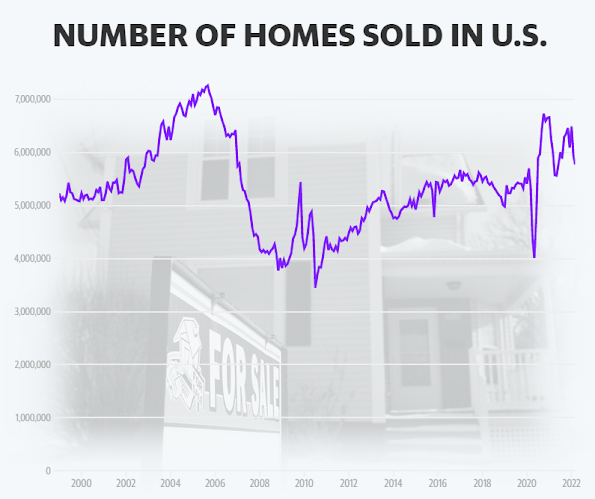
 Here are charts relevant to real estate investment; first is the homes sold chart since 2000:


And here is the chart of VNQ, a Vanguard real-estate ETF, since inception in 2005:


Let's zoom in with the sales chart to year-scale the same as the VNQ one. Bear in mind that the VNQ chart's interval is one month, while the sales chart is sometimes one month but usually two months.


I should be no surprise that VNQ rises or falls in correlation to the volume of sales. But I am far from sure that the market conditions today are ones we have seen before, namely:
  • Continuing high demand,
  • Rising interest rates,
  • High inflation
  • Decreasing supply of homes for sale
Why is the supply decreasing while demand is level? Probably because of millions of homeowners like me. We bought our present home in 2017 with a 3.75 percent mortgage. A year ago we refinanced at significantly less than 3 percent. If we sold our house and bought another one, we'd have a mortgage rate, as of today, of 4.5 percent. If we financed exactly the same amount as remains on our present mortgage, and not one dollar more, the new P&I (only) payment would be $268 more than on our present mortgage, or $3,216 per year. Over, say, a 30-year mortgage that would come to almost $100,000. And with inflation nearing double-digits, would I really want to remove that $3,216 from my disposable income?

What exactly is my - and millions of others' like me - incentive to sell other than from actual necessity? Maybe downsizing could be an answer. Near our house they are building duplex condos for retirees. The starting price for them is about what we paid for our separate house five years ago. Because our house has appreciated 66 percent since we bought it (according to Realtor.com) we could sell our house now and move into a condo, using the equity to pay way down the costs. Problem is, of course, they are significantly smaller and we do not want to downsize so dramatically. 

I suspect, though, that a lot of men and women a few years older than my wife and me will do so. But who knows? As I said, I do not think the market has ever had a combination of sustained demand, rising interest rate, skyrocketing inflation, and decreasing supply of existing homes. Builders cannot keep up for many reasons, one of which is enormously increased costs of materials and labor, and another being supply-chain difficulties that are still not wholly resolved. It is a good time, I think, to be content with what we have. And I think millions of other will think the same thing.

As for VNQ and similar funds, I would expect its chart to continue to mirror the sales chart, unfortunately. 

Update: "Homebuilder confidence falls for fourth straight month -- Sales traffic has declined amid rising prices and interest rates despite low inventory"
"The housing market faces an inflection point as an unexpectedly quick rise in interest rates, rising home prices and escalating material costs have significantly decreased housing affordability conditions, particularly in the crucial entry-level market," said NAHB chief economist Robert Dietz.
Update: And now, just two days after this post, Realtor.com: "Home Prices Have Begun Falling: Here Are the Cities Where They’re Down the Most." Those cities:


Update: A comment on FB at a related post there by a recently-retired homebuilder:
I got out just in time as the cost of building materials is simply insane. One rafter on my last house was almost $100 each. OSB sheathing is almost three times what it was a couple of years ago. People are still building like this is not a problem. Thus existing homes are pricing way up. This last house went for $480k after two days on market with two showings. I have $275k into it three years ago. Sooner or later building material costs will start coming down. At that point, the housing market will implode.


Monday, February 14, 2022

How taxes work


Came across this in my archives. A friend emailed this to me in 2003. It was purportedly by T. Davies, a professor of accounting at the University of South Dakota. I did then confirm, back then, that a man named Tom Davies with accounting credentials taught at the school; whether he was the author of the essay below seems reasonable but not certain. But it is an interesting analogy of the tax systems and tax cuts.

Let's put tax cuts in terms everyone can understand. Suppose that every day, ten men go out for dinner. The bill for all ten comes to $100. If they paid their bill the way we pay our taxes, it would go something like this: The first four men - the poorest - would pay nothing; the fifth would pay $1, the sixth would pay $3, the seventh $7, the eighth $12, the ninth $18, and the tenth man - the richest - would pay $59. That's what they decided to do. The ten men ate dinner in the restaurant every day and seemed quite happy with the arrangement - until one day, the owner threw them a curve (in tax language, a tax cut).

"Since you are all such good customers," he said, "I'm going to reduce the cost of your daily meal by $20." So now dinner for the ten only cost $80.

The group still wanted to pay their bill the way we pay our taxes. So the first four men were unaffected. They would still eat for free. But what about the other six men who actually pay the bill? How could they divvy up the $20 windfall so that everyone would get his "fair share?" The six men realized that $20 divided by six is $3.33. But if they subtracted that from everybody's share, the fifth and sixth man would end up being paid to eat their meal. So the restaurant owner suggested that it would be fair to reduce each man's bill by roughly the same amount and he proceeded to work out the amounts each should pay. And so the fifth man paid nothing, the sixth pitched in $2, and the seventh paid $5, the eighth paid $9, the ninth paid $12, leaving the tenth man with a bill of $52 instead of his earlier $59.

Each of the six was better off than before. And the first four continued to eat for free. But once outside the restaurant, the men began to compare their savings. "I only got a dollar out of the $20," declared the sixth man, but he, (pointing to the tenth) got $7!" "Yeah, that's right," exclaimed the fifth man, "I only saved a dollar too. It's unfair that he got seven times more than me!" "That's true!" shouted the seventh man, why should he get $7 back when I only got $2?" "The wealthy get all the breaks!"

"Wait a minute," yelled the first four men in unison, "We didn't get anything at all. The system exploits the poor!"

The nine men surrounded the tenth and beat him up. The next night he didn't show up for dinner, so the nine sat down and ate without him. But when it came time to pay the bill, they discovered, a little late what was very important. They were fifty-two dollars short of paying the bill!

Imagine that!

And that, boys and girls, journalists and college instructors, is how the tax system works. The people who pay the highest taxes get the most benefit from a tax reduction. Tax them too much, attack them for being wealthy, and they just may not show up at the table anymore. 

After all, no one is obligated to become a millionaire. I remember attending a ministerial conference where at lunch, another pastor sitting across the table from me said that the income-tax rate should be 100 percent of all income, however received, of more than $1 million. I said nothing, but wanted to point out that all that would do is guarantee that no one would make more than $1 million. 

It is a political slogan today that "the rich should pay their fair share." Of course, the politicians saying this never - and I mean never - define what is a fair share except that it always means "more." But here are inconvenient facts

  1. The people who have more income per year than 99 percent of Americans - this makes them the fabled one percent - collectively account for 20 percent of all income earned by all Americans. 

    1. So, if they are to pay their "fair share," would that not mean the one percent would pay 20 percent of all federal income taxes? 

    2. But in fact, the one percent pay 40 percent of all income taxes. 
       
  2. The top 0.1 percent of earners paid 20 percent of all income taxes. That is a greater sum than the bottom 75 percent of all taxpayers. 
     
  3. "It is hard to say that the tax code is rigged in favor of the rich when more than 53 million taxpayers, more than one-third of all taxpayers, have no income tax liability because of the numerous credits and deductions that have been created or expanded in recent decades." And the number of Form 1040 filers who have zero tax to pay has increased from 23.6 percent in 1997 to to more than 34 percent today. 


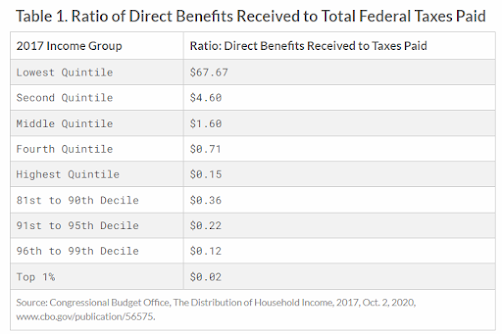
Then there is the question of the value of federal benefits tax filers receive in comparison to the amount of tax they pay. Or, for every $1 a tax payer pays, what is the value of federal benefits received? And here is the answer:

The CBO data indicates that redistribution reduced the incomes of households in the top 1 percent by more than one-third, while lifting the incomes of households in the lowest quintile by 126 percent, those in the second quintile by 46 percent, and those in the middle quintile by 10 percent. Those are the results that you would expect from a highly progressive fiscal system.

I am not saying this is wrong. I am saying that anyone who claims that the rich (which of course, always means "other people") should pay their fair share might want to understand what their share is to begin with. 

BTW, over the years in no few discussions with others about this topic, I have asked the "fair share" proponents whether they thought they, themselves, personally paid too little in taxes. In other words, I challenged them to say whether they were personally paying their fair share. Not one progressive has ever answered that they thought their own tax rate should be increased. It was always other people whom they demanded be taxed more.

Closing thoughts:

In large measure, the federal revenue system is designed to transfer money from the top half to the bottom half. The federal government really is a money-distribution organization. We govern ourselves by the way we spend each others' money. How much gets spent and for what is determined by how much agreement can be reached by a majority. But whether Left or Right, whether Democrat or Republican, the only real questions of American government and governance are, "Who will be be the beneficiaries of government spending? How much shall we exact from the public for it, and by what means?"

During the 1980s, the Grace Commission was formed by President Reagan to examine to where tax revenues disappear inside the great government money maw. The commission reported that none of the money collected by income taxes paid for services. All income-tax revenue serviced the national debt. The commission said that one third of income taxes,

. . . is consumed by waste and inefficiency in the Federal Government as we identified in our survey. Another one-third of all their taxes escapes collection from others as the underground economy blossoms in direct proportion to tax increases and places even more pressure on law abiding taxpayers, promoting still more underground economy - a vicious cycle that must be broken.

With two-thirds of everyone's personal income taxes wasted or not collected, 100 percent of what is collected is absorbed solely by interest on the Federal debt and by Federal Government contributions to transfer payments. In other words, all individual income tax revenues are gone before one nickel is spent on the services which taxpayers expect from their government.

Link to the full text of the report is here.

Saturday, October 16, 2021

Facebook Jail for citing the Bible

 I left the following as a comment on a FB friend's post. He is a somewhat progressive Methodist minister whose post was about how the Bible does or does not inform us on our obligations regarding immigrants illegally entering the United States. (That the same obligations would apply regarding those entering legally is not ever brought up, of course.) 

Below was my sole comment, which FB deleted because it "violated" Facebook's nebulous, never-public and ever-changing "community standards," which means it somehow presented a point of view that FB does not want to permit. 

See what you think. This is the verbatim, unedited comment except that I have deleted the name of the FB friend who posted it, nothing else. 

I am not disagreeing with you. But I am going to point out what a quite progressive pastor of my conference said at a ministers' meeting some years ago, I do not recall the context but I do recall her response. It was, "We are all biblical fundamentalists; it just depends on the topic."

There are definitely teachings, requirements, and admonitions in the Tanak about how the people of Israel were to interact with resident aliens. Should we adopt ALL of them as in force for our modern day and time? For example, there are clear, unambiguous mandates that marriages of Jews to foreigners is strictly prohibited. Can we go all fundamentalist with that today?

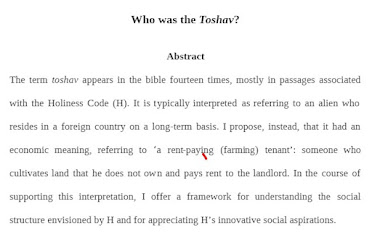
Then there are modern-day Jewish scholars of biblical Hebrew who say that the term "resident alien" is a mistranslation of the Hebrew word "toshav."

And finally, to close this comment, this article: "The Use and Abuse of the Bible in the Immigration Debate."

Here is the link to the article about the toshav by Joram Mayshar  of The Hebrew University, Jerusalem. 

So what exactly are the "community standards" that this violates? What are the biblical-interpretation credentials of the FB "fact checker" who yanked the comment (or more likely, what algorithm of FB's scanning software got triggered)? 

There is no logic or rationality to how or why of Facebook's cancel culture. 

Friday, August 13, 2021

Karl Marx on the fundamental error of the $15 minimum wage

Consider:


What Ms. Cash is saying is that she thinks that the amount of work she does must determine the wage she is paid. But not even Karl Marx thought that! In Capital: A Critique of Political Economy - The Process of Capitalist Production, Marx gave this explanation:

Karl Marx

Some people might think that if the value of a commodity is determined by the quantity of labour spent on it, the more idle and unskilful the labourer, the more valuable would his commodity be, because more time would be required in its production. The labour, however, that forms the substance of value, is homogeneous human labour, expenditure of one uniform labour power. The total labour power of society, which is embodied in the sum total of the values of all commodities produced by that society, counts here as one homogeneous mass of human labour power, composed though it be of innumerable individual units. ... 

... The labour time socially necessary is that required to produce an article under the normal conditions of production, and with the average degree of skill and intensity prevalent at the time. 

[Following is the key point:] 

The introduction of power-looms into England probably reduced by one-half the labour required to weave a given quantity of yarn into cloth. The hand-loom weavers, as a matter of fact, continued to require the same time as before; but for all that, the product of one hour of their labour represented after the change only half an hour's social labour, and consequently fell to one-half its former value.

What Marx was saying is that as efficiencies of production increase per unit of time, the value of the labor of the "old" production correspondingly decreases. When powered looms in England doubled the rate of production, the labor value of the prior manual production decreased by half.  

What Ms. Cash and her allies need to understand is what needs to be be said over and over: the actual, real-world minimum wage is $0.00. 

When she gets a raise to $15 per hour she will not increase her production of product. When McDonalds figures out that her work can be automated - as has already happened with electronic ordering kiosks replacing human order takers - the wage value of her work will go down, not up. And she should not be surprised when her wage then drops to zero because her old job is being done by a smart machine for an amortized "wage" of less than $15 per hour.

Tuesday, April 6, 2021

The White Supremacists who run the MLB


Now we know that the MLB All-Star game, having been canceled in Atlanta, will be played in Denver.
 
I will skip over the fact that Colorado's voting laws are more suppressive of minority voting than the new Ga. law that was the putative cause of the MLB game being yanked from Georgia.
 
To be blunt (and yes, I am serious about this): moving this game is white supremacy in action.
 
Slightly more than half of Atlanta's residents are black. Less than 10 percent of Denver's residents are black. Denver is one of the whitest major cities in the United States.
 
Who will suffer the estimated $100 million loss of revenue in Atlanta? Even Stacy Abrams and the Atlanta Braves organization were clear on that when they urged the MLB not to move the game: thousands of black Atlantans who staff, operate, supply, and retail the game venue itself and all the city's related business operations.

And who will be the new beneficiaries of that largesse? White Denver people, that's who.

So, tell me this: anyone who thinks the move to Denver was not racially motivated needs to explain just what the MLB would have done differently if it had been racially motivated. Anything?

For the record, I do not think it was so motivated. But that is quite irrelevant according to the tenets of Critical Race Theory. Intention does not matter - CRT holds that whites are not even aware of their own intentions regarding race.

The fact is that MLB effectively decided to take enormous revenue away from People of Color in Atlanta and give it to white people in Denver - who are already privileged to begin with simply because they are white.

Welcome to the world of White Woke.

Update: Gerard Baker in the WSJ:
The men who run Major League Baseball, Delta Air Lines, Coca-Cola and other giants have been quick to mouth the required antiphony of the modern liturgy. After long careers in which they seemed happy to let their talents propel them to unimaginable wealth, they’ve now discovered that the society that elevated them was founded in evil.
 
But instead of doing the honorable thing, and stepping down in favor of some less-privileged underling, they demonstrate a commitment to the faith by denouncing others. Here you have the essence of the new faith and morals of the woke classes, the truly privileged people in our society: I’m not to blame, you understand; it’s all those other white folk.


Friday, March 26, 2021

Shutting down the Suez Canal

By now I assume everyone knows that the Suez Canal is closed because of the container ship Ever Given ran aground while transiting:
 
Yep, it is blocked all right!

(The ship is operated by by the Taiwanese shipping line Evergreen, but the vessel is owned by a Japanese company, Shoei Kisen.)  

But the canal's operations were slowed (though not stopped) 10 years ago because the service workers linked to the waterway went on strike. At the time, about 2.1 million barrels per day (MBD) of oil and oil products were trans-shipped through the Canal in both directions. There is also the Sumed pipeline, running from the Red Sea to the Mediterranean coast, that has a capacity of about the same (crude only, though) which can easily pump 1 MBD.

Market speculators say that the canal's closure will cause the spot price of crude oil to rise. That is very possible, and near-certain if the closure lasts more than the two weeks initially estimated. Suez-transit costs are far below costs of sailing all the way around Africa's Cape of Good Hope, but this is mainly because ships' fuel oil ("bunker oil") is priced so high right now.

In 2011, shippers said that bunker fuel oil prices would need to fall to $370 per tonne to make the Africa Cape route economically attractive. It was priced about $100 more. Today, EMEA (Europe, Middle East and Africa) fuel oil prices are ranging between $454-485


Adding to total costs of Suez transit is the added costs of sailing the piracy waters off Somalia, although these risk costs are much lower now than in years past. At present, cost about $10 million more per year for a single Very Large Crude Carrier (VLCC, the second-largest crude-oil tanker afloat) to sail around the Cape rather than the Canal. "Need for rethinking about when to sail around the Cape of Good Hope?" explains the implication of routing through the Canal compared to sailing around Africa. A summary:

1. "... a fully laden VLCC cannot go through the Suez Canal without a partial discharging of cargo to the Sumed Pipeline at Ain Sukhna Terminal in the Rea Sea before picking up an equivalent shipment at Sidi Kerir Terminal on the Mediterranean Coast." The reason for the stop is that the Canal has a maximum depth of 66 feet; VLCCs cannot transit the Canal fully laden. And the offload/onload stops costs money.

2. "One important issue that has changed the picture dramatically is the potential repercussions for ship owners of the executive order issued by US President Obama." The order is still in effect. It is called, "Executive Order Blocking Property of Certain Persons Contributing to the Conflict in Somalia." For shippers, the order lay additional compliance requirements before they can deal with pirates who capture a vessel and/or crew. For example,
... the shipping company whose vessel is captured off of the coast of Somalia, in addition to determining whether to negotiate with the pirates, will also have to determine whether any sanctioned pirates are involved anywhere in the chain of events. Out of an abundance of caution, one would expect that a U.S.-based shipping company would presume an SDN is involved and would work with his insurance company and its financial institution to obtain the necessary authorization from OFAC before dealing with the pirates. One also would expect that OFAC will institute expedited licensing procedures to reflect the danger and urgency of pirate hostage-taking situations. Where a non-U.S. shipper is a victim of piracy but a U.S. insurer, reinsurer or financial institution is involved, the compliance burden is likely to shift to those parties.
Passage into out out of the Suez Canal in the south unavoidably entails sailing through piracy waters. The executive order raises compliance costs of the risk, though in a rather fuzzy way. However, these costs are part of the total costs of Canal passage, which are also affected by:

3. Bunker fuel oil prices, as discussed, plus daily charter rates and ship values for container vessels in relation to totals shipping costs of Suez transit.  
What matters the most in the cost calculations?

For a liner company it is primarily a question of higher bunker expenses due to the large consumption of fuel oil for the very powerful engine, while a tanker company primarily is concerned with the added capacity costs even though the fuel consumption also plays a significant part.
4. Comparing costs of the Canal versus around Africa:
The costs incurred from going round the Cape is related to the extra fuel consumption but also to the extra capacity required and related insurance premium increase in order to lift the same quantum of cargo in the same amount of time. Conversely, the costs incurred in going through the Suez Canal consist of canal tolls, extra insurance risk premium and the use of services such as tugs, pilotage and mooring. 
Bunker fuel today is about the same price as 10 years ago. But freight markets are low because of the pandemic. This makes the Canal option much less costly than sailing around the Cape. If bunker fuel's price drops below $370 per tonne, the Cape route becomes more economical even though much longer. But no one is forecasting that. 

The bottom line is, well, the bottom line. Costs of Canal transit would have to increase very sharply to make the Cape route more economical for crude and container ships. For example, piracy insurance premiums would have to more than quadruple.

One month ago, before the Ever Given problem, container ship charter prices reached a 13-year high of more than $21,000 per day for a one-year term, reaching into the $30s for a three-year term. There was already a shortage of shipping containers driving costs up, and now the Ever Given's capacity of 20,000 twenty-foot equivalent units (TEUs) is stuck going nowhere. However, there are a large number of other container vessels sitting dead in the water in Suez approaches on both ends of the canal. They and their container capacities are off the market also. 

The depressed oil markets because of Covid drove down VLCC charters costs to about that of container ships. However, VLCCs are much more fuel efficient than container ships, so total daily costs from all sources have to be compared. Dry bulk vessels have an altogether different calculation since they are chartered for each voyage, so total revenue weighs more heavily than costs, per se.

Here is a handy Excel calculator of comparative costs of sailing the Cape or the Canal that informs just how complex and assumptive the decision can be - click here.

My assessment:

Oil spot market prices will rise not long from now (they are up today) because of the blockage. Even when the blockage occurred, oil prices fell, but that was because EU countries had just announced stricter pandemic-lockdown-type measures, depressing economic activity forecasts. 

For those who are adventurous enough, buying "long" oil ETFs such as USO may pay off. (I am not so buying, however.) 

Related:

-- a primer on the world's oil-transit choke points.


Bookmark and Share

Sunday, January 24, 2021

The coming markets crash - and then what?

This is a compendium of emails exchanges I had with someone I have known very well for decades, and whose opinions and counsels I trust. It began when I sent him this:

The author, Sarah Kang, whom I do not know, is a certified financial planner. This piece came up on my news feed, so I thought I'd send it to you. I argue neither for or against her conclusion, but what do you think?

https://uakdiversified.com/blogs/f/stock-market-crash-probability-%E2%80%93-financial-advice-from-sarah-uj

The article is dated Jan. 13. It begins well enough:

With the political landscape picture becoming clearer going into 2021, it appears that two things are likely to happen.  The Democrat party now has power to implement its own fiscal policies. Most likely, more economic stimulation from the government and the Federal Reserve. Unlike the Republican party, the Democratic party has little to no resistance within the party to expanding government programs and providing monetary stimulus for the economy.  This means that stocks may push higher due to inflationary forces as the value of money declines steadily.

Of course, rising inflation means that any rising value of equity holdings are diminished accordingly. Her conclusion?

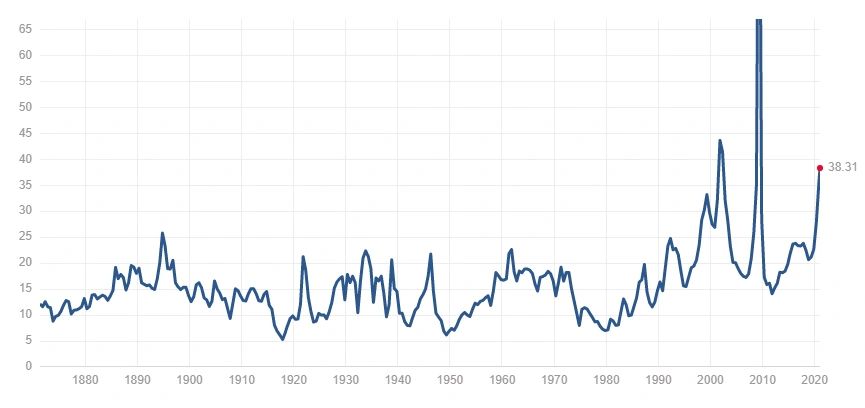
The above chart shows the short term-based PE ratio, a variation of the Shiller PE ratio.  It shows a rapid bubble formation is happening right now that matches the recent stock market crashes of 2000 and 2008.

In fact, it is very possible that the stock market may climb higher for the next several months fueled by cash injections from the government and the Fed. However, from a prudent trade off perspective, it is going to require taking on too much risk to try to cash in with this short-term outlook. 

Consider me the unpopular ski patrol who tells young “GoPro” kind of skiers not to go up on the peak of the mountain right after a big blizzard.  It won’t be a popular advice until after an avalanche happens. 

Looking 1~4 years ahead, the unconstrained money printing will lead to inflationary pressure along with a declining dollar value. This anticipation leads me to tweak existing investment portfolios to have a bit more position in high-quality foreign bonds, commodities, and carefully selected real estate investment trusts in lieu of long-term bonds. 

My correspondent replied:

Facts are facts.  The question is how to interpret them.  The data shown compared to 1929, 2000, and 2008 are true.  I think we are truly in uncharted waters with the government stimulus exceeding $5 trillion if Biden's $1.9 trillion package passes.  It may not.  There are for sure many stocks that are in a bubble where cash flow and earnings can't support the stock price -- pretty much all of those that had outsized gains in the past year (greater than 150%, maybe less in many examples).  They will take a dive when interest rates rise, the vaccine gets delayed, earnings or revenue, for those that don't have earnings, a signal right there, don't meet expectations, or employment doesn't come back as fast as it is forecast.

I think there are quite a few stocks that are not in a bubble.  That doesn't mean they can't go down in sympathy when the bubbles do burst but they will drop less and may be what people buy when they bail out of the bubble stocks. I am looking for more established companies that have reasonable growth prospects or that pay a good dividend, ideally both. 

My reply was this: 

I think we have been in uncharted waters since federal debt exceeded the nation's GDP years ago. Ten years ago I wrote about the "crush depth of debt" and I think we have been living on borrowed time (and money) since then. Like you, I have been transitioning more and more into established equities - in my case, away from individual stocks and into ETFs and mutual funds, including one or two that are losing money in a rising market, but give me a hedge. 
 
I also wonder at what point the degradation of American politics will begin to significantly affect the markets. The Democrat House, despite losing seats, is more determined than ever to crush "domestic terrorists," which of course really means anyone who opposes the Biden-Harris agenda. I may as well go on the record now: 2020 was the final national election of the United States as we have known it. No matter how the 2022 mid-terms turn out, the America of 2024 will be politically, formally fragmented. 
 
Just last October, more than half of Americans polled said they "believe the country is 'on the verge' of a second civil war." This did not come out of nowhere, that number has been rising for a number of years. Georgetown University’s Institute of Politics and Public Service polled the same question the same month and found that, "Partisan political division and the resulting incivility has reached a low in America, with 67% believing that the nation is nearing civil war... ." I do not myself predict an army-against-army conflict like 1861-1865, but I do forecast significant violence after the 2022 elections, no matter which party prevails, that will lead to some states seceding in polity if not in fact. 

Care to guess what that will mean for markets?
 
The only thing between now and then that might tamp down this rising probability down is that the one thing Democrats will never stand for is open defiance to their agenda. On inauguration day, Leftist anarchists violently rioted in Portland, Ore., against the Biden administration. The feds dispersed the rioters with tear gas and violence of their own. (Just imagine Dems' reactions if it had been Trump re-elected and the same thing was done.) Remember that in 1945, Stalin ordered the execution of German communists within his zone of occupation because once in power, Leftists will never accept competition, even from ideological allies. I do not think that Antifa will have an easy time for during the next two years, although they will never be named as "domestic terrorists" like almost all significant conservative organizations will be. 
 
So maybe investing more in international equities would be a good idea? Gold and/silver funds? As American continues fragmenting, I do not think that dollar-backed equities are going to do well. 

Monday, May 11, 2020

The white privilege of the Covid-19 shutdown

This was posted on Facebook recently:


I am almost at a loss for words at how genuinely moronic this is, and how cruel it really is. Almost.

So let's talk about "privilege:" 

Who is it that is insistently calling for the lockdowns to continue no matter the costs in actual lives taken by the shutdowns themselves, estimated, says CBS News, to range from 75,000 to 150,000?

Who is it that dismisses well-reasoned and dispassionate calls to reopen the economy so that lives are not shattered, families no longer suffer deprivation, and the elderly are not abandoned?

Who is it that dismisses the documented forecasts that continuing the shutdowns will devastate rural medical facilities and quality of health care of rural Americans?

It is college-degreed white men and women who are financially secure, and who do not themselves think for a moment about how to pay for their next grocery trip or whether they will ever regain employment even approximating what they had before they were laid off.

It is college-degreed white men and women who think that the masses leave their homes merely to get haircuts or go shopping or - as one left-wing friend of mine posted on Facebook - to go bowling.

Minorities and lower-income Americans are being literally killed by the shutdown and their lives are being broken (NPR: "Why The Government Shutdown Has A Disproportionate Effect On African-Americans" and Center for American Progress, "The Impact of the Government Shutdown on People of Color").

But at least no one is turning a fire hose on them, so all is well! (But let us ignore for the meme's sake the political party of the men who turned the hoses on the marchers or loosed the dogs.)

So college-degreed, financially secure, upper-middle class and up white people simply, comfortably dismiss both the non-white and white unwashed, uneducated, poor deplorable-classes as mere untermenschen who have no idea how good they actually have it.

As for black Americans, what this meme really says to them is, "Shut up about how we have thrown you back into poverty and want. It is more important for us to feel safe! We are not attacking you with dogs any more, so what's your beef?"

Memes like this are frankly the most stunning examples of white privilege that I have seen in a long time. I will go further: to post this marks one as an actual white supremacist. 


Updates as they come in: 

'Our life is in danger': Unemployment hits 34% in Hawaii with no end in sight

Yep:

WSJ: Medical Lockdown Will Cause a Disease Surge -- Patients who are sick with conditions other than Covid-19 aren’t seeking screening and treatment.


Monday, April 20, 2020

Deliberately inflating the Covid count - why?

Consider this FB post, which I have personally verified (I deleted the person's name).

Now, why is that the rule? Having been a federal bureaucrat, I will say (in my view, authoritatively) that the reason is simple: money.

Understand that this listing decision was not originated by physicians or nurses, but by administrators. And the overwhelming desire of every bureaucratic administrator everywhere is this: Increase his/her department's budget.  Because bureaucrats get promoted by showing they can manage ever-larger budgets, not for managing programs or people.

Medical bureaucrats know very well that C19-related, enormous streams of money are already flowing from federal spigots and will continue to do so for months or even years to come. And the amount any operation or agency will get will relate very directly to the number of C19 cases they report, especially the fatalities.

If you think this sounds cynical, I assure you: It is far from cynical enough.

And the beat goes on:
The Big Apple’s new death toll is 10,367. That figures combines the 6,589 victims who tested positive for the virus plus another 3,778  who were never tested, but whose death certificates list the cause of death as “COVID-19 or an equivalent,” according to city Health Department data from March 11 through April 13.
Italics mine, to illuminate what is being done here. What exactly is an "equivalent" cause of death to C19? Why, something that killed them, duh. You know, like lung cancer.

I said on my FB page, "First, let’s kill the children."
 Serious question: How many people are we willing to kill to stop people from dying of Covid-19?  
More specifically: How many children are we willing to kill to do it? Read this and weep:
"Hundreds of thousands of children could die this year due to the global economic downturn sparked by the coronavirus pandemic and tens of millions more could fall into extreme poverty as a result of the crisis, the United Nations warned on Thursday. ...

But the U.N. report warned that “economic hardship experienced by families as a result of the global economic downturn could result in an hundreds of thousands of additional child deaths in 2020, reversing the last 2 to 3 years of progress in reducing infant mortality within a single year.”
The full report is here, including the shocking nugget that 368 million children across 143 countries rely on school lunches as a source of nutrition, and,
"Hastily implemented lockdown measures risk disrupting food supply chains and local food markets,” which “pose potentially grave consequences for food security.”
Do you remember when, "Let's do it for the children!" was a rallying cry? Yeah, me, neither.

However, the sanguinary calculus is real: If we do not do lockdown/distancing by shutting down the economy, people will die. And if we do lockdown/distancing by shutting down the economy, people will still die - and the UN says that "hundreds of thousands" of them will be children. But as Roger Kimball explains,
We have often been presented with a false dichotomy between saving the economy and saving lives. This is a false dichotomy because, as Geach points out, “the state of our economy is not just a monetary risk, it is a health risk.” For one thing, “when people lose their jobs, they typically lose their health insurance.” He notes that there were more than 10,000 “economic suicides” as a result of the 2008 recession. There is also a spike in cancer deaths, drug abuse, domestic violence, and other pathologies.
This is not a guess, it is fact:
Every 1% hike in the unemployment rate will likely produce a 3.3% increase in drug overdose deaths and a 0.99% increase in suicides according to data provided by the National Bureau of Economic Research and the medical journal Lancet. These are facts based on experience, not models. If unemployment hits 32%, some 77,000 Americans are likely to die from suicide and drug overdoses as a result of layoffs. Scientists call these fatalities deaths of despair.
There are protests around the country against long-continuing the restrictions from now. I frankly would be far more impressed with the protesters if they would leave their guns and flags at home and at least substantively acknowledge that the C19 threat is real.

But lockdown absolutists need to under stand this: More than 22 million Americans have become unemployed in the last month. The longer we are told to stay "safe at home" instead of going back to work, the less safe homes will become because of the despair and depressions that unavoidably will manifest. More people will kill themselves or a family member, more spouses and children will suffer abuse and injury, more alcoholics will be made, more people will suffer fatal non-Covid illnesses, more drug addicts will be made - that list goes on and on.

To be clear: 
I am not saying that the lockdown and distancing measures should not have been imposed. I am saying as clearly as I can that the time will come when continuing them will become more costly and lethal than lifting them. 

It is long past the time when we must stop having a false debate about the lockdown.
"At some point," [Princeton bioethicist] Peter Singer says, "we are willing to trade off loss of life against loss of quality of life. No government puts every dollar it spends into saving lives. And we can't really keep everything locked down until there won't be any more deaths.

We need to think about this in the context of the well-being of the community as a whole….We are currently impoverishing the economy, which means we are reducing our capacity in the long term to provide exactly those things that people are talking about that we need—better health care services, better social-security arrangements to make sure that people aren't in poverty. There are victims in the future, after the pandemic, who will bear these costs. The economic costs we incur now will spill over, in terms of loss of lives, loss of quality of life, and loss of well-being.

I think that we're losing sight of the extent to which that's already happening. And we need to really consider that tradeoff.
 The "false debate," in other words, is not the discussion that considers the enormous human cost of suppressing economic activity. It's the discussion that pretends there is no such tradeoff. 
If lockdowns are not substantially lifted much past the middle of May, I predict very large numbers of the American people will start concluding that the real point of these restrictions is not the health of Americans at all, but something politically sinister. And no podium appearances by Dr. Fauci or Dr. Birx is going to persuade them otherwise.

Monday, March 23, 2020

The coming crash and what it portends

If we continue on the present course, we will enter a depression that might make the 1930s a distant competitor. The number of jobless Americans could reach tens of millions.


WSJ: Rethinking the Coronavirus Shutdown:
Yet the costs of this national shutdown are growing by the hour, and we don’t mean federal spending. We mean a tsunami of economic destruction that will cause tens of millions to lose their jobs as commerce and production simply cease. Many large companies can withstand a few weeks without revenue but that isn’t true of millions of small and mid-sized firms. ...

The deadweight loss in production will be profound and take years to rebuild. In a normal recession the U.S. loses about 5% of national output over the course of a year or so. In this case we may lose that much, or twice as much, in a month.

Our friend Ed Hyman, the Wall Street economist, on Thursday adjusted his estimate for the second quarter to an annual rate loss in GDP of minus-20%. Treasury Secretary Steven Mnuchin’s assertion on Fox Business Thursday that the economy will power through all this is happy talk if this continues for much longer.
This is the first time ever that the US Government has deliberately shut the economy down, and the idea that it can just be turned back on like flipping a switch is delusional.

Consider: We will never be able to determine how many lives were saved from the virus. But we will easily know how many people died because of the economic crash to come - just count increased suicides and even some homicides, to say nothing of untold numbers of people thrown into permanent poverty.

The lockdowns and stay-at-home orders are saving lives now. But if they continue much longer, they will cost lives later and cause economic, literal suffering for years and years to come.

Also, The Atlantic, "Suicide and the Economy."
On April 12, 1937, the express train to New York roared across the New Jersey countryside. The train, a Pennsy Railroad electric locomotive the color of bull’s blood, usually passed through the station at Elizabeth at about 50 miles per hour. On this particular morning, it came to an unanticipated stop. As the express rounded the curve, my great-grandfather jumped down from the platform, where witnesses reported he had been pacing for 10 minutes, and lay down across the tracks.

When the engineer was finally able to halt the train 100 feet past the platform, Roy Humphrey had disappeared beneath its wheels. His last act: raising his head to look at the oncoming train.

Roy was one of at least 40,000 Americans who took their own lives that year and the next, the two-year span that suicide rate spiked to its highest recorded level ever: more than 150 per 1 million annually. 
Related: Why we cannot afford 99-cent gasoline.

Update:

"US unemployment could surge to 30% next quarter and GDP might plunge 50%, Fed's Bullard warns"

Also relevant: "The luxury of apocalypticism -- The elites want us to panic about Covid-19 – we must absolutely refuse to do so."

The point is, there is such a thing as doing too little and also such a thing as doing too much. Doing too little against Covid-19 would be perverse and nihilistic. Society ought to devote a huge amount of resources, even if they must be commandeered from the private sector, to the protection of human life. But doing too much, or acting under the pressure to act rather than under the aim of coherently fighting disease and protecting people’s livelihoods, is potentially destructive, too. People need jobs, security, meaning, connection. They need a sense of worth, a sense of social solidarity, a sense of belonging. To threaten those things as part of a performative ‘war’ against what ought to be treated as a health challenge rather than as an End Times event would be self-defeating and utterly antithetical to the broader aim of protecting our societies from this novel new threat. To decimate the stuff of human life in the name of saving human life is a questionable moral approach.
And why cheap gasoline is unaffordable.

Tuesday, March 3, 2020

Is health care a human right? No.

I first wrote this in 2009, but it seems relevant to today as well; I have updated it.

Is health care a human right, as the United Methodist Church says? I don't see how. Human rights, as Americans have always understood them (beginning with Thomas Jefferson and the other Founders) are a fact of nature that cannot be rescinded by human beings. Rights are immutable, indeed, unalienable ("Not to be separated, given away, or taken away" Dictionary.com, as Jefferson wrote in the Declaration of Independence.)  As a precursor to his Declaration theology that unalienable human rights are a endowment by God, Jefferson wrote in his pre-revolution essay, Summary View of the Rights of British America, " The God who gave us life gave us liberty at the same time. The hand of force may disjoin, but cannot destroy them."

Since his day, and certainly preceding it, the historic American understanding of human rights is the
exercise of individual freedom, especially in the political realm, for both public and personal good. We have historically never understood our rights as encompassing access to services or commodities.

Rights are inherent in each individual equally, they are not divisible. Take the Declaration's famous insistence that among human rights is "the pursuit of happiness." Note that it is the
pursuit of happiness that is a right, not the achievement of it. Nor is one person more entitled to pursue happiness than another, no matter one’s station in life. Besides, happiness (what Jefferson meant was not happiness as we use the word today, but a state of contentment in life and possessions) is not something that can be given us, it is something we have to create.

It does sound all high-minded to say that, like rights, health care should be equal for everybody, which I suppose is why clergy are so susceptible to say so. It's more than obvious that no one in the Congress or the White House believed it in 2009 when Obamacare was enacted. If they had, the act would have required members of Congress and the rest of the federal government to fall under the "public option" along with the rest of us proles. But they’
ve protected their turf completely and much better turf is theirs than ours. I’ll believe that equal access and care for everyone is a moral imperative when the people who say it is a moral imperative place themselves under the same imperative.

The presumption that health care is a right, and therefore must be equal for everyone, is founded on two critical errors of understanding. The first is that health care is a resource that is simply available for those who need it, or that can be made equally available through proper legislation and regulation. The second error is that medical care and access to it can be rationed by command more equally, economically and fairly than by demand.


Health care is not a resource to be exploited

Medical facilities and doctors are not phenomena of nature, like water or petroleum are. Hospitals don’t just appear. They are produced. Medical care is not a resource that can be "mined" through more regulation to be more plentiful. Medical care is a
service


Specifically, it is a contracted service, in much the same way that legal assistance, automotive maintenance or pastoral care are services. Why? Because men and women choose of their own accord to get medical training. Once graduated, doctors, nurses, paramedics and technicians of various kinds reasonably expect that they will be compensated at a rate greater than their costs to enter the profession, greater than their extremely high overhead to run the practice, and enough to make their grueling hours materially worthwhile for themselves and their families.

This fact has very direct consequences under the Medicare and Medicaid systems we have today.
The Atlantic's business journalist Meg McArdle explains:

[W]e have a comprehensive national health care plan for seniors. Yet we have a shortage of geriatricians, the one specialty that you would think would be booming. Why? Because Medicare sets a single price for the services of geriatricians, and it is low. Since the field is not particularly enticing (though arguably it really should be, since geriatricians have extremely high job satisfaction compared to many more popular specialties), very few people go into it. It's one of relatively few specialties that consistently has most of its slots and fellowships unfilled.
Moreover, the skills and equipment a doctor or hospital possess are their individual property, not the property, even partially, of the state or public. (There are publicly-owned facilities such as VA hospitals, but in operation there is no difference to the general public between them and private facilities). No one has a natural right to someone else's property. To think we do directly violates the Tenth Commandment. As McArdle says, "People have no obligation to perform labor for others. I may not [justly or legally] force a surgeon to save my mother at gunpoint."

That means that to receive a doctor's services, the doctor and a patient must come to a mutually-agreeable arrangement of what medical care will be provided in exchange for a specified fee. This is a commercial transaction no different in type than hiring a plumber, cab driver or lawyer. That medical services may be life critical does not change the fundamental nature of the contract.

We have access to medical care only as long as a doctor is willing to provide it. No one has to become a doctor or continue in medical practice. If any "reform" of the present health care system reduces the rewards of practicing medicine or complicates the practice, fewer men and women will so choose. Access will then go down for everyone and costs will inevitably rise, no matter what the rate-payment of the public option is, because access or its lack is itself a cost and also drives other costs.


Health care is a service

As
Michael Keehn explains, health care is a service but not a community service. Police and fire departments provide community services. That seems obvious enough, but consider: fire departments do not protect your home individually. The fire chief definitely will let it burn to the ground if firefighting needs are greater elsewhere in the town. Just look at what is happening near Los Angeles as of the date of this post. Police and fire protection are in fact rationed to protect the lives and property of the greatest number of people possible with the resources available. But when the resources (manpower, equipment or money) run out, individuals are exposed to greater danger or loss though the community at large may still be protected.

Individual residents of a city do not contract for their community’s police or fire protection. When you call 9-1-1 because someone broke into your home while you were in bed, you don’t have to sign a contract with the police when they arrive, specifying the actions you want them to take and how much you are going to pay.

In contrast, medical care is an individual service. Doctors do not provide their services to the community as a whole, but to individuals. Because of that, each patient enters into a contract with his/her doctor specifying the medical services to be received and how much it will cost. This is mostly mediated through insurance companies, of course, which greatly simplifies the contracting process. The result is that a patient 's health is protected in a way that their safety or homes are not protected by the police or fire departments.

Interestingly, the Roman Catholic Church rejects the idea that health care is a human right. The Most Reverend R. Walker
Nickless, bishop of the Diocese of Sioux City, Iowa, explains.

[T]he Catholic Church does not teach that “health care” as such, without distinction, is a natural right.

The “natural right” of health care is the divine bounty of food, water, and air without which all of us quickly die. This bounty comes from God directly. None of us own it, and none of us can morally withhold it from others. The remainder of health care is a political, not a natural, right, because it comes from our human efforts, creativity, and compassion.
Like any human endeavor, health care is finite. It can be properly understood only as such. Any reform that treats medical care as if it can be made infinitely available is a product of cloud-cuckoo land. Medical care, like every other finite thing, must be allocated. The current buzzword for that is "rationed." That’s the foundation of the second critical mistake people are making about health care, that medical care and access to it can be rationed by the government more equally, economically and fairly than by consumers. 

Philip Barlow, Consultant neurosurgeon at Southern General Hospital, Glasgow, explains why "Health care is not a human right." 

Update, March 2020: In 2009. Philip Niles wrote that the real question is not whether health care is a human right, but "How much health care is a human right?" His essay is no no longer online. It is a good question because since medical care is finite. He says, 
With all of the emotional and financial investment in health care, it is important to address the situation with an actionable approach - not an ideologic one.  My suggestion is to quantify just HOW MUCH health care we believe is "right" to provide, recognize that we should cap public health care spending, and focus the moral/fiscal debate on how high that cap should be set.  Let's achieve our ambitions of providing access for the uninsured with the most likely way of succeeding: by haggling about the price.
There is always a price to be paid, one way or another. What politicians seeking votes seem to do is ignore that price (paid by the consumer) and cost (borne by the provider) are not the same. When a political candidate promises free health care for everyone, they conveniently ignore that free care is simply, literally impossible. 

Look at it this way: as I write, we are in the midst of the coronavirus concerns, with a few thousand died from it worldwide and several in the US, where cases are rising. Now imagine you are a government-employee administrator for Medicare For All the next time such a potential pandemic arises -- and most assuredly there will be a next time. 


You have to choose between funding two heart-replacement surgeries plus rehab routines or funding the testing of 50,000 potential virus infectees for the illness. You do not have the funds to do both. 


Which do you choose? Why? And what do you respond when the untreated persons demand it anyway because it is a human right? 


There is always this question: Who pays and in what coin? One candidate this year had either the temerity (or carelessness) to tell his audience the day before the S.C. primary, "Your taxes are going to be raised" to pay for Medicare For All. How much will taxes be raised? He did not say, but presumably they will raised an amount corresponding to the cost of providing the medical care to the population. In other words, everyone will still pay an insurance premium now called taxes, and the tax rate will never go anywhere but up. Why? Because every other nation with "free" health care finds it over-utilized and under-resourced. 


Take Canada, for example, which many politicos say can be a model for us. In reality ...
... Canadians' out-of-pocket health costs are nearly identical to what Americans pay—a difference of roughly $15 per month. In return, Canadians pay up to 50% more in taxes than Americans, with government health costs alone accounting for $9,000 in additional taxes per year. This comes to roughly $50 in additional taxes per dollar saved in out-of-pocket costs.  Keep in mind these are only the beginning of the financial hit from "Medicare for All." 
Canada's public system does not cover many large health costs, from pharmaceuticals to nursing homes to dental and vision. As a result, public health spending in Canada accounts for only 70% of total health spending. In contrast, Medicare for All proposals promise 100% coverage. This suggests the financial burdens on Americans, and distortions to care, would be far greater than what Canadians already suffer. ...  
More serious than the financial burdens is what happens to quality of care in a government-run system. Canada's total health costs are about one-third cheaper than the U.S. as a percent of GDP, but this is achieved by undesirable cost-control practices. For example, care is ruthlessly rationed, with waiting lists running into months or years. The system also cuts corners by using older and cheaper drugs and skimping on modern equipment. Canada today has fewer MRI units per capita than Turkey or Latvia. 
Moreover, underinvestment in facilities and staff has reached the point where Canadians are being treated in hospital hallways. Predictably, Canada's emergency rooms are packed. In the province of Quebec, wait-times average over four hours, leading many patients to just give up, go home and hope for the best.
The piper must always be paid. And so it shall be for us, but both in currency and in other than money. Medical care is always rationed. Always. And the rationing takes place within three areas:
  1. Price to the consumer, presently mediated through 
    1. insurance premiums and co-pays, and
    2. Medicare and co-pays and Medicaid.
    3. Under MFA, those will be taxes and HHS.
       
  2. Quality of the care provided, mediated through 
    1. the training of the physicians, nurses, and other medical staff
    2. the quality and availability of medical supplies and equipment.
    3. costs of the providers as related to price to the consumers.
       
  3. Availability of the care, mediated 
    1. always through the number of practitioners and where they work, and that is almost always mediated through compensation,
    2. and by what medical specialties they practice, noting that this is heavily related to compensation also (see Megan McArdles' observation above). 
    3. by limiting or even eliminating medical for some demographics, say by age, as now-suspended presidential candidate Mike Bloomberg said explicitly.
What we are falling into in this debate is the "Do something!" fallacy: 
  1. The status quo is deficient, so something must be done!
  2. This is something.
  3. Therefore, this must be done. 
Absolutely anything can be justified by that template - and is being justified. But remember: medical care is always rationed, either by price and cost, or by quality, or by availability. When we go to the polls in November, we will not be voting for free health care for everyone. We will be voting only for how we want health care rationed in the coming years, and we will be merely hoping without any evidence anywhere in the world that it will be better than what we have now. 


Here is The New York Times in 2009: "Why We Must Ration Health Care."
Health care is a scarce resource, and all scarce resources are rationed in one way or another. In the United States, most health care is privately financed, and so most rationing is by price: you get what you, or your employer, can afford to insure you for. But our current system of employer-financed health insurance exists only because the federal government encouraged it by making the premiums tax deductible. That is, in effect, a more than $200 billion government subsidy for health care. In the public sector, primarily Medicare, Medicaid and hospital emergency rooms, health care is rationed by long waits, high patient copayment requirements, low payments to doctors that discourage some from serving public patients and limits on payments to hospitals.

The case for explicit health care rationing in the United States starts with the difficulty of thinking of any other way in which we can continue to provide adequate health care to people on Medicaid and Medicare, let alone extend coverage to those who do not now have it.


This is not where are now except for the VA. Which should tell us something.

Forbes covered the way health care works (well, doesn't work) in Britain: "Britain's Version Of 'Medicare For All' Is Struggling With Long Waits For Care."


Consider how long it takes to get care at the emergency room in Britain. Government data show that hospitals in England only saw 84.2% of patients within four hours in February. That's well below the country's goal of treating 95% of patients within four hours -- a target the NHS hasn't hit since 2015. Now, instead of cutting wait times, the NHS is looking to scrap the goal. ...  
The NHS also routinely denies patients access to treatment. More than half of NHS Clinical Commissioning Groups, which plan and commission health services within their local regions, are rationing cataract surgery. They call it a procedure of "limited clinical value." It's hard to see how a surgery that can prevent blindness is of limited clinical value. Delaying surgery can cause patients' vision to worsen -- and thus put them at risk of falls or being unable to conduct basic daily activities.  
"It's shocking that access to this life-changing surgery is being unnecessarily restricted," said Helen Lee, a health policy manager at the Royal National Institute of Blind People.  
Many Clinical Commissioning Groups are also rationing hip and knee replacements, glucose monitors for diabetes patients, and hernia surgery by placing the same "limited clinical value" label on them. Patients face long wait times and rationing of care in part because the NHS can't attract nearly enough medical professionals to meet demand. At the end of 2018, more than 39,000 nursing spots were unfilled. That's a vacancy rate of more than 10%. Among medical staff, nearly 9,000 posts were unoccupied.
Update, April 2022: Britain's National Health Care "care backlog grows to record high of 6.2 million" (HT: Guy de Boer).

But don't worry. We will be promised that it will different here. But there is zero reason to believe that American politicians and bureaucrats are magically more generous, more compassionate or smarter than Britain's. 


Or for that matter, Canada's, where the government determines medical care, and so uses that power to favor selected constituencies. In Canada, rare but expensive medical treatments go grossly underfunded while the government spends enormous sums on cheap treatments and meds that vast numbers of voters use. Like this:
A girl who died of leukemia was given a final send off after her friends signed her casket with loving messages on January 30.  
[…]Laura might have experienced a few more milestones if a Hamilton, Ontario, Canada, hospital had been able to accommodate a bone marrow transplant for the young woman. Numerous donors were a match with Laura and ready to donate, but Hamilton’s Juravinski Hospital didn’t have enough beds in high-air-pressure rooms for the procedure. Hospital staff told her they had about 30 patients with potential donors, but the means to only do about five transplants a month.  
[…]Dr. Ralph Meyer, Juravinski’s vice-president of oncology and palliative care, told Ontario’s TheStar.com there are plenty of others facing the same situation as Laura in Canada.
Free birth control immediately? Check. Free needles to inject illegal narcotics? Check. Free condoms? Check. Free abortions on demand? Check. Life-saving operation for a single leukemia patient? Not a chance. Leukemia patients are too few to form a voting block, so let 'em die. 

Then there is the Catholic-run hospice in Canada that the government is requiring closure because it refuses to kill its patients
A hospice in Canada has lost its funding and is being forced to close after refusing to offer and perform medically assisted suicides. The Irene Thomas Hospice in Delta, British Columbia, will lose $1.5 million in funding and will no longer be permitted to operate as a hospice as of February 25, 2021. 
Fraser Health Authority, one of the six public health care authorities in the province, announced on Tuesday that it would be ending its relationship with the hospice over its refusal to provide medically assisted deaths to its patients.
Anyone who thinks that none of this can happen under Medicare For All is living on a different planet than the rest of us. 

When Jesus forced the issue

The eleventh chapter of the Gospel of John begins with Jesus learning that his friend, Lazarus of Bethany, had fallen ill. Despite the news,...