Showing posts with label History. Show all posts

Thursday, July 23, 2026

A world without nuclear weapons - what would it look like?

 From Pope Leo this week, according to the National Catholic Reporter: "Pope Leo quotes Bob Dylan song in book foreword calling for nuclear disarmament."

Pope Leo XIV said the conscience of just one person can "be worth the entire world" when it comes to preventing a nuclear catastrophe, in a new book foreword that also quotes an unpublished Bob Dylan song about the atomic bomb.

The pope made the remarks in a foreword published July 21 for a forthcoming book, "Disarmed and Disarming: Peace Is a Gift," which the Vatican Publishing House says will soon be released in English. 

In the essay, Leo cited lyrics from an unpublished 1963 song by Bob Dylan, "Go Away You Bomb," and he praised the pacifist Servant of God Dorothy Day as an example of someone who worked for peace.

"Above all in the atomic era, the affirmation of the truth must push through: it is not atomic weapons that generate peace, but disarmament," the pope wrote.

I am not sure why quoting Bob Dylan is a headline news item for the National Catholic Reporter, but there you are. Pope Leo broke no new ground for the papacy here, taking the same position that prior Popes have taken. 

I make no criticism of the Pope for this. I was trained in my military career as a nuclear target analyst and in two assignments I was directly in the chain of command had orders for use of nukes come down. So how do I feel about nukes?

Well, I hate the damn things!

That said, however, I think that total nuclear disarmament worldwide would not be the panacea that  its proponents seem to dream. What would a nuclear-weapons-free world look like? I suspect that disarmament advocates think it would look like this:


But we already know what a nuclear-free world looks like.

It looks like this.


From the first world war to the second was only 25 years. World War II ended almost immediately after the first (and thankfully only) use of atomic weapons. It's been 81 years since the end of the second world war. There has been no third world war. I don't mean that the past eight decades have been unicorns and rainbows, but can you imagine what a third world war might have been like even if fought with only conventional weapons?


Sunday, January 11, 2026

Has Iran reached its pivot point?

I am adding updates at the end.

I would hope that by now, readers are quite aware of the massive, nationwide popular protests and other actions by the people of Iran against the ruling Shia Muslim regime, headed by Ayatollah Khamenei. It began about 14 days ago, impelled at the start by the massive devaluation of Iran's currency, the rial, plunging the nation into severe inflation. 

But that devaluation was merely the "presenting issue" for the protests, leading now to millions of Iranian citizens taking to the streets across the entire nation to denounce the regime and in some places, burn government buildings. But presenting issues are never the issue, they are just the straw that breaks the camel's back. The fundamental issues relate to the decades of harsh, violent oppression of the Iranian people by the hardcore Islamist regime. Recall that just last month, there was the Kish Island marathon race where hundreds (maybe more) of women refused to wear head covering, defying strict Islamic dress codes that have seen increased public defiance since at least 2022. 

Just a few days ago, the regime blocked internet across the country. Elon Musk has made Starlink available to them, and almost all reports from the anti-regime movement are sent that way.


So what is the fundamental issue?

The popular rebellion springs from two basic conditions that have been building and reinforcing resentment against the ayatollah-led national government for many years. First is that in religious demographics, there has been a massive shift away from Islam in general, Shia Islam specifically. 

while we we commonly think of Iran as a Shia Muslim nation, independent studies, not under control of the regime, belie it. From, "Iran’s secular shift: new survey reveals huge changes in religious beliefs," published in 2020:

Our results reveal dramatic changes in Iranian religiosity, with an increase in secularisation and a diversity of faiths and beliefs. Compared with Iran’s 99.5% census figure, we found that only 40% identified as Muslim.

In contrast with state propaganda that portrays Iran as a Shia nation, only 32% explicitly identified as such, while 5% said they were Sunni Muslim and 3% Sufi Muslim. Another 9% said they were atheists, along with 7% who prefer the label of spirituality. Among the other selected religions, 8% said they were Zoroastrians – which we interpret as a reflection of Persian nationalism and a desire for an alternative to Islam, rather than strict adherence to the Zoroastrian faith – while 1.5% said they were Christian.

What accelerating changes have come in the last five years cannot be determined confidently, but the 2020 World Values Survey showed that Shia Islam adherents were down by 32% from the prior survey. As it also points out, 

Official figures often inflate Muslim numbers due to laws penalizing apostasy, leading to undercounts of atheists, agnostics, and other faiths, with significant numbers of Iranians identifying as non-Muslim or secular in independent studies. ... Conversion from Islam is illegal and apostasy can carry the death penalty, distorting official data. Independent surveys reveal a growing secular or non-Muslim segment within Iran, challenging state narratives.

So it is no surprise that the passing years have brought rapidly increasing discontent with the nation being ruled according to very strict, unforgiving dictates of Muslim sharia law, and increasingly lethal dictates at that. 

The pre-protest status quo was very harsh. According to a US Dept. of State report released by the Biden administration in 2022: 

According to numerous international human rights NGOs and media reporting, the government convicted and executed dissidents, political reformers, and peaceful protesters on charges of “enmity against God” and spreading anti-Islamic propaganda. Authorities carried out hudud punishments such as amputation of fingers (for theft), flogging, and internal exile. The government denied individuals access to attorneys and obtained false confessions through torture in some cases. It reportedly detained and held members of religious minorities incommunicado. In his July report on human rights in Iran, the UN special rapporteur on the situation of human rights in the Islamic Republic of Iran (UNSR) expressed alarm at “the disproportionate number of executions of members of minority communities, in particular the Baluch and Kurdish minorities,” who together accounted for 35 percent of the 251 individuals executed between January and June. The Abdorrahman Boroumand Center for Human Rights in Iran (ABC) reported there were 576 executions in 2022, including 71 in December, an increase from 317 executions in 2021 and 248 in 2020. On November 16, Amnesty International reported that authorities were seeking the death penalty for at least 21 persons, many for “enmity against God.” The Human Rights Activists News Agency (HRANA) stated that during the year, the government arrested 140 individuals, imprisoned 39, issued travel bans against 51, summoned 102, raided the homes of 94, and brought 11 to trial for their religious beliefs. Government officials, including the Supreme Leader, routinely engaged in egregious antisemitic rhetoric and Holocaust denial and distortion.

The report goes on to document repeated, violent human rights oppression by the Iranian government against vast swaths of citizens, particularly related to religion and enforcement of sharia law. 

Today's protest/rebellion

With the sudden devaluation of the rial, the "enough is enough" was reached. Over the last two weeks, street protests began and spread, slowly at first and then rapidly and widely, now taking place in every province in the country. Calls for the end of the regime began and spread, along with demands that governing the country be returned to Iran's historic monarchy, headed now by Shah Reza Pahlavi, who, according to The Times of Israel, is ready to return. 

The US-based son of Iran’s ousted shah says he is prepared to return to the country and lead a transition to a democratic government.

“I’m prepared to return to Iran at the first possible opportunity. I’m already planning on that,” Reza Pahlavi says on the Fox News show “Sunday Morning Futures” with Maria Bartiromo.

He adds: “My job is to lead this transition to make sure that no stone is left unturned, that in full transparency, people have an opportunity to elect their leaders freely and to decide their own future.”

But that may not be a great idea. As the NY Post reports

Pahlavi may be the figurehead of the monarchists, but he does not represent the majority of the 92,000,000 people of Iran or the millions of Iranians in the diaspora. President Trump has been right to state that it would be inappropriate for him to meet with him as president, as Pahlavi has proven to be a divisive rather than unifying figure. ...

What appeal Pahlavi may have is not due to any personal accomplishments — he has not created any successful businesses or built any institutions. Also, he does not have a revolutionary infrastructure inside or outside of Iran. He does not even appear to have a fully paid office staff.

His prominence stems from a sense of nostalgia for pre-revolutionary Iran, constant promotion by Persian-language media such as Iran International and reported cyber operations and diplomatic support by elements of the Israeli government.

Today's status quo 

Multiple news outlets have reported that, as predicted when the regime shut down internet access across the country three days ago, the regime has resorted to violence to crush the demonstrations. The BBC reports that as of now, many hundreds, perhaps thousands, of Iranian protesters have been killed by Iranian police, Revolutionary Guard, and army forces. The UK Guardian also reported, "The streets are full of blood" and, 

Video emerged of riot police breaking into a hospital treating wounded protesters in the western province of Ilam on 4 January, shocking Iranians, who were outraged at the beating of patients and doctors.

The BBC reports that 10,600 people have been arrested and imprisoned so far, a figure that is surely below the real number. Hospitals are reported to be overwhelmed by the number of shot Iranians brought there. 

Bodies outside a medical
centre in Tehran, from Reuters.

The Guardian report said,

A demonstrator who gathered in the Tajrish Arg neighbourhood detailed how snipers were firing at crowds, saying that he saw “hundreds of bodies” in the streets.

A picture of two Irans began to emerge.

During the day, state TV and official government bodies projected an air of normalcy, airing pro-government demonstrations and footage of people going about their business in neighbourhoods that were free of any protest actions.

At night, videos of protests raging through the streets leaked to the rest of the world, brought out at great effort by activists and shared with the Iranian diaspora abroad. Videos showed protesters braving the crackdown, with thousands marching through the streets across the country despite facing what appeared to be live fire from authorities.

What will the next day or two bring? 

Ayatollah Khamenei has proclaimed the protesters as "enemies of Allah," which carries an automatic death sentence. Multiple Iranians have reported that the regime's forces have been firing indiscriminately into the crowds. 

That level of deadly force may quell the rebellion. OTOH, it may make the public conclude that it's now or never to overthrow the regime, concluding quite reasonably that to try again later will bring mercilessly forceful responses much more quickly than this time.  

Will the United States strike Iran? 

CBS News reports

President Trump was briefed on new options for military strikes in Iran, a senior U.S. official confirmed Sunday.

Mr. Trump appeared to lay out his red line for action on Friday when he warned that if the Iranian government began "killing people like they have in the past, we would get involved."

"We'll be hitting them very hard where it hurts," he said at the White House. "And that doesn't mean boots on the ground, but it means hitting them very, very hard where it hurts." ... 

 The New York Times and The Wall Street Journal, citing anonymous U.S. officials, first reported Saturday night that Mr. Trump had been given military options but hadn't made a final decision. The WSJ reports that Trump will receive further options on Tuesday.

The U.S. has not moved any forces in preparation for potential military strikes. ...

Mohammad Bagher Qalibaf, Iran's parliament speaker and a hardliner who has run for the presidency in the past, warned Sunday that the U.S. military and Israel would be "legitimate targets" if the U.S. strikes the Islamic Republic.

"In the event of an attack on Iran, both the occupied territory and all American military centers, bases and ships in the region will be our legitimate targets," Qalibaf said, according to the Associated Press. "We do not consider ourselves limited to reacting after the action and will act based on any objective signs of a threat."

Would US military intervention be justified? I says yes. But that does not mean it would be wise. And I would say as well that, unlike the limited strike against select Venezuelan targets to support the capture of its president, Nicolás Maduro, military action against Iran would require prior Congressional authorization. 

But it should also be realized that Congress need not "declare war" against Iran. It need only recognize that the United States has been at war with Iran almost since the beginning of the post-Shah regime in 1979. While we have not declared war with Iran, it has definitely made war against us. And to ensure the success of replacing the regime there now may be worth the risks of direct US operations. After all, since 1979, Iran and its proxy groups have killed more than 1,000 Americans, including U.S. service members, diplomats, and civilians in various attacks worldwide, many of which occurred in the Middle East. See here for the list, which is not short.

There is another major factor, however, that mitigates against direct US military action. It is that the central key to whether the regime stays in power is the loyalty of the Islamic Republic Guard Corps, IRGC. The IGRC has two major functions: internal security through its Gestapo-equivalent arm, the Basij, and overall control of Iran's military and foreign policy, especially subverting western nations. On that function, "On 22 November 2020, Hussein Salami, the IRGC Commander-in-Chief, acknowledged: 'Today, the power of the Islamic Revolution has removed America from its strategic base. Today, the Basij discourse has spread in Yemen, Lebanon, Syria, Iraq, Latin America, and parts of Africa' " (link). 

However, as retired Army officer and strategy analyst Robert Maginness observes

This creates a decisive tension. On one hand, the IRGC has every reason to defend the regime that enriched it. On the other, prolonged instability, sanctions, and economic collapse threaten the very assets the Guards control. At some point, self-preservation may begin to compete with ideological loyalty.

That is why Iran’s future may depend less on what protesters do in the streets—and more on whom the IRGC ultimately chooses to back.

I think that there is surely awareness within the Trump administration that while Iran's regime must fall, it must fall at the hands of Iran's people, not the United States. Otherwise, the new government, whether run by the Shah or a democratic vanguard of the people, will not be seen by other nations as legitimate, and probably not by a significant number of Iranians - remember, the vast majority of Iranians are not joining the rebellion. 

I anticipate that US action will be mostly covert and directed toward two main objectives. First, advisory, material, and financial support to the revolutionists, especially in organization and establishing internal command and control. We will also enable communications that do not use the internet. I do not rule out that we will supply them weapons. 

Second, actions to decrease the IRGC's effectiveness in the near term, such as jamming communications and inserting counterfeit messaging into their comms systems. Axios reported late Jan. 11 that,

U.S. officials said most of the options that will be presented to the president at this stage are "not kinetic."

Such options include steps to deter the regime, like announcing an aircraft carrier strike group is heading to the region.

The officials said cyberattacks and information operations against the Iranian regime are also being considered.

The focus will be on increasing the capabilities of the revolutionists and decreasing the ability and the willingness of the IRGC to support the regime. There is no guarantee of success, of course. And it will almost certainly prove much more difficult than anticipated. 

Let us hope, however, that the people of Iran may persevere and replace the regime there on their own accord, and with as little loss of life as possible. For if they do not succeed, countless more will be killed by the regime nonetheless. That is their new reality, and I have to believe that they know it. 

Update, Jan. 12:

The revolutionists may well be doubling down. Link to video: https://x.com/Tendar/status/2010465996042064329 

Hudson.org, Jan. 9: "The Ayatollah’s Regime Is Crumbling."

Update, Jan. 13: 

1. The value of the rial has now dropped like an anvil tossed from a hot air balloon. 


A good, short analysis is here, bottom line:
Iran’s currency collapse is the final non-kinetic phase transition before irreversible regime fragmentation. This is an extinction-level internal systems failure. ...

Regime Forecast:

No currency = no supply chain = no governance = no control

The currency didn’t just collapse

The state did
2.
How does an authoritarian regime die? As Ernest Hemingway famously said about going broke – gradually then suddenly.

The protesters in Iran and their supporters abroad were hoping that the Islamic regime in Tehran was at the suddenly stage. The signs are, if it is dying, it is still at gradual.

The last two weeks of unrest add up to a big crisis for the regime. Iranian anger and frustration have exploded into the streets before, but the latest explosion comes on top of all the military blows inflicted on Iran in the last two years by the US and Israel.

But more significant for hard-pressed Iranians struggling to feed their families has been the impact of sanctions.

In the latest blow for the Iranian economy, all the UN sanctions lifted under the now dead 2015 nuclear deal were reimposed by the UK, Germany and France in September. In 2025 food price inflation was more than 70%. The currency, the rial, reached a record low in December.

While the Iranian regime is under huge pressure, the evidence is that it's not about to die.

Crucially, the security forces remain loyal. 
More at the link, of course.


Tuesday, June 24, 2025

What does "Just War" mean?


Just War Theory (JWT henceforth) forms the basis of modern international law regarding the causes, conduct, and conclusion of warfare. JWT is not a modern concept, however. It has sprung over many centuries of thought in the Christian traditions to resolve the tensions between the teaching of Christ and the realities of national affairs in a fallen world. For example:


The principal influence on JWT were Saint Augustine, AD 354-430, and St. Thomas Aquinas of the 13th century. Of the two, Aquinas remains the more influential and all work on JWT since him builds on his work. 


But what is war? The question seems self-evident, but modern Conventions such as The Hague and Geneva Conventions are careful to define. For centuries, war has been understood to be an act of nation-states, not of combat between non-state combatants, no matter how well armed and organized. Understand, however, that armed conflict between a nation state and a non-state combatant does qualify as war under the Conventions and other relevant treaties. 

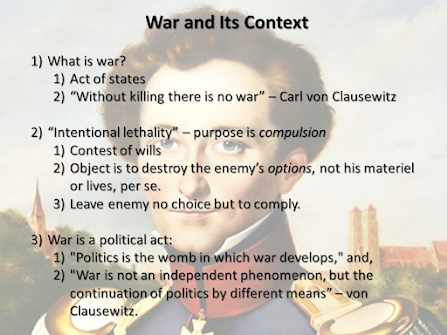
War is an act of deliberate destruction of an enemy's lives or physical assets. Absent "intentional lethality," there is no war regardless of what armed forces may otherwise do. Historically, however, the purpose of those operations has not simply to kill, but to compel submission by the enemy. As the US Army's World War 2 Gen. George S. Patton said, "Battles are won by frightening the enemy. You frighten the enemy by inflicting death and wounds." 

Europe's most celebrated theoretician of war is Prussian Gen. Carl von Clausewitz, 1780-1831, whose book, On War, is still studied around the world. One of his central tenets is that, "Politics is the womb in which war develops," and therefore, war is "the continuation of politics by different means.” 

Today's conventions clearly recognize that principle. 


In theorizing about war, these are the underlying visions of warfare that are used, usually more than one is used. 


As you can see, a nation's leaders may use moral principles to decide that employing the armed forces is justified under the various Conventions and the leaders' own national principles. But they may also see that while war is morally justified, it would be unwise and would likely have unacceptable outcomes. 

And that  leads to what are the bases, or templates, for which war might be made? I will let my slides speak for themselves:


Just War Theory JWT is a holistic view of war with a focus on attaining justice, limiting suffering, and encompassing all three of:

  • The cause of war
  • The conduct of war
  • The termination and aftermath of war
So, let's look at the basic details:


Just War Theory, along with international conventions and accords, forbid wars of conquest or aggression. The basic principle is that a nation may justly go to war to defend against aggression or to protect such aggression against third parties. However, Europe's history, culminating in the 30 Years War of the early 1600s, led to rejecting protection of third parties as an excuse to go to war. The Peace of Westphalia established national, geographic boundaries as the demarcation of nations (warring of parties), not language, tribal identity, or ethnicity. And the Peace deliberately set the internal affairs of a nation as immune from interference, especially war, by other states. 

This has formed a foundation for "governance" (if one may use that word) for war ever since, and is reflected strongly in the United Nations charter. The UN charter does explicitly allow for international alliances outside the UN that may establish war making for defensive purposes, with NATO being a primary example. 


Just War Theory holds as a matter of principle that making war therefore must be undertaken to establish a more just peace than pertained prior to the conflict. And the war may not itself be of greater evil than that it seeks to prevent. 

That war may not justly be waged absent reasonable prospect of success is important. It relates directly to the tenets of just conduct of war, and especially the greatly misunderstood principle of proportionality, about which more later. 

The Principle of Proper Authority

Just War Theory mandates that nations may go to war only with proper authority to do so. There is no international agreement on what that may be as a universal standard. The UN Charter permits specific kinds of war without UN consultation, but requires UN Security Council approval for other wars. (President Truman, for example, gained UNSC approval for the Korean War.) 

The UN Charter also recognizes that nations make security arrangements and treaties outside the UN structure. The most famous example is Article 5 of the NATO Charter, which requires every NATO member nation to respond militarily if any NATO member is attacked and Article 5 is invoked.
 
However, the only authority that can declare the United States is at war is the US Congress, not the UN. Treaties do not overwhelm the US Constitution. The UN cannot make American war legal or illegal, but it can make it legitimate in eyes of world. 

The US Constitution distinguishes between declaring war, which can be done only by Congress, and making war, which is the purview of the executive. As then-Senator Joe Biden accurately explained in 2001, the Congress has declared war when the Congress thinks it has. Hence, he said, an Authorization for the Use of Military Force meets Constitutional muster as a declaration of war.
I'm the guy that drafted the Use of Force proposal that we passed. It was in conflict between the President and the House. I was the guy who finally drafted what we did pass. Under the Constitution, there is simply no distinction ... between a formal declaration of war, and an authorization of use of force. There is none for Constitutional purposes. None whatsoever. 
Constitutional lawyers over many decades have held that varying kinds of enabling acts, such as monetary appropriations for military action, have also amounted to Constitutional satisfaction and, at least, consent of the Congress to action ordered by the president, in whom the Constitution grants authority to conduct warfare.

Just Conduct of War

Let me begin by reiterating that warfare is intentional lethality and destruction. Just conduct of war means that there must be limits to both. And that is where the principle of proportionality comes in. 

The doctrine of proportionality is simply stated that the means of conducting the war must be proportionate to the goal for which the war is waged. Another way of looking at it is that while the just ends desired do not justify any means to attain them, they absolutely justify some means. The tenet of proportionality, then, is to assess what the justified means are, then employ those means and not the unjustified ones.

The centering question of the doctrine of proportionality is deciding the violence necessary to achieve the war's objectives while not using excessive violence to do so. To employ too little violence is as disproportionate as to employ too much. It is unjust to wage war ineffectively even for a just cause.

Hence, proportionality means that one cannot use more force than necessary, but must use all the force that is necessary. It is critical to understand that proportionality does not mean, and never has meant, anything like a tit-for-tat response. 

In this, as in most of the just conduct tenets, huge gray areas of uncertainty abide. The combatants must do the best they can.  

The doctrine of Discrimination of violence means that weapons may not be employed with little or no regard to the nature of the target. Specifically, non-combatants may not be deliberately targeted and in fact, warring parties must use all achievable means to avoid it. But as warfare of the past 100-plus years has showed, it is permissible to bomb enemy factories even though factory workers are not members of the military. 

However, an international standard called Common Article 3 governs combat between state and non-state combatants. Its states that civilians' presence at a location does not automatically make that location off limits from attack. As Human Rights Watch explained during 2006's Hezbollah war, 
It, too, can be targeted if it makes an “effective” contribution to the enemy’s military activities and its destruction, capture or neutralization offers a “definite military advantage” to the attacking side in the circumstances ruling at the time. 
Other Categories
  • There are Hague Protocols on chemical and biological weapons. In this, United States policy since at least the 1960s has been in compliance. It is that the US will not use bioweapons, period, and will not be the first to use chemical weapons, but retains the right to respond likewise against an enemy's use of them. (As for nukes, US policy has not changed since they were invented: We have atomic weapons, and if you do not want us to use them, then do not attack us. Other nuclear-armed nations have basically the same stance.) 

  • Use of civilians as hostages or “human shields” is prohibited. 

  • Hospitals, other categories (such as houses of worship) may not be attacked. 

  • No “false flagging,” such as marking combatant vehicles with the insignia of the International Red Cross. 

  • Honorable surrender is defined, required to be honored. Pretense of surrender is prohibited for any reason. 

  • Militarization of protected structure removes its protection. A hospital, for example, may not be bombed, but if a combatant places anti-aircraft weapons atop it, it may legally be leveled without warning. 

  • The Conventions specify permissible treatment of POWs and refugees, including prohibitions of torture and other actions. 

  • Retribution actions are permitted, but very narrowly. For example, if a combatant nation executes 20 POWs because two of them had attempted escape, the those soldiers' nation may execute in retribution POWs that it holds, but only up to a point. 
The Conventions also specify occupying power obligations and define the distinction between lawful and unlawful combatants. Unlawful combatants are not afforded all the protections of lawful combatants. 

And the Conventions define and require the responsibility of moral action and accountability for all sides. That is, a warring nation is required to bring to discipline any member of its armed forces who commits a war crime.  

Just Ending of War

Here, there are three guiding principles:
  • Enduring peace 
  • Restraint of the victor 
  • Reconciliation among warring parties
What is the future of JWT, especially in its relation to international accords? I close with a link to an article by Jeff McMahan, professor of philosophy at Rutgers University and author of The Ethics of Killing: Problems at the Margins of Life and Killing in War. Click here: "Rethinking the ‘Just War,’ Part 1" (part 2 is linked at the end of that article).

Wednesday, April 16, 2025

Was Judas actually Christ's accomplice?

Or was Judas truly a traitor to Jesus after all?

One of the most deeply-rooted traditions in Christian faith is that one of Jesus' disciples, Judas Iscariot, cruelly betrayed Jesus in Jerusalem, guiding Temple soldiers to Jesus and identifying Jesus to them. Jesus was immediately seized and taken away. He was shortly condemned by both the Jewish Sanhedrin and the Roman governor, Pontius Pilate.

John's Gospel relates the beginning of the betrayal thus, John 13:21-30:
21 After he had said this, Jesus was troubled in spirit and testified, “Very truly I tell you, one of you is going to betray me.”

22 His disciples stared at one another, at a loss to know which of them he meant. 23 One of them, the disciple whom Jesus loved, was reclining next to him. 24 Simon Peter motioned to this disciple and said, “Ask him which one he means.”

25 Leaning back against Jesus, he asked him, “Lord, who is it?”

26 Jesus answered, “It is the one to whom I will give this piece of bread when I have dipped it in the dish.” Then, dipping the piece of bread, he gave it to Judas, the son of Simon Iscariot. 27 As soon as Judas took the bread, Satan entered into him.

So Jesus told him, “What you are about to do, do quickly.” 28 But no one at the meal understood why Jesus said this to him. 29 Since Judas had charge of the money, some thought Jesus was telling him to buy what was needed for the festival, or to give something to the poor. 30 As soon as Judas had taken the bread, he went out. And it was night.
 

A documentary on Discovery Channel some years ago examined the last week of Jesus' life. One scholar posed the idea that Judas did not betray Jesus, but was Jesus' accomplice in carrying out a course of action that went bad in ways Judas did not foresee, but Jesus did.

I don't recall the scholar's name, but his position was based almost exclusively on word studies of the Greek texts of the Gospel's accounts of the events, especially the word translated "betray," which is translated elsewhere as hand over or deliver up - about which more below.

The idea that Judas was traitor has very ample evidence, not least of which is the testimony of the Gospels themselves. Luke identifies Judas as a traitor early:
Luke 6:16: Judas son of James, and Judas Iscariot, who became a traitor. [There were two disciples named Judas. The infamous Judas was termed "Iscariot." This term refers to his hometown of Kerioth, in southern Judah. Hence, Judas was the only one of the Twelve who was not a Galilean.]
John's Gospel also identifies Judas as a traitor:
John 18:5: "Jesus of Nazareth," they replied. "I am he," Jesus said. (And Judas the traitor was standing there with them.)
There are other such specific attestations as well. (The Greek used for "traitor" is prodotes, which has no other connotation.)

"Traitor" is not the only pejorative term used about Judas in the Gospels. He is also called a "thief" in John 12:6; as the "keeper of the money bag, he used to help himself to what was put into it."

So an attempt to paint Judas in more favorable terms has very strong scriptural obstacles to overcome, to say the least. There are, however, some questions that intrigue:

How did Jesus know that Judas would betray him? None of the other disciples knew. Like the other Gospels, John 13 relates that Jesus gathered his disciples for a meal on his last evening as a free man. After an instructional discourse to them, Jesus informed them, "I tell you the truth, one of you is going to betray me" (v. 21). Jesus identified the traitor as one who with whom he would share bread, then handed bread to Judas.
As soon as Judas took the bread, Satan entered into him. "What you are about to do, do quickly," Jesus told him, but no one at the meal understood why Jesus said this to him.

Since Judas had charge of the money, some thought Jesus was telling him to buy what was needed for the Feast, or to give something to the poor [v.27-29].
How did Jesus know he would be betrayed in the first place, and that Judas would be the traitor? The Gospels give no clue.

The Greek word used for betrayal, paradidomi, does not mean only a traitorous action. It can also be translated, according to Strong's Greek Dictionary (a standard reference) as "to surrender, yield up, entrust or transmit," without necessarily implying underhandedness. My Liddell and Scott Greek-English Lexicon indicates the word is multivalent (as are so many Greek words) and betrayal is one of several meanings the word implies. Context is everything.

The King James version translates paradidomi as "deliver up" in other parts of the Gospels. The modern NIV translates it in other uses as "hand over." In Mark 10:33, Jesus foretells that the Jewish authorities will "hand him over" to the Romans, and the word used there is paradidomi, the same word translated as "betrayal" when referring to Judas' deeds.

The ambiguity of the word at least leaves open the possibility that Judas' actions were not actually traitorous. In fact, the NIV translates paradidomi as "hand over" in Matt 26:15-16. Judas went to the chief priests and asked, "What are you willing to give me if I hand him over to you?" So they counted out for him thirty silver coins. From then on Judas watched for an opportunity to hand him over."

(According to some historians, the money Judas was paid was standard bounty money paid to good citizens who identified wrong-doers.)

After Judas left the Upper Room, Jesus completed the Last Supper. Then he and his disciples went to the Mount of Olives, outside the city. Matthew and Mark say they went to there and then to "a place called Gethsemane," where he was arrested. Luke says he was arrested at the Mount of Olives and does not mention Gethsemane. John merely says they went to an olive grove across the Kidron Valley from the city. (The Gospels never refer to a place called the Garden of Gethsemane.) John confirms, though, that the place was known to Judas "because Jesus had often met there with his disciples" (John 18:2).

After a period of prayer and speaking to his disciples, Judas arrived with soldiers from the Temple, sometimes called Temple police because they were more a constabulary than a fighting force. (The synoptic Gospels say it was "a crowd" armed with clubs and such. John is probably more accurate.) Judas identified Jesus to them, and they apprehended him.


Events then proceeded apace. After a tempestuous confrontation with the Jewish High Priest, Caiaphas, and at least some members of the high Jewish council (the Sanhedrin), Jesus was charged with the religious crime of blasphemy for claiming messianic identity. This crime was one for which the Jewish law required death, but Caiaphas and others were already on record as fearing riots in Jerusalem if they even arrested Jesus, which is why they had done so at night. 

Caiaphas is recorded in John's gospel as willing to sacrifice Jesus to the Romans, but he knew that Pilate didn't much care about what religious offenses Jews committed. So he persuaded Pilate that Jesus was actually attempting insurrection against Rome. For that, Pilate sentenced Jesus to be crucified, a standard punishment for insurrection against Roman rule. The sentence was carried out.

Judas attempted to return the silver coins to the chief priests, then hanged himself. (Acts says, though, that he bought a field with the coins, fell headlong into it and was disemboweled.)

Those are the bare facts of what Judas and Jesus had to do with each other the last week of both their lives.

So - did Judas actually turn traitor against Jesus, or did Judas do what he did at Jesus' bidding?

The claim that Judas was a traitor has the substantial weight of text behind it, as I have explained. But it does not answer four key questions:

1. How did Jesus know he would be betrayed, and betrayed by Judas, and why were the other disciples clueless about it?

2. How did Judas know exactly where to lead the Temple police to arrest Jesus?

3. Why didn't Jesus escape away from Jerusalem when he had the chance? The Mount of Olives was the near edge of safety for him, from there he could have easily gotten away across Jordan River, which land John 11 identifies as safe haven for Jesus.

4. Why did Judas try to return the money and why did he commit suicide? Judas was no fool, he surely knew his betrayal would risk Jesus' life and could not have been surprised when Jesus was condemned.

Postulating that Judas has gotten a bad rap and that Judas was actually doing what Jesus wanted answers these questions. So consider some pluses and minuses of the "Judas as accomplice" theory:

A. As the only Judean, Judas was the only choice to be Jesus' messenger or intermediary with the high priests. The people of Jerusalem considered Galileans to be hicks from the sticks - John 7:41 records the incredulity of Judeans that Jesus was a Galilean: "How can the Christ come from Galilee?"
Advantage: accomplice.

B. Passover week in Jerusalem was always a tempestuous time. Tempers against the Roman occupiers ran high then, so high in fact that Pilate left the resort city of Caesarea and moved to Jerusalem for the duration, where he could control his forces on scene. Jesus was loved by many of the ordinary people. That would explain why the high priest didn't want to arrest Jesus during the daytime when the crowds could see.

But it does not explain why Jesus would arrange, via Judas, to meet with Caiaphas at night, nor for that matter why he didn't arrange to meet Caiaphas himself, without using Judas. If Jesus wanted to meet Caiaphas all he had to do was walk into the Temple and say hello.
Advantage: betrayal.

C. If Judas was Jesus' accomplice, why did Jesus tell the disciples, including Judas, that one of them would betray him? They all understood what he meant. For Jesus to call Judas a betrayer while actually being in collusion with him makes Jesus deceptive.

Not only that, Jesus threatened that it would be better for Judas had he never been born (Mark 14:21).
Advantage: betrayal (a major advantage at that).

D. But Jesus knew what Judas was going to do.
Advantage: accomplice.

E. Jesus went to exactly the place where Judas led the Temple police and did not attempt to evade them.
Advantage: accomplice.

F. If he was working at Jesus' initiative, Judas had no reason to believe that the Jewish high council harbored lethal intent toward Jesus. Thus, when Jesus was condemned, Judas was overcome with grief and remorse at having had a part in delivering up Jesus to that fate. So he killed himself.
Advantage: accomplice.

G. Judas took the silver coins from the high priests because he was avaricious and wanted to be paid for betraying Jesus,
or
the 30 pieces of silver were "market rate" and a routine matter for the high priests to pay for cooperating with them.
Advantage: neutral.

Outside the Gospels, Judas is mentioned a couple of times in Acts, written by the author of Luke, but that is all. The rest of the New Testament is silent about him. But the Gospels' record is uniformly negative. Clearly, there was an apostolic and early church understanding that Judas was a traitor.
Advantage: betrayal.

The idea that Judas was an accomplice of Jesus rather that his betrayer rests on too thin evidence to be accepted. The verdict of the early witnesses is upheld.

Update: I see I neglected to explain what the reason would be for Jesus to send Judas on a secret mission to have him delivered into the hands of High Priest. According to the ruminations of a couple of scholars on the Discovery Channel, Jesus wanted to force the issue of who he was with the High Priest and the Sanhedrin. Judas, being the sole Judean among them, could most easily act as intermediary with the Temple.

By this idea, the notion to see Caiaphas by subterfuge would have to be a very late idea in Jesus' mind. We could say the Jesus had tried to force the issue of confronting the Sanhedrin by his violent cleansing of the moneychangers from the Temple earlier in the week. And according to Matthew 23, Jesus launched into verbal broadside against the Temple class that we bloggers might say was the mother of all fisking of their religious practice and indeed, their very identity. He actually called them sons of Hell, not a move calculated to win their affection.

But these events did not cause the religious authorities to apprehend Jesus, forcing Jesus to arrange his "betrayal" to them by Judas. Judas thus would have been faithful to the end; he committed suicide from shock that his faithfulness had led to Jesus' death.

What this theory fails to explain is why Jesus was so desirous to stand before the High Priest. It could not have been merely to respond affirmatively to Caiaphas' question that he was indeed the "Son of the Most High." Jesus had been declaring his Messianic identity openly for some time; in fact, driving out the moneychangers was a Messianic act. He had personally forgiven sins in front of scribes and Pharisees for a couple of years or so, angering them because they knew that only God can forgive sins.

Nor does it hold up that Jesus expected the High Priest to confirm his Messiahship, for the Gospels are full of Jesus saying that judgment would fall upon "this generation" (meaning his own contemporaries) for not recognizing him.

There is one reason, though, that Jesus could have sent Judas to do what Judas did: Jesus intended to force his own execution. His death, then, was not the result merely of a good disciple gone bad, but the actual objective Jesus had in mind all along. And in fact, the Church has usually been quite comfortable with the idea that Jesus’ death was a cosmic necessity. But with Judas a true traitor, Jesus' death can seem practically accidental - it might not have taken place if Judas had reconsidered and heeded Jesus' warning, for example. And a near-accident is a mighty thin lifeline upon which to hang the redemption of humanity! So this part of the Jesus story is a buttress of the notion that Judas was Jesus' agent rather than his betrayer.

But there is an even stronger argument against the theory: Jesus kicked Judas out of the Upper Room before he instituted the Eucharist. Jesus and the disciples gathered there for a meal (not necessarily the Passover Seder; John says it was not, the other three Gospels say it was). It was only after the meal was done that Jesus took the bread, gave thanks for it, blessed the bread and gave it to his disciples. Likewise, it was after the supper that Jesus took the cup of wine and proclaimed it was the cup of the new covenant.

There is no question that Jesus saw the Eucharist as a defining ritual for his followers. He told them to practice it often and that he would share it with them again at the eschaton. That Jesus dismissed Judas from the room before the sharing of the bread and cup must be considered, I think, as proof that Judas was free-lancing, not secretly abetting Jesus' plans. To use a later religious term, Jesus excommunicated Judas from discipleship, and discipleship identity in Christian faith is practically defined by partaking of the Eucharist.

So, in my mind, the idea that Judas was actually Jesus' ally rather than his betrayer is refuted.

More plausible was the show's examination of just who was most responsible for plotting for Jesus to be executed, about which another post to follow.

Tuesday, January 28, 2025

SecDef Hegseth and his pointless name game

NBC affiliate WFMY in Greensboro, N.C., reports:

NORTH CAROLINA, USA — The controversy surrounding the name of North Carolina’s Fort Liberty is back in the spotlight following remarks by the newly appointed Secretary of Defense, Pete Hegseth.

In 2022, the U.S. military spent over $2 million to rename Fort Bragg to Fort Liberty, distancing itself from Confederate ties as Fort Bragg was originally named after Confederate General Braxton Bragg. However, during his first day on the job Monday, Hegseth referred to the base by its former name.

“Every moment that I’m here, I’m thinking about the guys and gals in Guam, in Germany, Fort Benning, and Fort Bragg, on missile defense sites and aircraft carriers,” Hegseth told reporters as he entered the Pentagon.

The mention of Fort Benning also stood out, as the Georgia base was renamed Fort Moore in 2023, another step in the Pentagon’s efforts to remove Confederate associations from military assets.

Hegseth’s remarks align with a promise President Donald Trump made on the campaign trail in Fayetteville, North Carolina three months ago. “Should we change the name from Fort Liberty back to Fort Bragg?” Trump asked a crowd of supporters, receiving loud cheers. “So here’s what we do: we get elected, I’m doing it. I’m doing it.”

I am a retired Army artillery officer. I served a tour at Ft Bragg in the latter 1980s. I am very definitely a political conservative, but I cannot agree with reverting the name back to Bragg. Here is why:

Confederate General Braxton Bragg
1. Ft Bragg was founded in Sept. 1918 as an artillery training center. Called Camp Bragg at first (because it was considered a temporary installation), it was named for North Carolina native Gen. Braxton Bragg for his artillery actions during the Mexican-American War in 1847. 

So far, so good. Bragg's record as a mid-grade US Army officer was in fact stellar. But another important reason the camp was named after him was, frankly, to appease Southerners while the US was at war in Europe. In 1918, there was still a large number of Civil War veterans, Union and Confederate, still living, and to their children and grandchildren, that war was not old history, far removed in time or space. So, the camp was named after a CSA general who conveniently was an NC native and Army artillery officer. 

Please note that there are no military installations outside the old CSA that were named after CSA figures. I will also note that Gen. Bragg was a truly dismal battlefield general, which IMO is another reason not to revert to using his name. 

I also think, however, that Fort Liberty is a nitwit name. Find a post-Civil War American military hero or renowned wartime commander and use that. 

2. There are some hard truths about the CSA. I was born and raised in the Deep South. My family's roots in Middle Tenn. go back to just after the Revolutionary War. I have ancestral family members who fought (and some died) for the CSA on both my mom's and dad's side (also for the Union on my dad's). Alexander Stephens, vice president of the CSA, was my wife's great-great grandfather's brother.

I take no back seat to anyone for Southern heritage and upbringing.

Like probably most native Southerners of my generation, I was raised being taught that the real reasons for the Southern states' secession was to preserve states’ rights and that the northern economic lobby was choking the South's economy with high tariffs on Southern goods.

Slavery? Well, it was in the mix somewhere, but slavery was not the real reason for secession. 

It is a lie, pure and simple

The states’ rights and tariffs arguments are entirely absent from Southern apologia until after the Civil War. In 1860 and before, no one in the South was using those topics to justify secession. Furthermore, in 1860 federal tariffs on Southern goods were lower than they had been since 1816. 

Why did the Southern states secede? To protect slavery, period.

Read the 11 seceded states' actual acts of secession, beginning with South Carolina's, and you will see that slavery was the sole reason for secession. South Carolina's act makes this very unambiguous: protection of slavery was the only topic presented as driving secession. Same with Mississippi. And the others.

The Confederate States of America was founded to do one thing only: to preserve the power of one class of people to literally own as chattel property another class of people. There is no other reason the CSA existed.

We are long, long past the time where any figure of the CSA should be honored with naming any federal property after him.  

I wrote  at greater length upon the CSA's secession and raison d'etre here: "Confederate monuments: So what? Now What?"

Monday, January 20, 2025

14th Amendment and "birthright citizenship"

I wrote this on another web site in 2010, so the issue of birthright American citizenship has been contentious for a long time. But the main points are still relevant, so here you go:

----------------------------------------

Many pixels are being lit up by some Republicans' commentary that the 14th Amendment to the 
Constitution "
is in need of review."

Senate Minority Leader Mitch McConnell (R-Ky.) told The Hill on Monday that Congress “ought to take a look at” changing the 14th Amendment, which gives the children of illegal immigrants a right to U.S. citizenship.

McConnell’s statement signals growing support within the GOP for the controversial idea, which has also recently been touted by Senate Minority Whip Jon Kyl (R-Ariz.) and Sen. Lindsey Graham (R-S.C.).

In an interview, McConnell said the 14th Amendment provision should be reconsidered in light of the country’s immigration problem.

The 14th Amendment was ratified in 1868. Its intention was to ensure that slaves freed by the Civil War could not be denied citizenship. The part of the amendment for that purpose simply states,

All persons born or naturalized in the United States, and subject to the jurisdiction thereof, are citizens of the United States and of the State wherein they reside.

This has been interpreted in the almost 150 years since as meaning that anyone born inside the US or its territories is automatically a citizen.

The 14th Amendment's crafter never imagined "anchor babies."

Babies born to illegal alien mothers within U.S. borders are called anchor babies because under the 1965 immigration Act, they act as an anchor that pulls the illegal alien mother and eventually a host of other relatives into permanent U.S. residency. (Jackpot babies is another term).

The United States did not limit immigration in 1868 when the Fourteenth Amendment was ratified. Thus there were, by definition, no illegal immigrants and the issue of citizenship for children of those here in violation of the law was nonexistent. Granting of automatic citizenship to children of illegal alien mothers is a recent and totally inadvertent and unforeseen result of the amendment and the Reconstructionist period in which it was ratified.

For decades after the amendment took effect, American Indians were ruled by federal courts, including the Supreme Court, not to be covered by the 14th Amendment because they were not fully under the jurisdiction of the United States. (The Tribes were then and still are in a treaty relationship with the federal government.) It took a special act of Congress in 1924 to confer citizenship upon American Indians.

In fact, there has never been a federal court that held the 14th Amendment conferred citizenship upon infants born to parents inside the country illegally. It is being done despite that fact.

So at a minimum, Congressional legislation clarifying what birthright citizenship is, within the context of the 14th Amendment, is not only appropriate, it is long overdue. I myself would support a Constitutional amendment to that effect. It would not require repealing or modifying the 14th Amendment. My draft reads:

Amendment 33 - Citizenship by Right of Birth Clarified
1. A person shall be a citizen of the United States by right of birth provided that the person is:

a. born in the United States to parents of whom at least one is, at the time of the birth, both a citizen of the United States and a de jure parent of the newborn, or,

b. born in the United States to parents who, though not citizens of the United States, are legally in the United States as permanent residents at the time of the birth, and who are de jure parents of the newborn, or,

c. born outside the United States to a de jure parent who is citizen of the United States at the time of the birth, provided that the birth occurs outside the United States because of United States diplomatic mission or military orders of a parent, or,

d. born outside the United States to a de jure parent who is citizen of the United States at the time of the birth, provided that the birth and identifying information of the newborn are registered within six months from the date of the birth with a United States diplomatic mission to the jurisdiction wherein the birth occurred.

2. Persons born in the United States and who do not meet a criterion citizenship by right of birth shall not be deprived of due process of law; nor shall any such persons within the jurisdiction of the United States be denied the equal protection of the laws by the United States nor by any State.

3. Congress shall have the power to enforce this amendment by appropriate legislation.

So there you are.

Updates: Here are three more links relevant to this topic. First is an article by George Mason law Prof. Ilya Somin, with whom I have corresponded now and then for going on 20 years, though I have never met him in person. I would say he is, overall, a centrist. He says that Trump cannot simply order it. Click here

Next is George Washington University law Prof. Jonathan Turley, one of the most respected legal scholars in the country. His article is from 2019, "No, It Is Not Racist To Oppose Birthright Citizenship," in which he points out, 

... that one of the outcomes was the passage of the 14th Amendment in 1868 to guarantee the rights of citizenship to protect the status of freed American slaves. That much is clear. The problem is that little else is. Since the 14th Amendment was ratified, many leaders have opposed claims of birthright citizenship, including former Senate Majority Leader Harry Reid. Moreover, most countries reject such claims of citizenship. One can be entirely on board with the outcome of the Civil War, not be a racist, and still oppose birthright citizenship.

Finally, here is today's BBC's article, "Trump has vowed to end birthright citizenship. Can he do it?" I read the BBC because in covering American topics, I find it often more balanced and non-partisan than US media. Also, though the article does not say this, foreign nationals enjoy no birthright citizenship in the UK. 

June 2026: The Supreme Court decided this month that birthright citizenship means that, with very narrow exclusions, any baby born in the United States is automatically a US citizen, including born here to a mother who entered the US legally or illegally, and for that matter may have entered the country literally only minutes before giving birth. 

Here is a Wall Street Journal article, free link, explaining what Chief Justice John Roberts got wrong in the majority decision. It was written Richard A. Epstein, a professor of law and NYU Law School, a senior lecturer at the University of Chicago and a Senior Fellow at Civitas Institute.

Roberts Gets the 14th Amendment Wrong. In the 1860s, citizenship was not only extended but defined more narrowly than the chief justice acknowledges.

Read the whole thing, but I think this is the key excerpt:

A key to the constitutional structure was the distinction between “subject to the jurisdiction thereof” in the 14th Amendment’s Citizenship Clause and “within the jurisdiction” in the Equal Protection Clause. The latter isn’t limited to citizens, as the Privileges or Immunities Clause is, but applies to all persons.

That rests on Blackstone’s explicit distinction between “local” and “natural” allegiance. The former requires all persons to respect the criminal and civil law while in a foreign nation, but ceases to bind them on their departure. Local allegiance never confers any opportunity to obtain citizenship, which natural allegiance does. The chief justice incorrectly collapses the two into one by writing that “the Citizenship Clause uses jurisdiction in its ordinary sense—referring to the power of the United States to govern those within its territory.” The Equal Protection Clause had nothing to do with citizenship. How could the 14th Amendment confer automatic birthright citizenship when the 1870 statute set out more-rigorous conditions to apply for naturalization?

As I said, read the whole piece.

A world without nuclear weapons - what would it look like?

 From Pope Leo this week, according to the National Catholic Reporter : " Pope Leo quotes Bob Dylan song in book foreword calling for n...