Showing posts with label Apologetics. Show all posts

Sunday, March 15, 2026

We are not blind, are we? Well . . .

The Gospel passage for today is the first 14 verses of the Gospel of John. It is a long passage so rather than include it it here, I offer this link. I also include the YouTube video of Jesus giving sight to a blind man – and what happened after that. It is from the 1977 mini-series, Jesus of Nazareth.

Did you know that this story is a joke? I don’t mean that it is funny, not at all. It is quite serious. Nor do I mean that it did not happen in real life. I believe it did. I am not mocking the passage and what it conveys. I am referring to the narrative structure of the passage.  

That is, this passage presents a situation that begs to be resolved, the blind man. Then the situation is resolved; Jesus gives the man sight. But then notice that the story continues, and in the end, there is a punch line: “If you were blind, you would not have sin. But now that you say, ‘We see,’ your sin remains.”

This punch line is the actual point of the story. It is not a funny story but a very serious one. Unlike a normal joke, though, this story tells you the punch line at both the beginning and the end: the kind of sight that matters most is spiritual sight that recognizes the true light of the world, Jesus. Those who think they can spiritually see without him are really the blind people of the world.

The disciples saw the blind man and immediately thought that he was blind because of his sin, or maybe his parents’ sin. Jesus will have none of that, for he knows that God does not smite sinners with such misfortunes – after all, where would God stop? The beggar's blindness is not punishment from God. Jesus knows it is an occasion for the redemptive and healing power of God to be displayed in him.

The man's blindness in this story serves as the dramatic foil for the real point, a point repeated throughout John's Gospel: sin is failure to respond to the presence of Christ and the Gospel. Jesus tells the Pharisees at the end of the story that if they had been blind – that is, never exposed to the presence of God in him, then they would be blameless for not acknowledging him. But they have encountered Jesus, and their assertion that they surely are not blind is the basis for Jesus’ judgment of them as sinners. Unlike the beggar, the Pharisees' physical sight is not the issue. What they refuse to perceive is that God is present and revealed in Jesus. They are blind to the most important fact of all, a fact that should be obvious to them. Hence, says Jesus, their sin remains because they continue to insist that they can see. 

Throughout John, sin is defined not so much as what one does but as how one responds to Christ. For John, the moral foibles of men and women living their daily lives is of concern mainly to lead people to know Christ as savior of the world. This recognition can be likened to a form of new sight.

 Have you ever needed your sight restored? A dad once told me of his son, whom I will call Sam, in fourth grade when they learned that he needed eyeglasses; in fact, he probably had needed them all along. 

Like most children who need glasses, Sam was very nearsighted. When his glasses were ready, his dad took him to get them. When they stepped outside Sam suddenly stopped, his jaw dropped, and he just stood there and stared around him for quite some time. 

"Look!" he exclaimed. "There are birds in that tree! There are wires between the telephone poles." All the way home he stared out the window, marveling at all the things he saw that he had never seen before.

So just imagine what the nameless beggar's reaction must have been to have his eyes opened! A miracle, you say? It's a greater one than you think,

Physicist Arthur Zajoc wrote that light and the mind are entwined. Many studies, he said, have investigated recovery from congenital blindness. Thanks to modern medicine and new surgery techniques, many people who had been blind from birth could gain their eyesight, perhaps not perfectly, but well enough to function as sighted persons instead of blind ones. Yet success is rare for adults even when the surgery is successful. Zajoc wrote, "the world does not appear to the patient as filled with the gifts of intelligible light, color, and shape upon awakening from surgery." Light and repaired eyes were not enough to grant the patient sight. "The light of day beckoned, but no light of mind replied," despite their "anxious, open eyes."

 The patients can see technically, but not practically. Surgeons alone cannot complete the task. The patients’ minds must be trained to recognize what the eyes detect. When patients’ bandages are removed, they are no longer physically blind, but they are perceptively blind, They do not recognize anything they look at. A clock may chime. The patients know what they are hearing, but they have no idea what to look for. They recognize the sound but have no way to associate the sound with anything they see.

Dr. Zajoc concluded, "Vision requires far more than a functioning physical organ. Without an inner light, without a formative visual imagination, we are blind. [That] inner light must flow into and marry with the light of nature to bring forth a world." 

The question for us all is whether we are seeing with inner sight, with spiritual sight. Do we train our souls to recognize what God wants us to see? What are we looking at, and are we failing to perceive the most important things of all? 


During the Covid lockdowns earlier this decade, an American missionary in Italy wrote what it was like to be in the severe social isolation Italy put in place. He emailed to a friend in America, 

But if you do end up in quarantine-- so far, it's not that bad. We've discovered how it's forced us to stop and notice the beauty in the world and our fellow humans and be grateful for things and people we used to take for granted-- sunshine and birds, flowers out the window, calls with people we've been meaning to catch up with one of these days when we both had time.

If there is a silver lining in the cloud of anxiety and fear that often surrounds us, maybe that is it: that we have the chance to see ourselves and others, and indeed the world itself, with new sight and renewed understanding. Despite all the turmoil, it is still a wonderful world, and we still belong to God. 

Remember these things: 

There is a light shining named Jesus Christ. The light of Christ can never be extinguished.

We are called to be reflections of Christ’s light – mirrors for Christ, as it were. These days give us the chance to polish that mirror!

“We are not blind, are we?” I do not believe we are – as long as we remember this: when we think we see everything God wants us to see, that is when we blind ourselves. It is not about simply opening our eyes, but also our hearts and our souls. Look first to Christ, and with Christ at one another.

Thursday, February 19, 2026

Lent and Chocolate - What's the Point?

The story is told of Sean O'Flannery, a lad who moved to Boston from Dublin. Coming home from school one day he went into an ice cream shop and told the jerk behind the counter (the soda jerk) "One scoop of yer best chocolate ice cream in four dishes!"

Soda jerks get strange requests, so he set four dishes with one scoop each in front of Sean. Sean took a spoon of one, held it before his face and loudly announced, "This is me beloved cousin eating ice cream back in the old country!" He ate the ice cream and took a spoonful from another scoop, "This is me dear friend Kelly eating ice cream back in me homeland!" The third dish he said was his favorite uncle, Finian, eating ice cream back home.

Sean raised the last scoop and said, "And this dish is for me!"

This practice went on for several months until one evening as the soda jerk was filling the four dishes Sean stopped him and said quietly, "Only three dishes today, please."

The soda jerk asked, "Did you suffer a loss and that is why you only want three scoops?"

"Heaven's no!" protested Sean O'Flannery. "It's Lent now, and I've given up ice cream!"

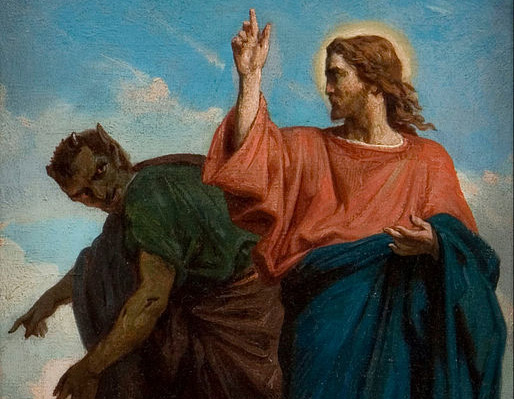
The word “Lent” comes from the Anglo-Saxon word, “lencten,” meaning Spring, the season in which Easter occurs. The forty days before Easter constitute the Lenten season, but the forty-day count does not include Sundays. All Sundays celebrate the resurrection, and so are excluded from the forty days count. The forty days duration is drawn from the length of time Jesus spent in prayer and fasting in the wilderness before he set out on his three-year ministry.
Matthew 4.1-4:

1 Then Jesus was led by the Spirit into the wilderness to be tempted by the devil. 2 After fasting forty days and forty nights, he was hungry. 3 The tempter came to him and said, “If you are the Son of God, tell these stones to become bread.”
4 Jesus answered, “It is written: ‘Man shall not live on bread alone, but on every word that comes from the mouth of God.
As originally conceived by the church long ago, the Lenten sacrifice was instituted as a “means of penitential preparation and preparation for baptism, which in the early church customarily took place on Easter Sunday.”

The tradition of fasting during Lent is an early one, originally done between Good Friday and Easter morning, the forty hours that Jesus was in the tomb. Christians would partake of no food or drink at all during that time. The fast was extended to the forty days before Easter sometime between 300 and 325, and changed so that food could be eaten only when evening had come.

The idea behind the fast was to imitate Christ. In addition to fasting, Christians would devote themselves to making prayer a faithful habit. So “prayer and fasting” have been closely linked for a long time.

And that brings me, by a rather circuitous route, to chocolate.

Chocolate is an absolutely unessential food, nutritionally speaking. We eat chocolate for no reason other than it is pleasurable. Since denial of the flesh is a prominent theme of Lent, rejection of chocolate in Lent is often offered as the Lenten sacrifice, particularly by people who wish to diet anyway.

The Lenten season is the time when we are supposed to ponder the extravagance of God’s love for us through Jesus Christ. Perhaps that fact could put a different spin on our concept of giving something up for Lent. The Lenten sacrifice is best oriented toward that which most blocks our spiritual growth. If that thing is chocolate, then it is appropriate to give up chocolate for Lent. But if something else is one’s greatest obstacle in being more Christlike, then giving up chocolate is spiritually pointless. 

The question is this: “What is the one thing that most hinders my Christian growth into the person whom God wants me to be?” The answer may not be easy, but it will always involve self-denial. We think that following Christ is hard because to obey Christ we must first disobey ourselves, and it is disobeying ourselves that makes us think following Christ is hard.


But Jesus said his yoke is easy, his burden is light. We just have to get over ourselves to do it.

As Robert Mulholland put it, “Jesus is not talking about giving up candy for Lent. He is calling for the abandonment of our entire, pervasive, deeply entrenched matrix of self-referenced being.”

If we focus on that between now and Easter Day, then we have a chance to become more mature in Christian faith and practice. It may be a habit that is out of true with Christian character that needs to be overcome for further growth. Or it may be a thing undone which must be done for deeper development to occur. The Lenten idea is for our habits to change enough in the next few weeks so that we can continue at a higher level of discipleship after Easter. The Lenten season and the Lenten sacrifice are not the points in and of themselves, the whole life of discipleship is.

Focusing on the one big thing is not the only Lenten discipline that would be helpful for spiritual development. Methodism’s founder, John Wesley, insisted that the only thing that distinguishes the Christian from the non-Christian are how we use our time and money. So, for the period of Lent I would suggest focusing on those two things in addition to whatever one big spiritual obstacle you might have. Some suggestions:
  • Tithe your income until Easter. 
  • Devote yourself to prayer daily and attending worship every Sunday. If you are traveling, say on business or spring break, then worship wherever you are.
  • Read the Bible each day. 
  • Call someone you love and let them know. 
  • Ask people who live alone to join you for lunch or whether you can visit them. 
  • Become involved in Christian ministries.
  • Re-establish or reinforce important relationships in your life.
Spiritually speaking, it is not enough to simply excise sin or personal vices from our lives. We have to replace vice with virtue. Thus, simply giving up something like chocolate for Lent is simply silly if we are only counting the days when we can start doing it again. That’s a game, not a spiritual discipline.

Lent should be a period of joyful, God-directed introspection into how we may be further united with Christ in godly love. If we make Lent into a severe, joyless, self-justifying exercise in self-denial, we have missed the point. Jesus sternly admonished teachers of the religious law and the Pharisees not to practice the letter of the law while neglecting “the more important matters of justice, mercy and faithfulness” (Matt 23:23).

When a lawyer asked Jesus, “which is the greatest commandment in the Law?” Jesus replied, “‘Love the Lord your God with all your heart and with all your soul and with all your mind.” And the second is like it: ‘Love your neighbor as yourself.’”

That is the whole point of spiritual growth and spiritual discipline, and hence the whole point of Lent: love. We are to be living ambassadors from God to one another and the world at large in Christ’s name. Christ was crucified, buried and raised from the dead for our sake and the sake of the whole world. Let us rededicate ourselves to being Christ’s ambassadors. It’s Lent, after all; it’s all about love, you see, Lent is all about love.

Wednesday, February 18, 2026

Life and dust and promise

Before I retired from full-time pastoral ministry, I had a particular dread every Ash Wednesday that lay people did not share. It arose from the fact that I imposed ashes upon everyone’s foreheads, but in years past I also placed ashes on the foreheads of my wife and children and said to them, “Remember that you are dust and to dust you shall return.” I really would rather not have said that to my own blood.

Ash Wednesday is the one day of the Christian year that is supposed to fill us with dread. Dread that God is just, dread that God will judge, dread that we might be judged in justice rather than in love. If wearing ashes on our foreheads should do anything for us, it should confront us with the fact that for all of us, there is an end coming one day. Before the most holy God, all the things we value will be as ashes. 

The American dream is that we can have it all. Therefore, we often seem not to understand that Christian discipleship is a zero-sum game: if we are to grow in discipleship, we must shrink in something else. If we are to add holiness to our lives, we must give up ungodliness. In his book I Surrender, Patrick Morley writes that the church’s main misconception is “that we can add Christ to our lives, but not subtract sin.” We think we can change what we believe without changing what we do. We want revival without reformation, we want rebirth without repentance. 

To repent means more than to regret. Originally a nautical term, it meant to change course, to go in a new direction. Repentance means to change, to be different. That’s the real reason why people are supposed to “give up something” for Lent. How often do we give up something trivial, like desserts or going to movies? It’s no repentance to give up something that we can easily do without and then, once Lent is over, resume. It’s no repentance to pretend we are turning away from actions instead of sins. Repentance is to pull out our deepest sins by the roots, and that will hurt! 

Fasting for Lent means to repent, not merely to do without food for part or all of a day. Fasting means to be focused on repentance so intently that we give up the ungodliness that pervades our lives. It is to be a holy man or holy woman for forty days. We express that turn toward holiness by symbolically wearing ashes to signify our awareness of our mortality, and to turn to ashes the parts of our lives, the parts of our character, that separate us from fullness of grace. 

Yet there is a danger in Lent as well as opportunity. Repentance is necessary, but repentance does not save us. We are saved by what God has done in the person and work of Jesus Christ. Repentance springs from understanding that we have no hope apart from Christ. The danger in Lent is that we will emphasize repentance of our sins to the exclusion of their cure. Our works are part of our faith, but we are justified before God by our works in faith not because of what we do but because of what God has already done. From the ashes of repentance, in grace, God can build anew. 

Peter Perry, a pastor in Texas, told of the time his neighbor’s house burned to the ground. “The trees all around were scorched,” he wrote. “The grass was brown."

A few blackened timbers stood near the back of the house, and the remains of the cast iron plumbing system rose out of the ashes. The day after the fire, as I walked to school with a friend, we saw the woman who had lived there, standing in the midst of what had once been her home, weeping and wondering aloud what would become of her and her family. As she gazed at the ruins of her life, she despaired. But her husband was comforting her. “We can rebuild,” he said. And they did. One year later, a beautiful new home graced that lot. And the home they built was built around the old home’s massive, stone fireplace. But I wonder . . . Did the woman and her husband and their children sit around that fireplace on winter nights, look at the dancing flames on the logs they were burning, and remember the ashes?

We do remember the ashes of our past, do we not? Old hurts, ancient wrongs. Writer Hazel Farris told of her childhood’s fiery temper. 

One day, after an argument had sent one of my playmates home in tears, my father told me that for each thoughtless, mean thing I did he would drive a nail into our gatepost. Each time I did a kindness or a good deed, one nail would be withdrawn. Months passed. Each time I entered our gate, I was reminded of the reasons for those ever‑increasing nails, until finally, getting them out became a challenge. At last the long‑awaited day arrived – only one more nail! As my father withdrew it I danced around proudly exclaiming, ‘See, Daddy, the nails are all gone.’ Father gazed intently at the post as he thoughtfully replied, ‘Yes, the nails are gone—but the scars remain.’

Scars do remain, and we wear them. We’ve made them, too. Sometimes we count our scars and relive the hurt and anger and pain of each one. Sometimes we love to inflame the passions of righteous indignation. But God does not do that. God forgives our sins and God forgets those sins. God does not carry grudges. In our repentance and humility before God, we can see that God’s ways are not our ways. God forgives, God forgets. Our sins were nailed to a cross on Calvary. In Christ’s triumph over the powers of sin and death, our sins have become like ashes, blown away in the wind. 

So, the call to repent must not be ignored. We must respond to God’s initiative. “If there are a thousand steps between us and God,” said Max Lucado, “God will take all but one. God will leave the final one for us. The choice is ours.” 

We are dust and to dust we shall return. The urgency of Lent is that we turn to God now, for later may never come. Dr. George Sweeting told of a visit to Niagara Falls. 

It was spring, and ice was rushing down the river,” he wrote. “As I viewed the large blocks of ice flowing toward the falls, I could see dead fish embedded in the ice. Gulls by the score were riding the ice down the river, feeding on the fish. As they neared the falls, their wings would go out, and they would escape from the falls.

I watched one gull which seemed to delay and wondered when it would leave. It was engrossed in the carcass of a fish, and when it finally came to the brink of the falls, out went its powerful wings. The bird flapped and flapped and even lifted the ice out of the water, and I thought it would escape. But it had delayed too long so that its claws had frozen into the ice. The weight of the ice was too great, and the gull plunged into the abyss.

The moment to turn back to God is this moment.

When we receive the ashes on our foreheads, there first stroke usually is a vertical one with the ashes on our forehead. Think of it as an “I.” The “I” is the egoistic part of each one of us that is the sinful self, the rebellious self, the self that wants to walk alone instead of with God. But right after the “I” we receive a horizontal line, and the “I” will be crossed out. Crossed out. As Bass Mitchell explained,  “The ashes made in the form of a cross remind us of the cross of Christ by which our sins and the sins of the whole world are canceled out!” 

Ash Wednesday reminds us that we come from a world of death and sin, but that we do not have to stay there. “We are dust, and to dust we shall return. Let us repent and believe in the Gospel!”

Thursday, November 27, 2025

A Thanksgiving Reflection


   Thanksgiving! When we take a day off to celebrate with families reunited and get stuffed fuller than the Thanksgiving turkey! It is a day we remember what we are thankful for. What are you thankful for? Shortly, we will have a time for everyone who wishes to share what they are thankful for. But I can explain that right now:

I am thankful for - the fork!

As table utensils go, the fork is a recent invention. The knife was first, of course, dating to prehistory. The spoon also dates to the Stone Age, literally. But forks date only to ancient Greece, and then they were large cooking utensils, not for the dining table. In the 600s, table forks were invented but used only in the Middle East. Table forks did not appear in Europe until a thousand years ago, and then only in Italy. The Italians were very slow to adopt them, not using them widely until five hundred more years passed. Forks did not reach France until 1533, but the French thought using them was an affectation and their adoption was very slow. The first table fork reached England in 1608, where they were promptly ridiculed as effeminate and unnecessary. Over many years, forks came to be adopted by the wealthy, who had them made from expensive materials intended to impress guests.

The first Thanksgiving celebration in Plymouth Colony was in 1621. There were no forks. The pilgrims and their guests used knives, spoons, their fingers, and cloth napkins to manipulate their food. So, I am thankful to have a fork to make eating Thanksgiving dinner easier.

The connection between food and giving thanks that reaches back thousands of years. As the children of Israel prepared to cross into the Promised Land, Moses told them,

When you have come into the land that the LORD your God is giving you as an inheritance to possess, and you possess it, and settle in it, 2you shall take some of the first of all the fruit of the ground, which you harvest from the land that the LORD your God is giving you, and you shall put it in a basket and go to the place that the LORD your God will choose as a dwelling for his name. … 8 “The LORD brought us out of Egypt with a mighty hand and an outstretched arm, with a terrifying display of power, and with signs and wonders; 9and he brought us into this place and gave us this land, a land flowing with milk and honey. 10So now I bring the first of the fruit of the ground that you, O LORD, have given me.” You shall set it down before the LORD your God and bow down before the LORD your God. 11Then you, together with the Levites and the aliens who reside among you, shall celebrate with all the bounty that the LORD your God has given to you and to your house (Deuteronomy 26:1-2, 8‑11).

Giving thanks to God has a connection with food about three millennia old. The ancient Jews knew of course that life depends on food. But they emphasized that their lives were sustained by the presence of God. After all, not only had God brought them out of slavery in Egypt, he had sustained them with manna as they wandered in the Sinai. They understood that filling the soul was as important as filling the plate.

There was once a man who was struck by a city bus and was critically injured. He was rushed unconscious to a hospital and went immediately into emergency surgery. The surgeon barely saved the man’s life after several hours on the operating table. The victim regained alertness five days later. The day after that, the surgeon stopped in to see him. Incredibly, the injured man launched into a litany of complaints about the care he had received in the last 24 hours – the food was cold, the nurses were slow when summoned, the TV was too small and too far away, the room was either too hot or too cold, and so on.

The surgeon interrupted, “Look, you were almost dead when you got here! I worked on you for five hours! I repaired both your shattered legs, set your broken arm and three ribs. One lung was punctured, and I saved you from suffocating. You were gashed across your head and I sewed it up. Your heartbeat was irregular, and I got it stabilized. A little gratitude might be in order!”

“Okay, doc, thanks,” the patient answered, “but what have you done for me today?”

Probably everyone here has had a moment like that doctor, being informed of perceived failure to meet someone’s else’s demand. One day in Galilee Jesus miraculously fed more than five thousand people, starting with just five small loaves of bread and two fish. That night Jesus left the area. The next day the crowd tracked Jesus down.

John 6:25-35

25 When they found him on the other side of the sea, they said to him, "Rabbi, when did you come here?"

26 Jesus answered them, "Very truly, I tell you, you are looking for me, not because you saw signs, but because you ate your fill of the loaves. 27 Do not work for the food that perishes, but for the food that endures for eternal life, which the Son of Man will give you. For it is on him that God the Father has set his seal."

28 Then they said to him, "What must we do to perform the works of God?"

29 Jesus answered them, "This is the work of God, that you believe in him whom he has sent."

30 So they said to him, "What sign are you going to give us then, so that we may see it and believe you? What work are you performing? 31 Our ancestors ate the manna in the wilderness; as it is written, 'He gave them bread from heaven to eat.'"

32 Then Jesus said to them, "Very truly, I tell you, it was not Moses who gave you the bread from heaven, but it is my Father who gives you the true bread from heaven. 33 For the bread of God is that which comes down from heaven and gives life to the world."

34 They said to him, "Sir, give us this bread always."

35 Jesus said to them, "I am the bread of life. Whoever comes to me will never be hungry, and whoever believes in me will never be thirsty.”

Jesus said the only reason the people followed him was because they saw him as a sort of walking grocery store. It was time, Jesus said, for the people to work for the food that endures for eternal life. The people asked what they needed to do to perform the works of God. Jesus answered they needed to start with believing in him because God had sent him.

They asked what sign, or miracle, Jesus would perform so that they may see it and believe in him. Now, just the day before the people had miraculously eaten their fill because of Jesus’ power, but now they said to him, what have you done for us today? It seems a strong sense of entitlement people often have is no new phenomenon.

Baby boomers like me were raised by the generation that grew up during the Great Depression and came of age during World War Two. Much of what my parents’ generation went through is out of place with how my age group knows life. Pulitzer Prize winning author William Manchester wrote of how his mother would cut and re-sew bed sheets to make them last longer. My grandfather, born in 1900, told me of young men he knew in the 1930s who worked ten-hour days on a farm to earn a dollar a day, and were glad to do it.

Yet my age group saw none of this. Robert J. Samuelson wrote of us baby boomers, “We didn't merely expect things to get better. We expected all social problems to be solved. In our new society most workers would have rising incomes and stable jobs. … Poverty, racism and crime would disappear. … We expected almost limitless personal freedom and self-fulfillment. After a while we thought we were entitled to them as a matter of right.”

Yet, as author Mike Bellah points out, when our parents told us how things were, they failed to tell us how things usually really are. In telling the stories of the Great Depression and the Great War, the generation who lived them wanted to create in their children a sense of gratefulness that those tribulations were over, but what they often created in us instead was a sense of entitlement. Why? Says Bellah, “Because of what they didn't say. What our parents failed to tell us is that conflict and want are part of humankind’s future as well as its past. There have been no utopias in history, and as long as the human condition remains the same (imperfect people living in an imperfect world), there will be no utopian tomorrows either.”

Since Jesus's day the human condition has remained the same – imperfect people living in an imperfect world. This new millennium is only twenty-one years old, and we are already shocked by its events. It seems depressingly much like the last one – and the one before that.

So, we may say to Jesus, what have you done for us today? And what sign will you give us so that we may believe in you?

In John, Jesus does not perform miracles on demand; in fact, John's Gospel doesn’t even use the word miracle. Jesus does signs that attest to his identity as the one sent by God, on whom God has set his seal, the mark of authenticity. The constant theme in John is that those who believe without seeing miracles or appearances are blessed. When we say, however sophisticated our words may be, what has Jesus done for us today, what sign can he give us so that we may believe, Jesus’ answer is always the same: “I am the bread of life. Whoever comes to me will never be hungry, and whoever believes will never be thirsty.”

Christ has nothing to offer us except himself. And that is more plentiful than we imagine. Perhaps we should be thankful this Thanksgiving not for things; I doubt that this year mere stuff is what we are thankful for, anyway. Despite the violence, despite the threats, despite the uncertainty, despite our politics, we may be thankful that we can rejoice in the Lord always and that the Lord is near. The peace of God will guard our hearts and minds in Christ Jesus.


   Thanksgiving, then, is not really a once-a-year celebration, except in a secular sense where it handily marks the day before Christmas shopping frenzy. Thanksgiving is for Christian people a continuous state of praise that acknowledges to God what God has done for us in the person and work of Jesus Christ. Thankfulness enables us to face the future with hope, for it is by thanking that we remember. To thank someone is to remember what he or she did for you. To remember what God has done is to be filled with hope, because God isn’t finished with the world or with us. As God has done, so God will do, and as God has given, so God will give. 

Thanksgiving is a joyful noise, a glad worship. Despite outwards circumstances, our hearts in faith do heed what the psalmist announced: The Lord is good, his steadfast love endures forever, and his faithfulness lasts to all generations.

Sunday, June 8, 2025

Pentecost advocacy

Pentecost was a Jewish celebration long before it was a Christian one. It was one of the designation of the Feast of Weeks, which came after Passover. In Jesus’ day, Pentecost was a time to renew the covenant God made with Noah. This festival day seems to be the reason the disciples gathered together in one place. They were good Jews and wanted to observe the holy day.

Jesus had ascended to heaven, leaving his disciples behind. He had told them that God would give them a great gift after he departed. Jesus had indicated it would be the Holy Spirit. Sometimes we hear that the Holy Spirit was not among human beings until the day of Pentecost, but that’s not the case. The spirit of God moved over the surface of the waters, says Genesis. Ezekiel and Isaiah both spoke of the Spirit, as did the Psalmist. Of course, Peter spoke of the Holy Spirit when he quoted the book of Joel in his sermon in our passage.

So the disciples were waiting for something to happen, but they didn’t know exactly what or when. The Scriptures don’t tell us what they were actually doing just before the Spirit hit them. Of course, what matters is not what they were doing before, but what they did after. 

Jesus had promised his disciples that he would send the Holy Spirit. One instance was in the passage from the Gospel of John: 

15:26 “When the Advocate comes, whom I will send to you from the Father, the Spirit of truth who comes from the Father, he will testify on my behalf. 27 You also are to testify because you have been with me from the beginning. 

16:4b “I did not say these things to you from the beginning, because I was with you. 5 But now I am going to him who sent me; yet none of you asks me, ‘Where are you going?’ 6 But because I have said these things to you, sorrow has filled your hearts.

7 Nevertheless I tell you the truth: it is to your advantage that I go away, for if I do not go away, the Advocate will not come to you; but if I go, I will send him to you. 8 And when he comes, he will prove the world wrong about sin and righteousness and judgment:

9 about sin, because they do not believe in me;

10 about righteousness, because I am going to the Father and you will see me no longer;

11 about judgment, because the ruler of this world has been condemned.

 12 “I still have many things to say to you, but you cannot bear them now. 13 When the Spirit of truth comes, he will guide you into all the truth; for he will not speak on his own, but will speak whatever he hears, and he will declare to you the things that are to come. 14 He will glorify me, because he will take what is mine and declare it to you. 15 All that the Father has is mine. For this reason I said that he will take what is mine and declare it to you.


Right off the bat Jesus tells us that the Holy Spirit is the Advocate. An advocate is someone who takes the side of another. There are two senses of advocacy. One is friendship or alliance. 

I remember reading a short story written about a hundred years ago of two brothers, rivals as brothers often are, whose mother’s birthday was coming up. Each saved money to buy her a special present.

Their family was of the working poor. Mom was a maid, and her sons saw her every day leave home carrying her broom, her mop and bucket, and cleaning rags. They knew she worked very hard for them.

The older brother determined to save enough money to buy his mother a small comb with a silver handle – an astonishing luxury for a woman whose husband had not been able even to afford to buy her a diamond for her ring. The older brother hauled coal, swept stables and ran errands for people for a nickel each until he had enough to buy the comb. He bought it, hid it under his bed, and counted the days until his mother would receive it. He imagined the thrill he would get as he thought of how she would react to such a splendiferous present. Her could hardly sleep at night. 

Truth be told, though, one big reason he wanted to give her the silver comb was that he knew his younger brother could not possibly attain so grand a present. He relished a looming sense of superiority over little brother. 

The big day finally came. After supper, their father, a stock clerk in a store, brought out a modest cake with a single candle. They sang, “Happy Birthday” and mom cut a piece for each of them, making the boys’ pieces the largest. Father left and returned with a small, wrapped package, presented it to his wife and wished her happy birthday. She unwrapped the package to reveal a lace shawl. She held it up in awe. She had never had anything like it before. 

 Big brother turned to little brother. “You go first,” he said. Little brother disappeared out the back and returned carrying – a new mop and bucket. “Happy birthday, Mom!” he exclaimed happily. 

And mom . . . mom just sat back and her eyes filled with tears. But they were not tears of happiness, as older brother quickly noticed. Mom was silent for a moment and then sobbed, “A bucket! It’s my birthday. I scrub on my knees and wring out a mop all day long, and for my birthday I get a mop and bucket!”

Little brother began to cry, too. Then dad said, “Dear, I know what you must be thinking. But please take a look at this bucket. It has wheels, so you won’t have to carry a heavy bucket full of water from one room to another anymore.”

Mother looked up, suddenly interested. “Oh, my,” she said, “that’s good!”

Dad continued, “It has a lever-driven mop squeezer. You won’t have to take the mop to a house’s sink and wring it with your hands anymore. It will wring the mop for you when you press this lever. No more bending over.”

Mom clapped her hands and laughed aloud. “This is so wonderful! I’m sorry I didn’t understand at first!” She took her younger son into her arms and hugged him. “Thank you!” she said.

Father affixed a certain gaze on the older brother. Dad knew about the silver comb. “Son,” said the father, “what is your present for your mother?”

The older brother felt the comb in his pocket. What a treasure it was, and yet something stayed his hand. It was a grand present and fine, but what would Mother think of the bucket when she held the silver comb? Would she remember again how hard she worked for so little, and push her younger son and his bucket aside to embrace a gift to make her feel like a queen, if only a little? How diminished would his little brother feel, again? 

“Well,” demanded his father, “what are you giving your mother?”

The older brother said softly, “Half the bucket.”

An advocate is someone who supports you, who props you up, who endorses your honest efforts to do well. I would guess that the younger brother had a different relationship with his older brother from that day on. They were rivals no more, but companions and friends.

 One of the most influential religious philosophers of the twentieth century, Alfred North Whitehead, wrote, “Religion is the transition from God the void to God the enemy, and from God the enemy to God the companion.” Some people don’t much think of God at all; to them God is a term without a real referent. God is a void. Others resist the work and will of God in their lives; they scoff at God, perhaps, but really see God as someone opposing them.  

But God is really our companion. In fact, I think one of the chief things Jesus did was prove that God is not our enemy and certainly not a void. God is our friend. Yet Jesus said, “. . . if I do not go away, the Advocate will not come to you; but if I go, I will send him to you.”

Unlike Jesus, who could only be in one place at a time, the Holy Spirit is everywhere at once. The Holy Spirit is the enduring companionship of God in our lives. Hence, Paul wrote,

Likewise the Spirit helps us in our weakness; for we do not know how to pray as we ought, but that very Spirit intercedes with sighs too deep for words. And God, who searches the heart, knows what is the mind of the Spirit, because the Spirit intercedes for the saints according to the will of God.

This kind of relationship is intimate and personal. A little word study indicates how close the Spirit is. The Hebrew word for the Spirit of God is ruah, which means breath, or wind. In the beginning, says Genesis, when God created the heavens and the earth, the Spirit (or breath) of God moved across the waters of creation. The New Testament word for Spirit means wind or breath, also. In John 20, Jesus breathed upon his disciples and said, “Receive the Holy Spirit,” which they certainly did on Pentecost. Two unrelated languages used the same concept to name the Spirit of God. Coincidence? I think not. 

Breathing is one of the most intimate acts. When a baby is born, the sound of its cries and breathing is the first thing the moms and dads wait for. 9-1-1 operators hear frantic calls that “my child” or my wife or my husband isn’t breathing. Medical care is high-tech, with machines to monitor brain waves and heartbeats, but it is the cessation of breathing that marks the passing. 

So considering how the Scriptures describe the Holy Spirit, I would say that the Spirit is as close as our next breath, in a very literal sense. All this is to say the advocacy of the Holy Spirit is up close and personal and allied with us, not opposed to us. 

Yet this advocacy and companionship is for a purpose. If on the one hand the Spirit comforts us and intercedes for us, on the other the Spirit also kicks us in the tail to live out our calling as disciples. Consider the famous account of the Day of Pentecost in Acts. 

 The future apostles and other disciples were all together in one place when “there came a sound like the rush of a violent wind.” Wind, Spirit, I am sure you picked that up. But did you get it: violent wind! Something is up. There is turmoil coming! Then tongues as of fire rested on each of them, then they heard each other speaking is many different languages. 


It must have been quite a scene because passersby scoffed that they were all drunk with new wine. Peter, emboldened by the Holy Spirit, preached that the last days had come. And so they had. We live in them still. 

What the Spirit did that day was jerk Jesus’ disciples into the future, to bring it about by continuing the work of Christ in the present life of the world. When the Holy Spirit hit them, it hit them all together, at the same time, and it blew them right out of their meeting room into the hostile, mean streets of Jerusalem and the world.

They were transformed into group of folks given something ultimate to do, to tell the entire world about Life. And they were given the ability and power to do it, the power of the Holy Spirit.

Pentecost is thus called the birthday of the Church. The great days of the Church are not only in the past. What happened on Pentecost can happen again – here and now – when we are willing to be picked up, possessed of God and be used as God’s instruments, when we are willing to set aside the pleasures and profits of the secular world so we can be instruments of God’s love and witnesses to Christ’s salvation.

On Sundays when we are together in one place, God comes into our lives to renew our redemption and our redemptive purpose, to heal our wounds and sustain us in our community of faith. God sends us to carry each other’s burdens, to meet one another’s difficulties. God calls us to live above mundane things and rise above despair and anxiety. God calls us to God’s self, to seek God’s face in our hearts and the hearts of others. So we meet together. 

May the Holy Spirit rest on us and send us out of the church as witnesses into the streets where we live and work. 

Sunday, March 30, 2025

The Right People for the Wrong Crowd

Luke 15 begins:

1 Now all the tax collectors and sinners were coming near to listen to him.  2 And the Pharisees and the scribes were grumbling and saying, “This fellow welcomes sinners and eats with them.” 

When you read the gospels, you discover that wherever Jesus was, there were usually a lot of the riffraff of society right there with him. One of the remarkable things about Jesus is that he accepted and even sought the company of people considered socially undesirable. In fact, Jesus once even invited himself to dinner at a hated tax collector’s house. 

Then, as now, the influential and powerful people didn’t like the wrong crowd and they didn’t like the way Jesus hung out with the wrong crowd. They thought there was a character defect in a man who would welcome sinners and eat with them. 

Usually we set up the Pharisees as the bad guys of the gospels. After all, Jesus criticized them frequently. But I will tell you: the closer my children got to high school the more I became like the Pharisees. I examined their friends closely. I wanted to know who they spent their time with and what they did together. I remember my own parents wanting to know these things and warning me not to keep bad company.

None of us would ever say to our children, “Go downtown and hang out with the drug pushers and shoplifters.” And if our kids did so, we’d certainly think they had gone terribly wrong. We are socially a lot more like the Pharisees than Jesus. We try to keep the wrong crowd at arm’s length or out of sight. 

The Pharisees wanted to avoid the wrong crowd. That’s not inherently a bad thing. The Pharisees believed that the separation of good and bad was necessary for the well being of the community. We believe that, too. It's why we have jails, after all.

But the Pharisees went too far. In their eyes, the people Jesus welcomed were beyond the margins of proper society and were to be scorned and rejected. And Jesus even ate meals with them! The Pharisees objected strenuously. So, Jesus told them parables about three lost things: a sheep, a coin, and a father who had two sons. He started this way:

4 “Which one of you, if he has a hundred sheep and loses one of them, would not leave the ninety-nine in the open pasture and go look for the one that is lost until he finds it? 5 Then when he has found it, he places it on his shoulders, rejoicing. 6 Returning home, he calls together his friends and neighbors, telling them, ‘Rejoice with me, because I have found my sheep that was lost.’ 7 I tell you, in the same way there will be more joy in heaven over one sinner who repents than over ninety-nine righteous people who have no need to repent.”

A shepherd has a hundred sheep counts only ninety-nine. So, he leaves the ninety-nine to find the lost sheep. He brings it home and calls his friends to rejoice with him. "Just so," Jesus concludes, "there will be more joy in heaven over one sinner who repents than over ninety nine righteous persons who need no repentance."

Then he told of a woman who lost a coin and tore her house upside down to find it. When she did, she threw a block party to celebrate. “Just so,” Jesus said, “I tell you, there is joy in the presence of the angels of God over one sinner who repents.” 

This is a play in three acts, and the third act Jesus told was a story of a young man who demanded of his father his share of his inheritance now. Dad gave it to him, and the young man moved far away. But he went broke and wound up slopping hogs for a living, which for a first-century Jew would be as far down the ladder as you could get. He remembered that even his father’s hired men lived better than that. So, he set off for home to ask for a job as a ranch hand. 

But while he was still far off, his father saw him and was filled with compassion; he ran and put his arms around him and kissed him. 21 Then the son said to him, ‘Father, I have sinned against heaven and before you; I am no longer worthy to be called your son.’ 22 But the father said to his slaves, ‘Quickly, bring out the best robe and put it on him; put a ring on his finger and sandals on his feet. 23 Get the fatted calf and kill it and let us eat and celebrate; 24 for this son of mine was dead and is alive again; he was lost and is found!’ And they began to celebrate. 

But the elder son refused to join the party. The father went to him, but the elder son said, 

"Listen! For all these years I have been working like a slave for you, and I have never disobeyed your command; yet you have never given me even a young goat so that I might celebrate with my friends. 30 But when this son of yours came back, who has wasted your property on prostitutes, you killed the fatted calf for him!’ 31 Then the father said to him, ‘Son, you are always with me, and all that is mine is yours. 32 But we had to celebrate and rejoice, because this brother of yours was dead and has come to life; he was lost and has been found.’” 

When we hear these stories, we imagine that we are the lost sheep or the wayward child. Sometimes we feel lost even now since we can still move away from God. We are comforted by the image of a God who keeps looking for us no matter how far we stray. All the tax collectors and sinners were coming near to listen to Jesus. When you are on the receiving end of the God who seeks you out, these parables are good news. 

But we should hear these parables with a cautious ear. Something strange is going on. “Which one of you, having a hundred sheep and losing one of them, does not leave the ninety nine in the wilderness and go after the one that is lost until you find it?” 

Now, our usual reaction to Jesus’ question is a sort of warm, mushy feeling as we envision a kindly shepherd searching high and low and gently bearing the lost lamb back on his broad shoulders. But that’s simply ridiculous! Which of you, having a hundred one-dollar bills in a crowded park, and losing one of them, would leave the other ninety nine on the park bench and go after the one that is lost until you find it? No one!

No shepherd would leave the flock to be easy prey for wolves for the sake of one lost sheep. A shepherd’s livelihood can survive the loss of one sheep, but not the loss of the many which would be killed if he abandoned the flock. It seems silly for the woman to throw a big party for finding her coin. Surely the party cost far more than the value of the coin. 

These parables make no obvious sense. There is no moral lesson for the lost. The sheep and the coin are found not because of anything they do but because someone is determined to find them. A lost sheep doesn’t know it is lost. It’s quite likely to wander away again. The coin is just an inanimate object. The son returns home to a place of honor, which reveals deep rifts within the family. What’s going on here?

Maybe the central point about these stories is not the lost sheep or coin or the wayward son. Maybe the stories tell us practically nothing about the lost ones, but an awful lot about ourselves. Jesus speaks of repentance in the first two stories but not the third. The wayward son is never said to repent, though he does have a carefully rehearsed, syrupy, and probably insincere speech. He starts to give it to his father, but his father interrupts it and tells his servants to prepare a banquet. 

Why does Jesus talk about repentance in the first two parables but not the third? No repentance is even possible for a coin or a sheep. And yet Jesus said at the end of each that all heaven rejoices when a sinner repents. So: who’s the sinner and what’s the repentance? 

For Jews of Jesus’ day “repentance” meant, “a fundamental change.” Who else could that be true of other than the shepherd and the woman? Whatever they had planned for the day got discarded because they lost count of what was valuable to them. So, they made a fundamental change to make the count include everything. Maybe that is what heaven celebrates: those who make a fundamental change about what counts. 

The older son, angered by the mercy of his father and the inclusion of his admittedly dishonorable younger brother, scorns the celebration. After all, the younger brother’s return is not characterized as repentance at all; it might be nothing more than a quest for free meals. The older son followed all the rules, did everything right. He neither asked for nor received dad’s favor. Now he feels cheated. And the father botched being a father because he didn’t remember, apparently, how to count to two sons, not just one. He never tried to find his wayward son, he just waved goodbye and good luck. Unlike the stories of shepherd or the woman, there was no fundamental change by anyone in the third parable. There is no one to admire in this parable. 

Nothing comes together for that highly dysfunctional family even at the end. We do not learn whether the rifts between the father and his sons, or between the brothers, will heal. The only redeeming fact of this story is that the banquet is well justified, because there was one who “was dead and has come to life; he was lost and has been found.” 

[All] The parables end with a party. Jesus doesn’t invite us to be rescued by God, but to join God in recovering the things God treasures. The parables reject the idea that there are certain conditions the lost must meet before they are eligible to be found, or that there are certain qualities they must exhibit before we will seek them out [New Interpreter's Bible]. 

Here is a true story: One winter when I was about twelve years old, two orphaned brothers walked from their temporary foster home to my neighborhood to ride their homemade sled down the steep hill near my house. My neighborhood group was at the hill riding our store bought Flyers. The two orphans’ sled had wooden runners and it tore the snow up. Frankly, we didn’t want to play with them. They were a rough pair, kind of crude and brash and obviously poor. They were the “wrong crowd” for us middle-class kids. I dropped several hints for them to go tear up some other hill with their lousy sled. Lunch time came, so I went home. While my mother was fixing me a sandwich, there was a knock on the front window next to the door. There stood the younger orphan boy, peering inside my house. My mother opened the door. “Can I have a sandwich?” the boy asked.

My mother brought him inside and took his wet outer clothes and put them into the dryer. She sat him at our dining room table and gave him my sandwich. “I’ll make you another one,” she told me. She heated some chicken soup—which she had not offered me—and set it before him. I wasn’t very happy about all this. I didn’t want to come to the table where that beggar sat. I retreated to the kitchen. My mother followed. I told her, “You gave him my sandwich! You didn’t heat any soup for me, but you did for him!”

My mother said, “Don’t be a stick in the mud! Come have lunch.”

Jesus said, “Come, you that are blessed by my Father, inherit the kingdom prepared for you…. . For I was hungry and you gave me something to eat, I was thirsty and you gave me something to drink, I was a stranger and you invited me in.”

Jesus invites us to become shepherds who seek the lost because they are precious to God and are worth being found. Restoration and wholeness become possible when we treat others according to how they are valued by God, not according to what the world says they are worth. The canyons that separate us—good from bad, worthy from unworthy, lost from found—are bridged by a searching love which embraces us all and invites us all to celebrate. 

Jesus asked the Pharisees to join the search and host the party. He wanted them to think about who counts and who’s counting them. He urged them not to write the wrong crowd off, but to be the right people for the wrong crowd. He challenged them to care deeply about all the people they had given up on and to be willing to take risks to find them. We cannot classify people according to what we think they are worth. The value of a single sheep or a lost coin or a wayward child cannot be computed according to conventional market standards. 

We know who the wrong crowd is, but we also need to know, thanks be to God, that we are the right people for the wrong crowd. 

Sunday, December 29, 2024

Why is there Christmas?

 “Why is there Christmas at all?”
This question makes it clear that we are not speaking of a holiday or the layers of secular commercialism that lie atop it. It is to ask, Why was God born into flesh and blood and all that those things entail? It is what we call Jesus’ Incarnation – the deity of God being born as human.
We can say what this did rather easily: it brought the sacred and eternal being of God into the carnal and temporal sphere of human life. God had done this before, though not in flesh and blood. He did so in Sinai in the giving of his Law to the chosen of Israel and in bringing them to the Promised Land. The Jews understood that God was made personally present in every aspect of their lives by the giving of his commandments even when they did not understand all of them.
The Jews call the commandments specifically and the Scriptures generally the Torah, the Word of God. Torah is the main way that Jews understand God to be present with them. The great Jewish theologian Michael Wyschogrod explained the meaning of the Torah. Instead of becoming present in the Word, wrote Wyschogrod,
    God could have played a godly role, interested in certain features of human existence, the spiritual, but not in others, the material. He could even have assigned [to] man the task of wrenching himself out of the material so as to assume his spiritual identity, which is just what so many [religions] believe he did. Instead, the God of Israel confirms man as he created him to live in the material cosmos ... There is a requirement for the sanctification of human existence in all of its aspects. And that is why God's election is of a carnal people. By electing the seed of Abraham, God creates a people that is in his service in the totality of its human being and not just in its moral and spiritual existence.[1]
Of course, we Christians have a different understanding of what forms the greatest manifestation and revelation of God on earth. We agree with the Jews that God’s Word is the purest manifestation and revelation of God that we have on earth. However, we don’t say “what” is God’s actual presence with us, we say, “who.” John’s Gospel tells us:
In the beginning was the Word, and the Word was with God, and the Word was God. 2 He was with God in the beginning. 3 Through him all things were made; without him nothing was made that has been made. 4 In him was life, and that life was the light of all humankind. 14 The Word became flesh and made his dwelling among us.
The Word of God, the Torah of God, the revelation of God, the Word become flesh – and so Christmas, of which Charles Wesley wrote:
Veiled in flesh the Godhead see;
Hail th’incarnate Deity,
Pleased with us in flesh to dwell,
Jesus our Emmanuel.
The Jews are exactly right: “that God and the Torah are one.” Because Jesus is the Word made flesh, the actual, living embodiment of the Torah, when Jesus said, “I and my Father are One,” his Jewish hearers understood him more deeply than the typical Christian reading those words today.
 Jesus of Nazareth is God’s proof that we can become what we should most desire: to be holy in our own flesh, in this life. God sanctifies us in this life, for he took on this life in his own person. We cannot be gods. But we can be godly. The birth of the Son of God into humanity shows us that.
Our daily headlines show us a world not much different from the one Jesus was born into. It was and remains a world of death, of tragedy, of evil, of pain, and of suffering, though thankfully leavened with beauty and joy and goodness. God wages war against everything that resists or opposes God’s intentions for his creation. But God does not war against flesh and blood. Instead, God sanctifies flesh and blood. Paul knew this, so he wrote,
For our battle is not against flesh and blood, but against the rulers, against the authorities, against the world powers of this darkness, against the spiritual forces of evil in the heavens.[2]
Yet why does this godly battle require God’s presence in human form? John’s most famous passage explains it quite simply: “For God so loved the world that he gave his only begotten Son ... .” And John later also quotes Jesus, “There is no greater love than to give up one’s life for one’s friends.”
We see on our nightly news the horrors visited by terrorists and other random violent acts of no apparent purpose. There are other sufferings we can hardly imagine. Evil is powerful in our world. Father Dwight Longenecker, a pastor in Greenville, South Carolina, wrote,[3]
   The true answer to the absurdity of evil is the supernatural rationality of love, for love is the outgoing goodness that counters evil. By "love," I do not mean merely sentimental or erotic love. I mean a power that is positive and creative and dynamic and pro-active in the world—the power which Dante said, "moved the Sun and the other stars." … Love is the light in the darkness ... .
All who are baptized into the body of Christ cease to be subject to the powers of this world and are transformed and transferred to a new and different kind of life, with different powers and possibilities for life, with new eyes to see the world, with a new family and a new Lord.
That is why to celebrate Advent and Christmas are not simply acts of worship. They are acts of defiance, for in singing carols and reading Scripture we announce that we do not submit to the principalities and powers of darkness or the spiritual forces of evil at loose in the world. To sing, “What child is this, who laid to rest, on Mary’s lap is sleeping?” is to speak more importantly than all the other voices in the world and to proclaim that we, God’s people,
... do not lose heart because we are being renewed every day. The promises of God far outweigh all the terrors of this world. We live not according to the fallen standards of this world because we are only here temporarily. We live in Christ’s Kingdom because it is eternal.[4]
The Reverend Nadia Bolz Weber put it this way, [5]
   Amongst the sounds of sirens and fear and isolation and uncertainty and loss we hear a sound that muffles all the rest: that still, small voice of Christ speaking our names.  … the very reason we can do these things is not because we happen to be the people with the best set of skills for this work.  Trust me, we are not. ...  – the reason we can stand and we can weep and we can listen is because finally we are bearers of resurrection. We do not need to be afraid. Because to sing to God amidst all of this is to defiantly proclaim ... that death is simply not the final word. To defiantly say that a light shines in the darkness and the darkness cannot, will not, shall not overcome it.
Consider this painting by Lorenzo Lotto (1480-1556):


Manger scenes became a popular artistic motif during the Renaissance. In almost all such paintings, the artists included the cross somewhere in the scenery. Sometimes it was on the horizon outside the manger. One artist, Lorenzo Lotto (1480-1556), painted a cross on a shelf on the manger’s wall, such as many homes would have had. 


Let us take a cue from those theologically-trained artists. They knew the connection between the manger and Calvary. So did Jesus. As his last trip to Jerusalem loomed, knowing what it portended, Jesus told the disciples, “Now my heart is troubled, and what shall I say? 'Father, save me from this hour'? No, it was for this very reason I came to this hour” (John 12:27). 
When we celebrate Christmas, we are celebrating the birth of someone who was born to die, as this artist recognized. For at its most basic level, the meaning of Christmas is the cross. To consider the life and death of Jesus, what possible expectation could we mortals have that the God who created the universe could be required, much less expected, to put on flesh and blood, be born as we are and die as we do, to take upon himself the sin of the whole world? Faced with this fact, what do we do in return?
That is the central question for us who celebrate the birth of Jesus because he put his own body between us and eternal destruction. Jesus died to bring us into everlasting life. The mystery of the Incarnation is conjoined by the shock of crucifixion. Both are resolved by Resurrection. "God With Us" did not start in Bethlehem two thousand years ago, nor was it ended at Calvary. God With Us happens today among those who follow the One who had “no crib for a bed,” the One who died on a cross and then ascended to the right hand of God.
 To celebrate Christmas, therefore, is not simply to sing carols in December in a church garlanded in greens. It is to become holy in this life each day of the year, to emerge victorious over sin, evil and death, to do the work of Christ in the world, to live knowing that Jesus is God with Us, and so we can, and must, be with God.
Every Thanksgiving my family and used to join my parents at the home of my younger brother, Usually there were 17-20 there, but one year there were only nine gathered around the table. My older brother and his wife came a long distance to be there, but only one of their four grown children could come. Our eldest child was not able to come, nor our second or his wife. My brothers and I had a running joke one of us always announced whenever we gathered for such celebrations. Sometime during Thanksgiving one of us would say to Dad, “Of course, you know that everyone who truly loves you came home for Thanksgiving.” And Dad responds, “Oh, sure, I know that.” We all laugh because we know it's just a joke.
But if you had been there that year, you would have seen fleeting sorrow flicker across our faces and a wisp of wistfulness in our eyes. For the breath of a sentence, our hearts were in Delaware or Wisconsin or Ohio or Florida because while the table was crowded, it was not full. Not everyone was there who belongs there.
That moment came to my mind when I read something author Bob Benson wrote in Come Share the Being. He and his wife had three children and he told of how they grew up and went away to college and then got married and made their own homes. They were proud of their children, he wrote, but after their youngest son moved away, “our minds were filled with memories from tricycles to commencements [and] deep down inside we just ached with loneliness and pain.
“And I was thinking about God,” Benson wrote. “He sure has plenty of children – plenty of artists, plenty of singers, and carpenters and candlestick makers, and preachers, plenty of everybody . . . except he only has one of you, and all rest together can never take your place. And there will always be an empty spot in his heart and a vacant chair at his table when you’re not home.
“And if once in a while it seems he’s crowding you a bit, try to forgive him. It may be one of those nights when he misses you so much he can hardly stand it.”
Maybe that is why Christ was born, lived, died and was raised from the tomb – because that’s what God does when he just can’t stand it anymore, when he just can’t stand the gulf of separation between us.
In Jesus’ day there was no occasion more festive or joyous than weddings. The best parties were wedding parties and feasts. The New Testament says that when Christ returns he will be reunited with his church in a celebration so magnificent that the Scriptures describe it as the grandest wedding celebration ever held. 
Are we preparing ourselves spiritually for this banquet? Do we understand how the reward of eternal life with God places a burden on us today? Methodist professor David Watson wrote,
When even a cursory thought is given to the countless millions in the world who are hungry, who are suffering, who languish under injustice, or are ravaged by war, the prospect of anyone celebrating personal salvation . . . borders on the obscene. There are still too many of Christ’s little ones who are hungry, too many who lack clothes, too many who are sick or in prison. There are too many empty places [at God’s banquet table]. The appropriate attitude for guests who have already arrived is to nibble on the appetizers and anticipate the feast which is to come. To sit down and begin to [feast] would be unpardonable . . . especially since the host is out looking for the missing guests, and could certainly use some help.
When we deeply consider what Christmas really means and what it obligates us to be and to do, we can only admit that we have surrendered all our rights to everything except humility.


Why is there Christmas? Because there is a place for every person at God’s table, but not everyone has come. Because God cannot stand the separation between himself and his children.
This day of celebration should also evoke is us an equally unbearable sorrow that we are not doing all we are able to do to close the separation. The best way to celebrate Christmas is to carry out the commandments of Christ all the year long.


[1]Quoted by David Goldman, “Banning circumcision is dangerous to your health,” http://www.atimes.com/atimes/Global_Economy/NG03Dj02.html
[2]Ephesians 6.12
[3]http://www.patheos.com/Catholic/Aurora-Murders-Demonic-Possession-Dwight-Longenecker-07-24-2012
[4]See 2 Cor 4.16-18
[5]http://www.patheos.com/blogs/nadiabolzweber/2012/07/sermon-about-mary-magdalen-the-masacre-in-our-town-and-defiant-alleluias/
Bookmark and Share

When Jesus forced the issue

The eleventh chapter of the Gospel of John begins with Jesus learning that his friend, Lazarus of Bethany, had fallen ill. Despite the news,...