Showing posts with label Politics. Show all posts

Tuesday, June 24, 2025

What does "Just War" mean?


Just War Theory (JWT henceforth) forms the basis of modern international law regarding the causes, conduct, and conclusion of warfare. JWT is not a modern concept, however. It has sprung over many centuries of thought in the Christian traditions to resolve the tensions between the teaching of Christ and the realities of national affairs in a fallen world. For example:


The principal influence on JWT were Saint Augustine, AD 354-430, and St. Thomas Aquinas of the 13th century. Of the two, Aquinas remains the more influential and all work on JWT since him builds on his work. 


But what is war? The question seems self-evident, but modern Conventions such as The Hague and Geneva Conventions are careful to define. For centuries, war has been understood to be an act of nation-states, not of combat between non-state combatants, no matter how well armed and organized. Understand, however, that armed conflict between a nation state and a non-state combatant does qualify as war under the Conventions and other relevant treaties. 

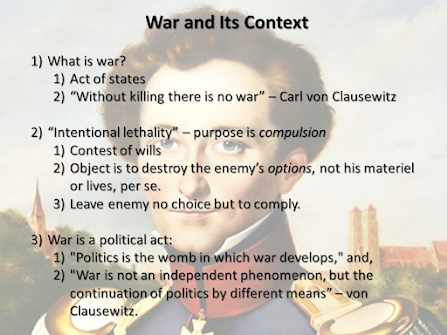
War is an act of deliberate destruction of an enemy's lives or physical assets. Absent "intentional lethality," there is no war regardless of what armed forces may otherwise do. Historically, however, the purpose of those operations has not simply to kill, but to compel submission by the enemy. As the US Army's World War 2 Gen. George S. Patton said, "Battles are won by frightening the enemy. You frighten the enemy by inflicting death and wounds." 

Europe's most celebrated theoretician of war is Prussian Gen. Carl von Clausewitz, 1780-1831, whose book, On War, is still studied around the world. One of his central tenets is that, "Politics is the womb in which war develops," and therefore, war is "the continuation of politics by different means.” 

Today's conventions clearly recognize that principle. 


In theorizing about war, these are the underlying visions of warfare that are used, usually more than one is used. 


As you can see, a nation's leaders may use moral principles to decide that employing the armed forces is justified under the various Conventions and the leaders' own national principles. But they may also see that while war is morally justified, it would be unwise and would likely have unacceptable outcomes. 

And that  leads to what are the bases, or templates, for which war might be made? I will let my slides speak for themselves:


Just War Theory JWT is a holistic view of war with a focus on attaining justice, limiting suffering, and encompassing all three of:

  • The cause of war
  • The conduct of war
  • The termination and aftermath of war
So, let's look at the basic details:


Just War Theory, along with international conventions and accords, forbid wars of conquest or aggression. The basic principle is that a nation may justly go to war to defend against aggression or to protect such aggression against third parties. However, Europe's history, culminating in the 30 Years War of the early 1600s, led to rejecting protection of third parties as an excuse to go to war. The Peace of Westphalia established national, geographic boundaries as the demarcation of nations (warring of parties), not language, tribal identity, or ethnicity. And the Peace deliberately set the internal affairs of a nation as immune from interference, especially war, by other states. 

This has formed a foundation for "governance" (if one may use that word) for war ever since, and is reflected strongly in the United Nations charter. The UN charter does explicitly allow for international alliances outside the UN that may establish war making for defensive purposes, with NATO being a primary example. 


Just War Theory holds as a matter of principle that making war therefore must be undertaken to establish a more just peace than pertained prior to the conflict. And the war may not itself be of greater evil than that it seeks to prevent. 

That war may not justly be waged absent reasonable prospect of success is important. It relates directly to the tenets of just conduct of war, and especially the greatly misunderstood principle of proportionality, about which more later. 

The Principle of Proper Authority

Just War Theory mandates that nations may go to war only with proper authority to do so. There is no international agreement on what that may be as a universal standard. The UN Charter permits specific kinds of war without UN consultation, but requires UN Security Council approval for other wars. (President Truman, for example, gained UNSC approval for the Korean War.) 

The UN Charter also recognizes that nations make security arrangements and treaties outside the UN structure. The most famous example is Article 5 of the NATO Charter, which requires every NATO member nation to respond militarily if any NATO member is attacked and Article 5 is invoked.
 
However, the only authority that can declare the United States is at war is the US Congress, not the UN. Treaties do not overwhelm the US Constitution. The UN cannot make American war legal or illegal, but it can make it legitimate in eyes of world. 

The US Constitution distinguishes between declaring war, which can be done only by Congress, and making war, which is the purview of the executive. As then-Senator Joe Biden accurately explained in 2001, the Congress has declared war when the Congress thinks it has. Hence, he said, an Authorization for the Use of Military Force meets Constitutional muster as a declaration of war.
I'm the guy that drafted the Use of Force proposal that we passed. It was in conflict between the President and the House. I was the guy who finally drafted what we did pass. Under the Constitution, there is simply no distinction ... between a formal declaration of war, and an authorization of use of force. There is none for Constitutional purposes. None whatsoever. 
Constitutional lawyers over many decades have held that varying kinds of enabling acts, such as monetary appropriations for military action, have also amounted to Constitutional satisfaction and, at least, consent of the Congress to action ordered by the president, in whom the Constitution grants authority to conduct warfare.

Just Conduct of War

Let me begin by reiterating that warfare is intentional lethality and destruction. Just conduct of war means that there must be limits to both. And that is where the principle of proportionality comes in. 

The doctrine of proportionality is simply stated that the means of conducting the war must be proportionate to the goal for which the war is waged. Another way of looking at it is that while the just ends desired do not justify any means to attain them, they absolutely justify some means. The tenet of proportionality, then, is to assess what the justified means are, then employ those means and not the unjustified ones.

The centering question of the doctrine of proportionality is deciding the violence necessary to achieve the war's objectives while not using excessive violence to do so. To employ too little violence is as disproportionate as to employ too much. It is unjust to wage war ineffectively even for a just cause.

Hence, proportionality means that one cannot use more force than necessary, but must use all the force that is necessary. It is critical to understand that proportionality does not mean, and never has meant, anything like a tit-for-tat response. 

In this, as in most of the just conduct tenets, huge gray areas of uncertainty abide. The combatants must do the best they can.  

The doctrine of Discrimination of violence means that weapons may not be employed with little or no regard to the nature of the target. Specifically, non-combatants may not be deliberately targeted and in fact, warring parties must use all achievable means to avoid it. But as warfare of the past 100-plus years has showed, it is permissible to bomb enemy factories even though factory workers are not members of the military. 

However, an international standard called Common Article 3 governs combat between state and non-state combatants. Its states that civilians' presence at a location does not automatically make that location off limits from attack. As Human Rights Watch explained during 2006's Hezbollah war, 
It, too, can be targeted if it makes an “effective” contribution to the enemy’s military activities and its destruction, capture or neutralization offers a “definite military advantage” to the attacking side in the circumstances ruling at the time. 
Other Categories
  • There are Hague Protocols on chemical and biological weapons. In this, United States policy since at least the 1960s has been in compliance. It is that the US will not use bioweapons, period, and will not be the first to use chemical weapons, but retains the right to respond likewise against an enemy's use of them. (As for nukes, US policy has not changed since they were invented: We have atomic weapons, and if you do not want us to use them, then do not attack us. Other nuclear-armed nations have basically the same stance.) 

  • Use of civilians as hostages or “human shields” is prohibited. 

  • Hospitals, other categories (such as houses of worship) may not be attacked. 

  • No “false flagging,” such as marking combatant vehicles with the insignia of the International Red Cross. 

  • Honorable surrender is defined, required to be honored. Pretense of surrender is prohibited for any reason. 

  • Militarization of protected structure removes its protection. A hospital, for example, may not be bombed, but if a combatant places anti-aircraft weapons atop it, it may legally be leveled without warning. 

  • The Conventions specify permissible treatment of POWs and refugees, including prohibitions of torture and other actions. 

  • Retribution actions are permitted, but very narrowly. For example, if a combatant nation executes 20 POWs because two of them had attempted escape, the those soldiers' nation may execute in retribution POWs that it holds, but only up to a point. 
The Conventions also specify occupying power obligations and define the distinction between lawful and unlawful combatants. Unlawful combatants are not afforded all the protections of lawful combatants. 

And the Conventions define and require the responsibility of moral action and accountability for all sides. That is, a warring nation is required to bring to discipline any member of its armed forces who commits a war crime.  

Just Ending of War

Here, there are three guiding principles:
  • Enduring peace 
  • Restraint of the victor 
  • Reconciliation among warring parties
What is the future of JWT, especially in its relation to international accords? I close with a link to an article by Jeff McMahan, professor of philosophy at Rutgers University and author of The Ethics of Killing: Problems at the Margins of Life and Killing in War. Click here: "Rethinking the ‘Just War,’ Part 1" (part 2 is linked at the end of that article).

Tuesday, January 28, 2025

SecDef Hegseth and his pointless name game

NBC affiliate WFMY in Greensboro, N.C., reports:

NORTH CAROLINA, USA — The controversy surrounding the name of North Carolina’s Fort Liberty is back in the spotlight following remarks by the newly appointed Secretary of Defense, Pete Hegseth.

In 2022, the U.S. military spent over $2 million to rename Fort Bragg to Fort Liberty, distancing itself from Confederate ties as Fort Bragg was originally named after Confederate General Braxton Bragg. However, during his first day on the job Monday, Hegseth referred to the base by its former name.

“Every moment that I’m here, I’m thinking about the guys and gals in Guam, in Germany, Fort Benning, and Fort Bragg, on missile defense sites and aircraft carriers,” Hegseth told reporters as he entered the Pentagon.

The mention of Fort Benning also stood out, as the Georgia base was renamed Fort Moore in 2023, another step in the Pentagon’s efforts to remove Confederate associations from military assets.

Hegseth’s remarks align with a promise President Donald Trump made on the campaign trail in Fayetteville, North Carolina three months ago. “Should we change the name from Fort Liberty back to Fort Bragg?” Trump asked a crowd of supporters, receiving loud cheers. “So here’s what we do: we get elected, I’m doing it. I’m doing it.”

I am a retired Army artillery officer. I served a tour at Ft Bragg in the latter 1980s. I am very definitely a political conservative, but I cannot agree with reverting the name back to Bragg. Here is why:

Confederate General Braxton Bragg
1. Ft Bragg was founded in Sept. 1918 as an artillery training center. Called Camp Bragg at first (because it was considered a temporary installation), it was named for North Carolina native Gen. Braxton Bragg for his artillery actions during the Mexican-American War in 1847. 

So far, so good. Bragg's record as a mid-grade US Army officer was in fact stellar. But another important reason the camp was named after him was, frankly, to appease Southerners while the US was at war in Europe. In 1918, there was still a large number of Civil War veterans, Union and Confederate, still living, and to their children and grandchildren, that war was not old history, far removed in time or space. So, the camp was named after a CSA general who conveniently was an NC native and Army artillery officer. 

Please note that there are no military installations outside the old CSA that were named after CSA figures. I will also note that Gen. Bragg was a truly dismal battlefield general, which IMO is another reason not to revert to using his name. 

I also think, however, that Fort Liberty is a nitwit name. Find a post-Civil War American military hero or renowned wartime commander and use that. 

2. There are some hard truths about the CSA. I was born and raised in the Deep South. My family's roots in Middle Tenn. go back to just after the Revolutionary War. I have ancestral family members who fought (and some died) for the CSA on both my mom's and dad's side (also for the Union on my dad's). Alexander Stephens, vice president of the CSA, was my wife's great-great grandfather's brother.

I take no back seat to anyone for Southern heritage and upbringing.

Like probably most native Southerners of my generation, I was raised being taught that the real reasons for the Southern states' secession was to preserve states’ rights and that the northern economic lobby was choking the South's economy with high tariffs on Southern goods.

Slavery? Well, it was in the mix somewhere, but slavery was not the real reason for secession. 

It is a lie, pure and simple. 

The states’ rights and tariffs arguments are entirely absent from Southern apologia until after the Civil War. In 1860 and before, no one in the South was using those topics to justify secession. Furthermore, in 1860 federal tariffs on Southern goods were lower than they had been since 1816. 

Why did the Southern states secede? To protect slavery, period.

Read the 11 seceded states' actual acts of secession, beginning with South Carolina's, and you will see that slavery was the sole reason for secession. South Carolina's act makes this very unambiguous: protection of slavery was the only topic presented as driving secession. Same with Mississippi. And the others.

The Confederate States of America was founded to do one thing only: to preserve the power of one class of people to literally own as chattel property another class of people. There is no other reason the CSA existed.

We are long, long past the time where any figure of the CSA should be honored with naming any federal property after him.  

I wrote  at greater length upon the CSA's secession and raison d'etre here: "Confederate monuments: So what? Now What?"

Monday, January 20, 2025

14th Amendment and "birthright citizenship"

I wrote this on another web site in 2010, so the issue of birthright American citizenship has been contentious for a long time. But the main points are still relevant, so here you go:

----------------------------------------

Many pixels are being lit up by some Republicans' commentary that the 14th Amendment to the 
Constitution "
is in need of review."

Senate Minority Leader Mitch McConnell (R-Ky.) told The Hill on Monday that Congress “ought to take a look at” changing the 14th Amendment, which gives the children of illegal immigrants a right to U.S. citizenship.

McConnell’s statement signals growing support within the GOP for the controversial idea, which has also recently been touted by Senate Minority Whip Jon Kyl (R-Ariz.) and Sen. Lindsey Graham (R-S.C.).

In an interview, McConnell said the 14th Amendment provision should be reconsidered in light of the country’s immigration problem.

The 14th Amendment was ratified in 1868. Its intention was to ensure that slaves freed by the Civil War could not be denied citizenship. The part of the amendment for that purpose simply states,

All persons born or naturalized in the United States, and subject to the jurisdiction thereof, are citizens of the United States and of the State wherein they reside.

This has been interpreted in the almost 150 years since as meaning that anyone born inside the US or its territories is automatically a citizen.

The 14th Amendment's crafter never imagined "anchor babies."

Babies born to illegal alien mothers within U.S. borders are called anchor babies because under the 1965 immigration Act, they act as an anchor that pulls the illegal alien mother and eventually a host of other relatives into permanent U.S. residency. (Jackpot babies is another term).

The United States did not limit immigration in 1868 when the Fourteenth Amendment was ratified. Thus there were, by definition, no illegal immigrants and the issue of citizenship for children of those here in violation of the law was nonexistent. Granting of automatic citizenship to children of illegal alien mothers is a recent and totally inadvertent and unforeseen result of the amendment and the Reconstructionist period in which it was ratified.

For decades after the amendment took effect, American Indians were ruled by federal courts, including the Supreme Court, not to be covered by the 14th Amendment because they were not fully under the jurisdiction of the United States. (The Tribes were then and still are in a treaty relationship with the federal government.) It took a special act of Congress in 1924 to confer citizenship upon American Indians.

In fact, there has never been a federal court that held the 14th Amendment conferred citizenship upon infants born to parents inside the country illegally. It is being done despite that fact.

So at a minimum, Congressional legislation clarifying what birthright citizenship is, within the context of the 14th Amendment, is not only appropriate, it is long overdue. I myself would support a Constitutional amendment to that effect. It would not require repealing or modifying the 14th Amendment. My draft reads:

Amendment 33 - Citizenship by Right of Birth Clarified
1. A person shall be a citizen of the United States by right of birth provided that the person is:

a. born in the United States to parents of whom at least one is, at the time of the birth, both a citizen of the United States and a de jure parent of the newborn, or,

b. born in the United States to parents who, though not citizens of the United States, are legally in the United States as permanent residents at the time of the birth, and who are de jure parents of the newborn, or,

c. born outside the United States to a de jure parent who is citizen of the United States at the time of the birth, provided that the birth occurs outside the United States because of United States diplomatic mission or military orders of a parent, or,

d. born outside the United States to a de jure parent who is citizen of the United States at the time of the birth, provided that the birth and identifying information of the newborn are registered within six months from the date of the birth with a United States diplomatic mission to the jurisdiction wherein the birth occurred.

2. Persons born in the United States and who do not meet a criterion citizenship by right of birth shall not be deprived of due process of law; nor shall any such persons within the jurisdiction of the United States be denied the equal protection of the laws by the United States nor by any State.

3. Congress shall have the power to enforce this amendment by appropriate legislation.

So there you are.

Updates: Here are three more links relevant to this topic. First is an article by George Mason law Prof. Ilya Somin, with whom I have corresponded now and then for going on 20 years, though I have never met him in person. I would say he is, overall, a centrist. He says that Trump cannot simply order it. Click here. 

Next is George Washington University law Prof. Jonathan Turley, one of the most respected legal scholars in the country. His article is from 2019, "No, It Is Not Racist To Oppose Birthright Citizenship," in which he points out, 

... that one of the outcomes was the passage of the 14th Amendment in 1868 to guarantee the rights of citizenship to protect the status of freed American slaves. That much is clear. The problem is that little else is. Since the 14th Amendment was ratified, many leaders have opposed claims of birthright citizenship, including former Senate Majority Leader Harry Reid. Moreover, most countries reject such claims of citizenship. One can be entirely on board with the outcome of the Civil War, not be a racist, and still oppose birthright citizenship.

Finally, here is today's BBC's article, "Trump has vowed to end birthright citizenship. Can he do it?" I read the BBC because in covering American topics, I find it often more balanced and non-partisan than US media. Also, though the article does not say this, foreign nationals enjoy no birthright citizenship in the UK. 

June 2026: The Supreme Court decided this month that birthright citizenship means that, with very narrow exclusions, any baby born in the United States is automatically a US citizen, including born here to a mother who entered the US legally or illegally, and for that matter may have entered the country literally only minutes before giving birth. 

Here is a Wall Street Journal article, free link, explaining what Chief Justice John Roberts got wrong in the majority decision. It was written Richard A. Epstein, a professor of law and NYU Law School, a senior lecturer at the University of Chicago and a Senior Fellow at Civitas Institute.

Roberts Gets the 14th Amendment Wrong. In the 1860s, citizenship was not only extended but defined more narrowly than the chief justice acknowledges.

Read the whole thing, but I think this is the key excerpt:

A key to the constitutional structure was the distinction between “subject to the jurisdiction thereof” in the 14th Amendment’s Citizenship Clause and “within the jurisdiction” in the Equal Protection Clause. The latter isn’t limited to citizens, as the Privileges or Immunities Clause is, but applies to all persons.

That rests on Blackstone’s explicit distinction between “local” and “natural” allegiance. The former requires all persons to respect the criminal and civil law while in a foreign nation, but ceases to bind them on their departure. Local allegiance never confers any opportunity to obtain citizenship, which natural allegiance does. The chief justice incorrectly collapses the two into one by writing that “the Citizenship Clause uses jurisdiction in its ordinary sense—referring to the power of the United States to govern those within its territory.” The Equal Protection Clause had nothing to do with citizenship. How could the 14th Amendment confer automatic birthright citizenship when the 1870 statute set out more-rigorous conditions to apply for naturalization?

As I said, read the whole piece.

Wednesday, May 24, 2023

Paganism is coming back strong

 These are four long-ish essays that deserve careful reading because, though not collaborative products, they all interrelate remarkably. I wish I had the time to excerpt them and comment. So for now, at least, the list:

Generation Z and the Future of Faith in America

From Commentary: The Return of Paganism - The spiritual crisis afflicting contemporary America has ancient and enduring roots—and so does the cure. Key point: As explained in the article, pagan practices ultimately always result in human sacrifice, especially of children.

The Queers Versus The Homosexuals - We are in a new era. And the erasure of gay men and lesbians is intensifying. (Yes, it is relevant to both links above)

Rape of the Locke - Western liberalism is being replaced. What comes next is illiberal to its core.


Friday, February 24, 2023

On the table: Reparations to "descendants of enslaved people"

Shelby County, Tenn., is where Memphis is located, and that is the city Tyre Nichols lived in until he lost his life at the hands and feet) of four Memphis police officers. 

NBC News reports that the county commission has voted to spend $5 million to study whether reparations should be paid to - the wording is important - "descendants of enslaved people." 

Officials in Tennessee’s largest county, which includes Memphis, voted Wednesday to study reparations for descendants of enslaved people, adding to a growing list of local and state governments that are considering or are launching similar programs.

Similar proposals are being considered in many places across the country. I have no doubt that the framers of the proposal, and of the possible mandate, use "descendants of enslaved people" to mean black Americans today who are descended from slaves in the United States prior to ratification of the 13th Amendment.


 But they had better be careful in their wording. There are enormous problems with such a classification. As an illustration, consider this headline in yesterday's Daily Mail: "Black Panther communist Angela Davis - who teaches that U.S. was built by racist colonizers - faces calls to pay reparations after genealogy show reveals her white puritan ancestor arrived in America on the Mayflower."

Angela Davis, 79, was flabbergasted to discover both sides of her family were white, and that her mom's ancestors were slave owners, on PBS show Finding Your Roots.

Stephen Darden, Davis's fourth great grandfather, moved to Georgia after the Revolutionary War and records indicate he owned four slaves. Hence, Angela Davis is descended from both slaves and slaveowners. 

So, should she contribute to the cost of reparations, or should she receive them? 

If the statute is written to pay "descendants of enslaved people," will it also specify whether applicants will have to show proof they are so descended? And if so, will an "obviously" white man who can prove it be entitled to reparations? Which leads to the question: what is the nature of such proof, if proof will be required? 

The simplest of course would be tracing ancestry through birth records - except that birth records for slaves can be quite difficult to obtain. Consider the opening of a US National Archives document entitled, "Federal Records that Help Identify Former Enslaved People and Slave Holders," by Claire Kluskens:

Researching African American ancestors who lived before the American Civil War (1861–1865) poses unique challenges. Enslaved individuals rarely had surnames and created few records themselves. Successful research usually requires positively identifying the slave holder(s) who may have created records that mentioned slaves. In addition, Southern states lost records due to the Civil War and other courthouse fires, and often didn’t begin recording births, marriages, or deaths until after 1900. Even African Americans whose ancestors were free before 1865 may find research challenging if their ancestors moved frequently, worked for others, and owned no land.

Back to the Davis problem, because it is extremely unlikely that there are no other or only a few such persons in her situation. Considering only Mayflower descendance, there are as many as 30 million descendants today of Mayflower settlers. (I am one.) Probably a high percentage of the 30 million have both African and European history, especially those who live in the east and the southeast. Then add the number of Africans who were brought here after 1620 to the number of Euros who came here, and the odds are sky high that anyone whose American ancestry on either parent's side reaches back to 1800 or so has dual-race ancestry.

Years ago, I read a Census Bureau report that said that Southerners whose ancestors on one side have lived in the South since 1800 have a 90 percent chance of having both black and white ancestry. I have not been able to find that report, but Forbes reported in 2021 that 33.8 million Americans identify themselves as descendants of two or more races. That is one in 10 of all Americans.

My own Mayflower ancestry is on my paternal grandmother's side from Thomas Matthew Rogers, who sailed on the Mayflower in 1620 and signed the Mayflower Compact. My paternal grandfather's (and hence my) descendance is from one Jakob Sensing, who immigrated to North Carolina from Germany in the 1730s. Yes, Sensing is a German name, and I have corresponded with Sensings in Germany, though I never met one while I lived there was 1983-1986. 

Despite the Census Bureau's report, it is highly unlikely that I am descended from American slaves  because my grandmother's family lived in the North since the Mayflower, moving to Tennessee only after the Civil War. And no Sensings ever owned a slave. 

But I specify American slaves because my brother had a DNA analysis done which showed he (and hence I) have a small percentage of Brazilian ancestry. That almost certainly indicates non-Euro ancestry for me. Brazil was the number one slave state in the entire New World until 1888, when it was outlawed there. In fact, of the 12 million Africans brought to the New World to enslavement, almost half went to Brazil! The Portuguese also enslaved indigenous people. (And the various indigenous tribes were all enslaving one another for centuries before the first Euro set foot there.) 

Angela Davis has to cope not only with the fact that she has deep-rooted white ancestors, but also that at least one of them was a slaveowner. Maybe this should compel her - and the rest of us - to reconsider what obligations, if any, we owe to one another based on what our ancestors did. Because no one's ancestors are innocent of sins against others, and no one's ancestors are free of being sinned against.

So again: what is the standard for reparations in Memphis? Admittedly, they have not worked that out. But if, for discussion, I lived there and the DNA test showed not Brazilian ancestry but African, could I receive payment? Why? For that matter, why not? 

Also, by specifying reparations only for "descendants of enslaved people," Memphis is automatically excluding black people whose ancestors moved here after the Civil War. Over the many decades after the war, though immigration of blacks (and Asians) to America was highly regulated, the number of immigrants from Africa was quite substantial and is continuing. In fact, "African immigration is now driving the growth of the Black population in New York City."

It would appear, then, that Shelby County's commissioners want to study reparations to be paid to the county's black residents - but not all of them, just some. (And also paid to apparently lily-white people who happen to be descendants of just one enslaved person.) They might want to consider that a poll conducted by Black Voices some years ago found that 75 percent of black Americans favor reparations, but more than half said that reparations would negatively affect race relations because payment would cause resentment by whites and other minorities - and now in Memphis at least, resentment by other black residents. I don't think they have thought this through very well. 

Tuesday, January 24, 2023

White washing Martin Luther King, Jr.

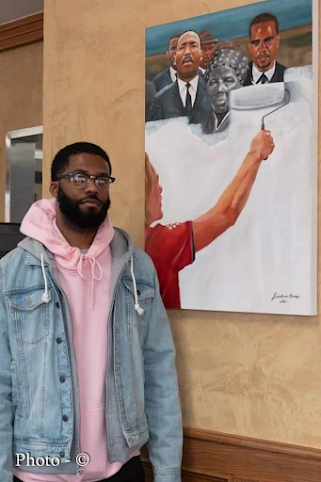
 Artist Jonathan Harris and his painting titled “Critical Race Theory:”


It is almost impossible to find anyone working for racial justice today who cites and uses MLK's life and work as sources and examples. Even on the federal holiday in his honor, the media offer only the briefest nod to his legacy.

Jonathan Harris is right: CRT is the field of white elites who practically have a seizure reading or watching Dr. King's "I Have a Dream" speech. CRT is in fact another white supremacist movement by which white elites demand that blacks and other minorities (but especially blacks) continue to know their place and do what they are told.

At Vanderbilt Divinity School a required course for my M.Div. was Black Religious Leadership. Each of us was assigned to study the life and teachings of prominent black religious leaders. I was assigned Malcolm X. We each had to explain our work and then defend our work and the person's work. (There was no written work to turn in; it was literally an oral exam. My written assignment was on Nat Turner.)

By the time I had completed about half of my sources for Malcolm X, I was thinking, "What exactly makes this guy a radical?" Because frankly, he seemed pretty reasonable to me. And he nailed it, also:


Friday, May 13, 2022

Evil never draws boundaries - here is proof


From former senior NYT reporter Bari Weiss:

The House Pro-Choice Caucus has just released official new language guidance: “Choice” is categorized as “harmful language” when talking about abortion. Yes, as the battle of a lifetime heats up, the House of Representatives’ Pro-Choice Caucus announced that their own name is problematic. Instead of “choice,” the better word is “decision.” They’re getting this from a Planned Parenthood document that argues that the word “choice” implies freedom that many black women don’t have.

From that same document: Instead of saying “pro-choice,” the new preferred phrase is: “Pro-abortion.” Yes: pro-abortion. Is this a joke? It is not.

Dems also have formally dropped the quite effective phrase “safe, legal, and rare,” since rare implies there’s anything wrong with copious abortions. Again, that’s real. Where activists once made huge inroads talking about abortion as a private, difficult choice a woman sometimes needs to make, they now argue it’s not a choice, that it’s not about women, and anyway the act should be celebrated.

Monday, April 25, 2022

Is Vladimir Putin driven by worsening illness?

 There are renewed rumors swirling about Vladimir Putin’s health (HT: Allan R. Bevere). New video shows him apparently gripping his desk tightly while sitting behind it, which the Daily Mail assessed thus: 


There is also video that the Daily Mail says shows "Putin looks unsteady in Easter church service footage showing him biting lip and fidgeting as health rumours grow and war continues to go badly." The Mail also recounts:

Vladimir Putin's five medically-related disappearances

November 2012: Business trips and long-distance flights of the president are canceled, some of Putin's meetings shown by the Kremlin turn out to be 'canned food'

March 5 – 15, 2015: Putin does not appear in public, all meetings are 'canned' - in other words pre-recorded events were shown with the pretence they were in real time

August 9-16, 2017: The President, with journalists, visits Abkhazia and Sochi, and then for a week the Kremlin publishes only 'canned food'

February 2018: In the midst of an election campaign, the president cancels public events. Peskov admits that the head of state 'had a cold'

September 13-29, 2021: Putin goes into 'self-isolation', all events are held via video link

Observers said Putin's actions are consistent with someone suffering from Parkinson's disease, which causes tremors, slow movement and stiffness.

And there is this tweet that purports to show Putin unsteady on his feet and walking somewhat irregularly. 

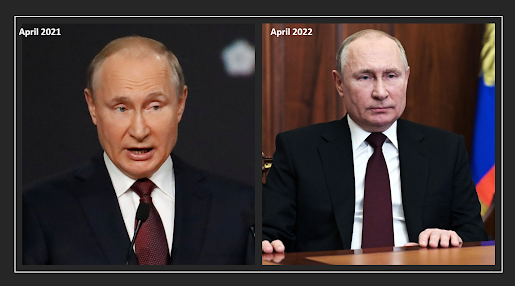
Here, though, are two photos of Vlad taken a year apart. I merged them into one side-by-side shot. The left photo is from an NBC News report from April 2021. The right photo is from now, April 2022, released by the Russian government. Do you see a difference? I do not strongly consider the difference in Putin’s pallor to be very significant because the lighting difference for the photos may have played a major part in that. However, months before now there was speculation that Putin was suffering from a chronic illness that made his face swell, which these (and other photos I saw) seem to show. And Newsweek repeats the rumor is that he is suffering from Parkinson’s Disease. 


Or it may be simply nothing much more than what former CIA Director John Brennan told MSNBC three days ago, “Video of Putin clutching table ‘shows that he’s a man that has quite a bit of stress’.” Yes, that is a ‘well, duh,’ statement, but that really might be all there is to it. Besides, the Russian (dis)info agencies all say Putin is well, is not taking meds or drugs, and is working hard etc. etc. etc.


I  note, though, that I have not found a single report of an actual physician making an observational assessment (not a diagnosis, of course) about what photos and videos convey about his health. So I will be even more pedantic that John Brennan and say simply, "Time will tell." 

Update: Now this:


Monday, June 21, 2021

Stop making Protestant arguments against Catholic bishops!

There is a tempest in a teapot among many of my ministerial colleagues about what the American bishops of the Roman Catholic Church have just done regarding President Biden and other Catholic elected officials. National Public Radio reports:

After a contentious debate, the U.S. Conference of Catholic Bishops has voted to move forward with a process that could call into question the eligibility of politicians like President Joe Biden to receive Communion.

The bishops voted 168-55 in favor of drafting "a formal statement on the meaning of the Eucharist in the life of the Church," officials announced on Friday afternoon, the final day of their three-day virtual meeting. Six bishops abstained.

Biden's election as only the nation's second Roman Catholic president has prompted renewed debate over denying Communion to Catholic politicians who support abortion rights, a position at odds with church teachings.

During their online meeting, bishops held a spirited discussion Thursday before voting on the proposal to direct the bishops' Committee on Doctrine to draft the statement. Such a document, once completed, could include guidelines for denying Communion to public officials.

I say that the reax by my colleagues is a tempest in a teapot not because the issue is not serious but that across the vast spectrum of Americans the bishops' decision has been met with a gigantic yawn, including by the vast majority of non-Catholic clergy. 

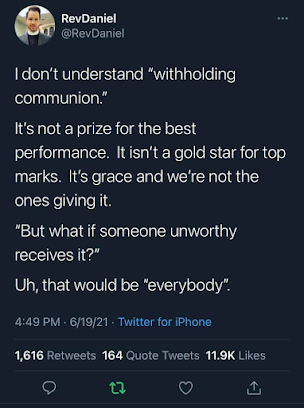
However, many are not happy about it at all. Here is a typical response:


In this post, I am arguing neither for nor against denial of Communion as a practice in the RCC. I am making no judgment whether denying it to President Biden, et. al., should be done or not. My two main points are: 
  1. The RCC's theology of this matter has no real cognate in Protestant churches, so arguing against denial from a Protestant basis is like stepping into a boxing ring by yourself, shadow boxing against an opponent who is not there, then claiming victory in a fight you never actually fought. 
     
  2. It is pretty obvious that tweets like this are not really directed at the RCC bishops, for this is not an attempt to persuade the bishops to reverse. This and other, similar tweets and posts are directed toward the posters own in-group to signal that they are defending not a superior theology of Communion, but political figures whose abortion advocacy must be protected. These are not religious or theological tweets or posts, they are political declarations hiding behind religious language. 
That said, I do not personally take issue with RevDaniel's implied theology of Communion here. The problem is that he is using a very Protestant argument against Catholic bishops, who if they ever read this will know immediately that RevDaniel knows almost nothing about the Catholic theology of the Eucharist (Communion). 

First, RCCs very emphatically believe that no one is worthy of receiving the Eucharist; their catechism says so very precisely. Communicants, those who receive the sacrament, are not worthy of the sacrament but are made eligible by obeying the commandments of Scripture regarding the sacrament. The formal Catholic teaching, or catechism, of the Eucharist includes:

1384 The Lord addresses an invitation to us, urging us to receive him in the sacrament of the Eucharist: "Truly, I say to you, unless you eat the flesh of the Son of man and drink his blood, you have no life in you."

1385 To respond to this invitation we must prepare ourselves for so great and so holy a moment. St. Paul urges us to examine our conscience: "Whoever, therefore, eats the bread or drinks the cup of the Lord in an unworthy manner will be guilty of profaning the body and blood of the Lord. Let a man examine himself, and so eat of the bread and drink of the cup. For any one who eats and drinks without discerning the body eats and drinks judgment upon himself."218 Anyone conscious of a grave sin must receive the sacrament of Reconciliation before coming to communion.

1386 Before so great a sacrament, the faithful can only echo humbly and with ardent faith the words of the Centurion: "Domine, non sum dignus ut intres sub tectum meum, sed tantum dic verbo, et sanabitur anima mea" ("Lord, I am not worthy that you should enter under my roof, but only say the word and my soul will be healed.").

The key sentence for this post is, "Anyone conscious of a grave sin must receive the sacrament of Reconciliation before coming to communion." What the bishops are insisting is that abortion on demand is a grave sin, and its political advocates and enablers would be partaking of the Eucharist in an unworthy manner unless they complete the steps of Reconciliation. Those steps are Confession, receiving Absolution from a priest, and doing the Penance assigned. 

We Protestants need to understand that the sacraments of the RCC are a system and are closely interrelated. This is not much true in my denomination, the United Methodist Church. Our two sacraments of baptism and Communion are related, but not much interrelated. 

Besides, even we UMC ministers formally (though not in practice) "fence" the Communion table in the first paragraph of the litany by saying, 

Christ our Lord invites to his table all who love him, who earnestly repent of their sin and seek to live in peace with one another.

And then we require confession! (Though the confession is a scripted prayer said by the whole congregation, not privately to a pastor.) But read that sentence carefully: We formally (again, not in practice) invite to Communion only those who love God, who repent of sin (which is what the RCC bishops are demanding in the present controversy, only they really mean it) and who want to live peacefully with one another. 

Barring persons from the Communion table has never been part of the UMC's theology, doctrine, or practice, so our verbal fence around the table is mostly symbolic and also a call for each person to examine themselves. However, before we get our Protestant backs up, we should consider that formally, we are not much different from the RCC in qualifying who may receive the sacrament. It's just that the RCC is far more likely to mean it. 

These are not religious or theological tweets or posts, they are political declarations hiding behind religious language. 

Update: An email from a practicing Catholic, Joseph S., points out that the denial of Communion (to one who has sinned and is unrepentant) is intended to protect that person from compounding his or her sin by receiving the sacrament in an unrepentant state. So, yes, denial of Communion is aimed at correction but also at protection. In this way denial of Communion is an act of pastoral care and Christian love. 

Update: Have done some more reading on this general topic, not about the Biden-Communion controversy. There have been for a long time, decades if not centuries, debates within Catholicism about the Eucharist being served to persons still in grave sin, such as divorced Catholics whose marriage was never annulled by the Church and who have since remarried. Catholic doctrine (and some Protestant denominations) consider that to be adultery, which is a state of grave sin. These have been serious debates of varying intensity over the years/decades, and were not tied to politics. A strict interpretation has held that Catholics still in grave sin (politically tinged or not!) should not receive the Eucharist. Some also say that such persons should not be allowed to serve in public ministry such as being a lector, who are lay persons reading Scripture of litanies during worship. So, even within the RCC, eligibility to receive the Eucharist has long been a very complicated issue on matters other than abortion for at least several decades. However, this present controversy could have far-reaching outcomes on Communion and matters other than abortion. As lawyers say, the bishops' lopsided vote on the abortion-Biden matter could set a precedent for other issues unrelated to abortion but still related to the sacrament. We should all pray for the Holy Spirit to be heard and heeded!

Also, the whole concept of denying Communion to a church member is widely misunderstood among non-Catholics to be a form of priestly punishment upon a sinful church member. That is not so. In fact, the emphasis of denial is that the person concerned should be encouraged and assisted to repent and reconcile by their own volition to enable them to approach the altar to receive the body and blood of Christ. Grudging repentance is not repentance at all. It is submission to power, not an acceptance of divine love and its return to God by the communicant. But the Church's goal is to help bring its members to, or back to, a state of loving God and neighbor with all their heart, soul, strength, and mind, and to receive Eucharist in that state, not in mere submission to priestly authority.

The responsibility is on the communicant, God and the Church being his/her helper. I am far from certain that the publicity of the recent vote regarding the president and other Catholic politicians is very helpful, and I have to imagine that among Catholic clerics there is no little discussion of that. 

Wednesday, March 31, 2021

Vaccine passports are white supremacist

The Biden administration has proposed Covid-19 "vaccine passports," according to multiple news reports. (Update, May 24: the state of Oregon has now announced that these will be required to go unmasked in any indoor, public-access gathering.)

The Biden administration is working on creating a set of standards for people to prove they've been vaccinated against Covid-19, according to an administration official.

The official said they're currently working with a range of companies on the standards, including non-profits and tech companies, adding that they are likely still weeks away from being finalized, the official said.

Multiple government agencies are engaged in conversations and planning, coordinated by the White House, as this kind of system will play a role in multiple aspects of life, including potentially the workforce, another senior administration official told CNN. [Link]

Implementing vaccine passports would be a white supremacist measure. This does not require a long explanation, so let's get straight to the point: poor people are much less likely to be vaccinated than higher-income persons, such as in these states:

But racial demographics are not spread evenly across income deciles.  

Any gap in vaccinating rich versus poor inevitably exacerbates racial divides. Black and Latino people are far more likely to live in poverty than white people, and despite having died at higher rates throughout the pandemic, they are receiving fewer vaccines than white people.
According to the long-set standards of Black Lives Matter and other critical-theory advocates, whether racial disparities like this are intended or not is irrelevant. These disparities are the results of racial discrimination and white privilege baked into the social-legal-medical networks for centuries. Therefore, it does not matter that this gap in immunization is not intended. It does not matter that the men and women managing the vaccine program and distribution, or administering it to the public, do not discriminate at the vaccine sites by the race of persons who come for the shots. (For clarity's sake I emphasize that I have not found any statement by BLM on vaccine passports; I am not quoting BLM here specifically on the passports, but using their long-established criteria to address the topic.)

Lack of deliberate intent does not excuse systemic racism. The fact that matters is this: "Black and Latino people are far more likely to live in poverty than white people, and despite having died at higher rates throughout the pandemic, they are receiving fewer vaccines than white people." 

Furthermore, a Research Letter published in the Journal of the American Medical Association revealed that even among health-care workers, 
... health workers in all ethnic groups were more likely to accept vaccination than were the same groups in the general population, but large disparities nevertheless persisted, the largest being between whites and blacks. Among the health workers, for example, about 35 percent of blacks said that they were not likely to accept the vaccine compared with about 10 percent of whites. The corresponding figures for the general population were about 60 percent and 24 percent, respectively. All other groups fell somewhere between blacks and whites.
"But such disparities exist mainly because blacks are simply deciding to refuse vaccination at higher rates than whites," is one response. "Everyone has the opportunity and so if more blacks than whites decline the shot, then it's their own fault." 

Of course, such a response can come only from a position of privilege. It concretizes rather than addresses the white supremacism of vaccination processes and passports. The passports will obviously be issued only to persons who have completed the vaccination shots. And that means that a vaccine-passport system will be just as racially unjust as vaccine administration. 

Passports will inevitably privilege white people over people of color. Whites will be advantaged for travel, for attendance at sporting events or even government functions open only to passport holders. And as CNN's report above indicates, whites will be massively over-privileged also for employment and job assignments. Jim Crow could not have thought of a better way to widen the income and social inequality gaps between whites and POCs. 


But at least there are no more mean tweets, so all is well. 

Update: A reader has pointed out another white supremacist aspect of this plan, namely that the vaccine passport's main means of distribution will be electronic. And that will require passport holders to have a smart phone, an app, full internet service and online accounts. Guess which economic and racial demographic is less likely to have those things? Although to be fair, the digital divide between whites and blacks is small for smart phones. See here.

It is also worth remembering that in the former slave states, manumitted blacks were required to carry with them at all times their certificate of manumission. If they didn't and so failed to produce them on demand, they could be (and were) returned immediately to slavery. So there is a certain history of "show me your papers" for black people that whites do not have. A lot of criticism by whites of the vaccine passport has been to compare it to Nazi Germany or the Soviet Union. Fair enough. But for black Americans, a more apt comparison would be to compare it to the Confederate Home Guard, described by some historians as the Gestapo of the Confederacy. 

Update: Are we seeing a pattern emerge from this administration? 
[A]ccording to a Thursday report in the Washington Post, the White House is being warned that too much focus on “physical” infrastructure could lose the bill support among minorities, because such a focus would represent “nostalgia” for an era where “working class whites” benefitted from government welfare, and could be considered both “racist” and “sexist.”
 
“Some people close to the White House said they feel that the emphasis on major physical infrastructure investments reflects a dated nostalgia for a kind of White working-class male worker,” the Post noted Thursday.
Racist and sexist in the same bill. Quite an accomplishment.


And as someone commented elsewhere, will Oregon require vaccine passports to be presented at voting stations? 

Tuesday, March 23, 2021

More divided now than ever


I used to believe that the USA is as divided now as it was in 1860, and as the 1860 electoral map shows, the country was very divided then. But I think we are far more divided now than then. 

Born and raised in the South, I was taught the mythologies of the South's secession and of the Civil War, especially those of the "Lost Cause" of the South and what I came to call "Noble Lincolnism" in the North. But after I decided to do my own research of the era, I discovered that almost all I thought I knew was simply Bravo-Sierra. 

I learned that not only was slavery the focal point of the country's disunity, it was in fact the only meaningful point of the nation's disunity. That is, in 1860 the South and North were not really in dissension over anything substantive but slavery, not even on secession. (After all, there was an active secession movement among state-level politicians, including the governor, in Wisconsin in 1860!)

On almost every other principle of America's founding and the structure and purpose of government, there was practically no disagreement between North and South. By 1860, though, all the areas of basic commonality were fully overshadowed by the slavery issue with all its moral and political implications, but both the USA and the temporary CSA were established as representative republics with governments of limited powers and authority. 

But today, the American Left and Right share almost no commonality of political world view. I am an ordained United Methodist minister, now retired, and I suggest that what is happening to the country is well illustrated by what has happened to the United Methodist Church, the third-largest religious denomination in the country.

The UMC began grappling with homosexuality in the 1976 General Conference of the church. In our polity, the GC, as it is called, is the only body that can set rules and regulations for the whole denomination. The GC meets every four years for two weeks and does not exist in between. 

Beginning in 1976, advocates for full inclusion of homosexuals in all offices of the UMC began their fight. Then and in each successive GC until 2016, they fought for the GC to approve ordination of homosexuals and to include officiating of same-sex marriages or unions as part of all pastors' ministry, to include such services in UM churches' sanctuaries. 

They never succeeded. Finally, 2016's GC set a special GC for 2019 that would have the sole task of resolving the issue once and for all. All the delegates agreed that the 2019 GC would determine the final answer and that neither the advocacy nor traditionalist side would raise it again. That GC met in February 2019 and voted to retain the status quo and in some details to strengthen it.  

Of course, it did not "resolve" the issue at all. The advocacy side doubled down and reorganized while the traditionalists stood around and patted themselves on the back for winning. As the result, the liberal-progressives dominated elections for delegates to the 2020 General Conference. In the meantime, an ad hoc commission was established to find a way forward. It announced that secessionism was the only answer for 2020 (although of course it was not called that) and with the Council of Bishops' approval, the first order of business for the 2020 GC was to be a vote on the dissolution of the United Methodist Church into at least two denominations. 

The 2020 GC did not take place because of Covid. It was rescheduled for this year, then rescheduled to begin in late August 2022 (update: now rescheduled again to 2024). Even so, there are no voices anywhere calling for reconsideration of dissolution. That die has been cast even though the vote remains 18 months away. 

It took from 1976 to 2019, but both sides finally realized that they each understood all matters of the issue and that no new arguments, no new theology, no new insights, and no more debates were going to go anywhere. No one's mind was going to be changed. No compromise was possible because the fundamental tenets of each sides' beliefs and religious world view had been pared down to their core. There was nothing left for either side to give that did not equal full surrender. And no one was going to raise the white flag. 

So secession. Sorry, I mean, "Protocol of Reconciliation and Grace through Separation." 

Welcome to America today, the UMC analogically writ large. Like the UMC, the coming dissolution of the United States began long ago. I think it actually began in the Civil War, which IMO is when the "imperial presidency" really began, though the seeds did not sprout until Wilson's disastrous presidency. But then they did take deep root and have grown ever since. 

Just as Lincoln's election brought secessionism into the fore in 1860, the one-two punch of Trump-then-Biden are the levers that are fracturing the country now. There simply is no compromise even possible between Left and Right any more because there is no common ground or understanding on how the country should move into the future. By "no," I mean zero. 

No common ground at all on these matters; there is no longer any "centrist" position:

  • Limited government
  • Size of government
  • Scope of government
  • Authority of government
  • Reach of control by government
  • Global warming - climate change - environmental policy
  • Who controls election processes in states
  • Who gets to vote
  • How voting is done
  • How votes are secured
  • How votes are validated
  • What is the meaning of citizenship
  • Immigration
  • Use of technology
  • Meaning of privacy
  • Meaning of human rights
  • What does the word, "unalienable" mean
  • What does federalism mean
  • Control of the judiciary
  • International relations
  • Energy policy
  • Federal spending
  • Abortion
  • Identity politics
  • The right to keep and bear arms
  • What is "truth?"

I could go on, of course, but I think that gets the idea across. I do not see how a dissolution of the country is avoidable. Avoidance will require sincere and enduring compromises of politics from both Left and Right, compromises that are not actually possible because they would require the surrender of fundamental tenets of political belief. That is not going to happen. 

So what will be the tripwire for us? I think it will be the 2022 mid-terms. No matter which party comes out ahead, the result will be soundly rejected by the other side. I pray that the aftermath will be peaceful, but I am not going to bet any money on it. But the United States as we have known it until now will begin dissolving then. 

God, I hope I am wrong. 

Related: The Priesthood of Politicism Offers Only Damnation

Update: As to be expected, Angelo M. Codevilla gets more to the heart of the matter than I, although his paper and my essay do not disagree. He is a senior fellow of the Claremont Institute and professor emeritus of International Relations at Boston University. Read, "American Exodus."

Update: "America never more politically divided than under Biden." 

The latest Gallup research shows that under President Joe Biden, the partisan gap has reached its widest point, surpassing the gulf under former President Donald Trump and likely making Biden the all-time leader of partisan approval.

In Biden’s first months, the gap between approving Democrats and Republicans has been 86 percentage points. That means Biden is approved by 96% of Democrats and 10% of Republicans. He easily beat his former boss, former President Barack Obama, by seven points.

By comparison, Trump had 87% approval among Republicans and 10% among Democrats. While he bragged about his GOP approval, former President George W. Bush had a higher (89%) rating with Republicans in his early days. ... 

The survey is the latest to show the political division in America growing after the heated 2020 election. It follows another from Rasmussen that found bipartisan agreement that "cheating" helped Biden win the election.

 Update: The Univ. of Virginia: "New Initiative Explores Deep, Persistent Divides Between Biden and Trump Voters."

— Majorities of Trump and Biden voters express support for several elements of the bipartisan infrastructure and reconciliation bills being debated in Congress, but there are marked differences in their levels of support. (see Table 1 below)

— Majorities — often large majorities — of both Biden and Trump voters express some form of distrust for voters, elected officials, and media sources they associate with the other side. A strong majority of Trump voters see no real difference between Democrats and socialists, and a majority of Biden voters at least somewhat agree that there is no real difference between Republicans and fascists. (see Table 2 below)

— Significant numbers of both Trump and Biden voters show a willingness to consider violating democratic tendencies and norms if needed to serve their priorities. Roughly 2 in 10 Trump and Biden voters strongly agree it would be better if a “President could take needed actions without being constrained by Congress or courts,” and roughly 4 in 10 (41%) of Biden and half (52%) of Trump voters at least somewhat agree that it’s time to split the country, favoring blue/red states seceding from the union. (see Table 3 below)

City Journal: The New Secession Movement | City Journal (city-journal.org) 

Washington Free Beacon: "The Sense of an Ending" Dec. 3, 2021.

Whatever happens, I find I cannot escape the sense that America has reached an impasse, that it has arrived at a moment of transition, and not just on the matter of abortion. Whether one looks at politics, economics, or the world, one sees a realignment of forces, a shuffling of players off and on the stage, to prepare for the next act in the drama. The Trump presidency seems less like the harbinger of a new beginning than a spectacular climax to a historical epoch. If so, we are living through a sort of denouement, a working through of conflicts left unresolved. "It feels like the order we have all taken for granted since the end of the Cold War is badly decaying, and has gotten so fragile that it might well shatter soon," wrote Damir Marusic of Wisdom of Crowds last month. Question is: What replaces it?

The U.S. is Heading Toward a Second Civil War. Here Is How We Avoid It --  The author offers no guarantees, but his prescriptions at minimum can do no harm. 

Self-hating elites are destroying our commonwealth, by Mackubin Owens, a senior fellow of the Foreign Policy Research Institute in Philadelphia

Monday, March 22, 2021

The Priesthood of Politicism Offers Only Damnation

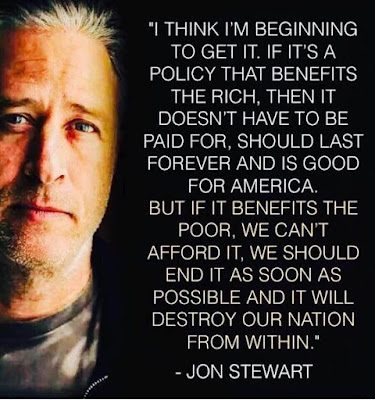
A progressive friend of mine posted this on his FB page. I was tempted at first to respond that the singular exception of either party that comes to mind is Donald Trump, in whose administration the incomes of minorities and the lower half of income earners rose faster and by a larger proportion than of whites and the upper earners. And that under Trump's policies, minority unemployment reached the lowest ever recorded. 

But I didn't so reply. Instead, it struck me that Stewart was basically correct, and that naming Trump as the exception simply buttressed Stewart's point. In fact, I agree with Stewart, but not fully because Stewart does not go near far enough. He pulls up way short of the issue. 

Following are three links, all dating well before Trump was even on the political scene at all, which should give a clue that the corruption of the federal government by far predates Jan. 20, 2017. 

The first is on billmoyers.com. Bill Moyers, now 86, is a lifelong Democrat who served as LBJ's press secretary for two years. His liberal-progressive creds are solidly established. And on his site is this article: "Anatomy of the Deep State," by Mike Lofgren. 
Yes, there is another government concealed behind the one that is visible at either end of Pennsylvania Avenue, a hybrid entity of public and private institutions ruling the country. ... the state within a state is hiding mostly in plain sight, and its operators mainly act in the light of day. Nor can this other government be accurately termed an “establishment.” All complex societies have an establishment, a social network committed to its own enrichment and perpetuation. In terms of its scope, financial resources and sheer global reach, the American hybrid state, the Deep State, is in a class by itself.
And as Lofgren explains, not only is it in a class by itself, it is in a class for itself and no one else. 

Second is a paper of a research project by Cambridge University, which, being in England, can hardly be accused of having a dog in the fight. Cambridge says its empirical research of American politics shows that
... economic elites and organized groups representing business interests have substantial independent impacts on U.S. government policy, while average citizens and mass-based interest groups have little or no independent influence.
Well, duh.
Third is, "America’s Ruling Class And the Perils of Revolution," by Angelo Codevilla. He is Prof. Emeritus of international relations at the Pardee School of Global Studies at Boston University. He also served as a foreign service officer and professional staff member of the Select Committee on Intelligence of the United States Senate.
Today’s ruling class, from Boston to San Diego, was formed by an educational system that exposed them to the same ideas and gave them remarkably uniform guidance, as well as tastes and habits. These amount to a social canon of judgments about good and evil, complete with secular sacred history, sins (against minorities and the environment), and saints. Using the right words and avoiding the wrong ones when referring to such matters — speaking the “in” language — serves as a badge of identity. Regardless of what business or profession they are in, their road up included government channels and government money because, as government has grown, its boundary with the rest of American life has become indistinct. Many began their careers in government and leveraged their way into the private sector. Some, e.g., Secretary of the Treasury Timothy Geithner, never held a non-government job. Hence whether formally in government, out of it, or halfway, America’s ruling class speaks the language and has the tastes, habits, and tools of bureaucrats. It rules uneasily over the majority of Americans not oriented to government.
As I said, all of these articles were published before Donald Trump was part of the country's political scene. Despite all the fury about Trump's presidential tweets and often off-putting personality, the real reason Washington pushed back against him was because "he is not one of us." It is true that under Trump the rich got richer, which ordinarily would be greeted joyously by Democrats and Republicans alike (but especially Democrats, who are now the party of and for the upper class). But that was far overwhelmed by the fact that the non-rich got richer also, and by higher margins than the wealthy. So the Trump years essentially were a time of wealth transfer from the wealthy Political Class to the non-Political Class, and that was simply intolerable. 

As Ben Weingarten explained last year, Trump exposed the rot and corruption of our ruling class.
[O]ne of President Donald Trump’s myriad achievements stands above all others: he has exposed the unprecedented degree of rot and corruption that pervades the American system.
 
More specifically, Trump has exposed the ruling class: the bipartisan political establishment and its adjuncts in Big Tech, the corporate media, Big Business and Woke Capital, the academy, and across the commanding heights of American society.
 
Trump’s manners engender hatred in the ruling class. Even more significantly, his tenacity in confronting the ruling class’s members with their failures—and the fact he has threatened to rectify those failures—discredits and disempowers those responsible for them. Their response—a perpetual effort to destroy him—has shown the ruling class to be lawless and tyrannical.
But Trump's truly unforgiveable sin for which no redemption was possible was this: he accurately identified China as the chief threat to America's political security, and took steps to oppose it. The literally uncounted and uncountable tens to hundreds of million dollars the Chinese Communist Party has poured into Political Class pockets has become its addiction, and no one is ever going to be allowed to turn it off or even reduce it. 

Two months before 2016's election, it was clear to Prof. Codevilla that America's status quo "has resulted in citizens morphing into either this class’s stakeholders or its subjects." 
From the primary season’s outset, the Democratic Party’s candidates promised even more radical “transformations.” When, rarely, they have been asked what gives them the right to do such things they have acted as if the only answer were Nancy Pelosi’s reply to whether the Constitution allows the government to force us into Obamacare: “Are you kidding? Are you kidding?”
 
On the Republican side, 17 hopefuls promised much, without dealing with the primordial fact that, in today’s America, those in power basically do what they please. Executive orders, phone calls, and the right judge mean a lot more than laws. They even trump state referenda. Over the past half-century, presidents have ruled not by enforcing laws but increasingly through agencies that write their own rules, interpret them, and punish unaccountably—the administrative state. 
In 2004, Glen Wishard wrote "A Thumbnail History of the Twentieth Century," boldface original:

The common theme is politics as a theology of salvation, with a heroic transformation of the human condition (nothing less) promised to those who will agitate for it. Political activity becomes the highest human vocation. The various socialisms are only the most prominent manifestation of this delusion, which our future historian calls "politicism". In all its forms, it defines human beings as exclusively political animals, based on characteristics which are largely or entirely beyond human control: ethnicity, nationality, gender, and social class. It claims universal relevance, and so divides the entire human race into heroes and enemies. To be on the correct side of this equation is considered full moral justification in and of itself, while no courtesy or concession can be afforded to those on the other. 
Therefore, politicism has no conscience whatsoever, no charity, and no mercy. 
I have said before that politics is the religion of America today, frankly much more on the Left than the Right, but not absent from the Right at all. 

Orwell was correct that politics very easily can can become nothing but gaining and keeping power. When that happened within one party - note past tense - in America, no one should be surprised that eventually the other party followed suit. 

That is where we are: politics in America is a literally religious-type quest for power - and for nothing else at all. We are way past (I say many years past) the times when effective, enduring compromise was possible. It is not. 

I do not see any way to reverse this. I am reminded of a disease I read of some time ago, that once it becomes symptomatic, it is too late to treat it. I think that politically that is where we are now. It seems clear to me that we no longer live in the "United" States of America, and I see no way to regain that. 

The question is whether the United States will survive in its present form, or will some kind of dissolution come to pass. Personally, I am not optimistic. 

 
See also:

Social Democracy is Collapsing Before our Eyes - American civic life is fracturing, and everyone knows it.


A world without nuclear weapons - what would it look like?

 From Pope Leo this week, according to the National Catholic Reporter : " Pope Leo quotes Bob Dylan song in book foreword calling for n...