Showing posts with label Ukraine-Russia. Show all posts

Monday, March 3, 2025

"I stand with Ukraine" means what, exactly?

Ukraine has only two choices

I am not going to dwell on the now-infamous, televised meeting that Ukraine's President V. Zelensky had with President Trump last Friday in the Oval Office. It is the outcome of the meeting that matters now. Why the meeting went the way it did does matter, but it is not my subject here. 

There are now only two paths forward for Ukraine, and therefore for the United States, NATO, and the EU nations who have supported Ukraine. I note that very quickly after the Oval office meeting adjourned, many progressives and Democrat figures posted memes like this one. 


Yet no one who posted this meme explained what exactly it means. As I asked at one such post, "If a Ukrainian in the war zone read your post, 'I stand with Ukraine,' what exactly would you want her to think you mean? How would you describe the ways her life and future will be better?" 

So let's take a look at the two - and only two things "I Stand With Ukraine" can mean. There are no other choices. 

First, though, I want to explain my creds in what I will write. I am a retired Army artillery officer with command and war-planning experience and responsibilities from battalion level to corps level and at the Pentagon, including at the Army Operations Center there. I have written operation plans and planning documents for actual shooting wars. I had the highest security clearances, including for nuclear and chemical target analysis, custodianship of actual atomic weapons, and decryption of Nuclear Control Orders. I am a graduate of the US Army Command and General Staff College. During part of my Pentagon tour I served on the personal staff of the Secretary of the Army. Now to continue:

Here are the only two things "I Stand With Ukraine" can mean:

ONE. I want the Ukraine war to continue on indefinitely in the same way it is going now. That means that I want more and more Ukrainian military and civilian personnel to die, more Ukrainian infrastructure to be destroyed, and countless more Ukrainians to refugee out of their country. 

TWO. I want the combat and killing to end and an enduring peace to be achieved, even if it means the status quo antebellum is not reestablished. 

The first thing operations and strategy planners do when going to work is to ask one simple question: "What is the status quo?" That is, what are the realties that exist now that we have to take into account? What is the situation and its implications? Regarding the Ukraine war, here are the important realities:

First, Russian forces have taken control of considerable Ukrainian territory (map source: BBC):

Zelensky has said - over and over since the war began - that he will accept no end of the war that does not include ejection of Russians from the territories they occupy in eastern UKR. In fact, he stated that point strongly in the now-infamous Oval Office meeting with Trump

Putin, however, insists that those territories are Russian home soil, not Ukrainian. In fact, it is true that they are large majority, ethnically Russian. Putin either does not know or does not care that the reason for that is that Stalin ejected and murdered Ukrainians living there and moved Russians in. Putin has threatened to use nuclear weapons to keep possession of those territories (although he has not repeated the threat very recently). 

Both sides have lost enormous numbers of personnel and military equipment. I would say that if Putin and co. are both willing and able to suffer even more such losses, they could push westward enough to set the terms for an armistice. That is a big if, though.

As for UKR, it simply does not have the human resources to recover the occupied territories, no matter how well armed they may be in the attempt. They did attempt it in 2023, when their military was much better manned (and womaned) and they failed miserably. After four months of a weak offense against Russian positions, UKR's army was on pace to recover the occupied territories - in 16 more years. Even Time magazine reported that UKR insiders near Zelensky said they all knew this, but that talking to Zelensky about it was a waste of time. 


That is the status quo, meaning both sides will continue to attack each other, but with no real changes on the map resulting. Again: this is what Zelensky stated very specifically he wanted to continue. And that is what Trump was trying to end and what Democrats also want to continue, apparently forever.

What was the reaction from Europe? Occupy Democrats posted this on Feb. 28:


Note that most of the Euro leaders simply said, "We stand with Ukraine," without saying exactly what that means. By default, it means they are choosing Option One: continuing, inconclusive warfare with more death and destruction and no end in sight. The relatively few nations that stated they wanted peace did not define what steps are necessary to achieve it or what acceptable terms are for peace. For example, Prime Minister of the Netherlands Dick Schoof: "... We want a lasting peace and an end to the war of aggression started by Russia." 

Well, duh. We all want peace, even Zelensky has said that. It is worth noting, however, that Zelensky demands peace with "security guarantees," but he has never addressed what those guarantees would be, how they would be accomplished, or who would guarantee them. 

I wonder, though, how aware these national leaders are of their own populations' attitude toward supporting Ukraine, which is both (a) Ukraine needs more support, but (b) not from my country:


So, to those who insist they "stand with Ukraine," please choose which option you mean. Do you mean you want the war to continue indefinitely? If so, why? Is there a time limit for supporting the status quo that once expired would turn you to wanting an end to the war? Or is there a limit to how many more Ukrainians may be violently killed that would change your mind? Or do you just want the combat to continue with no end? 

Or do you want the war to end as soon as possible? If yes, how? What would be your plan to end it? I echo what the Army Chief of Staff used to remind us at the Pentagon when we made plans: "Hope is not a method and wishes are not plans." What actions would Ukraine, the US, and Euro/NATO nations need to take to bring UKR and Russia to at least an armistice/ceasefire, even with more permanent details to be worked out afterward? President Trump did at least state them while no one else has. 

Finally, hating Trump is merely cheap virtue signaling. It is neither a method nor a plan. But if you feel better about hating Trump than you feel bad about Ukrainians getting killed with no end in sight, then you are morally bankrupt and God forbid you have any say in what happens. 

Links and pertinent info:

NATO's empty promise to Ukraine

Ukraine: Zelensky is a true hero, but does he have a clue? 

What Is America’s Strategic Interest In Ukraine?

What if Putin nukes Ukraine?

Ukraine on Fire documentary

 From Oliver Stone in 2016, so obviously not including recent events. But it does explain that no one's hands are clean, including America's. As for its sub-head, "Russian Aggression or American Interference?" well, as the saying goes, embrace the power of "and."

NATO RIP - Ukraine, Europe etc. Ukraine is probably going to RIP NATO into bits

10 Hard Facts About Ukraine and NATO, by retired Colonel and Army War College graduate Kurt Schlichter. 

Ten bad takeaways from the Zelenskyy blow-up, by renowned historian Victor Davis Hanson.

A view by the German editor-in-chief of Asia Times: Europe’s dangerous delusion of defense without the US - Europe can dream about strategic autonomy but the reality is it wholly lacks the military means to defy Trump’s Ukraine peace plan

Friday, July 14, 2023

Ukraine: Zelensky is a true hero, but does he have a clue?

I posted a couple of days ago on why NATO's decision not to invite Ukraine into NATO membership was a very sound decision. But also I related why NATO's assurances to Ukraine that an invitation to join will come someday are not realistic. Reuters: 

The leaders said in a declaration: "Ukraine's future is in NATO". But they offered no timeline for the process.

"We will be in a position to extend an invitation to Ukraine to join the alliance when allies agree and conditions are met," the declaration said, without specifying the conditions Ukraine needs to meet.

NATO was deliberately vague because its members have no sort of agreement on such conditions. Other reports say that no invitation will be made until after the end of the war. In fact, the NYT reported:

In a communiqué agreed to by all 31 NATO nations, the alliance said that “Ukraine’s future is in NATO,” and it will be allowed to join when the member countries agree that conditions are ripe — but it did not offer specifics or a timetable. ... 

The wording means that Mr. Biden, who declared last week that “Ukraine isn’t ready for NATO membership,” and like-minded allies had prevailed over Poland and Baltic nations that wanted a formal invitation for Ukraine to join the alliance as soon as the war ends.

Affirming an applicant nation into NATO requires unanimous vote by all member nations. Of course, that is not merely possible, it was done this week by admitting Sweden into NATO. But the tagline of the NYT quote, an "invitation for Ukraine to join the alliance as soon as the war ends," simply tells Russian President Putin to keep fighting as long as he can. And despite the fact that Russian troops have by no means covered themselves in glory in the war, Putin has a vastly larger reservoir of Russians to draw from than Zelensky has Ukrainians. 

Therefore, I have to think that by now Ukraine's President Volodymyr Zelensky is at least beginning to understand that Ukraine's admission to NATO is this:


So I surmise that Zelensky does have at least a clue about that. I wonder, though, about this: Last Sunday (July 9) he appeared on ABC News’ This Week. (Naturally, the lead in the linked story is about Trump, not Ukraine's situation or the NATO summit beginning two days later.) 
Ukrainian President Volodymyr Zelensky called out Donald Trump on Sunday for his outlandish and repeated claims that he could end the country’s drawn-out conflict with Russia in just a day if re-elected. 
He [Zelensky] made the statements ... noting tensions between the two former Soviet countries were already ratcheting up during Trump’s years as president—and that he did little to lower the temperature.

“It looks as if Donald Trump already had these 24 hours once in his time,” Zelensky said through a translator. “We were at war, not a full-scale war, but we were at war, and as I assume, he had that time at his disposal but he must have had some other priorities.”

Zelensky also rejected Trump’s past suggestion that Ukraine cede some of its contested territory to Russia as a peace offering—saying that he rejected such propositions wholeheartedly.

“If we are talking about ending the war at the cost of Ukraine—in other words, to make us give up our territories—I think, in this way, [President Joe] Biden could have brought it to an end in five minutes,” Zelensky said. 
“But we would not agree,” Zelensky added.

 Well, what Zelensky said about Trump (and Biden) is not very arguable. Here is what Trump said last March:

The ex-president said that if the war is not over by the end of the 2024 presidential election, and he were to be reelected to the White House, he would “within one day” have a peace deal in place.

Trump argued that negotiations between himself, Ukrainian President Volodymyr Zelensky and Russian President Vladimir Putin would be “easy.” 

“If it’s not solved, I will have it solved in 24 hours with Zelensky and with Putin, and there’s a very easy negotiation to take place, but I don’t want to tell you what it is because then I can’t use that negotiation,” Trump vowed, not so much as hinting at what his negotiation strategy would be. 

Now, that is a remarkably stupid thing for Trump to say, even for, well, Trump. That Zelensky took issue with it, somewhat gently I would add, is unsurprising. But here is where Zelensky either does understand the probable end to the war and is trying hard to call it off, or he does not understand and hence does not have a clue about what is really going on. 

Does Zelensky understand that his national goals for the conflict are not automatically the same as US or NATO's national strategic interests? Presently, they coincide closely, but much of our support for Ukraine stems from our disgust for the inhumane, unprovoked aggression it has suffered. However, that motivation will only last so long. 

As said in my prior post, I have supported the US and NATO efforts to date in assisting Ukraine diplomatically and materially, with military supplies and weapons. I continue to support such measures. 

But I also say that if Zelensky thinks that we will always support him, financially and materially, to fight a Forever War, he will be and should be very, very wrong.

Source: The Hoover Institution

He might also consider one simple question: Would he rather have the terms ending the war dictated to him by Moscow or by Washington and NATO?

Friday, October 7, 2022

What if Putin nukes Ukraine?

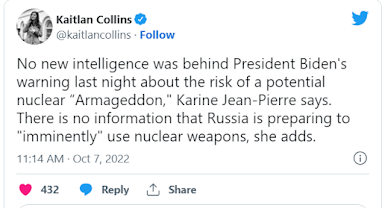
Is Armageddon coming?

Last night (10/6/2022), President Biden spoke at a fundraiser and said this (via the AP):

“[Putin was] not joking when he talks about the use of tactical nuclear weapons or biological or chemical weapons,” Biden said. “We have not faced the prospect of Armageddon since Kennedy and the Cuban Missile Crisis.”

The White House lost no time walking that back:


Europe's national leaders were also publicly averse to the president's comment. The AP reported, 

Asked about Biden’s remarks, French President Emmanuel Macron said it was crucial to speak with care on the nuclear threat.

“I have always refused to engage in political fiction, and especially ... when speaking of nuclear weapons,” Macron said at a EU summit in Prague. “On this issue, we must be very careful.”

Indeed. However, it is true that Vladimir Putin has said more than once that using nuclear weapons is not off the table. 

Putin has repeatedly alluded to using his country’s vast nuclear arsenal, including last month when he announced plans to conscript Russian men to serve in Ukraine.

“I want to remind you that our country also has various means of destruction ... and when the territorial integrity of our country is threatened, to protect Russia and our people, we will certainly use all the means at our disposal,” Putin said. “It’s not a bluff.”

Understand that Putin has already said many times that the ethnic-Russian parts of eastern Ukraine (Donetsk, Luhansk, Zaporizhzhia and Kherson) are part of Russia itself. Russian forces continue to occupy those regions but are facing increasingly effective actions by Ukraine's armed forces. Putin has been clear that these regions are not and have never been legitimately part of Ukraine but have always been Russian. So when Putin refers to the "territorial integrity of our country," he is absolutely including those regions as part of "our country." Putin has been repetitively clear that annexing the four territories is nonnegotiable, adding that Russian would defend them “with all the forces and means at our disposal.”

Does that include using nukes? Well, Putin did not explicitly say using nukes is on the table. But he certainly never even remotely ruled them out; if using "all the forces and means at our disposal" does not include them, what does it mean? As well, Putin said in a speech on Red Square at the end of September that the nuclear threshold in the Ukraine war had already been crossed! He said specifically that the atomic bombs the United States dropped on Japan in 1945 had “created a precedent.” 

But there is (we hope) a long way to go from "we can" to "we will." And surely this interview with retired US Army four-star general and former head of the CIA, David Petraeus, is mere coincidence. US would destroy Russian forces if Putin uses nukes: former CIA head Petraeus:

The US and its NATO allies would destroy Russian forces and sink the Black Sea fleet if Vladimir Putin decides to use nuclear weapons in Ukraine, former CIA Director David Petraeus has predicted.

The retired four-star general spelled out in an interview on ABC’s “This Week” on Sunday what he believed would happen if the Kremlin warmonger used nuclear weapons.

“We would respond by leading a NATO — a collective — effort that would take out every Russian conventional force that we can see and identify on the battlefield in Ukraine and also in Crimea and every ship in the Black Sea,” he said.

Petraeus said Russia’s use of nuclear weapons in Ukraine would not trigger NATO’s Article 5, which calls for collective defense of member states, because Ukraine is not part of the alliance.

But he said that if Putin were to use nuclear weapons, the high probability that radiation from the strike would affect a member of the alliance could possibly be construed as an attack against NATO and fall under Article 5.

Remember that Petraeus is not speaking for the Biden administration. We hope. 

American and NATO options

So: how can we respond if the Russians use a nuclear weapon in Ukraine? Bear in mind that there is no "good" response to a Russian nuke in UKR. Petraeus laid out a massive NATO response, which if done would have a very high probability of beginning a general war with Russia. 

Worse, Petraeus did not go to the step after: 

  1. Step One: Russia nukes Ukraine. 
  2. Two: Massive retaliation as Petraeus describes. 
  3. Three: Russia admits defeat and withdraws its forces from Ukraine and promises to be nice from now on. Right? 
  4. Or Three: Russia attacks American bases in the Mediterranean and its submarines target US Navy vessels. Or some other elevation of the conflict, including more nukes. 

Russia can nuke Ukraine. NATO can respond as NATO decides. After that, the crystal ball is not merely cloudy, it simply no longer exists. I am reminded of what Otto von Bismarck supposedly said, that to start a war is like entering a dark room blindfolded to look for a black cat that is not even there. 

What if Russia's nuke kills no one? 

Petraeus also seems to assume that a Russian atomic attack would be highly destructive and cause massive casualties. If I was Putin and decided to use a nuke, I would make sure it damaged nothing and killed no one. Yes, this can be done, easily in fact. And then I would warn that if my diktats were not obeyed, the follow-up would be very severe. 

During my US Army career as a field artillery officer, the artillery had several types of atomic warheads, ranging from the 155mm and 8-inch howitzers to Lance tactical and Pershing II strategic missiles. These atomic warheads and projectiles had yields ranging from close to the Hiroshima bomb all the way down to one for which the Minimum Safe Distance (MSD) for unwarned, exposed personnel was only 650 meters - or 0.4 mile! I was trained as a nuclear target analyst and I worked attack profiles for all these warheads against a wide variety of target types. 

So what do we do if Russia pops a less-than 1 kiloton warhead in the middle of nowhere in UKR for which the MSD is very, very low and no village is within it by a large margin? Atomic weapons kill or destroy in two ways: the blast, of course, and radiation. Lethal radiation includes gamma rays, neutron emissions (fairly low in a conventionally-designed warhead), and infrared, or heat. For a very low yield warhead, as I said, these all become negligible after only several hundred meters.

As for atomic fallout, that occurs only if the detonation's fireball touches the surface of the earth. My references always included the radius of the fireball from point of detonation, so fallout is fully avoidable. In fact, US policy has forbidden fallout for at least 50 years. Absent fallout, you still get what is called downwind radiation hazard, but the effects of this are more attenuated than of fallout (although DWR is not negligible by any means). And I am pretty sure that Petraeus was referring to that as the "radiation hazard." 

So, after such a detonation, the Russians have irradiated a small area of dirt in UKR with zero to few persons killed or affected and practically no infrastructure damage. Obviously, Putin would be signaling to show that a second attack will be more powerful and harshly located. And UKR and NATO would have to take that demonstration shot very seriously.

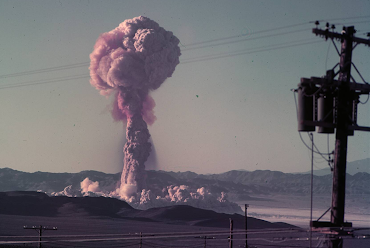
This is a very small atomic explosion

But do we wipe out Russia's Black Sea fleet for that? Bomb Russian troops in Ukraine? That simply invites Putin to unleash his arsenal against US forces in Europe, at minimum. Then what do we do? The only next step for us would be general war against Russia, for which the nuclear threshold has already crossed.

Putin has the first move

I hate to say it, but Putin holds the cards here. Why? National Review's Michael Brendan Dougherty points out the inexplicable lack of depth in Petraeus' answer:

So, the top minds in the administration and one of the most respected generals of his generation believe that if Russia uses a tactical nuke in Ukraine, NATO forces could suddenly join the war as full belligerents, proceed to annihilate the entire Russian military and/or launch a missile strike into the heart of Moscow to kill Putin — and Russia would not “expand” the conflict from there?

I’m sorry, but that is crazy and dangerous. No nuclear power would refuse to escalate as another one attempted to obliterate its armed forces and government. (Notice as well that General Petraeus does not say the president will go to Congress to seek a declaration of war — in his mind, the president apparently just gives the order.)

What Putin should consider 

All that said, can Putin successfully even order such a strike? Contrary to what most Americans think (including, inexcusably, some members of Congress), the US president does not have sole authority to order a nuclear strike. The president must originate the order, but there are carefully-constructed and very deliberate checks and balances in place that are not optional and in fact are required for the launch to take place. I had two assignments where I (and others) decrypted Nuclear Control Orders and I know how the system works. 

I find it almost impossible to believe that even Putin can simply tell his chief of the general staff to fire a nuke at Ukraine, even such as I have described above, and it simply gets done, no questions asked. And Putin of course knows that and knows equally well that to force the issue could lead to a coup. And even if the launch did take place, Russian domestic unrest would certainly be massive, widespread, and violent. 

Another consideration is that no government in the rest of the world will take Putin's side on this. As the Spectator reported Oct. 8 (link is paywalled), 

At September’s summit of the Shanghai Cooperation Organization in Samarkand, both India’s Narendra Modi and China’s Xi Jinping left him in no doubt as to their concerns about the war and its wider impact. According to British diplomatic sources, Beijing has been warning Moscow against breaking the nuclear taboo.  ... More directly, the Indian foreign minister, Subrahmanyam Jaishankar, explicitly said that the ‘nuclear issue’ was “of particular anxiety.”

Around the world and certainly in Europe, Russians could (and many would) be dragged from their homes or attacked on the streets and killed; scores of their embassies could be gutted. 

Even if Putin could successfully give the launch order, I do not think he could politically survive that aftermath. And perhaps not physically survive. 

But of course, I do not know all this, I just think that it is true and deeply hope that it is. As for now, pray for Vladimir Putin. Yes, I mean that seriously. And pray for our own president and NATO's leaders. 

Update: 

Walter Russell Mead writes in the WSJ that President Biden must make public  commitments "to respond with overwhelming force to Russian nuclear attacks." 

Also in the WSJ, "Vladimir Putin has gotten himself into an increasingly ridiculous situation, holding a gun to his own head and saying, 'Meet my demands or the idiot gets it'."

A correspondent friend writes, 

A demonstration nuke by Putin would be counterproductive for him. It would signal more to come, but would also command a NATO response. If he's going to nuke something he'd best nuke it for effect to begin with. I doubt he'll nuke anything for a couple of reasons, the first being the uncertainty of a western response, and the second being how little it gains him for the losses he'd sustain diplomatically. Putin does not have the forces to occupy Ukraine now, and nuking it gives him no more forces to follow up with. The mobilization of 300k men is not going well, and who expected otherwise?

We've an interest in not letting this become a war between Russia and NATO. Right now it's an existential war only for Ukraine. Turning it into an existential war for Russia would be a dynamic change too profound.

It is also relevant that the only reason those four Ukrainian provinces are majority Russian is because Stalin forcefully (and murderously) ejected native Ukrainians from them to move Russians in. That the regions are inherently Russian is a lie that Putin willingly embraces (if he even knows it is a lie at all).

Wednesday, July 20, 2022

China sits back to enjoy our decline

 Foreign Policy is one of the two main "trade journals" of international affairs. The other is Foreign Affairs. It cost $200 per year to subscribe to FP, so posting a link to this article would do no good. But the full text is online elsewhere and I have pasted it below. The article is by Andrew J. Nathan, a professor of political science at Columbia University.

Here is the text:

As Russia’s invasion of Ukraine falters, Moscow has many opponents and few backers. Even China, Moscow’s closest diplomatic partner other than Belarus, maintains a studied distance—on the one hand blaming the West for its supposed threat to Russian security and condemning the United States for imposing sanctions while on the other hand reaffirming its principled support for the territorial integrity of sovereign states and calling for a negotiated resolution of what it calls “the Ukraine crisis.” Why does China neither endorse nor condemn Russian President Vladimir Putin’s war?

The answer lies in what has become the first principle of Chinese foreign policy: distrust of the United States. For decades, China has embarked on a quest to assume what it regards as its historically mandated position as the dominant power in Asia. As strategic realists, Chinese leaders always expected the United States to push back, seeking to protect its legacy status as the region’s dominant power. And in Beijing’s view, the United States has done just that. As China’s power and ambitions have burgeoned, Beijing assesses that Washington has assaulted the Chinese Communist Party on ideological and human rights grounds; sought to undermine Chinese control of peripheral territories like Tibet, Xinjiang, and Hong Kong; perpetuated the division of Taiwan from the mainland; opposed China’s assertion of its rights in the South China Sea; colluded with U.S. allies and partners in thinly disguised coalitions to contain China, such as the U.S.-India-Japan-Australia Quadrilateral Security Dialogue; and used tariffs to try to force China to open its economy and change what the Communist Party views as its successful economic model.

But China remains steadily on course. Despite a host of challenges—exacerbated by recent draconian COVID-19 lockdowns in Shanghai and other cities—the ruling party remains confident that it can build a “great modern socialist country [that is] prosperous, strong, democratic, culturally advanced, harmonious, and beautiful” by the 100th anniversary of China’s founding in 2049.

They are equally sure that the United States is locked in an irreversible process of decline that will gradually eliminate it as a serious rival in Asia. Their confidence is based partly in Marxist theory, which says that a mature capitalist economy like that of the United States must encounter financial crises and class conflicts that will drag it down from the heights of prosperity. And it is based partly in their understanding of recent history, as events in the United States seem to unfold in the ways that theory predicts. Chinese confidence was boosted by the U.S. financial crisis of 2008, when Chinese Vice Premier Wang Qishan famously told then-U.S. Treasury Secretary Henry “Hank” Paulson, “[Y]ou were our teacher—and our teacher doesn’t look very smart!” Next came what Beijing viewed as an indecisive Obama administration; the vicious 2016 presidential election, when then-Democratic candidate Hillary Clinton responded to electoral pressures by abandoning a prime strategic asset against China, the Trans-Pacific Partnership trade deal; the Trump administration’s trashing of U.S. relations with its allies; the disastrous mishandling of the COVID-19 pandemic; the Jan. 6, 2021 assault on Capitol Hill; the catastrophic U.S. withdrawal from Afghanistan; and the political paralysis and widening polarization of the Biden era—all while the U.S. Navy in the Pacific Ocean complained that it did not have enough ships to deter China, and the American share of global GDP declined from 30 percent in 2000 to 24 percent in 2019.

Putin’s attack on Ukraine might have contributed to this decline by exposing U.S. indecision and the fragility of its alliances. Instead, it reversed the process—though, China believes, temporarily. The war created a rare consensus in U.S. domestic politics, strengthened the U.S. alliance system, and consolidated Washington’s view of relations with Russia and China as an existential conflict of values and systems. Putin’s war has given the United States an excuse to put increased pressure on China, demand more cooperation from its Asian allies, and pressure India to reduce economic ties with Russia. Worst of all, it has strengthened the U.S. defense commitment to Taiwan.

In this context, China’s strategic priority is to avoid doing anything that would interrupt the process of U.S. decline. China deeply resents American moral posturing, claiming to stand up for what is right and lawful, telling Beijing what is in China’s interest and how it will be punished if it does not comply. Although the American side is sincere about these attitudes, to China, they look like hypocrisy or (at best) self-delusion because it believes that American actions always reflect hard interests. As Beijing sees it, moral posturing is the way in which the United States has always legitimized its numerous political dominations and military interventions—what Beijing calls U.S. hegemony. Now, the United States would like to harvest additional benefits from Putin’s war by splitting China from Russia.

Beijing is not about to fall into that trap. Instead, it seeks to preserve whatever remains of its only substantial partner (aside from North Korea) in its efforts to check U.S. arrogance. The tie that binds China and Russia is antagonism to the United States. The two leaders exaggerated the state of their relationship at their last face-to-face meeting before the war, when they described the partnership as one with “no limits.” In fact, Russia has no interest in China’s primary security issues in Taiwan and the South China Sea, and China has no interest in Russia’s primary security issue of Western encroachment in Eastern Europe. Even though the last of the two countries’ border disputes was settled in 2008, China has not forgotten what it regards as Russian historical aggression, and Russia remains chronically anxious about the influx of Chinese workers into the lightly populated Russian Far East. The two countries forged cooperative security policies through the Shanghai Cooperation Organization, founded in 2001, but continue to compete for influence over the four Central Asian members of that organization. China buys oil and gas from Russia but drives a hard bargain on price. Chinese President Xi Jinping’s ideology is a version of atheist socialism; Putin’s is a form of Christian kleptocratic capitalism.

Despite all these differences, Chinese strategists live in the world as they find it, not as they wish it to be. No doubt Putin has rendered Russia a much-diminished strategic asset. Its military is degraded, its leverage over Western Europe through energy sales is disappearing, and its diplomatic credibility is bankrupt. China does not appreciate Moscow’s mishandling of the situation, its misestimation of Ukrainian resistance, Euro-American determination, and its own military prowess. Nor do they like that Russia is wrecking a valued trade partner of China: Ukraine. Yet barring a collapse of the Putin regime, even a diminished Russia will remain an asset in China’s resistance to U.S. hegemony. China is not about to throw away its main strategic partner.

But neither does China want Putin to drag it into a premature confrontation with the West. China prefers to let history take its predetermined course, with China gradually rising and the United States gradually declining, without the United States taking flight and adopting an outright containment policy toward China. For all the boilerplate flavor of his remarks, Xi was not misrepresenting Chinese views when he told then-U.S. President Donald Trump in April 2017, “There are a thousand reasons to make the China-U.S. relationship a success,” or when he told U.S. President Joe Biden in November 2021, “A sound and steady China-U.S. relationship is required for advancing our two countries’ respective development and for safeguarding a peaceful and stable international environment. … China and the United States should respect each other, coexist in peace, and pursue win-win cooperation.” Keeping the United States and its allies calm has been a hard enough strategy to pursue as China’s reach for influence has generated inevitable backlash not only in Washington but even in many of its client countries. But for Beijing now to fall in line with Putin’s failing war would only harden resistance to Chinese influence and reduce Chinese access to Western markets, capital, and technology.

These complex calculations explain why China has threaded a middle position in both its rhetoric and its actions. It blames the United States for putting Putin in a position where he needed to defend Russian security, but it asks for an end to the war and respect for Ukraine’s territorial integrity. It trades with Russia (and will get some good deals on oil and gas), only to the extent that it does not run afoul of international sanctions.

U.S. policymakers seem to understand this careful strategy and are willing to accept it. In his video conference with Xi on March 18, Biden tacitly gave room for China to pursue this middle position by limiting U.S. threats to China’s provision of what Biden called “material support” for Russia. The term is ambiguous but probably refers to supplying Moscow with weapons or backfilling against sanctions without banning normal commerce. China will remain on the sidelines as the drama in Europe unfolds, and when the dust settles, it hopes to resume its long march toward preeminence in Asia.

End text


Monday, April 25, 2022

Is Vladimir Putin driven by worsening illness?

 There are renewed rumors swirling about Vladimir Putin’s health (HT: Allan R. Bevere). New video shows him apparently gripping his desk tightly while sitting behind it, which the Daily Mail assessed thus: 


There is also video that the Daily Mail says shows "Putin looks unsteady in Easter church service footage showing him biting lip and fidgeting as health rumours grow and war continues to go badly." The Mail also recounts:

Vladimir Putin's five medically-related disappearances

November 2012: Business trips and long-distance flights of the president are canceled, some of Putin's meetings shown by the Kremlin turn out to be 'canned food'

March 5 – 15, 2015: Putin does not appear in public, all meetings are 'canned' - in other words pre-recorded events were shown with the pretence they were in real time

August 9-16, 2017: The President, with journalists, visits Abkhazia and Sochi, and then for a week the Kremlin publishes only 'canned food'

February 2018: In the midst of an election campaign, the president cancels public events. Peskov admits that the head of state 'had a cold'

September 13-29, 2021: Putin goes into 'self-isolation', all events are held via video link

Observers said Putin's actions are consistent with someone suffering from Parkinson's disease, which causes tremors, slow movement and stiffness.

And there is this tweet that purports to show Putin unsteady on his feet and walking somewhat irregularly. 

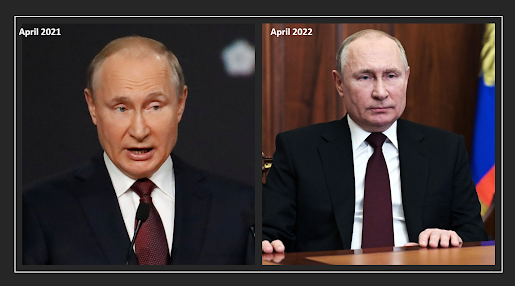
Here, though, are two photos of Vlad taken a year apart. I merged them into one side-by-side shot. The left photo is from an NBC News report from April 2021. The right photo is from now, April 2022, released by the Russian government. Do you see a difference? I do not strongly consider the difference in Putin’s pallor to be very significant because the lighting difference for the photos may have played a major part in that. However, months before now there was speculation that Putin was suffering from a chronic illness that made his face swell, which these (and other photos I saw) seem to show. And Newsweek repeats the rumor is that he is suffering from Parkinson’s Disease


Or it may be simply nothing much more than what former CIA Director John Brennan told MSNBC three days ago, “Video of Putin clutching table ‘shows that he’s a man that has quite a bit of stress’.” Yes, that is a ‘well, duh,’ statement, but that really might be all there is to it. Besides, the Russian (dis)info agencies all say Putin is well, is not taking meds or drugs, and is working hard etc. etc. etc.


I  note, though, that I have not found a single report of an actual physician making an observational assessment (not a diagnosis, of course) about what photos and videos convey about his health. So I will be even more pedantic that John Brennan and say simply, "Time will tell." 

Update: Now this:


Friday, April 8, 2022

The Ukraine War just got much, much bigger

 Last Friday:

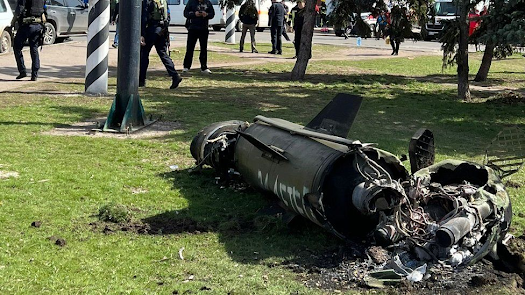
Scores of people, including children, have been killed when rockets hit a railway station in the eastern Ukrainian city of Kramatorsk.

Ukrainian officials say thousands of people were waiting for evacuation trains on Friday morning, desperate to flee heavy Russian shelling across the wider Donetsk region.

Both Ukraine and Russia have since blamed each other for the deadly attack.

The railway station was hit at about 10:30 local time (07:30 GMT) on Friday, Kramatorsk Mayor Oleksandr Honcharenk told the BBC.


So far, 52 persons are confirmed killed and at least 100 injured. A western aid worker for World Central Kitchen was nearby, helping distribute food at the station at the time. He "counted between five and 10 explosions." 

Ukraine's prosecutor general's office later said that nearly 4,000 people - mainly women and children - were at the station at the time.

With this attack, the latest in several like it - and coming on the heels of the Russian massacre of civilians in the formerly occupied town of Bucha in northern Ukraine - the war in Ukraine has transitioned to a new, much larger stage. Now going on for just under two months, neither the Russians nor the Ukrainians have yet attained their military objectives. That Ukraine has not expelled Russian forces from the country is hardly surprising, but Russia's vaunted land-power war machine is shown to be creaking with rusty obsolescence and incapability, plus poorly trained, poorly equipped, and poorly supported soldiers. 

And then last Wednesday,

Russia has admitted suffering "significant losses of troops" in Ukraine, as the invasion enters its 44th day.

Presidential spokesman Dmitry Peskov told British channel Sky News the casualties were "a huge tragedy for us". ...

However, his admission that Russia has suffered significant casualties is striking. On 25 March, Russia's Ministry of Defence said 1,351 of its soldiers had been killed in combat. Ukraine puts the Russian deaths at almost 19,000.

Neither Russia nor Ukraine's estimates of Russian losses can be independently verified - and analysts have cautioned that Russia may be downplaying its casualty rate, while Ukraine could be inflating it to boost morale. Western leaders believe that between 7,000 and 15,000 Russian soldiers have been killed.

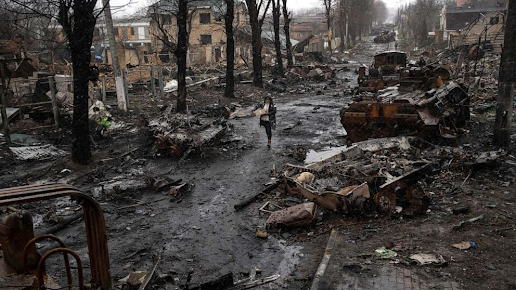
Rodrigo Abd/AP -- A woman walks amid destroyed Russian tanks in Bucha,
in the outskirts of Kyiv, Ukraine, April 3, 2022.

American defense officials said today,

In terms of total losses -- counting troops, tanks, aircraft and missile inventory -- Russia has lost between 15-20% of the combat power it originally had arrayed against Ukraine since the beginning of the invasion, according to the official.

(During my military career, we defined a unit that lost that large a percentage of troops as neutralized, and 30 percent as destroyed, that is, combat ineffective.)

These massacres and casualty levels (on both sides) now mean that a negotiated peace is off the table. For Putin to make such an agreement would be seen by the senior military and civilian Russian leadership as an admission of Putin's personal failure. And Putin would have to realize that making such a peace would be professionally and possibly personally lethal for him. Russians know good and well that the Czar/General Secretary/President is never the one who fails the country, ever. If Putin accepted a negotiated peace, everyone else within the senior reaches of government and the military would know that the scapegoating purges would come quickly. And Putin knows that they would know that. Who would act decisively first - Putin and his inner, purge-immune circle, or the intended victims? 

As for Zelensky, to negotiate a peace with invaders who have mass murdered his people on repeated occasions would also be an admission of failure. Unlike Russia, he would likely remain in office until the end of his term, and even if he was forced out, his exit would have the façade not of disgrace, but of an exhausted hero of world significance, to whom the nation owes its everlasting gratitude. 

Until a point, that is, And that point is if the war simply drags on. Putin cannot relent. Ukraine now must win. Before now, all Ukraine had to do was not lose, but that is no longer good enough. Now it must eject Russia from the country, and not slowly. But Putin cannot allow his army to be so defeated. As Walter Russell Mead put it:

Now both sides are stuck with a war that neither knows how to win, and it is difficult to see the outlines of a compromise peace that both sides can accept. Ukraine cannot accept a peace that leaves it exposed to further Russian aggression and that involves further territorial sacrifice, and Mr. Putin cannot end the war without demonstrable gains at the expense of Ukraine. The logic of warfare now seems to lock the two sides into further, perhaps escalating military, economic and political conflict as each looks for some pathway to victory.

No one had any real hope for the negotiations occasionally held in Belarus, anyway. After the Bucha massacre, "Mykhailo Podolyak, one of Ukraine's peace negotiators and aide to President Volodymyr Zelenskyy, said the tone of peace talks had forever changed because of Bucha... ."

As for Russia, just yesterday

Russian Foreign Minister Sergei Lavrov said on Thursday that Ukraine had presented Moscow with a draft peace deal containing "unacceptable" elements at variance with a previous agreement, comments that Kyiv dismissed as "pure propaganda".

The "peace" negotiations were never more than a kabuki dance to begin with, but with the Kramatorsk attack, the talks don't even rise to that level. 

The Ukraine war has now transitioned into a proxy war between Russia and the Euro-American alliance. Ukraine is tragically caught in the middle. The very difficult and very uncertain task before Europe and the United States now is to manage the war to keep it inside Ukraine. (But remember the caution attributed to Bismarck that starting a war is like entering a dark room, blindfolded, to look for a black cat that is not even there.)

Update: CBS News' report of the Kramatorsk attack:


Update: Daniel Henninger in the Wall Street Journal, Don’t Let Putin Win in Ukraine (excerpted):
It is good in the wake of the Bucha atrocities that President Biden and Europe’s leaders are talking about holding Mr. Putin and his associates accountable for war crimes—once it is possible to collect evidence. Still, one doesn’t have to be Volodymyr Zelensky to notice that these good intentions have little to do with the reality that the current level of help from the North Atlantic Treaty Organization still leaves Ukraine in purgatory, with one foot in Mr. Putin’s hell and the other stretching toward deliverance by the West.

It is increasingly clear that after failing to secure a quick win, Mr. Putin’s Plan B is scorched earth.

Using crudely targeted long-range missiles, land mines and his army’s historic instinct to barbarity, he is simply destroying Ukraine—its people, its economy, whole cities and infrastructure. After the current “pause,” he’ll go back for more.

The consequences of this obviously unexpected scale of destruction are significant for the West’s calculations. At this point all the arguments, such as they are, for affirming a negotiated settlement that turns so much of Ukraine over to Mr. Putin have become impossible to credit.

In the absence of anything but passing press contact with the U.S. president, a question often put to those who interpret for Mr. Biden at the White House, Pentagon and State Department is whether we want Ukraine to win. After this week, I think the better question is: Are we willing to make Mr. Putin lose?

Saying that he’s experiencing a “strategic defeat” is a dodge. Every day—or year—that he is killing and wrecking, he’s winning. Vladimir Putin has to lose in Ukraine, not only in the eyes of the aghast outside world. NATO’s current military and political status quo—the arms flows and ratcheting sanctions—just isn’t enough.

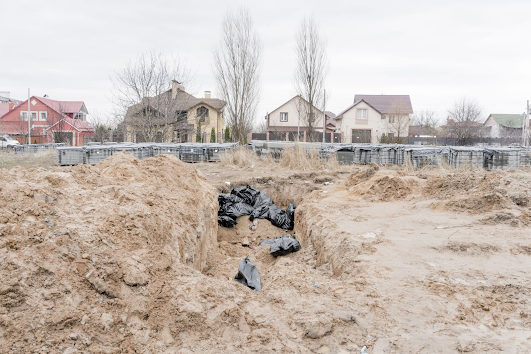
A mass grave behind Bucha’s Church of St. Andrew the First-Called All Saints. (WSJ)

Also, the April 8 sitrep from the Institute for the Study of War.

Finally, some observers, including some actually on the scene in Bucha, say that the civilians killed there should not be uncritically accepted as Russian victims. Whether you agree or not, it is not much arguable against the fact that both sides will lie outright if they think it helps them. 

A world without nuclear weapons - what would it look like?

 From Pope Leo this week, according to the National Catholic Reporter : " Pope Leo quotes Bob Dylan song in book foreword calling for n...