I know you have been anxiously awaiting when you can read my M.Div. thesis. Well, good news! Academia.edu has used AI to turn it into a podcast! And their page also used AI to create 12 slides of its points. They are below.
My thesis, or as Vanderbilt called it, Senior Project, is entitled, "The Disjunction Between Scientific Materialism and Classical Theism: A Process Solution." Before getting to the podcast and slides, here is an intro to the subjects concerned.
What is classical theism? In classical theism, God "is believed to have created the entire universe, to rule over it, and to intend to bring it to its fulfillment or realization, to "save it." Classical theism draws on "intuitions and assumptions of Greek philosophy as much as biblical images," says Tyron Inbody.
Catholic Scholasticism developed Aristotelian formulations of God "as absolute, changeless, eternal being or actuality." This idea of impassive immutability remained in the Reformation, though the Reformers emphasized God's sovereignty as unchallenged, absolute power, wholly righteous and gracious. God was understood to have "absolute priority and decisiveness" in divine election.
Always known as powerful in the Jewish and Christian traditions, God was now understood as absolutely omnipotent, able to do anything God chose. "The concept of God's omnipotence is located at the center of classical theism," wrote Inbody, and so is at the heart of theodicy problems. (Theodicy is the theology of the problem of human suffering and evil.)
What is Scientism? Scientism is faith in science. Scientism is faith in science. As the dominant world view of our day, it is considered self validating. Scientism makes two major claims, neither of which, however, are provable using the scientific method:
(1) only science reveals the Real and only science can discover truth;
(2) scientific knowledge of reality is exhaustive, not inherently limited, is holistic and sees reality as reality really is.
The challenge of the new, scientific ways of understanding the world resulted in theological liberalism, which attempted to ensure Christian faith in a world dominated by the increasing power of science. However, "Attempts to render God and the modern world view compatible have been unsuccessful," observed David R. Griffin in God and Religion in the Postmodern World. This has led either to religious pantheism or insulation, which define the disjunction between scientific materialism and theism.
In just the last two or three years, the US government, mainly the Defense Dept., has released videos of what used to be called UFOs, now called UAPs, Unidentified Aerial Phenomena. These include tracking and targeting video taken by US Navy jet fighters trying to intercept UAPs.
The most recent video release was in the past week. It is video taken from the bridge of USS Omaha of a UAP that shows apparent "transmedium" capability, meaning it travels through air or water with equal ease and speed - an ability massively beyond the capability of any technology we know of. Here is the video. As some commentators have noted, the bridge crew's voices also recorded betray no shock or astonishment, but more like "this again."
An explosive report featured on CBS News’s “60 Minutes” featured several former U.S. military officials who talked about what the U.S. government knows about unidentified aerial phenomena — UAP —more commonly referred to as UFOs.
The segment comes ahead of a report that the military is supposed to deliver an unclassified report to Congress by next month. Former Director of National Intelligence John Ratcliffe said in a recent interview that the findings will shock people because “frankly, there are a lot more sightings than have been made public.”
Read the linked article, but here two 60 Minutes reports on the topic (both dated May 16, 2021). The first segment is about six minutes long, the second about 13 minutes:
I wrote in 2013 of former Canadian defense minister Paul Hellyer, who served in that role (equivalent to the US secretary of defense) in the 1960s. He stated unambiguously that UFOs are non-terrestrial craft, directed by extra-terrestrial, highly intelligent beings. That makes Mr. Hellyer the most senior person I have ever heard of who claimed this.
But that might change with the release of the Pentagon report next month.
Finally, here is a mere 92 seconds of President Obama on a late-night talk show saying he cannot talk about the subject.
Was he jesting, or answering seriously, hoping it would be taken as jest? You decide.
Eduardo Zorita, a researcher on past temperature trends at the Institute for Coastal Research in Germany, writes,
... I may confirm what has been written in other places: research in some areas of climate science has been and is full of machination, conspiracies, and collusion, as any reader can interpret from the CRU-files. ...
These words do not mean that I think anthropogenic climate change is a hoax. On the contrary, it is a question which we have to be very well aware of. But I am also aware that in this thick atmosphere -and I am not speaking of greenhouse gases now- editors, reviewers and authors of alternative studies, analysis, interpretations,even based on the same data we have at our disposal, have been bullied and subtly blackmailed. In this atmosphere, Ph D students are often tempted to tweak their data so as to fit the 'politically correct picture'. Some, or many issues, about climate change are still not well known. Policy makers should be aware of the attempts to hide these uncertainties under a unified picture. I had the 'pleasure' to experience all this in my area of research.
"Climate science" is an ideal model to explain where we have been going politically, a trend that will only accelerate with the incoming Biden administration, whose platform and promises are far to the Left of any prior one. To wit: Climate science is on the whole a political movement, not a scientific discipline. Climate science has no "product." The outcomes of climate modeling cannot be used to do anything except what is being done with them - promote statist control of ever-expanding slices of national economies to conform to a trans-nationalist ideology.
German economist Ottmar Edenhofer is co-chair of the U.N. Intergovernmental Panel on Climate Change’s (IPCC) Working Group III on Mitigation of Climate Change. He was the lead author of the IPCC's 2007 report. He told Germany's Neue Zurcher Zeitung in November 2020, as reported by Investors.com:
"The climate summit in Cancun at the end of the month is not a climate conference, but one of the largest economic conferences since the Second World War."
Edenhofer let the environmental cat out of the bag when he said "climate policy is redistributing the world's wealth" and that "it's a big mistake to discuss climate policy separately from the major themes of globalization." ...
Edenhofer claims "developed countries have basically expropriated the atmosphere of the world community" and so they must have their wealth expropriated and redistributed to the victims of their alleged crimes, the postage stamp countries of the world. He admits this "has almost nothing to do with environmental policy anymore, with problems such as deforestation or the ozone hole."
Climate science's only customer is governments, there being no commercial market for forecasts of 50-100 years. When climate scientists found that their only steady funding came from statist bureaucrats, the discipline, very fuzzy with huge margins of error to begin with, became subordinated to politicians' goals.
So welcome to the incoming Biden administration and its Ministry of Truth:
If climate science could be used to do anything else, it would already be happening. But have you ever heard of any report of climate science's findings not seized upon by the Left to expand the power of the state or trans-state organs?
Now if climate scientists find that their only paying customers are statist bureaucrats, and most of the scientists were taught beginning as undergraduates to believe that ideology, what do you think will be the result?
The result is that climate science will be subordinated to political goals. This is exactly what has happened, as more and more scientists working in the field are pointing out. What we are seeing, I think, is that linguistic deconstructionism has polluted its first scientific discipline.
One of the basic tenets of postmodernist linguistic deconstructionism (which I learned how to do in my postgraduate studies at Vanderbilt) is that all text is tainted by bias and that objective points of view are impossible. Hence, the objective of expression is to exercise power. (Formerly the type of expression so designated has been confined, mostly, to those of history, literature and politics. But now even mathematics may be considered biased and subjective.)
Hence, there is no such as thing as objective truth and statements are never more than propositional in nature. A statement's truth content is never more than opinion, and opinions are nothing but expressions of power. Therefore, in a basic sense, all speech is power directed.
This is a fundamental world view of the Left and is derived directly from Marxism, as reworked by Leninism. Since Marx held that his communist theory was literally scientific, his economic-historical forecasts were not simply likely, they were certain. That is, Marx maintained that he was not offering merely one more historical treatise of human affairs, but an actual scientific proof that the proletariat would overthrow the bourgeoisie. To understand and partner with this inevitability was to be "on the right side of history" (which is where that overused cliché comes from). As formulated by Lenin et. al., truth is therefore not statements of objective facts, but assertions that move the communist revolution and its fulfillment closer to reality. "Truth" is therefore pliable and impermanent, the concept of truth being only practical. In practice, all of language became subservient to the dominance of the party, a fact recognized by George Orwell in his novel 1984 and its concept of Newspeak.
That, comrades, is the Leftist, socialist world of Revolutionary Truth, a Marxist-Leninist doctrine that is fundamental to how the Left operates and rules. A good illustration of Revolutionary Truth" is when Rep. and self-described socialist Alexandria Ocasio-Cortez went on 60 Minutes on Jan. 6, 2019, and said, “There's a lot of people more concerned about being precisely, factually, and semantically correct than about being morally right" (video at the link).
Because Marxism is a totalist system of belief, its devotees,
... want to impose a new order based on an “all-or-nothing claim to truth.” They operate within distinctive parameters of a “theology of Armageddon — a final battle between good and evil” – in which the stakes are nothing less than universal salvation. As outlined in Eric Hoffer’s classic, The True Believer, such movements have mastered the art of “religiofication,” that is, converting political grievances into messianic aspirations and “practical purposes into holy causes.”
"Truth" is therefore whatever brings the Revolution closer to reality. This was a world view fully adopted by Leninists and their successors. Truth is only accidentally connected to objective facts, which is exactly what AOC meant when she dismissed any connection between morality and facts.
The Left's domination of the academy began in the humanities departments. The penetration of the Newspeak mentality into the sciences probably began with what we now call climate science. In fact, Earth Day's founding in 1970 has Leftist roots, the original April 22 date not coincidentally being the
birth date of Lenin himself. From the original "grassroots hippie" event, the whole of modern-day environmentalism was born. And environmentalism has never been freed from its Marxist-Leninist roots.
What this means is that when climate science became dominated by the Left (well, it began that way), then its purpose was not to determine scientific truth, but to use science to exercise political power. A standard Leftist critique of the West's standing values was that they were social constructions, not rooted in objective reality (which does not exist, anyway), but in class struggles. That was the Left's entrée into the sciences, as Richard Rorty explained in AtlanticOnline,
Starting with the claim that homosexuality, the Negro race, and womanliness are social constructions, they go on to suggest that quarks and genes probably are too. "Ideology" and "power," they say, have infiltrated sterile laboratories and lurk between the lines of arcane journals of mathematical physics. The very idea of scientific objectivity, they say, is self-deceptive and fraudulent.
If scientific objectivity is a fraudulent concept, it does not mean that science is of no value. It simply means that science is just another tool for the class struggle and that it can be used on the right side of history. Like any other expression, scientific expressions are therefore concerned not with facts but with power.
So whenever any of my Left-leaning friends tell me I should just "trust the experts" or yield to "the science," I know they have conflated two very important but distinct things. First, the discipline of science itself and second, the scientists who practice that discipline. For while science can be said to be a moral discipline, it by no means follows that scientists are automatically moral persons. Scientists may be as venal, greedy and grabbing as anyone; simply possessing certain degrees and credentials does not cleanse their souls. When scientists - at least a large number of them - figure out that money, honors, awards, and positions will follow from some but not other scientific declarations, then it is all too easy and self-justifiable for them to accept a political leash.
Power is the only goal of the Left. When global warmists mount ad hominem attacks against skeptics, comparing them to Holocaust deniers for example, most of us see those attacks as tacit admissions of failure of the scientific argument. But the Left does not see them that way since the scientific argument is just a form of power expression. Ad hominem attacks are, too, and so, like science, are just a tool in the toolbox of power plays. They are an attempt to change the terms of the battle (and battle it is.)
That is why the Left is immune to accusations of hypocrisy, which is, "a feigning to be what one is not or to believe what one does not : behavior that contradicts what one claims to believe or feel." Leftists frequently contradict what they have already said, and the contradictory statement is declared just as emphatically and absolutely as the one it contradicts. To accuse them of hypocrisy is to waste time. A true statement to the Left is one that advances their causes; its contradiction of an earlier declaration is simply irrelevant. The prior statement advanced their cause and the present one does too, they think, and that is the end of the "hypocrisy" debate. After all, they consider your accusation of hypocrisy to be nothing but a power play anyway, so why should it influence them? And why should they shun self-contradiction if it happens to advance their power?
However, most of our country is not Leftists, far from it. We cannot let the Left set the terms of public debate. We have to keep hammering on the facts and that the Left has bent science to political power-play ends, and that environmentalism is a political movement, not a scientific discipline.
We need also to reject the idea that scientific expression is merely another way of expressing opinion. Although empiricism has its own difficulties, we need to recover a strong sense of a philosophy of science that undergirds science as relating to objective facts about nature. This does not mean that science has no social context, as NYU physicist Alan Sokal pointed out:
Science is a human endeavor, and like any other human endeavor it merits being subjected to rigorous social analysis. Which research problems count as important; how research funds are distributed; who gets prestige and power; what role scientific expertise plays in public-policy debates; in what form scientific knowledge becomes embodied in technology, and for whose benefit -- all these issues are strongly affected by political, economic and to some extent ideological considerations, as well as by the internal logic of scientific inquiry. They are thus fruitful subjects for empirical study by historians, sociologists, political scientists and economists.
The problem is that when the externals become dominant, then in a real sense it is not science that gets done, but something else dressed in scientific costume. There is a danger there that Sokal presciently pointed out 11 years ago:
There is nothing wrong with research informed by a political commitment, as long as that commitment does not blind the researcher to inconvenient facts.
The real "Inconvenient Truth" about climate science is that it is serving, rather than informing, a political agenda. And that is exactly what the next four years will bring in growing strength to the United States.
In a dreary Tuesday speech in Wilmington, Del., President-elect Joe Biden suggested that some schools should remain closed through April--and even longer if there is not another huge round of federal spending on education.
Mr. Biden, discussing the period following his Jan. 20 inauguration, said:
Another 100-day challenge is opening most of our K-through-eight schools by the end of the first 100 days in the spring. Look, we can only do that if Congress provides the necessary funding so we get schools, districts, communities, and states the resources they need for those so many things that aren’t there already in a tight budget.
Taxpayers may be even more depressed to learn they will now be asked to fund a Biden administration program to persuade people to ignore the message of the Biden presidential campaign.
Grow government: It's what they do. It's really all they do. And note author James Freeman's sentence that this speech contradicts "the message of the Biden presidential campaign." Of course, but so what?
Update, Feb. 6: Massachusetts' undersecretary for climate change, Charlie Baker, said it's time to put the screws to ordinary people to break their will:
“So let me say that again, 60% of our emissions that need to be reduced come from you, the person across the street, the senior on fixed income, right … there is no bad guy left, at least in Massachusetts to point the finger at, to turn the screws on, and you know, to break their will, so they stop emitting. That’s you. We have to break your will. Right, I can’t even say that publicly.”
Every government climate bureaucrat is at heart simply a dictator.
From fabricated research to paid authorships and citations, organized scientific fraud is on the rise, according to a new Northwestern University study.
By combining large-scale data analysis of scientific literature with case studies, the researchers led a deep investigation into scientific fraud. Although concerns around scientific misconduct typically focus on lone individuals, the Northwestern study instead uncovered sophisticated global networks of individuals and entities, which systematically work together to undermine the integrity of academic publishing.
The problem is so widespread that the publication of fraudulent science is outpacing the growth rate of legitimate scientific publications. The authors argue these findings should serve as a wake-up call to the scientific community, which needs to act before the public loses confidence in the scientific process.
The study, "The entities enabling scientific fraud at scale are large, resilient and growing rapidly," was published in the Proceedings of the National Academy of Sciences.
"Science must police itself better in order to preserve its integrity," said Northwestern's Luís A. N. Amaral, the study's senior author.
"If we do not create awareness around this problem, worse and worse behavior will become normalized. At some point, it will be too late, and scientific literature will become completely poisoned. Some people worry that talking about this issue is attacking science. But I strongly believe we are defending science from bad actors. We need to be aware of the seriousness of this problem and take measures to address it."
I took these photos in my front yard starting just after 5 p.m. CST today with Cathy's assistance. I used my Samsung S9 smart phone mounted on a tripod. Tonight is the closest approach of Jupiter and Saturn; tomorrow and for a few days afterward they will be farther apart, but still seem quite close. Not long after I finish this post, they will disappear behind the horizon.
But according to NASA, if we placed a dime on the goal line of a football field and pretended it was the sun, Jupiter would be at about the 10.5-yard line. Saturn would be almost twice as far out, at the 19-yard line. So they do not ever actually come close to one another. (Earth would be about two yards out from the dime-sized sun.)
Here is looking from our front yard. The planets are the bright dot above our neighbor's house, between the power lines.
Here is a telephoto view. I do have conventional digital and film cameras, but not with 8X telephoto like my phone has. This shot is about 4X.
Here is a series of 8x telephoto shots. Basically, if you've seen one you've seen them all. The phone does have a "night" photo setting, but after I used it, I could not tell any difference, probably because the phone was already stable on the tripod. But you can definitely tell there are two separate planets, and which one is Jupiter.
One final frame and we bid the conjunction adieu.
I hope you got to see it, too!
BTW, the Bethlehem star that the magi, or wise men, followed to find the Christ child was also a conjunction of Jupiter, although not with Saturn, but with the star Regulus. Modern astronomers have calculated it quite precisely. Read about that in, "Why is Christmas on December 25?"
Merry Christmas to all, and God bless us, every one!
Electrics' killer? Life-cycle pollution, compared to diesel cars - what it takes industrially to obtain the raw materials and turn them into finished, operating vehicles, operate them during their life span, and dispose of them when the reach the end. And the core of the problem is batteries.
When CO2 emissions linked to the production of batteries and the German energy mix – in which coal still plays an important role – are taken into consideration, electric vehicles emit 11% to 28% more than their diesel counterparts, according to the study, presented on Wednesday at the Ifo Institute in Munich.
Mining and processing the lithium, cobalt and manganese used for batteries consume a great deal of energy. A Tesla Model 3 battery, for example, represents between 11 and 15 tonnes of CO2. Given a lifetime of 10 years and an annual travel distance of 15,000 kilometres, this translates into 73 to 98 grams of CO2 per kilometre, scientists Christoph Buchal, Hans-Dieter Karl and Hans-Werner Sinn noted in their study.
The CO2 given off to produce the electricity that powers such vehicles also needs to be factored in, they say.
When all these factors are considered, each Tesla emits 156 to 180 grams of CO2 per kilometre, which is more than a comparable diesel vehicle produced by the German company Mercedes, for example.
The German researchers, therefore, take issue with the fact that European officials view electric vehicles as zero-emission ones. They note further that the EU target of 59 grams of CO2 per km by 2030 corresponds to a “technically unrealistic” consumption of 2.2 litres of diesel or 2.6 litres of gas per 100 kms.
These new limits pressure German and other European car manufacturers into switching massively to electric vehicles whereas, the researchers feel, it would have been preferable to opt for methane engines, “whose emissions are one-third less than those of diesel motors.”
A battery pack for a Tesla Model 3 pollutes the climate with 11 to 15 tonnes of CO2. Each battery pack has a lifespan of approximately ten years and total mileage of 94,000, would mean 73 to 98 grams of CO2 per kilometer (116 to 156 grams of CO2 per mile), Buchal said. Add to this the CO2 emissions of the electricity from powerplants that power such vehicles, and the actual Tesla emissions could be between 156 to 180 grams of CO2 per kilometer (249 and 289 grams of CO2 per mile).
An electric car such as a Tesla is not powered by electricity. It is powered by coal; the electricity is just a means of transfer.
The same problem, btw, exists in the nearly-mythical hydrogen-powered car. The hydrogen has to come from somewhere. Atoms of H It do not exist in nature unbound to other elements. And you always use more energy to obtain free hydrogen than you get from oxidizing it. Guess where that energy comes from?
Here is a good video that explains hydrogen's potential advantages but very present difficulties very well.
... he argues that the scientist’s confidence in reason ultimately depends on the existence of a rational and purposeful Creator. Otherwise, our thoughts are nothing more than electro-chemical events, the chattering of soul-less synapses. “If you take the atheistic, naturalistic, materialistic view, you’re going to invalidate the reasoning process,” he says, “because in the end you’re going to say that the brain is simply the end product of a blind, unguided process. If that’s the case, why should you trust it?"
The materialist view inevitably gives birth to a form of determinism that appears to mock our essential humanity. Richard Dawkins, evolutionary biologist and atheist, expresses the modern scientific outlook thus: “The universe we observe has precisely the properties we should expect if there is, at the bottom, no design, no purpose, no evil and no good. Nothing but blind, pitiless indifference. DNA neither knows nor cares. DNA just is. And we dance to its tune.”
Dawkins routinely falls into confirmation bias: he examines the universe expecting to find purposelessness, and voila! That is indeed what he finds. And he says that his determination is scientific. Yet such a claim is not at all scientific because there is no "scientific" proof of any kind that the universe is purposeless.
To claim, as Dawkins does (along with other atheists) that there is no God is to claim, really, that one possesses infinite knowledge - enough to claim that no being exists that has infinite knowledge! But this kind of militant atheism is not a rational stance, it is a rebellious, emotion-based stance, as openly admitted by atheist Thomas Nagel, professor of philosophy and law at New York University:
I want atheism to be true and am made uneasy by the fact that some of the most intelligent and well-informed people I know are religious believers. It isn't just that I don't believe in God and, naturally, hope that I'm right in my belief. It's that I hope there is no God! I don't want there to be a God; I don't want the universe to be like that. My guess is that this cosmic authority problem is not a rare condition and that it is responsible for much of the scientism and reductionism of our time. One of the tendencies it supports is the ludicrous overuse of evolutionary biology to explain everything about human life, including everything about the human mind… This is a somewhat ridiculous situation… [I]t is just as irrational to be influenced in one’s beliefs by the hope that God does not exist as by the hope that God does exist. (The Last Word, pp. 130-131, quoted by fellow philosopher Edward Feser.)
Personally, I do not insist that atheism is either irrational or non-rational, though as Nagel points out, that is a very common stance among self-described atheists. I do say, however, that atheism is very unwise, as mathematician Blaise Pascal rather decisively demonstrated.
Last week I explained five historical facts that must be accounted for either to affirm or deny that Jesus rose from the dead. These facts do not rely on supernatural authority or a claim that they must be believed because the Bible is inspired Scripture.
Historians, and not just Christian ones, are in broad consensus that these were factual events, not claims invented by the church, especially since absent these facts there is no reason to assume there would have been a church to invent them in the first place.
Thus, seriously grappling with the claim that Jesus rose from the dead must include these facts in the explanation. Explanations must explain. Simply to deny these facts does not rebut or disprove them. One cannot explain, for example, how the Civil War started while denying that South Carolina ever bombarded Fort Sumter.
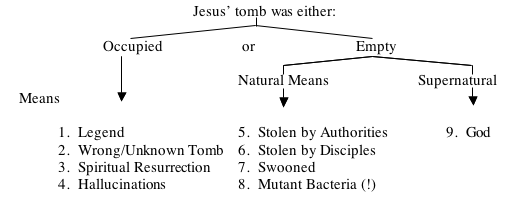
Skeptics of the historical fact of Jesus's resurrection offer explanations that fall into four main categories:
1. The key actors on Good Friday and Sunday morning botched what they were doing.
2. Science proves Jesus’s resurrection is impossible.
3. The accounts of Jesus’s resurrection are mythical of a kind common in the ancient world.
4. The apostles were either deluded or they mounted a deliberate conspiracy of falsehoods.
The "they botched it" theories
The "Swoon Theory"
The first allegedly-botched job was the crucifixion, in which the Romans incompetently took Jesus down from the cross unconscious rather than dead. Joseph and the women entombed Jesus still alive. This is called the “Swoon” theory; it dates to the 1780s.
The swoon theory says that the coolness of the tomb and Friday’s partial application of funereal spices made Jesus come to his senses. Before dawn Sunday he rolled away the stone and found some workman’s clothes, causing Mary Magdalene to mistake him for a gardener. So, the swoon theory does explain why the women found the tomb empty and why the presumed gardener claimed he was Jesus.
But it assumes that
the brutal flogging that Jesus received from the Romans,
the shredding of his head by a wreath of thorns,
hanging on the cross with nailed hands and feet (with severe physical effects, including dislocation of the shoulders),
and the deep piercing of his chest by a Roman spear,
were all relatively minor injuries that
left Jesus mentally fully competent,
were not severe enough and evoked too little bleeding to kill or even much weaken him,
insufficiently injured his hands and feet to degrade either his dexterity or mobility,
left him with enough physical strength to single-handedly roll away a one-ton stone from the tomb, in the dark.
did not hinder his ability to sneak past an armed guard standing only a few feet from the tomb,
had healed enough so that Mary did not recognize him as the recently-crucified Jesus.
The swoon theory also ignores the fact that Jesus would have consumed neither food nor drink since Thursday evening but apparently suffered no ill effects from 84 hours or so without nourishment or water.
The theory assumes that Roman soldiers, of all people, did not know how to kill a defenseless man and ignores that their motivation to make sure Jesus was dead very great: under Roman military law, Roman soldiers who failed to carry out a sentence properly could be punished by receiving the same sentence to serve instead, meaning the soldiers at the cross were highly motivated to be positive that Jesus and the two thieves crucified with him were dead for sure.
The swoon theory also requires that Joseph and the women who partially prepared Jesus for burial on Friday did not detect that he still breathed and had a heartbeat, however weak it may have been. People in ancient times were very familiar with corpses. There were no funeral homes. Families did that work on their own. The women friends of Jesus, like any women of the day, knew very well about –
·livor mortis, the collection of blood in the lowest parts of a corpse after the heart ceases beating, due to gravity. Livor mortis causes marked purpling of the body where it occurs and is usually noticeable starting about 20-30 minutes after death (though full discoloration takes somewhat longer). A man dead on a cross would have been so colored at around the ankles and shoulders. If Jesus was not dead when he was removed, livor mortis would not have occurred, and the women would certainly have noticed.
·rigor mortis, the stiffening of the limbs of a corpse caused by chemical changes in the muscles. A corpse is highly resistant to manipulation because of this. To be fair to the swoon theory, though, it takes between 4-6 hours after death for rigor mortis to set in. Jesus was entombed by then.
The swoon theory, then, requires not only that the Roman soldiers blundered the crucifixion but that the women were blind to the lack of empirical evidence that Jesus was dead, evidence which was common knowledge in their day.
The swoon theory does not explain
·why Mary said Jesus was risen rather than that he survived.
·why Jesus apparently needed no medical care or convalescence.
·with whom Jesus lodged after his botched crucifixion, because he is nowhere presented as hanging out with the disciples.
·why Paul and James, who had not followed Jesus, said they knew Jesus risen (and Paul first persecuted Christians).
·why the Church would begin with such energy and devotion
·why the apostles suffered hard lives and cruel deaths to insist that Jesus was a risen Savior rather than merely a lucky convict.
·why the Romans did not mount a manhunt for the surviving Jesus when we know that when the Romans wanted you dead, they meant it. (The Romans didn't hunt for Jesus after the actual resurrection, either, when Peter et. al. were proclaiming him risen. Why? Because the Romans knew darn good and well that they had taken him down dead from the cross.)
An explanation, actually to explain, cannot create more unresolved issues than it tries to solve. The swoon theory thus fails.
Also, see the Journal of the American Medical Association's explanation, summarized here. The abstract:
Jesus of Nazareth underwent Jewish and Roman trials, was flogged, and was sentenced to death by crucifixion. The scourging produced deep stripelike lacerations and appreciable blood loss, and it probably set the stage for hypovolemic shock, as evidenced by the fact that Jesus was too weakened to carry the crossbar (patibulum) to Golgotha. At the site of crucifixion, his wrists were nailed to the patibulum and, after the patibulum was lifted onto the upright post (stipes), his feet were nailed to the stipes. The major pathophysiologic effect of crucifixion was an interference with normal respirations. Accordingly, death resulted primarily from hypovolemic shock and exhaustion asphyxia. Jesus' death was ensured by the thrust of a soldier's spear into his side. Modern medical interpretation of the historical evidence indicates that Jesus was dead when taken down from the cross.
The “wrong-tomb” theory
This theory simply says that on Sunday morning the women mistakenly went to an unused, open tomb, talked with a gardener whom they mistook for Jesus, then excitedly told the disciples that Jesus’s tomb was empty and Jesus was risen.
However,
·The women were not looking for an open, empty tomb. They had asked themselves en route how they would get the stone rolled away. So, when coming to an open, empty tomb, why didn't they just keep going? Wrong-tomb theorists do not say, except to claim that the women were confused. ("They went to the wrong tomb because they were confused. How do we know they were confused? Because they went to the wrong tomb." Got it?)
·Having already been to Jesus's tomb on Friday, they knew which tomb to go to.
The wrong tomb theory does not explain:
·why the gardener Mary conversed with claimed he was Jesus
·why Mary called him Lord when he knew and she thought that Jesus was dead elsewhere.
·why the gardener told Mary to tell the disciples he would meet them in Galilee.
The wrong-tomb theory also echoes the ancient belief that women could not be trusted to relate facts rather than addle-headed nonsense. Its unspoken precept is, “Let me tell you what those idiot women did.”
No historian concerned about his reputation promotes either the swoon theory or the wrong-tomb theory any more, but many people still argue them.
"Scientific" objections to the resurrection
Many people think that science shows it to be impossible. In fact, science shows no such thing. There are some scientists who say the resurrection is scientifically impossible. But there are many other scientists who profess religious faith. For example:
“A scientific discovery is also a religious discovery. There is no conflict between science and religion. Our knowledge of God is made larger with every discovery we make about the world.” - Joseph H. Taylor, Jr., who received the 1993 Nobel Prize in Physics for the discovery of the first known binary pulsar, and for his work which supported the Big Bang theory of the creation of the universe.
“Astronomers have proven that the world began abruptly in an act of creation, And they have found that all this happened as a product of forces they cannot hope to discover. That there are what I or anyone would call supernatural forces at work is now, I think, a scientifically proven fact”. – Robert Jastrow, Astronomer, physicist and founder of NASA’s Goddard Institute of Space Studies.
“The common belief that the actual relations between religion and science over the last few centuries have been marked by deep and enduring hostility is not only historically inaccurate, but actually a caricature so grotesque that what needs to be explained is how it could possibly have achieved any degree of respectability.” – Colin Russell, Cambridge University historian of science.
“Both religion and science require a belief in God. For believers, God is in the beginning, and for physicists He is at the end of all considerations… To the former He is the foundation, to the latter, the crown of the edifice of every generalized world view.” – Max Planck, Nobel Prize physicist, founder of quantum theory, one of the most important physicists of the 20th century).
Two other examples are Dr. Francis Collins, director of the National Institutes of Health and former head of the human genome project, and Dr. John Lennox, professor and Fellow in Mathematics at Oxford University. There are many others.
Sociologist Elaine Ecklund surveyed 1,700 scientists and conducted personal interviews with 275 of them at elite American universities, seeking to find out what their views on religion were. She writes:
After four years of research, at least one thing became clear: Much of what we believe about the faith lives of elite scientists is wrong. The [presumed] ‘insurmountable hostility’ between science and religion is a caricature, a thought-cliché, perhaps useful as a satire on group-think, but hardly representative of reality.
Professor Ecklund's book is called Science vs. Religion: What Scientists Really Think. A long review with excerpts is here. Most of the non-religious scientists Ecklund interviewed said that they just were not interested in religion questions, any more than a Methodist preacher would be much interested in how to mass produce elemental isotopes. And unlike the rest of America, younger scientists are more religious than older ones.
So, it is important to understand the difference between what science, as a discipline, can do and what scientists may personally believe. Scientists may deny or affirm the resurrection, but science as a discipline can neither rebut nor confirm it. Every discipline, science included, is bounded by "limit questions," which are inquiries that the discipline itself cannot answer. For example, science does not and cannot tell you where to take your next vacation. Science is unsuited definitively to answer historical questions. You would think I was joking if I asked for scientific proof that George Washington crossed the Delaware River to fight Hessian forces at Trenton on Christmas 1776. That is not a scientific question, though science may help answer many historical details. The resurrection of Jesus is an historical question that science as a discipline cannot answer. It's not a scientific question. Every profession or skill or knowledge set is faced with limit questions. Imagine an evening at a concert and that as people started to leave you heard the man beside you say, “Speaking as a cardiologist, I have determined that this orchestra’s first violinist is the finest in North America.” Now that may be true, but it is certainly nothing one can determine because of cardiological training. It simply is not a medical question.
Similarly, science investigates the natural world and so cannot speak definitively about supernatural events, which is what the resurrection is. One big reason is that the scientific method can't adequately address miracles. The error some scientists make is in therefore saying that there are no such things as miracles.
Scientific integrity requires that scientists and non-scientists alike recognize that there are limits to scientific knowledge. Failing this is the main error of the so-called New Atheist movement, whose advocates insist that
·only science reveals the Real,
·only science can discover truth
·scientific knowledge is exhaustive and inherently unlimited.
But these claims are themselves not testable with the scientific method! They are not scientific claims, but claims of faith in science, or scientism. Richard Lewontin, an evolutionary biologist and geneticist, explained in The New York Review of Books in 1997 (link) that scientism has a ...
... prior commitment to materialism. It is not that the methods and institutions of science somehow compel us to accept a material explanation of the phenomenal world, but, on the contrary, we are forced by our a priori adherence to material causes to create an apparatus of investigation and a set of concepts that produce material explanations ... . Moreover, that materialism is absolute, for we cannot allow a Divine Foot in the door.
But nothing about Jesus' resurrection overturns science at all. Before he was Pope Benedict, Cardinal Ratzinger wrote that the resurrection is
... no contradiction of clear scientific data. The Resurrection accounts speak of something new, something unprecedented -- a new dimension of reality that is revealed. What already exists is not called into question. Rather we are told that there is a further dimension, beyond what was previously known.
Hypothesis one: We’re not talking about a literal resurrection. Perhaps it is just an inspiring myth that served to justify the propagation of Jesus’ exalted ethical teachings. A literal resurrection contradicts the known laws of nature. Maybe scientists can celebrate the idea of Jesus’s spirit living on, while his body remained in the grave.
Hypothesis two: We really believe in the bodily resurrection of the first century Jew known as Jesus of Nazareth. My Christian colleagues at MIT – and millions of other scientists worldwide – somehow think that a literal miracle like the resurrection of Jesus is possible. And we are following a long tradition. The founders of the scientific revolution and many of the greatest scientists of the intervening centuries were serious Christian believers.
Hypothesis 3: I was brainwashed as a child. ... But no, I did not grow up in a home where I was taught to believe in the resurrection. I came to faith in Jesus when I was an undergraduate at Cambridge University and was baptized in the chapel of Kings College on my 20th birthday.
Hypothesis two wins:
To explain how a scientist can be a Christian is actually quite simple. Science cannot and does not disprove the resurrection. Natural science describes the normal reproducible working of the world of nature. Indeed, the key meaning of “nature”, as Boyle emphasized, is “the normal course of events.” Miracles like the resurrection are inherently abnormal. ...
Today’s widespread materialist view that events contrary to the laws of science just can’t happen is a metaphysical doctrine, not a scientific fact. What’s more, the doctrine that the laws of nature are “inviolable” is not necessary for science to function. Science offers natural explanations of natural events. It has no power or need to assert that only natural events happen.
So if science is not able to adjudicate whether Jesus’ resurrection happened or not, are we completely unable to assess the plausibility of the claim? No. Contrary to increasingly popular opinion, science is not our only means for accessing truth. In the case of Jesus’ resurrection, we must consider the historical evidence, and the historical evidence for the resurrection is as good as for almost any event of ancient history. [Italics added]
Much more here:
The Mythical Story theory
The next rebuttal of the resurrection is the claim that stories about a divine hero dying and returning to life were a dime a dozen among ancient peoples and that Jesus's resurrection is just another example. In this claim, “Jesus Christ is a mythological character along the same lines as the Greek, Roman, Egyptian, Sumerian, Phoenician, Indian or other godmen, who are all presently accepted as myths rather than historical figures.”
However, experts in the field are not making this claim. Professor Norman Geisler of Loyola University explains, “No Greek or Roman myth spoke of a literal incarnation of a monotheistic God into human form by way of a literal virgin birth, followed by his death and physical resurrection.”
Nor were such stories very common at all. Only about fifteen such ancient stories are identified by claimants. British scholar Norman Anderson argues,
The basic difference between Christianity and the mysteries is the historic basis of one and the mythological character of the others. The deities of the mysteries were no more than ‘nebulous figures of an imaginary past,’ while the Christ whom the [apostles] proclaimed had lived and died only a few years before the first New Testament documents were written.
As Peter told the people of Jerusalem on Pentecost, you know this Jesus of whom I speak. Peter was not referring to a mythical figure of a hazy, distant past, but one whom his hearers had known personally.
Furthermore, most of the evidence for the alleged similarities from the pagan myths date between the second to fourth centuries, long after the New Testament had been written. If anything, most of those ancient myths are likely based on Jesus rather than the other way around.
Also, myth theorists must explain why the fiercely monogamous Jews would have adopted pagan myths to promote the Jewish Jesus and why they would have falsely claimed Jesus dead and risen when the existing, well-developed concept of the messiah had never included such a concept.
Finally, the pagan-myth hypothesis makes no attempt at all to grapple with the historical facts that are, well, facts, not myth.
Also a scholarly presentation, here is Dr. William Lane Craig:
The apostles were deluded or frauds
Last is the claim that the apostles were either deluded or they mounted a deliberate conspiracy of falsehoods. Almost no one claims any more that the apostles were deliberately lying because, as J.P. Moreland put it,
The disciples had nothing to gain by lying and starting a new religion. They faced hardship, ridicule, hostility, and martyr's deaths. In light of this, they could never have sustained such unwavering motivation if they knew what they were preaching was a lie. The disciples were not fools and Paul was a cool-headed intellectual of the first rank. There would have been several opportunities over three to four decades of ministry to reconsider and renounce a lie.
Charles Colson served Richard Nixon as "Special Counsel to the President" and was a key player in the Watergate conspiracy that finally led to Nixon's resignation. Colson was in fact one of the "Watergate Seven," the core conspirators, and he was the first Watergate conspirator to be sent to federal prison. In prison, Colson became a devout Christian; after release he spent the rest of his life in evangelism, especially prison ministries.
Here is what he once said about the idea that Jesus was not really raised from the dead, that the whole resurrection story came from collusion by the disciples:
I know the resurrection is a fact, and Watergate proved it to me. How? Because 12 men testified they had seen Jesus raised from the dead, then they proclaimed that truth for 40 years, never once denying it. Every one was beaten, tortured, stoned and put in prison. They would not have endured that if it weren't true. Watergate embroiled 12 of the most powerful men in the world - and they couldn't keep a lie for three weeks. You're telling me 12 apostles could keep a lie for 40 years? Absolutely impossible.
Let’s look at the delusion angle. Today’s leading figure in promoting this theory is German scholar and self-admitted atheist Gerd Ludemann, who says in What Really Happened to Jesus that the apostles undeniably believed what they proclaimed, but were so psychologically distraught from the cruel death of Jesus that they all suffered exactly the same hallucination that Jesus was alive again. Ludemann says that the source of the disciples’ visions were psychological processes which occurred “completely without divine intervention.” Therefore, “A consistent modern view must say farewell to the resurrection of Jesus as a historical event.”
(Ludemann taught for several years at Vanderbilt Divinity School, the source of my own M.Div. I began there just after he had returned to Germany so I did not study under him. However, What Really Happened to Jesus was an assigned book in my New Testament class.)
On its face the delusion theory seems plausible. But I would submit that it fails for these reasons:
·First, delusion theory presumes from the outset that the resurrection is false. When its greatest proponent is a self-described atheist, it sort of gives the game away. That is, its intention is to conclude what it begins with.
·Second, the delusion theory does not explain why the tomb was empty or why deluded apostles would say that a woman first bore the Easter message.
·Third, that the apostles’ delusion was caused by their psychological need to regain company with Jesus is suspect because the pre-resurrection disciples seem less devoted to Jesus than the theory demands. John 11, for example, records that eleven of the twelve were so upset with Jesus that they wanted to quit and go home, staying only because Thomas talked them into it. Every disciple abandoned Jesus to his fate when he was arrested, hardly evidence of such intense love and loyalty that they would later see hallucinations of Jesus alive.
·Fourth, the theory does not explain why Paul and Jesus's brother James became deluded as well. Neither man followed Jesus before his death; Paul had never even met him. Ludemann simply dodges this question altogether.
·Fifth, Ludeman assumes that the psychology of each of the disciples was identical and that they each spontaneously reacted mentally to Jesus’ death in exactly the same way. But this is a mere assumption necessary to make delusion theory work. It also assumes that their delusion was contagious and that Thomas could be “infected” by it when he had emphatically rejected the other disciples' testimonies and instead demanded literally tangible, physical proof.
Finally, such a delusion seems unique in the entire world, having never occurred before or since. Ludemann attempts to show analogous delusions in other figures or groups of people in other historical occasion, but the examples are present only superficial similarities; most are actually more dissimilar than similar.
If the apostles were deluded, then I want that same delusion! It is a delusion that inspires people to become the finest they can be, to exhibit and live the highest virtues and to order their lives around love, integrity, faithfulness and devotion to the good of all. Delusion? May we all hope to be equally deluded.
Summary
I will leave the summary to Dr. Holly Ordway, Ph.D. (U-Mass. Amherst), a professor of literature in Texas. She grew up atheist, convinced that belief in a deity was mere superstition. But in 2012, she was baptized into the Catholic Church and since has written several works on Christian literature. In an interview, she said,
There were many pieces of evidence that all fit together to make a convincing case for the Resurrection [of Jesus]; I’ll mention just a couple here. One of them is the behavior of the disciples before and after the Resurrection. The Gospel accounts do not portray their behavior after the Crucifixion in a particularly flattering light. Even though Jesus had predicted his own resurrection, the disciples gave up and went away, assuming that Jesus was a failed messiah. If the disciples had made up the Resurrection story afterwards, why would they have included details that made them look disloyal and cowardly? My academic studies in literature allowed me to recognize that the Gospels were written as history, not myth or parable, and that there hadn’t been enough time for a legend to form. It began to seem like the best explanation for all these events being recounted this way, was that they really happened.
Then, after the Resurrection, there’s a complete turn-around in their behavior, and they become bold proclaimers of the Risen Lord. There were plenty of words that people in ancient times could have used to describe visions or sightings of ghosts, and indeed, such language would have gotten them in much less trouble! But they spoke of a Jesus who was alive, bodily resurrected, and in short order were willing to die for that claim.
Perhaps the most convincing evidence for the Resurrection, though, was the Church itself. If I supposed that the Church had invented the Resurrection to explain its own worship of Jesus, I had to ask, how did that worship arise in the first place? If the Church was not the result of a miracle, it was itself a miracle.
It’s important to say that there was no single, knock-out piece of evidence that convinced me; I was convinced by the cumulative claim, the way it all fit together. Historical events can’t be proved like a math problem or tested like a scientific hypothesis, and there’s always a way to form an alternate explanation. But just because an alternative exists doesn’t mean it’s is equally reasonable or likely. Speaking within my own field of literature, there are people who claim that William Shakespeare didn’t really write his plays. There are even a few legitimately fuzzy areas: for instance, a few of his plays were co-authored, and it seems likely to me that at least one passage in Macbeth (Hecate’s speech) was a later interpolation. Nonetheless, the evidence taken as whole points to Shakespearean authorship!