Showing posts with label Government. Show all posts

Sunday, February 22, 2026

War, Iran, and Just War Theory

As you probably know by now, there is a greater concentration of US armed forces in the Middle East today than at any time since 2003. Yet there has been no attack by any country there against America. There have been over time threats and attacks against US warships in the region prior to the military buildup, but with little consequence. 

From the Wall Street Journal, free link to article:
https://www.wsj.com/world/middle-east/iran-middle-east-us-military-7400d800?st=du2MWT&reflink=desktopwebshare_permalink

The American forces are, of course, directed toward Iran. Last June, President Trump ordered US Air Force B-2 bombers to bomb Iran's nuclear-weapons production facilities, specifically those used to process uranium and related materials. This was done with great success, though whether those facilities can be reconstituted is uncertain. 


In early January, massive demonstrations against Iran's dictatorial regime began by Iranians began across the country. They continued for more than a month, although the regime suppressed them with increasing brutality; Britain's The Guardian reports 30,000 or more were killed. It was during those demonstrations that the American naval buildup began in the region. In early January 2026, Trump stated the U.S. was "locked and loaded and ready to go" to support protesters. No such action was taken, but the American buildup continued.

Presently, the US and Iran have delegations in Oman negotiating over the future of Iran's nuclear program. 

Iran and the United States have differing views over sanctions relief in talks to curb Tehran’s nuclear ambitions, a senior Iranian official told Reuters on Sunday, adding that new talks were planned in early March as fears of a military confrontation grow.

Iran and the U.S. renewed negotiations earlier this month to tackle their decades-long dispute over Tehran’s nuclear programme as the U.S. builds up its military capability in the Middle East, fuelling fears of a wider war.

Iran has threatened to strike U.S. bases in the Middle East if it is attacked by U.S. forces.

“The last round of talks showed that U.S. ideas regarding the scope and mechanism of sanctions relief differ from Iran’s demands. Both sides need to reach a logical timetable for lifting sanctions,” the official said.

“This roadmap must be reasonable and based on mutual interests.” Iran’s Foreign Minister Abbas Araqchi said on Friday that he expected to have a draft counterproposal ready within days, while U.S. President Donald Trump said he was considering limited military strikes.

The prospect of American war against Iran is real, though its probability can't be assessed with any degree of assurance. This essay is my assessment of the prospective war in the context of Just War Theory (JWT henceforth), a theological inquiry in Christianity going back at least to Saint Augustine, 354-430. It's most robust treatment was by St. Thomas Aquinas, 1225-1274, whose exposition was so thorough that it still forms the basis of modern theory. I have written over the years quite a bit about JWT in different contexts.

Today my main points are that going to war justly requires that at least these questions to be answered in the affirmative, below.

  1. Is there just cause for the war?
  2. Is the war authorized by proper authority?
  3. Is it wise, as far as we can discern, to wage the war?
  4. Is there a just objective to waging war?

First, though, there is the question whether the bombings last June of Iranian nuclear production constituted "war," or were they military violence of a kind other than war. I think the answer is straightforward, for here the key point is not what President Trump wanted to do (destroy those facilities) but the means he used to do it. And the means were exclusively military and violent, though of course there was no other way.

Throughout history, to attack another country with military forces has been seen unambiguously as an act of war. Just imagine that the evening of Dec. 7, 1941, the Japanese government messaged President Roosevelt that the air raid against Pearl Harbor should not be construed as as act of war, but only as a warning to the US not to inhibit Japan's imperial plans in the Far East. "We are prepared to do more," Japan might have said, if the United States did not comply. What do you think Roosevelt's response would have been?

And that leads to a second key point: President Trump ordered the air raids, so he does not get to call it war or not-war. That is Iran's decision. To expect that Iran's regime and their Revolutionary Guard (IRGC) to think of the strikes as anything other than war is fantasy thinking. However, that is no change of status for them. Successive ayatollah regimes there since 1979 have affirmed they are at war with the United States, which they nickname "the Great Satan" of the world. 

And Iran has been carrying out war against us. Since the 1979 Islamic Revolution, Iran and its network of proxy groups are responsible for the deaths of more than 1,000 American soldiers and civilians. These deaths have occurred through direct attacks, embassy bombings, hostage-taking, and, most prominently, through the training and arming of militants in Iraq, Syria, and Lebanon. A partial list is here

One thing we must understand, then, is not whether we should go to war with Iran, but that we have been at war with Iran since 1979, which they have prosecuted in both word and deed. The question is, then, do we continue with the status quo or do we prosecute the war with means directed toward an end that we select? 

1. Is there just cause for war? 

Since just cause (meaning justifiable cause) is a basic tenet of JWT, it must be addressed. However, as I explained just above, we already are at war with Iran, which it initiated based on Shia Islam eschatology. When presented with such a fait accompli, asking whether we should recognize and act on that fact has no basis. On Dec. 8, 1941, President Roosevelt did not ask the Congress to declare going to war with Japan, but simply to declare that the state of war already existed. 

The question, then, is what is the justifiable conduct of the war we are already in. That is a question of our objective to end the war and of the means we use to do so: What constitutes a level of violence inflicted upon Iran's regime and armed forces that is would effectively deter them from attacking Americans or especially developing and using atomic weapons? 

That is, from the Trump administration's view, the very point of the negotiations with Iran in Oman today, to achieve that goal without military force - but with its threat looming always in the background. The American objectives to end the war must be tightly defined to enable planners and assessors to determine what must be done to achieve them, though certainty will not be possible. 

2. Is the war authorized by proper authority?

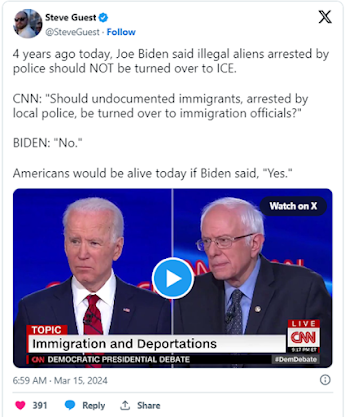
The US Constitution clearly grants to Congress, and only to Congress, the authority to "declare war." However, the Constitution does not define  what constitutes a declaration. As then-Senator Joe Biden accurately explained in 2001, the Congress has declared war when the Congress thinks it has. Hence, he said, an Authorization for the Use of Military Force meets Constitutional muster as a declaration of war.

I happen to be a professor of Constitutional law. I'm the guy that drafted the Use of Force proposal that we passed. It was in conflict between the President and the House. I was the guy who finally drafted what we did pass. Under the Constitution, there is simply no distinction between a formal declaration of war, and an authorization of use of force. There is none for Constitutional purposes. None whatsoever. 

Constitutional lawyers over the decades have held that varying kinds of enabling acts, such as monetary appropriations for military action, have also amounted to Constitutional satisfaction and, at least, consent of the Congress to action ordered by the president, in whom the Constitution grants authority to conduct warfare.

Since the dawn of the American republic, the Congress and the presidents have generally agreed that the president may order US forces into combat against another nation, solely on his own authority, if and only if there is:

  1. Imminent danger of attack from the other power, so imminent that time taken for Congressional deliberations would hinder defense against it, or,
  2. To protect actual threat against US citizens abroad, or to rescue them from actual danger.  

At this time, neither of these are the case versus Iran, otherwise justified though it may be. My conclusion is that if President Trump or his successor decides to elevate military actions against Iran, Congressional authorization must be granted. 

3. Is it wise, as far as we can discern, to wage the war?

With war already a fact, the question is how to wage it wisely. However, this question is really one of setting the national objectives and predicting their consequences. But that will always be broadly uncertain and as cannot be well answered except retrospectively. But doing nothing or taking indecisive actions would be profoundly unwise. 

The question of wisdom must be faced because JWT has long held that waging war futilely is it self unjust, no matter the justification of other tenets of JWT. And that leads directly to the doctrine of proportionality, which so many people think means that we may not respond to an attack with more force than the attacker used. It absolutely does not mean that. 

As I explain in my essay, What does "Just War" mean?

The doctrine of proportionality is simply stated that the means of conducting the war must be proportionate to the goal for which the war is waged. Another way of looking at it is that while the just ends desired do not justify any means to attain them, they absolutely justify some means. The tenet of proportionality, then, is to assess what the justified means are, then employ those means and not the unjustified ones. ...

Hence, proportionality means that one cannot use more force than necessary, but must use all the force that is necessary.  It is critical to understand that proportionality does not mean, and never has meant, anything like a tit-for-tat response. 

4. Is there a just objective to waging war? 

At a minimum, a just objective to the war must be cessation of hostilities by Iran upon US persons and  facilities. That means to do that range from settling treaty agreements in Oman to using military force against Iran and its  proxy militias. I personally am sure that Iran will not ever cease its warfare against the US and our interests (and allies) unless the ayatollah regime is ended and the IRGC is destroyed. 

That is exactly is the reason that Congressional and public debate must be entered into sooner rather than later. Actively warring against Iran may be the right thing to do (or maybe the least-bad option) but it must be the right way politically, strategically, and tactically. And IMO, that starts with explanations to the public of what is at stake and sober discussions in the Congress. What I do not affirm is that this or a successor president should wage this war on his own authority only. 

Related: 
Why Iran is betting on war, from the Financial Times. 


Tuesday, June 24, 2025

What does "Just War" mean?


Just War Theory (JWT henceforth) forms the basis of modern international law regarding the causes, conduct, and conclusion of warfare. JWT is not a modern concept, however. It has sprung over many centuries of thought in the Christian traditions to resolve the tensions between the teaching of Christ and the realities of national affairs in a fallen world. For example:


The principal influence on JWT were Saint Augustine, AD 354-430, and St. Thomas Aquinas of the 13th century. Of the two, Aquinas remains the more influential and all work on JWT since him builds on his work. 


But what is war? The question seems self-evident, but modern Conventions such as The Hague and Geneva Conventions are careful to define. For centuries, war has been understood to be an act of nation-states, not of combat between non-state combatants, no matter how well armed and organized. Understand, however, that armed conflict between a nation state and a non-state combatant does qualify as war under the Conventions and other relevant treaties. 

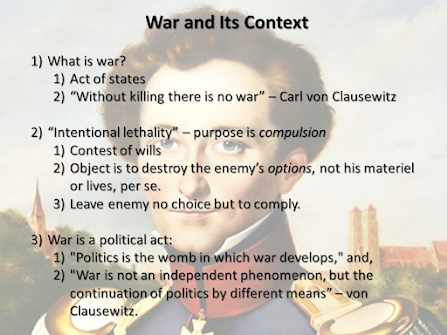
War is an act of deliberate destruction of an enemy's lives or physical assets. Absent "intentional lethality," there is no war regardless of what armed forces may otherwise do. Historically, however, the purpose of those operations has not simply to kill, but to compel submission by the enemy. As the US Army's World War 2 Gen. George S. Patton said, "Battles are won by frightening the enemy. You frighten the enemy by inflicting death and wounds." 

Europe's most celebrated theoretician of war is Prussian Gen. Carl von Clausewitz, 1780-1831, whose book, On War, is still studied around the world. One of his central tenets is that, "Politics is the womb in which war develops," and therefore, war is "the continuation of politics by different means.” 

Today's conventions clearly recognize that principle. 


In theorizing about war, these are the underlying visions of warfare that are used, usually more than one is used. 


As you can see, a nation's leaders may use moral principles to decide that employing the armed forces is justified under the various Conventions and the leaders' own national principles. But they may also see that while war is morally justified, it would be unwise and would likely have unacceptable outcomes. 

And that  leads to what are the bases, or templates, for which war might be made? I will let my slides speak for themselves:


Just War Theory JWT is a holistic view of war with a focus on attaining justice, limiting suffering, and encompassing all three of:

  • The cause of war
  • The conduct of war
  • The termination and aftermath of war
So, let's look at the basic details:


Just War Theory, along with international conventions and accords, forbid wars of conquest or aggression. The basic principle is that a nation may justly go to war to defend against aggression or to protect such aggression against third parties. However, Europe's history, culminating in the 30 Years War of the early 1600s, led to rejecting protection of third parties as an excuse to go to war. The Peace of Westphalia established national, geographic boundaries as the demarcation of nations (warring of parties), not language, tribal identity, or ethnicity. And the Peace deliberately set the internal affairs of a nation as immune from interference, especially war, by other states. 

This has formed a foundation for "governance" (if one may use that word) for war ever since, and is reflected strongly in the United Nations charter. The UN charter does explicitly allow for international alliances outside the UN that may establish war making for defensive purposes, with NATO being a primary example. 


Just War Theory holds as a matter of principle that making war therefore must be undertaken to establish a more just peace than pertained prior to the conflict. And the war may not itself be of greater evil than that it seeks to prevent. 

That war may not justly be waged absent reasonable prospect of success is important. It relates directly to the tenets of just conduct of war, and especially the greatly misunderstood principle of proportionality, about which more later. 

The Principle of Proper Authority

Just War Theory mandates that nations may go to war only with proper authority to do so. There is no international agreement on what that may be as a universal standard. The UN Charter permits specific kinds of war without UN consultation, but requires UN Security Council approval for other wars. (President Truman, for example, gained UNSC approval for the Korean War.) 

The UN Charter also recognizes that nations make security arrangements and treaties outside the UN structure. The most famous example is Article 5 of the NATO Charter, which requires every NATO member nation to respond militarily if any NATO member is attacked and Article 5 is invoked.
 
However, the only authority that can declare the United States is at war is the US Congress, not the UN. Treaties do not overwhelm the US Constitution. The UN cannot make American war legal or illegal, but it can make it legitimate in eyes of world. 

The US Constitution distinguishes between declaring war, which can be done only by Congress, and making war, which is the purview of the executive. As then-Senator Joe Biden accurately explained in 2001, the Congress has declared war when the Congress thinks it has. Hence, he said, an Authorization for the Use of Military Force meets Constitutional muster as a declaration of war.
I'm the guy that drafted the Use of Force proposal that we passed. It was in conflict between the President and the House. I was the guy who finally drafted what we did pass. Under the Constitution, there is simply no distinction ... between a formal declaration of war, and an authorization of use of force. There is none for Constitutional purposes. None whatsoever. 
Constitutional lawyers over many decades have held that varying kinds of enabling acts, such as monetary appropriations for military action, have also amounted to Constitutional satisfaction and, at least, consent of the Congress to action ordered by the president, in whom the Constitution grants authority to conduct warfare.

Just Conduct of War

Let me begin by reiterating that warfare is intentional lethality and destruction. Just conduct of war means that there must be limits to both. And that is where the principle of proportionality comes in. 

The doctrine of proportionality is simply stated that the means of conducting the war must be proportionate to the goal for which the war is waged. Another way of looking at it is that while the just ends desired do not justify any means to attain them, they absolutely justify some means. The tenet of proportionality, then, is to assess what the justified means are, then employ those means and not the unjustified ones.

The centering question of the doctrine of proportionality is deciding the violence necessary to achieve the war's objectives while not using excessive violence to do so. To employ too little violence is as disproportionate as to employ too much. It is unjust to wage war ineffectively even for a just cause.

Hence, proportionality means that one cannot use more force than necessary, but must use all the force that is necessary. It is critical to understand that proportionality does not mean, and never has meant, anything like a tit-for-tat response. 

In this, as in most of the just conduct tenets, huge gray areas of uncertainty abide. The combatants must do the best they can.  

The doctrine of Discrimination of violence means that weapons may not be employed with little or no regard to the nature of the target. Specifically, non-combatants may not be deliberately targeted and in fact, warring parties must use all achievable means to avoid it. But as warfare of the past 100-plus years has showed, it is permissible to bomb enemy factories even though factory workers are not members of the military. 

However, an international standard called Common Article 3 governs combat between state and non-state combatants. Its states that civilians' presence at a location does not automatically make that location off limits from attack. As Human Rights Watch explained during 2006's Hezbollah war, 
It, too, can be targeted if it makes an “effective” contribution to the enemy’s military activities and its destruction, capture or neutralization offers a “definite military advantage” to the attacking side in the circumstances ruling at the time. 
Other Categories
  • There are Hague Protocols on chemical and biological weapons. In this, United States policy since at least the 1960s has been in compliance. It is that the US will not use bioweapons, period, and will not be the first to use chemical weapons, but retains the right to respond likewise against an enemy's use of them. (As for nukes, US policy has not changed since they were invented: We have atomic weapons, and if you do not want us to use them, then do not attack us. Other nuclear-armed nations have basically the same stance.) 

  • Use of civilians as hostages or “human shields” is prohibited. 

  • Hospitals, other categories (such as houses of worship) may not be attacked. 

  • No “false flagging,” such as marking combatant vehicles with the insignia of the International Red Cross. 

  • Honorable surrender is defined, required to be honored. Pretense of surrender is prohibited for any reason. 

  • Militarization of protected structure removes its protection. A hospital, for example, may not be bombed, but if a combatant places anti-aircraft weapons atop it, it may legally be leveled without warning. 

  • The Conventions specify permissible treatment of POWs and refugees, including prohibitions of torture and other actions. 

  • Retribution actions are permitted, but very narrowly. For example, if a combatant nation executes 20 POWs because two of them had attempted escape, the those soldiers' nation may execute in retribution POWs that it holds, but only up to a point. 
The Conventions also specify occupying power obligations and define the distinction between lawful and unlawful combatants. Unlawful combatants are not afforded all the protections of lawful combatants. 

And the Conventions define and require the responsibility of moral action and accountability for all sides. That is, a warring nation is required to bring to discipline any member of its armed forces who commits a war crime.  

Just Ending of War

Here, there are three guiding principles:
  • Enduring peace 
  • Restraint of the victor 
  • Reconciliation among warring parties
What is the future of JWT, especially in its relation to international accords? I close with a link to an article by Jeff McMahan, professor of philosophy at Rutgers University and author of The Ethics of Killing: Problems at the Margins of Life and Killing in War. Click here: "Rethinking the ‘Just War,’ Part 1" (part 2 is linked at the end of that article).

Saturday, March 15, 2025

Beware the compassion police

reposted from 2003
links were good at the time of original posting

Why compassion cannot be a basis for public policy

I recall a story in the Washington Post from the early 1990s, when I lived in northern Virginia, written by a Catholic nun. It told of a ministry in downtown DC that she was working, offering free lunches to the poor.

When she and her fellow charity workers had started this ministry they had decided not to require means tests of the people who came to eat. Means tests - requiring the recipients offer evidence they could not afford to pay for the meals - would be degrading, they concluded. The poor were beaten down by life enough without the church adding to it.

Yet after several weeks the sister had changed her mind. The soup kitchen initially attracted diners who were clearly homeless, near-indigent or working poor. But as time went on, she observed the diners were better and better dressed. They were cleaner, obviously more healthy. At first, a large number of diners had walked to the kitchen, but now most drove, and as more time passed, older cars parked outside gave way to newer cars, then expensive cars. The kind of person who first began eating there became rarer and rarer.

The nun concluded that they should have required means testing to protect the poor. It was clear to her that they were now running a kitchen serving free food to people of substantial means, not the poor they intended to serve.

"Which among you," asked Jesus, "when asked by your child for bread, would give him a stone?" Well, none of us, of course. And which of us, encountering someone who truly could not afford his next meal, would fail to buy it for him?

Personal charity and works of compassion are basic requirement of Christian ethics. But Christian people with best of intentions go awry when they attempt to make their personal ethics public policy. Compassion is bad public policy.

I table-talked once with several of my colleagues at a seminar, some of whom insisted that health care should be free for the poor, meaning, of course, that the government will pay for it - meaning of course, the non-poor will pay for it.

As one of the seminar’s presenters pointed out, the non-poor are already paying for the poor’s health care. Heath insurance premiums are padded to cover the costs of treating the uninsured. In 2003, wrote Ezekiel J. Emanuel and Victor R. Fuchs, "the average health insurance premium for a family of four is about $9,000." Make no mistake, the poor don’t receive high-quality care except for emergency-room visits, but that is where they tend to get almost all their health care. Our taxes also pay health care costs. Of the $1.4 trillion the United States now spends about on health care, the government pays about 45 percent. (link)

Individuals exercise compassion, defined by the Oxford dictionary as "sympathetic pity and concern for the sufferings and misfortunes of others." Governments and social arrangements exercise justice. Justice is only accidentally compassionate because justice, to be justice, must balance the valid, competing needs of persons and groups within society. Justice attempts to answer, "What is right, what is fair?" Justice is enforced against the will of at least one of the contending parties. Hence, justice is at its foundation coercive.

Compassion, though, seeks to alleviate shortcoming, suffering or pain, to heal in body, mind or soul. Compassion cannot be enforced. I could not compel a stranded motorist one day to accept my aid, because it would have been literally criminal to do so. In offering aid, I did not have to balance competing claims for my time and money because there were no claims and could not be any. The issue was not what was just or fair, but what was possible.

Compassion is self limiting; one is compassionate to whom one will to the extent of the resources one decides to donate. There are, say, 50 hungry people. You buy lunch for 15, maybe 25, 45 or all. You stop when you can afford to buy no more or simply when you decide you have spent enough and still want to have enough to buy a new DVD. There is no guilt on anyone’s part because no one has done anything wrong. You were under no legal obligation to buy anyone lunch in the first place, so choosing to feed some, not all, is your free choice. The others had no entitlement to your money.

But justice is only roughly self limiting. An employer who cheated his employees of some of their wages for a time, totaling $25,000, cannot plead for reduced judgment because he has only $10,000 in the bank. The court will hold still him liable for all of it, plus lost interest and punitive fines and perhaps prison. The employees have a rightful claim that the employer may not rightfully deny.

Justice attempts to make right or compensate wrongs done by persons or groups against others. Compassion attempts to make more level the relationships of resources or care between persons or groups of persons.

Compassion makes a very poor guide for justice. Compassion can exist only when there is no right to receive it. A judge, for example, cannot be justly compassionate. For a judge to show compassion for one party to a case is to treat another party unjustly. Showing compassion to a burglar by an unwarranted light sentence is to rob the victim’s family of their rightful claim that the burglar will be fairly penalized. And it puts at risk larger society, which has the right to expect that burglars will not soon be turned loose to rob again.

Similarly, compassion for the victim’s family that leads to an overly harsh sentence - life in prison, for example, for a first offense when no one is injured - sets aside the rightful claim of the convict that his punishment will be consonant with the crime. Likewise, society has a rightful claim not to bear the burden of supporting him for a lifetime for commission of one, non-violent offense.

It is impossible for interactions with government to be compassionate because interactions with government are never between equals. Government is always coercive. Interactions with government are always based on unequal power relationships, not compassion.

The fact that different groups have different interests that must be sometimes balanced and sometimes found to be right or wrong is what seems to escape many churches’ proclamations about public policy. The pronouncements tend to be personal compassion writ large, into state policy, then to be coercively enforced.

Case in point: identification cards now being issued by the Mexican consulate in Tennessee, including last year in Shelbyville. Anyone care to guess how many card recipients are in the US illegally? Shelbyville is the center of Tennessee Walking Horses, a major equestrian industry. A man who was senior manager of a large Walking Horse ranch told me that the whole industry would "dry up" if its illegal-immigrant workers were taken away.

From compassion, some people say that illegal immigrants should be allowed to enter the US and work here unhindered. They come here only for economic opportunity, after all, having no prospects for personal advancement in their home country (Mexico, for most of them).

But this argument also exposes the emotional blindness of wishing to make compassion public policy. For when compassion is moved into the large-scale public arena, its focus is too narrow to promote the general welfare. Amnesty for illegal immigrants (whether by proclamation or non-enforcement, which is what we have today) means depriving others of something they to which they have a rightful claim.

I guarantee that the jobs the Walking Horse illegal aliens are working existed before they moved here. Ranchers had to mend fences and shovel barns and bale hay long before Mexicans moved here in numbers. But who was doing that labor before? Not business executives. Not otherwise idle, bon-bon eating housewives. The American working poor made the ranches go. That is who the illegals displaced. But those displaced have a rightful claim to such jobs over persons who are at-large criminals, which is literally what illegal aliens are.

There is a long list of other groups who have rightful claims adversely affected by the issue, but that’s not the point of this essay. My point is that compassion fails as policy because it is impossible to be fairly compassionate, except with one’s own resources. Making compassion into policy or law for society compels others to conform to your idea of compassion, trampling on their freedom to be compassionate according to their own lights or to be hard-hearted as they wish. And compassion that coerces is not compassion at all; it is tyranny.

Systems of justice may be tyrannical, too, of course. That is why Western political philosophy has promoted mercy to temper justice. Mercy is not the same as compassion, though as a personal quality mercy and compassion are closely related. William Shakespeare wrote in The Merchant of Venice,

The quality of mercy is not strain'd,
It droppeth as the gentle rain from heaven
Upon the place beneath. It is twice blest:
It blesseth him that gives and him that takes.
'T is mightiest in the mightiest: it becomes
The throned monarch better than his crown;
His sceptre shows the force of temporal power,
The attribute to awe and majesty,
Wherein doth sit the dread and fear of kings;
But mercy is above this sceptred sway,
It is enthroned in the hearts of kings,
It is an attribute to God himself;
And earthly power doth then show likest God’s,
When mercy seasons justice. Therefore, Jew,
Though justice be thy plea, consider this,
That in the course of justice none of us
Should see salvation: we do pray for mercy;
And that same prayer doth teach us all to render
The deeds of mercy. (Act iv, sc. 1.)

In terms of justice, though, "clemency" is probably a better word, indicating mercy shown toward one who has offended, but whose punishment or rehabilitation is either completed sooner than expected, or earned during the course thereof.

Not only mercy tempers justice. Religion has served that purpose in Western history also, as have Enlightenment philosophies of individual rights and the idea that the locus of state sovereignty lies in the people, not the state apparatus. But justice remains coercive at base, serving no one perfectly but (hopefully) all as fairly and unobtrusively as possible. However, this is what compassion cannot do.

I find, then, that I have arrived at the place theologian Reinhold Niebuhr arrived several decades ago.

Reinhold Niebuhr, a professor of Christian ethics, was one of the most influential theologians of the last century. In his work, Moral Man in Immoral Society, Niebuhr explained that while individual persons live generally moral lives, high morality is difficult, if not impossible, for human societies and social groups as a whole. Very rarely does a group of persons comport itself better than individuals do in personal relationships. When human beings engage in collective activity, Niebuhr said, they are overwhelmed by an inability to be moral. The larger the group, the greater this inability is.

Niebuhr was specifically addressing Just War theory in the works I cite here, but I think the same train of thought applies to issues of justice and compassion within societies.

Niebuhr concluded in "Must We Do Nothing?" in The Christian Century (3-30-1932), "The hope of attaining an ethical goal for society by purely ethical means, without coercion . . . is an illusion" of the "comfortable classes" of society. There never will be enough love and unselfishness among nations [or persons] to resolve the conflicts of history [or societies] only by ethical [or compassionate] means, even though there may be occasional successes now and then. It is part of humanity's "moral conceit" to think that human sin will not overwhelm individual morality [and compassion] when persons act collectively.

Until the return of Christ, wrote Niebuhr, human societies will never be able to conform purely to the ethic of Christian love. In the interim, we must structure our world based on justice, as best we can, even though communities of justice are inferior to communities of love or compassion. The best justice human societies can attain will only roughly correspond to divine justice. Human justice will always involve contests of power because different groups make opposing claims that they consider rightful.

Niebuhr concluded that the ethical goals of human society must not be sacrificed "simply because we are afraid to use any but purely ethical means." Nor, I think, should they be sacrificed because an ethic of love cannot serve as the fundamental ordering of society.

Yet works of compassion can indeed take on orders of magnitude that project them into the arena of justice, just not judicial justice. When acts of compassion come to affect so many persons that the order of society is changed, so is the nature of the society’s justice. Justice is, after all, only the "right ordering of things" in human affairs (said Aristotle, as I recall).

I have in mind the work of Bangladeshi economist Muhammed Yunus. Banks in Bangladesh refused to loan impoverished women money so they could begin their own businesses. The average loan refused was 62 cents. Yunus reached into his own pocket and loaned 42 men and women in one village a grand total of $27.

Every borrower paid Yunus back with interest. The banks still refused to write loans. Reports "Vanderbilt Magazine," Fall 2003, p. 49:

Village by village, district by district, Yunus proved conventional bank lenders wrong. Twenty-seven years later, his pioneering approach to micro-lending has spawned nothing short of a credit revolution.

His Grameen Bank . . . has disbursed roughly $3 billion to more than 2 million borrowers in Bangladesh alone, allowing many thousands to lift themselves up from the most abject poverty. 

His bank has been imitated by more than 7,000 other organizations around the world, including some in America. This is compassion writ large and well. It is personal; Yunus used his own money, not someone else’s. Yet its effects are transforming the social order of societies.

As for me, though, whenever I hear a politician tell weepy anecdotes about some unfortunates, then declare that "America is better than that," I lock up my wallet. I know he wants to make his personal sense of compassion into public policy, by coercion, using my money.

As it turns out, US Congressman David Crockett had some things to say about this topic about 171 years ago.

I should also point out that some of my Christian friends will take offense at my claim that, "Compassion can exist only when there is no right to receive it." I say again: works of compassion are a duty of Christian disciples. But they are done in gratitude for and imitation of the saving work of Christ. Hence, they are unenforceable by human agency and are voluntary. Compelling others to perform one’s own idea of compassion is the very opposite of compassion, for compassion cannot coerce others and remain compassion. Even so, the Scriptures are clear that we will be judged by Christ according to our works of compassion.

Another thought by Neibuhr: In February 1941 Niebuhr wrote,

Love must be regarded as the final flower and fruit of justice. When it is substituted for justice it degenerates into sentimentality and may become the accomplice of tyranny. Looking at the tragic contemporary scene within this frame of reference, we feel that American Christianity is all too prone to disavow its responsibilities for the preservation of our civilization against the perils of totalitarian aggression. We are well aware of the sins of all the nations, including our own, which have contributed to the chaos of our era. We know to what degree totalitarianism represents false answers to our own unsolved problems - political, economic, spiritual. Yet we believe the task of defending the rich inheritance of our civilization to be an imperative one, however much we might desire that our social system were more worthy of defense. We believe that the possibility of correcting its faults and extending its gains may be annulled for centuries if this external peril is not resolutely faced.

This is a critical point. Niebuhr was saying that if Christians refrain from maintaining justice, even by force if necessary, because they substitute love for justice, then the love they wish to promote actually becomes the handmaiden of tyranny. And of course, that is no love at all.

Tuesday, January 28, 2025

SecDef Hegseth and his pointless name game

NBC affiliate WFMY in Greensboro, N.C., reports:

NORTH CAROLINA, USA — The controversy surrounding the name of North Carolina’s Fort Liberty is back in the spotlight following remarks by the newly appointed Secretary of Defense, Pete Hegseth.

In 2022, the U.S. military spent over $2 million to rename Fort Bragg to Fort Liberty, distancing itself from Confederate ties as Fort Bragg was originally named after Confederate General Braxton Bragg. However, during his first day on the job Monday, Hegseth referred to the base by its former name.

“Every moment that I’m here, I’m thinking about the guys and gals in Guam, in Germany, Fort Benning, and Fort Bragg, on missile defense sites and aircraft carriers,” Hegseth told reporters as he entered the Pentagon.

The mention of Fort Benning also stood out, as the Georgia base was renamed Fort Moore in 2023, another step in the Pentagon’s efforts to remove Confederate associations from military assets.

Hegseth’s remarks align with a promise President Donald Trump made on the campaign trail in Fayetteville, North Carolina three months ago. “Should we change the name from Fort Liberty back to Fort Bragg?” Trump asked a crowd of supporters, receiving loud cheers. “So here’s what we do: we get elected, I’m doing it. I’m doing it.”

I am a retired Army artillery officer. I served a tour at Ft Bragg in the latter 1980s. I am very definitely a political conservative, but I cannot agree with reverting the name back to Bragg. Here is why:

Confederate General Braxton Bragg
1. Ft Bragg was founded in Sept. 1918 as an artillery training center. Called Camp Bragg at first (because it was considered a temporary installation), it was named for North Carolina native Gen. Braxton Bragg for his artillery actions during the Mexican-American War in 1847. 

So far, so good. Bragg's record as a mid-grade US Army officer was in fact stellar. But another important reason the camp was named after him was, frankly, to appease Southerners while the US was at war in Europe. In 1918, there was still a large number of Civil War veterans, Union and Confederate, still living, and to their children and grandchildren, that war was not old history, far removed in time or space. So, the camp was named after a CSA general who conveniently was an NC native and Army artillery officer. 

Please note that there are no military installations outside the old CSA that were named after CSA figures. I will also note that Gen. Bragg was a truly dismal battlefield general, which IMO is another reason not to revert to using his name. 

I also think, however, that Fort Liberty is a nitwit name. Find a post-Civil War American military hero or renowned wartime commander and use that. 

2. There are some hard truths about the CSA. I was born and raised in the Deep South. My family's roots in Middle Tenn. go back to just after the Revolutionary War. I have ancestral family members who fought (and some died) for the CSA on both my mom's and dad's side (also for the Union on my dad's). Alexander Stephens, vice president of the CSA, was my wife's great-great grandfather's brother.

I take no back seat to anyone for Southern heritage and upbringing.

Like probably most native Southerners of my generation, I was raised being taught that the real reasons for the Southern states' secession was to preserve states’ rights and that the northern economic lobby was choking the South's economy with high tariffs on Southern goods.

Slavery? Well, it was in the mix somewhere, but slavery was not the real reason for secession. 

It is a lie, pure and simple

The states’ rights and tariffs arguments are entirely absent from Southern apologia until after the Civil War. In 1860 and before, no one in the South was using those topics to justify secession. Furthermore, in 1860 federal tariffs on Southern goods were lower than they had been since 1816. 

Why did the Southern states secede? To protect slavery, period.

Read the 11 seceded states' actual acts of secession, beginning with South Carolina's, and you will see that slavery was the sole reason for secession. South Carolina's act makes this very unambiguous: protection of slavery was the only topic presented as driving secession. Same with Mississippi. And the others.

The Confederate States of America was founded to do one thing only: to preserve the power of one class of people to literally own as chattel property another class of people. There is no other reason the CSA existed.

We are long, long past the time where any figure of the CSA should be honored with naming any federal property after him.  

I wrote  at greater length upon the CSA's secession and raison d'etre here: "Confederate monuments: So what? Now What?"

Monday, January 20, 2025

14th Amendment and "birthright citizenship"

I wrote this on another web site in 2010, so the issue of birthright American citizenship has been contentious for a long time. But the main points are still relevant, so here you go:

----------------------------------------

Many pixels are being lit up by some Republicans' commentary that the 14th Amendment to the 
Constitution "
is in need of review."

Senate Minority Leader Mitch McConnell (R-Ky.) told The Hill on Monday that Congress “ought to take a look at” changing the 14th Amendment, which gives the children of illegal immigrants a right to U.S. citizenship.

McConnell’s statement signals growing support within the GOP for the controversial idea, which has also recently been touted by Senate Minority Whip Jon Kyl (R-Ariz.) and Sen. Lindsey Graham (R-S.C.).

In an interview, McConnell said the 14th Amendment provision should be reconsidered in light of the country’s immigration problem.

The 14th Amendment was ratified in 1868. Its intention was to ensure that slaves freed by the Civil War could not be denied citizenship. The part of the amendment for that purpose simply states,

All persons born or naturalized in the United States, and subject to the jurisdiction thereof, are citizens of the United States and of the State wherein they reside.

This has been interpreted in the almost 150 years since as meaning that anyone born inside the US or its territories is automatically a citizen.

The 14th Amendment's crafter never imagined "anchor babies."

Babies born to illegal alien mothers within U.S. borders are called anchor babies because under the 1965 immigration Act, they act as an anchor that pulls the illegal alien mother and eventually a host of other relatives into permanent U.S. residency. (Jackpot babies is another term).

The United States did not limit immigration in 1868 when the Fourteenth Amendment was ratified. Thus there were, by definition, no illegal immigrants and the issue of citizenship for children of those here in violation of the law was nonexistent. Granting of automatic citizenship to children of illegal alien mothers is a recent and totally inadvertent and unforeseen result of the amendment and the Reconstructionist period in which it was ratified.

For decades after the amendment took effect, American Indians were ruled by federal courts, including the Supreme Court, not to be covered by the 14th Amendment because they were not fully under the jurisdiction of the United States. (The Tribes were then and still are in a treaty relationship with the federal government.) It took a special act of Congress in 1924 to confer citizenship upon American Indians.

In fact, there has never been a federal court that held the 14th Amendment conferred citizenship upon infants born to parents inside the country illegally. It is being done despite that fact.

So at a minimum, Congressional legislation clarifying what birthright citizenship is, within the context of the 14th Amendment, is not only appropriate, it is long overdue. I myself would support a Constitutional amendment to that effect. It would not require repealing or modifying the 14th Amendment. My draft reads:

Amendment 33 - Citizenship by Right of Birth Clarified
1. A person shall be a citizen of the United States by right of birth provided that the person is:

a. born in the United States to parents of whom at least one is, at the time of the birth, both a citizen of the United States and a de jure parent of the newborn, or,

b. born in the United States to parents who, though not citizens of the United States, are legally in the United States as permanent residents at the time of the birth, and who are de jure parents of the newborn, or,

c. born outside the United States to a de jure parent who is citizen of the United States at the time of the birth, provided that the birth occurs outside the United States because of United States diplomatic mission or military orders of a parent, or,

d. born outside the United States to a de jure parent who is citizen of the United States at the time of the birth, provided that the birth and identifying information of the newborn are registered within six months from the date of the birth with a United States diplomatic mission to the jurisdiction wherein the birth occurred.

2. Persons born in the United States and who do not meet a criterion citizenship by right of birth shall not be deprived of due process of law; nor shall any such persons within the jurisdiction of the United States be denied the equal protection of the laws by the United States nor by any State.

3. Congress shall have the power to enforce this amendment by appropriate legislation.

So there you are.

Updates: Here are three more links relevant to this topic. First is an article by George Mason law Prof. Ilya Somin, with whom I have corresponded now and then for going on 20 years, though I have never met him in person. I would say he is, overall, a centrist. He says that Trump cannot simply order it. Click here

Next is George Washington University law Prof. Jonathan Turley, one of the most respected legal scholars in the country. His article is from 2019, "No, It Is Not Racist To Oppose Birthright Citizenship," in which he points out, 

... that one of the outcomes was the passage of the 14th Amendment in 1868 to guarantee the rights of citizenship to protect the status of freed American slaves. That much is clear. The problem is that little else is. Since the 14th Amendment was ratified, many leaders have opposed claims of birthright citizenship, including former Senate Majority Leader Harry Reid. Moreover, most countries reject such claims of citizenship. One can be entirely on board with the outcome of the Civil War, not be a racist, and still oppose birthright citizenship.

Finally, here is today's BBC's article, "Trump has vowed to end birthright citizenship. Can he do it?" I read the BBC because in covering American topics, I find it often more balanced and non-partisan than US media. Also, though the article does not say this, foreign nationals enjoy no birthright citizenship in the UK. 

June 2026: The Supreme Court decided this month that birthright citizenship means that, with very narrow exclusions, any baby born in the United States is automatically a US citizen, including born here to a mother who entered the US legally or illegally, and for that matter may have entered the country literally only minutes before giving birth. 

Here is a Wall Street Journal article, free link, explaining what Chief Justice John Roberts got wrong in the majority decision. It was written Richard A. Epstein, a professor of law and NYU Law School, a senior lecturer at the University of Chicago and a Senior Fellow at Civitas Institute.

Roberts Gets the 14th Amendment Wrong. In the 1860s, citizenship was not only extended but defined more narrowly than the chief justice acknowledges.

Read the whole thing, but I think this is the key excerpt:

A key to the constitutional structure was the distinction between “subject to the jurisdiction thereof” in the 14th Amendment’s Citizenship Clause and “within the jurisdiction” in the Equal Protection Clause. The latter isn’t limited to citizens, as the Privileges or Immunities Clause is, but applies to all persons.

That rests on Blackstone’s explicit distinction between “local” and “natural” allegiance. The former requires all persons to respect the criminal and civil law while in a foreign nation, but ceases to bind them on their departure. Local allegiance never confers any opportunity to obtain citizenship, which natural allegiance does. The chief justice incorrectly collapses the two into one by writing that “the Citizenship Clause uses jurisdiction in its ordinary sense—referring to the power of the United States to govern those within its territory.” The Equal Protection Clause had nothing to do with citizenship. How could the 14th Amendment confer automatic birthright citizenship when the 1870 statute set out more-rigorous conditions to apply for naturalization?

As I said, read the whole piece.

Monday, March 18, 2024

Immigrants and criminality

The Left is insisting that crime rates of immigrants is just wonderful, such as, "The ‘Criminal Immigrant’ Canard" by by Mona Charen:
Every study on the subject has shown that since 1960, immigrants are much less likely than native-born Americans to be arrested or convicted of crimes (excluding crimes associated with entry into the country). The right highlights a few cases of murder committed by immigrants, but as Alex Nowrasteh of the Cato Institute shows, undocumented immigrants are 27.7 times less likely to commit homicide than natives, and legal immigrants are 57.1 times less likely.
Okay, fine - but she overlooks at least two points. One is that the crime rate for illegal immigrants is more than twice as high as for legal immigrants. Second, she and other libs ignore the fact that regardless of the number of homicides committed by illegal immigrants versus American citizens, that number would be magnitudes lower if this administration had not simply thrown away controls on who gets into the country.

These immigrants are not committing crimes instead of Americans, but in addition to Americans. There are therefore many Americans victimized, even murdered, by illegal immigrants whose entry into the country was deliberately allowed as policy by the Biden administration. And that does not even include the 100,000-plus deaths from drug overdose, most from fentanyl brought easily over the southern border by Mexican cartels.

Then there is this guy, apprehended by the US Border Patrol on March 9 near El Paso, Texas: "Illegal migrant from Lebanon caught at border admitted he’s a Hezbollah terrorist hoping ‘to make a bomb’ — and was headed for NY."
[Basel Bassel] Ebbadi said in a sworn interview after his arrest that he had trained with Hezbollah for seven years and served as an active member guarding weapons locations for another four years, the documents show. Ebbadi’s training focused on “jihad” and killing people “that was not Muslim,” he said.

Another reason Charen's argument fails is that Charen never even mentions of per-capita rates of crime of native-born Americans compared to the per-capita crime rates of legal and illegal immigrants. That is, what is the percentage of native-born Americans convicted of felonies in relation to the total number of native-born Americans in the country? And the same for legal immigrants and illegal immigrants.

Charen does not touch that and neither does the Stanford University study she cites. Its main metric claims that immigrants have had similar or lower incarceration rates than U.S.-born white men for the last 140 years of American history. And that is true for its metric of such rates of both groups per 100,000 residents, but that 100K is not broken down by race or citizenship. It is just per 100K of people living in the country:

As someone else put it, of course immigrants commit fewer crimes than American citizens. And in Japan, immigrants commit fewer crimes than the Japanese. In Egypt, immigrants commit fewer crimes than Egyptians. By the way, in India immigrants commit fewer crimes than Indians. Get the point?

And why is Stanford using a baseline of only white, native-born American men to compare to the foreign-born rate? Here are Census Bureau facts:
    • In 2020 (the latest year of Stanford's study), the total population in the US was 325,268,000. Of these, 57.8 percent were White, or 188,004,904.
    • The total native-born population was 280,361,000 (the Bureau rounded the numbers).
    • That means, according to Stanford's methods, that in 2020, the 92,356,086 non-white, native-born Americans committed no crimes!
    • However, in 2020, according to the federal Bureau of Justice Statistics, "about 48% of inmates held in local jails were white, 35% were black, and 15% were Hispanic. American Indians or Alaska Natives; Asians, Native Hawaiians, or Other Pacific Islanders; and persons of two or more races accounted for 2% of the total jail population." In fact, "In 2020, the [overall] imprisonment rate was 358 per 100,000 U.S. residents, the lowest since 1992."
That last datum, also from the Bureau of Justice Statistics, flatly contradicts the Stanford study, which inexplicably charts incarceration of white men alone at about 1,700 per 100,000! I could not find foreign-born incarceration numbers for 2020 specifically, but in 2018 the Department of Justice announced "that more than one-in-five of all persons in Bureau of Prisons custody were known or suspected aliens, and 93 percent of confirmed aliens in DOJ custody were in the United States unlawfully." That stat certainly has not improved.

Also crushing the Stanford study is this DOJ chart; compare to the chart above.


Here is the inaccuracy (I dare not call it deception) of the Stanford study:
  • To claim that foreign-born persons in the United States are less likely to commit crimes than native-born white men simply borders on gaslighting. It is not a relevant comparison.
  • In 2020, the year ending the Stanford chart, there were 280,361,000 native-born persons in the country. What is the incarceration rate of native-born persons per 100K for all native-born Americans? Stanford simply ignores this.
Actually, some number of the white total residents was foreign born, but the Census report breaks down only by totals of native v. foreign born; the 57.8 percent figure cited also does not distinguish between native and foreign born. In 2020, there were 44.9 million foreign-born people living in the US. Of them, 50.7 percent, or 22.75 million, were naturalized citizens.

Yes, legal immigrants do commit crimes, but it is in fact very difficult to immigrate to the this country legally, and there is ample screening of each person. But there is little (mainly no) screening at all for those entering illegally. An enormous number (the "gotaways") are not caught and are not even known of. According to MSN four months ago, using Customs and Border Patrol data, "Illegal border crossers total over 10 million since Biden inauguration."
Since January 2021, a minimum estimate of nearly 1.7 million gotaways have illegally entered the U.S.

Based on earlier projections and including Office of Field Operations data, former CBP chief Mark Morgan told The Center Square the gotaway data is likely to reach or exceed one million for fiscal 2023 alone.

In fiscal 2021, there were at least 308,655 known, reported gotaways; in fiscal 2022, 606,150 were reported. According to preliminary data obtained by The Center Square, Border Patrol agents reported at least 769,174 gotaways at the southwest border alone.
The rest, numbering now in the many millions, with very few exceptions are simply given a court date that is many years away, then are released into the country with zero requirements or supervision of any kind.
How many of them are committing crimes? No one knows. What percentage of them are committing crimes? No one knows. How many of them, like Basel Ebbadi, intentionally came here with evil intentions, as FBI Director Christopher Wray has strongly warned Congress about more than once? No one knows.

Director Wray has strongly warned of potential violence from border crossers. For example:
There are many other such reports.

The Left's argument boils down to this: "Yes, immigrants, including 'undocumented' ones, do commit crimes, but so what? So do American citizens!" But as I said above, illegal immigrants' crimes are in addition to what Americans commit. The perpetrators were deliberately admitted into the country. Why is the Left energetically supporting policies that result in crimes, including rape and murder, that did not have to happen?


Update: "Undocumented Immigrants, U.S. Citizens, and Convicted Criminals in Arizona," by the Crime Prevention Research Center:
Abstract
Using newly released detailed data on all prisoners who entered the Arizona state prison from January 1985 through June 2017, we are able to separate non-U.S. citizens by whether they are illegal or legal residents. Unlike other studies, these data do not rely on self-reporting of criminal backgrounds. Undocumented immigrants are at least 142% more likely to be convicted of a crime than other Arizonans. They also tend to commit more serious crimes and serve 10.5% longer sentences, more likely to be classified as dangerous, and 45% more likely to be gang members than U.S. citizens. Yet, there are several reasons that these numbers are likely to underestimate the share of crime committed by undocumented immigrants. There are dramatic differences between in the criminal histories of convicts who are U.S. citizens and undocumented immigrants.

Young convicts are especially likely to be undocumented immigrants. While undocumented immigrants from 15 to 35 years of age make up slightly over two percent of the Arizona population, they make up about eight percent of the prison population. Even after adjusting for the fact that young people commit crime at higher rates, young undocumented immigrants commit crime at twice the rate of young U.S. citizens. These undocumented immigrants also tend to commit more serious crimes.

If undocumented immigrants committed crime nationally as they do in Arizona, in 2016 they would have been responsible for over 1,000 more murders, 5,200 rapes, 8,900 robberies, 25,300 aggravated assaults, and 26,900 burglaries.

Laken Riley’s murder and the long shadow of Willie Horton. The writer is professor of political science emeritus at the University of Chicago, where he founded the Program on International Politics, Economics and Security.

Update: Law Enforcement Officials testify to Congress about the criminal acts done by illegal immigrants.

A world without nuclear weapons - what would it look like?

 From Pope Leo this week, according to the National Catholic Reporter : " Pope Leo quotes Bob Dylan song in book foreword calling for n...