Showing posts with label Faith. Show all posts

Thursday, February 19, 2026

Lent and Chocolate - What's the Point?

The story is told of Sean O'Flannery, a lad who moved to Boston from Dublin. Coming home from school one day he went into an ice cream shop and told the jerk behind the counter (the soda jerk) "One scoop of yer best chocolate ice cream in four dishes!"

Soda jerks get strange requests, so he set four dishes with one scoop each in front of Sean. Sean took a spoon of one, held it before his face and loudly announced, "This is me beloved cousin eating ice cream back in the old country!" He ate the ice cream and took a spoonful from another scoop, "This is me dear friend Kelly eating ice cream back in me homeland!" The third dish he said was his favorite uncle, Finian, eating ice cream back home.

Sean raised the last scoop and said, "And this dish is for me!"

This practice went on for several months until one evening as the soda jerk was filling the four dishes Sean stopped him and said quietly, "Only three dishes today, please."

The soda jerk asked, "Did you suffer a loss and that is why you only want three scoops?"

"Heaven's no!" protested Sean O'Flannery. "It's Lent now, and I've given up ice cream!"

The word “Lent” comes from the Anglo-Saxon word, “lencten,” meaning Spring, the season in which Easter occurs. The forty days before Easter constitute the Lenten season, but the forty-day count does not include Sundays. All Sundays celebrate the resurrection, and so are excluded from the forty days count. The forty days duration is drawn from the length of time Jesus spent in prayer and fasting in the wilderness before he set out on his three-year ministry.
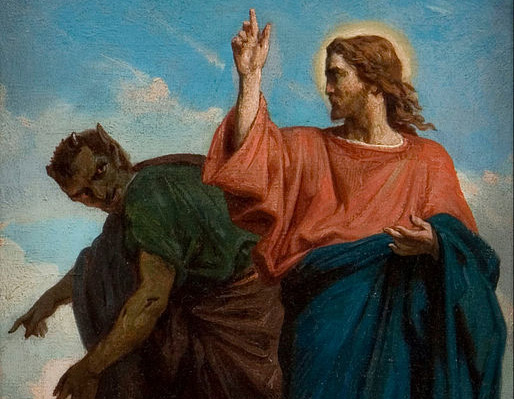
Matthew 4.1-4:

1 Then Jesus was led by the Spirit into the wilderness to be tempted by the devil. 2 After fasting forty days and forty nights, he was hungry. 3 The tempter came to him and said, “If you are the Son of God, tell these stones to become bread.”
4 Jesus answered, “It is written: ‘Man shall not live on bread alone, but on every word that comes from the mouth of God.
As originally conceived by the church long ago, the Lenten sacrifice was instituted as a “means of penitential preparation and preparation for baptism, which in the early church customarily took place on Easter Sunday.”

The tradition of fasting during Lent is an early one, originally done between Good Friday and Easter morning, the forty hours that Jesus was in the tomb. Christians would partake of no food or drink at all during that time. The fast was extended to the forty days before Easter sometime between 300 and 325, and changed so that food could be eaten only when evening had come.

The idea behind the fast was to imitate Christ. In addition to fasting, Christians would devote themselves to making prayer a faithful habit. So “prayer and fasting” have been closely linked for a long time.

And that brings me, by a rather circuitous route, to chocolate.

Chocolate is an absolutely unessential food, nutritionally speaking. We eat chocolate for no reason other than it is pleasurable. Since denial of the flesh is a prominent theme of Lent, rejection of chocolate in Lent is often offered as the Lenten sacrifice, particularly by people who wish to diet anyway.

The Lenten season is the time when we are supposed to ponder the extravagance of God’s love for us through Jesus Christ. Perhaps that fact could put a different spin on our concept of giving something up for Lent. The Lenten sacrifice is best oriented toward that which most blocks our spiritual growth. If that thing is chocolate, then it is appropriate to give up chocolate for Lent. But if something else is one’s greatest obstacle in being more Christlike, then giving up chocolate is spiritually pointless. 

The question is this: “What is the one thing that most hinders my Christian growth into the person whom God wants me to be?” The answer may not be easy, but it will always involve self-denial. We think that following Christ is hard because to obey Christ we must first disobey ourselves, and it is disobeying ourselves that makes us think following Christ is hard.

But Jesus said his yoke is easy, his burden is light. We just have to get over ourselves to do it.

As Robert Mulholland put it, “Jesus is not talking about giving up candy for Lent. He is calling for the abandonment of our entire, pervasive, deeply entrenched matrix of self-referenced being.”

If we focus on that between now and Easter Day, then we have a chance to become more mature in Christian faith and practice. It may be a habit that is out of true with Christian character that needs to be overcome for further growth. Or it may be a thing undone which must be done for deeper development to occur. The Lenten idea is for our habits to change enough in the next few weeks so that we can continue at a higher level of discipleship after Easter. The Lenten season and the Lenten sacrifice are not the points in and of themselves, the whole life of discipleship is.

Focusing on the one big thing is not the only Lenten discipline that would be helpful for spiritual development. Methodism’s founder, John Wesley, insisted that the only thing that distinguishes the Christian from the non-Christian are how we use our time and money. So, for the period of Lent I would suggest focusing on those two things in addition to whatever one big spiritual obstacle you might have. Some suggestions:
  • Tithe your income until Easter. 
  • Devote yourself to prayer daily and attending worship every Sunday. If you are traveling, say on business or spring break, then worship wherever you are.
  • Read the Bible each day. 
  • Call someone you love and let them know. 
  • Ask people who live alone to join you for lunch or whether you can visit them. 
  • Become involved in Christian ministries.
  • Re-establish or reinforce important relationships in your life.
Spiritually speaking, it is not enough to simply excise sin or personal vices from our lives. We have to replace vice with virtue. Thus, simply giving up something like chocolate for Lent is simply silly if we are only counting the days when we can start doing it again. That’s a game, not a spiritual discipline.

Lent should be a period of joyful, God-directed introspection into how we may be further united with Christ in godly love. If we make Lent into a severe, joyless, self-justifying exercise in self-denial, we have missed the point. Jesus sternly admonished teachers of the religious law and the Pharisees not to practice the letter of the law while neglecting “the more important matters of justice, mercy and faithfulness” (Matt 23:23).

When a lawyer asked Jesus, “which is the greatest commandment in the Law?” Jesus replied, “‘Love the Lord your God with all your heart and with all your soul and with all your mind.” And the second is like it: ‘Love your neighbor as yourself.’”

That is the whole point of spiritual growth and spiritual discipline, and hence the whole point of Lent: love. We are to be living ambassadors from God to one another and the world at large in Christ’s name. Christ was crucified, buried and raised from the dead for our sake and the sake of the whole world. Let us rededicate ourselves to being Christ’s ambassadors. It’s Lent, after all; it’s all about love, you see, Lent is all about love.

Thursday, November 27, 2025

A Thanksgiving Reflection


   Thanksgiving! When we take a day off to celebrate with families reunited and get stuffed fuller than the Thanksgiving turkey! It is a day we remember what we are thankful for. What are you thankful for? Shortly, we will have a time for everyone who wishes to share what they are thankful for. But I can explain that right now:

I am thankful for - the fork!

As table utensils go, the fork is a recent invention. The knife was first, of course, dating to prehistory. The spoon also dates to the Stone Age, literally. But forks date only to ancient Greece, and then they were large cooking utensils, not for the dining table. In the 600s, table forks were invented but used only in the Middle East. Table forks did not appear in Europe until a thousand years ago, and then only in Italy. The Italians were very slow to adopt them, not using them widely until five hundred more years passed. Forks did not reach France until 1533, but the French thought using them was an affectation and their adoption was very slow. The first table fork reached England in 1608, where they were promptly ridiculed as effeminate and unnecessary. Over many years, forks came to be adopted by the wealthy, who had them made from expensive materials intended to impress guests.

The first Thanksgiving celebration in Plymouth Colony was in 1621. There were no forks. The pilgrims and their guests used knives, spoons, their fingers, and cloth napkins to manipulate their food. So, I am thankful to have a fork to make eating Thanksgiving dinner easier.

The connection between food and giving thanks that reaches back thousands of years. As the children of Israel prepared to cross into the Promised Land, Moses told them,

When you have come into the land that the LORD your God is giving you as an inheritance to possess, and you possess it, and settle in it, 2you shall take some of the first of all the fruit of the ground, which you harvest from the land that the LORD your God is giving you, and you shall put it in a basket and go to the place that the LORD your God will choose as a dwelling for his name. … 8 “The LORD brought us out of Egypt with a mighty hand and an outstretched arm, with a terrifying display of power, and with signs and wonders; 9and he brought us into this place and gave us this land, a land flowing with milk and honey. 10So now I bring the first of the fruit of the ground that you, O LORD, have given me.” You shall set it down before the LORD your God and bow down before the LORD your God. 11Then you, together with the Levites and the aliens who reside among you, shall celebrate with all the bounty that the LORD your God has given to you and to your house (Deuteronomy 26:1-2, 8‑11).

Giving thanks to God has a connection with food about three millennia old. The ancient Jews knew of course that life depends on food. But they emphasized that their lives were sustained by the presence of God. After all, not only had God brought them out of slavery in Egypt, he had sustained them with manna as they wandered in the Sinai. They understood that filling the soul was as important as filling the plate.

There was once a man who was struck by a city bus and was critically injured. He was rushed unconscious to a hospital and went immediately into emergency surgery. The surgeon barely saved the man’s life after several hours on the operating table. The victim regained alertness five days later. The day after that, the surgeon stopped in to see him. Incredibly, the injured man launched into a litany of complaints about the care he had received in the last 24 hours – the food was cold, the nurses were slow when summoned, the TV was too small and too far away, the room was either too hot or too cold, and so on.

The surgeon interrupted, “Look, you were almost dead when you got here! I worked on you for five hours! I repaired both your shattered legs, set your broken arm and three ribs. One lung was punctured, and I saved you from suffocating. You were gashed across your head and I sewed it up. Your heartbeat was irregular, and I got it stabilized. A little gratitude might be in order!”

“Okay, doc, thanks,” the patient answered, “but what have you done for me today?”

Probably everyone here has had a moment like that doctor, being informed of perceived failure to meet someone’s else’s demand. One day in Galilee Jesus miraculously fed more than five thousand people, starting with just five small loaves of bread and two fish. That night Jesus left the area. The next day the crowd tracked Jesus down.

John 6:25-35

25 When they found him on the other side of the sea, they said to him, "Rabbi, when did you come here?"

26 Jesus answered them, "Very truly, I tell you, you are looking for me, not because you saw signs, but because you ate your fill of the loaves. 27 Do not work for the food that perishes, but for the food that endures for eternal life, which the Son of Man will give you. For it is on him that God the Father has set his seal."

28 Then they said to him, "What must we do to perform the works of God?"

29 Jesus answered them, "This is the work of God, that you believe in him whom he has sent."

30 So they said to him, "What sign are you going to give us then, so that we may see it and believe you? What work are you performing? 31 Our ancestors ate the manna in the wilderness; as it is written, 'He gave them bread from heaven to eat.'"

32 Then Jesus said to them, "Very truly, I tell you, it was not Moses who gave you the bread from heaven, but it is my Father who gives you the true bread from heaven. 33 For the bread of God is that which comes down from heaven and gives life to the world."

34 They said to him, "Sir, give us this bread always."

35 Jesus said to them, "I am the bread of life. Whoever comes to me will never be hungry, and whoever believes in me will never be thirsty.”

Jesus said the only reason the people followed him was because they saw him as a sort of walking grocery store. It was time, Jesus said, for the people to work for the food that endures for eternal life. The people asked what they needed to do to perform the works of God. Jesus answered they needed to start with believing in him because God had sent him.

They asked what sign, or miracle, Jesus would perform so that they may see it and believe in him. Now, just the day before the people had miraculously eaten their fill because of Jesus’ power, but now they said to him, what have you done for us today? It seems a strong sense of entitlement people often have is no new phenomenon.

Baby boomers like me were raised by the generation that grew up during the Great Depression and came of age during World War Two. Much of what my parents’ generation went through is out of place with how my age group knows life. Pulitzer Prize winning author William Manchester wrote of how his mother would cut and re-sew bed sheets to make them last longer. My grandfather, born in 1900, told me of young men he knew in the 1930s who worked ten-hour days on a farm to earn a dollar a day, and were glad to do it.

Yet my age group saw none of this. Robert J. Samuelson wrote of us baby boomers, “We didn't merely expect things to get better. We expected all social problems to be solved. In our new society most workers would have rising incomes and stable jobs. … Poverty, racism and crime would disappear. … We expected almost limitless personal freedom and self-fulfillment. After a while we thought we were entitled to them as a matter of right.”

Yet, as author Mike Bellah points out, when our parents told us how things were, they failed to tell us how things usually really are. In telling the stories of the Great Depression and the Great War, the generation who lived them wanted to create in their children a sense of gratefulness that those tribulations were over, but what they often created in us instead was a sense of entitlement. Why? Says Bellah, “Because of what they didn't say. What our parents failed to tell us is that conflict and want are part of humankind’s future as well as its past. There have been no utopias in history, and as long as the human condition remains the same (imperfect people living in an imperfect world), there will be no utopian tomorrows either.”

Since Jesus's day the human condition has remained the same – imperfect people living in an imperfect world. This new millennium is only twenty-one years old, and we are already shocked by its events. It seems depressingly much like the last one – and the one before that.

So, we may say to Jesus, what have you done for us today? And what sign will you give us so that we may believe in you?

In John, Jesus does not perform miracles on demand; in fact, John's Gospel doesn’t even use the word miracle. Jesus does signs that attest to his identity as the one sent by God, on whom God has set his seal, the mark of authenticity. The constant theme in John is that those who believe without seeing miracles or appearances are blessed. When we say, however sophisticated our words may be, what has Jesus done for us today, what sign can he give us so that we may believe, Jesus’ answer is always the same: “I am the bread of life. Whoever comes to me will never be hungry, and whoever believes will never be thirsty.”

Christ has nothing to offer us except himself. And that is more plentiful than we imagine. Perhaps we should be thankful this Thanksgiving not for things; I doubt that this year mere stuff is what we are thankful for, anyway. Despite the violence, despite the threats, despite the uncertainty, despite our politics, we may be thankful that we can rejoice in the Lord always and that the Lord is near. The peace of God will guard our hearts and minds in Christ Jesus.


   Thanksgiving, then, is not really a once-a-year celebration, except in a secular sense where it handily marks the day before Christmas shopping frenzy. Thanksgiving is for Christian people a continuous state of praise that acknowledges to God what God has done for us in the person and work of Jesus Christ. Thankfulness enables us to face the future with hope, for it is by thanking that we remember. To thank someone is to remember what he or she did for you. To remember what God has done is to be filled with hope, because God isn’t finished with the world or with us. As God has done, so God will do, and as God has given, so God will give. 

Thanksgiving is a joyful noise, a glad worship. Despite outwards circumstances, our hearts in faith do heed what the psalmist announced: The Lord is good, his steadfast love endures forever, and his faithfulness lasts to all generations.

Sunday, July 6, 2025

Why does prayer work?

1 John 5:14

This is the confidence we have in approaching God: that if we ask anything according to his will, he hears us.

James 5:16

Therefore confess your sins to each other and pray for each other so that you may be healed. The prayer of a righteous person is powerful and effective.

Several years ago, Christian writer Cory Copeland wrote of the death at 55 years of age of his father’s best friend, stricken by a heart attack standing on his own driveway.

   Over the next few days as the news of the event spread, I began to see Facebook posts and tweets asking for prayers of comfort and healing for the family. As a close‑knit Church often does, our congregation was rallying around this crestfallen clan and asking everyone to seek God’s love and mercy so that He might prop them up in grace throughout their difficult time. Yet, as I read the numerous statuses and 140‑character messages of caring devotion, one question began to run rampant through my still‑reeling mind: Why?


   It wasn’t that I didn’t care about the grieving family this great man had left behind. In fact, it was quite the opposite. I hurt for them and with them, and I shared in their sudden and brutal loss.


   No, I was haunted by this question because I wondered what good it might do to ask God to comfort this family. After all, He’s a benevolent God, and there was no doubt He was already surrounding these hurting people with His love and grace and mercy without my instructing or requesting Him to do so. He didn’t need me pointing Him in their direction. ... 

Prayer is a paradox. We take it for granted that God already knows the things we are praying about, and that God knows whether those things are good or bad. God’s knowledge and goodness are a given. People mostly pray to get God to do something, to get God to exercise divine power.

We do believe God has the power to intervene in human affairs. If we thought God could not act in our lives, we would not ask God to do so. But we don’t take God’s power for granted: The very fact that we ask God to act means we are uncertain he will. Prayer sometimes seems like a roll of the dice. We can find ourselves praying with no real expectation that it will accomplish anything. Yet, says James, “The prayer of a righteous person is powerful and effective.


It’s baseball season. A player stands at the plate. He raises the bat. The umpire calls out, “Play ball!” The catcher signals the pitcher for a fast ball. The pitcher winds up and throws. The hitter sees the ball and predicts where it will go. He has to decide whether to swing. Just think how many happenings are all coming together into the one single moment at which the ball passes over the plate. So many happenings are related together to make that moment that we couldn’t name them all if we tried. Before the players even arrived, the grounds crew mowed the grass and raked the infield. The custodial staff cleaned the locker rooms. A bank approved a new loan to keep the stadium afloat for another year. The visiting team traveled into town. We could go on like this all the way back to Abner Doubleday, who invented baseball in the first place.

All these prior events come together in the first pitch, coming in waist high over the plate. The batter doesn’t swing. “Strike!” yells the umpire. Many things had to work to make this one moment, but the batter was free to swing or not. No swing.

In every moment there are countless prior events, some good and some bad. But in every event, no matter how enormous or small it seems to us, there is the will of God toward the good. We call it grace. The grace of God is everywhere, in all times, in all places, and in all circumstances. In the dedication of a church building, there is grace. In the birth of a child, there is grace, in the vote of the U.S. Senate there is grace. There is grace even in the veins of a heroin addict, grace all the way down to where his blood cells rub together. God’s grace is everywhere, even in the most desperate times and places, even when it is not apparent or much perceivable. God’s grace is custom-fitted for each situation, nestling within all the other events that make up every moment.

In every moment, God’s will is toward the good. Every moment is made up of many influences, and one of those influences is God’s grace pushing toward the good. But like Casey at the Bat who decided not to swing on a perfectly good pitch, God’s grace can be resisted. God’s grace is not coercive. Some level of self determination is built into creation. In human beings, we call it free will. God’s grace influences but does not crush our freedom.

Prayer is a grace multiplier and grace magnifier. Prayer is raw material for God’s grace. In prayer we connect through faith our weakness with God’s strength, and God connects our faith with the things or persons prayed for. By praying we participate in God’s work. In prayer we seek to influence events to conform to God’s good will. God receives our prayers and fits them into all the influences working within each moment.

Our prayers during worship services are mostly for medical-related reasons. I’ve heard it called it the organ recital  – Aunt Edna’s kidneys, Uncle Albert’s heart. Beginning in the 1980s, medical science began to pay attention to whether praying for the ill or injured actually does any good. Studies continue today, including by the National Institutes of Health, which beforehand refused even to publich an article that had the word “prayer” in it.

Studies at Duke, Dartmouth, and Yale universities show, for example:

  • Hospitalized people who never attended church have an average stay of three times longer than people who attended regularly. 
  • Heart patients were 14 times more likely to die following surgery if they did not participate in a religion.
  • Elderly people who never or rarely attended church had a stroke rate double that of people who attended regularly.

A journal published by Harvard University in 1998 included this tidbit:

In a 1987 study, cardiologist Randolph Byrd at San Francisco General Hospital asked intercessory prayer groups from across the United States to pray for roughly half of the 393 individuals admitted to the coronary care unit with either heart attacks or severe chest pain. This was a scientific experiment in which none of the patients, physicians, or nurses knew which individuals were receiving prayer. Those who were prayed for showed dramatic improvement: fewer deaths, fewer complications, and fewer medical interventions.

To be fair, other studies have not shown a positive link between prayer and healing. So while the body of research is compelling, it is not necessarily convincing in a scientific sense. That’s okay. Science cannot provide every answer for every question. Persons pray from faith rather than research.

So why does prayer work? Methodist theologian Marjorie Suchocki put it this way:

Prayer changes the world. God works with what is, in order to lead the world toward what can be. To pray is to change the way the world is by adding that prayer to the reality of the world.

Prayer changes what is possible for the future. There is a future possible with prayer that is not possible without it. There are “redemptive possibilities” for the world that are not reached without prayer.

Not every prayer is useful to God. James wrote that if we pray selfishly, God does not respond (James 4:3). God’s will is only for the good. If we pray for something not good, then that prayer is useless to God for influencing events. It’s like handing a lawnmower to a brick mason. A brick mason can’t use a lawnmower to build a wall, and God does not use prayers for bad to accomplish his will for good.

Isaiah said that sin separates us from God and makes God ignore our prayers. “Your iniquities have separated you from your God,” Isaiah wrote, “your sins have hidden his face from you, so that he will not hear” (Isa 59:2). Since we all have sin in our lives, how will God hear our prayers?

Jesus said that we should try to have faith at least the size of a mustard seed. Just the tiny amount of faith that leads us to say, “Thy will be done” – and mean it – is enough to break through our sin in prayer. Faith enough to begin is faith enough for God to hear.

Prayer is intimate communication with God. As we continue to pray we open ourselves to God’s grace. We give God permission to change us in our deepest places. God leads us to renounce the reign of sin in our lives. As we grow in faith we become more godly. We gain greater understanding of God’s will. We grow in compassion for other people. As our own character becomes more like God’s, our prayers become more powerful. Righteous people pray powerful prayers.

The Apostle John tells us to be confident that God hears us when we pray according to his will. We can and should pray for specific things. After all, on the night Jesus was arrested, Jesus prayed very specifically about what he wanted. But at the end, Jesus said that what he wanted most of all was what God wanted. That’s the place to end up in our prayers: turning our own desires, as heartfelt as they may be, over to God.

The world consists of events, of things that happen and affect other things. Prayer is something that we make happen that God uses to affect other things.  We count on God to hear and respond when we pray. God counts on us to pray. Our prayers become tools in God’s hands to shape the world for the Kingdom of God. We’re all in this world together, you and I and God. God uses our prayers to work his grace fully. So prayer is not empty speech. Prayer is as fundamental to the makeup of the universe as atoms. Our prayers help God bring the full potential of grace into each moment.

John Wesley put it this way:

   God's command to "pray without ceasing" is founded on the necessity we have of his grace to preserve the life of God in the soul, which can no more subsist one moment without it, than the body can without air.

   Whether we think of, or speak to, God, whether we act or suffer for him, all is prayer, when we have no other object than his love, and the desire of pleasing him.

   All that a Christian does, even in eating and sleeping, is prayer, when it is done in simplicity, according to the order of God, without either adding to or diminishing from it by his own choice.

   Prayer continues in the desire of the heart, though the understanding be employed on outward things.

   In souls filled with love, the desire to please God is a continual prayer.

   As the furious hate which the devil bears us is termed the roaring of a lion, so our vehement love may be termed crying after God.


   God only requires of his adult children, that their hearts be truly purified, and that they offer him continually the wishes and vows that naturally spring from perfect love. For these desires, being the genuine fruits of love, are the most perfect prayers that can spring from it.

“This is the confidence we have in approaching God: that if we ask anything according to his will, he hears us. Therefore confess your sins to each other and pray for each other so that you may be healed. The prayer of a righteous person is powerful and effective.”

Sunday, April 13, 2025

Palm Sunday and Crowds and Mobs

Matthew 21.1-11 

As they approached Jerusalem and came to Bethphage on the Mount of Olives, Jesus sent two disciples, 2 saying to them, “Go to the village ahead of you, and at once you will find a donkey tied there, with her colt by her. Untie them and bring them to me. 3 If anyone says anything to you, say that the Lord needs them, and he will send them right away.”

4 This took place to fulfill what was spoken through the prophet:

5 “Say to Daughter Zion,

    ‘See, your king comes to you,

gentle and riding on a donkey,

    and on a colt, the foal of a donkey.’”

6 The disciples went and did as Jesus had instructed them. 7 They brought the donkey and the colt and placed their cloaks on them for Jesus to sit on. 8 A very large crowd spread their cloaks on the road, while others cut branches from the trees and spread them on the road. 9 The crowds that went ahead of him and those that followed shouted,

“Hosanna to the Son of David!”

“Blessed is he who comes in the name of the Lord!”

“Hosanna in the highest heaven!”

10 When Jesus entered Jerusalem, the whole city was stirred and asked, “Who is this?”

11 The crowds answered, “This is Jesus, the prophet from Nazareth in Galilee.”

Jerusalem was an emotional place during Passover season. Jewish pilgrims from all over the Mediterranean poured into the holy city to make sacrifices at the Temple. There was enormous religious fervor in the city, so much that the Roman garrison there went on special alert since the Jews’ hatred of the Roman occupiers reached a fever pitch during Passover week. 

There may have been as many as two hundred thousand pilgrims in the city on that day. We don’t know how many of them greeted Jesus with palm fronds. There might have been only a couple of hundred people gathering at the gate to welcome Jesus or there may have been several thousand. Certainly, Jesus was famous enough by then to draw a large crowd. In fact, that Jesus attracted crowds was the reason the high council later arrested him late at night, when everyone would be in bed.


Whatever the number of people waving palm fronds was that day, they had a definite expectation of Jesus. Instead of entering triumphantly on a charging stallion, Jesus rode into town on a colt; other Gospels say a donkey. This was no act of humility on Jesus’ part. He was asserting kingly authority and messianic identity. Matthew’s account of the day refers to the prophecy of Zechariah that says that Jerusalem’s king would come “triumphant and victorious ... humble and riding on a donkey, on a colt, the foal of a donkey.” Mark, however, doesn’t make much of this. Like Matthew, Mark does not say the crowd waved palm branches, but instead “leafy branches.” John’s Gospel says they waved palms, a practice the Jews of the day observed for a number of important celebrations. Even so, the crowd who preceded Jesus into Jerusalem shouted its excitement of his arrival:

“Hosanna! Blessed is the one who comes in the name of the Lord! Blessed is the coming kingdom of our ancestor David! Hosanna in the highest heaven!”

The crowd was proclaiming Jesus as their messiah who would deliver them from Roman rule and restore the glories of King David’s ancient kingdom of Israel. So let’s jump ahead five days, to when Jesus, under arrest, is brought before the Roman governor, Pontius Pilate:

6 Now at the festival he used to release a prisoner for them, anyone for whom they asked. 7Now a man called Barabbas was in prison with the rebels who had committed murder during the insurrection. 8So the crowd came and began to ask Pilate to do for them according to his custom. 9Then he answered them, “Do you want me to release for you the King of the Jews?” 10For he realized that it was out of jealousy that the chief priests had handed him over. 11But the chief priests stirred up the crowd to have him release Barabbas for them instead. 12Pilate spoke to them again, “Then what do you wish me to do with the man you call the King of the Jews?” 13They shouted back, “Crucify him!” 14Pilate asked them, “Why, what evil has he done?” But they shouted all the more, “Crucify him!” 15So Pilate, wishing to satisfy the crowd, released Barabbas for them; and after flogging Jesus, he handed him over to be crucified. 

The difference between a crowd and a mob is thin. Crowds cheer, mobs riot. It is important, though, to know that the people who cheered Jesus on Sunday were not the people who demanded his crucifixion on Thursday. The Sunday crowd was of ordinary people who lived near, but not in Jerusalem, and probably many pilgrims from elsewhere who may have been there mainly out of curiosity. 

However, the crowd that demanded Jesus’ execution was hand-picked by the high priest. They were men whose position and livelihood depended on Pilate’s favorable opinion of them. Indeed. The high priest himself took that office only with Pilate’s approval. 

The men of that crowd – and they were almost certainly all men – may have watched Jesus’ Sunday entrance, but they did not wave a leafy branch. Jesus claiming messianic authority alarmed them rather than gave them hope.

And yet, I wonder: how many of the Sunday people would have joined the Thursday men if they had been given the chance?

For centuries Christians have commemorated Palm Sunday by waving palm fronds in a celebratory processional into the sanctuary. I have read that this church tradition began in Jerusalem as a way that pilgrims there could learn of Jesus’ last week. It was an early form of interactive learning. 

 But is it really such a great thing to pretend we are part of that palm-waving crowd? One thing about the way the Gospels tell their story is that crowds in the Gospels are almost always clueless. They just don’t get it. When Jesus rode into Jerusalem on a colt, the crowd cheered him. Why? 

No one, including the disciples, had the slightest notion that the messiah would be anything other than political figure. Devout Jew, of course, but a political leader who would return Judea to full independence. That meant a kingly military leader. 

That the messiah would never think of such a thing was not part of the picture. And that the messiah would be executed by the Romans would have been thought impossible. 

Importantly, that the messiah would save Israel by his death and then bodily resurrection would have struck them as insane. The gospels are clear that even after Jesus had explained this to his disciples on the way to Jerusalem, they simply dismissed it.

So on Sunday, the crowd cheered Jesus mostly from their own selfish ambition of what they wanted him to do. They hoped first that he would reclaim the throne of David, which was contested by Herod the Great’s three sons and daughter. Then they hoped that Jesus, divinely assisted, would lead an uprising against the Romans that would drive them from Judea. Jesus planned to do neither. After all, he already had possession of the true throne of David, which the angel Gabriel had told Mary, Jesus’ mother, in Luke chapter 1. As for raising an army, what use would that have been to someone who could summon unnumbered legions of angels to his side? 

Jesus surely knew what the crowd expected and just as surely knew he was not their man, not like they wanted.

But let us not be too hard on those cheering Jerusalemites. We cannot blame them for wanting to be free of oppression. Nor should we scorn them for not knowing that Jesus was destined to be crucified, dead and buried, and on the third day to rise from the dead. That was still several days away and who could have imagined it, anyway? All the Palm Sunday people knew about Jesus was that he loved God, he spent a lot of time with the unlovable people of society, he was known to work miracles now and then, and he was a compelling preacher who verbally fought with the powerful people of the Jewish nation. 

There really was not much more to know about Jesus, five days before he was executed as a religious heretic and political insurrectionist. Everything that makes us know Jesus as the Christ springs from Easter, not Palm Sunday. It is Easter, not today, that defines our faith. Unlike the crowd calling Hosanna! two thousand years ago, we know Jesus as the Risen One, the King of Kings whose throne is infinitely more glorious than that occupied by David or his descendants. 

 That being so, why on earth would we celebrate that crowd of two millennia ago? Perhaps we should do so to remind ourselves that all earthly glory is fleeting. Gratitude does not last forever, sometimes not even for a few days. Disappointments or worse always follow from staking one’s well-being on any mortal human being. 

The ugliness of fickle faith will never be more nakedly displayed than during Jesus’s last week in Jerusalem. One crowd cheered him, another crowd jeered him and called for his death. For the Palm Sunday crowd, Jesus turned out not to be who they hoped he was. For the Good Friday crowd, Jesus was all too potentially who they feared he was. Jesus entered the city riding as prophecy foretold the King of the Jews would ride, being greeted to uninhibited acclaim, yet the final calls of a crowd Jesus heard were calls for his execution only a few days later, people yelling to Pilate, “We have no king but Caesar!” and “Give us Barabbas!” instead of Jesus. Then finally, they will scream, “Crucify him! Crucify him!”

If we are to commemorate the Sunday crowd, it can be only to admonish ourselves not to be like them. They cheered sincerely and earnestly, but they cheered in vain. The lesson they teach us is only to stake our lives on something other than mere human aspirations or merely human leaders. It is to remind us not to define the Christ by our own mere wishes, but by God’s revelation.

It must be to ask ourselves, even if only once per year, “What do we expect from Jesus?” Consider what Jesus endured during Passion Week. He was – 

Hailed by the people, 

feared by the powerful, 

watched by the Romans, 

loved by his disciples, 

then betrayed by one and abandoned by the rest, 

arrested by the Jewish police, 

beaten by his countrymen, 

tried and convicted by the Jews and the Romans, 

flogged by the Romans,

scorned by the people, 

crucified by the Romans,

buried by some friends.

With a record like that, what do we expect of him? Is it sensible that we should expect Jesus simply to give us more of what we already have? Was the mission of Jesus Christ simply to assure us that he’s okay, we’re okay, just keep doing what we’re doing, living like we’re living, wanting what we’re wanting, and Jesus will just smile approvingly at us and make sure that everything works out all right? Or should we imagine that the Son of God has a different agenda than we do, and his agenda might topple our own as certainly as the ancient temple in Jerusalem came tumbling down forty years after Jesus entered the city? 

These are questions to ponder this Holy Week. The answers are not found on Palm Sunday. They begin in earnest later during Passion Week, reaching their crescendo Sunday morning. 


Sunday, March 16, 2025

Sinkholes and the Human Condition

John’s third chapter opens with Jesus in conversation with a highly-respected Jewish leader named Nicodemus. Nicodemus came to Jesus to commend him as man of God, but Jesus doesn’t even acknowledge the compliments. Jesus talks about faith and the proper object of faith. Jesus explains that everyone must be born “again” to see the Kingdom of God. It is also possible to translate the words as “born from above,” that is, spiritually, rather than “again.”
In verses 14-15, Jesus explains why he must be crucified to bring eternal life to everyone who believes in him. Then this:
16“For God so loved the world that he gave his only Son, so that everyone who believes in him may not perish but may have eternal life. 17Indeed, God did not send the Son into the world to condemn the world, but in order that the world might be saved through him. 18 Whoever believes in him is not condemned, but whoever does not believe stands condemned already because they have not believed in the name of God’s one and only Son. 19 This is the verdict: Light has come into the world, but people loved darkness instead of light because their deeds were evil.”

We almost always recite only verse 16, then stop. But there is the rest of the story and Jesus told it. It is a blunt, unpleasant truth. Jesus drew a genuine distinction between salvation and its lack.
Furthermore, Jesus said that there is no neutral territory. There is no spiritual space where we are neither saved nor unsaved, there is no halftime where we get to ponder the question for awhile off the clock. Jesus said those who do not believe “are condemned already,” that is, unsaved to begin with. This is a “hard teaching,” as Jesus disciples put it about another subject later in John. Either one believes in Jesus or one does not; there is nothing in between.
Jesus tells Nicodemus that he is himself proof that faith is justified. Jesus is clear that he is the actual embodiment of God on earth. To make that confession about Jesus, to affirm his teachings about himself, is to be born “from above,” that is, spiritually reborn by the Spirit of God, just as Jesus was himself born of God.
To believe in Christ is more than merely acknowledging that Christ was a real person. There is a difference between saying, “I believe I have a neighbor” and “I believe in my neighbor.” It is one thing for us to believe that there was a Christ, it is another thing for us to believe in Christ. To believe in Christ is to place one’s destiny in his hands.
 
The story is told of a husband and wife walking in their town when the sidewalk gave way beneath them. It was a sinkhole, and they fell to the bottom, almost twenty feet down. They yelled for help because they knew that the sinkhole would cave in again and bury them. They were, we might say, “condemned already.”
 

Shortly a philosopher came along. He saw their plight and said, “Let me explain to you the metaphysical meaning of sinkholes.”
Next came a psychotherapist, who asked, “Did you ever have arguments with your mother over sinkholes?”
Then came a self-help, motivational speaker, who jumped up and down excitedly and exhorted them, “Yes! Yes, you can! You can get out of that sink hole. Say it after me, now: I can! I can! I can do it!”
Then Professor Schrodinger walked by with his cat and told them, “In another quantum state you are already buried.”
The next fellow was a congressional candidate who said, “Vote for me and I’ll introduce legislation to outlaw sinkholes.”
Then President Trump came by and said, “I would have built a yuuuuuge wall around that sinkhole!”
A lawyer came by and said, “I will help you sue the property owner.”
Their parents came by and told them, “If you loved us you would move out of that sinkhole.”
The county inspector walked up and asked, “Do you have a sinkhole permit?”
A news reporter asked, “Can I get some video of you in the sinkhole?”
An IRS agent informed them, “Medical expenses from sinkhole injuries are deductible only for the amount that exceeds seven and one-half percent of your adjusted gross income.”
Former President Biden came along and told them, "I will send legislation to Congress to send stimulus relief checks for everyone trapped in sinkholes."
An optimist told them, “Cheer up! Things could get worse!”
A pessimist came along and said, “Don't cheer up, things will get worse.”
A Methodist preacher arrived and asked, “Did you know that sinkholes can be used as metaphors for the human condition of John 3.16-19?”
A Buddhist showed up and told them, “The sinkhole is not real.”
A television evangelist told them, “Send me money and I will pray for you to get out of the sinkhole.”
A Hindu guru came along and told them, “The sinkhole is your karma.”
A Zen master walked up and asked, “What is the sound of a sinkhole?”
A Confucian appeared and said, “Confucius says, ‘In all lives there are sinkholes, such is fate.’”
A Muslim approached and said, “It is Allah’s will for you to be in the sinkhole.”
Then Jesus came to the sinkhole. He did not pause to ponder sinkholes or to explain them to the couple trapped there. He just leaped to the bottom of the sinkhole and said, “Jump on my back and I will carry you out of the sinkhole.” And he did.

We are in the season of Lent, of course, and that is the season that even Methodist preachers really, really like. During Lent we get to really hammer sin and bang on the pulpit about what miserable sinners and reprobates make up the human race. During Lent we have a preaching license to give all the explanations and warnings about the sinkhole of human sin. Well, that or something like it has a place in Lenten reflection. I am pretty sure that a lot of people really don’t understand that the sinkhole problem of the human condition is indeed grave. We may wonder about it in the aftermath of horrific crimes in the news, but even those horrors rarely evoke true conviction of the sinkhole problem of human sin.

In 1998 I went on a study trip to Appalachia as part of a course at the Vanderbilt Divinity School. One Sunday we attended a service in a small up-hollow town in coal country. It was a congregation of the Old Regular Baptist church. That was the name of the denomination: Old Regular Baptist. The service started at nine and ended at noon. Three hours of church, five preachers!
It was an engrossing experience. The first preacher was like the guy with a guitar who plays and sings before a Garth Brooks concert: just starting out. He gave a heartfelt testimony but got sung down by the choir because he went on too long. Then there was another man who had preached before. He was more polished. And so it went, each preacher more talented than the one before. After the fourth preacher sat down, everyone took a short break.
Then the choir sang a hymn and the headliner preacher stepped up to the pulpit. At first he spoke slowly, softly, then he picked up the tempo and the volume. He knew about every sin in the book, and apparently somebody in the congregation had done at least one of them recently. Eloquently, he covered all the bases: the human inability to love God right, the need for repentance and the imperative that we throw ourselves at the foot of the cross and pray for the precious blood of Jesus to cleanse us.
By and by he took his coat off. Then a few minutes later he loosened his necktie. Awhile later he rolled up his sleeves. Before long he took out his handkerchief and wiped his sweating brow. “Though our sins be red as scarlet, Jesus will wash them white as snow. Jesus stands at the door and knocks, but in our pride we won’t answer the door – we should be ashamed to leave him standing there in the cold, the one who suffered and died for us.”
And finally, the expected ending: though no one has any right to ask God anything, and none of us are worthy even to untie Jesus’s sandals, from his infinite and incomprehensible grace and love Christ will accept us if we sincerely beg his forgiveness. Then he sat down, the choir sang another hymn, and everyone left.

We don’t always take God very seriously as God, a God who is as close to us our next breath. For sure the Old Regular Baptists up there in Appalachia take God pretty seriously. They live a hard life and they sometimes know a hard God. Their kind of worship is not for us, but the wind of the Spirit blows where it chooses. 
Yet while we need to be reminded that sin is a serious, in fact fatal, condition, we must not lose sight of the great thing about Lent. Lent is about sin, yes, but how much more is it about love and mercy and forgiveness of sin! We think we are doing pretty well and that God must love us because we are doing well and because we are are pretty good people. I mean, look at us: What’s not to love? Yet those Appalachian Baptists knew what Nicodemus had to learn: God does not love us because of who we are, but because of who God is.

Bishop Will Willimon wrote:
In the midst of our trivial moralizing, our scolding and scrambling for a few penitential brownie points, John reminds us of why we’re here. We are on the way of the cross not because of what we have done or left undone but because of what God has done.
The goriest work of human sin gets sidetracked into glorious divine redemption. The prophet is sent not to scold but to save. It was out of love that he came among us and stood beside us and chided us and died with us, for us, and saved us. Love.
Now we remember. It was for this that we began the journey. It was not for sackcloth and ashes, whips, the sacrifice of a before-dinner martini and empty stomachs that we are here. It was love that put us in this parade. We kneel not as miserable worms but as those brought to their knees by sheer wonder at the gift. It was not to condemn us that our Lord bid us bear his cross, but to save us. We are not here as the lost but as the found.
The cross is heavy and clouds gather, and we shall have more days for honesty, more Sundays to examine our lives again and pray for the courage to be truthful about all, the ways in which we betray so great a love. Lent is not over; “there is still more repenting to be done. But as we turn our steps again” toward Calvary, “let us take these words with us: it was not for condemnation that he was sent to us, but for love. He beckons us on, not to condemn but to save. (Christian Century March 17, 1982, p. 292)

Shall we be born again, be born from above by the wind of the Spirit? Yes, we shall. We shall have faith: we are ready to bet our lives on the Son of God. For God so loved the world that he gave his only Son, so that everyone who believes in him may not perish but have eternal life. Thanks be to God!

Sunday, March 2, 2025

Transfiguration Sunday

 Moses led the children of Israel out of slavery in Egypt to a Promised Land in the east. They were pursued to the sea by Pharaoh’s army. But God rescued them across the sea. The people went to Sinai where Moses ascended the mountain to receive from God the Sinai covenant and the Ten Commandments, inscribed on stone tablets.

While waiting for Moses to come down from Sinai, the people decided to worship idols. They persuaded Moses’ brother, Aaron, to make golden calves for them. He caved in and did what they demanded. You may remember this scene from Cecil B. DeMille’s epic, The Ten Commandments, with Charlton Heston as Moses.

In the movie, when Moses returned with the Commandments and saw the people’s idolatry, he threw the tablets at the people. The tablets exploded and made a huge sinkhole that sucked down all the unfaithful people but spared the faithful ones. It was great cinema, but what the Bible says actually happened was that a civil war broke out that claimed the lives of three thousand people. Moses’ side prevailed.

Then God told the people to leave Sinai and go to the promised land, but he, God, would not go with them. “If I were to go with you even for a moment,” God said, “I might destroy you.” Moses asked God, “If you are pleased with me, teach me your ways so I may know you and continue to find favor with you. Remember that this nation is your people. The LORD replied, ‘My Presence will go with you, and I will give you rest’” (Exod 33:13-14).

Moses asked God to show him his glory. God did, but only a partial glimpse. Showing Moses a place to stand, God said, “When my glory passes by, I will put you in a cleft in the rock and cover you with my hand until I have passed by. Then I will remove my hand, and you will see my back; but my face must not be seen” (Exod 33:21‑23 NIV).

God then required Moses to chisel out stone tablets like the first ones that Moses had broken when he had seen the golden calf. Moses was to bring the tablets to the top of Sinai where God would restore the Commandments on them. Moses did so.

   29 Moses came down from Mount Sinai. As he came down from the mountain with the two tablets of the covenant in his hand, Moses did not know that the skin of his face shone because he had been talking with God.

   30 When Aaron and all the Israelites saw Moses, the skin of his face was shining, and they were afraid to come near him. 31 But Moses called to them; and Aaron and all the leaders of the congregation returned to him, and Moses spoke with them.

  32 Afterward all the Israelites came near, and he gave them in commandment all that the LORD had spoken with him on Mount Sinai. 33 When Moses had finished speaking with them, he put a veil on his face; 34 but whenever Moses went in before the LORD to speak with him, he would take the veil off, until he came out; and when he came out, and told the Israelites what he had been commanded, 35 the Israelites would see the face of Moses, that the skin of his face was shining; and Moses would put the veil on his face again, until he went in to speak with him. (Exod 34:29-35).

It is not wholly clear what the Scriptures mean by saying that Moses’ face was shining. We use expressions like that ourselves, metaphorically. Remember the children’s song, “We’re all in our places with bright shining faces”? Brides are sometimes said to be “radiant” on their wedding days. An old country expression for being attracted to someone romantically was that you “took a shine” to the other. So perhaps that’s what Aaron and the others saw in Moses’ face, just a special look. Perhaps.

But perhaps not. A close, personal encounter with the creator of the cosmos is simply an experience of a different quality than anything else. Besides, Moses’ own brother and the others were afraid of him when they saw his shining face. Something unique must have been going on.

Moses had gone deeply into the presence of God with all its dangers. “Show me your glory,” Moses asked of God. “No one may see my face and live,” God told him. Narratively, the glory of the Lord had been on Sinai until then. But God had just promised to send his own presence to go with the people. In making Moses’ face to shine, the glory of God is narratively brought from Sinai to the tabernacle built by the Hebrews. “Moses’ descent from the mountain” with shining face “is a [narrative] device for the awesome coming of heavenly glory to dwell in the midst of Israel” (NIB).

The most important events in stories of Jews and Christians alike concern the awe-inspiring entry of God into human history. The Bible struggles to find ways to speak about this awesome entry, and one of its preferred ways is “glory.” The apostle Paul used this story of Moses to buttress his own claim that the glory of God has become visible on the earth in the person of Jesus Christ.

The Gospel of John is clear that the glory of God is found in Jesus. God’s glory is located most precisely in the cross. As the events unfolded that led to his death Jesus told his disciples, “The hour has come for the Son of Man to be glorified” (John 12:23). In the shameful, shattering instrument of the cross, God’s glory shines as an instrument for Christ’s resurrection. In the cross and the empty tomb, the so-called glory that was Rome and all earthly powers became minutely dim. Here indeed is the real transfiguration: that by the body of the one crucified and risen, the glory of God is seen by his suffering, death, and resurrection. And for the church, the present body of Christ in the world, God’s glory can be seen in nothing else but the way we live together as the physical body of Christ in the world today.

I have often wondered how Moses coped with his singular experience of beholding God’s glory so intimately. It was no life of sweetness and light to lead the children of Israel. Moses and the Lord alike frequently observed that the people were “stiff-necked,” obstinate and stuck in their ways. It turned out to be so apt that they called themselves the children of Israel. They were not mature, as a group, in the ways of the Lord.

They complained a lot, starting barely after they reached the sea. They saw Pharaoh’s army coming after them and yelled at Moses, “Was it because there were no graves in Egypt that you brought us to the desert to die? What have you done to us by bringing us out of Egypt? Didn’t we say to you in Egypt, leave us alone?” (Exod. 14:11-12a). How quickly the days of slavery became treasured as the “good ole days!”

They complained about lacking water. When they got good water, they complained about not having enough to eat: “In the desert the whole community grumbled against Moses and Aaron,” Exodus 16 relates. “The Israelites said to them, ‘If only we had died by the LORD's hand in Egypt! There we sat around pots of meat and ate all the food we wanted, but you have brought us out into this desert to starve this entire assembly to death’” (Exod 16:2‑3 NIV). So God sent the people manna in the morning and quail in the evening. They still weren’t happy.

It was rough being Moses. He occupied an office political as well as religious, but none of the people he attempted to lead had elected him. Moses was called by God and appointed as their leader. He was often fiercely opposed. He suffered all the criticism, rumormongering, hostility, and opposition that today’s elected officials know. Even after God gave the people bread and meat, it didn’t let up. At one place things got so heated Moses told God that he feared for his life (Exod 17:4). Just to be fair, Moses was not very diplomatic in his speech; people never had a problem knowing where he stood. He seemed to have had a demanding edge about him that irritated people. Well, so did Jesus. Just read Matthew 23, where Jesus called some people “sons of hell,” not something calculated to win their admiration.

Quite clearly, most Israelites didn’t want Moses at all. His standards were too strict, perhaps. After all, Moses gave them Law, but what they really wanted was license – anything goes. Eugene Peterson wrote that the people really wanted Aaron, not Moses, because Aaron was compliant. He gave in to their demands. If you wanted a golden calf, Aaron’s your man. Just wait until Moses isn’t around, then see Aaron. Golden calves abound in religious life, Peterson wrote, in times both ancient and modern. He cautioned religious leaders against yielding to the pressure to become “quality-control supervisors in a golden calf factory.”

I wonder whether Moses ever sent out his resume to neighboring nations instead of putting up with all the petty backbiting and outright hostility that he got for trying to do his job. It must have been tempting. He’d had a professional life before he saw the burning bush. He was unusually qualified for positions in civil government or business. Job offers there would have been. But he stayed. Why?

It could only have been because Moses had been to the mountaintop. It can only be because he had beheld in some special way the glory of God. And that experience never let him go. At the end of the day Moses must have understood that neither complaints nor compliments of others could primarily determine his course. He could only do his best to do what God wanted. No doubt Moses often felt severely incapable of doing so; in fact, he tried very hard to argue God out of his call. I don’t see how Moses ever actually felt adequate to his vocation. But he had been to the mountaintop and that experience had changed him for good. “What was it like?” people must have asked him, then waited while Moses groped for words. Finally, he might have managed only to say, “It was glorious.”

Walter Brueggemann wrote that the glory from God is carried by odd, strange persons, Moses and Jesus being two prime examples. (Remember that when Jesus returned to his hometown and declared that the messianic prophecies were fulfilled by him, the people exclaimed, unbelievingly, “Isn’t this Joseph’s son?”)

So, Brueggemann wrote, “This [fact] is not [so much] a summons that all should be ‘carriers,’ for those carriers are chosen only in God’s inscrutable power and freedom. It is, rather, an invitation . . . to notice the glory of God in those who refuse the golden calf, who stand in the breach to see the glory, and who bring the tablets and let life begin again. God’s glory is never far from God’s command, which authorizes the revamping of all of life. There is dread in the coming of this glory, but there is also inordinate, practical possibility. For all of his shining, Moses’ work is on earth,” with his people (NIB).

“If you are pleased with me,” Moses prayed, “teach me your ways so I may know you and continue to find favor with you. Remember that these people are your people.”

Transfiguration Sunday is about the glory of God and asks us individually and collectively a pointed question: Does we shine with the glory of God? When the world sees us does it know that the presence of God is with us, imperfect as we are?

Epiphanies may come, and then they go. Rarely does God slap us upside the head with flashes of lightning and voices like thunder. Usually, God quietly simply beckons us, tantalizes us, and sometimes God pulls back the curtain between heaven and earth just barely enough to give us a peek, and then only fleetingly. If ever such a such a glimpse is given to you, cherish it but don't try to capture it. It’s a snapshot gift, just a glimpse, an intuitive grasp of reality through an illuminating discovery.

We treasure our glimpses of glory. But afterward we must go back to the valley to follow Christ, because we can’t build shelters for Christ’s glory, we have to live it out. Glimpses of glory do not answer all our doubts or tell us what to do next. We can’t build our whole faith on sporadic glimpses any more than we could compose a symphony from notes picked at random. There is more to Jesus’ story than that transfiguring night on the mountain. But it does make a difference to have seen, even for a moment, the future, to have heard the confirming, reassuring voice out of the silence.

This week is the beginning of Lent, the season of the cross. We shall begin a Lenten walk with Jesus down the narrow way of obedience, a way which leads on Good Friday to pain and death. Leave here today and you are on your way to that cruciform valley.

But as you go to be a disciple wherever you make your home in the valley, know this: In Jesus Christ, God's past has come to fruition, the law and the prophets are fulfilled in him, God's Beloved. When we walk out those doors, it will be an ordinary March day, with nothing visibly different from when we came in.

But we should be different. We might tell no one, though our faces may be shining since we have, in a manner of speaking, come from the mountain. You will be different, having seen God's future, having heard the words that keeps you going as you take up your cross and follow Christ: “This is my son, my chosen; listen to him!” 

Let us pray:

Lord of life and light,

before your humiliation and shame, on your way to the cross, you were transfigured before us, the veil was lifted, and we saw your glory.

In all the dark, difficult places of our lives, show us your glory. Give us the grace to see you walking beside us, comforting us in our struggles, encouraging us in our sadness. Take us to the mountaintop, help us to see.

With you beside us, we are able to face evil and injustice with courage. With you walking ahead of us, we are able to walk with confidence. Show us your glory,

....in our sickness and pain,

....in our bereavement and loss,

....in our confusion and doubt,

....in our loneliness and solitude,

....in our temptation and weakness,

This we pray in the confidence that you are indeed God's only begotten Son, the light of our lives, the one to whom we are to listen and follow in all the moments of our lives. Amen.

A world without nuclear weapons - what would it look like?

 From Pope Leo this week, according to the National Catholic Reporter : " Pope Leo quotes Bob Dylan song in book foreword calling for n...