Showing posts with label Faith and Reason. Show all posts

Sunday, April 26, 2026

The only way in

 John 10:1‑10

 “Very truly, I tell you, anyone who does not enter the sheepfold by the gate but climbs in by another way is a thief and a bandit. 2 The one who enters by the gate is the shepherd of the sheep. 3 The gatekeeper opens the gate for him, and the sheep hear his voice. He calls his own sheep by name and leads them out. 4 When he has brought out all his own, he goes ahead of them, and the sheep follow him because they know his voice. 5 They will not follow a stranger, but they will run from him because they do not know the voice of strangers.” 6 Jesus used this figure of speech with them, but they did not understand what he was saying to them.

   7 So again Jesus said to them, “Very truly, I tell you, I am the gate for the sheep. 8 All who came before me are thieves and bandits, but the sheep did not listen to them. 9 I am the gate. Whoever enters by me will be saved and will come in and go out and find pasture. 10 The thief comes only to steal and kill and destroy. I came that they may have life and have it abundantly.”

How do you go to a place you want to be? GPS answers that question easily for driving there. You enter your destination and Google Maps, for example, usually offers three different routes.

Have you ever wanted to go somewhere and found there was only one way to it? Or along the way there was a place that there was no choice but to pass through? When Cathy and I lived in Oklahoma, we found there are destinations in the Great American Desert for which there is one way to go and that’s it. Either follow it or don't get there.

In our passage for today, Jesus describes himself like that. He speaks of himself as a shepherd who guides and leads his sheep. In fact, Jesus taught that not only is he the Way, but he is also the gate for his flock. The actual gate.

The only legitimate way into Christ’s kingdom is through him. He is the gate. We may think there is another way, but we are only fooling ourselves to think that.

We are familiar with thinking of Jesus as a Good Shepherd whom we follow. But what about Jesus as the actual gate, or actual entrance to the kingdom?

The implications of that are very important. So let’s take a look.

I was stationed in Germany from 1983 to 1986. Cathy and I lived in a small farming village called Dorf-Guell, about 35 miles north of Frankfurt. Behind our house was a large, open field that lay fallow the three years we were there. One morning I opened the blinds in the back window and was startled to see a flock of sheep all over our backyard, some grazing right next to our house’s wall. At the edge of the field stood the shepherd, attired in German shepherd’s clothing just as if he had come straight from central casting. I called Cathy and we watched for awhile. After several minutes, the shepherd walked to the right. When he reached the side of the flock he turned and spoke to the sheep. Right away the sheep stopped grazing and walked toward him. The shepherd turned and walked on, the sheep following docilely behind him. The sheep dog brought up the rear, keeping the sheep in formation.

Jesus' hearers would have understood the images of ancient Judea shepherding, of course, in a way that tends to escape us. At night, shepherds in Judea would bring their flocks together for the night for security, but how to separate them in the morning? Each would simply call his sheep, who recognized their shepherd’s voice and ignored other voices.

William Barclay explained that in the fields shepherds would construct a simple pen for the flock at night with only one entrance, and the shepherd would sleep across the entrance. The shepherd literally was the gate for the sheep. Obviously, anyone having legitimate business would come to the shepherd. Anyone who went into the pen by going through the simple fence was up to no good.

But, as John explains in verse six, Jesus is speaking figuratively. His words must have called to mind passages of the Jewish Scriptures in which God describes himself as a shepherd and the people as his flock. Ezekiel 34, for example, portrays most kings of Israel as bad shepherds who through misrule and corrupt religion place the flock - the people of Israel - in danger both physical and spiritual. Ezekiel counters that God alone is the good shepherd who will rescue the sheep and place them in the care of “my servant, David” - meaning a monarchy restored to righteousness of King David.

But in Jesus' day the kingdom of Israel was gone forever. The Romans ruled Judea, so it is highly unlikely that Jesus was referring to any political entity as thieves and bandits. Nor would he have meant that the long line of Jewish and Hebrew prophets who came before him were the bad men because Jesus respected Moses and his successors.

Jesus' teaching, then operates on a religious level, and on at least three of them. New Testament scholars agree that Jesus was directly referring to the Pharisees as the thieves and the bandits. Some versions of the passage say so explicitly. John's Gospel is especially harsh toward them - the prior chapter relates their cold accusations of blasphemy toward a blind man Jesus has healed. They hardly have the best interests of the flock in their hearts, while Jesus, who removed the blindness, is a shepherd to tends to the sheep. So, at one level Jesus is contrasting himself with the Pharisees and the Pharisees come off poorly.

But there is more. If the only authorized access to the sheepfold is through the gate - and the gate is Jesus himself - then membership in the flock is determined solely by one’s relationship to Jesus. The only approved way into the fold is through Jesus.

We live in a tolerant age, and this is an intolerant passage, at least in part. On the one hand, there are no preconditions as to which sheep can be part of the flock. If they enter through the gate, through Christ, then they are part of the flock not because we say so but because Jesus says so. Their membership in the flock is assured. On the other hand, there is no way to be a rightful part of the flock except through Jesus; sheep who try to jump over the fence may get into the sheepfold, but they don't belong and are merely Christian imposters whom Jesus does not include in his flock.

There are staggering implications for churches here. It is easy to become a member of a congregation or denomination. But this passage constrains us from thinking that being listed on a church’s membership roll is the same thing as being part of Jesus' own flock. The act of joining a church does not guarantee salvation, for if the joining is done by jumping the fence, then it is religious pretension. The only thing that counts is one’s relationship to the shepherd: Christ alone gives entrance into the eternal Kingdom of God; no one else does, and there is no other way.

This is not a warm, fuzzy teaching. It's a smack upside the head. Whoever enters the sheepfold through Jesus is saved - but no one else can admit entrance nor is anyone who enters another way saved. By Christ and by Christ alone is our eternal place in the pasture both granted and assured.

Jesus is at one time the entryway into the eternal kingdom, and at the same time the true leader of the flock for abundant life. The church's identity can only be determined by the identity of Christ: if Christ is the one who saves and leads, we are those who are saved and are led.

We become members of Christ's flock by entering into relationship with God through Christ, in whom we receive abundant life. Most importantly, we are among those for whom Jesus was willing to die. By his death Jesus paradoxically opened the gate to life both abundantly Spirit-filled in the here and now and to eternal life in the presence of God.

So, we cannot understand ourselves as some of his sheep unless we keep foremost in mind who Jesus is as our shepherd. When we reflect on what and whom our church is supposed to be in the world, we should ask ourselves whether we are being sheepish enough to be part of Jesus' flock. What does it mean for us to live as Jesus's sheep? How do we manifest our sheepish identity in the world? How do we as Christ's flock point the way to Christ as the shepherd, and not merely the shepherd for us alone, but for the world?

Most urgently, perhaps, we need always to remind ourselves of whose voice to listen to. There are hundreds of different voices calling to us sheep and it is easy for the shepherd's voice to be lost in the cacophony. As author Robert Kohler wrote, there are different kinds of voices calling us to different kinds of work, and the problem is to find out which voice is the call of God rather than the voice of self-interest, cultural values, or something else. "All we, like sheep, have gone astray," said Isaiah, we are all doing our own private thing (Is. 53:6). We are called by the thieves and bandits of politics, consumerism, selfishness, entertainment, inactivity, work work work work - the list is endless. Do we still hear the shepherd's voice?

What does the Good Shepherd call us to?

He calls us to love one another, John 13:34 ‑ "I give you a new commandment: that you love one another. Just as I have loved you, you should also love one another.

He calls us from labor to rest (Matt. 11:28): Come to me, all you that are weary and are carrying heavy burdens, and I will give you rest.

·     Calls us from death to life (1 John 3:14): We know that we have passed from death to life because we love one another.

·     Calls us from bondage to liberty (Gal 5:13)

·     Calls us out of darkness into light (1 Pet. 2:9)

·     Calls us from bondage to peace (1 Cor. 7:15

·     Calls us to the fellowship of His Son (1 Cor. 1:9)

When we faithfully answer the call, here is what happens:

·     We become children of God (John 1:12)

·     We become the servants of God (Matt. 25:21)

·     We become God's witnesses (I Thess. 2:10)

·     We become workers together with God (2 Cor. 6:1)

·     We live a holy calling (2 Tim. 1:9)

These are merely some of the things that come to mind from this passage. But foremost always we have to remember:

·       the only valid way into God's kingdom is through Christ. To think we have a place apart from going through Christ is lethal self-deception.

·       only Christ is the shepherd; the sheep must heed only his call and follow where he leads.

·       that is the way to life more abundant.

Remember what Paul wrote in Galatians 5.13: “For you were called to freedom, brothers and sisters; only do not use your freedom as an opportunity for self‑indulgence, but through love become servants to one another.”

Sunday, March 22, 2026

When Jesus forced the issue


The eleventh chapter of the Gospel of John begins with Jesus learning that his friend, Lazarus of Bethany, had fallen ill. Despite the news, Jesus stayed two more days where he was.

Then he told his disciples they were leaving for Bethany, which was only two miles from Jerusalem. The disciples want none of it, reminding him that he and they had almost been killed in Jerusalem less than a week prior. Finally, they agreed. When they arrived, Lazarus had already been in his tomb for four days. Many people had come to console Martha and Mary, Lazarus’ sisters; some had come from Jerusalem.   

Martha went to Jesus [and said], “Lord, if you had been here, my brother would not have died. But even now I know that God will give you whatever you ask of him.” Jesus said to her, “Your brother will rise again.” Martha said to him, “I know that he will rise again in the resurrection on the last day.” Jesus said to her, “I am the resurrection and the life. Those who believe in me, even though they die, will live, and everyone who lives and believes in me will never die.”

Martha went to her sister Mary and told her that Jesus was here. Mary quickly went to him. There were many people nearby.

Mary said to Jesus, “Lord, if you had been here, my brother would not have died.” When Jesus saw her weeping, and the Jews who came with her also weeping, he was greatly disturbed in spirit and deeply moved.  He said, “Where have you laid him?” They said to him, “Lord, come and see.” Jesus began to weep. So the Jews said, “See how he loved him!”

But some of them said, “Could not he who opened the eyes of the blind man have kept this man from dying?”

Then Jesus, again greatly disturbed, came to the tomb. It was a cave, and a stone was lying against it. Jesus said, “Take away the stone.” Martha, the sister of the dead man, said to him, “Lord, already there is a stench because he has been dead four days.” Jesus said to her, “Did I not tell you that if you believed, you would see the glory of God?” So they took away the stone. And Jesus looked upward and said, “Father, I thank you for having heard me. I knew that you always hear me, but I have said this for the sake of the crowd standing here, so that they may believe that you sent me.” When he had said this, he cried with a loud voice, “Lazarus, come out!” The dead man came out, his hands and feet bound with strips of cloth, and his face wrapped in a cloth. Jesus said to them, “Unbind him, and let him go.”

The story of Lazarus perplexes and confuses almost as much as it enlightens. Jesus showed no sense of urgency about Lazarus’ illness. He seemed strangely unconcerned when he got the news. He responded, “This illness does not lead to death,” yet Lazarus had died either the day the messenger arrived or the day before. “Rather,” Jesus continued, “it is for God’s glory, so that the Son of God may be glorified through it.” 

This statement almost makes Jesus seem cold or calculating. First, he dismisses the seriousness of the report, then he says that Lazarus’ illness is not really about Lazarus at all – it’s about him, Jesus. Despite the apparent callousness of Jesus’ attitude, I think this statement really holds the key to understanding the whole story.

The Lazarus story is the pivot point in the life of Christ as John tells it. The raising of Lazarus is the last miracle Jesus performs in John. John says that many of the people who saw Lazarus come forth from the tomb put their faith in Jesus, but others went to the Sanhedrin and reported what had happened. “If we let him go on like this, everyone will believe in him,” said one of its members, “and then the Romans will come and take away both our place and our nation.”

Caiaphas, the high priest, said, “It is better for you that one man dies for the people than that the whole nation perishes.” So, from that day on the Sanhedrin plotted to take his life (John 11:48‑53).

Jesus almost certainly knew how those things would work out if he went to Bethany. Tempers were flaring all over about him. Jesus must have known he was the center of potentially deadly controversy. Then he got the message of Lazarus’ illness and said that the illness would not lead to death, but it would serve for God’s glory, so that he, Jesus, might be glorified through it.

I don’t think that “glorified” refers to the raising of Lazarus here. In every instance where John uses the word glorified, he means Jesus’ trial and crucifixion. I think Jesus understood as well as the Sanhedrin that the Romans might respond violently to his ministry. Jesus was well connected, with friends who were members of the Sanhedrin itself. Lazarus himself was probably wealthy and also well connected. They well understood Pilate’s mass murdering record and so did Jesus.

If so, then it may make sense to understand Jesus’ words this way: “This illness does not lead to death [of the Jewish nation at Pilate’s hands], rather it will lead to my death, which will glorify God.” The resuscitation of Lazarus’ corpse, then, may be seen as a powerfully symbolic act of Jesus preserving the life of his people. Jesus is probably less focused on Lazarus himself than on the big picture. Maybe that’s why he waited two days before setting out for Bethany, to think, ponder, and pray whether it was the right time to force a decision by the Jewish hierarchy about who he was. Could he, by bringing Lazarus forth from the tomb, force the Sanhedrin to recognize him as the Messiah? Or would the act drive them to turn him over to the Romans for their perceived good of the nation?

Whether these questions and considerations were actually ones that Jesus pondered we cannot know. But he finally made up his mind to go to Bethany.

The sacrificial scene is set. Jesus goes to meet Martha and Mary and tells them that he is personally the resurrection and the life. But at that time and place, in the cemetery, surrounded by death and wailing and grief, words are cheap. His acts are required, and they will prove decisive. 

 Often you will hear preachers try to humanize Jesus with the verse that says, “Jesus began to weep.” It seems a sentimental scene: Jesus, disturbed in his spirit, deeply moved, weeping in sympathetic grief with Mary and Martha. And no doubt that was part of it, but not the main part. As John wrote it, which doesn’t translate to English very cleanly, different language describes the mourners’ crying and Jesus’ weeping. The mourners are wailing in despair, but Jesus’ tears are of anger and frustration. John says some people comment on Jesus’ tears by saying, “See how he loved him.” In John, the crowd never understands what’s really going on. Jesus did love Lazarus, but his love moves him to action, not weeping.

Perhaps Jesus is “greatly disturbed” to tears because no one gets it. The disciples didn’t get it back across the Jordan when Jesus told them Lazarus’ illness would bring Jesus to be glorified. Martha doesn’t get it when Jesus tells her plain as day, “I am the resurrection and the life.” Her response is rote repetition of religious affirmation. Mary doesn’t get it. She sees Jesus as nothing more than a divine rescuer from the troubles of this world: “If you had been here, my brother would not have died,” Mary says, accusing him of dereliction of duty. Jesus weeps because everyone, including his disciples, so profoundly misunderstand what he is all about. Jesus is not a divine knight in armor who rides in to shield tragedy from our lives. Rather, he is the walking proof of God’s promise that despite the troubles of the world, we should take heart because Christ has overcome the world.

Maybe Jesus is troubled and weeping also because he knows that to bring Lazarus out of the tomb will irrevocably set him on the course to Golgotha. If people tried to kill him for saying who he is, then to raise Lazarus will make them go bananas. But he can’t back out because he knows why he came into the world. He calls Lazarus forth from his tomb and within a day or two Jesus is marked for execution.

You know, Jesus’s religious talk with Martha pretty much goes nowhere. When a loved one dies no one is in the mood for theology, not right away, at least. People who cry in anguish when their children or spouses or other loved ones perish are reacting appropriately to the tragedy. And yet, we do not accept death as the final reality. Our real desire is not things that never end, but that when they end, they end well. After all is said and all is done, is everything going to be okay? That is the problem of the grave.

The apostle Paul wrote that all things finally work for the good. He does not mean that tragic deaths are somehow actually good, he means that death and evil and suffering are not powerful enough to prevent God from bringing creation to its final, good fulfillment. The present life of good and evil, pleasure and pain, is eventually resolved beyond this world. When God brings creation to its final fulfillment, the promise is not a point-for-point reward for suffering, but “an infinite good that would render worthwhile any finite suffering endured in the course of attaining it” (John Hick).

Jesus told Martha that he is the resurrection and the life, and that those who believe in him, even though they die, will live. Everyone who believes in him will never die. Then he went to the tomb of a man dead for four days and told him, “Come forth!”

I think John has done us a favor by downplaying the humanity of Jesus in this story. If Jesus, the Son of God, in whom all things were made, responded to the sisters’ plea, and wept at the cemetery from nothing but sympathy with their grief and sorrow at Lazarus’ death, then we have put our faith in a mighty small god. Even we, finite in understanding, can see that there are cosmic dimensions here, such as the pervasiveness of suffering and tragic death in a world we say is governed by a wholly good and infinitely powerful God. Martha’s faith is at best ambiguous, and considering the circumstances, we can identify with that. I would hope these issues, at least, occurred to Jesus.

Do we really want the Christ to approach the graves of our loved ones merely as a sympathetic friend who helps us cry? We can do that on our own quite well. No, we want someone with the power to order them to come forth, who can demonstrate that we do not die, period, we die, comma. And if the Lord is sometimes frustrated at us while we cope with what life throws at us, that’s quite okay. By such things we can come to understand him more fully. In faith, we can turn pain to power, tragedy to triumph, and crucifixion to resurrection, even though it may not be an easy or quick thing to do.

There was a decidedly unordinary day in Bethany about two thousand years ago, a day in which Lazarus came forth, wrapped in grave clothes. “Unbind him, and let him go,” said Jesus. We are no longer bound by death, in this life or the next. Jesus is the resurrection and the life. We shall not reckon our lives by the power of death, but by the fact that in Christ we have the sure promise of eternal life with God.

Thursday, February 19, 2026

Lent and Chocolate - What's the Point?

The story is told of Sean O'Flannery, a lad who moved to Boston from Dublin. Coming home from school one day he went into an ice cream shop and told the jerk behind the counter (the soda jerk) "One scoop of yer best chocolate ice cream in four dishes!"

Soda jerks get strange requests, so he set four dishes with one scoop each in front of Sean. Sean took a spoon of one, held it before his face and loudly announced, "This is me beloved cousin eating ice cream back in the old country!" He ate the ice cream and took a spoonful from another scoop, "This is me dear friend Kelly eating ice cream back in me homeland!" The third dish he said was his favorite uncle, Finian, eating ice cream back home.

Sean raised the last scoop and said, "And this dish is for me!"

This practice went on for several months until one evening as the soda jerk was filling the four dishes Sean stopped him and said quietly, "Only three dishes today, please."

The soda jerk asked, "Did you suffer a loss and that is why you only want three scoops?"

"Heaven's no!" protested Sean O'Flannery. "It's Lent now, and I've given up ice cream!"

The word “Lent” comes from the Anglo-Saxon word, “lencten,” meaning Spring, the season in which Easter occurs. The forty days before Easter constitute the Lenten season, but the forty-day count does not include Sundays. All Sundays celebrate the resurrection, and so are excluded from the forty days count. The forty days duration is drawn from the length of time Jesus spent in prayer and fasting in the wilderness before he set out on his three-year ministry.
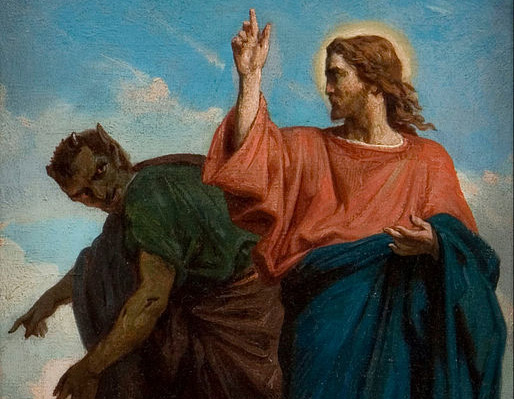
Matthew 4.1-4:

1 Then Jesus was led by the Spirit into the wilderness to be tempted by the devil. 2 After fasting forty days and forty nights, he was hungry. 3 The tempter came to him and said, “If you are the Son of God, tell these stones to become bread.”
4 Jesus answered, “It is written: ‘Man shall not live on bread alone, but on every word that comes from the mouth of God.
As originally conceived by the church long ago, the Lenten sacrifice was instituted as a “means of penitential preparation and preparation for baptism, which in the early church customarily took place on Easter Sunday.”

The tradition of fasting during Lent is an early one, originally done between Good Friday and Easter morning, the forty hours that Jesus was in the tomb. Christians would partake of no food or drink at all during that time. The fast was extended to the forty days before Easter sometime between 300 and 325, and changed so that food could be eaten only when evening had come.

The idea behind the fast was to imitate Christ. In addition to fasting, Christians would devote themselves to making prayer a faithful habit. So “prayer and fasting” have been closely linked for a long time.

And that brings me, by a rather circuitous route, to chocolate.

Chocolate is an absolutely unessential food, nutritionally speaking. We eat chocolate for no reason other than it is pleasurable. Since denial of the flesh is a prominent theme of Lent, rejection of chocolate in Lent is often offered as the Lenten sacrifice, particularly by people who wish to diet anyway.

The Lenten season is the time when we are supposed to ponder the extravagance of God’s love for us through Jesus Christ. Perhaps that fact could put a different spin on our concept of giving something up for Lent. The Lenten sacrifice is best oriented toward that which most blocks our spiritual growth. If that thing is chocolate, then it is appropriate to give up chocolate for Lent. But if something else is one’s greatest obstacle in being more Christlike, then giving up chocolate is spiritually pointless. 

The question is this: “What is the one thing that most hinders my Christian growth into the person whom God wants me to be?” The answer may not be easy, but it will always involve self-denial. We think that following Christ is hard because to obey Christ we must first disobey ourselves, and it is disobeying ourselves that makes us think following Christ is hard.


But Jesus said his yoke is easy, his burden is light. We just have to get over ourselves to do it.

As Robert Mulholland put it, “Jesus is not talking about giving up candy for Lent. He is calling for the abandonment of our entire, pervasive, deeply entrenched matrix of self-referenced being.”

If we focus on that between now and Easter Day, then we have a chance to become more mature in Christian faith and practice. It may be a habit that is out of true with Christian character that needs to be overcome for further growth. Or it may be a thing undone which must be done for deeper development to occur. The Lenten idea is for our habits to change enough in the next few weeks so that we can continue at a higher level of discipleship after Easter. The Lenten season and the Lenten sacrifice are not the points in and of themselves, the whole life of discipleship is.

Focusing on the one big thing is not the only Lenten discipline that would be helpful for spiritual development. Methodism’s founder, John Wesley, insisted that the only thing that distinguishes the Christian from the non-Christian are how we use our time and money. So, for the period of Lent I would suggest focusing on those two things in addition to whatever one big spiritual obstacle you might have. Some suggestions:
  • Tithe your income until Easter. 
  • Devote yourself to prayer daily and attending worship every Sunday. If you are traveling, say on business or spring break, then worship wherever you are.
  • Read the Bible each day. 
  • Call someone you love and let them know. 
  • Ask people who live alone to join you for lunch or whether you can visit them. 
  • Become involved in Christian ministries.
  • Re-establish or reinforce important relationships in your life.
Spiritually speaking, it is not enough to simply excise sin or personal vices from our lives. We have to replace vice with virtue. Thus, simply giving up something like chocolate for Lent is simply silly if we are only counting the days when we can start doing it again. That’s a game, not a spiritual discipline.

Lent should be a period of joyful, God-directed introspection into how we may be further united with Christ in godly love. If we make Lent into a severe, joyless, self-justifying exercise in self-denial, we have missed the point. Jesus sternly admonished teachers of the religious law and the Pharisees not to practice the letter of the law while neglecting “the more important matters of justice, mercy and faithfulness” (Matt 23:23).

When a lawyer asked Jesus, “which is the greatest commandment in the Law?” Jesus replied, “‘Love the Lord your God with all your heart and with all your soul and with all your mind.” And the second is like it: ‘Love your neighbor as yourself.’”

That is the whole point of spiritual growth and spiritual discipline, and hence the whole point of Lent: love. We are to be living ambassadors from God to one another and the world at large in Christ’s name. Christ was crucified, buried and raised from the dead for our sake and the sake of the whole world. Let us rededicate ourselves to being Christ’s ambassadors. It’s Lent, after all; it’s all about love, you see, Lent is all about love.

Wednesday, February 18, 2026

Life and dust and promise

Before I retired from full-time pastoral ministry, I had a particular dread every Ash Wednesday that lay people did not share. It arose from the fact that I imposed ashes upon everyone’s foreheads, but in years past I also placed ashes on the foreheads of my wife and children and said to them, “Remember that you are dust and to dust you shall return.” I really would rather not have said that to my own blood.

Ash Wednesday is the one day of the Christian year that is supposed to fill us with dread. Dread that God is just, dread that God will judge, dread that we might be judged in justice rather than in love. If wearing ashes on our foreheads should do anything for us, it should confront us with the fact that for all of us, there is an end coming one day. Before the most holy God, all the things we value will be as ashes. 

The American dream is that we can have it all. Therefore, we often seem not to understand that Christian discipleship is a zero-sum game: if we are to grow in discipleship, we must shrink in something else. If we are to add holiness to our lives, we must give up ungodliness. In his book I Surrender, Patrick Morley writes that the church’s main misconception is “that we can add Christ to our lives, but not subtract sin.” We think we can change what we believe without changing what we do. We want revival without reformation, we want rebirth without repentance. 

To repent means more than to regret. Originally a nautical term, it meant to change course, to go in a new direction. Repentance means to change, to be different. That’s the real reason why people are supposed to “give up something” for Lent. How often do we give up something trivial, like desserts or going to movies? It’s no repentance to give up something that we can easily do without and then, once Lent is over, resume. It’s no repentance to pretend we are turning away from actions instead of sins. Repentance is to pull out our deepest sins by the roots, and that will hurt! 

Fasting for Lent means to repent, not merely to do without food for part or all of a day. Fasting means to be focused on repentance so intently that we give up the ungodliness that pervades our lives. It is to be a holy man or holy woman for forty days. We express that turn toward holiness by symbolically wearing ashes to signify our awareness of our mortality, and to turn to ashes the parts of our lives, the parts of our character, that separate us from fullness of grace. 

Yet there is a danger in Lent as well as opportunity. Repentance is necessary, but repentance does not save us. We are saved by what God has done in the person and work of Jesus Christ. Repentance springs from understanding that we have no hope apart from Christ. The danger in Lent is that we will emphasize repentance of our sins to the exclusion of their cure. Our works are part of our faith, but we are justified before God by our works in faith not because of what we do but because of what God has already done. From the ashes of repentance, in grace, God can build anew. 

Peter Perry, a pastor in Texas, told of the time his neighbor’s house burned to the ground. “The trees all around were scorched,” he wrote. “The grass was brown."

A few blackened timbers stood near the back of the house, and the remains of the cast iron plumbing system rose out of the ashes. The day after the fire, as I walked to school with a friend, we saw the woman who had lived there, standing in the midst of what had once been her home, weeping and wondering aloud what would become of her and her family. As she gazed at the ruins of her life, she despaired. But her husband was comforting her. “We can rebuild,” he said. And they did. One year later, a beautiful new home graced that lot. And the home they built was built around the old home’s massive, stone fireplace. But I wonder . . . Did the woman and her husband and their children sit around that fireplace on winter nights, look at the dancing flames on the logs they were burning, and remember the ashes?

We do remember the ashes of our past, do we not? Old hurts, ancient wrongs. Writer Hazel Farris told of her childhood’s fiery temper. 

One day, after an argument had sent one of my playmates home in tears, my father told me that for each thoughtless, mean thing I did he would drive a nail into our gatepost. Each time I did a kindness or a good deed, one nail would be withdrawn. Months passed. Each time I entered our gate, I was reminded of the reasons for those ever‑increasing nails, until finally, getting them out became a challenge. At last the long‑awaited day arrived – only one more nail! As my father withdrew it I danced around proudly exclaiming, ‘See, Daddy, the nails are all gone.’ Father gazed intently at the post as he thoughtfully replied, ‘Yes, the nails are gone—but the scars remain.’

Scars do remain, and we wear them. We’ve made them, too. Sometimes we count our scars and relive the hurt and anger and pain of each one. Sometimes we love to inflame the passions of righteous indignation. But God does not do that. God forgives our sins and God forgets those sins. God does not carry grudges. In our repentance and humility before God, we can see that God’s ways are not our ways. God forgives, God forgets. Our sins were nailed to a cross on Calvary. In Christ’s triumph over the powers of sin and death, our sins have become like ashes, blown away in the wind. 

So, the call to repent must not be ignored. We must respond to God’s initiative. “If there are a thousand steps between us and God,” said Max Lucado, “God will take all but one. God will leave the final one for us. The choice is ours.” 

We are dust and to dust we shall return. The urgency of Lent is that we turn to God now, for later may never come. Dr. George Sweeting told of a visit to Niagara Falls. 

It was spring, and ice was rushing down the river,” he wrote. “As I viewed the large blocks of ice flowing toward the falls, I could see dead fish embedded in the ice. Gulls by the score were riding the ice down the river, feeding on the fish. As they neared the falls, their wings would go out, and they would escape from the falls.

I watched one gull which seemed to delay and wondered when it would leave. It was engrossed in the carcass of a fish, and when it finally came to the brink of the falls, out went its powerful wings. The bird flapped and flapped and even lifted the ice out of the water, and I thought it would escape. But it had delayed too long so that its claws had frozen into the ice. The weight of the ice was too great, and the gull plunged into the abyss.

The moment to turn back to God is this moment.

When we receive the ashes on our foreheads, there first stroke usually is a vertical one with the ashes on our forehead. Think of it as an “I.” The “I” is the egoistic part of each one of us that is the sinful self, the rebellious self, the self that wants to walk alone instead of with God. But right after the “I” we receive a horizontal line, and the “I” will be crossed out. Crossed out. As Bass Mitchell explained,  “The ashes made in the form of a cross remind us of the cross of Christ by which our sins and the sins of the whole world are canceled out!” 

Ash Wednesday reminds us that we come from a world of death and sin, but that we do not have to stay there. “We are dust, and to dust we shall return. Let us repent and believe in the Gospel!”

Sunday, January 18, 2026

Contribution or commitment?

Today is the second Sunday of the church season of Epiphany

1 Corinthians 1:1-9

1 Paul, called to be an apostle of Christ Jesus by the will of God, and our brother Sosthenes, 

2 To the church of God that is in Corinth, to those who are sanctified in Christ Jesus, called to be saints, together with all those who in every place call on the name of our Lord Jesus Christ, both their Lord and ours: 3 Grace to you and peace from God our Father and the Lord Jesus Christ. 

4 I give thanks to my God always for you because of the grace of God that has been given you in Christ Jesus, 5 for in every way you have been enriched in him, in speech and knowledge of every kind 6 just as the testimony of Christ has been strengthened among you 7 so that you are not lacking in any spiritual gift as you wait for the revealing of our Lord Jesus Christ. 

8 He will also strengthen you to the end, so that you may be blameless on the day of our Lord Jesus Christ. 9 God is faithful; by him you were called into the fellowship of his Son, Jesus Christ our Lord. 

When Paul wrote the Corinthians, he reminded them of who they were right off the bat. They were the church of God in Corinth. They were the only church in Corinth, actually. They were sanctified in Christ, called to be saints. They were recipients of grace and peace from the Lord. They had been enriched by Christ in speech and knowledge of every kind. They lacked no spiritual gift necessary for their church to thrive. They were being strengthened every day. And Paul repeated the fact that they were called into fellowship with Christ. 


It is mistaken to think a calling to Christian ministry is something that happens to men and women who become pastors, and that the rest of the people in a church are not called. This notion is flatly contradicted by Scripture. All people of a church are called to Christian discipleship. Even when we recognize that fact, we say that pastors are called to “full time Christian service,” as if there is any other kind. Is there anyone here who feels called to be a part-time Christian? 

I understand that my own calling is to serve as a full-time pastor. But my prior calling, shared by all other Christian people, was to Christian discipleship.

The first step in effective discipleship is heeding the call. We are called to be saints, we are called into fellowship with Christ. This call is the foundation upon which everything else is built. Responding to Christ’s call does two main things. First, it places each man, woman or child within the realm of salvation. This is no little thing! Just what salvation is and what it means is a topic for another day, but we have to recognize that salvation is a big deal. The Scriptures talk about it a lot, and so did Jesus.

 Answering the call to follow Christ is not a purely altruistic thing. Each one of us benefits, but we benefit principally in ways not found in the other areas of our lives. We benefit in peace, fellowship, assurance, faith, hope and other ways, none of which are listed in the benefits package of a Fortune 500 firm. And we will benefit in being resurrected from death to live in God’s presence forever. The need and desire to be saved is part of human nature. It’s a mistake to turn Christian discipleship simply into other-directed servanthood with no self-interest involved, as long as we recognize that the self-interest served by Christ’s call is not selfishness. It is principally love. Human beings are born to love and to be loved. We live best when we live in the love of God, the love of godly people, and the love of godly things. But love is never turned inward; true love is never narcissism. Godly love is patient and kind. Love is effusive and overflows from one person to another and desires the best for others. The call to discipleship is a call to be divinely loved and a call to love others divinely. 

The second main thing the call does is serve the world’s interest. The self-interest of love is paradoxical in that it cannot be served without reaching out to others and inviting them to heed the same call of Christ that we heard. Ministering to others in Christ’s name, witnessing to them and sharing the Gospel with them are two of the most self-satisfying things we can do precisely because they serve others as well as ourselves. They enrich our own souls, the lives of others and the cause of Christ in the world. 

But this Christian activity is not automatic. Hearing the call is simply to acknowledge that it is given. Heeding the call is to reorient our intentions and lives according to the call’s imperatives. In Ephesians, Paul urges us “to live a life worthy of the calling” we have received (v. 4.1). A life worthy of being called is a life of commitment to the caller, to Christ. The commitment part is where we tend to stumble. Hearing the Word and doing the Word are two sides of the same coin, but the one does not automatically follow the other. 

When airliners accelerate for takeoff, there is a point in the takeoff roll, called the V1 speed, at which the pilot must commit the airplane to flight. Once the V1 speed is reached it is not possible to stop the airplane on the ground before the runway ends. No matter what happens, once V1 is reached, the pilot must commit to takeoff.

 Hearing the call of Christ is like being given permission to run up the throttle and point down the runway. But at some point, individuals, churches or even whole denominations have to commit to takeoff rather than just run up the engines and make a lot of noise and never go anywhere. And we have to recognize when we have passed the point of no return because true progress, once underway, can’t be stopped without crashing. 

Much of the time we solicit people to contribute to the church when we should be asking is for people to commit to discipleship. A contributor can simply watch, but a committer is deeply involved. I am thinking of the time a chicken and a pig decided to go out to breakfast. They came to a diner where the chicken read the menu posted outside the door. "Ham and eggs," said the chicken. "That sounds okay to me. Let's go in."

But the pig replied, "Not so fast. To you than a contribution, but to me it's a commitment." 

Maybe the difference between a contribution and a commitment is that commitments involve risk. I don't mean danger, necessarily, although commitment to Christian discipleship can be dangerous. What I am getting at here is not danger, but presence. Contributions can be phoned it, but commitment requires presence. As the pig in the story knew, contributions are what we do using our things, but commitments are what we do using ourselves.

We make a lot of commitments because most of us lead fairly busy lives. Telephones, radios, televisions, meetings, commutes, deadlines, errands, the crowded calendars we keep, all the clutter of too many requirements and too little time. Our busyness constitutes a lot of static in our lives that the call of God has to punch through. Hearing, much less heeding the call of discipleship can be difficult. 

One crucial element of heeding the call to discipleship is being informed in faith by a community of faith. Being a member of a Christian congregation is crucial to hearing God’s call. Yes, it is true that simply going to church does not make you a Christian any more than simply going into a kitchen makes you a chef. But no one becomes a chef who never enters a kitchen. 

Disciples are formed in congregations. People can be religious without going to church, but mere religiosity is not the point of Christian discipleship. People can be spiritual without going to church, but Jesus never called people simply to be spiritual. He calls us to discipleship, and discipleship requires membership because Christianity is covenantal. Christian living always involves Christian community. Christian covenant always involves both the one and the many, not one or the many.

 The vows of membership to join the United Methodist Church are simple: we promised before God and one another to support the church with our prayers, our presence, our gifts and our service. Discipleship takes all four, but I have never known anyone who could do all four in equal proportion. The point isn’t legalistic exactitude, but neither can one part simply be substituted for another. Giving more money to the church does not relieve one from praying. Practicing private devotions does not excuse one from attending worship. Perfect attendance at worship or serving the church on a committee or a ministry does not reduce the obligation to tithe. All of these things take commitment, and they are all necessary responses to the call to discipleship. 


We are being called, each one of us. Let us put aside our childish excuses. No longer shall we ignore the call or pretend not to hear it. No longer shall we hide behind the inactivity of others or pretend that others may be called, but not us. I am called, you are called, and we are all called together.

God is faithful, and by him we are called into the fellowship of his Son, Jesus Christ our Lord. Let us hear and heed so that we may live as, and lead others to become, disciples of Jesus Christ. 

Thursday, November 27, 2025

A Thanksgiving Reflection


   Thanksgiving! When we take a day off to celebrate with families reunited and get stuffed fuller than the Thanksgiving turkey! It is a day we remember what we are thankful for. What are you thankful for? Shortly, we will have a time for everyone who wishes to share what they are thankful for. But I can explain that right now:

I am thankful for - the fork!

As table utensils go, the fork is a recent invention. The knife was first, of course, dating to prehistory. The spoon also dates to the Stone Age, literally. But forks date only to ancient Greece, and then they were large cooking utensils, not for the dining table. In the 600s, table forks were invented but used only in the Middle East. Table forks did not appear in Europe until a thousand years ago, and then only in Italy. The Italians were very slow to adopt them, not using them widely until five hundred more years passed. Forks did not reach France until 1533, but the French thought using them was an affectation and their adoption was very slow. The first table fork reached England in 1608, where they were promptly ridiculed as effeminate and unnecessary. Over many years, forks came to be adopted by the wealthy, who had them made from expensive materials intended to impress guests.

The first Thanksgiving celebration in Plymouth Colony was in 1621. There were no forks. The pilgrims and their guests used knives, spoons, their fingers, and cloth napkins to manipulate their food. So, I am thankful to have a fork to make eating Thanksgiving dinner easier.

The connection between food and giving thanks that reaches back thousands of years. As the children of Israel prepared to cross into the Promised Land, Moses told them,

When you have come into the land that the LORD your God is giving you as an inheritance to possess, and you possess it, and settle in it, 2you shall take some of the first of all the fruit of the ground, which you harvest from the land that the LORD your God is giving you, and you shall put it in a basket and go to the place that the LORD your God will choose as a dwelling for his name. … 8 “The LORD brought us out of Egypt with a mighty hand and an outstretched arm, with a terrifying display of power, and with signs and wonders; 9and he brought us into this place and gave us this land, a land flowing with milk and honey. 10So now I bring the first of the fruit of the ground that you, O LORD, have given me.” You shall set it down before the LORD your God and bow down before the LORD your God. 11Then you, together with the Levites and the aliens who reside among you, shall celebrate with all the bounty that the LORD your God has given to you and to your house (Deuteronomy 26:1-2, 8‑11).

Giving thanks to God has a connection with food about three millennia old. The ancient Jews knew of course that life depends on food. But they emphasized that their lives were sustained by the presence of God. After all, not only had God brought them out of slavery in Egypt, he had sustained them with manna as they wandered in the Sinai. They understood that filling the soul was as important as filling the plate.

There was once a man who was struck by a city bus and was critically injured. He was rushed unconscious to a hospital and went immediately into emergency surgery. The surgeon barely saved the man’s life after several hours on the operating table. The victim regained alertness five days later. The day after that, the surgeon stopped in to see him. Incredibly, the injured man launched into a litany of complaints about the care he had received in the last 24 hours – the food was cold, the nurses were slow when summoned, the TV was too small and too far away, the room was either too hot or too cold, and so on.

The surgeon interrupted, “Look, you were almost dead when you got here! I worked on you for five hours! I repaired both your shattered legs, set your broken arm and three ribs. One lung was punctured, and I saved you from suffocating. You were gashed across your head and I sewed it up. Your heartbeat was irregular, and I got it stabilized. A little gratitude might be in order!”

“Okay, doc, thanks,” the patient answered, “but what have you done for me today?”

Probably everyone here has had a moment like that doctor, being informed of perceived failure to meet someone’s else’s demand. One day in Galilee Jesus miraculously fed more than five thousand people, starting with just five small loaves of bread and two fish. That night Jesus left the area. The next day the crowd tracked Jesus down.

John 6:25-35

25 When they found him on the other side of the sea, they said to him, "Rabbi, when did you come here?"

26 Jesus answered them, "Very truly, I tell you, you are looking for me, not because you saw signs, but because you ate your fill of the loaves. 27 Do not work for the food that perishes, but for the food that endures for eternal life, which the Son of Man will give you. For it is on him that God the Father has set his seal."

28 Then they said to him, "What must we do to perform the works of God?"

29 Jesus answered them, "This is the work of God, that you believe in him whom he has sent."

30 So they said to him, "What sign are you going to give us then, so that we may see it and believe you? What work are you performing? 31 Our ancestors ate the manna in the wilderness; as it is written, 'He gave them bread from heaven to eat.'"

32 Then Jesus said to them, "Very truly, I tell you, it was not Moses who gave you the bread from heaven, but it is my Father who gives you the true bread from heaven. 33 For the bread of God is that which comes down from heaven and gives life to the world."

34 They said to him, "Sir, give us this bread always."

35 Jesus said to them, "I am the bread of life. Whoever comes to me will never be hungry, and whoever believes in me will never be thirsty.”

Jesus said the only reason the people followed him was because they saw him as a sort of walking grocery store. It was time, Jesus said, for the people to work for the food that endures for eternal life. The people asked what they needed to do to perform the works of God. Jesus answered they needed to start with believing in him because God had sent him.

They asked what sign, or miracle, Jesus would perform so that they may see it and believe in him. Now, just the day before the people had miraculously eaten their fill because of Jesus’ power, but now they said to him, what have you done for us today? It seems a strong sense of entitlement people often have is no new phenomenon.

Baby boomers like me were raised by the generation that grew up during the Great Depression and came of age during World War Two. Much of what my parents’ generation went through is out of place with how my age group knows life. Pulitzer Prize winning author William Manchester wrote of how his mother would cut and re-sew bed sheets to make them last longer. My grandfather, born in 1900, told me of young men he knew in the 1930s who worked ten-hour days on a farm to earn a dollar a day, and were glad to do it.

Yet my age group saw none of this. Robert J. Samuelson wrote of us baby boomers, “We didn't merely expect things to get better. We expected all social problems to be solved. In our new society most workers would have rising incomes and stable jobs. … Poverty, racism and crime would disappear. … We expected almost limitless personal freedom and self-fulfillment. After a while we thought we were entitled to them as a matter of right.”

Yet, as author Mike Bellah points out, when our parents told us how things were, they failed to tell us how things usually really are. In telling the stories of the Great Depression and the Great War, the generation who lived them wanted to create in their children a sense of gratefulness that those tribulations were over, but what they often created in us instead was a sense of entitlement. Why? Says Bellah, “Because of what they didn't say. What our parents failed to tell us is that conflict and want are part of humankind’s future as well as its past. There have been no utopias in history, and as long as the human condition remains the same (imperfect people living in an imperfect world), there will be no utopian tomorrows either.”

Since Jesus's day the human condition has remained the same – imperfect people living in an imperfect world. This new millennium is only twenty-one years old, and we are already shocked by its events. It seems depressingly much like the last one – and the one before that.

So, we may say to Jesus, what have you done for us today? And what sign will you give us so that we may believe in you?

In John, Jesus does not perform miracles on demand; in fact, John's Gospel doesn’t even use the word miracle. Jesus does signs that attest to his identity as the one sent by God, on whom God has set his seal, the mark of authenticity. The constant theme in John is that those who believe without seeing miracles or appearances are blessed. When we say, however sophisticated our words may be, what has Jesus done for us today, what sign can he give us so that we may believe, Jesus’ answer is always the same: “I am the bread of life. Whoever comes to me will never be hungry, and whoever believes will never be thirsty.”

Christ has nothing to offer us except himself. And that is more plentiful than we imagine. Perhaps we should be thankful this Thanksgiving not for things; I doubt that this year mere stuff is what we are thankful for, anyway. Despite the violence, despite the threats, despite the uncertainty, despite our politics, we may be thankful that we can rejoice in the Lord always and that the Lord is near. The peace of God will guard our hearts and minds in Christ Jesus.


   Thanksgiving, then, is not really a once-a-year celebration, except in a secular sense where it handily marks the day before Christmas shopping frenzy. Thanksgiving is for Christian people a continuous state of praise that acknowledges to God what God has done for us in the person and work of Jesus Christ. Thankfulness enables us to face the future with hope, for it is by thanking that we remember. To thank someone is to remember what he or she did for you. To remember what God has done is to be filled with hope, because God isn’t finished with the world or with us. As God has done, so God will do, and as God has given, so God will give. 

Thanksgiving is a joyful noise, a glad worship. Despite outwards circumstances, our hearts in faith do heed what the psalmist announced: The Lord is good, his steadfast love endures forever, and his faithfulness lasts to all generations.

Sunday, November 9, 2025

Bridging the Gap Between Scientism and Classical Theism

I know you have been anxiously awaiting when you can read my M.Div. thesis. Well, good news! Academia.edu has used AI to turn it into a podcast! And their page also used AI to create 12 slides of its points. They are below.

My thesis, or as Vanderbilt called it, Senior Project, is entitled, "The Disjunction Between Scientific Materialism and Classical Theism: A Process Solution." Before getting to the podcast and slides, here is an intro to the subjects concerned.

What is classical theism?  In classical theism, God "is believed to have created the entire universe, to rule over it, and to intend to bring it to its fulfillment or realization, to "save it." Classical theism draws on "intuitions and assumptions of Greek philosophy as much as biblical images," says Tyron Inbody. 

Catholic Scholasticism developed Aristotelian formulations of God "as absolute, changeless, eternal being or actuality." This idea of impassive immutability remained in the Reformation, though the Reformers emphasized God's sovereignty as unchallenged, absolute power, wholly righteous and gracious. God was understood to have "absolute priority and decisiveness" in divine election. 

Always known as powerful in the Jewish and Christian traditions, God was now understood as absolutely omnipotent, able to do anything God chose. "The concept of God's omnipotence is located at the center of classical theism," wrote Inbody, and so is at the heart of theodicy problems. (Theodicy is the theology of the problem of human suffering and evil.)

What is Scientism? Scientism is faith in science. Scientism is faith in science. As the dominant world view of our day, it is considered self validating. Scientism makes two major claims, neither of which, however, are  provable using the scientific method:

    (1) only science reveals the Real and only science can discover truth; 

    (2) scientific knowledge of reality is exhaustive, not inherently limited, is holistic and sees reality as  reality really is.

The challenge of the new, scientific ways of understanding the world resulted in theological liberalism, which attempted to ensure Christian faith in a world dominated by the increasing power of science. However, "Attempts to render God and the modern world view compatible have been unsuccessful," observed David R. Griffin in God and Religion in the Postmodern World. This has led either to religious pantheism or insulation, which define the disjunction between scientific materialism and theism.

And so, here is the podcast. Slides are below: 


A world without nuclear weapons - what would it look like?

 From Pope Leo this week, according to the National Catholic Reporter : " Pope Leo quotes Bob Dylan song in book foreword calling for n...