Showing posts with label Media. Show all posts

Saturday, October 31, 2020

What will you do when they come for you?

Update note: If you do not read all the way to the very end, you will not learn who "they" refers to in the title. Hint: it is not the police.

This was left as a comment on FB by a former police officer named Michael. I will not use his last name here. 

True story : 911 call, son is threatening family with knife, me and 4 other cops on my team show up. I go around back of the house as others go in the front. As soon as I turn the corner the kid is on top of me with a knife. I fight with him and get stabbed in hand but we were able to get him handcuffed. He goes to get psyched clear before arraignment. DA lets him out. He returns home and stabs his father to death the same night his family comes and bails him out. Something to really think about.

I am thinking of the police shooting of black man Walter Wallace in Philadelphia last Monday. 

PHILADELPHIA (AP) — Police shot and killed a 27-year-old Black man on a Philadelphia street after yelling at him to drop his knife, sparking violent protests that police said injured 30 officers and led to dozens of arrests.

The shooting occurred before 4 p.m. Monday as officers responded to a report of a person with a weapon, police spokesperson Tanya Little said.

Officers were called to the Cobbs Creek neighborhood and encountered the man, later identified as Walter Wallace, who was holding a knife, Little said. Officers ordered Wallace to drop the knife, but he instead “advanced towards” them. Both officers then fired “several times,” Little said.

Wallace was hit in the shoulder and chest. One of the officers then put him in a police vehicle and drove him to a hospital, where he was pronounced dead a short time later, Little said.
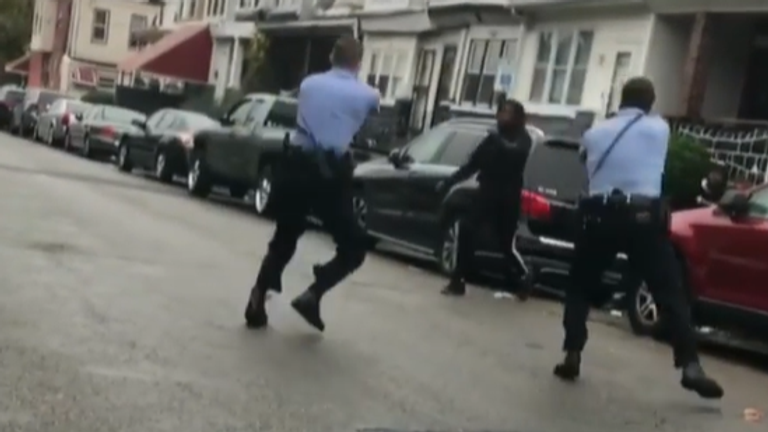
Riots followed, of course, demanding justice for Wallace, justice which included burning down a Vietnamese church. 

So here are my questions for ordinary people - not activists - to ponder about police:

  • If you call 9-1-1 because you are under threat of actual harm or death, do you want the police to respond? 

If not, of course, why call them at all? However, everyone should understand that police provide community service, not personal service. That means that police have no obligation either legally or contractually to place themselves in danger at all, not to protect you or anyone else. Your city or county is not obligated at all to send anyone to your 9-1-1 call.
  • If police do arrive and are placed under imminent danger of harm or death by the suspect, how do you think police should respond?
We all hope that Michael's example, above, would be the model - subdue the suspect and place him under arrest. But Michael was caught by surprise. Neither of the cops in Philly were. So here are the cops' choices:
  1. Use deadly force as the Philly officers did. 
  2. Wait until one of them is actually harmed before using deadly force.
  3. Try to subdue an armed assailant, perhaps under the influence of drugs, and hope that they don't get injured or killed while doing so. After all, "that's what they signed up for," right?
  4. Get back in their patrol car and leave.
Before settling on your final answer, consider whether your answer is different whether the suspect is white or black. Because I predict that is definitely something police will consider before acting before long. 
  • Get attacked by a white guy and shoot him to save their own lives: no controversy, standard investigation, routine media report and suspension of patrol duty while the investigation is done. Then back to work. 
     
  • Get attacked by a black guy and shoot him to save their own lives: immediate enormous controversy, intense investigation, intense media scrutiny, extended suspension of patrol duty while the investigation is done. Receive death threats against themselves and their families. Enormous legal costs. Be blamed for destruction caused by rioters and looters beginning that day.  Not returned to regular police duty for many months after the investigation is finished, perhaps not ever. 
There is a third option, and a huge number of police are taking it: retire if eligible or quit. Police retirements and resignations have risen this year by multiples. And police-force accessions are very, very low. I read of one big-city, new-cop class that graduated three new officers. Three. That same month 12 serving officers retired. They took at least 250 officer-years of experience with them.  

There is a looming, severe cop shortage in cities across the country. Police who want to stay in the biz are fleeing to rural counties, but those counties have only so many slots. 

We will see the day when dialing 9-1-1 will basically be met with silence. What will you do then?

The wealthy are already hiring former cops or military to protect them ("Luxury apartment buildings in New York City are hiring armed security to protect wealthy residents amid fear of election day unrest"). I mean, Jeff Bezos will not need to call 9-1-1, let's face it. But you and I? It will be open season on us by a growing and emboldened criminal class, which will be free to range far outside their present working area. Your quiet, no-crime suburb will not stay that way. And the poor, including black Americans whose lives are supposed to matter, will suffer perhaps worst of all. 

Do you want to defund or abolish police? Okay, fine. I hope you find a way to abolish criminals, too. If you don't, what will you do when they come for you?

Sunday, September 5, 2010

Who else would?

A New York Times blog reports on an academic study done relating to church attendance. The blogger writes this blinding glimpse of the obvious:

The study specifically focused on the behavior of Catholics and Protestants because they were most likely to attend church on Sundays.
Imagine that!

Might it have been that the researchers specifically focused on the behavior of Catholics and Protestants because they were most likely to attend church at all?

Yah, could be.

Saturday, April 24, 2010

Why don’t we still have stables at the church?

The first church I served was founded in 1844, but the Union army destroyed the building during the Civil War. At war’s end, the people bought another tract of land and built a new church. It being 1865, they built a stable and carriage shed in the rear to protect horses and carriages from the elements when the people were at church.

The stable and shed are no longer there.

The sanctuary originally had narrow, wooden benches with no backs, a common feature of churches back then. In the early 1900s, high-backed pews were installed, decreasing seating capacity by almost 100. Soft pew cushions were added about 25 years ago.

No one knows what happened to the benches.

The church was originally lit by oil lamps. It was not electrified until FDR’s Rural Electrification Administration gave assistance. Since the mid-1930s, the church has used electric lights.

The oil lamps are nowhere to be found.

A man in his 80s told me he used to come early on winter Sundays as a lad to light the coal heaters in the sanctuary. A few years after getting electric lights, the church converted to electric heat.

The coal heaters are long gone.

The transoms over the stained-glass windows could be opened for ventilation when they were installed in 1916. Decades later the church added air conditioning.

The transoms were then soldered shut.

Some years before I arrived, the church converted a Sunday School room to a nursery. Before then, mothers were expected to look after their small children at church or stay home with them.

Though the stables had long disappeared when I arrived, the church had no parking lot. It did have a small, graveled-over area that was itself overgrown with grass. People parked on it and on the lawn.

One especially soggy November a woman visitor pointed out to me that she had apparently ruined her shoes walking through the mud from her car. I related this conversation to our lay leader, who was a woman also, but she replied that muddy shoes were a small price to pay to worship God when the early Christians worshiped at risk of death.

The problem is, of course, that there were dozens of churches in the community where one could worship just as well without ruining one’s shoes. Not long afterward, the church built a 100-space, paved, curbed and lined parking lot with a sheltered drive-up.

Each one of these changes - electric lighting, central heating and cooling, adaptation to autos - was, in its time, very controversial among the members, some of whom resisted them vigorously.

Would you like our church to take out the cushioned pews, uninstall the air conditioning, disable the microphones and return to kerosene lighting? Of course not – but it’s important to realize that what we think of as normal and common-sense practice was once widely seen as radical, new-fangled, faddish and unnecessary.

They are universal features now because churches learned that if they did not adapt, people would go elsewhere. When a significant percentage of churches began to accommodate cars instead of horse and carriage, people who drove cars went to them. Churches that held onto stables either closed or made the shift. Same with efficient cooling: people migrated away from open-window churches to air-conditioned ones until the holdout churches understood they’d have to get cool or close.

Today, the “textual generation” is being replaced by the “audiovisual, web-connected generation.” The former learns mainly by reading. But people not much younger than me learn mainly by looking and hearing. The younger someone is, the truer this is. People in their teens and 20s also expect to absorb information by more than one means at a time and interact with one another while they are doing it.

Today, churches are turning to use of multimedia during worship at a rapid pace. Overall, this is less controversial than tearing down the stables was. But like stabled churches had to do, we have to realize that this is the way that society is moving. Churches must adopt this technology or the next generation will simply go elsewhere.

I find this an exciting opportunity, not a daunting challenge. For the first time in literally all the centuries of the Christian era, we actually have a new means to connect the Good News of Jesus Christ with people in ways that have never been possible before. This should fill us with enthusiasm, not timidity!

Update, Dec. 2011: The Baptist Press says its surveys and studies show that American churchgoers are just as "digitally engaged" as the general population.

As long ago as 2007, three-fourths of churches reported that they "regularly use some kind of visual enhancement" of their worship services.

A world without nuclear weapons - what would it look like?

 From Pope Leo this week, according to the National Catholic Reporter : " Pope Leo quotes Bob Dylan song in book foreword calling for n...