Showing posts with label Methodism. Show all posts

Thursday, February 19, 2026

Lent and Chocolate - What's the Point?

The story is told of Sean O'Flannery, a lad who moved to Boston from Dublin. Coming home from school one day he went into an ice cream shop and told the jerk behind the counter (the soda jerk) "One scoop of yer best chocolate ice cream in four dishes!"

Soda jerks get strange requests, so he set four dishes with one scoop each in front of Sean. Sean took a spoon of one, held it before his face and loudly announced, "This is me beloved cousin eating ice cream back in the old country!" He ate the ice cream and took a spoonful from another scoop, "This is me dear friend Kelly eating ice cream back in me homeland!" The third dish he said was his favorite uncle, Finian, eating ice cream back home.

Sean raised the last scoop and said, "And this dish is for me!"

This practice went on for several months until one evening as the soda jerk was filling the four dishes Sean stopped him and said quietly, "Only three dishes today, please."

The soda jerk asked, "Did you suffer a loss and that is why you only want three scoops?"

"Heaven's no!" protested Sean O'Flannery. "It's Lent now, and I've given up ice cream!"

The word “Lent” comes from the Anglo-Saxon word, “lencten,” meaning Spring, the season in which Easter occurs. The forty days before Easter constitute the Lenten season, but the forty-day count does not include Sundays. All Sundays celebrate the resurrection, and so are excluded from the forty days count. The forty days duration is drawn from the length of time Jesus spent in prayer and fasting in the wilderness before he set out on his three-year ministry.
Matthew 4.1-4:

1 Then Jesus was led by the Spirit into the wilderness to be tempted by the devil. 2 After fasting forty days and forty nights, he was hungry. 3 The tempter came to him and said, “If you are the Son of God, tell these stones to become bread.”
4 Jesus answered, “It is written: ‘Man shall not live on bread alone, but on every word that comes from the mouth of God.
As originally conceived by the church long ago, the Lenten sacrifice was instituted as a “means of penitential preparation and preparation for baptism, which in the early church customarily took place on Easter Sunday.”

The tradition of fasting during Lent is an early one, originally done between Good Friday and Easter morning, the forty hours that Jesus was in the tomb. Christians would partake of no food or drink at all during that time. The fast was extended to the forty days before Easter sometime between 300 and 325, and changed so that food could be eaten only when evening had come.

The idea behind the fast was to imitate Christ. In addition to fasting, Christians would devote themselves to making prayer a faithful habit. So “prayer and fasting” have been closely linked for a long time.

And that brings me, by a rather circuitous route, to chocolate.

Chocolate is an absolutely unessential food, nutritionally speaking. We eat chocolate for no reason other than it is pleasurable. Since denial of the flesh is a prominent theme of Lent, rejection of chocolate in Lent is often offered as the Lenten sacrifice, particularly by people who wish to diet anyway.

The Lenten season is the time when we are supposed to ponder the extravagance of God’s love for us through Jesus Christ. Perhaps that fact could put a different spin on our concept of giving something up for Lent. The Lenten sacrifice is best oriented toward that which most blocks our spiritual growth. If that thing is chocolate, then it is appropriate to give up chocolate for Lent. But if something else is one’s greatest obstacle in being more Christlike, then giving up chocolate is spiritually pointless. 

The question is this: “What is the one thing that most hinders my Christian growth into the person whom God wants me to be?” The answer may not be easy, but it will always involve self-denial. We think that following Christ is hard because to obey Christ we must first disobey ourselves, and it is disobeying ourselves that makes us think following Christ is hard.


But Jesus said his yoke is easy, his burden is light. We just have to get over ourselves to do it.

As Robert Mulholland put it, “Jesus is not talking about giving up candy for Lent. He is calling for the abandonment of our entire, pervasive, deeply entrenched matrix of self-referenced being.”

If we focus on that between now and Easter Day, then we have a chance to become more mature in Christian faith and practice. It may be a habit that is out of true with Christian character that needs to be overcome for further growth. Or it may be a thing undone which must be done for deeper development to occur. The Lenten idea is for our habits to change enough in the next few weeks so that we can continue at a higher level of discipleship after Easter. The Lenten season and the Lenten sacrifice are not the points in and of themselves, the whole life of discipleship is.

Focusing on the one big thing is not the only Lenten discipline that would be helpful for spiritual development. Methodism’s founder, John Wesley, insisted that the only thing that distinguishes the Christian from the non-Christian are how we use our time and money. So, for the period of Lent I would suggest focusing on those two things in addition to whatever one big spiritual obstacle you might have. Some suggestions:
  • Tithe your income until Easter. 
  • Devote yourself to prayer daily and attending worship every Sunday. If you are traveling, say on business or spring break, then worship wherever you are.
  • Read the Bible each day. 
  • Call someone you love and let them know. 
  • Ask people who live alone to join you for lunch or whether you can visit them. 
  • Become involved in Christian ministries.
  • Re-establish or reinforce important relationships in your life.
Spiritually speaking, it is not enough to simply excise sin or personal vices from our lives. We have to replace vice with virtue. Thus, simply giving up something like chocolate for Lent is simply silly if we are only counting the days when we can start doing it again. That’s a game, not a spiritual discipline.

Lent should be a period of joyful, God-directed introspection into how we may be further united with Christ in godly love. If we make Lent into a severe, joyless, self-justifying exercise in self-denial, we have missed the point. Jesus sternly admonished teachers of the religious law and the Pharisees not to practice the letter of the law while neglecting “the more important matters of justice, mercy and faithfulness” (Matt 23:23).

When a lawyer asked Jesus, “which is the greatest commandment in the Law?” Jesus replied, “‘Love the Lord your God with all your heart and with all your soul and with all your mind.” And the second is like it: ‘Love your neighbor as yourself.’”

That is the whole point of spiritual growth and spiritual discipline, and hence the whole point of Lent: love. We are to be living ambassadors from God to one another and the world at large in Christ’s name. Christ was crucified, buried and raised from the dead for our sake and the sake of the whole world. Let us rededicate ourselves to being Christ’s ambassadors. It’s Lent, after all; it’s all about love, you see, Lent is all about love.

Sunday, December 21, 2025

A Prayer at Taps for members of the armed forces

I will attend the funeral this afternoon of a long-retired US Army chaplain, a United Methodist ordained minister whom I met late in his life and greatly respected. He was a Vietnam veteran and a wonderful man, with an equally-admirable wife and daughter. 

Although I am not taking part in the service, I post here "A Prayer at Taps," from the armed forces' Song and Service Book for Ship and Field. This book was published by the US Army and US Navy in 1941. It was used throughout World War 2 and for years afterward. 

I bought two copies when my wife and I visited Pearl Harbor in 2005. These copies are original editions, never before used. When I officiated funerals for veterans, I would offer this prayer at graveside. And I hope it will be offered when I pass from this life. 


Middle Tennessee State veterans Cemetery

A Prayer at Taps

Before we go rest we commit ourselves to thy care, O God our Father, beseeching Thee through Christ our Lord to keep alive thy grace in our hearts. Watch Thou, O Heavenly Father, with those who wake, or watch, or weep to-night, and give thine angels charge over those who sleep. Tend those who are sick, rest those who are weary, soothe those who suffer, pity those in affliction; be near and bless those who are dying, and keep under thy holy care those who are dear to us. Through Christ our Lord, Amen. 

I would delete the "Amen" sentence, though, and continue praying with these words, printed on the inside rear cover:

O Lord, support us all the day long through this troublous life, until the shadows lengthen, and the evening comes, and the busy world is hushed, and the fever of life is over, and our work is done. Then of thy great mercy grant us a safe lodging, and a holy rest, and peace at last. Through Jesus Christ our Lord. Amen.

Thank you, O Lord, for the life and ministries of Rev. Chaplain (Lt. Col.) Richard Stewart, and please bless all those dear to him. 


Rev. Richard Earl Stewart
September 23, 1932 — December 16, 2025


Sunday, October 12, 2025

What's your pearl?

 Here is a true story that I read a few years ago. 

An aging woman decided to move into the city to a retirement home. She had a big sale to downsize. One thing she did was slap a "for sale" sign on her late husband’s pride and joy – a 1963 Mercedes 300SL Gullwing that he had bought in 1972. She remembered that he had told her the Mercedes was collector’s item worth one hundred thousand dollars not long before he had died fifteen years ago, so that’s what she priced it. One shopper saw the for-sale sign in the car’s window, and he immediately wrote her a check for twenty-five hundred dollars to hold the car for him for the day. Then he went to the bank and opened a home-equity line of credit. On the way there he called his broker and cashed in mutual funds. Then he maxed out his Visa card on a cash advance. He wound up with a certified check for $100,000 and drove back to buy the car. He knew what the widow did not: in the years since her husband died the car had increased in value to $250,000. 

That man was willing to take risks to obtain something of tremendous value. I knew a man in Nashville who told me a long time ago that he was offered the opportunity to become one of the original investors in the franchise license for all of Nashville for Wendy’s restaurants. He turned it down because he did not want to be diverted from the business he had already built up. Later, of course, he wished he had invested.

 Would you pay a hundred thousand dollars for an ordinary orange? Eleven millionaires drowned when
the Titanic sank in 1912. One who survived was Arthur Peuchen, who left $300,000 in a lockbox in his cabin. "The money seemed to mock me at that time," he said later. "I picked up three oranges instead." A hundred thousand bucks each. 

What is of ultimate value to us, so much so that we would sacrifice almost anything else to obtain it? Jesus spoke about that Matthew 13.44-45:

44 “The kingdom of heaven is like treasure hidden in a field. When a man found it, he hid it again, and then in his joy went and sold all he had and bought that field.

45 “Again, the kingdom of heaven is like a merchant looking for fine pearls. 46 When he found one of great value, he went away and sold everything he had and bought it.

In the ancient world a large, flawless pearl would have been something like the Hope diamond of its day. Ancient literature tells of single pearls worth millions of dollars in modern value. When this merchant found such a pearl, he cleaned out his stock and sold his personal possessions to buy it. The merchant apparently did not come out ahead financially; he just changed assets at an even value. There is no hint that he sold the pearl later. For all we know, he simply kept it.

But this story is not really about an actual pearl, is it? What Jesus seems to be trying to communicate is the importance of knowing first, what is of ultimate value and second, what will it take to obtain it. 

Contrast this parable with the story of a young man, also told in Matthew, who asked Jesus what he needed to do to gain eternal life. After a short conversation, Jesus tells him, "Sell everything you have, give the money to the poor, then come and follow me." But the man said no. Matthew says he went away sorrowful because he had “many possessions.” Jesus offered him ultimate value, and the young man declined because, he thought, the price was too high. 

Take a moment to think briefly about what this parable means for you.

Matthew 13 is a series of parables, one right after another. Parables are narrative stories that set up a situation at the beginning, show a kind of “twist” in the middle, and end with a punchline. This parable does that, too, although not very obviously. In fact, I think that all of Matthew 13 from start to finish is one long parable about the kingdom of heaven and what it takes to be in it with the punch line in verses forty-nine and fifty, which tell of severe judgment at the end of the age. It’s quite grim. 

So, for anyone who understands the parable of the pearl to mean, “The pearl is the gospel, and we should be willing to surrender everything for the sake of the kingdom,” I think that is a very valid interpretation. But I also remember what our bishop, Bill McAlilly, likes to say about his son’s soccer coach, who would always ask his players after a goal was scored, whether by his team or the other: “So what? Now what?”  

The parable of the merchant is about doing whatever it takes to be in the kingdom of heaven. That’s fine. So what? Now what? 

That is the hard part for me because it forces me to ask, “What is my pearl right now?” Because you see, everybody has a pearl. What’s mine? What’s yours?

What is it that I treasure more than anything else – so much that, like the merchant once he gets the pearl, I am not willing to part with it, ever? That’s my pearl. Everyone here has a pearl, also. So, take a moment now and think about the answer to this question: What is your pearl? What is more important to you than everything else? What is it that would make you give up almost anything else to keep? 

When I served a church in west Nashville, I did some volunteer ministry at Lighthouse Ministries, a live-in center for men suffering from addiction issues or homelessness. I remember counseling a young man who just would not follow the rules of living there. He said in one session with the director and me that he really wanted to go home to visit his mother over Christmas but of course he had no money even to take a bus to Jackson, Tennessee, where she lived. The director said that funding could be provided, but it was not simply free. He had to follow the rules and go through the process of making his life better. He said that was too hard and there were too many things out of his control. I asked him, “You can make your bed tomorrow morning, right?” He nodded. “Well,” I said, “that’s in your control and it is one of the rules here. Don’t worry about what you can’t control. Do the things you can control.”

His pearl was to spend Christmas with his mother. It was a good goal. I remember a discussion about this parable by Vanderbilt Professor Amy-Jill Levine. She said that after class one day where they talked about this parable, a young female student came to her and said, I know what my pearl was. I did give up everything for it – all my money, all my possessions, I even ended my marriage for it. It was alcohol. I was willing to give up everything I had to get the next drink. 

When I ask myself what my pearl is, I also cannot avoid asking, Is that what my pearl should be? Is my pearl a good one? 

Professor Levine also talked about leading a Bible study at River Bend prison and discussing this parable, where an inmate told her that his pearl was freedom, to be released from prison. Another said that his pearl was simply staying alive while he was in prison. 

Viktor Frankl wrote a book called Man’s Search for Meaning not long after he was liberated from a Nazi concentration camp near the end of World War Two. The Library of Congress lists this book as one of the most significant books of the twentieth century. Frankl lost his entire family in the camps – his wife and children did not survive. 

But Frankl wrote about all the things the Nazis, with all their evil designs, could not take away. He wrote of people who entered the gas chambers praying the Lord’s Prayer or the ancient prayer of the Jews, the Shema Israel. He told of starving prisoners who went through the huts giving their meager bread ration to others near death. Such acts convinced Frankl that a person’s ability to choose one’s attitude, to control one’s inner life, no matter the circumstances, was the single human freedom that no earthly power could ever destroy. So even the worst that this world can throw at us cannot take everything. Frankl did not talk about parables, but he did find his pearl, to be in control of his inner life. And that was how he found freedom in the camps, even surrounded by death at every hour. 

What’s your pearl? Should it be?

The error I have made so far in talking about this parable is individualizing it, as if Jesus was talking to and provoking thought in individual persons. Yes, there is a lesson for each of us in this parable and my lesson and yours won’t necessarily be the same. But there is a lesson for us together also, with the same focusing question: What is the pearl of our church? What is the centering and central focus of our life together as the body of Christ? Is that focus what should be our focus? 

So, I ask this question of the whole church: What is it that we do, that if we stopped doing it, would lead us to think we had surrendered a central, vital element of being a church belonging to Jesus Christ? 

Here is a second question: Is there anything that we are not doing that, by its omission, is already surrendering central, vital element of being a church belonging to Jesus Christ?

And here is the third and final question. Does it matter – does it really, truly matter enough for all of us together – as a church – to do whatever must be done to take hold of that pearl?

These are hazardous questions. If we are honest with ourselves individually or with ourselves as a congregation, we would have to admit that, as W. Edwards Deming pointed out, the main purpose of human organizations is to maintain the status quo. 

The first time I thought about this for myself, I came to understand that my pearl was just that: preserving the status quo. I understand that the prospect of change can be disturbing. At the outset it can seem like entering a dark room blindfolded. Yet as Sam Cooke sang in 1964, “A Change Is Gonna Come” whether we like it or not, whether we want it or not, whether we are prepared for it or not. And there are only three ways to deal with change: 

1. Make things happen, 

2. Watch things happen, or 

3. Wonder what in the world just happened. 

Over time, I came to realize that no matter how wonderful the status quo feels, it is not possible to maintain it. The only place the status quo is maintained is a cemetery. As Jesus said, “Let the dead bury the dead” and, “God is the God of the living.” To be alive is to change. 

So, in the coming months and years, what changes to our status quo are coming? And what would we like the changes to be? Here is a template I use: 

First, rediscover and renew our calling from God as Christian ministers and lay people, as individual disciples and as connectional Methodist church people. Jesus told Peter he would make him fish for people. Do we remember when we got hooked by Jesus? Is it still fresh? Or did we get stuck in a rut, which is to say, did we devote our energies to preserving the status quo?

Second, are we intentionally making disciples or just accepting people into membership? We should discern together and put into place together an intentional path to discipleship. It cannot be enough any longer simply to accept people into membership and leave them free lancing afterward. No longer can we say, “We have Sunday School classes and Bible studies and women’s groups and community ministries, and we hope that one of them is right for you.” Jesus did not give us the mission of making church members, but of making disciples. 

Of course, we will have to figure out just what a disciple is, but I will leave that for another day.

Third, do we see all the people, including both the people of our fellowship, whether members or not, and the people of our larger community? William Temple observed, “The church is the only cooperative society in the world that exists for the benefit of its non-members.” I think that’s a bit of an overstatement, since I think we would agree that police, fire and rescue departments and the US military also exist for the benefit of non-members. But Temple’s point is still sound: Jesus didn’t begin the Church in order to convey member-benefit packages to church people. 

Now, we do benefit, and very richly. But not in ways awarded by other organizations. Jesus put it this way to his disciples just before he was arrested: “Peace I leave with you; my peace I give you. I do not give to you as the world gives. So, do not let your hearts be troubled and do not be afraid.”

Fourth, how shall we preserve that of our church which is excellent and gives glory to God, of which there are many examples? It is true, that as Sebastian says in The Tempest, “What's past is prologue,” but it is also past. We cannot plan for the past, only for a church we will bequeath to our children and grandchildren. 

Personally, I am optimistic! After all, Jesus said, "Do not worry, saying, 'What shall we eat?' or 'What shall we drink?' or 'What shall we wear?' For people who don’t know God wear themselves out themselves over such things. Your heavenly Father knows that you need them. So, seek first his kingdom and his righteousness, then all those other things will be given to you as well."

Good words to live by and plan with. Thanks be to God!

Sunday, August 21, 2022

What has Jesus ever done for us?

On Aug. 21, I was privileged to have been invited to preach at Sango UMC, Clarksville, Tenn., on the occasion of their homecoming Sunday and celebration of the church's 122nd anniversary of its founding.

This is the video of my sermon; the whole service's video is on Sango's Facebook page. As I explain at the beginning, I ripped the title of the sermon off from a skit by Monty Python about Jews in ancient Judea, under Roman rule and occupation, discussing, "What have the Romans ever done for us?"

And so, "What has Jesus ever done for us?"


The prepared text: 

Luke 9 presents a series of vignettes about Jesus as he makes his way with his disciples to Jerusalem, where he will be crucified. One of the vignettes is from verses 46 to 48:

An argument started among the disciples as to which of them would be the greatest. 47 Jesus, knowing their thoughts, took a little child and had him stand beside him. 48 Then he said to them, “Whoever welcomes this little child in my name welcomes me; and whoever welcomes me welcomes the one who sent me. For it is the one who is least among you all who is the greatest.”

Consider that brief statement in v 46: "An argument started among the disciples as to which one of them would be the greatest."

Even at this late date, the disciples thought of Jesus and their discipleship in earthly ways. They thought that Jesus would arrive in Jerusalem and depose the Roman vassal, Herod Antipas, from the throne of Judea, then take the crown himself. He could claim it, being in the line of descent from King David. And the disciples knew that Jesus had a very large following, not an army but large enough to be turned into a formidable mob. In fact, when the Roman governor Pilate later interrogated Jesus, he expressed surprise that none of his followers were fighting in the streets to free him, prompting Jesus to reply, "My kingdom is not of this world."

So, the disciples argued on the Jerusalem road, basically, about which offices Jesus would appoint them to once he took power. Who would be the secretary of state? Treasurer? Chief of staff? Secretary of commerce?

"But Jesus, aware of their inner thoughts," put a stop to such foolish chatter. Then there is this stark sentence, verse 51: “When the days drew near for him to be taken up, he set his face to go to Jerusalem.”

John Piper wrote,

To set his face towards Jerusalem meant something very different for Jesus than it did for the disciples. ... Jerusalem meant one thing for Jesus: certain death. Nor was he under any illusions of a quick and heroic death. He predicted in Luke 18:31, "Behold, we are going up to Jerusalem, and everything that is written of the Son of man by the prophets will be accomplished. For he will be delivered to the Gentiles and will be mocked and shamefully treated and spit upon; they will scourge him and kill him." When Jesus set his face to go to Jerusalem, he set his face to die. ...

If we look at Jesus' death merely because of a betrayer's deceit and the Sanhedrin's fear and Pilate's spinelessness and the soldiers' nails and spear, Jesus’ death might seem very involuntary. And the benefit of salvation that comes to us who believe from this death might be viewed as God's way of making a virtue out of a necessity. But once you read Luke 9:51 all such thoughts vanish. Jesus was not accidentally entangled in a web of injustice. The saving benefits of his death for sinners were not an afterthought. God intended it all out of infinite love of sinners like us and appointed a time. Jesus, who was the very embodiment of his Father's love for sinners, saw that the time had come, so he set his face to fulfill his mission: to die in Jerusalem for our sake. "No one takes my life from me,” he said, “but I lay it down of my own accord" (John 10:18).

But all the disciples could talk about was, "What will Jesus do for us?"

Nowadays we call this a "consumerist" approach to following Jesus. Here is where the disciples went off course:

·        They placed their own welfare and desires at the top,

·        Their primary frame of reference was the organization,

·        They saw themselves in competition with each other, and,

·        They wanted personal benefits.

Of the four faults I have listed, the second is the most fatal and the most relevant for 21st-century Christians. We have a strong tendency to think of ourselves as organization people. Our primary frame of reference is the Church, while the New Testament is clear that it should be the risen Christ. Ideally, there would not be a tissue-paper's width of difference between the two, but we have never achieved that ideal though we must keep trying.

How much we fall into the disciples' consumerist error is illustrated by two simple words: "church shopping." Just Google those two words and see what comes up. The problem with church shopping is not that people are looking for a church, which is a great thing. It is that church “shopping” puts the church as the primary frame of reference rather than the Lord. As retired pastor Gordon Anderson put it,

The danger for those of us who are looking for a spiritual community is that we might slip into a consumer mentality. You can tell this has happened when you sound like a movie critic at lunch on Sunday afternoon.
 

“I don’t know, the sermon kind of bothered me. I didn’t like the sound of his voice. How about that solo? Yikes, someone was off key. Also, what’s up with [using an offering collection station instead of passing the plate?] And anyway, I’m not sure they have the kind of youth program we’re looking for.”

A church consumer is focused on things like,

·        How large is your children's or youth program?

·        Is there a Sunday School for my age group?

·        What kind of music program is there?

·        Is there a VBS?

And other questions or statements with a similar outlook.

I want to be clear: All those things are important, and churches neglect them to their peril. But they are not of primary importance. A church’s organization and programs are not more important than the Christ who is our only reason for being.

Author Bill Muehlenberg put it this way:[1]

The fact is that while we may be able to market the church, we cannot market Christ, the gospel, Christian character, or meaning in life. The church can offer handy childcare to weary parents, intellectual stimulation to the restless video generation, a feeling of family to the lonely and dispossessed – and, indeed, lots of people come to churches for these reasons. But neither Christ nor his truth can be marketed by appealing to consumer interest, because the premise of all marketing is that the consumer’s need is sovereign, that the customer is always right, and this is precisely what the gospel insists cannot be the case.

To anyone who may be church shopping, I pray God will guide you and suggest that you ask these questions of this or any church, its people, and its pastor:

·        Is this a congregation where I can find help in moving on to Christian perfection?

·        Are the people of this church taking dominion over sin and will they help me do the same?

·        Are they being filled with the pure love of God, and may I also be filled here?

·        Is this a congregation centered on Christ? Are these a people for whom Christ is so real that they live all their lives to his glory?

If the answer to those questions is predominantly affirmative, then looking at programs and activities may be a next step. But if the answer is no, then a church’s programs and activities don’t much matter.

Falling into the disciples’ error is before us and every church daily. So, let us pray that we remain focused not on what has Jesus ever done for us, but how we may grow together in holiness to serve the Lord and his kingdom no matter the benefits or costs to ourselves.

The disciples became apostles through Christ’s resurrection and his commandment to go into the world to proclaim the Good News. They learned their lessons superbly well. Never in their letters or epistles do we read any hint of consumerist Christianity. In fact, all but John were martyred for their faith, and John died in exile. Among the apostles, "What has Jesus ever done for us?" is never asked in anticipation, but with thanksgiving, as in Ephesians chapter 1:

3 Praise be to the God and Father of our Lord Jesus Christ, who has blessed us in the heavenly realms with every spiritual blessing in Christ. 4 For he chose us in him before the creation of the world to be holy and blameless in his sight. In love 5 he predestined us for adoption to sonship through Jesus Christ, in accordance with his pleasure and will ... 7 In him we have redemption through his blood, the forgiveness of sins, in accordance with the riches of God’s grace 8 that he lavished on us. ...

11 In him we were also chosen, having been predestined according to the plan of him who works out everything in conformity with the purpose of his will, 12 in order that we, who were the first to put our hope in Christ, might be for the praise of his glory.

This is the Spirit that should live within all of us and should be the main attraction to people seeking a congregational home. We can market our church but must not. We cannot market Christ; we can only give witness to our redemption through him and his forgiveness of our sins. And that is where we find what unites Christian people together as brothers and sisters with Christ and adopted children of God. We are not united by the bumper stickers we place on our cars, not by the political causes we support or oppose, not by our careers or credentials. We are united by loving God and one another and living according to the mystery of our faith: Christ has died, Christ is risen, Christ will come again.

What has Jesus ever done for us? More than we can ever imagine. Perhaps we also should set our face toward Jerusalem, determined to stay faithful to the call of Christ no matter the cost, understanding what the apostles did: It’s not about us.

Let us then ask the Lord to strengthen in us and all Christians faith in Christ, the Savior of the world. Please join me in our Litany for Christian Unity, number 556 in your hymnal:

Let us ask the Lord to strengthen in all Christians' faith in Christ, the Savior of the world.

Listen to us, O Lord.

Let us ask the Lord to sustain and guide Christians with his gifts along the way to full unity.

Listen to us, O Lord.

Let us ask the Lord for the gift of unity and peace for the world.

Listen to us, O Lord.

Let us pray together:

We ask you, O Lord, for the gifts of your Spirit.

   Enable us to penetrate the depth of the whole truth,

       and grant that we may share with others

            the goods you have put at our disposal.

Teach us to overcome divisions. Send us your Spirit

   to lead to full unity your sons and daughters in full charity,

       in obedience to your will; through Christ our Lord. Amen.

"May the God of endurance and encouragement grant you to live in such harmony with one another, in accord with Christ Jesus, that together you may with one voice glorify the God and Father of our Lord Jesus Christ. Therefore welcome one another as Christ has welcomed you, for the glory of God." 

Romans 15.5-7:

Saturday, May 14, 2022

A Methodist Conference May Not Separate - Unless It Does

US Conferences Can’t Leave the United Methodist Church, Rules UMC's Judicial Council (Link)

While the denomination’s Book of Discipline has provisions for individual churches wishing to leave the United Methodist Church with their properties, there’s nothing within church law that would allow an annual conference — one of the United Methodist Church’s 53 regional networks of churches and ministries within the United States — to do the same, according to the denomination’s Judicial Council.

The Judicial Council ruled Tuesday (May 10) that only the General Conference, the denomination’s global decision-making body, can determine the process and conditions for annual conferences to disaffiliate from the United Methodist Church.

And the General Conference hasn’t done that.

“There is no basis in Church law for any annual conference to adopt stopgap policies, pass resolutions, take a vote, or act unilaterally for the purpose of removing itself from The United Methodist Church,” Decision 1444 reads.

I am an ordained, retired UMC minister. In the UMC a conference is basically the same as a Catholic diocese - a defined geographical area with the churches therein under the leadership of a bishop. An "annual conference" is simply a convention of clergy and elected lay delegates of the conference, meeting once per year. The Judicial Council is exactly right that there is no provision in the UMC's canon law, The Book of Discipline, that permits a conference to depart the denomination. However, individual congregations have been permitted to depart the denomination, with conditions, since 2019. 

Consider, though the U.S. Supreme Court's 1869 case, Texas v. White. Chief Justice Salmon Chase wrote in the majority opinion that no provision in the Constitution permits a state to secede. Yet Chase wrote that states may nonetheless secede in two ways. One was by consent of the other states (Chase did not say how) and the other was simply that it declares secession and makes it stick.

In other words, a state may not secede from the Union - unless it does! And that is exactly where we are in the UMC with US domestic conferences and their potential departures. A conference may not depart the denomination - unless it does. (Overseas conferences already have existing ways to leave the UMC.)

For the record, I do not support any conference attempting to withdraw, and I cannot imagine how such a motion in my own conference would even come before the delegates for a vote. However, I have read that two or three US conferences have taken some steps toward separation. 

If a conference decides to withdraw from the denomination and is not compelled to remain, then its withdrawal becomes fait accompli. And since compulsion will not, of course, be by physical force, that leaves only persuasion or court order. Persuasion will not work, it is too far gone for that. And courts' histories on accepting cases about a church's or denomination's internal affairs is that they don't. The courts deal with US law, not UMC canon law.

There are legally enforceable real-property trust clauses that would have to dealt with for a departure. Briefly, conferences hold their real property in legal trust for use by the denomination. But if a conference does not contest them, there is nothing else to stop it. 

On May 1 of this year, the Global Methodist Church formally began as a new denomination. Its main founders are former United Methodist laity and clergy who would have remained in the denomination at least until the announced UMC General Conferences had taken place. A General Conference is the only body that has authority to set denominational policy, rules, and procedures. 

One was scheduled for May 2020, at which the first item of business was to have been a vote on a "Protocol" shepherded by the UMC's bishops to permit and fund "breakaway" churches and conferences, disabling the trust clauses so that those churches could keep their real property. (There were other matters, but I want to keep it simple here.) 

However, the meeting venue canceled the 2020 GC because of Covid. Some time later, the GC was rescheduled for late August of this year. Then in March of this year, "the Commission on General Conference announced it was postponing the meeting again — this time to 2024. Though COVID-19 numbers have dropped in the United States, the commission said, delegates living outside the country are having trouble getting visas to travel to the in-person gathering."

And so the GMC's organizers and backers went forward. That said, despite the Judicial Council's recent ruling, conferences are already leaving the UMC. But they are doing it one church at a time, over time. As I said, The Discipline does specify how local churches can sever from the UMC, and they are doing it at an increasing pace. In Florida, for example (not where I live) more than 100 individual churches have left the UMC, which is 20 percent of all the churches in the conference. We will probably see this at an increasing pace. 

So, by the time of the 2024 GC, votes relating to departing the denomination may be more pro forma than substantive, although funding will still be addressed (probably vigorously).

See also:

Bishop Schnase offers prophetic assessment of UMC

Death throes of the Blue Model church

Sunday, December 5, 2021

The coming Tennessee-Western Kentucky Conference

The final organizational meeting of the not-quite-achieved Tennessee-Western Kentucky Conference was held Dec. 4 via Zoom teleconferencing. The Tennessee and Memphis Conferences will be officially merged in January 2022 into the new Conference. 

The entire video record of the Dec. 4 meeting is here and embedded below. Bishop Bill McAllily's message for the day begins at the 33.05 mark. I highly recommend it! 


(For those who may not know, Bishop McAllily is bishop of both present conferences, a practice that began decades before his assignment here.)

Monday, June 21, 2021

Stop making Protestant arguments against Catholic bishops!

There is a tempest in a teapot among many of my ministerial colleagues about what the American bishops of the Roman Catholic Church have just done regarding President Biden and other Catholic elected officials. National Public Radio reports:

After a contentious debate, the U.S. Conference of Catholic Bishops has voted to move forward with a process that could call into question the eligibility of politicians like President Joe Biden to receive Communion.

The bishops voted 168-55 in favor of drafting "a formal statement on the meaning of the Eucharist in the life of the Church," officials announced on Friday afternoon, the final day of their three-day virtual meeting. Six bishops abstained.

Biden's election as only the nation's second Roman Catholic president has prompted renewed debate over denying Communion to Catholic politicians who support abortion rights, a position at odds with church teachings.

During their online meeting, bishops held a spirited discussion Thursday before voting on the proposal to direct the bishops' Committee on Doctrine to draft the statement. Such a document, once completed, could include guidelines for denying Communion to public officials.

I say that the reax by my colleagues is a tempest in a teapot not because the issue is not serious but that across the vast spectrum of Americans the bishops' decision has been met with a gigantic yawn, including by the vast majority of non-Catholic clergy. 

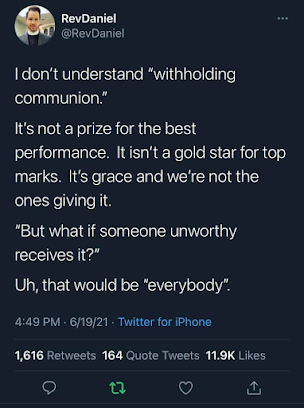
However, many are not happy about it at all. Here is a typical response:


In this post, I am arguing neither for nor against denial of Communion as a practice in the RCC. I am making no judgment whether denying it to President Biden, et. al., should be done or not. My two main points are: 
  1. The RCC's theology of this matter has no real cognate in Protestant churches, so arguing against denial from a Protestant basis is like stepping into a boxing ring by yourself, shadow boxing against an opponent who is not there, then claiming victory in a fight you never actually fought. 
     
  2. It is pretty obvious that tweets like this are not really directed at the RCC bishops, for this is not an attempt to persuade the bishops to reverse. This and other, similar tweets and posts are directed toward the posters own in-group to signal that they are defending not a superior theology of Communion, but political figures whose abortion advocacy must be protected. These are not religious or theological tweets or posts, they are political declarations hiding behind religious language. 
That said, I do not personally take issue with RevDaniel's implied theology of Communion here. The problem is that he is using a very Protestant argument against Catholic bishops, who if they ever read this will know immediately that RevDaniel knows almost nothing about the Catholic theology of the Eucharist (Communion). 

First, RCCs very emphatically believe that no one is worthy of receiving the Eucharist; their catechism says so very precisely. Communicants, those who receive the sacrament, are not worthy of the sacrament but are made eligible by obeying the commandments of Scripture regarding the sacrament. The formal Catholic teaching, or catechism, of the Eucharist includes:

1384 The Lord addresses an invitation to us, urging us to receive him in the sacrament of the Eucharist: "Truly, I say to you, unless you eat the flesh of the Son of man and drink his blood, you have no life in you."

1385 To respond to this invitation we must prepare ourselves for so great and so holy a moment. St. Paul urges us to examine our conscience: "Whoever, therefore, eats the bread or drinks the cup of the Lord in an unworthy manner will be guilty of profaning the body and blood of the Lord. Let a man examine himself, and so eat of the bread and drink of the cup. For any one who eats and drinks without discerning the body eats and drinks judgment upon himself."218 Anyone conscious of a grave sin must receive the sacrament of Reconciliation before coming to communion.

1386 Before so great a sacrament, the faithful can only echo humbly and with ardent faith the words of the Centurion: "Domine, non sum dignus ut intres sub tectum meum, sed tantum dic verbo, et sanabitur anima mea" ("Lord, I am not worthy that you should enter under my roof, but only say the word and my soul will be healed.").

The key sentence for this post is, "Anyone conscious of a grave sin must receive the sacrament of Reconciliation before coming to communion." What the bishops are insisting is that abortion on demand is a grave sin, and its political advocates and enablers would be partaking of the Eucharist in an unworthy manner unless they complete the steps of Reconciliation. Those steps are Confession, receiving Absolution from a priest, and doing the Penance assigned. 

We Protestants need to understand that the sacraments of the RCC are a system and are closely interrelated. This is not much true in my denomination, the United Methodist Church. Our two sacraments of baptism and Communion are related, but not much interrelated. 

Besides, even we UMC ministers formally (though not in practice) "fence" the Communion table in the first paragraph of the litany by saying, 

Christ our Lord invites to his table all who love him, who earnestly repent of their sin and seek to live in peace with one another.

And then we require confession! (Though the confession is a scripted prayer said by the whole congregation, not privately to a pastor.) But read that sentence carefully: We formally (again, not in practice) invite to Communion only those who love God, who repent of sin (which is what the RCC bishops are demanding in the present controversy, only they really mean it) and who want to live peacefully with one another. 

Barring persons from the Communion table has never been part of the UMC's theology, doctrine, or practice, so our verbal fence around the table is mostly symbolic and also a call for each person to examine themselves. However, before we get our Protestant backs up, we should consider that formally, we are not much different from the RCC in qualifying who may receive the sacrament. It's just that the RCC is far more likely to mean it. 

These are not religious or theological tweets or posts, they are political declarations hiding behind religious language. 

Update: An email from a practicing Catholic, Joseph S., points out that the denial of Communion (to one who has sinned and is unrepentant) is intended to protect that person from compounding his or her sin by receiving the sacrament in an unrepentant state. So, yes, denial of Communion is aimed at correction but also at protection. In this way denial of Communion is an act of pastoral care and Christian love. 

Update: Have done some more reading on this general topic, not about the Biden-Communion controversy. There have been for a long time, decades if not centuries, debates within Catholicism about the Eucharist being served to persons still in grave sin, such as divorced Catholics whose marriage was never annulled by the Church and who have since remarried. Catholic doctrine (and some Protestant denominations) consider that to be adultery, which is a state of grave sin. These have been serious debates of varying intensity over the years/decades, and were not tied to politics. A strict interpretation has held that Catholics still in grave sin (politically tinged or not!) should not receive the Eucharist. Some also say that such persons should not be allowed to serve in public ministry such as being a lector, who are lay persons reading Scripture of litanies during worship. So, even within the RCC, eligibility to receive the Eucharist has long been a very complicated issue on matters other than abortion for at least several decades. However, this present controversy could have far-reaching outcomes on Communion and matters other than abortion. As lawyers say, the bishops' lopsided vote on the abortion-Biden matter could set a precedent for other issues unrelated to abortion but still related to the sacrament. We should all pray for the Holy Spirit to be heard and heeded!

Also, the whole concept of denying Communion to a church member is widely misunderstood among non-Catholics to be a form of priestly punishment upon a sinful church member. That is not so. In fact, the emphasis of denial is that the person concerned should be encouraged and assisted to repent and reconcile by their own volition to enable them to approach the altar to receive the body and blood of Christ. Grudging repentance is not repentance at all. It is submission to power, not an acceptance of divine love and its return to God by the communicant. But the Church's goal is to help bring its members to, or back to, a state of loving God and neighbor with all their heart, soul, strength, and mind, and to receive Eucharist in that state, not in mere submission to priestly authority.

The responsibility is on the communicant, God and the Church being his/her helper. I am far from certain that the publicity of the recent vote regarding the president and other Catholic politicians is very helpful, and I have to imagine that among Catholic clerics there is no little discussion of that. 

Tuesday, March 23, 2021

More divided now than ever


I used to believe that the USA is as divided now as it was in 1860, and as the 1860 electoral map shows, the country was very divided then. But I think we are far more divided now than then. 

Born and raised in the South, I was taught the mythologies of the South's secession and of the Civil War, especially those of the "Lost Cause" of the South and what I came to call "Noble Lincolnism" in the North. But after I decided to do my own research of the era, I discovered that almost all I thought I knew was simply Bravo-Sierra. 

I learned that not only was slavery the focal point of the country's disunity, it was in fact the only meaningful point of the nation's disunity. That is, in 1860 the South and North were not really in dissension over anything substantive but slavery, not even on secession. (After all, there was an active secession movement among state-level politicians, including the governor, in Wisconsin in 1860!)

On almost every other principle of America's founding and the structure and purpose of government, there was practically no disagreement between North and South. By 1860, though, all the areas of basic commonality were fully overshadowed by the slavery issue with all its moral and political implications, but both the USA and the temporary CSA were established as representative republics with governments of limited powers and authority. 

But today, the American Left and Right share almost no commonality of political world view. I am an ordained United Methodist minister, now retired, and I suggest that what is happening to the country is well illustrated by what has happened to the United Methodist Church, the third-largest religious denomination in the country.

The UMC began grappling with homosexuality in the 1976 General Conference of the church. In our polity, the GC, as it is called, is the only body that can set rules and regulations for the whole denomination. The GC meets every four years for two weeks and does not exist in between. 

Beginning in 1976, advocates for full inclusion of homosexuals in all offices of the UMC began their fight. Then and in each successive GC until 2016, they fought for the GC to approve ordination of homosexuals and to include officiating of same-sex marriages or unions as part of all pastors' ministry, to include such services in UM churches' sanctuaries. 

They never succeeded. Finally, 2016's GC set a special GC for 2019 that would have the sole task of resolving the issue once and for all. All the delegates agreed that the 2019 GC would determine the final answer and that neither the advocacy nor traditionalist side would raise it again. That GC met in February 2019 and voted to retain the status quo and in some details to strengthen it.  

Of course, it did not "resolve" the issue at all. The advocacy side doubled down and reorganized while the traditionalists stood around and patted themselves on the back for winning. As the result, the liberal-progressives dominated elections for delegates to the 2020 General Conference. In the meantime, an ad hoc commission was established to find a way forward. It announced that secessionism was the only answer for 2020 (although of course it was not called that) and with the Council of Bishops' approval, the first order of business for the 2020 GC was to be a vote on the dissolution of the United Methodist Church into at least two denominations. 

The 2020 GC did not take place because of Covid. It was rescheduled for this year, then rescheduled to begin in late August 2022 (update: now rescheduled again to 2024). Even so, there are no voices anywhere calling for reconsideration of dissolution. That die has been cast even though the vote remains 18 months away. 

It took from 1976 to 2019, but both sides finally realized that they each understood all matters of the issue and that no new arguments, no new theology, no new insights, and no more debates were going to go anywhere. No one's mind was going to be changed. No compromise was possible because the fundamental tenets of each sides' beliefs and religious world view had been pared down to their core. There was nothing left for either side to give that did not equal full surrender. And no one was going to raise the white flag. 

So secession. Sorry, I mean, "Protocol of Reconciliation and Grace through Separation." 

Welcome to America today, the UMC analogically writ large. Like the UMC, the coming dissolution of the United States began long ago. I think it actually began in the Civil War, which IMO is when the "imperial presidency" really began, though the seeds did not sprout until Wilson's disastrous presidency. But then they did take deep root and have grown ever since. 

Just as Lincoln's election brought secessionism into the fore in 1860, the one-two punch of Trump-then-Biden are the levers that are fracturing the country now. There simply is no compromise even possible between Left and Right any more because there is no common ground or understanding on how the country should move into the future. By "no," I mean zero. 

No common ground at all on these matters; there is no longer any "centrist" position:

  • Limited government
  • Size of government
  • Scope of government
  • Authority of government
  • Reach of control by government
  • Global warming - climate change - environmental policy
  • Who controls election processes in states
  • Who gets to vote
  • How voting is done
  • How votes are secured
  • How votes are validated
  • What is the meaning of citizenship
  • Immigration
  • Use of technology
  • Meaning of privacy
  • Meaning of human rights
  • What does the word, "unalienable" mean
  • What does federalism mean
  • Control of the judiciary
  • International relations
  • Energy policy
  • Federal spending
  • Abortion
  • Identity politics
  • The right to keep and bear arms
  • What is "truth?"

I could go on, of course, but I think that gets the idea across. I do not see how a dissolution of the country is avoidable. Avoidance will require sincere and enduring compromises of politics from both Left and Right, compromises that are not actually possible because they would require the surrender of fundamental tenets of political belief. That is not going to happen. 

So what will be the tripwire for us? I think it will be the 2022 mid-terms. No matter which party comes out ahead, the result will be soundly rejected by the other side. I pray that the aftermath will be peaceful, but I am not going to bet any money on it. But the United States as we have known it until now will begin dissolving then. 

God, I hope I am wrong. 

RelatedThe Priesthood of Politicism Offers Only Damnation

Update: As to be expected, Angelo M. Codevilla gets more to the heart of the matter than I, although his paper and my essay do not disagree. He is a senior fellow of the Claremont Institute and professor emeritus of International Relations at Boston University. Read, "American Exodus."

Update: "America never more politically divided than under Biden." 

The latest Gallup research shows that under President Joe Biden, the partisan gap has reached its widest point, surpassing the gulf under former President Donald Trump and likely making Biden the all-time leader of partisan approval.

In Biden’s first months, the gap between approving Democrats and Republicans has been 86 percentage points. That means Biden is approved by 96% of Democrats and 10% of Republicans. He easily beat his former boss, former President Barack Obama, by seven points.

By comparison, Trump had 87% approval among Republicans and 10% among Democrats. While he bragged about his GOP approval, former President George W. Bush had a higher (89%) rating with Republicans in his early days. ... 

The survey is the latest to show the political division in America growing after the heated 2020 election. It follows another from Rasmussen that found bipartisan agreement that "cheating" helped Biden win the election.

 Update: The Univ. of Virginia: "New Initiative Explores Deep, Persistent Divides Between Biden and Trump Voters."

— Majorities of Trump and Biden voters express support for several elements of the bipartisan infrastructure and reconciliation bills being debated in Congress, but there are marked differences in their levels of support. (see Table 1 below)

— Majorities — often large majorities — of both Biden and Trump voters express some form of distrust for voters, elected officials, and media sources they associate with the other side. A strong majority of Trump voters see no real difference between Democrats and socialists, and a majority of Biden voters at least somewhat agree that there is no real difference between Republicans and fascists. (see Table 2 below)

— Significant numbers of both Trump and Biden voters show a willingness to consider violating democratic tendencies and norms if needed to serve their priorities. Roughly 2 in 10 Trump and Biden voters strongly agree it would be better if a “President could take needed actions without being constrained by Congress or courts,” and roughly 4 in 10 (41%) of Biden and half (52%) of Trump voters at least somewhat agree that it’s time to split the country, favoring blue/red states seceding from the union. (see Table 3 below)

City Journal: The New Secession Movement | City Journal (city-journal.org) 

Washington Free Beacon: "The Sense of an Ending" Dec. 3, 2021.

Whatever happens, I find I cannot escape the sense that America has reached an impasse, that it has arrived at a moment of transition, and not just on the matter of abortion. Whether one looks at politics, economics, or the world, one sees a realignment of forces, a shuffling of players off and on the stage, to prepare for the next act in the drama. The Trump presidency seems less like the harbinger of a new beginning than a spectacular climax to a historical epoch. If so, we are living through a sort of denouement, a working through of conflicts left unresolved. "It feels like the order we have all taken for granted since the end of the Cold War is badly decaying, and has gotten so fragile that it might well shatter soon," wrote Damir Marusic of Wisdom of Crowds last month. Question is: What replaces it?

The U.S. is Heading Toward a Second Civil War. Here Is How We Avoid It --  The author offers no guarantees, but his prescriptions at minimum can do no harm. 

Self-hating elites are destroying our commonwealth, by Mackubin Owens, a senior fellow of the Foreign Policy Research Institute in Philadelphia

Monday, July 6, 2020

The Official American Hymn Glorifying War

I am a retired Army combat-arms officer and I agree with Laurence M. Vance: "The Battle Hymn of the Republic" is blasphemous (at best) and has no place being sung in Christian worship services. It is found in The United Methodist Hymnal but let us pray it will be excised when(ever) the next hymnal is published.

Killed in action soldiers of the Battle of Antietam, near Dunker Church. Why do churches sing a hymn that celebrates wholesale killing and destruction and calls them holy and good?
Read the whole article for a detailed, line-by-line explanation why this "hymn" is best described as a satanic perversion of the Gospel of Jesus Christ. Here is the conclusion:
The “Battle Hymn of the Republic” ought to be parodied, satirized, and lampooned. It has nothing to do with God or Christianity. It is not a Christian hymn. It does not belong in a Christian hymnbook. It should not be sung in any Christian church — Northern or Southern. It should not be on the lips of any Christian — Yankee or Southerner. It is partisan political paean to bogus history and faulty theology. For much too long Christians have sung this “hymn” with religious fervor while remaining in ignorance as to its history and theology. For much too long pastors and song leaders have included this “hymn” in church services without stopping to consider whether it is an appropriate song for a Christian worship service. Disparaging the singing of this song has nothing to do with being a Confederate sympathizer, or being unpatriotic or anti-Lincoln, but it has everything to do with exercising biblical discernment. Traditions are hard to break, and especially religious ones, but the singing of the “Battle Hymn of the Republic” is one that must go.
And the sooner the better.

Tuesday, January 28, 2020

A note to the congregations

Greetings in the name of our Lord Jesus Christ!

As I briefly explained to Gideon and Greenbrier UMCs on Jan. 26, every year at this time, pastors and the Staff-Parish Relations Committee (SPRC) of their churches enter into a time of consultation about pastors' appointments. Appointments begin each each year at the end of June. In the Tennessee Conference, every appointment is for one year at a time, basically from the beginning of July to the end of the next June.

During the still-ongoing consultation process it became clear to the SPRC's of both Gideon and Greenbrier that I will not be returned to the Greenbrier-Gideon Charge as pastor. The two predominant reasons are:
  • Retirement of pastors in the Conference this year will likely be higher than average, which causes more moves than usual.
  • The financial condition of both congregations, especially forecasting to January 2021. 

Here is why January 2021 figures in. Starting this year, 2020, every church is fully responsible for paying all of its pastor(s)' health insurance premium and pension "match." For 2020 only, the Conference is paying half of the insurance premium and three-fourths of the pension match. Starting Jan. 1, 2021, both subsidies drop to zero. That means that in the middle of the appointment year, the direct-billing total rises very sharply -- for Greenbrier church alone more than $9,000 and for Gideon proportionately.

Both churches have been faced this year with declining offering amounts chiefly because of deaths of members whose giving has not been significantly offset by other members, and by persons moving away, either literally by moving van, or figuratively by attending another church.

(Almost every UM pastor either within our conference or outside it I have spoken with, and it has been a lot, have said their attendance has also dropped. That many, maybe most, of the departures have resulted from the ongoing turmoil in the UMC regarding actions of last February's General Conference, and the guaranteed continuation of it coming in this May's GC, there is little doubt. )

With all of this as background, in my consultation meetings with both SPRCs, we all agreed that my continuation as pastor of this charge was not financially supportable. Frankly, had the SPRCs' members not already understood that, I would have put it on the table. But we all knew this. The main task now for each church's SPRC is preparing for their own consultations with our district superintendent, the Rev. Scott Aleridge. I continue to work with both committees on that.

As for myself, Cathy and I had always planned on retiring in 2022. We frankly see little point, and have no desire, to move our home and begin new at another church, then retire after only two years there. I do not think it would be fair to that church. And, since Greenbrier is very north in the Conference, any move would almost certainly take us farther away from our new grandchild to be born in March. Add the hassle of selling our home and possibly having to buy a new one, or live in a parsonage for only two years, then move our household again, and other things like that. For these reasons, I informed Rev. Aleridge last weekend that I would retire this summer.

As I said Sunday, Cathy and I are deeply grateful to the people of Greenbrier and Gideon churches for the time we have been here, and for the five months I still have to enjoy as your pastor. It is possible that I may be asked to take a part-time appointment somewhere within driving distance, but there is no way to know now. But today, you and I serve our Lord and one another in love, thanks be to God!

Grace and peace,

Pastor Don

Thursday, January 9, 2020

The Methodists' coming punishment of God

I wrote this with non-UMC readers in mind, so I do not dwell on the minutiae of the recently-released "Protocol" document. Besides, this is long enough without that.

Just after New Year’s Day there was national and regional news coverage announcing, “United Methodist Church Announces Proposal to Split Over Gay Marriage” (NPR), or similar headlines.


Why did this become suddenly worthy of such large-scale coverage? That the church has been wrestling with homosexuality since at least 1972 is no secret. Accurate headlines would read, "United Methodist Church leaders agree to catch up to fact that the UMC is already splitting over gay rights."

The UMC is the America’s second-largest Protestant denomination with about 7.5 million US members, and about that many around the world, with the largest foreign numbers in Africa.

The massive coverage of the latest split proposal, called “Protocol of Reconciliation & Grace Through Separation,” does not really break much new ground. There were already a few breakup plans proposed and on the table several months ago.

So, what is the situation now, what comes next, and what after that?

“Status quo” is Latin for “the mess we’re in” 

In fact, nothing has been decided and no actual actions have been taken to split the UMC. That a split is nearly certain to come before this summer is not much in doubt. But what the details will be no one can predict.

The UMC’s only body that can determine policy denomination-wide is the General Conference. Presided over by bishops, who can speak to issues but may not vote, the GC convenes once per four years and does not exist in between. It will convene again on May 5. The “gay issue” will certainly be the priority matter. Voting delegates come from the church’s conferences, which is what the UMC calls dioceses. The number of delegates is fixed; how many come from each conference is based on their membership number. Delegates per conference must be both laity and clergy.

So, what will the fight be about?

The present canon law of the UMC, called the Book of Disciplinesays this:
• ¶ 304.3: The practice of homosexuality is incompatible with Christian teaching. Therefore self-avowed practicing homosexuals are not to be certified as candidates, ordained as ministers, or appointed to serve in The United Methodist Church. View full statement.

• ¶ 341.6: Ceremonies that celebrate homosexual unions shall not be conducted by our ministers and shall not be conducted in our churches.
This has been the policy for many years. However, a special, called General Conference in February 2019 added mandatory penalties for violations and prohibited giving …
… United Methodist funds to any gay caucus or group, or otherwise use such funds to promote the acceptance of homosexuality or violate the expressed commitment of The UMC "not to reject or condemn lesbian and gay members and friends."
That GC also adopted means by which churches that could not abide by these provisions could withdraw from the UMC while retaining possession of their real estate and buildings. Some did, but not many.

Instead, the vast majority of progressives remained in the UMC to continue the fight. This caused two major consequences:
  1. Traditionalists rebelled against the never-ending infighting and started to leave the UMC individually, causing a significant decline in attendance and collections. This was amplified by the relatively smaller number of progressive Methodists who made the same choice. Progressive churches (in aggregate) sharply dropped paying their apportionments (denominational dues) in protest. Only two months after the special GC, The Hill reported, "Liberal Methodist churches withholding dues after denomination vote to ban LGBT-inclusive practices." Presently, the denomination and its congregations are financially tenuous.
     
  2. While traditionalists patted themselves on the back for winning, progressives redoubled to orient on the election of delegates to this May’s GC. As a result, it is generally acknowledged that the majority of American delegates elected are clearly progressive.
Long before the “Protocol” was released on Jan. 3, clergy from one end of the spectrum to the other had concluded that some sort of split of the UMC was not merely inevitable, it was desirable.

That the new changes to the Discipline formally provided for churches to withdraw was simply dismissed by UM progressives. They were determined that the UMC itself would become fully progressive, not some church splintered from it. That determination has not lessened.

The near horizon

True, the Protocol is not even on the agenda for this May’s General Conference, although there are ways it can be added. Even so, that it was released by the COB in an obviously pre-planned, coordinated national media campaign for maximum coverage, compels pulpit pastors like me to understand a sobering fact: We may not be interested in the Protocol, but the Protocol is very interested in us.

Dale M. Coulter, associate professor of historical theology at Regent University, observed in First Things, that
... the Protocol does not allow local churches or conferences to remain neutral any longer. In its current configuration, the Protocol requires that a choice be made—even if that choice is not to vote and thus remain in the post-separation UMC after the dust settles. The fight will now be taken to the local level.
The Protocol simply torpedoes whatever remained of the center. The center, or what was left of it, now no longer exists. When the president of the Council of Bishops is a Protocol signatory and its first appearance is on the COB's web site, the idea that there remains sort of centrist path is shredded. It is reasonable to assume that this is the outcome preferred by a clear majority, perhaps all, of the UM's bishops. On the date of this post the UM News Service announced that members of the team that developed the Protocol "will be interviewed in a live-streamed panel discussion on Monday, Jan. 13" for an hour at 9.30 a.m. EST on umnews.org. No other proposal for General Conference on this or any other topic has received such genuflection, which IMO speaks volumes.

So even if some bishops think there should still be a middle way, their peers have shut them down. (Remember, though, that the Council of Bishops formally endorsed a centrist plan for the UMC at the February 2019 special General Conference, and it was promptly rejected by both left and right.)

Pastors' shepherding of congregations through the coming schism will be challenging, to say the least. Each pastor will have to choose a side while still pastoring all the people of the church, and the people will be choosing their sides, too. Most congregations' members will not be unified with one another. I have known, for example, members who hold the traditionalist position but who also have homosexual close family members. For them, the issue is very personal. And that puts ministers right here:


The reason is that congregants will fall into three basic groups of response:
  1. Those who will leave the church because the pastor chose the "wrong" position,
     
  2. Those who will leave the church because the pastor would not announce his/her position,
     
  3. And those who feel so deeply rooted that they are not going to leave their church no matter what, or who simply want this whole issue to just go away - at least until a very progressive or very traditionalist pastor takes the pulpit in their church. Then, to borrow Robert Heinlein's metaphor, they will hoist the Jolly Roger.
Which is to say, we ministers (but not only us) are being presented with a Star Trek Kobayashi Maru no-win scenario, for which this Forbes article is useful in understanding in trying to maintain ethical leadership. It explains, among other things,
A crucial feature of good ethical decision-making in the real world is understanding the limits of your powers. You try to make choices that bring lots of good consequences and minimal bad ones, that fulfill your obligations to everyone to whom you have obligations (including yourself) — but you’re doing it in a complicated world where you must make your choices on the basis of imperfect information, and where other people are doing things that may impose constraints on your options. Ethics cannot require us to be omniscient or omnipotent. This means that sometimes even the most creative and optimistic ethical decision-maker has to face a situation where none of the available choices or outcomes are very good.
Even allowing for all that, the Protocol's basic premise that traditionalists and progressives must divorce one another is hardly disputed within the UMC. The Protocol likely will be added to the handful of "split up" proposals already on the General Conference's agenda. For sure, no one expects “the mess we’re in” to continue post-GC.

A safe assumption is that at least two Methodist denominations will arise from this May's GC. One will be progressive/liberal and the other orthodox/traditionalist/conservative. What the actual names will be who knows, but theologically and ideologically that’s how they will be. There could be other denominations, too.

It must be recognized that individual churches will get to choose. If My Town UMC's conference votes to be in the progressive church but MTUMC's members are mostly traditionalist, then MTUMC's members will be able to vote to join another denomination. But they will still lose some members when they do. Likewise if a progressive congregation votes to leave a traditionalist conference. Not all the sheep will follow. Shrinkage, probably dramatic at that, is inevitable.

And then what? There will be no Promised Land for either faction.

Both or all new denominations will be significantly down-funded from now. Staffs at the denominational, conference, and local-church level will diminish and there will be significant downward pressure on salaries from top to bottom. That means that most pastors and staff who can retire will do so and those who cannot yet retire but have other options will take them. The already-over bureaucratic structure of today's UMC will not collapse, exactly, but it will shrink a lot.

Even assuming there is an amicable split, or at least not an angry one, the coming few years will not be unicorns and rainbows for either progressives of traditionalists. I think both denominations will have many difficulties getting organized (which is to be expected) but also fights over their respective purity codes will erupt also. That is, what is it that marks one as a True Traditionalist or a True Progressive? Neither side can answer that right now because any answer given now is mainly influenced by the "mess we're in" and not what will pertain then.

Both denominations will find themselves bickering about a whole host of matters other than homosexuality, which as a topic will be off the table anyway. This will further cause church members to vote with their feet, accelerating the decline of Methodism in America. The Baptists or the MCC , however, will probably be very grateful. And then there was this posted by a friend I have known since before the internet:
Went to a Catholic funeral. At the supper I mentioned how beautiful their church was.
The answer was, "Beautiful yes, but it takes a lot of money for upkeep. We couldn't afford it if it were not for all the Protestants that are converting."
That will continue.

Where do we find God here?


I hope for a far finer future than I envision. But as a very senior leader observed in my prior career, "Hope is not a method and wishes are not plans." In our history since our founding in the Christmas Conference of 1784, there have been quite a number of splits. The only one approaching the scale of what is coming this year was a full-scale  schism in 1844 over slavery. But slavery was ended and the two denominations finally reunited. The coming schism will be permanent. After all, homosexuality is not going to simply be ended like slavery was.

I know that God never withdraws his grace and guidance. Jesus' resurrection never becomes less efficacious. But I also remember this:


And we will get it good and hard.

If you think I am overstating all of this I only reply, wait and see. Because you ain't seen nothing yet.

The outcome will be like this, only it will not be funny.


Bookmark and Share

A world without nuclear weapons - what would it look like?

 From Pope Leo this week, according to the National Catholic Reporter : " Pope Leo quotes Bob Dylan song in book foreword calling for n...