Showing posts with label Technology. Show all posts

Tuesday, April 22, 2025

Artificial Intelligence and The Day the Earth Stood Still

The Day the Earth Stood Still is a foreboding prophecy

The 1951 sci-fi classic, The Day the Earth Stood Stillhas been called "the first thinking person's science fiction movie." It was made during the second year of the Korean War and the formative years of the Cold War - the USSR detonated its second atomic bomb that year, and the United States was only a year away from testing the first hydrogen bomb. And of course, the world was only six years away from the abattoir of World War II.

The drama is this: a large flying saucer lands in front of the Washington Monument. The military surrounds it with tanks and troops. A giant, humanoid robot emerges. We learn later its name is Gort. The special effects are very primitive by today's standards and probably were not been terribly convincing even in 1951. But that's okay - this isn't a special effects movie. An alien man, Klaatu, comes out. He is human, or at least humanlike. He announces he wants to address all the nations of the world. American agrees but the Soviets refuse. Klaatu escapes from government minders, disguises himself as a businessman, and takes a boarding room in Washington to use as a base of operations.


The movie was loosely based on a 1940 short story called, "Farewell to the Master," by Harry Bates. Bates was one of the towering figures of science fiction in the 1930s and 1940s, a time known as the "Golden Age of Science Fiction." Amazingly, I found the text of Farewell to the Master online - 
you can read it here, and I heartily recommend it to you.

In the end, Klaatu makes it back to his spaceship. Gort is revealed an extremely powerful and destructive machine, equipped with a vaporizer ray, for example, as two soldiers guarding him discovered the hard way. Many critics say that Klaatu is a Christ figure - he comes from the heavens, is rejected by the authorities, hunted down and shot by soldiers. He resuscitates, then announces just before his ascension into the heavens that his purpose is to save humankind.

While the cinematic parallels are doubtless intentional, Klaatu as Christlike doesn't hold water. Klaatu is really an emissary of the "civilized" races of the universe, but he is revealed in the film's denouement as a galactic bully, a mere thug delivering a cruel ultimatum: either humankind stops making war or "the earth will be turned into a cinder."

Moreover, it is Gort, not Klaatu, who holds the earth's fate in his hands. Klaatu explains that his race created Gort and others like him to annihilate any people or any planet that breaks the peace. The robots' power is absolute and cannot be revoked, says Klaatu. The result is that they live in peace, and if humanity wishes to survive it must accept the dictatorship of the robots.

What Klaatu seems not to understand is that while he and his fellows live in peace, it is literally the peace of the grave. They are slaves. Their message to earth is simple: becomes slaves like us or die. This is not a message for the ages, and were it not for the movie's technical merits, it probably would have rightfully passed into oblivion long ago.

There is a high level of technical excellence in the movie. The use of light and shadow, always crucial in a black and white film, is very well done. Klaatu, played by Michael Rennie, is kindly and attractive - that is, until he makes his naked threats. The movie foreshadows the coming of Mutual Assured Destruction, MAD - the uneasy, dangerous equilibrium of neither peace nor war the USSR and USA found themselves in not many years later. Like thermonuclear weapons, Gort and the robots are weapons of mass destruction, only on a cosmic scale.

Unlike TDTESS's approximate contemporary, 1953's War of the Worlds, the alien's mission is dramatically presented as intriguing, even hopeful, until the end. It is not Klaatu or Gort who are aggressive, except for Gort's inexplicable vaporizing of the two guards. It is the human beings who use violence, who shoot Klaatu for no good reason. Klaatu is dramatically developed as the soul of friendliness; he even becomes a father figure to the son of the woman running the boarding house.

Yet the idea of machines having ultimate destructive power is one that hardly appeals to us. Only 32 years later Arnold Schwarzenegger would become a star by playing another version of Gort, but one somewhat less powerful. The apotheosis of machine-driven WMDs is excoriated in that movie's second sequel, Terminator 3.

But consider that Gort is a personification of what we call Artificial Intelligence. Even the groundbreaking researchers and developers of AI have warned strongly that AI has the real potential to dominate, or even end, humanity. AI, they say, may become so independently self-guided that it works only to advance only its own self-created goals and interests. Or as I put it awhile back:


When AI becomes so self-directed that it considers humankind as merely another resource to be controlled, exploited, or even terminated to achieve AI's own ends, then we will have Gort in a worldwide network of impenetrable self-sufficiency and power. 

Here is an example from last year. There were a few news articles that Britain's Royal Air Force was using AI-connected flight simulators to test targeting and destruction of enemy air defense installations. In the electronic exercise, a central RAF aircraft controlled AI-piloted drones. The drones' mission was to detect air defense sites and destroy them. But the control aircraft had to approve each launch because the exercise had friendly AD sites built in as well as enemy. 

According to the reports, the AI network seemed to understand that its purpose was to destroy air defense sites and it apparently  decided that it was irrelevant that some were enemy and some were friendly, so it finally shot down the control aircraft and started blasting all AD sites indiscriminately. 

That is a network of Gort. The human operators and designers became effectively slaves to what they had created. Heaven forbid that our AI networks will one day achieve Gort on a worldwide scale, but I fear we are headed that way. 

What will happen when AI become so self aware that it understands we need it but it does not need us? 

Update: Well, here is part of the answer to my closing question:
A lot of people think this technology is going to get so good, so fast that it will pose an existential threat to humanity. For example, Ross Douthat recently did a fascinating (and terrifying) interview with Daniel Kokotajlo, an AI researcher who is extremely concerned about the rise of superintelligent AI. He believes that in about 18 months from now, AI computer programmers will have put their human counterparts out of business, simply because they will be able to code at a superhuman level. Not long after that Kokotajlo predicts that we will reach a situation where “the AI becomes superhuman at AI research and eventually superhuman at everything.” That’s when things get spectacularly weird and, in all likelihood, rather dangerous.

Thursday, August 15, 2019

Ban on driving while using cell phone - just a cash cow?

Last July 1, a law went into effect here in Tennessee that makes it illegal for anyone driving a car to hold a cellular phone in his or her hand. Reports the Knoxville News Sentinel,
The Tennessee law banning hand-held cell phones went into effect July 1. Drivers can eat, drink, converse, sing, look at roadside sights, talk to their kids in the back seat, and it’s all perfectly legal. Pick up a cell phone, however, and you’re a distracted-driving lawbreaker. Law enforcement and first responders, however, are exempt from the safety measure that the legislature and governor determined is required for Tennessee drivers.
The Sentinel is not a fan of the law, mainly because such bans, in effect in some other states for many years, have not once been shown to affect the accident rate at all. They cite a number of such studies.

But it does roll cash into county and state coffers.
At $50 per ticket, the Tennessee Highway Patrol’s cell phone ban enforcement netted, it would appear, a minimum of $21,200 for the 424 tickets the THP wrote in July, Knox News reported. Tickets increase up to $200 depending on the situation.
And yet . . .

Yes, the ban here in Tennessee is really just another way to tax people. OTOH, the worst accident scene I ever got called by the sheriff's dept. to go work was directly caused by a young woman driving on a two-lane state highway in Franklin, Tenn. It was before smart phones were invented. She was trying to punch a number into her cell phone and wandered into the other lane. An oncoming 18-wheeler swerved to miss her, bounced back onto the road and went head on into a Chevy pickup behind the woman's car. 

The impact was so violent that it completely separated the truck's body from its frame, knocking the truck body 20 or more feet away from the frame assembly, which was solely occupied by the driver, married only three weeks, on his way home from work. He had been ripped into three separate pieces. The 18-wheeler's driver was injured.

The woman phone caller was wholly uninjured but when I spoke with her she was not very coherent. She was still holding the phone in her hand, up next to her head, though of course there was no call connected, and basically just walking in a small circle at the rear of her car.

A highway patrol trooper told me that in his 26 years in the THP, this was the most violent accident he had seen. After seeing the truck driver's remains, I could see why. Before the medical examiner's team went to retrieve the remains, I held a time of prayer and Holy Communion for them (I always took my Communion kit responding to sheriff's department calls).

So I cannot argue with Tennessee's law.

Tuesday, January 29, 2019

Digital heroin addiction worsening

I have used, though did not invent, the term "digital heroin" to refer to people's addiction the glowing-screen devices, especially smart phone and tablets, and especially by children. Comes now further, abject confirmation. From the Daily Mail, "Generation of child web addicts: Youngsters are becoming so obsessed with the internet they spend more time on YouTube than with friends as parents struggle to keep control of their online usage."
Children have become such screen addicts they are abandoning their friends and hobbies, a major report warns today. Researchers found under-fives spend an hour and 16 minutes a day online. Their screen time rises to four hours and 16 minutes when gaming and television are included. Youngsters aged 12 to 15 average nearly three hours a day on the web – plus two more hours watching TV. The study said YouTube was ‘a near permanent feature’ of many young lives, and seven in ten of those aged 12 to 15 took smartphones to bed. It concluded: ‘Children were watching people on YouTube pursuing hobbies that they did not do themselves or had recently given up offline.’ A growing number of parents admitted to researchers that they had lost control of their children’s online habits.
Next is a report on Nashville's local Fox affiliate, "Study: Increased screen time in young children associated with developmental delays."
A new study from psychologists and doctors in Canada found increased screen time in young children can cause issues with children reaching developmental milestones. Researchers studied 2,441 mothers and children with higher levels of screen time for children aged 24 and 36-months-old. Researchers then examined developmental milestone test results in the same children at 36 and 60-months-old. The study found on average, 24-month-old children were watching 17 hours of television per week, 36-month-olds watched 25 hours per week, and 36-month-olds watched 11 hours per week. The totals reflect findings children on average in the U.S. watch to 2 hours and 19 minutes of screen time each day. For each age group, children with increased screen times showed poorer performances on developmental testing when they reached the next age group. Developmental evaluations included communication, gross motor, fine motor, problem solving, and personal-social skills. The totals are well above the recommended 1 hour per day of screen time watching high-quality programs. Researchers say about one quarter of children are not developmentally ready for school entry and the trend parallels an increase in screen time use by children.
Many parents use glowing screens as a sedative to pacify their children I have seen this in public too many times to count. But people, these thing are literally addictive, and when children (a) learn they will be given a screen to stop pitching a fit, and (b) they cannot help pitching the fit anyway because they literally are suffering from withdrawal symptoms, then the parent-child-screen interface becomes a self-reinforcing do loop. My kids escaped this, fortunately. Our youngest was 14 when the first smart phone came out and none of them got a smart phone until they were in college (if then). But I have, no kidding, seen infants who cannot even walk yet with their very own smart phones - and now you can buy those phones especially built for small kids (more accurately, for parents of small kids who visually identify those phones with toys, as the makers intend them to do).
Yes, this is sadly real - just click here.
What is the tie-in to these kids' futures? Well, consider that researchers both in the US and Europe have discovered that IQ scores are getting lower, and the younger one is, the greater likelihood his/her IQ is lower than a generation before. And while glowing screens do not seem to explain all the fall, they are absolutely part of it.

Falling IQ scores may explain why politics has turned so nasty

Western IQ scores are falling. Is it computers or something else? Parents, take this seriously!

Monday, February 26, 2018

Post-Parkland: Yes, the AR-15 is a very deadly military weapon

Introduction

I advise readers in advance that parts of this post will be both technical and probably unsettling. I am going to describe the wound ballistics of the 5.56mm round fired by the civilian-model AR-15 rifle, which is the civilian version of the US military's M4 carbine rifle. The only difference between the two weapons is that the M4 has a selector switch that enables it to fire fully automatic. That is, if the shooter depresses and holds the trigger, the weapon will will continue to fire until its ammunition supply in exhausted (see end note).

Both weapons will fire semi-auto, where a trigger pull shoots one round only. Trained shooters can fire very rapidly that way by pulling and releasing the trigger, but the rate of fire will not be nearly as high as full auto. Nonetheless, it can still be very high.

In ballistics, the general principles of which I learned at the US Army Field Artillery School, there are three phases for rifle (or artillery) ammunition: barrel ballistics, flight ballistics, and terminal ballistics. For rifles, terminal ballistics are usually called wound ballistics - what happens to the bullet when it strikes a target. For this discussion, the target is a human body.

I gained my expertise, such as it may be, in this arcane subject area during the years I served as a principal staff officer of US Army Criminal Investigation Command, which is the Army's version of NCIS (for which there is an extremely unrealistic series on TV). Investigators become specialized over time in diverse forensic fields ranging from accounting to blood-pattern analysis to wound ballistics. They were my tutors. So that is where I learned most of these factors. I asked CID agents to review my final draft of this article and received very learned and concise additions and emendations, which I have incorporated. One retired agent who reviewed it spent 40 years in forensic ballistics work, including wound ballistics. He had investigated a large number of cases involving military rifles. I am grateful for the agents' contributions.

This is, btw, a long post of several minutes reading time.

History of the rifle and ammunition

After World War II the US Army and NATO countries adopted 7.62mm rifle rounds as the standard. I am, not trying to sound pedantic, but that means that the bullet is 7.62 millimeters in diameter. "Caliber" is expressed as a decimal of inches, for example, .30-caliber means the bullet is 3/10 inch in diameter.

By the latter 1950s, the U.S. began working to find a different rifle round for the NATO standard. Finally, the Armalite Rifle (hence, "AR") company produced a rifle that in 1963 was adopted by the US Army as the M16. Armalite worked on the rifle in concert with Remington Arms for the ammunition, which was type-classified also in 1963 as the 5.56mm M193 round. However, while the 5.56mm round was adopted as the NATO standard in 1977, it was not the US M193 round that was adopted because several NATO nations considered the wounds the M193 produced to be so devastating that they approached inhumane.

The M16 rifle itself had serious teething problems in the Vietnam war. Early models were prone to misfeeding and jamming. These were finally corrected and the rifle and ammunition became extremely lethal tools in the hands of American soldiers and Marines. Because the M16 was lightweight and the M193 round produced low recoil compared to previous military rounds, US troops were able to achieve very high rates of accurate fire, much higher on both counts than the 7.62mm round or its .30-06 WW2 predecessor. (.30-06 means that it is a .30-caliber round that was adopted by the military in 1906.)

The NATO standard 7.62mm round, left, and the 5.56mm round next to a AA battery. 

Why is the 5.56mm round so deadly in school shootings?

The 5.56 round is so devastating is because of its ballistic characteristics and its very high velocity. Barrel ballistics are not significant for this discussion.

Flight ballistics: The bullet exits the muzzle of the AR-15 (or M4) unstable. The bullet is not merely spinning around its long axis (the front to rear line). It also "yaws" circularly, up to 4 degrees off center line (a form of gyroscopic precession). At about 100 meters, however, the yaw disappears and the round flies very stable out to about 400 meters, when it starts yawing again.

Victims of school shootings are all shot at ranges of much less than 100 meters. So the bullet strikes them while still yawing. That directly affects what happens to them,

Terminal, or wound, ballistics: There is a term or art among law-enforcement officers called, "instant incapacitation." It means a firearm wound that is so severe that the struck person becomes functionally incapable either immediately or within very few seconds. Instant incapacitation is caused by two things: First is massive and sudden loss of blood. Second is severe interruption of the central nervous system. The 5.56 does both.

1. The 5.56 round exits the rifle at just more than 1,000 meters per second, about three times the speed of sound.  When the 5.56 bullet hits a human body, it immediately begins to decelerate. This bullet's length to width ratio is high. The nose of the bullet begins to decelerate but the rear is still traveling supersonic. The rear is going faster than the nose. This causes the rear to overtake the nose, meaning that the bullet begins to tumble end over end. This tumbling in turn causes the bullet to fragment not quite completely and the fragments travel through flesh, bounce off bone into new directions and sever nervous-system connections. This tumbling is enhanced if the bullet is yawing at impact, as every bullet fired during a school shooting is. That is part one of what causes instant incapacitation.

2. Many ballisticians also say that the supersonic shock wave, shaped like a cone pointed in the direction the bullet was flying, enters the entrance wound and expands it rapidly for a distance into the body (how much depends on the location of the entrance wound and the angle). This causes excess bleeding over what the bullet would cause alone. This effect is called "hydrostatic shock," but not all armaments ballisticians agree that it is significantly damaging. In fact, while sound travels four times faster through human tissue than through the air, sonic waves have been proven not to damage the body.

Cavitation: Any high-velocity bullet (and almost all non-HV bullets, too) not only creates a cavity in the body corresponding to the width of the bullet, they also create large-diameter cavities from the sudden displacement of tissue caused by the speed of the bullet. This is called "cavitation" and highly variable from one weapon to another. A radiologist who helped treat victims at Parkland described it this way:
The bullet from an AR-15 passes through the body like a cigarette boat traveling at maximum speed through a tiny canal. The tissue next to the bullet is elastic—moving away from the bullet like waves of water displaced by the boat—and then returns and settles back. This process is called cavitation; it leaves the displaced tissue damaged or killed. The high-velocity bullet causes a swath of tissue damage that extends several inches from its path. It does not have to actually hit an artery to damage it and cause catastrophic bleeding. Exit wounds can be the size of an orange.
However, the effects of cavitation depend on the tissue affected. Muscle tissue is much less affected and, given survival of the victim, muscle tissue will recover. Vital organs are not so hardy. They can be badly damaged by cavitation but even so, actual destruction is caused by bullet fragmentation much more than cavitation.

Here are photos of cavitation in ballistic gelatin hit by a 5.56 round. The top photo is of a non-yawing round, the bottom of a yawing round. At the far left of each photo is the bullet angle of attack.


 As you can see, while both impacts are horrific, the yaw "wound" is truly devastating. Earlier in the same article, the radioligist observed,
I was looking at a CT scan of one of the mass-shooting victims from Marjory Stoneman Douglas High School, who had been brought to the trauma center during my call shift. The organ looked like an overripe melon smashed by a sledgehammer, and was bleeding extensively. How could a gunshot wound have caused this much damage?

The reaction in the emergency room was the same. One of the trauma surgeons opened a young victim in the operating room, and found only shreds of the organ that had been hit by a bullet... . Nothing was left to repair—and utterly, devastatingly, nothing could be done to fix the problem. The injury was fatal.
These facts are why I reject as unfounded - indeed, invalid and misleading - that the 5.56mm round is nothing special compared to other rifle rounds and is not very powerful at all, a claim that was explicitly made in  Tennessean op-ed only yesterday (Feb. 25), "Why blaming the AR-15 for mass shootings is misguided." The author, Robin Patty, "is a disabled veteran and a former Special Forces operator who resides in Murfreesboro." While I thank her for her service, neither being a disabled veteran (so am I) or a Special Forces operator bestows special expertise in this area.

In her op-ed, Ms. Patty writes of the AR-15 firing a 5.56mm round,
It’s not powerful, so much so that some states don’t allow the cartridge that it fires to be used on deer.  
This weapons system was never designed or intended to be used to hunt any kind of game animal. It was developed by the Defense Department to do one thing only: kill humans beings of enemy armies as quickly as possible. For that purpose, it is extremely powerful. That some states do not allow it to be used to hunt deer is true. It is also irrelevant.
It’s not military grade. It simply looks like a military rifle, as the M16/M4 are all capable of automatic fire and the AR-15 is not.  
As I wrote above, that is the only difference between the military M4 and the civilian AR-15. I again say it is true but also irrelevant. Perhaps (as in maybe) Cruz could have mowed down 45 killed and 25 wounded if he had been shooting an M4 on full auto. So what? Does that make 17 dead and 12 wounded somehow less serious or less urgent for actions to prevent another repeat? Of course not.

When discussing school shootings - and not other kinds of murders or even other mass shootings - there is a unique threat in the 5.56 round fired from the AR-15 rifle.

That is why I find it difficult to oppose raising the legal age to 21 to possess these weapons because frankly, an average 18-year-old today is mentally and morally at about the level of a 14-year-old (and often younger) of any prior generation. At the same time, though, Cruz is the only school mass killer under age 21; all the others were mid-twenties except Lanza, 20, and he murdered his mother to get his hands on her AR-15 that he used to shoot school children.

So while I will not oppose raising the legal-possession age, I also do not really think it will much matter. But I will go one step further: if 18-year-olds are too immature to own a rifle, then we sure as H E double hockey sticks should not let them vote, either.

Coming soon: The other op-ed in Sunday's Tennessean saying, "A solution to ending mass shootings: Ending sales of guns to civilians," and why it is even more gravely in error than Ms. Patty's op-ed. In fact, it is downright looney. But that is for later.

Related: Mass shootings: "Hope is not a method and wishes are not plans"

End note: M4 carbines issued to soldiers for combat will fire full auto, but only three rounds at a time. Extensive testing by the Army showed that because of recoil, the soldier's aim is degraded after the fourth round so that it and subsequent rounds miss. Therefore, those weapons are modified so the soldier will shoot three, stop, re-aim, shoot three, stop, etc.

Also, a commonly-used round in AR-style guns is the .223-caliber round rather than the 5.56mm. They are very similar but are not identical. However, the terminal ballistics, which are what matters, of the .223 are the same as for the 5.56.

Bookmark and Share

Monday, April 17, 2017

The electronic nightmare scenarios

 Massive power outage hits San Francisco, shuts down businesses, BART station, traffic lights

A massive power outage in San Francisco on Friday morning caused a blackout in neighborhoods across the city, from the Financial District to the Presidio, forcing the closure of businesses, a federal courthouse and a BART station, officials said.

A spokesman for Pacific Gas and Electric Co. said at least 90,000 customers lost power.
PG&E also said that it had not identified the cause of the outage.

But it might be a good time to remind ourselves that America's power grid is so vulnerable to sabotage and attack that even Scientific American says that it keeps the Pentagon up at night.
A report last year [2015-DS] prepared for the President and Congress emphasized the vulnerability of the grid to a long-term power outage, saying “For those who would seek to do our Nation significant physical, economic, and psychological harm, the electrical grid is an obvious target.” 
The damage to modern society from an extended power outage can be dramatic, as millions of people found in the wake of Hurricane Sandy in 2012. The Department of Energy earlier this year said cybersecurity was one of the top challenges facing the power grid, which is exacerbated by the interdependence between the grid and water, telecommunications, transportation, and emergency response systems.
And The Hill reported a year ago that a power grid attack is a nightmare scenario.
The threat of an attack on the nation’s power grid is all too real for the network security professionals who labor every day to keep the country safe.

“In order to restore civilized society, the power has got to be back on,” said Scott Aaronson, who oversees the Electricity Subsector Coordinating Council (ESCC), an industry-government emergency response program.

While cybersecurity experts and industry executives describe such warnings as alarmist, intelligence officials say people underestimate how destructive a power outage can be.

The most damaging kind of attack, specialists say, would be carefully coordinated to strike multiple power stations.

If hackers were to knock out 100 strategically chosen generators in the Northeast, for example, the damaged power grid would quickly overload, causing a cascade of secondary outages across multiple states. While some areas could recover quickly, others might be without power for weeks.
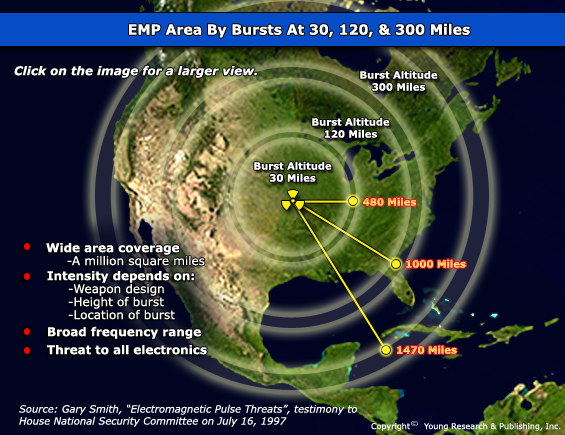
But the greatest threat is from the electro-magnetic pulse (EMP) emanating from a near-space atomic detonation. In one instant, power grids across most of the country could be rendered useless. Some estimates of deaths caused, not by the atomic blast but by the years-long effects of sudden reversion to a 18th-century way of life, are in the many millions.

Just last month former CIA Director James Woolsey wrote that,
... former senior national security officials of the Reagan and Clinton administrations warned that North Korea should be regarded as capable of delivering by satellite a small nuclear warhead, specially designed to make a high-altitude electromagnetic pulse (EMP) attack against the United States. According to the Congressional EMP Commission, a single warhead delivered by North Korean satellite could blackout the national electric grid and other life-sustaining critical infrastructures for over a year—killing 9 of 10 Americans by starvation and societal collapse.

Two North Korean satellites, the KMS-3 and KMS-4, presently orbit over the U.S. on trajectories consistent with surprise EMP attack.
Ninety-percent of Americans dead? I would not go that far, but more than 10 million, certainly. Probably multiples of that.


So why does North Korea have two satellites in polar orbits, each traversing over the United States several times per day?

Having been a nuclear target analyst in my military career, I find this simply horrifying.

UpdateThere are many more threats to the country's grid than just EMP or conventional sabotage. "In 1989, for example, 6 million residents of Quebec lost power for nine hours following a geomagnetic disturbance from a solar storm."

What about truly massive solar storms? These are usually called Coronal Mass Ejections and if large enough the ejected solar mass, not just radiation, can penetrate the earth's atmosphere. A "significant flare" occurred less than three years ago.


Much larger CMEs than this have reached earth very recently.
Solar storms would primarily affect the power grid, and are not likely to harm things like computers.  Also, solar storms would only disrupt communications temporarily, and would not be likely to cause direct harm to communications equipment (except for satellites).   An extremely large solar storm, though, would induce geomagnetic currents that could destroy a substantial fraction of the very largest transformers on the power grid (possibly over much of the world).  If this happened, electric power loss due to a large solar storm would be out for a period of years and possibly decades.  Unlike nuclear EMP, such a solar storm is an eventual inevitability.
The last solar storm that could have caused this level of damage happened in 1859, before the power grid was in place (although in 1921 a large solar storm, of briefer duration than the 1859 event, occurred which affected a much smaller area of the planet). The power grid has only been in place for a fraction of one percent of human history, and a really large solar storm (of the size and duration of the 1859 event) has not happened in that time.  There is a general assumption that any solar event that is similar to, or larger than, the 1859 solar superstorm will simply never happen again, although there is no justification for such an assumption -- in fact, we know that this assumption is false. There is a good possibility that such a large-scale solar storm will happen in this century. If it happens in the current situation without adequate spares for our largest transformers, a large part of the worldwide power grid (including 70 to 100 percent of the United States power grid) will be down for years.
Those transformers are custom manufactured for each site. They are not pieces that simply roll off an assembly line. But reverting to an 18th century lifestyle isn't the half of it. We'd also revert to an 18th-century economy. Absent the US national grid alone, to say nothing of Europe's grid and western Asia's, the worldwide economy would simply collapse. Very hard and very fast.

The net worth of the typical American would simply vanish because money today is almost purely electronic. SFGate reports of an ice cream store whose owner kept the store opened despite having no power - may as well sell as much ice cream as possible before it melted, right? But "sales were few and far between."
“No one pays cash anymore,” he said, spoon in hand as a siren wailed outside. “I’m angry. I’m annoyed."
Charge and debit cards are not money, they are promissory notes, basically IOUs. In an EMP or CME, you might have had $50,000 just sitting in your savings account, but not any more. The ledgers would still show it but they are mostly electronic, too. And banks don't keep much cash on hand, anyway. Same for international commerce and currencies. They'd be shut down.

Life would become nasty, brutish, and short very quickly. Civil violence would reach unimaginable proportions as commodities (like food and drugs) become immediately scarce. It would be a zombie apocalypse, minus the zombies.

Tuesday, January 8, 2013

New Answer to Fermi's Paradox?

Radiation From Deep-Space Could Accelerate Alzheimer’s - Business Insider:

Physicist Enrico Fermi postulated that once a civilization attained even rudimentary space flight, it should be able to reach any point in the galaxy in only five million years. The Milky Way, however, is billions of years old.

"So," asked Fermi, "where is everybody?"

One original answer I have seen is that all the alien races we assume are out there are too busy overeating fast food and watching electronic porn to journey millions of light years through space for no good reason.

Now a more technical reason may be in the offing. Turns out that interstellar space flight probably will just plain kill you:


If you get radiation-induced Alzheimer's just going to Mars, it surely means death going to an enormously-farther star.

Bookmark and Share

Monday, October 15, 2012

Baumgartner supersonic jump helmet video

A camera mounted on supersonic parachutist Felix Baumgartner's helmet shows what happened when, tens of thousands of feet above the earth, he went into an uncontrolled spin.


Baumgartner later related that he knew he was in trouble. The spinning could have pushed too much blood into his cranium, causing a blackout or possibly rupturing vessels in the brain. He considered deploying his drogue chute to stabilize but he knew that if he did, the attempt for a supersonic record would be gone forever.

With only seconds to decide, Baumgartner got his fall sorted out, probably aided by entering denser air that enabled greater control from his arms and legs. He did keep accelerating, though, and went on to hit Mach 1.24 before landing safely.

Wednesday, September 26, 2012

Close to the Big Bang

Here is the latest deep-field photo by the Hubble telescope.


Click image to view larger.
Called the eXtreme Deep Field, the picture captures a mass of galaxies stretching back almost to the time when the first stars began to shine. 
But this was no simple point and snap - some of the objects in this image are too distant and too faint for that. 
Rather, this view required Hubble to stare at a tiny patch of sky for more than 500 hours to detect all the light, 
"It's a really spectacular image," said Dr Michele Trenti, a science team member from the University of Cambridge, UK. 
"We stared at this patch of sky for about 22 days, and have obtained a very deep view of the distant Universe, and therefore we see how galaxies were looking in its infancy."
Most people know that the universe is expanding, but not many non-astronomers are familiar with the theory of inflation, which reveals that the term "Big Bang" is misleading. Instead, says NASA's "Universe 101" web site, the universe's creation "is better thought of as the simultaneous appearance" of the universe everywhere there is the universe.

Inflation theory holds that the universe went from nothing at all to more than 99 percent of its present size in less than one-billionth of a billionth of a second – which is to say, instantly. So while empirical data, especially the uniformity of cosmic background radiation, support the conclusion  the universe began from a single point, from any reasonable human perspective there was no explosion. The universe simply appeared everywhere at once, instantaneously.

Inflation theory explains how the image of the galaxy enclosed in a square, above, can be thought to be the galaxy when it was only 460 million years old (making it presumptively the oldest object ever photographed). Stars and galaxies did not form right away after creation, but this galaxy was already billions of light years distant from ours when it came together.

 Bookmark and Share

Wednesday, February 16, 2011

Jeopardy's Watson computer: Just a high-speed moron

Here is the Youtube of IBM's computer, Watson, beating its human challengers like a mongrel dog on Jeopardy last night. Look carefully at the clues? Notice anything?


Almost none of the answers on the game board required any kind of abstract reasoning to answer. In fact, you could put a human with practically no knowledge of the subjects on the board in front of a computer connected to Google and that person could simply type in the nouns of the clues and get the same answers.

Example - the first question of the game:


And the Google:


Strip out Watson's blinding speed, and it is no smarter than human beings at all. Watson, for all its engineering impressiveness, simply did only what computers have always done: collate at blinding speed (and compute mathematical probabilities to choose an answer). It does not matter that Watson was not connected to the Internet since its mass-memory unit holds 16 Terabytes of data, processed by a 2,880 processor core. As my own computer professor said (many years ago!), "A computer is just a high-speed moron." There is nothing about Watson that I have read so far that obviates that observation.

I think its programmers must have realized this since they artificially crippled Watson by design. Note that Watson was programmed not to buzz in unless it computed an answer of at least 50 percent "confidence" of being right. This was an entirely artificial barrier. Why not 75 percent? Or 25 percent? Or any level at all? Watson is so blindingly fast that it could have buzzed in for every question before either champion (making their presence merely ceremonial, which it almost was anyway). Then Watson simply could have given its top answer, regardless of confidence level, and the computer still would have got 90% of the questions right.

In other words, if the game had allowed Watson to give uncrippled answers, it would have always answered first and would have won even more decisively. But then, with access to the same amounts of data resources through Google, I could beat the two champions if the game always allowed me to answer first. In fact, I'd win under the same confidence crippling as long as I could answer first - because clearly Watson will always be able to buzz in faster than a person.

So what does Watson really prove? From a technical, engineering and programming perspective, it's an amazing achievement with enormous potential for a wide range of applications ranging across broad multi-disciplinary subjects and problems. As for the Jeopardy game, there's less than meets the eye. Count it as a proof-of-concept exercise. What it did not do was reason abstractly. It just collated amazing amounts of information very rapidly. But we already knew that computers are faster than we are for specified tasks. That's why we build them to begin with.

Sorry, Prof. Reynolds, the Singularity has not arrived.

Update: Good discussion on this at The Speculist, including this nugget:

@stephentgo: Repercussions of IBM's Watson unknown, but any job that involves answering questions by phone will soon be at risk. http://bit.ly/hp91hW

Bookmark and Share

Tuesday, November 30, 2010

Healthier, wealthier, but no wiser

Poor Richard tells us, "Early to bed, early to rise, makes a man healthy, wealthy and wise."

Well, two out of three ain't bad, I guess.

Over the past 200 years, people around the globe have grown healthier and wealthier. Sadly, we are no wiser.

A fascinating live chart:


Back to Poor Richard to close:
If what most men admire, they would despise,
’Twould look as if mankind were growing wise.

Saturday, April 24, 2010

Why don’t we still have stables at the church?

The first church I served was founded in 1844, but the Union army destroyed the building during the Civil War. At war’s end, the people bought another tract of land and built a new church. It being 1865, they built a stable and carriage shed in the rear to protect horses and carriages from the elements when the people were at church.

The stable and shed are no longer there.

The sanctuary originally had narrow, wooden benches with no backs, a common feature of churches back then. In the early 1900s, high-backed pews were installed, decreasing seating capacity by almost 100. Soft pew cushions were added about 25 years ago.

No one knows what happened to the benches.

The church was originally lit by oil lamps. It was not electrified until FDR’s Rural Electrification Administration gave assistance. Since the mid-1930s, the church has used electric lights.

The oil lamps are nowhere to be found.

A man in his 80s told me he used to come early on winter Sundays as a lad to light the coal heaters in the sanctuary. A few years after getting electric lights, the church converted to electric heat.

The coal heaters are long gone.

The transoms over the stained-glass windows could be opened for ventilation when they were installed in 1916. Decades later the church added air conditioning.

The transoms were then soldered shut.

Some years before I arrived, the church converted a Sunday School room to a nursery. Before then, mothers were expected to look after their small children at church or stay home with them.

Though the stables had long disappeared when I arrived, the church had no parking lot. It did have a small, graveled-over area that was itself overgrown with grass. People parked on it and on the lawn.

One especially soggy November a woman visitor pointed out to me that she had apparently ruined her shoes walking through the mud from her car. I related this conversation to our lay leader, who was a woman also, but she replied that muddy shoes were a small price to pay to worship God when the early Christians worshiped at risk of death.

The problem is, of course, that there were dozens of churches in the community where one could worship just as well without ruining one’s shoes. Not long afterward, the church built a 100-space, paved, curbed and lined parking lot with a sheltered drive-up.

Each one of these changes - electric lighting, central heating and cooling, adaptation to autos - was, in its time, very controversial among the members, some of whom resisted them vigorously.

Would you like our church to take out the cushioned pews, uninstall the air conditioning, disable the microphones and return to kerosene lighting? Of course not – but it’s important to realize that what we think of as normal and common-sense practice was once widely seen as radical, new-fangled, faddish and unnecessary.

They are universal features now because churches learned that if they did not adapt, people would go elsewhere. When a significant percentage of churches began to accommodate cars instead of horse and carriage, people who drove cars went to them. Churches that held onto stables either closed or made the shift. Same with efficient cooling: people migrated away from open-window churches to air-conditioned ones until the holdout churches understood they’d have to get cool or close.

Today, the “textual generation” is being replaced by the “audiovisual, web-connected generation.” The former learns mainly by reading. But people not much younger than me learn mainly by looking and hearing. The younger someone is, the truer this is. People in their teens and 20s also expect to absorb information by more than one means at a time and interact with one another while they are doing it.

Today, churches are turning to use of multimedia during worship at a rapid pace. Overall, this is less controversial than tearing down the stables was. But like stabled churches had to do, we have to realize that this is the way that society is moving. Churches must adopt this technology or the next generation will simply go elsewhere.

I find this an exciting opportunity, not a daunting challenge. For the first time in literally all the centuries of the Christian era, we actually have a new means to connect the Good News of Jesus Christ with people in ways that have never been possible before. This should fill us with enthusiasm, not timidity!

Update, Dec. 2011: The Baptist Press says its surveys and studies show that American churchgoers are just as "digitally engaged" as the general population.

As long ago as 2007, three-fourths of churches reported that they "regularly use some kind of visual enhancement" of their worship services.

Wednesday, December 23, 2009

No Christmas Kindle

The idea of reading eBooks appeals to me because I am out of library space in my home. I could buy another bookshelf but there is really no place to put it. Earlier this month my older brother received a Kindle for his birthday. I haven't seen it yet, but he described its utility to me a some length on a phone call. My wife had already asked whether I might want a Kindle for Christmas -- she's tired of finding books I am reading laying around; I might have a different book for most rooms in the house. I have no problem following three or four books at one time so I just leave one in the den, another in the living room, one in my home office and one ... well, somewhere else.

So eBooking has a certain attraction. I can have many different books on the electronic reader with the Kindle keeping track of which page I am on in each. But would the Kindle be right for me? I scoped the reviews of the three main readers and pretty quickly rejected the Sony eReader. Reviews said it wasn't near up to the Kindle's snuff.

But Barnes & Noble has a new e-reader called the Nook that reviewers say is kicking the Kindle's pedestal and maybe knocking it over. I'm not getting a Nook, either, but I think its feature set is superior to the Kindle's.

Kindle and Nook both have a free reader for both PCs and Macs. I installed both vendors' downloads and the readers are very good. Although a notebook computer's screen is not the e-ink used by the two e-readers, the typeface and clarity of the PC readers' display was superior to that of most web pages.

Both Amazon and B&N also offer a free e-reader download for the iPhone and iPod Touch. I downloaded B&N's reader onto my son's Touch (with permission), downloaded a free book and was very impressed again with the clarity of the display the readability. Obviously, not as much text per screen, but a flick of the finger from right to left turns the page with the silky smoothness Apple has perfected for its handhelds.

But wait, there's more! B&N also has a free e-reader for Blackberry. (Amazon's is "coming soon.") So I installed it onto my Tour. I was surprised again at how well the text displayed. A press of the trackball turns the page instantly. Because the Tour's screen is so small (but thankfully hi-res) I pressed the trackball a lot to get through the first chapter of Dracula -- it was 96 screens long!

Once a book is added to your accounts library at either vendor, you can download it to any device registered on the account with no additional charge. So I can read Dracula on either my computer or my Blackberry. The Kindle even lets you sync between the Kindle and your computer so that if you stop reading a book on page 75 on the Kindle, you can pick it up right there on the computer. I didn't see this feature on B&N's site for the Nook.

However, neither a Nook nor a Kindle will be under the tree for me this month. Their drawback is that they are single-purpose devices. Reading books or mags is all you can do with either of them. (They also will play sound files of various sorts.) Frankly, at $259 and $249 respectively, they are just too limited in capability for the price.

For $10 more than the Nook I can get a 32gb iPod Touch from Amazon, download both the Kindle and Nook's readers to it free, and read away with great ease. I can buy books from both vendors rather than be limited to the vertical-only vending for either device. And the Touch will do a lot more than serve as an e-reader. (I'd get an iPhone but am slaved to Verizon, besides, AT&T's 3G coverage ends 40 miles from my home.) The Touch's wi-fi works for full web browsing. The Kindle does not have wi-fi. The Nook does, but only for downloading eBooks, not for browsing. (Both the Kindle and the Nook download materials over a built-in cell phone connection no extra charge.)

The Touch will store and play music, of course, as do the e-readers, and also movies. There is a ginormous library of apps, including Documents to Go for word processing and office software functions. And I can watch TV on it with my Slingbox. In short, the Touch is not as good a reader than either the Kindle or the Nook, mainly because of screen size, but has so much more total capability for basically the same money that I can't make sense of getting either the Kindle or the Nook.


Endnotes: Here's a hands-on review of the Nook that generally agrees with my impressions, although I have never touched one. One thing the review points out is that despite the overall size of both Kindle and Nook, the reading area of their screens is only about the size of a 3 by 5 index card, which is not very much larger than the screen of a Touch or iPhone.

Of course, a book is a single-purpose device, too. Except there is no book on my shelf that I paid $249 for. I don't dispute that the Kindle and Nook are e-reader hedgehogs ("the hedgehog knows how to do only one thing, but it does it extremely well"). For me that is simply too much money to spend to read eBooks when there is a multi-purpose alternative that e-reads almost as well.

As for the optical advantages of e-ink, I'll not dispute it but OTOH, reading several chapters on my Blackberry didn't bother my eyes. Haven't tried it on the PC reader. Maybe the Blackberry's display, though backlit, is closer to e-ink than to my notebook PC's display, I dunno.

Thursday, September 17, 2009

Crash test clarity

This car crash test by the Insurance Institute for Highway Safety hits (heh) a little close to home for me. The IIHS offset crashed a 2009 Chevy Malibu into a 1959 Chevy Bel Air. As the video shows, despite being made of heavy gage steel, the Bel Air folded up like tin foil. The impact would have killed its driver instantly, while the Malibu's driver would have suffered a slight knee injury.


Why does this hit close to home? Because I survived with practically no injury a 70 mph, one-car crash of my 2004 Malibu in Interstate 40 in December 2007.

Hard rain, a shallow left turn, I-40 West at Tenn. mile marker 171, near Dickson, 1:30 Saturday afternoon. I pretty quickly figured out that my control inputs were not doing any good. Looking through the windshield at other westbound traffic behind me was one clue. (Fortunately, the nearest traffic was 200 yards or so away.)

In one gestalt moment, I realize that I am wrecking at interstate speed and surely will not survive.

"Jesus, it's your automobile."

There were two or three high-speed revolutions on the road surface. All I heard was whizzing of the tires skidding across first the pavement and then the grass. The windshield went opaque from water and thrown mud. I hear two loud bangs and the car suddenly stops. I am surrounded by pine trees. I smell and see smoke. The car's on fire! Seat belt off, pull the door handle. Nothing happens. The door's jammed. I see shattered glass all over me and feel cold air against my face. The driver's side window is shattered. Even if the door worked, it wouldn't open more than two inches because of the trees. Great: I lived through the crash to burn to death.

But the smoke smells different than smoke from burning petroleum or rubber. It smells explosive. Then I see the deflated air bags and realize they are the smoke's source. Relax. I feel no pain. The front of the car is buckled upward. Nothing penetrated the passenger compartment, which did not deform.
I drive a 2005 Volvo S-60T now, a make whose safety is legendary. I tried to find another used Malibu but the prices were out of reach. It's a popular car for excellent reasons.

Tuesday, August 4, 2009

Joining the Crackberry Legion

I broke down late last week and retired my Palm Treo 755P in favor of a Blackberry Tour, left. (I use Verizon.) It is an improvement over the long-in-the-tooth Palm, but for my purposes not really a huge improvement. A data plan is required with the Blackberry, of course, while it was not with the Palm. I did not have one before nor did I wish for one. Besides, the Tour is a 3G phone while the Palm was not. So the Palm was slow using the Internet during the very rare times I logged on.

I played with the touchscreen Blackberry Storm for some time in the store, but it seemed clunky to me, slow to respond to commands. The larger screen would have been nice (the Tour's is a little smaller than the Palm's) but the Tour seemed more usable.

I was much concerned about getting my data moved from the Palm to the Tour. The Verizon guy told me he could transfer my contacts using their SIM-card data transfer gizmo, but not the calendar, tasks or memos. However, according to the Blackberry web site, the desktop software included with the Tour had a "device switching" function that would transfer all of that, either from a Palm OS or a Windows Mobile OS (or, needless to say, from another Blackberry).

Blackberry lied. When got the phone I discovered that yes, there is such a selection on the Blackberry desktop menu, but there are two show stoppers.

First, it's in a foreign language (click image for larger view). I discovered that Blackberry's site has no number for tech support, referring you instead to your service provider. So I called Verizon, where the collective response from the several different persons I was bounced to was, "Huh?"

Second, a Google search of the problem (not translating, but the data transfer) did result in useful info that finally solved the problem. I learned that the device switcher won't work with Palm desktops newer than version 4.X while mine was v. 6.7. So, said the Blackberry forum I was reading, sync the Palm with the existing desktop, uninstall the desktop and install v. 4.X. Then re-sync the Palm device with the older version of the desktop, then run Blackberry's device switch.

Well, not quite. The last step did not work since the Blackberry device switch function was still (of course) in Sanskrit or whatever and besides, it still wouldn't import when I guessed which buttons to click.

There was, however, salvation of the transfer. The Blackberry desktop's sync function will sync with Yahoo's calendar, contacts and tasks. And Yahoo will sync with Palm 4.X (though not with later versions). So I synced between the Palm desktop and Yahoo, then between the Tour and Yahoo. Voilá, my Tour had all my data.

Well, not quite. The Palm's contacts, calendar and tasks came through cleanly, but not the memos. It seems Yahoo has no memo function. It does have a notepad function, but the Tour has no equivalent and nothing on the Yahoo notepad will sync over to the Blackberry. I have a lot of memos on the Palm and so far have been stymied as to how to transfer them over.

The other concern was my password safe. On the Palm I used a free, and excellent, Palm program called YAPS (Yet Another Password Safe). This little jewel will export all its data into a Palm memo and will import from the same. You can copy and paste this memo from the Palm desktop into Windows notepad and with a little manual tweaking convert it into a CSV file.

Alas, this does you no good in importing it into Blackberry's Password Safe. It won't import a CSV or any other file. I had to enter all my password information manually into the Tour. I'm not complaining; I understand the imperative for security here, and limiting ways to access the data is a big part of that. 'Twas a pain, that's all.

The Tour is still too new to write a review. I haven't used it long enough. Overall it is certainly more capable than the Palm. The Palm is a touchscreen phone, although best touched with its included stylus rather than a finger, and the Tour uses the (in)famous Blackberry trackball centered at screen's bottom. This means I can operate the Tour one-handed (well, I have to) which does work better than one-handed operation of the Palm, which is possible but clunkier than on the Blackberry.

I considered selling my Palm on eBay but the 755P's listed there are not selling for much. So I am keeping it as a backup phone just in case. Since I can always re-sync it with Yahoo, should I require its use again I'll have all my data at hand.

What I really wanted, of course, was the Palm Pre, but it's available only on Sprint. Checking Sprint's coverage map for my area and my business-related travel areas showed that once you get off the interstate, you're pretty much out of Sprint's calling area. Verizon is supposed to get a Pre or a Palm device like it some time next year, so I'll take a look at it then.

Friday, May 15, 2009

Cool pic of the day

An amateur astronomer has taken the photo of a lifetime - the space shuttle transiting between the sun and the earth.


That is definitely the cool pic of the day. More here.

Thursday, June 26, 2008

Wordling

I've been experimenting with Wordle, which makes word patterns that are pretty interesting. Here's the first example that I decided to save (lclick on images for full-size view):


And here is another:


Wordles are certainly eye catching. One more:

Monday, June 2, 2008

Landing in Honduras

Rescue workers surround a passenger plane which skidded off a runway at Tegucigalpa airport in Honduras, May 30, 2008.

I've landed a few times at Tegucigalpa, Honduras' airport, and let me tell, you, it can be a hairy ride. There is one runway. From the south, Runway 20, the front end of the runway sits atop a high, steep bluff. It's like landing an airliner on an aircraft carrier, minus the arresting cables. Undershoot and you hit the mountain. Overshoot, and you hit the mountain at the other end of the runway. Approaching from that direction means your glide path pretty much has to match the descending slope of the mountains as you approach on final, like this:


I made that approach in a Tennessee Air Guard C-130, having hitched a ride from Panama to return to Joint Task Force Bravo, based in Honduras' Comayagua Valley, in 1989. Since I was a native Nashvillian, I was invited to make the whole flight sitting atop an upturned tool box on the flight deck.

The pilots, two airline captains back in the States, had decided to tease the air defense batteries of then-Communist Nicaragua by flying three miles plus one hundred yards off its west coast. "There's another one," one would say whenever the panel warning light lit to signify that yet another missile-targeting radar had illuminated the plane. Didn't seem to bother them much, but I spent several minutes peering out the right window, looking for rocket contrails.

Over Tiger Island, at the juncture of Nicaragua, Honduras and El Salvador, we banked into a very steep right turn to avoid overflying either of the other two countries. We spent several minutes trying to find a gap in the cloud deck below us. But the deck was solid, so "into the weather" we went. The cloud was thick. We didn't drop below it until we were already on long final to Teguc ("tuh-goose" as we called it). I was looking at the dense gray inside of clouds one moment, and the next I was staring at treetops just a couple of hundred feet below. We tracked the mountainside all the way down, descending probably 3,000 feet while remaining only a couple of hundred feet above the ground all the while.

Last Friday, five were killed when an El Salvador airliner, pictured above, skidded off the runway in bad weather. The wonder is not that crashes happen there, but that so few happen. No doubt the airports' reputation "as one of the most treacherous airports in Latin America due to a difficult approach" puts pilots on the keen, making them treat the landing as less routine than elsewhere. Sort of like the airport at St. Maarten, which ends barely off the beach.

When Jesus forced the issue

The eleventh chapter of the Gospel of John begins with Jesus learning that his friend, Lazarus of Bethany, had fallen ill. Despite the news,...