Showing posts with label Justice. Show all posts

Sunday, June 8, 2025

The aliens among us - who is my neighbor?

Having this past week attended the annual conference of the Tennessee-Western Kentucky Conference of the UMC, I have questions about a resolution that was passed by overwhelming majority with no debate, "Welcoming the Migrant in our Midst." You may read the entire resolution here

I am impelled to ask some questions about exactly who the resolution is referring to. "Migrants" is a very inexact term. I would like the resolution's authors to explain who exactly is a migrant. I'll take it for granted that no US citizen is a migrant within the intent of the resolution. So:
  1. Is a migrant any foreign national (FN henceforth) presently inside the United States? For example, does migrant status include foreign nationals who are here as tourists? 
  2. Or, are there any categories of FNs in America who do not qualify as migrants, for example, FNs enrolled as students in US universities? Or FNs employed by a home country corporation and sent here for business purposes?
  3. Are FNs who enter the US across the southern or northern borders through established federal entry points, with proper identity documentation, but not as tourists or for other temporary purposes, included as migrants? 
  4. Are FNs who enter the US across the southern or northern borders by deliberately avoiding established federal entry points (hence, entering the US in violation of US law) included as migrants?
  5. The resolution's first paragraph states that migrants "have journeyed here seeking safety, security, and better financial opportunities..." Specifically, then, are FNs who enter into the US seeking other things, such as smuggling deadly drugs (i.e., fentanyl) or engaging in human trafficking, included or excluded in the resolution's understanding of migrants? 

Once I know the answers, I will have more to say. Of course, what I say will depend on what the answers are.

Monday, March 18, 2024

Immigrants and criminality

The Left is insisting that crime rates of immigrants is just wonderful, such as, "The ‘Criminal Immigrant’ Canard" by by Mona Charen:
Every study on the subject has shown that since 1960, immigrants are much less likely than native-born Americans to be arrested or convicted of crimes (excluding crimes associated with entry into the country). The right highlights a few cases of murder committed by immigrants, but as Alex Nowrasteh of the Cato Institute shows, undocumented immigrants are 27.7 times less likely to commit homicide than natives, and legal immigrants are 57.1 times less likely.
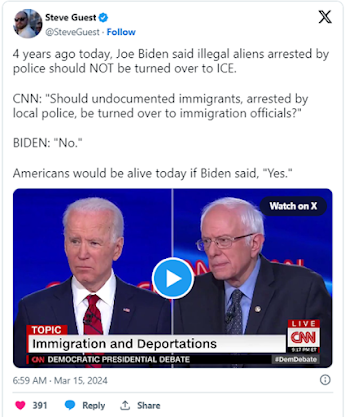
Okay, fine - but she overlooks at least two points. One is that the crime rate for illegal immigrants is more than twice as high as for legal immigrants. Second, she and other libs ignore the fact that regardless of the number of homicides committed by illegal immigrants versus American citizens, that number would be magnitudes lower if this administration had not simply thrown away controls on who gets into the country.

These immigrants are not committing crimes instead of Americans, but in addition to Americans. There are therefore many Americans victimized, even murdered, by illegal immigrants whose entry into the country was deliberately allowed as policy by the Biden administration. And that does not even include the 100,000-plus deaths from drug overdose, most from fentanyl brought easily over the southern border by Mexican cartels.

Then there is this guy, apprehended by the US Border Patrol on March 9 near El Paso, Texas: "Illegal migrant from Lebanon caught at border admitted he’s a Hezbollah terrorist hoping ‘to make a bomb’ — and was headed for NY."
[Basel Bassel] Ebbadi said in a sworn interview after his arrest that he had trained with Hezbollah for seven years and served as an active member guarding weapons locations for another four years, the documents show. Ebbadi’s training focused on “jihad” and killing people “that was not Muslim,” he said.

Another reason Charen's argument fails is that Charen never even mentions of per-capita rates of crime of native-born Americans compared to the per-capita crime rates of legal and illegal immigrants. That is, what is the percentage of native-born Americans convicted of felonies in relation to the total number of native-born Americans in the country? And the same for legal immigrants and illegal immigrants.

Charen does not touch that and neither does the Stanford University study she cites. Its main metric claims that immigrants have had similar or lower incarceration rates than U.S.-born white men for the last 140 years of American history. And that is true for its metric of such rates of both groups per 100,000 residents, but that 100K is not broken down by race or citizenship. It is just per 100K of people living in the country:

As someone else put it, of course immigrants commit fewer crimes than American citizens. And in Japan, immigrants commit fewer crimes than the Japanese. In Egypt, immigrants commit fewer crimes than Egyptians. By the way, in India immigrants commit fewer crimes than Indians. Get the point?

And why is Stanford using a baseline of only white, native-born American men to compare to the foreign-born rate? Here are Census Bureau facts:
    • In 2020 (the latest year of Stanford's study), the total population in the US was 325,268,000. Of these, 57.8 percent were White, or 188,004,904.
    • The total native-born population was 280,361,000 (the Bureau rounded the numbers).
    • That means, according to Stanford's methods, that in 2020, the 92,356,086 non-white, native-born Americans committed no crimes!
    • However, in 2020, according to the federal Bureau of Justice Statistics, "about 48% of inmates held in local jails were white, 35% were black, and 15% were Hispanic. American Indians or Alaska Natives; Asians, Native Hawaiians, or Other Pacific Islanders; and persons of two or more races accounted for 2% of the total jail population." In fact, "In 2020, the [overall] imprisonment rate was 358 per 100,000 U.S. residents, the lowest since 1992."
That last datum, also from the Bureau of Justice Statistics, flatly contradicts the Stanford study, which inexplicably charts incarceration of white men alone at about 1,700 per 100,000! I could not find foreign-born incarceration numbers for 2020 specifically, but in 2018 the Department of Justice announced "that more than one-in-five of all persons in Bureau of Prisons custody were known or suspected aliens, and 93 percent of confirmed aliens in DOJ custody were in the United States unlawfully." That stat certainly has not improved.

Also crushing the Stanford study is this DOJ chart; compare to the chart above.


Here is the inaccuracy (I dare not call it deception) of the Stanford study:
  • To claim that foreign-born persons in the United States are less likely to commit crimes than native-born white men simply borders on gaslighting. It is not a relevant comparison.
  • In 2020, the year ending the Stanford chart, there were 280,361,000 native-born persons in the country. What is the incarceration rate of native-born persons per 100K for all native-born Americans? Stanford simply ignores this.
Actually, some number of the white total residents was foreign born, but the Census report breaks down only by totals of native v. foreign born; the 57.8 percent figure cited also does not distinguish between native and foreign born. In 2020, there were 44.9 million foreign-born people living in the US. Of them, 50.7 percent, or 22.75 million, were naturalized citizens.

Yes, legal immigrants do commit crimes, but it is in fact very difficult to immigrate to the this country legally, and there is ample screening of each person. But there is little (mainly no) screening at all for those entering illegally. An enormous number (the "gotaways") are not caught and are not even known of. According to MSN four months ago, using Customs and Border Patrol data, "Illegal border crossers total over 10 million since Biden inauguration."
Since January 2021, a minimum estimate of nearly 1.7 million gotaways have illegally entered the U.S.

Based on earlier projections and including Office of Field Operations data, former CBP chief Mark Morgan told The Center Square the gotaway data is likely to reach or exceed one million for fiscal 2023 alone.

In fiscal 2021, there were at least 308,655 known, reported gotaways; in fiscal 2022, 606,150 were reported. According to preliminary data obtained by The Center Square, Border Patrol agents reported at least 769,174 gotaways at the southwest border alone.
The rest, numbering now in the many millions, with very few exceptions are simply given a court date that is many years away, then are released into the country with zero requirements or supervision of any kind.
How many of them are committing crimes? No one knows. What percentage of them are committing crimes? No one knows. How many of them, like Basel Ebbadi, intentionally came here with evil intentions, as FBI Director Christopher Wray has strongly warned Congress about more than once? No one knows.

Director Wray has strongly warned of potential violence from border crossers. For example:
There are many other such reports.

The Left's argument boils down to this: "Yes, immigrants, including 'undocumented' ones, do commit crimes, but so what? So do American citizens!" But as I said above, illegal immigrants' crimes are in addition to what Americans commit. The perpetrators were deliberately admitted into the country. Why is the Left energetically supporting policies that result in crimes, including rape and murder, that did not have to happen?


Update: "Undocumented Immigrants, U.S. Citizens, and Convicted Criminals in Arizona," by the Crime Prevention Research Center:
Abstract
Using newly released detailed data on all prisoners who entered the Arizona state prison from January 1985 through June 2017, we are able to separate non-U.S. citizens by whether they are illegal or legal residents. Unlike other studies, these data do not rely on self-reporting of criminal backgrounds. Undocumented immigrants are at least 142% more likely to be convicted of a crime than other Arizonans. They also tend to commit more serious crimes and serve 10.5% longer sentences, more likely to be classified as dangerous, and 45% more likely to be gang members than U.S. citizens. Yet, there are several reasons that these numbers are likely to underestimate the share of crime committed by undocumented immigrants. There are dramatic differences between in the criminal histories of convicts who are U.S. citizens and undocumented immigrants.

Young convicts are especially likely to be undocumented immigrants. While undocumented immigrants from 15 to 35 years of age make up slightly over two percent of the Arizona population, they make up about eight percent of the prison population. Even after adjusting for the fact that young people commit crime at higher rates, young undocumented immigrants commit crime at twice the rate of young U.S. citizens. These undocumented immigrants also tend to commit more serious crimes.

If undocumented immigrants committed crime nationally as they do in Arizona, in 2016 they would have been responsible for over 1,000 more murders, 5,200 rapes, 8,900 robberies, 25,300 aggravated assaults, and 26,900 burglaries.

Laken Riley’s murder and the long shadow of Willie Horton. The writer is professor of political science emeritus at the University of Chicago, where he founded the Program on International Politics, Economics and Security.

Update: Law Enforcement Officials testify to Congress about the criminal acts done by illegal immigrants.

Sunday, November 6, 2022

Christians and the State


Tuesday is, of course, election day. As citizens of the world’s largest representative democracy, each of us has the right to speak our minds about our nation’s national issues to those whom we have elected to make the decision. Moreover, in such serious matters as those before us now, I would say we are obligated to do so.

However, who to vote for is not my topic this morning. I am using the issue as a chance to explore what the Bible teaches Christians about living under secular law in relationship to government. For that is how you and I live each day in either times of turmoil or peace. 

In the apostles’ time about three hundred years afterward, how Christians should live under a government that was in no way Christian and was often actually lethal to Christians was a subject of great importance. It is still today a problem for many of our brothers and sisters in Christ around the world. But perhaps the fundamental problem Paul and the other apostles faced is not so different from ours if we think of the world as a larger community: On one hand, how do we live peaceably and godly in a world in which violence is seen by some as an answer to any question, and on the other, how do we live the fullness of Christ’s commandments under laws at home that are arguably sometimes repressive of doing so? 

Here is what I mean. A few years ago in Raleigh, NC, a church ministry called Love Wins was threatened with arrest. Reverend Hugh Howell explained: 

On the morning of Saturday, August 24, Love Wins Ministries, where I am pastor and director, showed up at Moore Square in Raleigh, North Carolina at 9:00 a.m., just like we have done virtually every Saturday and Sunday for the last six years. We provide, without cost or obligation, hot coffee and a breakfast sandwich to anyone who wants one. We keep this promise to our community in cooperation with five different, large suburban churches that help us with manpower and funding.

On that morning three officers from Raleigh Police Department prevented us from doing our work, for the first time ever. An officer said, quite bluntly, that if we attempted to distribute food, we would be arrested. …

When I asked the officer why, he said that he was not going to debate me. "I am just telling you what is. Now you pass out that food, you will go to jail."

What will we do? Simple: we will feed people. I am, after all (however imperfectly), a follower of Jesus, who said himself that when we ignore hungry people, we ignore him.

That situation practically defines the tension Paul addressed in Romans 13:

Let everyone be subject to the governing authorities, for there is no authority except that which God has established. The authorities that exist have been established by God. 2 Consequently, whoever rebels against the authority is rebelling against what God has instituted, and those who do so will bring judgment on themselves. 3 For rulers hold no terror for those who do right, but for those who do wrong. Do you want to be free from fear of the one in authority? Then do what is right and you will be commended. 4 For the one in authority is God’s servant for your good. But if you do wrong, be afraid, for rulers do not bear the sword for no reason. They are God’s servants, agents of wrath to bring punishment on the wrongdoer. 5 Therefore, it is necessary to submit to the authorities, not only because of possible punishment but also as a matter of conscience. 

We may as well admit that Paul’s verses are difficult to swallow without reservations. Within the last century, "a century of unspeakable horror," says New Testament scholar N. T. Wright, “these verses have been [effectively] struck out of the canon, vilified, and blamed for untold miseries.” History poses no challenge to finding governments or government policies that ranged from unjust to evil to downright demonic, whether at home or abroad. 

Paul was not naïve. He knew well the evil that governments do – a main example being crucifying Jesus and persecuting his followers. It seems likely to me that Paul, a well-trained Pharisee, was thinking an old Jewish precept that God requires order in the world, not chaos. Hence, the principle of human governance is a divine principle. He is endorsing the necessity of government in general, but not any government in particular. 

Justice was a high virtue of Jewish thought. The prophets emphasized that one of the cardinal responsibilities of rulers was to preserve justice, the right ordering of the relationship between the state apparatus and the people.

If the rulers were responsible for maintaining justice, then the people had to obey the rules for justice to be served. One of Paul’s themes in Romans 12 and 13, says Wright, is that “justice is served not by private vengeance but by individuals trusting the authorities to keep wickedness in check. Knowledge that the authorities are there to look after such matters is a strong incentive to forswear freelance attempts at ‘justice'.”

Paul knew, of course, that no human system of justice is perfect; the best we can do is roughly correspond our affairs to divine justice. Yet Paul advises the Christians in Rome not to take justice into their own hands. Their identity as the only Christians in town did not give them permission for anarchy. Instead, their responsibility is to work for the Kingdom of God in proclaiming the Gospel until, Paul implicitly hopes, all rulers ultimately pledge their first allegiance to God rather than the state. The Roman Christians must not therefore try to establish themselves as a “para-state” organization but remain under Roman authority even while they work to bring forth the Kingdom of God. 

The Christians in Rome were a small minority. Paul did not think that they should become agents of chaos, attempting to live as if they had no relation to the political world at large. Paul did not desire them to replace the Roman government with a religious cult. The ultimate overthrow of unjust power comes by other means – which is to say, regime change of the ungodly is done by converting them, a theme Paul expounded back in Romans Five.

If we accept that we Christians are under at least a divine principle of obedience to civil authority, what are our obligations to obey specific laws in 21st-century America?  

Let’s look at this issue in a way that almost all of us face every day: driving a car. The government sets speed limits. The majority of Tennessee’s Christians think that the speed limits on our interstates are too low. My proof is daily at 7 a.m. on I-65 to Nashville. It cannot be only the unconverted heathen going 85 or more. Does the fact that “everybody is doing it” make it okay? 

Paul had no experience with a democratic form of government. Americans do not claim that God established our government; our Constitution states that “We the people of the United States . . . ordain and establish” the government. Our nation’s founders believed that the first imperative of government in the first place is to safeguard personal liberty. Liberty requires some degree of order to flourish, yet not too much order, lest it be crushed.

Liberty is not found in chaotic societies. Some places on the globe today fit that description; political analysts call them “failed states,” and life there is truly awful. Neither is freedom found in hyper-ordered societies of control, such as North Korea. 

Liberty is found at neither extreme, but between them. Community and justice require some rules for the common good, but as few rules as necessary, not as many as possible. 

One may argue that our driving environment is too chaotic and is not ordered enough. In Germany, where very high speeds are legal, the drivers are extremely self-disciplined compared to us and much more law abiding in their driving. 

So we might ask whether breaking the speed limit is unacceptably chaotic. That question I leave to each person’s conscience. But the relationship of obeying the speed limit to order or chaos is not the only consideration. Christians are enjoined by Christ to love one another. In fact, just after our passage, Paul says, “Let no debt remain outstanding, except the continuing debt to love one another, for whoever loves others has fulfilled the law. … those who love one another fulfill the law… . Love does no wrong to the neighbor; therefore, the fulfillment of the law is love.” 

Love by definition is directed toward the well-being of others. If breaking the law is justified, it can only be justified in Christian faith for the higher principle of love, and not from selfish interest. 

When my son Thomas was five years old, he suffered an accident in our back yard that gave him a deep cut barely above one eye. He was bleeding profusely. My wife wrapped a towel around the wound and we jumped into the car. Dale Earnhardt, Jr. could not have beat me to the emergency room. Love for my son certainly far outweighed Paul’s injunction to submit to the government during that drive. 

So there’s my answer: if civil disobedience is ever justified for Christian people, it is justified only for reasons of love and justice, not selfishness. “I like to drive fast” or “I’m late for a meeting” are selfish reasons, not loving ones, not just ones. In the meantime, let those who believe the speed limits are too low campaign within the political system to change them. That’s how America works. 

 In fact, Paul’s passage strongly implies that political activity by Christian persons is affirmed and validated. Paul never indicated that Christian faith and political activity by Christians were antithetical to one another. Christians can be involved in the political life of society by voting, campaigning, or holding office without ceasing to be Christians, and may see all such things as part of their Christian service.

Reverend Howell in Raleigh ended his article by listing the email addresses and phone numbers of the Mayor and of the City Council members, then continued,

We encourage you to continue to call and voice your concern. We spoke with the Mayor yesterday, and while she did say that no one will be arrested for feeding hungry people in the park, it's important to continue to make your voice heard. The status quo is not acceptable.

No matter how temporal authority rules, it is God who over-rules. All governments and their ministers, everyone who wields political power, whether Christian or not, are under God’s judgment whether they realize it or not. They are to rule justly and fairly so that freedom of the people may flourish, constraining the conduct of the people only enough to keep chaos at bay. The people are obliged to obey civil laws unless doing so plainly would violate our high duties of divine love in service to God’s kingdom. 

I’ll give Rev. Howell the last word: “Keep in mind that … Anger does not cast out fear -- only love can do that.”


Tuesday, April 6, 2021

The White Supremacists who run the MLB


Now we know that the MLB All-Star game, having been canceled in Atlanta, will be played in Denver.
 
I will skip over the fact that Colorado's voting laws are more suppressive of minority voting than the new Ga. law that was the putative cause of the MLB game being yanked from Georgia.
 
To be blunt (and yes, I am serious about this): moving this game is white supremacy in action.
 
Slightly more than half of Atlanta's residents are black. Less than 10 percent of Denver's residents are black. Denver is one of the whitest major cities in the United States.
 
Who will suffer the estimated $100 million loss of revenue in Atlanta? Even Stacy Abrams and the Atlanta Braves organization were clear on that when they urged the MLB not to move the game: thousands of black Atlantans who staff, operate, supply, and retail the game venue itself and all the city's related business operations.

And who will be the new beneficiaries of that largesse? White Denver people, that's who.

So, tell me this: anyone who thinks the move to Denver was not racially motivated needs to explain just what the MLB would have done differently if it had been racially motivated. Anything?

For the record, I do not think it was so motivated. But that is quite irrelevant according to the tenets of Critical Race Theory. Intention does not matter - CRT holds that whites are not even aware of their own intentions regarding race.

The fact is that MLB effectively decided to take enormous revenue away from People of Color in Atlanta and give it to white people in Denver - who are already privileged to begin with simply because they are white.

Welcome to the world of White Woke.

Update: Gerard Baker in the WSJ:
The men who run Major League Baseball, Delta Air Lines, Coca-Cola and other giants have been quick to mouth the required antiphony of the modern liturgy. After long careers in which they seemed happy to let their talents propel them to unimaginable wealth, they’ve now discovered that the society that elevated them was founded in evil.
 
But instead of doing the honorable thing, and stepping down in favor of some less-privileged underling, they demonstrate a commitment to the faith by denouncing others. Here you have the essence of the new faith and morals of the woke classes, the truly privileged people in our society: I’m not to blame, you understand; it’s all those other white folk.


Monday, July 20, 2020

The Robber, the Priest, and the good Samaritan

Luke 10:25-37 (a modern  version)

A lawyer stood up to put Jesus on the spot. “Teacher,” he asked, “what do I have to do to have eternal life?”

Jesus replied, “What is written in the Law? How do you read it?”

He answered: ““You shall love the Lord your God with all your heart and with all your soul and with all your strength and with all your mind” and, “Love your neighbor as yourself.”

“You are absolutely right,” Jesus replied. “Do that and you will live.”

But the lawyer wanted to impress others, so he asked Jesus, “And who is my neighbor?”

In reply Jesus said: “A man was walking down from Jerusalem to Jericho, when he was mugged by robbers. They stripped him naked, beat him up and went away, leaving him half dead. A priest happened to be going down the same road, and when he saw the man, he passed him by on the other side of the road. A Temple administrator who came to the place and saw him, also passed him by on the other side.

“But a Samaritan, of all people, was traveling and as he came where the man was; and when he saw him, he felt sorry for him. He went to him and gave him first aid, pouring on oil and wine. Then he put the man on his own donkey, took him to an inn and took care of him.

“The next day he gave the innkeeper two days” rent. “Look after him,” he said. “When I come back, I’ll make up the difference for any extra costs you may have.”

“Which of these three do you think was a neighbor to the man who got mugged by the robbers?”

The lawyer replied, “The one who had mercy on him.”

Jesus told him, “Go and do that sort of thing yourself.”


The Robber

They never learn, do they? So many travelers get robbed and mugged along this road that everyone should know not to travel it alone. It’s a perfect road for us robbers. It twists and turns; it’s narrow and steep in many places. People can’t get away easily. There are a lot of places for me to hide, waiting for the next nitwit to come along.

Here comes one now. If he’s dumb enough to travel alone, he deserves what I’m gonna give him. Look at him! Upstanding fellow, isn’t he? Well, dressed, well groomed. A real pillar of the community, I’ll bet – yeah, respected member of synagogue, pays his taxes, reads the Scriptures on holy days, kids are just perfect – I’ve seen men like him before. Pretty wife, no doubt – too bad she’s not with him today!

He’s loaded, that’s for sure.

This is the sort of man who made me the way I am, you know. So what I’m going to do to him is fair. Oh, no one sat me down one day and said, look, young man, what you need to do is be a cutthroat. That decision was mine, I admit that. When I was seven my father was killed in an accident, and people like this guy – he’s looking around cautiously now, but it’s too late – people like this guy didn’t give my family any help. We were poor, and we were told in ways subtle and blunt that everything that happened to us was our own fault.

One of the well-to-do men of our town told us that God had simply structured society in a certain way. Those who were righteous and moral were blessed by God with money, property, and standing in the community. Of course, you could tell someone was righteous by the heft of his wallet or the size of his house. Question: Why is this man prosperous? Because he is righteous and moral. Second question: How do you know he is righteous and moral? Because he is prosperous.

Yeah, right.

So I learned that we were poor because we were sinners. You could tell we were sinners because we were poor. After a while, I believed it. Others sure did; they made certain assumptions about us. Strange men would come into town as they traveled and hit the tavern. They’d ask where a guy could find a little “companionship” around here. And the innkeeper would name a woman or three, including my mom. But my mother never rented herself to men. Never! She made her living doing menial labor – hauling water, cutting wood, feeding livestock. Never did she prostitute herself! There were a few prostitutes in the town, sad women with no future. My mother sometimes took pity on them because she lived a hard life, too. They were the only other persons we shared our meager food with. When the self-proclaimed righteous men of the town saw my mom they would cross the street to avoid passing near her..

The first man I mugged was one of the strangers who propositioned my mother. After my mom sent him packing, I followed. I was fifteen and furious. I’d had all I was going to take. The man went down an alley and I followed with hate in my heart. Before he knew what had happened, I clobbered him over the head with a thick stake. He collapsed. I hit him hard across the face and kicked him in the gut. I took his wallet. Then I knelt and put my knee on his throat. I told him, “If you ever bother my mother again, I’ll kill you!”

The money came in handy. I didn’t tell my mother where I got it and she didn’t ask. Afterward, one mugging followed another, until here I am on the Jerusalem road, with my mother long dead. Why do I keep doing what I’m doing? Because I don’t know how to do anything else. And because I’ll never forgive men like this guy coming down the road for what they put my mother through. I’m no longer mad, but I will continue to get even. All those righteous people think I was born a sinner, so a sinner is what they’ll get – and they’ll get it good and hard.

They say there is a fellow going around now who has a new teaching. Jesus is his name. I hear Jesus says to do good to those who do evil to you. (Ha!) They say he heals the sick and shares bread with outcasts and sinners, even prostitutes and tax collectors. (I never mug tax collectors – you know, professional courtesy.) Whoever this Jesus guy is, he’s sure not a righteous man because he rubs elbows with the wrong crowd. Maybe he’s someone like me, from the wrong side of the tracks. The rumor is that his father wasn’t really his father.

“Love your neighbor” is what they say he teaches. I know who my neighbor is. It’s Eleazar here beside me, an expert with a knife. Someone like me, that’s my neighbor. Someone I can trust because they know if they betray me I’ll get even. But this Jesus, from all accounts, would want me to believe that this fat-wallet guy coming down the road is my neighbor, too. No way, no way! I would never mug my neighbor. But this guy is dead meat. Get ready, boys – neighbors – he’s almost here! One, two, three – Get him!


The Priest

Well, I see the robbers got another one. Beat him to a pulp and stripped him naked. Must be the Adoniah gang. They say that’s their trademark, stripping their victim and beating him half dead. Of course, this poor man’s money is long gone. That would be the first thing they took.

He looks dead. Maybe he’s only half dead. It’s hard to say. What do I do here? If I stop, maybe the muggers will get me. I’m late to Jericho. If I stop, I’ll be even more late. My priestly business takes priority here. I mean, what would become of the order of our religion if all the clergy let themselves be delayed just because someone was in need? It would be chaos! The righteous people have certain expectations, and one of them is that their clergy will take care of clergy business. Anyone can stop and tend to this fellow, and someone will be along in a moment, surely. I have priestly business in Jericho, and only I can do that, not just anyone. So if I stop here, then my work won’t get done and the people will be disappointed and angry.

But if I pass on by, some folks will think I should have stopped. What about that? I know – I’ll claim that our religious Law forbids me to touch a corpse because it would make me religiously unclean. (That man is dead, isn’t he? Yes, he must be.) And one thing a priest must never be is religiously unclean, everyone agrees with that. Of course, not being experts in religious law they won’t know that caring for an abandoned corpse does not make someone unclean, even a priest. So I could bury this fellow – yes, I am quite certain he really is dead – I could cover this fellow without violating religious law at all. But that will just be my little secret. I’ll even cross to the other side of the road to make it more convincing. I must make my meeting.

The meeting is important. The subject is a radical man going around teaching and preaching, Jesus of Nazareth. He’s certainly not a good Jew. He socializes with sinners and outcasts and even eats with them. It is very upsetting. We have tried to convince Jesus not to befriend sinners and be more reserved like his cousin was, John the Baptist. You know what he said? “John the Baptist didn’t eat or drink with the wrong crowd, and you said he was in league with the devil. Now I, Jesus, eat and drink with them, and you accuse me of being a glutton and a drunkard, a friend of thieves and other sinners. Get a grip!”

Speaking of the Law, surely Jesus knows that our accusation is a veiled threat. I mean, Jesus doesn’t follow the law, but he sure does know the Scriptures forward and backward. Too bad they don’t mean anything to him. I am sure he caught the reference to Deuteronomy 21, verse 18, that requires gluttons and drunkards to be stoned to death.

We’ve put Jesus on notice to be more selective in acknowledging someone as his neighbor or face the consequences. No thieves and prostitutes and other sinners allowed!

I can’t understand why anyone would listen to Jesus, but thousands do. Personally, I like the guy, but his religious ideas are wacky. They are a threat to the system.

I’ll bet if Jesus was walking with me he’d stop and take care of this poor fellow here. That’s exactly the problem. He just won’t tend to business. He’s always being distracted by do-goodism. Heal this fellow, comfort that widow, feed that child, all without distinction. Love your neighbor, he says, and he’s right, of course. That’s in the law, no arguing about it. Too bad Jesus doesn’t understand who his neighbors really are.


The Samaritan

I’ve got to get out of this place if it’s the last thing I ever do. And if I stay in this country much longer, it will be the last thing I ever do. I hate Jews as much as they hate us Samaritans. I’ve had a couple of close calls already. I really think if I stay longer, my luck will run out. Someone will kill me. And he will get a medal for it! No one will be interested in the murder but the Romans. Come to think of it, they won’t be interested, either. My sons will have to avenge me.

Let me just get through Jericho! Then I’m up the Jordan River and I’m home free.

Is that a dead man? Yes, another victim of the criminals along this road. More evidence of Jewish depravity, that they let such crime go on. No, he’s not dead; he just moved. They’ve stripped him bare. It’s not obvious he’s Jewish with his clothes gone, since his robe would identify his tribe. Oh, he’s Jewish for sure; what else would he be?

Man, they sure worked him over! Poor guy. I hope somebody helps him out. Not me, no sir. I’m not stopping for this Jewish scum.

Pause

Maybe I should turn back and just give him a drink of water. I wish I hadn't gone so far past him. It’s uphill to go back. It’s getting late. I need to keep going. But I’ll run back and give him a drink of water, then go on. That won’t take long.

Ah, the water is making him come around. Maybe a sip of wine will help now that he is more alert. One of his eyes is so swollen he can’t see with it, but he sees me with the other eye. Okay, I’ll let him take a good look at me. When he sees I am Samaritan he’ll push me away. I bet he’d literally rather die than accept aid from a Samaritan. Uh, uh, see there? His jaw has dropped. He knows what I am. Okay, Jew, I’m outta here. I’m just as disgusted as you are. What was I thinking?

“Thank you,” he said to me. I turned away from my donkey and faced him again. “You're welcome,” I said.

“You are Samaritan, aren’t you?” he asked.

“Yes,” I said.

He said, “Sometimes I saw others go by, even a priest, but no one stopped but you.” I nodded. Then he said the most surprising thing: “God bless you for stopping.” I would have bet my last shekel I would never hear that from a Jew!

He moaned in pain. He was cut and badly banged up. “Shall I bandage your wounds?” I asked.

“You would do this for me, Samaritan?” he asked rather incredulously.

I could hardly believe it myself. “Yes,” I said.

“Don’t you need to move on?” he asked. “Samaria is still a long way off.”

I said, “Do you want to be bandaged or not?”

I could see his turmoil. Samaritans and Jews had been mortal enemies for generations. He was more unclean from me touching him than from being beaten and stripped naked. But the pain overcame his objections. “Yes, please,” he finally said, and he added, “I am called Jacob.”

“I am Samuel,” I answered. I poured oil on his cuts and bruises and wrapped them in clean cloth. I offered him a robe to wear. “You will look like a Samaritan for awhile,” I acknowledged, “so if you refuse to wear it, I’ll understand.” But he took the robe and I helped him put it on.

“Can you walk?” I asked him. We tried to stand him up but he couldn’t. “Onto the donkey,” I ordered. He made a weak attempt at humor: “A Jew on a Samaritan donkey. The first person we meet will say you have a stupid jackass with you, but your donkey is nice.” I laughed. Then he laughed. Then we both laughed long and loud, although he had to stop because the thieves had kicked his ribs so hard. But it was funny – a Samaritan man on the Jerusalem road leading a donkey with a battered Jewish man riding it. No playwright could ever have dreamed it up.

We did get some strange stares along the road but there were no incidents. By and by the road leveled out. There was an inn ahead, so I stopped and rented a room for the both of us. I bought supper for him and he seemed better. But that night his pain got worse and he got a fever. He was in and out of consciousness and mostly incoherent. I stayed up most of the night placing cloths soaked with cool water on his forehead and changing the bandages on his wounds.

The next morning I was exhausted. I had a real dilemma. I really did need to get on. I wished I had asked him where his family lived. I went to the innkeeper and told him what had happened. He nodded his head; I was not the first to tell him such a story. I told him, “My friend is named Jacob. He is a neighbor of mine. Here is two day’s rent for the room. I’ll be back by that time, and I’ll pay whatever extra it costs you.”

“Okay,” he agreed.

When I returned Jacob was much better. The innkeeper refused additional payment, telling me, “A neighbor of yours is a neighbor of mine.” We all parted company and I returned home.

My brother was indignant when I told him the tale. “I can’t believe you showed a Jew mercy!” he exclaimed. “They’re outside our circle!”

I reminded my brother that the Jews and we Samaritans had a common religious heritage and both used the first five books of the Scriptures. Leviticus commanded us to love our neighbors as ourselves.

“Oh,” he retorted, ‘so now a Jew lying in a ditch is my neighbor!”

I said, “Maybe anyone who needs mercy is our neighbor. You should try it sometime.”


Saturday, August 2, 2014

Christian clergy's fantasy theology

Quick Thoughts On Today’s Non-Violent Witness:

July 31, 2014

We are safe. We are healthy. All is well.

white house1Today’s action went incredibly well, any way you choose to look at it. More than 100 faith leaders (Many clergy. Even Bishops) chose to be arrested at the White House, as a witness against our nation’s treatment of immigrants, calling the President and Congress to act.
The DC Park Police treated us with the utmost respect and dignity. They treated us fairly and, dare I say: kindly.

The witness was peaceful and powerful. At a certain point, the police backed away all other bystanders and media from a very large perimeter…about half a football field. That was a sobering moment…to realize that we had been separated out, and were now standing alone, in front of the White House itself.

After three “warnings,” they then moved in and, one by one, took us into custody.

What you have to understand is that being arrested was the entire point of the exercise. In an FB post about the day, the author wrote, "Our non-violent witness at the White House Thursday was a powerful experience."

Powerful for whom? Not for Obama nor for any of his administration. It was powerful for him. And that in fact was the entire point.

This "Arrest me!" drill is a perfect example of what Lee Harris called "fantasy theology," though he wrote of it in a different context.
MY FIRST ENCOUNTER with this particular kind of fantasy occurred when I was in college in the late sixties. A friend of mine and I got into a heated argument. Although we were both opposed to the Vietnam War, we discovered that we differed considerably on what counted as permissible forms of anti-war protest. To me the point of such protest was simple — to turn people against the war. Hence anything that was counterproductive to this purpose was politically irresponsible and should be severely censured. My friend thought otherwise; in fact, he was planning to join what by all accounts was to be a massively disruptive demonstration in Washington, and which in fact became one.

My friend did not disagree with me as to the likely counterproductive effects of such a demonstration. Instead, he argued that this simply did not matter. His answer was that even if it was counterproductive, even if it turned people against war protesters, indeed even if it made them more likely to support the continuation of the war, he would still participate in the demonstration and he would do so for one simple reason — because it was, in his words, good for his soul.

What I saw as a political act was not, for my friend, any such thing. It was not aimed at altering the minds of other people or persuading them to act differently. Its whole point was what it did for him.

And what it did for him was to provide him with a fantasy — a fantasy, namely, of taking part in the revolutionary struggle of the oppressed against their oppressors. By participating in a violent anti-war demonstration, he was in no sense aiming at coercing conformity with his view — for that would still have been a political objective. Instead, he took his part in order to confirm his ideological fantasy of marching on the right side of history, of feeling himself among the elect few who stood with the angels of historical inevitability. Thus, when he lay down in front of hapless commuters on the bridges over the Potomac, he had no interest in changing the minds of these commuters, no concern over whether they became angry at the protesters or not. They were there merely as props, as so many supernumeraries in his private psychodrama. The protest for him was not politics, but theater; and the significance of his role lay not in the political ends his actions might achieve, but rather in their symbolic value as ritual. In short, he was acting out a fantasy.

It was not your garden-variety fantasy of life as a sexual athlete or a racecar driver, but in it, he nonetheless made himself out as a hero — a hero of the revolutionary struggle. ...
 For want of a better term, call the phenomenon in question a fantasy ideology — by which I mean, political and ideological symbols and tropes used not for political purposes, but entirely for the benefit of furthering a specific personal or collective fantasy. 
And that is the preferred theology of the ordained Left in America: purely symbolic acts by which they prove to one another that they are on the side of the angels. That nothing actually changes concerning the protested situations is entirely beside the point.

Bookmark and Share

Thursday, June 11, 2009

Is the duty of the wealthy is to be robbed by the government?


At least, that's what I glean from this letter to the editor (link may be perishable):
My philosophy is simple. If an individual or a family has a disproportionate part of the wealth, money or whatever you want to call it, they have the responsibility to pay a disproportionate part of the federal taxes.
Well, they already do. To be in the top one percent of annual income, you need make only $208,000. I say "only" $208K because while that is an awful lot of money, it is quite within the reach of ordinary Americans who work hard and invest wisely, especially if they begin an IRA young.
Contrary to populist belief, One Percenters actually pay more in taxes than others and have done so for years. And while liberals have long derided the notion that tax cuts lead to more tax revenues, experience proves otherwise. When President Reagan cut the top income tax rate from 70 percent in 1980 to 28 percent in 1988, the tax burden of the top 1 percent increased from 17.6 percent of total taxes to 27.5 percent. Today, the top 1 percent pays about 30 percent. Two Percenters pay a lot, too. So do Three, Four and Five Percenters. In 1998, the top 25 percent paid 80 percent of the total tax burden, according to the Tax Foundation, a Washington-based research group. Even more sobering, the top half of all taxpayers (with taxable incomes exceeding $100,000) pay 95 percent of all state and federal taxes. [link]
The letter-writer betrays what seems to me to be a common misunderstanding: that because paying taxes is a civic responsibility, hence a civic virtue, it is therefore also a moral responsibility and a moral virtue. Not so.

Taxes are exactions by force by the government from the people. Taxation is the coercive appropriation of private property for purposes held to be the public good. But the government does not have a right to the people's money, it has only a need for it. We established a government of limited, delegated powers, and have authorized the government to exact taxes - but the government has no right to do so, it has only the authority to do so. All rights remain solely the possession of the people, who may, if they wish, revoke the taxation authority of the government altogether. (In theory, of course, since in practice it could never be done.)

Everyone is legally obligated to pay the taxes s/he rightfully owes - but not one cent more. As Justice Learned Hand wrote in Helvering v. Gregory (1934),
Anyone may so arrange his affairs that his taxes shall be as low as possible; he is not bound to choose that pattern which will best pay the Treasury; there is not even a patriotic duty to increase one's taxes.
The wealthy always pay more in taxes. They have to, because, as Willie Sutton famously explained why he robbed banks, "That's where the money is." Government is expensive and only the comparatively wealthy have enough money to fund it. Hence, about half of all citizens pay practically nothing. In large measure, the federal revenue system is designed to transfer money from the top half to the bottom half. 

In fact, the federal government really is a money-distribution organization. We govern ourselves by the way we spend each others' money. How much gets spent and for what is determined by how much agreement can be reached by a majority. But whether Left or Right, whether Democrat or Republican, the only real questions of American government and governance are, "Who will be be the beneficiaries of government spending? How much shall we exact from the public for it, and by what means?"

In 1984, the Grace Commission was formed by President Reagan to examine where tax revenues disappear to inside the great government money maw. The commission reported that none of the money collected by income taxes paid for services - all income-tax revenue serviced the national debt. The commission said that one third of income taxes,
. . . is consumed by waste and inefficiency in the Federal Government as we identified in our survey. Another one-third of all their taxes escapes collection from others as the underground economy blossoms in direct proportion to tax increases and places even more pressure on law abiding taxpayers, promoting still more underground economy - a vicious cycle that must be broken.

With two-thirds of everyone's personal income taxes wasted or not collected, 100 percent of what is collected is absorbed solely by interest on the Federal debt and by Federal Government contributions to transfer payments. In other words, all individual income tax revenues are gone before one nickel is spent on the services which taxpayers expect from their Government.
According to a slightly breathless web site owned by an outfit called The Solutions Group, income taxes were never intended to pay for services. Although personal income taxation dates to the early 20th century, income-tax withholding was instituted in World War II, conceived of by then-Chairman of the Federal Reserve Bank of New York, Beardsley Ruml.
To explain the new tax, and its purposes, Chairman Ruml wrote an article which appeared in the January 1946 issue of "American Affairs," the "newsletter" publication of the Council on Foreign Relations. Appropriately enough, the article was entitled, "Taxes For Revenue Are Obsolete." . . .

So taxes aren't needed for running the federal government anymore. This leaves many asking, "Why does the government take so much of what I earn?" Chairman Ruml, under the heading "What Taxes Are Really For," gave the following answers:
"Federal taxes can be made to service four principle purposes of a social and economic character. These purposes are:

1. As an instrument of fiscal policy to help stabilize the purchasing power of the dollar;

2. To express public policy in the distribution of wealth and of income, as in the case of the progressive income and estate taxes;

3. To express public policy in subsidizing or in penalizing various industries and economic groups;

4. To isolate and assess directly the costs of certain national benefits, such as highways and social security."
Our government has used our federal tax program consciously for each of these purposes. In serving these purposes, the tax program is a means to an end.

So, here is what IRS taxes are -- and -- are not used for:

1. They are used to help implement economic policies designed by the federal government,

2. They are used for social purposes (meaning, to determine who should or should not, in the opinion of Congress, have certain amounts of money -- commonly called redistribution of wealth), and

3. They are used to subsidize various groups and interests, such as private banks.

-But-

4. They are NOT used to pay for any government services!
These are the reasons I say that no one has a moral duty to pay taxes, just a social-contract and legal obligation to do so. The moral imperatives pertaining to the wealthy lie elsewhere. But that's a topic for another post.

Update: President Obama has said that the point of raising taxes is not to raise revenue, but to be more "fair," whatever that means. Here's the cite:
[A]fter ABC's Charlie Gibson noted that the record shows increased taxes on capital gains -- which would affect 100 million Americans -- would likely lead to a decrease in government revenues: "Well, Charlie, what I've said is that I would look at raising the capital gains tax for purposes of fairness."
During the campaign the Brookings Institution's Tax Policy Center examined Obama's Tax Proposals' Impact on Tax Revenue, 2009-18, which further proves that actually funding the government's operations is the furthest thing from the president's mind when it comes to tax policy.

A world without nuclear weapons - what would it look like?

 From Pope Leo this week, according to the National Catholic Reporter : " Pope Leo quotes Bob Dylan song in book foreword calling for n...