Showing posts with label Palestinians. Show all posts

Friday, February 21, 2025

The aftermath of Hamas murdering children

On Feb. 20, Hamas handed over to Israel the corpses of four dead Israeli hostages, including two small children, but only after using them for propaganda. 

Before handing over the remains, Hamas staged a parade of the bodies through streets of Gaza, proudly and cruelly displaying them  to cheering Gazan crowds. As the Wall Street Journal observed

Hamas put their coffins on a stage in front of a huge propaganda poster of Israeli Prime Minister Benjamin Netanyahu. A crowd looked on and milled around, and “triumphant music” played, according to one news report. Mr. Netanyahu was depicted with fangs, dripping blood above the faces of the four dead hostages, smiling in photographs from happier times. “The War Criminal Netanyahu & His Nazi Army Killed Them with Missiles from Zionist Warplanes,” the poster claimed.

The coffin propaganda underlines the challenge of deradicalization for any postwar plan for Gaza.

Israeli medical staff conducted autopsies on the returned hostages. One was Oded Lifshitz, 84. The other three were Kfir and Ariel Bibas and their mother, Shiri. The Israeli government then announced: 

A. The bodies of the two children, one taken hostage at 4 years old and the other at 9 months, are injured in ways completely consistent with being brutally murdered, mainly by manual strangulation, and inconsistent with being killed by an air strike, as Hamas claims. 

Update: It is also confirmed that after the two boys were strangled, their bodies were pounded with rocks to make them appear to have been killed by an air raid. Details here, if you can stomach them.

B. The body of Shiri is in fact not Shiri at all. Hamas gave a corpse to Israel of a dead woman whose identity is unknown. 

Update: Hamas has now returned the actual remains of Shiri, whose identity has been so confirmed by Israel. 

What Hamas did drew sharp rebukes from very senior Arab Muslim authorities. 


And in yesterday's WSJ, author Bernard-Henri Lévy had this and other things to say about Hamas

Once, children were gassed as they descended from the trains. Hamas waited. Damn those who try to drag us into the false game of moral equivalency. These two breaths cut short, this double death of innocence, is Hamas’s abomination alone—and it is unforgivable.

Were the two muftis sincere in their condemnations? I think so. The muftis know very well that Muhammed specifically forbade the intentional killing of children, even in warfare. (That is no doubt why Hamas lied about Kfir and Ariel being killed by an Israeli airstrike. Hamas openly celebrated that they were dead but lied about how they died. Why one and not the other?)

Islam holds that there are two inarguable sources of commandments that must be obeyed with no exceptions. One of course is the Koran. The other is the Hadith, which is a collection of sayings of Muhammed. The Hadith is equal in status to the Koran. 

In a well-known hadith, Muhammed instructed his companions during military expeditions, "Do not kill children, women, or the elderly, and do not attack those who are not fighting." (Reported in Sahih Muslim, Sunan Abu Dawud, and other collections)

Another narration states, "Do not kill a child, nor a woman, nor an old man, nor destroy crops, nor kill those who are in their places of worship." (Sunan Abu Dawud)

Islamic jurisprudence distinguishes between combatants (those actively engaged in fighting) and non-combatants (those who are not involved in hostilities). Children, by their very nature, are considered non-combatants and are protected under Islamic law.

The deliberate targeting of children, whether in warfare or otherwise, is considered a grave sin and a violation of Islamic law.

The looming question now is, "In light of these Hamas atrocities, what happens (eventually) to Hamas and the future of Gaza and its people?" 

On Feb. 4, President Trump raised a lot of eyebrows by declaring that Gaza should become an American protectorate, the Gazan people should be resettled elsewhere, and then the US would rebuild Gaza as a sort of "Middle East Riviera." Political and media commentators scornfully denounced the idea right away. On Feb. 6, I commented on Facebook:

When the Israelis withdrew from Gaza in (IIRC) 2004-2005, they actually offered to do much the same thing as Trump said, although on a smaller scale. Hamas seized power shortly afterward and killed every Gazan who got in their way.

But could it happen now? I think this is less a real proposal than Trump's way of signaling to Egypt, Saudi Arabia, and other Arab states that the status quo antebellum must not be restored. Trump's real message, I think, is, "The perpetual warfare between Israel and Hamas stops now." And yes, it has been perpetual; I visited the southern Israeli town of Sederot in 2007 on the same day it received a rocket bombardment from Gaza.

What Trump did was describe a wealthier, peaceful future for Gaza and the next step is to simply ask, "If not that, then what? Because more years of war is not on the table."

The Wall Street Journal's editorialists said much the same thing, but with more historical context and detail. 

President Trump’s idea that the U.S. might remove and relocate some two million Palestinians from Gaza and then “own” and rebuild the strip isn’t going to happen soon, if ever. But the idea, however preposterous, does have the virtue of forcing the world to confront its hypocrisy over the fate of the Palestinian people.

What was the Arab powers' reaction? It was that they got Trump's message, at least in part. 


Egypt led the response, probably because Hamas was a child of the Muslim Brotherhood, an Egyptian Islamist, insurrectionist movement dating to the 1920s. Egypt's government finally defeated the Brotherhood only in 2013, although the Brotherhood cannot be said to be fully neutralized yet. That Hamas and the Brotherhood are so closely linked is doubtless the reason that when the present war between Gaza and Israel began, Egypt publicly announced it was sending a tank battalion to its border with Gaza with orders to shoot on sight anyone crossing the border without prior permission. Egypt also strongly reinforced its border wall.

So it is no wonder that Egypt's immediate response to Trump's declaration was that it would refuse to resettle any Gazans, even temporarily, and that Hamas must have no role governing postwar Gaza. 


And now the rest of the Arab world understands that Hamas has committed atrocities that directly violate the commandments of Muhammed. Of course, the Arab elites already knew that, but Hamas handled the return of the dead hostages, especially the two dead children, so stupidly that it could not be ignored or shrugged away. 

I think a corner has been turned. If, as I wrote at the time, Trump's real message was "this is the last war Hamas will fight, ever," then I think the Arab powers are taking it seriously, regardless of the rest of what Trump said. The stupid parading of the four dead hostages to celebrate their deaths and the obvious lie that Hamas did not kill the children have forced Arab elites and rulers to take Trump's declaration seriously, even if not literally. 

So has a corner been turned? We can hope so, but at this point only the steering wheel has moved. The war is not over. But at least the Arab powers are finally confronting the fact that when it ends, the ending must be permanent this time. And that is progress. 

Friday, October 13, 2023

War and the reshaping of societies

 Let me emphasize at the outset that my assessment of the looming Israeli invasion of Gaza is intended to be descriptive, not prescriptive. I am not proposing what Israel should do, but what it may do as the coming days and weeks unfold, even if Israel does not actually intend it now. 

Israeli artillery firing

Having formed a "unity government" for the war, Israeli PM Benjamin Netanyahu has stated clearly that the permanent end of Hamas as the principal war aim. That this objective requires a land invasion of Gaza is also clear. But what can it take to destroy Hamas? Netanyahu has said that killing its terrorists fighters is a specific goal, but Hamas is not merely an organization. It is also an ideology. How does Israel end with not only the present Hamas organization destroyed, but also the ideology?

America's Civil War and World War 2 may provide a clue. 

But first, what is Hamas' ideology? 

It is very simple: Kill Jews, kill Jews, kill more Jews. Specifically, Hamas (and Lebanon's Hezbollah) has said publicly and often that it has at least the following goals:

1. The elimination of the state of Israel and establishment of a Muslim nation "from the Jordan river to the Mediterranean Sea." Jews must vacate this land entirely or they will be killed. 

2. In the meantime, and as a tactic to attain that goal, Hamas has said before and again very recently that Jews must be killed. Last Saturday, Hamas military commander Mohammed Deif announced,  “Operation Al-Aqsa Deluge.” Al-Aqsa is the name of the mosque atop the Temple Mount in Jerusalem. Deif said that the mass killings of Israelis were a mere “first strike,” with much more yet to come. 

Photos: New York Times

Deif was not ambiguous, emphasizing, 

“I say to our pure mujahedeen: This is the day that you make this criminal enemy understand that its time is up. ‘Kill them wherever you may find them.’” 

The last sub-quote is directly from the Quran, Suras 2:191 and 4:89. Someone might object that Deif is being very selective in his quotes of the Quran (he used other such verses) because there are verses of peace and tolerance in the Quran. For that, please read the explanation of the Muslim principle of Naskh, or abrogation, at the end of this post. 

Hamas is making total war against Israelis. It only goal is to kill Israelis. It does not merely hope, but actually believes that doing so will bring the cessation of Jews living in Hamas' future Palestinian state.

It is also worth noting that mainline Islamic exegesis of the Quran and Hadith is (and has been since Mohammed's day) that any Muslim killed while fighting for Islam is brought immediately into Allah's paradise. This is not a fringe view; it was stated plainly by Mohammed himself. As Muslim scholar Tajuddin B. Shu`aib explained:

[F]or Muslims to wield weapons in a war in which Islam itself is defended is literally an act of worship. The Muslim jihadi has the right to expect reward proportionate to his sacrificial worship. In military jihad, the ultimate sacrifice is to die, which deserves the ultimate reward, immediate entry by the slain jihadi's soul into Paradise. This doctrine springs from the words of Mohammed himself, who during the battle of Badr told his soldiers, "I swear by the One in whose hand Mohammad's soul is, any man who fights them today and is killed while he is patient in the ordeal and seeks the pleasure of Allah, going forward and not backing off, Allah will enter him into Paradise.“

Lessons from the Civil War and World War 2

As I noted in, "Confederate monuments: So what? Now What?," the only meaningful ideological difference between the CSA and the Union states was over slavery. What the CSA's ideology was hardly needs explaining. (I should note again that President Lincoln was adamantly anti-slavery, but ending slavery was not why he went to war with the CSA.) 

After more than two years of indecisive, though bloody fighting, the Union's strategy took a linchpin turn when Gen. U.S. Grant was appointed commander of the US Army and he unleashed Gen. William Tecumseh Sherman to invade the South. Sherman stated his goal very plainly:

 "War is the remedy that our enemies have chosen, and I say let us give them all they want."

"This war differs from other wars, in this particular. We are not fighting armies but a hostile people, and must make old and young, rich and poor, feel the hard hand of war."

Sherman's tactics were ruthless, but they did do what he set out to do. His and Grant's maneuvers and battlefield victories made it very plain not only to the Confederacy's leadership (especially Gen. R.E. Lee) that they could not win the war, it was also crystal clear to ordinary men and women throughout the South, including those never actually touched by the fighting. Slavery was ended by the war and it is worth noting also that no state has attempted to secede since then. 

When the United States entered World War 2, it knew that invading enemy-occupied nations and territories was unavoidable. In 1943, Gen. D.D. Eisenhower was named Supreme Allied Commander of European operations and was given this simple directive: "You will enter the continent of Europe and in conjunction with other Allied nations, undertake operations aimed at the heart of Germany and the destruction of her armed forces.” 

 Based on what the Israeli government has said about its objectives in its present war, Eisenhower's directive could be lightly modified to state Israel's objectives in invading Gaza. However, as allied forces in WW2 found out, and as Israel undoubtedly realizes, military theorist Carl von Clausewitz nailed it about 200 years ago: "In war everything is simple, but the simplest things can be very difficult."

One of the preludes to the massive landings on Normandy's beaches to "enter the continent or Europe" in 1944 was sustained, large-scale aerial bombing of Germany by American and British aircraft. As the war went on and German (and Japanese) resistance failed to slacken, President Roosevelt decided that the German and Japanese peoples must realize after the war that not only had their armed forces been defeated: the entire nation, as a nation, had been beaten. He and Churchill were well aware that German militarism had survived World War I because its apologists had successfully propagated the myth that the Kaiser's army had not really been defeated, it had been "stabbed in the back" by disloyal factions at home.

Hence, wrote Roosevelt in a letter to Secretary of War Henry Stimson,

It is of utmost importance that every person in Germany should realize that this time Germany is a defeated nation. . . . The fact that they are a defeated nation, collectively and individually, must be so impressed upon them that they will hesitate to start any new war.

So, according to historian Richard B. Frank in his award-winning book, Downfall, the End of the Imperial Japanese Empire:

Viewed in this light, massive urban bombing complemented the aim of unconditional surrender. It was not just a handful of vile men who flaunted vile ideologies; whole populations imbibed these beliefs and acted as willing acolytes. Unconditional surrender and vast physical destruction would sear the price of aggression into the minds of the German and Japanese peoples. No soil would be left from which myths might later sprout that Germany and Japan had not really been defeated. These policies would assure that there would be no third world war with Germany, nor would Japan get a second opportunity.

One notes that Japan and Germany have been well behaved since 1945. But we also have to note that massive, destructive bombing was alone not the reason. It was simply impossible for either country's armed forces to claim that they had prevailed, or at least held their own, on the field of battle. German and Japanese orphans, widows and grieving parents were in almost every other household, and a lie that their armed forces had not really lost could not possibly have found legs to stand on.

Dresden, Germany, 1945

Gaza, 2023

Israel's task is to discern what it will take (a) actually to destroy Hamas as a threat to Israeli lives, and (b) how to make sure that Gazans never again consent to another such organization to operate among them. (Remember, the Gazans elected Hamas to power in 2006, but that was the last time the Gazans had any say.) 

That Israel has today issued warnings to northern Gazans to evacuate within 24 hours was done from humanitarian considerations as well as hoping for military simplicity when Israel invades I have no doubt. That Hamas has said that it will not permit anyone to evacuate underscores Hamas' brutality, but it may also serve to underscore to ordinary Gazans that Hamas is not really their benefactor. (However, as I type, TV news is showing video of long lines of cars moving south along the Gazan coast.)

When Israel incurred into Lebanon in 2006, I observed that the fighting there had come to resemble the combat on Okinawa in World War 2, with well-prepared defensive positions and underground lines of communications. Hezbollah emphasized anti-tank capability, just as the Japanese had learned to do on the Pacific war. 

But combat in both Okinawa and Lebanon was mainly on open terrain, while Gaza is heavily built up. Urban combat is the most brutal and difficult of all conventional fighting for it takes place not only in left, right, front, and rear, as in open country, but also up and down. Hamas has spent years not only fortifying potential defense positions, but also constructing tunnels around Gaza that some estimates say are 300 miles in length altogether. As well, they are certainly booby-trapped with remote detonation. 

The End Game

At this point, both Israel and Hamas must realize that, as Gen. Douglas MacArthur said, "In war there is no substitute for victory." Victory for Hamas can be defined very simply: it survives as an ongoing, at least minimally effective, violent anti-Israel entity as before. Hamas' leaders know that to abandon murderous violence to establish a purely Palestinian state by political measures, rather than violence, means two things: (a) Hamas would not even be Hamas any more, so what is the point, and (b) mere politics will never accomplish that goal anyway. Hamas' true believers would literally rather die than take that course.

As for Israel, its leadership at least knows that Hamas must be ended and no Hamas-by-another-name can be allowed. There is no answer to how long it will take to destroy Hamas or how many casualties it will cost. But neither Grant nor Sherman knew those things ahead of time, either. So Israel must proceed, though it is doing so as Otto von Bismarck reportedly said about going to war, "entering a dark room blindfolded to search for a black cat that is not even there." 

Gaza's residents, whether they know it now or not, must decide in whose hands they literally trust their lives and the lives of their children. Hamas is quite willing to sacrifice them. But they may come to realize that while Israel will not target them, neither will Israel refrain from attacking if Hamas militarizes their refuges. An international standard called Common Article 3 governs combat between state and non-state combatants. Its states that civilians' presence at a location does not automatically make that location off limits from attack. As Human Rights Watch explained during 2006's Hezbollah war, 

It, too, can be targeted if it makes an “effective” contribution to the enemy’s military activities and its destruction, capture or neutralization offers a “definite military advantage” to the attacking side in the circumstances ruling at the time. 

Victory for non-combatants on both sides really means that they live through the war. But tragically, so many have died already and so many more will die to come. 

End Note: The Muslim principle of abrogation. 

The Quran is not arranged chronologically. Its chapters (Suras) are presented according to their length. Even within chapters chronology is confusing. For example, Sura 2, v. 190 was revealed to Mohammed six years after v. 193, and there are other such examples.

The principle of abrogation is followed by all Muslims and Muslim clerics. It is simply that the chronologically-later verses supersede, or abrogate, the earlier ones if there is a conflict (and there are many such conflicts). All the verses of peace are earlier than, and therefore abrogated by, the "verses of the sword." 

The principle of abrogation is mainline Muslim exegesis; the Quran has been understood this way since Islam's beginning. (See "Islam: the requirement of jihad.")

See also "Israel's Darkest Day," by David P. Goldman, with whom I have corresponded now and then over the years. Very thought-provoking essay. 

Update: The Wall Street Journal, "Israel Aims to Destroy Hamas. What Comes Next for Gaza Is Unclear" (free link):

“We will destroy the rule of Hamas,” Israeli Defense Minister Yoav Gallant said Friday after meeting U.S. Defense Secretary Lloyd Austin in Tel Aviv. “We will eliminate the military capabilities of Hamas. We will make sure this threat does not exist on our borders. It will be lengthy. It will be lethal. It will be powerful. And it will be for forever.”

But Israeli leaders have yet to answer another important question: What comes after Hamas? ...

“I don’t give a damn,” said Jacob Nagel, who served as Prime Minister Benjamin Netanyahu’s national security adviser and is in touch with government officials. “It’s much more important to act and finish the problem. And then we can decide what to do.” 

“I used to say: think then act. What happened this weekend changed all the rules of play,” added Nagel. His view is echoed by Israeli military and political leaders across the political spectrum.


Sunday, October 8, 2023

The war in Israel

In late December 2008, Israel and Hamas fought a somewhat smaller-intensity war than what began this week. I took the occasion to write about what Hamas is, how it began, what its objectives are, and how the Hamas-Israel ongoing war can end (Notes on the Gaza Bombings). 

As you will see, not much has changed since then, except that the scale and ferocity of Hamas' attacks this week are evoking a much stronger Israeli response than in earlier years. Furthermore, Israeli Prime Minister Netanyahu was a professional solider before entering politics. While he faces criticism and controversy on domestic matters, Israelis know that his skills for this crisis are excellent.

In southern Israel there is a town called Sederot (sometimes spelled Sderot). It is only one kilometer from Gaza. Just Friday, Hamas gunmen drove through Sederot, shooting at Israelis.
I visited Sederot in October 2007, arriving only a few hours after it had come under rocket attack from Hamas, firing from Gaza. Such attacks were frequent. Here is my account, "The Sederot Gambit:" 

I will update this post from time to time with additional developments. It needs to be understood, however, that Hamas has literally, militarily invaded Israel. Dozens of towns in Israel were not only bombarded with Hamas rockets, Hamas soldiers went into them shooting people on the street without regard to age or status. John Hinderaker has posted several videos of just those things as they happened

Wednesday, December 22, 2010

Bethlehem Today: Hamas Central

I am 55 years old. When I was born, Christians in Bethlehem numbered almost 90 percent of the people living there. Now it is less than 10 percent and falling. Christians in Bethlehem and the rest of the West Bank are ruthlessly oppressed by Islamists. Most Westerners are unaware that Hamas controls the town, with the Palestinian Authority of little influence. During the week I traveled there in autumn of 2007, 100 Christian families were physically kicked out of their houses by Muslim Palestinians while the PA police literally stood by and watched. I did not see it. I learned it from non-Israeli Westerners living in Jerusalem, one of whom I spoke with having personally assisted some of the families in their new refugee status.

Hamas might (or might not) intend to leave just enough Christians in Bethlehem to make sure the thriving tourism business of Western Christians stays profitable. By New Year's, almost 1.5 million tourists will have visited Bethlehem this year, a record. They bring an enormous monetary inflow into the West Bank. More Eastern European and Near East Christian pilgrims visit than Americans, but Americans are very numerous and tend to spend more money each. The gift shops are clean and well stocked (I bought my home's Nativity set in one) and are operated by Christian Palestinians, but they own the businesses in name only. They stay in business only by the forbearance of the PA, who taxes them heavily. Any Christian business operator and all Christian tour guides must be politically vetted by Hamas PA in order to operate. These Christians will unfailingly assure you that relationships among Christians and Muslims in the West Bank are simply superb. And then they will quickly move on to another topic.

The Israeli security fence, erected because of the Second Intifada's bombing campaign against Israel, separates Bethlehem from Jerusalem. Traversing means passing through a military-grade checkpoint. Driving from Israeli-controlled Jerusalem into Hamas-controlled Bethlehem was unencumbered. Vehicles pretty much breezed right through. The Palestinians have no fear of Israeli suicide bombers coming to devastate their buses or restaurants. After all, there are no Israeli suicide bombers.


I took the photo above from the Palestinian side of the checkpoint. As the backed-up traffic shows, there is no breezing through from Bethlehem to Jerusalem. Vehicles and pedestrians are inspected. Tour buses generally get through pretty quickly since not even Hamas is dumb enough (well, yet) to try to plant a bomb or terrorist aboard one, which would end tourists and pilgrim coming to the West Bank, a far too expensive outcome for them to accept.

Near the checkpoint proper there are instructions in Hebrew, Arabic and English. All street sings in Israel are in those three languages.


The Palestinians put up propaganda on their side of the security fence.


Another example:


The Israelis put up propaganda on their side, too, but of a definitely peaceful sort:


I found the mural ironic, since whatever they Israelis and Palestinians have, "love and peace" ain't it, on either side.

Most of the entire West Bank is enclosed by a security fence, about 700 kilometers. About six percent of the distance is a wall rather than a fence because of the density of the buildings present. The fence generally follows the "Green Line," but the Green Line is ill defined in some places. The Green Line, btw, is the ceasefire line agreed to in 1949, at the close of Irael's war for independence. It is not actually a border of any kind. It is called the Green Line because it was drawn on the negotiators' map with a green pencil. Really.


This shot of the security wall was taken near the unused Jerusalem airport. Rock throwers shut the airport down some years ago. They threw rocks over the wall above at airliners landing or just onto the runway, the horizontal, flat gray feature just below the wall. Any pilot who may be reading can imagine how eager airline pilots were to land on runways covered in rocks.

Despite the international controversy about the fence/wall, it would be very hard to find an Israeli of any political stripe who would call for its removal. The fence was erected by a government very reluctant to do so, and was opposed by both Labor and Likud. But the bombings of the Second Intifada, begun in 2000, became so severe that the people demanded the barrier go up. Since it went up, terrorist violence inside Israel has fallen by 80-95 percent, depending the on the region of the country.

The barrier has made life harder for the Palestinians, who complain that it has degraded their quality of life. The typical Israeli responds, "Our lives come before your quality of life." Hard to argue with that.

Yossi Klein Halevi, a prominent Israeli journalist, said the barrier should be named the "Yasser Arafat Memorial Wall."

But back to Bethlehem. During the 4th century Constantine declared Christianity the official religion of the Roman empire. His mother, Queen Helena, traveled across the Holy Land and managed to identify many of the precise locations of significance in Jesus' life. ("Why yes, your Highness, you're right: this is the place where Jesus fed the multitude!") One of those places was the birthplace of Jesus. Since that day, Christian shrines have been been successively erected atop it and other identified sites. Most of the present Church of the Nativity dates from the Crusades. This is the interior of the Crusader section.


The traditional birth site of Jesus is well below this level, the site of a (presumed) small cave in the rocky hillside.


During my time here, a large group of Eastern-church pilgrims came through. They were clearly overwhelmed with emotion. Most of them knelt on both knees and kissed the star embedded in the floor and left to the left, crying. I confess to have been stricken emotionally at two sites I visited, but this was not one of them (neither was the Church of the Resurrection).

Bethlehem is in economic boom times now, but Islam is overwhelmingly powerful there, with Hamas' brand on the rise. Hamas' candidates in fact won a majority of municipal elections in Bethlehem. Since 1995, only Christians are permitted to be the town's mayor, but present Mayor Victor Batarseh was hand-picked for the office by Hamas. Batarseh previously was known for his atheism, militant Marxism and very active membership in the radical Popular Front for the Liberation of Palestine. The PFLP assassinated Israeli Cabinet Minister Rehavam Ze’evi in Jerusalem in 2002. Bartarseh has since held that the assassination “was legitimate retaliation for Israeli state terror.”

Occupying the majority of city council seats and with Batarseh as mayor, Hamas, whose charter calls for the destruction of Israel, is in iron control of the birthplace of the Prince of Peace. His followers there subsist at leave of the Islamists or, if they are able or compelled, move out of the West Bank. It is too dangerous to remain, just as it was for Jesus 2,000 years ago.

Related: "Bethlehem belongs to Hamas," in Israel Today.

Tuesday, January 6, 2009

An Israel-Hamas Primer

Robert O. Freedman, Ph.D., is professor of political science at Baltimore Hebrew University, and Visiting Professor of Political Science at Johns Hopkins University. He was the editor of 14 books on Israel and the Middle East, including Israel in the Begin Era (1982), Israel Under Rabin (1995), The Middle East and the Peace Process(1998), Israel’s First Fifty Years (2000) and The Middle East Enters the 21st Century (2002).

A past president of the Association for Israel Studies, Dr. Freedman has served as a commentator on National Public Radio, the BBC and the Voice of America, and is a consultant to the US State Department and the CIA.

At the site of Middle East Strategy at Harvard, Dr. Freedman has published, "Israel’s strike on Gaza: a primer." Very readable, concise and well worth the time.

Sunday, December 28, 2008

Notes on the Gaza bombings

Two days ago, the Israeli Air Force began a large, sustained bombing campaign against Hamas sites inside the Gaza Strip, a small patch of land between Egypt and Israel, and bordering both countries. This post is a summary of the background of this conflict, which has been going on for decades, and the events that led Israel to attack Hamas this week.

What is Hamas?

Hamas is an Islamist faction that was founded in Gaza about 20 years ago. It is violently anti-Israel. Hamas is a direct outgrowth of the original Islamist group of the Middle East, the Egyptian Muslim Brotherhood, founded in the early 1920s to counter Western influences in Egypt and, later, elsewhere in Arab lands.

Hamas supporters in Iran cheering Hamas' war against Israel

Hamas was elected to office in Gaza by Gazans in 2006, mainly because of the corruption and inefficiency of the then-ruling Palestinian Authority (PA) under Mahmud Abbas. After its election, Hamas set about murdering PA officials and members of Fatah, the PA's armed political wing. By mid-2007, the PA had been driven out of Gaza except for a few liaison offices. Today, the PA governs only the West Bank, between Jordan and Israel.

Hamas has always openly proclaimed that its purpose is the destruction of Israel as a political entity and the ejection of all Jews from the land of Israel. Hamas' charter states bluntly, "There is no solution for the Palestinian question except through Jihad," as well as calling for an end to the state of Israel.

Wikipedia has a reasonably balanced and complete history of Hamas, including this insight:
According to Steven Erlanger of the New York Times, Hamas excludes the possibility of long term reconciliation with Israel. "Since the Prophet Muhammad made a temporary hudna, or truce, with the Jews about 1,400 years ago, Hamas allows the idea. But no one in Hamas says he would make a peace treaty with Israel or permanently give up any part of Palestine." Mkhaimer Abusada, a political scientist at Al Azhar University explains that “They (Hamas) talk of hudna, not of peace or reconciliation with Israel."
Hudna is an Arab word with a uniquely Muslim context meaning temporary truce in order to gain strength or advantage enough to resume open warfare. Another history of Hamas can be read on MidEastWeb.org. Hamas is listed as a terrorist organization by the United States, Canada, the European Union and other countries and is banned by Jordan.

What does "Islamist" mean?

The religion founded by Muhammad is Islam; its adherents are Muslims. Their beliefs and way of life are called Islamic. "Islamist" is not a Muslim term. It was coined by French scholar Gilles Kepel, head of the post-graduate program on the Arab and Muslim worlds at the Institut d’Etudes Politiques in Paris, to describe a particular strain of politically active Islam that promotes a strict, unyielding view of Islam. Islamism was originally oriented toward changing Arab countries to practice in government and social life that strict view. (See his article, “The Trail of Political Islam,” http://www.opendemocracy.net/debates/article-5-57-421.jsp.)

The best-known Islamist today is al Qaeda founder Osama bin Laden. In many interviews and written documents he has promulgated since the early 1990s, bin Laden has stated his objectives plainly:
  1. The ejection of, first, Americans and second, all other non-Muslims from the whole of Saudi Arabia, which bin Laden refers to as the "Land of the Two Holy Places" (Mecca and Medina, the latter being Muhammed's birthplace).
  2. The institution of strict sharia, or Islamic, law in Saudi Arabia, followed by the same in all the other countries bordering the Persian Gulf.
  3. The reclaiming for Islam all the historic lands of the ancient Islamic caliphate at their widest extent. For example, bin Laden refers to Spain not as Spain, or even its older name of Andalusia, but as al-Andalus, the Arabic name given to those parts of the Iberian Peninsula governed by Muslims at various times in the period between 711 and 1492.
  4. The expansion of Islam across the entire globe.

These are ambitious objectives, as you can see.

Muslim law Professor Khaled Abou El Fad explains Islamism as "supremacist puritanism" in his article. "Islam and the Theology of Power."

What is the source of the conflict between Israel and the Palestinians?

There is no casual answer to this question. For the long answer, I recommend Sister Ruth Lautt's comprehensive article, The Church’s Witness on Issues in the Arab/Israeli Conflict. Here is a shorter answer.

"Palestine" was never an independent nation since before the time of Christ, having since then been ruled by the Greeks, the Romans, the Byzantines and Arabians, briefly by Europeans during the Crusades (and not all of Palestine then). Until the establishment of modern Israel in 1948, the people living in historic Palestine had never been self governing since the land belonged to ancient Israel/Judah.

In late modern times, most of the Middle East was under the sway of the Ottoman Empire, headquartered in Turkey. The Ottomans made the unfortunate decision to ally with Germany during World War I. The end of the war meant the end of the Ottoman Empire, and Palestine came under control of the British as a prize of war. (British forces under George Allenby took Jerusalem in 1917.)

The land that became modern Israel was sparsely populated at that time. One-third of the people living there were Jews, more than had lived there since Roman times. The League of Nations, formed in 1919, passed resolutions directing the British to create a Jewish homeland. This directive became known as the British Mandate and ultimately came to include approximately the lands that became Israel in 1948, plus the Transjordan (known today as the West Bank) and Gaza.

In 1947, the United Nations resolved that the lands of the British Mandate, not including Jordan, be partitioned into two states, one Jewish, one Arab. The Jews accepted this resolution while the Arab nations violently opposed it. The result was the war for Israeli independence, beginning in May 1948 and culminating in a ceasefire in February 1949. During the war hundreds of thousands of people, both Jews and Arabs, were dispossessed of their homes and forced to leave or chose to leave because of the violence of war. Refugees were Arabs and Jews in approximately equal numbers. Sister Ruth summarizes,

The Arabs that stayed in what became the borders of Israel became Israeli citizens. The Arabs that fled or were forced out became refugees. For the most part they were never resettled and the United Nations maintained and continues to maintain them as refugees in Lebanon, Syria, Jordan and in what we now call the Palestinian territories under a special agency created only for Palestinian refugees -- United Nations Relief and Works Agency for Palestine Refugees in the Near East (UNWRA).
Today, these refugees and their descendants live mainly in the West Bank and Gaza. Neighboring Arab countries have been very inhospitable in accepting them. For example, after the Gulf War of 1991, Kuwait expelled all Palestinians living and working in the country, about 200,000 overall.

Since 1948, the Arab nations have not accepted the legitimacy of Israel as a state and have rejected the concept of a "two-state solution," the basis of the original British Mandate that would have created both a Jewish nation and a Palestinian nation. The two-state solution still forms the basis of the West's attempts to mediate a peace. This is exactly the solution that Hamas rejects. Even Yasir Arafat, when proclaiming his acceptance of the state of Israel to the West, made it clear in his domestic statements that Israel could not continue as a Jewish state, but would have to become a majority-Muslim country.

Except Egypt, no Arab nation has formally signaled acceptance of Israel as a Jewish state, although Jordan does so in practice if not in declaration. Most of the rest of the Arab countries deal with Jewish Israel as a fait accompli, though they look forward to the day when it will transition to Muslim majority.

This history is the root of the conflict between Hamas and Israel (and, for that matter, between Israel and Hezbollah in Lebanon).

Why is Israel bombing Hamas in Gaza?

Hamas has for years been carrying out terrorist attacks against Israeli citizens. A large number of suicide bombers attacking Israelis in the last dozen years or so have come from Gaza, sponsored by Hamas or Fatah. Under Prime Minister Ariel Sharon, Israel sealed the border with Gaza a few years ago and withdrew all forces from Gaza. Sharon also ordered the dismantling of Jewish settlements in Gaza. However, peace did not break out once the last Israeli left Gaza. If anything, violence against Israel intensified.

For several years, Hamas has launched explosive rockets from Gaza into southern Israel. A number of Israelis, including women and children, have been killed. These rocket attacks are indiscriminate since Hamas long ago declared that any Israeli of any age, occupation or either sex is a legitimate target. In retaliation (and contrast), Israel has carried out carefully controlled, precision attacks against key Hamas figures, especially those commanding or conducting the rocket attacks. The Israeli attacks have almost without exception been conducted using precision-guided missiles fired from Israeli helicopters with few other Gazans killed or injured.

Earlier this year, Hamas agreed to a ceasefire with Israel. However, Hamas continued to launch rockets against Israel not long after agreeing to the ceasefire. They fired dozens of rockets per day, sometimes as many as 60, causing deaths and injuries among Israeli citizens. Hundreds of thousands of Israelis were compelled to hide in shelters for many hours per day. (Some of Hamas's rockets can range 40 kilometers, about 25 miles.) The economy and social life of southern Israel was pretty much shut down.

I spent some time in the frequently-targeted Israeli town of Sederot in October 2007. Six rockets hit near the town the day I was there, although not during the time I was there. I posted a photo-essay here.

These attacks were the proximate cause of Israel's bombing of Hamas' facilities this week. While working through backchannels to get Hamas to honor the ceasefire, Israel began planning this campaign perhaps as long as six months ago, according to the UK's Guardian newspaper, which continued,
[Israeli Defense Minister Ehud] Barak said yesterday (Dec. 28) the timing of the operation was dictated by Israel's patience simply "having running out" in the face of renewed rocket and mortar attacks from Gaza into Israel when the shaky six-month ceasefire expired 10 days ago. "Any other sovereign nation would do the same," is the official Israeli refrain. Amid the storm of international criticism of Israel's hugely disproportionate response, it is easy to overlook the domestic pressure faced by the Israeli government over its handling of "Hamastan".

Homemade Qassam rockets and mortars rarely kill but they do terrify and have undermined Israel's deterrent power as well as keeping 250,000 residents of the south of the country in permanent danger.
It is, of course, the Guardian that says Israel's campaign is "disproportionate," an unsurprising charge for the paper to make since it has a long anti-Israel editorial history. (British newspapers are openly partisan and don't claim to be impartial in reporting.) See my own assessment here. Actually, rumors of action against Gaza have been flying for much longer than six months.

Israel's attacks are intended to do four main things:
  1. Kill as many high-level Hamas figures as possible.
  2. Reduce the ranks of Hamas rank and file by causing casualties among them.
  3. Provide disincentives for Gazans' support of Hamas' control of their political future and hence,
  4. Delegitimize Hamas' authority.

As video from Gaza makes clear, Israel's attacks have been conducted with as great precision as possible. The vast majority of killed and injured have been unambiguously members of Hamas. Gazan civilians have suffered, yes, but there is no way to claim with integrity that the Israelis have failed to follow the Just War tenet of discrimination, just as it is undeniable that Hamas has deliberately attempted with success to kill Israeli civilians.

How will this all end?

Unfortunately, the question assumes that there will be an end. Hamas, funded by Saudi Arabia and equipped by Iran through Egypt, considers itself locked in a death match with Israel. Israel cannot permit hundreds of thousands of its people to live under constant threat of death by Hamas' rockets.

Israeli prime Minister Olmert has been on politically shaky ground for several months, accused of graft and corruption going back years. The end of his ministry looms. Even so, he has indicated that he will order a land invasion of Gaza if Hamas fails to follow the terms of the ceasefire it agreed to follow. Israeli tank units have already assembled near Gaza.

In my opinion, the war cannot end on terms favorable to Hamas because Hamas simply is too weak to enforce its will against Israel. Terrorism is all it can do, and while the destruction it has wreaked using terrorism has been great in the past, it can never be so great that Israel will submit.

Israel, on the other hand, has the military capability to crush utterly Hamas, but the cost in lives to both Israel and Gaza's civilians would be more than Israel is prepared to accept. An air campaign alone cannot compel Hamas to surrender its fight. Unless Israel is prepared to accept a long-term deployment of its armed forces inside Gaza, these strikes will bring only temporary respite from Hamas' attacks. However, Olmert proved in 2006, during Israel's campaign against Hezbollah in southern Lebanon, that he has no stomach for a long slog of ground warfare.

On the other hand, Israel can "win" if it can knock out Hamas' claim to be the legitimate representative of the Gazan people. Arab journalist Khaled Abu Toameh, whom I met and talked with for an afternoon in October 2007, writes that the attacks have already caused Hamas to lose much legitimacy.

Hamas appears to have lost some of its credibility due to the fact the Islamist movement was unprepared for the surprise offensive - a fact that contributed to the deaths of dozens of policemen who were attending a graduation ceremony in Gaza City on Saturday.

Hamas's relatively moderate response to the operation (only a few dozen rockets and mortars that have killed one Israeli citizen so far) has also harmed the movement's reputation.

Prior to the attack, Hamas operatives had threatened to fire thousands of rockets at Israel, including Beersheba and Ashdod.

Hamas's top leaders in the Gaza Strip, Ismail Haniyeh, Mahmoud Zahar and Said Siam, have all gone underground out of fear of being targeted by Israel. Just a few days ago the three had proudly announced that they were not afraid of death and would be "honored" to join the bandwagon of Palestinian "martyrs." The general feeling on the streets of the Gaza Strip on Sunday night was that the countdown to the collapse of the Hamas regime had begun. As one local journalist put it, "We don't know who's in control of the Gaza Strip. The feeling is that the Hamas regime is crumbling."

The question is, though: who or what is ready to replace Hamas if it loses political power in Gaza? PA President Abbas has publicly been unsupportive of Hamas, even going so far as to blame Hamas for the Israel's attacks it broke its ceasefire with Israel. As Mr. Toameh notes, Abbas would like nothing more than for the PA to return to power in Gaza.

As well, there is good reason to believe that some important Arab states are not much sorry to see Israel take Hamas down a peg or three, much as they publicly denounced but privately approved Israel's abortive attempt to shatter Hezbollah in Lebanon in 2006. The reason? The Sunni states near Israel - Saudi Arabia, Jordan and Egypt - are very concerned about Iran's rising influence in the Mediterranean Middle East. Iran sponsors both Hamas and Hezbollah (Hezbollah, or "Party of God," was a political entity in Iran originally; the Lebanese faction is a sort of franchise). Zvi Barel writes,

Thus far, Hamas has not succeeded in generating an Arab diplomatic initiative that would lead to a renewed cease-fire on its terms. Egypt and Saudi Arabia, which view Hamas as an Iranian ally whose goal is to increase Tehran's regional influence at their expense, prefer to wait a bit in the hopes that Israel's military operation will strip Hamas of its ability to dictate terms. And without those two states, the Arab League will have trouble even convening an emergency summit.

Granted, such a summit has limited practical value. But its absence indicates that Arab solidarity with the Palestinians is crumbling under Hamas' leadership.

Middle East politics often seem opaque. There is much that goes on "behind the curtain" that we do not see. So expect to be surprised again in days to come.

Also recommended:

"The Sederot Gambit"

"1948, Israel and the Palestinians: The True Story" in the Wall Street Journal, May 2008 (free link).

"The neighborhood bully strikes again," by Gideon Levy, who denounces the campaign, based (apparently) not on a lack of justification but because Gideon believes the Olmert government to be incompetent in security matters (and for good reasons, I would add).

"A hard look at Hamas' capabilities," which are not to be scoffed at.

Islam: the requirement of jihad


Is Israel's bombing of Hamas a disproportionate response?

French President Nikolas Sarkozy has already called Israel's air raids of Hamas' terrorist facilities, "disproportionate."

Israel is bombing intensely a large number of Hamas facilities in Gaza because of Hamas' has been firing dozens of rockets per day into southern Israel. A few Israelis have died or been injured. But about 250,000 Israelis are within the range of Hamas' rockets and most of them have been forced to stay in bomb shelters for extended periods every day for several weeks. News reports from Gaza say that this week israel has killed more than 300 people, the great majority of them members of Hamas, but many civilians have also been killed or injured.

Israel's bombing can be seen as disproportionate only if the Just War Theory principle of proportionality is (wrongly) understood as meaning a tit for tat response. That is, if Hamas kills three Israelis, Israel may retaliate, but not more violently than Hamas was. This is a severe misunderstanding of what proportionality means in Just War theory.

Just War theory recognizes that a nation has the right to defend itself from aggression. Proportionality does not mean that Israel cannot fight back with more violence than Hamas is using against it. It means that its response must be proportionate to the good Israel is defending. In this case, the good Israel is defending is the right of its citizens to live and work free of the threat of sudden death from Hamas' rockets. A proportionate response for Israel is to take all measures to eliminate this threat, but not to use more violence than necessary to achieve that end. A related principle, discrimination, means that Israel must discriminate between legitimate targets and non-legitimate targets, attacking the former but not the latter.

Israel's primary obligation is to its own citizens, and it is not to limit its retaliation to the level of violence that Hamas has been using against Israel, but to use the full amount of force necessary either to remove Hamas' capability or will to do so any more.

See also Richard Cohen's 2006 column, "A Proportionate Response is Madness."

Sunday, June 1, 2008

Smuggling

"They can figure out how to smuggle anti-aircraft missiles and hand grenades into Gaza, but not sugar and flour. Some 'blockade.'"

Friday, February 29, 2008

The Sederot Gambit

Sederot (sometimes spelled Sderot) is an Israeli town in the country's south, only one kilometer from Gaza. On Feb. 27, a college student in Sederot was killed by a Kassam rocket. Hours later, a father of four was killed by a Grad rocket in neighboring Ashkelon, reported the Jerusalem Post.
Shortly after a student at Sapir College in Sderot was killed and one other person was wounded by shrapnel in a Kassam rocket attack, a barrage of four Grad missiles struck the Ashkelon area. According to Channel 1, one person was wounded by shrapnel.

The Sapir College casualty has been identified as Roni Yihieh, 47, of Moshav Bit'ha near Ofakim. Yehieh, a father of four, was critically wounded when a rocket hit a parking lot on the western Negev campus, and died shortly after being evacuated to Barzilai Hospital in Ashkelon.
Hamas has been firing the anti-personnel rockets into Israeli towns and countryside with regularity for years.

On Oct. 23 of last year I visited the towns of Sederot and Ashkelon. Six rockets fell near Sederot not long before my group arrived. Here are the remains of three of them (all photos and video taken by me).


There is a large rack of exploded rockets outside Sederot's police station. They have a diagram explaining how the rockets are made.


These are purely anti-personnel rockets. The warhead section contains only a couple of pounds of high explosive to propel pellets or ball bearings intended to do nothing but shred flesh. The rockets lack the explosive power to destroy buildings, although they can penetrate unreinforced walls or roofs and cause substantial damage:


Israel has tethered three blimps around the northern perimeter of Gaza with automated warning sensors and systems.


The town official who showed us around said it is optically based. When a launch is detected, warning speakers in the town - there are a lot of speakers - announces "red dawn" over and over. Townspeople have only 20 seconds to seek shelter before the rockets hit. The town continues to build shelters such as this one.


Here is a video of the extent of the rack of recovered detonated rockets. This rack shows only six months worth of rockets launched. Some people of Sederot have been killed before the latest round of attacks, including children, as well as some Israelis in the surrounding areas.


Bret Stephens writes about the dilemma facing Israel because of the rockets Hamas rains down on the south Israel town of Sederot.
The more vexing question, both morally and strategically, is what Israel ought to do about Gaza. The standard answer is that Israel's response to the Kassams ought to be "proportionate." What does that mean? Does the "proportion" apply to the intention of those firing the Kassams -- to wit, indiscriminate terror against civilian populations? In that case, a "proportionate" Israeli response would involve, perhaps, firing 2,500 artillery shells at random against civilian targets in Gaza. Or should proportion apply to the effects of the Kassams -- an exquisitely calibrated, eye-for-eye operation involving the killing of a dozen Palestinians and the deliberate maiming or traumatizing of several hundred more?
He goes on to discuss the lack of Israeli options in more detail - read the whole thing - but the elephant in the living room is this: as long as Europe and the United States hold Israel and Hamas to two different standards, then Israel can only suffer these attacks with little hope of ending them. Hamas is a terrorist outfit founded for one reason only: the destroy Israel. As Stephens points out,
Hamas has also made no effort to rewrite its 1988 charter, which calls for Israel's destruction. The charter is explicitly anti-Semitic: "The time will not come until Muslims will fight the Jews (and kill them); until the Jews hide behind rocks and trees, which will cry: O Muslim! there is a Jew hiding behind me, come on and kill him!" (Article Seven) "In order to face the usurpation of Palestine by the Jews, we have no escape from raising the banner of Jihad." (Article 15) And so on.
What Israel has been doing is conducting "targeted assassinations" of senior Hamas leaders and of those involved in the manufacture and deployment of the rockets. The strikes have mainly been done by guided missiles fired from attack helicopters. But of course, the West condemns those strikes, apparently for no other reason that sometimes, despite Israel's pains to be precise, other Gazans are killed or wounded. That and the now-reflexive response that "it's Israel's fault" no matter what happens.

From Israel's own perspective, invading Gaza is not an option. It would bog the country down for years of occupation at prohibitive cost in both money and lives of Israeli troops. And of course it would also be condemned by the West and the UNSC. Finally, Israelis are acutely aware that a a Jewish country, founded because of the Holocaust, is morally restrained in unique ways from "going Roman" on Gaza, no matter how many rockets fly from there.

So Hamas gets to play its Sederot Gambit with impunity and insignificant cost to itself or to Gazans. Hamas can make life unendurable for thousands of Israelis who simply want to live in their own country. And the gambit is working not because of Israel's own lack of options, but because the West, which could make life very hard for Hamas and could interdict its supplies of lethal materials from Iran, averts its eyes, pretends it isn't happening, and washes its hands of the whole situation.

Update: Herb Keinon, reporting from Israel, says that Israel may be about to launch a "large-scale incursion into Gaza."
According to defense sources, the goals of such an operation - reportedly in the planning stages for weeks if not months - would not "merely" be to reduce the threat of rocket fire and rocket manufacturing in the Gaza Strip, but would also likely entail paralyzing the Hamas government's ability to operate, and even include "regime change."
We'll see. The Olmert government pretty much proved in 2006's Lebanon invasion that it does not have the stomach or the will to bring military campaigns to actual decision. There's no real reason to think it will be more determined this time.

Sunday, December 30, 2007

WWJD? Not this

WWJD? Not this.

When visiting the traditional birthplace of Jesus in Bethlehem, especially at

Christmastime, is it best to:

A. Kneel worshipfully at the manger's site and touch it reverently, as millions of people have done through the centuries? (This is a picture of the manger site that I took in October.)

B. Approach the altar of the Church of the Nativity, built over the manger site, and pray or meditate silently.

C. Get into a fistfight with other Christians over the custodianship of the church.

I mean, WWJD, yes?

If you answered, "C," then step to the head of the line.
Seven people were injured on Thursday when Greek Orthodox and Armenian priests came to blows in a dispute over how to clean the Church of the Nativity in Bethlehem.

Following the Christmas celebrations, Greek Orthodox priests set up ladders to clean the walls and ceilings of their part of the church, which is built over the site where Jesus Christ is believed to have been born.

But the ladders encroached on space controlled by Armenian priests, according to photographers who said angry words ensued and blows quickly followed.

For a quarter of an hour bearded and robed priests laid into each other with fists, brooms and iron rods while the photographers who had come to take pictures of the annual cleaning ceremony recorded the whole event.

A dozen unarmed Palestinian policemen were sent to try to separate the priests, but two of them were also injured in the unholy melee.


Click this pic to see video of the fight.

National Geographic has an article this month on Bethlehem. It mentions the contentiousness over "every square foot" of the Church of the Nativity.
The Christians themselves are not immune to infighting. Literally every square foot of the Church of the Nativity is battled over by the three sects that share use of the
church: Greek Orthodox, Roman Catholic, and Armenian Orthodox.

The holy men of the three denominations bicker over who gets to clean which sacred wall, who can walk in which aisle. The guards in the church, it sometimes seems, are not there to protect tourists but to keep priests from attacking each other. "Apart from Christ," says Father Ibrahim Faltas, a Franciscan friar who served in the Church of the Nativity for 12 years, "there have been few here who would turn the other cheek."
Yes, I am sure Jesus is so proud.

Apart from that, though, the Geographic's piece seems fairhanded, based on what I learned there. And it does explain the plight of the Christians, although its numbers are off. My studies showed that the percentage of Christians living in Bethlehem was never as high (since World War II, anyway) as the 90 percent the article says; it was between 70-80 percent. And today the percentage of Christians is down to no more than 15 percent (and likely less than 10 percent), rather than the 30 percent the article claims. Also, the article does not relate the fact that Christians there and in the rest of the Palestinian areas are strongly persecuted by Palestinian Muslims. Even murder is not unusual, and the Palestinian Authority does not investigate.

(Fuggitaboudit in Gaza, controlled by Hamas.) More routine is property confiscation or destruction or coerced emigration. The week before my group arrived, 300 Palestinian Christian families were forced to leave their home in and near Bethlehem. They were simply thrown out of their houses and told that for their safety they'd better get out of town.

Together, the fighting at the Church of the Nativity (not by far the first time it's happened) and the Geographic article show that all religion is volatile in Israel and surrounds, in fact, throughout the whole Middle East. Peace shall not come easily there.

Friday, October 26, 2007

Hamas, Fatah human rights abuses documented

The man I am sitting with in the photo below, taken in Jericho last Saturday, is Bassem Eid, the founder and manager of the Palestinian Human Rights Monitoring Group. Mr. Eid is a Muslim and a member of the largest Arab tribe in the West Bank.


Right to left: the author, Bassem Eid, Ruth Lautt.

Mr. Eid formerly helped monitor and investigate claims of human rights violations by the Israelis. After the founding of the Palestinian Authority by the Oslo agreements, Eid noticed that no one was paying attention to HR violations by the PA or Palestinian militias. So Eid founded the PHRMG in 1996.

PHRMG's latest revelations of human-rights violations by the PA and Hamas were released yesterday, entitled, "Fatah and Hamas Human Rights Violations in the Palestinian Occupied Territories from June 2007 to October 2007" (PDF online).

No one else is doing the work that Bassem Eid and his small number of assistants are doing. He was arrested by the PA in the 1990s, but was held only a day. The fact that his tribe is the largest in the West Bank - and therefore has the most muscle to retaliate against anyone who might harm him - is almost certainly the only reason he is still breathing.

I'll post a summary of our conversation with Mr. Eid soon.

Thursday, March 3, 2005

A history of Arab terrorism


Copyright © 2005 Donald Sensing

It was in the latter third of the twentieth century that "terrorist" became strongly associated with "Arab" in the West. The words were welded in the 1972 Olympic Games at Munich. Images broadcast worldwide of armed, hooded Palestinian terrorists peering from the balcony of Israeli athletes' apartments were powerfully fearful. The terrorists, members of the Black September faction of the Palestine Liberation Organization, took eleven Israelis hostage and brokered a deal with German authorities to be flown by helicopter to a NATO air base. There, an airliner was to fly them all to Cairo.


The German police thought there were five terrorists. Five snipers were assigned to kill the terrorists before they boarded the helicopters. But there were eight terrorists. Nonetheless, the police attempted to carry out their plan. A brief firefight ensued that ended badly. All the Israelis died, along with five terrorists and one German policeman.
For many years afterward, the images and narrative from the Munich games defined Arab terrorism in much of the West.
Three stages of Arab terrorism
Terrorism has been used by peoples and nationalities around the world throughout history, but the terrorism carried out by Muslims has for several decades has either been done by Arab Muslims (i.e., all nineteen hijackers of Sept. 11, 2001) or has been inspired by Arab sponsors or teachers (Abu Sayyef terrorists in the Philippines). Hence, the problem of Muslim terrorism is almost exclusively a problem of Arab terrorism.
Modern Arab terrorism has gone through three stages. The first was a revival of strict Islamic devotion. Islamism, as the movement came to be called, was originally a reform movement calling secularized Arab governments and societies to return to the basics of pure Islam as the reformers defined it. Islamism began in Egypt in the early 1920s. It was and still is fundamentally religious in nature. It was not originally violent but became violent fairly soon; Islamists believed that they were obligated to strike those who defied Islam as Islamists perceived it. For many decades afterward, and still significantly today, the targets of Islamist terrorists were Arab governments. Islamism's goal was the institution of strict Islamic law, sharia, in Muslim countries and the rooting out of all non-Muslim influences in the ordering of societies.
The second stage of Arab terrorism was born by the displacement of Palestinian Arabs from their homes by the United Nations' establishment of the state of Israel in 1948. When it became obvious that Israel would not be defeated in conventional battle, as the wars of 1948 and 1956 proved, armed Palestinian groups arose to fight the Israelis. [1]
These groups were essentially secular-political in outlook rather than Islamic; nationalism was a strong ideal in the Middle East at the time. For example, the famed Palestine Liberation Organization, PLO, was founded in 1964 as an umbrella Palestinian nationalist organization, not a religious one, to coordinate the tactics and strategy of several existing violent and political groups. While the PLO used terrorism to fight Israel, it did not overlay Islamism atop its agenda. Palestinian-based terrorism, ultimately supported by Syria, Iraq, Saudi Arabia and many other Arab governments, has always been the most active Arab terrorism, even after Osama bin Laden founded al Qaeda, whose attacks, while more lethal and sensational, have not been nearly as numerous as those of Palestinian-based groups. [2].
Black September's attack in Munich was a variant of anti-Israel violence, not an attack upon the West generally nor even Germany specifically. The attack's basic goal was to force Western governments to pay attention to Palestinian grievances.
By the end Soviet war in Afghanistan many thousands of Arab men had embraced Islamism and jihadism. Arab terrorism reached its third stage in the early 1990s. Henceforth, Islamist terrorism would be directed not only at insufficiently Islamic governments or Israel, but also directly at the West, especially the United States.

Why did they attack us?
In the aftermath of the attacks of Sept. 11, 2001, many Americans, shocked that they would be so suddenly and brutally attacked, asked, “Why do they hate us?” It seemed that the question was asked mostly by a sector of Americans who already had some answers readily at hand, namely, that we were attacked because America was a cultural and economic imperialist power that was at best resented by the Third World and more commonly hated. The barely-unspoken presumption was that we got what was rightfully coming to us.
Anatol Lieven wrote in the London Review of Books that America is “a menace to itself and to mankind.” MIT’s Professor Noam Chomsky repeatedly characterized the United States as the world’s major terrorist state. At the other end of the ideological spectrum was the Rev. Jerry Falwell, a nationally-known, politically active, Baptist pastor in Lynchburg, Virginia. Falwell claimed on a broadcast of The 700 Club only two days after 9/11 that the attacks were God's judgment on America for abortion, feminism, homosexuality and liberal organizations such as the ACLU. (He retracted on CNN on September 14.) Such statements from the far Left and far Right are representative of the verbal vitriol that American and western European figures have hurled at America to “explain” the attacks [3].
It took months for non-superficial explanations to appear in the mainstream media. Why so long? At an address at Hillsdale College, journalist Brit Hume said in April 2003 that “the idea that those who attacked America were themselves illegitimate – indeed, even evil – is not the kind of thing that springs to the minds of the people responsible for Newsweek cover stories. What springs to their minds is that we’ve done something wrong.” With our own citizens and other Westerners saying such things, and finding an amplifier in the media, it became easy to believe that non-Westerners of the world must really despise us.
With less intensity, the explanation of Arab terrorism as springing from poverty and hopelessness found support on both sides of America’s political aisle. “We fight against poverty,” President George W. Bush said in a speech in Monterrey, Mexico, “because hope is an answer to terror. ... We will challenge the poverty and hopelessness and lack of education and failed governments that too often allow conditions that terrorists can seize.”
Former Vice President Al Gore argued that the anger underlying terrorism in the Islamic world stemmed from “the continued failure to thrive, as rates of economic growth stagnate, while the cohort of unemployed young men under twenty continues to increase.”[4]
The problem with this explanation is that it does not explain. Its root is the immiserization thesis of Marxism, as redefined in the 1950s by Paul Baran, a Polish-born American economist and a Marxist. Baran took Marx’s idea that capitalism immiserates workers and applied it to the worldwide economy. America, a capitalist nation, automatically makes the rest of the world poorer and more miserable. About twenty years later, Immanuel Wallerstein wrote an elaborate intellectual reinforcement of Baran’s thesis, and their revisions of Marxist theory really define Marxism today. [5]
However, disciplined research rebuts the idea that poverty, in itself, breeds terrorism. Many commentators have noted that the nineteen hijackers of 9/11 hailed from the privileged classes of Egypt and Saudi Arabia; ringleader Mohammed Atta held advanced university degrees, for example.
Professor Alberto Abadie of Harvard University's John F. Kennedy School of Government completed extensive research on the relationship between poverty and terrorism, published in November 2004. He told the university's newspaper, "In the past, we heard people refer to the strong link between terrorism and poverty, but when you look at the data, it's not there. This is true not only for events of international terrorism but also for the overall level of terrorism, both of domestic and of foreign origin." [6] He summarized his conclusions in his paper succinctly,
I fail to find a significant association between terrorism and economic variables such as income once the effect of other country characteristics is taken into account. ... The estimates suggest, however, that political freedom has a non-monotonic effect on terrorism. This result is consistent with the observed increase in terrorism for countries in transition from authoritarian regimes to democracies. In addition, the results show that certain geographic characteristics may favor the presence of terrorism. [7]
Another study rebutting a linkage between poverty and terrorism was done by Alan B. Krueger, professor of economics and public policy at Princeton University, and Jitka Malecková, professor of Middle Eastern studies at Charles University in Prague. In June 2003, The Chronicle of Higher Education published their paper, “Seeking the Roots of Terrorism." Krueger and Malecková concluded,
Instead of viewing terrorism as a response . . . to poverty or ignorance, we suggest that it is more accurately viewed as a response to [the terrorists’ own] political conditions and longstanding feelings of indignity and frustration that have little to do with economic circumstances. We suspect that is why international terrorist acts are more likely to be committed by people who grew up under repressive political regimes. [8]
Asking, "Why do they hate us?" really misses the point. It is more fruitful to ask why the political repression of the Arab people by Arab governments leads their more privileged members to attack us.
Even before the United States launched offensive operations against Afghanistan on October 7, 2001, President Bush was taking pains to point out that America was not making war against Islam itself, but against those who wage war against us or support the terrorists.
Arabs account for only about twenty percent of Muslims worldwide. There are tens of millions more Muslims in Indonesia than in all the Arab lands combined. There are enormous numbers of non-Arab Muslims who are not unified in rage against America. Islam today is much greater than Arab Islam.
However, it is impossible to speak meaningfully about Islam without being immersed in Arab history. Since the conquest by Arabian armies of northern Africa, the eastern Mediterranean coast and lands to the east and north, the rise and fall of Arab culture has been almost identical with the rise and fall of Islam itself. Islam did not wipe clean everything Arabic that came before it, but it did alter or subsume everything. It was among the Arabs that radicalized Islamic revivalist movements began, and it was from them that it has spread to other Muslim areas.

Muslim expansionism and Western response
Within a mere eighty-one years after the death of Mohammed, Islam came to dominate land masses from the Arabian Peninsula to the Atlantic Ocean. Muslim armies stormed into Europe from the east and the southwest. Spain fell under Arab domination in 713 and was not fully freed until 1492. In 732, an Arab army under Abd er Rahman marched toward Paris; it was defeated near Tours by Charles Martel.
By the tenth century, the best army and navy in Europe were Muslim, under the command of Abd ar-Rahman III of Spain. “The cultural achievements of his caliphate . . . [were] unmatched by any Christian or Muslim state. The period of his reign (and really until 1031) marks the Golden Age of both Arab and Jewish culture in Spain.” [9]
The Muslim Ottoman Turks penetrated into eastern Europe as far north as Poland, and into Russia all the way to St. Petersburg, where there is still today a large, active mosque.
Arab naval raiders reached England, the west coast of Europe and even Iceland. For hundreds of years Islamic civilization was the historical pinnacle of world history in almost every category and was far more religiously tolerant than Christendom, especially for Jews and sectarian Christians. The West was almost constantly on the defensive; the cultural and religious survival of Europe was, as Wellington would later describe Waterloo, a close-run thing.
It was fashionable for awhile after Sept. 11's infamy to blame the East’s hatred of the West on the Crusades. The Crusades were a series of eight major invasions by European armies of near-Eastern lands that occurred intermittently from 1095-1291. Their main focus was wresting Jerusalem from Muslim control, in which they were successful for awhile. The Crusaders established kingdoms in Syria and Palestine, but these were small and penetrated no more than about fifty miles into Arab lands.
At their end, as Princeton University's Professor Bernard Lewis has pointed out, the Crusades ended in the defeat of the Crusaders; the Crusades were a Muslim victory. By 1300, Muslim armies were so decisively victorious in the Middle East that European armies did not return for five hundred years, when they were much more successful due to technological advantage and their own modern economies.
The present-day effects of the Crusades are debated among historians. Karen Armstrong made a strong case in Holy War: the Crusades and Their Impact on Today's World that Europeans after the Crusades saw Islam as "the irreconcilable enemy of Western civilization" and that the "hatred and suspicion" of the Christian West by Muslims engendered by the Crusades "still reverberates," including specifically in the 9/11 attacks.
Osama bin Laden has repeatedly referred to Western powers, especially the United States, as "Crusaders." He has called the American military response to Islamist terrorism a new Crusade against Islam. Yet he has not said that his campaign of terror is intended to avenge the Crusades. His objective is to inculcate Islamism in Muslim countries today, not seek revenge for a series of battles beginning almost a millennium ago.
Professor Thomas Madden wrote in “Crisis” in April 2002 that although scholars are still working out the truth about the Crusades, "much can already be said with certainty":                
For starters, the Crusades to the East were in every way defensive wars. They were a direct response to Muslim aggression – an attempt to turn back or defend against Muslim conquests of Christian lands. ...
With enormous energy, the warriors of Islam struck out against the Christians shortly after Mohammed’s death. They were extremely successful. ... The old Roman Empire, known to modern historians as the Byzantine Empire, was reduced to little more than Greece. In desperation, the emperor in Constantinople sent word to the Christians of western Europe asking them to aid their brothers and sisters in the East.
That is what gave birth to the Crusades. They were not the brainchild of an ambitious pope or rapacious knights but a response to more than four centuries of conquests in which Muslims had already captured two-thirds of the old Christian world. At some point, Christianity as a faith and a culture had to defend itself or be subsumed by Islam. The Crusades were that defense. [10]
After the last Crusade was vanquished, the Islamic caliphate counter-attacked. In 1480, Sultan
Sultan Mehmed II
Mehmed II captured Italy's easternmost town, Otranto, and razed it. He intended to use it as a port for the conquest of Italy itself. The danger was so great that Rome was evacuated, but Mehmed died and nothing came of his plans. The overland route into Europe, through the Balkans, was repeatedly invaded by Muslim armies; one under Suleiman the Magnificent was defeated at Vienna not by European arms but by a rainstorm that negated his use of artillery.
Yet by the end of the seventeenth century, the tide had turned. After the Ottoman army was decisively defeated at Vienna in 1683, Islam began a retreat that many say has not yet ended, a retreat encompassing not only the military realm, but the commercial, economic, political, scientific and social.
The Muslim eclipse and the Muslim response
The Muslim world began to be eclipsed by the West well before its final siege of Vienna and has lived in the West’s shadow ever since. It is historically ironic that the Islamic spearhead against the West for hundreds of years was the Ottoman regime, headed not by Arabs but by Muslim Turks. Yet today the Turks are formally allied with Europe and the United States in NATO and Turkey is the best example of democracy to be found among Islamic nations.
Beginning about 330 years ago, wrote Bernard Lewis,
Muslims began to feel threatened by the rise and expansion of the great Christian empires of Eastern and Western Europe. The old easy-going tolerance, resting on an assumption not only of superior religion but also of superior power, was becoming difficult to maintain. The threat that Christendom now seemed to be offering to Islam was no longer merely political and military; it was beginning to shake the very structure of Muslim society. [11]
With varying degrees of enthusiasm, the Muslims’ ruling and intellectual classes across the near-Eastern lands began to understand that no longer could they merely observe what was happening in Europe, they had to imitate Europe in order to have any chance of competing with it. The list of things the Turks and later the Arabs adopted from Europe is long, but two of them bear particular weight today. The first is the triplet concept of nationhood, citizenship and patriotism, which were never native to the near-eastern Muslims. Even today they have not sunk in very far. The Arab culture is generally oriented around the tribe and the clan, loyalty to which still defines the second level of how most Arab societies are organized today. (The first level is Islam.) 
Abdul Gamel Nasser
The attempt to adopt these triplet concepts finally resulted in pan-Arabism, a movement for the unification of the Arab peoples at a political level. Closely related to Arab nationalism – the ideology that all Arabs are one people, united by language, culture and history – pan-Arabism was first pressed about a century ago. It found renewed vigor in the 1950s as a means to defeat Israel on the one hand and on the other to strengthen Arab culture and identity against the West. Its primary spokesmen in those days were Syrian and Egyptian, both countries being ruled by secular parties. Egyptian President Abdul Gamel Nasser (1918-1970) was a tireless worker for pan-Arabism. In fact, he led Syria and Egypt to merge into a single state in 1958 called the United Arab Republic. But the UAR dissolved only three years later after a coup in Syria.
The inability of pan-Arabist-inclined governments to generate economic growth, coupled with the stunning defeat of both Egypt and Syria by Israel in 1967's Six Day War, led to pan-Arabism's decline as an ideal. The highly westernized and charismatic Nasser could not succeed in making pan-Arabic nationalism work, and the concept pretty much died along with him. [12]
The second European concept adopted with varying strength across Arab lands was political also. The Arabs generally began to reclaim political autonomy only in the early 1900s. Having been dominated by European countries, they adopted variants of European economic models. But they did so at exactly the wrong time: when European socialism was first burgeoning but before its inherent weaknesses became evident. Canadian journalist David Warren grew up in Pakistan, an Islamic state. He wrote that Arab leaders most often,
... became socialists of one kind or another, for in the world of only a few decades ago, that very Western ideology of ‘socialism’ could still be presented as the coming thing, as a ‘scientific’ thing, the cutting edge of progress. Most came to believe that the best way to modernize their societies was through central planning, and that their own class was in effect the socialist vanguard. [13]
But political-economic socialism requires a coherent national order. The post-colonial Arab leaders attempted to make Western-style nations of peoples whose historical social structure was ancient nomadic Bedouinism. Their socialist and nationalist plans, wrote Warren, became “a catastrophe. ... None of [their] five-year plans ever worked. And the only thing that did work was the elites clinging to power, trying to Westernize or modernize their societies with increasing frustration.”
The economic stagnation of Arab countries was coupled with increasing Westernization of Arab elites. According to Warren, in recent decades the leadership of the Arab countries was “quite well acquainted with the broad cosmopolitan world of modernity,” [14] and had been educated in European universities.  “And while they remained Muslim, at least nominally, they were also secularized [and] tended, unconsciously or even consciously, to look upon their own religious inheritance as backward, inferior, incapable of competing.”
The self-immiserization of the Arabs
It was not the West that immiserated the people of the Arab lands; it has been their own governments, usually meaning dictators, attempting to imitate the West. They failed because the patina of westernization they adopted was unsuitable for their native culture and was incomplete in any event: the Arabs never adopted a capitalist system, but attempted to make European-style socialism work anyway. But even in Europe, socialism is capitalist at heart. [15]
In America, power follows money. One makes a lot of money and then uses the money to gain power. In the Near East, money follows power. One uses or gains power in order to garner wealth. This is exactly the model Saddam Hussein followed, for example, although much more brutally than most Arabs had done before, and it has been what the House of Saud has done since Franklin Roosevelt’s concordance with it in World War II imbued it with international legitimacy.
The enormous infusion of dollars into oil-producing Arab states followed the Arab oil embargo after the 1973 Yom Kippur war. Without raising production, the Arab states tripled their oil revenues,[16] especially Saudi Arabia, whose money is the irrigation stream of Arab terrorism today.
Petrodollars have not resulted in as much improvement of the lives of ordinary Arabs as might be expected, given the enormous revenues oil has garnered. The vast majority of oil dollars have stuck to the fingers of the ruling classes. Oil’s effect has been to depress severely every other economic activity in the Arab lands. For that reason, some Arab writers have called the oil economies, “golden manacles.” The net export of non-petroleum products out of all the Arabs countries combined is less than that of Finland. The non-oil component of the combined gross domestic products of the Arab oil states is less than that of Israel.
Westernization has, however, resulted in some improvements in the material life of the Arab peoples. The Western idea of a comprehensive education system has taken root in almost every Arab country, although women are still generally very limited in what they may study. Over the decades, Arab cities began to show clear Western influences, especially in improvements in infrastructure and sanitation. Western architecture is prominent, if not actually dominant, in some new Arab cities, especially in the oil states.
Even so, Arab leaders could not use Western means to achieve Western-like successes without giving real power to the people. This they did not want to do. Arab culture is very strongly patriarchal. There is no tradition of gender, social or economic egalitarianism, though women's rights wax and wane across different Arab lands. This is critical, because in the Arab lands today, the concentration of wealth and the concentration of political power are in the same hands, unlike the West from late medieval times on, where commerce led wealth to be concentrated in the hands of those who had no inherited political position. But in the Arab countries, there are no economic centers to challenge the ruling despots because the despots are the economic centers.
Many Arab scholars know these things, of course. In 2005 the Arab Human Development Report was issued under United Nations’ auspices by a group of Arab social scientists. Thomas Friedman summarized it thus: [17]
The report notes that most Arab states today resemble "a 'black hole,' which converts its surrounding social environment into a setting in which nothing moves and from which nothing escapes." All political parties, institutions, courts, intelligence services, police and media are centralized in the hands of the Arab leader - that's why the "modern-day Arab state is frequently dubbed 'the intelligence state.' " What all these states have in common, the report says, "is that power is concentrated at the tip of the executive pyramid and that the margin of freedom permitted (which can be swiftly reduced) has no effect on the state's firm and absolute grip on power." But without a majority of people behind them, all of these Arab regimes lack legitimacy. …
The chain constricting freedom, the report notes, "completes its circle in the political realm, squeezing Arab public life into a small and constricted space. ... This complicated process has led Arab citizens, including some among the intelligentsia, to a state of submission fed by fear and marked by denial of their subjugation."
All these things, developing over time, were fertile ground for a religious reactionary movement among the masses.
The religious reaction
Beginning in the 1970s, large movements of young Arabs occurred from the rural areas to the cities because of a population explosion after World War II. (Middle Eastern countries have a very young population, which is one reason Iran today is a socio-political and religious powder keg.) Gilles Kepel, head of the post-graduate program on the Arab and Muslim worlds at the Institut d’Etudes Politiques in Paris, explains [18] that this generation was the first mostly literate one as well. Because they could read and decipher religious texts Islamist propaganda was soon directed their way. Says Kepel,
Yet the younger generation, in facing the challenges that confronted them in this strange environment, could hardly draw on their newly acquired written culture. Because they had acquired this cultural capital, they had ‘great expectations’ – which were not met – and this led to social deprivation on quite a new scale.
Such experiences were all the more bitter in the 1970s, as this was also the first generation to reach adulthood without any living memory of the colonial era. As a result, they tended to take the political elite in power at its word. The latter, young people believed, was accountable for what it had delivered (or, in most cases, not delivered). This created a huge feeling of disarray, of relative deprivation, of social frustration – and, in consequence, a desire to find a language which would be able to decipher the evils of society, and to bring about an alternative.
Because Arab oil wealth enriched some Arab states and not others, a great economic divide came to be opened for the first time among the Arab masses. The overall effect of Westernization has been, as Kepel noted, to leave many Arabs in a state of relative deprivation. They are overall better off than they were, say, before World War II, but relative to their political masters, the West and even from one Arab nation to another, they see themselves as getting the short end of the stick.
"Relative deprivation" is a term of art among religious historians. Among very religious communities, whether Islamic, Jewish or Christian, relative deprivation often leads to eschatological fervor. Eschatology is a religious hope for an ideal, religiously pure time. And this soil was also fertile for the work of Islamic revivalists who had begun about 80 years ago to challenge Westernization on religious grounds. They increasingly succeeded because they had the intellectual-religious tools necessary for the task.
Their eschatology was that the Westernization of their Arab cultures had corrupted the Arab cultures and was apostate to Islam. By rejecting Westernism and practicing strict Islam, their societies would recover their authenticity and pure Islam would be recovered, yielding ideal societies. As Ian Buruma wrote in “The New York Times Magazine” (Nov. 5, 2004), "The religious revolution that now stalks the Muslim world has come as a reaction, in part, to the failure of modern secular politics."
There were other crucial contributing factors. Khaled Abou El Fadl, professor of Islamic law at UCLA's School of Law, wrote that the classical period of Islamic civilization was marked by a high degree of discourse, a tolerance for disputation and a firm grounding in moral philosophy and principled thinking. Terrorism in classical Islamic jurisprudence was unconditionally condemned: "Regardless of the desired goals or ideological justifications, the terrorizing of the defenseless was recognized as a moral wrong and an offense against society and God." But classical Islam has disappeared. Continues Prof. El Fadl,
Much has changed in the modern age. Islamic civilization has crumbled, and the traditional institutions that once sustained the juristic discourse have all but vanished. The moral foundations that once mapped out Islamic law and theology have disintegrated, leaving an unsettling vacuum. More to the point, the juristic discourses on tolerance towards rebellion and hostility to the use of terror are no longer part of the normative categories of contemporary Muslims. Contemporary Muslim discourses either give lip service to the classical doctrines without a sense of commitment or ignore and neglect them all together.
There are many factors that contributed to this modern reality. Among the pertinent factors is the undeniably traumatic experience of colonialism, which dismantled the traditional institutions of civil society. The emergence of highly centralized, despotic and often corrupt governments, and the nationalization of the institutions of religious learning undermined the mediating role of jurists in Muslim societies. Nearly all charitable religious endowments became state-controlled entities, and Muslim jurists in most Muslim nations became salaried state employees, effectively transforming them into what may be called "court priests." The establishment of the state of Israel, the expulsion of the Palestinians and the persistent military conflicts in which Arab states suffered heavy losses all contributed to a widespread siege mentality and a highly polarized and belligerent political discourse. Perhaps most importantly, Western cultural symbols, modes of production and social values aggressively penetrated the Muslim world, seriously challenging inherited values and practices, and adding to a profound sense of alienation. [19]
At first, Islamists' enemies were other Arabs – the political classes who had tried to institute Westernization in the first place. The first significant group of Islamists was the Muslim Brotherhood in Egypt.
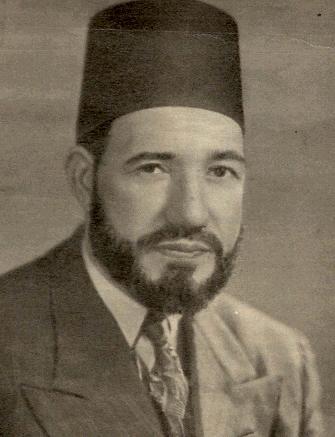
Hasan al-Banna
The Muslim Brotherhood was founded in 1928 by Hasan al-Banna, a 22-year-old elementary school teacher, as an Islamic revivalist movement. Al-Banna emphasized that Islam was a comprehensive way of life. Over the next twenty years the Brotherhood’s ideology came to encompass religion, education and politics. It became terrorist inside Egypt not long after its founding and was outlawed. A Muslim Brother assassinated Prime Minister Mahmud Fahmi Nokrashi in December 1948. Al-Banna himself was killed by government agents in Cairo in February, 1949.
The Egyptian government legalized the Brotherhood again in 1948, but only as a religious organization; it was banned again in 1954 because it insisted that Egypt be governed under sharia, or Islamic law. The brotherhood attempted to assassinate Nasser four times and four of its members assassinated Egyptian President Anwar Sadat in 1981.
The Brotherhood’s slogan is, “Allah is our objective. The Prophet is our leader. Quran is our law. Jihad is our way. Dying in the way of Allah is our highest hope.” The Brotherhood served as a model for subsequent revivalist movements and is theologically aligned with Saudi Wahhabism. The Palestinian terrorist group Hamas is an outgrowth of the Muslim Brotherhood.
The Islamist movement and its terrorist wings need to be distinguished from secular Arab movements. One way to do so is by looking at their respective targets. Until the rise of al Qaeda, Islamist terrorism was directed mostly inward, toward secular-leaning Arab governments. In contrast, terrorism directed against Israel was done primarily by Arab secular-nationalist groups such as the Palestine Liberation Organization. From its beginning, the PLO was oriented toward the reclamation of land and homes lost to Arabs by the founding of the state of Israel in 1948.  An example of secular-based terrorist group operating against Israel is the al-Aqsa Martyr Brigades, a homegrown group behind the rash of suicide bombings against Israelis in the second Intifada of 2002-2004. The Brigades are affiliated with the al-Fatah faction of the PLO. However, as Iran’s Islamic revolution solidified its grip, its mullahs began sponsoring Islamist terrorist groups against Israel, Hezbollah being a principle example.
Today anti-Western terrorism is the near-exclusive province of al Qaeda, founded by Osama bin Laden and headed by him.[20] By the time of al Qaeda's advent, Islamism "defined Islam as the exact antithesis of the West, under the guise of reclaiming the true and real Islam. Whatever the West was perceived to be, Islam was understood to be the exact opposite." [21] Bin Laden broke new ground in two ways: first in the boldness and scope of his attacks and second in that he was uninterested in traditional internal Muslim bickering. Any Muslim was welcome who wished to fight America, the West, or the apostate rulers of Muslim countries.
Osama bin Laden's strategic objectives
Converted to Islamism by fighting in Afghanistan, Osama bin Laden became the most die-hard jihadi of all. Unfortunately, he had hundreds of millions of dollars of family wealth to back him up. Bin Laden used a great deal of it before his access to it was cut off.
The new mission in life that bin Laden adopted can be stated simply: pure Islamic rule and life for Islamic lands, followed by re-establishing a unified, Muslim caliphate reflecting the old Muslim empire at its peak. After that, the rest of the world is to be converted to Islam by peaceful means if possible, by war if necessary.
The first imperative: eject America. Bin Laden, being a Saudi, turned attention first to his home country even though he no longer lived in it. No matter where pure Islamism might be established, Islamism as a renewal movement would fail if never established in Saudi Arabia. Saudi Arabia was the native land of Mohammed; bin Laden frequently referred to it as "the land of the Two Holy Mosques" (one being Mecca itself, the holiest site in all Islam, the other being in Medina).
 The Soviets had hardly withdrawn in defeat from Afghanistan than there was an enormous influx of American and other Western military forces into Saudi Arabia after Saddam Hussein invaded Kuwait in 1990. After the Gulf War, a substantial American military presence remained in Saudi Arabia. Their presence was objectionable to bin Laden for two reasons. First, the Westerners defiled the holy land of Mohammed because they were non-Muslim infidels. Second, their presence proved the impotence, and hence the religious apostasy, of the ruling House of Saud. A pure Islamic nation would have no need of infidel troops to defend itself. As far as he was concerned, the Americans were invaders of Saudi Arabia; he told The Independent of Britain in 1996 that "our country has become an American colony." Bin Laden became convinced that America was in conspiracy with "Zionists" to destroy Islam.
Bin Laden was also convinced that Mohammed's native land must be trod only by Muslims, never by non-Muslims. True Islam in Saudi Arabia could not be achieved with the kufr (unbeliever) army stationed there; hence the American presence must be expelled and not just America’s military presence. All non-Muslim Americans must leave.
Bin Laden's first grievance, though, was against the ruling House of Saud, whom bin Laden (and many clerics in Saudi Arabia, for that matter) considered apostate to Islam. Not only had it invited the American army into the kingdom - the most serious charge Osama held against the royals - bin Laden has been emphatic that the Saudi regime is corrupt and oppressive of the Saudi people, although, of course, he blamed the United States for all this. In his 1996 fatwa(religious judgment), "Declaration of War against the Americans Occupying the Land of the Two Holy Places," bin Laden said of the House of Saud:
The latest and the greatest of these aggressions, incurred by the Muslims since the death of the Prophet (Allah's blessing and salutations on him) is the occupation of the land of the two Holy Places - the foundation of the house of Islam, the place of the revelation, the source of the message and the place of the noble Ka'ba, the Qiblah of all Muslims - by the armies of the American Crusaders and their allies. . . .
 [T]he competition between influential [Saudi] princes for personal gains and interest had destroyed the country. Through its course of actions the regime has torn off its legitimacy:
 (1) Suspension of the Islamic Shari'ah law and exchanging it with man made civil law. . . .
 (2) The inability of the regime to protect the country, and allowing the enemy of the Ummah [Muslim people] - the American crusader forces- to occupy the land for the longest of years.
There followed a long list of grievances against the Saudi regime, particularly emphasizing its un-Islamic rule, the wealth-corruption of its princes and accusations of being a puppet of the USA.
Yet Osama seems indifferent whether the Saudi royals convert to pure Islam, as bin Laden defines it, or are destroyed. In a November 1996 interview with "Nida'ul Islam," bin Laden said, regarding Saudi Arabia,
There are several choices for the regime [of which] the most important of these is to bring back Islamic law, and to practice real Shura [consultative government].
The regime may resort to this choice after finding itself in the position of a morsel of food for the Americans to take, after the enmity has been stirred with their people. These people today feel that the Americans have exceeded their limits both politically and economically, the regime now knows that the public are aware that their sovereignty is shared. This was particularly evident in the recent period through the American press statements which give justification to the American occupation which only exists to rob the wealth of the people to the benefit of the Americans. This option is dependent on the agreement of the people who hold the solution and have the ability to effect change, at the forefront of these would be the honest scholars.
As for the other option, this is a very difficult and dangerous one for the regime, and this involves an escalation in the confrontation between the Muslim people and the American occupiers and to confront the economic hemorrhage. Its most important goal would be to change the current regime, with the permission of Allah.
Abd-al-Bari 'Atwan, editor in chief of the London-based Al-Quds al-'Arabi newspaper, said after another interview with bin Ladin, conducted by Jamal Isma'il in Afghanistan and broadcast on Middle East television,
I felt that the man had his own vision and special strategy. This strategy is based on his concept of the region. The first point in this strategy is that the US Administration or the US forces, which he considers occupation forces in the Gulf and Arabian Peninsula, are a prelude to a comprehensive Israeli-Jewish hegemony over the region with the aim of looting its wealth and humiliating its Muslim people. One senses this as the essence of his creed and strategy.
Therefore, he believes that expelling these US forces from the Arab world is a top priority. He believes that the regimes should be reformed or, more correctly, changed. The regimes immune to reform should be changed, the sharia should be applied properly, and a just Islamic system should be set up in the Islamic and Arab states, particularly the Gulf states. This is a summary of his strategy. Currently, he does not want to fight the regimes. That is what he told me. He wants to fight the Americans, who are protecting these regimes.
So while bin Laden does not specifically seek to destroy the House of Saud, he thinks it will be necessary if the House does not reform. If the royals are brought down violently, bin Laden thinks it will be by popular uprising, a revolution resulting from the long-suffering Saudi people deciding to suffer no more. His 1996 fatwa makes clear that he expects this general uprising to do two things in sequence: expel the Americans from Saudi Arabia, then force reform of the Saudi regime or its replacement. The result will be the institution of a true Islamic society - as bin Laden understands such a society to be.
Because bin Laden thinks that US forces entered Saudi Arabia not as allies but as conquerors, he is convinced that America will not vacate Saudi Arabia on its own. It must be expelled violently. This task, he says in the fatwa, is the primary duty of every true Muslim. [22]
The greatest threat to Islamism
Yussuf al-Ayyeri, one of Osama bin Laden's closest associates since the early 1990s, was killed by Saudi security forces in Riyadh in June 2003. He wrote a book published by al Qaeda entitled, The Future of Iraq and the Arabian Peninsula shortly before his death. In it al-Ayyeri explained succinctly America's greatest threat to Islamism: "It is not the American war machine that should be of the utmost concern to Muslims. What threatens the future of Islam, in fact its very survival, is democracy."
Iran-born author Amir Taheri summarized the book thus for the New York Post:
Al-Ayyeri then shows how various forms of unbelief attacked the world of Islam in the past century or so, to be defeated in one way or another.
The first form of unbelief to attack was "modernism" (hidatha), which led to the caliphate's destruction and the emergence in the lands of Islam of states based on ethnic identities and territorial dimensions rather than religious faith.
What Al-Ayyeri sees now is a "clean battlefield" in which Islam faces a new form of unbelief. This, he labels "secularist democracy." This threat is "far more dangerous to Islam" than all its predecessors combined. The reasons, he explains in a whole chapter, must be sought in democracy's "seductive capacities."
This form of "unbelief" persuades the people that they are in charge of their destiny and that, using their collective reasoning, they can shape policies and pass laws as they see fit. [23]
Modernity is precisely what bin Laden and his allies are fighting against, for modernity carries within it the idea that human societies should be able to shape their culture as they please. But such is anathema to radical Islamism, which wants to make strict sharia, Islamic law, the sole rule of society.
The problem of science
Equally threatening to Islamism as the Western democratic tradition is the Western idea that truth about the very nature of reality and humankind’s place in the cosmos can come from human investigation – science –  rather than divine revelation. Experimental science is a European invention, although the Muslims came close to inventing it near the end of their golden age. In fact, the Turks built a great observatory near Istanbul in 1577 that was the equal of any in Europe. But the sultan ordered it razed to the ground on the insistence of the Chief Mufti. That event ended decisively near-Eastern Muslim science down to the present day. Science education in Arab lands today is limited in scope and is more engineering than research science.
Modern science has had a much more difficult time being accepted in Muslim lands than elsewhere in the world. In an article, “The Religion of Modern Science: Roots of modern God-free thinking,” published in the western-based Islamic Journal, Muslim author Harun Yahya wrote of Western scientific absolutists who “regard modern science as absolute and true religion, and want to impose this view to all humankind. . . . However, the question is not that whether Islam is in line with science or not, but whether science is in line with Islam. What needs to be approved is science, not Islam.” [24]
There are many points of contention and conflict between Arab Islam and the West, but the chief religious contention between Islamists and the West is not really between Islam and Christianity but between Islam and Western scientific-materialism.
Because of the supremacy of the sciences in western thought, Western culture has become caught in a cycle of ever-increasing changes. Western societies contend with an exponentially increasing pace of cultural changes. The pace and kinds of changes that we adapt to (with greater or lesser difficulty, to be sure) are exactly the changes that Islamists correctly believe would destroy basic structures of their society which they believe are the divinely-commanded.
In their view, certain social structures (chiefly the status and role of women) are absolutely essential, required by Allah's command as revealed in the Quran. Without those structures, a society is wholly corrupted. We see them as hopeless religious fanatics; they see us as godless and degenerate.
The tension between Islam's historic traditions and modern pressures of scientific modernity is found throughout the Muslim world. Many Arab intellectuals know that their countries have fallen behind most of the rest of the world. They want to gain the benefits of technological society, but without the cultural baggage that comes with it. They want to modernize their societies but not westernize them. Their vision of modernization is mostly technological, such as communications, medical science, education, transportation, and consumer goods.
These twin desires – keep the West out but bring modernity’s trappings in – are in perpetual tension. Not even the strictest mullahs are willing to give up their cell phones and hearing aids in their dream of a throwback Muslim society. As for the so-called Arab street, enormous numbers of them want to live in the West, and many millions of them have emigrated from Arab lands to do so. Before America invaded Iraq, seventy-five percent of the world’s refugees were from Muslim countries.
But the Arabs’ state their revulsion for the West more strongly than they really mean. So, wrote Victor Davis Hanson, [25]
The best way to get America and the West out of millions of Islamic lives is not to burn effigies of George Bush in the Arab Street, but would be for Arab governments to prohibit immigration to the West, to stop importing Western material goods, and to bar decadent Westerners from entering Arab countries.
Any takers? The bitter truth is that the Middle East wants the West far more than the West the Middle East.
Whether political or religious fervor primarily motivate anti-Western terrorism is unclear, and does not really matter. The bifurcation of politics and religion is a Western notion, not a Muslim one. In any event, their aim is to cleanse the Arab lands of Westernism and institute their own version of pure Islamic society. The paradigms of success are Iran and Taliban-ruled Afghanistan; even the very conservative Saudis are too Western for them.
The Old is New Again
The war that radical, violent Islamists are waging against the West springs from the fact that Islamism and Westernism are fundamentally incompatible. But both are too deeply embedded in both sides' culture, social systems, politics and religion to be very easily altered. Compared to this centuries-old struggle, the Cold War was a brief respite. Rather than the new millennium inaugurating a golden age of human progress and well-being, what was old is new again. History has returned.
Update, December 2025: If, as Victor Davis Hanson, wrote, the Islamists want "to get America and the West out of millions of Islamic lives," then today their goal has been to de-westernize the West and make it Islamic. This is well underway in Europe, where this Christmas season Muslims in Germany and Belgium have stampeded through cities' outdoor Christmas markets and have caused many to be canceled or barricaded. This happened in Brussels this week:


Footnotes:
1. There was anti-Jewish violence in Palestine dating all the way back to the 1920s, but the organization of essentially terroristic, anti-Israel factions among the Palestinians really dates from the establishment of Israel as an political entity. In 1952, for example, "there were about 3,000 incidents of cross-border violence" and from 1951-1955 almost 1,000 Israelis died in such attacks, according to the Israeli government.

2. Islamist terrorist groups operate there now whose direct patrons are Syria and Islamic Iran. There are excellent reasons to believe that Islamist terrorist groups became dominant before 2000; their influence and proven murderousness may have been a key reason Yasir Arafat turned down breathtaking concessions offered by Israel during the Wye River negotiations sponsored by the Clinton administration. By 2004 Arafat's own officers openly acknowledged the Islamist groups' power. In 2002 an officer of Fatah, founded by Arafat in the 1950s, openly told the Jerusalem Post, "We can't ignore the role of Hamas and Islamic Jihad in the resistance against Israel. On the other hand, we can't turn a blind eye to the broad popular support that they enjoy among the Palestinians" (Apr. 19, 2004).

3. The difference between the Right and Left is that the Right said the attacks were divine judgment against America because of individual Americans' increasingly immoral character, while the Left said the attacks were the justified and inevitable response by the oppressed to America's imperialistic economic and foreign policies.

4. Alan B. Krueger and Jitka Mlecková, “Seeking the Roots of Terrorism,” http://chronicle.com/free/v49/i39/39b01001.htm

5. Lee Harris, “The Intellectual Origins Of America-Bashing,” Policy Review, Dec. 2002.

6. "Harvard Gazette," Nov. 4, 2004.

7. Alberto Abadie, "Poverty, Political Freedom, and the Roots of Terrorism," October 2004.

10. Thomas F. Madden, “The Real History of the Crusades.” Crisis, April 1, 2002.

11. Bernard Lewis, What Went Wrong. Perennial Press, 2002

12. During 1991's Gulf War, I was a career Army officer, assigned to the US Army’s main operations center below the Pentagon. There I read a State Department message summarizing what a very senior Egyptian government official had said to an American diplomat. One thing stuck in my mind. “Egypt is the only true Arab nation state,” said the official. “The rest are all tribes with flags.” This particular official insisted that American ideas about Arab unity were nonsense.

13. “Wrestling With Islam,” http://www.davidwarrenonline.com/Miscell/index02.shtml

14. “When Pakistan was created, its founder, Mohammed Ali Jinnah, famously declared, ‘You are free, free to go to your temples, you are free to go to your mosques or to any other places of worship in this state of Pakistan. You may belong to any religion or caste or creed – that has nothing to do with the business of the state.’” (Zahir Janmohamed, Washington Post, June 25, 2003; Page A23

15. However, the modern West treated Middle Eastern lands as backward places to be conquered or enlightened (The French and British from 1798-1948) and/or as holding resources to be gained through commercial exploitation (America, Britain and France from the 1930s until now). In fact, Arab “countries” are mostly a Western imposition, except for Egypt, and much of the troubles there arose from the fact that the national boundaries of Arab countries were drawn by European rulers.
    For much of the Cold War America used Arab nations, along with Turkey and Iran, as a bulwark against potential Soviet expansionism toward the oil fields of Iran, Iraq and Saudi Arabia. It was not an unreasonable fear, but it slewed our relationship with the region in utilitarian ways, which many Arabs saw as another form of colonialism.
    Today, however, the great majority of Iranians today are too young to remember pre-Islamism days and are rejecting the harsh, oppressive rule of the ayatollahs. The ayatollahs have not made the people’s life better than under the shah; in many ways it is worse, especially in the regulation of personal minutiae. Of the Iranians, “the majority want a sweeping transformation. They do not want to be told what to think, what to wear, what to read, what to watch and how to behave, and they are frustrated at the glacial pace of change.” (New York Times, June 16, 2003). In many ways, this statement defines the frustration felt by masses of Arabs with their own governments.

16. Raphael Patai, The Arab Mind. Hatherleigh Press, 2002.

17. Thomas L. Friedman, “Arabs Lift Their Voices.” New York Times, April 7, 2005

18. Gilles Kepel, “The Trail of Political Islam.” http://www.opendemocracy.net/debates/article-5-57-421.jsp

19. Khaled Abou El Fadl ,"Islam and the Theology of Power." Islam for Today, http://www.islamfortoday.com/elfadl01.htm

20. Al Qaeda, however, is not a unitary organization with a rigid, vertically-organized chain of command. It is a conglomerate of sometimes disparate groups with like aims, willing to use like means, enjoying the fruits of bin Laden’s core staff’s work, and oriented on common enemies, mainly Saudi Arabia’s ruling royals and America.

21. El Fadl, op. cit.

22. The United States removed most of its armed forces from Saudi Arabia after 2003's invasion of Iraq. But some American military remain there, as well as thousands of American civilians who live there. So American infidels still corrupt the soil of the Land of the Two Holy Mosques.

23. Amir Teheri, “Al Qaeda’s Agenda for Iraq.” New York Post, Sept. 4, 2003

25. V. D. Hanson, “Winning After All.” National Review, June 2003, http://www.nationalreview.com/hanson/hanson062003.asp

A world without nuclear weapons - what would it look like?

 From Pope Leo this week, according to the National Catholic Reporter : " Pope Leo quotes Bob Dylan song in book foreword calling for n...