I have 18 movie versions of Charles Dickens' novel, A Christmas Carol, in my personal collection. And I watch all of them each Christmas season. Here is where you may find as many versions of the movie as I can find online for free viewing. They are listed in the order I found them, not according to my personal rating of their worth.
First up, from 1984, starring George C. Scott as Scrooge, free on YouTube and hence embedded here:
__________________________________________
Nest is Scrooged, starring Alistair Sim. This movie has received high marks for Sims' performance as Ebenezer Scrooge.
__________________________________________
Next is is Patrick Stewart playing Scrooge from 1999. This one has become an almost instant classic.
__________________________________________
This version stars Guy Pearce as a younger Scrooge than we usually imagine. And it is more based on the novel's theme than its narrative, although the character's names are the same. Hence it is a reboot of sorts, rather long (almost three hours) with many added scenes, and Marley's ghost has a much larger part. But I give it good marks for staying faithful to Dickens' themes.
__________________________________________
Here is the first movie of the novel with sound, 1935's Scrooge, starring Seymour Hicks.
__________________________________________
1938's version, starring Reginald Owen:
__________________________________________
A Christmas Carol (1954), starring Frederic March and Basil Rathbone:
__________________________________________
Here is An American Christmas Carol from 1979, starring Henry Winkler:
__________________________________________
From 2015, starring Anthony D.P. Mann, one of the shortest versions at 59 minutes:
__________________________________________
From the BBC in 2000, one of my favorite versions, set in modern London with Scrooge being a young hoodlum loan shark, starring Ross Kemp.
__________________________________________
And last, a musical version starring Albert Finney and Alec Guinness, Scrooge, from 1970.
Have fun, and remember the lesson the story tells so well!
Here is security-camera video of the shooting at the Fort Lauderdale airport last Friday [in 2017 - DS], for which Esteban Santiago has been charged with multiple felonies. There is nothing graphic in the video, but watch what the people standing behind him do - and more importantly, do not do.
I understand that people were caught wholly by surprise and did not process what was happening very quickly. I understand that as a retired Army combat-arms officer I would recognize gunfire and its implications many times more quickly than the average civilian.
But that is of no comfort to the five people Santiago is accused of murdering or the six of wounding.
News reports say that the FBI has not ruled out a terrorism connection yet (I am doubtful) but even if not, this is the kind of thing ISIS wants its members of sympathizers to do anywhere in America they can. Can we expect more shootings like this? Almost certainly. [Update, Jan. 11: The terrorism angle may be justified, "Airport Shooter Converted to Islam, Identified as Aashiq Hammad Years Before Joining Army"]
In such a situation, you have only one rule: OODA. Observe, Orient, Decide, Act. What you must not do is what the people in the video did.
Observe: No longer can you assume you are safe. No longer can you enter public places without awareness of what is going on near and far from you. You must observe what is happening! Not just with your eyes, but with your hearing and other senses, too.
This must become a habit that does not stop. When I was learning to fly, my instructor insisted that at every moment of flight, I should always have identified a place to land if my motor quit. Since the airplane was obviously moving, that meant I had to near-constantly observe for a suitable emergency set-down place.
At every moment, you must know where exits are, the fastest ways to get there, which one is best, which one is second best. You must know where to hide if escape is closed off.
Orient: In the video, the people behind the shooter did not ascertain what was happening for precious seconds. Under gunfire, this can be fatally slow. You must orient on the danger without hesitating. That means where, what, how.
No one did that when the shooting started. I am not casting blame. They just didn't. See what they did? They froze for precious seconds, which can get you killed, while trying to process what they were seeing and hearing.
Decide: Quite simply, in about a half-second you have to orient on what the danger is and decide what to do. Back to the people in the video: when they decided to move, they stepped only a few feet, then either fell straight down or huddled behind luggage. They were still targets and had gained no safety at all. Your decision must be one that will reduce your danger. It is not enough to decide to do something, you must do something effective.
Act: Action must follow decision in less than an eyeblink of time. In almost any shooting situation, you have to run like Jesse Owens out of there. Run away and do not stop until you are behind friendly guns (cops).
You may respond that no one can outrun a bullet. That's true, but running away does two things: first, it removes you from the area of danger, of course, but second, it reduces your attractiveness as a target to the shooter. They do not shoot at distant people. They just don't, especially with a handgun and even if a shooter does he will very likely miss.
Do not run routes that you would take if nothing was happening. Go through obstacles rather than around, if possible. Go across baggage carousels for a shorter route or faster exit. If you're not in an airport the same principles apply.
What about hiding? If the only exit is on the other side of the shooter, then hiding may be your only option. There are two kinds of hiding: concealment and cover. Concealment is simply getting yourself out of sight from the shooter (but be prepared to move) but that doesn't mean he can't shoot you. If you hide behind a curtain you can still be shot! So cover is the better choice, where the shooter can neither see you nor shoot you if he tried. But remember one of Murphy's Laws of Combat: "Make it too hard for the enemy to get in, and you've made it too hard for you to get out." Your objective in taking cover or concealment is immediate safety but also finally to get the heck out of there!
Pray to God that you never encounter such a situation. But remember that "hope is not a method and wishes are not plans." Be prepared!
Update:
Also, be aware that buildings' interiors often provide limited exits, which will be fatal funnels as folks mob the door and cannot get out once the bullets start flying. Do not follow the crowd unless there is no alternative!
Be camouflaged. That not mean wearing woodland-pattern clothing, but to be low profile, dress modestly, and use clutter and quiet movements to become a bit more ninja-like. Being flashy and glued to your smart phone is a no go. Dressing and acting bland, dull, and as unnoticeable as possible may give you an edge.
If someone were to ask you, "Why was JFK assassinated?" you certainly would not answer, "To save us from our sins." Yet that is usually the first thing that comes to mind when we church people are asked why Jesus died or why he was crucified.
That answer is correct, of course, but is that really all there is to it? None of Jesus' accusers thought that. Caiaphas, the high priest who turned Jesus over to Pilate, would have thought such an answer to be idiotic. Pilate, a Roman pagan, would never have remotely thought it. None of the crowd who demanded of Pilate, "Crucify him!" thought their sins would be forgiven via Jesus' death on a cross.
And for that matter, not even Jesus' disciples thought so, despite more than one occasion when Jesus had clearly taught it to them.
So what was happening in the ordinary realm of human motives and actions that ended with Jesus dying on a Roman cross outside Jerusalem? "Execution Day - The Case Against Christ," is an essay I wrote in 2019 to explore how to answer why Jesus was crucified in the same way we might answer why JFK was shot - who did it, why, and what did they hope to gain? To read, just click on the link.
Or watch this video I made about the same subject.
OMG! What if Trump orders this before Jan. 20! But that cannot happen, read on to see why - and why Nancy Pelosi's urging of a military coup against Trump must be condemned.
Even the New York Times characterizes one of Speaker of the House Nancy Pelosi's recent actions as coming narrowly close to inciting a military coup against the president. According to the NYT,
Ms. Pelosi also said she had spoken with Gen. Mark A. Milley, the chairman of the Joint Chiefs of Staff, about “preventing an unstable president from initiating military hostilities or accessing the launch codes.” . . .
But some Defense Department officials have privately expressed anger that political leaders seemed to be trying to get the Pentagon to do the work of Congress and Cabinet secretaries, who have legal options to remove a president.
Mr. Trump, they noted, is still the commander in chief, and unless he is removed, the military is bound to follow his lawful orders. While military officials can refuse to carry out orders they view as illegal, they cannot proactively remove the president from the chain of command. That would be a military coup, these officials said.
The NYT did not have to print what those Pentagon officials said. That the reporter and editor included it proves they agreed with that assessment.
And yet, somehow it is only Donald Trump who is trying to destroy the foundations of our government, amirite?
While Pelosi’s letter highlights the concern among lawmakers about what Trump may try to do during his remaining time in office, there are questions about what Milley or anyone could actually do to stop a president from using nuclear weapons.
“There is no legal way to do this. The president has sole, unfettered authority to order the use of nuclear weapons with no ‘second vote’ required,” said Jeffrey Lewis, a professor at the Middlebury Institute of International Studies at Monterey in California.
I am sure Prof. Lewis is an expert on something. Nuclear launch procedures are definitely not one of them. This sentence he spoke is factually incorrect, period: "The president has sole, unfettered authority to order the use of nuclear weapons with no ‘second vote’ required."
I was a nuclear-target analyst during part of my military career. I decrypted and validated Nuclear Control Orders, which are the most tightly controlled messages and actions used by the Defense Department, and in two assignments I would have been directly in the chain of command had actual launch orders come down. I can tell you authoritatively that Nancy Pelosi knows bupkus about what it takes to launch a nuke. If she had ever been briefed, she would never have made this phone call.
Fact: Only the president can originate the order for a nuclear strike by US armed forces, but the president is only one of the people who must approve the launch. Actually, a valid and actionable launch order can be sent and acted upon without the president's order or even his involvement - but only under extremely unusual and pre-defined circumstances. It is safe to say, though not precisely accurate, that a nuclear launch cannot occur without a president's orders -- but it is simply wrong that the president alone (note that word: alone) can order it.
Prof. Lewis' statement would be accurate this way: "The president has the authority to order the use of nuclear weapons, but there are other 'votes' that must concur; some are technical procedures and some are not."
I will not list the steps that have to be done to launch a nuke. In fact, I will never reveal them. But here is a clue: the Denzel Washington/Gene Hackman movie Crimson Tide just scared the crap out of me.
And here is Bloomberg News' explanation of launch procedures. It, like the sequence in Crimson Tide, is accurate as far as it goes, but at least it does not say, as Prof. Lewis does, that the people in the chain of command from the White House down to the launch crews are mere puppets in the hands of a president.
It is not credible that any speaker of the House would not know what these procedures are. I do not believe that Pelosi therefore really thought that Trump might go rogue and start nuking Moscow and Peking and Pyongyang (or San Francisco?).
So what was Pelosi really trying to accomplish with this phone call, especially since those of us who served in the Pentagon can tell that Gen. Milley basically told her to mind her own business?
It is not coincidental that Pelosi was already scheduled to be on CBS News 60 Minutes program the evening after she made the call. And she gave a press conference after the call, also. So what was the real purpose of the call? It was certainly not to restrain a rogue president from ordering nuclear launches.
The purpose was the shameless self promotion of one Nancy Pelosi and the further demonization of Donald Trump. It was to signal the American people that they are all going to die in nuclear war except for her heroic steps and that (here is the real point:) President Trump must be removed from office now, either by impeachment or via the 25th Amendment.
As always, Nancy Pelosi has no goal but "get Trump." No matter what, he will be out of office at the stroke of noon Jan. 20. And what will Nancy Pelosi do then?
Army and Air National Guard members deploying to Washington, D.C. to help guard the capital and stay through the Jan. 20 inauguration will have access to lethal weapons at their commanders' discretion, Guard commanders said Friday.
On inauguration day 2016, Antifa et. al. rioted most of the day and burned down blocks of D.C.'s stores and buildings. Who was sent to bring them under control? DC police whose use of rubber stun bullets itself became the target of violent protests.
But for this inauguration, military weapons. And not by Trump's order, but by demand of D.C.'s Democrat mayor. But remember: Trump is the fascist.
Electrics' killer? Life-cycle pollution, compared to diesel cars - what it takes industrially to obtain the raw materials and turn them into finished, operating vehicles, operate them during their life span, and dispose of them when the reach the end. And the core of the problem is batteries.
When CO2 emissions linked to the production of batteries and the German energy mix – in which coal still plays an important role – are taken into consideration, electric vehicles emit 11% to 28% more than their diesel counterparts, according to the study, presented on Wednesday at the Ifo Institute in Munich.
Mining and processing the lithium, cobalt and manganese used for batteries consume a great deal of energy. A Tesla Model 3 battery, for example, represents between 11 and 15 tonnes of CO2. Given a lifetime of 10 years and an annual travel distance of 15,000 kilometres, this translates into 73 to 98 grams of CO2 per kilometre, scientists Christoph Buchal, Hans-Dieter Karl and Hans-Werner Sinn noted in their study.
The CO2 given off to produce the electricity that powers such vehicles also needs to be factored in, they say.
When all these factors are considered, each Tesla emits 156 to 180 grams of CO2 per kilometre, which is more than a comparable diesel vehicle produced by the German company Mercedes, for example.
The German researchers, therefore, take issue with the fact that European officials view electric vehicles as zero-emission ones. They note further that the EU target of 59 grams of CO2 per km by 2030 corresponds to a “technically unrealistic” consumption of 2.2 litres of diesel or 2.6 litres of gas per 100 kms.
These new limits pressure German and other European car manufacturers into switching massively to electric vehicles whereas, the researchers feel, it would have been preferable to opt for methane engines, “whose emissions are one-third less than those of diesel motors.”
A battery pack for a Tesla Model 3 pollutes the climate with 11 to 15 tonnes of CO2. Each battery pack has a lifespan of approximately ten years and total mileage of 94,000, would mean 73 to 98 grams of CO2 per kilometer (116 to 156 grams of CO2 per mile), Buchal said. Add to this the CO2 emissions of the electricity from powerplants that power such vehicles, and the actual Tesla emissions could be between 156 to 180 grams of CO2 per kilometer (249 and 289 grams of CO2 per mile).
An electric car such as a Tesla is not powered by electricity. It is powered by coal; the electricity is just a means of transfer.
The same problem, btw, exists in the nearly-mythical hydrogen-powered car. The hydrogen has to come from somewhere. Atoms of H It do not exist in nature unbound to other elements. And you always use more energy to obtain free hydrogen than you get from oxidizing it. Guess where that energy comes from?
Here is a good video that explains hydrogen's potential advantages but very present difficulties very well.
Authorities have identified one of the two suspects in a shooting Tuesday at a public charter school in Colorado just eight miles from Columbine High School.
Devon Erickson, 18, has been held in the attack at STEM School Highlands Ranch in which seven students were injured and one killed, reported 9News, the Denver NBC news outlet.
The Wall Street Journal reports that the second suspect has been identified and is a juvenile girl, which crosses a threshold of feminine equality that we never would have wanted. I wrote most of what follows a year ago, just after a school shooting in Texas, but I hardly need to change a word.
Writing in 2015, Malcolm Gladwell wrote what I think is still the best explanation for modern American mass shootings, and it’s easily the least comforting. At the risk of oversimplifying a complex argument, essentially he argues that each mass shooting lowers the threshold for the next. He argues, we are in the midst of a slow-motion “riot” of mass shootings, with the Columbine shooting in many ways the key triggering event. Relying on the work of Stanford sociologist Mark Granovetter, Gladwell notes that it’s a mistake to look at each incident independently:
But Granovetter thought it was a mistake to focus on the decision-making processes of each rioter in isolation. In his view, a riot was not a collection of individuals, each of whom arrived independently at the decision to break windows. A riot was a social process, in which people did things in reaction to and in combination with those around them. Social processes are driven by our thresholds—which he defined as the number of people who need to be doing some activity before we agree to join them. In the elegant theoretical model Granovetter proposed, riots were started by people with a threshold of zero—instigators willing to throw a rock through a window at the slightest provocation. Then comes the person who will throw a rock if someone else goes first. He has a threshold of one. Next in is the person with the threshold of two. His qualms are overcome when he sees the instigator and the instigator’s accomplice. Next to him is someone with a threshold of three, who would never break windows and loot stores unless there were three people right in front of him who were already doing that—and so on up to the hundredth person, a righteous upstanding citizen who nonetheless could set his beliefs aside and grab a camera from the broken window of the electronics store if everyone around him was grabbing cameras from the electronics store.
It works like this:
This "infectious" behavior is well known and described by people who study and teach leadership. Here are two real problems: First is what Granovetter describes: once there are enough early adopters of a behavior, then mass adoption easily follows. Hence, Gladwell describes school shootings as a "slow motion riot." But portents are that it won't stay slow.
Second is what is revealed by retired Army officer and psychologist Dave Grossman, who documents in Assassination Generation: Video Games, Aggression, and the Psychology of Killing and other works that more and more boys are growing up learning to kill vicariously through both popular media and electronic gaming - and that for increasing numbers the vicarious violence will give way to actual.
In one of his early works, On Killing, Grossman documented the great difficulty the US Army had in World War II in training its soldiers, especially infantrymen, actually to take the enemy's life. The leadership found that American men came into the military with deeply-inbred reluctance to harm other human beings, and that only a small minority of infantry even fired their rifles once in a firefight.
Grossman's thesis in what is happening to America today is that we have, as a whole society, widened the boundaries of what constitutes prohibited violence. Prior generations had mass murderers, of course, but even the most depraved killers in the not-too-distant past would never have even thought of shooting schoolchildren at their desks. Now it is, as Gladwell notes, becoming increasingly within the boundaries of conduct that society has moved.
In the coming days the editorialists and TV commentators will have a lot more to say. I do not expect their offerings to be much different from what they said after the Parkland, or Aurora, or Sandy Hook massacres or ... well, pick one. The media’s talking heads will recycle the same things they said before. We’ll hear a lot about America’s gun culture, and all the talk will be about guns and not about the culture.
Does America have a "gun culture?" You bet it does, and it this is it:
This movie was to open in Newtown, Conn., on Dec. 14, 2012, the day of the killing rampage in Sandy Hook Elementary School. Warner Bros. pulled the opening
The Hollywood gun culture:
Business Insider reprints part of an AskMen piece on "The 99 Most Desirable Women Of The Year." Here is no. 99, Bérénice Marlohe, who plays Severine in Skyfall.
Glorifying violence, especially gun violence, is the present purpose of America's entertainment industry. This is what untold numbers of our children are doing in their homes:
The margins continue to be moved, whether we want it or not. Because there is too much money being made by murder-as-entertainment to give it up, and we the people are willingly paying for it.
One of the ways that the Columbine shooting remains key is in how subsequent school chooters have imitated it to some degree. Not every shooter, but enough to see that Columbine still forms a template. For example,
Some aspects of Friday's [Texas] shooting had echoes of the massacre at Columbine High School in 1999. The two teenaged killers in that incident wore trench coats, used shotguns and planted improvised explosives, killing 10 before committing suicide themselves.
As did the accused killer in Texas, except for the suicide. Reports say, though, that he told police he intended to commit suicide but found he could not go through with it.
As for this week's shootings? The WSJ article linked above concludes,
George Brauchler, the district attorney for the area, noted at the Wednesday morning news conference the number of mass shootings that the Denver region had endured over the years.
“If you had suggested to anyone behind me that within 20 years and 20 miles, we would have dealt with Columbine, the Aurora theater, Arapahoe High School,” he said, rattling off Colorado mass shootings, flanked by officials. “We would have thought you were mad.”
Steve Holley recalled being at his son’s school to pick him up just as the school was put on high alert because of the scare involving the woman obsessed with Columbine.
“It was just like, ‘Here we go again,’ ” Mr. Holley said of Tuesday’s shooting. “I remarked to one of the other parents we were waiting in the gym with: ‘This is the new norm.’ ”
"The new norm" - the slow-motion riot is not happening slowly any more.
Ian Hutchison is a professor of nuclear science and engineering at MIT. Here he rebuts the idea that science is the ultimate way of knowing about the Real.
"Scientism" is used to describe faith in science. Prof. Hutchison is a Christian. In an address at the Veritas Forum, he spoke of three hypotheses to explain why he believes in the resurrection of Jesus:
Hypothesis one: We’re not talking about a literal resurrection. Perhaps it is just an inspiring myth that served to justify the propagation of Jesus’ exalted ethical teachings. A literal resurrection contradicts the known laws of nature. Maybe scientists can celebrate the idea of Jesus’s spirit living on, while his body remained in the grave.
Hypothesis two: We really believe in the bodily resurrection of the first century Jew known as Jesus of Nazareth. My Christian colleagues at MIT – and millions of other scientists worldwide – somehow think that a literal miracle like the resurrection of Jesus is possible. And we are following a long tradition. The founders of the scientific revolution and many of the greatest scientists of the intervening centuries were serious Christian believers.
Hypothesis 3: I was brainwashed as a child. ... But no, I did not grow up in a home where I was taught to believe in the resurrection. I came to faith in Jesus when I was an undergraduate at Cambridge University and was baptized in the chapel of Kings College on my 20th birthday.
Hypothesis two wins:
To explain how a scientist can be a Christian is actually quite simple. Science cannot and does not disprove the resurrection. Natural science describes the normal reproducible working of the world of nature. Indeed, the key meaning of “nature”, as Boyle emphasized, is “the normal course of events.” Miracles like the resurrection are inherently abnormal. ...
Today’s widespread materialist view that events contrary to the laws of science just can’t happen is a metaphysical doctrine, not a scientific fact. What’s more, the doctrine that the laws of nature are “inviolable” is not necessary for science to function. Science offers natural explanations of natural events. It has no power or need to assert that only natural events happen.
So if science is not able to adjudicate whether Jesus’ resurrection happened or not, are we completely unable to assess the plausibility of the claim? No. Contrary to increasingly popular opinion, science is not our only means for accessing truth. In the case of Jesus’ resurrection, we must consider the historical evidence, and the historical evidence for the resurrection is as good as for almost any event of ancient history.
It is refreshing that a scientist understands the principle of "limit questions." Limit questions are those that are outside the realm of a particular field of knowledge. For example, suppose you attended a concert by the London Symphony. As you are leaving afterward, you overhear a man in front of you say, "Speaking as a cardiologist, it is my medical opinion that this was the finest performance of Saint-Saux's Symphony Number Three in C Minor ever presented anywhere."
Immediately you can see that such a statement is simply nonsense. It may well have been the best-ever performance of the symphony, but true or false, it is not a medical question and so his opinion "as a cardiologist" has no authority at all. The quality of a concert is a limit question for physicians. It is outside medical science’s realm of knowledge and expertise.
This is exactly the mistake that many scientists, such as the late Stephen Hawking, make. When they denounce Christians for affirming the resurrection, they claim that science has proved it was impossible. But as Prof. Hutchison explains, miracles are inherently limit questions for science.It gets worse. Comes now Wharton School professor and forecasting expert J. Scott Armstrong, whose research shows that fewer than one percent of published scientific papers published in scientific journals actually follow the scientific method.
“We also go through journals and rate how well they conform to the scientific method. I used to think that maybe 10 percent of papers in my field … were maybe useful. Now it looks like maybe, one tenth of one percent follow the scientific method” said Armstrong... .
Scientific integrity requires scientists and non-scientists alike to recognize that there are limits to scientific knowledge. Failing this is the main error of the New Atheist movement, whose advocates insist that,
·only science reveals the Real,
·only science can discover truth
·scientific knowledge is exhaustive and inherently unlimited.
But these claims are themselves not testable with the scientific method. They are not scientific claims at all, but claims of faith in science, or scientism. Richard Lewontin, an evolutionary biologist and geneticist, explained in The New York Review of Books in 1997 (link) that scientism has a…
... prior commitment to materialism. It is not that the methods and institutions of science somehow compel us to accept a material explanation of the phenomenal world, but, on the contrary, we are forced by our a priori adherence to material causes to create an apparatus of investigation and a set of concepts that produce material explanations ... . Moreover, that materialism is absolute, for we cannot allow a Divine Foot in the door.
This is not evidence of an inquiring mind. The intellectual atheists' veil was further pulled back by Thomas Nagel, professor of philosophy and law at New York University:
I want atheism to be true and am made uneasy by the fact that some of the most intelligent and well-informed people I know are religious believers. It isn't just that I don't believe in God and, naturally, hope that I'm right in my belief. It's that I hope there is no God! I don't want there to be a God; I don't want the universe to be like that. My guess is that this cosmic authority problem is not a rare condition and that it is responsible for much of the scientism and reductionism of our time. One of the tendencies it supports is the ludicrous overuse of evolutionary biology to explain everything about human life, including everything about the human mind… This is a somewhat ridiculous situation… [I]t is just as irrational to be influenced in one’s beliefs by the hope that God does not exist as by the hope that God does exist. (The Last Word, pp. 130-131, quoted by fellow philosopher Edward Feser.)
Aldous Huxley, author of Brave New World, put it this way:
I had motives for not wanting the world to have a meaning; consequently I assumed that it had none and was able without any difficulty to find satisfying reasons for this assumption…. Those who detect no meaning in the world generally do so because, for one reason or another, it suits their books that the world should be meaningless. …
For myself as, no doubt, for most of my contemporaries, the philosophy of meaninglessness was essentially an instrument of liberation. The liberation we desired was …liberation from … a certain system of morality. We objected to the morality because it interfered with our sexual freedom…. There was one admirably simple method in our political and erotic revolt: We could deny that the world had any meaning whatsoever. Similar tactics had been adopted during the eighteenth century and for the same reasons. (Ends and Means, 270-273)
However, affirming the resurrection of Jesus is not wishful thinking, it is the most reasonable conclusion based on the non-supernatural facts and circumstances surrounding the issue. Note well, please: that the resurrection of Jesus did occur is the ending point of examination of the facts, not the beginning point.
The resurrection of Jesus is foremost an historical question, not primarily a scientific one or even, really, a religious one. And so there will be limits of what science can declare about it just as there are limits on what science can declare about any other historical event. For example, it cannot be "scientifically proven" that Gen. George Washington led his army across the Delaware River on Christmas night, 1776, to attack Hessian forces at Trenton, N.J. That is an historical question, not scientific one.
I posted about alternative explanations of the historical events just recently, so I'll not revisit them. Today, let's just deal with one, which is the claim by many scoffers and skeptics that Jesus never really existed in the first place. But what happens when, live and on the air, an atheist holding that position runs into a non-Christian, world-recognized scholar who says that position is silly? Well, this.
Update: Michael Polanyi, a Fellow of the Royal Society and former professor of physical chemistry at the University of Manchester: "Any account of science which does not explicitly describe it as something we believe in, is essentially incomplete and a false pretension. It amounts to a claim that science is essentially different from and superior to all human beliefs which are not scientific statements, and this is untrue... ." Read more.
Last week I explained five historical facts that must be accounted for either to affirm or deny that Jesus rose from the dead. These facts do not rely on supernatural authority or a claim that they must be believed because the Bible is inspired Scripture.
Historians, and not just Christian ones, are in broad consensus that these were factual events, not claims invented by the church, especially since absent these facts there is no reason to assume there would have been a church to invent them in the first place.
Thus, seriously grappling with the claim that Jesus rose from the dead must include these facts in the explanation. Explanations must explain. Simply to deny these facts does not rebut or disprove them. One cannot explain, for example, how the Civil War started while denying that South Carolina ever bombarded Fort Sumter.
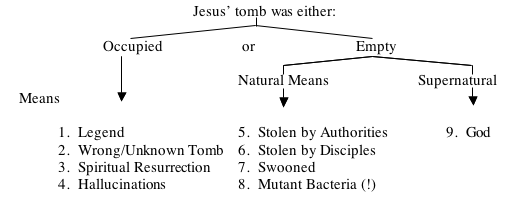
Skeptics of the historical fact of Jesus's resurrection offer explanations that fall into four main categories:
1. The key actors on Good Friday and Sunday morning botched what they were doing.
2. Science proves Jesus’s resurrection is impossible.
3. The accounts of Jesus’s resurrection are mythical of a kind common in the ancient world.
4. The apostles were either deluded or they mounted a deliberate conspiracy of falsehoods.
The "they botched it" theories
The "Swoon Theory"
The first allegedly-botched job was the crucifixion, in which the Romans incompetently took Jesus down from the cross unconscious rather than dead. Joseph and the women entombed Jesus still alive. This is called the “Swoon” theory; it dates to the 1780s.
The swoon theory says that the coolness of the tomb and Friday’s partial application of funereal spices made Jesus come to his senses. Before dawn Sunday he rolled away the stone and found some workman’s clothes, causing Mary Magdalene to mistake him for a gardener. So, the swoon theory does explain why the women found the tomb empty and why the presumed gardener claimed he was Jesus.
But it assumes that
the brutal flogging that Jesus received from the Romans,
the shredding of his head by a wreath of thorns,
hanging on the cross with nailed hands and feet (with severe physical effects, including dislocation of the shoulders),
and the deep piercing of his chest by a Roman spear,
were all relatively minor injuries that
left Jesus mentally fully competent,
were not severe enough and evoked too little bleeding to kill or even much weaken him,
insufficiently injured his hands and feet to degrade either his dexterity or mobility,
left him with enough physical strength to single-handedly roll away a one-ton stone from the tomb, in the dark.
did not hinder his ability to sneak past an armed guard standing only a few feet from the tomb,
had healed enough so that Mary did not recognize him as the recently-crucified Jesus.
The swoon theory also ignores the fact that Jesus would have consumed neither food nor drink since Thursday evening but apparently suffered no ill effects from 84 hours or so without nourishment or water.
The theory assumes that Roman soldiers, of all people, did not know how to kill a defenseless man and ignores that their motivation to make sure Jesus was dead very great: under Roman military law, Roman soldiers who failed to carry out a sentence properly could be punished by receiving the same sentence to serve instead, meaning the soldiers at the cross were highly motivated to be positive that Jesus and the two thieves crucified with him were dead for sure.
The swoon theory also requires that Joseph and the women who partially prepared Jesus for burial on Friday did not detect that he still breathed and had a heartbeat, however weak it may have been. People in ancient times were very familiar with corpses. There were no funeral homes. Families did that work on their own. The women friends of Jesus, like any women of the day, knew very well about –
·livor mortis, the collection of blood in the lowest parts of a corpse after the heart ceases beating, due to gravity. Livor mortis causes marked purpling of the body where it occurs and is usually noticeable starting about 20-30 minutes after death (though full discoloration takes somewhat longer). A man dead on a cross would have been so colored at around the ankles and shoulders. If Jesus was not dead when he was removed, livor mortis would not have occurred, and the women would certainly have noticed.
·rigor mortis, the stiffening of the limbs of a corpse caused by chemical changes in the muscles. A corpse is highly resistant to manipulation because of this. To be fair to the swoon theory, though, it takes between 4-6 hours after death for rigor mortis to set in. Jesus was entombed by then.
The swoon theory, then, requires not only that the Roman soldiers blundered the crucifixion but that the women were blind to the lack of empirical evidence that Jesus was dead, evidence which was common knowledge in their day.
The swoon theory does not explain
·why Mary said Jesus was risen rather than that he survived.
·why Jesus apparently needed no medical care or convalescence.
·with whom Jesus lodged after his botched crucifixion, because he is nowhere presented as hanging out with the disciples.
·why Paul and James, who had not followed Jesus, said they knew Jesus risen (and Paul first persecuted Christians).
·why the Church would begin with such energy and devotion
·why the apostles suffered hard lives and cruel deaths to insist that Jesus was a risen Savior rather than merely a lucky convict.
·why the Romans did not mount a manhunt for the surviving Jesus when we know that when the Romans wanted you dead, they meant it. (The Romans didn't hunt for Jesus after the actual resurrection, either, when Peter et. al. were proclaiming him risen. Why? Because the Romans knew darn good and well that they had taken him down dead from the cross.)
An explanation, actually to explain, cannot create more unresolved issues than it tries to solve. The swoon theory thus fails.
Also, see the Journal of the American Medical Association's explanation, summarized here. The abstract:
Jesus of Nazareth underwent Jewish and Roman trials, was flogged, and was sentenced to death by crucifixion. The scourging produced deep stripelike lacerations and appreciable blood loss, and it probably set the stage for hypovolemic shock, as evidenced by the fact that Jesus was too weakened to carry the crossbar (patibulum) to Golgotha. At the site of crucifixion, his wrists were nailed to the patibulum and, after the patibulum was lifted onto the upright post (stipes), his feet were nailed to the stipes. The major pathophysiologic effect of crucifixion was an interference with normal respirations. Accordingly, death resulted primarily from hypovolemic shock and exhaustion asphyxia. Jesus' death was ensured by the thrust of a soldier's spear into his side. Modern medical interpretation of the historical evidence indicates that Jesus was dead when taken down from the cross.
The “wrong-tomb” theory
This theory simply says that on Sunday morning the women mistakenly went to an unused, open tomb, talked with a gardener whom they mistook for Jesus, then excitedly told the disciples that Jesus’s tomb was empty and Jesus was risen.
However,
·The women were not looking for an open, empty tomb. They had asked themselves en route how they would get the stone rolled away. So, when coming to an open, empty tomb, why didn't they just keep going? Wrong-tomb theorists do not say, except to claim that the women were confused. ("They went to the wrong tomb because they were confused. How do we know they were confused? Because they went to the wrong tomb." Got it?)
·Having already been to Jesus's tomb on Friday, they knew which tomb to go to.
The wrong tomb theory does not explain:
·why the gardener Mary conversed with claimed he was Jesus
·why Mary called him Lord when he knew and she thought that Jesus was dead elsewhere.
·why the gardener told Mary to tell the disciples he would meet them in Galilee.
The wrong-tomb theory also echoes the ancient belief that women could not be trusted to relate facts rather than addle-headed nonsense. Its unspoken precept is, “Let me tell you what those idiot women did.”
No historian concerned about his reputation promotes either the swoon theory or the wrong-tomb theory any more, but many people still argue them.
"Scientific" objections to the resurrection
Many people think that science shows it to be impossible. In fact, science shows no such thing. There are some scientists who say the resurrection is scientifically impossible. But there are many other scientists who profess religious faith. For example:
“A scientific discovery is also a religious discovery. There is no conflict between science and religion. Our knowledge of God is made larger with every discovery we make about the world.” - Joseph H. Taylor, Jr., who received the 1993 Nobel Prize in Physics for the discovery of the first known binary pulsar, and for his work which supported the Big Bang theory of the creation of the universe.
“Astronomers have proven that the world began abruptly in an act of creation, And they have found that all this happened as a product of forces they cannot hope to discover. That there are what I or anyone would call supernatural forces at work is now, I think, a scientifically proven fact”. – Robert Jastrow, Astronomer, physicist and founder of NASA’s Goddard Institute of Space Studies.
“The common belief that the actual relations between religion and science over the last few centuries have been marked by deep and enduring hostility is not only historically inaccurate, but actually a caricature so grotesque that what needs to be explained is how it could possibly have achieved any degree of respectability.” – Colin Russell, Cambridge University historian of science.
“Both religion and science require a belief in God. For believers, God is in the beginning, and for physicists He is at the end of all considerations… To the former He is the foundation, to the latter, the crown of the edifice of every generalized world view.” – Max Planck, Nobel Prize physicist, founder of quantum theory, one of the most important physicists of the 20th century).
Two other examples are Dr. Francis Collins, director of the National Institutes of Health and former head of the human genome project, and Dr. John Lennox, professor and Fellow in Mathematics at Oxford University. There are many others.
Sociologist Elaine Ecklund surveyed 1,700 scientists and conducted personal interviews with 275 of them at elite American universities, seeking to find out what their views on religion were. She writes:
After four years of research, at least one thing became clear: Much of what we believe about the faith lives of elite scientists is wrong. The [presumed] ‘insurmountable hostility’ between science and religion is a caricature, a thought-cliché, perhaps useful as a satire on group-think, but hardly representative of reality.
Professor Ecklund's book is called Science vs. Religion: What Scientists Really Think. A long review with excerpts is here. Most of the non-religious scientists Ecklund interviewed said that they just were not interested in religion questions, any more than a Methodist preacher would be much interested in how to mass produce elemental isotopes. And unlike the rest of America, younger scientists are more religious than older ones.
So, it is important to understand the difference between what science, as a discipline, can do and what scientists may personally believe. Scientists may deny or affirm the resurrection, but science as a discipline can neither rebut nor confirm it. Every discipline, science included, is bounded by "limit questions," which are inquiries that the discipline itself cannot answer. For example, science does not and cannot tell you where to take your next vacation. Science is unsuited definitively to answer historical questions. You would think I was joking if I asked for scientific proof that George Washington crossed the Delaware River to fight Hessian forces at Trenton on Christmas 1776. That is not a scientific question, though science may help answer many historical details. The resurrection of Jesus is an historical question that science as a discipline cannot answer. It's not a scientific question. Every profession or skill or knowledge set is faced with limit questions. Imagine an evening at a concert and that as people started to leave you heard the man beside you say, “Speaking as a cardiologist, I have determined that this orchestra’s first violinist is the finest in North America.” Now that may be true, but it is certainly nothing one can determine because of cardiological training. It simply is not a medical question.
Similarly, science investigates the natural world and so cannot speak definitively about supernatural events, which is what the resurrection is. One big reason is that the scientific method can't adequately address miracles. The error some scientists make is in therefore saying that there are no such things as miracles.
Scientific integrity requires that scientists and non-scientists alike recognize that there are limits to scientific knowledge. Failing this is the main error of the so-called New Atheist movement, whose advocates insist that
·only science reveals the Real,
·only science can discover truth
·scientific knowledge is exhaustive and inherently unlimited.
But these claims are themselves not testable with the scientific method! They are not scientific claims, but claims of faith in science, or scientism. Richard Lewontin, an evolutionary biologist and geneticist, explained in The New York Review of Books in 1997 (link) that scientism has a ...
... prior commitment to materialism. It is not that the methods and institutions of science somehow compel us to accept a material explanation of the phenomenal world, but, on the contrary, we are forced by our a priori adherence to material causes to create an apparatus of investigation and a set of concepts that produce material explanations ... . Moreover, that materialism is absolute, for we cannot allow a Divine Foot in the door.
But nothing about Jesus' resurrection overturns science at all. Before he was Pope Benedict, Cardinal Ratzinger wrote that the resurrection is
... no contradiction of clear scientific data. The Resurrection accounts speak of something new, something unprecedented -- a new dimension of reality that is revealed. What already exists is not called into question. Rather we are told that there is a further dimension, beyond what was previously known.
Hypothesis one: We’re not talking about a literal resurrection. Perhaps it is just an inspiring myth that served to justify the propagation of Jesus’ exalted ethical teachings. A literal resurrection contradicts the known laws of nature. Maybe scientists can celebrate the idea of Jesus’s spirit living on, while his body remained in the grave.
Hypothesis two: We really believe in the bodily resurrection of the first century Jew known as Jesus of Nazareth. My Christian colleagues at MIT – and millions of other scientists worldwide – somehow think that a literal miracle like the resurrection of Jesus is possible. And we are following a long tradition. The founders of the scientific revolution and many of the greatest scientists of the intervening centuries were serious Christian believers.
Hypothesis 3: I was brainwashed as a child. ... But no, I did not grow up in a home where I was taught to believe in the resurrection. I came to faith in Jesus when I was an undergraduate at Cambridge University and was baptized in the chapel of Kings College on my 20th birthday.
Hypothesis two wins:
To explain how a scientist can be a Christian is actually quite simple. Science cannot and does not disprove the resurrection. Natural science describes the normal reproducible working of the world of nature. Indeed, the key meaning of “nature”, as Boyle emphasized, is “the normal course of events.” Miracles like the resurrection are inherently abnormal. ...
Today’s widespread materialist view that events contrary to the laws of science just can’t happen is a metaphysical doctrine, not a scientific fact. What’s more, the doctrine that the laws of nature are “inviolable” is not necessary for science to function. Science offers natural explanations of natural events. It has no power or need to assert that only natural events happen.
So if science is not able to adjudicate whether Jesus’ resurrection happened or not, are we completely unable to assess the plausibility of the claim? No. Contrary to increasingly popular opinion, science is not our only means for accessing truth. In the case of Jesus’ resurrection, we must consider the historical evidence, and the historical evidence for the resurrection is as good as for almost any event of ancient history. [Italics added]
Much more here:
The Mythical Story theory
The next rebuttal of the resurrection is the claim that stories about a divine hero dying and returning to life were a dime a dozen among ancient peoples and that Jesus's resurrection is just another example. In this claim, “Jesus Christ is a mythological character along the same lines as the Greek, Roman, Egyptian, Sumerian, Phoenician, Indian or other godmen, who are all presently accepted as myths rather than historical figures.”
However, experts in the field are not making this claim. Professor Norman Geisler of Loyola University explains, “No Greek or Roman myth spoke of a literal incarnation of a monotheistic God into human form by way of a literal virgin birth, followed by his death and physical resurrection.”
Nor were such stories very common at all. Only about fifteen such ancient stories are identified by claimants. British scholar Norman Anderson argues,
The basic difference between Christianity and the mysteries is the historic basis of one and the mythological character of the others. The deities of the mysteries were no more than ‘nebulous figures of an imaginary past,’ while the Christ whom the [apostles] proclaimed had lived and died only a few years before the first New Testament documents were written.
As Peter told the people of Jerusalem on Pentecost, you know this Jesus of whom I speak. Peter was not referring to a mythical figure of a hazy, distant past, but one whom his hearers had known personally.
Furthermore, most of the evidence for the alleged similarities from the pagan myths date between the second to fourth centuries, long after the New Testament had been written. If anything, most of those ancient myths are likely based on Jesus rather than the other way around.
Also, myth theorists must explain why the fiercely monogamous Jews would have adopted pagan myths to promote the Jewish Jesus and why they would have falsely claimed Jesus dead and risen when the existing, well-developed concept of the messiah had never included such a concept.
Finally, the pagan-myth hypothesis makes no attempt at all to grapple with the historical facts that are, well, facts, not myth.
Also a scholarly presentation, here is Dr. William Lane Craig:
The apostles were deluded or frauds
Last is the claim that the apostles were either deluded or they mounted a deliberate conspiracy of falsehoods. Almost no one claims any more that the apostles were deliberately lying because, as J.P. Moreland put it,
The disciples had nothing to gain by lying and starting a new religion. They faced hardship, ridicule, hostility, and martyr's deaths. In light of this, they could never have sustained such unwavering motivation if they knew what they were preaching was a lie. The disciples were not fools and Paul was a cool-headed intellectual of the first rank. There would have been several opportunities over three to four decades of ministry to reconsider and renounce a lie.
Charles Colson served Richard Nixon as "Special Counsel to the President" and was a key player in the Watergate conspiracy that finally led to Nixon's resignation. Colson was in fact one of the "Watergate Seven," the core conspirators, and he was the first Watergate conspirator to be sent to federal prison. In prison, Colson became a devout Christian; after release he spent the rest of his life in evangelism, especially prison ministries.
Here is what he once said about the idea that Jesus was not really raised from the dead, that the whole resurrection story came from collusion by the disciples:
I know the resurrection is a fact, and Watergate proved it to me. How? Because 12 men testified they had seen Jesus raised from the dead, then they proclaimed that truth for 40 years, never once denying it. Every one was beaten, tortured, stoned and put in prison. They would not have endured that if it weren't true. Watergate embroiled 12 of the most powerful men in the world - and they couldn't keep a lie for three weeks. You're telling me 12 apostles could keep a lie for 40 years? Absolutely impossible.
Let’s look at the delusion angle. Today’s leading figure in promoting this theory is German scholar and self-admitted atheist Gerd Ludemann, who says in What Really Happened to Jesus that the apostles undeniably believed what they proclaimed, but were so psychologically distraught from the cruel death of Jesus that they all suffered exactly the same hallucination that Jesus was alive again. Ludemann says that the source of the disciples’ visions were psychological processes which occurred “completely without divine intervention.” Therefore, “A consistent modern view must say farewell to the resurrection of Jesus as a historical event.”
(Ludemann taught for several years at Vanderbilt Divinity School, the source of my own M.Div. I began there just after he had returned to Germany so I did not study under him. However, What Really Happened to Jesus was an assigned book in my New Testament class.)
On its face the delusion theory seems plausible. But I would submit that it fails for these reasons:
·First, delusion theory presumes from the outset that the resurrection is false. When its greatest proponent is a self-described atheist, it sort of gives the game away. That is, its intention is to conclude what it begins with.
·Second, the delusion theory does not explain why the tomb was empty or why deluded apostles would say that a woman first bore the Easter message.
·Third, that the apostles’ delusion was caused by their psychological need to regain company with Jesus is suspect because the pre-resurrection disciples seem less devoted to Jesus than the theory demands. John 11, for example, records that eleven of the twelve were so upset with Jesus that they wanted to quit and go home, staying only because Thomas talked them into it. Every disciple abandoned Jesus to his fate when he was arrested, hardly evidence of such intense love and loyalty that they would later see hallucinations of Jesus alive.
·Fourth, the theory does not explain why Paul and Jesus's brother James became deluded as well. Neither man followed Jesus before his death; Paul had never even met him. Ludemann simply dodges this question altogether.
·Fifth, Ludeman assumes that the psychology of each of the disciples was identical and that they each spontaneously reacted mentally to Jesus’ death in exactly the same way. But this is a mere assumption necessary to make delusion theory work. It also assumes that their delusion was contagious and that Thomas could be “infected” by it when he had emphatically rejected the other disciples' testimonies and instead demanded literally tangible, physical proof.
Finally, such a delusion seems unique in the entire world, having never occurred before or since. Ludemann attempts to show analogous delusions in other figures or groups of people in other historical occasion, but the examples are present only superficial similarities; most are actually more dissimilar than similar.
If the apostles were deluded, then I want that same delusion! It is a delusion that inspires people to become the finest they can be, to exhibit and live the highest virtues and to order their lives around love, integrity, faithfulness and devotion to the good of all. Delusion? May we all hope to be equally deluded.
Summary
I will leave the summary to Dr. Holly Ordway, Ph.D. (U-Mass. Amherst), a professor of literature in Texas. She grew up atheist, convinced that belief in a deity was mere superstition. But in 2012, she was baptized into the Catholic Church and since has written several works on Christian literature. In an interview, she said,
There were many pieces of evidence that all fit together to make a convincing case for the Resurrection [of Jesus]; I’ll mention just a couple here. One of them is the behavior of the disciples before and after the Resurrection. The Gospel accounts do not portray their behavior after the Crucifixion in a particularly flattering light. Even though Jesus had predicted his own resurrection, the disciples gave up and went away, assuming that Jesus was a failed messiah. If the disciples had made up the Resurrection story afterwards, why would they have included details that made them look disloyal and cowardly? My academic studies in literature allowed me to recognize that the Gospels were written as history, not myth or parable, and that there hadn’t been enough time for a legend to form. It began to seem like the best explanation for all these events being recounted this way, was that they really happened.
Then, after the Resurrection, there’s a complete turn-around in their behavior, and they become bold proclaimers of the Risen Lord. There were plenty of words that people in ancient times could have used to describe visions or sightings of ghosts, and indeed, such language would have gotten them in much less trouble! But they spoke of a Jesus who was alive, bodily resurrected, and in short order were willing to die for that claim.
Perhaps the most convincing evidence for the Resurrection, though, was the Church itself. If I supposed that the Church had invented the Resurrection to explain its own worship of Jesus, I had to ask, how did that worship arise in the first place? If the Church was not the result of a miracle, it was itself a miracle.
It’s important to say that there was no single, knock-out piece of evidence that convinced me; I was convinced by the cumulative claim, the way it all fit together. Historical events can’t be proved like a math problem or tested like a scientific hypothesis, and there’s always a way to form an alternate explanation. But just because an alternative exists doesn’t mean it’s is equally reasonable or likely. Speaking within my own field of literature, there are people who claim that William Shakespeare didn’t really write his plays. There are even a few legitimately fuzzy areas: for instance, a few of his plays were co-authored, and it seems likely to me that at least one passage in Macbeth (Hecate’s speech) was a later interpolation. Nonetheless, the evidence taken as whole points to Shakespearean authorship!