Showing posts with label Markets. Show all posts

Sunday, July 30, 2023

How to self annuitize your income for life


I hardly ever write about personal finance, even though I am very interested and reasonably well read in it, being retired. But a recent article in the Wall Street Journal (free link)about QLACs, or Qualified Lifetime Annuity Contracts, started me thinking. 

Millions of Americans have good reason to worry they will outlive their retirement savings. A little known tax-advantaged annuity can help avoid that, providing a guaranteed income in the final years of life.

Starting this year, Americans can use up to $200,000 of their retirement accounts to purchase qualified longevity annuity contracts, or QLACs. ... 

An annuity is an insurance contract that you can buy to provide a steady income like a pension, making it easier to plan for the uncertainty of life expectancy. QLACs have existed for a decade and offer significantly more income for life than a typical immediate annuity, since the payments don’t start until later in life, at, say, age 80 or 85. They also have a special tax benefit. 

The shift from the security of pensions to relying on 401(k)s turned workers into both investors and actuaries, tasked with building a nest egg big enough to last their lifespan. QLACs are a way to remove some of that guesswork. 

Let me be clear: I have no annuities now and no intention of ever getting one. My father was an agent for one the country's largest life insurance companies. Starting near the end of his career, the company began selling brokerage products, including annuities, in addition to insurance. One day I was home visiting and he took me to a seminar at his office on annuities (we were going to the golf course afterward). Everything I heard there convinced me never to buy one. 

The WSJ's article on QLACs made me wonder whether there is a way for individual investors like me to guarantee lifetime income the way that QLACs do, but without simply handing up to $200,000 over the the annuity company, locking it up:

The drawbacks to a QLAC are the upfront cost and that if an emergency occurs and you need money before the beginning of payouts, you can’t touch it. It is locked in. The size of the payout also depends on how long you live. 

My wife is 65. I have promised our kids that I will provide for her until she turns 100, but then she is their problem. This is a very realistic expectation since she comes from a family of Methuselahs, of whom living to very late 90s and beyond is quite common. 

So I thought, how to take, say, a QLAC's $200,000 and self annuitize it until 2058? The first thing I tried was to withdraw annually an amount of money equal to the balance on hand divided by the number of years left to go. And bingo! It worked. So the first year's withdrawal would be $200,000 / 35 = $5,714. And I let Excel do the rest:


Note that the annual balance increases in this case until 2037, then starts to fall. If the Annual Withdrawal Decimal remains equal to 1.0, as here, the Annual W/D Increase will always equal the Annual ROI, in this case, 5 percent. Continuing to the year 2058, my wife would receive $30,019 that year, leaving a balance of zero. Total withdrawals would be $516,116. 

But wait! There's more! What if the Annual W/D is "decimalized"? On the Excel, the annual withdrawal is calculated thus:

Amount withdrawn = balance / (Years to Go * Ann W/D Decimal), or the first year:
5,714 = 200,000 / (35 * 1.0) 

If the Annual W/D Decimal is greater than 1.0, it simply increases the number of each Yr to Go fractionally. It seems counter-intuitive, but the larger that decimal is, the greater is the total amount withdrawn at 2058; here is that table: 


But how to make sure you get a good ROI? Well, if the point is to guarantee income for life, you can do that simply by dropping that $200K (or other amount) into a savings account. You will get an annual withdrawal increase of, say 0.5%. 

But you will also get killed by inflation. After 35 years, your withdrawal of $6,770 will be worth a mere $1,946 in 2023 buying power, using 3.5 percent average annual inflation. So what to do? 

Option One - Fixed-Return Instruments 
Invest the starting balance in fixed-return instruments, such as government or corporate bonds - which as I write the WSJ says is better now than buying stocks (free link). Those rates are fixed for the life of the bond. For example, as I type this, three- and six-month US Treasury Bills can be bought with a yield to mark (maturity rate)  of 5.483 percent. You can set up a "ladder," in which you buy T-bills that mature in three, six, nine and 12 months, rolling them all into three-month bonds as they mature. That means you have bonds maturing every three months as long as you keep that up. You can do the same with other corporate bonds and CDs. 

However, if you do that you cannot sell/redeem them early without taking a loss on the ones you redeem. And profits are taxable, so best to do this in tax-excluded accounts such as a Roth IRA. 

US Treasury Direct, run by the Dept. of Treasury, offers I-Bonds, the return of which are related directly to the inflation rate, adjusted every six months. You can buy up to $10,000 per year per person. They cannot be redeemed at all before the end of 12 months, then if you redeem before the end of five years, you will be docked the previous three months interest. But if your goal is to maintain buying power versus inflation, they can be a good choice

Option Two - High Yield Savings and Money Market Accounts
Ordinary savings accounts, as indicated above, pay practically nothing in interest these days. But there are other savings instruments that offer the same liquidity and pay much higher rates. One example is a money market fund, which is a mutual fund that invests in short-term, high-quality securities. However, since they are designed to provide high liquidity and generate current income with low risk, money market funds do not offer capital appreciation and are generally not suitable as long-term investments. 

That means that your invested principal will itself never be worth more than it began, but you will earn much more in interest or dividends than in an ordinary savings account, in which the amount deposited never gains value, either, it also just earns interest. So, these are not equity investments like buying shares of stocks or Exchange Traded Funds (ETFs) are, in which a share bought for, say, $25 may appreciate to more than that while also (hopefully) paying dividends. 

However, current yields for money market accounts range from 5.0 to just more than 5.2 percent per year, adjusted every week. So, if you think of them as another kind of savings account, they are a very good choice. Also, you can buy tax-exempt MM funds; they pay less in interest but may be an excellent choice for taxable accounts, such as an ordinary brokerage account. 

High Yield Savings Accounts are simply savings accounts that pay a much higher rate than ordinary ones. (This begs the question of why there are ordinary savings accounts at all!) CNBC explains (excerpted):

High-yield savings accounts stand out from traditional savings accounts in that they reward you with a higher interest rate, allowing your money to grow even faster as it sits in your account. 

It’s important to note, however, that the APY that savings accounts offer when you sign up can change at any time. These rates are variable and often go up or down in accordance with the Federal Reserve changing its benchmark interest rate.

Not only does your money earn a better return in a high-yield savings account, but you still have access to your cash when you need it as you would in a normal savings account. Your money in a high-yield savings account should be federally insured by the Federal Deposit Insurance Corporation (FDIC), which means that deposits up to $250,000 are protected if the bank were to suddenly collapse.
CNBC's page relates that HYSA interest ranges from 4.18 percent to 4.81 percent, but the article was published last February, so rates will be different today. 

Option Three - Dividend Growth Investments
This means to purchase shares of stocks or ETFs focusing on their dividends, which are payments of earnings returned to shareholders. Dividend Growth means two things:

1. The share price of the equity increases over time, so your invested principal increases in value with no further action by you. 

2. The dividend paid also increases over time, usually per year, so that the amount of dividends paid per share also increases. 

Dividends are measured in yield, which simply means the percentage of a share's value, or price, that is paid in dividends. Dividend payments may be reinvested to buy more shares or simply accepted as cash into your account, your choice. Two well-known and highly invested examples are SCHD and NOBL, named respectively Schwab US Dividend Equity ETF and Proshares S&P 500 Dividend Aristocrat ETF. If you had invested $10,000 in each on Jan. 1, 2014, this would be the result:


These are excellent annual returns, btw. 

Multi-gazillionaire Warren Buffet's advice to ordinary investors is simply to buy ETFs priced directly to the S&P 500 index and that's it. NOBL is one such example, but Forbes says these are the best S&P 500 ETFs this year
  1. SPY, with 10-Year Average Annualized Return, 12.30%
  2. IVV, 12.28%
  3. VOO, 12.35%
  4. SPLG, 12.27%
  5. IVW, 13.79
  6. RSP, 10.71
Together, their averaged annual return is 12.28 percent. So what would the self-annuity look like with that average annual return? This:


With withdrawals increasing an average of 12.28 percent per year, you will beat the tar out of inflation. But (and there is always a "but," right?), "annual average" does not mean "every year." Here is the chart of high earner IVW over the last five years. 


So, it's return is neither a uniform nor guaranteed. That needs to be considered for self annuitizing for life, too. This chart, however, reflects only share price. Here is the chart with dividends included:


It is very important to assess your comfort level relative to risk of loss compared to likelihood of gains. 

Conclusion

I think I have demonstrated that it is possible to self annuitize for life. To start with an expected longevity age, the IRS publishes Publication 590-B because that is what they use to determine Required Minimum Distributions (RMDs) from IRAs and other taxable retirement accounts. The IRS updates the pub intermittently, the latest table is here.

Be aware also that the figures of my worksheet may be overridden by RMDs if you include taxable accounts. If the calculated withdrawal is less than the RMD for that year, then you must withdraw more money to equal the RMD (or more, if you want). 

But being required to withdraw at least the RMD does not mean you have to spend it. You can transfer all or part of it to ordinary investment or banking accounts and continue to use them for self annuity balances, or anything else. 

My wife and I are both retired now. We do not intend to self annuitize as I have described, however, because we do not need to. We withdraw what we need to and leave the rest in various equities and accounts as described above. But we also know the day may come when self annuitizing those accounts will be the best solution once we reach our truly elderly years. 

And that is one of the major beauties of self annuitizing - you never tie your money up handing it off to some corporation. It is always yours and you can begin self annuitizing it when you want or need to. No matter when you start, the calcs always guarantee a lifetime income. 

Good luck!

End notes:
WSJ, free link: You May Need Less Money Than You Think for Retirement

For the record, I am not a financial advisor. Nothing I write here is intended to be actual advice, just some things to think about. I sell no products of any kind related to finance. In fact, I sell no products of any kind period. Did I mention that I am retired

Here are a few more dividend leaders for 2023 so far:

  1. GSL, Global Ship Lease, Inc., Year To Date Return, 34.92% 
  2. OBDC, Blue Owl Capital Corporation, 26.76% 
  3. JEPQ, JPMorgan Nasdaq Equity Premium Income ETF, 25.79% 
  4. EOI, Eaton Vance Enhanced Equity Income Fund, 16.81% 
  5. AMLP, Alerian MLP ETF, 15.56% (MLP means Master Limited Partnership)
  6. MLPA, Global X MLP ETF, 13.32% 
  7. AOD, Aberdeen Total Dynamic Dividend Fund, 11.59% 
  8. JEPI, JPMorgan Equity Premium Income ETF, 6.46% 
  9. ARLP, Alliance Resource Partners, L.P., 7.41%

Friday, August 13, 2021

Karl Marx on the fundamental error of the $15 minimum wage

Consider:


What Ms. Cash is saying is that she thinks that the amount of work she does must determine the wage she is paid. But not even Karl Marx thought that! In Capital: A Critique of Political Economy - The Process of Capitalist Production, Marx gave this explanation:

Karl Marx

Some people might think that if the value of a commodity is determined by the quantity of labour spent on it, the more idle and unskilful the labourer, the more valuable would his commodity be, because more time would be required in its production. The labour, however, that forms the substance of value, is homogeneous human labour, expenditure of one uniform labour power. The total labour power of society, which is embodied in the sum total of the values of all commodities produced by that society, counts here as one homogeneous mass of human labour power, composed though it be of innumerable individual units. ... 

... The labour time socially necessary is that required to produce an article under the normal conditions of production, and with the average degree of skill and intensity prevalent at the time. 

[Following is the key point:] 

The introduction of power-looms into England probably reduced by one-half the labour required to weave a given quantity of yarn into cloth. The hand-loom weavers, as a matter of fact, continued to require the same time as before; but for all that, the product of one hour of their labour represented after the change only half an hour's social labour, and consequently fell to one-half its former value.

What Marx was saying is that as efficiencies of production increase per unit of time, the value of the labor of the "old" production correspondingly decreases. When powered looms in England doubled the rate of production, the labor value of the prior manual production decreased by half.  

What Ms. Cash and her allies need to understand is what needs to be be said over and over: the actual, real-world minimum wage is $0.00. 

When she gets a raise to $15 per hour she will not increase her production of product. When McDonalds figures out that her work can be automated - as has already happened with electronic ordering kiosks replacing human order takers - the wage value of her work will go down, not up. And she should not be surprised when her wage then drops to zero because her old job is being done by a smart machine for an amortized "wage" of less than $15 per hour.

Sunday, January 24, 2021

The coming markets crash - and then what?

This is a compendium of emails exchanges I had with someone I have known very well for decades, and whose opinions and counsels I trust. It began when I sent him this:

The author, Sarah Kang, whom I do not know, is a certified financial planner. This piece came up on my news feed, so I thought I'd send it to you. I argue neither for or against her conclusion, but what do you think?

https://uakdiversified.com/blogs/f/stock-market-crash-probability-%E2%80%93-financial-advice-from-sarah-uj

The article is dated Jan. 13. It begins well enough:

With the political landscape picture becoming clearer going into 2021, it appears that two things are likely to happen.  The Democrat party now has power to implement its own fiscal policies. Most likely, more economic stimulation from the government and the Federal Reserve. Unlike the Republican party, the Democratic party has little to no resistance within the party to expanding government programs and providing monetary stimulus for the economy.  This means that stocks may push higher due to inflationary forces as the value of money declines steadily.

Of course, rising inflation means that any rising value of equity holdings are diminished accordingly. Her conclusion?

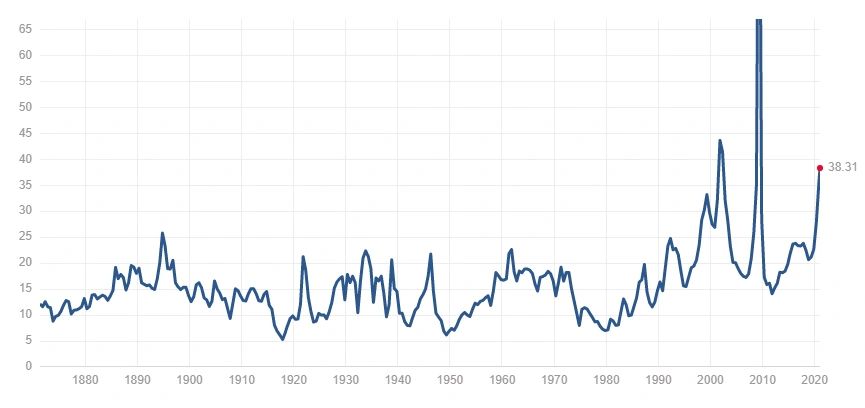
The above chart shows the short term-based PE ratio, a variation of the Shiller PE ratio.  It shows a rapid bubble formation is happening right now that matches the recent stock market crashes of 2000 and 2008.

In fact, it is very possible that the stock market may climb higher for the next several months fueled by cash injections from the government and the Fed. However, from a prudent trade off perspective, it is going to require taking on too much risk to try to cash in with this short-term outlook. 

Consider me the unpopular ski patrol who tells young “GoPro” kind of skiers not to go up on the peak of the mountain right after a big blizzard.  It won’t be a popular advice until after an avalanche happens. 

Looking 1~4 years ahead, the unconstrained money printing will lead to inflationary pressure along with a declining dollar value. This anticipation leads me to tweak existing investment portfolios to have a bit more position in high-quality foreign bonds, commodities, and carefully selected real estate investment trusts in lieu of long-term bonds. 

My correspondent replied:

Facts are facts.  The question is how to interpret them.  The data shown compared to 1929, 2000, and 2008 are true.  I think we are truly in uncharted waters with the government stimulus exceeding $5 trillion if Biden's $1.9 trillion package passes.  It may not.  There are for sure many stocks that are in a bubble where cash flow and earnings can't support the stock price -- pretty much all of those that had outsized gains in the past year (greater than 150%, maybe less in many examples).  They will take a dive when interest rates rise, the vaccine gets delayed, earnings or revenue, for those that don't have earnings, a signal right there, don't meet expectations, or employment doesn't come back as fast as it is forecast.

I think there are quite a few stocks that are not in a bubble.  That doesn't mean they can't go down in sympathy when the bubbles do burst but they will drop less and may be what people buy when they bail out of the bubble stocks. I am looking for more established companies that have reasonable growth prospects or that pay a good dividend, ideally both. 

My reply was this: 

I think we have been in uncharted waters since federal debt exceeded the nation's GDP years ago. Ten years ago I wrote about the "crush depth of debt" and I think we have been living on borrowed time (and money) since then. Like you, I have been transitioning more and more into established equities - in my case, away from individual stocks and into ETFs and mutual funds, including one or two that are losing money in a rising market, but give me a hedge. 
 
I also wonder at what point the degradation of American politics will begin to significantly affect the markets. The Democrat House, despite losing seats, is more determined than ever to crush "domestic terrorists," which of course really means anyone who opposes the Biden-Harris agenda. I may as well go on the record now: 2020 was the final national election of the United States as we have known it. No matter how the 2022 mid-terms turn out, the America of 2024 will be politically, formally fragmented. 
 
Just last October, more than half of Americans polled said they "believe the country is 'on the verge' of a second civil war." This did not come out of nowhere, that number has been rising for a number of years. Georgetown University’s Institute of Politics and Public Service polled the same question the same month and found that, "Partisan political division and the resulting incivility has reached a low in America, with 67% believing that the nation is nearing civil war... ." I do not myself predict an army-against-army conflict like 1861-1865, but I do forecast significant violence after the 2022 elections, no matter which party prevails, that will lead to some states seceding in polity if not in fact. 

Care to guess what that will mean for markets?
 
The only thing between now and then that might tamp down this rising probability down is that the one thing Democrats will never stand for is open defiance to their agenda. On inauguration day, Leftist anarchists violently rioted in Portland, Ore., against the Biden administration. The feds dispersed the rioters with tear gas and violence of their own. (Just imagine Dems' reactions if it had been Trump re-elected and the same thing was done.) Remember that in 1945, Stalin ordered the execution of German communists within his zone of occupation because once in power, Leftists will never accept competition, even from ideological allies. I do not think that Antifa will have an easy time for during the next two years, although they will never be named as "domestic terrorists" like almost all significant conservative organizations will be. 
 
So maybe investing more in international equities would be a good idea? Gold and/silver funds? As American continues fragmenting, I do not think that dollar-backed equities are going to do well. 

A world without nuclear weapons - what would it look like?

 From Pope Leo this week, according to the National Catholic Reporter : " Pope Leo quotes Bob Dylan song in book foreword calling for n...