Showing posts with label Videos. Show all posts

Sunday, October 8, 2023

The war in Israel

In late December 2008, Israel and Hamas fought a somewhat smaller-intensity war than what began this week. I took the occasion to write about what Hamas is, how it began, what its objectives are, and how the Hamas-Israel ongoing war can end (Notes on the Gaza Bombings). 

As you will see, not much has changed since then, except that the scale and ferocity of Hamas' attacks this week are evoking a much stronger Israeli response than in earlier years. Furthermore, Israeli Prime Minister Netanyahu was a professional solider before entering politics. While he faces criticism and controversy on domestic matters, Israelis know that his skills for this crisis are excellent.

In southern Israel there is a town called Sederot (sometimes spelled Sderot). It is only one kilometer from Gaza. Just Friday, Hamas gunmen drove through Sederot, shooting at Israelis.
I visited Sederot in October 2007, arriving only a few hours after it had come under rocket attack from Hamas, firing from Gaza. Such attacks were frequent. Here is my account, "The Sederot Gambit:" 

I will update this post from time to time with additional developments. It needs to be understood, however, that Hamas has literally, militarily invaded Israel. Dozens of towns in Israel were not only bombarded with Hamas rockets, Hamas soldiers went into them shooting people on the street without regard to age or status. John Hinderaker has posted several videos of just those things as they happened

Monday, April 25, 2022

Is Vladimir Putin driven by worsening illness?

 There are renewed rumors swirling about Vladimir Putin’s health (HT: Allan R. Bevere). New video shows him apparently gripping his desk tightly while sitting behind it, which the Daily Mail assessed thus: 


There is also video that the Daily Mail says shows "Putin looks unsteady in Easter church service footage showing him biting lip and fidgeting as health rumours grow and war continues to go badly." The Mail also recounts:

Vladimir Putin's five medically-related disappearances

November 2012: Business trips and long-distance flights of the president are canceled, some of Putin's meetings shown by the Kremlin turn out to be 'canned food'

March 5 – 15, 2015: Putin does not appear in public, all meetings are 'canned' - in other words pre-recorded events were shown with the pretence they were in real time

August 9-16, 2017: The President, with journalists, visits Abkhazia and Sochi, and then for a week the Kremlin publishes only 'canned food'

February 2018: In the midst of an election campaign, the president cancels public events. Peskov admits that the head of state 'had a cold'

September 13-29, 2021: Putin goes into 'self-isolation', all events are held via video link

Observers said Putin's actions are consistent with someone suffering from Parkinson's disease, which causes tremors, slow movement and stiffness.

And there is this tweet that purports to show Putin unsteady on his feet and walking somewhat irregularly. 

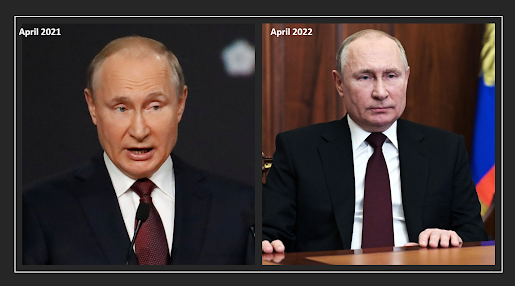
Here, though, are two photos of Vlad taken a year apart. I merged them into one side-by-side shot. The left photo is from an NBC News report from April 2021. The right photo is from now, April 2022, released by the Russian government. Do you see a difference? I do not strongly consider the difference in Putin’s pallor to be very significant because the lighting difference for the photos may have played a major part in that. However, months before now there was speculation that Putin was suffering from a chronic illness that made his face swell, which these (and other photos I saw) seem to show. And Newsweek repeats the rumor is that he is suffering from Parkinson’s Disease


Or it may be simply nothing much more than what former CIA Director John Brennan told MSNBC three days ago, “Video of Putin clutching table ‘shows that he’s a man that has quite a bit of stress’.” Yes, that is a ‘well, duh,’ statement, but that really might be all there is to it. Besides, the Russian (dis)info agencies all say Putin is well, is not taking meds or drugs, and is working hard etc. etc. etc.


I  note, though, that I have not found a single report of an actual physician making an observational assessment (not a diagnosis, of course) about what photos and videos convey about his health. So I will be even more pedantic that John Brennan and say simply, "Time will tell." 

Update: Now this:


Friday, September 10, 2021

Twenty years - and it is still not over

I made this YouTube video for the 10th anniversary of 9/11. But it is not tied to 2011.

Monday, March 22, 2021

The Priesthood of Politicism Offers Only Damnation

A progressive friend of mine posted this on his FB page. I was tempted at first to respond that the singular exception of either party that comes to mind is Donald Trump, in whose administration the incomes of minorities and the lower half of income earners rose faster and by a larger proportion than of whites and the upper earners. And that under Trump's policies, minority unemployment reached the lowest ever recorded. 

But I didn't so reply. Instead, it struck me that Stewart was basically correct, and that naming Trump as the exception simply buttressed Stewart's point. In fact, I agree with Stewart, but not fully because Stewart does not go near far enough. He pulls up way short of the issue. 

Following are three links, all dating well before Trump was even on the political scene at all, which should give a clue that the corruption of the federal government by far predates Jan. 20, 2017. 

The first is on billmoyers.com. Bill Moyers, now 86, is a lifelong Democrat who served as LBJ's press secretary for two years. His liberal-progressive creds are solidly established. And on his site is this article: "Anatomy of the Deep State," by Mike Lofgren. 
Yes, there is another government concealed behind the one that is visible at either end of Pennsylvania Avenue, a hybrid entity of public and private institutions ruling the country. ... the state within a state is hiding mostly in plain sight, and its operators mainly act in the light of day. Nor can this other government be accurately termed an “establishment.” All complex societies have an establishment, a social network committed to its own enrichment and perpetuation. In terms of its scope, financial resources and sheer global reach, the American hybrid state, the Deep State, is in a class by itself.
And as Lofgren explains, not only is it in a class by itself, it is in a class for itself and no one else. 

Second is a paper of a research project by Cambridge University, which, being in England, can hardly be accused of having a dog in the fight. Cambridge says its empirical research of American politics shows that
... economic elites and organized groups representing business interests have substantial independent impacts on U.S. government policy, while average citizens and mass-based interest groups have little or no independent influence.
Well, duh.
Third is, "America’s Ruling Class And the Perils of Revolution," by Angelo Codevilla. He is Prof. Emeritus of international relations at the Pardee School of Global Studies at Boston University. He also served as a foreign service officer and professional staff member of the Select Committee on Intelligence of the United States Senate.
Today’s ruling class, from Boston to San Diego, was formed by an educational system that exposed them to the same ideas and gave them remarkably uniform guidance, as well as tastes and habits. These amount to a social canon of judgments about good and evil, complete with secular sacred history, sins (against minorities and the environment), and saints. Using the right words and avoiding the wrong ones when referring to such matters — speaking the “in” language — serves as a badge of identity. Regardless of what business or profession they are in, their road up included government channels and government money because, as government has grown, its boundary with the rest of American life has become indistinct. Many began their careers in government and leveraged their way into the private sector. Some, e.g., Secretary of the Treasury Timothy Geithner, never held a non-government job. Hence whether formally in government, out of it, or halfway, America’s ruling class speaks the language and has the tastes, habits, and tools of bureaucrats. It rules uneasily over the majority of Americans not oriented to government.
As I said, all of these articles were published before Donald Trump was part of the country's political scene. Despite all the fury about Trump's presidential tweets and often off-putting personality, the real reason Washington pushed back against him was because "he is not one of us." It is true that under Trump the rich got richer, which ordinarily would be greeted joyously by Democrats and Republicans alike (but especially Democrats, who are now the party of and for the upper class). But that was far overwhelmed by the fact that the non-rich got richer also, and by higher margins than the wealthy. So the Trump years essentially were a time of wealth transfer from the wealthy Political Class to the non-Political Class, and that was simply intolerable. 

As Ben Weingarten explained last year, Trump exposed the rot and corruption of our ruling class.
[O]ne of President Donald Trump’s myriad achievements stands above all others: he has exposed the unprecedented degree of rot and corruption that pervades the American system.
 
More specifically, Trump has exposed the ruling class: the bipartisan political establishment and its adjuncts in Big Tech, the corporate media, Big Business and Woke Capital, the academy, and across the commanding heights of American society.
 
Trump’s manners engender hatred in the ruling class. Even more significantly, his tenacity in confronting the ruling class’s members with their failures—and the fact he has threatened to rectify those failures—discredits and disempowers those responsible for them. Their response—a perpetual effort to destroy him—has shown the ruling class to be lawless and tyrannical.
But Trump's truly unforgiveable sin for which no redemption was possible was this: he accurately identified China as the chief threat to America's political security, and took steps to oppose it. The literally uncounted and uncountable tens to hundreds of million dollars the Chinese Communist Party has poured into Political Class pockets has become its addiction, and no one is ever going to be allowed to turn it off or even reduce it. 

Two months before 2016's election, it was clear to Prof. Codevilla that America's status quo "has resulted in citizens morphing into either this class’s stakeholders or its subjects." 
From the primary season’s outset, the Democratic Party’s candidates promised even more radical “transformations.” When, rarely, they have been asked what gives them the right to do such things they have acted as if the only answer were Nancy Pelosi’s reply to whether the Constitution allows the government to force us into Obamacare: “Are you kidding? Are you kidding?”
 
On the Republican side, 17 hopefuls promised much, without dealing with the primordial fact that, in today’s America, those in power basically do what they please. Executive orders, phone calls, and the right judge mean a lot more than laws. They even trump state referenda. Over the past half-century, presidents have ruled not by enforcing laws but increasingly through agencies that write their own rules, interpret them, and punish unaccountably—the administrative state. 
In 2004, Glen Wishard wrote "A Thumbnail History of the Twentieth Century," boldface original:

The common theme is politics as a theology of salvation, with a heroic transformation of the human condition (nothing less) promised to those who will agitate for it. Political activity becomes the highest human vocation. The various socialisms are only the most prominent manifestation of this delusion, which our future historian calls "politicism". In all its forms, it defines human beings as exclusively political animals, based on characteristics which are largely or entirely beyond human control: ethnicity, nationality, gender, and social class. It claims universal relevance, and so divides the entire human race into heroes and enemies. To be on the correct side of this equation is considered full moral justification in and of itself, while no courtesy or concession can be afforded to those on the other. 
Therefore, politicism has no conscience whatsoever, no charity, and no mercy. 
I have said before that politics is the religion of America today, frankly much more on the Left than the Right, but not absent from the Right at all. 

Orwell was correct that politics very easily can can become nothing but gaining and keeping power. When that happened within one party - note past tense - in America, no one should be surprised that eventually the other party followed suit. 

That is where we are: politics in America is a literally religious-type quest for power - and for nothing else at all. We are way past (I say many years past) the times when effective, enduring compromise was possible. It is not. 

I do not see any way to reverse this. I am reminded of a disease I read of some time ago, that once it becomes symptomatic, it is too late to treat it. I think that politically that is where we are now. It seems clear to me that we no longer live in the "United" States of America, and I see no way to regain that. 

The question is whether the United States will survive in its present form, or will some kind of dissolution come to pass. Personally, I am not optimistic

 
See also:

Social Democracy is Collapsing Before our EyesAmerican civic life is fracturing, and everyone knows it.


Thursday, August 1, 2019

What next for us?


There is said to be a Chinese curse that simply says, “May you live in interesting times.” Whether a curse or not, I’d say we are certainly living in interesting times!

I think most of you know that the United Methodist Church is facing an uncertain future as a denomination. The General Conference (GC) is the only body that makes denomination-wide policy. It is useful to recall that the UMC is a worldwide church with several million members outside the United States.

Since the GC of 1972, the UMC has been wrestling with what shall be the denomination-wide position regarding homosexuality. Presently, the UMC's position is that homosexuals, like all other peope, "are persons of sacred worth" and are invited to become part of the body of Christ through baptism, to celebrate Holy Communion, and to serve in the church as fully as everyone else, with two exceptions:
  • "Self-confessed, practicing homosexuals" may not be ordained as ministers of the UMC, and
  • No UM minister, whether ordained or licensed, may officiate a same-sex wedding anywhere, nor may such ceremonies be conducted on the grounds of UM churches, no matter who officiates. 
By the time of the 2016 GC, the durability and mounting intensity among progressives and traditionalists had reached the point where a special General Conference was set for February 2019. It was intended that this GC would provide the definitive position of the church, for no other business was to be brought before it.

Last February, the General Conference retained the existing position and strengthened it. Some provisions of what was passed were subsequently nullified by the UM Judicial Council. But the core parts were retained. See here.

Even so, the debate is far from finished. The GC regularly meets every four years and will convene again in May 2020. There is, as of now I think, a widespread belief among all sides of that issue that no compromise-outcome is really possible. I am reminded of Abraham Lincoln’s observation in his 1858 “House Divided” speech, that every solution to the slavery question had been attempted and failed and no more compromising was possible. The nation, he said, would eventually either legalize slavery in every state or in abolish slavery in every state. What it could not do any longer was maintain the status quo.

I think that is what progressives and traditionalists alike are concluding about the UMC’s position on homosexuality. Everything that can be tried has been tried, and the subject is still not settled within the denomination. The One Church Plan, endorsed by the Council of Bishops, was rejected last February and no one today is promoting it for next May.

If I could forecast now the GC will decide next May, I could make a fortune on the stock market. I know that many influential progressive and traditionalist Methodists across the country are in ongoing conversation. I am gratified not have seen or read of spite-filled language or personal attacks by either side.

But what about us?

I echo what Bishop McAlilly told the annual conference in June. I am pastor of all the people of the church and I will not be drawn into partisan positions. Of course, I have my beliefs about this issue, but as I told the annual conference, “I could be wrong” (an admission I wish everyone progressive or traditionalist would also make).

TNAC 2019 Bishop's Remarks from TNUMC on Vimeo.

"It's tough to make predictions, especially about the future." Even so, here are my predictions:

Our calling to be disciples of Jesus Christ will not change even though our denomination is going through “interesting times.” Jesus’ Great Commandment to go make disciples shall remain before us.

We shall face the future unafraid because
  • we are still united in our baptism even if not by certain beliefs on this (or other) topics,
  • we therefore will continue to worship together and move on to Christian perfection through deeds of devotion, charity, and justice.


These "interesting times" are temporary. Christ’s church is eternal!

Regardless of the future of the United Methodist Church, we remain united in our prayers, our presence, our gifts, our service, and our witness.

The Lord is with us! Let’s remain with the Lord -- and with one another!

Thursday, May 10, 2018

The perplexed, confused mind of the atheist skeptic

I do not know anything about the atheist radio talk show in the clip at bottom that non-Christian historian Bart Ehrman appeared on. As Ehrman says in the interview, "I am not a believer" in the divine nature of Christ. And that is probably why, as he says in the tape, atheist groups and the like keep calling on him to help them rebut Christianity. Below is his response to such a call asking him to affirm that in fact no such person as Jesus of Nazareth ever existed.
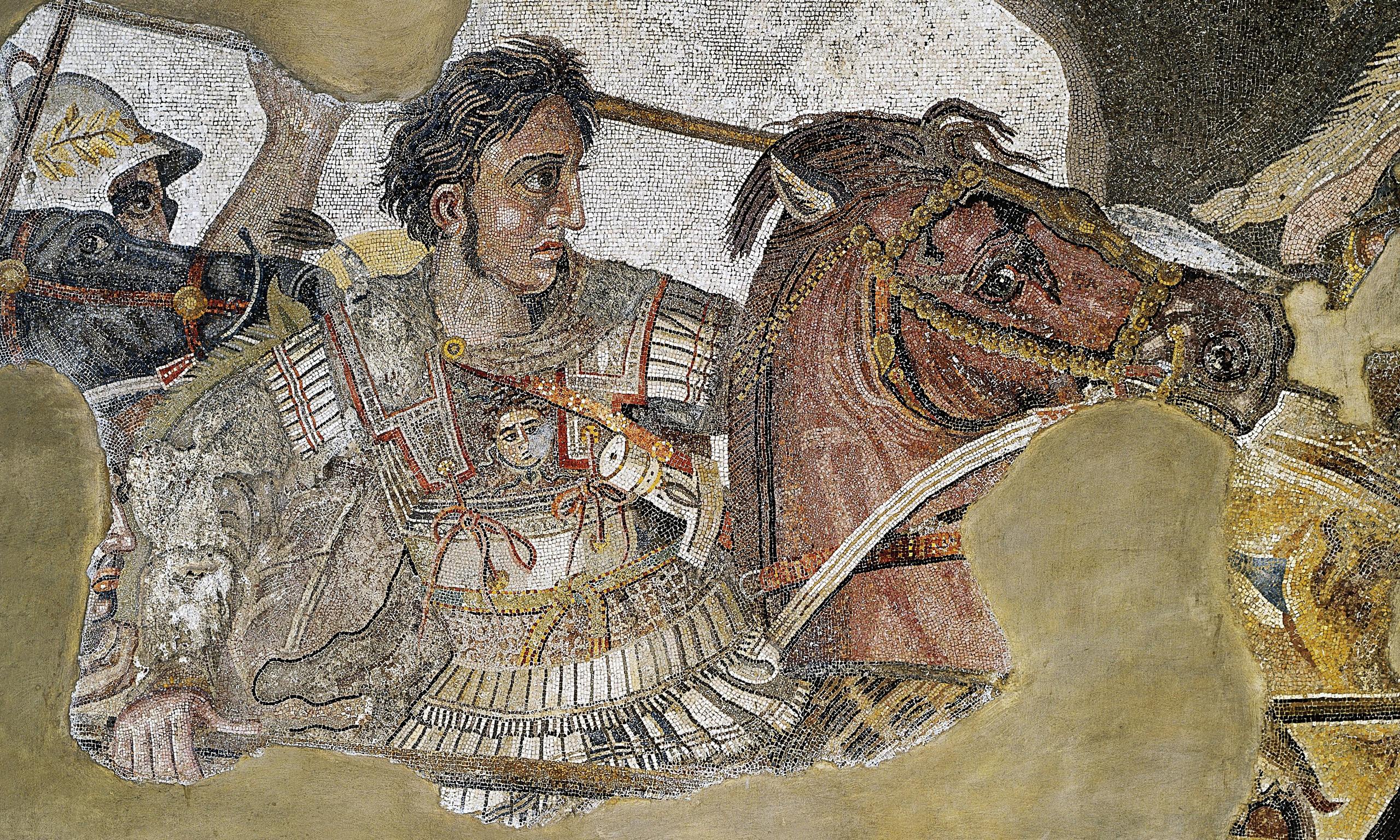
Alexander the Great.
His historical existence is much less well attested than that of Jesus of Nazareth.
However, as Ehrman points out, the historical existence of Jesus is better attested than almost anyone else from his era, better attested, in fact, than Julius Caesar. And, although not included in this segment, it is probably worth noting that the earliest reference to Alexander the Great, who died in 323 BC, dates from 300 years afterward,  and the record that is considered most reliable dates 200 years later than that.

That's as if we know the American Revolution occurred in the 1770s, but no record of George Washington will be made until the year 2081, 67 years from now.

And no one doubts that Alexander lived. However, the earliest writings about Jesus of Nazareth, the letters of the apostles, date beginning less than 20 years after Jesus died during the governorship of Pontius Pilate.

So why do these people keep insisting that Jesus never lived, that his character is wholly fictional? Because if you stick to that claim, they think that everything else about Christian faith can be easily dismissed. But that is not so, either. About which more later.

Here is the radio interview with Bart Ehrman, an American New Testament scholar focusing on textual criticism of the New Testament, the historical Jesus, and the development of early Christianity. He has written and edited 30 books, including three college textbooks. He has also authored six New York Times bestsellers. He is currently the James A. Gray Distinguished Professor of Religious Studies at the University of North Carolina at Chapel Hill. He does not claim Christian faith.


Here is Prof. Ehrman explaining elsewhere that atheists' claim that Jesus is a fictional figure make them, in Ehrman's words, "look foolish."


A companion video is of Prof. William Lane Craig, an American analytic philosopher and Christian apologist. He holds faculty positions at Talbot School of Theology (Biola University), and Houston Baptist University. He has debated the existence of God with public figures such as Sam Harris, Christopher Hitchens, and Lawrence M. Krauss. Craig established and runs the online apologetics ministry ReasonableFaith.org.

Here Dr. Craig discusses the relevance of non-biblical sources about Jesus. 


Bookmark and Share

Tuesday, May 9, 2017

Maybe the best war movie ever made is Russian

I thought about posting this on Memorial Day weekend but the fact that White Tiger is a Russian (post-Soviet, 2012) movie made me reconsider.


IMDB.com summarizes it thus:
Great Patriotic War, early 1940s. After barely surviving a battle with a mysterious, ghostly-white Tiger tank, Red Army Sergeant Ivan Naydenov becomes obsessed with its destruction.
Which is true as far as it goes, but this is not just a duello movie of two single-focused, even near-fanatic tank crews gunning for one another. It's not a land-borne version of The Enemy Below. White Tiger is a penetrating inquiry into war and the human condition. The German tank and the Russian protagonist are archetypes not just of soldiers anywhere, but of fallen humanity itself. Fortunately, you can watch the whole movie, subtitled in English, right here. It seems its copyright does not extend to the United States (update: it is also now in Amazon Prime).


At the very end is a monologue by Adolf Hitler, speaking to an unidentified man couched in shadows. Despite the identity of the speaker - and the screenplay's words in his mouth are reflective of what Hitler said and thought - the monologue is quite thought provoking, coming as it does following the last view of the Russian tank we see, and why and how we see it.

This is a very serious, compelling work of cinema. I hope you will agree.

Bookmark and Share

Sunday, May 29, 2016

Courage, an essay for Memorial Day

On Memorial Day we remember the men and women who gave their lives in the service of our country or who have died since their time of service. We should be careful to distinguish between this day and Veterans Day, a day set aside to pay tribute to those serving now or who have served and are still living.

While giving honor to more than one million, one hundred thousand American men and women who died in battle, we draw up short of honoring war itself or glorifying it. General William Tecumseh Sherman, the Union commander who devastated vast swaths of Georgia and both Carolinas during the Civil War, wrote to his wife at war’s end,
I confess, without shame, that I am sick and tired of fighting — its glory is all moonshine; even the most brilliant success is over dead and mangled bodies, with the anguish and lamentations of distant families ... it is only those who have never heard a shot, never heard the shriek and groans of the wounded and lacerated ... that cry aloud for more blood, more vengeance, more desolation.
Yet while the dead whom we honor today would almost certainly agree with General Sherman's sentiments, they also knew that it is untrue that nothing is worth fighting for. Teddy Roosevelt earned wartime honors in the Spanish-American war and then received the Nobel Peace Prize for brokering the end of the Russo-Japanese war. Roosevelt put the tension between our desire for peace and the sometime necessity of war this way:
[M]y disagreement with the peace-at-any-price men, the ultra-pacifists, is not in the least because they favor peace. I object to them, first, because they have proved themselves futile and impotent in working for peace, and second, because they commit ... the crime against morality of failing to uphold righteousness as the all-important end toward which we should strive ... To condemn equally might which backs right and might which overthrows right is to render positive service to wrong-doers. . . . To denounce the nation that wages war in self-defense, or from a generous desire to relieve the oppressed, in the same terms in which we denounce war waged in a spirit of greed or wanton folly stands on a par with denouncing equally a murderer and the policeman who, at peril of his life and by force of arms, arrests the murderer. In each case the denunciation denotes not loftiness of soul but weakness both of mind and morals. – America and the World War
But I am not exploring today the topic of just or unjust wars. This post is about courage.


Every member of the service who faces battle knows about fear. But there are ample opportunities in the military to be in fear in either peace or war.

One fearful day for me was on Sicily drop zone at Fort Bragg, North Carolina, on July 1, 1987. A C-130 approached to drop off a Sheridan armored reconnaisance vehicle, flying about five feet above the ground. The chutes deployed but the C-130 hit the ground flat on its underside. It was about 75 feet away from me. The pilot gave the engines full throttle, trying to get back into the air, but the landing gear was buried in the sand and the tail assembly had almost been severed by the impact. The plane ran into a wooded ravine where it blew up.

My friend, Maj. Baxter Ennis, was with me. Like many of the other soldiers present, we ran into the flames because in the military you never abandon your comrades. There was fire and smoke everywhere, not only from the burning jet fuel; the forest was on fire, too. The heat was extremely intense. We finally left, having accomplished nothing. This is that crash:


Two flight officers in the cockpit were severely burned but lived. Four aircraft crewmen and a soldier on the ground were killed. I had never met them. I didn’t even know their names until the news media broadcast them. But I don’t think a single week has gone by since then that I don’t think of them, and think of that day.

The pilot was Captain Garry Bardo, Jr..
The navigator was First Lieutenant John B. Keiser, III.
The loadmaster was Technical Sergeant Timothy J. Matar.
The assistant loadmaster was Airman First Class Albert G. Dunse.
The soldier was Staff Sergeant Douglas Hunter.

These are some names I am remembering for Memorial Day.

William Manchester won the Pulitzer Prize for his biography of John. F. Kennedy. Manchester fought on Okinawa as a Marine sergeant. He wrote of single-handedly entering a building to take out an enemy sniper: “There was a door which meant there was another room and the sniper was in that—and I just broke down. I was absolutely gripped by fear that this man would expect me and would shoot me.”

Fear in danger hardly needs justification. It is not fear that needs explanation, but courage. As one veteran wrote, the reasonable thing in battle would be to run away. Whence comes the courage to stay, much less courage to heroics? Were they truly willing to die for their country? I don't think so. There's an old story that goes back probably to the Civil War of the young soldier whose commander asked him, "Are you willing to die for your country?" The young man answered, "Certainly not. But I am ready to die, unwilling."

What is courage? Courage is not simply the absence of fear. Indeed, many men who have been awarded the highest decorations for bravery in battle admit they were frightened the entire time.

No, courage is not the lack of fear. One facing real danger without fear is either a fool or ignorant. As someone once wisecracked, "When everyone around you is losing their head and you’ve kept yours, then you don’t understand the situation."

So, then, is courage the mastery of fear? The will to act despite danger and the fear of it is necessary for courage to come forth. But even that falls short as a workable definition. Courage, like fear, is mostly an emotional response to the danger. Courage is not unthinking, but it is usually uncritical. Courage is an act of will but more than that. Courage is an act of being.

Many soldiers have done heroic acts and later said they were hardly in control of themselves. The ancient Greeks called this state katalepsis, "possession," and even the Spartans tried to train their soldiers never to fall under this condition. Audie Murphy was awarded the Distinguished Service Cross for action in this condition after his best friend was killed. In this state there is no conscious fear and heroic deeds seem reckless more than courageous.

Without fear there is no courage, but fear and courage are not opposites. Courage is the opposite of cowardice, not of fear. Courage and cowardice are opposite sides of the same coin, but what is the obverse side of the coin of fear?

Again we consult ones who have seen both sides of the coin. William Manchester suffered a non-life-threatening wound on Okinawa that sent him to the honorable safety of a field hospital. There he learned that his unit would make an amphibious assault further up the island. Manchester explained in his book, Goodbye, Darkness, that the thought of his friends facing danger without him to help them “was just intolerable.”
Those men on the line were my family, my home. They were closer to me than I can say. I had to be with them, rather than let them die and me live with the knowledge that I might have saved them.
He went AWOL from the hospital, joined his unit was blown nearly to bits by Japanese artillery in the ensuing battle.

Military service, especially in battle, is steeped with the convictions of deepest emotion. In battle there is fear and courage, anger and compassion. There is resignation and determination. There is hope and despair. The chief emotion of the battlefield, unlikely as it may be, is love. When patrolling deserts of Iraq or the mountains of Afghanistan, soldiers stay where flies the angry iron not for country or flag or other abstractions. In the final sense they fight for their friends. One Iraq veteran wrote,
I've found the hard way that war is not glamorous. You quickly lose the idea of being a man fighting for his country when you have to carry your comrade who has been wounded in a gun fight. That nobility is lost quickly. ... It's not about fighting for the flag, it's about fighting for my life and fighting for my buddies' lives. These men I am lucky enough to serve with, I have become so attached to it's like they are my brothers.
The opposite of fear is not courage. It is love. The apostle John wrote (1 John 4:16-18),
And so we know and rely on the love God has for us. God is love. Whoever lives in love lives in God, and God in him. In this way, love is made complete among us so that we will have confidence on the Day of Judgment, because in this world we are like him. There is no fear in love. But perfect love drives out fear, because fear has to do with punishment. The one who fears is not made perfect in love.
John was not writing of the battlefield, of course, but of why disciples of Jesus Christ should have no fear of the judgment of God because God loves us and we love God. God's love is perfect to begin with. It's our love of God that must be perfected. The more perfectly one loves God the less one fears God.

In the Old Testament, the admonition to "fear God" mostly means to hold in reverential awe rather than to be actually afraid. The New Testament uses fear that way, too. But Jesus warns us that God is to be feared in the usual sense of the word. In Luke 12:5, Jesus said, "But I will show you whom you should fear: Fear him who, after the killing of the body, has power to throw you into hell. Yes, I tell you, fear him."

He's talking about God and the judgment of God. What insures us against the judgment of God and therefore against the fear of hell's punishment is love. A misconception among church people is that it is God's love for us that removes this fear. To the contrary, it is our love for God. "There is no fear in love. But perfect love drives out fear."

Love displaces fear just as oil displaces water. It is not just the fear of God that is banished by love for God. It is the fear of most anything life can throw at us. I am not confusing fear with concern or caution. It is reasonable to maximize one’s chances for good outcomes in danger or times of uncertainty. That is one thing, but to be gripped by fear is another. Love drives out fear as long as we remember that there is nothing in this life or after it that can separate us from the love of God in Jesus Christ, and that, as Paul put it, the sufferings of this world do not compare with the glory that God has in store for us (Rom 8.18).

Yet there is a paradox here. If love drives out fear, then is love the only source of courage? “Among men who fight together there is an intense love,” Manchester explained. His story of leaving the field hospital is a love story. Yet it was a fear story, too. His fear, as he also admitted, was that his friends would be in danger and unless he was with them he would not be able to do anything about it. Here his fear for his friends’ safety was not driven out by his love for them, his fear for them and love for them combined to evoke courage. Love and fear, two sides of the same coin. Manchester’s courage was born of both fear and love to place himself in danger to protect his comrades.

Former Marine and author Steven Pressfield put it this way in Gates of Fire:
What can be more noble than to slay oneself? Not literally. ... But to extinguish the selfish self within, that part which looks only to its own preservation, to save its own skin. ... 
When a warrior fights not for himself, but for his brothers, when his most passionately sought goal is neither glory nor his own life’s preservation, but to spend his substance for them, his comrades, not to abandon them, not to prove unworthy of them, then his heart truly has achieved contempt for death, and with that he transcends himself and his actions touch the sublime. That is why the true warrior cannot speak of battle save to his brothers who have been there with him. The truth is too holy, too sacred for words.
Anita Dixon, of Wichita, Kan., whose son Army Sgt. Evan Parker was killed while serving in Iraq in 2005, kisses the graves in section 60, where many of the casualties from Iraq and Afghanistan are buried, among flags placed in preparation of Memorial Day at Arlington National Cemetery in Arlington, Va. on Thursday May 27, 2010. 'I'm putting a kiss on the graves because they're all brothers,' says Dixon, ' the military is a family.' says Dixon. (AP Photo/Jacquelyn Martin)

Whether they served in peace or war, the men and women we memorialize today were not so impoverished of spirit that they were unable to surrender the pleasures of life. They deemed that their love of country and duty to freedom were of greater value and more important imperative, so they reckoned that if dangers must be faced, they would face them in the most desirable way, by placing their own mortal bodies "between their loved homes and the war's desolation."

Because of their sacrifice we go safely to our homes. Henceforth we should stand in humility when their names are read. This date should never go by but that on it our fallen shall be remembered.

The prophet Micah wrote that the time will come when God will judge between all the peoples and will settle disputes between strong nations far and wide. They will beat their swords into plowshares and their spears into pruning hooks. Nation will not take up sword against nation, nor will they train for war anymore. All people will be at peace, and no one will make them afraid (Micah 4:3-4).

Let us pray that day comes quickly. Until then may the Lord watch over those who serve today, to make them instruments of justice, enablers of peace, and finally to see them safely home.

Bookmark and Share

Thursday, May 12, 2016

Organizational maturity is a death sentence

When I was an artillery officer on the staff of XVIII Airborne Corps at Fort Bragg, NC, in the latter 1980s, it fell to me to be assigned as the escort officer for Miss North Carolina to the anniversary dinner of the Fayetteville chapter of the Association of the US Army, or AUSA. It was a community-relations gig.

Tough duty, I know, but it had to be done so I just rubbed my artillery insignia, tossed down a cup of coffee and headed off to the trenches.

I'll say not a word about the truly stunning woman at my arm as we entered and dined (for I was and still am married to one) but will relate what led me in the next few days to develop my theory or Organizational Maturity.

After the meal came the business part of the dinner meeting. Then as now, AUSA says it's purpose is "to support all aspects of national security while advancing the interests of America's Army and
the men and women who serve. AUSA is a private, non-profit educational organization that supports America's Army - Active, National Guard, Reserve, Civilians, Retirees, Government Civilians, Wounded Warriors, Veterans, and family members."

Um, not that night.

The entire discussion of the post-prandial meeting was taken up by devoted talk that chapter was threatened with losing its status as the largest chapter of AUSA in membership numbers.

"How to get more members? What do we do with members who are enrolled but don't pay their dues? How do we replace lapsed or deceased members? How do we reach the young people?"

Etc, etc, etc.

Not one word about the troops. Not. One. Word.

And so here is Don's Theorem of Organizational Maturity:

Every organization that does not directly depend on profit-loss models to stay operating eventually abandons its founding purposes and focuses inward, concerned first with keeping itself going and then with sustaining its membership's comfortableness.

This is the special threat to volunteer organizations. It is always a sign of the organization's decline.

It works like this:

Friday, February 12, 2016

Where will you run to?

The Cleansing of the Temple statue at a Liverpool art gallery
The Rev. Richard Hall explains this photo:
Visitors to a Liverpool art gallery are being shaken by the sight of a new statue of Jesus. Called ‘The Cleansing of the Temple’, I don’t suppose it is meant to represent ‘Gentle Jesus meek and mild’, but reactions have been even more extreme than the artist intended. Some are convinced the statue is evil and recoil in terror. Others fall to their knees in prayer. Some say they see sparks coming from the statues eyes.
Gerard Van Der Leun quotes the lyrics of 16 Horepowers’ song, “Sinnerman.”
 o sinnerman where will you run to
sinnerman where will you run to
All on that day
Run to the mountain
The mountain wont hide you
Run to the sea
The sea will not have you
And run to your grave
Your grave will not hold you.
All on that day.
Gerard explains,
Many years ago, I was flipping through the pages of a newsmagazine and came upon a photograph of the machete-hacked corpse of a child floating like some half-chewed chunk of jetsam in a backwater of Lake Victoria. This was during what we now think of, because we have to think of it as something distinct from our normal run-of-the-mill massacres, as the Rwanda genocide.

It was a crystal clear photograph showcasing an act of genocide like any other, only the meaningless details changed: children, machetes, an African lake. As a professional in the pornography of violence, the photographer had gotten in close. The child’s eyes could be seen. They were without pupils, a dead fish-belly white; the white of clotted milk. …

The child was long since buried or left to dissolve as mere carrion. What had disturbed me was only the abstraction of a child snagged out of the world with photographic film, transmitted across the oceans via orbiting satellites. printed up on sheets of flimsy paper, and delivered to me and millions of others on a weekly basis…. to what purpose? To. What. Purpose.

Because I needed to know? What did I know? That we are, each and every one of us, capable of the darkest evil? This much I’d known long before I’d known it. Did I see it because I needed more confirmation? I’d long been confirmed. And yet the image stuck in my mind, not as an obsession, but as an unbidden harbinger. And in time, I came to know it’s purpose.

It’s purpose was to teach me to hate God. …
Ah, holy Jesus, how hast thou offended,
that we to judge thee have in hate pretended?
By foes derided, by thine own rejected,
O most afflicted! 

(Johann Heermann)


Gerard continues,
Childhood leukemia? God’s on the job. A close friend is shot-gunned on 14th street in a mugging? God’s there pulling the trigger. Yet another mass grave in yet another subdivision of Hell in Europe, Africa, the Middle East? God’s working the back-hoe. It’s all a tough and dirty job and nobody but God has the moral clarity to do it. He’s the original Bastard. A real Professional. To top it all off He had billions of fools convinced of His mercy and His goodness. They were ready to tell you that “God so loved the world. …
But,

O sinnerman where will you run to

All on that day

Then one day,
It was a jester that stopped my hate of God. Not a great jester, I'll grant you, but a jester just the same. He used to caper for donations in the Central Park Zoo. Perhaps he capers there today. I wouldn't know.
Since this jester's act was pitched towards humans with no more than five or six years of experience in the world, the only people that ever stopped and listened and watched him were little children with their parents or nannies. And on one particular day, for no clear reason, myself. ...

Maybe it was because I was tired of hating God at every turn. Maybe it was because I'd simply come to the end of wanting to take the woes of the world onto my shoulders. Maybe it was because I just happened, at that moment, to be ready to snap out of it. Or maybe it was because of the childish message of the song. Urban sophisticates can, after all, be some of the densest matter in the universe, and sometimes need to be spoken to in very simple ways. 
For me, the voice said something like, "Oh, come off it and cop to your own shortcomings. I gave you everything there is and now you want Me to fix it? Be glad I made it fixable. And, if I hadn't made it the way it is, there'd be no you hanging around to hate Me, would there?"
And my hatred of God left me. 
There wasn't any kind of great switcheroo where my hatred was replaced with love and the peace that passeth all understanding. It wasn't a replacement. It was a departure. And nobody waved goodbye. Least of all me.
I did not forget the photograph. I would never forget the photograph. But I did let go of the idea that the evil it embodied was an Act of God. It took me a long time, a lot of hate, and a very simple song before I came to understand that every act of evil is an Act of Man. 
Lo, the Good Shepherd for the sheep is offered;
the slave hath sinned, and the Son hath suffered.
For our atonement, while we nothing heeded,
God interceded.

There was a day when Jesus was teaching in the synagogue at Capernaum, where he said,
“This is indeed the will of my Father, that all who see the Son and believe in him may have eternal life; and I will raise them up on the last day.” … And he said, “For this reason I have told you that no one can come to me unless it is granted by the Father.” Because of this many of his disciples turned back and no longer went about with him.
O sinnerman where will you run to …
Run to the mountain
The mountain wont hide you
Run to the sea
The sea will not have you
And run to your grave
Your grave will not hold you.

So Jesus asked the twelve, “Do you also wish to go away?” Simon Peter answered him, “Lord, to whom can we go? You have the words of eternal life.”

Your grave will not hold you
all on that day
run to the lord

The Hebrew Scriptures say that the word of the LORD came to Jonah son of Amittai: “Go to the great city of Nineveh and preach against it, because its wickedness has come up before me.” But Jonah ran away from the LORD and headed for Tarshish. He went down to Joppa, where he found a ship bound for that port. After paying the fare, he went aboard and sailed for Tarshish to flee from the LORD. Then the LORD sent a great wind on the sea, and such a violent storm arose that the ship threatened to break up.

O sinnerman where will you run to
O sinnerman where will you run to?

Then the sailors said to each other, “Come, let us cast lots to find out who is responsible for this calamity.” They cast lots and the lot fell on Jonah. … The sea was getting rougher and rougher. So they asked him, “What should we do to you to make the sea calm down for us?”

“Pick me up and throw me into the sea,” he replied, “and it will become calm. I know that it is my fault that this great storm has come upon you.”

Instead, the men did their best to row back to land. But they could not, for the sea grew even wilder than before. Then they cried to the LORD, “O LORD, please do not let us die for taking this man’s life. Do not hold us accountable for killing an innocent man, for you, O LORD, have done as you pleased.” Then they took Jonah and threw him overboard … .

O sinnerman where will you run to?
Run to the sea
The sea will not have you
And run to your grave
Your grave will not hold you
all on that day.

Where can we run to? The Psalmist asked that question: “Where can I go from your spirit? Where can I flee from your presence?” Jonah surely did not think he could escape God. He instead sought to disqualify himself from carrying out God’s command by running away from what God wanted him to do.

Is that the escape we try to make, too? To run away from our God-commanded responsibilities? Why on earth do we think we can succeed? Not even the grave can hide us when the Lord comes again. The prophet Malachi had words to say about that:
But who may abide the day of his coming? and who shall stand when he appeareth? for he is like a refiner’s fire … And he shall sit as a refiner and purifier of silver: and he shall purify the children of Levi, and refine them like gold and silver, that they may give offerings to the LORD in righteousness.
O sinnerman where will you run to?
Run to the mountain
The mountain won’t hide you
Run to the sea
The sea will not have you
And run to your grave
Your grave will not hold you
all on that day.
Run to the Lord.
When you gonna stop running?
When you gonna cease fleeing?
When you gonna stop hiding?
When you gonna start heeding?
O sinnerman, Jesus is calling!
O sinnerman, Jesus does see you!
O sinnerman, Jesus is coming,
all on that day!
O sinnerman where will you run to?
Run to the Lord!

For me, kind Jesus, was thy incarnation,
thy mortal sorrow, and thy life’s oblation;
thy death of anguish and thy bitter passion,
for my salvation.
Therefore, kind Jesus, since I cannot pay thee,
I do adore thee, and will ever pray thee,
think on thy pity and thy love unswerving,
not my deserving.


Thursday, April 9, 2015

Top Gun for churches!

Remember this scene from the iconic mid-1980s movie, Top Gun?


Only the top Navy crews were selected for this advanced training, but they were routinely defeated in mock combat missions by the instructor pilots and crews. At the end of the course, the students were leagues beyond where they began.

An initiative by the Tennessee Conference called Healthy Congregations may be thought of as Top Gun for churches. Even if a church is the best of the best, Healthy Congregations will make it better. 

Westview UMC will have its first Healthy Congregations session Sunday afternoon, May 3, following our special Cinco de Mayo fellowship meal. 

Healthy Congregations is training, it is not a program. Its basis that churches (like any human organization) are systems of relationships among their members. The chief way that congregations are unhealthy, or not, is the ways in which they handle anxiety and conflict. 

Anxiety and conflict are in themselves neither healthy nor unhealthy, but the way that they are handled and resolved is one or the other. 


Is is not anxiety per se that inhibits church health, but how its members relate to one another in handling and coping with that anxiety. 

After all, a lack of anxiety in a church is not necessarily a good thing. Quick, name one human organization that is permanently free of anxiety!

This:


A church that is always free of anxiety is probably terminal and may already be dead!

Healthy Congregations training helps congregations make healthier decisions, be focused on their vision, receive inoculation against unhealthy conflict, and keep a healthy process of dealing with conflict. It is a better way of understanding people’s interactions and how to improve them for the betterment of the church. 

Healthy Congregations is not a program that requires maintenance or a committee to manage it. It evokes no new annual nominations or elections and requires no supervisor.

For Whom: The entire church.

When: Each session is scheduled individually. At least 3½ hours is needed, five hours are better; the decision is up to the church. A meal may be included in addition to the training time. 
Facilitators: Facilitators are of the Tennessee Conference and have been trained and resourced by the National Healthy Congregations organization.
What is included? Below are the six training options. Workshop 1 will be the first session. The other options are available if a church wishes to schedule additional training in the future.
·        Workshop 1: Creating Healthy congregations helps churches to accept and deal with differences and disagreements, and change in a very healthy and productive way while maintaining a focus on their strengths and mission.
·        Workshop 2: Healthy Congregations respond to anxiety and change by identifying and dealing with anxiety in the church, the management of conflict, and the development of flexibility and creativity while managing the conflict.
·        Workshop 3:Healthy Congregations helps leaders increase their ability to manage anxiety in themselves and in a congregation through how they function as leaders rather than through programs and techniques. These include developing leaders with immunity to processes that tear down the fabric of the church community.
·        Workshop 4:Healthy Congregations strengthens relationships with members through healthy forgiveness, truth telling, connecting, and graciousness encouragement and care.
·        Workshop 5:Healthy Congregations develop generous people by looking at broad perspectives around stewardship and tying it into emotional processes.
·        Workshop 6:The Spiritual Care of Healthy Congregations focuses on members’ spiritual holiness and health, hospitality, and their “beginning again as a way of life.”
All of the workshops use realistic video scenarios to illuminate the lessons and learning. Many attendees nod their heads throughout!

Here is the national organization's video introduction.


Please reserve Sunday, May 3's afternoon for this valuable, important training! I guarantee you will be glad you did at the end of the first workshop!

Sunday, April 20, 2014

He is risen! He is risen, indeed!


The two most profound events in the Bible are Christmas and Easter, the birth and resurrection of Christ. I find it odd that we have so much made them child centered, and use childish rituals to celebrate them. I think it is the way adults avoid facing the soul-shattering seriousness of them. M. Craig Barnes, pastor of National Presbyterian Church in Washington, D.C., wrote, 
We think of Easter as a time for bunnies and little chicks, colorful eggs, and little girls in cute new dresses. But we ought to be thinking about grown women, with their dresses hiked up to their knees, running with terror out of a cemetery. . . . Easter is not about renewal, [not about] new beginnings, [not about] the perseverance of the human spirit... .
... and it is certainly not about daffodils pushing blooms up through the soil or chicks hatching from eggs! None of that sentimental drivel can comfort the next of kin of the Terror War dead or the Syrian Christians being killed or exiled at the hands of al Qaeda. 
 
What Easter is, is that “Christ has died, Christ has risen.” Jesus’ resurrection means that the worst thing that happens to us is not the last thing that happens to us. Christ’s resurrection reveals that we do not die, “period”; we die, “comma.” On Easter God turns pain to power; God transforms tragedy to triumph and pushes through crucifixion to resurrection.
If Christian faith is about nothing but the here and now, then the Apostle Paul admits it isn't worth the time we spend on it. That is why the cross and the empty tomb stand at the center of our relationship with God and one another. On the cross is where the proclamation that Jesus was “God with us,” was made completely true, for Jesus died as we do. Easter's empty tomb beckons us to trust in a gracious God who provides throughout both our life and our death. 
 
Yet our deepest horror is not death itself, said philosopher John Locke. It is “perpetual perishing” - the fact that nothing lasts. Everything we are and all we love fade alike into nothingness. As Ecclesiastes mourns, “The dead know nothing; they have no further reward, and even the memory of them is forgotten” (Eccl 9:5b). The destruction of even the memory of the past is perpetual perishing. 
 
The apostle Paul was under no illusions about the facts of human life. He observed in Romans that human beings "are accounted as sheep to be slaughtered.” But Paul denied that human destiny is to disappear into nothingness. No matter what happens in our lives, Paul knew one thing is certain: 
Neither death, nor life, ... nor things present, nor things to come, nor powers, nor height, nor depth, nor anything else in all creation, will be able to separate us from the love of God in Christ Jesus our Lord. 
You can bet your life on it!


Bookmark and Share

Thursday, October 4, 2012

Is Misfortune God's Doing?

Is Misfortune God's Doing? An Excerpt From Harold Kushner's New Look at 'The Book of Job.' – Tablet Magazine:

There is one place in the Bible where serious theological conversation about the nature and thought process of God does take place, prompted by the conflict between the human wish to see the world as a moral sphere where people get what they deserve, where everything happens for a reason, and the inescapable reality that ours is a world where good people suffer for no apparent reason. The book of Job is a full-length argument about whether the misfortunes that befall ostensibly good people come to them from the hand of God. If we want to believe that ours is a moral world, the scene of justice and fairness, we need to confront the arguments presented in what is probably the most challenging book in the entire Bible: the book of Job. ...
The first thing you need to know about the biblical book of Job is that there are two of them. There is the Fable of Job, a very old, simple folktale of faith maintained and rewarded, found in chapters 1, 2, and 42 of the biblical book. And then there is the Poem of Job, a much later, more complicated work comprising the large middle section of the book. A lot of people reading the Bible don’t realize that. They assume it is a single work, a theological sandwich composed of two slices of pious theology wrapped around a dense filling of hard-to-follow religious poetry.


Bookmark and Share

Wednesday, September 19, 2012

Interview with a Cairo rioter

I must protect my sources and means, but I have this morning conducted an interview with a Cairo resident who took part in the riot against the American embassy in Cairo last week. In fact, he was one of the relative few who actually made it over the wall into the grounds of the embassy.

My interview was with a Cairo man, 28 years old, named Muhammad Achmed Mohammed. He speaks English well but not quickly and sometimes stops and restates his point. In the transcript, I have omitted those kinds of gaps or restarts in order to enhance clarity.

ME: Hello, Muhammad, thank you for agreeing to speak with me today. I hope my readers and I will understand better what happened last week with the events at the American embassy.

Muhammad: Yes, of course. I am happy to talk with you. We need to understand one another better, I agree with you.

ME: Well, then let's start there. What would you like Americans to understand most of all?

Muhammad: It is very simple: If you insult Muhammad the prophet, peace be upon him, we will kill you.

ME: So if I said to you, in person, not on the telephone – and please understand that I am not saying this, I am merely proposing a fictional situation for discussion, nothing more – that Muhammad was a false prophet, what would your reaction be?

Muhammad: I would have to kill you.

ME: Even though I am not a Muslim?

Muhammad: There is only the consideration that because you are not a Muslim of course you do not believe that Muhammad, peace be upon him, was a prophet. Nonetheless, you would deserve to die unless you immediately repented of you sin and made shahada that,"There is no god but Allah and Muhammad is his prophet." If you did that, of course then we would be brothers and you would live.

ME: What if someone who has already made shahada said that Muhammad was not a prophet after all?

Muhammad: That is apostasy and he would have to die without hesitation. So you see, Islam is actually more forgiving of nonbelievers than Muslims.

ME: But my fictional example was purely religious in nature, whether Muhammad was or was not a prophet. What if I said something not really religious, such as – another fictional example to help us understand, please remember – "Muhammad was a murderer and pedophile child rapist?"

Muhammad: It does not matter. You cannot insult the prophet in any way and expect to live.

ME: So, no claiming that Muhammad snorted cocaine?

Muhammad: Afraid not.

ME: Kited checks?

Muhammad: No.

ME: Voted for Obama?

Muhammad: Still death, except for that insult I would torture you first.

ME: Let's get back to the embassy matter. What did you do that first night?

Muhammad: As I was leaving my workplace that later afternoon, my friend Achmed Muhammad Achmed called me on my cell phone and told me that we were going to storm the American embassy later that evening. I told him I wanted to take part.

ME: Did he say why you were storming the embassy?

Muhammad: No, it was not necessary. We had been talking with the Salafis about it for a long time. They said that September 11 would be a good date. That made sense.

ME: When you said, "we" would be going against the embassy, who do you mean by we?

Muhammad: Achmed Muhammad Achmed and two thousand of our closest friends. There were more than that in the event, but I didn't know all of them. We are aligned with the Salafis but when the riot began, the Brotherhood tried to horn in. That was rude.

ME: Did you and the other Salafis riot because of the Youtube video?

Muhammad: Huh?

ME: Did you and the other Salafis riot because of the Youtube video? The one that was said to insult Islam?

Muhammad: Let me see . . . Oh, yes, that was the reason, certainly.

ME: The White House says that the riots in Cairo and Libya and eighteen or so other Muslim nations are not protests against America or the Obama administration. Your response?

Muhammad: Oh, yes, of course, that is correct. We love America and especially we love President Hussein.

ME: Obama.

Muhammad: Gesundheit. Is that the right word?

ME: No, I mean President Obama, not President Hussein.

Muhammad: Who?

ME: Obama!

Muhammad: What?

ME: I don't know! ... Okay, reset. You mentioned your workplace and that you love America and its president. What do you do for a living?

Muhammad: I own "Achmed's Flag Emporium," where my brother and my cousin make and sell American flags that are specially designed to burn easily and brightly. Business is excellent!

ME: But you love America?

Muhammad: Of course! Selling American flags to burn is making me rich!
_______________________________________________

Update: Jump ahead to 3:07


Endnote: Just to make sure - please realize that this is "interview" is a work of fiction, intended as satire. I did not actually speak to anyone in Egypt.

Bookmark and Share

A world without nuclear weapons - what would it look like?

 From Pope Leo this week, according to the National Catholic Reporter : " Pope Leo quotes Bob Dylan song in book foreword calling for n...