Showing posts with label Crime and punishment. Show all posts

Thursday, September 25, 2025

Christian faith and capital punishment

I wrote this in 1999 on the occasion of Tennessee about to commit a convict to death for the first time since 1960. 

John 8:3‑11

3          The teachers of the law and the Pharisees brought in a woman caught in adultery. They made her stand before the group

4          and said to Jesus, “Teacher, this woman was caught in the act of adultery.

5          In the Law Moses commanded us to stone such women. Now what do you say?”

6          They were using this question as a trap, in order to have a basis for accusing him. But Jesus bent down and started to write on the ground with his finger.

7          When they kept on questioning him, he straightened up and said to them, “If any one of you is without sin, let him be the first to throw a stone at her.”

8          Again he stooped down and wrote on the ground.

9          At this, those who heard began to go away one at a time, the older ones first, until only Jesus was left, with the woman still standing there.

10        Jesus straightened up and asked her, “Woman, where are they? Has no one condemned you?”

11        “No one, sir,” she said. “Then neither do I condemn you,” Jesus declared. “Go now and leave your life of sin.”


 Robert Glen Coe is on death row at the Tennessee State Penitentiary, awaiting execution for the murder of eight-year-old Cary Ann Medlin of Greenfield. It was a particularly cold-blooded murder, and Coe was justly convicted of the crime.

Coe deserves to die for what he did.

Coe’s original execution date has come and gone. He is still alive due a temporary stay of execution during which his attorneys are asking for more reviews of his case.

Tennessee has not executed anyone since 1960. Several years later, the Supreme Court struck down all existing death sentences as unconstitutional. But in so doing, the court laid out conditions under which the death penalty would meet constitutional requirements. Subsequently all but a handful of states revised their criminal codes to meet these conditions, and executions resumed in 1977 with the firing squad death of Gary Gilmore in Utah. In 1979, Robert Coe brutally murdered Cary Ann Medlin.

The death penalty is one of the social issues which finds Christian people on all sides. Christian churches have wrestled with it throughout their history. As early as the second century, executioners, magistrates and judges could be denied the Lord’s Supper because of their part in state executions. In late medieval times Saint Thomas Aquinas wrote against harshness in judicial sentencing. Yet both Catholic and Protestant churches either carried out or condoned death penalties until modern times in America and elsewhere.

In the passage from the Gospel of John of the woman caught in the act of adultery, the teachers of the Law and the Pharisees who bring the woman to Jesus accurately state that the law of Moses requires her to be executed for her adultery. Leviticus 20:10 says, “If a man commits adultery with another man's wife – with the wife of his neighbor – both the adulterer and the adulteress must be put to death.” This code is repeated in Deuteronomy. Let us note that the Law required that both the woman and the man be executed, but the scribes and the Pharisees, all men, somehow avoided taking the guilty man into custody. (The double standard was no less alive then as now.) Even so, the woman was indeed guilty, having been caught in the act, and according to the Law she deserved to die. “What do you say?” the men asked Jesus.

Jesus signals he won’t accept the question on the terms it is offered by crouching to write on the ground with his finger. “When Jesus does speak, he speaks to the situation of the scribes and Pharisees as well as to the woman. . . . Jesus treats the woman and the scribes and Pharisees as theological equals, each as human beings to whom words about sin can be addressed” (NIB).

Jesus offers all of his listeners an opportunity to break from old ways of justice, determined by the power of condemnation and death, to enter a new society where grace can endure even when punishment is called for. This new society with its new standards is the Kingdom of God.

At its core, this story in John is not really about the woman or her sin. Nor is it primarily about the self-righteous certainty of the men who accused and convicted her. The story is about how Christ challenges both crimes and punishments that contradict what Christ stands for. Jesus was certainly not sympathetic to the sin of adultery. He pointed out elsewhere that only adultery justified divorce. Jesus did not try to excuse her adultery to the men. In fact, Jesus didn’t seem very concerned about the woman at all – his directed all his attention toward the men who wanted to take her life. Faced with this unmistakably severe transgression of the law, Jesus questioned the cut and dried, hard-hearted manner in which the authorities sought to impose justice. Perhaps Williams Shakespeare was thinking about Christ’s words when he wrote in The Merchant of Venice

The quality of mercy is not strain'd,

It droppeth as the gentle rain from heaven

Upon the place beneath. It is twice blest:

It blesseth him that gives and him that takes.

'T is mightiest in the mightiest: it becomes

The throned monarch better than his crown;

...

But mercy is above this sceptred sway,

It is enthroned in the hearts of kings,

It is an attribute to God himself; ...

Though justice be thy plea, consider this,

That in the course of justice none of us

Should see salvation: we do pray for mercy;

And that same prayer doth teach us all to render

The deeds of mercy. (Act iv, sc. 1.)

Jesus condoned neither the crime the woman committed nor the violence the men wish to do. He recognized that they were both gripped in the sinful cycles of their past. If both the men and the woman are to be freed, they must all renounce their former ways. Jesus final words are spoken to the woman but are also addressed to the men with stones. The woman did deserve to die according to the Law, but all her accusers finally realized they did not deserve to kill her.

Jesus challenged both the woman and the men to peer into their own souls and stare in brutal honesty at themselves. By doing so they all, actually, received a blessing from the Son of God – ‘I do not condemn you’ – followed by a command, “Go and sin no more.”

 There is no denying that the Law of Moses lists a large number of offenses for which death is prescribed. Exodus lists murder as one, but simple assault on one’s parents is also a capital offense. Then, a few verses later we discover, “Anyone who curses his father or mother must be put to death”  (Exod 21:17). And we are also informed, “Observe the Sabbath, because it is holy to you. Anyone who desecrates it must be put to death. . .” (Exod 31:14a). How many of us would like to plead for our lives against that charge?

As far as I know, Christian proponents of the death penalty cite only the Judaic Law to support their position, never the Gospels. Yet Jesus said that love is the heart of the Law, and that God is a God of life, not death. If there is any theological support for the death penalty to be derived from the testament of the Good News of Jesus Christ, I have yet to see it, and I have done a great deal of reading on this subject over the years because I used to support the death penalty. What turned me from supporter to opponent of the death penalty finally was realizing that the Law of Moses is not the ultimate revelation of the nature and character of God or of God’s will. God is most fully revealed in the person and work of Jesus Christ, whose fate was to be executed by the state. Luke twenty-three records that even as the Romans nailed him to the cross, Jesus prayed, “Father, forgive them, for they do not know what they are doing” (Luke 23:34).

Robert Glen Coe is no Jesus Christ, and American justice is more fair than Roman justice, but Christ’s prayer still calls us to reflect whether we really know what we are doing when we push the buttons that cause lethal chemicals to flow into the veins of a man strapped to a gurney.

 There is an organization called, “Murder Victims Families for Reconciliation.” Its executive director is Renny Cushing, whose father was murdered. These are Renny’s words:

“At about 10 o’clock at night, there was a knock on the front door. My mother was lying on the couch watching the Celtics playoff game. My father was at the kitchen table reading the newspaper, and he got up to answer the door. As he did, a couple of shotgun blasts rang out, ripped his chest apart, and he died in front of my mother. From that day, from that moment, I became the survivor of a homicide victim. And in the aftermath of that I had reason to contemplate – on numerous occasions and in some depth – how we deal as a society and individually in the aftermath of murder.”

We talk a lot about victims’ rights in the legal system. And we should, because for a long time the victim of crime was seen mostly as a witness to the crime rather than someone whose life has been shredded by violence. Relatives of murder victims feel emotions that others cannot comprehend. Bud Welch’s daughter, Julie, was killed by Timothy McVeigh in the Oklahoma City bombing in April 1995. Welch wrote:

      “All my life, I had always opposed the death penalty. My entire family has, even going back to my grandparents. Well, after Tim McVeigh bombed the Oklahoma City Federal Building, the rage, the revenge, the hate – you can’t think of enough adjectives to describe what I felt like. I did change my mind about the death penalty. After McVeigh and Nichols had been charged – I mean, fry them. We didn’t need a trial, a trial was simply a delay. That was my feeling, that was my emotion. You no doubt saw McVeigh or Nichols being rushed from an automobile to a building, bulletproof vests on, and the reason that the police do this is because people like me will kill them. The police presence around Tim McVeigh and Terry Nichols was the very deterrent that kept me from being on death row in Oklahoma today. Because had I thought that if there was any opportunity to kill them, I would have done so.


    “For about the next eight months, I struggled with the thought of what’s going to happen to [McVeigh and Nichols], how am I going to get some peace. [The death penalty] sounded so wonderful to me at the time. I thought about that over the next eight months. I also remembered the statement that Julie had made to me driving across Iowa one time in her junior year. We heard a newscast on the radio about an execution that had happened in Texas the night before. Julie’s response to that was, “Dad, all they’re doing is teaching hate to their children in Texas.” I didn’t think a lot of it at the time, but I remembered her saying that. Then after she was killed, and after I got past [the] initial period, this kept echoing in my mind. I had this anguish about what was going to happen. The trials hadn’t even begun yet, and I went to asking myself, once they’re tried and executed, what then? How’s that going to help me? It isn’t going to bring Julie back. I asked that question for a period of two weeks probably. I realized that its all about revenge and hate. And revenge and hate is why Julie and 167 others are dead today. After I was able to get that revenge and hate out of my system, I made a statement to an Associated Press reporter one day that I did not believe in the death penalty.”

Renny Cushing wrote that survivors of homicide victims want three basic things.

1.    They want to know the truth, how it happened that somebody that they loved could be taken from them. They need to know the truth just to help them get back some control over their lives.

2.    The second thing they want is justice. With murder, said Cushing, the only real justice possible would be to exchange the life of the murdered person with the life of the murderer. But no exchange is possible because we can’t bring the murder victim back, no matter what we do to the killer. So we have to do the best we can to secure justice. One of the ways to do that is to restore the sense of security that’s been lost by families and society by the murder. And that means killers need to be separated from society. Both the surviving families and society need the security of doing that, to hold offenders accountable.

3.    The third thing survivors want is healing. Healing is not an event. The death penalty focuses upon a single event, raising the expectation that if you simply extinguish the life of someone who took a life, the execution itself will be a healing event. It’s a mistake, says Cushing, that if you just kill the killer it will all be better, and you’ll feel better, and you can just go on. The reality is, though, that healing is a process that goes on all the time. It is part of the burden that homicide survivors come to grips with, that healing is a process that will go on for the rest of their lives.

Cushing wrote, “I came to realize that those who were affected by his killing were not just [my] family, not just the people in the community. It also involved the families of the people who killed my father. The idea that I would be healed, that any murder victim would be healed, by inflicting pain upon the family of a murderer” is not true. Grief is not a zero-sum game. “My pain doesn’t get eased by inflicting pain on [them].” The death penalty just creates more victims. “One thing with the death penalty, there’s a kind of finality. When we kill people who kill our loved ones, we forever preclude the opportunity for those of us who want to figure out how to have an interactive forgiveness. The existence of the death penalty in and of itself becomes a barrier to victim healing. I don’t want to live in a society where, in the aftermath of murder, policy prevents people from healing.”

In the Sermon on the Mount Jesus said, “You have heard that it was said, ‘Eye for eye, and tooth for tooth.’ But I tell you: Love your enemies and pray for those who persecute you” (Matt 5:38, 44). Gandhi put it this way: “An eye for an eye leaves the whole world blind.”

 In the movie Saving Private Ryan, set in World War Two, Tom Hanks plays Captain Miller, who is assigned the mission of finding Private Ryan to take him out of battle because all three of Ryan’s brothers have been killed in action. With a squad of men, Captain Miller sets forth. Before they find Ryan, two of Miller’s men are killed. One of Miller’s men rebels because he can’t make the math come out right – two of his friends dead before they even find this one faceless Ryan. He demands Captain Miller tell him why Ryan is so important to him.

Miller’s answer surprises them all. “I don’t know Ryan,” Captain Miller says. “I don’t care anything about him. I just want to go home. And if finding this Ryan makes that happen sooner rather than later, well then, that’s my mission.” With that Captain Miller walks to the body of their medic, who was killed shortly before, to pull it into a newly-dug grave. After a few moments the others join in to help. There is no more dissension. They will save Private Ryan, not for Ryan’s good, but for their own.

I don’t know Robert Coe. I don’t care anything about him. I have practically no sympathy for him. I won’t even try to argue that he does not deserve to die. I oppose his execution not for his sake but for mine. My call as a Christian disciple is to reduce violence, not condone more death. To the powers and principalities that seek to take life for life, I say, “Not in my name nor in the name of the Lord I serve.”

Some night soon Robert Coe will be strapped onto a gurney and wheeled into the death chamber. There will be a group of selected witnesses there, of course, but you and I will be there, too, because we are the ones who finally make our laws. We will be there, and in each hand we are holding stones to throw at him. I pray that we will someday soon reach the spiritual maturity of the scribes and Pharisees whom Jesus faced down, so we can drop our stones like they did. Perhaps we will finally realize that although Robert Coe may well deserve to die, not one of us deserves to kill him. _____________________

Statements by Renny Cushing and Bud Welch are found at http://www.mvfr.org. I have minimally edited them for length and clarity for hearing.


Thursday, September 11, 2025

I do not want to pray for the killer, but I will

This photo of the unnamed, suspected murderer of Charlie Kirk was released today by the FBI. It is a frame from surveillance cameras on the university campus where Kirk was assassinated while speaking to about 3,000 students. 


I often quote what Preacher Mapple told the whaling sailors before they went to sea in Herman Melville's Moby Dick. Paraphrasing for brevity, he said that the things God wants us to do are hard to do, which is why God commands us rather than tries to persuade us. But to obey God we must first disobey ourselves, and we mistake the difficulty of disobeying ourselves with the hardness of obeying God. And we should recall that Jesus said, "My burden is easy and my yoke is light."

I know that Jesus was not joking when he commanded us in Matthew 5, "But I say to you, Love your enemies and pray for those who persecute you... ." Although the wanted killer, whoever he is, is not my personal enemy or persecutor, I know I have to pray for him. 

But I confess I do not want to do that. In fact, I would rather pray about the killer than pray for him, like this: "O Lord, may you swallow him in the earth and commit him to the fires of hell." But of course, I cannot do that and be loyal either to my identity as a disciple of Christ or to my vows as an ordained minister. After all, we are instructed, 

"Bless those who persecute you; bless and do not curse them." (Rom. 12.14)

God himself "is kind to the ungrateful and the evil." (Luke 6.35)

"As surely as I live, declares the Sovereign Lord, I take no pleasure in the death of the wicked, but rather that they turn from their ways and live." Ezekiel 33:11

So I know that I indeed have to pray for, not against, this wanted fugitive. But in this I remember what my friend Rabbi Daniel Jackson wrote me about such a task, citing Proverbs 25.21-22:

If your enemy is hungry, give him bread to eat, 

and if he is thirsty, give him water to drink,

for you will heap burning coals on his head,

    and the Lord will reward you.

Rabbi Daniel explained to me that of course, one may interpret the first verse literally - if your enemy is physically hungry, give him a meal, if physically thirsty, give him water. But the second verse is a key that literalism is not the only way to read this. After all, you will not literally heap burning coals upon your enemy's head, nor is that a metaphor for discomfiting your enemy so much by your kindness that he will metaphorically be that uncomfortable in reaction. 

Instead, Daniel cited multiple Scripture where the image of burning coals being poured over one's head refers to the certain judgment of God. If there are coals to be poured, Daniel explained, make sure you do the righteous things necessary to avoid them. The hunger, then, refers to a spiritual emptiness that you try to fill with the bread of life - for Jews, it means the Word of God, the witness of the Tanak; for Christians it means that also, plus the life, death, and resurrection of Christ. And the same meaning for the water to drink. 

So, how then to pray for Charlie Kirk's assassin? I can do nothing except pray for the grace of God to fall upon him and for the Holy Spirit to lead him and give him clarity of understanding, to turn his purposes to righteous endeavors, to bring him to lay aside the sword and embrace the cross, and to surrender himself peacefully to officers of the law. More specific than that I dare not. The many blanks are ably filled in by God.

And for the record, I also pray for the officers of the law working the case, for leaders of our government, and the temperance of our nation. For this is also commanded by our Lord. And of course, the family of Mr. Kirk are at the top of the list.  

God bless them, every one. 


Sunday, June 8, 2025

The aliens among us - who is my neighbor?

Having this past week attended the annual conference of the Tennessee-Western Kentucky Conference of the UMC, I have questions about a resolution that was passed by overwhelming majority with no debate, "Welcoming the Migrant in our Midst." You may read the entire resolution here

I am impelled to ask some questions about exactly who the resolution is referring to. "Migrants" is a very inexact term. I would like the resolution's authors to explain who exactly is a migrant. I'll take it for granted that no US citizen is a migrant within the intent of the resolution. So:
  1. Is a migrant any foreign national (FN henceforth) presently inside the United States? For example, does migrant status include foreign nationals who are here as tourists? 
  2. Or, are there any categories of FNs in America who do not qualify as migrants, for example, FNs enrolled as students in US universities? Or FNs employed by a home country corporation and sent here for business purposes?
  3. Are FNs who enter the US across the southern or northern borders through established federal entry points, with proper identity documentation, but not as tourists or for other temporary purposes, included as migrants? 
  4. Are FNs who enter the US across the southern or northern borders by deliberately avoiding established federal entry points (hence, entering the US in violation of US law) included as migrants?
  5. The resolution's first paragraph states that migrants "have journeyed here seeking safety, security, and better financial opportunities..." Specifically, then, are FNs who enter into the US seeking other things, such as smuggling deadly drugs (i.e., fentanyl) or engaging in human trafficking, included or excluded in the resolution's understanding of migrants? 

Once I know the answers, I will have more to say. Of course, what I say will depend on what the answers are.

Monday, March 18, 2024

Immigrants and criminality

The Left is insisting that crime rates of immigrants is just wonderful, such as, "The ‘Criminal Immigrant’ Canard" by by Mona Charen:
Every study on the subject has shown that since 1960, immigrants are much less likely than native-born Americans to be arrested or convicted of crimes (excluding crimes associated with entry into the country). The right highlights a few cases of murder committed by immigrants, but as Alex Nowrasteh of the Cato Institute shows, undocumented immigrants are 27.7 times less likely to commit homicide than natives, and legal immigrants are 57.1 times less likely.
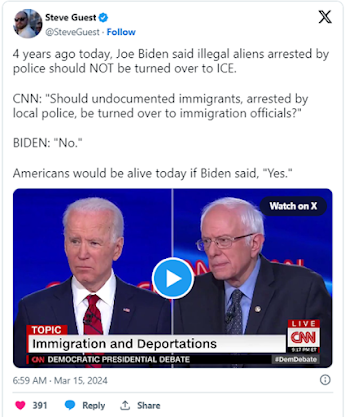
Okay, fine - but she overlooks at least two points. One is that the crime rate for illegal immigrants is more than twice as high as for legal immigrants. Second, she and other libs ignore the fact that regardless of the number of homicides committed by illegal immigrants versus American citizens, that number would be magnitudes lower if this administration had not simply thrown away controls on who gets into the country.

These immigrants are not committing crimes instead of Americans, but in addition to Americans. There are therefore many Americans victimized, even murdered, by illegal immigrants whose entry into the country was deliberately allowed as policy by the Biden administration. And that does not even include the 100,000-plus deaths from drug overdose, most from fentanyl brought easily over the southern border by Mexican cartels.

Then there is this guy, apprehended by the US Border Patrol on March 9 near El Paso, Texas: "Illegal migrant from Lebanon caught at border admitted he’s a Hezbollah terrorist hoping ‘to make a bomb’ — and was headed for NY."
[Basel Bassel] Ebbadi said in a sworn interview after his arrest that he had trained with Hezbollah for seven years and served as an active member guarding weapons locations for another four years, the documents show. Ebbadi’s training focused on “jihad” and killing people “that was not Muslim,” he said.

Another reason Charen's argument fails is that Charen never even mentions of per-capita rates of crime of native-born Americans compared to the per-capita crime rates of legal and illegal immigrants. That is, what is the percentage of native-born Americans convicted of felonies in relation to the total number of native-born Americans in the country? And the same for legal immigrants and illegal immigrants.

Charen does not touch that and neither does the Stanford University study she cites. Its main metric claims that immigrants have had similar or lower incarceration rates than U.S.-born white men for the last 140 years of American history. And that is true for its metric of such rates of both groups per 100,000 residents, but that 100K is not broken down by race or citizenship. It is just per 100K of people living in the country:

As someone else put it, of course immigrants commit fewer crimes than American citizens. And in Japan, immigrants commit fewer crimes than the Japanese. In Egypt, immigrants commit fewer crimes than Egyptians. By the way, in India immigrants commit fewer crimes than Indians. Get the point?

And why is Stanford using a baseline of only white, native-born American men to compare to the foreign-born rate? Here are Census Bureau facts:
    • In 2020 (the latest year of Stanford's study), the total population in the US was 325,268,000. Of these, 57.8 percent were White, or 188,004,904.
    • The total native-born population was 280,361,000 (the Bureau rounded the numbers).
    • That means, according to Stanford's methods, that in 2020, the 92,356,086 non-white, native-born Americans committed no crimes!
    • However, in 2020, according to the federal Bureau of Justice Statistics, "about 48% of inmates held in local jails were white, 35% were black, and 15% were Hispanic. American Indians or Alaska Natives; Asians, Native Hawaiians, or Other Pacific Islanders; and persons of two or more races accounted for 2% of the total jail population." In fact, "In 2020, the [overall] imprisonment rate was 358 per 100,000 U.S. residents, the lowest since 1992."
That last datum, also from the Bureau of Justice Statistics, flatly contradicts the Stanford study, which inexplicably charts incarceration of white men alone at about 1,700 per 100,000! I could not find foreign-born incarceration numbers for 2020 specifically, but in 2018 the Department of Justice announced "that more than one-in-five of all persons in Bureau of Prisons custody were known or suspected aliens, and 93 percent of confirmed aliens in DOJ custody were in the United States unlawfully." That stat certainly has not improved.

Also crushing the Stanford study is this DOJ chart; compare to the chart above.


Here is the inaccuracy (I dare not call it deception) of the Stanford study:
  • To claim that foreign-born persons in the United States are less likely to commit crimes than native-born white men simply borders on gaslighting. It is not a relevant comparison.
  • In 2020, the year ending the Stanford chart, there were 280,361,000 native-born persons in the country. What is the incarceration rate of native-born persons per 100K for all native-born Americans? Stanford simply ignores this.
Actually, some number of the white total residents was foreign born, but the Census report breaks down only by totals of native v. foreign born; the 57.8 percent figure cited also does not distinguish between native and foreign born. In 2020, there were 44.9 million foreign-born people living in the US. Of them, 50.7 percent, or 22.75 million, were naturalized citizens.

Yes, legal immigrants do commit crimes, but it is in fact very difficult to immigrate to the this country legally, and there is ample screening of each person. But there is little (mainly no) screening at all for those entering illegally. An enormous number (the "gotaways") are not caught and are not even known of. According to MSN four months ago, using Customs and Border Patrol data, "Illegal border crossers total over 10 million since Biden inauguration."
Since January 2021, a minimum estimate of nearly 1.7 million gotaways have illegally entered the U.S.

Based on earlier projections and including Office of Field Operations data, former CBP chief Mark Morgan told The Center Square the gotaway data is likely to reach or exceed one million for fiscal 2023 alone.

In fiscal 2021, there were at least 308,655 known, reported gotaways; in fiscal 2022, 606,150 were reported. According to preliminary data obtained by The Center Square, Border Patrol agents reported at least 769,174 gotaways at the southwest border alone.
The rest, numbering now in the many millions, with very few exceptions are simply given a court date that is many years away, then are released into the country with zero requirements or supervision of any kind.
How many of them are committing crimes? No one knows. What percentage of them are committing crimes? No one knows. How many of them, like Basel Ebbadi, intentionally came here with evil intentions, as FBI Director Christopher Wray has strongly warned Congress about more than once? No one knows.

Director Wray has strongly warned of potential violence from border crossers. For example:
There are many other such reports.

The Left's argument boils down to this: "Yes, immigrants, including 'undocumented' ones, do commit crimes, but so what? So do American citizens!" But as I said above, illegal immigrants' crimes are in addition to what Americans commit. The perpetrators were deliberately admitted into the country. Why is the Left energetically supporting policies that result in crimes, including rape and murder, that did not have to happen?


Update: "Undocumented Immigrants, U.S. Citizens, and Convicted Criminals in Arizona," by the Crime Prevention Research Center:
Abstract
Using newly released detailed data on all prisoners who entered the Arizona state prison from January 1985 through June 2017, we are able to separate non-U.S. citizens by whether they are illegal or legal residents. Unlike other studies, these data do not rely on self-reporting of criminal backgrounds. Undocumented immigrants are at least 142% more likely to be convicted of a crime than other Arizonans. They also tend to commit more serious crimes and serve 10.5% longer sentences, more likely to be classified as dangerous, and 45% more likely to be gang members than U.S. citizens. Yet, there are several reasons that these numbers are likely to underestimate the share of crime committed by undocumented immigrants. There are dramatic differences between in the criminal histories of convicts who are U.S. citizens and undocumented immigrants.

Young convicts are especially likely to be undocumented immigrants. While undocumented immigrants from 15 to 35 years of age make up slightly over two percent of the Arizona population, they make up about eight percent of the prison population. Even after adjusting for the fact that young people commit crime at higher rates, young undocumented immigrants commit crime at twice the rate of young U.S. citizens. These undocumented immigrants also tend to commit more serious crimes.

If undocumented immigrants committed crime nationally as they do in Arizona, in 2016 they would have been responsible for over 1,000 more murders, 5,200 rapes, 8,900 robberies, 25,300 aggravated assaults, and 26,900 burglaries.

Laken Riley’s murder and the long shadow of Willie Horton. The writer is professor of political science emeritus at the University of Chicago, where he founded the Program on International Politics, Economics and Security.

Update: Law Enforcement Officials testify to Congress about the criminal acts done by illegal immigrants.

Sunday, November 6, 2022

Christians and the State


Tuesday is, of course, election day. As citizens of the world’s largest representative democracy, each of us has the right to speak our minds about our nation’s national issues to those whom we have elected to make the decision. Moreover, in such serious matters as those before us now, I would say we are obligated to do so.

However, who to vote for is not my topic this morning. I am using the issue as a chance to explore what the Bible teaches Christians about living under secular law in relationship to government. For that is how you and I live each day in either times of turmoil or peace. 

In the apostles’ time about three hundred years afterward, how Christians should live under a government that was in no way Christian and was often actually lethal to Christians was a subject of great importance. It is still today a problem for many of our brothers and sisters in Christ around the world. But perhaps the fundamental problem Paul and the other apostles faced is not so different from ours if we think of the world as a larger community: On one hand, how do we live peaceably and godly in a world in which violence is seen by some as an answer to any question, and on the other, how do we live the fullness of Christ’s commandments under laws at home that are arguably sometimes repressive of doing so? 

Here is what I mean. A few years ago in Raleigh, NC, a church ministry called Love Wins was threatened with arrest. Reverend Hugh Howell explained: 

On the morning of Saturday, August 24, Love Wins Ministries, where I am pastor and director, showed up at Moore Square in Raleigh, North Carolina at 9:00 a.m., just like we have done virtually every Saturday and Sunday for the last six years. We provide, without cost or obligation, hot coffee and a breakfast sandwich to anyone who wants one. We keep this promise to our community in cooperation with five different, large suburban churches that help us with manpower and funding.

On that morning three officers from Raleigh Police Department prevented us from doing our work, for the first time ever. An officer said, quite bluntly, that if we attempted to distribute food, we would be arrested. …

When I asked the officer why, he said that he was not going to debate me. "I am just telling you what is. Now you pass out that food, you will go to jail."

What will we do? Simple: we will feed people. I am, after all (however imperfectly), a follower of Jesus, who said himself that when we ignore hungry people, we ignore him.

That situation practically defines the tension Paul addressed in Romans 13:

Let everyone be subject to the governing authorities, for there is no authority except that which God has established. The authorities that exist have been established by God. 2 Consequently, whoever rebels against the authority is rebelling against what God has instituted, and those who do so will bring judgment on themselves. 3 For rulers hold no terror for those who do right, but for those who do wrong. Do you want to be free from fear of the one in authority? Then do what is right and you will be commended. 4 For the one in authority is God’s servant for your good. But if you do wrong, be afraid, for rulers do not bear the sword for no reason. They are God’s servants, agents of wrath to bring punishment on the wrongdoer. 5 Therefore, it is necessary to submit to the authorities, not only because of possible punishment but also as a matter of conscience. 

We may as well admit that Paul’s verses are difficult to swallow without reservations. Within the last century, "a century of unspeakable horror," says New Testament scholar N. T. Wright, “these verses have been [effectively] struck out of the canon, vilified, and blamed for untold miseries.” History poses no challenge to finding governments or government policies that ranged from unjust to evil to downright demonic, whether at home or abroad. 

Paul was not naïve. He knew well the evil that governments do – a main example being crucifying Jesus and persecuting his followers. It seems likely to me that Paul, a well-trained Pharisee, was thinking an old Jewish precept that God requires order in the world, not chaos. Hence, the principle of human governance is a divine principle. He is endorsing the necessity of government in general, but not any government in particular. 

Justice was a high virtue of Jewish thought. The prophets emphasized that one of the cardinal responsibilities of rulers was to preserve justice, the right ordering of the relationship between the state apparatus and the people.

If the rulers were responsible for maintaining justice, then the people had to obey the rules for justice to be served. One of Paul’s themes in Romans 12 and 13, says Wright, is that “justice is served not by private vengeance but by individuals trusting the authorities to keep wickedness in check. Knowledge that the authorities are there to look after such matters is a strong incentive to forswear freelance attempts at ‘justice'.”

Paul knew, of course, that no human system of justice is perfect; the best we can do is roughly correspond our affairs to divine justice. Yet Paul advises the Christians in Rome not to take justice into their own hands. Their identity as the only Christians in town did not give them permission for anarchy. Instead, their responsibility is to work for the Kingdom of God in proclaiming the Gospel until, Paul implicitly hopes, all rulers ultimately pledge their first allegiance to God rather than the state. The Roman Christians must not therefore try to establish themselves as a “para-state” organization but remain under Roman authority even while they work to bring forth the Kingdom of God. 

The Christians in Rome were a small minority. Paul did not think that they should become agents of chaos, attempting to live as if they had no relation to the political world at large. Paul did not desire them to replace the Roman government with a religious cult. The ultimate overthrow of unjust power comes by other means – which is to say, regime change of the ungodly is done by converting them, a theme Paul expounded back in Romans Five.

If we accept that we Christians are under at least a divine principle of obedience to civil authority, what are our obligations to obey specific laws in 21st-century America?  

Let’s look at this issue in a way that almost all of us face every day: driving a car. The government sets speed limits. The majority of Tennessee’s Christians think that the speed limits on our interstates are too low. My proof is daily at 7 a.m. on I-65 to Nashville. It cannot be only the unconverted heathen going 85 or more. Does the fact that “everybody is doing it” make it okay? 

Paul had no experience with a democratic form of government. Americans do not claim that God established our government; our Constitution states that “We the people of the United States . . . ordain and establish” the government. Our nation’s founders believed that the first imperative of government in the first place is to safeguard personal liberty. Liberty requires some degree of order to flourish, yet not too much order, lest it be crushed.

Liberty is not found in chaotic societies. Some places on the globe today fit that description; political analysts call them “failed states,” and life there is truly awful. Neither is freedom found in hyper-ordered societies of control, such as North Korea. 

Liberty is found at neither extreme, but between them. Community and justice require some rules for the common good, but as few rules as necessary, not as many as possible. 

One may argue that our driving environment is too chaotic and is not ordered enough. In Germany, where very high speeds are legal, the drivers are extremely self-disciplined compared to us and much more law abiding in their driving. 

So we might ask whether breaking the speed limit is unacceptably chaotic. That question I leave to each person’s conscience. But the relationship of obeying the speed limit to order or chaos is not the only consideration. Christians are enjoined by Christ to love one another. In fact, just after our passage, Paul says, “Let no debt remain outstanding, except the continuing debt to love one another, for whoever loves others has fulfilled the law. … those who love one another fulfill the law… . Love does no wrong to the neighbor; therefore, the fulfillment of the law is love.” 

Love by definition is directed toward the well-being of others. If breaking the law is justified, it can only be justified in Christian faith for the higher principle of love, and not from selfish interest. 

When my son Thomas was five years old, he suffered an accident in our back yard that gave him a deep cut barely above one eye. He was bleeding profusely. My wife wrapped a towel around the wound and we jumped into the car. Dale Earnhardt, Jr. could not have beat me to the emergency room. Love for my son certainly far outweighed Paul’s injunction to submit to the government during that drive. 

So there’s my answer: if civil disobedience is ever justified for Christian people, it is justified only for reasons of love and justice, not selfishness. “I like to drive fast” or “I’m late for a meeting” are selfish reasons, not loving ones, not just ones. In the meantime, let those who believe the speed limits are too low campaign within the political system to change them. That’s how America works. 

 In fact, Paul’s passage strongly implies that political activity by Christian persons is affirmed and validated. Paul never indicated that Christian faith and political activity by Christians were antithetical to one another. Christians can be involved in the political life of society by voting, campaigning, or holding office without ceasing to be Christians, and may see all such things as part of their Christian service.

Reverend Howell in Raleigh ended his article by listing the email addresses and phone numbers of the Mayor and of the City Council members, then continued,

We encourage you to continue to call and voice your concern. We spoke with the Mayor yesterday, and while she did say that no one will be arrested for feeding hungry people in the park, it's important to continue to make your voice heard. The status quo is not acceptable.

No matter how temporal authority rules, it is God who over-rules. All governments and their ministers, everyone who wields political power, whether Christian or not, are under God’s judgment whether they realize it or not. They are to rule justly and fairly so that freedom of the people may flourish, constraining the conduct of the people only enough to keep chaos at bay. The people are obliged to obey civil laws unless doing so plainly would violate our high duties of divine love in service to God’s kingdom. 

I’ll give Rev. Howell the last word: “Keep in mind that … Anger does not cast out fear -- only love can do that.”


Sunday, July 10, 2022

The Good Samaritan and Problem of Evil

Gustave Dore, The Good Samaritan

One of the greatest obstacles of inviting people to Christian faith is the problem of evil in the world. Some people cannot reconcile an all-knowing, all-good, all-powerful God with the violence our own planet wreaks upon itself and humankind. Yet the tornados, hurricanes, and earthquakes that lay waste to cities and destroy lives usually don't present nearly the challenge to faith presented by the evil men and women do to one another.

Those who find the problem of evil a major challenge to faith are right to take the issue so seriously. The longest book of the Bible, Job, is entirely concerned with nothing else. Human evil is a prominent theme of Jonah, one of the shortest books. An enormous amount of Jesus' teachings and deeds were oriented on good and evil, and Jesus' own people, the Jews, were formed by hundreds of years in chattel slavery in Egypt, finally delivered by God's hand. 

Jesus told a parable of a farmer who sowed good seed in his field, but an enemy came and sowed weeds among the wheat. By the time the farmer knew his field had been polluted, tearing up the weeds would have torn up the wheat as well. He told his workers, to let them grow together until the harvest; then at harvest to collect the weeds first and burn them but store the wheat in the barn. 

Jesus never explained why evil exists. The weeds were planted by an enemy, whom Jesus explained to his disciples was the devil, but he does not explain why there is a devil in the first place. He teaches that the time will come when God will separate evil from good, and evil-doers from the righteous. That time is not yet. Grain isn’t harvested until it is ripe, and the parable seems to teach that for God to destroy evil now would do more harm than good. We might wish for fire from heaven to take care of certain matters, but God, wise beyond our understanding, knows better. 

But time for weeds does eventually run out. At harvest the reapers saved the wheat and burned the weeds. So, wrote Peter, “Since everything will be destroyed in this way, what kind of people ought you to be? You ought to live holy and godly lives” (2 Pet 3:11). 

That’s the rub, isn’t it? Each person must decide whether he or she is wheat or weeds. Jesus pulled no punches on what difference it makes. In Matthew 7, Jesus said, "Every tree that does not bear good fruit is cut down and thrown into the fire. Not everyone who says to me, 'Lord, Lord,' will enter the kingdom of heaven, but only those who do the will of my Father who is in heaven" (Matt 7:19-20). 

We each must decide to be wheat, not weeds. It does not happen by accident; and the default is weeds. And weeds get burned. This is a hard teaching, no two ways about it. But there it is. But Jesus didn’t end the parable there. The good part is the tag line: “the righteous will shine like the sun in the kingdom of their Father.” 

God is much more oriented on saving the righteous than destroying the evil. It’s more important for the wheat to grow than the weeds to perish. Peter wrote in his second epistle, “The Lord is not slow in keeping his promise, as some understand slowness. He is patient with you, not wanting anyone to perish, but everyone to come to repentance” (2 Pet 3:9 NIV). 

Vladimir Lenin said it was better to execute 100 innocent men than to let one guilty man go free. Lenin did what he said, of course, and we can easily imagine him ripping up 100 stalks of wheat to get one weed. God doesn’t work like that. Instead, God knows that goodness is more powerful than evil, and love is more powerful than hate. Transforming weeds to wheat is something God can do. 

But change is not always something we embrace easily. Some people change when they see the light and others wait until they feel the heat. The light is better. 

Jesus didn't simply make threats or promises about the end of evil. He both showed and taught what Paul later called "a more excellent way." That’s how Jesus lived his life: befriending sinners, hanging out with hated tax collectors and other discards of society. In agriculture weeds stay weeds, no matter what, but human beings can change. There were two weedy men, thieves, nailed to crosses beside Jesus. Yet one went to paradise that day.

One day Jesus was conversing with a religious lawyer. The lawyer said to Jesus, "Teacher, what must I do to inherit eternal life?" 

Jesus answered, "What is written in the law? What do you read there?" 

The lawyer said, "You shall love the Lord your God with all your heart, and with all your soul, and with all your strength, and with all your mind; and your neighbor as yourself." 

Jesus told him, "You have given the right answer; do this, and you will live." 

But the lawyer wanted to make himself look good, so he asked Jesus, "And who is my neighbor?" 

Jesus replied, "A man was going down from Jerusalem to Jericho, and fell into the hands of robbers, who stripped him, beat him, and went away, leaving him half dead. Now by chance a priest was going down that road; and when he saw him, he passed by on the other side. So likewise a Levite, when he came to the place and saw him, passed by on the other side.

"But a Samaritan while traveling came near him; and when he saw him, he was moved with pity. He went to him and bandaged his wounds, having poured oil and wine on them. Then he put him on his own animal, brought him to an inn, and took care of him. The next day he took out two denarii, gave them to the innkeeper, and said, 'Take care of him; and when I come back, I will repay you whatever more you spend.' "Which of these three, do you think, was a neighbor to the man who fell into the hands of the robbers?" 

The lawyer said, "The one who showed him mercy." 

Jesus said to him, "Go and do likewise" (Luke 10:25‑37).

The great English statesman Edmund Burke observed that the only thing necessary for evil to triumph is for good people to do nothing. In this story, a priest and a Levite did do nothing, surely because of excellent reasons in their own mind. But the Samaritan didn't do nothing. He gave first aid to the beaten traveler, carried him to an inn and paid for his lodging. Because of him, the evil done to the traveler, while real, did not triumph. He did these things even though Samaritans and Jews generally despised each other. 

None of us think of ourselves as evil men or women. Yet do we have the right to think of ourselves as good? So many of us define our goodness by what we do not do - we don't do drugs, we don't steal from our employers, we don't fight with our neighbors. But do we define our neighbors as inclusively as Jesus did? 

The Samaritan showed mercy to the beaten Jew. Why do persons such as this Samaritan exist? There are ordinary people of our communities who live decent but mostly unremarkable lives, but there are also men or women who remind us of the Samaritan, who even shame us by their example. Christ's commandment to love our neighbors as ourselves is not uniquely Christian. But it is especially for Christians. Why do we not have a whole town of Christian Samaritans? After all, we see in the world that there not only Osama bin Ladens, but also Mother Teresas. 

And there are people like “Dr. David Baum, a long-time obstetrician in Highland Park,” Illinois, who last Monday,
Dr. Baum
… was attending the parade with his wife and children to watch his two-year-old grandson participate. When the shots rang out and others fled, he ran into the fray to try to help the victims. … 
Baum said there were at least three doctors, a nurse, and a nurse practitioner who joined him in treating victims.   …
In fact, “bystanders tied tourniquets and administered CPR” and 
... people from every corner of the Highland Park community sprang into action on July 4 in the wake of unspeakable tragedy. Nearly a dozen people, including off-duty doctors, nurses, and a football coach, were among the first to administer lifesaving assistance to victims of the parade shooting. 
I believe that there are more good Samaritans than are known. Samaritan-hood takes many forms today and the vast majority get no headlines. 

Perhaps such inquiries help form an answer to the faith problem of evil, for if there is a problem of evil, there is also a problem of good. If the existence of sin and evil hinder faith in a loving, redemptive God, then shouldn’t the daily instances of goodness and mercy we see around us compel us to know that a loving, redemptive God is real and in the world? 

So to persons who feel stymied in faith by the problem of evil, I say to remember that all of us are active actors in, not passive observers of, this world and the opportunities it presents for both good and evil. The psalmist's cry to God is less a plea to him than a recognition of our duties before him: "Give justice to the weak and the orphan; maintain the right of the lowly and the destitute. Rescue the weak and the needy; deliver them from the hand of the wicked.” 

That’s our job, for we are the answer to that prayer. The prophet Micah put it this way: "[God] has told you, O mortal, what is good; and what does the Lord require of you but to do justice, and to love kindness, and to walk humbly with your God?" 

The problem of evil is not a problem to be solved, it is a condition to be overcome. God is working in the world both to overcome evil and redeem it, and God does not labor alone. Each one of us is called to be a coworker of God. The Bible nowhere divorces love of neighbor from love for God. They are two sides of the same coin. To be righteous before God requires both; to prevail against evil requires both. 

How shall evil be overcome? Each of us shall open our hearts to God, be filled with Christ, accept the pardon given us. And by opening our hands to our neighbors, so that they may see Christ reflected from us. J. Gresham Machen wrote in 1923, 
 If we really love our fellow men, we shall never be content with [simply] binding up their wounds and pouring on oil and wine or rendering them any such lesser service. We shall indeed do such things for them. But the main business of our lives will be to bring them to the Saviour of their souls. (Christianity and Liberalism)

End note: In 2017, a man named Stephen Paddock shot hundreds of people. killing dozens, in La Vegas. Read what might God have said about that. 

Friday, July 1, 2022

What not to do under gunfire

Originally posted in May 2017

Here is security-camera video of the shooting at the Fort Lauderdale airport last Friday [in 2017 - DS], for which Esteban Santiago has been charged with multiple felonies. There is nothing graphic in the video, but watch what the people standing behind him do - and more importantly, do not do.


I understand that people were caught wholly by surprise and did not process what was happening very quickly. I understand that as a retired Army combat-arms officer I would recognize gunfire and its implications many times more quickly than the average civilian.

But that is of no comfort to the five people Santiago is accused of murdering or the six of wounding.

News reports say that the FBI has not ruled out a terrorism connection yet (I am doubtful) but even if not, this is the kind of thing ISIS wants its members of sympathizers to do anywhere in America they can. Can we expect more shootings like this? Almost certainly. [Update, Jan. 11: The terrorism angle may be justified, "Airport Shooter Converted to Islam, Identified as Aashiq Hammad Years Before Joining Army"]

In such a situation, you have only one rule: OODA. Observe, Orient, Decide, Act. What you must not do is what the people in the video did.

Observe:
No longer can you assume you are safe. No longer can you enter public places without awareness of what is going on near and far from you. You must observe what is happening! Not just with your eyes, but with your hearing and other senses, too.

This must become a habit that does not stop. When I was learning to fly, my instructor insisted that at every moment of flight, I should always have identified a place to land if my motor quit. Since the airplane was obviously moving, that meant I had to near-constantly observe for a suitable emergency set-down place.

At every moment, you must know where exits are, the fastest ways to get there, which one is best, which one is second best. You must know where to hide if escape is closed off.

Orient:
In the video, the people behind the shooter did not ascertain what was happening for precious seconds. Under gunfire, this can be fatally slow. You must orient on the danger without hesitating. That means where, what, how.

No one did that when the shooting started. I am not casting blame. They just didn't. See what they did? They froze for precious seconds, which can get you killed, while trying to process what they were seeing and hearing.

Decide:
Quite simply, in about a half-second you have to orient on what the danger is and decide what to do. Back to the people in the video: when they decided to move, they stepped only a few feet, then either fell straight down or huddled behind luggage. They were still targets and had gained no safety at all. Your decision must be one that will reduce your danger. It is not enough to decide to do something, you must do something effective.

Act:
Action must follow decision in less than an eyeblink of time. In almost any shooting situation, you have to run like Jesse Owens out of there. Run away and do not stop until you are behind friendly guns (cops).

You may respond that no one can outrun a bullet. That's true, but running away does two things: first, it removes you from the area of danger, of course, but second, it reduces your attractiveness as a target to the shooter. They do not shoot at distant people. They just don't, especially with a handgun and even if a shooter does he will very likely miss.

Do not run routes that you would take if nothing was happening. Go through obstacles rather than around, if possible. Go across baggage carousels for a shorter route or faster exit. If you're not in an airport the same principles apply.

What about hiding? If the only exit is on the other side of the shooter, then hiding may be your only option. There are two kinds of hiding: concealment and cover. Concealment is simply getting yourself out of sight from the shooter (but be prepared to move) but that doesn't mean he can't shoot you. If you hide behind a curtain you can still be shot! So cover is the better choice, where the shooter can neither see you nor shoot you if he tried. But remember one of Murphy's Laws of Combat: "Make it too hard for the enemy to get in, and you've made it too hard for you to get out." Your objective in taking cover or concealment is immediate safety but also finally to get the heck out of there!

Pray to God that you never encounter such a situation. But remember that "hope is not a method and wishes are not plans." Be prepared!

Update

Also, be aware that buildings' interiors often provide limited exits, which will be fatal funnels as folks mob the door and cannot get out once the bullets start flying. Do not follow the crowd unless there is no alternative! 

Be camouflaged. That not mean wearing woodland-pattern clothing, but to be low profile, dress modestly, and use clutter and quiet movements to become a bit more ninja-like. Being flashy and glued to your smart phone is a no go. Dressing and acting bland, dull, and as unnoticeable as possible may give you an edge.

A world without nuclear weapons - what would it look like?

 From Pope Leo this week, according to the National Catholic Reporter : " Pope Leo quotes Bob Dylan song in book foreword calling for n...