Sunday, November 27, 2022

Advent 1 - We Are Adjudged and Sentenced


Happy New Year! 

It is the first Sunday of Advent. As I am sure many of you know, today is the first day of the annual liturgical calendar. Advent is thus the first season of the church calendar, and it begins four Sundays before Christmas Day. 

The church calendar is out of sync with our ordinary calendar not only because its New Year begins, usually, in November, but because the church’s seasons begin on the days they celebrate, not end then. We Americans just celebrated Thanksgiving but now, as far as we’re concerned, Thanksgiving is over and done with, now we are putting up Christmas decorations and already celebrating that day. And on December 26 Christmas will be over and we will focus on the secular New Year’s Eve and Day. 

But the church calendar does not work like that. Advent is not about Christmas per se. That's what the season of Christmas is for that begins Christmas day. Advent does lead us to the birth of Jesus in his Nativity in Bethlehem, but Advent's message is not mainly about Jesus' birth – what happened – but his incarnation – why his birth happened and what it portends. In Advent we reflect upon God decisively breaking into human affairs, including in Bethlehem two millennia ago and a time yet to come when Christ will return in judgment. 

When will that day come? In Matthew 24 Jesus is speaking with his disciples about the day of the Lord when the Son of Man will come in judgment. Here is what he says:

36 “But about that day and hour no one knows, neither the angels of heaven, nor the Son, but only the Father. 37 For as the days of Noah were, so will be the coming of the Son of Man. 38 For as in those days before the flood they were eating and drinking, marrying and giving in marriage, until the day Noah entered the ark, 39 and they knew nothing until the flood came and swept them all away, so too will be the coming of the Son of Man. 40 Then two will be in the field; one will be taken and one will be left. 41 Two women will be grinding meal together; one will be taken, and one will be left. 42 Keep awake therefore, for you do not know on what day your Lord is coming. 43 But understand this: if the owner of the house had known in what part of the night the thief was coming, he would have stayed awake and would not have let his house be broken into. 44 Therefore you also must be ready, for the Son of Man is coming at an unexpected hour.” (Matthew 24.36-44)

Jesus tells us that his coming as the judge of the world will be in a time of business as usual. In the days of Noah people continued with life as life always had been, eating and drinking and getting married, even though they could see Noah building a big ship about half the size of the Titanic. When the flood came, they got swept away by surprise.

That’s how it will be when the Son of Man comes in judgment, Jesus says. Folks will be caught by surprise in the middle of ordinary life. So, says, Jesus, keep awake. If you knew that a burglar was going to break into your house tonight, you would stay awake. You’d probably have the police parked outside, too. How much more alert we should be all the time in anticipation of the coming of Christ! 

Matthew’s passage is not intended to impel us to try to figure out when Jesus is coming, in fact just the opposite. According to Matthew, we cannot know when Jesus is coming. Jesus will come at an unexpected time. So, followers of Christ are to spend their time announcing the Good News and being the body of Christ in this world, not wrapped up in apocalyptic speculation. Christ will know his own when he returns. 

We believe judgment is to be feared, do we not? We know what a judge is: someone in black robes sitting high in a courtroom meting out justice and throwing people in jail. Judgment is usually an image of fear for us, and many people think of the coming day of the Lord with images of wars and rumors of war, earthquakes and natural disasters preceding the Last Judgment.  

Before we suppose that global catastrophes must precede the return of Christ in judgment, we might want to reflect on the word that Isaiah saw concerning Judah and Jerusalem:

3Many peoples shall come and say, “Come, let us go up to the mountain of the LORD, to the house of the God of Jacob; that he may teach us his ways and that we may walk in his paths.” For out of Zion shall go forth instruction, and the word of the LORD from Jerusalem. 4 He shall judge between the nations, and shall impose terms on many peoples; they shall beat their swords into plowshares, and their spears into pruning hooks; nation shall not lift up sword against nation, neither shall they learn war anymore. 5 O house of Jacob, come, let us walk in the light of the LORD! (Isaiah 2:3-5)

Make no mistake, this God Isaiah is talking about is a God of judgment. Isaiah is speaking of the Kingdom of God as the highest mountain. God will judge among all the nations. 

This judgment Isaiah describes liberates all humankind from strife and war and brings peace. This is a judgment of hope! God’s salvation righteousness puts an end to oppression and injustice and violence. God’s judgment rings down the curtain on the way human beings are divided against each other. Men and women, young and old, rich and poor, black and white – all shall come and say, “Let us go up to the mountain of the Lord, that we may walk in his paths.” 

Especially heartening is that the nations disarm themselves. We finally will stop killing each other over resources or politics or ideology – or religion. 

If Isaiah's vision has such words of hope, it also has an undertone of discouragement. Do we have to wait until God decides personally to take over this world's management to achieve peace? Are we condemned until then to face one war after another, one Nine-Eleven after another, one Coventry after another, one Hiroshima after another? If by Isaiah's lights history is supposed to be moving toward the divine kingdom, why do we see so little evidence of it? The prior century and this one, too, have been drenched in the blood of more uncountable millions than any century ever; just in what way exactly is history progressing toward a divine fulfillment? 

So, we can sympathize with those who long for Christ to return on the clouds of heaven and simply take over the world. If Christ shall come again to establish the reign of God forever, a mere glance at news reports makes us think that tomorrow morning would be fine! 

After all, God’s justice is saving righteousness. God’s judgment is liberation. Isaiah sees history flowing to the high mountain of God, where all are taught the ways of God and all walk in God’s path. 

So why delay, Lord? O Come, O Come, Emmanuel – and this afternoon would be great! But that is not what Isaiah is getting at. He says that the certain coming of the day of the Lord means that we should walk in the light of the Lord now. The judgment of God determines how we should live now. God’s judgment is not only a future event. We are already judged, and thus we should live in faith together, worship in love together, study the Word of God together, be in ministry to each other and the world together. 

We have been adjudged, and we have been sentenced – not to punishment, but to love. We are adjudged as ones beloved of God, and we are sentenced to love the Lord our God with all our heart, with all our soul, with all our strength and with all our mind, and to love our neighbors as ourselves. 

By now many of you may be wondering what these passages have to do with Christmas. It’s Advent, after all, which is supposed to be about the infant Jesus and the manger. But here’s the preacher talking about the second coming and the end of the world. 

The Scriptures designated for the first Sunday of Advent always look forward to the return of Christ. The Advent season ends with celebrating Christ’s incarnation but is always begun with passages to remind us that the reign of God over human affairs is ultimate and for all time. Advent thus does not celebrate only Christmas, Christ’s first coming among us. It also looks ahead to the completion of God’s redemptive acts in the coming again of Christ in judgment. Advent’s theme really is not, “Get ready for Christmas.” It instead asks, “Are we ready for Christ?” Yet the coming of Jesus in the manger and Christ’s coming again in judgment are not so very different. Business as usual describes not only the world when Christ will come again, but also the world when Jesus was born. After all, Joseph and Mary went to Bethlehem in the first place because their taxes had been raised. There sure isn’t anything unusual about that!

The birth of Jesus in Bethlehem was an act of God’s judgment on the world. No savior would have been born if the world did not need saving. When we celebrate Christmas, we celebrate the judgment of God on each of us. To visit the manger is both to be indicted and invited - indicted under God’s judgment and invited by God to be reconciled through his Son. 

Like Joseph and Mary two thousand years ago, we live in a time of business as usual. But we cannot just do business as usual. We are to live in the light of the Lord, staying spiritually awake. Just as the people of Judea did not know when their savior would be born, we do not know when Christ will come again in glory. 

The comings of Jesus Christ into the world, past, present, and future, should give us a new vision for reality, a new way of seeing what God intends for humanity. This Advent season is a time to be awake and watch for the owner of this house we live in called planet earth. Let Christ take us in judgment, for Christ’s judgment is liberation and freedom. Whether judged by the first Advent or the promise of Christ to come again, we live in the light of Christ. Our Lord breaks into our ordinary lives with extraordinary power when we don’t expect it. Advent is above all else the unexpected season. 

Come, Lord Jesus, come! O come, O come, Emmanuel!

Sunday, November 6, 2022

Christians and the State


Tuesday is, of course, election day. As citizens of the world’s largest representative democracy, each of us has the right to speak our minds about our nation’s national issues to those whom we have elected to make the decision. Moreover, in such serious matters as those before us now, I would say we are obligated to do so.

However, who to vote for is not my topic this morning. I am using the issue as a chance to explore what the Bible teaches Christians about living under secular law in relationship to government. For that is how you and I live each day in either times of turmoil or peace. 

In the apostles’ time about three hundred years afterward, how Christians should live under a government that was in no way Christian and was often actually lethal to Christians was a subject of great importance. It is still today a problem for many of our brothers and sisters in Christ around the world. But perhaps the fundamental problem Paul and the other apostles faced is not so different from ours if we think of the world as a larger community: On one hand, how do we live peaceably and godly in a world in which violence is seen by some as an answer to any question, and on the other, how do we live the fullness of Christ’s commandments under laws at home that are arguably sometimes repressive of doing so? 

Here is what I mean. A few years ago in Raleigh, NC, a church ministry called Love Wins was threatened with arrest. Reverend Hugh Howell explained: 

On the morning of Saturday, August 24, Love Wins Ministries, where I am pastor and director, showed up at Moore Square in Raleigh, North Carolina at 9:00 a.m., just like we have done virtually every Saturday and Sunday for the last six years. We provide, without cost or obligation, hot coffee and a breakfast sandwich to anyone who wants one. We keep this promise to our community in cooperation with five different, large suburban churches that help us with manpower and funding.

On that morning three officers from Raleigh Police Department prevented us from doing our work, for the first time ever. An officer said, quite bluntly, that if we attempted to distribute food, we would be arrested. …

When I asked the officer why, he said that he was not going to debate me. "I am just telling you what is. Now you pass out that food, you will go to jail."

What will we do? Simple: we will feed people. I am, after all (however imperfectly), a follower of Jesus, who said himself that when we ignore hungry people, we ignore him.

That situation practically defines the tension Paul addressed in Romans 13:

Let everyone be subject to the governing authorities, for there is no authority except that which God has established. The authorities that exist have been established by God. 2 Consequently, whoever rebels against the authority is rebelling against what God has instituted, and those who do so will bring judgment on themselves. 3 For rulers hold no terror for those who do right, but for those who do wrong. Do you want to be free from fear of the one in authority? Then do what is right and you will be commended. 4 For the one in authority is God’s servant for your good. But if you do wrong, be afraid, for rulers do not bear the sword for no reason. They are God’s servants, agents of wrath to bring punishment on the wrongdoer. 5 Therefore, it is necessary to submit to the authorities, not only because of possible punishment but also as a matter of conscience. 

We may as well admit that Paul’s verses are difficult to swallow without reservations. Within the last century, "a century of unspeakable horror," says New Testament scholar N. T. Wright, “these verses have been [effectively] struck out of the canon, vilified, and blamed for untold miseries.” History poses no challenge to finding governments or government policies that ranged from unjust to evil to downright demonic, whether at home or abroad. 

Paul was not naïve. He knew well the evil that governments do – a main example being crucifying Jesus and persecuting his followers. It seems likely to me that Paul, a well-trained Pharisee, was thinking an old Jewish precept that God requires order in the world, not chaos. Hence, the principle of human governance is a divine principle. He is endorsing the necessity of government in general, but not any government in particular. 

Justice was a high virtue of Jewish thought. The prophets emphasized that one of the cardinal responsibilities of rulers was to preserve justice, the right ordering of the relationship between the state apparatus and the people.

If the rulers were responsible for maintaining justice, then the people had to obey the rules for justice to be served. One of Paul’s themes in Romans 12 and 13, says Wright, is that “justice is served not by private vengeance but by individuals trusting the authorities to keep wickedness in check. Knowledge that the authorities are there to look after such matters is a strong incentive to forswear freelance attempts at ‘justice'.”

Paul knew, of course, that no human system of justice is perfect; the best we can do is roughly correspond our affairs to divine justice. Yet Paul advises the Christians in Rome not to take justice into their own hands. Their identity as the only Christians in town did not give them permission for anarchy. Instead, their responsibility is to work for the Kingdom of God in proclaiming the Gospel until, Paul implicitly hopes, all rulers ultimately pledge their first allegiance to God rather than the state. The Roman Christians must not therefore try to establish themselves as a “para-state” organization but remain under Roman authority even while they work to bring forth the Kingdom of God. 

The Christians in Rome were a small minority. Paul did not think that they should become agents of chaos, attempting to live as if they had no relation to the political world at large. Paul did not desire them to replace the Roman government with a religious cult. The ultimate overthrow of unjust power comes by other means – which is to say, regime change of the ungodly is done by converting them, a theme Paul expounded back in Romans Five.

If we accept that we Christians are under at least a divine principle of obedience to civil authority, what are our obligations to obey specific laws in 21st-century America?  

Let’s look at this issue in a way that almost all of us face every day: driving a car. The government sets speed limits. The majority of Tennessee’s Christians think that the speed limits on our interstates are too low. My proof is daily at 7 a.m. on I-65 to Nashville. It cannot be only the unconverted heathen going 85 or more. Does the fact that “everybody is doing it” make it okay? 

Paul had no experience with a democratic form of government. Americans do not claim that God established our government; our Constitution states that “We the people of the United States . . . ordain and establish” the government. Our nation’s founders believed that the first imperative of government in the first place is to safeguard personal liberty. Liberty requires some degree of order to flourish, yet not too much order, lest it be crushed.

Liberty is not found in chaotic societies. Some places on the globe today fit that description; political analysts call them “failed states,” and life there is truly awful. Neither is freedom found in hyper-ordered societies of control, such as North Korea. 

Liberty is found at neither extreme, but between them. Community and justice require some rules for the common good, but as few rules as necessary, not as many as possible. 

One may argue that our driving environment is too chaotic and is not ordered enough. In Germany, where very high speeds are legal, the drivers are extremely self-disciplined compared to us and much more law abiding in their driving. 

So we might ask whether breaking the speed limit is unacceptably chaotic. That question I leave to each person’s conscience. But the relationship of obeying the speed limit to order or chaos is not the only consideration. Christians are enjoined by Christ to love one another. In fact, just after our passage, Paul says, “Let no debt remain outstanding, except the continuing debt to love one another, for whoever loves others has fulfilled the law. … those who love one another fulfill the law… . Love does no wrong to the neighbor; therefore, the fulfillment of the law is love.” 

Love by definition is directed toward the well-being of others. If breaking the law is justified, it can only be justified in Christian faith for the higher principle of love, and not from selfish interest. 

When my son Thomas was five years old, he suffered an accident in our back yard that gave him a deep cut barely above one eye. He was bleeding profusely. My wife wrapped a towel around the wound and we jumped into the car. Dale Earnhardt, Jr. could not have beat me to the emergency room. Love for my son certainly far outweighed Paul’s injunction to submit to the government during that drive. 

So there’s my answer: if civil disobedience is ever justified for Christian people, it is justified only for reasons of love and justice, not selfishness. “I like to drive fast” or “I’m late for a meeting” are selfish reasons, not loving ones, not just ones. In the meantime, let those who believe the speed limits are too low campaign within the political system to change them. That’s how America works. 

 In fact, Paul’s passage strongly implies that political activity by Christian persons is affirmed and validated. Paul never indicated that Christian faith and political activity by Christians were antithetical to one another. Christians can be involved in the political life of society by voting, campaigning, or holding office without ceasing to be Christians, and may see all such things as part of their Christian service.

Reverend Howell in Raleigh ended his article by listing the email addresses and phone numbers of the Mayor and of the City Council members, then continued,

We encourage you to continue to call and voice your concern. We spoke with the Mayor yesterday, and while she did say that no one will be arrested for feeding hungry people in the park, it's important to continue to make your voice heard. The status quo is not acceptable.

No matter how temporal authority rules, it is God who over-rules. All governments and their ministers, everyone who wields political power, whether Christian or not, are under God’s judgment whether they realize it or not. They are to rule justly and fairly so that freedom of the people may flourish, constraining the conduct of the people only enough to keep chaos at bay. The people are obliged to obey civil laws unless doing so plainly would violate our high duties of divine love in service to God’s kingdom. 

I’ll give Rev. Howell the last word: “Keep in mind that … Anger does not cast out fear -- only love can do that.”


Friday, October 7, 2022

What if Putin nukes Ukraine?

Is Armageddon coming?

Last night (10/6/2022), President Biden spoke at a fundraiser and said this (via the AP):

“[Putin was] not joking when he talks about the use of tactical nuclear weapons or biological or chemical weapons,” Biden said. “We have not faced the prospect of Armageddon since Kennedy and the Cuban Missile Crisis.”

The White House lost no time walking that back:


Europe's national leaders were also publicly averse to the president's comment. The AP reported, 

Asked about Biden’s remarks, French President Emmanuel Macron said it was crucial to speak with care on the nuclear threat.

“I have always refused to engage in political fiction, and especially ... when speaking of nuclear weapons,” Macron said at a EU summit in Prague. “On this issue, we must be very careful.”

Indeed. However, it is true that Vladimir Putin has said more than once that using nuclear weapons is not off the table. 

Putin has repeatedly alluded to using his country’s vast nuclear arsenal, including last month when he announced plans to conscript Russian men to serve in Ukraine.

“I want to remind you that our country also has various means of destruction ... and when the territorial integrity of our country is threatened, to protect Russia and our people, we will certainly use all the means at our disposal,” Putin said. “It’s not a bluff.”

Understand that Putin has already said many times that the ethnic-Russian parts of eastern Ukraine (Donetsk, Luhansk, Zaporizhzhia and Kherson) are part of Russia itself. Russian forces continue to occupy those regions but are facing increasingly effective actions by Ukraine's armed forces. Putin has been clear that these regions are not and have never been legitimately part of Ukraine but have always been Russian. So when Putin refers to the "territorial integrity of our country," he is absolutely including those regions as part of "our country." Putin has been repetitively clear that annexing the four territories is nonnegotiable, adding that Russian would defend them “with all the forces and means at our disposal.”

Does that include using nukes? Well, Putin did not explicitly say using nukes is on the table. But he certainly never even remotely ruled them out; if using "all the forces and means at our disposal" does not include them, what does it mean? As well, Putin said in a speech on Red Square at the end of September that the nuclear threshold in the Ukraine war had already been crossed! He said specifically that the atomic bombs the United States dropped on Japan in 1945 had “created a precedent.” 

But there is (we hope) a long way to go from "we can" to "we will." And surely this interview with retired US Army four-star general and former head of the CIA, David Petraeus, is mere coincidence. US would destroy Russian forces if Putin uses nukes: former CIA head Petraeus:

The US and its NATO allies would destroy Russian forces and sink the Black Sea fleet if Vladimir Putin decides to use nuclear weapons in Ukraine, former CIA Director David Petraeus has predicted.

The retired four-star general spelled out in an interview on ABC’s “This Week” on Sunday what he believed would happen if the Kremlin warmonger used nuclear weapons.

“We would respond by leading a NATO — a collective — effort that would take out every Russian conventional force that we can see and identify on the battlefield in Ukraine and also in Crimea and every ship in the Black Sea,” he said.

Petraeus said Russia’s use of nuclear weapons in Ukraine would not trigger NATO’s Article 5, which calls for collective defense of member states, because Ukraine is not part of the alliance.

But he said that if Putin were to use nuclear weapons, the high probability that radiation from the strike would affect a member of the alliance could possibly be construed as an attack against NATO and fall under Article 5.

Remember that Petraeus is not speaking for the Biden administration. We hope. 

American and NATO options

So: how can we respond if the Russians use a nuclear weapon in Ukraine? Bear in mind that there is no "good" response to a Russian nuke in UKR. Petraeus laid out a massive NATO response, which if done would have a very high probability of beginning a general war with Russia. 

Worse, Petraeus did not go to the step after: 

  1. Step One: Russia nukes Ukraine. 
  2. Two: Massive retaliation as Petraeus describes. 
  3. Three: Russia admits defeat and withdraws its forces from Ukraine and promises to be nice from now on. Right? 
  4. Or Three: Russia attacks American bases in the Mediterranean and its submarines target US Navy vessels. Or some other elevation of the conflict, including more nukes. 

Russia can nuke Ukraine. NATO can respond as NATO decides. After that, the crystal ball is not merely cloudy, it simply no longer exists. I am reminded of what Otto von Bismarck supposedly said, that to start a war is like entering a dark room blindfolded to look for a black cat that is not even there. 

What if Russia's nuke kills no one? 

Petraeus also seems to assume that a Russian atomic attack would be highly destructive and cause massive casualties. If I was Putin and decided to use a nuke, I would make sure it damaged nothing and killed no one. Yes, this can be done, easily in fact. And then I would warn that if my diktats were not obeyed, the follow-up would be very severe. 

During my US Army career as a field artillery officer, the artillery had several types of atomic warheads, ranging from the 155mm and 8-inch howitzers to Lance tactical and Pershing II strategic missiles. These atomic warheads and projectiles had yields ranging from close to the Hiroshima bomb all the way down to one for which the Minimum Safe Distance (MSD) for unwarned, exposed personnel was only 650 meters - or 0.4 mile! I was trained as a nuclear target analyst and I worked attack profiles for all these warheads against a wide variety of target types. 

So what do we do if Russia pops a less-than 1 kiloton warhead in the middle of nowhere in UKR for which the MSD is very, very low and no village is within it by a large margin? Atomic weapons kill or destroy in two ways: the blast, of course, and radiation. Lethal radiation includes gamma rays, neutron emissions (fairly low in a conventionally-designed warhead), and infrared, or heat. For a very low yield warhead, as I said, these all become negligible after only several hundred meters.

As for atomic fallout, that occurs only if the detonation's fireball touches the surface of the earth. My references always included the radius of the fireball from point of detonation, so fallout is fully avoidable. In fact, US policy has forbidden fallout for at least 50 years. Absent fallout, you still get what is called downwind radiation hazard, but the effects of this are more attenuated than of fallout (although DWR is not negligible by any means). And I am pretty sure that Petraeus was referring to that as the "radiation hazard." 

So, after such a detonation, the Russians have irradiated a small area of dirt in UKR with zero to few persons killed or affected and practically no infrastructure damage. Obviously, Putin would be signaling to show that a second attack will be more powerful and harshly located. And UKR and NATO would have to take that demonstration shot very seriously.

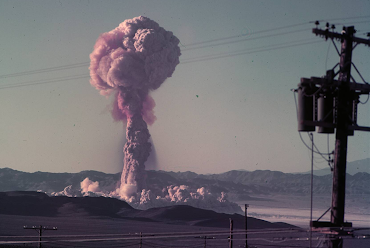
This is a very small atomic explosion

But do we wipe out Russia's Black Sea fleet for that? Bomb Russian troops in Ukraine? That simply invites Putin to unleash his arsenal against US forces in Europe, at minimum. Then what do we do? The only next step for us would be general war against Russia, for which the nuclear threshold has already crossed.

Putin has the first move

I hate to say it, but Putin holds the cards here. Why? National Review's Michael Brendan Dougherty points out the inexplicable lack of depth in Petraeus' answer:

So, the top minds in the administration and one of the most respected generals of his generation believe that if Russia uses a tactical nuke in Ukraine, NATO forces could suddenly join the war as full belligerents, proceed to annihilate the entire Russian military and/or launch a missile strike into the heart of Moscow to kill Putin — and Russia would not “expand” the conflict from there?

I’m sorry, but that is crazy and dangerous. No nuclear power would refuse to escalate as another one attempted to obliterate its armed forces and government. (Notice as well that General Petraeus does not say the president will go to Congress to seek a declaration of war — in his mind, the president apparently just gives the order.)

What Putin should consider 

All that said, can Putin successfully even order such a strike? Contrary to what most Americans think (including, inexcusably, some members of Congress), the US president does not have sole authority to order a nuclear strike. The president must originate the order, but there are carefully-constructed and very deliberate checks and balances in place that are not optional and in fact are required for the launch to take place. I had two assignments where I (and others) decrypted Nuclear Control Orders and I know how the system works. 

I find it almost impossible to believe that even Putin can simply tell his chief of the general staff to fire a nuke at Ukraine, even such as I have described above, and it simply gets done, no questions asked. And Putin of course knows that and knows equally well that to force the issue could lead to a coup. And even if the launch did take place, Russian domestic unrest would certainly be massive, widespread, and violent. 

Another consideration is that no government in the rest of the world will take Putin's side on this. As the Spectator reported Oct. 8 (link is paywalled), 

At September’s summit of the Shanghai Cooperation Organization in Samarkand, both India’s Narendra Modi and China’s Xi Jinping left him in no doubt as to their concerns about the war and its wider impact. According to British diplomatic sources, Beijing has been warning Moscow against breaking the nuclear taboo.  ... More directly, the Indian foreign minister, Subrahmanyam Jaishankar, explicitly said that the ‘nuclear issue’ was “of particular anxiety.”

Around the world and certainly in Europe, Russians could (and many would) be dragged from their homes or attacked on the streets and killed; scores of their embassies could be gutted. 

Even if Putin could successfully give the launch order, I do not think he could politically survive that aftermath. And perhaps not physically survive. 

But of course, I do not know all this, I just think that it is true and deeply hope that it is. As for now, pray for Vladimir Putin. Yes, I mean that seriously. And pray for our own president and NATO's leaders. 

Update: 

Walter Russell Mead writes in the WSJ that President Biden must make public  commitments "to respond with overwhelming force to Russian nuclear attacks." 

Also in the WSJ, "Vladimir Putin has gotten himself into an increasingly ridiculous situation, holding a gun to his own head and saying, 'Meet my demands or the idiot gets it'."

A correspondent friend writes, 

A demonstration nuke by Putin would be counterproductive for him. It would signal more to come, but would also command a NATO response. If he's going to nuke something he'd best nuke it for effect to begin with. I doubt he'll nuke anything for a couple of reasons, the first being the uncertainty of a western response, and the second being how little it gains him for the losses he'd sustain diplomatically. Putin does not have the forces to occupy Ukraine now, and nuking it gives him no more forces to follow up with. The mobilization of 300k men is not going well, and who expected otherwise?

We've an interest in not letting this become a war between Russia and NATO. Right now it's an existential war only for Ukraine. Turning it into an existential war for Russia would be a dynamic change too profound.

It is also relevant that the only reason those four Ukrainian provinces are majority Russian is because Stalin forcefully (and murderously) ejected native Ukrainians from them to move Russians in. That the regions are inherently Russian is a lie that Putin willingly embraces (if he even knows it is a lie at all).

Sunday, September 11, 2022

La gente adecuada para la multitud equivocada

 This is a Spanish translation of this post: "The Right People for the Wrong Crowd."

¿Quién cuenta?

Lucas 15 comienza:
1 Ahora todos los publicanos y pecadores se acercaban para escucharle.  2 Y los fariseos y los escribas murmuraban y decían: Este recibe a los pecadores y come con ellos. 
Cuando lees los evangelios, descubres que dondequiera que estuviera Jesús, generalmente había mucha gentuza de la sociedad allí con él. Una de las cosas notables de Jesús es que aceptó e incluso buscó la compañía de personas consideradas socialmente indeseables. De hecho, una vez Jesús incluso se invitó a cenar en la casa de un odiado recaudador de impuestos. 

Entonces, como ahora, a las personas influyentes y poderosas no les agradaba la multitud equivocada y no les gustaba la forma en que Jesús se relacionaba con la multitud equivocada. Pensaban que había un defecto de carácter en un hombre que daba la bienvenida a los pecadores y comía con ellos. 

Generalmente presentamos a los fariseos como los malos de los evangelios. Después de todo, Jesús los criticaba con frecuencia. Pero les diré: cuanto más se acercaban mis hijos a la escuela secundaria, más me parecía a los fariseos. Examiné a sus amigos de cerca. Quería saber con quién pasaban su tiempo y qué hacían juntos. Recuerdo que mis propios padres querían saber estas cosas y me advertían que no tuviera malas compañías.

Ninguno de nosotros les diría jamás a nuestros hijos: "Vayan al centro y salgan con los traficantes de drogas y los ladrones". Y si nuestros hijos lo hicieran, ciertamente pensaríamos que se han equivocado terriblemente. Socialmente nos parecemos mucho más a los fariseos que a Jesús. Tratamos de mantener a la multitud equivocada a distancia o fuera de la vista.

Los fariseos querían evitar a la multitud equivocada. Eso no es inherentemente malo. Los fariseos creían que la separación del bien y del mal era necesaria para el bienestar de la comunidad. Nosotros también creemos eso. Después de todo, es por eso que tenemos cárceles.

Pero los fariseos fueron demasiado lejos. A sus ojos, las personas que Jesús acogió estaban más allá de los márgenes de la sociedad adecuada y debían ser despreciadas y rechazadas. ¡Y Jesús incluso comía con ellos! Los fariseos se opusieron enérgicamente. Entonces Jesús les contó parábolas sobre tres cosas perdidas: una oveja, una moneda y un padre que tenía dos hijos. Empezó de esta manera:
4 “¿Quién de vosotros, si tiene cien ovejas y se le pierde una de ellas, no deja las noventa y nueve en el campo y va a buscar la que se ha perdido hasta encontrarla? 5 Luego, cuando lo ha encontrado, se lo pone sobre los hombros, regocijado. 6 Al regresar a casa, reúne a sus amigos y vecinos y les dice: 'Alégrense conmigo, porque he encontrado mi oveja que se había perdido.' 7 Les digo que de la misma manera habrá más alegría en el cielo por un solo pecador. que se arrepiente que más de noventa y nueve justos que no tienen necesidad de arrepentirse”.
Un pastor tiene cien ovejas y cuenta sólo noventa y nueve. Entonces, deja las noventa y nueve para encontrar la oveja perdida. Lo lleva a casa y llama a sus amigos para que se regocijen con él. "De la misma manera", concluye Jesús, "habrá más alegría en el cielo por un pecador que se arrepienta que por noventa y nueve justos que no necesitan arrepentimiento".

Luego habló de una mujer que perdió una moneda y destrozó su casa para encontrarla. Cuando lo hizo, organizó una fiesta en la calle para celebrar. “De la misma manera”, dijo Jesús, “os digo que hay gozo en presencia de los ángeles de Dios por un pecador que se arrepiente”. 

Esta es una obra de teatro en tres actos, y el tercer acto que Jesús contó fue la historia de un joven que exigió a su padre su parte de la herencia actual. Papá se lo dio y el joven se mudó lejos. Pero se arruinó y terminó criando cerdos para ganarse la vida, lo que para un judío del siglo I sería lo más abajo posible en la escala social. Recordó que incluso los jornaleros de su padre vivían mejor que eso. Entonces, partió hacia su casa para pedir trabajo como peón de rancho.
Pero cuando aún estaba lejos, su padre lo vio y se llenó de compasión; corrió, lo rodeó con sus brazos y lo besó. 21 Entonces el hijo le dijo: Padre, he pecado contra el cielo y contra ti; Ya no soy digno de ser llamado hijo vuestro. 22 Pero el padre dijo a sus siervos: Rápido, sacad el mejor vestido y vestidle; puso un anillo en su dedo y sandalias en sus pies. 23 Tomad el becerro gordo y matadlo y comamos y celebremos; 24 porque este hijo mío estaba muerto y ha vuelto a vivir; ¡Estaba perdido y fue encontrado!’ Y comenzaron a celebrar.
Pero el hijo mayor se negó a unirse al partido. El padre fue hacia él, pero el hijo mayor le dijo: 
"¡Escucha! Durante todos estos años he trabajado como esclavo para ti, y nunca he desobedecido tus órdenes; sin embargo, nunca me has dado ni siquiera un cabrito para que pudiera celebrar con mis amigos. 30 Pero cuando este hijo de Volvió el tuyo, que había desperdiciado tus bienes en prostitutas, y mataste para él el becerro gordo. 31 Entonces el padre le dijo: 'Hijo, tú siempre estarás conmigo, y todo lo mío es tuyo. Teníamos que hacer fiesta y alegrarnos, porque este hermano tuyo estaba muerto y ha resucitado, estaba perdido y ha sido encontrado.’” 
Cuando escuchamos estas historias, imaginamos que somos la oveja perdida o el niño descarriado. A veces nos sentimos perdidos incluso ahora, ya que todavía podemos alejarnos de Dios. Nos consuela la imagen de un Dios que sigue buscándonos por mucho que nos desviemos. Todos los publicanos y pecadores se acercaban para escuchar a Jesús. Cuando eres el receptor del Dios que te busca, estas parábolas son buenas noticias.

Pero debemos escuchar estas parábolas con oído cauteloso. Algo extraño está pasando. “¿Quién de vosotros, si tiene cien ovejas y se le pierde una, no deja las noventa y nueve en el desierto y va tras la que se ha perdido hasta encontrarla?” 

Ahora, nuestra reacción habitual a la pregunta de Jesús es una especie de sentimiento cálido y blando cuando imaginamos a un pastor bondadoso buscando por todas partes y cargando suavemente al cordero perdido sobre sus anchos hombros. ¡Pero eso es simplemente ridículo! ¿Quién de vosotros, teniendo cien billetes de un dólar en un parque lleno de gente, y perdiendo uno de ellos, dejaría los otros noventa y nueve en el banco del parque e iría tras el que se perdió hasta encontrarlo? ¡Nadie!

Ningún pastor dejaría el rebaño para ser presa fácil de los lobos por el bien de una oveja perdida. El sustento de un pastor puede sobrevivir a la pérdida de una oveja, pero no a la pérdida de muchas que morirían si abandonara el rebaño. Parece una tontería que la mujer organice una gran fiesta para encontrar su moneda. Seguramente la fiesta costó mucho más que el valor de la moneda. 

Estas parábolas no tienen ningún sentido obvio. No hay lección moral para los perdidos. La oveja y la moneda no se encuentran por nada de lo que hicieron sino porque alguien está decidido a encontrarlas. Una oveja perdida no sabe que está perdida. Es muy probable que vuelva a alejarse. La moneda es sólo un objeto inanimado. El hijo regresa a casa, a un lugar de honor, lo que revela profundas divisiones dentro de la familia. ¿Qué está pasando aquí?

Tal vez el punto central de estas historias no sea la oveja o la moneda perdidas ni el hijo descarriado. Tal vez las historias no nos digan prácticamente nada acerca de los perdidos, pero sí mucho acerca de nosotros mismos. Jesús habla del arrepentimiento en las dos primeras historias, pero no en la tercera. Nunca se dice que el hijo descarriado se arrepienta, aunque sí tiene un discurso cuidadosamente ensayado, meloso y probablemente insincero. Comienza a dárselo a su padre, pero su padre lo interrumpe y les dice a sus sirvientes que preparen un banquete.

¿Por qué habla Jesús del arrepentimiento en las dos primeras parábolas, pero no en la tercera? No es posible el arrepentimiento ni siquiera para una moneda o una oveja. Y sin embargo, Jesús dijo al final de cada una que todo el cielo se regocija cuando un pecador se arrepiente. Entonces: ¿quién es el pecador y qué es el arrepentimiento?

Para los judíos de la época de Jesús, el “arrepentimiento” significaba “un cambio fundamental”. ¿De quién más podría ser eso cierto, aparte del pastor y la mujer? Todo lo que habían planeado para el día se descartó porque perdieron la cuenta de lo que era valioso para ellos. Entonces, hicieron un cambio fundamental para que la cuenta incluyera todo. Tal vez eso es lo que celebra el cielo: a aquellos que hacen un cambio fundamental sobre lo que cuenta.

El hijo mayor, enojado por la misericordia de su padre y la inclusión de su hermano menor, que reconoció haber sido deshonroso, desprecia la celebración. Después de todo, el regreso del hermano menor no se caracteriza como arrepentimiento en absoluto; podría ser nada más que una búsqueda de comidas gratis. El hijo mayor siguió todas las reglas, hizo todo bien. No pidió ni recibió el favor de papá. Ahora se siente engañado. Y el padre falló en ser padre porque aparentemente no recordaba cómo contar hasta dos hijos, no solo uno. Nunca trató de encontrar a su hijo descarriado, solo le dijo adiós y buena suerte. A diferencia de las historias del pastor o la mujer, no hubo ningún cambio fundamental en nadie en la tercera parábola. No hay nadie a quien admirar en esta parábola.

Ni siquiera al final se logra arreglar nada para esa familia altamente disfuncional. No sabemos si las divisiones entre el padre y sus hijos, o entre los hermanos, sanarán. El único hecho redentor de esta historia es que el banquete está bien justificado, porque había uno que “estaba muerto y ha vuelto a la vida; estaba perdido y ha sido encontrado”.

[Todas] Las parábolas terminan con una fiesta. Jesús no nos invita a ser rescatados por Dios, sino a unirnos a Dios para recuperar las cosas que Él atesora. Las parábolas rechazan la idea de que hay ciertas condiciones que los perdidos deben cumplir antes de ser elegibles para ser encontrados, o que hay ciertas cualidades que deben exhibir antes de que los busquemos [Nueva Biblia del Intérprete].
A continuación se presenta una historia real: Un invierno, cuando yo tenía unos doce años, dos hermanos huérfanos caminaron desde su hogar temporal de acogida hasta mi vecindario para bajar en su trineo casero la empinada colina cerca de mi casa. Mi grupo del vecindario estaba en la colina montando en nuestros Flyers comprados en la tienda. El trineo de los dos huérfanos tenía patines de madera y levantaba la nieve. Francamente, no queríamos jugar con ellos. Eran un par de niños rudos, un poco rudos y descarados y obviamente pobres. No eran el “grupo adecuado” para nosotros, niños de clase media. Les di varias pistas para que fueran a correr por otra colina con su pésimo trineo. Llegó la hora de comer, así que me fui a casa. Mientras mi madre me preparaba un sándwich, alguien llamó a la ventana de enfrente, junto a la puerta. Allí estaba el niño huérfano más joven, mirando hacia el interior de mi casa. Mi madre abrió la puerta. “¿Puedo tomar un sándwich?”, preguntó el niño.

Mi madre lo llevó adentro, tomó su ropa exterior mojada y la puso en la secadora. Lo sentó en la mesa del comedor y le dio mi sándwich. “Te prepararé otro”, me dijo. Calentó un poco de sopa de pollo, que no me había ofrecido, y se la puso delante. No estaba muy feliz con todo esto. No quería ir a la mesa donde estaba sentado ese mendigo. Me retiré a la cocina. Mi madre me siguió. Le dije: “¡Le diste mi sándwich! No calentaste sopa para mí, ¡pero sí para él!”.

Mi madre dijo: “¡No seas un palo en el barro! Ven a almorzar”.

Jesús dijo: “Vengan, benditos de mi Padre, hereden el reino preparado para ustedes… Porque tuve hambre y me dieron de comer, tuve sed y me dieron de beber, fui forastero y me invitaron a entrar”.

Jesús nos invita a convertirnos en pastores que buscan a los perdidos porque son preciosos para Dios y vale la pena encontrarlos. La restauración y la plenitud se hacen posibles cuando tratamos a los demás de acuerdo con el valor que Dios les da, no de acuerdo con lo que el mundo dice que valen. Los cañones que nos separan (buenos de malos, dignos de indignos, perdidos de encontrados) están unidos por un amor que nos busca y nos abraza a todos y nos invita a celebrar.

Jesús pidió a los fariseos que se unieran a la búsqueda y organizaran la fiesta. Quería que pensaran en quiénes cuentan y quiénes los cuentan. Los instó a no descartar a la gente equivocada, sino a ser las personas adecuadas para la gente equivocada. Los desafió a preocuparse profundamente por todas las personas a las que habían dado por perdidas y a estar dispuestos a correr riesgos para encontrarlas. No podemos clasificar a las personas según lo que creemos que valen. El valor de una sola oveja, una moneda perdida o un niño descarriado no se puede calcular según los estándares convencionales del mercado.

Sabemos quiénes son las personas equivocadas, pero también debemos saber, gracias a Dios, que somos las personas adecuadas para las personas equivocadas.

Sunday, August 21, 2022

What has Jesus ever done for us?

On Aug. 21, I was privileged to have been invited to preach at Sango UMC, Clarksville, Tenn., on the occasion of their homecoming Sunday and celebration of the church's 122nd anniversary of its founding.

This is the video of my sermon; the whole service's video is on Sango's Facebook page. As I explain at the beginning, I ripped the title of the sermon off from a skit by Monty Python about Jews in ancient Judea, under Roman rule and occupation, discussing, "What have the Romans ever done for us?"

And so, "What has Jesus ever done for us?"


The prepared text: 

Luke 9 presents a series of vignettes about Jesus as he makes his way with his disciples to Jerusalem, where he will be crucified. One of the vignettes is from verses 46 to 48:

An argument started among the disciples as to which of them would be the greatest. 47 Jesus, knowing their thoughts, took a little child and had him stand beside him. 48 Then he said to them, “Whoever welcomes this little child in my name welcomes me; and whoever welcomes me welcomes the one who sent me. For it is the one who is least among you all who is the greatest.”

Consider that brief statement in v 46: "An argument started among the disciples as to which one of them would be the greatest."

Even at this late date, the disciples thought of Jesus and their discipleship in earthly ways. They thought that Jesus would arrive in Jerusalem and depose the Roman vassal, Herod Antipas, from the throne of Judea, then take the crown himself. He could claim it, being in the line of descent from King David. And the disciples knew that Jesus had a very large following, not an army but large enough to be turned into a formidable mob. In fact, when the Roman governor Pilate later interrogated Jesus, he expressed surprise that none of his followers were fighting in the streets to free him, prompting Jesus to reply, "My kingdom is not of this world."

So, the disciples argued on the Jerusalem road, basically, about which offices Jesus would appoint them to once he took power. Who would be the secretary of state? Treasurer? Chief of staff? Secretary of commerce?

"But Jesus, aware of their inner thoughts," put a stop to such foolish chatter. Then there is this stark sentence, verse 51: “When the days drew near for him to be taken up, he set his face to go to Jerusalem.”

John Piper wrote,

To set his face towards Jerusalem meant something very different for Jesus than it did for the disciples. ... Jerusalem meant one thing for Jesus: certain death. Nor was he under any illusions of a quick and heroic death. He predicted in Luke 18:31, "Behold, we are going up to Jerusalem, and everything that is written of the Son of man by the prophets will be accomplished. For he will be delivered to the Gentiles and will be mocked and shamefully treated and spit upon; they will scourge him and kill him." When Jesus set his face to go to Jerusalem, he set his face to die. ...

If we look at Jesus' death merely because of a betrayer's deceit and the Sanhedrin's fear and Pilate's spinelessness and the soldiers' nails and spear, Jesus’ death might seem very involuntary. And the benefit of salvation that comes to us who believe from this death might be viewed as God's way of making a virtue out of a necessity. But once you read Luke 9:51 all such thoughts vanish. Jesus was not accidentally entangled in a web of injustice. The saving benefits of his death for sinners were not an afterthought. God intended it all out of infinite love of sinners like us and appointed a time. Jesus, who was the very embodiment of his Father's love for sinners, saw that the time had come, so he set his face to fulfill his mission: to die in Jerusalem for our sake. "No one takes my life from me,” he said, “but I lay it down of my own accord" (John 10:18).

But all the disciples could talk about was, "What will Jesus do for us?"

Nowadays we call this a "consumerist" approach to following Jesus. Here is where the disciples went off course:

·        They placed their own welfare and desires at the top,

·        Their primary frame of reference was the organization,

·        They saw themselves in competition with each other, and,

·        They wanted personal benefits.

Of the four faults I have listed, the second is the most fatal and the most relevant for 21st-century Christians. We have a strong tendency to think of ourselves as organization people. Our primary frame of reference is the Church, while the New Testament is clear that it should be the risen Christ. Ideally, there would not be a tissue-paper's width of difference between the two, but we have never achieved that ideal though we must keep trying.

How much we fall into the disciples' consumerist error is illustrated by two simple words: "church shopping." Just Google those two words and see what comes up. The problem with church shopping is not that people are looking for a church, which is a great thing. It is that church “shopping” puts the church as the primary frame of reference rather than the Lord. As retired pastor Gordon Anderson put it,

The danger for those of us who are looking for a spiritual community is that we might slip into a consumer mentality. You can tell this has happened when you sound like a movie critic at lunch on Sunday afternoon.
 

“I don’t know, the sermon kind of bothered me. I didn’t like the sound of his voice. How about that solo? Yikes, someone was off key. Also, what’s up with [using an offering collection station instead of passing the plate?] And anyway, I’m not sure they have the kind of youth program we’re looking for.”

A church consumer is focused on things like,

·        How large is your children's or youth program?

·        Is there a Sunday School for my age group?

·        What kind of music program is there?

·        Is there a VBS?

And other questions or statements with a similar outlook.

I want to be clear: All those things are important, and churches neglect them to their peril. But they are not of primary importance. A church’s organization and programs are not more important than the Christ who is our only reason for being.

Author Bill Muehlenberg put it this way:[1]

The fact is that while we may be able to market the church, we cannot market Christ, the gospel, Christian character, or meaning in life. The church can offer handy childcare to weary parents, intellectual stimulation to the restless video generation, a feeling of family to the lonely and dispossessed – and, indeed, lots of people come to churches for these reasons. But neither Christ nor his truth can be marketed by appealing to consumer interest, because the premise of all marketing is that the consumer’s need is sovereign, that the customer is always right, and this is precisely what the gospel insists cannot be the case.

To anyone who may be church shopping, I pray God will guide you and suggest that you ask these questions of this or any church, its people, and its pastor:

·        Is this a congregation where I can find help in moving on to Christian perfection?

·        Are the people of this church taking dominion over sin and will they help me do the same?

·        Are they being filled with the pure love of God, and may I also be filled here?

·        Is this a congregation centered on Christ? Are these a people for whom Christ is so real that they live all their lives to his glory?

If the answer to those questions is predominantly affirmative, then looking at programs and activities may be a next step. But if the answer is no, then a church’s programs and activities don’t much matter.

Falling into the disciples’ error is before us and every church daily. So, let us pray that we remain focused not on what has Jesus ever done for us, but how we may grow together in holiness to serve the Lord and his kingdom no matter the benefits or costs to ourselves.

The disciples became apostles through Christ’s resurrection and his commandment to go into the world to proclaim the Good News. They learned their lessons superbly well. Never in their letters or epistles do we read any hint of consumerist Christianity. In fact, all but John were martyred for their faith, and John died in exile. Among the apostles, "What has Jesus ever done for us?" is never asked in anticipation, but with thanksgiving, as in Ephesians chapter 1:

3 Praise be to the God and Father of our Lord Jesus Christ, who has blessed us in the heavenly realms with every spiritual blessing in Christ. 4 For he chose us in him before the creation of the world to be holy and blameless in his sight. In love 5 he predestined us for adoption to sonship through Jesus Christ, in accordance with his pleasure and will ... 7 In him we have redemption through his blood, the forgiveness of sins, in accordance with the riches of God’s grace 8 that he lavished on us. ...

11 In him we were also chosen, having been predestined according to the plan of him who works out everything in conformity with the purpose of his will, 12 in order that we, who were the first to put our hope in Christ, might be for the praise of his glory.

This is the Spirit that should live within all of us and should be the main attraction to people seeking a congregational home. We can market our church but must not. We cannot market Christ; we can only give witness to our redemption through him and his forgiveness of our sins. And that is where we find what unites Christian people together as brothers and sisters with Christ and adopted children of God. We are not united by the bumper stickers we place on our cars, not by the political causes we support or oppose, not by our careers or credentials. We are united by loving God and one another and living according to the mystery of our faith: Christ has died, Christ is risen, Christ will come again.

What has Jesus ever done for us? More than we can ever imagine. Perhaps we also should set our face toward Jerusalem, determined to stay faithful to the call of Christ no matter the cost, understanding what the apostles did: It’s not about us.

Let us then ask the Lord to strengthen in us and all Christians faith in Christ, the Savior of the world. Please join me in our Litany for Christian Unity, number 556 in your hymnal:

Let us ask the Lord to strengthen in all Christians' faith in Christ, the Savior of the world.

Listen to us, O Lord.

Let us ask the Lord to sustain and guide Christians with his gifts along the way to full unity.

Listen to us, O Lord.

Let us ask the Lord for the gift of unity and peace for the world.

Listen to us, O Lord.

Let us pray together:

We ask you, O Lord, for the gifts of your Spirit.

   Enable us to penetrate the depth of the whole truth,

       and grant that we may share with others

            the goods you have put at our disposal.

Teach us to overcome divisions. Send us your Spirit

   to lead to full unity your sons and daughters in full charity,

       in obedience to your will; through Christ our Lord. Amen.

"May the God of endurance and encouragement grant you to live in such harmony with one another, in accord with Christ Jesus, that together you may with one voice glorify the God and Father of our Lord Jesus Christ. Therefore welcome one another as Christ has welcomed you, for the glory of God." 

Romans 15.5-7:

Sunday, August 14, 2022

Prayer and suffering, Luke 18:1‑8

Luke 22:39; 41-42 – Jesus went out as usual to the Mount of Olives, and his disciples followed him. 41 He withdrew about a stone's throw beyond them, knelt down and prayed, 42 "Father, if you are willing, take this cup from me; yet not my will, but yours be done."

Here is a meditation on this passage by author Amanda Witt.

   Listen to the phrasing of our prayers: Please heal her – but if not, then your will be done. Please give me a job – but if not, your will be done. Please bring home my lost child – but if not, your will be done.

   We are praying humbly. We are saying that we know that God knows better than we do. But many times our phrasing seems to imply that God's will is always the bad thing – malignancy, poverty, bereavement. We speak as if we think God wants to hurt us, and if we're lucky he'll give us our way and not wreak his terrible will on us.

"Too often," wrote Thomas Merton, "the conventional conception of ‘God's will’ as a sphinx‑like and arbitrary force bearing down upon us with implacable hostility, leads people to lose faith in a God they cannot find it possible to love.”

That is the center of the problem of prayer and suffering. Merton continued, “We must learn to realize that the love of God seeks us in every situation and seeks our good. His inscrutable love seeks our awakening ....

 When we understand ... we will learn to take the risks implied by faith, to make the choices that deliver us from our routine self and open to us the door of a new being, a new reality.

When Christ prayed in the garden of Gethsemane to be spared the agony of the cross and concluded, 'Yet not my will, but yours,' it turned out that God's will was indeed terrible to behold. Sometimes it will be so in our own lives. Yet even in such circumstances we must remember, as Christ surely remembered, that we pray for God's will to be done because His will is the best, most wonderful thing that could happen to us, even if it is also the most terrible thing we can imagine (Thomas Merton, Seeds of Contemplation).

Let us pray:

Great and holy God, creator of the universe and author of every good work, we praise you for giving us the gift of prayer, that we may approach you confidently. Let us pray from our minds, Lord, that our thoughts may be true and holy. Let us pray from our hearts, Lord, that our souls may be filled with love. Let us pray without ceasing, Lord, that when you come again, you will find faith on the earth. In the name of the Father, Son and Holy Spirit. Amen.

Are you familiar with the story of the persistent widow? She was an elderly, United Methodist woman whom we’ll call Matilda. She was not able to do all the maintenance that her house needed over time, so she asked her church’s lay leader to arrange for some men of the church to come over and help her out. Time went by and no men came by, so she asked again with no result. Finally, she started calling him on the phone at various times of the day or evening, ignoring his pleas to leave him alone. At last, he could not take it anymore and just to get her to be quiet he persuaded several men to go to her house one Saturday.

They did do a lot of work. The cleaned out her gutters and cut dead branches off some trees. They repainted some places inside and out and weeded her garden. They edged her sidewalks and sprayed grass killer on her driveway and replaced burned out eave lights, and much more.

The next day Matilda was not in church. And the week after that she was not there. When she was absent on the third Sunday the lay leader asked Matilda’s best friend if Matilda was all right.

“Oh, she’s fine,” came the reply. “But she told me that ya’ll made her house look so upscale that she decided to join the Episcopal church.”

Well, that’s one story of a persistent widow. Jesus told one, too.

Luke 18:1‑8

1 And he told them a parable to illustrate that they ought always to pray without giving up. 2 He said, “In a certain city there was a judge who had no regard for God or the opinions of others. 3 And there was a widow in that city who kept coming to him and saying, ‘Give me justice in my lawsuit.’ 4 For a while he brushed her off, but finally he said to himself, ‘Though I don’t care what God or other people think, this widow keeps bothering me. So I will rule in her favor so she will quit pestering me to death.”

6 And the Lord said, “If even that sinful judge says that, 7 don’t you think that God will give justice to his people, who call to him all the time? Do you think he will drag his feet over their prayers? 8 I tell you, he will give justice to them right away! Even so, when the Son of Man comes, will he find faith on earth?”

In this passage Jesus is not comparing God to the unjust judge. He is contrasting God with the judge. The widow had to pester the judge for a long time before she finally wore him down, but Jesus says that God does not drag his feet over our prayers.

I have corresponded for about 20 years with a writer named Gerard Vanderleun who once wrote an essay why prayers are answered -- or aren’t, as the case may be. The main thrust of Gerard's essay concerns God's workload. "He's one God who is running a very big universe," wrote Gerard. 

Perhaps He's got the whole thing franchised and He's running thousands of universes in a host of different dimensions, all with local variations to the main menu. We don't know. We can't know. But if you grant even one universe to this one God, you've got to admit this would be a very busy Supreme Being. Even being omnipotent and omnipresent and omniscient, You'd still have an In Box beyond the human mind's capacity for bogglement. ...

The final upshot is that, even if God just steps away from his desk for a quick trip to heaven's free beverage machine, when He gets back, he's confronted with at least 4,675,839 prayers presented as pink ‘While You Were Out Slips.’

I submit that even the most omnipotent God cannot deal with incoming requests at this rate. ...

To me this is the most obvious reason that some prayers are answered while most are not. It's simply a question of time and resources, even for God.

Does it really happen this way? I will readily grant that prayers come to God at a rate that we can but poorly imagine – Gerard mentions a scene in the movie Bruce Almighty where Bruce, an ordinary man to whom God gives his divine power for a weekend, is so overwhelmed monitoring the prayer board that he freaks out and hits the "yes to all" button, which causes no end of turmoil in the world because the millions of prayers include requests for unholy things or vast contradictions among them. 

It will not do to hide behind the old cliché that "God does answer every prayer, it's just that often the answer is no." That's not what Gerard is getting at. He is addressing why so many prayers apparently get no answer at all. They are, as far as mere humans can tell, simply ignored. Why?

 That prayers come too fast, too many even for God to handle is a reason I cannot accept. Here's why. The eleventh-century English theologian Anselm of Canterbury defined God simply as “that than which no greater can be conceived." This insight has stood the test of time quite well. After all, if there is a Supreme Being, then that being must be, well, Supreme. There can be no greater.

So if God, the Creator of the universe, is unable to keep up with the workload of managing it, then I would not say that God is doing the best he can. I would say that the entity so described is not God.

Why are so many prayers apparently unanswered? "Apparently" is a sort of dodge, of course, because most of us understand that some prayers get answered in ways we may not recognize. God is not always obvious in his works. Answers to prayers are often subtle.

But that understanding can't be used every time. There are tragedies or suffering that can force us to confront a core issue of faith: if God seems not to heed prayers of the most crucial kind, then exactly why should we believe the Scriptures, which say that we can approach God with confidence? How could Jesus have claimed that God responds quickly to our prayers?

Of course, we do not ask such questions outside of the tragic. No one who gets a promotion and raise at work sees it as evidence of God' absence and then decides to throw Jesus under the bus.

It is in suffering that we tend to see God as inscrutable or indifferent when our prayers seem to be ignored. How often have I heard platitudes such as, "God does not put on us more than we can bear," which is nowhere taught in the Bible, or, "God must have some reason for this," which presents God as a sphinxlike, arbitrary force bearing down upon us with implacable hostility, as Merton said. Do we really think we are pawns pushed around by incomprehensible, divine capriciousness?

Jesus had little patience with the idea that God snuffs out people arbitrarily or even as punishment. In Luke 13 Jesus commented on two recent tragedies. One was that Pontius Pilate had ordered the slaughter of some Galileans who were making their sacrifices. Then there was a building that collapsed and killed eighteen people. Do you think they were worse sinners or guiltier than everyone else? Jesus asked. He answered, “I tell you, no... .”

If tragedy is God’s punishment for sin, the obvious question is, Where would God stop? With the righteous? Jesus refuted the idea that the righteous will not suffer; in fact, he promised it as a consequence of righteousness!

After an Indian ocean tsunamis killed almost a quarter million people in 2004, British journalist Gerard Baker observed the triumphant shouts of the new-atheist movement that the disasters proved God does not exist. Baker wrote (abridged):

   We ask: why would God allow such suffering? A perfectly legitimate question, of course. We know all too well that undeserved pain, injury, disease, and loss of life are daily facts of life for hundreds of millions of people on the planet.

   If, then, what the atheists are attacking is the notion of an all‑seeing, all‑powerful benign deity, constantly engaged in and altering the tide of human events, they do not need a tsunami to prove their point. The knowledge that just one child somewhere was dying of cancer would bring the whole fantasy crumbing down.

   Put it this way: imagine for a moment, that there were not only no earthquakes, floods and storms, but that there was no innocent suffering and never had been in the history of the earth. Imagine if, every time a faulty gene was on its way to being transmitted to an unborn child, the hand of God dipped in and the gene was corrected. Imagine God frantically circling the globe redirecting every train headed for a faulty bridge, reprogramming every failed computer in a hospital operating theatre, and printing money every time some undeserving chap got down on his luck.

   Imagine, in other words, if everyone since the beginning of time lived to a ripe old age and died in his bed.

   Such a fair, challengeless world might be a wonderful place to live. But I don’t think that it would be recognisably human. If we have reason to doubt the point of our existence in this world, surely we would understand it even less in that one. And if I were God, and had created Man, I am not quite sure that I would see the point either.

That we should be extremely reluctant to blame God for our suffering does not mean that God is absent from our suffering. Both testaments see suffering as part of human life. Jesus said so too: “In this world you will have trouble,” he said. “But take heart! I have overcome the world!”

Over time – and it was frankly a long time – I came to an understanding that for the most urgent issues of life and death, God has already answered our prayers long ago. Heal my wife's cancer, my child's leukemia, my heart disease – these are serious concerns to be sure, for which a miracle would be welcomed indeed. Yet I cannot justify praying for that which the Scriptures offer no support. There is nothing in the Bible promising God's people a pass on the tragedies of life. Of course, I do pray for healing of the sick and I do pray for the lives of those facing death. Yet, in grappling with the many cases I have encountered, I had to understand that God is not a cosmic vending machine dispensing favors for which prayers are the currency. God is Lord of both life and death, and as Paul wrote, there is nothing in life or in death that can separate us from the love of God for us in Christ Jesus. That is itself an answer already given to many prayers. Though the sufferings of this life are real, they are not permanent. In a profound way, our prayers in such times have been permanently answered already in the incarnation, work, and resurrection of Jesus Christ.

With that assurance, the more years I spend in prayer, the less I pray, or see the point in praying, mostly for God to do something, doggone it and the more I pray for God to lead me to do something. I pray less that God will conform to my desires or needs of the moment, no matter how pressing they may be, but that I and others concerned in the prayer‑situation be conformed more to God in the likeness of Christ. And that fact is itself an answer, already given, to many prayers, though the sufferings of this life remain real. They just do not remain permanent.

Yet more is necessary, I think. Prayer is only one part of engaging God. In the movie Forrest Gump, there is a character named Lieutenant Dan. He lost both legs in Vietnam and, embittered by his life, finally joins his old subordinate, Gump, in running a shrimp boat off the Louisiana coast. Dan scoffs at Gump's simple faith and sarcastically tells him to pray for shrimp. One day they are caught at sea by a violent storm that threatens to sink the boat. But Dan refuses to seek shelter in the boat’s cabin. He remains high on the mast with the whipping rain and lightning all around, shaking his fist to the storm and yelling at God, "Is this the best you can do?"

Lieutenant Dan is unable to dismiss God as delusion, even though it would be so much easier to do so. He is determined to confront God as God, even to defy God if that is what it takes to encounter him deeply. The two men and their boat survive the storm and over time, Dan finally finds his peace with God.

So many of us decline to encounter God except in storms of life or in pro‑forma occasions such as a minute of silence now and then. We should remember that the prayers of our lips are to be buttressed by godly living for godly purposes. It surely can be no wonder that God refuses to acknowledge prayers seeking his miracles when we so consistently fail to acknowledge his call to us for our daily service. Just as Jesus in the garden, we find that maturity in prayer is not about God doing what we want, but about being willing and empowered to do what God wants even if it makes us recoil. We need remember that the worst thing that can happen to us is not the last thing that will happen to us because Christ has died, Christ is risen, thanks be to God.

The conundrum of life‑as‑prayer is that we come less and less to ask God for a performance as for his presence – come what may. Finally, we realize that God with us and us with God is all the answer God may give us and is sufficient for our need.

A world without nuclear weapons - what would it look like?

 From Pope Leo this week, according to the National Catholic Reporter : " Pope Leo quotes Bob Dylan song in book foreword calling for n...