Saturday, March 30, 2024

Easter- So What?


What's wrong with this picture? Well, a number of things, but let us admit that it is not intended to be a photo-accurate depiction of Jesus exiting his tomb on the first Easter morning almost 2,000 years ago. It's obviously simply intended to illustrate the central claim of Christianity: that Jesus of Nazareth, having been crucified to death (here's why) on Friday and entombed late that afternoon, was raised from death by the power of God on Sunday morning.

Back to the picture. My friends know I am a stickler for accuracy. First, there is no passage in the Gospels that describe Jesus exiting the tomb. He was laid in the tomb on Friday. The stone was rolled across the entrance to seal the tomb. On Sunday the women, friends of his and his mother, went to the tomb and found the stone rolled away and the tomb empty. The stone was not rolled away for Jesus's exit, but for the women's convenience so they could enter easily.

What the women saw inside were Jesus's grave wrappings, lying exactly as if the corpse within had simply vanished inside them. John's Gospel records, "the cloth that had been on Jesus’ head [was] not lying with the linen wrappings but rolled up in a place by itself."

Romans aimed for maximum deterrent effect in crucifixion. Inflicting humiliation was part of the package. They stripped the condemned entirely naked before they nailed them to the cross. Jesus was naked when his friends took him down from the cross. They tried to clean his terribly-savaged corpse (whipped nearly to death by the Romans before crucifixion) and apply funereal spices before the onset of the Sabbath at sundown. They didn't finish. So they covered Jesus's face with a cloth, about the size of a modern hand towel, wrapped his body with a large cloth and then looped a long strip of cloth around the outside (probably torn from the side of the large cloth), loosely so that removing it would be easy on Sunday morning, when the women would return to finish applying the spices.

So however Jesus exited the tomb, he came out naked, certainly not clothed in a Clorox-clean robe. We know this because John says the Christ, arisen,
... said to her [Mary Magdalene], "Woman, why are you weeping? Whom are you looking for?"

Supposing him to be the gardener, she said to him, "Sir, if you have carried him away, tell me where you have laid him, and I will take him away."
So somewhere, perhaps, a gardener was going to get to work later and wonder had happened to his work clothes.

The story of the first Easter is as familiar to church people as any story we know. Perhaps it has lost its power because of that fact. Each Gospel telling of that first Easter day adds certain embellishments, too. Mark's account is rather sparse, but the other Gospels add more and more detail until by the time we're through we have a virtual parade of folks and supernatural beings practically huddled near the tomb - Roman soldiers, Temple representatives, the women, panting disciples, angels. I almost expect the Marine band to be along any minute. And somewhere in there, almost lost in the crowd, we catch a fleeting glimpse of Jesus, risen from the dead, and everyone uncomprehending of what it means, including the women who saw him and the two men who can't make much sense how Jesus's grave clothes can just be empty.

And it happened way over yonder, in Israel, way back when. What is Easter for in 2024?

United Methodist Bishop Will Willimon served many years at the dean of Duke University’s chapel. He once told of an interview he gave to a student reporter for the Duke University campus newspaper. Easter was approaching. So was Spring Break, which ended on Easter weekend that year.

“I'm doing a story on fun things to do during Spring Break,” said the student-reporter, “and thought it would be cool to mention the Chapel.”

“Okay,” said Reverend Willimon.

“Dr. Willimon,” the student said, “what is the goal of Easter?”

Willimon later wrote that he had no ready answer. A horrible thought went through his mind – an image of a headline, “Preacher says Easter is pointless.”

At right is an iconic photo of Buzz Aldrin walking on the moon long before he danced with the stars. A few years after this day in July 1969, some wag made a poster of this photo (I Googled in vain for an image) topped with the words, "So What?"

And this is, in fact, an excellent question to ask about the illustration of Jesus exiting the tomb, above, leaving aside its inaccuracy to the recorded event.

What is the point of Jesus's resurrection? What purpose does it serve?

There's an old story of a preacher who had invited the children up to the altar area one Easter morning for the children's sermon. He asked the question, "When Jesus came out of the tomb that day, what do you suppose was the first thing he said?"

A little girl jumped up, waving her hand and exclaiming, "I know! I know!" She thrust one foot forward and raised her hands triumphantly above her hand, then yelled, "TA DA!"

Is that it? God gets to wow us? Well, I am appropriately wowed. But if that's all there is, then my life is no different and I am no better off.

But, as you might imagine, the apostle Paul got it clearly. In a letter to the church in Corinth, Greece, he wrote (1 Corinthians 15:12-20):
12It is proclaimed that Christ has been raised from the dead, so how can some of you say that there is no resurrection of the dead? 13If there is no resurrection of the dead, then Christ was not raised, either. 14And if Christ was not raised, our preaching is useless and so is your faith. 15Moreover, we are liars about God, for we have staked our reputations that God raised Christ from the dead. But he did not raise him if all the dead are not raised. 16For if all the dead are not raised, then neither has Christ been raised. 17And if Christ has not been raised, your faith does you no good because you’re still in your sins. 18That means that those who died believing in Christ are gone forever. 19If Christ matters only for this life, we are more pitiful than anyone else. 20But Christ really has been raised from the dead; he was the first to be raised of all the dead.
The primary point of Jesus's resurrection is not really Jesus. The point is you and me. The resurrection of Jesus is the surety of a promise. The fundamental promise of God is that he will bring human beings into reconciliation with himself and preserve the righteous to live with him forever. How do we know that we will be raised from the dead? We know because God has already raised Jesus from the dead. Jesus’s resurrection is how God has proved he will keep his promise to raise everyone the dead at the end of the age. In fact, Paul sees Jesus’ resurrection as the actual inaugural event of the general resurrection.

That's why Paul elsewhere says that Jesus is a pioneer for the faith of Christian people. By his resurrection, Jesus blazed a trail. Jesus promised, explained this ahead of time.
"Do not let your hearts be troubled. Trust in God; trust also in me. In my Father's house are many rooms; if it were not so, I would have told you. I am going there to prepare a place for you. And if I go and prepare a place for you, I will come back and take you to be with me that you also may be where I am. You know the way to the place where I am going."
Now I am not much one for the way that, "Much of modern Christianity preaches a comforting Home Depot theology: You can do it. We can help." One thing's for sure: if we are to be raised from death ourselves, somewhen, not one of us can do it on our own. And yes, I do think that we American Christians are much too narcissistic in our religious life but Easter really is maybe the one Sunday we can ask, faithfully, "What's in it for me?"

Your own empty tomb, someday, that's what. Pretty good deal, I'd say.

Here is a Youtube of His Majesty's Clerkes singing, "The Lord is Ris'n Indeed," by early American composer William Billings.

Monday, March 18, 2024

Religion, science, God


Immigrants and criminality

The Left is insisting that crime rates of immigrants is just wonderful, such as, "The ‘Criminal Immigrant’ Canard" by by Mona Charen:
Every study on the subject has shown that since 1960, immigrants are much less likely than native-born Americans to be arrested or convicted of crimes (excluding crimes associated with entry into the country). The right highlights a few cases of murder committed by immigrants, but as Alex Nowrasteh of the Cato Institute shows, undocumented immigrants are 27.7 times less likely to commit homicide than natives, and legal immigrants are 57.1 times less likely.
Okay, fine - but she overlooks at least two points. One is that the crime rate for illegal immigrants is more than twice as high as for legal immigrants. Second, she and other libs ignore the fact that regardless of the number of homicides committed by illegal immigrants versus American citizens, that number would be magnitudes lower if this administration had not simply thrown away controls on who gets into the country.

These immigrants are not committing crimes instead of Americans, but in addition to Americans. There are therefore many Americans victimized, even murdered, by illegal immigrants whose entry into the country was deliberately allowed as policy by the Biden administration. And that does not even include the 100,000-plus deaths from drug overdose, most from fentanyl brought easily over the southern border by Mexican cartels.

Then there is this guy, apprehended by the US Border Patrol on March 9 near El Paso, Texas: "Illegal migrant from Lebanon caught at border admitted he’s a Hezbollah terrorist hoping ‘to make a bomb’ — and was headed for NY."
[Basel Bassel] Ebbadi said in a sworn interview after his arrest that he had trained with Hezbollah for seven years and served as an active member guarding weapons locations for another four years, the documents show. Ebbadi’s training focused on “jihad” and killing people “that was not Muslim,” he said.

Another reason Charen's argument fails is that Charen never even mentions of per-capita rates of crime of native-born Americans compared to the per-capita crime rates of legal and illegal immigrants. That is, what is the percentage of native-born Americans convicted of felonies in relation to the total number of native-born Americans in the country? And the same for legal immigrants and illegal immigrants.

Charen does not touch that and neither does the Stanford University study she cites. Its main metric claims that immigrants have had similar or lower incarceration rates than U.S.-born white men for the last 140 years of American history. And that is true for its metric of such rates of both groups per 100,000 residents, but that 100K is not broken down by race or citizenship. It is just per 100K of people living in the country:

As someone else put it, of course immigrants commit fewer crimes than American citizens. And in Japan, immigrants commit fewer crimes than the Japanese. In Egypt, immigrants commit fewer crimes than Egyptians. By the way, in India immigrants commit fewer crimes than Indians. Get the point?

And why is Stanford using a baseline of only white, native-born American men to compare to the foreign-born rate? Here are Census Bureau facts:
    • In 2020 (the latest year of Stanford's study), the total population in the US was 325,268,000. Of these, 57.8 percent were White, or 188,004,904.
    • The total native-born population was 280,361,000 (the Bureau rounded the numbers).
    • That means, according to Stanford's methods, that in 2020, the 92,356,086 non-white, native-born Americans committed no crimes!
    • However, in 2020, according to the federal Bureau of Justice Statistics, "about 48% of inmates held in local jails were white, 35% were black, and 15% were Hispanic. American Indians or Alaska Natives; Asians, Native Hawaiians, or Other Pacific Islanders; and persons of two or more races accounted for 2% of the total jail population." In fact, "In 2020, the [overall] imprisonment rate was 358 per 100,000 U.S. residents, the lowest since 1992."
That last datum, also from the Bureau of Justice Statistics, flatly contradicts the Stanford study, which inexplicably charts incarceration of white men alone at about 1,700 per 100,000! I could not find foreign-born incarceration numbers for 2020 specifically, but in 2018 the Department of Justice announced "that more than one-in-five of all persons in Bureau of Prisons custody were known or suspected aliens, and 93 percent of confirmed aliens in DOJ custody were in the United States unlawfully." That stat certainly has not improved.

Also crushing the Stanford study is this DOJ chart; compare to the chart above.


Here is the inaccuracy (I dare not call it deception) of the Stanford study:
  • To claim that foreign-born persons in the United States are less likely to commit crimes than native-born white men simply borders on gaslighting. It is not a relevant comparison.
  • In 2020, the year ending the Stanford chart, there were 280,361,000 native-born persons in the country. What is the incarceration rate of native-born persons per 100K for all native-born Americans? Stanford simply ignores this.
Actually, some number of the white total residents was foreign born, but the Census report breaks down only by totals of native v. foreign born; the 57.8 percent figure cited also does not distinguish between native and foreign born. In 2020, there were 44.9 million foreign-born people living in the US. Of them, 50.7 percent, or 22.75 million, were naturalized citizens.

Yes, legal immigrants do commit crimes, but it is in fact very difficult to immigrate to the this country legally, and there is ample screening of each person. But there is little (mainly no) screening at all for those entering illegally. An enormous number (the "gotaways") are not caught and are not even known of. According to MSN four months ago, using Customs and Border Patrol data, "Illegal border crossers total over 10 million since Biden inauguration."
Since January 2021, a minimum estimate of nearly 1.7 million gotaways have illegally entered the U.S.

Based on earlier projections and including Office of Field Operations data, former CBP chief Mark Morgan told The Center Square the gotaway data is likely to reach or exceed one million for fiscal 2023 alone.

In fiscal 2021, there were at least 308,655 known, reported gotaways; in fiscal 2022, 606,150 were reported. According to preliminary data obtained by The Center Square, Border Patrol agents reported at least 769,174 gotaways at the southwest border alone.
The rest, numbering now in the many millions, with very few exceptions are simply given a court date that is many years away, then are released into the country with zero requirements or supervision of any kind.
How many of them are committing crimes? No one knows. What percentage of them are committing crimes? No one knows. How many of them, like Basel Ebbadi, intentionally came here with evil intentions, as FBI Director Christopher Wray has strongly warned Congress about more than once? No one knows.

Director Wray has strongly warned of potential violence from border crossers. For example:
There are many other such reports.

The Left's argument boils down to this: "Yes, immigrants, including 'undocumented' ones, do commit crimes, but so what? So do American citizens!" But as I said above, illegal immigrants' crimes are in addition to what Americans commit. The perpetrators were deliberately admitted into the country. Why is the Left energetically supporting policies that result in crimes, including rape and murder, that did not have to happen?


Update: "Undocumented Immigrants, U.S. Citizens, and Convicted Criminals in Arizona," by the Crime Prevention Research Center:
Abstract
Using newly released detailed data on all prisoners who entered the Arizona state prison from January 1985 through June 2017, we are able to separate non-U.S. citizens by whether they are illegal or legal residents. Unlike other studies, these data do not rely on self-reporting of criminal backgrounds. Undocumented immigrants are at least 142% more likely to be convicted of a crime than other Arizonans. They also tend to commit more serious crimes and serve 10.5% longer sentences, more likely to be classified as dangerous, and 45% more likely to be gang members than U.S. citizens. Yet, there are several reasons that these numbers are likely to underestimate the share of crime committed by undocumented immigrants. There are dramatic differences between in the criminal histories of convicts who are U.S. citizens and undocumented immigrants.

Young convicts are especially likely to be undocumented immigrants. While undocumented immigrants from 15 to 35 years of age make up slightly over two percent of the Arizona population, they make up about eight percent of the prison population. Even after adjusting for the fact that young people commit crime at higher rates, young undocumented immigrants commit crime at twice the rate of young U.S. citizens. These undocumented immigrants also tend to commit more serious crimes.

If undocumented immigrants committed crime nationally as they do in Arizona, in 2016 they would have been responsible for over 1,000 more murders, 5,200 rapes, 8,900 robberies, 25,300 aggravated assaults, and 26,900 burglaries.

Laken Riley’s murder and the long shadow of Willie Horton. The writer is professor of political science emeritus at the University of Chicago, where he founded the Program on International Politics, Economics and Security.

Update: Law Enforcement Officials testify to Congress about the criminal acts done by illegal immigrants.

Monday, February 19, 2024

NASCAR is boring now

I am currently watching the rain-delayed Daytona 500 NASCAR race and it has already made me think of an essay I wrote after the 2012 race. And though today's race is only a few laps on, nothing has changed since then. 

From 2012, with edits for today; let's see if it still rings true by the end of today's race:

_______________________________________________

Saw most of the rain-delayed 2012 Daytona 500 Monday night, and I have to say that it was an incredibly boring race - except, of course, when driver Pablo Montoya blasted into a jet-engine-blower truck and everything blew up. No one was injured, incredibly, and so I can guiltlessly say that the episode was the only truly entertaining period of the race.

The problem is not new. NASCAR races became boring when NASCAR mandated that every Sprint Cup driver had to drive the "Car of Tomorrow" racer beginning in 2008. That means that all the Sprint Cup races - the big leagues of NASCAR - are basically just one big IROC series, a now-defunct racing series in which, "Drivers raced identically-prepared stock cars set up by a single team of mechanics in an effort to make the race purely a test of driver ability."

The problem with using the COT in NASCAR is that brand distinction (Ford, Chevy, etc.) now means nothing at all. It did back in, say, Richard Petty's day. The cars now are all the same except for very minor and immaterial differences. In Daytona there was a field of 30-plus cars that all had almost exactly the same performance envelopes and so most all the race looked like this [and this is exactly what I am looking at on the screen right now]:

This is only a giant clump of cars in which almost none of the drivers are actually racing except for the handful at the front. Inside the gaggle there is no real racing, just each driver awaiting a screwup by someone else to leave an opening. The problem is that the screwups turn out this way - this was on the 5th lap today:


In the 2012 race, there were several such wrecks. Again, no one hurt, thankfully. In the old days it was rare for NASCAR wrecks to wipe out eight or so cars at a time. It happened, but not much. Now, it's rare when wrecks don't do so. All this does is stop the race (well, what little racing there actually is) for many laps under the yellow. What it does not do is make the race a race when the green flag gets waved again. There are fewer cars to clump together at 195 mph, but it's still just a clump. And so: another such wreck. In fact, the last of these wrecks of the evening in 2012 took place mere minutes before the end, and when it started I thought for a moment that Fox was replaying a wreck from earlier in the race. 

NASCAR blames its multiyear attendance drop on the 2008 recession. Problem is that attendance peaked in 2005 and has shrunk every year since. Both 2009's and 2010's attendance were less than 2003's.

Why? Because the drivers aren't racing anymore; the winner usually just turns out to be the luckiest of the last men standing, having missed being wiped out in a pile up. That means the "race" is boring because viewers are not actually watching a competition, just a high-speed game of Russian Roulette.

Even the wrecks are not entertaining, not because drivers don't get hurt (that's a good thing) but because they are so predictable and frequent that there is no longer a surprise factor in them and all they do is interrupt what little racing there might be. "Look, honey, twelve cars are spinning out of control again. I'll go get that popcorn for you now."

Update: Surely to no one's surprise, this happened today with eight laps left in the race. Seventeen cars were removed from the race. As I said, NASCAR races are now just endurance and luck to be the last man standing. And there was another wreck with two laps to go, taking out four or five cars. 

Sunday, February 11, 2024

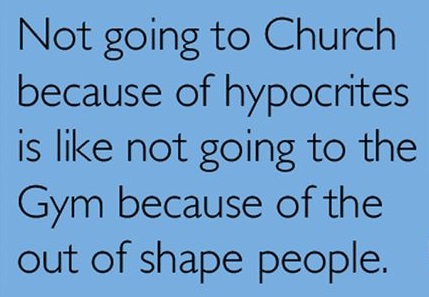
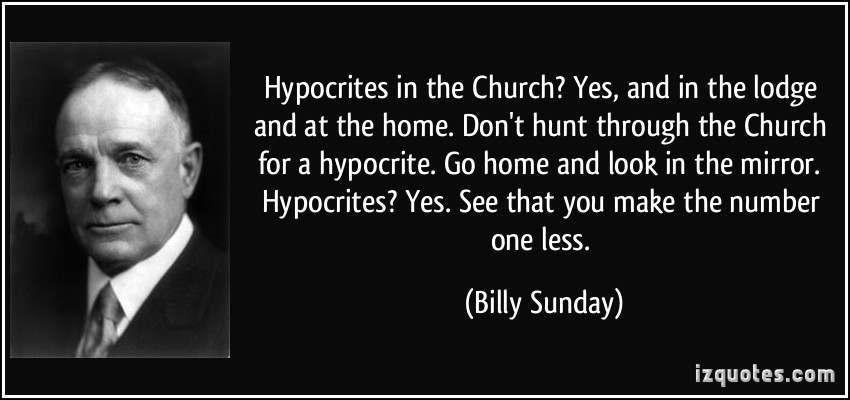
Let's hear it for hypocrites!

A few weeks ago I attended a seminar on how to connect with non-religious people. That's the new term for describing the folks we used to refer to as the unchurched. The presenter had arranged for four self-described non-religious people to form a panel for us. Curiously, to be called "non-religious," all but one attended a Christian church and the fourth followed Buddhism. In the Q&A they tried to clarify that what they meant, by calling themselves non-religious, was that they rejected the in institutions of religion, the formally-organized structures of denominationalism, and by strong implication, the basic tenets of historic Christian religion as well. Jesus, it seems, is whomever you wish him to be, rather than a first-century Jew of a particular context and religious heritage. (I wrote about that issue here.)

But at one point the panel and other attendees generally agreed that one of the main reasons the unchurched are well, unchurched is because church people are such hypocrites. I personally think that is maybe the oldest excuse in the book and I am morally certain that one day in Corinth a man approached Saint Paul and told him, “Well, Paul, the reason I won't join your new church here in Corinth is because there are so many hypocrites in it.”

And Paul probably replied, “Come on anyway. We always have room for one more.”

The hypocrisy excuse for staying away from church has got to be the oldest there is. Which only proves what Mark Twain observed, "When you don't want to do something, any excuse will do." And to borrow one of Yogi Berra's malapropisms, if people don't want to come to church, nobody's going to stop them.

But I say, "Hooray for hypocrites!" If you're a hypocrite, you're just my guy or gal. To reverse what Marc Antony said about Caesar, I come to praise hypocrites, not bury them. I am unashamed to admit that I am a Christian hypocrite, and furthermore, I hope every one of you are also.

"Hypocrite" is derived from the Greek, "hypókrisis," or "play acting." It was the description for actors in the Greek theater and refers even more specifically to the masks that certain actors wore to denote different roles, multiple roles being quite common in ancient Greek theater. Members of the chorus - a sort of on stage narrator group - also often wore masks to correspond with the mood, emotion or tome of what they were singing or narrating.

So a hypocrite is literally a "mask wearer," one who hides who s/he really is. It is, as the Greek denotes, play acting. Jesus had a lot to say about play actors, and none of it good. The Jewish prophets spoke against those who made sacrifices one day and cheated their neighbors the next. Isaiah 29.13 says, “The Lord says: ‘These people come near to me with their mouth and honor me with their lips, but their hearts are far from me. Their worship of me is made up only of rules taught by men'.”

The Wailing Wall in Jerusalem, part of the Western Wall of the Jewish Temple that was destroyed in 70 c.e. by the Romans. The Western Wall is all that remains of the Temple. Today, Jews of all religious convictions go there to pray. I prayed there, too, the same day I took this photo in October 2007.


Jesus preached stoutly against religious hypocrisy. For example, he said: "And whenever you pray, do not be like the hypocrites; for they love to stand and pray in the synagogues and at the street corners, so that they may be seen by others."

That is, Jesus denounced making a show of praying in public to gain status with others for being pious. We might call it, “competitive piety.” Jesus said to pray in private. Prayer should be meant for God to hear, not for others to see. 

The apostle Paul weighed in, too, in Romans 2.1: “Therefore, you have no excuse, every one of you who judges. For in passing judgment on another you condemn yourself, because you, the judge, practice the very same things.”

The Bible offers many examples of the hypocrisies of a people of God, some examples are:

Professing love of God while holding bitterness toward persons (1 Jn 4.20)
Going merely through the motions of worship (Mt. 15.7-9)
Claiming the name of Christ without giving Christ true allegiance (Mt. 7.21-23)
Putting on religious airs in front of others (Mt. 6.1)
Professing faith in Christ while not doing the ministries of the church (James 2.14-26)
Placing money and things above God and persons (Lk. 16.13)
Not admitting of sinfulness (1 Jn 1.10)
Using the Scriptures to advance a personal agenda rather than God's (2 Peter 2.1-3)
Complacency in God's grace of forgiveness (1 Peter 2.16)
Not showing Christ in us by the way we live (Titus 1.16)
Seeking the esteem of other persons over obeying Christ (Lk 16.15) 

No matter how you cut it, the teachings of the Bible and of Jesus personally are harsh on hypocrites. So how can I say that I am here to praise hypocrites, not to denounce them? In fact, if non-religious people think you're a hypocrite, you're just my guy or gal.

Why? Because hypocrisy requires the hypocrite to believe in something or someone outside himself. Hypocrisy requires an aspiration to something higher or better than oneself. That is the meaning of the folk saying, "Hypocrisy is the tribute vice pays to virtue." Hypocrisy is an imperfect, deficient attempt to be better.


Thankfully, I have known very few non-hypocritical people. They were insufferable. They were entirely self-centered, self-directed, self-oriented, self-focused and just plain purely selfish. They recognized no cause, entity or belief higher than themselves, their own desires, wants or needs. You can see, I'm sure, that it is impossible for such people to act hypocritically because they are always looking out for Number One in every situation. They never pretend they are acting in someone else's interests. They don't seek others' approval because they don't fundamentally care about others or what they think.

Very, very rarely is this kind of person found in a church. The church-attending hypocrites over which the seminar attendees clucked-clucked so sadly are not actually hypocritical in the usual meaning of the word: "a pretense of having a virtuous character, moral or religious beliefs or principles, etc., that one does not really possess." Yes, they fall short of what they intend, but their striving is real, not phony, and they try to do better. If they are hypocrites, then so was St. Paul.
Not that I have already obtained this or have already reached the goal; but I press on to make it my own, because Christ Jesus has made me his own. Beloved, I do not consider that I have made it my own; but this one thing I do: forgetting what lies behind and straining forward to what lies ahead, I press on towards the goal for the prize of the heavenly call of God in Christ Jesus.
It is deceit that makes hypocrisy what it is. Absent this deceit, there is no hypocrisy, just error or human frailty. That's what the hypocrisy-excuse people don't understand - or pretend not to understand - about church people. What may appear to be church people's hypocrisy is almost always just simple failure to meet the standards of our faith rather than deceit. Why? Because the standard is so high.

For example, Jesus admonished, “But I say to you that everyone who looks at a woman with lust has already committed adultery with her in his heart” (Matthew 5:28).

Or, “You have heard that it was said, ‘You shall love your neighbor and hate your enemy.’ But I say to you, Love your enemies and pray for those who persecute you … .” (Matthew 5:43-44).

There are many such examples. To attempt but fail to meet such a difficult standard is not hypocrisy.

When I tried to play football in high school, Coach Keaton was clear that to gain a place on the starting squad meant achieving a high level of performance. So, when I, a sophomore, could not run the 40-yard dash in under 4.5 seconds, did Coach Keaton yell at me, “You hypocrite!”? Of course not. He simply shrugged and said, “Work harder.” 

Jesus does not denounce us for trying and failing – if we really are trying. And I think he’s a little more compassionate than Coach Keaton was because while Jesus will tell us to work harder, he will also be our personal trainer – providing we are willing to be trained and submit to the training regimen.

All churches, including my own, are filled with Christians in training and worse yet, they all have Christians in training as pastors. Jesus told us to be perfect as our Father in Heaven is perfect. That sets the bar incredibly high. So, if in training to clear that bar we are dismissed by non-Christians as hypocrites, then I say be of good cheer. Rejoice and be glad and let’s have many more just like you!

Vice is easy, virtue is hard. It's no hypocrisy to fall short of a very high standard and such an excellent goal. And I would suggest that people accusing us of hypocrisy have yet to see the log in their own eye, choosing the easy way over the hard way, and pretending it is virtue. So, who are the hypocrites? Well, we always have room for one more.

We should not take religious hypocrisy less seriously than the Bible does, but "Christians are just hypocrites" is merely an excuse to reject the Gospel more than a reasonable observation. The church is a human institution. Name one large human institution that has always lived up to its standards. Law? Medicine? Banking? Politics? No, not even one. 


I also say that we badly err when we try to justify the church. We are not called to offer people the church. We are to offer them Christ. And we should offer Christ as Jesus did, in love of and care for the soul. After all, Paul’s reminder to the church in Corinth two thousand years ago applies to us today:
26 Brothers and sisters, think of what we were when Christ called us. Not many of us were wise by human standards; not many were influential; not many born with a silver spoon. 27 But God chose the foolish things of the world to shame the wise; God chose the weak things of the world to shame the strong. 28 God chose the lowly things of this world and the despised things—and the things that are not—to nullify the things that are, 29 so that no one may boast before him. 30 It is because of him that we are in Christ Jesus, who has become for us wisdom from God—that is, our righteousness, holiness, and redemption (1 Cor. 1.26-30)
And so to anyone who wishes to accuse me of religious hypocrisy, I can only reply as Paul did: 
I have not yet obtained perfection; but I am moving on to perfection because Christ Jesus has made me his own. Friends, I have not reached that goal, but I am not letting my past control me. I press on to what lies ahead, towards better fulfilling heavenly call of God through Jesus Christ.
So however we fall short of the standards of our faith, and fall short we certainly often do, we nonetheless seek a "more excellent way" and strain forward to what lies ahead, pressing on towards the goal.

Sunday, February 4, 2024

What's your pearl?

Here is a true story that I read a few years ago. An aging woman decided to move into the city to a retirement home. She had a big sale to downsize. One thing she did was slap a "for sale" sign on her late husband’s pride and joy – a 1963 Mercedes 300SL Gullwing that he had bought in 1972. She remembered that he had told her the Mercedes was collector’s item worth one hundred thousand dollars not long before he had died fifteen years ago, so that’s what she priced it. 

One shopper saw the for-sale sign in the car’s window, and he immediately wrote her a check for twenty-five hundred dollars to hold the car for him for the day. Then he went to the bank and opened a home-equity line of credit. On the way there he called his broker and cashed in mutual funds. Then he maxed out his Visa card on a cash advance. He wound up with a certified check for $100,000 and drove back to buy the car. He knew what the widow did not: in the years since her husband died the car had increased in value to $250,000.

That man was willing to take risks to obtain something of tremendous value. I knew a man in Nashville who told me a long time ago that he was offered the opportunity to become one of the original investors in the franchise license for all Davidson County for Wendy’s restaurants. He turned it down because he did not want to be diverted from the business he had already built up. Later, of course, he wished he had invested.

Would you pay a hundred thousand dollars for an ordinary orange? Eleven millionaires drowned when the Titanic sank in 1912. One who survived was Arthur Peuchen, who left $300,000 in a lockbox in his cabin. "The money seemed to mock me at that time," he said later. "I picked up three oranges instead." A hundred thousand bucks each.

What is of ultimate value to us, so much so that we would sacrifice almost anything else to obtain it? Jesus spoke about that Matthew 13.44-45:

44 “The kingdom of heaven is like treasure hidden in a field. When a man found it, he hid it again, and then in his joy went and sold all he had and bought that field.

45 “Again, the kingdom of heaven is like a merchant looking for fine pearls. 46 When he found one of great value, he went away and sold everything he had and bought it.

In the ancient world a large, flawless pearl would have been something like the Hope diamond of its day. Ancient literature tells of single pearls worth millions of dollars in modern value. When this merchant found such a pearl, he cleaned out his stock and sold his personal possessions to buy it. The merchant apparently did not come out ahead financially; he just changed assets at even value. There is no hint that he sold the pearl later. For all we know, he simply kept it.

But this story is not really about an actual pearl, is it? What Jesus seems to be trying to communicate is the importance of knowing first, what is of ultimate value and second, what will it take to obtain it.

Contrast this parable with the story of a young man, also told in Matthew, who asked Jesus what he needed to do to gain eternal life. After a short conversation, Jesus tells him, "Sell everything you have, give the money to the poor, then come and follow me." But the man said no. Matthew says he went away sorrowful because he had “many possessions.” Jesus offered him ultimate value but the young man declined because, he thought, the price was too high.

Today is interactive sermon day. I would ask that everyone take a moment, turn to your neighbor and talk briefly about what this parable means for you. Pause

Matthew 13 is a series of parables, one right after another. Parables are narrative stories that set up a situation at the beginning, show a kind of “twist” in the middle, and end with a punchline. This parable does that, too, although not very obviously. In fact, I think that all of Matthew 13 from start to finish is one long parable about the kingdom of heaven and what it takes to be in it with the punch line in verses forty-nine and fifty, which tell of severe judgment at the end of the age. It’s quite grim.

So, for anyone who understands the parable of the pearl to mean, “The pearl is the gospel, and we should be willing to surrender everything for the sake of the kingdom,” I shall not disagree. But I also remember what our bishop, Bill McAlilly, likes to say about his son’s soccer coach, who would always ask his players after a goal was scored, whether by his team or the other: “So what? Now what?”

So, say the parable of the merchant is about doing whatever it takes to be in the kingdom of heaven. That’s fine. So what? Now what?

That is the hard part for me because it forces me to ask, “What is my pearl right now?” Because you see, everybody has a pearl. What’s mine? What’s yours?

What is it that I treasure more than anything else – so much that, like the merchant once he gets the pearl, I am not willing to part with it, ever? That’s my pearl. Everyone here has a pearl, also. So, take a moment now and think about the answer to this question: What is your pearl? What is more important to you than everything else? What is it that would make you give up almost anything else to keep? If you are inclined, turn to your neighbor and talk it over.

-----------

When I served a church is west Nashville, I did some volunteer ministry at Lighthouse Ministries, a live-in center for men suffering from addiction issues or homelessness. I remember counseling a young man who just would not follow the rules of living there. He said in one session with the director and me that he really wanted to go home to visit his mother over Christmas but of course he had no money even to take a bus to Jackson, Tennessee, where she lived. The director said that funding could be provided, but it was not simply free. He had to follow the rules and go through the process of making his life better. He said that was too hard and there were too many things out of his control. I asked him, “You can make your bed tomorrow morning, right?” He nodded. “Well,” I said, “that’s in your control and it is one of the rules here. Don’t worry about what you can’t control. Do the things you can control.”

His pearl was to spend Christmas with his mother. It was a good goal. I remember a discussion about this parable by Vanderbilt Professor Amy-Jill Levine. She said that after class one day where they talked about this parable, a young female student came to her and said, I know what my pearl was. I did give up everything for it – all my money, all my possessions, I even ended my marriage for it. It was alcohol. I was willing to give up everything I had to get the next drink.

When I ask myself what my pearl is, I also cannot avoid asking, Is that what my pearl should be? Is my pearl a good one?

Professor Levine also talked about leading a Bible study at River Bend Prison and discussing this parable, where an inmate told her that his pearl was freedom, to be released from prison. Another said that his pearl was simply staying alive while he was in prison.

Viktor Frankl wrote a book called Man’s Search for Meaning not long after he was liberated from a Nazi concentration camp near the end of World War Two. The Library of Congress lists this book as one of the most significant books of the twentieth century. Frankl lost his entire family in the camps – his wife and children did not survive.

But Frankl wrote about all the things the Nazis, with all their evil designs, could not take away. He wrote of people who entered the gas chambers praying the Lord’s Prayer or the ancient prayer of the Jews, the Shema Israel. He told of starving prisoners who went through the huts giving their meager bread ration to others near death. Such acts convinced Frankl that a person’s ability to choose one’s attitude, to control one’s inner life, no matter the circumstances, was the single human freedom that no earthly power could ever destroy. So even the worst that this world can throw at us cannot take everything. Frankl did not talk about parables, but he did find his pearl, to be in control of his inner life. And that was how he found freedom in the camps, even surrounded by death at every hour.

What’s your pearl? Should it be?

The error I have made so far in talking about this parable is individualizing it, as if Jesus was talking to and provoking thought in individual persons. Yes, there is a lesson for each of us in this parable and my lesson and yours won’t necessarily be the same. But there is a lesson for us together also, with the same focusing question: What is the pearl of our church? What is the centering and central focus of our life together as the body of Christ? Is that focus what should be our focus?

So, I would ask each of us right now to answer this question: What is it that we do, that if we stopped doing it, would lead us to think we had surrendered a central, vital element of being a church belonging to Jesus Christ? Please discuss with your neighbor.

Here is a second question: Is there anything that we are not doing that, by its omission, is already surrendering central, vital element of being a church belonging to Jesus Christ?

And here is the third and final question, not for discussion but for answering for oneself: Does it matter – does it really, truly matter enough for all of us together – as a church – to do whatever must be done to take hold of that pearl?

These are hazardous questions. If we are honest with ourselves individually or with ourselves as a congregation, we would have to admit that, as W. Edwards Deming pointed out, the main purpose of human organizations is to maintain the status quo.

The first time I thought about this for myself, I came to understand that my pearl was just that: preserving the status quo. I understand that the prospect of change can be disturbing. At the outset it can seem like entering a dark room blindfolded. Yet as Sam Cooke sang in 1964, “A Change Is Gonna Come” whether we like it or not, whether we want it or not, whether we are prepared for it or not. And there are only three ways to deal with change:

1.     Make things happen,

2.     Watch things happen, or

3.     Wonder what in the world just happened.

Over time, I came to realize that no matter how wonderful the status quo feels, it is not possible to maintain it. The only place the status quo is maintained is a cemetery. As Jesus said, “Let the dead bury the dead” and, “God is the God of the living.” To be alive is to change.

So, discuss briefly with one another this question: In the coming months and years, what changes to our status quo are coming? And what would we like the changes to be? Here is a template I use:

First, rediscover and renew our calling from God as Christian ministers and lay people, as individual disciples and as connectional Methodist church people. Jesus told Peter he would make him fish for people. Do we remember when we got hooked by Jesus? Is it still fresh? Or did we get stuck in a rut, which is to say, did we devote our energies to preserving the status quo?

Second, are we intentionally making disciples or just accepting people into membership? We should discern together and put into place together an intentional path to discipleship. It cannot be enough any longer simply to accept people into membership and leave them free lancing afterward. No longer can we say, “We have Sunday School classes and Bible studies and women’s groups and community ministries, and we hope that one of them is right for you.” Jesus did not give us the mission of making church members, but of making disciples.

Of course, we will have to figure out just what a disciple is, but I will leave that for another day.

Third, do we see all the people, including both the people of our fellowship, whether members or not, and the people of our larger community? William Temple observed, “The church is the only cooperative society in the world that exists for the benefit of its non-members.” I think that’s a bit of an overstatement, since I think we would agree that police, fire and rescue departments and the US military also exist for the benefit of non-members. But Temple’s point is still sound: Jesus didn’t begin the Church in order to convey member-benefit packages to church people.

Now, we do benefit, and very richly. But not in ways awarded by other organizations. Jesus put it this way to his disciples just before he was arrested: “Peace I leave with you; my peace I give you. I do not give to you as the world gives. So, do not let your hearts be troubled and do not be afraid.”

Fourth, how shall we preserve that of our church which is excellent and gives glory to God, of which there are many examples? It is true, that as Sebastian says in The Tempest, “What's past is prologue,” but it is also past. We cannot plan for the past, only for a church we will bequeath to our children and grandchildren.

Personally, I am optimistic! After all, Jesus said, "Do not worry, saying, 'What shall we eat?' or 'What shall we drink?' or 'What shall we wear?' For people who don’t know God wear themselves out themselves over such things. Your heavenly Father knows that you need them. So, seek first his kingdom and his righteousness, then all those other things will be given to you as well."

Good words to live by and plan with. Thanks be to God!

Sunday, January 28, 2024

Who knows? What we can learn from ancient Nineveh

 Jonah 3:1 10

1 Then the word of the LORD came to Jonah a second time: 2 "Go to the great city of Nineveh and proclaim to it the message I give you."

3 Jonah obeyed the word of the LORD and went to Nineveh. Now Nineveh was a very important city   a visit required three days. 4On the first day, Jonah started into the city. He proclaimed: "Forty more days and Nineveh will be overturned."

5 The Ninevites believed God. They declared a fast, and all of them, from the greatest to the least, put on sackcloth. 6 When the news reached the king of Nineveh, he rose from his throne, took off his royal robes, covered himself with sackcloth and sat down in the dust. 7Then he issued a proclamation in Nineveh: "By the decree of the king and his nobles: Do not let any man or beast, herd or flock, taste anything; do not let them eat or drink. 8But let man and beast be covered with sackcloth. Let everyone call urgently on God. Let them give up their evil ways and their violence. 

"9    Who knows? God may yet relent and with compassion turn from his fierce anger so that we will not perish."

10 When God saw what they did and how they turned from their evil ways, he had compassion and did not bring upon them the destruction he had threatened.

Jonah visited Nineveh during the glory days of the Assyrian empire. From about 885 to 625 BC, the Assyrians dominated the ancient world. As early as 841 BC, Jehu, King of Israel, was forced to pay tribute to the Assyrian ruler, Shalmaneser III. This kind of harassment continued for over a century. Then Assyria brutally conquered Israel in 722 BC.

God called Jonah to go to the heartland of his people’s worst enemy. It was a radical order which would have taxed the obedience of any prophet.

Once there, Jonah goes straight to work. He doesn't look for the local Holiday Inn to drop off his luggage. He doesn't buy a paper to check up on the local news. He doesn't request an audience with the king. He shows no interest in the power structure of the city. He just marches in and for three days he shouts to the Ninevites that their time is limited. Whatever the Assyrians may have thought about him, Jonah got their attention.

Jonah foretells gloom and doom, death and destruction. His voice is not one of woe, but of triumph. Nineveh, the capital of Jonah’s hated enemy, will be overthrown. This is a good deal! These pillaging, plundering and looting Assyrians are finally going to get what’s coming to them, and it’s about time, too!

Jonah is a man of judgment, certitude and certainty. In Jonah’s world there are actions and consequences. This is how things are. No wriggle room, that’s Jonah. How can we argue with that idea? It’s true, isn’t it? if you work hard, you get ahead. If you make good grades, you get into a good college. If you can’t do the time, don’t do the crime. Actions have consequences.

In fact, the promises God are often found in scripture phrased in “if-then” terms. In Deuteronomy we read, “If you fully obey the Lord your God and carefully follow all his commands, the Lord your God will set you high above all the nations of earth. However, if you do not fully obey the Lord your God and do not carefully follow all his commands, all these curses will come upon you.”

At the beginning of the story, Jonah learns that the wickedness of the Ninevites has come before God. Jonah pronounces doom for the Ninevites, but he never tells them why they deserve it. Presumably, the Ninevites understood why an Israelite and an Israelite’s God would condemn them. There is no word of grace in Jonah’s proclamation. Throughout scripture and in our own experience of knowing God, God’s grace is always pre-eminent. It is prevenient, to use the Wesleyan term. God’s grace always goes before his messengers and prepares the receivers of the message to hear it. As things turned out, Jonah’s imperfect prophecy didn’t prevent the Holy Spirit’s work. The Ninevites were convicted of their wickedness by Jonah’s warning. The whole city repented and was spared.

Despite Jonah’s imperfections, we need people like him. It’s far too easy to become morally, economically, culturally and religiously lazy, even wicked. Especially when things are going pretty good, as they were for the Ninevites then and are for most Americans right now. I am pro-prosperity. I see no inherent moral virtue in poverty. We have nice homes, good schools, good jobs, nice clothes and a high standard of living. These are good things. We have a good life. I don’t mean they are good in some sort of double talking, theologically wisecracking sort of way. I mean genuinely, truly good. But how easy it is to be seduced by the siren song of secular success and forget whence comes our wealth and good life. It’s all on loan from God.

One of the richest persons in the Bible realized this. When Job lost all his wealth, he honestly acknowledged, “I came naked from my mother’s womb, I will leave this world naked. The Lord gives, the Lord takes away. May the name of the Lord be praised.” The Bible is clear about who gives us what we have. Deuteronomy records God’s admonition to the Hebrews in chapter 8. I’m going to slightly—but only slightly—paraphrase it:

Be careful that you do not forget the Lord your God, failing to keep his commands. Otherwise, when you eat and are satisfied, when you build fine houses and settle down, when your companies grow large and your stock holdings increase and all your stock investments beat the S&P 500, your heart will become proud and you will forget the Lord your God and you may say to yourself, “My power and knowledge have produced this wealth for me.” But remember the Lord your God, for it is God who gives you the ability to produce wealth. If you ever forget the Lord your God and follow other gods and bow down to them and worship them, you will surely be destroyed.

We are the wealthiest nation ever to exist. Stupendously endowed with enormous natural resources, fresh water and fantastically productive soil, we have formulated an economic and political system unmatched in all history for material production and comfort. Are we blessed by God? You bet! Yet I fear that as a nation we say, “Our power and knowledge have produced this wealth for us.”

A few years ago survey by the Barna Group discovered that almost two-thirds of Americans agreed that the purpose of life was enjoyment and personal fulfillment and that each person’s responsibility is to oneself. Robert Wuthnow wrote in his book, God and Mammon in America, that Americans are, as a culture, spiritually adrift in making decisions in economics, career choice, workplace commitment, consumerism and charity. Those who described themselves as committed churchgoers often said they had their materialistic and workaholic tendencies reinforced by their religious beliefs and faith training. They live, they admitted, “pretty much the same as those who have no faith at all.”

In his “Letter From Birmingham Jail,” Martin Luther King, Jr. lamented, “The contemporary church is often a weak, ineffectual voice with an uncertain sound. It is so often the arch-supporter of the status quo. Far from being disturbed by the presence of the church, the power structure of the average community is consoled by the church’s silent, or often vocal, sanction of things as they are.”

It is sometimes a Christian’s responsibility to stride like Jonah into the hearts of our cities and the boardrooms of the powerful and proclaim, “You are forgetting the Lord your God and are following secular idols like consumerism, perverse entertainment and secular pride. You worship and bow down to them, but the Lord gives and the Lord takes away.” Jesus said judgment comes to those who store up things for themselves but are not rich toward God. Life is more than good food and the body, more than fine clothes.

The Ninevites believed what Jonah told them. From king to pauper, they repented and called upon God. They gave up their evil ways and violence. “Who knows?” they declared. “God may yet relent and with compassion turn from his fierce anger so that we will not perish.” When God saw they had turned from their evil ways, he had compassion and did not destroy them.

Now how can that be? God went to a lot of trouble to get Jonah to the Ninevites and now they are spared? Just because of a little sackcloth and ashes and fasting? What’s the deal? Actions, consequences, right? Not here! The dirty, rotten Assyrians beat the rap on a technicality. Jonah sulked and left town.

Well, not so fast. The Assyrians were never ones for small gestures. Their army’s effectiveness would have made William Tecumseh Sherman green with envy. Nineveh was the largest city in the world at the time, almost sixty miles around. Its walls were so thick that three chariots could be driven abreast on top. Fifteen hundred watchtowers were set along the wall, each tower two hundred feet high—oh, yes, the Assyrians made big plans and did things in a grand way.

So it’s no surprise they went for big-time repentance. Their repentance was no pro-forma, half-hearted, mealy-mouthed, “Dear-God-we’re-sorry-please-forgive-us” ritual. It was Super Bowl level, Nobel-prize caliber, Neiman-Marcus catalog, total quality repentance. No public opinion polling. No encounter groups or sensitivity sessions. No city council meetings or legislative deliberations. No Sunday School series or committee meetings. There was no temporizing or excuse making. There was only a collective shock of having been judged by the ultimately righteous God and their desire to turn away from sin.

I’m not sure we know how to do that kind of repentance today. Many of you may remember a best-selling book of the nineteen seventies called, I’m Okay, You’re Okay. I’ll bet the Ninevites said that to one another before Jonah showed up. It’s hardly a clarion call to repentance. We typically plead for God’s intervention in the mess we’re in now, as if God is a cosmic lifeguard who exists to bail us out of our self-made predicaments.

The Ninevites’ repentance was deep and profound—a genuine conviction of ignoring God and going their own way, doing their own thing. They urgently called upon God, giving up their sinful ways.

Jonah knew what kind of God he was representing. The forty days came and went. Nineveh was still standing. Jonah was so mad he wanted to die. He yelled at God, “I know this would happen! I knew you were a God of love, gracious and compassionate. That’s why I didn’t want to come here is the first place.” The Assyrians knew something about God, too. They knew something about God that it’s easy to forget. God responds to humble, genuinely contrite appeals for mercy. “Who knows?” they cried. “Perhaps God will relent and show compassion.”

The Ninevites took a chance on God. They bet on God’s mercy and love. We should not deride their faith.

Jesus told the story of the prodigal son who sank so low he slopped hogs for a living. The pig slop was better than his own meals. He set out for home, penniless, to ask his father to accept him as a servant. Who knows? Maybe his father will say yes.

A Roman centurion approached Jesus of Nazareth. The centurion’s beloved servant was desperately ill and near death. Who knows? The centurion thought. Maybe this Galilean rabbi really can heal my servant.

Do we have the faith even to ask, “Who knows?” It is true that the Ninevites had a deadline to meet to get right with God. Forty days is not a long time. But how much time do we need? We would be alarmed if we knew we would not live another month, but we are careless even though we don’t know we’ll live another day.

Who knows but that there are people sitting here who are not right with God and realize it? There’s no reason to wait any longer. No more time is needed. Christ’s grace has already brought you to this place, and not by accident. This is a church of the crucified and risen, living Christ, not a social club or civic organization. Our founder was a homeless Jew who was executed as a criminal insurrectionist and religious heretic. He was never on the social “A” list and he wouldn’t have been invited to the Swan Ball. Yet it is through this Christ Jesus that God accounts us as righteous. If you confess with your mouth that Jesus is Lord and believe in your heart that God raised him from the dead, you will be saved. Today is the day. Now is the time.

Who knows? Perhaps God really is gracious and compassionate, slow to anger and abounding in love, just as Jonah knew and the Ninevites discovered.

A world without nuclear weapons - what would it look like?

 From Pope Leo this week, according to the National Catholic Reporter : " Pope Leo quotes Bob Dylan song in book foreword calling for n...