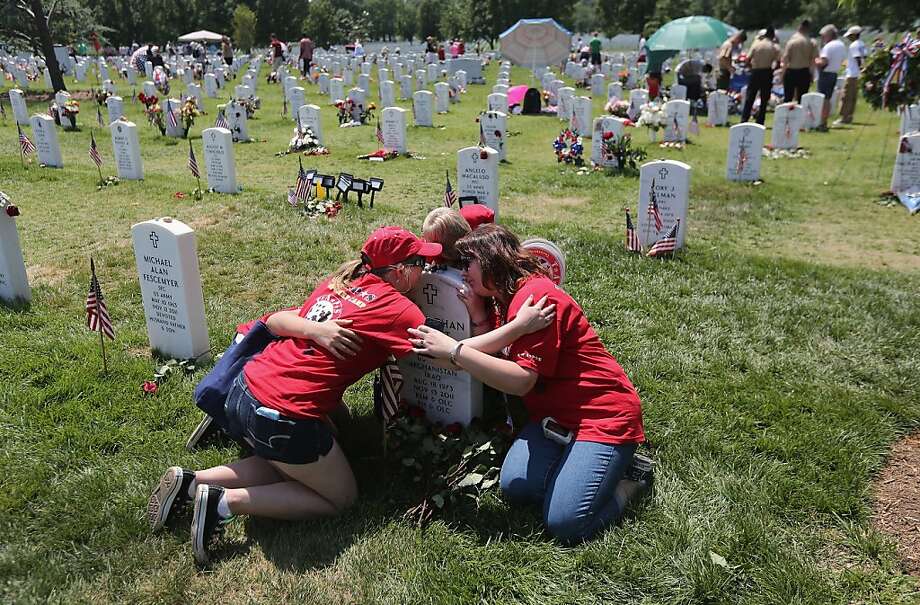
Our sense of honor pervades everything we do. This isn’t the Western definition of honor, it’s more like Hispanic honor of machismo. Perception of manhood is vital and in fact it can be a matter of life and death. A man without honor gets no wife, often no work, and in Iraq he may be shunned or even killed by the own family depending on how grave the offense is. Defending honor is part of our cultural heritage. It is the focal point of everything we do and is jealously guarded. Honor means influence and power, our foremost concern. Less power means fewer contracts, less money, less food, angrier families. We must regain lost honor any way we can, even if it means violently attacking the ones who dishonored us.
14 On one occasion when Jesus was going to the house of a leader of the Pharisees to eat a meal on the Sabbath ... . 7 When he noticed how the guests chose the places of honor, he told them a parable. 8"When you are invited by someone to a wedding banquet, do not sit down at the place of honor, in case someone more distinguished than you has been invited by your host; 9 and the host who invited both of you may come and say to you, 'Give this person your place,' and then in disgrace you would start to take the lowest place. 10 But when you are invited, go and sit down at the lowest place, so that when your host comes, he may say to you, 'Friend, move up higher'; then you will be honored in the presence of all who sit at the table with you. 11 For all who exalt themselves will be humbled, and those who humble themselves will be exalted."
If someone has a stubborn and rebellious son who does not obey his father and mother and will not listen to them when they discipline him, ... 20 They shall say to the elders, “This son of ours … is a glutton and a drunkard.” 21 Then all the men of his town are to stone him to death.
But he said, “Lord, permit me first to go and bury my father.” But he said to him, “Allow the dead to bury their own dead; but as for you, go and proclaim everywhere the kingdom of God.”
Another [man] also said, “I will follow you, Lord; but first permit me to say good-bye to those at home.” But Jesus said to him, “No one, after putting his hand to the plow and looking back, is fit for the kingdom of God.”
While Jesus was still talking to the crowd, his mother and brothers stood outside, wanting to speak to him. Someone told him, “Your mother and brothers are standing outside, wanting to speak to you.” He replied to him, “Who is my mother, and who are my brothers?” Pointing to his disciples, he said, “Here are my mother and my brothers. For whoever does the will of my Father in heaven is my brother and sister and mother.”
There is neither Jew nor Gentile, neither slave nor free, nor is there male and female, for you are all one in Christ Jesus (Gal. 3.28).

There is a tempest in a teapot among many of my ministerial colleagues about what the American bishops of the Roman Catholic Church have just done regarding President Biden and other Catholic elected officials. National Public Radio reports:

After a contentious debate, the U.S. Conference of Catholic Bishops has voted to move forward with a process that could call into question the eligibility of politicians like President Joe Biden to receive Communion.
The bishops voted 168-55 in favor of drafting "a formal statement on the meaning of the Eucharist in the life of the Church," officials announced on Friday afternoon, the final day of their three-day virtual meeting. Six bishops abstained.
Biden's election as only the nation's second Roman Catholic president has prompted renewed debate over denying Communion to Catholic politicians who support abortion rights, a position at odds with church teachings.
During their online meeting, bishops held a spirited discussion Thursday before voting on the proposal to direct the bishops' Committee on Doctrine to draft the statement. Such a document, once completed, could include guidelines for denying Communion to public officials.
I say that the reax by my colleagues is a tempest in a teapot not because the issue is not serious but that across the vast spectrum of Americans the bishops' decision has been met with a gigantic yawn, including by the vast majority of non-Catholic clergy.
However, many are not happy about it at all. Here is a typical response:
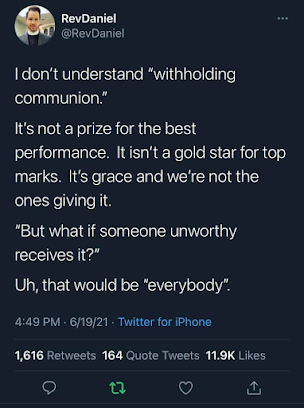
First, RCCs very emphatically believe that no one is worthy of receiving the Eucharist; their catechism says so very precisely. Communicants, those who receive the sacrament, are not worthy of the sacrament but are made eligible by obeying the commandments of Scripture regarding the sacrament. The formal Catholic teaching, or catechism, of the Eucharist includes:
1384 The Lord addresses an invitation to us, urging us to receive him in the sacrament of the Eucharist: "Truly, I say to you, unless you eat the flesh of the Son of man and drink his blood, you have no life in you."
1385 To respond to this invitation we must prepare ourselves for so great and so holy a moment. St. Paul urges us to examine our conscience: "Whoever, therefore, eats the bread or drinks the cup of the Lord in an unworthy manner will be guilty of profaning the body and blood of the Lord. Let a man examine himself, and so eat of the bread and drink of the cup. For any one who eats and drinks without discerning the body eats and drinks judgment upon himself."218 Anyone conscious of a grave sin must receive the sacrament of Reconciliation before coming to communion.
1386 Before so great a sacrament, the faithful can only echo humbly and with ardent faith the words of the Centurion: "Domine, non sum dignus ut intres sub tectum meum, sed tantum dic verbo, et sanabitur anima mea" ("Lord, I am not worthy that you should enter under my roof, but only say the word and my soul will be healed.").
The key sentence for this post is, "Anyone conscious of a grave sin must receive the sacrament of Reconciliation before coming to communion." What the bishops are insisting is that abortion on demand is a grave sin, and its political advocates and enablers would be partaking of the Eucharist in an unworthy manner unless they complete the steps of Reconciliation. Those steps are Confession, receiving Absolution from a priest, and doing the Penance assigned.
We Protestants need to understand that the sacraments of the RCC are a system and are closely interrelated. This is not much true in my denomination, the United Methodist Church. Our two sacraments of baptism and Communion are related, but not much interrelated.
Besides, even we UMC ministers formally (though not in practice) "fence" the Communion table in the first paragraph of the litany by saying,
Christ our Lord invites to his table all who love him, who earnestly repent of their sin and seek to live in peace with one another.
And then we require confession! (Though the confession is a scripted prayer said by the whole congregation, not privately to a pastor.) But read that sentence carefully: We formally (again, not in practice) invite to Communion only those who love God, who repent of sin (which is what the RCC bishops are demanding in the present controversy, only they really mean it) and who want to live peacefully with one another.
Barring persons from the Communion table has never been part of the UMC's theology, doctrine, or practice, so our verbal fence around the table is mostly symbolic and also a call for each person to examine themselves. However, before we get our Protestant backs up, we should consider that formally, we are not much different from the RCC in qualifying who may receive the sacrament. It's just that the RCC is far more likely to mean it.
These are not religious or theological tweets or posts, they are political declarations hiding behind religious language.
Update: An email from a practicing Catholic, Joseph S., points out that the denial of Communion (to one who has sinned and is unrepentant) is intended to protect that person from compounding his or her sin by receiving the sacrament in an unrepentant state. So, yes, denial of Communion is aimed at correction but also at protection. In this way denial of Communion is an act of pastoral care and Christian love.
Update: Have done some more reading on this general topic, not about the Biden-Communion controversy. There have been for a long time, decades if not centuries, debates within Catholicism about the Eucharist being served to persons still in grave sin, such as divorced Catholics whose marriage was never annulled by the Church and who have since remarried. Catholic doctrine (and some Protestant denominations) consider that to be adultery, which is a state of grave sin. These have been serious debates of varying intensity over the years/decades, and were not tied to politics. A strict interpretation has held that Catholics still in grave sin (politically tinged or not!) should not receive the Eucharist. Some also say that such persons should not be allowed to serve in public ministry such as being a lector, who are lay persons reading Scripture of litanies during worship. So, even within the RCC, eligibility to receive the Eucharist has long been a very complicated issue on matters other than abortion for at least several decades. However, this present controversy could have far-reaching outcomes on Communion and matters other than abortion. As lawyers say, the bishops' lopsided vote on the abortion-Biden matter could set a precedent for other issues unrelated to abortion but still related to the sacrament. We should all pray for the Holy Spirit to be heard and heeded!
Also, the whole concept of denying Communion to a church member is widely misunderstood among non-Catholics to be a form of priestly punishment upon a sinful church member. That is not so. In fact, the emphasis of denial is that the person concerned should be encouraged and assisted to repent and reconcile by their own volition to enable them to approach the altar to receive the body and blood of Christ. Grudging repentance is not repentance at all. It is submission to power, not an acceptance of divine love and its return to God by the communicant. But the Church's goal is to help bring its members to, or back to, a state of loving God and neighbor with all their heart, soul, strength, and mind, and to receive Eucharist in that state, not in mere submission to priestly authority.
The responsibility is on the communicant, God and the Church being his/her helper. I am far from certain that the publicity of the recent vote regarding the president and other Catholic politicians is very helpful, and I have to imagine that among Catholic clerics there is no little discussion of that.
I took this photo in 2008 at the Vietnam War Memorial, near the Lincoln Memorial.

There is one Sensing whose name is engraved on the wall, Capt. John L. Sensing, US Army. I never knew him, but we are some ordinal of cousin, since all Sensings (in the South, anyway) descend from one Jakob Sensing, who immigrated to North Carolina from Germany in the 1730s. One of his sons, a Revolutionary War veteran, took his veteran's land grant in Tennessee. So here we are.


My son sent me this article [from where it was originally posted] and it gave me chills. Robert E. Masseth was my brother-in-law and my son is his name sake. My husband, David Masseth passed away with cancer this summer. We did not get a lot of information about his brother other then he was killed in a helicopter crash on April 30, 1970.
In just the last two or three years, the US government, mainly the Defense Dept., has released videos of what used to be called UFOs, now called UAPs, Unidentified Aerial Phenomena. These include tracking and targeting video taken by US Navy jet fighters trying to intercept UAPs.
The most recent video release was in the past week. It is video taken from the bridge of USS Omaha of a UAP that shows apparent "transmedium" capability, meaning it travels through air or water with equal ease and speed - an ability massively beyond the capability of any technology we know of. Here is the video. As some commentators have noted, the bridge crew's voices also recorded betray no shock or astonishment, but more like "this again."
Much more info with assessments at "Pentagon Confirms Authenticity of Video Showing UFO Maneuvering Near U.S. Navy Ship."
Then there is this: "Bombshell UFO Report: U.S. Military Encounters UFOs ‘Every Day’ That Far Exceed Its Tech, Capabilities."
An explosive report featured on CBS News’s “60 Minutes” featured several former U.S. military officials who talked about what the U.S. government knows about unidentified aerial phenomena — UAP —more commonly referred to as UFOs.
The segment comes ahead of a report that the military is supposed to deliver an unclassified report to Congress by next month. Former Director of National Intelligence John Ratcliffe said in a recent interview that the findings will shock people because “frankly, there are a lot more sightings than have been made public.”
Read the linked article, but here two 60 Minutes reports on the topic (both dated May 16, 2021). The first segment is about six minutes long, the second about 13 minutes:
I wrote in 2013 of former Canadian defense minister Paul Hellyer, who served in that role (equivalent to the US secretary of defense) in the 1960s. He stated unambiguously that UFOs are non-terrestrial craft, directed by extra-terrestrial, highly intelligent beings. That makes Mr. Hellyer the most senior person I have ever heard of who claimed this.
But that might change with the release of the Pentagon report next month.
Finally, here is a mere 92 seconds of President Obama on a late-night talk show saying he cannot talk about the subject.
Was he jesting, or answering seriously, hoping it would be taken as jest? You decide.
Update: CNN covered it, too.

Acts 1.-11:
6 So when they had come together, they asked him, "Lord, is this the time when you will restore the kingdom to Israel?"
7 He replied, "It is not for you to know the times or periods that the Father has set by his own authority. 8 But you will receive power when the Holy Spirit has come upon you; and you will be my witnesses in Jerusalem, in all Judea and Samaria, and to the ends of the earth."
9 When he had said this, as they were watching, he was lifted up, and a cloud took him out of their sight. 10 While he was going and they were gazing up toward heaven, suddenly two men in white robes stood by them. 11 They said, "Men of Galilee, why do you stand looking up toward heaven? This Jesus, who has been taken up from you into heaven, will come in the same way as you saw him go into heaven."
You have probably heard the expression, "an elephant in the living room." The source of this saying apparently was a substance-abuse counselor, who said that families in which there is a drug user are living with an elephant in the living room: It moves around, takes up an enormous amount of space, makes loud noises, bumps into them, knocks things over, smells bad - yet the family members are usually in denial and pretend it isn't there.
The story of Jesus' ascension is sort of an elephant in the living room of North American Christianity. Clergy of mainline churches like the UMC know what dominates this story but we usually pretend it isn't there. In previous years on Ascension Sunday, I ignored the elephant, too, but today I'm coming clean. What dominates this story is Jesus' bodily ascension into Heaven.
A miracle, in
other words. That's the elephant.
The 21st-century Western mind pretends the miracle isn't there. We search for the moral of the story or its implied meaning and ignore the miracle. Lay people are taught, by implication, to do that in our secular school systems and colleges. Clergy are taught to do that in mainline seminaries and divinity schools. Almost every mention of biblical miracles in my classes at Vanderbilt Divinity School was to show how the event itself wasn't really important and wasn't the real point of the story, anyway. Don't dwell on the miracle - with the unspoken implication being that the miracle didn't really happen or that the event was really an ordinary event that occurred in unordinary circumstances and was mistaken for a miracle. Besides, the people who wrote the Bible were educated for their day, but not for ours, and did not enjoy the benefit of the scientific method as a way of understanding reality.
But we have to
face the elephant in the living room of 21st-century, North American
Christian faith, the fact that the entire Christian religion inescapably rests
on miracles. And whatever other points the Ascension stories may have for us in
our day, the central part of the story is that Jesus ascended bodily into
Heaven.
In defense of
modern scholarship, though, I readily agree that in miracle stories, including
those of Jesus' healing, the miracle is not the only point of the
stories, and sometimes not even the main point. For example, Jesus healed the
servant of a Roman centurion whose faith in Jesus was so profound that Jesus
exclaimed, "I have not found anyone in Israel with such great faith"
(Matt 8:10). That's the real kicker of the story, not the healing, which takes
place entirely offstage.
But there are
three miraculous events of Jesus' life in which the miracle is so central to
defining who Jesus was - and who he is today - that explaining them away cuts the heart from our faith.
The first is
Jesus' miraculous Incarnation as the unique Son of God. I do not refer to the
virgin birth. I mean that, as Paul wrote, "In Christ all the fullness of
the Deity lives in bodily form," (Col 2:9), which cannot be said about any
other person past or present. That Jesus was fully God and fully human is an
essential miracle of his very existence that cannot be intellectualized away
without surrendering the essence of who Christ is, what he means and what he
does.
Second is that
Jesus was dead, buried, and on the third day rose from the dead. The
resurrection is the hinge of Christianity, about which everything
else rotates. Everything about our faith depends on it. Once its affirmation is
abandoned, Christian faith becomes pointless, another fact that Paul
recognized. He wrote the Corinthians that if there is no resurrection, 'Let us eat and drink, for tomorrow we die' (1 Cor. 15.32).
The third miracle
is the Ascension.
The Reverend
Robert Hansel described most classical art of the Ascension. "We see Jesus
dressed in gauzy, flowing robes and he appears to be floating weightlessly on a
couple of insubstantial‑looking white clouds. The clouds are being lifted up by
some smiling, chubby cherubs. It seems like some kind of pre‑technology
elevator or a circus levitation act. Even though we understand that what we're
seeing is artistic and poetic, we just have to smile at the apparent silliness
of the whole thing. Jesus lifting off like a rocket? Peter Pan with pixie dust?
Come on! Isn't this whole idea of Ascension dated and embarrassing ‑ something
we'd be better off simply leaving out of contemporary Christian theology?"
The modern mind
replies, "Yes."
Yes, we all know
that people do not fly unassisted through the air and that precious few of us
have seen angels, although we can all imagine circumstances when that would be
greatly improved if one showed up now and then. And we know that wherever
Heaven is, it isn't directly over our heads, as hundreds of spaceships have
proven.
And having
affirmed all that, we are left with the cold, hard fact that Jesus isn't here
any more, and neither is his body.
The suffering,
death, resurrection, appearances and ascension of Jesus Christ form a single
narrative. In religious terms, they use poetic imagery and mythical literary
language to describe the central events of the most important person in all
history. Religious language is used best for religious experience. But there is
also a very practical matter addressed, an important one for a faith that
claims to be grounded in real events of actual history, as ours does. That is,
What happened to Jesus' body?
Matthew records
that this question was of foremost concern to Jesus' opponents after he was
buried and the tomb turned up empty. Disbelieving that Jesus was raised from
the dead, the question of what happened to Jesus' body was both obvious and
urgent.
The story of
Christ's ascension leaves us with much the same question, too. Namely, if Jesus
didn't ascend into heaven, where is his grave? For he is no longer walking
around, continuing his ministry. A crucial historical fact of Christianity is
that Jesus' body is missing. Peter preached to the people of Jerusalem on the
day of Pentecost, "Jesus God raised up, and of that all of us are
witnesses. ... I may say to you confidently of our ancestor David that he both
died and was buried, and his tomb is with us to this day." Jesus' tomb is still here, too, but unlike
David's tomb, there's no body there. So for people who dismiss the Ascension
story from a scientific-technical point of view as I once did, I have to ask:
If Jesus is not
here, and he is not ascended, what happened to him? And more importantly, what
will happen to us?
For Christ's
resurrection to be decisive, it had to be permanent. After all,
Lazarus was also raised by God's power, through Jesus. Note that we call
ourselves "Christians," not "Lazarites." Lazarus'
resuscitation was a temporary reprieve from the grave and therefore of no value
to our salvation.
The Ascension of
Christ is a critical element of Jesus's story, and therefore of our salvation.
But we are a scientifically minded, technically trained people, and unlike the
uneducated, superstitious masses of earlier centuries, we know better than to
believe in fairy tales like the Ascension story. At least, that's how I used to
think, including for quite a while after I became committed to Christ. But I
think now that we cannot gut the story of Jesus of its miraculous content,
leaving holes in the narrative, and expect something sensible to remain. If
Jesus didn't heal the sick in inexplicable ways, then what did he do? Just
preach? There have been countless thousands of extraordinary preachers since
Jesus' day. Quick, name two, not including Billy Graham ... or Donald Sensing.
So preaching itself gets no monuments dedicated to you.
Thomas Jefferson
was a man of the Enlightenment and the age of Rationalism, a deist rather than
a traditional Christian. He took scissors to the New Testament, cutting out the
verses that mentioned miracles. What was left was perhaps morally inspiring,
but not exceptional. As you may recall me saying before, any religion founded
only on Jesus' teachings would be simply an admirable form of orthodox Judaism.
That's no bad thing, but that is not what brings us here each Sunday. The
disciples knew this, even said so explicitly. Paul wrote the Corinthians that
if Christ is not raised than we are still in our sins and have no hope.
Reverend Hansel again:
Whatever we may think of the poetic
imagery, the Ascension tells us finally and completely who Jesus really is. The
picture of Jesus returning to God the Father enables us to let go of previous
and incomplete pictures of Jesus. Certainly Jesus is the baby in the manger at
Bethlehem, but that's not who he is now. Yes, he is the great teacher of the
Sermon on the Mount, but we know much more than just a record of his words. We
know that he hung and died on the cross, but that's not where he is today. We
believe that he rose victorious from the empty tomb, but he's not just hanging
around like some sort of wandering ghost.
Ascension adds a final and critical
photograph to the album of who Christ is and what he does. He is ascended -
once more with the Father, enthroned forever as the ruler and judge of all
human history. This is the final picture and a very important one indeed
because it puts all the other pictures in perspective."
http://www.explorefaith.org/Homily04.28.02.html)
There is a lot
more to the Ascension story than the Ascension itself, but without the
Ascension itself, there isn't much else about the story that matters.
Dear people who filled up a dozen or more five-gallon cans with gasoline - or filled plastic plastic household tub-storage containers (that, too) or plain buckets - please permit me to give a lesson in commodity economics.

Like all commodities, pump prices of gasoline are set according to anticipated replacement cost. When the spot-market price rises, gas stations raise pump prices. You may not realize it but the pump price includes not much profit for the station, so they have to get enough revenue from each delivery to pay for the next one.
While gasoline has its own spot market, raw petroleum is far more widely traded because it is the source, of course, of gasoline to begin with. Contrary to what you must have thought, the rise in fuel prices the past week was not due to the shutdown of the Colonial Pipeline. It was because petroleum spot market prices went sharply upward. Here is the five-day graph:

This is the chart for the June 21 closing contract. It is a "futures" contract, as is typical of commodities. This means that the contract closes on June 21 and whoever still owns a bid on it better have a place to put 100,000 barrels of oil. And the money to pay for it. At today's price that would be $6,379,000.
Note that about noon yesterday, a high price was reached for the last several days, actually the high since May 5, which was before the pipeline shutdown. Since then, gasoline prices have risen because of the spot price of petroleum rose, not because of Colonial's pipeline problems and not because you panic buyers and hoarders started filling up every container you could with gas.
And now, merely coincidentally with Colonial starting the pipeline again, oil and gasoline prices are falling - more than four percent since noon yesterday.
There is now no market for all those five-gallon cans full of over-priced gas that you were planning to sell later for what, 10 bucks per gallon or more? So while everyone else is driving around on much cheaper gas, you will have to use those cans, full of over-market-priced gas, to power your own car or truck. You can't let it sit because gasoline "spoils" after several weeks, actually starts to oxidize just sitting there. "Oxidize" is how fuel chemists say "burns." That's right, gasoline will start on it own to react to the oxygen in the air, and will over time be significantly degraded as an engine fuel.
So you will literally have to burn money by using that high-priced gas. Without knowing it, you took a mini-course in commodities trading. And lost, big time.
Please make sure the lesson sticks!
End on a humor break:

1 Out of the depths I cry to you, O LORD; 2 O Lord, hear my voice. Let your ears be attentive to my cry for mercy. 3 If you, O LORD, kept a record of sins, O Lord, who could stand? 4 But with you there is forgiveness; therefore you are feared.
5 I wait for the LORD, my soul waits, and in his word I put my hope. 6 My soul waits for the Lord more than watchmen wait for the morning, more than watchmen wait for the morning.
7 O Israel, put your hope in the LORD, for with the LORD is unfailing love and with him is full redemption. 8 He himself will redeem Israel from all their sins.

Anyone who has studied the history of Marxist movements (and derivatives) across the world comes to understand what the very basic, indeed foundational principle of Marxism and related ideologies are.

Marxist scholars in the West simply adapted their revolutionary theory to the social and racial unrest of the 1960s. Abandoning Marx’s economic dialectic of capitalists and workers, they substituted race for class and sought to create a revolutionary coalition of the dispossessed based on racial and ethnic categories.
California public schools are embarking on a new experiment: education as social justice. Earlier this year, the state Department of Education approved an ethnic studies model curriculum, and individual school districts have begun to implement programs that advocate “decolonizing” the United States and “liberating” students from capitalism, patriarchy, and settler colonialism. ...I have obtained documents from one such program, the Santa Clara County Office of Education’s Ethnic Studies Initiative, that paint a disturbing picture of the ethnic studies curriculum and the activists leading the charge. According to the documents and to sources within the district, the Office of Education held a series of teacher-training sessions on how to deploy ethnic studies in the classroom. The leaders, including district staff, an advisor for the state Ethnic Studies Model Curriculum, and a professor from San Jose State University, encouraged teachers to inject left-wing politics into the classroom and to hide controversial materials from parents.
 |
| The severest punishment God ever lays upon us is to let us have what we want. |
The other candidates’ supporters tore down our posters and ripped my head off pictures. Fake social media posts circulated that my fraternity had parties with Confederate flags and chanted that the South would rise again. One message said, “White men are the absolute worst!” and “He should get dragged for it!” Then came the anti-Semitism: “Hitler got something right!”This was a victimhood arms race. I was cast as a white, male evil-doer who must be shamed and punished for all the white man’s sins. I was unfit to hold office. My economic inclusion work didn’t mean a thing. I was paraded out for a social media stoning, and the social justice mob would stop at nothing.Everything I had worked for was destroyed, and so was my reputation. I felt unsafe to walk on campus. The other candidates were elected unopposed. They made "misogynoir" their campaign slogan. I had no choice but to drop out of the election race for my physical safety and mental health and leave Nashville for someplace safe.Vanderbilt’s campaign rules prohibit negative campaigning and ban any remark or attack about a candidate’s personal character. These rules require collegiality and civility, but Vanderbilt stood by while this angry mob weaponized social justice, targeted me, threatened me, and ran me out of town.I’ve begun to believe that for some of my attackers, social justice is a cover for people who get pleasure from inflicting harm on others — straight-up bullying made a hundred times worse on social media. When did woke culture become so toxic? Some are cowards who hide behind an avatar. I am through being trampled on, but I shouldn’t have to fight back. When the social justice mob came for me, my university did nothing.
[Italics added]


"In this view of things [said Hart], we are free when we achieve that end toward which our inmost nature is oriented ... and whatever separates us from that end -- even if it comes from our own wills -- is a form of bondage. We are free not merely because we can choose, but only when we have chosen well."For to choose poorly is to enslave ourselves to the impermanent, the irrational and eventually the destructive. Simply choosing, unconnected from divine guidance and godly standards, is to choose ultimately to reject freedom and to be enslaved to what Paul called the body of death and finally to choose to perish rather than attain everlasting life.
From Pope Leo this week, according to the National Catholic Reporter : " Pope Leo quotes Bob Dylan song in book foreword calling for n...