Monday, June 21, 2021

Stop making Protestant arguments against Catholic bishops!

There is a tempest in a teapot among many of my ministerial colleagues about what the American bishops of the Roman Catholic Church have just done regarding President Biden and other Catholic elected officials. National Public Radio reports:

After a contentious debate, the U.S. Conference of Catholic Bishops has voted to move forward with a process that could call into question the eligibility of politicians like President Joe Biden to receive Communion.

The bishops voted 168-55 in favor of drafting "a formal statement on the meaning of the Eucharist in the life of the Church," officials announced on Friday afternoon, the final day of their three-day virtual meeting. Six bishops abstained.

Biden's election as only the nation's second Roman Catholic president has prompted renewed debate over denying Communion to Catholic politicians who support abortion rights, a position at odds with church teachings.

During their online meeting, bishops held a spirited discussion Thursday before voting on the proposal to direct the bishops' Committee on Doctrine to draft the statement. Such a document, once completed, could include guidelines for denying Communion to public officials.

I say that the reax by my colleagues is a tempest in a teapot not because the issue is not serious but that across the vast spectrum of Americans the bishops' decision has been met with a gigantic yawn, including by the vast majority of non-Catholic clergy. 

However, many are not happy about it at all. Here is a typical response:
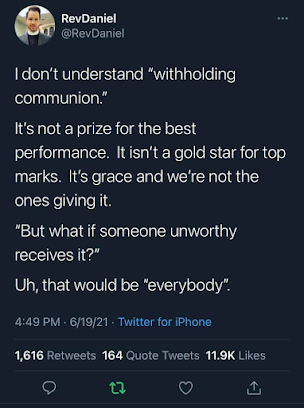

In this post, I am arguing neither for nor against denial of Communion as a practice in the RCC. I am making no judgment whether denying it to President Biden, et. al., should be done or not. My two main points are: 
  1. The RCC's theology of this matter has no real cognate in Protestant churches, so arguing against denial from a Protestant basis is like stepping into a boxing ring by yourself, shadow boxing against an opponent who is not there, then claiming victory in a fight you never actually fought. 
     
  2. It is pretty obvious that tweets like this are not really directed at the RCC bishops, for this is not an attempt to persuade the bishops to reverse. This and other, similar tweets and posts are directed toward the posters own in-group to signal that they are defending not a superior theology of Communion, but political figures whose abortion advocacy must be protected. These are not religious or theological tweets or posts, they are political declarations hiding behind religious language. 
That said, I do not personally take issue with RevDaniel's implied theology of Communion here. The problem is that he is using a very Protestant argument against Catholic bishops, who if they ever read this will know immediately that RevDaniel knows almost nothing about the Catholic theology of the Eucharist (Communion). 

First, RCCs very emphatically believe that no one is worthy of receiving the Eucharist; their catechism says so very precisely. Communicants, those who receive the sacrament, are not worthy of the sacrament but are made eligible by obeying the commandments of Scripture regarding the sacrament. The formal Catholic teaching, or catechism, of the Eucharist includes:

1384 The Lord addresses an invitation to us, urging us to receive him in the sacrament of the Eucharist: "Truly, I say to you, unless you eat the flesh of the Son of man and drink his blood, you have no life in you."

1385 To respond to this invitation we must prepare ourselves for so great and so holy a moment. St. Paul urges us to examine our conscience: "Whoever, therefore, eats the bread or drinks the cup of the Lord in an unworthy manner will be guilty of profaning the body and blood of the Lord. Let a man examine himself, and so eat of the bread and drink of the cup. For any one who eats and drinks without discerning the body eats and drinks judgment upon himself."218 Anyone conscious of a grave sin must receive the sacrament of Reconciliation before coming to communion.

1386 Before so great a sacrament, the faithful can only echo humbly and with ardent faith the words of the Centurion: "Domine, non sum dignus ut intres sub tectum meum, sed tantum dic verbo, et sanabitur anima mea" ("Lord, I am not worthy that you should enter under my roof, but only say the word and my soul will be healed.").

The key sentence for this post is, "Anyone conscious of a grave sin must receive the sacrament of Reconciliation before coming to communion." What the bishops are insisting is that abortion on demand is a grave sin, and its political advocates and enablers would be partaking of the Eucharist in an unworthy manner unless they complete the steps of Reconciliation. Those steps are Confession, receiving Absolution from a priest, and doing the Penance assigned. 

We Protestants need to understand that the sacraments of the RCC are a system and are closely interrelated. This is not much true in my denomination, the United Methodist Church. Our two sacraments of baptism and Communion are related, but not much interrelated. 

Besides, even we UMC ministers formally (though not in practice) "fence" the Communion table in the first paragraph of the litany by saying, 

Christ our Lord invites to his table all who love him, who earnestly repent of their sin and seek to live in peace with one another.

And then we require confession! (Though the confession is a scripted prayer said by the whole congregation, not privately to a pastor.) But read that sentence carefully: We formally (again, not in practice) invite to Communion only those who love God, who repent of sin (which is what the RCC bishops are demanding in the present controversy, only they really mean it) and who want to live peacefully with one another. 

Barring persons from the Communion table has never been part of the UMC's theology, doctrine, or practice, so our verbal fence around the table is mostly symbolic and also a call for each person to examine themselves. However, before we get our Protestant backs up, we should consider that formally, we are not much different from the RCC in qualifying who may receive the sacrament. It's just that the RCC is far more likely to mean it. 

These are not religious or theological tweets or posts, they are political declarations hiding behind religious language. 

Update: An email from a practicing Catholic, Joseph S., points out that the denial of Communion (to one who has sinned and is unrepentant) is intended to protect that person from compounding his or her sin by receiving the sacrament in an unrepentant state. So, yes, denial of Communion is aimed at correction but also at protection. In this way denial of Communion is an act of pastoral care and Christian love. 

Update: Have done some more reading on this general topic, not about the Biden-Communion controversy. There have been for a long time, decades if not centuries, debates within Catholicism about the Eucharist being served to persons still in grave sin, such as divorced Catholics whose marriage was never annulled by the Church and who have since remarried. Catholic doctrine (and some Protestant denominations) consider that to be adultery, which is a state of grave sin. These have been serious debates of varying intensity over the years/decades, and were not tied to politics. A strict interpretation has held that Catholics still in grave sin (politically tinged or not!) should not receive the Eucharist. Some also say that such persons should not be allowed to serve in public ministry such as being a lector, who are lay persons reading Scripture of litanies during worship. So, even within the RCC, eligibility to receive the Eucharist has long been a very complicated issue on matters other than abortion for at least several decades. However, this present controversy could have far-reaching outcomes on Communion and matters other than abortion. As lawyers say, the bishops' lopsided vote on the abortion-Biden matter could set a precedent for other issues unrelated to abortion but still related to the sacrament. We should all pray for the Holy Spirit to be heard and heeded!

Also, the whole concept of denying Communion to a church member is widely misunderstood among non-Catholics to be a form of priestly punishment upon a sinful church member. That is not so. In fact, the emphasis of denial is that the person concerned should be encouraged and assisted to repent and reconcile by their own volition to enable them to approach the altar to receive the body and blood of Christ. Grudging repentance is not repentance at all. It is submission to power, not an acceptance of divine love and its return to God by the communicant. But the Church's goal is to help bring its members to, or back to, a state of loving God and neighbor with all their heart, soul, strength, and mind, and to receive Eucharist in that state, not in mere submission to priestly authority.

The responsibility is on the communicant, God and the Church being his/her helper. I am far from certain that the publicity of the recent vote regarding the president and other Catholic politicians is very helpful, and I have to imagine that among Catholic clerics there is no little discussion of that. 

Saturday, May 29, 2021

The Wall

I took this photo in 2008 at the Vietnam War Memorial, near the Lincoln Memorial. 

There is one Sensing whose name is engraved on the wall, Capt. John L. Sensing, US Army. I never knew him, but we are some ordinal of cousin, since all Sensings (in the South, anyway) descend from one Jakob Sensing, who immigrated to North Carolina from Germany in the 1730s. One of his sons, a Revolutionary War veteran, took his veteran's land grant in Tennessee. So here we are.


Capt. Sensing was a helicopter pilot, flying an OH-6 Cayuse aircraft (right) in the Thua Thien Province when his bird was hit by an RPG near Firebase Ripchord, April 30, 1970. He was serving in B Troop, 2/17 Air Cavalry.

Also killed on the helicopter were SP5 Robert E. Masseth and SP4 David W. Staton.

In 2019, Capt. Sensing's cousin, Dave Davidson, posted a moving tribute to him on Facebook and included this photo of John:


God rest you all, John!

In 2010, Debbie Masseth sent this: 
My son sent me this article [from where it was originally posted] and it gave me chills. Robert E. Masseth was my brother-in-law and my son is his name sake. My husband, David Masseth passed away with cancer this summer. We did not get a lot of information about his brother other then he was killed in a helicopter crash on April 30, 1970.
Somehow, the circle remains unbroken. 

Friday, May 28, 2021

Monday, May 17, 2021

UFOs Bombshells and the US Government

In just the last two or three years, the US government, mainly the Defense Dept., has released videos of what used to be called UFOs, now called UAPs, Unidentified Aerial Phenomena. These include tracking and  targeting video taken by US Navy jet fighters trying to intercept UAPs. 

The most recent video release was in the past week. It is video taken from the bridge of USS Omaha of a UAP that shows apparent "transmedium" capability, meaning it travels through air or water with equal ease and speed - an ability massively beyond the capability of any technology we know of. Here is the video. As some commentators have noted, the bridge crew's voices also recorded betray no shock or astonishment, but more like "this again." 

Much more info with assessments at "Pentagon Confirms Authenticity of Video Showing UFO Maneuvering Near U.S. Navy Ship."

Then there is this: "Bombshell UFO Report: U.S. Military Encounters UFOs ‘Every Day’ That Far Exceed Its Tech, Capabilities."

An explosive report featured on CBS News’s “60 Minutes” featured several former U.S. military officials who talked about what the U.S. government knows about unidentified aerial phenomena — UAP —more commonly referred to as UFOs.

The segment comes ahead of a report that the military is supposed to deliver an unclassified report to Congress by next month. Former Director of National Intelligence John Ratcliffe said in a recent interview that the findings will shock people because “frankly, there are a lot more sightings than have been made public.”

Read the linked article, but here two 60 Minutes reports on the topic (both dated May 16, 2021). The first segment is about six minutes long, the second about 13 minutes:


I wrote in 2013 of former Canadian defense minister Paul Hellyer, who served in that role (equivalent to the US secretary of defense) in the 1960s. He stated unambiguously that UFOs are non-terrestrial craft, directed by extra-terrestrial, highly intelligent beings. That makes Mr. Hellyer the most senior person I have ever heard of who claimed this. 

But that might change with the release of the Pentagon report next month. 

Finally, here is a mere 92 seconds of President Obama on a late-night talk show saying he cannot talk about the subject. 

Was he jesting, or answering seriously, hoping it would be taken as jest? You decide.

Update: CNN covered it, too.


Transcript here.

Sunday, May 16, 2021

Jesus' Ascension - really?


Acts 1.-11:

6 So when they had come together, they asked him, "Lord, is this the time when you will restore the kingdom to Israel?"

7 He replied, "It is not for you to know the times or periods that the Father has set by his own authority. 8 But you will receive power when the Holy Spirit has come upon you; and you will be my witnesses in Jerusalem, in all Judea and Samaria, and to the ends of the earth."

9 When he had said this, as they were watching, he was lifted up, and a cloud took him out of their sight. 10 While he was going and they were gazing up toward heaven, suddenly two men in white robes stood by them. 11 They said, "Men of Galilee, why do you stand looking up toward heaven? This Jesus, who has been taken up from you into heaven, will come in the same way as you saw him go into heaven."

You have probably heard the expression, "an elephant in the living room." The source of this saying apparently was a substance-abuse counselor, who said that families in which there is a drug user are living with an elephant in the living room: It moves around, takes up an enormous amount of space, makes loud noises, bumps into them, knocks things over, smells bad - yet the family members are usually in denial and pretend it isn't there.

The story of Jesus' ascension is sort of an elephant in the living room of North American Christianity. Clergy of mainline churches like the UMC know what dominates this story but we usually pretend it isn't there. In previous years on Ascension Sunday, I ignored the elephant, too, but today I'm coming clean. What dominates this story is Jesus' bodily ascension into Heaven.

A miracle, in other words. That's the elephant.

The 21st-century Western mind pretends the miracle isn't there. We search for the moral of the story or its implied meaning and ignore the miracle. Lay people are taught, by implication, to do that in our secular school systems and colleges. Clergy are taught to do that in mainline seminaries and divinity schools. Almost every mention of biblical miracles in my classes at Vanderbilt Divinity School was to show how the event itself wasn't really important and wasn't the real point of the story, anyway. Don't dwell on the miracle - with the unspoken implication being that the miracle didn't really happen or that the event was really an ordinary event that occurred in unordinary circumstances and was mistaken for a miracle. Besides, the people who wrote the Bible were educated for their day, but not for ours, and did not enjoy the benefit of the scientific method as a way of understanding reality.

But we have to face the elephant in the living room of 21st-century, North American Christian faith, the fact that the entire Christian religion inescapably rests on miracles. And whatever other points the Ascension stories may have for us in our day, the central part of the story is that Jesus ascended bodily into Heaven.

In defense of modern scholarship, though, I readily agree that in miracle stories, including those of Jesus' healing, the miracle is not the only point of the stories, and sometimes not even the main point. For example, Jesus healed the servant of a Roman centurion whose faith in Jesus was so profound that Jesus exclaimed, "I have not found anyone in Israel with such great faith" (Matt 8:10). That's the real kicker of the story, not the healing, which takes place entirely offstage.

But there are three miraculous events of Jesus' life in which the miracle is so central to defining who Jesus was - and who he is today - that explaining them away cuts the heart from our faith.

The first is Jesus' miraculous Incarnation as the unique Son of God. I do not refer to the virgin birth. I mean that, as Paul wrote, "In Christ all the fullness of the Deity lives in bodily form," (Col 2:9), which cannot be said about any other person past or present. That Jesus was fully God and fully human is an essential miracle of his very existence that cannot be intellectualized away without surrendering the essence of who Christ is, what he means and what he does.

Second is that Jesus was dead, buried, and on the third day rose from the dead. The resurrection is the hinge of Christianity, about which everything else rotates. Everything about our faith depends on it. Once its affirmation is abandoned, Christian faith becomes pointless, another fact that Paul recognized. He wrote the Corinthians that if there is no resurrection, 'Let us eat and drink, for tomorrow we die' (1 Cor. 15.32).

The third miracle is the Ascension.

The Reverend Robert Hansel described most classical art of the Ascension. "We see Jesus dressed in gauzy, flowing robes and he appears to be floating weightlessly on a couple of insubstantial‑looking white clouds. The clouds are being lifted up by some smiling, chubby cherubs. It seems like some kind of pre‑technology elevator or a circus levitation act. Even though we understand that what we're seeing is artistic and poetic, we just have to smile at the apparent silliness of the whole thing. Jesus lifting off like a rocket? Peter Pan with pixie dust? Come on! Isn't this whole idea of Ascension dated and embarrassing ‑ something we'd be better off simply leaving out of contemporary Christian theology?"

The modern mind replies, "Yes."

Yes, we all know that people do not fly unassisted through the air and that precious few of us have seen angels, although we can all imagine circumstances when that would be greatly improved if one showed up now and then. And we know that wherever Heaven is, it isn't directly over our heads, as hundreds of spaceships have proven.

And having affirmed all that, we are left with the cold, hard fact that Jesus isn't here any more, and neither is his body.

The suffering, death, resurrection, appearances and ascension of Jesus Christ form a single narrative. In religious terms, they use poetic imagery and mythical literary language to describe the central events of the most important person in all history. Religious language is used best for religious experience. But there is also a very practical matter addressed, an important one for a faith that claims to be grounded in real events of actual history, as ours does. That is, What happened to Jesus' body?

Matthew records that this question was of foremost concern to Jesus' opponents after he was buried and the tomb turned up empty. Disbelieving that Jesus was raised from the dead, the question of what happened to Jesus' body was both obvious and urgent.

The story of Christ's ascension leaves us with much the same question, too. Namely, if Jesus didn't ascend into heaven, where is his grave? For he is no longer walking around, continuing his ministry. A crucial historical fact of Christianity is that Jesus' body is missing. Peter preached to the people of Jerusalem on the day of Pentecost, "Jesus God raised up, and of that all of us are witnesses. ... I may say to you confidently of our ancestor David that he both died and was buried, and his tomb is with us to this day."  Jesus' tomb is still here, too, but unlike David's tomb, there's no body there. So for people who dismiss the Ascension story from a scientific-technical point of view as I once did, I have to ask:

  • If Jesus was not raised from the dead and seen by the Mary and the other women and the disciples, why did they disciples devote the rest of the lives to preaching that Christ is risen, even to the point of suffering brutal death for their witness, save one apostle, John, who died imprisoned? And why did anyone believe them and endure similar fates by the thousands?
  • Accepting for the sake of argument that Christ was raised from the tomb but denying that Christ ascended into heaven, then what happened to his body? In a religion with two thousand years of raising innumerable monuments to even the most obscure saint or martyr, where is the church or reliquary or plain granite obelisk claiming to stand on Jesus' final resting place?

If Jesus is not here, and he is not ascended, what happened to him? And more importantly, what will happen to us?

For Christ's resurrection to be decisive, it had to be permanent. After all, Lazarus was also raised by God's power, through Jesus. Note that we call ourselves "Christians," not "Lazarites." Lazarus' resuscitation was a temporary reprieve from the grave and therefore of no value to our salvation.

The Ascension of Christ is a critical element of Jesus's story, and therefore of our salvation. But we are a scientifically minded, technically trained people, and unlike the uneducated, superstitious masses of earlier centuries, we know better than to believe in fairy tales like the Ascension story. At least, that's how I used to think, including for quite a while after I became committed to Christ. But I think now that we cannot gut the story of Jesus of its miraculous content, leaving holes in the narrative, and expect something sensible to remain. If Jesus didn't heal the sick in inexplicable ways, then what did he do? Just preach? There have been countless thousands of extraordinary preachers since Jesus' day. Quick, name two, not including Billy Graham ... or Donald Sensing. So preaching itself gets no monuments dedicated to you.

Thomas Jefferson was a man of the Enlightenment and the age of Rationalism, a deist rather than a traditional Christian. He took scissors to the New Testament, cutting out the verses that mentioned miracles. What was left was perhaps morally inspiring, but not exceptional. As you may recall me saying before, any religion founded only on Jesus' teachings would be simply an admirable form of orthodox Judaism. That's no bad thing, but that is not what brings us here each Sunday. The disciples knew this, even said so explicitly. Paul wrote the Corinthians that if Christ is not raised than we are still in our sins and have no hope.

Reverend Hansel again:

     Whatever we may think of the poetic imagery, the Ascension tells us finally and completely who Jesus really is. The picture of Jesus returning to God the Father enables us to let go of previous and incomplete pictures of Jesus. Certainly Jesus is the baby in the manger at Bethlehem, but that's not who he is now. Yes, he is the great teacher of the Sermon on the Mount, but we know much more than just a record of his words. We know that he hung and died on the cross, but that's not where he is today. We believe that he rose victorious from the empty tomb, but he's not just hanging around like some sort of wandering ghost.

    Ascension adds a final and critical photograph to the album of who Christ is and what he does. He is ascended - once more with the Father, enthroned forever as the ruler and judge of all human history. This is the final picture and a very important one indeed because it puts all the other pictures in perspective." http://www.explorefaith.org/Homily04.28.02.html)

There is a lot more to the Ascension story than the Ascension itself, but without the Ascension itself, there isn't much else about the story that matters.

Thursday, May 13, 2021

Gasoline economics for panic hoarders

Dear people who filled up a dozen or more five-gallon cans with gasoline - or filled plastic plastic household tub-storage containers (that, too) or plain buckets - please permit me to give a lesson in commodity economics.


Yes, gasoline is a commodity. Its pricing is based on demand, actually, more on anticipated demand than present demand. Gasoline and other petroleum products are traded on worldwide exchanges. Prices on these "spot markets" can be very volatile. 

Like all commodities, pump prices of gasoline are set according to anticipated replacement cost. When the spot-market price rises, gas stations raise pump prices. You may not realize it but the pump price includes not much profit for the station, so they have to get enough revenue from each delivery to pay for the next one. 

While gasoline has its own spot market, raw petroleum is far more widely traded because it is the source, of course, of gasoline to begin with. Contrary to what you must have thought, the rise in fuel prices the past week was not due to the shutdown of the Colonial Pipeline. It was because petroleum spot market prices went sharply upward. Here is the five-day graph:


This is the chart for the June 21 closing contract. It is a "futures" contract, as is typical of commodities. This means that the contract closes on June 21 and whoever still owns a bid on it better have a place to put 100,000 barrels of oil. And the money to pay for it. At today's price that would be $6,379,000. 

Note that about noon yesterday, a high price was reached for the last several days, actually the high since May 5, which was before the pipeline shutdown. Since then, gasoline prices have risen because of the spot price of petroleum rose, not because of Colonial's pipeline problems and not because you panic buyers and hoarders started filling up every container you could with gas. 

And now, merely coincidentally with Colonial starting the pipeline again, oil and gasoline prices are falling - more than four percent since noon yesterday. 

There is now no market for all those five-gallon cans full of over-priced gas that you were planning to sell later for what, 10 bucks per gallon or more? So while everyone else is driving around on much cheaper gas, you will have to use those cans, full of over-market-priced gas, to power your own car or truck. You can't let it sit because gasoline "spoils" after several weeks, actually starts to oxidize just sitting there. "Oxidize" is how fuel chemists say "burns." That's right, gasoline will start on it own to react to the oxygen in the air, and will over time be significantly degraded as an engine fuel. 

So you will literally have to burn money by using that high-priced gas. Without knowing it, you took a mini-course in commodities trading. And lost, big time. 

Please make sure the lesson sticks! 

End on a humor break: 


Friday, May 7, 2021

Betrayal and Forgiveness

Psalm 130.1 8
1 Out of the depths I cry to you, O LORD; 2 O Lord, hear my voice. Let your ears be attentive to my cry for mercy. 3 If you, O LORD, kept a record of sins, O Lord, who could stand? 4 But with you there is forgiveness; therefore you are feared. 
5 I wait for the LORD, my soul waits, and in his word I put my hope. 6 My soul waits for the Lord more than watchmen wait for the morning, more than watchmen wait for the morning. 
7 O Israel, put your hope in the LORD, for with the LORD is unfailing love and with him is full redemption. 8 He himself will redeem Israel from all their sins.
Twenty-eight years ago I had a time of deep, searing anger. A time when my heart was consumed with bitter, white-hot rage at someone who betrayed me, one whom I liked and admired and respected, but whom I felt had figuratively plunged a long, double-edged dagger into my back and then slowly twisted it. I hope you’ve never experienced this kind of anger. It’s a consuming, self-gratifying, self-justifying, self-fulfilling anger. It needs no tending or encouragement, since it’s a panjandrum of an emotional perpetual-motion machine. You see, I liked this rage. How wronged I was! How vicious my former friend had been to me! Oh, it was wonderful to be so completely in the right and have such a justifiable wrath! I didn’t want to forgive her without a price being paid. I wanted her groveling supplications for mercy, after which I planned to devastate her with a thundering cannonade of wounded righteousness. Only then would forgiveness follow—maybe.
 
But that’s not what Jesus taught. Jesus said in Mark 11:25, “And when you stand praying, if you hold anything against anyone, forgive him, so that your Father in heaven may forgive you your sins."
 
How easy it is to think of ourselves as forgiven sinners but ignore that we are to be forgiving saints. If we want to be forgiven, we have to forgive. I’ve wondered about forgiveness. Paul wrote in Hebrews that God would not remember our sins and lawlessness after he forgives us. Jesus said to the paralytic man who had been lowered to him through the roof, “Your sins are forgiven.” So I wonder, what does it mean for Jesus to say, “Your sins are forgiven,” and what difference does it make? 

 
There are two stories, both true, that answer this question for me.
 
The Washington Times newspaper reported one day of a Methodist minister in Virginia named Walter Everett whose son was shot to death by Michael Carlucci. Carlucci had been on a two-day bender of drugs and booze when the young Everett, a neighbor, knocked on his door. Carlucci did not know Everett, and thinking he was an intruder, shot him after a short struggle. Carlucci plead guilty to manslaughter.
 
Less than a month into his prison sentence, Carlucci got his first letter from Rev. Everett. “He told me that he had forgiven me for the love of God,” said Carlucci. “Tears were coming down my face. It made me feel like I wanted to live, where before I didn’t care.”
 
Carlucci was later released on parole, drug free and sober. Before proposing to his girlfriend, he asked Reverend Everett to officiate at the wedding. Everett agreed and the wedding took place.
 
In Rome in World War II, a Nazi Gestapo colonel named Herbert Kappler was responsible for rounding up escaped Allied prisoners and for destroying the Italian partisans. It was also his job to round up Jews and send them to Germany for slave labor. Later, the Jews were killed in concentration camps after they became too weak to work. Kappler had been hand-picked for this job by Reichsfuhrer Heinrich Himmler himself, no doubt because of Kappler’s brutal suppression of the Belgian underground. In Rome, Kappler sent the Gestapo into the streets to enforce his will; all who resisted were simply gunned down on the spot. Kappler himself put a bullet through the head of a Vatican priest who had been captured carrying messages for the partisans.
 
The greatest obstacle to Kappler's work was an underground railroad, managed out of Rome, which was concealing more than 4,000 escapees and Jews. They were hidden in the city, the countryside or infiltrated north to Switzerland. 
  
The key figure in this underground railroad was an Irish priest of the Vatican’s diplomatic service, Monsignor Hugh O’Flaherty. Colonel Kappler greatly hated Father O’Flaherty. O’Flaherty coordinated the humanitarian effort by arranging financing and hideouts. He often physically escorted his charges part of the way on their journey. Kappler could not arrest O’Flaherty because O’Flaherty was a citizen of Vatican City, not Italy. And Vatican City was off limits by order of Hitler himself.
 
One day, however, Kappler determined that O’Flaherty was too dangerous merely to be arrested. He sent a pair of assassins into a Roman church to kill O'Flaherty as he prayed, but O'Flaherty eluded them. Kappler then posted snipers at various places around the Vatican with orders to shoot O’Flaherty immediately upon his departure, even by a single foot, outside the limits of the Vatican.
 
This could not stop O’Flaherty. He eluded the Germans and made his way out of Vatican City to continue his work, disguised as a laborer or perhaps a shopkeeper. When Kappler captured another priest, O’Flaherty dressed in the uniform of a German officer and boldly walked into the prison to administer his friend confession before he was executed. Kappler's frustration and fury grew, and he intensified his efforts to capture both O’Flaherty and destroy the partisans.
 
The night came when O’Flaherty’s luck ran out. One evening as he lay in bed, Kappler’s aide, disguised in priestly robes, entered his room and placed a pistol to his temple. He took O'Flaherty to the Coliseum, dark and foreboding. A figure loomed ahead. In a moment O’Flaherty could see it was Col. Kappler. 

We will pick up the story in The Scarlet and the Black, starring Gregory Peck and Christopher Plummer, first with their meeting at the Coliseum, then Kappler's interrogation by his American captors, then the conclusion.


So I wonder about forgiveness. I wonder about Jesus’ justice when he forgives someone like Herbert Kappler. Of all people, we would likely say that Nazis are the ones who deserve eternal damnation. When Jesus forgives Nazis, we wonder, “Is there no justice?” 
 
“I do not rejoice at the death of the wicked,” God said through Ezekiel, “but take delight when they turn from their ways and live.” God can forgive even Nazis. God can forgive even me. God’s justice is based on love. God’s justice springs from his saving righteousness, from his forgiveness. His justice means all the Nazis of human history do not win. Indeed, no evil wins because all the evil of all time combined is less powerful than God's one day of love and forgiveness on the cross. This is a great hope we have in Christ, that because he forgives, his goodness will triumph and our sins and lawlessness God will remember no more.
 
God’s forgiveness means we are not condemned to be broken people, consumed by hatred and bitterness and anger. It means that we are not destined to be broken souls, shattered of heart and spirit, irretrievably blighted of love and all that is noble. It means we will be mended, made new and filled with the goodness of Christ.
 
I know that Reverend Everett did a good thing, a holy thing, when he forgave his son’s killer and blessed him at his marriage. The cynic may snort and the scoffer deride, but within my heart I know that Reverend Everett is a better man than I, and far more fortunate to be of such holiness. He is strongest in his broken places because those are the places Jesus knit him back together. Everett forgave because he was forgiven.
 
Well, I finally prayed about my rage and anger at my friend. Several days after this started I was alone, washing dishes in the kitchen, and muttering to God, trying to explain how I couldn’t forgive this wrong and how I didn’t think I should have to. I heard a reply then, not from inside my head, it was from above my right ear. It was a stinging rebuke. It said, “They made me carry a cross up Calvary but I forgave them at the top.” Those words literally knocked me down to the floor. To this day I remain deeply ashamed of having nurtured such anger in my heart and being so unwilling to forgive. 
 
The greatest miracle Christ performs is to shower grace and forgiveness on you and me. Paul wrote in First Timothy, “ . . . Christ Jesus came into the world to save sinners-- of whom I am the worst. But for that very reason I was shown mercy so that in me, the worst of sinners, Christ Jesus might display his unlimited patience as an example for those who would believe on him and receive eternal life.” [1 Tim. 1:15b-16]
 
If God did not forgive us he would not love us. If God did not love us, we would be loveless in our hearts, barren and desolate in hopeless, empty solitude. God went as Christ to the cross to forgive. The fact that we can forgive one another is Christ's gift. The obligation to forgive one another is his commandment. 
 
None of Jesus’ other miracles would matter if he did not forgive. Of what use is eternal life with God if he is eternally angry at me? Forgive is what God does. Having been forgiven, we may “approach the throne of grace with confidence, so that we may receive mercy and find grace....” [Heb. 4:16]
And having been forgiven, we are also able to forgive, and we are also required to forgive. 

Friday, April 16, 2021

Marxists making money, as usual

Anyone who has studied the history of Marxist movements (and derivatives) across the world comes to understand what the very basic, indeed foundational principle of Marxism and related ideologies are.

Their only real objective is to make their leadership - the "Revolutionary Vanguard," in proper Marxist terms - fabulously wealthy with rights, privileges, and opportunities that they deliberately deny to the proletariat.
Folks, that's it. That is the very fundamental purpose of Marxism and all related ideologies, including all the so-called "social-justice" militancies active in America today.
And this is nowhere better illustrated (for now) than by the latest report of Black Lives Matter's self-described Marxist leader, Patrisse Khan-Cullors.

Understand this: BLM's leadership shows evidence of no other active agenda except to continue this scam. All the rhetoric and demonstrations are deceitful, deliberately so. This, and only this, is what BLM is actually intent on doing, because its leadership has no other plan or purpose.
And what was the reason she gave? Her many words can be fully accurately summarized in only four words: "Because I deserve it."
If you want to be awakened, rather than deceitfully "woke," just read this.

Glenn Reynolds reminds us: In a famous Soviet joke, then-General Secretary of the Communist Party Leonid Brezhnev shows his mother his luxury apartment, his limousine, his fancy country house and his helicopter only to have her object: ‘But Leonid, what if the communists find out?'

Related, from 2019: "Donald Trump is a symptom of a new kind of class warfare raging at home and abroad." What’s happening in America is an echo of what’s happening in democracies around the world, and it’s not happening because of Trump.


Marxist scholars in the West simply adapted their revolutionary theory to the social and racial unrest of the 1960s. Abandoning Marx’s economic dialectic of capitalists and workers, they substituted race for class and sought to create a revolutionary coalition of the dispossessed based on racial and ethnic categories.
California public schools are embarking on a new experiment: education as social justice. Earlier this year, the state Department of Education approved an ethnic studies model curriculum, and individual school districts have begun to implement programs that advocate “decolonizing” the United States and “liberating” students from capitalism, patriarchy, and settler colonialism. ...

I have obtained documents from one such program, the Santa Clara County Office of Education’s Ethnic Studies Initiative, that paint a disturbing picture of the ethnic studies curriculum and the activists leading the charge. According to the documents and to sources within the district, the Office of Education held a series of teacher-training sessions on how to deploy ethnic studies in the classroom. The leaders, including district staff, an advisor for the state Ethnic Studies Model Curriculum, and a professor from San Jose State University, encouraged teachers to inject left-wing politics into the classroom and to hide controversial materials from parents.


Wednesday, April 14, 2021

We become what we focus on

The severest punishment God ever lays upon us is to let us have what we want.

"Where there is no vision, the people perish: but he that keepeth the law, happy is he."
Proverbs 29.18, King James Version

Jason Gould is a Vanderbilt University student who, though liberal and progressive, fell afoul of the "woke" Gestapo (yes I use that word intentionally) that operates on almost every campus today. He was savaged by the campus newspaper and other attacks while the university administration found other things to occupy its attention, like watching the grass grow. One university staffer even took part. This despite the fact that he was running for student government office, for which Vanderbilt's rules specifically forbid personal attacks upon any candidate. Oh, he was (a) white and (b) Jewish, so he was automatically guilty of everything. He relates, 
The other candidates’ supporters tore down our posters and ripped my head off pictures. Fake social media posts circulated that my fraternity had parties with Confederate flags and chanted that the South would rise again. One message said, “White men are the absolute worst!” and “He should get dragged for it!” Then came the anti-Semitism: “Hitler got something right!”
 
This was a victimhood arms race. I was cast as a white, male evil-doer who must be shamed and punished for all the white man’s sins. I was unfit to hold office. My economic inclusion work didn’t mean a thing. I was paraded out for a social media stoning, and the social justice mob would stop at nothing.
 
Everything I had worked for was destroyed, and so was my reputation. I felt unsafe to walk on campus. The other candidates were elected unopposed. They made "misogynoir" their campaign slogan. I had no choice but to drop out of the election race for my physical safety and mental health and leave Nashville for someplace safe.
 
Vanderbilt’s campaign rules prohibit negative campaigning and ban any remark or attack about a candidate’s personal character. These rules require collegiality and civility, but Vanderbilt stood by while this angry mob weaponized social justice, targeted me, threatened me, and ran me out of town.
 
I’ve begun to believe that for some of my attackers, social justice is a cover for people who get pleasure from inflicting harm on others — straight-up bullying made a hundred times worse on social media. When did woke culture become so toxic? Some are cowards who hide behind an avatar. I am through being trampled on, but I shouldn’t have to fight back. When the social justice mob came for me, my university did nothing.

[Italics added] 

"When did woke culture become so toxic?" Well, it began toxic and went downhill from there. Gould is right, though - show me a "woke" warrior and I will show you someone who will someday be quite gleeful about flogging class enemies into the gulag. Consider this tweet:


We are a very short way from the Stalinist modus operandi: 
  1. Show me the man or woman, and I will tell you their crimes. 
  2. You may not be guilty of anything at all, but you are a member of a class - that is, a racial or religious group - that is guilty of everything. 
So what does all that have to do with Proverbs 29.18? Here it is again: "Where there is no vision, the people perish: but he that keepeth the law, happy is he" -- King James Version. 

The KJV text, though well known, poorly communicates what the verse is trying to say. The KJV was done in the very early 1600s and for today, it just is not a good translation.

"Vision" refers to spiritual sight, more properly, spiritual insight. The verse, properly understood in its context and intention, is actually one of the most important warnings and assurances in the entire Bible.

Try this: When the people lose sight of God’s will, they go astray, but they prosper when they keep God’s law.

"The people" in the verse does not refer just to a worshiping congregation, but in the context of its time, a national people, the people of ancient Israel. The verse is talking about national consequences of ignoring God and the benefits of cleaving to God's commandments.

Bible Gateway has a long list of different translations and renderings. The ERV's translation is probably the best: "If a nation is not guided by God, the people will lose self-control, but the nation that obeys God’s law will be happy."

One Hebrew word study I read said that the real thrust of the verse is that when the nation loses sight of godliness, it descends into anarchy. We become what we focus on. When we lose sight of God and God's will for our lives, we become ungodly. That never ends well, either for individuals, churches or nations.

Here is a key point: God commandments were revealed to humanity. We did not make them up. We are so far removed from their revelation that we think that morality, as we understand it, is the natural way that people live together. In fact, the societies around the ancient Jews and early Christians were brutal.
 
The Romans considered mercy, charity and forgiveness to be vices, not virtues. Roman parents beat their children for the showing weakness of mercy. Human morality absent divine commandment is base and as Proverbs says, descends finally into anarchy. We will either rule our passions or be ruled by them. As St Paul put it, "God cannot be disregarded." Note well: he did not write God "should not be" or "must not be," but cannot be disregarded. It is not possible. He continued, "You will harvest what you plant."

Morally, our capacities are weighted toward the negative side of the scale. People intend greater good than they achieve. Treaties, alliances, aid organizations, political parties, civic groups, even churches – all begun for good reasons to accomplish good things, and all fall short of what their founders intended.

Hence the necessity of God giving the moral law. My friend and former co-author Rabbi Daniel Jackson wrote, "There are obvious logical elements of the Law of Sinai that might be deduced logically (or rationally). Yet, much of the Scriptures is based on directives and rules that we would not have known if the Scriptures did not tell us so."

God's Law frees us from the baser demons of our being so that we may discover the better angels of our nature. Every choice to depart from God's Law chips away at our integrity as persons belonging to Jesus. Integrity matters!

During his time as a rancher, Theodore Roosevelt and one of his cowpunchers lassoed a maverick steer, lit a fire, and put a branding iron in it to heat. The part of the range they were on was actually owned by Gregor Lang, one of Roosevelt's neighbors. According to the cattleman's rule, the steer therefore belonged to Lang. Roosevelt saw his employee, the cowboy, raise the glowing branding iron toward the steer, but it was Roosevelt's brand. "Wait, it should be Lang's brand," he said.

"That's all right, boss," said the cowboy. "Lang will never know."

"Drop that iron," Roosevelt demanded, "go back to the ranch, get your things and get out." Roosevelt later explained, "A man who will steal for me will steal from me."

Integrity, says Webster's, is "adherence to moral and ethical principles; soundness of moral character; honesty." And that takes the willingness and ability to cleave to a standard, whether you call it the law or a code or something else. Choices matter, and the choices we make are not isolated from one another.

The issue is more acute for young people than for me or those older than me. It sounds trite to say but it's nonetheless true that we grew up in a different time than you. The advice to "do your own thing" was unknown to us and we would never have even thought of agreeing that something may be right for you and wrong for me, or vice-versa, depending on our own inclinations, points of view and what we simply want to believe.

The problem is that to be a man or woman in 2021 is to believe in nothing. Or more accurately, to believe in nothing in particular. The spirit of this age gleefully embraces that nothing underlies fundamental reality, making, in the words of David Hart, "a fertile void in which all things are [claimed] possible, from which arises no impediment" to our desires and therefore we may decide for ourselves what is right or wrong and what we choose.


Which is to say that modern America as a whole no longer believes that there are objective criteria by which to judge our choices because being able to choose in the first place is the highest good there is. Therefore, all judgment, whether divine or human, infringes on choosing – and being able to choose according to one's own standards exercises "an almost mystical supremacy over all other concerns."

This is a purely modern idea. In centuries past, even before Jesus was born, true human freedom was understood as liberation "from whatever constrains us from living a life of rational virtue" and that led to our intellectual and spiritual flourishing. Freedom was the ability to overcome "our willful surrender to momentary impulses, [including] our own foolish or wicked choices."
"In this view of things [said Hart], we are free when we achieve that end toward which our inmost nature is oriented ... and whatever separates us from that end -- even if it comes from our own wills -- is a form of bondage. We are free not merely because we can choose, but only when we have chosen well."
For to choose poorly is to enslave ourselves to the impermanent, the irrational and eventually the destructive. Simply choosing, unconnected from divine guidance and godly standards, is to choose ultimately to reject freedom and to be enslaved to what Paul called the body of death and finally to choose to perish rather than attain everlasting life.

God's law enables human beings to be freed from the shackles of spiritual and mental bondage that prevent us from being saved in this life and the next. Paul's advice of Romans 12 holds true: "Do not be conformed to this world, but be transformed by the renewal of your mind, that by testing you may discern what is the will of God, what is good and acceptable and perfect."

Even Jesus understood that a life of choosing rightly is not easy. "Enter through the narrow gate," he said, "for the gate is wide and the road is easy that leads to destruction, and there are many who take it. For the gate is narrow and the road is hard that leads to life, and there are few who find it."

What to do and how? Paul tells us that in Philippians 4:8: “… Whatever is true, whatever is honorable, whatever is just, whatever is pure, whatever is pleasing, whatever is commendable, if there is any excellence and if there is anything worthy of praise, think about these things.”

It's not easy to live rightly to remain free. It is bondage to death and sin that is easy. But we can break those chains if we keep focused on God. Then we will be free indeed.

Friday, April 9, 2021

The pitfalls of piety, the dangers of mercy


I have sometimes thought that Jesus' resurrection and Ascension was made evident to Mary and the other disciples in their ordinary lives in part to demonstrate that there is no real dividing line between the Kingdom here and now and the the Kingdom there and then. Think of the Kingdom of God as a house. The death of our present bodies is simply a door leading from one living room of the Kingdom to another. But they are rooms in the same house. 

After all, Jesus could have been raised from death and he could have returned to the Father with no witnesses to either event. The Holy Spirit could still have come and if Gabriel had appeared before the disciples and announced Jesus raised and ascended I think they would have believed. 

But instead, Jesus died and was raised in "this room" of the eternal House of God. He lived, and lived again, in this time and this place - and the same Jesus who did that then ascended bodily to the "other room" of the House of God. There is a distinction between the two rooms, but it is a weak distinction. What they have in common is far stronger. 

That said, I think that Dallas Willard overstates his point. I know one danger is to be so heavenly minded we will be of no earthly good. But I disagree that the Gospels are "less" about eternal salvation than right living now. I do not think that Jesus made that distinction. It is one, single Kingdom and he preached to live it in starting now. But he never said that "getting to Heaven" was less important than right living now. In fact, I think that such a statement would have struck Jesus as nonsensical. 

I would have us bear in mind what C.S. Lewis said in "The Problem of Pain," 

We are very shy nowadays of even mentioning Heaven. We are afraid of the jeer about "pie in the sky," and of being told that we are trying to "escape from the duty of making a happy world here and now into dreams of a happy world elsewhere." But either there is "pie in the sky" or there is not. If there is not, then Christianity is false, for this doctrine is woven into its whole fabric. If there is, then this truth, like any other, must be faced, whether it is useful at political meetings or not.

And from "Mere Christianity:"

Aim at Heaven and you will get earth ‘thrown in’: aim at earth and you will get neither. It seems a strange rule, but something like it can be seen at work in other matters. Health is a great blessing, but the moment you make health one of your main, direct objects you start becoming a crank and imagining there is something wrong with you. You are only likely to get health provided you want other things more—food, games, work, fun, open air. In the same way, we shall never save civilisation along as civilisation is our main object. We must learn to want something else even more. 

It may be argued - and in fact, my colleague Joey Reed does so argue - that Lewis also overstated his case. As Joey wrote, 

The Kingdom of Heaven is rich enough to extend from the past to the present to the future. Those who relegate it to one or the other have chosen chocolate or vanilla or strawberry when the box clearly says "Neapolitan".


It's all one box of ice cream. In Joey's and my Wesleyan tradition, we avoid over-concentrating on which room of the house we are in by staying on balance in Christian discipleship. I did not originate this diagram, but is captures what healthy discipleship is:
Discipleship is not either-or one side or one level, but not the other. It is both-and. If we overemphasize piety, we risk morphing into "I got mine" Christians, whom Jesus quite specifically said in Matthew 25 he would eject from his presence. If we overemphasize works of mercy, we risk developing a messiah complex of our own, thinking that the Kingdom can be realized here and now in its entirety and that society can be perfected by ourselves - especially by politics apart from God-Christ-Church. And good luck facing Jesus with that. 

John Wesley said that we are obligated to move on to Christian perfection in this life. He never thought he had done so, although in his journals he named a handful of persons he thought had. He cautioned that perfection in this life is not perfection's end state, but just the best we can do in this life. He defined it as reaching a point at which one does not consciously sin. 

I rarely argue with Wesley, but I think he missed it there. I believe German pastor Dietrich Bonhoeffer proved it in the great dilemma he faced in opposing Hitler. His dilemma was not whether to oppose him at all, that was a no-brainer. The dilemma was by what means, namely whether to actively be part of a plot to remove Hitler from power, even killing him to do it. 

To murder someone even as evil as Hitler, Bonhoeffer thought, was to sin. But to be passive against someone as evil as Hitler was also sinful. Which was the greater sin, or did that question even make sense? This problem illustrates the potential conflict between piety and mercy. 

Finally, Bonhoeffer concluded that he would be judged for following either course. He chose to be judged for trying to end Hitler's terror reign early rather than wait for it passively. Bonhoeffer was arrested in 1943 and was finally imprisoned at Flossenbürg concentration camp, Germany. There he was hanged just two weeks before American soldiers liberated the camp. 

Bonhoeffer's decision is the reverse of Wesley's description of Christian perfection. Bonhoeffer came to realize that this life presents us with irreconcilable problems. There was no "unconscious" sin for Bonhoeffer to commit. There was only a deliberate, conscious decision to sin either by passivity or by action. 

He recalled Martin Luther's admonition, “Sin boldly. But believe even more boldly in Christ, and rejoice.”  Bonhoeffer wrote in The Cost of Discipleship,
This gospel seeks us and justifies us exactly as sinners. Admit your sin boldly; do not try to flee from it, but ‘believe much more boldly.'
In this he realized that no course of action was judgment-free. He was going to sin either passively, by doing nothing, or "boldly," by becoming an active co-conspirator to kill Hitler. All he could do was admit his sin at least as boldly fully and trust in God all the more. 

The pitfall of American Christianity is that it is easy. The pious among us are almost never tested in our piety and the merciful among us are over-tested in our mercy. Christ's grace is cheap when we feel no cost to ourselves to live it out. The over-pious put themselves outside the fray and the over-merciful let themselves be consumed by it. Either position increases human suffering both in this life and the next.  

We must not be so heavenly minded that we are of no earthly good. But we must never be so earthly good that we omit ourselves and others from the eternal kingdom. 

Tuesday, April 6, 2021

Why there is no such thing as a corporate tax


First, corporations do not pay any corporate tax — individuals do. That is because companies pass on their costs. Some of the tax is paid by consumers, who pay higher prices. Company employees pay some of the tax through lower wages. And investors’ retirement accounts pay some of the tax through lower returns. ...
 
In a 2020 study by Scott R. Baker of Northwestern University, Stephen Teng Sun of City University of Hong Kong, and Constantine Yannelis of the University of Chicago estimate that 31 percent of the cost of an increase in corporate taxes is borne by consumers, 38 percent by workers, and 31 percent by shareholders, or about a third each. Other studies have found different ratios. A 2020 Tax Policy Center study, a joint effort between the Urban Institute and the Brookings Institution, estimates an 80–20 split between investors and labor. The Tax Foundation’s Stephen J. Entin estimated in 2017 that labor pays 70 percent or more of the corporate tax. Differences aside, these studies share a common conclusion: Ultimately, corporations themselves pay no corporate tax.

And you know what? There is no way to make them. I do not mean the government should not make them pay it, or must not make them pay it. I mean that the government cannot make them pay it for one simple reason: corporations have no money of their own. Every dollar they pay in corporate taxes has to come from somewhere. Unlike the government, corporations cannot print their own money. 

This is not where Amazon gets its money:


This is:


When the administration says it will raise corporate tax rates, what it really means is that it will raise your personal tax rate through indirect means. Make no mistake, this is not a tax on Amazon or Kroger or Tesla or Apple. It is a tax on 

  • all of us who shop there or anywhere else, paid through higher prices, 
  • everyone who works for any company subject to the tax, paid by lower wages and salaries,
  • any retiree whose retirement funds include those companies from lower returns (which means every retiree with a 401(k) or any other private pension fund),
  • every American regardless of age or income because the effect will also lead to higher inflation because higher consumer prices will not be matched by higher supply of consumer goods.
But we voted for it last November, so all is well, right? After all, "Democracy is the idea that the common folk know what they want and deserve to get it good and hard" - H.L. Mencken.

A world without nuclear weapons - what would it look like?

 From Pope Leo this week, according to the National Catholic Reporter : " Pope Leo quotes Bob Dylan song in book foreword calling for n...