History reveals that across time and the globe, disputes over succession of power have usually been settled by mobs or armies in the streets, ending with one of the contenders dead or fled. Even in civilized England, three sitting kings were murdered by their successors and one was deposed by Parliament, which then beheaded him. But in America, where there are at least 250 million guns in private hands, there is no such history of violence over elections. Perhaps it is because we may change administrations but not governments. Elections here don’t bring violence, at worst they bring . . . lawyers. Through the lens of history, our domestic political predicament is unusually peaceful.
America’s founders realized that the people of a democracy would inevitably divide into factions, setting the people in opposition to one another. For that reason, the founders mistrusted direct democracy. “Democracies,” James Madison wrote in Federalist 10, “have ever been spectacles of turbulence and contention; have ever been found incompatible with personal security or the rights of property; and have in general been as short in their lives as they have been violent in their deaths.” The founders feared the tyranny of a democratic majority almost as much the tyranny of a monarchy. The script of Mel Gibson’s blockbuster movie, The Patriot, reflected this fear when Mel Gibson’s character expressed doubts about the revolution by asking a colonial assembly, “Will you tell me why I should trade one tyrant three thousand miles away for three thousand tyrants one mile away?”
Hence the founders rejected direct democracy. In fact, wrote historian Fred Barbash,
“Democracy,
as we think of it, wasn’t a serious option. Democracy was an alien notion; the
word itself was rarely used in the debates of that time. The real power, they
believed, resided in the House of Representatives, elected by popular vote.”
(As an aside, the founders appear to have assumed that presidential elections would be decided by the House more often than not. “It will rarely happen that the majority of the whole votes will fall on any one candidate,” said George Mason of Virginia.)
There is the famous anecdote of Benjamin Franklin leaving the Constitutional Convention and being asked by a woman on the sidewalk what government she would have. “A republic,” he answered, “if you can keep it.” Of course, a republic will have factions, too, but is much less subject to their ill effects. It would be nice to say that the founders thought that high-falutin ideals like truth, justice and morality would protect national unity, but they weren’t so naive. They knew high ideals could be easily perverted for tyranny’s purposes. The unity of the nation may be rooted in the ideals of the government but can be preserved only in the form of the government. So the founders made the nation a republic, which is the main reason we have the electoral college rather than direct election.
A
republic, as defined by the founders, is a government which derives all its
powers from the people and is administered by persons holding their offices for
a limited period. Essential to a republic is that elected officials come from
all segments of society and not from a small proportion, or a favored class.
Furthermore, every tenure of office must be conditional in some way, either by
limiting terms by law or by enabling removal by law.
Factionalism
cannot be eliminated from society. “The latent causes of faction are sown in
the nature of man,” Madison wrote, because differing interests always have
divided humankind “into parties . . . and rendered them much more disposed to .
. . oppress each other than to co-operate for their common good,” an
observation proven every four years. Madison observed that the tendency toward
disunity was so deeply rooted in human nature that the most violent conflicts
have been kindled for the most frivolous reasons.
Madison
thought it folly “to say that enlightened statesmen will be able to adjust
these clashing interests, and render them all subservient to the public good.
Enlightened statesmen will not always be at the helm.” Furthermore, politicians
necessarily deal with matters immediately at hand and rarely take a long view
of things.
Now,
here is the reason I’ve gone through this civics lesson, for the Founders left a
bombshell for church people. John Adams wrote, “We have no government armed
with power capable of contending with human passions unbridled with morality
and religion. Our constitution was made only for a moral and religious people.
It is wholly inadequate to the government of any other.”
In
other words, the founders understood that the protections of constitutional
liberty depended on the morality and religious conviction of the people. Yet
while morality and religion were necessary
for liberty, they cannot guarantee
liberty, because, wrote Madison, “Neither moral nor religious motives can be
relied on” to control factionalism and discord. After all, a sense of morality
and religion do not even prevent “the violence of individuals.” In civil
affairs, the moral and religious senses restrain factions less and less as
factions get bigger. Thus, individually moral and religious men and women
inflamed and united by acrimonious passion become a mob.
This
is an important point. The present election has inflamed passions throughout
the country, including to the violence that the Founders warned us. Neither candidate has made much in the campaigns of their religious convictions. It is just as well. America's Founders trusted neither religion nor its lack as a
qualification of a candidate. While we may hope and pray that our national
leaders will be guided by the highest ideals of moral and religious convictions,
our nation’s founders warned us not to count on it, either for office seekers,
office holders or voters. We must seek another source of unity for our nation,
not to supplant morality and religion but to complement them.
Our
continuing hope for national unity is that we re-unite around the flagpole of
the ideals of the republican form of government the founders bequeathed us. We
must re-educate ourselves in republican ideals (note the small "r") and how it inhibits the dangers of democracy. The Federalist Papers wax
long and eloquent on the virtues of a republic, but I’ll not list them here.
A
closing thought: James Madison wrote in The Federalist Papers Number 39 of
“that honourable determination which animates every votary of freedom, to rest
all our political experiments on the capacity of mankind for
self-government."
The
prosperity of American civilization does not rest upon the power of government to
rule us, not even in the slightest. The future of our nation is founded by our ability and
willingness to govern ourselves, to suppress the devils of our passions to let
flower the better angels of our nature.
If we cannot continue to do that then truly our votes will not matter.


Update note: If you do not read all the way to the very end, you will not learn who "they" refers to in the title. Hint: it is not the police.
This was left as a comment on FB by a former police officer named Michael. I will not use his last name here.
True story : 911 call, son is threatening family with knife, me and 4 other cops on my team show up. I go around back of the house as others go in the front. As soon as I turn the corner the kid is on top of me with a knife. I fight with him and get stabbed in hand but we were able to get him handcuffed. He goes to get psyched clear before arraignment. DA lets him out. He returns home and stabs his father to death the same night his family comes and bails him out. Something to really think about.
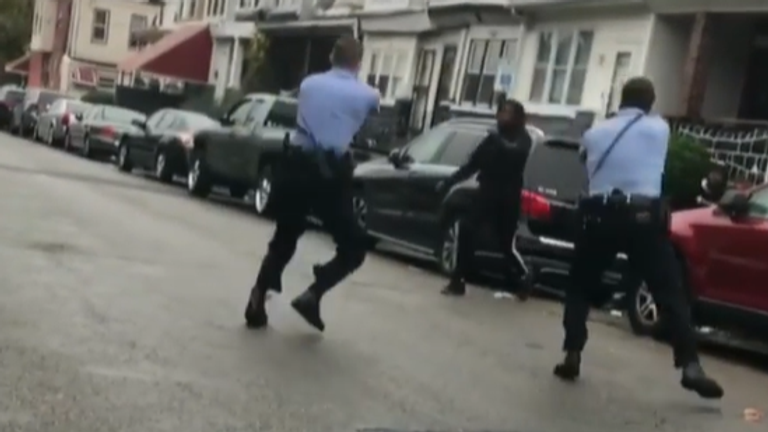
I am thinking of the police shooting of black man Walter Wallace in Philadelphia last Monday.
PHILADELPHIA (AP) — Police shot and killed a 27-year-old Black man on a Philadelphia street after yelling at him to drop his knife, sparking violent protests that police said injured 30 officers and led to dozens of arrests.
The shooting occurred before 4 p.m. Monday as officers responded to a report of a person with a weapon, police spokesperson Tanya Little said.
Officers were called to the Cobbs Creek neighborhood and encountered the man, later identified as Walter Wallace, who was holding a knife, Little said. Officers ordered Wallace to drop the knife, but he instead “advanced towards” them. Both officers then fired “several times,” Little said.
Wallace was hit in the shoulder and chest. One of the officers then put him in a police vehicle and drove him to a hospital, where he was pronounced dead a short time later, Little said.
Riots followed, of course, demanding justice for Wallace, justice which included burning down a Vietnamese church.
So here are my questions for ordinary people - not activists - to ponder about police:
1 John 3:18-22
Little children, let us love, not in word or speech, but in truth and action. And by this we will know that we are from the truth and will reassure our hearts before him whenever our hearts condemn us; for God is greater than our hearts, and he knows everything. Beloved, if our hearts do not condemn us, we have boldness before God; and we receive from him whatever we ask, because we obey his commandments and do what pleases him.
I speak a lot about the church as
family and the clear New Testament affirmation that we are made brothers and
sisters of Christ and therefore brothers and sisters with each other.
Similarly, our questions are not whether we are a family of God in Jesus
Christ; that’s simply a given. The questions are, “What kind of family are we?”
and “What kind of family are we becoming?”
All of us know that terrible fights
can occur within families. I know a man who was named as the executor of his
cousin’s will many years ago. The cousin had never married and had lived around
the world. Her estate was not extravagant, but it contained valuable jewelry
and attractive works of art. Another cousin soon decided she had been stiffed
in the will. Protests and discussion turned into acrimony and accusation.
Finally the other cousin brought a lawsuit against the estate and the executor,
her own relative. And for what? Another trinket, that’s all. True story.
 Many of you may remember a hit show of
the 1970s called, “All in the Family,” in which a newlywed man and his wife
lived with the bride’s parents. The father called his son-in-law “Meathead”
instead of Michael, which tells you about their relationship right there. One
show concerned a dispute Michael and his wife, Gloria, had over a serious issue
between them. It was whether they would postpone having their first child so
she could go to work to support them while he earned an advanced degree. It
turned into a huge row between them. They stopped speaking, pretended the other
was not there – well, you know the drill. They were deadlocked.
Many of you may remember a hit show of
the 1970s called, “All in the Family,” in which a newlywed man and his wife
lived with the bride’s parents. The father called his son-in-law “Meathead”
instead of Michael, which tells you about their relationship right there. One
show concerned a dispute Michael and his wife, Gloria, had over a serious issue
between them. It was whether they would postpone having their first child so
she could go to work to support them while he earned an advanced degree. It
turned into a huge row between them. They stopped speaking, pretended the other
was not there – well, you know the drill. They were deadlocked.
Such kinds of disputes are all in the family, to be sure.
But we are not to concentrate on the
disputes or arguments we have had within our church family, or even the hatred
we may have suffered from our brothers and sisters, but on the enduring
responsibility of love that we have for one another. A family of God is not to
be stifled by bitterness or self‑interest, but galvanized for compassion toward
others.
John also reminds us that such love does not come from within ourselves. It is, rather, God's love, which persists among those who remember that Christ “laid down his life for us.” Hence, Christlike love is not simply “word or speech,” says John, but “truth and action.”
The two-millennia dream of
Christian peoples has been to build a community of faith, a family of God, that
is impelled by an ethic of love more than an ethic of justice. For the enduring
duty and the perpetual dream of Christian people is to embody the love of
Christ as fully as humanly possible. And generally, usually, most of the time,
we do pretty well – at least on Sundays. But I wonder whether how well we are
doing the rest of the time. We say on Sundays we go to church, as if the church
was a place. What really happens on Sundays is not that we go to church, it is
that we assemble the church.
We are the church, wherever we are
and whatever we are doing. Christianity is what Christians do, at least
in the eyes of the rest of the world. When Christian people pursue virtue, then
the church is virtuous. When Christian people give in to vice, then the church
is vicious.
The philosopher William James told a
story about a woman who came to one of his lectures and explained to him that
the earth is flat and rests on the back of a giant turtle. He asked, “What is
the turtle standing on?” “On the back of a still bigger turtle,” came the
reply. He started to ask the obvious question when the woman held up her hand
and said, “Never mind, it’s turtles, all the way down.”
Sometimes I feel Christians too
easily disconnect how we are saved with the result of being saved and the
collective life we live because of it. It is all one story. There is not one
way we became children of God and another by which we became each other’s
brothers and sisters and still another means by which we are transformed into
disciples of the Lord.
No: it’s Jesus, all the way down.
So let us return to the story of Gloria and Michael for a moment. Near the end of the episode it appeared as if their marriage was in serious trouble. Edith, scatterbrained Gloria’s mother, was addled, naive, overly trusting and forgetful, but she had a heart of gold. Edith sat alone with her son in law and told him the story of her aunt and uncle.
"When I was a little girl,"
she said, my aunt and uncle had a huge argument because there was no ketchup at
supper one evening. My aunt had not bought a new bottle and the old one was
empty. My uncle was very angry because he always wanted ketchup on his meat
loaf. It turned into a huge argument. They finally finished dinner but the
issue was never resolved. For thirty-five years afterward, until my uncle died,
things were never the same between them."
Michael interrupted, “Ma, our dispute
is not over a bottle of ketchup!”
“I know,” replied Edith, “but would
you rather kill your marriage over something else? Can’t you remember how you love
each other?”
“Beloved,” wrote John,
if our hearts do not condemn us, we have boldness before God; and we
receive from him whatever we ask, because we obey his commandments and do what
pleases him. And this is his commandment, that we should believe in the name of
his Son Jesus Christ and love one another, just as he has commanded us.”
WI remember what George H. W. Bush reportedly
said about broccoli: "I don't like it. And I'm glad I don't like it
because if I liked it, I'd eat it. But I don't want to eat it because I don't
like it."
Isn't that often how we think of
loving one another as Jesus commanded? A counselor once wrote of a client,
"He likes everyone in general but no one in particular." And it's
easy for any of us to regard another church member the same way G. H. W. Bush
regarded broccoli: "I don't like him. And I'm glad I don't like him
because if I liked him, I'd have to love him. And I don't want to love him
because I don't like him."
On the contrary, in his book Mere
Christianity, C. S. Lewis wrote,
Do not waste your time bothering whether you 'love' your neighbor. Act as if you did. As soon as we do this, we find one of the great secrets. When you are behaving as if you loved someone, you presently will come to love him. If you injure someone you dislike, you will only find yourself disliking him more. If you do him a good turn, you will find yourself disliking him less.
Evangelist Dwight Moody wrote,
In Chicago a few years ago a little boy
attended a Sunday school I know of. When his parents moved to another part of
the city the little fellow still attended the same Sunday school, although it
meant a long, tiresome walk each way. A friend asked him why he went so far and
told him that there were plenty of others just as good nearer his home.
"They may be as good for others, but
not for me," was his reply.
"Why not?" she asked.
"Because they love a fellow over
there," he replied.
It is Jesus all the way down, and it
is love all the way up.
In the book of Revelation, there is a
section in which Christ dictates a letter to the churches. The Lord told the
Ephesian church that he knew their deeds, their “hard work and your
perseverance” and how they did not tolerate evil. “You have persevered and have
endured hardships for my name, and have not grown weary,” Said the Lord. “Yet I
hold this against you: You have forsaken your first love” (Rev 2:1‑4).
Doesn’t that sound like something a
wife or husband might say to husband driven by career ambitions and the duty to
“provide” for his wife and children? That’s all fine and commendable, but she
asks, wasn’t she his first love? Nowadays a husband might make the same kind of
complaint to his wife, or for that matter children to their parents. What
happened to your first love, and where does that leave me?
Of how many churches today might it be said that they have forgotten their first love?
People of God, friends of God: our
first love is Jesus called the Christ! Here, at home, at work or leisure, on
the road, and everywhere:
Christ be with us, Christ within us,
Christ behind us, Christ before us,
Christ beside us, Christ to win us,
Christ to comfort and restore us.
Christ beneath us, Christ above us,
Christ in quiet, Christ in danger,
Christ in hearts of all that love us,
Christ in mouth of friend and
stranger.
Christ in every eye that sees us,
Christ in every ear that hears us.
By his grace we are brothers and sisters with him and one another. And by his grace do we love one another.

Those who live by kingdom standards and values now will not only bear witness to the kingdom but also will be rewarded in ‘the resurrection of the righteous.’ Righteousness, not social position or the esteem of others should be our goal.
Luke 10:25-37 (a modern version)
A lawyer stood up to put Jesus on the spot. “Teacher,” he asked, “what do I have to do to have eternal life?”
Jesus replied, “What is written in the Law? How do you read it?”
He answered: ““You shall love the Lord your God with all your heart and with all your soul and with all your strength and with all your mind” and, “Love your neighbor as yourself.”
“You are absolutely right,” Jesus replied. “Do that and you will live.”
But the lawyer wanted to impress others, so he asked Jesus, “And who is my neighbor?”
In reply Jesus said: “A man was walking down from Jerusalem to Jericho, when he was mugged by robbers. They stripped him naked, beat him up and went away, leaving him half dead. A priest happened to be going down the same road, and when he saw the man, he passed him by on the other side of the road. A Temple administrator who came to the place and saw him, also passed him by on the other side.
“But a Samaritan, of all people, was traveling and as he came where the man was; and when he saw him, he felt sorry for him. He went to him and gave him first aid, pouring on oil and wine. Then he put the man on his own donkey, took him to an inn and took care of him.
“The next day he gave the innkeeper two days” rent. “Look after him,” he said. “When I come back, I’ll make up the difference for any extra costs you may have.”
“Which of these three do you think was a neighbor to the man who got mugged by the robbers?”
The lawyer replied, “The one who had mercy on him.”
Jesus told him, “Go and do that sort of thing yourself.”

The Robber
They never learn, do they? So many travelers get robbed and mugged along this road that everyone should know not to travel it alone. It’s a perfect road for us robbers. It twists and turns; it’s narrow and steep in many places. People can’t get away easily. There are a lot of places for me to hide, waiting for the next nitwit to come along.
Here comes one now. If he’s dumb enough to travel alone, he deserves what I’m gonna give him. Look at him! Upstanding fellow, isn’t he? Well, dressed, well groomed. A real pillar of the community, I’ll bet – yeah, respected member of synagogue, pays his taxes, reads the Scriptures on holy days, kids are just perfect – I’ve seen men like him before. Pretty wife, no doubt – too bad she’s not with him today!
He’s loaded, that’s for sure.
This is the sort of man who made me the way I am, you know. So what I’m going to do to him is fair. Oh, no one sat me down one day and said, look, young man, what you need to do is be a cutthroat. That decision was mine, I admit that. When I was seven my father was killed in an accident, and people like this guy – he’s looking around cautiously now, but it’s too late – people like this guy didn’t give my family any help. We were poor, and we were told in ways subtle and blunt that everything that happened to us was our own fault.
One of the well-to-do men of our town told us that God had simply structured society in a certain way. Those who were righteous and moral were blessed by God with money, property, and standing in the community. Of course, you could tell someone was righteous by the heft of his wallet or the size of his house. Question: Why is this man prosperous? Because he is righteous and moral. Second question: How do you know he is righteous and moral? Because he is prosperous.
Yeah, right.
So I learned that we were poor because we were sinners. You could tell we were sinners because we were poor. After a while, I believed it. Others sure did; they made certain assumptions about us. Strange men would come into town as they traveled and hit the tavern. They’d ask where a guy could find a little “companionship” around here. And the innkeeper would name a woman or three, including my mom. But my mother never rented herself to men. Never! She made her living doing menial labor – hauling water, cutting wood, feeding livestock. Never did she prostitute herself! There were a few prostitutes in the town, sad women with no future. My mother sometimes took pity on them because she lived a hard life, too. They were the only other persons we shared our meager food with. When the self-proclaimed righteous men of the town saw my mom they would cross the street to avoid passing near her..
The first man I mugged was one of the strangers who propositioned my mother. After my mom sent him packing, I followed. I was fifteen and furious. I’d had all I was going to take. The man went down an alley and I followed with hate in my heart. Before he knew what had happened, I clobbered him over the head with a thick stake. He collapsed. I hit him hard across the face and kicked him in the gut. I took his wallet. Then I knelt and put my knee on his throat. I told him, “If you ever bother my mother again, I’ll kill you!”
The money came in handy. I didn’t tell my mother where I got it and she didn’t ask. Afterward, one mugging followed another, until here I am on the Jerusalem road, with my mother long dead. Why do I keep doing what I’m doing? Because I don’t know how to do anything else. And because I’ll never forgive men like this guy coming down the road for what they put my mother through. I’m no longer mad, but I will continue to get even. All those righteous people think I was born a sinner, so a sinner is what they’ll get – and they’ll get it good and hard.
They say there is a fellow going around now who has a new teaching. Jesus is his name. I hear Jesus says to do good to those who do evil to you. (Ha!) They say he heals the sick and shares bread with outcasts and sinners, even prostitutes and tax collectors. (I never mug tax collectors – you know, professional courtesy.) Whoever this Jesus guy is, he’s sure not a righteous man because he rubs elbows with the wrong crowd. Maybe he’s someone like me, from the wrong side of the tracks. The rumor is that his father wasn’t really his father.
“Love your neighbor” is what they say he teaches. I know who my neighbor is. It’s Eleazar here beside me, an expert with a knife. Someone like me, that’s my neighbor. Someone I can trust because they know if they betray me I’ll get even. But this Jesus, from all accounts, would want me to believe that this fat-wallet guy coming down the road is my neighbor, too. No way, no way! I would never mug my neighbor. But this guy is dead meat. Get ready, boys – neighbors – he’s almost here! One, two, three – Get him!
The Priest
Well, I see the robbers got another one. Beat him to a pulp and stripped him naked. Must be the Adoniah gang. They say that’s their trademark, stripping their victim and beating him half dead. Of course, this poor man’s money is long gone. That would be the first thing they took.
He looks dead. Maybe he’s only half dead. It’s hard to say. What do I do here? If I stop, maybe the muggers will get me. I’m late to Jericho. If I stop, I’ll be even more late. My priestly business takes priority here. I mean, what would become of the order of our religion if all the clergy let themselves be delayed just because someone was in need? It would be chaos! The righteous people have certain expectations, and one of them is that their clergy will take care of clergy business. Anyone can stop and tend to this fellow, and someone will be along in a moment, surely. I have priestly business in Jericho, and only I can do that, not just anyone. So if I stop here, then my work won’t get done and the people will be disappointed and angry.
But if I pass on by, some folks will think I should have stopped. What about that? I know – I’ll claim that our religious Law forbids me to touch a corpse because it would make me religiously unclean. (That man is dead, isn’t he? Yes, he must be.) And one thing a priest must never be is religiously unclean, everyone agrees with that. Of course, not being experts in religious law they won’t know that caring for an abandoned corpse does not make someone unclean, even a priest. So I could bury this fellow – yes, I am quite certain he really is dead – I could cover this fellow without violating religious law at all. But that will just be my little secret. I’ll even cross to the other side of the road to make it more convincing. I must make my meeting.
The meeting is important. The subject is a radical man going around teaching and preaching, Jesus of Nazareth. He’s certainly not a good Jew. He socializes with sinners and outcasts and even eats with them. It is very upsetting. We have tried to convince Jesus not to befriend sinners and be more reserved like his cousin was, John the Baptist. You know what he said? “John the Baptist didn’t eat or drink with the wrong crowd, and you said he was in league with the devil. Now I, Jesus, eat and drink with them, and you accuse me of being a glutton and a drunkard, a friend of thieves and other sinners. Get a grip!”
Speaking of the Law, surely Jesus knows that our accusation is a veiled threat. I mean, Jesus doesn’t follow the law, but he sure does know the Scriptures forward and backward. Too bad they don’t mean anything to him. I am sure he caught the reference to Deuteronomy 21, verse 18, that requires gluttons and drunkards to be stoned to death.
We’ve put Jesus on notice to be more selective in acknowledging someone as his neighbor or face the consequences. No thieves and prostitutes and other sinners allowed!
I can’t understand why anyone would listen to Jesus, but thousands do. Personally, I like the guy, but his religious ideas are wacky. They are a threat to the system.
I’ll bet if Jesus was walking with me he’d stop and take care of this poor fellow here. That’s exactly the problem. He just won’t tend to business. He’s always being distracted by do-goodism. Heal this fellow, comfort that widow, feed that child, all without distinction. Love your neighbor, he says, and he’s right, of course. That’s in the law, no arguing about it. Too bad Jesus doesn’t understand who his neighbors really are.
The Samaritan
I’ve got to get out of this place if it’s the last thing I ever do. And if I stay in this country much longer, it will be the last thing I ever do. I hate Jews as much as they hate us Samaritans. I’ve had a couple of close calls already. I really think if I stay longer, my luck will run out. Someone will kill me. And he will get a medal for it! No one will be interested in the murder but the Romans. Come to think of it, they won’t be interested, either. My sons will have to avenge me.
Let me just get through Jericho! Then I’m up the Jordan River and I’m home free.
Is that a dead man? Yes, another victim of the criminals along this road. More evidence of Jewish depravity, that they let such crime go on. No, he’s not dead; he just moved. They’ve stripped him bare. It’s not obvious he’s Jewish with his clothes gone, since his robe would identify his tribe. Oh, he’s Jewish for sure; what else would he be?
Man, they sure worked him over! Poor guy. I hope somebody helps him out. Not me, no sir. I’m not stopping for this Jewish scum.
Pause
Maybe I should turn back and just give him a drink of water. I wish I hadn't gone so far past him. It’s uphill to go back. It’s getting late. I need to keep going. But I’ll run back and give him a drink of water, then go on. That won’t take long.
Ah, the water is making him come around. Maybe a sip of wine will help now that he is more alert. One of his eyes is so swollen he can’t see with it, but he sees me with the other eye. Okay, I’ll let him take a good look at me. When he sees I am Samaritan he’ll push me away. I bet he’d literally rather die than accept aid from a Samaritan. Uh, uh, see there? His jaw has dropped. He knows what I am. Okay, Jew, I’m outta here. I’m just as disgusted as you are. What was I thinking?
“Thank you,” he said to me. I turned away from my donkey and faced him again. “You're welcome,” I said.
“You are Samaritan, aren’t you?” he asked.
“Yes,” I said.
He said, “Sometimes I saw others go by, even a priest, but no one stopped but you.” I nodded. Then he said the most surprising thing: “God bless you for stopping.” I would have bet my last shekel I would never hear that from a Jew!
He moaned in pain. He was cut and badly banged up. “Shall I bandage your wounds?” I asked.
“You would do this for me, Samaritan?” he asked rather incredulously.
I could hardly believe it myself. “Yes,” I said.
“Don’t you need to move on?” he asked. “Samaria is still a long way off.”
I said, “Do you want to be bandaged or not?”
I could see his turmoil. Samaritans and Jews had been mortal enemies for generations. He was more unclean from me touching him than from being beaten and stripped naked. But the pain overcame his objections. “Yes, please,” he finally said, and he added, “I am called Jacob.”
“I am Samuel,” I answered. I poured oil on his cuts and bruises and wrapped them in clean cloth. I offered him a robe to wear. “You will look like a Samaritan for awhile,” I acknowledged, “so if you refuse to wear it, I’ll understand.” But he took the robe and I helped him put it on.
“Can you walk?” I asked him. We tried to stand him up but he couldn’t. “Onto the donkey,” I ordered. He made a weak attempt at humor: “A Jew on a Samaritan donkey. The first person we meet will say you have a stupid jackass with you, but your donkey is nice.” I laughed. Then he laughed. Then we both laughed long and loud, although he had to stop because the thieves had kicked his ribs so hard. But it was funny – a Samaritan man on the Jerusalem road leading a donkey with a battered Jewish man riding it. No playwright could ever have dreamed it up.
We did get some strange stares along the road but there were no incidents. By and by the road leveled out. There was an inn ahead, so I stopped and rented a room for the both of us. I bought supper for him and he seemed better. But that night his pain got worse and he got a fever. He was in and out of consciousness and mostly incoherent. I stayed up most of the night placing cloths soaked with cool water on his forehead and changing the bandages on his wounds.
The next morning I was exhausted. I had a real dilemma. I really did need to get on. I wished I had asked him where his family lived. I went to the innkeeper and told him what had happened. He nodded his head; I was not the first to tell him such a story. I told him, “My friend is named Jacob. He is a neighbor of mine. Here is two day’s rent for the room. I’ll be back by that time, and I’ll pay whatever extra it costs you.”
“Okay,” he agreed.
When I returned Jacob was much better. The innkeeper refused additional payment, telling me, “A neighbor of yours is a neighbor of mine.” We all parted company and I returned home.
My brother was indignant when I told him the tale. “I can’t believe you showed a Jew mercy!” he exclaimed. “They’re outside our circle!”
I reminded my brother that the Jews and we Samaritans had a common religious heritage and both used the first five books of the Scriptures. Leviticus commanded us to love our neighbors as ourselves.
“Oh,” he retorted, ‘so now a Jew lying in a ditch is my neighbor!”
I said, “Maybe anyone who needs mercy is our neighbor. You should try it sometime.”
From Pope Leo this week, according to the National Catholic Reporter : " Pope Leo quotes Bob Dylan song in book foreword calling for n...