Monday, January 18, 2021

The Revolutionary Truth of the new Biden administration

Eduardo Zorita, a researcher on past temperature trends at the Institute for Coastal Research in Germany, writes
... I may confirm what has been written in other places: research in some areas of climate science has been and is full of machination, conspiracies, and collusion, as any reader can interpret from the CRU-files. ...

These words do not mean that I think anthropogenic climate change is a hoax. On the contrary, it is a question which we have to be very well aware of. But I am also aware that in this thick atmosphere -and I am not speaking of greenhouse gases now- editors, reviewers and authors of alternative studies, analysis, interpretations,even based on the same data we have at our disposal, have been bullied and subtly blackmailed. In this atmosphere, Ph D students are often tempted to tweak their data so as to fit the 'politically correct picture'. Some, or many issues, about climate change are still not well known. Policy makers should be aware of the attempts to hide these uncertainties under a unified picture. I had the 'pleasure' to experience all this in my area of research.
"Climate science" is an ideal model to explain where we have been going politically, a trend that will only accelerate with the incoming Biden administration, whose platform and promises are far to the Left of any prior one. To wit: Climate science is on the whole a political movement, not a scientific discipline. Climate science has no "product." The outcomes of climate modeling cannot be used to do anything except what is being done with them - promote statist control of ever-expanding slices of national economies to conform to a trans-nationalist ideology. 


German economist Ottmar Edenhofer is co-chair of the U.N. Intergovernmental Panel on Climate Change’s (IPCC) Working Group III on Mitigation of Climate Change. He was the lead author of the IPCC's 2007 report. He told Germany's Neue Zurcher Zeitung in November 2020, as reported by Investors.com:
"The climate summit in Cancun at the end of the month is not a climate conference, but one of the largest economic conferences since the Second World War."

Edenhofer let the environmental cat out of the bag when he said "climate policy is redistributing the world's wealth" and that "it's a big mistake to discuss climate policy separately from the major themes of globalization." ...

Edenhofer claims "developed countries have basically expropriated the atmosphere of the world community" and so they must have their wealth expropriated and redistributed to the victims of their alleged crimes, the postage stamp countries of the world. He admits this "has almost nothing to do with environmental policy anymore, with problems such as deforestation or the ozone hole."
Climate science's only customer is governments, there being no commercial market for forecasts of 50-100 years. When climate scientists found that their only steady funding came from statist bureaucrats, the discipline, very fuzzy with huge margins of error to begin with, became subordinated to politicians' goals.

So welcome to the incoming Biden administration and its Ministry of Truth:
 

If climate science could be used to do anything else, it would already be happening. But have you ever heard of any report of climate science's findings not seized upon by the Left to expand the power of the state or trans-state organs?

Now if climate scientists find that their only paying customers are statist bureaucrats, and most of the scientists were taught beginning as undergraduates to believe that ideology, what do you think will be the result?

The result is that climate science will be subordinated to political goals. This is exactly what has happened, as more and more scientists working in the field are pointing out. What we are seeing, I think, is that linguistic deconstructionism has polluted its first scientific discipline. 

One of the basic tenets of postmodernist linguistic deconstructionism (which I learned how to do in my postgraduate studies at Vanderbilt) is that all text is tainted by bias and that objective points of view are impossible. Hence, the objective of expression is to exercise power. (Formerly the type of expression so designated has been confined, mostly, to those of history, literature and politics. But now even mathematics may be considered biased and subjective.)

Hence, there is no such as thing as objective truth and statements are never more than propositional in nature. A statement's truth content is never more than opinion, and opinions are nothing but expressions of power. Therefore, in a basic sense, all speech is power directed.

This is a fundamental world view of the Left and is derived directly from Marxism, as reworked by Leninism. Since Marx held that his communist theory was literally scientific, his economic-historical forecasts were not simply likely, they were certain. 
That is, Marx maintained that he was not offering merely one more historical treatise of human affairs, but an actual scientific proof that the proletariat would overthrow the bourgeoisie. To understand and partner with this inevitability was to be "on the right side of history" (which is where that overused cliché comes from). As formulated by Lenin et. al., truth is therefore not statements of objective facts, but assertions that move the communist revolution and its fulfillment closer to reality. "Truth" is therefore pliable and impermanent, the concept of truth being only practical. In practice, all of language became subservient to the dominance of the party, a fact recognized by George Orwell in his novel 1984 and its concept of Newspeak. 

That, comrades, is the Leftist, socialist world of Revolutionary Truth, a Marxist-Leninist doctrine that is fundamental to how the Left operates and rules. A good illustration of Revolutionary Truth" is when Rep. and self-described socialist Alexandria Ocasio-Cortez went on 60 Minutes on Jan. 6, 2019, and said, “There's a lot of people more concerned about being precisely, factually, and semantically correct than about being morally right" (video at the link).

Because Marxism is a totalist system of belief, its devotees,
... want to impose a new order based on an “all-or-nothing claim to truth.” They operate within distinctive parameters of a “theology of Armageddon — a final battle between good and evil” –  in which the stakes are nothing less than universal salvation. As outlined in Eric Hoffer’s classic, The True Believer, such movements have mastered the art of “religiofication,” that is, converting political grievances into messianic aspirations and “practical purposes into holy causes.”
"Truth" is therefore whatever brings the Revolution closer to reality. This was a world view fully adopted by Leninists and their successors. Truth is only accidentally connected to objective facts, which is exactly what AOC meant when she dismissed any connection between morality and facts.

The Left's domination of the academy began in the humanities departments. The penetration of the Newspeak mentality into the sciences probably began with what we now call climate science. In fact, Earth Day's founding in 1970 has Leftist roots, the original April 22 date not coincidentally being the 
birth date of Lenin himself. From the original "grassroots hippie" event, the whole of modern-day environmentalism was born. And environmentalism has never been freed from its Marxist-Leninist roots.

What this means is that when climate science became dominated by the Left (well, it began that way), then its purpose was not to determine scientific truth, but to use science to exercise political power. A standard Leftist critique of the West's standing values was that they were social constructions, not rooted in objective reality (which does not exist, anyway), but in class struggles. That was the Left's entrée into the sciences, as Richard Rorty explained in AtlanticOnline, 
Starting with the claim that homosexuality, the Negro race, and womanliness are social constructions, they go on to suggest that quarks and genes probably are too. "Ideology" and "power," they say, have infiltrated sterile laboratories and lurk between the lines of arcane journals of mathematical physics. The very idea of scientific objectivity, they say, is self-deceptive and fraudulent.
If scientific objectivity is a fraudulent concept, it does not mean that science is of no value. It simply means that science is just another tool for the class struggle and that it can be used on the right side of history. Like any other expression, scientific expressions are therefore concerned not with facts but with power. 

So whenever any of my Left-leaning friends tell me I should just "trust the experts" or yield to "the science," I know they have conflated two very important but distinct things. First, the discipline of science itself and second, the scientists who practice that discipline. For while science can be said to be a moral discipline, it by no means follows that scientists  are automatically moral persons. Scientists may be as venal, greedy and grabbing as anyone; simply possessing certain degrees and credentials does not cleanse their souls. When scientists - at least a large number of them - figure out that money, honors, awards, and positions will follow from some but not other scientific declarations, then it is all too easy and self-justifiable for them to accept a political leash. 

Power is the only goal of the Left. When global warmists mount ad hominem attacks against skeptics, comparing them to Holocaust deniers for example, most of us see those attacks as tacit admissions of failure of the scientific argument. But the Left does not see them that way since the scientific argument is just a form of power expression. Ad hominem attacks are, too, and so, like science, are just a tool in the toolbox of power plays. They are an attempt to change the terms of the battle (and battle it is.)

That is why the Left is immune to accusations of hypocrisy, which is, "a feigning to be what one is not or to believe what one does not : behavior that contradicts what one claims to believe or feel." Leftists frequently contradict what they have already said, and the contradictory statement is declared just as emphatically and absolutely as the one it contradicts. To accuse them of hypocrisy is to waste time. A true statement to the Left is one that advances their causes; its contradiction of an earlier declaration is simply irrelevant. The prior statement advanced their cause and the present one does too, they think, and that is the end of the "hypocrisy" debate. After all, they consider your accusation of hypocrisy to be nothing but a power play anyway, so why should it influence them? And why should they shun self-contradiction if it happens to advance their power? 

However, most of our country is not Leftists, far from it. We cannot let the Left set the terms of public debate. We have to keep hammering on the facts and that the Left has bent science to political power-play ends, and that environmentalism is a political movement, not a scientific discipline.

We need also to reject the idea that scientific expression is merely another way of expressing opinion. Although empiricism has its own difficulties, we need to recover a strong sense of a philosophy of science that undergirds science as relating to objective facts about nature. This does not mean that science has no social context, as NYU physicist Alan Sokal pointed out:

Science is a human endeavor, and like any other human endeavor it merits being subjected to rigorous social analysis. Which research problems count as important; how research funds are distributed; who gets prestige and power; what role scientific expertise plays in public-policy debates; in what form scientific knowledge becomes embodied in technology, and for whose benefit -- all these issues are strongly affected by political, economic and to some extent ideological considerations, as well as by the internal logic of scientific inquiry. They are thus fruitful subjects for empirical study by historians, sociologists, political scientists and economists.
The problem is that when the externals become dominant, then in a real sense it is not science that gets done, but something else dressed in scientific costume. There is a danger there that Sokal presciently pointed out 11 years ago: 
There is nothing wrong with research informed by a political commitment, as long as that commitment does not blind the researcher to inconvenient facts.
The real "Inconvenient Truth" about climate science is that it is serving, rather than informing, a political agenda. And that is exactly what the next four years will bring in growing strength to the United States. 

Update: This headline from the WSJ sums it all up: "Legion of Gloom -- Biden and friends are still trying to justify the coming expansion of government"
In a dreary Tuesday speech in Wilmington, Del., President-elect Joe Biden suggested that some schools should remain closed through April--and even longer if there is not another huge round of federal spending on education.
 
Mr. Biden, discussing the period following his Jan. 20 inauguration, said:
Another 100-day challenge is opening most of our K-through-eight schools by the end of the first 100 days in the spring. Look, we can only do that if Congress provides the necessary funding so we get schools, districts, communities, and states the resources they need for those so many things that aren’t there already in a tight budget.
 Taxpayers may be even more depressed to learn they will now be asked to fund a Biden administration program to persuade people to ignore the message of the Biden presidential campaign. 
Grow government: It's what they do. It's really all they do. And note author James Freeman's sentence that this speech contradicts "the message of the Biden presidential campaign." Of course, but so what? 

Update, Feb. 6: Massachusetts' undersecretary for climate change, Charlie Baker, said it's time to put the screws to ordinary people to break their will
“So let me say that again, 60% of our emissions that need to be reduced come from you, the person across the street, the senior on fixed income, right … there is no bad guy left, at least in Massachusetts to point the finger at, to turn the screws on, and you know, to break their will, so they stop emitting. That’s you. We have to break your will. Right, I can’t even say that publicly.”
Every government climate bureaucrat is at heart simply a dictator. 

Update, August 2025: Phys-Org: "Organized scientific fraud is growing at an alarming rate, study uncovers." 
From fabricated research to paid authorships and citations, organized scientific fraud is on the rise, according to a new Northwestern University study.

By combining large-scale data analysis of scientific literature with case studies, the researchers led a deep investigation into scientific fraud. Although concerns around scientific misconduct typically focus on lone individuals, the Northwestern study instead uncovered sophisticated global networks of individuals and entities, which systematically work together to undermine the integrity of academic publishing.

The problem is so widespread that the publication of fraudulent science is outpacing the growth rate of legitimate scientific publications. The authors argue these findings should serve as a wake-up call to the scientific community, which needs to act before the public loses confidence in the scientific process.

The study, "The entities enabling scientific fraud at scale are large, resilient and growing rapidly," was published in the Proceedings of the National Academy of Sciences.

"Science must police itself better in order to preserve its integrity," said Northwestern's Luís A. N. Amaral, the study's senior author.

"If we do not create awareness around this problem, worse and worse behavior will become normalized. At some point, it will be too late, and scientific literature will become completely poisoned. Some people worry that talking about this issue is attacking science. But I strongly believe we are defending science from bad actors. We need to be aware of the seriousness of this problem and take measures to address it."
I rest my case.



Saturday, January 16, 2021

"The Staggering, Heartless Cruelty Toward the Elderly"

That is a headline in The Atlantic, which sub-heads the piece by Rabbi Shai Held, "A global pandemic doesn’t give us cause to treat the aged callously." 

As someone tweeted at me earlier today, “To be perfectly honest, and this is awful, but to the young, watching as the elderly over and over and over choose their own interests ahead of Climate policy kind of feels like they’re wishing us to a death they won’t have to experience. It’s a sad bit of fair play.”

Notice how the all-too-familiar rhetoric of dehumanization works: “The elderly” are bunched together as a faceless mass, all of them considered culprits and thus effectively deserving of the suffering the pandemic will inflict upon them. Lost entirely is the fact that the elderly are individual human beings, each with a distinctive face and voice, each with hopes and dreams, memories and regrets, friendships and marriages, loves lost and loves sustained. But they deserve to die—and as for us, we can just go about our business.

And that point of view may well become federal policy: "Ezekiel Emanuel, tapped for Biden’s coronavirus task force, has controversial views on aging."

Emanuel’s role on the board has garnered controversy due to a 2014 article he penned in the Atlantic. In it, Emanuel wrote that he hopes to die at the age of 75, as he believed that life past that point “renders many of us, if not disabled, then faltering and declining, a state that may not be worse than death but is nonetheless deprived.”

In the article, he strongly implied, though did not outright state, that as a matter of policy, life-extending medical treatments should be withheld from anyone age 75 or older. Here is the article

What Rabbi Held has not grasped (or maybe he really has) is that "the elderly" are being classified the same way as the non-elderly: by class identity. After all, why should they not be "bunched together as a faceless mass" when that is the only acceptable way to identify people in this age of identity politics? You are not you, singular, you are you, plural. You are not defined by yourself but by people who share mostly-superficial characteristics with you. And you have no choice to opt out of this identity-political classification. 

The reason is that today, rights belong to groups, not individuals. Actually, rights do not "belong" to anyone or any group. Right are conferred upon us by those have gained social and political power to decide. That means that some groups have more rights or stronger rights than others. Which group enjoys more rights than others is simply a matter of which is strongest at any given time. 

And that means that American politics is primarily concerned with gaining power. 

The slide into power-politics began decades ago, but accelerated in the 1990s. But it was forecast long before then by President Dwight D. Eisenhower.

If a political party does not have its foundation in the determination to advance a cause that is right and that is moral, then it is not a political party; it is merely a conspiracy to seize power. 
President Eisenhower at the Fourth Annual Republican Women’s National Conference on 6 March 1956.

No longer can we include American politics within a moral universe. American politics today does not seek to find and strengthen the things that unites Americans into common cause and shared citizenship. It dismisses that such things exist anyway, for in identity-power politics, there is only class struggle, not unity. To speak of "unity" among disparate identity groups is merely to adopt the supremacist, and therefore oppressive, language of the dominant ancestor group that invented the term to begin with. In America, of course, that means whites. 

The need to cleanly distinguish between transgressors and innocents means that in identity politics, everyone must have an unequivocal group affiliation. My father's family emigrated from Lebanon; my mother's family emigrated from Wales, Holland, and Germany. I am Protestant, rather than Catholic. None of these descriptors – over which wars in Europe, the Mediterranean region, and America have been fought for several thousand years – matter to identity politics. Until and unless the category of MENA is given sanction by the US government, I am white – and therefore a transgressor. Nothing more. 

Joshua Mitchell, professor of political theory at Georgetown University in his book, American Awakening: Identity Politics and Other Afflictions of Our Time, Kindle p. 72

"Unity," then, means one thing to the Right and an altogether different thing to the Left. But at bottom, Right and left agree (unwittingly) on this: They each think the other side promotes "unity" as shorthand for "do what we demand." But there is no reason to make such demands of other people unless power is what the demander is really after. 

An illustration from the looming inauguration of Joe Biden as president will serve. The Biden transition team announced to fanfare that "America United" will be his inauguration theme. Well and good, who could argue that disunity should be the theme? Besides, as the AP points out, "Unity has long been a theme, and anxiety, for new presidents."

Maybe pursuing unity is why Mr. Biden decided to savagely compare Republican Senators Ted Cruz and Josh Hawley to Adolf Hitler’s top propagandist Joseph Goebbels. Why? Because the two senators, along with about half the electorate (according to nonpartisan polls) still think there are too many unanswered questions about the integrity of the presidential vote. So they are Nazis, Biden wants us to think. Now there's a call for unity! 

He might do well to consider Prof. Mitchell's warning, "Unity achieved by scapegoating another person or group is a cheap imitation of the genuine communion for which we long. Identity politics chooses the cheap imitation as a shortcut to the real thing. Always." 

Wednesday, January 13, 2021

At least our politicians are honest, and other notes


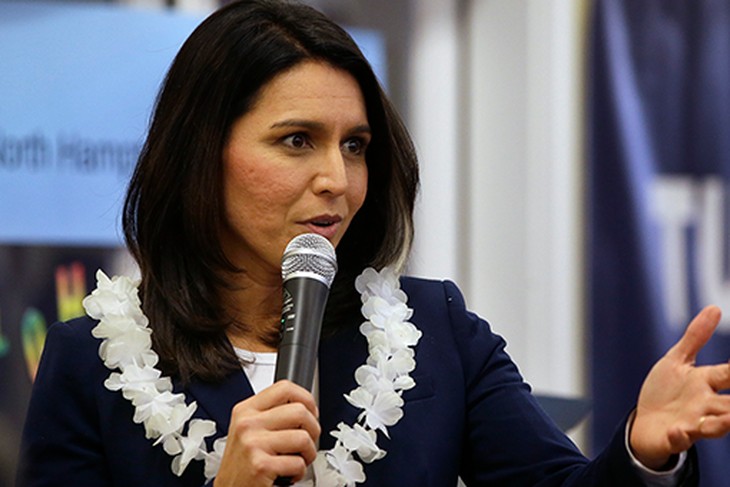
Former US Representative Tulsi Gabbard (D-HI-2)

“I’ve seen it happen,” she continued. “Google will have a bit reception and members of congress will go and pick up their checks. Facebook will have a big reception and they’ll go and ‘hey, where’s my check?'” And that is the definition of an honest politician

-----------

House Democrats have introduced a bill to abolish the electoral college via constitutional amendment. Because they hate a representative republic. 

-----------

Did Trump Incite Violence? Raheem Kassam Demonstrates The Timeline Doesn’t Work. But this will be ignored because narrative. 

-----------

Did Trump incite violence, part 2: The FBI warned the Capitol Hill Police before Jan. 6 that Congress would be targeted. 

----------

We Need a New Media System -- If you sell culture war all day, don’t be surprised by the real-world consequences. More than ever, American media's central objective is profits, not truth. 

-----------

From last October: 'The country’s lost its mind': Polls warning of civil war, violence shows deep partisan chasm over election. Think the numbers would be more or less of that view now? 

-----------

But remember: Trump is Hitler and his supporters are fascists.  PBS lawyer seen on video calling for children of Republicans to be put in re-education camps


-----------

But remember: Trump is Hitler and his supporters are fascists, part 2: 


That is not a parody Twitter account. It has hundreds of thousands of followers. They are not joking. But this is not hate speech. To be hate speech, it would have to say one of the following instead of "conservatives": blacks, Democrats, gays, transgenders, Hispanics, lesbians, progressives, and who knows how many other protected identity groups. That would be hate speech. But if it is about mere conservatives, it is rational discourse, amirite?
-----------
But remember: Trump is Hitler and his supporters are fascists, part 3: Antifa Demands Powell's Stop Selling Andy Ngo's Book, Forces Store To Close Early

-----------
Speaking of Trump, you know how it goes for brutal Nazi dictators: Evil Fascist Dictator Censored And Voted Out Of Office

----------
Speaking of Trump, you know how it goes for brutal Nazi dictators, part 2: They get impeached a second time.

Monday, January 11, 2021

New York Times: Nancy Pelosi calls for military coup

OMG! What if Trump orders this before Jan. 20!
But that cannot happen, read on to see why -
and why Nancy Pelosi's urging of a military coup 
against Trump must be condemned.

Even the New York Times characterizes one of Speaker of the House Nancy Pelosi's recent actions as coming narrowly close to inciting a military coup against the president. According to the NYT,

Ms. Pelosi also said she had spoken with Gen. Mark A. Milley, the chairman of the Joint Chiefs of Staff, about “preventing an unstable president from initiating military hostilities or accessing the launch codes.” . . .

But some Defense Department officials have privately expressed anger that political leaders seemed to be trying to get the Pentagon to do the work of Congress and Cabinet secretaries, who have legal options to remove a president.

Mr. Trump, they noted, is still the commander in chief, and unless he is removed, the military is bound to follow his lawful orders. While military officials can refuse to carry out orders they view as illegal, they cannot proactively remove the president from the chain of command. That would be a military coup, these officials said.

The NYT did not have to print what those Pentagon officials said. That the reporter and editor included it proves they agreed with that assessment. 

And yet, somehow it is only Donald Trump who is trying to destroy the foundations of our government, amirite? 

Reuters reported the phone call, too,  with a truly uninformed nitwit being quoted:

While Pelosi’s letter highlights the concern among lawmakers about what Trump may try to do during his remaining time in office, there are questions about what Milley or anyone could actually do to stop a president from using nuclear weapons.

“There is no legal way to do this. The president has sole, unfettered authority to order the use of nuclear weapons with no ‘second vote’ required,” said Jeffrey Lewis, a professor at the Middlebury Institute of International Studies at Monterey in California.

I am sure Prof. Lewis is an expert on something. Nuclear launch procedures are definitely not one of them. This sentence he spoke is factually incorrect, period: "The president has sole, unfettered authority to order the use of nuclear weapons with no ‘second vote’ required."

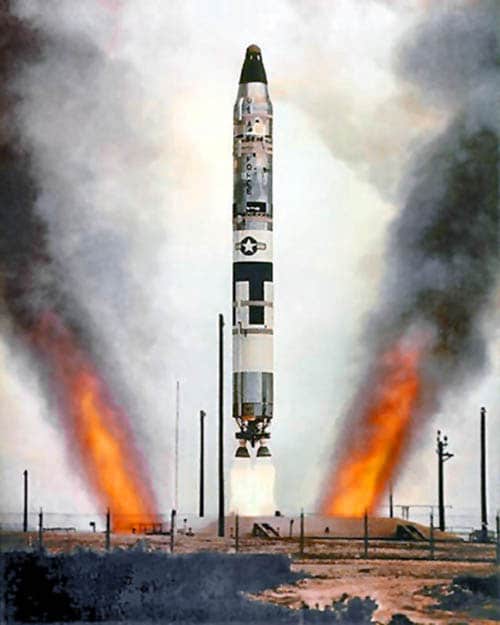
I was a nuclear-target analyst during part of my military career. I decrypted and validated Nuclear Control Orders, which are the most tightly controlled messages and actions used by the Defense Department, and in two assignments I would have been directly in the chain of command had actual launch orders come down. I can tell you authoritatively that Nancy Pelosi knows bupkus about what it takes to launch a nuke. If she had ever been briefed, she would never have made this phone call. 

Fact: Only the president can originate the order for a nuclear strike by US armed forces, but the president is only one of the people who must approve the launch. Actually, a valid and actionable launch order can be sent and acted upon without the president's order or even his involvement - but only under extremely unusual and pre-defined circumstances. It is safe to say, though not precisely accurate, that a nuclear launch cannot occur without a president's orders -- but it is simply wrong that the president alone (note that word: alone) can order it.

Prof. Lewis' statement would be accurate this way: "The president has the authority to order the use of nuclear weapons, but there are other 'votes' that must concur; some are technical procedures and some are not." 

I will not list the steps that have to be done to launch a nuke. In fact, I will never reveal them. But here is a clue: the Denzel Washington/Gene Hackman movie Crimson Tide just scared the crap out of me.

And here is Bloomberg News' explanation of launch procedures. It, like the sequence in Crimson Tide, is accurate as far as it goes, but at least it does not say, as Prof. Lewis does, that the people in the chain of command from the White House down to the launch crews are mere puppets in the hands of a president.  

It is not credible that any speaker of the House would not know what these procedures are. I do not believe that Pelosi therefore really thought that Trump might go rogue and start nuking Moscow and Peking and Pyongyang (or San Francisco?). 

So what was Pelosi really trying to accomplish with this phone call, especially since those of us who served in the Pentagon can tell that Gen. Milley basically told her to mind her own business? 

It is not coincidental that Pelosi was already scheduled to be on CBS News 60 Minutes program the evening after she made the call. And she gave a press conference after the call, also. So what was the real purpose of the call? It was certainly not to restrain a rogue president from ordering nuclear launches. 

The purpose was the shameless self promotion of one Nancy Pelosi and the further demonization of Donald Trump. It was to signal the American people that they are all going to die in nuclear war except for her heroic steps and that (here is the real point:) President Trump must be removed from office now, either by impeachment or via the 25th Amendment. 

As always, Nancy Pelosi has no goal but "get Trump." No matter what, he will be out of office at the stroke of noon Jan. 20. And what will Nancy Pelosi do then? 

Maybe this is relevant: "National Guard Troops Deploying to DC Will Come With Lethal Weapons."

Army and Air National Guard members deploying to Washington, D.C. to help guard the capital and stay through the Jan. 20 inauguration will have access to lethal weapons at their commanders' discretion, Guard commanders said Friday.

On inauguration day 2016, Antifa et. al. rioted most of the day and burned down blocks of D.C.'s stores and buildings. Who was sent to bring them under control? DC police whose use of rubber stun bullets itself became the target of violent protests. 

But for this inauguration, military weapons. And not by Trump's order, but by demand of D.C.'s Democrat mayor. But remember: Trump is the fascist. 

Monday, December 21, 2020

The "Christmas Conjunction"

 I took these photos in my front yard starting just after 5 p.m. CST today with Cathy's assistance. I used my Samsung S9 smart phone mounted on a tripod. Tonight is the closest approach of Jupiter and Saturn; tomorrow and for a few days afterward they will be farther apart, but still seem quite close. Not long after I finish this post, they will disappear behind the horizon. 

But according to NASA, if we placed a dime on the goal line of a football field and pretended it was the sun, Jupiter would be at about the 10.5-yard line. Saturn would be almost twice as far out, at the 19-yard line. So they do not ever actually come close to one another. (Earth would be about two yards out from the dime-sized sun.) 


Here is looking from our front yard. The planets are the bright dot above our neighbor's house, between the power lines. 


Here is a telephoto view. I do have conventional digital and film cameras, but not with 8X telephoto like my phone has. This shot is about 4X.


Here is a series of 8x telephoto shots. Basically, if you've seen one you've seen them all. The phone does have a "night" photo setting, but after I used it, I could not tell any difference, probably because the phone was already stable on the tripod. But you can definitely tell there are two separate planets, and which one is Jupiter. 


One final frame and we bid the conjunction adieu.


I hope you got to see it, too!

BTW, the Bethlehem star that the magi, or wise men, followed to find the Christ child was also a conjunction of Jupiter, although not with Saturn, but with the star Regulus. Modern astronomers have calculated it quite precisely. Read about that in, "Why is Christmas on December 25?"

Merry Christmas to all, and God bless us, every one!

Wednesday, December 16, 2020

A Quiz on the Origins of Christmas Traditions

Here is a little quiz on the origin of many Christian traditions of the Western world. First the quiz and then the answers. Good luck!

1.True or False:  The Old Testament prophesied that the Messiah would be born in Bethlehem.

2. T or F: The Old Testament prophesied that the Messiah would be born in December.

3. T or F: The prophet Isaiah foretold that the Messiah would be born of a virgin mother.

4. T or F: The early church began the tradition of the Christmas tree.

5. T or F: Saint Nicholas figures prominently in our Christmas celebrations because he was the church leader who made Christmas a Catholic festival day.

6.Which of the following figures does not appear in the Gospels’ narratives of the birth of Jesus?
        a. Shepherds
        b. Angels
        c. Astrologers
        d. A drummer boy

7. T or F: Christmas gets its name because for centuries the Catholic church celebrated a Mass at midnight on Christmas Eve called the “Christ Mass.”

8. T or F: In colonial America, the Puritans were well known for celebrating Christmas as a major church holiday.

9.The pagan Romans celebrated which of the following on Dec. 25?
        a. The winter solstice, the shortest day of the year.
        b. The birthday of the Roman deity Mithra, the god of the regenerating sun.
        c. The feast of Saturnalia.
        d. None of the above.

10. T or F: The early church set Dec. 25 as the celebration of the nativity of Jesus so that it would occur between the Roman feast of Saturnalia, Dec. 19, and the Roman feast of Kalends, which occurred on January 1.

11. T or F: Christmas Day is a legal holiday in Egypt.

12. Saint Nicholas was Bishop Nicholas of Myra, in what is modern Turkey, in the early 300s. He is considered the protector of what kinds of persons?
        a. Virgins
        b. Thieves
        c. Children
        d. Sailors

13. T or F: Part of St. Nicholas is entombed in Flushing, NY.

14. When did the first retail-store Santa Claus appear? Between ...
        a. 1800-1850
        b. 1851-1900
        c. 1901-1950
        d. After 1950

15. T or F: The Christmas tree is actually of pagan origin, dating from pre-Christian Germany and adopted and Christianized by Christian missionaries.

 
Christmas Tree at NYC's Rockefeller Center, 2019

16.When did the Christmas tree come into widespread usage in the United States?

        a. Before the Revolutionary War 
        b. Between 1820-1840
        c. The late 1800s.

17. In Old England, on what day of the year did masters and servants eat the same meal at the same table?
        a. The monarch’s birthday, to signify that they were all alike subjects of the king or queen.
        b. June 15, the date King John agreed to the terms of the Magna Carta in 1215, to signify that they all alike had their rights as English people confirmed by the sovereign.
        c. Thanksgiving Day, to signify together their common dependency on a gracious God.
        d. Christmas Day, in the spirit of humility before Christ's incarnation, the act of divine condescension before which all persons are equal.

18. Which US president began the custom of lighting the public White House Christmas tree?
        a. Abraham Lincoln, who used candles
        b. Grover Cleveland, in whose term the White House was wired for electricity
        c. Calvin Coolidge, whose home state of Vermont sent him a tree.
        d. Franklin Delano Roosevelt, who used it as a beacon of hope during the Great Depression

19. T or F: Christmas carols were begun by church leaders 800 years ago, notably St.Francis of Assisi, because popular music had become too bawdy and impious.

20. Christmas cards began –
        a. In late Medieval times as a means by which the Pope sent Christmas blessings and instructions for the new year to the bishops in Europe.
        b. In the Thirty Years War, 1618-1648, when generals offered to send soldiers’ Christmas letters home free of charge.
        c. During England’s Industrial Revolution in the 1840s, when wages rose enough for ordinary people to afford the penny postage cost and the steam press enabled inexpensive printing of the cards.

21. Extra credit: What American economic occurrence is credited by historians with beginning the modern commercialization of Christmas, and when was it?


The Answers:

1. True The Old Testament prophesied that the Messiah would be born in Bethlehem. Christians have said from the beginning that this verse, written several hundred years before Jesus was born, prophesied his birth in Bethlehem:  Mic 5:2   

But you, O Bethlehem of Ephrathah, who are one of the little clans of Judah, from you shall come forth for me one who is to rule in Israel, whose origin is from of old, from ancient days. 

2. False "The Old Testament prophesied that the Messiah would be born in December." No time of birth was prophesied at all. 

3. True The prophet Isaiah foretold that the Messiah would be born of a virgin mother. Matthew's Gospel (1:23) says thus: " 'Look, the virgin shall conceive and bear a son, and they shall name him Emmanuel,' which means, 'God is with us'." 

However, Matthew is quoting a Greek translation (the Septuagint) of Isaiah 7:14, which says (NRSV), “Therefore the Lord himself will give you a sign. Look, the young woman is with child and shall bear a son, and shall name him Immanuel” (my italics). The Septuagint translated the Hebrew word, almah (young woman, maiden) using the Greek word parthenos (virgin). So the answer might be, “True, sort of.” OTOH, the 70 scholars who translated the Hebrew Scriptures into Greek were no dummies and were all Jews besides, so their interpretation of almah as "virgin" should carry a lot of weight.

4. False        "The early church began the tradition of the Christmas tree." Nope, not even close. 

5. False "Saint Nicholas figures prominently in our Christmas celebrations because he was the church leader who made Christmas a Catholic festival day." It is a festival day, but not because of St. Nick.

Christmas was celebrated from the very early days of the Church in various localities (the nearer to Jerusalem, the more likely the celebration). Several church leaders promoted the day, including Chrysostom and St. Ambrose, and the day appeared on all Western Church calendars no later than the mid-300s and on Eastern Church calendars a couple of decades later.

6. Which of the following figures does not appear in the Gospels’ narratives of the birth of Jesus? 

        d. A drummer boy

7. True Christmas gets its name because for centuries the Catholic church celebrated a Mass at midnight on Christmas Eve called the “Christ Mass.” This word dates to 1038's Old English, “Cristes Maess.” Other languages use different words and word origins.

8. False "In colonial America, the Puritans were well known for celebrating Christmas as a major church holiday."

Puritans actually outlawed Christmas in Boston during part of the 17th century. English Protestantism generally resisted celebrating Christmas. Puritans also got Christmas outlawed in England during the Interregnum, resulting in pro-Christmas rioting, even in Canterbury. The ban was lifted in 1660 with the Restoration.

9. The Romans celebrated which of the following on Dec. 25?

        d. None of the above. 

Mithra, a deity imported from Persia by the Roman military, became an important member of the Roman pantheon as time went on. By the middle of the third century, Mithraism was the main religion of Rome. Modern skeptics' claims that Mithra's birthday is Dec. 25 lack historical documentation. The Feast of Saturnalia was instituted originally for Dec. 17 and was later extended to Dec. 23. The winter solstice, of course, is Dec. 21. 

10. False The quiz question was, "The early church set Dec. 25 as the celebration of the nativity of Jesus so that it would occur between the Roman feast of Saturnalia, Dec. 19, and the Roman feast of Kalends, which occurred on January 1."  

First, that Christmas was set to “take over” or Christianize the feast of Saturnalia (or of Mithra) is refuted by historical evidence. The early Christian scholar Tertullian dated Jesus' birth as Dec. 25 at least  seventy-five years before Emperor Aurelian instituted a Roman, pagan celebration of the winter solstice. Tertullian's calculations were based on legendary-type beliefs about martyred Jewish prophets and so hold no weight today, but he nonetheless did date Jesus' birth to Dec. 25 decades before anyone in pagan Roman religion even noted the date on the calendar. 

Se also my essay, "Why is Christmas on December 25?" -- Whatever date Jesus was born, it almost definitely was not December 25. So why do we date Christmas on it?

11. True Christmas Day is a legal holiday in Egypt. It only became a holiday in 2003.

12. Saint Nicholas was Bishop Nicholas of Myra, in what is modern Turkey, in the early 300s. He is considered the protector of what kinds of persons (include all that apply)?

a. Virgins
b. Thieves
c. Children
d. Sailors

All of the above. The legend of St. Nicholas was spread by sailors and took root in The Netherlands as Holland was becoming a great sea power. St. Nicholas was known in life to have been kind to maidens and children. Not sure how he became a protector of thieves, though!

13. True Part of St. Nicholas is entombed in Flushing, NY. Relics of the saint, including a piece of his skull, were brought to an Eastern Orthodox church there in 1972.

14. When did the first retail-store Santa Claus appear?

a. 1851-1900 

He was James Edgar and played the part in Brockton, Mass., in 1890, the same year that Katherine Lee Bates invented Mrs. Claus in “Sunshine and Other Verses for Children.” This makes St. Nicholas the only married saint, but of course neither the Roman church nor the Eastern church recognize Mrs. Claus. 

15. False "The Christmas tree is actually of pagan origin, dating from pre-Christian times and adopted and Christianized by Christian missionaries."

The oak tree was sacred to pre-Christian Germans, not the evergreen. The Christmas tree as a symbol of new life in Christ supplanted the oak tree in Germany, probably from St. Boniface who evangelized Germany in the early 800s. Legend has it that Boniface stopped the sacrifice of young boy against an oak and then cut the oak down, whereupon a fir tree sprang up in its place. More historically, the fir tree is known to have been used in Christmas plays in Germany in the 1500s to represent the tree of knowledge of good and evil (the Genesis story). Decorating the Christmas tree probably began from the way apples were hung from this dramatic tree to represent the fruit of temptation that Adam and Eve ate. By the 1700s Christmas trees became widespread in German homes during Christmastime.

16. When did the Christmas tree come into widespread usage in the United States? 

a. The late 1800s.

17. In Old England, on what day of the year did masters and servants eat the same meal at the same table?

Christmas Day, in the spirit of humility before Christ's incarnation, the act of divine condescension before which all persons are equal.

18. Which US president began the custom of lighting the public White House Christmas tree?

Calvin Coolidge, whose home state of Vermont sent him a tree.

19. True "Christmas carols were begun by church leaders 800 years ago, notably St. Francis of Assisi, because popular music had become too bawdy and impious." 

A “carol” was a form of circle folk-singing and dancing. Beginning in the 700s, traveling minstrel shows spread the form across most of Europe and, like all pop musicians, had found great success with risqué lyrics and movements, which only goes to show how long this sort of thing has been going on.

20. Christmas cards began –

During England’s Industrial Revolution in the 1840s, when wages rose enough for ordinary people to afford the penny postage cost and the steam press enabled inexpensive printing of the cards. Also, as far as I can determine, the first British penny was minted in 1840 and the penny price for postage was set then, too. 

42. Extra credit: What American economic occurrence is credited by historians with jump starting the commercialization of Christmas?

The depression of 1839-1840

The commercial aspect of the holiday began at a low level in the 1820s with the publication of “The Night Before Christmas,” attributed (later) to Clement Moore. This poem is credited with making Christmas a children’s holiday and starting the practice of giving gifts to children by parents; before then, kids were given sweets and treats. But the commercialization of Christmas in the US really got a head of steam when gift-giving was promoted to overcome the depression of 1839-1840. It’s never looked back. In England the trend was accelerated by the publication of Charles Dickens' novella, "A Christmas Carol."

Tuesday, December 15, 2020

A Christmas Quiz

Here is a Christmas-related quiz I put together a few years ago. First four pages are the questions, the last six are the answers and explanation. Covers the Bible, religious traditions and secular history. 

Monday, December 14, 2020

Christmas and the Cross

 My family and I have lived in neighborhoods that had Homeowners Associations and and other ones, like our present one, that did not. I could make a cogent case to have them, and also not to have them. The devil, as they say, is in the details. 

But this takes the cake. Now an HOA has decided that it is a theological-decision panel.

A family in Raleigh, North Carolina were shocked when their homeowner’s association (HOA) tried to force them to remove a six-foot Christmas cross that the family put up as a holiday decoration, stating that crosses can only be displayed during Passover or Easter.
 
“Lo and behold, after putting it out right after Thanksgiving, we got a notice in the mail. It shocked us,” James Faison said to the local ABC affiliate in the city. “We believe that the cross is symbolic of hope, salvation and deliverance. It’s so important that we have this cross up for Christmas time.
 
But the HOA disagreed. 
 
In a letter, the Faisons were told, “The board does not consider this a Christmas decoration, but Easter/Passover seasonal decoration.” Ironically, James reports that there are many Christians on the board, but they believe that there should be a distinction and separation between Christmas and Easter.
 
Perhaps they forgot that you need Christmas to get to Easter, or maybe they haven’t gone to a Christmas Eve service that serves communion as a reminder of Christ’s ultimate sacrifice.
 
Either way the Faisons were given notification that if they didn’t come into “compliance,” they would be forced to pay a $100 fine.
 
“They didn’t mention anything in the bylaws, they didn’t say go look here in the bylaws as far as it relates to the HOA in the community, this is the reason why. They didn’t say any of those things,” James said. “They asked me to provide biblical references.”
 
The Faisons did as asked.
 
Part of the HOA’s response included, “The cross represents the death of Jesus Christ who died for our sins so we can have eternal life. The Christmas season is associated with the birth of the Savior such as nativity scenes would be appropriate representation of the season. The Board believes that the Bible is very clear on the distinction between these two major events in Christ’s life on earth. The cross is appropriate for display during the Easter season, but not as a decoration during the Christmas season. Unless biblical references can be provided noting the cross as a symbol of the Christmas season for the board to reconsider, the cross is not considered to be a Christmas decoration.”
So this HOA thinks it can meet for what - 15 minutes? - and refute about 2,000 years of Christian theology, as well as hundred of years of Christian iconography. 

Well. 

"For the glory of the Lord shall be revealed," promised the Scriptures, and the glory of God can hardly be beheld impassively. One either runs to embrace the Lord or runs from him. Neutrality is not even possible.

So the passages for Advent typically include reminders that, absent God’s gracing presence, we mortals are lost in our sins. Almost every Advent, the lectionary passage for the first Sunday is of the severity of God's judgment. We are reminded that, “Christ has come, Christ will come again.” And his next advent will not be so innocently or unthreateningly accomplished.

Yet Advent also shows that by being born the baby in the manger God was not going on the offensive against us. He joins us an our ally. In fact, God’s kingly, overwhelming power is found there literally to be defenseless, so much so that Joseph and Mary had to flee the town to save Jesus’ life.

Is there power in such weakness? No, not in weakness per se. Jesus’ Godly power, or our own, is found neither in human in weakness nor in strength, but in faithfulness. It is God who is strong, not we mortals. Compared to the God’s strength, human weakness is inevitable but it is also inconsequential. God knows this, so he did not shrink from being born of woman, just as we are, nor from enduring the travails of human life in all its triumphs and disappointments, its joys and frustrations.

And at the end, death on a cross. But death could not hold Jesus because God is stronger than death.

Manger scenes became a popular artistic motif during the Renaissance. In almost all such paintings, the artists included the cross somewhere in the scenery. Sometimes it was on the horizon outside the manger. One artist, Lorenzo Lotto (1480-1556), painted a cross on a shelf on the manger’s wall, such as many homes would have had. 

Let us take a cue from those theologically-trained artists. They knew the connection between the manger and Calvary. So did Jesus. As his last trip to Jerusalem loomed, knowing what it portended, Jesus told the disciples, “Now my heart is troubled, and what shall I say? 'Father, save me from this hour'? No, it was for this very reason I came to this hour” (John 12:27).

As for scripturally connecting Jesus' birth with his death, read these passages.
 
What is the meaning of Christmas? The meaning of Christmas is the cross.

Sunday, December 6, 2020

A reflection on the second Sunday of Advent

Advent is when we should make the jump -
will we do it willingly?
Every year at this time we list the things we want for Christmas. Kids expect great things from Santa Claus. Let’s face it, there usually is not a lot of humility in our lists of what we want. Deep down, we both expect to be given those things and think we deserve them anyway. Now, no hands, please, but how many of you have gone shopping after Christmas to buy something on your list you did not get as a gift? Somehow, at Christmas we think we deserve nice stuff, and we’re quite okay with giving nice stuff, too. But there’s a certain system at work in Christmas gift giving: we give, we get, and that’s how it’s supposed to be.

Have you ever gotten what you did not deserve? I don’t mean just at Christmas, when you were either disappointed or delighted with a surprise gift. In the Bible some people get what they deserve and others what they don’t deserve. Sometimes a king, or maybe an entire nation, say, Egypt or Israel, does wrong or sins, and then they suffer the consequences. It’s what they deserve. Like crime, sin has consequences, some of which are realized in this life, others in the next. 

There are also examples in the Bible of people getting what they do not deserve. Some of them are tragic – Jesus being sentenced to death is the leading case. Even Pilate, who sentenced him, declared that Jesus had done no wrong. But he ordered Jesus crucified anyway. 

Other times, people get what they do not deserve, and it is good. Second Samuel, chapter nine, tells the story of Mephibosheth, son of Jonathan, who was son of Saul, whom David succeeded as king. At the very pinnacle of his reign, David remembered Saul. He asked his court, “Is there anyone left of the house of Saul, that I may show him kindness for Jonathan’s sake?” 

David did not ask, “Who among Saul’s house deserves some kindness?” He didn’t ask whether there was anyone from Saul’s house who could serve him now. No, David asks simply, “Is there anyone whom I may show kindness?”

David’s question was purely graceful and loving. “Yes,” says a former servant of Saul. “Jonathan’s son still lives. He is crippled in both feet.” Immediately, David replies, “Bring him to live here!” David restored Mephibosheth’s property, and handicapped Mephibosheth ate at David’s table. 

The story of Mephibosheth at David’s table illustrates God’s grace. Divine grace is the unmerited, unearned favor of God. Mephibosheth didn’t deserve a place at the table. He could not possibly have earned it. He was crippled and very much out of place compared to the famous generals and statesmen and the royal David and Bathsheba. Yet, there he was, dining at the finest table that could be prepared. Nothing but grace brought him there. He didn’t deserve it. 

Another fellow who didn’t deserve what he got was a young man Jesus told of who got sick and tired of living at home with Dad and Dad’s rules, Dad’s regulations, Dad’s list of chores, Dad’s discipline. He demanded his share of his inheritance now, which was basically telling Dad, you are as good as dead to me. I renounce you. And then he left the country. But he went broke and in desperation returned home, hoping that his father would at least hire him as a field hand. 

But while he was still far off, his father saw him and was filled with compassion; he ran and put his arms around him and kissed him. The he threw a big homecoming party for his rebellious son because he felt as though his son had died, and was alive again, had been lost, but now was found. 


 One theme of Advent is the judgment of God. God rarely judges judicially, as in a courtroom. Isaiah wrote that God's judicial-type judgment is unusual, calling it God’s “strange work” and “alien task” (Isa 28:21). God’s judgment is fundamentally that of salvation and unmerited favor. God judges like a father hoping for his children to come to their senses and exulting when they do. God is an unfair judge, by our standards, because from his judgment we do not get what we deserve. And thank God we don’t.

In 586 BC the Babylonian empire conquered Jerusalem after years of warfare and exiled a large number of Jews to Babylon, hundreds of miles to the east. For decades they remained, until the king there told them they could go home. Isaiah had prophesied for forty years that Judah was in mortal danger. The first 39 chapters of the book of Isaiah are concerned with that. But the last 27 chapters take a new tone, beginning with our passage for today, Isaiah 40:1-11:

1 Comfort, O comfort my people, says your God. 2 Speak tenderly to Jerusalem, and cry to her that she has served her term, that her penalty is paid, that she has received from the Lord’s hand double for all her sins.

3 A voice cries out: “In the wilderness prepare the way of the LORD, make straight in the desert a highway for our God. 4 Every valley shall be lifted up, and every mountain and hill be made low; the uneven ground shall become level, and the rough places a plain. 5 Then the glory of the LORD shall be revealed, and all people shall see it together, for the mouth of the LORD has spoken.”

6 A voice says, “Cry out!” And I said, “What shall I cry?” All people are grass, their constancy is like the flower of the field. 7 The grass withers, the flower fades, when the breath of the LORD blows upon it; surely the people are grass. 8 The grass withers, the flower fades; but the word of our God will stand forever.

9 Get you up to a high mountain, O Zion, herald of good tidings; lift up your voice with strength, O Jerusalem, herald of good tidings, lift it up, do not fear; say to the cities of Judah, “Here is your God!” 10 See, the Lord GOD comes with might, and his arm rules for him; his reward is with him, and his recompense before him. 11 He will feed his flock like a shepherd; he will gather the lambs in his arms, and carry them in his bosom, and gently lead the mother sheep. 

It has usually been thought that this passage announces the end of the Jews’ exile in Babylon. Or it may address the end of the troubles and wars in Israel before the exile took place. In any event Isaiah advises the people that their penalty has been paid, they have served their term, and that they have received from the Lord double for all their sins. Their sentence of war and conquest is finished, or their exile, so their debt for their sin has been paid. After all, when prisoners are released from a prison term, we say they have paid their debt to society. And that’s a sound interpretation of the passage.

But what about the part that says they have received from the Lord’s hand double for all their sins? That’s not fair; is it a case of God punishing them twice as hard as they deserved? I think this is related to the assurance of comfort. Isaiah is assuring the people that their sin really is remitted, as much as if they had received twice the sentence they should have gotten. Hence, they should be comforted.

 What does comfort mean to us? La-Z-Boy tries to sell us its recliners because they are comfortable. When we try to comfort someone in grief we commiserate with them or help them with meals or errands. Consider, though, that the word, “comfort,” is from an Old French word meaning, “to strengthen,” derived from Latin meaning the same thing. 

When God comforts his people, he gives them the strength to do what needs to be done. But the way that God sets before them is not the way they are used to. When I was stationed at Fort Bragg, North Carolina, I asked a paratrooper acquaintance of mine how many parachute jumps he had made. 

He said, “None.” 

I said, “None? But you’re in the 82d Airborne Division!” 

“Yeah,” he said, “but I have never jumped from a plane. However, I have been pushed out seventy-eight times!” 

The comfort that God is announcing is that he will give his people the strength to to jump into a new way of living, a new way of relating to him. There is a new day coming, a new advent of God’s presence, and they need to be ready. And sometimes, God pushes us when we won't make the jump.

God will do for us mortals what we surely don’t deserve: save us from our own sin, our own faults, our own inherent inabilities. Where our morality and spirituality is a desert, a wilderness, God will make a straight highway. There is to be a new order of things now, a leveling, as it were, so that all will be with God in the same way. 

Eventually, the Jews in exile in Babylon did return home, but their new independence was short-lived. They were again conquered by the Greeks under Alexander, enjoyed another brief period of independence, then fell to the Romans, who crushed the Jewish state so utterly that it vanished until 1948. 

 Of all the prophets who foretold Christ, Isaiah was perhaps the most compelling. His prophecies of the Suffering Servant are poetically beautiful and uncannily accurate in describing the Christ. What could be more remarkable than for the Son of God to appear in person, born of woman, living among his people? Jesus was indeed “the glory of the LORD,” revealed for all people to see. 

Empires come and go, withering like grass and fading like flowers, says Isaiah, but God remains. 

A young musician once went to see his old music teacher. During the visit, his elderly mentor took a tuning fork and struck it on the end of the table. He said. “That is ‘A.’” From the floor above them they could hear the voice of a singer rehearsing. “She sings sharp,” the old teacher said with a smile. He struck the tuning fork again and paused as he lifted it and said, “She is sharp, but this is an ‘A’ — always has been, always will be — 440 vibrations per second. It will still be ‘A’ five thousand years from now.” 

The word of our God, said Isaiah, will stand forever. 

Is there a wilderness in your life? Spiritually speaking, do things seem like a desert? Be comforted, be strengthened, and during this Advent season, prepare a way for the Lord and make straight in the desert a highway for God. The glory of the Lord is coming near. Be prepared!

Sunday, November 1, 2020

Election and Unity - a reflection on this Tuesday


 English statesman Edmund Burke observed that America is the only nation ever to be founded upon an idea. The American idea, and ideal, is that there really can be a country where all persons are “created equal; that they are endowed by their Creator with certain unalienable rights; that among these are life, liberty, and the pursuit of happiness,” and that the purpose of government is to secure these rights, deriving its just powers from the consent of the governed.  

History reveals that across time and the globe, disputes over succession of power have usually been settled by mobs or armies in the streets, ending with one of the contenders dead or fled. Even in civilized England, three sitting kings were murdered by their successors and one was deposed by Parliament, which then beheaded him. But in America, where there are at least 250 million guns in private hands, there is no such history of violence over elections. Perhaps it is because we may change administrations but not governments. Elections here don’t bring violence, at worst they bring . . . lawyers. Through the lens of history, our domestic political predicament is unusually peaceful.

America’s founders realized that the people of a democracy would inevitably divide into factions, setting the people in opposition to one another. For that reason, the founders mistrusted direct democracy. “Democracies,” James Madison wrote in Federalist 10, “have ever been spectacles of turbulence and contention; have ever been found incompatible with personal security or the rights of property; and have in general been as short in their lives as they have been violent in their deaths.” The founders feared the tyranny of a democratic majority almost as much the tyranny of a monarchy. The script of Mel Gibson’s blockbuster movie, The Patriot, reflected this fear when Mel Gibson’s character expressed doubts about the revolution by asking a colonial assembly, “Will you tell me why I should trade one tyrant three thousand miles away for three thousand tyrants one mile away?”

Hence the founders rejected direct democracy. In fact, wrote historian Fred Barbash,

“Democracy, as we think of it, wasn’t a serious option. Democracy was an alien notion; the word itself was rarely used in the debates of that time. The real power, they believed, resided in the House of Representatives, elected by popular vote.”

(As an aside, the founders appear to have assumed that presidential elections would be decided by the House more often than not. “It will rarely happen that the majority of the whole votes will fall on any one candidate,” said George Mason of Virginia.)

There is the famous anecdote of Benjamin Franklin leaving the Constitutional Convention and being asked by a woman on the sidewalk what government she would have. “A republic,” he answered, “if you can keep it.” Of course, a republic will have factions, too, but is much less subject to their ill effects. It would be nice to say that the founders thought that high-falutin ideals like truth, justice and morality would protect national unity, but they weren’t so naive. They knew high ideals could be easily perverted for tyranny’s purposes. The unity of the nation may be rooted in the ideals of the government but can be preserved only in the form of the government. So the founders made the nation a republic, which is the main reason we have the electoral college rather than direct election.

A republic, as defined by the founders, is a government which derives all its powers from the people and is administered by persons holding their offices for a limited period. Essential to a republic is that elected officials come from all segments of society and not from a small proportion, or a favored class. Furthermore, every tenure of office must be conditional in some way, either by limiting terms by law or by enabling removal by law.

Factionalism cannot be eliminated from society. “The latent causes of faction are sown in the nature of man,” Madison wrote, because differing interests always have divided humankind “into parties . . . and rendered them much more disposed to . . . oppress each other than to co-operate for their common good,” an observation proven every four years. Madison observed that the tendency toward disunity was so deeply rooted in human nature that the most violent conflicts have been kindled for the most frivolous reasons.

Madison thought it folly “to say that enlightened statesmen will be able to adjust these clashing interests, and render them all subservient to the public good. Enlightened statesmen will not always be at the helm.” Furthermore, politicians necessarily deal with matters immediately at hand and rarely take a long view of things.

Now, here is the reason I’ve gone through this civics lesson, for the Founders left a bombshell for church people. John Adams wrote, “We have no government armed with power capable of contending with human passions unbridled with morality and religion. Our constitution was made only for a moral and religious people. It is wholly inadequate to the government of any other.”

In other words, the founders understood that the protections of constitutional liberty depended on the morality and religious conviction of the people. Yet while morality and religion were necessary for liberty, they cannot guarantee liberty, because, wrote Madison, “Neither moral nor religious motives can be relied on” to control factionalism and discord. After all, a sense of morality and religion do not even prevent “the violence of individuals.” In civil affairs, the moral and religious senses restrain factions less and less as factions get bigger. Thus, individually moral and religious men and women inflamed and united by acrimonious passion become a mob.

This is an important point. The present election has inflamed passions throughout the country, including to the violence that the Founders warned us. Neither candidate has made much in the campaigns of their religious convictions. It is just as well. America's Founders trusted neither religion nor its lack as a qualification of a candidate. While we may hope and pray that our national leaders will be guided by the highest ideals of moral and religious convictions, our nation’s founders warned us not to count on it, either for office seekers, office holders or voters. We must seek another source of unity for our nation, not to supplant morality and religion but to complement them.

Our continuing hope for national unity is that we re-unite around the flagpole of the ideals of the republican form of government the founders bequeathed us. We must re-educate ourselves in republican ideals (note the small "r") and how it inhibits the dangers of democracy. The Federalist Papers wax long and eloquent on the virtues of a republic, but I’ll not list them here.

A closing thought: James Madison wrote in The Federalist Papers Number 39 of “that honourable determination which animates every votary of freedom, to rest all our political experiments on the capacity of mankind for self-government."

The prosperity of American civilization does not rest upon the power of government to rule us, not even in the slightest. The future of our nation is founded by our ability and willingness to govern ourselves, to suppress the devils of our passions to let flower the better angels of our nature.

If we cannot continue to do that then truly our votes will not matter. 

Saturday, October 31, 2020

All the Halloween jokes you ever wanted to know


Q: What is the most important subject a witch learns in school?
A: Spelling.

Q: Why didn’t the skeleton want to go to school?
A: His heart wasn’t in it.

Q: Why didn’t the skeleton accept a dare?
A: He didn’t have the guts!

Q: Where do skeletons get broken bones fixed?
A: The body shop.

Q: Why didn’t the skeleton go to the dance?
A: Because he had no BODY to go with.

Q: What room does a ghost not need?
A: A living room.

Q: What is a mummy’s favorite music?
A: Wrap music!

Q: Why don’t skeletons eat spicy food?
A: They don’t have the stomach for it.

Q: What are cemeteries so crowded?
A: Because people are dying to get in.

Q: Why do ghosts like riding in elevators?
A: It raises their spirits.

Q: Why do mummies have no friends?
A: Because they’re too wrapped up in themselves!

Q: Why don’t spooks like rain on Halloween?
A: It dampens their spirits.

Q: What do you call Bambi’s ghost?
A: Bamboo.

Q: Why are ghosts so bad at lying?
A: Because you can see right through them!

Q: What is a vampire’s favorite fruit?
A: A nectarine!

Q: What kind of dessert does a ghost like?
A: I scream!

Q: What happens to bad little Egyptian girls?
A: They become mummies!

Q: What does a skeleton say before dinner?
A: Bone appetit!

Q: What do you get when you cross a snowman with a vampire?
A: Frostbite.

Q: Why do ghosts make good cheerleaders?
A: Because they have a lot of spirit.

Q: Why is a skeleton so mean?
A: He doesn’t have a heart.

Q: Why don’t mummies go on vacation?
A: Because they don’t like to unwind!

Q: Why did the mummy sleep so soundly?
A: Because he was dead tired.

Q: Where do girl ghosts go to buy nice things?
A: The boo-tique.

Q: What is a skeleton’s favorite food?
A: Spare ribs.

Q: Where is a skeleton's favorite house located?
A: On a dead-end street.

Q: Where is a ghost's favorite house located?
A: On a boolevard.

A world without nuclear weapons - what would it look like?

 From Pope Leo this week, according to the National Catholic Reporter : " Pope Leo quotes Bob Dylan song in book foreword calling for n...