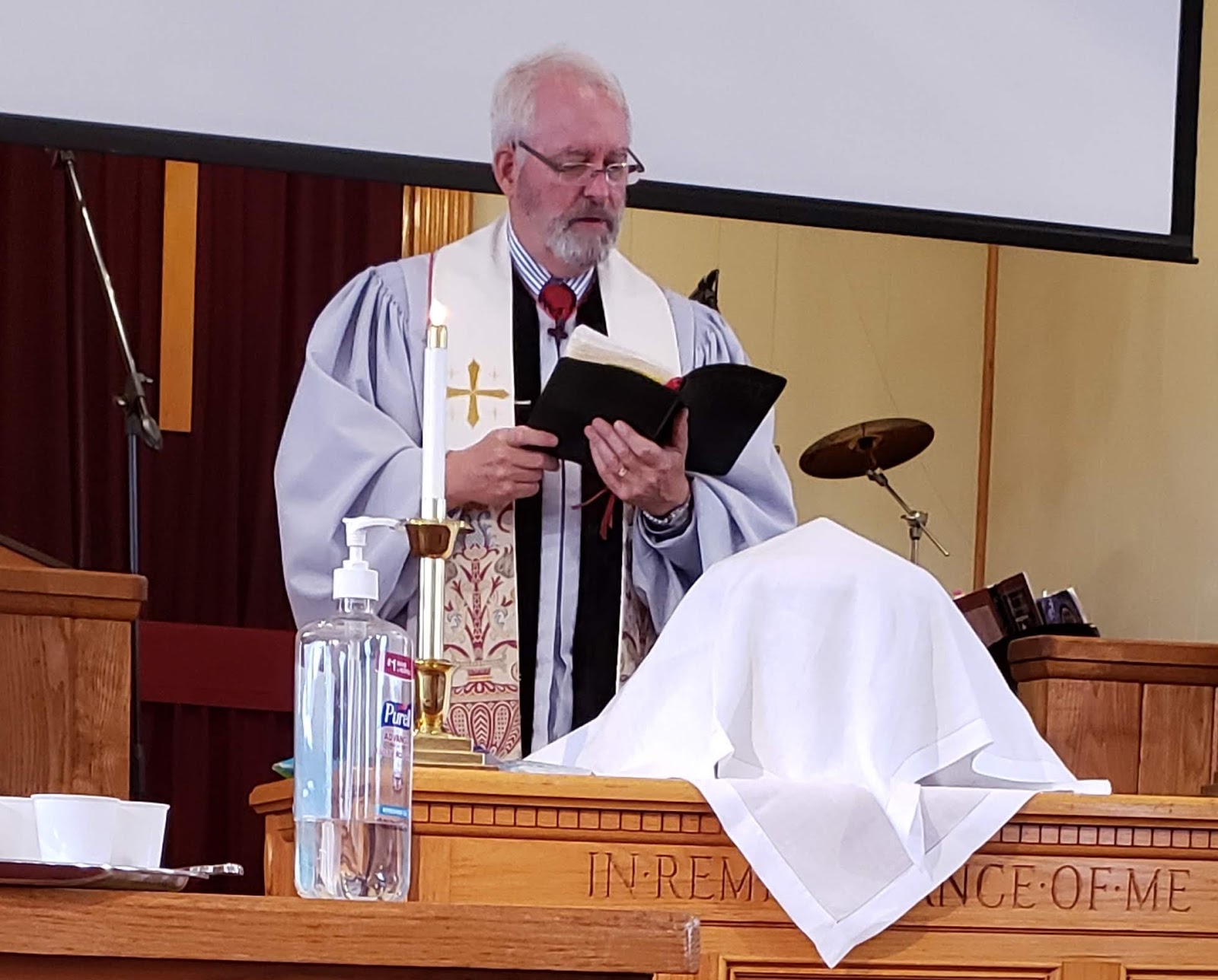
Today I conducted my final Sunday services under full-time appointment. The first was at Gideon UMC, the second at Greenbrier UMC, both in Greenbrier, Tennessee. After 23 years of full-time pastoring in the UMC, preceded by retiring as an artillery officer from the US Army, plus two years of employment in a BTB Information Technology compay, I will enter retired status for good this coming Wednesday. Here are some photos from this morning.
Serving Communion at Gideon. We used prepackaged, individual cups with the wafer and the wine (grape juice) wrapped together in one unit. I served with tongs so no one's hands ever touched the cups but the communicant's.
My final benediction at Gideon UMC.
When Cathy and I arrived at Greenbrier UMC, this sign awaited us near the front entrance.
Beginning my final service at Greenbrier UMC.
Consecrating the Communion elements.
My successor pastor, beginning there July 1, is the Rev. Jason Wilkerson, whom I have known since I moved to Robertson County three years ago. He is a very fine Christian gentleman and minister. I invited him and his family to attend today to introduce him to the congregation. I also asked him to assist in serving Communion.
Our Communion steward, the wonderful Donna Watkins, prepared Communion with the bread (the "chiclet" style) in trays of cups and the wine in other trays. She prepared these entirely in keeping with proper C19 protocols so that neither the bread, the liquid, nor the cups were ever touched by anyone but the recipients.
Rev. Wilkerson and I were both masked while serving and we donned new sterile nitrile gloves first. We removed each cup from the tray and handed it to the communicant so that no unprotected hands ever touched anything but their own serving.
In the photo above, I am serving Rev. Wilkerson at the end, just after he served me. This was one part of our ritual of me passing the pastoral care of the congregation to him - leaving him with the place of honor in the Methodist tradition: last. Hopefully, this helped the people understand that there is an orderly, grace-filled and indeed sacramental continuity of pastoral care of the people of God.
Then we proceeded with a litany of passing of the pastoral ministry from myself to Jason. We each led the congregation is responses and prayers for one another and the church itself.
Our closing hymn was, "Lord, You Have Come to the Lakeshore," number 344 in the UM Hymnal. This hymn was requested by a church member but coincidentally (or not!) it was also the thematic hymn of the service of Annual Conference in which I was ordained. So the hymn has always been deeply meaningful to both Cathy and me.
My final benediction to the people of Greenbrier UMC, which I basically ripped off from Paul's first letter to the church in Corinth, chapter 4. But I meant every word as if I had written them myself, although I could not have done so nearly as well as Paul did.
To the church of God that is Greenbrier UMC, to those who are sanctified in Christ Jesus, called to be saints, together with all those who in every place call on the name of our Lord Jesus Christ, both their Lord and ours:
I give thanks to God for you because of the grace of God that has been given you in Christ Jesus, for in every way you have been enriched in him, in speech and knowledge of every kind just as the testimony of Christ has been strengthened among you. He will also strengthen you to the end, so that you may be blameless on the day of our Lord Jesus Christ. God is faithful; by him you were called into the fellowship of his Son, Jesus Christ our Lord.
The church hosted a "walk-thru" reception for Cathy and me after the service. It would have been outside had weather permitted.
A wonderful lady of the church made this for me - Wake Forest was my undergrad school. I already had a Vandy bottle. I earned my M.Div. there.
That Cathy was also in ministry with me at the churches was a real fact and the people said so! This was given to her because everyone knows (I mean really knows!) that Cathy loves to cheer for Duke basketball.
This fine family of four are special to me for two reasons. One is that I baptized all four of them when they joined the church. The other is that he is also retired from the Army and is the only other person in the church who speaks the language of acronym as I do. So we could have whole conversations without anyone else understanding a word (except probably our wives)!
The church gave us this laser-etched crystal plaque as a gift. We are deeply moved by this thoughtfulness!
The people of Greenbrier UMC very kindly made this video for Cathy and me.
Cathy and I are thankful beyond description to all the people of Greenbrier and Gideon UMCs for the past three years. A finer and more wonderful group of people with whom to come to the finish line neither of us can imagine! What is next for us? Love God, love neighbor, and leave the rest up to the Lord.
May the love of God, the mercy of Jesus Christ our Lord, and the strengthening presence of the Holy Spirit be with us all, now and always. Amen.
A fountain dedicated to Holocaust survivors was toppled into pieces at Santa Rosa Memorial Park, where police are investigating the act of vandalism to determine if it is a hate crime.
The other enemy is Christianity, which cannot be tolerated by atheistic humanism because Christian faith simply contradicts not only that atheistic humanism is correct, but that it is even possibly correct. And so we have anarchist race warrior Shaun King:
So, did Jesus have a northern European appearance? Of course not. In fact, we do not know what Jesus looked like. Over the centuries since his day, Christians around the world have created art showing a Jesus who looked like them:
There are thousands of similar examples in countries around the world. Are these wrong, also? When Chinese Christians portray Jesus with Asian features, are they guilty of Chinese supremacism (and that definitely is a thing)? Are African Christians' portrayals of Jesus as an African guilty of cultural or racial appropriation? Or is it only the whites whose Jesus must be destroyed? To ask the question is to answer it. Not all mainly-humanists are atheists. But whenever Christians begin to consider other persons, either other Christians or not, mainly as enemies who must be defeated, well, that is when they have in their hearts denounced Christ and have embraced the powers and principalities of the world. Understand this: "white Jesus" is not the real target at all. It is only a beginning point. Anyone of any race who renounces the call to violence and carries out the commandments of Christ is the real target.
In the century and a half since, "Eternal Father, Strong to Save," was composed, it has come into widespread use by both Britain's Royal Navy and the US Navy, becoming known as the Royal Navy Hymn in the former and the Navy Hymn in the latter.
William Whiting of England composed the poem in 1860 for a student of his who was soon to sail for America. The music was composed by another Englishman, Rev. John Bacchus Dykes, an Episcopalian clergyman. The music was published in 1861, but I don't know how the lyrics and the music came to be put together.
The hymn was sung at Franklin D. Roosevelt's funeral, as well as the funerals of John F. Kennedy and Ronald Reagan. And as the 1999 movie, Titanic shows, it was also sung during services aboard the doomed vessel the Sunday before she sank. (However, the version sung in the movie was not arranged until 1940.)
Since the hymn was penned, a number of other verses have been composed by various persons over the years. Some of these have been adopted by the Armed Forces Chaplain's Board for inclusion in worship services conducted by military chaplains. These additional verses, prayers for the Marines, aviators, astronauts, the wounded, families at home and others, are included as an addendum on the US Navy's web page devoted to the hymn. Verses for the hymn are easy to write. The rhyming is simply, aabbcc, with each line consisting of eight syllables in iambic tetrameter (which by definition is eight syllables anyway).
The original hymn itself, of course, long ago passed into the public domain, so anyone may use the music or compose a verse thereto. Of the verses in the video, authorship is as follows:
Verse 1 - William Whiting, the original first verse.
Verse 2 - me, composed for this day as a prayer for the Army
Verse 3 - J. E. Seim, 1966
Verse 4 - Mary C. D. Hamilton, 1915
Verse 5 - me again
Eternal Father, strong to save, Whose arm hath bound the restless wave, Who bidd'st the mighty ocean deep Its own appointed limits keep; Oh, hear us when we cry to Thee, For those in peril on the sea! O Lord of hosts, to you we turn To give us grace we cannot earn. Our soldiers guard our way of life; Be with them all in times of strife. Let courage flow from your command; We pray for those who fight on land. Eternal Father, grant, we pray, To all Marines, both night and day, The courage, honor, strength, and skill Their land to serve, thy law fulfill; Be thou the shield forevermore From every peril to the Corps Lord, guard and guide all those who fly Through the great spaces in the sky. Be with them always in the air, In darkening storms or sunlight fair; Oh, hear us when we lift our prayer, For those in peril in the air! Almighty God, whose arm is strong, protect us e'er from doing wrong. We pray to always do what’s right, for justice only be our fight. Let peace now reign across our land, brought to us by your gracious hand.
You can hear the US Navy Sea Chanters, the service's chorus, sing the first verse by clicking here.
Lord God, grant us the faith that will truly honor those we remember this day.They died for their country; give us the faith to live for our country. They died to bring peace; give us the faith to live for peace.
They died believing in us, their fellow Americans; give us the faith to believe in one another and in our future. Grant us the same sense of commitment to people and their right to justice and peace as those we remember.
Teach us to honor all our relationships, from those dearest to us to those whom we will never meet but with whom we share this common planet. Grant us wisdom, give us hope, grant us dreams and visions like those that inspired people to give their lives, believing that through adversity and conflict would come peace and justice.
Lord, save us from complacency and prejudice – those very things that create conflict and cause young lives to be lost in battle or in despair. Make us instruments of your peace:
Where there is hatred, let us sow love;
where there is injury, pardon;
where there is discord, unity;
where there is doubt, faith;
where there is despair, love;
where there is darkness, light;
where there is sadness, joy.
Lord, hear our prayer, and let our cry come unto you. Amen.
Adapted from the prayer for the Anzac Day Dawn Service, Sydney, Australia, 1987.
Yesterday, my father, Thurman Sensing, died after a sudden and steep decline the night before. He lived for the past two years in Woodcrest Health Care of Nashville, basically a high-end nursing home. Because of the C19 restrictions, I was unable to visit him from mid-March until yesterday, when my brother, Will, and I were called to come in. Our older brother lives in Delaware.
Dad was 92 years and eight months old when passed from this life. Will and I were at his bedside when Dad died very peacefully at 4 p.m. almost on the dot.
Dad was a Seabee sailor during and after World War 2 aboard the battleship USS Texas and the escort carrier USS Bougainville, both in the Pacific.
For the past several years, I took Dad to lunch on Memorial Day. I was looking forward to bringing him lunch (C19 permitting) this month.
I had always feared that a morning phone call from Woodcrest would bear the news that Dad had died overnight, so Will and I are thankful we could be at his side. God is with us.
Because of C19 restrictions in Nashville, we will not have a visitation or a chapel service. It will be graveside only. While non-family will not be turned away by any means, cemetery rules at this time require that no more than 10 persons be at graveside. Others may come, but must stand well away. (I officiated a funeral like that last month. It is lousy, but that's what was required.)
Dad was a good father, an honorable man of courage, integrity and duty. I was blessed to be his son and I give thanks for all that he showed me and taught me. Fathers' Day next month will seem very, very empty, I already know.
God be with you, Dad, 'til we meet again.
By his counsels guide, uphold you,
With his sheep securely fold you,
God be with you till we meet again.
Thurman Sensing, Jr., of Nashville, passed from this life into God’s eternal presence on May 14, 2020. Born on Sept. 20, 1927, he was preceded in death in 2015 by his wife of 64 years, Angelyn Burkitt Sensing. He is survived by his three sons, Andy (Terri) of Hockessin, Delaware; Don (Catherine) of Greenbrier, Tenn.; and William (Janice) of Nashville. He is also survived by seven grandchildren and seven great-grandchildren.
Thurman was a World War Two veteran, having served in the US Navy aboard the battleship USS Texas and the escort carrier USS Bougainville. He graduated from Vanderbilt University in 1950 and then worked as an agent for New York Life until well into his 80s, having earned numerous sales awards throughout his career. Thurman also served as president and secretary of the Woodmont Kiwanis club.
An Eagle Scout, Thurman was co-founder of Troop 121 at Woodmont Baptist Church
Receiving the Good Shepherd award in 2016
and served as an assistant scoutmaster and Explorer scout leader. He served as Chairman of Tenn. Committee of scouting and as the Advancement Chairman for many years. He received The Pathfinder and Long Rifle awards and was the Western District Eagle representative on the Eagle advancement board. He was a recipient of the scouting Good Shepherd award.
An avid and highly-skilled golfer, he tried to imbue his enthusiasm for the game in his three sons but alas, only one came even close to his devotion and skill. If heaven doesn’t have a golf course now, they will shortly!
A graveside service will be held at Woodlawn Cemetery, Nashville, on Monday, May 18, with the Rev. Nathan Parker of Woodmont Baptist Church officiating.
The family asks that in lieu of flowers, memorials may be given to the Scouts BSA or to the memorial fund of Woodmont Baptist Church.
A Prayer at Taps, from the Song and Service Book for Ship and Field, 1941, a publication of the office of the chief chaplains of the War Department and the Navy Department, and used during World War Two:
Before we go to rest we commit ourselves to thy care, O God our Father, beseeching Thee though Christ our Lord to keep alive thy grace in our hearts. Watch Thou, O Heavenly Father, with those who wake, or watch, or weep to-night, and give thine angels charge over those who sleep. Tend those who are sick, rest those who are weary, soothe those who suffer, pity those in affliction; be near and bless those who are dying, and keep under thy holy care those who are dear to us.
O Lord, support us all the days of this troublous life, until the shadows lengthen, and the evening comes, and the busy world is hushed, and the fever of life is over, and our work is done. Then of thy great mercy grant us a safe lodging, and a holy rest, and peace at last. Through Jesus Christ our Lord. Amen.
Update: We received the death certificates right after the service. The cause of death is listed as cardiac and pulmonary arrest. We believe that is the correct determination, especially since Dad had already had a heart attack in his late 70s, and it is fully consistent with the suddenness of his terminal condition and the symptoms he exhibited until 4 p.m. of the day he passed.
I am almost at a loss for words at how genuinely moronic this is, and how cruel it really is. Almost.
So let's talk about "privilege:"
Who is it that is insistently calling for the lockdowns to continue no matter the costs in actual lives taken by the shutdowns themselves, estimated, says CBS News, to range from 75,000 to 150,000?
Who is it that dismisses well-reasoned and dispassionate calls to reopen the economy so that lives are not shattered, families no longer suffer deprivation, and the elderly are not abandoned?
Who is it that dismisses the documented forecasts that continuing the shutdowns will devastate rural medical facilities and quality of health care of rural Americans?
It is college-degreed white men and women who are financially secure, and who do not themselves think for a moment about how to pay for their next grocery trip or whether they will ever regain employment even approximating what they had before they were laid off.
It is college-degreed white men and women who think that the masses leave their homes merely to get haircuts or go shopping or - as one left-wing friend of mine posted on Facebook - to go bowling.
But at least no one is turning a fire hose on them, so all is well! (But let us ignore for the meme's sake the political party of the men who turned the hoses on the marchers or loosed the dogs.)
So college-degreed, financially secure, upper-middle class and up white people simply, comfortably dismiss both the non-white and white unwashed, uneducated, poor deplorable-classes as mere untermenschen who have no idea how good they actually have it.
As for black Americans, what this meme really says to them is, "Shut up about how we have thrown you back into poverty and want. It is more important for us to feel safe! We are not attacking you with dogs any more, so what's your beef?"
Memes like this are frankly the most stunning examples of white privilege that I have seen in a long time. I will go further: to post this marks one as an actual white supremacist.
This Sunday is Mothers Day, and guess what? Mothers Day is not about what we think it is about.
Many of us already know that we have sentimentalized Mothers Day away from its founding purpose. But I suppose there is no going back. Anyway, here is the true story of Mothers Day.
The day’s founders did not start honoring mothers because they wanted to honor childbearing. The woman credited with founding the modern observance of Mother’s Day is Anna Jarvis. Her Methodist Church in Grafton, West Virginia, is called "the Mother’s Day Church" because Anna Jarvis was active there; her home in Grafton is a national landmark.
Anna Jarvis was inspired by her mother, Anna Reeves Jarvis who organized “Mothers’ Work Day Clubs” in the 1850's in the area. The clubs provided medicines for the poor, inspected milk for children, provided nursing care for the sick, and ran shelters for children with tuberculosis.
When the Civil War broke out, she called together her clubs and asked them to make a pledge that friendship and good will would not be a casualty of the war. Throughout the war, the women nursed soldiers from both sides and saved many lives.
Anna Reeves Jarvis became a genuine peace maker after the war, organizing “Mothers’ Friendship Days” to bring together families from North and South which had been torn asunder by the war.
Anna Jarvis, the daughter, was born in 1850 and was an impressionable child and teenager when her mother was at the peak of her courageous work. So, in 1907, two years after her mother’s death, she organized the first “mother’s day” in Grafton, West Virginia, so that her mother’s work of peace and mission would not be forgotten.
Another of the earliest promoters of the idea of Mother’s Day was Julia Ward Howe, author of Battle Hymn of the Republic. Julia Ward Howe was a militant abolitionist, and her “Battle Hymn” inspired the Union Army in the Civil War.
When the Civil War was over, Julia Ward Howe focused her attention on two other causes: voting rights for women, and world peace. In 1870 war broke out between France and Prussia. The war in Europe did not make sense to her and she wrote, “Why do not the mothers of mankind interfere in these matters to prevent the waste of that human life of which they alone know and bear the cost?. . . Arise ...Christian women of this day. As men have often forsaken the plough and the anvil at the summons of war, let women on this day leave the duties of hearth and home to set out in the work of peace.”
She began organizing what she called “Mothers’ Peace Day” festivals which were celebrated annually on June 2. Her conviction was that though the world may be divided by war and conflict, the experience of childbirth could bind the mothers of the world together into one family.
So, the central concerns of those who established Mother’s Day were civil liberties, international peace, overcoming poverty and ministering to the poor and sick. From the beginning this was a day not simply to remember one’s own mother, but to find lessons for life in the experience and work of such mothers as Anna Reeves Jarvis and Julia Ward Howe.
The New England Journal of Medicine, one of the most highly-regarded medical publications in the country, puts it plainly: the C19 medical regimes put in place weeks ago are killing non-Covid patients.
Although canceling procedures such as elective hernia repairs and knee replacements is relatively straightforward, for many interventions the line between urgent and nonurgent can be drawn only in retrospect. As Brian Kolski, director of the structural heart disease program at St. Joseph Hospital in Orange County, California, told me, “A lot of procedures deemed ‘elective’ are not necessarily elective.” Two patients in his practice whose transthoracic aortic valvular replacements were postponed, for example, died while waiting. “These patients can’t wait 2 months,” Kolski said. “Some of them can’t wait 2 weeks.” Rather than a broad moratorium on elective procedures, Kolski believes we need a more granular approach. “What has been the actual toll on some of these patients?” he asked.
Mr. R., a 75-year-old man with advanced heart failure, is another of Kolski’s patients for whom the toll has been great. Because he had progressive volume overload and delirium, Kolski referred him to a hospital for an LVAD workup in early March. Then, as his wife, Ms. R., told me, “the world went wonky, and everything went down the toilet.” Having begun admitting patients with coronavirus, the hospital told the couple it was kicking everyone else out. “They are telling me my husband has 6 to 12 months to live without this procedure,” Ms. R. said, “and now they are canceling it on us.” They were then quarantined at home — 2 hours away from the hospital — with no plan in place. Mr. R.’s health quickly deteriorated again, but his wife had been advised to keep him out of the hospital. When they finally had a video visit on April 9, he’d become so ill that the heart failure physician didn’t recognize him. Mr. R. was promptly admitted, and the LVAD was placed. Though Ms. R. is relieved, ongoing challenges include her husband’s persistent delirium, a visitor policy that allows her to be at the bedside only intermittently, and the need for nearby lodging that they can’t afford.
Thankfully, states are starting to wake up to the reality. Georgia, Tennessee, and even Colorado will transition out of strict regimes within the next week or so.
I have asked before (to receive no answer from anyone at all) so I will ask again: How many non-Covid-infected persons, especially children, are you personally willing to see die to keep the lockdowns in place? Give me an actual number and explain why preventing those persons' deaths is less desirable than preventing deaths from C19.
We need to heed what the NEJM says explicitly: these are "Trade-offs We Don’t Have to Make." The Economist knew in early April.
Covid-19 presents stark choices between life, death and the economy - The trade-offs required by the pandemic will get even harder
Imagine having two critically ill patients but just one ventilator. That is the choice which could confront hospital staff in New York, Paris and London in the coming weeks, just as it has in Lombardy and Madrid. Triage demands agonising decisions. Medics have to say who will be treated and who must go without: who might live and who will probably die
And that same kind of tradeoff has already cost the lives of non-Covid patients who were denied lifesaving procedures because of the possibility that the medical facility might have a sudden, large inflow of C19 patients.
I have to be frank: I simply dismiss anyone's view that pretends there is no such tradeoff.
Updates:
Stanford University's Hoover Institution Senior Fellow Scott Atlas, MD, former head of neuroradiology at Stanford University Medical Center, writing in The Hill, makes these points:
The overwhelming majority of people do not have any significant risk of dying from COVID-19.
Protecting older, at-risk people eliminates hospital overcrowding.
ital population immunity is prevented by total isolation policies, prolonging the problem.
[Non-Covid] People are dying because other medical care is not getting done due to hypothetical projections.
We have a clearly defined population at risk who can be protected with targeted measures.
"The recent Stanford University antibody study now estimates that the fatality rate if infected is likely 0.1 to 0.2 percent." [That is almost exactly the same as seasonal flu. Important you note that it is .01% of the people who actually get the virus, not of the whole US population!]
Critical health care for millions of Americans is being ignored and people are dying to accommodate “potential” COVID-19 patients and for fear of spreading the disease. Most states and many hospitals abruptly stopped “nonessential” procedures and surgery. That prevented diagnoses of life-threatening diseases, like cancer screening, biopsies of tumors now undiscovered and potentially deadly brain aneurysms. Treatments, including emergency care, for the most serious illnesses were also missed. Cancer patients deferred chemotherapy. An estimated 80 percent of brain surgery cases were skipped. Acute stroke and heart attack patients missed their only chances for treatment, some dying and many now facing permanent disability.
According to data from the National Bureau of Economic Research and the Lancet, a medical journal, every one percent hike in unemployment will likely produce a 3.3 percent increase in drug-overdose deaths and a 0.99 percent increase in suicides.
For the year ending February 2019 (NCHS), 69,029 people died of drug overdoses, almost 7 out of 10 the result of opioids. Suicide, the tenth leading cause of death in the United States, accounted for 48,344 deaths (CDC), more than twice the number of homicides (19,510).
Lockdown-related deaths will likely exceed the base-case number of covid-19 deaths by 141%—and this offsets 60% of the highest estimate of 140,381 predicted by IMHE researchers.
NBC News: "Social distancing could have devastating effect on people with depression"
In our studies of suicide in my Master program at Vanderbilt University, we learned that while not everyone with clinical or deeper depression commits suicide, almost every person who commits suicide was suffering from depression.
Tens of thousands of people in the UK and Canada have already died because their own non-Covid medical conditions were not treated in order to save beds for C19 patients. Who did not materialize in near the numbers predicted. [Ontario Health Minister Christine] said last week that,
... a number of hospitals and medical associations are actually saying that they now want to proceed with these postponed and cancelled surgeries. It’s the government that’s holding them back.
“We want to make sure we’re not going to have increased pressures with COVID-19 cases before we can start opening up those surgeries,” Elliott said on Tuesday.
But that FAO report appears to have answered that question. They found that, as of April 23, there were 9,345 empty acute-care beds and 2,191 empty critical care beds across Ontario, which is Canada’s second hardest hit province.
We were originally told that the point of the lockdown was to guarantee we don’t overwhelm the health care system. We haven’t.
So what’s the hold up on safely re-opening the Canadian economy? The secondary harms are getting worse by the day.
Consider this FB post, which I have personally verified (I deleted the person's name).
Now, why is that the rule? Having been a federal bureaucrat, I will say (in my view, authoritatively) that the reason is simple: money.
Understand that this listing decision was not originated by physicians or nurses, but by administrators. And the overwhelming desire of every bureaucratic administrator everywhere is this: Increase his/her department's budget. Because bureaucrats get promoted by showing they can manage ever-larger budgets, not for managing programs or people.
Medical bureaucrats know very well that C19-related, enormous streams of money are already flowing from federal spigots and will continue to do so for months or even years to come. And the amount any operation or agency will get will relate very directly to the number of C19 cases they report, especially the fatalities.
If you think this sounds cynical, I assure you: It is far from cynical enough.
The Big Apple’s new death toll is 10,367. That figures combines the 6,589 victims who tested positive for the virus plus another 3,778 who were never tested, but whose death certificates list the cause of death as “COVID-19 or an equivalent,” according to city Health Department data from March 11 through April 13.
Italics mine, to illuminate what is being done here. What exactly is an "equivalent" cause of death to C19? Why, something that killed them, duh. You know, like lung cancer.
Serious question: How many people are we willing to kill to stop people from dying of Covid-19?
More specifically: How many children are we willing to kill to do it? Read this and weep:
"Hundreds of thousands of children could die this year due to the global economic downturn sparked by the coronavirus pandemic and tens of millions more could fall into extreme poverty as a result of the crisis, the United Nations warned on Thursday. ...
But the U.N. report warned that “economic hardship experienced by families as a result of the global economic downturn could result in an hundreds of thousands of additional child deaths in 2020, reversing the last 2 to 3 years of progress in reducing infant mortality within a single year.”
The full report is here, including the shocking nugget that 368 million children across 143 countries rely on school lunches as a source of nutrition, and,
"Hastily implemented lockdown measures risk disrupting food supply chains and local food markets,” which “pose potentially grave consequences for food security.”
Do you remember when, "Let's do it for the children!" was a rallying cry? Yeah, me, neither.
However, the sanguinary calculus is real: If we do not do lockdown/distancing by shutting down the economy, people will die. And if we do lockdown/distancing by shutting down the economy, people will still die - and the UN says that "hundreds of thousands" of them will be children. But as Roger Kimball explains,
We have often been presented with a false dichotomy between saving the economy and saving lives. This is a false dichotomy because, as Geach points out, “the state of our economy is not just a monetary risk, it is a health risk.” For one thing, “when people lose their jobs, they typically lose their health insurance.” He notes that there were more than 10,000 “economic suicides” as a result of the 2008 recession. There is also a spike in cancer deaths, drug abuse, domestic violence, and other pathologies.
Every 1% hike in the unemployment rate will likely produce a 3.3% increase in drug overdose deaths and a 0.99% increase in suicides according to data provided by the National Bureau of Economic Research and the medical journal Lancet. These are facts based on experience, not models. If unemployment hits 32%, some 77,000 Americans are likely to die from suicide and drug overdoses as a result of layoffs. Scientists call these fatalities deaths of despair.
There are protests around the country against long-continuing the restrictions from now. I frankly would be far more impressed with the protesters if they would leave their guns and flags at home and at least substantively acknowledge that the C19 threat is real.
But lockdown absolutists need to under stand this: More than 22 million Americans have become unemployed in the last month. The longer we are told to stay "safe at home" instead of going back to work, the less safe homes will become because of the despair and depressions that unavoidably will manifest. More people will kill themselves or a family member, more spouses and children will suffer abuse and injury, more alcoholics will be made, more people will suffer fatal non-Covid illnesses, more drug addicts will be made - that list goes on and on.
To be clear:
I am not saying that the lockdown and distancing measures should not have been imposed. I am saying as clearly as I can that the time will come when continuing them will become more costly and lethal than lifting them.
"At some point," [Princeton bioethicist] Peter Singer says, "we are willing to trade off loss of life against loss of quality of life. No government puts every dollar it spends into saving lives. And we can't really keep everything locked down until there won't be any more deaths.
We need to think about this in the context of the well-being of the community as a whole….We are currently impoverishing the economy, which means we are reducing our capacity in the long term to provide exactly those things that people are talking about that we need—better health care services, better social-security arrangements to make sure that people aren't in poverty. There are victims in the future, after the pandemic, who will bear these costs. The economic costs we incur now will spill over, in terms of loss of lives, loss of quality of life, and loss of well-being.
I think that we're losing sight of the extent to which that's already happening. And we need to really consider that tradeoff.
The "false debate," in other words, is not the discussion that considers the enormous human cost of suppressing economic activity. It's the discussion that pretends there is no such tradeoff.
If lockdowns are not substantially lifted much past the middle of May, I predict very large numbers of the American people will start concluding that the real point of these restrictions is not the health of Americans at all, but something politically sinister. And no podium appearances by Dr. Fauci or Dr. Birx is going to persuade them otherwise.
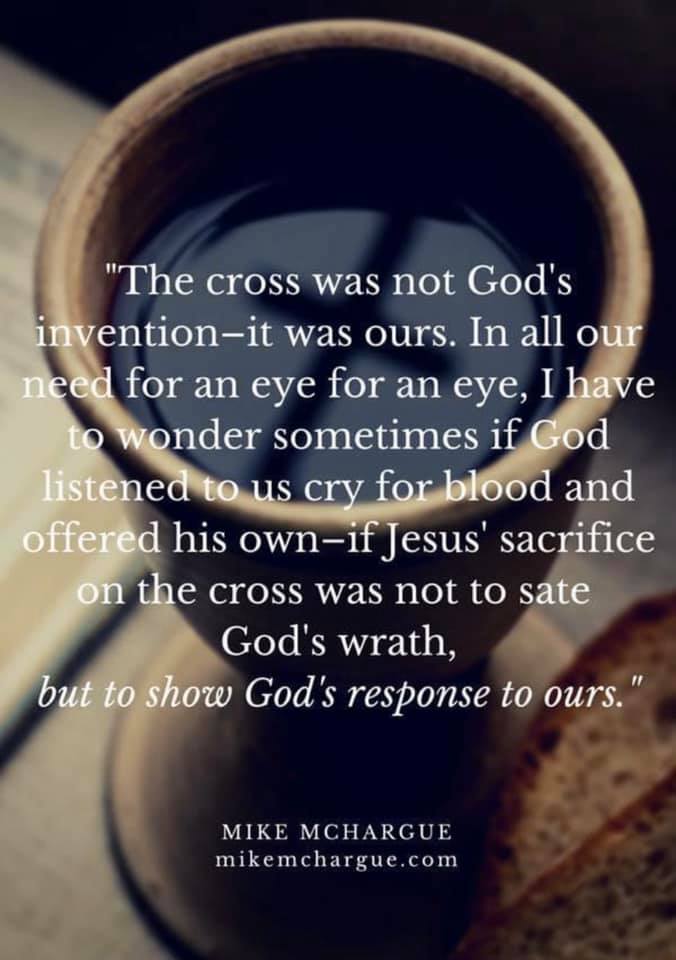
Actually, this accords very well with the doctrine of substitutionary atonement.
In John 18, in the Garden,
Jesus said to Peter, “Put your sword back into its sheath. Am I not to drink the cup that the Father has given me?”
Jesus had already prayed that God would take the cup away from him, but by the time he was arrested, Jesus knew God would not.
But what is that cup he refers to? It is not the cup of wine in Communion - the Lord's Supper was already in the past. So that cup does not refer to Jesus' blood.
There are two schools of thought about what that cup is. One is that it represents the fifth cup of the Passover, the cup of Elijah, which is not drunk during the Passover meal but symbolically placed at the table's center. It represents God's promise, that "I will bring you into the land."
That is an eschatological promise and so cannot be fulfilled except by the Messiah. And so Jesus understood he was personally its fulfillment, but the means of fulfillment was filled with dread.
The other understanding is that this cup is the cup of God’s wrath upon sinful humanity. A "cup" is used as a symbol of God’s wrath several times in the Jewish Scriptures (Jeremiah 25:15-16; Isaiah 51:17, 22; Lamentations 4:21; Ezekiel 23:28-34; Habakkuk 2:16). It is likewise used as a symbol for enduring God’s wrath in Revelation 14:9-10 and 16:19.
Here, when Jesus said on the cross, "Tetelestai" ("It is finished") Jesus was saying he had himself consumed all the wrath of God. He had drunk all the cup of God's wrath that should be poured on humankind, but was no longer. "It is finished" - all the work of Christ on the earth was completed and the salvation of humanity was now accomplished. And so he could say, "Into your hands I commend my Spirit."
All the wrath of God would be buried with Jesus but it would not arise from the burial. It is gone forever. And that is the response of God to all the wrath humanity has poured out upon him and the Son, and one another. It is not poured back onto us but was destroyed on the cross and buried in the earth, for wrath has no place in the eternal presence of God.
If we continue on the present course, we will enter a depression that might make the 1930s a distant competitor. The number of jobless Americans could reach tens of millions.
Yet the costs of this national shutdown are growing by the hour, and we don’t mean federal spending. We mean a tsunami of economic destruction that will cause tens of millions to lose their jobs as commerce and production simply cease. Many large companies can withstand a few weeks without revenue but that isn’t true of millions of small and mid-sized firms. ...
The deadweight loss in production will be profound and take years to rebuild. In a normal recession the U.S. loses about 5% of national output over the course of a year or so. In this case we may lose that much, or twice as much, in a month.
Our friend Ed Hyman, the Wall Street economist, on Thursday adjusted his estimate for the second quarter to an annual rate loss in GDP of minus-20%. Treasury Secretary Steven Mnuchin’s assertion on Fox Business Thursday that the economy will power through all this is happy talk if this continues for much longer.
This is the first time ever that the US Government has deliberately shut the economy down, and the idea that it can just be turned back on like flipping a switch is delusional.
Consider: We will never be able to determine how many lives were saved from the virus. But we will easily know how many people died because of the economic crash to come - just count increased suicides and even some homicides, to say nothing of untold numbers of people thrown into permanent poverty.
The lockdowns and stay-at-home orders are saving lives now. But if they continue much longer, they will cost lives later and cause economic, literal suffering for years and years to come.
On April 12, 1937, the express train to New York roared across the New Jersey countryside. The train, a Pennsy Railroad electric locomotive the color of bull’s blood, usually passed through the station at Elizabeth at about 50 miles per hour. On this particular morning, it came to an unanticipated stop. As the express rounded the curve, my great-grandfather jumped down from the platform, where witnesses reported he had been pacing for 10 minutes, and lay down across the tracks.
When the engineer was finally able to halt the train 100 feet past the platform, Roy Humphrey had disappeared beneath its wheels. His last act: raising his head to look at the oncoming train.
Roy was one of at least 40,000 Americans who took their own lives that year and the next, the two-year span that suicide rate spiked to its highest recorded level ever: more than 150 per 1 million annually.
The point is, there is such a thing as doing too little and also such a thing as doing too much. Doing too little against Covid-19 would be perverse and nihilistic. Society ought to devote a huge amount of resources, even if they must be commandeered from the private sector, to the protection of human life. But doing too much, or acting under the pressure to act rather than under the aim of coherently fighting disease and protecting people’s livelihoods, is potentially destructive, too. People need jobs, security, meaning, connection. They need a sense of worth, a sense of social solidarity, a sense of belonging. To threaten those things as part of a performative ‘war’ against what ought to be treated as a health challenge rather than as an End Times event would be self-defeating and utterly antithetical to the broader aim of protecting our societies from this novel new threat. To decimate the stuff of human life in the name of saving human life is a questionable moral approach.
Jesus Heals a Man Born Blind 9 As he went along, he saw a man blind from birth. 2 His disciples asked him, “Rabbi, who sinned, this man or his parents, that he was born blind?”
3 “Neither this man nor his parents sinned,” said Jesus, “but this happened so that the works of God might be displayed in him. 4 As long as it is day, we must do the works of him who sent me. Night is coming, when no one can work. 5 While I am in the world, I am the light of the world.”
6 After saying this, he spit on the ground, made some mud with the saliva, and put it on the man’s eyes. 7 “Go,” he told him, “wash in the Pool of Siloam” (this word means “Sent”). So the man went and washed, and came home seeing.
8 His neighbors and those who had formerly seen him begging asked, “Isn’t this the same man who used to sit and beg?” 9 Some claimed that he was.
Others said, “No, he only looks like him.”
But he himself insisted, “I am the man.”
10 “How then were your eyes opened?” they asked.
11 He replied, “The man they call Jesus made some mud and put it on my eyes. He told me to go to Siloam and wash. So I went and washed, and then I could see.”
12 “Where is this man?” they asked him.
“I don’t know,” he said.
The Pharisees Investigate the Healing
13 They brought to the Pharisees the man who had been blind. 14 Now the day on which Jesus had made the mud and opened the man’s eyes was a Sabbath. 15 Therefore the Pharisees also asked him how he had received his sight. “He put mud on my eyes,” the man replied, “and I washed, and now I see.”
16 Some of the Pharisees said, “This man is not from God, for he does not keep the Sabbath.”
But others asked, “How can a sinner perform such signs?” So they were divided.
17 Then they turned again to the blind man, “What have you to say about him? It was your eyes he opened.”
The man replied, “He is a prophet.”
18 They still did not believe that he had been blind and had received his sight until they sent for the man’s parents. 19 “Is this your son?” they asked. “Is this the one you say was born blind? How is it that now he can see?”
20 “We know he is our son,” the parents answered, “and we know he was born blind. 21 But how he can see now, or who opened his eyes, we don’t know. Ask him. He is of age; he will speak for himself.” 22 His parents said this because they were afraid of the Jewish leaders, who already had decided that anyone who acknowledged that Jesus was the Messiah would be put out of the synagogue. 23 That was why his parents said, “He is of age; ask him.”
24 A second time they summoned the man who had been blind. “Give glory to God by telling the truth,” they said. “We know this man is a sinner.”
25 He replied, “Whether he is a sinner or not, I don’t know. One thing I do know. I was blind but now I see!”
26 Then they asked him, “What did he do to you? How did he open your eyes?”
27 He answered, “I have told you already and you did not listen. Why do you want to hear it again? Do you want to become his disciples too?”
28 Then they hurled insults at him and said, “You are this fellow’s disciple! We are disciples of Moses! 29 We know that God spoke to Moses, but as for this fellow, we don’t even know where he comes from.”
30 The man answered, “Now that is remarkable! You don’t know where he comes from, yet he opened my eyes. 31 We know that God does not listen to sinners. He listens to the godly person who does his will. 32 Nobody has ever heard of opening the eyes of a man born blind. 33 If this man were not from God, he could do nothing.”
34 To this they replied, “You were steeped in sin at birth; how dare you lecture us!” And they threw him out.
Spiritual Blindness
35 Jesus heard that they had thrown him out, and when he found him, he said, “Do you believe in the Son of Man?”
36 “Who is he, sir?” the man asked. “Tell me so that I may believe in him.”
37 Jesus said, “You have now seen him; in fact, he is the one speaking with you.”
38 Then the man said, “Lord, I believe,” and he worshiped him.
39 Jesus said, “For judgment I have come into this world, so that the blind will see and those who see will become blind.”
40 Some Pharisees who were with him heard him say this and asked, “What? Are we blind too?”
41 Jesus said, “If you were blind, you would not be guilty of sin; but now that you claim you can see, your guilt remains.
If you like the very low gasoline prices, even though we are not supposed to drive anywhere, get used to it. Oil's spot price may drop some more, yes (it plummeted today after Thursday's highest-rate increase ever in one day). But production is going to drop. Usually, that means gas prices rise. Not this time. And that is actually very bad news.
Cheap gas and nowhere to go. That's bad.
American oil frackers operate at a loss much below $60 per barrel (depending where they are located). The largest such operation, the Permian Basin, needs about $65 per barrel to make a profit. It straddles Texas and New Mexico.
The drop in oil price was triggered by Russia's refusal to cut production at the Saudis' request. So the Saudis jacked production up to drive the price down and punish the Russians. Well, good luck with that:
After oil prices collapsed in the worst drop in nearly three decades—courtesy of the renewed Saudi-Russia rivalry on the oil market – Russia’s Finance Ministry said on Monday that Moscow had enough resources to cover budget shortfalls amid oil prices at $25-30 a barrel for six to ten years.
Not coincidentally, both the Saudis and the Russians would like to see America's frackers permanently closed and the United States to return to a major importer of oil, not net exporters as we are right now.
One way or another oil prices will rise - eventually. That seems a cloud but actually it is the silver lining. The cloud is cheap oil. Active-rig counts fell this week in the US by 160, year over year, to 722. On the other hand, US oil production remains near an all-time high at 13.1 million barrels per day. Go figure.
Analysts say that the month of April could see the largest supply overhang in the history of the oil market.
“We now expect the y/y demand loss to peak in April at 10.4 million barrels per day (mb/d), and annual demand to fall by a record 3.39mb/d in 2020,” Standard Chartered wrote in a note.
In the short run, the oil market surplus could reach a peak of 13.7 mb/d in April, Standard Chartered said, with an average surplus of 12.9 mb/d for the second quarter. The inventory buildup could reach a gargantuan 2.1 billion barrels by the end of the year, “stretching the midstream of the industry to its limits,” the bank wrote. That figure represents an upward revision of 50 percent from the 1.4-billion-barrel inventory surplus the bank predicted…just a week ago.
Other analysts have even more dramatic scenarios. Eurasia Group says demand could fall by as much as 25 mb/d in the next few weeks and months. The historic glut means that the world could run out of storage space. “The combination of weakening demand and excess supply is hardly going to be accommodated by onshore storage,” Giovanni Serio, head of analysis at Vitol, told the FT. “At a certain point…we will need to fill all the boats.”
Texas regulators are considering curtailing oil production in America’s largest oil-producing state, something they haven’t done in decades, people familiar with the matter said.
Several oil executives have reached out to members of the Texas Railroad Commission, which regulates the industry, requesting relief following an oil-price crash, the people said. U.S. benchmark oil closed around $25 a barrel Thursday.
Texas, which hasn’t limited production since the 1970s, was a model for the Organization of the Petroleum Exporting Countries, which has sought to control world-wide oil prices in recent decades. OPEC and Russia were unable to reach a deal on reducing output in response to the coronavirus pandemic, which helped trigger the current collapse in prices.
It is unclear whether regulators will ultimately act to curtail production, but staffers are examining what would be required in such an event, the people said.
Oil prices have always been manipulated by producers. Even so, at the end of the day, demand has always been in control. And now the worldwide demand has dropped like an anvil and will continue to do so. The largest users of petro products - shipping and aviation - are harboring vessels and canceling flights. That will likely accelerate.
That said, oil production is going to plummet because, as stated above, we are running out of places to put it. That does not mean that gas prices will suddenly rise. The huge over-supply will see to that. But cheap gas prices are not going to offset the real pain dropping demand will cause: higher unemployment not only of oil-industry workers, but businesses whose revenues depend on customers using oil just to buy or get to their products or locations, such as hotels, tourist attractions, airline workers, dock workers, gas station owners and workers, the list is very long.
I am not an economist by a long shot, but unless we stop our "insane over-reaction," there is going to be a lot of pain to come that 99-cent gasoline will not pay for.
Update: How low can it go? "How Low Can Oil Go? One Forecast Sees $5 a Barrel." Which means that gasoline will be not much higher than free - and yet it will be also more difficult to find because gas stations will be closing at accelerated rates as oil prices plummet.