Sunday, August 19, 2018

The Dieppe Raid and blown intelligence

German photo of Allied dead at Dieppe
British intelligence told the Germans in advance of the Dieppe raid

On this day in 1942, a force of 4,963 Canadian troops, accompanied by just over a thousand British soldiers, 50 US Rangers and 15 Frenchmen, conducted the catastrophe of Operation Jubilee.

Known to history as the Dieppe Raid, the outcome of the brief assault against the French, German-held port of Dieppe was a decisive, bloody defeat of the Allied forces.
At Dieppe, 907 Canadians, including 56 officers, lost their lives in a battle that lasted for only nine hours. A total of 3,369 men were killed or wounded. At Dieppe, the Canadian Army lost more prisoners than in the whole eleven months of the later campaign in North-West Europe, or the twenty months during which Canadians fought in Italy.
Why did the raid take place?

Objectives

Allied planners had agreed that an actual second-front invasion of occupied France could not be undertaken without substantially more experience. Though successful, the landings against Vichy French forces in northern Africa were certainly no rehearsal for operations against Nazi forces on the French coast.

So the Dieppe raid was born. The raid had no long-term tactical objective; even had the raid been entirely successful., Dieppe was to have been abandoned and troops withdrawn to Britain after a short time. The raid's goals were entirely strategic, oriented toward the future invasion of France from the sea.

Jubilee's main objectives were to train leaders at all level to conduct large-scale amphibious, combined and joint operations against the coast of France, to seize the port and hold it for a short time, to take prisoners and gather intelligence, and to demolish certain German fortifications.

It was in short meant to form the basis of an extensive set of lessons learned that could be applied toward invasion when invasion came, and to boost home-front morale at a time of the war when little could be cheered in European fighting.

The Raid

Carried by 240 Allied vessels, the raid was late in getting started, a day late in fact, having originally been scheduled for Aug. 18. The first troops to land had to advance in dawn's light rather than darkness as planned. Consequent loss of surprise is still held to be a primary reason that the raid was repulsed so bloodily. In fact, the Allies had utterly lost the advantage of surprise, but the loss was not because of daylight; it was because of the postponement. German forces were fully alerted and aware of the coming raid before the first ships appeared over the horizon.

There were two supporting, prior attacks on the east and west of the main line of advance, commencing at 0500 hours. Both were thrown back quickly with great loss. Because of this, the Germans were able to bring fierce, effective fire directly upon the main force when it landed opposite Dieppe.

Landing at 0530 hours, the main force was immediately taken under intense small arms, mortar and artillery fire. Despite the heroism of the attacking troops, a bare few made it off the beach. Twelve of 27 Canadian tanks were knocked out before getting off the sand. Only six reached the beach's esplanade, where they were stopped by antitank ditches and then destroyed.

Six hundred Canadian reserve troops were landed when commanders mistakenly thought that the initial troops had taken a foothold in Dieppe. They suffered all the way onto land and 475 of them never made it back to England.

Hardly anywhere did Allied troops make it much more than a few dozen yards away from the waterline. Only Number 4 Commando of the Royal Marines achieved all its objectives of the day, and those were very limited, though difficult to be sure. At 1050 the order to abandon the attack was given.

Why the attack failed

Loss of surprise on the morning of the attack is usually attributed as a main reason the raid failed. Yet the real reason the attack failed was revealed in 1963 by Stanley Lovell, chief of research and development of the American Office of Strategic Services during the war. The reason was very simple: Britain's Secret Intelligence Service ("Broadway") told the Germans about the raid a day ahead of time, on purpose.

In chapter 15 of his book, Of Spies and Stratagems, Lovell relates the story of a German spy captured in Britain on Aug. 31, 1939, who under interrogation claimed that his lineage was of "almost nobility." Before long, the SIS and the German came to agreement: he would be doubled to work for the SIS and after the war was won Britain would make him a knight of the realm.

Lovell says he personally read many of the messages to the German espionage service that the would-be knight sent, many of which critically misinformed the Germans of Britain's readiness to repulse invasion or of the combat depth of the Royal Air Force.

A precursor to the misfired Dieppe stratagem was a commando raid against the island of Lofoten, where German occupiers produced large quantities of fish oil used in explosives. The doubled agent radioed the Abwehr that the islands would be attacked on March 6, 1941. Germany rushed forces to the scene only to find two-day old, charred ruins and a sign poked into the sand that said, "We'll smoke your fish for you!"

Three months later a similarly accurate-but-late message was sent warning of a commando raid against the French port of St. Nazaire, where the destroyer Campbelltown, loaded with explosives, was remotely crashed into the only drydock along that coast large enough to handle German U-boats.

The SIS was given permission to send just such a too-late-but-true message to the Germans about the Dieppe raid. The message was to be sent Monday evening the 18th of August, about 12 hours after the Allied forces had landed.

The SIS was not told that the landing was postponed until Tuesday. The Germans received the message Monday evening, alerted their forces at Dieppe and were waiting before dawn on the 19th.

Lovell writes that a director of Britain's Special Operation, Executive told him that the SIS operation escaped being closed down by the thinnest of margins, surviving only when a Briton pointed out that the doubled agent's standing with the Abwehr could not possibly be higher, and that the Germans would now believe anything he told them.

Claiming to have very highly-placed sources deep within General Dwight D. Eisenhower's headquarters, the agent became deeply involved in deception operations covering Operation Overlord, the invasion of France in 1944. Most important was to deceive the Germans of the place and time of the invasion. I'll let Lovell finish the story (click for larger image):


The aftermathThe raid was a disaster for the Allies and a propaganda triumph for the Germans. Lovell writes of the sickening feeling Allied commanders had when viewing captured German reels of the battle.


As you may imagine, finger pointing among British commanders and the imperial staff began almost immediately. Lord Louis Mountbatten, the attack's main advocate, maintained the rest of his life that lessons learned from the raid were invaluable for later Allied successes. These arguments are weak, according to the BBC:
The disaster did point up the need for much heavier firepower in future raids. It was recognised that this should include aerial bombardment, special arrangements to be made for land armour, and intimate fire support right up to the moment when troops crossed the waterline (the most dangerous place on the beach) and closed with their objectives. 
However, it did not need a debacle like Dieppe to learn these lessons. As judged by General Sir Leslie Hollis - secretary to the Chiefs of Staff Committee and deputy head of the Military Wing of the War Cabinet with direct access to Churchill - the operation was a complete failure, and the many lives that were sacrificed in attempting it were lost with no tangible result.
Canada at War disagrees with the BBC's assessment that nothing worthwhile was learned at Dieppe.
The Dieppe fiasco demonstrated that it was imperative to improve communications at all levels: on the battlefield, between the HQs of each unit, between air, naval and ground forces. The idea of capturing a well-defended seaport to use as a bridgehead was dropped after August 19th, 1942. In addition, the raid on Dieppe showed how important it was to use prior air bombings to destroy enemy defences as much as possible, to support assault troops with artillery fire from ships and landing crafts, to improve techniques and equipment to remove obstacles to men and tanks. 
The true meaning of the sacrifices made at Dieppe was made obvious two years after this ill-fated date, when on D-Day the Allies gained a foothold in Europe to free the continent from Nazi aggression. 
Canadian General H.D.G. Crerar says D-Day would have been a disaster were it not for the lessons of Dieppe. Among those lessons: don’t assault a fortified fort; rather, attack on the beaches, give infantry support and plan it all down to the last hand grenade.
This seems a better assessment to me. Perhaps these lessons would have been learned otherwise, but perhaps not. For sure they were learned that day. Just as importantly, the British and other Allies took to heart that there had to be a seamless integration between military, intelligence and counterintelligence operations. This was just as valuable a lesson as any of the military ones.

Finally, Global News Canada says that raid's magnitude was a deception operation aimed to mask the raid's true purpose: to "pinch" (capture) a new version of the Nazi Enigma encryption machine.
According to O’Keefe’s research, British naval officers used Operation Jubilee to target the German-made Enigma code machine, an electro-mechanical piece of equipment that used a series of rotors for the encryption and decryption of secret messages. ... 
While the British were successful breaking into the three-rotor Enigma machines, everything changed on February 1, 1942, when the Germans introduced the four-rotor Enigma device — instantly blacking out Bletchley Park. 
According to files, British naval intelligence believed that in order to crack the four-rotor Enigma machine, a pinch raid was necessary. A successful pinch would mean secretly stealing parts of the machine, code books and setting sheets.
This may well be true, with the other objectives listed above being also true, but of lesser strategic importance. It doesn't change the fact that the SIS blew the secrecy of the whole show.

Bookmark and Share

Tuesday, August 14, 2018

Taking Communion to the Sick and Home-bound

GUIDELINES FOR COMMUNION MINISTERS TO THE SICK AND HOME-BOUND

Introduction

Holy Communion is one of two a sacraments in the United Methodist Church, the other being baptism. In the UMC, communion is an act of the whole church. We do not practice private communion. It is always done within the context of the assembled community of faith. But, like almost every other Christian denomination, we recognize that not everyone can be assembled when communion is offered. Persons who are not able to come by reason of illness, disability or medical treatment or condition may be offered communion where they reside or are under treatment. In the United Methodist Church, this is known as extending the table. However, communion for these persons begins within the context of the community of faith. The communion elements of bread and wine are consecrated by the pastor before being transported to serve to the home-bound for the sick.


General information

1.         Because Communion is an act of the church, it is intended for any person baptized into the body of Christ in the apostolic tradition. In Methodism, Communion may be taken by unbaptized persons if they are desirous of baptism soon. Hence, Communion should be served only by baptized persons.

2.         One of the earliest sacramental issues the early church had to deal with was whether the moral character of clergy or lay persons could negate the efficacy of the sacraments. That is, were there sins that should disqualify clergy or laity from either consecrating or receiving the sacraments? The answer is no. The actor in the sacraments is God, whose power is not hindered by the human condition. Therefore, there is no personal issue of servers that makes them unworthy to take Communion to the homebound or sick. We are not worthy to receive or serve Communion to begin with!

3.         Communion is to be neither consecrated, served, nor received casually. It is a means of grace by which Christ sanctifies his holy church to move us on to perfection. While a Communion visit may be light-hearted, serving and receiving Communion should be treated with respect.

4.         Ideally, Communion to the sick and homebound should be taken on the same day that it is celebrated at the church, using the same Communion elements as shared by the congregation.  Those who carry Holy Communion to the sick and persons otherwise confined, therefore, continue the community's act of worship. They extend the community's embrace to include those unable to be physically present. If a same-day visit is not possible, Communion should be taken as soon as possible.

5.         Always call ahead to confirm the day and time to come. Observe the visitants’ condition and time your visit with them as you deem best for all. Remember, most will be very glad to see you and may want you to stay longer than you planned!

6.         “Visit at full speed” right to departure. Do not take several minutes to explain why you must leave and say farewell. When the time comes that you must leave, simply stand and politely say so, make brief but cordial farewells, and go.

7.         When praying with the homebound and sick, ask them first what they wish you to pray for, if they are able to answer.

8.         Communion is to be offered to all persons present if they wish. So it is good to know how many persons will be there before arriving.

To continue, click on "read more": 

Qualifications

Ministers of Communion for the sick should:

·     be sincere Christians in faith and practice who follow the Christian way of life. They should be at ease with other people.

·     participate faithfully in the sacramental and liturgical life of the Church.

·     be able to minister to others in the company of suffering or even death.

·     keep confidences and not discuss indiscriminately the condition of persons or their homes.

·     be able to deal with the sick or the elderly in a compassionate, cheerful and sensitive way.

Role of Clergy and Laity

Since the early church, the consecration of the bread wine for Communion has been the exclusive privilege of clergy, including in Protestant denominations. However, this does not mean that the entire Communion liturgy must be led only by clergy. Lay persons may lead the liturgy all the way to the “Words of Institution.” The UMC’s Discipleship Ministries explains:[1]

The "Great Thanksgiving," in which we find the "words of institution," is a prayer addressed to God. The prayer is the second of four ritual actions for the Lord's Supper that are modeled on the actions of Jesus on the night of his last meal with the disciples and on his actions at the table in Emmaus. The actions are: take (preparing the bread and cup); bless (giving thanks over the bread and cup); break (breaking the single loaf of bread and raising the cup); and give (the bread and cup are given to the people). Simply stated, the first part of the prayer blesses God, the second recalls Jesus, and the third part invokes the Holy Spirit. At the point where the prayer turns to recalling the Last Supper, the prayer becomes a narrative of the actions and words of Jesus. In "Word and Table I," the words about the bread are from Luke 22:19 and those about the cup are from Matthew 26:27.
On the night in which he gave himself up for us,
he took bread, gave thanks to you, broke the bread,
gave it to his disciples, and said:
"Take, eat; this is my body which is given for you.
Do this in remembrance of me."
When the supper was over, he took the cup,
gave thanks to you, gave it to his disciples, and said:
"Drink from this, all of you;
this is my blood of the new covenant,
poured out for you and for many
for the forgiveness of sins.
Do this, as often as you drink it,
in remembrance of me."
These words are commonly called the "words of institution," and they are universally used with the Lord's Supper.

In orthodox history, these words were held by the early church and in the centuries following to be where the bread and wine became the actual body and blood of Christ in their essence, though not in appearance. In Methodist theology, the bread remains bread and the wine (or juice) remains wine. However, like most Protestant denominations, we hold that the Words of Institution are the point at which the bread and wine become a holy meal, consecrated to, and by, our Lord.

Hence, the bread and wine taken to the homebound and sick must be consecrated by clergy beforehand or at the scene of the visit. This will normally be done during the preceding Communion service. Once a server offers Communion to the homebound or sick, it is appropriate, whether lay server or clergy, to repeat the Words of Institution there to provide a spiritual setting for the communicant and a preparation for the prayer and invocation that follows.

What to say when serving

Both clergy and lay persons utter the same words when serving the bread and wine:

1.         When offering the bread, say, “The body of Christ, given for you.” (Sometimes servers say, “broken for you,” but this is not preferable since Jesus told his disciples his body was “given.” Furthermore, John 19.36 quotes Psalm 34.20 as a prophecy of Jesus’s death, “These things happened so that the scripture would be fulfilled: ‘Not one of his bones will be broken… .’”)

2.         When offering the cup, say, “The blood of Christ, shed for you.”

Making the visit

Call ahead before visiting. Take a Sunday bulletin for each household you will visit.

As you begin the visit:

·     Remember you are in ministry not only to the homebound or ill person, but to any family member who is also present.

·     Share greetings and introductions; share information about the church if the person shows interest.

·     After listening to the conditions and desires of the person who is sick, ask if the person desires Communion at this time. Invite the family to receive Communion also. Ask what Scripture reading s/he would like and read it, or choose a suitable one if they have no preference. It need not be a long passage – be aware that short and comforting passages are a virtue!

·     Pace the ritual with sensitivity. Be aware of the sick person's ability to follow. Adapt to each visit.

·     Try to sit with the communicant(s) at a table if possible. If not, place the Communion elements on a surface where they can be manipulated easily with little chance of mishandling. Sometimes this can be a challenge, especially in medical settings.

·     Give a small portion of the bread and wine to a person who has difficulty swallowing;  only a small particle of the bread can be taken if necessary, but do not insist. In hospital, it may be necessary only to use the sponge-stick mouth moisteners for the wine.

·     The plastic Communion cups may be discarded at the end of the visit. Unused break and wine should be taken with you when you depart to be disposed of appropriately.

Acceptance of Gifts

Occasionally, the person you visit may want you to take a gift, offering, or donation with you for the church. This can be an awkward moment.  You are not obligated to accept it so do not do so if you do not wish to. Even if willing, do not accept a large sum, even in a check.

Questions and Answers

1.  Should prayer and Communion be at the beginning or end of our time together?

There is no set rule but most people find it more comfortable to spend some time in conversation before sharing prayer and Holy Communion.

2.  What prayers do I say when I bring Holy Communion to the sick?

Consider the person's illness, pain level, tiredness, and ability to concentrate; also be considerate of others who are responding to that person's physical needs.

3.  If others are present, should I invite them to pray and receive Communion with the sick person?

Yes, others should be invited to join in prayer and receive Communion.

4.  What if the sick person is unable to swallow?

A moistening of the lips with the consecrated wine is an act of pastoral care that may be done instead.

5.  Should I receive Communion when ministering to others?

Yes. Serve yourself last.

6.  What do I do with unused bread and wine?

A common Methodist practice is to scatter unused, consecrated bread and wine onto open ground as a blessing to nature by nature’s God. A short invocation may be offered while doing so, such as, “May the grace of God abound throughout all creation,” or similar. There are no set words.

7.  What should I do if the bread is dropped or the person removes it from his/her mouth?

If no health concerns, it may be picked up and consumed. Otherwise it should be disposed of as above. Of course, if anyone declines or refuses to receive Communion, you should respect this wish.

______________________________

[1] http://www.umcdiscipleship.org/resources/changing-the-words-of-communion

Tuesday, July 17, 2018

Alone in the universe, redux

"New study casts doubt on rise of alien life in our galaxy."


The Milky Way may be vast, but some scientists suggest that we are the galaxy's only inhabitants.
If we own up to the true extent of these uncertainties and do the requisite math, the Oxford study finds that there’s at least a 53 percent chance that we’re alone in the Milky Way and at least a 40 percent chance that we’re alone in the visible universe. Homo sapiens could be the smartest thing going.

This result, they claim, melts the Fermi Paradox like butter on a hot griddle — maybe no one has colonized the galaxy because no one else inhabits it.


Saturday, July 7, 2018

How to get even the right way


Have you ever wanted to get even with someone? I mean, have you ever felt you were so wronged or betrayed that you actually imagined ways to turn the tables, to exact retribution, to shame the other and emerge victorious and triumphant?
I've been there. But I learned something through the years. It does not have to be that way and when I chose to set that kind of thinking and acting behind me I found a sense of peace and freedom that I will never surrender merely for a moment's satisfaction or self-justification. It's not worth it.
At one point in Romans 12, the apostle Paul quoted Proverbs passage as part of his instruction to Christian on how they should live morally according to the commandments of God. Proverbs says:
Proverbs 25.21-22
21 If your enemies are hungry, give them bread to eat; and if they are thirsty, give them water to drink; 22 for you will heap coals of fire on their heads, and the Lord will reward you.
It will be helpful, I think, to understand what the context was of the teaching and especially why Paul quoted it. If Paul was arguing for this moral conduct, then he was necessarily arguing against another. What was it?
Paul was writing to the single church in Rome, whose members were both Jewish expatriates and Roman former pagans. The morals Paul was teaching were Jewish morals, and so were the moral teachings of the other apostles – and in fact of Jesus himself. In fact, every one of Jesus' moral and ethical teachings are found in the Old Testament. Paul's instructions to church in Rome would have been familiar to its Jewish members, but not so much to the Roman members because the contrast between Roman ethics and Jewish ethics was stark.
Ancient Romans held that mercy, compassion and unmerited kindnesses to others were vices, not virtues. Roman parents beat their children for showing compassion or mercy to others, even their friends. To win, to prevail, to improve one’s standing even by trampling on others was admired and encouraged in the Roman world. When a Roman was wronged by another it was mandatory that he get even. Better yet, that he retaliated more harshly than he had been wronged.
The ancients’ social system was that of honor and shame. It is the oldest system of human behavior there is. An honor-shame system means that nothing is more important that where one believes he or she stands in society. One’s place on the totem pole is paramount because that social standing affects absolutely everything else. Honor-shame systems have been deeply embedded across the Middle East for thousands of years and still rule there, except in Israel.
An Iraqi explained what it meant this way:
Our sense of honor pervades everything we do. This isn’t the Western definition of honor, it’s more like Hispanic honor of machismo. Perception of manhood is vital and in fact it can be a matter of life and death. A man without honor gets no wife, often no work, and in Iraq he may be shunned or even killed by the own family depending on how grave the offense is. Defending honor is part of our cultural heritage. It is the focal point of everything we do and is jealously guarded. Honor means influence and power, our foremost concern. Less power means fewer contracts, less money, less food, angrier families. We must regain lost honor any way we can, even if it means violently attacking the ones who dishonored us.
This is the way that almost every society in the world was organized for thousands of years. Whether Japanese, Chinese, African, Norse, Southern European or Native American, honor – one’s standing in the order of human relationships – was of supreme importance.
Jesus preached consistently against honor codes and the sinful habits of pride they cause. Luke 14 tells of a day Jesus went to the house of a Pharisee leader to eat a meal on the Sabbath. He saw all the other guests jockeying to sit near the host, the place of honor. He told them that they were risking dishonor because someone really important might come in and kick them out.
“But when you are invited, go and sit down at the lowest place, so that when your host comes, he may say to you, ‘Friend, move up higher’; then you will be honored in the presence of all who sit at the table with you. For all who exalt themselves will be humbled, and those who humble themselves will be exalted.”
Across all human societies, people protect their status one way or another. Social climbing, power grabbing and the jealous guarding of one’s privileges or position are often paramount.
Jesus said no to all that: “For all who exalt themselves will be humbled, and those who humble themselves will be exalted.” The one-upmanship games and mutual back-scratching or back-stabbing ways of the world have no place in relationships founded upon Jesus’ teachings. After all, he ate with sinners and tax collectors, spoke in public to prostitutes and other low-lifes, and died strung up between two thieves.
Jesus emphasized rejecting worldly standards by his conclusion of the teaching:
He said also to the one who had invited him, “When you give a luncheon or a dinner, do not invite your friends or your brothers or your relatives or rich neighbors, so that they may invite you in return, and you would be repaid. But when you give a banquet, invite the poor, the crippled, the lame, and the blind. And you will be blessed, because they cannot repay you, for you will be repaid at the resurrection of the righteous.”
Alan Culpepper wrote, “Those who live by kingdom standards and values now will not only bear witness to the kingdom but also will be rewarded in ‘the resurrection of the righteous.’ Righteousness, not social position or the esteem of others should be our goal.”
God is not interested in where we put our place tag on the tables of life. “Instead, God looks to see that we have practiced the generosity and inclusiveness of the kingdom in our daily social relationships.” The old order offers merely the temporary reward of social position. The new order brings the eternal reward of God’s favor.
So what does it mean to pour heaping coals upon the head of one’s enemy? For a long time I thought Paul meant that when I return kindness for another’s hostility, the other person couldn’t stand being treated kindly instead of meanly and would burn with resentment. But Paul can’t mean that because in Romans 12.9 he says, “Love must be sincere.” We cannot sincerely, lovingly gloat over causing others to seethe with indignation at us -- even if they are jerks!
Let’s take a look at Psalm 140[1], which begins,
Deliver me, O Lord, from evildoers;
    protect me from those who are violent,
2 who plan evil things in their minds
    and stir up wars continually.
Then in verses 9-10 we read this:
Those who surround me lift up their heads;
    let the mischief of their lips overwhelm them!
10 Let burning coals fall on them!
    Let them be flung into pits, no more to rise!
Pretty rough stuff! The psalmist is using the image of burning coals falling upon his enemies to symbolize the judgment of God upon the wicked.
Now, here is Paul in Romans 12.
Dear ones, never avenge yourselves, but leave room for the wrath of God; for it is written, “Vengeance is mine, I will repay, says the Lord.” 20 No, “if your enemies are hungry, feed them; if they are thirsty, give them something to drink; for by doing this you will heap burning coals on their heads.” 21 Do not be overcome by evil, but overcome evil with good.
The coals symbolize the judgment of God in both Proverbs and Romans. I think Paul is telling us that the commandments of God to treat one another with loving kindness do not depend on how others treat us. Everyone is liable to a judgment of God, so we must control our own passions first lest burning coals fall on us as well.
The teaching is a Jewish one, so I asked my friend and former co-author, Israeli Rabbi Daniel Jackson, for an interpretation. He sent back that we are not dealing merely with human enemies here. We are also set upon by temptation to sin. Daniel wrote, “The intention of Proverbs 25 is to direct our attention to ourselves to control our passions, to ensure that in allour ways, we are reminded that we are to be Holy in all our actions and relations.” He wrote:
“If your enemy is hungry, feed him bread, and if he is thirsty, give him water to drink.” Honor him; treat him with Holiness. … We are dealing with the Evil Inclination and its cravings. If your evil inclination is hungry and wants you to sate it with “sins”, then feed it the Bread of Torah [The Word of God, the Scriptures-DS]; if it is thirsty, sate it from the Eternal Spring of the Divine.
Then, you are putting coals on its head, which is to say, you have begun the refining process of separating out the dross from the silver.
"Submit yourselves to God," wrote the apostle James. "Resist the devil and he will flee from you" (James 4.7). The most persistent and cleverest enemy we have is the temptations to abandon righteousness as a way of life and holiness as our goal. The way to resist and overcome is to choose godliness over ungodliness and feed the Bread of Life to our inclinations to evil and wrong-doing.
When our enemies are hungry and we feed them, when they are thirsty and we give them something to drink, we have done our duty to God and one another. The others might continue in ungodly hostility, but we have done all that we can do. Retribution, if any, is up to God, not us. Our calling to live as, and lead others to become, disciples of Jesus Christ, does not change.

A friend of mine once told me that he dreamed of standing before Jesus after Christ had come again in glory. He said he was prepared to recite the creeds, offer personal confessions of faith, confess his sins and prostrate himself before the Lord.
But it didn’t go like that. Instead, Jesus sat down next to him and said, “People live their lives as if they think I will ask them these questions on judgment day:
“Did you get everything in life that you thought you thought you were entitled to?
“Did you get even with the people who did you wrong?
“Were you worried about what other people thought of you?
“Did you hold on to grudges and imagine ways to hit back?
“Did you treat other people based on what they could do for you later?
“Tell, me, is that how you lived your life?”
My friend said that in his dream he had no reply but was filled with remorse. Then Jesus said, “Here is what I really want to know:
“Did my light shine through you in the way you lived?
“Did you forgive the people who did you wrong, even seventy times seven times?
“Were you worried about what I thought of you more than what other people thought of you?
“Did you pray for your enemies and do good to those who did you wrong?
“Did you treat other people on the basis that my love for them was as great as my love for you?
“Tell me, is that how you lived your life?”
I think that’s a pretty tough final exam, but one we need to make sure we pass.
21 If your enemies are hungry, give them bread to eat; and if they are thirsty, give them water to drink; 22 for you will heap coals of fire on their heads, and the Lord will reward you.
Which is to say, offer them the bread of life and the living water of God. Offer them Christ. It really is so simple as that.


[1] https://hermeneutics.stackexchange.com/questions/8406/what-is-the-meaning-of-heap-burning-coals-on-his-head

Monday, July 2, 2018

Little Round Top, Gettysburg - did it really matter?

One hundred fifty-five years ago today was fought the Battle of Little Round Top, on the second day of the Battle of Gettysburg, named after the nearby town in Pennsylvania. Here is an essay I wrote a few years ago the upends some of the popular mythology of the battle.

Monument to the 20th Maine near the summit of Little Round Top.
The LRT fight is one of the most heralded combat actions in US Army history. Volunteers of the 20th Maine Regiment defended the hill against the determined attacks of the 15th and 47th Alabama regiments. Other CSA regiments attacked elsewhere along the Union line. LRT was key terrain because it sat just south of the end of the Union line, entrenched along Cemetery Ridge, running northward from LRT to the small town of Gettysburg. "Key terrain" in military parlance is that terrain which, when occupied by a military force, affords a distinct advantage to the force possessing it. In this case, LRT afforded a comprehensive observation point over most of the battlefield, especially of Union positions, and a location from which enfilading fire could be placed upon much of the Union line along Cemetery Ridge. "Enfilading" fire is when the long axis of the beaten zone (where the rounds fall) corresponds to the long axis of the target, as opposed to defilade, when most or all of the target is outside the beaten zone.

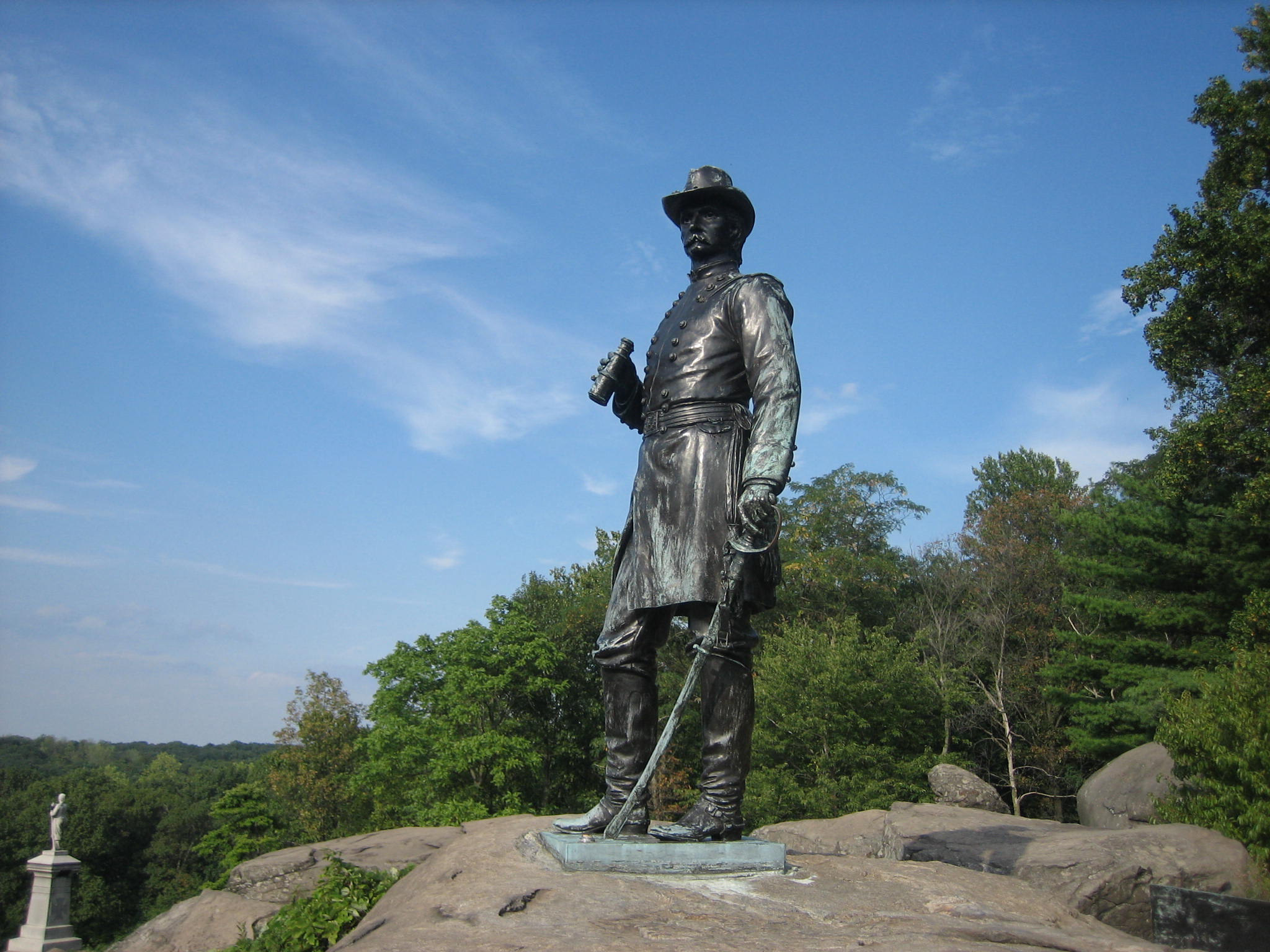
Statue of Maj Gen. Warren atop Little Round Top. The general was called the "Savior of the Union" by the northern press for recognizing the hazard if CSA troops had gained possession of the hill.
On the second day of the battle, Maj. Gen. Governeur Warren, chief engineer of the Army of the Potomac, went to the peak of LRT to observe the battlefield and was shocked to discover that the hill was unoccupied. Spotting CSA formations maneuvering to occupy it, Warren sent an urgent notice to Col. Vincent Strong of the 1st Division, V Corps, who promptly sent a brigade to the area. The 20th Maine infantry deployed to the summit of LRT, arriving only 15-20 minutes before the Confederate regiments, who promptly attacked. The Maine troops were commanded by one of the most remarkable military figures America has ever produced. Colonel Joshua Lawrence Chamberlain, the 20th Maine's commander, had no military experience or training before the war, spending his life in the bookish realm of Bowdoin College, where he taught classical studies.

Maj. Gen. Joshua Chamberlain
The battle of Little Round Top began his reputation but there was much more to come in the war for him. By war's end, he had been wounded six times.  He was the only man in the Union army promoted to a higher rank (brigadier general) while a battle literally raged around him, this by Gen. Ulysses Grant at Petersburg. President Lincoln later brevetted Chamberlain to major general. At Appomattox, Grant appointed Chamberlain to command the Union troops receiving the surrender of arms and colors from the various Confederate formations, probably the highest honor Grant could have conferred on any officer.

Chamberlain went on to serve as governor of Maine and president of Bowdoin College. He was belatedly awarded the Medal of Honor in 1893 for his command at LRT. Chamberlain died in 1914 at age 85 and is considered today to be the last Civil War soldier to have died of wounds, as he never really recovered from his grievous battle injuries, especially those of Petersburg.

On July 2, 1863, Col. Chamberlain took 386 soldiers to the top of LRT. Within about an hour, 29 were dead, 91 wounded, and 5 missing, losses of one-third of their strength. The two CSA regiments had been repulsed with heavy losses themselves. The 20th Maine held the hill through the next day, although by then the center of the battle had shifted to the center of the Union line, where three divisions of CSA infantry attacked and were repulsed with very heavy loss.

Since that day, the 20th Maine has been credited with, minimally, preventing the Union line from being turned by the Confederate troops which, it has been said for 150 years, would have meant the rout of the Union army at Gettysburg. None of the events of July 3 would have then transpired, meaning that the heavy losses the Army of Northern Virginia suffered on that day would not have occurred. The way instead would have been free for Gen. Robert E. Lee to advance the army toward Washington, D.C., with the battered Army of the Potomac offering only ineffectual resistance. Hence, the popular imagination holds that Chamberlain and the 20th Maine actually saved the Union itself from defeat.

Sorry, no.

In fact, a strong case can be made that the battle for Little Round Top, for all its incredible bravery and lethality, was nothing more than a local action with little actual effect upon the battle of Gettysburg as a whole, much less upon the fate of the entire Union.

When I was finishing my military career in the 1990s, I worked for Maj. Gen. Peter Berry, a Maine native and devoted Chamberlain fan. He even had a bust of Chamberlain in his office and owned some of Chamberlain's original papers. Maj. Gen. Berry was also a close friend of a brigadier general, whose last name was Nelson, who was the chief of military history for the whole Army. (He was a real historian, too, with a Ph.D. in the field from Princeton and published books and monographs.) So the two generals got all us staff officers on an Army green bus one day (we were stationed in Washington) and off we went to tour the Gettysburg battlefield, conducted at every point by the US Army's chief of military history, which would seem to me to be as about an authoritative docent as you could get.

Brig. Gen. Nelson explained early on that as a Nebraska native, he had no apologist position for either side. As we stood near the Warren statue at Little Round Top, Brig. Gen. Nelson explained the course of the action and then why it didn't matter much in the outcome of the battle.

The terrain at the time was  wooded. The summit of the hill was mostly cleared, but there was no road up the hill and the ground was still timbered in many places and generally very rough. Nelson pointed out that although LRT enfiladed the southern half of the Union line, small arms fire against the Union lines would have been wholly ineffective because of the engagement distances. Had the Confederates taken LRT, Nelson said, they would have had excellent observation of the disposition of Union formations, which would have been a real advantage. But the Union commander, Gen. George Meade, would have adjusted his tactics and lines accordingly and almost certainly would have sent troops to attack LRT.

A larger hill nearby, called Round Top (later, Big Round Top) was already in Union hands (though fighting for its possession continued until the next day). Artillery atop that hill could have effectively bombarded CSA troops on LRT, also. No, said Nelson, the only way LRT could have afforded the CSA a location from which to inflict actual damage upon Union forces was artillery fire upon the Union line. But that would have required the Confederates to clear perhaps hundreds of yards of wooded terrain, irregular and rough, all uphill, then drag the cannon and ammunition up. This would have been no easy task as an exercise, but in actual combat, under fire or attack, probably could not have been accomplished at all and would have taken well into July 3 to get done at in any event. And Lee could not have afforded to wait on it.

Bottom Line: the battle of LRT has remained in the public imagination as a decisive action of the whole war. But in fact, its outcome more likely than not did not affect even the outcome of the battle. Here is an interactive, chronological map of the Gettysburg battle. A clip from the movie, "Gettysburg," which shows the 20th Maine's final, desperate and successful attempt to stave off defeat.


And finally, speaking of things Civil War, there is the fabled "rebel yell." The largest Civil War veterans reunion ever held was at Gettysburg on the battle's 50th anniversary in 1913. More than 50,000 Civil War veterans of both armies attended, though not all had fought at Gettysburg, of course.

One story of the 1913 reunion I read said that when thousands of the Southern veterans lined up before Cemetery Ridge and together wailed out the rebel yell, a loud moan of despair arose from the Union veterans on the ridge. PTSD?

The elderly Confederate line advanced at a walk while the Union veterans crouched behind the stone wall of The Angle and other places along the old defensive line. No one else made a sound. When the two formations were only a dozen feet apart, suddenly all semblance of old military discipline was broken and the former enemies embraced and shook hands and slapped each others' backs.

There is a recording, purportedly of an elderly Confederate veteran giving the rebel yell. His name was Thomas Alexander of the 35th North Carolina Regiment, who made the recording in 1935 for a radio station at a regimental reunion. Here is the recording, followed by a contemporary digital special-effects manipulation of Alexander's yell to emulate that of a whole infantry company.


Update: The Battle of Gettysburg ended July 3, and is almost universally regarded as the pivotal engagement of the whole war, although no one knew it at the time. Here is the photo today of the home page of Bing.com.

[The] photo shows the statue erected to honor the 155th Pennsylvania Infantry, a volunteer regiment that joined up with the Army of the Potomac, which was led by Union General George Meade. July 3 marked the last day of vicious combat here, 155 years ago. The following day Confederate forces would begin their retreat to Virginia. With total casualties on both sides of roughly 50,000 lives, the Battle of Gettysburg remains the most costly conflict in US history in terms of lives lost.
Bookmark and Share

Tuesday, June 26, 2018

The least-known important battle in American history

Anyone recognize this site?


This is the location of what is almost certainly the least-known important battle in American history, the Battle of Bloody Marsh, 1742, Saint Simon's Island, Georgia. The victors were the British, the vanquished Spanish.

After this battle, the Spanish empire abandoned all of North America north of present-day Florida. Before the battle, Spain had claimed all land presently comprising Georgia, Alabama and Mississippi.

Georgia was the last of the 13 future-USA colonies to be settled, partly because Spain had claimed it in the 1500s. Britain wanted Georgia and called the territory south of South Carolina "debatable land." They (and the Spanish) knew that the debate would be carried out by gunfire, not rhetoric.

The main British figure was James Oglethorpe, a former member of Parliament who could have lived at ease in Britain. But he wangled a commission from King George II to establish British settlements in Georgia. He started with Savannah in 1733 and in 1736 established a coastal fort at Saint Simons Island that he named Fort Frederica, after the Prince of Wales (using the feminine form because there already was a Fort Frederick in South Carolina).


The ruins of Fort Frederica today with three cannon. The nearest two
are of the period, though not of this fort. The far cannon was emplaced
here when the fort was active.
A humanitarian reformer and abolitionist, Oglethorpe also established a town next to the fort that he wanted to be a refuge for England's destitute. The town eventually grew to several hundred people but never attained economic viability.

The town of Frederica. There were many houses here once. The ruins
of the military garrison building stand in the distance.
In 1740, war broke out between Spain and Britain. Oglethorpe took troops from Fort Frederica and embarked with a war fleet against St. Augustine. After 38 days of futile bombardment, Oglethorpe sailed back north. He and his regiment returned to Fort Frederica to await the inevitable Spanish retribution.

Campaigns moved slowly then. The Spanish moved against Saint Simons in 1742. They captured Fort Saint Simons quickly after Oglethorpe ordered it abandoned and burned. The Spanish then set up to cross the island, which was heavily overgrown and marshy in that day.

The leading Spanish element was a recon patrol, sent to find landward approaches to Fort Frederica. In this it failed, but Oglethorpe's Indian allies reported the patrol was within a half-mile of the fort. Oglethorpe, who had a bit of a temper and impulsiveness, rounded up some Highlander soldiers and set forth to ambush the Spanish. This he did, joined by numerous Chicksaw, Yamacraw and Creek warriors.

The skirmish lasted less than  an hour, but it cost the Spanish recon element 36 killed or captured, about a third of their number, including an officer second in command of all the Spanish troops. The rest fled toward Fort Saint Simons, where they encountered a relief force of Spanish troops coming to their rescue. This firefight became known as the Battle of Gully Hole Creek.

Meanwhile, Oglethorpe learned from interrogated prisoners that a larger Spanish force was planned to come down the single, narrow road connecting Fort Frederica with Fort Saint Simons. He marched to a position where he could ambush the Spanish as they crossed a causeway across a marsh. Once there, he decided he needed more troops and personally rode back to Fort Frederica to get them.

North is at the bottom of this map
While he was gone, the Spanish column crossed the causeway and the British-Indian force took them under rifle fire. The Spanish took cover on the side of the causeway and returned fire. For about an hour, the two forces simply volleyed at one another through dense rifle smoke. Some British soldiers even ran away, but the senior officer at the scene, a first lieutenant, controlled the incipient panic.

Finally, the Spanish commander decided to withdraw, which was just as well since many of his troops had already done so in a freelance manner. After two more weeks of each side jockeying for position and advantage, but no fighting, a British fleet arrived and the Spanish abandoned the island. As it turned out, Spain never pressed a claim for Georgia again.

On the British side the two battles were greatly exaggerated, while on the Spanish they were greatly minimized. The Spanish commander, Manuel Mantiano, claimed that he lost only seven killed at the marsh, while the British said they killed at least 200 and the marsh's waters ran red with Spanish blood (hence the name of the battle).

The next year, Oglethorpe (now a national hero) left for Britain, where he married an heiress. He stayed in Britain the rest of his life and never returned to Georgia. There was only a little more fighting in the Americas until the war ended with the Treaty of Aix-la-Chapelle in 1748. The treaty ceded Georgia to Britain; in 1763 Spain gave Florida to Britain as well in a territory exchange under the Treaty of Paris.

With the end of Spain's threat to Georgia, Fort Frederica had no purpose. Britain pulled the 42nd Regiment of Foot from the fort in 1749, though a tiny garrison remained there until at least 1774. The town adjacent faltered without the garrison and by 1755 was mostly empty. Most of the town burned in 1758 and all but a tiny number of the few residents left.

Today the fort and the town's remains are owned by the National Park Service and are open to the public. Their  combined layout is interesting in that both the fort and the town are surrounded by ramparts. 

A cannon actually emplaced at Fort Frederica in its active days.

Wide shot of the fort. The ramparts are merely short
ridges now and only one building remains above ground.

Looking down Broad Street of the town of Frederica. Very little
remains of the town today.

Tuesday, June 12, 2018

Council of Bishops and the One Church Model

There will be a special General Conference of the UMC in February of 2019. The General Conference is the only body of the UMC that can set rules and standards and doctrine for the whole church. Only the GC can amend the church canon law, the Book of Discipline. The GC is not a standing body, it exists only when convened. That happens every four years by rule. Special General Conferences are rare and time limited. February's Conference is scheduled (and funded) for only three days.

The topic for the special Conference is to set a way forward for the church in grappling with the issue of homosexuality. Presently, there are two restrictions on this issue:
  1. "Self avowed, practicing homosexuals" may not be ordained in the UMC,
     
  2. Same-sex weddings or unions may not be conducted on any United Methodist property, nor may UM ministers officiate such ceremonies anywhere. 
That's it. And those are the two issues that the GC will address. At the last ordinary GC in 2016, a Commission on A Way Forward was founded to study and draft proposals to go before 2019's called GC. The proposals, usually referred to a models, were to be presented first to the Council of Bishops, who were empowered in 2016 to choose one to recommend to the 2019 GC. (Or the Council could reject them all and make its own recommendation, but no one expected that to happen, and it has not.) 

The Commission came up with three models, each of which were presented to the Council earlier this year. They are:
  1. Traditionalist - which would make no changes to the Discipline and would therefore maintain the status quo.
     
  2. One Church Model - in which decisions about whether to ordain LGBTQ clergy or to officiate at same-gender unions would be made closer to the congregational level. The plan would remove the restrictive language against the practice of homosexuality in the Discipline. The plan also adds assurances to pastors and conferences who in good conscience cannot perform same-sex weddings or ordain “self-avowed practicing” gay clergy that they don’t have to do so. Central conferences — church regions in Africa, Asia and Europe — could maintain current restrictions.
     
  3. The Connectional-Conference plan, which would allow conferences to choose among three connectional conferences for affiliation. The connectional conferences would align based on theology or perspective on LGBTQ ministry — be it traditionalist, progressive or allowing for a variety of approaches. This plan would require multiple amendments to the denomination’s constitution.
Last month, the Council of Bishops voted to recommend the One Church model to the 2019 Conference. However, it also voted that the other two models should remain on the table for consideration. By the way, bishops have voice but no vote at General Conferences.

For more information, read this piece from the UM News Service and see this video.

Thursday, May 24, 2018

Colonel (ret.) George D. Stephens, USAR, and the World War 2 Memorial

Reposted from April 2008
Spring break was last week here in Clarksville, Tenn. So my wife, daughter and I hopped in the Camry and went to Washington, D.C. We went first to Durham, N.C., to pick up my father-in-law, Col. (ret.) George Stephens, USAR. George was drafted into the Army in the summer of 1941 for one year. When Pearl Harbor was attacked in December, all service terms were extended, basically, indefinitely. ("Stop loss" is no new concept.) Massive inductions of both draftees and volunteers began immediately after the Pearl Harbor attack.
 
George said that before his original year's service was up, he discovered he was already an "old soldier." We went to DC to take George to the National World War II Memorial, which opened in 2004 (IIRC) and which he had never seen. George, a widower, will turn 89 in June (update: he passed away in May 2018, less than a month before his 99th birthday). It was a quick trip - up to Ft. Belvoir, Va., on Wednesday to stay the night, then into DC all day Thursday and back to Durham that night.

The Memorial is located at the end of the reflecting pool, between the Lincoln Memorial and the Washington Monument. It is a large memorial, befitting a big war. This is a pic from the memorial's web site, taken from the Washington Monument.


The north end is dedicated to the Atlantic-area campaigns and the south end to the Pacific area. George served exclusively in the Pacific, continuously overseas for 39 months, taking part in eight combat amphibious assaults and the ensuing campaigns. Though a member of the Medical Service Corps, he personally saw heavy combat but was never wounded. I am reminded of Bill Mauldin's classic cartoon of front-line medical personnel:
Caption: "The reason ya don't git combat pay is 'cause ya don't fight."

George was not a medic, but served in aid stations close to the fighting lines and routinely went into the fighting to evacuate the wounded. He has spoken movingly to me of the men who died of their wounds on the way back to the aid station and of a few who were shot to death by the Japanese as George was carrying them to (relative) safety. There was one occasion (or only one that he told me of) when his position was strafed by Japanese Zero fighters. He said it so provoked his ire that he jumped up with his Garand rifle and shot a couple of clips back at them. Didn't hit them, of course, and later he said he wondered why he did something so foolish, since he had left the nominal safety of his foxhole to stand up to shoot his rifle.


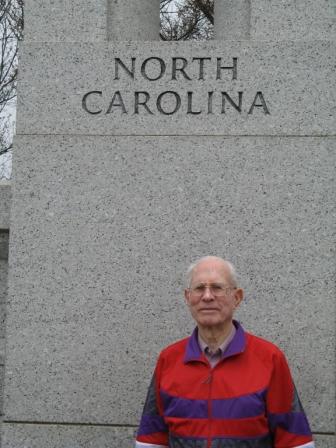
A passerby agreed to take this photo of the four of us standing under the Pacific campaign memorial tower. George was a staff sergeant when fighting in the Luzon campaign. During the campaign, he was commissioned a second lieutenant personally by Gen. Douglas MacArthur.

As you might imagine, there are a number of World War II vets and their family members at the memorial on any given day. The gentleman below left is from Seattle. I regret that I did not write down his name. He was a B-17 pilot in Europe. He told us he had two bombers shot out from under him, one by flak and the other by the German jet fighter, Messerschmitt 262, armed with 30mm cannon. He said that the Messerschmitt completely wrecked his B-17 in only five seconds of shooting. He was able to land the plane at a US air base in Belgium, but so severe was the damage that the ground crew simply bulldozed it off the runway and scavenged it for what undamaged parts they could get. He also landed the flak-hit bomber, but it was unrepairable, too. His son-in-law, who was with him last week, told me that after the war he became a nuclear physicist.

Here is a view looking from the World War II Memorial to the Lincoln Memorial. The waterfall in the foreground is part of the war memorial, it is not connected to the reflecting pool that lies beyond it.


My father-in-law was called to active duty for two years in the Korean War, serving the entire time at the base hospital at Fort Benning, Ga. Here he stands at the Korean War Memorial, a couple of hundred yards to the southeast of the Lincoln Memorial. The Korean War Memorial is neither as large nor as inspiring as the World War II Memorial. I will say, though, that it seems to be visited devotedly by Koreans who come to DC. There were many Koreans there when we were there. Having served in Korea, I recognized the language even though I cannot speak it.


We stopped to see the cherry blossoms along the tidal basin. I snapped this picture of George standing across from the Jefferson Memorial. I am proud, and awed, too, to say that he is one of the Americans who saved the world from fascism and tyranny when everything dear to civilization was threatened with destruction. It was by his efforts and those of his comrades (never to forget those who gave their lives!) that Jefferson's ideals survived. He helped preserve what he there surveyed.


Below is a video I took of George narrating his service record in the Pacific, walking along the campaign pool under the Pacific tower. Of the 20 campaign locations engraved into the stones, George fought or served at 10 of them. The ambient noise at the memorial is very high from all the waterworks, so you'll have to listen closely to hear George's voice.

A world without nuclear weapons - what would it look like?

 From Pope Leo this week, according to the National Catholic Reporter : " Pope Leo quotes Bob Dylan song in book foreword calling for n...