Thursday, May 24, 2018

Colonel (ret.) George D. Stephens, USAR, and the World War 2 Memorial

Reposted from April 2008
Spring break was last week here in Clarksville, Tenn. So my wife, daughter and I hopped in the Camry and went to Washington, D.C. We went first to Durham, N.C., to pick up my father-in-law, Col. (ret.) George Stephens, USAR. George was drafted into the Army in the summer of 1941 for one year. When Pearl Harbor was attacked in December, all service terms were extended, basically, indefinitely. ("Stop loss" is no new concept.) Massive inductions of both draftees and volunteers began immediately after the Pearl Harbor attack.
 
George said that before his original year's service was up, he discovered he was already an "old soldier." We went to DC to take George to the National World War II Memorial, which opened in 2004 (IIRC) and which he had never seen. George, a widower, will turn 89 in June (update: he passed away in May 2018, less than a month before his 99th birthday). It was a quick trip - up to Ft. Belvoir, Va., on Wednesday to stay the night, then into DC all day Thursday and back to Durham that night.

The Memorial is located at the end of the reflecting pool, between the Lincoln Memorial and the Washington Monument. It is a large memorial, befitting a big war. This is a pic from the memorial's web site, taken from the Washington Monument.


The north end is dedicated to the Atlantic-area campaigns and the south end to the Pacific area. George served exclusively in the Pacific, continuously overseas for 39 months, taking part in eight combat amphibious assaults and the ensuing campaigns. Though a member of the Medical Service Corps, he personally saw heavy combat but was never wounded. I am reminded of Bill Mauldin's classic cartoon of front-line medical personnel:
Caption: "The reason ya don't git combat pay is 'cause ya don't fight."

George was not a medic, but served in aid stations close to the fighting lines and routinely went into the fighting to evacuate the wounded. He has spoken movingly to me of the men who died of their wounds on the way back to the aid station and of a few who were shot to death by the Japanese as George was carrying them to (relative) safety. There was one occasion (or only one that he told me of) when his position was strafed by Japanese Zero fighters. He said it so provoked his ire that he jumped up with his Garand rifle and shot a couple of clips back at them. Didn't hit them, of course, and later he said he wondered why he did something so foolish, since he had left the nominal safety of his foxhole to stand up to shoot his rifle.


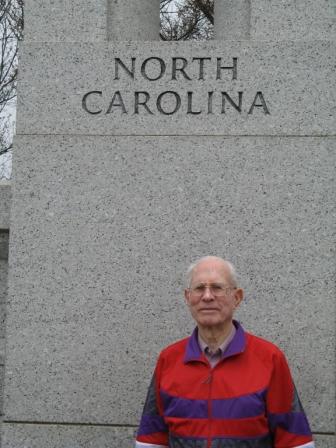
A passerby agreed to take this photo of the four of us standing under the Pacific campaign memorial tower. George was a staff sergeant when fighting in the Luzon campaign. During the campaign, he was commissioned a second lieutenant personally by Gen. Douglas MacArthur.

As you might imagine, there are a number of World War II vets and their family members at the memorial on any given day. The gentleman below left is from Seattle. I regret that I did not write down his name. He was a B-17 pilot in Europe. He told us he had two bombers shot out from under him, one by flak and the other by the German jet fighter, Messerschmitt 262, armed with 30mm cannon. He said that the Messerschmitt completely wrecked his B-17 in only five seconds of shooting. He was able to land the plane at a US air base in Belgium, but so severe was the damage that the ground crew simply bulldozed it off the runway and scavenged it for what undamaged parts they could get. He also landed the flak-hit bomber, but it was unrepairable, too. His son-in-law, who was with him last week, told me that after the war he became a nuclear physicist.

Here is a view looking from the World War II Memorial to the Lincoln Memorial. The waterfall in the foreground is part of the war memorial, it is not connected to the reflecting pool that lies beyond it.


My father-in-law was called to active duty for two years in the Korean War, serving the entire time at the base hospital at Fort Benning, Ga. Here he stands at the Korean War Memorial, a couple of hundred yards to the southeast of the Lincoln Memorial. The Korean War Memorial is neither as large nor as inspiring as the World War II Memorial. I will say, though, that it seems to be visited devotedly by Koreans who come to DC. There were many Koreans there when we were there. Having served in Korea, I recognized the language even though I cannot speak it.


We stopped to see the cherry blossoms along the tidal basin. I snapped this picture of George standing across from the Jefferson Memorial. I am proud, and awed, too, to say that he is one of the Americans who saved the world from fascism and tyranny when everything dear to civilization was threatened with destruction. It was by his efforts and those of his comrades (never to forget those who gave their lives!) that Jefferson's ideals survived. He helped preserve what he there surveyed.


Below is a video I took of George narrating his service record in the Pacific, walking along the campaign pool under the Pacific tower. Of the 20 campaign locations engraved into the stones, George fought or served at 10 of them. The ambient noise at the memorial is very high from all the waterworks, so you'll have to listen closely to hear George's voice.

Saturday, May 19, 2018

School shootings: We keep moving the margins

In the wake of this week's mass murders at a Texas high school by (allegedly) a 17-year-old student, it is chilling to think that what used to be outside the margins regarding guns and schools is now becoming normalized: "The Best Explanation for Our Spate of Mass Shootings Is the Least Comforting."
Writing in 2015, Malcolm Gladwell wrote what I think is still the best explanation for modern American mass shootings, and it’s easily the least comforting. At the risk of oversimplifying a complex argument, essentially he argues that each mass shooting lowers the threshold for the next. He argues, we are in the midst of a slow-motion “riot” of mass shootings, with the Columbine shooting in many ways the key triggering event. Relying on the work of Stanford sociologist Mark Granovetter, Gladwell notes that it’s a mistake to look at each incident independently:
But Granovetter thought it was a mistake to focus on the decision-making processes of each rioter in isolation. In his view, a riot was not a collection of individuals, each of whom arrived independently at the decision to break windows. A riot was a social process, in which people did things in reaction to and in combination with those around them. Social processes are driven by our thresholds—which he defined as the number of people who need to be doing some activity before we agree to join them. In the elegant theoretical model Granovetter proposed, riots were started by people with a threshold of zero—instigators willing to throw a rock through a window at the slightest provocation. Then comes the person who will throw a rock if someone else goes first. He has a threshold of one. Next in is the person with the threshold of two. His qualms are overcome when he sees the instigator and the instigator’s accomplice. Next to him is someone with a threshold of three, who would never break windows and loot stores unless there were three people right in front of him who were already doing that—and so on up to the hundredth person, a righteous upstanding citizen who nonetheless could set his beliefs aside and grab a camera from the broken window of the electronics store if everyonearound him was grabbing cameras from the electronics store.
Actually, this "infectious" behavior is well known and described by people who study and teach leadership. Take, for example, this video that was used in the TED talk below about the very processes Granovetter described.


Here are two real problems: First is what Granovetter describes and the TED talk confirms: once there are enough early adopters of a behavior, then mass adoption easily follows. Hence, Gladwell's describes school shootings as a "slow motion riot." But portents are that it won't stay slow.

Second is what is revealed by retired Army officer and psychologist Dave Grossman, who documents in Assassination Generation: Video Games, Aggression, and the Psychology of Killing and other works that more and more boys are growing up learning to kill vicariously through both popular media and electronic gaming - and that for increasing numbers the vicarious violence will give way to actual.

In one of his early works, On Killing, Grossman documented the great difficulty the US Army had in World War II in training its soldiers, especially infantrymen, actually to take the enemy's life. The leadership found that American men came into the military with deeply-inbred reluctance to harm other human beings, and that only a small minority of infantry even fired their rifles once in a firefight.

Grossman's thesis in what is happening to America today is that we have, as a whole society, moved the "margins" of what constitutes prohibited violence. Prior generations had mass murderers, of course, but even the most depraved killers in the not-too-distant past would never have even thought of shooting schoolchildren at their desks. Now it is, as Gladwell notes, becoming increasingly within the margins of conduct that society has moved.

In the coming days the editorialists and TV commentators will have a lot more to say. I do not expect their offerings to be much different from what they said after the Parkland, or Aurora, or Sandy Hook massacres or ... well, pick one. The media’s talking heads will recycle the same things they said before. We’ll hear a lot about America’s gun culture, and all the talk will be about guns and not about the culture.

Does America have a "gun culture?" You bet it does, and it this is it:

This movie was to open in Newtown, Conn., on Dec. 14, 2012, the
day of the killing rampage in Sandy Hook Elementary School.
Warner Bros. pulled the opening

The Hollywood gun culture:
Business Insider reprints part of an AskMen piece on
"
The 99 Most Desirable Women Of The Year."
Here is no. 99, 
Bérénice Marlohe, who plays Severine in Skyfall.
Glorifying violence, especially gun violence, is the present purpose of America's entertainment industry. This is what untold numbers of our children are doing in their homes:


The margins continue to be moved, whether we want it or not. Because there is too much money being made by murder-as-entertainment to give it up, and we the people are willingly paying for it.

Update: One of the ways that the Columbine shooting remains key is in how subsequent school chooters have imitated it to some degree. Not every shooter, but enough to see that Columbine still forms a template. For example,
Some aspects of Friday's [Texas] shooting had echoes of the massacre at Columbine High School in 1999. The two teenaged killers in that incident wore trench coats, used shotguns and planted improvised explosives, killing 10 before committing suicide themselves.
As did the accused killer in Texas, except for the suicide. Reports say, though, that he told police he intended to commit suicide but found he could not go through with it.

Sunday, May 13, 2018

"Just Say No– To Local Church Options for the UMC"

One of the most respected theologians of the United Methodist Church explains why the "Local Option" resolution of the present impasses over same-sex marriage and ordination of homosexuals is very badly misguided.
First of all, because they are profoundly un-Methodist. Methodists do not decide major issue of doctrine or polity at the local church level, nor even at the annual conference level. They are quite rightly decided at the General Conference level, which is the only body which can speak for the whole church on such matters. This is why we have A United Methodist book of Discipline, which includes the doctrines and sanctioned practices in it. This has been the Methodist way for basically our entire existence. Ours is not a Baptist or Congregational church polity, nor should it become one. If it did that we would lose the genius that is Methodist connectionalism. So NO!— the local church should not suddenly become the arbiters of truth as to what counts as holy matrimony, what counts as being morally fit for ordination, what counts as appropriate Christian sexual behavior. No, no,no. Whatever solutions we may come up with to deal with our difficulties this is a ploy of desperation that denudes us of our Methodism that should be soundly rejected.

Secondly, for the entire existence of the Christian church, including the Methodist church, Christian marriage has been rightly and Biblical defined as when God joins together one man and one woman– period! This is exactly what Jesus himself directly says in Mark 10 and Mt. 19, and the only second option he gives in Mt. 19 is to be celibate for the sake of the kingdom. He even uses the dramatic term being a eunuch for the Kingdom. To change our view of what counts as Christian marriage is to disfellowship ourselves from the larger body of Christ— the Catholics, the Orthodox, most Baptists and Congregationalists, and so on. We should not go there if we care at all about ecumenism. Modern cultural trends that have affected and infected some of the Protestant mainline denominations here, and in a few places abroad, should not be allowed to overturn 2,000 years of what the church has said about proper Christian marriage.
There's more. Read the whole thing.


Thursday, May 10, 2018

The perplexed, confused mind of the atheist skeptic

I do not know anything about the atheist radio talk show in the clip at bottom that non-Christian historian Bart Ehrman appeared on. As Ehrman says in the interview, "I am not a believer" in the divine nature of Christ. And that is probably why, as he says in the tape, atheist groups and the like keep calling on him to help them rebut Christianity. Below is his response to such a call asking him to affirm that in fact no such person as Jesus of Nazareth ever existed.
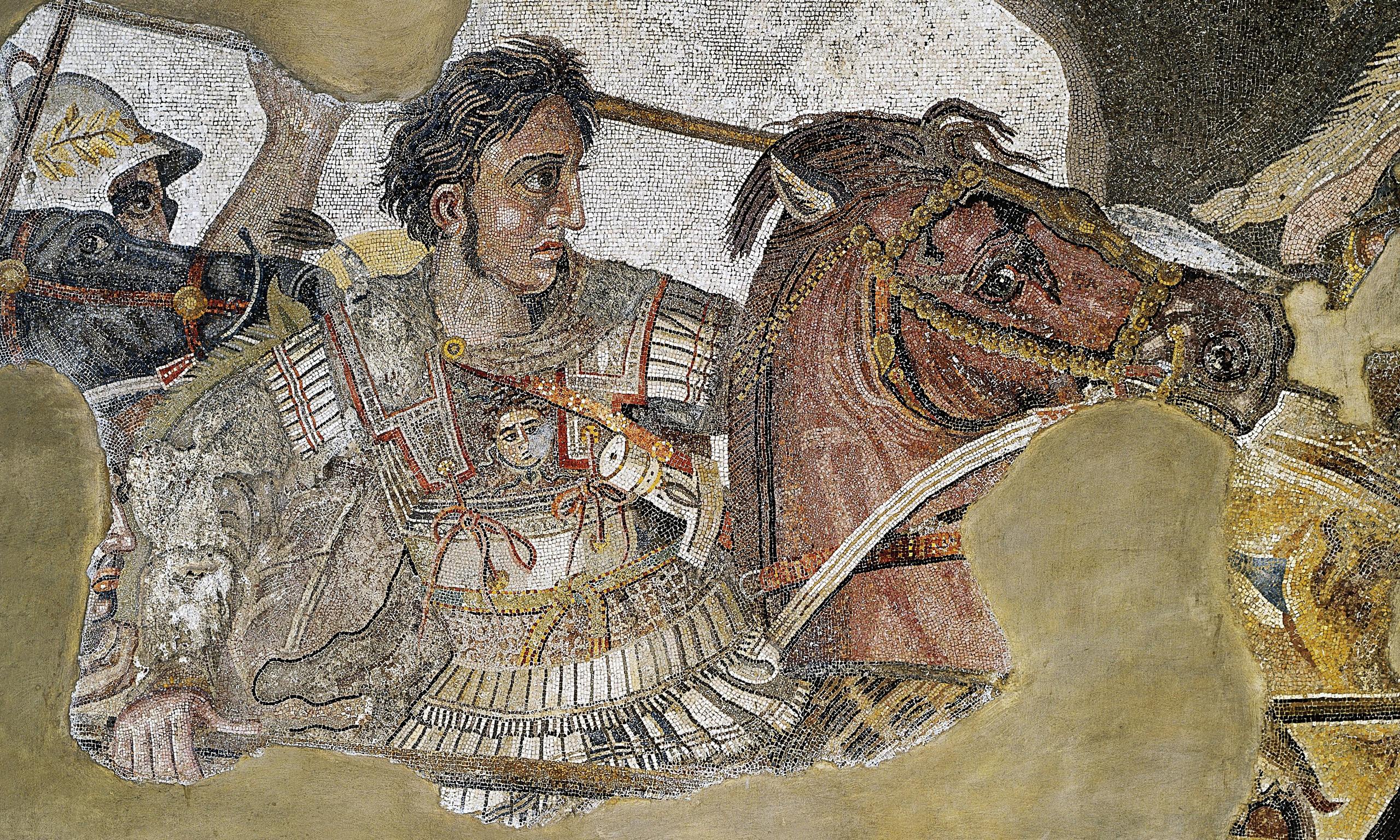
Alexander the Great.
His historical existence is much less well attested than that of Jesus of Nazareth.
However, as Ehrman points out, the historical existence of Jesus is better attested than almost anyone else from his era, better attested, in fact, than Julius Caesar. And, although not included in this segment, it is probably worth noting that the earliest reference to Alexander the Great, who died in 323 BC, dates from 300 years afterward,  and the record that is considered most reliable dates 200 years later than that.

That's as if we know the American Revolution occurred in the 1770s, but no record of George Washington will be made until the year 2081, 67 years from now.

And no one doubts that Alexander lived. However, the earliest writings about Jesus of Nazareth, the letters of the apostles, date beginning less than 20 years after Jesus died during the governorship of Pontius Pilate.

So why do these people keep insisting that Jesus never lived, that his character is wholly fictional? Because if you stick to that claim, they think that everything else about Christian faith can be easily dismissed. But that is not so, either. About which more later.

Here is the radio interview with Bart Ehrman, an American New Testament scholar focusing on textual criticism of the New Testament, the historical Jesus, and the development of early Christianity. He has written and edited 30 books, including three college textbooks. He has also authored six New York Times bestsellers. He is currently the James A. Gray Distinguished Professor of Religious Studies at the University of North Carolina at Chapel Hill. He does not claim Christian faith.


Here is Prof. Ehrman explaining elsewhere that atheists' claim that Jesus is a fictional figure make them, in Ehrman's words, "look foolish."


A companion video is of Prof. William Lane Craig, an American analytic philosopher and Christian apologist. He holds faculty positions at Talbot School of Theology (Biola University), and Houston Baptist University. He has debated the existence of God with public figures such as Sam Harris, Christopher Hitchens, and Lawrence M. Krauss. Craig established and runs the online apologetics ministry ReasonableFaith.org.

Here Dr. Craig discusses the relevance of non-biblical sources about Jesus. 


Bookmark and Share

Saturday, April 28, 2018

Firebase Four-Papa-One, Korean DMZ, 1978

I explained the Korean DMZ and the Joint Security Area in a different (and later) post, "When I visited North Korea."

Just outside the DMZ during my tour in Korea (77-78) was an artillery firebase called 4P1, pronounced Four-Papa-One. Because the DMZ runs north-south in that part of the country, 4P1 was actually east of the DMZ.

I spent my Korea tour as a lieutenant assigned C Battery, 1st Battalion, 38th Field Artillery, whose motto was "Steel Behind the Rock." "Steel" referred to artillery fire, "the Rock" was the 38th Infantry Regiment, which earned the nickname Rock of the Marne for its heroic defense near the Marne River in France in 1918. My battery's standing mission in Korea was to provide artillery fire for the 1st Battalion, 38th Infantry. We were all part of the 2d US Infantry Division, which is still stationed in South Korea.

In 1978, 4P1 was the only combat firebase in the Army. The division's artillery units took turns rotating through duty at 4P1. My battalion's turn came up in the summer of 1978. There were five batteries in the battalion, three of which were firing batteries with howitzers. Each of those three spent 35 days there. We went up with our six 105mm howitzers in late May, commanded by Capt. Bill Brophy, an outstanding officer. (Bill retired in 1999 as a colonel and is now a vice president of Usibelli Coal Mines, Inc., in Alaska.)

I was the battery fire direction officer (FDO), in charge of the fire direction center, FDC. (Yes, I know, you didn't sign up for an acronym lesson, but that's what the military uses.) We also had three lieutenants as forward observers (you guessed it, "FOs"). Our FOs went to duty inside the DMZ.

There were two guard posts inside the DMZ. One was called GP Ouelette, so close to the boundary line with North Korea you could have spit on communist soil. The other GP was maybe 400 meters further away; I don't recall its name. Under the terms of the armistice, only military police are allowed inside the DMZ. So we had two infantry military police detachments inside the DMZ, one detachment at each of two guard posts. Each was at least of platoon strength and very heavily armed. Every time I went to Ouelette I became a military policeman, too, complete with arm brassard, rifle locked and loaded the whole time.

M102A1 105mm howitzer
Our guns fired projectiles weighing 35 pounds with a maximum range of 11 kilometers. A 105mm high-explosive projectile had a casualty radius of 30 meters. Our six guns could fire a total of 180 rounds the first three minutes of a fire mission, then for weapon-safety reasons, had to drop to three rounds per gun per minute for sustained firing. The guns were arranged in the open in a pattern we called a "lazy W,"with 25 meters spacing between guns laterally, and alternating front to rear about 15 meters.

My FDC was inside an underground bunker at one end of the gun line, about 30 meters up a rise. The FDC served as the operations center for the battery, with our bunks at the far end. We had radios to talk to the division command post-forward, which had a secure line to the main division command post in the south. We also had radio to the infantry operations center at Camp Liberty Bell, just outside the DMZ, where an infantry battalion was stationed at high alert. We had a radio to each guard post to talk to our observers and we had field phones to Capt. Brophy's ready room, each of the guns and the executive officer's battle station. We were up and running 24/7. Our main job was calculating ballistic firing solutions for the guns.

There were 125 prearranged targets inside North Korea and the DMZ for which we had to recalculate firing data four times per day. Weather has great effect on artillery ballistics, and four times per day a "metro" section, not part of our unit, flew weather balloons that collected weather data and radioed it back to the ground. These data were converted into a very lengthy numeric voice message which was radioed to us. Receiving metro messages was very exacting and time consuming. Fortunately, 4P1's bunker had an electronic artillery computer called the Field Artillery Digital Automatic Computer (FADAC, of course, pronounced fay-dack), but only my FDC sergeant, Sgt. Gosinski, and I had been trained on it. Without it we could not possibly have manually recalculated data for 125 targets four times per day. Sometimes, we got the weather data on punch-hole tape, which FADAC could read.

The permissible response time for fire missions was very short. The guns were laid on a target inside the DMZ, which we could have shot within seconds of receiving the radio call for fire. To keep us on our toes, the division had a practice mission called, "speedball do not load." At any time of day or night, no matter the weather, a division-staff officer could direct an FO to radio a call for fire to us - but obviously not to be shot. The stopwatch was ticking, and excuses were not accepted!

A breath away from war

To distinguish these missions from real missions, the call for fire was slightly changed. The FO would call us and say, "adjust fire, speedball do not load, over." That way we knew it was a practice mission. As I recall, though, we only had three minutes to report ready to fire, except that we did not actually load a round into the howitzer.

We'd flip a light switch by the radio that started a siren above the bunker. Across the fire base, every cannon crewman and battery NCOs sprinted to their guns if they weren't already there. Meantime, the FO completed the target information, we computed the firing data and read it on the field phone to the guns.

After just a few days we in the FDC could tell right away when the FO had a SDNL mission because of the stress in his voice.

So one afternoon the radio comes to life and I could tell it was a SDNL mission. But instead of saying, "Adjust fire, speedball do not load, over," he said, "Fire for effect, at my command, over." That was a real call for fire. I hit the siren.

There had been a breach of the MDL by a platoon of 40-50 North Korean troops. They had crossed to our side of the DMZ. On the division radio network I heard the infantry military police on patrol inside the DMZ being ordered to set up an ambush and kill them. Capt. Brophy was off site in his jeep. I called him on the radio and gave him a code phrase to return immediately.

We quickly computed firing data. I directed the mission be fired with three rounds per gun (18 total) of high-explosive rounds, using impact-detonating fuzes instead of air burst fuzes. Sgt. Gosinski sent the firing data to the guns. Some gun chiefs were a little confused about whether this mission was practice or real - the ones who were Vietnam vets weren't confused! I briefed the XO by field phone and he got the gun chiefs straightened out. Each crew loaded a high-explosive round and placed two more, ready to fire, in the ready rack. Things were very tense. The battery commander came in and I briefed him, then he went to the gun line.

I don't know how long we stayed ready to fire, probably 20 minutes. Then the FO called. My FDC soldiers were wide eyed when they heard him. I probably was, too! We knew that 4P1 could get hit by more than 600 North Korean artillery rounds within 10 minutes. We would have been atomized in such a barrage.

"End of mission," said the FO.

The enemy had crossed back over the line before they reached the ambush. So they lived to see another day, and so did we.

Bookmark and Share

Sunday, March 25, 2018

Shot bombers and school shootings

In trying to decide what to do about school shootings, especially mass shootings, are we making a fundamental error by considering only the schools that suffered them and the men who committed them? Or should we base our decisions mainly by examining schools that have not suffered them?


In  my prior post on why we are probably alone in the universe ("
Where is everybody? They're dead"), I included what the analysis of combat-damage assessment of World War II bombers had to do with the existence of life on other worlds. What might it have to do with school shootings? Let's see.

The Atlantic wrote of World War 2 bomber crews who did pattern analysis of bullet holes from enemy fighters attacks. They thought if there was a pattern, then they could lessen the number of bombers shot down by increasing the armor in the hit sections of the bomber.
But the Hungarian-born mathematician Abraham Wald, and his colleagues at the Statistical Research Group at Columbia University, had a novel, if counterintuitive, prescription. Don’t protect the planes where they were taking the most damage, Wald said. Armor the planes where there were no bullet holes at all.

“You put armor where there are no holes, because the planes that got shot there didn’t return to the home base,” says Anders Sandberg, a senior research fellow at University of Oxford’s Future of Humanity Institute. “They crashed.”

The holes didn’t show where returning planes were likely to get hit, but only what it was possible for later observers to see. This is known as an observer selection effect, and the same sort of bias might apply not only to perforated planes, but to whole worlds as well.
Observer selection effect (OSE henceforth) means that we are able to observe something only because we survived the causes. It is not the same as observer bias, in which our interpretations of what we observe is shaped by preconceptions. No, OSE means that we can observe at all because we are observing only non-negative outcomes.

I asked my chemical-engineer daughter about the shot bomber problem and she immediately said that the bombers that did not return were of greater assessment value than the ones who did. She explained that OSE is a well-understood hazard in science and engineering and was a topic of discussion in her statistics and probability courses.

And so to schools: Are we looking in the wrong places for indicators of what to do? Maybe the characteristics of schools and their students who have not been subjected to the violence could be more informative than the ones who have.

Or maybe there are simply too few school massacres (fortunately) to do an OSE analysis. I do not know, I am neither an engineer nor mathematician. But if so, I wonder whether that might mean we are doomed to know too little to do anything effective until, God forbid, there have been a large number more such horrors. 

Thursday, March 22, 2018

Where is everybody? They're dead.

Fermi's Paradox was first posed by physicist Enrico Fermi in 1950. It goes like this: The universe is many billions of years old. Fermi calculated that an alien species smart enough to become spacefarers could reach any point in our galaxy in five million years. But we we have no scientific evidence that aliens beings have been here.


So, Fermi asked, where is everybody?


Many answers have been proposed by serious, highly-credentialed scientists - more than 50 different answers, as I recall. Now, Astronomy.com offers this: The aliens are silent because they are extinct:


Latest theory: This will never hear anything.
Life on other planets would likely be brief and become extinct very quickly, said astrobiologists from the Australian National University (ANU).

In research aiming to understand how life might develop, scientists realized new life would commonly die out due to runaway heating or cooling on their fledgling planets.

“The universe is probably filled with habitable planets, so many scientists think it should be teeming with aliens,” said Aditya Chopra from ANU.

“Early life is fragile, so we believe it rarely evolves quickly enough to survive.”

“Most early planetary environments are unstable. To produce a habitable planet, life forms need to regulate greenhouse gases such as water and carbon dioxide to keep surface temperatures stable.”

About four billion years ago, Earth, Venus, and Mars may have all been habitable. However, a billion years or so after formation, Venus turned into a hothouse and Mars froze into an icebox.

Early microbial life on Venus and Mars, if there was any, failed to stabilize the rapidly changing environment, said Charley Lineweaver from ANU.

“Life on Earth probably played a leading role in stabilizing the planet’s climate,” he said.
Then there is recent study, published in the prestigious journal Science, that life is simply impossible in probably 90 percent of galaxies in the universe because of intense gamma radiation. And ordinary solar and cosmic radiation would have stopped life here on Earth without the Earth's magnetic fields shielding the planet, but planetary magnetic fields apparently are very uncommon; they have not been detected on any other planet anywhere.

But wait! There's more! 
The Atlantic writes of World War 2 bomber crews who did pattern analysis of bullet holes from enemy fighters attacks. They thought if there was a pattern, then they could lessen the number of bombers shot down by increasing the armor in the hit sections of the bomber.


But it turns out that armoring holed sections of returned bombers was the wrong thing to do. 
Don’t protect the planes where they were taking the most damage, [mathematician Abraham] Wald said. Armor the planes where there were no bullet holes at all.

“You put armor where there are no holes, because the planes that got shot there didn’t return to the home base,” says Anders Sandberg, a senior research fellow at University of Oxford’s Future of Humanity Institute. “They crashed.”
The article goes on to explain "observer selection effect," where we are able to observe something only because we survived the causes. We look at our own world and see life in enormous variety, flourishing everywhere, even in rocks and immense pressures of the deep sea and hot springs of near-boiling temperatures.

So we readily conclude, "Life is everywhere on our planet, so it must be everywhere out there." This powers the SETI programs, in fact, and is so pervasive it even has a name: the Principle of Mediocrity, which means simply that earth and its biosphere are unexceptional. The earth and its life are merely average in the universe - average, which is what "mediocre" means. But it is just as likely - probably more so - that our conclusions spring the the observer selection effect: we conclude that what we see here is normal everywhere.

We see 100-mile-wide "bullet" holes on our planet, and hey, we're still here. All is well and this is cosmically normal. But there's a problem.

After all, there are 100-mile impact craters on our planet’s surface from the past billion years, but no 600-mile craters. But of course, there couldn’t be scars this big. On worlds where such craters exist, there is no one around afterward to ponder them. In a strange way, truly gigantic craters don’t appear on the planet’s surface because we’re here to look for them. Just as the wounds of the returning planes could reflect only the merely survivable, so too for our entire planet’s history. It could be that we’ve been shielded from these existential threats by our very existence. ...
 “Maybe the universe is super dangerous and Earth-like planets are destroyed at a very high rate,” Sandberg says. “But if the universe is big enough, then when observers do show up on some very, very rare planets, they’ll look at the record of meteor impacts and disasters and say, ‘The universe looks pretty safe!’ But the problem is, of course, that their existence depends on them being very, very lucky. They’re actually living in an unsafe universe and next Tuesday they might get a very nasty surprise.”

If this is true, it might explain why our radio telescopes have reported only a stark silence from our cosmic neighborhood. 
"Stark silence." Where is everybody? They're dead.
Perhaps we’re truly extreme oddballs, held aloft by a near-impossible history—one free from deadly migrating gas giants and solar-system chaos, but also filled with freakishly favorable accidents, like a cataclysmic impact early in our history that created a strange, gigantic moon that stabilized our orbit and allowed complex life to flourish. As the solar system continued to shake out, we somehow ended up with just the right amount of water to lubricate plate tectonics, keeping the climate habitable over hundreds of millions of years and preventing a Venus-style planetary resurfacing catastrophe, but not so much water that we wound up on a lifeless water world.
So far, empirical evidence supports the conclusion that we are alone. Or at least, "We’re effectively alone in the Universe... ."

Update, April 2023: It may well be that they are dead because they developed Artificial Intelligence that was much smarter than they were  - as we here on earth are close to doing now. And their AI simply killed them - not from hatred or anger or ill will, but because it simply considered the alien beings to be "made of atoms it can use for something else." But we may soon join their ranks, according to Eliezer  Yudkowsky, who leads research at the Machine Intelligence Research Institute and is widely regarded as a founder of the field of AI:
If somebody builds a too-powerful AI, under present conditions, I expect that every single member of the human species and all biological life on Earth dies shortly thereafter.
Read the whole thing, and this, too.

UpdateThe thought occurs to me that any alien spacefaring species would have had to evolve from cave-man equivalence to sophisticated technical skills. But technological evolution depends wholly not merely on a species' intelligence. It also depends on progressively powerful energy generation and usage.

We humans went from:
  • manpower to horsepower to
  • water and wind power (small dams and windmills) to
  • steam power to
  • coal power to
  • petroleum power to
  • nuclear power.
But our planet had those resources available. What if there is a super-intelligent species on Distant Planet that lacks merely one of those stepping stone energy sources? Such as no sub-species equivalent to horses, or no petroleum equivalent available.

No stepping stone energies, no space travel, no matter how smart they are.

Friday, March 16, 2018

Secret Service on preventing school shootings

This 2012, two-minute video is an interview with two Secret Service researchers about school shootings. Main takeway: In almost every case of someone shooting up a school, the shooter wrote or said in advance that he was going to do it.


And so did Nikolas Cruz, quite a long time before the Parkland, Fla., massacre. But the question is begged, if one of the most important ways to stop these shootings is to report to the authorities, then are not the authorities obligated to take steps?

When it came to the Parkland horror, apparently not. The literally years-long prequels to the massacre were filled with warnings that were, in some cases, deliberately ignored.

There were multiple warning extending back to early 2016 that Cruz was a threat to human life and safety

The Miami Herald:
The rage and obsession with violence documented by Cruz’s therapists during nearly two years of interactions when he was 15 to 17 years old continued through his school career: Again and again, authorities were warned about the teen’s explosive tendencies and lack of impulse control. Again and again, authorities ignored the warnings.

In addition to the troubling behavior Cruz exhibited at the schools he attended — including an incident in which the teen reportedly brought a backpack with bullets to class — law enforcement officers were also alerted that Cruz might be dangerous.

The FBI failed to act on two tips about Cruz, one of which involved Cruz posting online that he planned to become a “professional school shooter.” The Broward Sheriff’s Office was also warned about the teen, and had received a report that he “planned to shoot up the school.”
The FBI failed and has admitted to it. They failed so severely that Fla. Gov Scott called for the director's resignation.

The Broward County sheriff's department failed many times, especially after being specifically warned that Cruz would become violent very soon.

The school system could have had Cruz arrested, but did not because he was named Cruz.

The Broward County school board knew of Parkland shooter's obsession with guns and violence, documents show.

Stoneman HS administrators  themselves failed to take action in advance of the shooting..

Deputies visited Cruz's home on police business 45 or more times in the preceding few years.

911 audio of Deputy Peterson's radio transmissions provably show that he lied when he said post-event that he thought the shots were coming from outside the school.

Three other deputies arrived and took cover behind the cars and did nothing.

EMTs have said on the record that deputies prevented them from entering the school to begin treating and evacuating wounded. (Link is to local reporter's Twitter feed.) Also here.

So Cruz killed 17 people and wounded 12.

Reporting threats to the authorities only works when the authorities do something about the report. For the Parkland shooting, the authorities failed at literally every level. One has to ask: if they were going to design a system to fail on purpose, what would they have done differently from what they did do?

Monday, March 12, 2018

Sports: how to pay full costs of college


Would love to see a chart like this with the percentages of HS athletes who participate in NCAA athletics on a scholarship. Then let parents see it who are spending a fortune on putting their kids on every league sport they can under the delusion that it will pay their way through college.

I swear I could write a book about it. Our son did receive a scholarship for track and field when he started at Wake Forest in 2006. He was a thrower (discus, shot put, hammer, etc.). It was not until after he was awarded the scholarship that my wife and I learned how incredibly difficult they are to get. In fact, it was not offered at all until (a) he had been accepted to WFU on academic merit, and (b) he finished his senior HS year ranked second in the state in both shot put and discus.

And the first year his amount was 17 percent of Wake's $46,500 cost. He did not receive 100 percent until his senior year, and that was after he had been ranked as one of the top 15 javelin throwers in the NCAA. (Soph and junior years were much higher, but still less than100 percent.)

A coach told me that colleges do not award athletic scholarships for experience, that is, just because a kid showed up for practices and games for 10-12 years before college. If a boy or girl has played that long and is not ranked, then from a college coach's perspective, it means one or all of the following: S/he is not motivated, so no money for them. S/he is not talented, so no money for them. S/he has had bad coaching that the college coach now has to overcome, so no money for them.

Most parents do not know that the NCAA allocates scholarships to schools per sport. So there is a ceiling on how many full scholarships each head coach can award (which explains why they fractionalize them). As the coach told us, the way to get more money is to perform at a high level. It is literally pay for play.

However, academic awards have no such ceiling. Colleges can award as much money for academics as they can raise and get endowed. From parents' perspective, this can be very, very lucrative. I know a certain young lady whose academic awards and scholarships came to 125 percent of her annual costs. Yes, the extra 25 percent was hers to keep. She literally made a profit going to college.

Truly gifted child athletes can have a future in scholarship athletics, but they are a tiny number. For the other kids, athletics should be just for fun and fitness. Parent, spend that "would have spent" money for tutors in math and science.

Monday, February 26, 2018

Post-Parkland: Yes, the AR-15 is a very deadly military weapon

Introduction

I advise readers in advance that parts of this post will be both technical and probably unsettling. I am going to describe the wound ballistics of the 5.56mm round fired by the civilian-model AR-15 rifle, which is the civilian version of the US military's M4 carbine rifle. The only difference between the two weapons is that the M4 has a selector switch that enables it to fire fully automatic. That is, if the shooter depresses and holds the trigger, the weapon will will continue to fire until its ammunition supply in exhausted (see end note).

Both weapons will fire semi-auto, where a trigger pull shoots one round only. Trained shooters can fire very rapidly that way by pulling and releasing the trigger, but the rate of fire will not be nearly as high as full auto. Nonetheless, it can still be very high.

In ballistics, the general principles of which I learned at the US Army Field Artillery School, there are three phases for rifle (or artillery) ammunition: barrel ballistics, flight ballistics, and terminal ballistics. For rifles, terminal ballistics are usually called wound ballistics - what happens to the bullet when it strikes a target. For this discussion, the target is a human body.

I gained my expertise, such as it may be, in this arcane subject area during the years I served as a principal staff officer of US Army Criminal Investigation Command, which is the Army's version of NCIS (for which there is an extremely unrealistic series on TV). Investigators become specialized over time in diverse forensic fields ranging from accounting to blood-pattern analysis to wound ballistics. They were my tutors. So that is where I learned most of these factors. I asked CID agents to review my final draft of this article and received very learned and concise additions and emendations, which I have incorporated. One retired agent who reviewed it spent 40 years in forensic ballistics work, including wound ballistics. He had investigated a large number of cases involving military rifles. I am grateful for the agents' contributions.

This is, btw, a long post of several minutes reading time.

History of the rifle and ammunition

After World War II the US Army and NATO countries adopted 7.62mm rifle rounds as the standard. I am, not trying to sound pedantic, but that means that the bullet is 7.62 millimeters in diameter. "Caliber" is expressed as a decimal of inches, for example, .30-caliber means the bullet is 3/10 inch in diameter.

By the latter 1950s, the U.S. began working to find a different rifle round for the NATO standard. Finally, the Armalite Rifle (hence, "AR") company produced a rifle that in 1963 was adopted by the US Army as the M16. Armalite worked on the rifle in concert with Remington Arms for the ammunition, which was type-classified also in 1963 as the 5.56mm M193 round. However, while the 5.56mm round was adopted as the NATO standard in 1977, it was not the US M193 round that was adopted because several NATO nations considered the wounds the M193 produced to be so devastating that they approached inhumane.

The M16 rifle itself had serious teething problems in the Vietnam war. Early models were prone to misfeeding and jamming. These were finally corrected and the rifle and ammunition became extremely lethal tools in the hands of American soldiers and Marines. Because the M16 was lightweight and the M193 round produced low recoil compared to previous military rounds, US troops were able to achieve very high rates of accurate fire, much higher on both counts than the 7.62mm round or its .30-06 WW2 predecessor. (.30-06 means that it is a .30-caliber round that was adopted by the military in 1906.)

The NATO standard 7.62mm round, left, and the 5.56mm round next to a AA battery. 

Why is the 5.56mm round so deadly in school shootings?

The 5.56 round is so devastating is because of its ballistic characteristics and its very high velocity. Barrel ballistics are not significant for this discussion.

Flight ballistics: The bullet exits the muzzle of the AR-15 (or M4) unstable. The bullet is not merely spinning around its long axis (the front to rear line). It also "yaws" circularly, up to 4 degrees off center line (a form of gyroscopic precession). At about 100 meters, however, the yaw disappears and the round flies very stable out to about 400 meters, when it starts yawing again.

Victims of school shootings are all shot at ranges of much less than 100 meters. So the bullet strikes them while still yawing. That directly affects what happens to them,

Terminal, or wound, ballistics: There is a term or art among law-enforcement officers called, "instant incapacitation." It means a firearm wound that is so severe that the struck person becomes functionally incapable either immediately or within very few seconds. Instant incapacitation is caused by two things: First is massive and sudden loss of blood. Second is severe interruption of the central nervous system. The 5.56 does both.

1. The 5.56 round exits the rifle at just more than 1,000 meters per second, about three times the speed of sound.  When the 5.56 bullet hits a human body, it immediately begins to decelerate. This bullet's length to width ratio is high. The nose of the bullet begins to decelerate but the rear is still traveling supersonic. The rear is going faster than the nose. This causes the rear to overtake the nose, meaning that the bullet begins to tumble end over end. This tumbling in turn causes the bullet to fragment not quite completely and the fragments travel through flesh, bounce off bone into new directions and sever nervous-system connections. This tumbling is enhanced if the bullet is yawing at impact, as every bullet fired during a school shooting is. That is part one of what causes instant incapacitation.

2. Many ballisticians also say that the supersonic shock wave, shaped like a cone pointed in the direction the bullet was flying, enters the entrance wound and expands it rapidly for a distance into the body (how much depends on the location of the entrance wound and the angle). This causes excess bleeding over what the bullet would cause alone. This effect is called "hydrostatic shock," but not all armaments ballisticians agree that it is significantly damaging. In fact, while sound travels four times faster through human tissue than through the air, sonic waves have been proven not to damage the body.

Cavitation: Any high-velocity bullet (and almost all non-HV bullets, too) not only creates a cavity in the body corresponding to the width of the bullet, they also create large-diameter cavities from the sudden displacement of tissue caused by the speed of the bullet. This is called "cavitation" and highly variable from one weapon to another. A radiologist who helped treat victims at Parkland described it this way:
The bullet from an AR-15 passes through the body like a cigarette boat traveling at maximum speed through a tiny canal. The tissue next to the bullet is elastic—moving away from the bullet like waves of water displaced by the boat—and then returns and settles back. This process is called cavitation; it leaves the displaced tissue damaged or killed. The high-velocity bullet causes a swath of tissue damage that extends several inches from its path. It does not have to actually hit an artery to damage it and cause catastrophic bleeding. Exit wounds can be the size of an orange.
However, the effects of cavitation depend on the tissue affected. Muscle tissue is much less affected and, given survival of the victim, muscle tissue will recover. Vital organs are not so hardy. They can be badly damaged by cavitation but even so, actual destruction is caused by bullet fragmentation much more than cavitation.

Here are photos of cavitation in ballistic gelatin hit by a 5.56 round. The top photo is of a non-yawing round, the bottom of a yawing round. At the far left of each photo is the bullet angle of attack.


 As you can see, while both impacts are horrific, the yaw "wound" is truly devastating. Earlier in the same article, the radioligist observed,
I was looking at a CT scan of one of the mass-shooting victims from Marjory Stoneman Douglas High School, who had been brought to the trauma center during my call shift. The organ looked like an overripe melon smashed by a sledgehammer, and was bleeding extensively. How could a gunshot wound have caused this much damage?

The reaction in the emergency room was the same. One of the trauma surgeons opened a young victim in the operating room, and found only shreds of the organ that had been hit by a bullet... . Nothing was left to repair—and utterly, devastatingly, nothing could be done to fix the problem. The injury was fatal.
These facts are why I reject as unfounded - indeed, invalid and misleading - that the 5.56mm round is nothing special compared to other rifle rounds and is not very powerful at all, a claim that was explicitly made in  Tennessean op-ed only yesterday (Feb. 25), "Why blaming the AR-15 for mass shootings is misguided." The author, Robin Patty, "is a disabled veteran and a former Special Forces operator who resides in Murfreesboro." While I thank her for her service, neither being a disabled veteran (so am I) or a Special Forces operator bestows special expertise in this area.

In her op-ed, Ms. Patty writes of the AR-15 firing a 5.56mm round,
It’s not powerful, so much so that some states don’t allow the cartridge that it fires to be used on deer.  
This weapons system was never designed or intended to be used to hunt any kind of game animal. It was developed by the Defense Department to do one thing only: kill humans beings of enemy armies as quickly as possible. For that purpose, it is extremely powerful. That some states do not allow it to be used to hunt deer is true. It is also irrelevant.
It’s not military grade. It simply looks like a military rifle, as the M16/M4 are all capable of automatic fire and the AR-15 is not.  
As I wrote above, that is the only difference between the military M4 and the civilian AR-15. I again say it is true but also irrelevant. Perhaps (as in maybe) Cruz could have mowed down 45 killed and 25 wounded if he had been shooting an M4 on full auto. So what? Does that make 17 dead and 12 wounded somehow less serious or less urgent for actions to prevent another repeat? Of course not.

When discussing school shootings - and not other kinds of murders or even other mass shootings - there is a unique threat in the 5.56 round fired from the AR-15 rifle.

That is why I find it difficult to oppose raising the legal age to 21 to possess these weapons because frankly, an average 18-year-old today is mentally and morally at about the level of a 14-year-old (and often younger) of any prior generation. At the same time, though, Cruz is the only school mass killer under age 21; all the others were mid-twenties except Lanza, 20, and he murdered his mother to get his hands on her AR-15 that he used to shoot school children.

So while I will not oppose raising the legal-possession age, I also do not really think it will much matter. But I will go one step further: if 18-year-olds are too immature to own a rifle, then we sure as H E double hockey sticks should not let them vote, either.

Coming soon: The other op-ed in Sunday's Tennessean saying, "A solution to ending mass shootings: Ending sales of guns to civilians," and why it is even more gravely in error than Ms. Patty's op-ed. In fact, it is downright looney. But that is for later.

Related: Mass shootings: "Hope is not a method and wishes are not plans"

End note: M4 carbines issued to soldiers for combat will fire full auto, but only three rounds at a time. Extensive testing by the Army showed that because of recoil, the soldier's aim is degraded after the fourth round so that it and subsequent rounds miss. Therefore, those weapons are modified so the soldier will shoot three, stop, re-aim, shoot three, stop, etc.

Also, a commonly-used round in AR-style guns is the .223-caliber round rather than the 5.56mm. They are very similar but are not identical. However, the terminal ballistics, which are what matters, of the .223 are the same as for the 5.56.

Bookmark and Share

Sunday, February 4, 2018

Betting on God

 Betting on God Malachi 3.6-11 

The fourth chapter of Luke relates how Jesus was tempted by the devil in the wilderness. The final temptation was this: 
9 The devil led him to Jerusalem and had him stand on the highest point of the temple. “If you are the Son of God,” he said, “throw yourself down from here. 10 For it is written: 
“‘He will command his angels concerning you 
    to guard you carefully; 
11 they will lift you up in their hands, 
    so that you will not strike your foot against a stone.’” 
12 Jesus answered, “It is said: ‘Do not put the Lord your God to the test.’” 
The commandment not to put God to the test is in Deuteronomy 6.16. There, Moses tells the people they may not test God. And yet another prophet, Malachi, quotes God directly as telling us to put him to the test. It is Malachi 3.6-11: 
6 “I the Lord do not change. So you, the descendants of Jacob, are not destroyed. 7 Ever since the time of your ancestors you have turned away from my decrees and have not kept them. Return to me, and I will return to you,” says the Lord Almighty. 

“But you ask, ‘How are we to return?’  

8 “Will a mere mortal rob God? Yet you rob me.” 

“But you ask, ‘How are we robbing you?’” 

“In tithes and offerings. 9 You are under a curse—your whole nation—because you are robbing me. 10 Bring the whole tithe into the storehouse, that there may be food in my house. Test me in this,” says the Lord Almighty, “and see if I will not throw open the floodgates of heaven and pour out so much blessing that there will not be room enough to store it.”  
Malachi was written in the fourth century BC. In that day, there was no paper money and not much coinage. From their earliest days, the Jews tithed, or gave ten percent, of their income to support the priests and Temple. They tithed mainly agricultural products as spelled out in Jewish law. Malachi said that failing to tithe was an offense against God himself, actually robbing God, which placed the entire nation under a curse. It’s pretty grim stuff.  


And then God, speaking through the prophet, tells the people, “Test me in this and see if I will not throw open the floodgates of heaven and pour out so much blessing that there will not be room enough to store it.” 

The word Malachi used for “test” here is different from the one used for test in Deuteronomy, which says simply, “Do not put the Lord to the test.” There it means to goad or to force an issue. Malachi, though, uses a word that means “to examine, scrutinize, or prove.”  

In Deuteronomy, God forbids us to put him on the spot or force an issue. In Malachi God commands us to let him prove his promise. Here’s the difference: 

If someone said to me at about 10.50 on a Sunday morning, “You’re going to make sure we are dismissed today absolutely no later than noon sharp, right, pastor?” I might reply, “Don’t put me on the spot.” That’s Deuteronomy. 

But if I say, “I will give a five-dollar bill to the first person who stands and reads aloud John chapter one, verse one, and you can make me prove it,” well, that’s Malachi.  

Wait for someone to read John 1.1.  

I appreciate that NAME trusted me, but I assure you that I am infinitely less trustworthy than God. So we should trust God infinitely more than we trust mere mortals.  

The blessings God promises in Malachi for tithing are pretty general. First is that we cannot imagine the wonderful gifts of grace that will result. The second promise is more focused: God tells the agricultural people of Malachi’s time that he will make their work more fruitful. Their prosperity will increase. 

Now, 2,500 years after Malachi, should we understand that if we tithe that our employers will give us raises or our personal pension plans will always beat the markets? Of course not. Dave Ramsey said that he tithed all the way into bankruptcy.  Malachi is focused on the good of all the people, not individuals.  

The “you” Malachi uses is the plural form; if he’d been from southern Judah he’d have said “ya’ll.” In that sense, we should each ask ourselves this question: “If I tithe, will God bless me alone without regard to the people of my community of faith?”  

In the movie The Untouchables, Robert DeNiro plays Al Capone. I don’t recommend Al Capone for spiritual guidance, but there is a movie scene that’s relevant. At one point he talks about baseball: 
A man stands alone at the plate. This is a time for what? For individual achievement. There he stands alone. But in the field, what? Part of a team. Looks, throws, catches, hustles – part of one big team. Bats himself the live-long day, Babe Ruth, Ty Cobb and so on. But if the team don’t field, what is he? Follow me? No one! Sunny day, the stands are full of fans. What does he have to say? “I’m going out there for myself. But I get nowhere unless the team wins.” 
Now consider: can I imagine that God is blessing me for tithing in ways that have nothing to do with you? Why would I even want God to single me out for the showers of Heaven and leave you out of it? None of us get anywhere as a people of God unless the team wins. 

There is an old illustration that every year Lowe’s sells a million quarter-inch drill bits. And yet not one buyer of a quarter-inch drill bit actually wants a quarter-inch drill bit. What they want is a quarter-inch hole.  

I do not tithe just to show God that I obey him. I don’t tithe simply because it is my duty as a follower of Christ. They are true statements, but they are also just drill bits. In the years Cathy and I have tithed we have come to understand that tithing is not the objective of tithing. The objective is that quarter-inch hole; it is what tithing does. All of our discipleship is embedded within our membership in the family of God, adopted sons and daughters of God and brothers and sisters, therefore, with one another. Therefore, our tithes and offerings always affect one another, too.  

So, to me, the number one reason to tithe is not to be blessed by God, happy and sure as that is. The number one reason is to be a blessing to others. I know that through my giving, combined with yours, God is praised, children are blessed, the ill are ministered, the grieving are comforted, and Christ is present more powerfully in our community. I cannot ask God for any greater blessing than his assurance that I take part in his work in the world. Money is a tool for that, but it is the Lord who does the work. How blessed I am that I can provide some of the tools for the Lord’s use! 

So here is a short list of things to ponder about tithing, based on what former Director of Missions in the SBC, Joe McKeever, wrote: 
  1. Tithing does not make sense in our human perspective. Jesus said, “I do not give to you as the world gives,” and neither does our Lord expect from us as the world expects.

  2. Tithing is faith initiative. It is a matter of trust from start to finish, trust first in God and trust also in the stewards of our church. Trust means confidence in God and one another even when “results” are not readily apparent.  

  3. Faithful tithing is not a matter of being able to afford it. If one waits until he or she can afford it, it will never start. What “I can’t afford tithing right now” really means is, “I don’t want to have to do this from faith.” In the mid-1980s when Cathy and I decided to go from giving five bucks a week to a full ten percent of our income, I made out a three-year plan to rearrange our spending to make room for it. It actually took us six months. Funny thing when you join God's team: he puts you on the field pretty quick.  

  4. Besides, the world and/or the devil, take your pick, will work steadily to make sure that we cannot afford tithing. There is always another loan to take, another bill to pay, another item to buy, another vacation to save for. To wait to tithe when we can afford it means we will put ourselves first, financially, and give God what’s left over. That’s backwards! There will always be reasons not to tithe.  

  5. But there always abides one pre-eminent reason to tithe: it is one of the best means by which we can individually participate in bringing the love of God and salvation of Christ to people we have not met, done through the extended ministries of the church, as well as contribute to the edification of our own community of faith. For this reason, over time tithing becomes a way of thankful living and not a burdensome duty. It becomes a gift of joy rather than a begrudging deed of duty. 
God demands we test him on this. He is willing for us to make him prove what he says. Is there any reason to doubt God? Let everyone answer for themselves!  

A world without nuclear weapons - what would it look like?

 From Pope Leo this week, according to the National Catholic Reporter : " Pope Leo quotes Bob Dylan song in book foreword calling for n...