Sunday, July 16, 2017

How to Get Even the Right Way


Have you ever wanted to get even with someone? I mean, have you ever felt you were so wronged or betrayed that you actually imagined ways to turn the tables, to exact retribution, to shame the other and emerge victorious and triumphant?
I've been there. But I learned something through the years. It does not have to be that way and when I chose to set that kind of thinking and acting behind me I found a sense of peace and freedom that I will never surrender merely for a moment's satisfaction or self-justification. It's not worth it.
Some of you with excellent memories may recall the passage from last week’s reading of part of Romans 12. At one point, the apostle Paul quoted Proverbs passage as part of his instruction to Christian on how they should live morally according to the commandments of God. Proverbs says:
Proverbs 25.21-22
21 If your enemies are hungry, give them bread to eat;
    and if they are thirsty, give them water to drink;
22 for you will heap coals of fire on their heads,
    and the Lord will reward you.
It will be helpful, I think, to understand what the context was of the teaching and especially why Paul quoted it. If Paul was arguing for this moral conduct, then he was necessarily arguing against another. What was it?
Paul was writing to the single church in Rome, whose members were both Jewish expatriates and Roman former pagans. The morals Paul was teaching were Jewish morals, and so were the moral teachings of the other apostles – and in fact of Jesus himself. In fact, every one of Jesus' moral and ethical teachings are found in the Old Testament. Paul's instructions to church in Rome would have been familiar to its Jewish members, but not so much to the Roman members because the contrast between Roman ethics and Jewish ethics was stark.
Ancient Romans held that mercy, compassion and unmerited kindnesses to others were vices, not virtues. Roman parents beat their children for showing compassion or mercy to others, even their friends. To win, to prevail, to improve one’s standing even by trampling on others was admired and encouraged in the Roman world. When a Roman was wronged by another it was mandatory that he get even. Better yet, that he retaliated more harshly than he had been wronged.
The ancients’ social system was that of honor and shame. It is the oldest system of human behavior there is. An honor-shame system means that nothing is more important that where one believes he or she stands in society. One’s place on the totem pole is paramount because that social standing affects absolutely everything else. Honor-shame systems have been deeply embedded across the Middle East for thousands of years and still rule there, except in Israel.
An Iraqi explained what it meant this way:
Our sense of honor pervades everything we do. This isn’t the Western definition of honor, it’s more like Hispanic honor of machismo. Perception of manhood is vital and in fact it can be a matter of life and death. A man without honor gets no wife, often no work, and in Iraq he may be shunned or even killed by the own family depending on how grave the offense is. Defending honor is part of our cultural heritage. It is the focal point of everything we do and is jealously guarded. Honor means influence and power, our foremost concern. Less power means fewer contracts, less money, less food, angrier families. We must regain lost honor any way we can, even if it means violently attacking the ones who dishonored us.
This is the way that almost every society in the world was organized for thousands of years. Whether Japanese, Chinese, African, Norse, Southern European or Native American, honor – one’s standing in the order of human relationships – was of supreme importance.
Jesus preached consistently against honor codes and the sinful habits of pride they cause. Luke 14 tells of a day Jesus went to the house of a Pharisee leader to eat a meal on the Sabbath. He saw all the other guests jockeying to sit near the host, the place of honor. He told them that they were risking dishonor because someone more  important might come in and kick them out.
“But when you are invited, go and sit down at the lowest place, so that when your host comes, he may say to you, ‘Friend, move up higher’; then you will be honored in the presence of all who sit at the table with you. For all who exalt themselves will be humbled, and those who humble themselves will be exalted.”
Across all human societies, people protect their status one way or another. Social climbing, power grabbing and the jealous guarding of one’s privileges or position are often paramount.
Jesus said no to all that: “For all who exalt themselves will be humbled, and those who humble themselves will be exalted.” The one-upmanship games and mutual back-scratching or back-stabbing ways of the world have no place in relationships founded upon Jesus’ teachings. After all, he ate with sinners and tax collectors, spoke in public to prostitutes and other low-lifes, and died strung up between two thieves.
Jesus emphasized rejecting worldly standards by his conclusion of the teaching:
He said also to the one who had invited him, “When you give a luncheon or a dinner, do not invite your friends or your brothers or your relatives or rich neighbors, so that they may invite you in return, and you would be repaid. But when you give a banquet, invite the poor, the crippled, the lame, and the blind. And you will be blessed, because they cannot repay you, for you will be repaid at the resurrection of the righteous.”
Alan Culpepper wrote, “Those who live by kingdom standards and values now will not only bear witness to the kingdom but also will be rewarded in ‘the resurrection of the righteous.’ Righteousness, not social position or the esteem of others should be our goal.”
God is not interested in where we put our place tag on the tables of life. “Instead, God looks to see that we have practiced the generosity and inclusiveness of the kingdom in our daily social relationships.” The old order offers merely the temporary reward of social position. The new order brings the eternal reward of God’s favor.
So what does it mean to pour heaping coals upon the head of one’s enemy? For a long time I thought Paul meant that when I return kindness for another’s hostility, the other person couldn’t stand being treated kindly instead of meanly and would burn with resentment. But Paul can’t mean that because in Romans 12.9 he says, “Love must be sincere.” We cannot sincerely, lovingly gloat over causing others to seethe with indignation at us -- even if they are jerks!
Let’s take a look at Psalm 140[1], which begins,
Deliver me, O Lord, from evildoers;
    protect me from those who are violent,
2 who plan evil things in their minds
    and stir up wars continually.
Then in verses 9-10 we read this:
Those who surround me lift up their heads;
    let the mischief of their lips overwhelm them!
10 Let burning coals fall on them!
    Let them be flung into pits, no more to rise!
Pretty rough stuff! The psalmist is using the image of burning coals falling upon his enemies to symbolize the judgment of God upon the wicked.
Now, here is Paul in Romans 12.
Dear ones, never avenge yourselves, but leave room for the wrath of God; for it is written, “Vengeance is mine, I will repay, says the Lord.” 20 No, “if your enemies are hungry, feed them; if they are thirsty, give them something to drink; for by doing this you will heap burning coals on their heads.” 21 Do not be overcome by evil, but overcome evil with good.
The coals symbolize the judgment of God in both Proverbs and Romans. I think Paul is telling us that the commandments of God to treat one another with loving kindness do not depend on how others treat us. Everyone is liable to a judgment of God, so we must control our own passions first lest burning coals fall on us as well.
The teaching is a Jewish one, so I asked my friend, Israeli Rabbi Daniel Jackson, for an interpretation. He sent back that we are not dealing merely with human enemies here. We are also set upon by temptation to sin. Daniel wrote, “The intention of Proverbs 25 is to direct our attention to ourselves to control our passions, to ensure that in all our ways, we are reminded that we are to be Holy in all our actions and relations.” He wrote:
“If your enemy is hungry, feed him bread, and if he is thirsty, give him water to drink.” Honor him; treat him with Holiness. … We are dealing with the Evil Inclination and its cravings. If your evil inclination is hungry and wants you to sate it with “sins”, then feed it the Bread of Torah [The Word of God, the Scriptures-DS]; if it is thirsty, sate it from the Eternal Spring of the Divine.
Then, you are putting coals on its head, which is to say, you have begun the refining process of separating out the dross from the silver.
"Submit yourselves to God," wrote the apostle James. "Resist the devil and he will flee from you" (James 4.7). The most persistent and cleverest enemy we have is the temptations to abandon righteousness as a way of life and holiness as our goal. The way to resist and overcome is to choose godliness over ungodliness and feed the Bread of Life to our inclinations to evil and wrong-doing.
When our enemies are hungry and we feed them, when they are thirsty and we give them something to drink, we have done our duty to God and one another. The others might continue in ungodly hostility, but we have done all that we can do. Retribution, if any, is up to God, not us. Our calling to live as, and lead others to become, disciples of Jesus Christ, does not change.

A friend of mine once told me that he dreamed of standing before Jesus after Christ had come again in glory. He said he was prepared to recite the creeds, offer personal confessions of faith, confess his sins and prostrate himself before the Lord.
But it didn’t go like that. Instead, Jesus sat down next to him and said, “People live their lives as if they think I will ask them these questions on judgment day:
“Did you get everything in life that you thought you thought you were entitled to?
“Did you get even with the people who did you wrong?
“Were you worried about what other people thought of you?
“Did you hold on to grudges and imagine ways to hit back?
“Did you treat other people based on what they could do for you later?
“Tell, me, is that how you lived your life?”
My friend said that in his dream he had no reply but was filled with remorse. Then Jesus said, “Here is what I really want to know:
“Did my light shine through you in the way you lived?
“Did you forgive the people who did you wrong, even seventy times seven times?
“Were you worried about what I thought of you more than what other people thought of you?
“Did you pray for your enemies and do good to those who did you wrong?
“Did you treat other people on the basis that my love for them was as great as my love for you?
“Tell me, is that how you lived your life?”
I think that’s a pretty tough final exam, but one we need to make sure we pass.
21 If your enemies are hungry, give them bread to eat; and if they are thirsty, give them water to drink; 22 for you will heap coals of fire on their heads, and the Lord will reward you.
Which is to say, offer them the bread of life and the living water of God. Offer them Christ. It really is so simple as that.


[1] https://hermeneutics.stackexchange.com/questions/8406/what-is-the-meaning-of-heap-burning-coals-on-his-head

Thursday, June 8, 2017

Why college grads don't know how to think

This does not mean what you probably think it does. Not any longer.
Many Colleges Fail to Improve Critical-Thinking Skills -- Results of a standardized measure of reasoning ability show many students fail to improve over four years—even at some flagship schools, according to a Wall Street Journal analysis of nonpublic results.
Freshmen and seniors at about 200 colleges across the U.S. take a little-known test every year to measure how much better they get at learning to think. The results are discouraging.

At more than half of schools, at least a third of seniors were unable to make a cohesive argument, assess the quality of evidence in a document or interpret data in a table, The Wall Street Journal found after reviewing the latest results from dozens of public colleges and universities that gave the exam between 2013 and 2016. (See full results.)

At some of the most prestigious flagship universities, test results indicate the average graduate shows little or no improvement in critical thinking over four years.
That's because the test the freshmen and seniors take are not designed to test the critical thinking that is taught them in high school and college. Nor is this result the least surprising.

Why College Graduates Still Can’t Think.
Traditionally, the “critical” part of the term “critical thinking” has referred not to the act of criticizing, or finding fault, but rather to the ability to be objective. “Critical,” in this context, means “open-minded,” seeking out, evaluating and weighing all the available evidence. It means being “analytical,” breaking an issue down into its component parts and examining each in relation to the whole. 
Above  all, it means “dispassionate,” recognizing when and how emotions influence judgment and having the mental discipline to distinguish between subjective feelings and objective reason—then prioritizing the latter over the former.

I wrote about all this in a recent post on The Chronicle of Higher Education’s Vitae website, mostly as background for a larger point I was trying to make. I assumed that virtually all the readers would agree with this definition of critical thinking—the definition I was taught as a student in the 1980s and which I continue to use with my own students.

To my surprise, that turned out not to be the case. Several readers took me to task for being “cold” and “emotionless,” suggesting that my understanding of critical thinking, which I had always taken to be almost universal, was mistaken.

I found that puzzling, until one helpful reader clued me in: “I share your view of what critical thinking should mean,” he wrote. “But a quite different operative definition has a strong hold in academia. In this view, the key characteristic of critical thinking is opposition to the existing ‘system,’ encompassing political, economic, and social orders, deemed to privilege some and penalize others. In essence, critical thinking is equated with political, economic, and social critique.”
Boldface added. What is the result? Where to begin? Well, how about where the overwhelming majority of American kids get their education, the public schools system. Education journalist Bruce Deitrick Price explains what happened when a parent had an unplanned, frank conversation with her child's principal:
Finally the principal, aggravated and arrogant, told me schools no longer believe in academic excellence because demanding subjects no longer appeal to the mainstream student or to his parents.

He proclaimed that his program, his syllabus, his teachers were all fully in compliance with local, state, and federal standards, and he wasn't going to change a single thing to accommodate me or my daughter.

He said proudly he is a "Progressive," he has a Ph.D., and he had "helped" develop and design many of those standards, and he believed in them.  He said any kid who wants a higher-level education for a professional career will have to get it somewhere else. 
And then they go college. Notre Dame Prof. Patrick Daneen writes,
My students are know-nothings. They are exceedingly nice, pleasant, trustworthy, mostly honest, well-intentioned, and utterly decent. But their brains are largely empty, devoid of any substantial knowledge that might be the fruits of an education in an inheritance and a gift of a previous generation. They are the culmination of western civilization, a civilization that has forgotten nearly everything about itself, and as a result, has achieved near-perfect indifference to its own culture. ...

At best, they possess accidental knowledge, but otherwise are masters of systematic ignorance. It is not their “fault” for pervasive ignorance of western and American history, civilization, politics, art and literature. They have learned exactly what we have asked of them – to be like mayflies, alive by happenstance in a fleeting present.

Our students’ ignorance is not a failing of the educational system – it is its crowning achievement. Efforts by several generations of philosophers and reformers and public policy experts — whom our students (and most of us) know nothing about — have combined to produce a generation of know-nothings. The pervasive ignorance of our students is not a mere accident or unfortunate but correctible outcome, if only we hire better teachers or tweak the reading lists in high school. It is the consequence of a civilizational commitment to civilizational suicide. The end of history for our students signals the End of History for the West.
Providence College Prof. Anthony Esolen describes what he and his peers are up against in “Exercises in Unreality: The Decline of Teaching Western Civilization.”
I now regularly meet students who have never heard the names of most English authors who lived before 1900. That includes Milton, Chaucer, Pope, Wordsworth, Byron, Keats, Tennyson, and Yeats. Poetry has been largely abandoned. Their knowledge of English grammar is spotty at best and often nonexistent. That is because grammar, as its own subject worthy of systematic study, has been abandoned. Those of my students who know some grammar took Latin in high school or were taught at home. The writing of most students is irreparable in the way that aphasia is. You cannot point to a sentence and say, simply, ‘Your verb here does not agree with your subject.’ That is not only because they do not understand the terms of the comment. It is also because many of their sentences will have no clear subject or verb to begin with. The students make grammatical errors for which there are no names. Their experience of the written language has been formed by junk fiction in school, text messages, blog posts, blather on the airwaves, and the bureaucratic sludge that they are taught for ‘formal’ writing, and that George Orwell identified and skewered seventy years ago. The best of them are bad writers of English; the others write no language known to man.
Wall Street Journal editorialist Bret Stephens wrote in 2012,
A few months ago, I interviewed a young man with an astonishingly high GPA from an Ivy League university and aspirations to write about Middle East politics. We got on the subject of the Suez Crisis of 1956. He was vaguely familiar with it. But he didn't know who was president of the United States in 1956. And he didn't know who succeeded that president. ...

Many of you have been reared on the cliché that the purpose of education isn't to stuff your head with facts but to teach you how to think. Wrong. I routinely interview college students, mostly from top schools, and I notice that their brains are like old maps, with lots of blank spaces for the uncharted terrain. It's not that they lack for motivation or IQ. It's that they can't connect the dots when they don't know where the dots are in the first place.
Then there is Lucia Martinez, an English professor at Reed College who identifies as gay and mixed-race. She wrote, “I am intimidated by these students.”
Prof. Martinez
“I am scared to teach courses on race, gender, or sexuality, or even texts that bring these issues  up in any way—and I am a gay mixed-race woman,” she wrote. “There is a serious problem here… and I’m at a loss as to how to begin to address it, especially since many of these students don’t believe in either historicity or objective facts.” (link)
Noted British philosopher Roger Scruton explains one result:
Young people today are very reluctant to assume that anything is certain, and this reluctance is revealed in their language. In any matter where there might be disagreement, they will put a question mark at the end of the sentence. And to reinforce the posture of neutrality they will insert words that function as disclaimers, among which the favourite is ‘like’. You might be adamant that the Earth is spherical, but they will suggest instead that the Earth is, ‘like, spherical?’

Whence came this ubiquitous hesitation? As I understand the matter, it has much to do with the new ideology of non-discrimination. Modern education aims to be ‘inclusive’, and that means not sounding too certain about anything in case you make people who don’t share your beliefs feel uncomfortable. Indeed, even calling them ‘beliefs’ is slightly suspect. The correct word is ‘opinions’. If you try to express your certainties in a classroom today you are apt to be looked at askance, not because you are wrong, but because of the strangeness of being certain about anything and the even greater strangeness of wanting to impart your certainties to others. The person with certainties is the excluder, the one who disrespects the right we all have to form our own ‘opinions’ about what matters.

However, as soon as inclusiveness itself is questioned, freedom is cast aside. Students seem to be as prepared as they ever were to demand that ‘no platform’ be given to people who speak or think in the wrong way. Speaking or thinking in the wrong way does not mean disagreeing with the beliefs of the students — for they have no beliefs. It means thinking as though there really is something to think — as though there really is a truth that we are trying to reach, and that it is right, having reached it, to speak with certainty. What we might have taken to be open-mindedness turns out to be no-mindedness: the absence of beliefs, and a negative reaction to all those who have them. The greatest sin is a refusal to end each sentence with a question mark.
Ah, yes: it is objectively true that there is no such thing as objective truth. And critical thinking means you know how to denounce the system in proper Marxist terms.

Bookmark and Share

Friday, June 2, 2017

Robot priests - not fake news


It's called BlessU2, a robot that offers words of blessings from the Christian tradition. John Daniel Davidson is less than impressed, In fact, he bemoans what a robot priest portends for Germany, where the robot was set up in Wittenburg Cathedral.
Meanwhile, Christianity is disappearing from the European continent. Two years ago, Damian Thompson noted in The Spectator that in the first decade of the twenty-first century, the number of Christians in Britain fell by 5.3 million, or about 10,000 a week. At that rate of decline, he wrote, “the mission of St Augustine to the English, together with that of the Irish saints to the Scots, will come to an end in 2067.”
That is the year in which the Christians who have inherited the faith of their British ancestors will become statistically invisible. Parish churches everywhere will have been adapted for secular use, demolished or abandoned. 
Our cathedral buildings will survive, but they won’t be true cathedrals because they will have no bishops. The Church of England is declining faster than other denominations; if it carries on shrinking at the rate suggested by the latest British Social Attitudes survey, Anglicanism will disappear from Britain in 2033. One day the last native-born Christian will die and that will be that.
The decline might be accelerating even beyond these dire projections. In January, the number of people attending weekly Church of England services dropped below one million for the first time ever, accounting for less than 2 percent of the population. Church attendance is now at half the level it was in the 1960s. Thompson argues the reason for all this is secularization—and not just secularization of the wider culture but secularization occurring within the church, with liberal pastors and clergy taking up whatever latest progressive cause comes across the transom. This is a familiar story in America, too, where mainline Protestant churches, whose chief concerns these days seem to be climate change and gay marriage, are going the way of the Church of England. If current trends continue, America’s mainline churches have only 23 Easters left before they’re empty.
This is not an unusual sight across Europe:


Back to the robot. It robot does bring up some interesting avenues for discussion of creator and the created. If we humans can offer others the blessing of Christ vicariously, does the robot offer the blessings of the priest vicariously? An imago in homine perhaps, rather than imago Dei? Can a robot be a means of grace? Is it even possible for a priest or pastor to act as a pass-thru of a blessing (from Christ thru the priest to the robot) or is the human agent as far as a blessing can go? Is this robot is an echo of the Tower of Babel - an attempt by part of the Church to take the place of the deity even if only in simulacrum? However, I am also reminded of what Andy Puzder, CEO of Hardee's/Carl Jrs' fast food chain,  said last year. He said that they were installing ordering kiosks with touchscreens in a large number of restaurants to see whether they were viable.
“They’re always polite, they always upsell, they never take a vacation, they never show up late, there’s never a slip-and-fall, or an age, sex, or race discrimination case,” says Puzder of swapping employees for machines. “Millennials like not seeing people. I’ve been inside restaurants where we’ve installed ordering kiosks… and I’ve actually seen young people waiting in line to use the kiosk where there’s a person standing behind the counter, waiting on nobody.”
See this, too. What will BlessU2 be like in 30 years when it is fully integrated with Artificial Intelligence and you can actually have an intelligent conversation with it that would seem indistinguishable from one with a real person? And ponder about a robot consecrating and serving Holy Communion. I am not saying it will happen, but, well, consider this:  Neuroscience will give us what we’ve sought for decades: computers that think like we do. I am glad I won't live to see it.

Bookmark and Share

Thursday, May 25, 2017

The Official American Holy War Hymn

I am a retired Army artillery officer and I agree with Laurence M. Vance: "The Battle Hymn of the Republic" is blasphemous (at best) and has no place being sung in Christian worship services. It is found in The United Methodist Hymnal but let us pray it will be excised when(ever) the next hymnal is published.

Killed in action soldiers of the Battle of Antietam, near Dunker Church. Why do churches sing a hymn that celebrates wholesale killing and destruction and calls them holy and good?
Read the whole article for a detailed, line-by-line explanation why this "hymn" is best described as a satanic perversion of the Gospel of Jesus Christ. Here is the conclusion:
The “Battle Hymn of the Republic” ought to be parodied, satirized, and lampooned. It has nothing to do with God or Christianity. It is not a Christian hymn. It does not belong in a Christian hymnbook. It should not be sung in any Christian church — Northern or Southern. It should not be on the lips of any Christian — Yankee or Southerner. It is partisan political paean to bogus history and faulty theology. For much too long Christians have sung this “hymn” with religious fervor while remaining in ignorance as to its history and theology. For much too long pastors and song leaders have included this “hymn” in church services without stopping to consider whether it is an appropriate song for a Christian worship service. Disparaging the singing of this song has nothing to do with being a Confederate sympathizer, or being unpatriotic or anti-Lincoln, but it has everything to do with exercising biblical discernment. Traditions are hard to break, and especially religious ones, but the singing of the “Battle Hymn of the Republic” is one that must go.
And the sooner the better.

Tuesday, May 9, 2017

Maybe the best war movie ever made is Russian

I thought about posting this on Memorial Day weekend but the fact that White Tiger is a Russian (post-Soviet, 2012) movie made me reconsider.


IMDB.com summarizes it thus:
Great Patriotic War, early 1940s. After barely surviving a battle with a mysterious, ghostly-white Tiger tank, Red Army Sergeant Ivan Naydenov becomes obsessed with its destruction.
Which is true as far as it goes, but this is not just a duello movie of two single-focused, even near-fanatic tank crews gunning for one another. It's not a land-borne version of The Enemy Below. White Tiger is a penetrating inquiry into war and the human condition. The German tank and the Russian protagonist are archetypes not just of soldiers anywhere, but of fallen humanity itself. Fortunately, you can watch the whole movie, subtitled in English, right here. It seems its copyright does not extend to the United States (update: it is also now in Amazon Prime).


At the very end is a monologue by Adolf Hitler, speaking to an unidentified man couched in shadows. Despite the identity of the speaker - and the screenplay's words in his mouth are reflective of what Hitler said and thought - the monologue is quite thought provoking, coming as it does following the last view of the Russian tank we see, and why and how we see it.

This is a very serious, compelling work of cinema. I hope you will agree.

Bookmark and Share

Monday, April 17, 2017

The electronic nightmare scenarios

 Massive power outage hits San Francisco, shuts down businesses, BART station, traffic lights

A massive power outage in San Francisco on Friday morning caused a blackout in neighborhoods across the city, from the Financial District to the Presidio, forcing the closure of businesses, a federal courthouse and a BART station, officials said.

A spokesman for Pacific Gas and Electric Co. said at least 90,000 customers lost power.
PG&E also said that it had not identified the cause of the outage.

But it might be a good time to remind ourselves that America's power grid is so vulnerable to sabotage and attack that even Scientific American says that it keeps the Pentagon up at night.
A report last year [2015-DS] prepared for the President and Congress emphasized the vulnerability of the grid to a long-term power outage, saying “For those who would seek to do our Nation significant physical, economic, and psychological harm, the electrical grid is an obvious target.” 
The damage to modern society from an extended power outage can be dramatic, as millions of people found in the wake of Hurricane Sandy in 2012. The Department of Energy earlier this year said cybersecurity was one of the top challenges facing the power grid, which is exacerbated by the interdependence between the grid and water, telecommunications, transportation, and emergency response systems.
And The Hill reported a year ago that a power grid attack is a nightmare scenario.
The threat of an attack on the nation’s power grid is all too real for the network security professionals who labor every day to keep the country safe.

“In order to restore civilized society, the power has got to be back on,” said Scott Aaronson, who oversees the Electricity Subsector Coordinating Council (ESCC), an industry-government emergency response program.

While cybersecurity experts and industry executives describe such warnings as alarmist, intelligence officials say people underestimate how destructive a power outage can be.

The most damaging kind of attack, specialists say, would be carefully coordinated to strike multiple power stations.

If hackers were to knock out 100 strategically chosen generators in the Northeast, for example, the damaged power grid would quickly overload, causing a cascade of secondary outages across multiple states. While some areas could recover quickly, others might be without power for weeks.
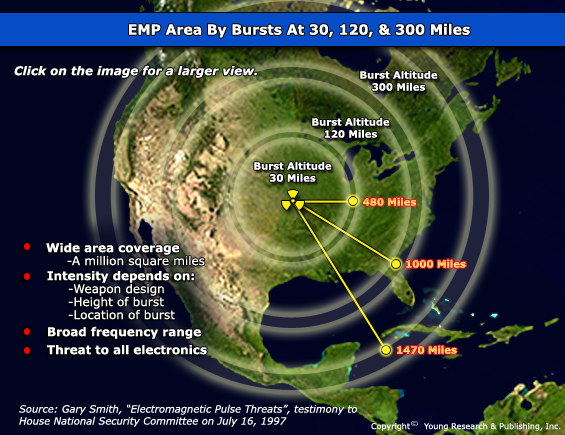
But the greatest threat is from the electro-magnetic pulse (EMP) emanating from a near-space atomic detonation. In one instant, power grids across most of the country could be rendered useless. Some estimates of deaths caused, not by the atomic blast but by the years-long effects of sudden reversion to a 18th-century way of life, are in the many millions.

Just last month former CIA Director James Woolsey wrote that,
... former senior national security officials of the Reagan and Clinton administrations warned that North Korea should be regarded as capable of delivering by satellite a small nuclear warhead, specially designed to make a high-altitude electromagnetic pulse (EMP) attack against the United States. According to the Congressional EMP Commission, a single warhead delivered by North Korean satellite could blackout the national electric grid and other life-sustaining critical infrastructures for over a year—killing 9 of 10 Americans by starvation and societal collapse.

Two North Korean satellites, the KMS-3 and KMS-4, presently orbit over the U.S. on trajectories consistent with surprise EMP attack.
Ninety-percent of Americans dead? I would not go that far, but more than 10 million, certainly. Probably multiples of that.


So why does North Korea have two satellites in polar orbits, each traversing over the United States several times per day?

Having been a nuclear target analyst in my military career, I find this simply horrifying.

Update: There are many more threats to the country's grid than just EMP or conventional sabotage. "In 1989, for example, 6 million residents of Quebec lost power for nine hours following a geomagnetic disturbance from a solar storm."

What about truly massive solar storms? These are usually called Coronal Mass Ejections and if large enough the ejected solar mass, not just radiation, can penetrate the earth's atmosphere. A "significant flare" occurred less than three years ago.


Much larger CMEs than this have reached earth very recently.
Solar storms would primarily affect the power grid, and are not likely to harm things like computers.  Also, solar storms would only disrupt communications temporarily, and would not be likely to cause direct harm to communications equipment (except for satellites).   An extremely large solar storm, though, would induce geomagnetic currents that could destroy a substantial fraction of the very largest transformers on the power grid (possibly over much of the world).  If this happened, electric power loss due to a large solar storm would be out for a period of years and possibly decades.  Unlike nuclear EMP, such a solar storm is an eventual inevitability.
The last solar storm that could have caused this level of damage happened in 1859, before the power grid was in place (although in 1921 a large solar storm, of briefer duration than the 1859 event, occurred which affected a much smaller area of the planet). The power grid has only been in place for a fraction of one percent of human history, and a really large solar storm (of the size and duration of the 1859 event) has not happened in that time.  There is a general assumption that any solar event that is similar to, or larger than, the 1859 solar superstorm will simply never happen again, although there is no justification for such an assumption -- in fact, we know that this assumption is false. There is a good possibility that such a large-scale solar storm will happen in this century. If it happens in the current situation without adequate spares for our largest transformers, a large part of the worldwide power grid (including 70 to 100 percent of the United States power grid) will be down for years.
Those transformers are custom manufactured for each site. They are not pieces that simply roll off an assembly line. But reverting to an 18th century lifestyle isn't the half of it. We'd also revert to an 18th-century economy. Absent the US national grid alone, to say nothing of Europe's grid and western Asia's, the worldwide economy would simply collapse. Very hard and very fast.

The net worth of the typical American would simply vanish because money today is almost purely electronic. SFGate reports of an ice cream store whose owner kept the store opened despite having no power - may as well sell as much ice cream as possible before it melted, right? But "sales were few and far between."
“No one pays cash anymore,” he said, spoon in hand as a siren wailed outside. “I’m angry. I’m annoyed."
Charge and debit cards are not money, they are promissory notes, basically IOUs. In an EMP or CME, you might have had $50,000 just sitting in your savings account, but not any more. The ledgers would still show it but they are mostly electronic, too. And banks don't keep much cash on hand, anyway. Same for international commerce and currencies. They'd be shut down.

Life would become nasty, brutish, and short very quickly. Civil violence would reach unimaginable proportions as commodities (like food and drugs) become immediately scarce. It would be a zombie apocalypse, minus the zombies.

Saturday, April 8, 2017

Just War and Syria Strikes

Can we frighten this man into killing
people only conventionally?
United States armed forces, under President Trump's orders, conducted a missile attack against a Syrian airfield on March 6.

This attack was against a nation that, while reprehensible under the Assad regime, was at peace with the United States. But we bombed it absent any aggression by Syria against the United States, or even a threat of it.

I am framing my assessment in the context of Just War Theory (JWT henceforth), a theological inquiry in Christianity going back at least to Saint Augustine, 354-430. It's most robust treatment was by St. Thomas Aquinas, 1225-1274, whose exposition was so thorough that it still forms the basis of modern theory. I have written over the years quite a bit about JWT in different contexts.

Today my main points are that going to war justly requires that at least these questions to be answered in the affirmative, below.

1. Is there just cause for the war?

2. Is the war authorized by proper authority?

3. Is it wise, as far as we can discern, to wage the war?

4. Is there a just objective to waging war?

First, though, there is the question whether the cruise-missile strikes against Sharyat airfield the evening of March 6 constituted "war," or were they military violence of a kind other than war. I think the answer is straightforward, for here the key point is not what President Trump wanted to do (frighten Assad) but the means he used to do it. And the means were exclusively military and violent.

Throughout history, to attack another country with military forces has been seen unambiguously as an act of war. Just imagine that the evening of Dec. 7, 1941, the Japanese government messaged President Roosevelt that the air raid against Pearl Harbor should not be construed as as act of war, but only as a warning to the US not to inhibit Japan's imperial plans in the Far East. "We are prepared to do more," Japan might have said, if the United States did not comply. What do you think Roosevelt's response would have been?

And that leads to a second key point: Though President Trump initiated the violence, he does not get to call it war or not-war. Bashar Assad does. To expect that Assad sees the strikes as anything other than war is fantasy thinking.

This doesn't mean that Assad won't be cowed away from using chemical weapons again. My point is that no matter how the strikes are spun by the administration or others, they opened an actual war against Syria. The war may be brief, it may not. Syria might respond, it might not. But war it is. And we must remember that it takes both sides to end a war. The United States unilaterally began it, but we cannot unilaterally end it. This war will not be ended until Assad either says so or is removed from power. And even then his successor may choose to continue it.

Is there just cause for war?

Just Cause of war is the fundamental question, of course. I remember reading a (probably apocryphal) story of a South Seas island native chieftain who after a large battle between the US Marines and the Japanese in World War 2 asked the American commander who was going to eat the vast quantities of flesh of the slain soldiers.

The Marine general explained that neither the Japanese nor Americans killed people for food.

"What barbarians you are!" the chief replied, "To kill for no good reason!"

Historically, Western thought on war has held that war cannot be separated from larger concerns of nations, and in fact is one part of national relationships. "Politics is the womb in which war develops," said Prussian officer and theorist Carl von Clausewitz. More famous is his observation that, "War is not an independent phenomenon, but the continuation of politics by different means."

JWT has generally held that the political just cause for war is pretty narrowly expressed: either to defend one's own nation from actual or imminent attack, or to protect innocent third parties from lethal aggression or oppression. Some years after the American Civil War, Union General William T. Sherman put it simply: "The only just aim of war is a more just peace," which is a political goal. Absent a political orientation, warfare becomes just what the South Seas chieftain said, an exercise in pointless killing.

Not all JWT theorists agree that a nation may strike pre-emptively even in the case of clearly imminent attack, but since no one in the Trump administration claims that Syria poses any kind of military threat to the US, I'll not address the self-defense tenet here, especially since in his remarks following the missile strike, President Trump never invoked it at all. (In fact, when President Obama was contemplating similar strikes in 2013, he said specifically that the United States did not face an imminent threat.)

Absent self defense, then, the question then becomes one of protection of the innocent. Is that the case here?  Undeniably, victims of March 4's sarin attack against Idlib Province, held by opponents of the Assad regime, were innocent. After all, of the 85-plus people who died and scores more injured, many were children. So it would seem that a prima facie case can be made that the cruise-missile attacks against Sharyat airfield were justified on the basis.

However, the question is then begged whether chemical weapons are so unique that American warmaking on their users is justifiable for that reason alone. The Syrian civil war has already taken the lives of 400,000 people, perhaps as many as 500,000, of whom many thousands were children and countless thousands more were adult non-combatants. Neither President Obama nor President Trump ever invoked the prospect of military strikes against Syrian government forces for that reason.

So what, exactly, makes Tuesday's chemical attack so uniquely objectionable? It cannot be the number of victims, which in war's sanguinary calculus was rather small compared to other attacks by Syrian forces on civilian targets. Nor can it truly be that children were killed, even though President Trump did cite that specifically. Children have been killed all along.

It would seem, then, this administration like the prior one, maintains that the use of chemical weapons by itself was the reason for the cruise missiles to be launched. Is that a just cause of war against Syria?

If the answer is no, then war making against Syria cannot justly be done on that basis alone.

If the answer is yes, as the administration clearly claims it is, we move to closely-related inquiry of JWT - the war we wage must be justly conducted to achieve a just objective, which Trump says is the cessation of chemical weapons.

Here is the sticking point as I see it. By focusing exclusively on chemical casualties, Trump has written off a half-million or so violently killed by other means. Trump spoke not a syllable indicating he would take active steps to end that slaughter. But Trump did call for a political settlement -- as did Obama, as have many other states, ad infinitum and ad nauseum.

But this simply means that at best the war will continue with conventional violence only, and unnumbered thousands more will die -- unless truly decisive military steps are taken to remove Assad from power and enforce a ceasefire. Absolutely no nation is contemplating that -- which makes the claim that the deaths of this week's 85 persons are uniquely offensive simply hollow and morally unsustainable.

Let's look at the the JWT tenet of proportionality. The doctrine of proportionality is simply stated that the means of conducting the war must be proportionate to the goal for which the war is waged. Another way of looking at it is that while the just ends desired do not justify any means to attain them, they absolutely justify some means. The tenet of proportionality, then, is to assess what the justified means are, then employ those means and not the unjustified ones.

Which leads directly to the question: what exactly is the goal here? The president, secretary of state and others, in multiple remarks and interviews, have announced four key things:

A. There is no intention of effecting regime change in Syria by military means.

B. The strikes are to punish Assad's regime for using chemical weapons.

C. The strikes are intended to deter Assad from using such weapons in the future.

D. It is more urgent than ever that a political solution to the conflict be obtained.

Are these just objectives of war? If so, it is apparently just to "punish" Assad for using chemical weapons, and to deter him from using them again, but not just to remove him from power. Why? (I will note that these are identical objectives to those of President Obama in 2013.)

In fact, is punishment itself a just aim of war? This tends to slide the war into a legal enforcement mode, which indeed the president has more or less confirmed in his denunciation of Assad's use of chemical weapons. But that only makes us confront a key question: why is it just to punish Assad but leave him in power - when it was his criminal exercise of power that is at the heart of the violation?

The question of means

"Without killing," wrote Clausewitz, "there is no war." Conducting war is a matter of intentional lethality. In the proposed war against Syria, then, this is the question of means: What constitutes a level of violence inflicted upon the Assad regime that is effective deterrence against using WMDs by the regime again or, in future years, deters other bad actors in the region?

The centering question of the doctrine of proportionality is deciding the violence necessary to achieve the war's objectives while not using excessive violence to do so. To employ too little violence is as disproportionate as to employ too much. It is unjust to wage war ineffectively even for a just cause.

Hence, planning for such strikes necessarily involved a massive amount of guess work on what level of lethality and destruction needed to be inflicted upon Syria to ensure the Assad regime never orders the use of chemical weapons again. But that is a heavily psychological calculation for which a high-confidence answer is practically impossible!

The reason is that we do not know the calculations Assad used to to order the chem-weapons attack in the first place. What was going through his mind when he gave the order? We don't know, although in 2013 the Obama administration said it had intercepted some messages that gave some clues. Even if the Trump administration has such messages, they are almost certainly originated mostly by subordinates and oriented toward action rather than rationale, and are many levels removed from what Assad was thinking, Since making him fearful of re-use is a stated goal of the president, our own calculations' margin of uncertainty is bound to be very vast.

As for deterring leaders of other nations, namely Iran and North Korea, assessing what example to make of Syria to deter them is like entering a dark room blindfolded, in the dead of night in a dense fog, to look for a black cat that may not even be there. Does anyone really expect that the Iranian or North Korean governments will abandon their goal of attaining nuclear capability just because the United States mounted a very limited missile strike against Syria, even if the president has promised would be repeated if he sees fit?

All of these things mean that the proportionality calculus has no answer. It is like a math question to solve the value of X in which both the variables and constants are also unknown. We do not know how much death and destruction to inflict upon Assad-Syria to persuade the regime to refrain from using a single class of weapons in the future, and have no realistic prospect that we even can know. And this is a problem cubed for deterrence of other national regimes.

So the question: Even stipulating that the use of chemical weapons is a just cause for the proposed war, can the war be justly waged when we have no way of assessing, within reasonable margins of error, what waging it will require to achieve its stated goals?

When I was assigned to the Pentagon during the planning for Operation Desert Storm, the first ground war against Iraq in 1991, Army Chief of Staff Gen. Carl Vuono emphasized that in our planning we needed to remember two simple concepts: "Hope is not a method and wishes are not plans." Good advice now, too. To which I add: launching missiles is not a strategy.

This is not a strategy. It may be a means to achieve a strategy. Or it may not. 
But is there a strategy?

ABC News Radio reported March 8 of the aftermath of a meeting between the Senate's leaders and Chairman of the Joint Chiefs of Staff Gen. Joseph Dunford on the previous day:
“We don’t have the benefit of a larger strategy, for the same reason that I think the previous administration had difficulty coming up with a strategy, because it’s very, very complicated,” Sen. John Cornyn, the second-highest ranking Republican in the Senate, said Friday after a meeting with the Chair of Joint Chiefs of Staff. 
The Hill adds,
Senators left a closed-door briefing Friday saying the Trump administration did not lay out a comprehensive plan for Syria. 
Cornyn added that there were “discussions” about the legal authority being used in Syria and whether the administration’s main target is President Bashar Assad government's or the Islamic State in Iraq and Syria (ISIS).

“We ... need a strategy to figure out what is our goals in Syria,” he said. “Is our goal just to defeat ISIS or is our goal to change the regime, and if there is policy to change the regime what comes next?”
There is presently no answer to that question.

My conclusion: The Trump administration has no strategic objectives evidenced by the missile strikes. "No chemical weapons" is not a strategic goal because it leaves untouched and undeterred almost all of Assad's total offensive capability and gives assent to the war's continuation, even escalation, by conventional means and offers no remotely significant protection of the innocent from lethal attack.

There is no just cause for this war if we use the terms and conditions that President Trump himself has set.

2. Is the war authorized by proper authority?

The US Constitution clearly grants to Congress, and only to Congress, the authority to "declare war." However, the Constitution does not define just what constitutes a declaration. As then-Senator Joe Biden accurately explained in 2001, the Congress has declared war when the Congress thinks it has. Hence, he said, an Authorization for the Use of Military Force meets Constitutional muster as a declaration of war.
I happen to be a professor of Constitutional law. I'm the guy that drafted the Use of Force proposal that we passed. It was in conflict between the President and the House. I was the guy who finally drafted what we did pass. Under the Constitution, there is simply no distinction ... Louis Fisher(?) and others can tell you, there is no distinction between a formal declaration of war, and an authorization of use of force. There is none for Constitutional purposes. None whatsoever. 
Constitutional lawyers over the decades have held that varying kinds of enabling acts, such as monetary appropriations for military action, have also amounted to Constitutional satisfaction and, at least, consent of the Congress to action ordered by the president, in whom the Constitution grants authority to conduct warfare.

Neither of these conditions pertained to the missile strikes. The president did not even bring into consultation the senior leaders of either chamber of Congress before the strikes took place. Even stipulating that bombing Assad's forces may be justified under humanitarian concerns, what the Guardian [newspaper] is conflating is the difference between moral justification of war and legal basis for it. They are not the same.

Under classic just war theory, both just cause and rightful authority are required. In Syria today there may be just cause for Western intervention, but so far there has been no rightful authority for it.  Since the dawn of the American republic, the Congress and the presidents have generally agreed that the president may order US forces into combat against another nation, solely on his own authority, if and only if there is:
1. Imminent danger of attack from the other power, so imminent that time taken for Congressional deliberations would hinder defense against it, or,

2. To protect actual threat against US citizens abroad, or to rescue them from actual danger.  
Neither of these were the case in Syria. Therefore, no matter the moral justification of them, the missile strikes failed the test of rightful authority. This is the president wielding military power not in a representative-democratic manner,  but in a monarchist manner.

There was and is no threat to the United States or to the Syrian people that is so immediately imminent that no time dare be spent in Congressional deliberation to authorize the strikes. If there is, the president should explain why, with 400,000-plus already dead, a few more days of deliberation is unwarranted.

My conclusion: The "proper authority" test was not met.

3. Is it wise, as far as we can discern, to wage the war?

With the failure of the first two criteria, it is hard to see how this war is being waged wisely so far. That the risk of confrontation with Russia has risen, perhaps sharply, seems incontrovertible. However, this question is really one of consequences as cannot be well answered except retrospectively.

My conclusions: Although I do not think the strikes were wise, based on their failure of proportionality (mainly meaning that Assad, not concrete and dirt, should have been the target), I'll keep an open mind. It may turn out to have been better than ill-advised. We will just have to wait and see.

4. Is there a just objective to waging war? 

Well, not yet. See all of the above. But to the point: the deaths and suffering inflicted by chemical weapons have been and are such a tiny part of the overall deaths and suffering inflicted that merely ending their use is not in itself a just objective of waging war against Assad's Syria.

Final thought

One thing the chemical and missile attacks have done is illustrate that the status quo - unending war that is effectively a proxy war between the Western powers one one side and Russia and Iran on the other - cannot be maintained for long. Eventually, Trump and his administration will be faced with doing something other than simply keeping their hand in. The United States will face the hard choice in Syria of going big or going home.

That is exactly is the reason that Congressional and public debate must be entered into sooner rather than later. Going to war against Assad-Syria may be the right thing to do (or maybe the least-bad option) but President Trump initiated it the wrong way politically, strategically, and tactically.

Related:

Secretary of State John Kerry insisted in June 2013 that US warplanes should begin bombing Assad-regime targets right away. But he said that US bombings would be "unbelievably small" in their scope and effects. Not only would such intervention fail the Just War test, it also failed the test of the rigidly secular concept of Realpolitik.

The key note from that day: Joint Chiefs Chairman Gen. Martin Dempsey made it clear that a few runs on target would do no good, that if the bombing was not be be merely symbolic, it would require a sustained, large effort of no short duration.

What has changed since then? Nothing. Except now there are Russian boots on the ground in Syria, which certainly does not simplify things.

Update: "The Grim Logic Behind Syria’s Chemical Weapons Attack"

Bookmark and Share

A world without nuclear weapons - what would it look like?

 From Pope Leo this week, according to the National Catholic Reporter : " Pope Leo quotes Bob Dylan song in book foreword calling for n...