Monday, July 20, 2020

The Robber, the Priest, and the good Samaritan

Luke 10:25-37 (a modern  version)

A lawyer stood up to put Jesus on the spot. “Teacher,” he asked, “what do I have to do to have eternal life?”

Jesus replied, “What is written in the Law? How do you read it?”

He answered: ““You shall love the Lord your God with all your heart and with all your soul and with all your strength and with all your mind” and, “Love your neighbor as yourself.”

“You are absolutely right,” Jesus replied. “Do that and you will live.”

But the lawyer wanted to impress others, so he asked Jesus, “And who is my neighbor?”

In reply Jesus said: “A man was walking down from Jerusalem to Jericho, when he was mugged by robbers. They stripped him naked, beat him up and went away, leaving him half dead. A priest happened to be going down the same road, and when he saw the man, he passed him by on the other side of the road. A Temple administrator who came to the place and saw him, also passed him by on the other side.

“But a Samaritan, of all people, was traveling and as he came where the man was; and when he saw him, he felt sorry for him. He went to him and gave him first aid, pouring on oil and wine. Then he put the man on his own donkey, took him to an inn and took care of him.

“The next day he gave the innkeeper two days” rent. “Look after him,” he said. “When I come back, I’ll make up the difference for any extra costs you may have.”

“Which of these three do you think was a neighbor to the man who got mugged by the robbers?”

The lawyer replied, “The one who had mercy on him.”

Jesus told him, “Go and do that sort of thing yourself.”


The Robber

They never learn, do they? So many travelers get robbed and mugged along this road that everyone should know not to travel it alone. It’s a perfect road for us robbers. It twists and turns; it’s narrow and steep in many places. People can’t get away easily. There are a lot of places for me to hide, waiting for the next nitwit to come along.

Here comes one now. If he’s dumb enough to travel alone, he deserves what I’m gonna give him. Look at him! Upstanding fellow, isn’t he? Well, dressed, well groomed. A real pillar of the community, I’ll bet – yeah, respected member of synagogue, pays his taxes, reads the Scriptures on holy days, kids are just perfect – I’ve seen men like him before. Pretty wife, no doubt – too bad she’s not with him today!

He’s loaded, that’s for sure.

This is the sort of man who made me the way I am, you know. So what I’m going to do to him is fair. Oh, no one sat me down one day and said, look, young man, what you need to do is be a cutthroat. That decision was mine, I admit that. When I was seven my father was killed in an accident, and people like this guy – he’s looking around cautiously now, but it’s too late – people like this guy didn’t give my family any help. We were poor, and we were told in ways subtle and blunt that everything that happened to us was our own fault.

One of the well-to-do men of our town told us that God had simply structured society in a certain way. Those who were righteous and moral were blessed by God with money, property, and standing in the community. Of course, you could tell someone was righteous by the heft of his wallet or the size of his house. Question: Why is this man prosperous? Because he is righteous and moral. Second question: How do you know he is righteous and moral? Because he is prosperous.

Yeah, right.

So I learned that we were poor because we were sinners. You could tell we were sinners because we were poor. After a while, I believed it. Others sure did; they made certain assumptions about us. Strange men would come into town as they traveled and hit the tavern. They’d ask where a guy could find a little “companionship” around here. And the innkeeper would name a woman or three, including my mom. But my mother never rented herself to men. Never! She made her living doing menial labor – hauling water, cutting wood, feeding livestock. Never did she prostitute herself! There were a few prostitutes in the town, sad women with no future. My mother sometimes took pity on them because she lived a hard life, too. They were the only other persons we shared our meager food with. When the self-proclaimed righteous men of the town saw my mom they would cross the street to avoid passing near her..

The first man I mugged was one of the strangers who propositioned my mother. After my mom sent him packing, I followed. I was fifteen and furious. I’d had all I was going to take. The man went down an alley and I followed with hate in my heart. Before he knew what had happened, I clobbered him over the head with a thick stake. He collapsed. I hit him hard across the face and kicked him in the gut. I took his wallet. Then I knelt and put my knee on his throat. I told him, “If you ever bother my mother again, I’ll kill you!”

The money came in handy. I didn’t tell my mother where I got it and she didn’t ask. Afterward, one mugging followed another, until here I am on the Jerusalem road, with my mother long dead. Why do I keep doing what I’m doing? Because I don’t know how to do anything else. And because I’ll never forgive men like this guy coming down the road for what they put my mother through. I’m no longer mad, but I will continue to get even. All those righteous people think I was born a sinner, so a sinner is what they’ll get – and they’ll get it good and hard.

They say there is a fellow going around now who has a new teaching. Jesus is his name. I hear Jesus says to do good to those who do evil to you. (Ha!) They say he heals the sick and shares bread with outcasts and sinners, even prostitutes and tax collectors. (I never mug tax collectors – you know, professional courtesy.) Whoever this Jesus guy is, he’s sure not a righteous man because he rubs elbows with the wrong crowd. Maybe he’s someone like me, from the wrong side of the tracks. The rumor is that his father wasn’t really his father.

“Love your neighbor” is what they say he teaches. I know who my neighbor is. It’s Eleazar here beside me, an expert with a knife. Someone like me, that’s my neighbor. Someone I can trust because they know if they betray me I’ll get even. But this Jesus, from all accounts, would want me to believe that this fat-wallet guy coming down the road is my neighbor, too. No way, no way! I would never mug my neighbor. But this guy is dead meat. Get ready, boys – neighbors – he’s almost here! One, two, three – Get him!


The Priest

Well, I see the robbers got another one. Beat him to a pulp and stripped him naked. Must be the Adoniah gang. They say that’s their trademark, stripping their victim and beating him half dead. Of course, this poor man’s money is long gone. That would be the first thing they took.

He looks dead. Maybe he’s only half dead. It’s hard to say. What do I do here? If I stop, maybe the muggers will get me. I’m late to Jericho. If I stop, I’ll be even more late. My priestly business takes priority here. I mean, what would become of the order of our religion if all the clergy let themselves be delayed just because someone was in need? It would be chaos! The righteous people have certain expectations, and one of them is that their clergy will take care of clergy business. Anyone can stop and tend to this fellow, and someone will be along in a moment, surely. I have priestly business in Jericho, and only I can do that, not just anyone. So if I stop here, then my work won’t get done and the people will be disappointed and angry.

But if I pass on by, some folks will think I should have stopped. What about that? I know – I’ll claim that our religious Law forbids me to touch a corpse because it would make me religiously unclean. (That man is dead, isn’t he? Yes, he must be.) And one thing a priest must never be is religiously unclean, everyone agrees with that. Of course, not being experts in religious law they won’t know that caring for an abandoned corpse does not make someone unclean, even a priest. So I could bury this fellow – yes, I am quite certain he really is dead – I could cover this fellow without violating religious law at all. But that will just be my little secret. I’ll even cross to the other side of the road to make it more convincing. I must make my meeting.

The meeting is important. The subject is a radical man going around teaching and preaching, Jesus of Nazareth. He’s certainly not a good Jew. He socializes with sinners and outcasts and even eats with them. It is very upsetting. We have tried to convince Jesus not to befriend sinners and be more reserved like his cousin was, John the Baptist. You know what he said? “John the Baptist didn’t eat or drink with the wrong crowd, and you said he was in league with the devil. Now I, Jesus, eat and drink with them, and you accuse me of being a glutton and a drunkard, a friend of thieves and other sinners. Get a grip!”

Speaking of the Law, surely Jesus knows that our accusation is a veiled threat. I mean, Jesus doesn’t follow the law, but he sure does know the Scriptures forward and backward. Too bad they don’t mean anything to him. I am sure he caught the reference to Deuteronomy 21, verse 18, that requires gluttons and drunkards to be stoned to death.

We’ve put Jesus on notice to be more selective in acknowledging someone as his neighbor or face the consequences. No thieves and prostitutes and other sinners allowed!

I can’t understand why anyone would listen to Jesus, but thousands do. Personally, I like the guy, but his religious ideas are wacky. They are a threat to the system.

I’ll bet if Jesus was walking with me he’d stop and take care of this poor fellow here. That’s exactly the problem. He just won’t tend to business. He’s always being distracted by do-goodism. Heal this fellow, comfort that widow, feed that child, all without distinction. Love your neighbor, he says, and he’s right, of course. That’s in the law, no arguing about it. Too bad Jesus doesn’t understand who his neighbors really are.


The Samaritan

I’ve got to get out of this place if it’s the last thing I ever do. And if I stay in this country much longer, it will be the last thing I ever do. I hate Jews as much as they hate us Samaritans. I’ve had a couple of close calls already. I really think if I stay longer, my luck will run out. Someone will kill me. And he will get a medal for it! No one will be interested in the murder but the Romans. Come to think of it, they won’t be interested, either. My sons will have to avenge me.

Let me just get through Jericho! Then I’m up the Jordan River and I’m home free.

Is that a dead man? Yes, another victim of the criminals along this road. More evidence of Jewish depravity, that they let such crime go on. No, he’s not dead; he just moved. They’ve stripped him bare. It’s not obvious he’s Jewish with his clothes gone, since his robe would identify his tribe. Oh, he’s Jewish for sure; what else would he be?

Man, they sure worked him over! Poor guy. I hope somebody helps him out. Not me, no sir. I’m not stopping for this Jewish scum.

Pause

Maybe I should turn back and just give him a drink of water. I wish I hadn't gone so far past him. It’s uphill to go back. It’s getting late. I need to keep going. But I’ll run back and give him a drink of water, then go on. That won’t take long.

Ah, the water is making him come around. Maybe a sip of wine will help now that he is more alert. One of his eyes is so swollen he can’t see with it, but he sees me with the other eye. Okay, I’ll let him take a good look at me. When he sees I am Samaritan he’ll push me away. I bet he’d literally rather die than accept aid from a Samaritan. Uh, uh, see there? His jaw has dropped. He knows what I am. Okay, Jew, I’m outta here. I’m just as disgusted as you are. What was I thinking?

“Thank you,” he said to me. I turned away from my donkey and faced him again. “You're welcome,” I said.

“You are Samaritan, aren’t you?” he asked.

“Yes,” I said.

He said, “Sometimes I saw others go by, even a priest, but no one stopped but you.” I nodded. Then he said the most surprising thing: “God bless you for stopping.” I would have bet my last shekel I would never hear that from a Jew!

He moaned in pain. He was cut and badly banged up. “Shall I bandage your wounds?” I asked.

“You would do this for me, Samaritan?” he asked rather incredulously.

I could hardly believe it myself. “Yes,” I said.

“Don’t you need to move on?” he asked. “Samaria is still a long way off.”

I said, “Do you want to be bandaged or not?”

I could see his turmoil. Samaritans and Jews had been mortal enemies for generations. He was more unclean from me touching him than from being beaten and stripped naked. But the pain overcame his objections. “Yes, please,” he finally said, and he added, “I am called Jacob.”

“I am Samuel,” I answered. I poured oil on his cuts and bruises and wrapped them in clean cloth. I offered him a robe to wear. “You will look like a Samaritan for awhile,” I acknowledged, “so if you refuse to wear it, I’ll understand.” But he took the robe and I helped him put it on.

“Can you walk?” I asked him. We tried to stand him up but he couldn’t. “Onto the donkey,” I ordered. He made a weak attempt at humor: “A Jew on a Samaritan donkey. The first person we meet will say you have a stupid jackass with you, but your donkey is nice.” I laughed. Then he laughed. Then we both laughed long and loud, although he had to stop because the thieves had kicked his ribs so hard. But it was funny – a Samaritan man on the Jerusalem road leading a donkey with a battered Jewish man riding it. No playwright could ever have dreamed it up.

We did get some strange stares along the road but there were no incidents. By and by the road leveled out. There was an inn ahead, so I stopped and rented a room for the both of us. I bought supper for him and he seemed better. But that night his pain got worse and he got a fever. He was in and out of consciousness and mostly incoherent. I stayed up most of the night placing cloths soaked with cool water on his forehead and changing the bandages on his wounds.

The next morning I was exhausted. I had a real dilemma. I really did need to get on. I wished I had asked him where his family lived. I went to the innkeeper and told him what had happened. He nodded his head; I was not the first to tell him such a story. I told him, “My friend is named Jacob. He is a neighbor of mine. Here is two day’s rent for the room. I’ll be back by that time, and I’ll pay whatever extra it costs you.”

“Okay,” he agreed.

When I returned Jacob was much better. The innkeeper refused additional payment, telling me, “A neighbor of yours is a neighbor of mine.” We all parted company and I returned home.

My brother was indignant when I told him the tale. “I can’t believe you showed a Jew mercy!” he exclaimed. “They’re outside our circle!”

I reminded my brother that the Jews and we Samaritans had a common religious heritage and both used the first five books of the Scriptures. Leviticus commanded us to love our neighbors as ourselves.

“Oh,” he retorted, ‘so now a Jew lying in a ditch is my neighbor!”

I said, “Maybe anyone who needs mercy is our neighbor. You should try it sometime.”


"‘Critical Theory’ Is A Disastrous, Unbiblical Worldview"


Monday, July 6, 2020

The Official American Hymn Glorifying War

I am a retired Army combat-arms officer and I agree with Laurence M. Vance: "The Battle Hymn of the Republic" is blasphemous (at best) and has no place being sung in Christian worship services. It is found in The United Methodist Hymnal but let us pray it will be excised when(ever) the next hymnal is published.

Killed in action soldiers of the Battle of Antietam, near Dunker Church. Why do churches sing a hymn that celebrates wholesale killing and destruction and calls them holy and good?
Read the whole article for a detailed, line-by-line explanation why this "hymn" is best described as a satanic perversion of the Gospel of Jesus Christ. Here is the conclusion:
The “Battle Hymn of the Republic” ought to be parodied, satirized, and lampooned. It has nothing to do with God or Christianity. It is not a Christian hymn. It does not belong in a Christian hymnbook. It should not be sung in any Christian church — Northern or Southern. It should not be on the lips of any Christian — Yankee or Southerner. It is partisan political paean to bogus history and faulty theology. For much too long Christians have sung this “hymn” with religious fervor while remaining in ignorance as to its history and theology. For much too long pastors and song leaders have included this “hymn” in church services without stopping to consider whether it is an appropriate song for a Christian worship service. Disparaging the singing of this song has nothing to do with being a Confederate sympathizer, or being unpatriotic or anti-Lincoln, but it has everything to do with exercising biblical discernment. Traditions are hard to break, and especially religious ones, but the singing of the “Battle Hymn of the Republic” is one that must go.
And the sooner the better.

Friday, July 3, 2020

God and Hamilton

I refer not only to the musical - which was released as a movie today by Disney Plus - but also to a book Kevin Cloud, who is a pastor, church planter, and author. He earned an M.Div. from Nazarene Theological Seminary. He has planted four successful churches in the Kansas City area and currently serves as the director of spiritual life at the Culture House, an arts conservatory in Olathe, Kansas. His site is  www.godandhamilton.com.

With his permission, I am publishing his article as an intro to his book.
________________________________

Redemption

The musical Hamilton resonates with me more than any piece of art I have ever experienced, primarily because it teems with the most important themes of my life. Engaging these themes of grace, shame, forgiveness, and surrender through Hamilton’s story encourages, inspires, and transforms me. But above all other themes, Hamilton’s story resonates with me because, ultimately, it tells a story that I desperately need to experience–a story of redemption.

When I take an honest assessment of my life, I see brokenness everywhere. I live with mixed motives, impure thoughts, and selfish actions. When I look at the world around me, more so today than ever, it appears to be constantly assaulted by the forces of brokenness. Death, terrorism, poverty, and divisiveness seem to win the day. My own life, and the world that we all live in, both share an acute desperation for redemption.

Hamilton moves people because it reminds us of this possibility. Interestingly, Hamilton is not the driving force behind this redemption, but rather his loving, faithful, and determined wife, Eliza. She takes the brokenness from his life and makes it beautiful.

The greatest source of pain and brokenness in Hamilton’s life originated from his status as an orphan, 
a reality that haunted him throughout his life. Hamilton, like most orphans, surely grew up feeling abandoned, unwanted, and unloved, hounded by loneliness and inadequacy.

I read an article written by an orphan named David, who experienced a deep sense of abandonment and rejection, feelings he struggled with into his late fifties. Another girl whose parents died wrote that orphans grow up rarely feeling special or loved. They wear secondhand clothes, play with used toys, and rarely celebrate their birthdays. Many orphans don’t even know the date of their birthday.
I can imagine heartbreaking conversations where Hamilton shared his pain and suffering from being an orphan with Eliza. I can also imagine Eliza, as any loving spouse would, feeling a deep sense of empathy about Hamilton’s struggles as an orphan. Hamilton’s brokenness must have become her brokenness, as she carried his burden with her husband. After Hamilton’s death, and after she healed from her grief, Eliza took that hurt, suffering, and brokenness, and gave everything she could to redeem it, to make it new.

After Alexander died, grief overwhelmed Eliza. In his biography of Alexander Hamilton, Ron Chernow writes, “For Eliza Hamilton, the collapse of her world was total, overwhelming, and remorseless. Within three years, she had had to cope with four close deaths: her eldest son, her sister Peggy, her mother, and her husband, not to mention the mental breakdown of her eldest daughter.” Chernow shares that immediately after the death of Hamilton, Eliza invited Gouverneur Morris, a close family friend, into the room, then “burst into tears, told him he was the best friend her husband had, begged him to join her in prayers for her own death, and then to be a father for her children.”
Eliza, in this moment, found herself completely overwhelmed by brokenness and death. She couldn’t even begin to imagine redemption. But in time, God would give her faith to see the possibility of redemption out of the brokenness. Eventually, she would take Hamilton’s broken pieces and make them beautiful.

Eliza slowly recovered from her grief, finding solace in her faith in God. “Suffering from the ‘irreparable loss of a most amiable and affectionate husband,’ she prayed for ‘the mercies of the divine being in whose dispensations’ all Christians should acquiesce,” writes Chernow. Her faith helped her to recover from the devastating loss and begin to imagine a new life.

Hamilton himself had encouraged her to remember her faith before his death. In his letter he wrote the night before his duel with Aaron Burr, he reminded Eliza, “The consolations of religion, my beloved, can alone support you and these you have a right to enjoy. Fly to the bosom of your God and be comforted. With my last idea, I shall cherish the sweet hope of meeting you in a better world.”
As Eliza slowly recovered from her grief, she discovered a new calling. She partnered with a small group of women to found the first private orphanage in New York City. Her Hamilton had suffered as an orphan his entire life; now she would work to alleviate the suffering of others who faced the same struggle.

Orphans during this era faced a brutal reality, with no good options available to them. Many orphans lived on the streets in gangs, fighting a daily battle to survive. The tenement housing district was grossly overpopulated and overrun with abhorrent living conditions. Almshouses or indentured servitude provided shelter and food for a life of hard labor and a loss of freedom, but oftentimes created structures that abused vulnerable children.

For twenty-seven years, Eliza worked tirelessly, providing orphans a hopeful alternative. Chernow writes, “She oversaw every aspect of the orphanage work. She raised money, leased properties, visited almshouses, investigated complaints, and solicited donations of coal, shoes, and Bibles.” Eliza believed that God himself had given her this calling, “My maker has pointed out this duty to me and has given me the ability and inclination to perform it.”

The work challenged her greatly and oftentimes operated dangerously low on resources. Eliza once committed to never turning away a child, whether they possessed a dime in the treasury or not. In 1813, the orphanage account fell to $60 while caring for the needs of ninety children. Yet despite these ongoing challenges, Eliza believed in God’s provision and faithfully continued her work. In doing so, she offered redemption to these children who otherwise faced a hopeless existence.
The end of Miranda’s musical beautifully illustrates Eliza redeeming Hamilton’s brokenness. The scene captures one of the most powerful artistic representations of redemption I’ve ever witnessed. The final song features Eliza singing about the different ways she honored her husband’s legacy. She considered the orphanage her crowning achievement in this pursuit. She sings about how she helped hundreds of orphans in the city, and how she sees her husband in each child that she serves. The musical ends with a brilliant white spotlight shining on Eliza as she smiles, her face radiating joy as the theatre fades to black.

The way we become agents of redemption here and now is simple but hard: we love. Eliza made Hamilton’s brokenness beautiful for hundreds of orphans by loving them in tangible ways. She threw herself into this work out of her love for her husband, and her love of God. Chernow writes, “Perhaps nothing expressed her affection for Hamilton more tenderly than her efforts on behalf of orphans. . . . Surely some extra dimension of religious fervor had entered into Eliza’s feelings toward her husband because of his boyhood.”

The work she pioneered continues to this day. The organization Eliza created more than two hundred years ago still exists, now called Graham Windham. The people of Graham Windham continue to live out Eliza’s legacy, tirelessly working on behalf of poor children and families in New York City. The families they serve live in New York City’s most severely distressed neighborhoods, ninety-five percent of whom live at or below the poverty line.

Jess Dannhauser, the current president and CEO of Graham Windham, sees their work as a continuation of Eliza’s legacy. Experiencing the musical Hamilton moved him deeply. “When Eliza sings that she sees Alexander in the eyes of these orphans, I see that as her saying these kids have great potential inside of them. That spirit is what animates our work today.”

Kimberly Hardy Watson, Graham Windham’s chief operating officer, agrees: “I find myself often wondering, what would Eliza think about what we are doing today? If she and the other cofounders had a clear understanding of what they endeavored for children, are we keeping to that promise? Are we being good stewards of that vision?” More than two hundred years after Eliza initiated this project, the brokenness continues to be made beautiful.

The cast of Hamilton participates in the work of Graham Windham. Some of the cast members participate as pen pals with children from Graham Windham. Phillipa Soo and Morgan Marcell created “The Eliza Project,” with a mission to “use the arts as a means of expression, as an outlet for personal experience, and to uplift the creative spirit.” Soo recruits other cast members to join her in teaching kids at Graham Windham acting, dance, and rap. These actors continue to tell Eliza’s story of redemption, not only on the stage, but also in their tangible acts of love for these children.

Adapted from God and Hamilton. Copyright © 2018 by Kevin Cloud. Published by Deep River Books, Sisters, Oregon. Used by Permission. 

Sunday, June 28, 2020

"I have finished the race..." - 2 Timothy 4.7

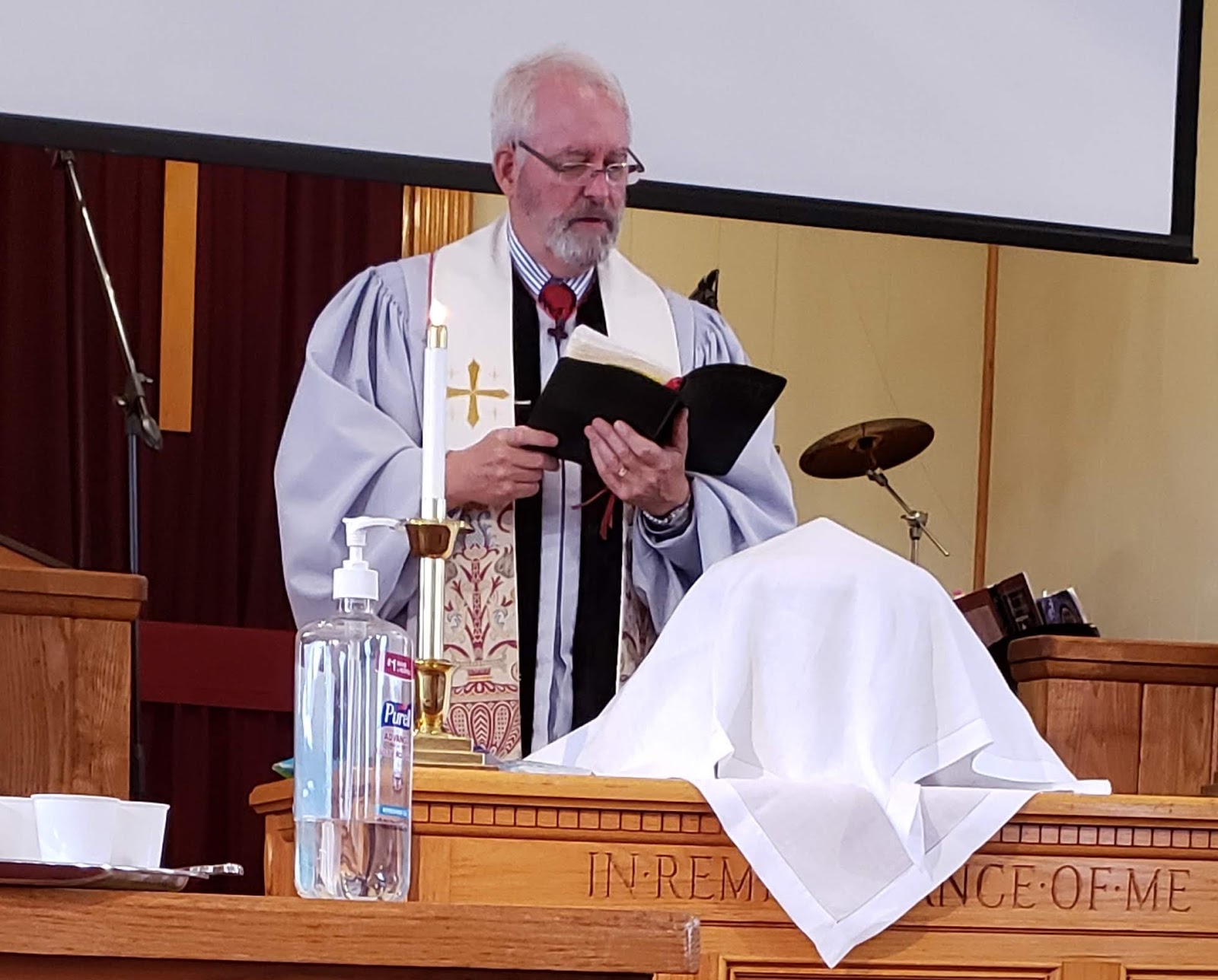
Today I conducted my final Sunday services under full-time appointment. The first was at Gideon UMC, the second at Greenbrier UMC, both in Greenbrier, Tennessee.

After 23 years of full-time pastoring in the UMC, preceded by retiring as an artillery officer from the US Army, plus two years of employment in a BTB Information Technology compay, I will enter retired status for good this coming Wednesday. 

Here are some photos from this morning.

Serving Communion at Gideon. We used prepackaged, individual cups with the wafer and the wine (grape juice) wrapped together in one unit. I served with tongs so no one's hands ever touched the cups but the communicant's.

My final benediction at Gideon UMC.

When Cathy and I arrived at Greenbrier UMC, this sign awaited us near the front entrance.

Beginning my final service at Greenbrier UMC. 

Consecrating the Communion elements.

My successor pastor, beginning there July 1, is the Rev. Jason Wilkerson, whom I have known since I moved to Robertson County three years ago. He is a very fine Christian gentleman and minister. I invited him and his family to attend today to introduce him to the congregation. I also asked him to assist in serving Communion.

Our Communion steward, the wonderful Donna Watkins, prepared Communion with the bread (the "chiclet" style) in trays of cups and the wine in other trays. She prepared these entirely in keeping with proper C19 protocols so that neither the bread, the liquid, nor the cups were ever touched by anyone but the recipients.

Rev. Wilkerson and I were both masked while serving and we donned new sterile nitrile gloves first. We removed each cup from the tray and handed it to the communicant so that no unprotected hands ever touched anything but their own serving.

In the photo above, I am serving Rev. Wilkerson at the end, just after he served me. This was one part of our ritual of me passing the pastoral care of the congregation to him - leaving him with the  place of honor in the Methodist tradition: last. Hopefully, this helped the people understand that there is an orderly, grace-filled and indeed sacramental continuity of pastoral care of the people of God. 
Then we proceeded with a litany of passing of the pastoral ministry from myself to Jason. We each led the congregation is responses and prayers for one another and the church itself. 

Our closing hymn was, "Lord, You Have Come to the Lakeshore," number 344 in the UM Hymnal. This hymn was requested by a church member but coincidentally (or not!) it was also the thematic hymn of the service of Annual Conference in which I was ordained. So the hymn has always been deeply meaningful to both Cathy and me. 

My final benediction to the people of Greenbrier UMC, which I basically ripped off from Paul's first letter to the church in Corinth, chapter 4. But I meant every word as if I had written them myself, although I could not have done so nearly as well as Paul did.
To the church of God that is Greenbrier UMC, to those who are sanctified in Christ Jesus, called to be saints, together with all those who in every place call on the name of our Lord Jesus Christ, both their Lord and ours: 
I give thanks to God for you because of the grace of God that has been given you in Christ Jesus, for in every way you have been enriched in him, in speech and knowledge of every kind just as the testimony of Christ has been strengthened among you. He will also strengthen you to the end, so that you may be blameless on the day of our Lord Jesus Christ. God is faithful; by him you were called into the fellowship of his Son, Jesus Christ our Lord.

The church hosted a "walk-thru" reception for Cathy and me after the service. It would have been outside had weather permitted. 


A wonderful lady of the church made this for me - Wake Forest was my undergrad school. I already had a Vandy bottle. I earned my M.Div. there.

That Cathy was also in ministry with me at the churches was a real fact and the people said so! This was given to her because everyone knows (I mean really knows!) that Cathy loves to cheer for Duke basketball.

This fine family of four are special to me for two reasons. One is that I baptized all four of them when they joined the church. The other is that he is also retired from the Army and is the only other person in the church who speaks the language of acronym as I do. So we could have whole conversations without anyone else understanding a word (except probably our wives)!


The church gave us this laser-etched crystal plaque as a gift. We are deeply moved by this thoughtfulness!

The people of Greenbrier UMC very kindly made this video for Cathy and me.


Cathy and I are thankful beyond description to all the people of Greenbrier and Gideon UMCs for the past three years. A finer and more wonderful group of people with whom to come to the finish line neither of us can imagine! What is next for us? Love God, love neighbor, and leave the rest up to the Lord. 

May the love of God, the mercy of Jesus Christ our Lord, and the strengthening presence of the Holy Spirit be with us all, now and always. Amen.

Tuesday, June 23, 2020

Secularists require an enemy

Mark Tapscott wonders why do, "... secular/humanist movements seem to create enemies, evil oppressors, that must be totally eradicated?"
https://hillfaith.blog/2020/06/23/heres-the-dilemma-humanism-cant-solve-but-christianity-can/

There are two specific groups of people who will always become the target of secularism's ire. First of course are Jews:

Holocaust Survivors Memorial Toppled At California Cemetery
https://thewashingtonsentinel.com/holocaust-survivors-memorial-toppled-at-california-cemetery/
A fountain dedicated to Holocaust survivors was toppled into pieces at Santa Rosa Memorial Park, where police are investigating the act of vandalism to determine if it is a hate crime.

As if there is a real question about that . . .

Exhibit two: this happened in Nashville, only a 30-40 minute drive from my home: "Nashville Holocaust Memorial desecrated with antisemitic messages."
https://www.antisemitism.co.il/2020/06/nashville-holocaust-memorial-desecrated.html

The other enemy is Christianity, which cannot be tolerated by atheistic humanism because Christian faith simply contradicts not only that atheistic humanism is correct, but that it is even possibly correct.

And so we have anarchist race warrior Shaun King:

So, did Jesus have a northern European appearance? Of course not. In fact, we do not know what Jesus looked like. Over the centuries since his day, Christians around the world have created art showing a Jesus who looked like them:


There are thousands of similar examples in countries around the world. Are these wrong, also? When Chinese Christians portray Jesus with Asian features, are they guilty of Chinese supremacism (and that definitely is a thing)? Are African Christians' portrayals of Jesus as an African guilty of cultural or racial appropriation? 

Or is it only the whites whose Jesus must be destroyed? To ask the question is to answer it. 

Not all mainly-humanists are atheists. But whenever Christians begin to consider other persons, either other Christians or not, mainly as enemies who must be defeated, well, that is when they have in their hearts denounced Christ and have embraced the powers and principalities of the world. 

Understand this: "white Jesus" is not the real target at all. It is only a beginning point. Anyone of any race who renounces the call to violence and carries out the commandments of Christ is the real target.

Sunday, May 24, 2020

An Armed Forces Hymn for Memorial Day


In the century and a half since, "Eternal Father, Strong to Save," was composed, it has come into widespread use by both Britain's Royal Navy and the US Navy, becoming known as the Royal Navy Hymn in the former and the Navy Hymn in the latter.

William Whiting of England composed the poem in 1860 for a student of his who was soon to sail for America. The music was composed by another Englishman, Rev. John Bacchus Dykes, an Episcopalian clergyman. The music was published in 1861, but I don't know how the lyrics and the music came to be put together.

The hymn was sung at Franklin D. Roosevelt's funeral, as well as the funerals of John F. Kennedy and Ronald Reagan. And as the 1999 movie, Titanic shows, it was also sung during services aboard the doomed vessel the Sunday before she sank. (However, the version sung in the movie was not arranged until 1940.)

Since the hymn was penned, a number of other verses have been composed by various persons over the years. Some of these have been adopted by the Armed Forces Chaplain's Board for inclusion in worship services conducted by military chaplains. These additional verses, prayers for the Marines, aviators, astronauts, the wounded, families at home and others, are included as an addendum on the US Navy's web page devoted to the hymn. Verses for the hymn are easy to write. The rhyming is simply, aabbcc, with each line consisting of eight syllables in iambic tetrameter (which by definition is eight syllables anyway).

The original hymn itself, of course, long ago passed into the public domain, so anyone may use the music or compose a verse thereto. Of the verses in the video, authorship is as follows:

Verse 1 - William Whiting, the original first verse.
Verse 2 - me, composed for this day as a prayer for the Army
Verse 3 - J. E. Seim, 1966
Verse 4 - Mary C. D. Hamilton, 1915
Verse 5 - me again
Eternal Father, strong to save,
Whose arm hath bound the restless wave,
Who bidd'st the mighty ocean deep
Its own appointed limits keep;
Oh, hear us when we cry to Thee,
For those in peril on the sea!

O Lord of hosts, to you we turn
To give us grace we cannot earn.
Our soldiers guard our way of life;
Be with them all in times of strife.
Let courage flow from your command;
We pray for those who fight on land.

Eternal Father, grant, we pray,
To all Marines, both night and day,
The courage, honor, strength, and skill
Their land to serve, thy law fulfill;
Be thou the shield forevermore
From every peril to the Corps

Lord, guard and guide all those who fly
Through the great spaces in the sky.
Be with them always in the air,
In darkening storms or sunlight fair;
Oh, hear us when we lift our prayer,
For those in peril in the air!

Almighty God, whose arm is strong,
protect us e'er from doing wrong.
We pray to always do what’s right,
for justice only be our fight.
Let peace now reign across our land,
brought to us by your gracious hand.
 You can hear the US Navy Sea Chanters, the service's chorus, sing the first verse by clicking here.

A prayer for Memorial Day

Lord God, grant us the faith that will truly honor those we remember this day.They died for their country; give us the faith to live for our country. They died to bring peace; give us the faith to live for peace.
They died believing in us, their fellow Americans; give us the faith to believe in one another and in our future. Grant us the same sense of commitment to people and their right to justice and peace as those we remember.
Teach us to honor all our relationships, from those dearest to us to those whom we will never meet but with whom we share this common planet. Grant us wisdom, give us hope, grant us dreams and visions like those that inspired people to give their lives, believing that through adversity and conflict would come peace and justice.
Lord, save us from complacency and prejudice – those very things that create conflict and cause young lives to be lost in battle or in despair. Make us instruments of your peace:
Where there is hatred, let us sow love; 
where there is injury, pardon;
where there is discord, unity; 
where there is doubt, faith;
where there is despair, love; 
where there is darkness, light;
where there is sadness, joy.
Lord, hear our prayer, and let our cry come unto you. Amen.

Adapted from the prayer for the Anzac Day Dawn Service, Sydney, Australia, 1987.

Friday, May 15, 2020

Farewell to father

Yesterday, my father, Thurman Sensing, died after a sudden and steep decline the night before. He lived for the past two years in Woodcrest Health Care of Nashville, basically a high-end nursing home. Because of the C19 restrictions, I was unable to visit him from mid-March until yesterday, when my brother, Will, and I were called to come in. Our older brother lives in Delaware.

Dad was 92 years and eight months old when passed from this life. Will and I were at his bedside when Dad died very peacefully at 4 p.m. almost on the dot.

Dad was a Seabee sailor during and after World War 2 aboard the battleship USS Texas and the escort carrier USS Bougainville, both in the Pacific.


For the past several years, I took Dad to lunch on Memorial Day. I was looking forward to bringing him lunch (C19 permitting) this month.


I had always feared that a morning phone call from Woodcrest would bear the news that Dad had died overnight, so Will and I are thankful we could be at his side. God is with us.

Because of C19 restrictions in Nashville, we will not have a visitation or a chapel service. It will be graveside only. While non-family will not be turned away by any means, cemetery rules at this time require that no more than 10 persons be at graveside. Others may come, but must stand well away. (I officiated a funeral like that last month. It is lousy, but that's what was required.)

Dad was a good father, an honorable man of courage, integrity and duty. I was blessed to be his son and I give thanks for all that he showed me and taught me. Fathers' Day next month will seem very, very empty, I already know.
God be with you, Dad, 'til we meet again.
By his counsels guide, uphold you,
With his sheep securely fold you,
God be with you till we meet again. 
From the 1880 hymn by Jeremiah Eames Rankin. 
Here is his obituary.
Thurman Sensing, Jr., of Nashville, passed from this life into God’s eternal presence on May 14, 2020. Born on Sept. 20, 1927, he was preceded in death in 2015 by his wife of 64 years, Angelyn Burkitt Sensing. He is survived by his three sons, Andy (Terri) of Hockessin, Delaware; Don (Catherine) of Greenbrier, Tenn.; and William (Janice) of Nashville. He is also survived by seven grandchildren and seven great-grandchildren.

Thurman was a World War Two veteran, having served in the US Navy aboard the battleship USS Texas and the escort carrier USS Bougainville. He graduated from Vanderbilt University in 1950 and then worked as an agent for New York Life until well into his 80s, having earned numerous sales awards throughout his career. Thurman also served as president and secretary of the Woodmont Kiwanis club.

An Eagle Scout, Thurman was co-founder of Troop 121 at Woodmont Baptist Church
Receiving the Good Shepherd award in 2016
and served as an assistant scoutmaster and Explorer scout leader. He served as Chairman of Tenn. Committee of scouting and as the Advancement Chairman for many years. He received The Pathfinder and Long Rifle awards and was the Western District Eagle representative on the Eagle advancement board. He was a recipient of the scouting Good Shepherd award.

An avid and highly-skilled golfer, he tried to imbue his enthusiasm for the game in his three sons but alas, only one came even close to his devotion and skill. If heaven doesn’t have a golf course now, they will shortly!

A graveside service will be held at Woodlawn Cemetery, Nashville, on Monday, May 18, with the Rev. Nathan Parker of Woodmont Baptist Church officiating.

The family asks that in lieu of flowers, memorials may be given to the Scouts BSA or to the memorial fund of Woodmont Baptist Church.
A Prayer at Taps, from the Song and Service Book for Ship and Field, 1941, a publication of the office of the chief chaplains of the War Department and the Navy Department, and used during World War Two:
Before we go to rest we commit ourselves to thy care, O God our Father, beseeching Thee though Christ our Lord to keep alive thy grace in our hearts. Watch Thou, O Heavenly Father, with those who wake, or watch, or weep to-night, and give thine angels charge over those who sleep. Tend those who are sick, rest those who are weary, soothe those who suffer, pity those in affliction; be near and bless those who are dying, and keep under thy holy care those who are dear to us.

O Lord, support us all the days of this troublous life, until the shadows lengthen, and the evening comes, and the busy world is hushed, and the fever of life is over, and our work is done. Then of thy great mercy grant us a safe lodging, and a holy rest, and peace at last. Through Jesus Christ our Lord. Amen.
Update: We received the death certificates right after the service. The cause of death is listed as cardiac and pulmonary arrest. We believe that is the correct determination, especially since Dad had already had a heart attack in his late 70s, and it is fully consistent with the suddenness of his terminal condition and the symptoms he exhibited until 4 p.m. of the day he passed.

Monday, May 11, 2020

The white privilege of the Covid-19 shutdown

This was posted on Facebook recently:


I am almost at a loss for words at how genuinely moronic this is, and how cruel it really is. Almost.

So let's talk about "privilege:" 

Who is it that is insistently calling for the lockdowns to continue no matter the costs in actual lives taken by the shutdowns themselves, estimated, says CBS News, to range from 75,000 to 150,000?

Who is it that dismisses well-reasoned and dispassionate calls to reopen the economy so that lives are not shattered, families no longer suffer deprivation, and the elderly are not abandoned?

Who is it that dismisses the documented forecasts that continuing the shutdowns will devastate rural medical facilities and quality of health care of rural Americans?

It is college-degreed white men and women who are financially secure, and who do not themselves think for a moment about how to pay for their next grocery trip or whether they will ever regain employment even approximating what they had before they were laid off.

It is college-degreed white men and women who think that the masses leave their homes merely to get haircuts or go shopping or - as one left-wing friend of mine posted on Facebook - to go bowling.

Minorities and lower-income Americans are being literally killed by the shutdown and their lives are being broken (NPR: "Why The Government Shutdown Has A Disproportionate Effect On African-Americans" and Center for American Progress, "The Impact of the Government Shutdown on People of Color").

But at least no one is turning a fire hose on them, so all is well! (But let us ignore for the meme's sake the political party of the men who turned the hoses on the marchers or loosed the dogs.)

So college-degreed, financially secure, upper-middle class and up white people simply, comfortably dismiss both the non-white and white unwashed, uneducated, poor deplorable-classes as mere untermenschen who have no idea how good they actually have it.

As for black Americans, what this meme really says to them is, "Shut up about how we have thrown you back into poverty and want. It is more important for us to feel safe! We are not attacking you with dogs any more, so what's your beef?"

Memes like this are frankly the most stunning examples of white privilege that I have seen in a long time. I will go further: to post this marks one as an actual white supremacist. 


Updates as they come in: 

'Our life is in danger': Unemployment hits 34% in Hawaii with no end in sight

Yep:

WSJ: Medical Lockdown Will Cause a Disease Surge -- Patients who are sick with conditions other than Covid-19 aren’t seeking screening and treatment.


Monday, May 4, 2020

What is Mothers Day for?

This Sunday is Mothers Day, and guess what? Mothers Day is not about what we think it is about.


Many of us already know that we have sentimentalized Mothers Day away from its founding purpose. But I suppose there is no going back. Anyway, here is the true story of Mothers Day.

The day’s founders did not start honoring mothers because they wanted to honor childbearing. The woman credited with founding the modern observance of Mother’s Day is Anna Jarvis. Her Methodist Church in Grafton, West Virginia, is called "the Mother’s Day Church" because Anna Jarvis was active there; her home in Grafton is a national landmark.

Anna Jarvis was inspired by her mother, Anna Reeves Jarvis who organized “Mothers’ Work Day Clubs” in the 1850's in the area. The clubs provided medicines for the poor, inspected milk for children, provided nursing care for the sick, and ran shelters for children with tuberculosis.

When the Civil War broke out, she called together her clubs and asked them to make a pledge that friendship and good will would not be a casualty of the war. Throughout the war, the women nursed soldiers from both sides and saved many lives.

Anna Reeves Jarvis became a genuine peace maker after the war, organizing “Mothers’ Friendship Days” to bring together families from North and South which had been torn asunder by the war.

Anna Jarvis, the daughter, was born in 1850 and was an impressionable child and teenager when her mother was at the peak of her courageous work. So, in 1907, two years after her mother’s death, she organized the first “mother’s day” in Grafton, West Virginia, so that her mother’s work of peace and mission would not be forgotten.

Another of the earliest promoters of the idea of Mother’s Day was Julia Ward Howe, author of Battle Hymn of the Republic. Julia Ward Howe was a militant abolitionist, and her “Battle Hymn” inspired the Union Army in the Civil War.

When the Civil War was over, Julia Ward Howe focused her attention on two other causes: voting rights for women, and world peace. In 1870 war broke out between France and Prussia. The war in Europe did not make sense to her and she wrote, “Why do not the mothers of mankind interfere in these matters to prevent the waste of that human life of which they alone know and bear the cost?. . . Arise ...Christian women of this day. As men have often forsaken the plough and the anvil at the summons of war, let women on this day leave the duties of hearth and home to set out in the work of peace.”

She began organizing what she called “Mothers’ Peace Day” festivals which were celebrated annually on June 2. Her conviction was that though the world may be divided by war and conflict, the experience of childbirth could bind the mothers of the world together into one family.

So, the central concerns of those who established Mother’s Day were civil liberties, international peace, overcoming poverty and ministering to the poor and sick. From the beginning this was a day not simply to remember one’s own mother, but to find lessons for life in the experience and work of such mothers as Anna Reeves Jarvis and Julia Ward Howe.

A world without nuclear weapons - what would it look like?

 From Pope Leo this week, according to the National Catholic Reporter : " Pope Leo quotes Bob Dylan song in book foreword calling for n...