Sunday, March 24, 2019

Reasons to disbelieve Jesus rose from the dead (Expanded Edition)

But do they hold up? 

Last week I explained 
five historical facts that must be accounted for either to affirm or deny that Jesus rose from the dead. These facts do not rely on supernatural authority or a claim that they must be believed because the Bible is inspired Scripture.


Historians, and not just Christian ones, are in broad consensus that these were factual events, not claims invented by the church, especially since absent these facts there is no reason to assume there would have been a church to invent them in the first place.
Thus, seriously grappling with the claim that Jesus rose from the dead must include these facts in the explanation. Explanations must explain. Simply to deny these facts does not rebut or disprove them. One cannot explain, for example, how the Civil War started while denying that South Carolina ever bombarded Fort Sumter.


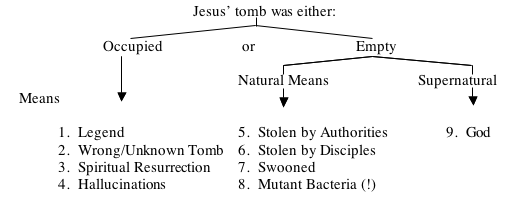
Skeptics of the historical fact of Jesus's resurrection offer explanations that fall into four main categories:
1.  The key actors on Good Friday and Sunday morning botched what they were doing.
2.  Science proves Jesus’s resurrection is impossible.
3.  The accounts of Jesus’s resurrection are mythical of a kind common in the ancient world.
4.  The apostles were either deluded or they mounted a deliberate conspiracy of falsehoods.

The "they botched it" theories
The "Swoon Theory"
The first allegedly-botched job was the crucifixion, in which the Romans incompetently took Jesus down from the cross unconscious rather than dead. Joseph and the women entombed Jesus still alive. This is called the “Swoon” theory; it dates to the 1780s.
The swoon theory says that the coolness of the tomb and Friday’s partial application of funereal spices made Jesus come to his senses. Before dawn Sunday he rolled away the stone and found some workman’s clothes, causing Mary Magdalene to mistake him for a gardener. So, the swoon theory does explain why the women found the tomb empty and why the presumed gardener claimed he was Jesus.
But it assumes that 
  • the brutal flogging that Jesus received from the Romans, 
  • the shredding of his head by a wreath of thorns, 
  • hanging on the cross with nailed hands and feet (with severe physical effects, including dislocation of the shoulders), 
  • and the deep piercing of his chest by a Roman spear, 
were all relatively minor injuries that 
  • left Jesus mentally fully competent, 
  • were not severe enough and evoked too little bleeding to kill or even much weaken him, 
  • insufficiently injured his hands and feet to degrade either his dexterity or mobility, 
  • left him with enough physical strength to single-handedly roll away a one-ton stone from the tomb, in the dark. 
  • did not hinder his ability to sneak past an armed guard standing only a few feet from the tomb,
  • had healed enough so that Mary did not recognize him as the recently-crucified Jesus. 
The swoon theory also ignores the fact that Jesus would have consumed neither food nor drink since Thursday evening but apparently suffered no ill effects from 84 hours or so without nourishment or water.
The theory assumes that Roman soldiers, of all people, did not know how to kill a defenseless man and ignores that their motivation to make sure Jesus was dead very great: under Roman military law, Roman soldiers who failed to carry out a sentence properly could be punished by receiving the same sentence to serve instead, meaning the soldiers at the cross were highly motivated to be positive that Jesus and the two thieves crucified with him were dead for sure.

The swoon theory also requires that Joseph and the women who partially prepared Jesus for burial on Friday did not detect that he still breathed and had a heartbeat, however weak it may have been. People in ancient times were very familiar with corpses. There were no funeral homes. Families did that work on their own. The women friends of Jesus, like any women of the day, knew very well about –
·      livor mortis, the collection of blood in the lowest parts of a corpse after the heart ceases beating, due to gravity. Livor mortis causes marked purpling of the body where it occurs and is usually noticeable starting about 20-30 minutes after death (though full discoloration takes somewhat longer). A man dead on a cross would have been so colored at around the ankles and shoulders. If Jesus was not dead when he was removed, livor mortis would not have occurred, and the women would certainly have noticed.
·      rigor mortis, the stiffening of the limbs of a corpse caused by chemical changes in the muscles. A corpse is highly resistant to manipulation because of this. To be fair to the swoon theory, though, it takes between 4-6 hours after death for rigor mortis to set in. Jesus was entombed by then. 
The swoon theory, then, requires not only that the Roman soldiers blundered the crucifixion but that the women were blind to the lack of empirical evidence that Jesus was dead, evidence which was common knowledge in their day.
The swoon theory does not explain
·  why Mary said Jesus was risen rather than that he survived. 
·  why Jesus apparently needed no medical care or convalescence. 
·  with whom Jesus lodged after his botched crucifixion, because he is nowhere presented as hanging out with the disciples.
·  why Paul and James, who had not followed Jesus, said they knew Jesus risen (and Paul first persecuted Christians).
·  why the Church would begin with such energy and devotion 
·  why the apostles suffered hard lives and cruel deaths to insist that Jesus was a risen Savior rather than merely a lucky convict. 
·  why the Romans did not mount a manhunt for the surviving Jesus when we know that when the Romans wanted you dead, they meant it. (The Romans didn't hunt for Jesus after the actual resurrection, either, when Peter et. al. were proclaiming him risen. Why? Because the Romans knew darn good and well that they had taken him down dead from the cross.)
An explanation, actually to explain, cannot create more unresolved issues than it tries to solve. The swoon theory thus fails.
Also, see the Journal of the American Medical Association's explanation, summarized here. The abstract:
Jesus of Nazareth underwent Jewish and Roman trials, was flogged, and was sentenced to death by crucifixion. The scourging produced deep stripelike lacerations and appreciable blood loss, and it probably set the stage for hypovolemic shock, as evidenced by the fact that Jesus was too weakened to carry the crossbar (patibulum) to Golgotha. At the site of crucifixion, his wrists were nailed to the patibulum and, after the patibulum was lifted onto the upright post (stipes), his feet were nailed to the stipes. The major pathophysiologic effect of crucifixion was an interference with normal respirations. Accordingly, death resulted primarily from hypovolemic shock and exhaustion asphyxia. Jesus' death was ensured by the thrust of a soldier's spear into his side. Modern medical interpretation of the historical evidence indicates that Jesus was dead when taken down from the cross.
The “wrong-tomb” theory 
This theory simply says that on Sunday morning the women mistakenly went to an unused, open tomb, talked with a gardener whom they mistook for Jesus, then excitedly told the disciples that Jesus’s tomb was empty and Jesus was risen.
However, 
·                  The women were not looking for an open, empty tomb. They had asked themselves en route how they would get the stone rolled away. So, when coming to an open, empty tomb, why didn't they  just keep going? Wrong-tomb theorists do not say, except to claim that the women were confused. ("They went to the wrong tomb because they were confused. How do we know they were confused? Because they went to the wrong tomb." Got it?)
·                  Having already been to Jesus's tomb on Friday, they knew which tomb to go to.
The wrong tomb theory does not explain: 
·                  why the gardener Mary conversed with claimed he was Jesus 
·                  why Mary called him Lord when he knew and she thought that Jesus was dead elsewhere.
·                  why the gardener told Mary to tell the disciples he would meet them in Galilee. 
The wrong-tomb theory also echoes the ancient belief that women could not be trusted to relate facts rather than addle-headed nonsense. Its unspoken precept is, “Let me tell you what those idiot women did.”
No historian concerned about his reputation promotes either the swoon theory or the wrong-tomb theory any more, but many people still argue them.
"Scientific" objections to the resurrection
Many people think that science shows it to be impossible. In fact, science shows no such thing. There are some scientists who say the resurrection is scientifically impossible. But there are many other scientists who profess religious faith. For example:
“A scientific discovery is also a religious discovery. There is no conflict between science and religion. Our knowledge of God is made larger with every discovery we make about the world.” - Joseph H. Taylor, Jr., who received the 1993 Nobel Prize in Physics for the discovery of the first known binary pulsar, and for his work which supported the Big Bang theory of the creation of the universe.  
“Astronomers have proven that the world began abruptly in an act of creation, And they have found that all this happened as a product of forces they cannot hope to discover. That there are what I or anyone would call supernatural forces at work is now, I think, a scientifically proven fact”. – Robert Jastrow, Astronomer, physicist and founder of NASA’s Goddard Institute of Space Studies.  
“The common belief that the actual relations between religion and science over the last few centuries have been marked by deep and enduring hostility is not only historically inaccurate, but actually a caricature so grotesque that what needs to be explained is how it could possibly have achieved any degree of respectability.” – Colin Russell, Cambridge University historian of science.  


“Both religion and science require a belief in God. For believers, God is in the beginning, and for physicists He is at the end of all considerations… To the former He is the foundation, to the latter, the crown of the edifice of every generalized world view.” – Max Planck, Nobel Prize physicist, founder of quantum theory, one of the most important physicists of the 20th century).

Two other examples are Dr. Francis Collins, director of the National Institutes of Health and former head of the human genome project, and Dr. John Lennox, professor and Fellow in Mathematics at Oxford University. There are many others.
Sociologist Elaine Ecklund surveyed 1,700 scientists and conducted personal interviews with 275 of them at elite American universities, seeking to find out what their views on religion were. She writes:
After four years of research, at least one thing became clear: Much of what we believe about the faith lives of elite scientists is wrong. The [presumed] ‘insurmountable hostility’ between science and religion is a caricature, a thought-cliché, perhaps useful as a satire on group-think, but hardly representative of reality.
Professor Ecklund's book is called Science vs. Religion: What Scientists Really Think. A long review with excerpts is here.

Most of the non-religious scientists Ecklund interviewed said that they just were not interested in religion questions, any more than a Methodist preacher would be much interested in how to mass produce elemental isotopes. And unlike the rest of America, younger scientists are more religious than older ones.
So, it is important to understand the difference between what science, as a discipline, can do and what scientists may personally believe. Scientists may deny or affirm the resurrection, but science as a discipline can neither rebut nor confirm it. Every discipline, science included, is bounded by "limit questions," which are inquiries that the discipline itself cannot answer.

For example, science does not and cannot tell you where to take your next vacation. Science is unsuited definitively to answer historical questions. You would think I was joking if I asked for scientific proof that George Washington crossed the Delaware River to fight Hessian forces at Trenton on Christmas 1776. That is not a scientific question, though science may help answer many historical details. 

The resurrection of Jesus is an historical question that science as a discipline cannot answer. It's not a scientific question. Every profession or skill or knowledge set is faced with limit questions. Imagine an evening at a concert and that as people started to leave you heard the man beside you say, “Speaking as a cardiologist, I have determined that this orchestra’s first violinist is the finest in North America.” Now that may be true, but it is certainly nothing one can determine because of cardiological training. It simply is not a medical question. 
Similarly, science investigates the natural world and so cannot speak definitively about supernatural events, which is what the resurrection is. One big reason is that the scientific method can't adequately address miracles. The error some scientists make is in therefore saying that there are no such things as miracles. 

Scientific integrity requires that scientists and non-scientists alike recognize that there are limits to scientific knowledge. Failing this is the main error of the so-called New Atheist movement, whose advocates insist that 
·                  only science reveals the Real, 
·                  only science can discover truth 
·                  scientific knowledge is exhaustive and inherently unlimited. 
But these claims are themselves not testable with the scientific method! They are not scientific claims, but claims of faith in science, or scientism. Richard Lewontin, an evolutionary biologist and geneticist, explained in The New York Review of Books in 1997 (link) that scientism has a ...
... prior commitment to materialism. It is not that the methods and institutions of science somehow compel us to accept a material explanation of the phenomenal world, but, on the contrary, we are forced by our a priori adherence to material causes to create an apparatus of investigation and a set of concepts that produce material explanations ... . Moreover, that materialism is absolute, for we cannot allow a Divine Foot in the door.
But nothing about Jesus' resurrection overturns science at all. Before he was Pope Benedict, Cardinal Ratzinger wrote that the resurrection is 
... no contradiction of clear scientific data. The Resurrection accounts speak of something new, something unprecedented -- a new dimension of reality that is revealed. What already exists is not called into question. Rather we are told that there is a further dimension, beyond what was previously known.  
Dr. Ian Hutchison is a professor of nuclear science and engineering at MIT. He is also a Christian. In an address at the Veritas Forum, he spoke of three hypotheses to explain why he believes in the resurrection of Jesus:
Hypothesis one: We’re not talking about a literal resurrection. Perhaps it is just an inspiring myth that served to justify the propagation of Jesus’ exalted ethical teachings. A literal resurrection contradicts the known laws of nature. Maybe scientists can celebrate the idea of Jesus’s spirit living on, while his body remained in the grave. 
Hypothesis two: We really believe in the bodily resurrection of the first century Jew known as Jesus of Nazareth. My Christian colleagues at MIT – and millions of other scientists worldwide – somehow think that a literal miracle like the resurrection of Jesus is possible. And we are following a long tradition. The founders of the scientific revolution and many of the greatest scientists of the intervening centuries were serious Christian believers. 
Hypothesis 3: I was brainwashed as a child. ... But no, I did not grow up in a home where I was taught to believe in the resurrection. I came to faith in Jesus when I was an undergraduate at Cambridge University and was baptized in the chapel of Kings College on my 20th birthday.
Hypothesis two wins:
To explain how a scientist can be a Christian is actually quite simple. Science cannot and does not disprove the resurrection. Natural science describes the normal reproducible working of the world of nature. Indeed, the key meaning of “nature”, as Boyle emphasized, is “the normal course of events.” Miracles like the resurrection are inherently abnormal. ...
Today’s widespread materialist view that events contrary to the laws of science just can’t happen is a metaphysical doctrine, not a scientific fact. What’s more, the doctrine that the laws of nature are “inviolable” is not necessary for science to function. Science offers natural explanations of natural events. It has no power or need to assert that only natural events happen.
So if science is not able to adjudicate whether Jesus’ resurrection happened or not, are we completely unable to assess the plausibility of the claim? No. Contrary to increasingly popular opinion, science is not our only means for accessing truth. In the case of Jesus’ resurrection, we must consider the historical evidence, and the historical evidence for the resurrection is as good as for almost any event of ancient history. [Italics added]
Much more here:


The Mythical Story theory
The next rebuttal of the resurrection is the claim that stories about a divine hero dying and returning to life were a dime a dozen among ancient peoples and that Jesus's resurrection is just another example. In this claim, “Jesus Christ is a mythological character along the same lines as the Greek, Roman, Egyptian, Sumerian, Phoenician, Indian or other godmen, who are all presently accepted as myths rather than historical figures.”
However, experts in the field are not making this claim. Professor Norman Geisler of Loyola University explains, “No Greek or Roman myth spoke of a literal incarnation of a monotheistic God into human form by way of a literal virgin birth, followed by his death and physical resurrection.”


Nor were such stories very common at all. Only about fifteen such ancient stories are identified by claimants. British scholar Norman Anderson argues, 
The basic difference between Christianity and the mysteries is the historic basis of one and the mythological character of the others. The deities of the mysteries were no more than ‘nebulous figures of an imaginary past,’ while the Christ whom the [apostles] proclaimed had lived and died only a few years before the first New Testament documents were written.
As Peter told the people of Jerusalem on Pentecost, you know this Jesus of whom I speak. Peter was not referring to a mythical figure of a hazy, distant past, but one whom his hearers had known personally.
Furthermore, most of the evidence for the alleged similarities from the pagan myths date between the second to fourth centuries, long after the New Testament had been written. If anything, most of those ancient myths are likely based on Jesus rather than the other way around.
Also, myth theorists must explain why the fiercely monogamous Jews would have adopted pagan myths to promote the Jewish Jesus and why they would have falsely claimed Jesus dead and risen when the existing, well-developed concept of the messiah had never included such a concept.
Finally, the pagan-myth hypothesis makes no attempt at all to grapple with the historical facts that are, well, facts, not myth.  
A summary of present scholarship on the pagan-myth hypothesis is here: "Scholarship On the Claim that the Resurrection Was Copied From Paganism."

Also a scholarly presentation, here is Dr. William Lane Craig:


The apostles were deluded or frauds
Last is the claim that the apostles were either deluded or they mounted a deliberate conspiracy of falsehoods. Almost no one claims any more that the apostles were deliberately lying because, as J.P. Moreland put it,
The disciples had nothing to gain by lying and starting a new religion. They faced hardship, ridicule, hostility, and martyr's deaths. In light of this, they could never have sustained such unwavering motivation if they knew what they were preaching was a lie. The disciples were not fools and Paul was a cool-headed intellectual of the first rank. There would have been several opportunities over three to four decades of ministry to reconsider and renounce a lie.
Charles Colson served Richard Nixon as "Special Counsel to the President" and was a key player in the Watergate conspiracy that finally led to Nixon's resignation. Colson was in fact one of the "Watergate Seven," the core conspirators, and he was the first Watergate conspirator to be sent to federal prison. In prison, Colson became a devout Christian; after release he spent the rest of his life in evangelism, especially prison ministries.
Here is what he once said about the idea that Jesus was not really raised from the dead, that the whole resurrection story came from collusion by the disciples:
I know the resurrection is a fact, and Watergate proved it to me. How? Because 12 men testified they had seen Jesus raised from the dead, then they proclaimed that truth for 40 years, never once denying it. Every one was beaten, tortured, stoned and put in prison. They would not have endured that if it weren't true. Watergate embroiled 12 of the most powerful men in the world - and they couldn't keep a lie for three weeks. You're telling me 12 apostles could keep a lie for 40 years? Absolutely impossible.
Let’s look at the delusion angle. Today’s leading figure in promoting this theory is German scholar and self-admitted atheist Gerd Ludemann, who says in What Really Happened to Jesus that the apostles undeniably believed what they proclaimed, but were so psychologically distraught from the cruel death of Jesus that they all suffered exactly the same hallucination that Jesus was alive again. Ludemann says that the source of the disciples’ visions were psychological processes which occurred “completely without divine intervention.” Therefore, “A consistent modern view must say farewell to the resurrection of Jesus as a historical event.”
(Ludemann taught for several years at Vanderbilt Divinity School, the source of my own M.Div. I began there just after he had returned to Germany so I did not study under him. However, What Really Happened to Jesus was an assigned book in my New Testament class.)
On its face the delusion theory seems plausible. But I would submit that it fails for these reasons:
·                  First, delusion theory presumes from the outset that the resurrection is false. When its greatest proponent is a self-described atheist, it sort of gives the game away. That is, its intention is to conclude what it begins with.
·                  Second, the delusion theory does not explain why the tomb was empty or why deluded apostles would say that a woman first bore the Easter message.
·                  Third, that the apostles’ delusion was caused by their psychological need to regain company with Jesus is suspect because the pre-resurrection disciples seem less devoted to Jesus than the theory demands. John 11, for example, records that eleven of the twelve were so upset with Jesus that they wanted to quit and go home, staying only because Thomas talked them into it. Every disciple abandoned Jesus to his fate when he was arrested, hardly evidence of such intense love and loyalty that they would later see hallucinations of Jesus alive.
·                  Fourth, the theory does not explain why Paul and Jesus's brother James became deluded as well. Neither man followed Jesus before his death; Paul had never even met him. Ludemann simply dodges this question altogether.
·                  Fifth, Ludeman assumes that the psychology of each of the disciples was identical and that they each spontaneously reacted mentally to Jesus’ death in exactly the same way. But this is a mere assumption necessary to make delusion theory work. It also assumes that their delusion was contagious and that Thomas could be “infected” by it when he had emphatically rejected the other disciples' testimonies and instead demanded literally tangible, physical proof.
Finally, such a delusion  seems unique in the entire world, having never occurred before or since. Ludemann attempts to show analogous delusions in other figures or groups of people in other historical occasion, but the examples are present only superficial similarities; most are actually more dissimilar than similar.

If the apostles were deluded, then I want that same delusion! It is a delusion that inspires people to become the finest they can be, to exhibit and live the highest virtues and to order their lives around love, integrity, faithfulness and devotion to the good of all. Delusion? May we all hope to be equally deluded.
Summary
I will leave the summary to Dr. Holly Ordway, Ph.D. (U-Mass. Amherst), a professor of literature in Texas. She grew up atheist, convinced that belief in a deity was mere superstition. But in 2012, she was baptized into the Catholic Church and since has written several works on Christian literature. In an interview, she said,
There were many pieces of evidence that all fit together to make a convincing case for the Resurrection [of Jesus]; I’ll mention just a couple here. One of them is the behavior of the disciples before and after the Resurrection. The Gospel accounts do not portray their behavior after the Crucifixion in a particularly flattering light. Even though Jesus had predicted his own resurrection, the disciples gave up and went away, assuming that Jesus was a failed messiah. If the disciples had made up the Resurrection story afterwards, why would they have included details that made them look disloyal and cowardly? My academic studies in literature allowed me to recognize that the Gospels were written as history, not myth or parable, and that there hadn’t been enough time for a legend to form. It began to seem like the best explanation for all these events being recounted this way, was that they really happened.
Then, after the Resurrection, there’s a complete turn-around in their behavior, and they become bold proclaimers of the Risen Lord. There were plenty of words that people in ancient times could have used to describe visions or sightings of ghosts, and indeed, such language would have gotten them in much less trouble! But they spoke of a Jesus who was alive, bodily resurrected, and in short order were willing to die for that claim.
Perhaps the most convincing evidence for the Resurrection, though, was the Church itself. If I supposed that the Church had invented the Resurrection to explain its own worship of Jesus, I had to ask, how did that worship arise in the first place? If the Church was not the result of a miracle, it was itself a miracle.
It’s important to say that there was no single, knock-out piece of evidence that convinced me; I was convinced by the cumulative claim, the way it all fit together. Historical events can’t be proved like a math problem or tested like a scientific hypothesis, and there’s always a way to form an alternate explanation. But just because an alternative exists doesn’t mean it’s is equally reasonable or likely. Speaking within my own field of literature, there are people who claim that William Shakespeare didn’t really write his plays. There are even a few legitimately fuzzy areas: for instance, a few of his plays were co-authored, and it seems likely to me that at least one passage in Macbeth (Hecate’s speech) was a later interpolation. Nonetheless, the evidence taken as whole points to Shakespearean authorship!
“Evidence as a whole” is really the key.


[5] Ibid


Tuesday, March 19, 2019

Rational Christian belief

How an atheist writer and lecturer came to confess Christ and become a Christian.
Philip Vander Elst, a former atheist, is a freelance writer and lecturer. He graduated from Oxford in 1973 with a degree in politics and philosophy, and has since spent most of his professional life in politics and journalism. He says that he loves “the world of books, ideas and debate,” and that two questions have always interested him, “Is there a God? And, if there is, what is the connection between God and freedom?” Vander Elst now works at Areopagus Ministries.

Vander Elst grew up in a non-Christian family with intellectually gifted but unbelieving parents, “I used to think that belief in God and the supernatural had been discredited by the advance of science, and was incompatible with liberty. Religious faith seemed to me to involve the blind worship of a cosmic dictator, and the abandonment of reason in favour of ‘revelation’. Why, in any case, should I take religion seriously, I thought, when the existence of evil and suffering clearly discredited the Christian claim that our world owed its existence to a benevolent Creator?”
Read the post for the answer.

Sunday, March 17, 2019

Five Confounding Facts About Jesus' Resurrection

What would the church be like today if Jesus had died an old man in bed?
A.   It would look almost the same as it does now. Sunday schools, worship, hymns and ministries would be much the same. 
B.   We’d all be Unitarians. Except that even Unitarians discuss Jesus's resurrection stories. If Jesus died in bed, those stories wouldn’t have been told. So perhaps we’d be Unitarians-Lite. 
C.   What church? We’d all be either pagans, Jews or Muslims.
This was actually a discussion topic in a theology class when I was at Vanderbilt. My answer was C: “What church? Without the shock and discontinuity of Jesus’s crucifixion and resurrection there would be no church at all.”
This frankly did not much impress the TA leading the session, who scoffed at the whole idea of Jesus’s bodily resurrection and who thought that Jesus’s teachings were an excellent vehicle to promote  Marxism – she said this  – and so my insistence on the reality of the resurrection of Jesus garnered me only a B in the class. It was the proudest B I ever got (except seventh-grade algebra).
But I still insist that without Jesus’s resurrection, “we got nuthin.” That Jesus’s teachings are excellent hardly need be said, but they are all found in the Jewish Scriptures. If you built a religion only on Jesus’s teachings you would wind up with a variant of orthodox Judaism, differing only in perhaps having comparatively lax dietary laws and lacking the ideological rigidity of Jesus’s day, a rigidity that is not much found among Orthodox Jews of today, by the way.
Some Orthodox Jews I have spoken with admire Jesus’s teachings and interpretation of the Torah. Jesus broke no new ground there. Jesus simply expressed God’s previously-revealed truths in a compelling manner. So a religious movement based just on Jesus’s ethical and moral teachings would be definitively Jewish, not very different from the Judaism of his time, and certainly nothing to motivate twelve men to give their lives evangelizing the whole world in Jesus’s name. I mean, why bother?
But the TA’s discussion highlights one of the most confounding historical facts about Jesus and the resurrection story: The Church came into being suddenly and with an enormous fervor that finally brokered regime change of the Roman empire itself. 
If Christianity started as nothing but a minority Jewish movement centered on an executed and still-dead messianic leader, why did it succeed when all the other messianic movements of the day failed? No one has ever explained that.
There are at least five historical facts that must be accounted for either to affirm the resurrection or to deny it. These facts are not dependent upon the Scriptures being inspired by the Holy Spirit. These are objective facts that can be independently verified by anyone taking the time to do so.

The first fact I just talked about. It is the sudden and immediate founding of the Church following the death of the man called Jesus of Nazareth. We don’t even have to bring up the Day of Pentecost. That the church began with the power and beliefs that it did has never been explained on any basis that leaves Jesus, like John Brown, “a molderin’ in his grave,” especially since absent Jesus's resurrection, there is nothing left but ordinary Judaism. 
What must be explained is not why the first Christ-followers were Jews (who else would they be?), but why they were Jews who insisted their Messiah had been executed and then raised by God from the dead. 
The reason this is critical is because the long existing Jewish concept of the Messiah had never included his execution and resurrection. The Messiah was conceived of as a political figure and deliverer from foreign occupation and domination, first by the Greeks from about 250 BC and then by the Romans, after which the Messiah would re-establish the throne and lineage of King David.
That many people hoped Jesus would be this kind of Messiah is seen in his joyous greeting as he entered Jerusalem on the day Christians call Palm Sunday. They lay their cloaks on the road in front of him, a sign of highest respect and honor. They waved palm branches, a symbol of Judean nationalism, as Jesus entered the city riding in on a colt (Matthew says a young donkey). This was seen as fulfilling the prophecy of Zechariah 9:9, which said, 
"Rejoice greatly, O Daughter of Zion! Shout, Daughter of Jerusalem! See, your king comes to you, righteous and having salvation, gentle and riding on a donkey, on a colt, the foal of a donkey."
As a member of the line of King David, Jesus had a rightful claim to the throne of Judea. The throne was occupied by Herod Antipas, a Roman vassal who was not even really Jewish. The people despised Herod almost as much as Pilate. They wanted to be free of him as well as of the Romans.
The Jews wanted a Jewish King with a legitimate claim to the throne who would rule justly. They thought that Jesus was their man. His works of mercy and compassion were well known, as was the amazing power with which Jesus did them. Luke says that "the whole multitude of the disciples began to praise God joyfully with a loud voice for all the deeds of power that they had seen."
Nor was Jesus's potential Messiah-ship missed by the Jewish high council, the Temple/Priestly Sanhedrin, headed by the High Priest, Caiaphas. John 11-12 record that he certainly saw Jesus as a potential leader of insurrection against Rome, which caused him great concern that the Roman governor, Pontius Pilate, would lay waste to Judea when Jesus made his move. This was not at all an unjustified fear, except that Jesus never intended to lead such a revolt. 
All of this is to emphasize that when Jesus was executed, his appeal to the people would have died along with his body. There had been other would-be Messiahs before who fared as badly at it as Jesus did and whose followers promptly and permanently dissipated, fearing for their own lives - and Jesus never tried to be such a Messiah in the first place. (Now we see that when Jesus's disciples fled and hid when Jesus was arrested, they were just playing to type, for they knew that Jesus was a goner for sure and they would be next if they didn't get out of Dodge.) 
In fact, the Gospels record that by the day of Jesus's execution, public sentiment was swinging heavily against him. Even if the priests did hand pick a crowd to yell to Pilate to crucify Jesus, they had no difficulty finding people willing to do it. 
So why would the Jesus movement not merely survive his death but actually accelerate afterward? Jesus was an abject failure in every aspect of Messiah-ship as conventionally conceived. And yet, almost instantly after his death, not only were more and more people, quickly numbering thousands in fact, counting themselves as Christ followers, they also completely re-wrote what "Messiah" meant at all. 
Donald Juel discusses the challenge of a crucified Messiah:
The idea of a crucified Messiah is not only unprecedented within Jewish tradition; it is so contrary to the whole nation of a deliverer from the line of David, so out of harmony with the constellation of biblical texts we can identify from various Jewish sources that catalyzed around the royal figure later known as the “the Christ” that terms like “scandal” and “foolishness” are the only appropriate responses. Irony is the only means of telling such a story, because it is so counterintuitive. 
Even Paul commented about the challenge of proclaiming an executed Messiah to other Jews: 
For since in the wisdom of God the world through its wisdom did not know him, God was pleased through the foolishness of what was preached to save those who believe. Jews demand signs and Greeks look for for wisdom, but we preach Christ crucified: a stumbling block to Jews and foolishness to Gentiles (1 Cor.1:21‑22). 
Non-Christian historian Bart Ehrman wrote, 
Christians who wanted to proclaim Jesus as messiah would not have invented the notion that he was crucified because his crucifixion created such a scandal. Indeed, the apostle Paul calls it the chief “stumbling block” for Jews (1 Cor. 1:23). Where did the tradition come from? It must have actually happened.
There is no historically-grounded explanation for this sudden and enormous change that leaves Jesus dead after Good Friday. The only explanation that has evidence behind it is that Jesus was crucified, died and was raised from death, was then seen risen by numerous people who had known him in life, and these facts impelled a wrenching re-evaluation of what being Jewish actually meant at all.

There are at least four other historical facts that either to affirm or reject Jesus's resurrection must account for. The question is not whether these historical facts are actually facts. The question is what explanation actually explains, actually accounts for all of them?
Two– Jesus’s tomb was discovered empty on the Sunday after he died on the cross.
Three – The first person to claim that Jesus rose from the dead was a woman.
Four – Many other people also said they saw Jesus risen from the dead, especially Paul and James the brother of Jesus, called James the Just.
Five – The apostles who proclaimed Jesus’s resurrection were killed for doing so, except John, who died in exile. None recanted even when it would have saved their lives.
Note that none of these facts rely on supernatural authority. They are historical facts documented as well or better than accounts of other ancient figures or events. Let’s take a closer at each.

Fact Two: Jesus's tomb was found to be empty on the Sunday after his crucifixion.
All accounts of the day include this fact. Since multiple attestation is a bedrock principle of historical inquiry, historians, and not only Christian ones, consider this fact to be solidly established.
This fact was so confounding to the apostles’ opponents that the Gospels record that within days or sooner of the first Easter, those opponents admitted they could not explain the empty tomb nor could they produce Jesus's body themselves, so they spread the story that the disciples stole the body. Yet there is not a scintilla of evidence that the disciples did so.
But let us stipulate for argument’s sake that somehow three or four disciples managed to sneak undetected past an armed guard of soldiers at the tomb, roll away a one-ton stone without making noise, enter the tomb without being noticed, and trundle away Jesus’s corpse without being seen, leaving the stone rolled away without the soldiers subsequently noticing. (Sure, let’s say that is exactly what happened.)
That leaves us with the inexplicable fact that the disciples did exactly nothing afterward. They did not start telling people that the tomb was empty and they had seen Jesus alive again. The disciples did not originate the Easter story at all. Instead, we butt against historical fact number three:

Fact three: The original testimony of Jesus's resurrection was given by a woman, Mary Magdalene.
When Mary discovered the tomb was open and empty, she thought someone had taken the body, not that Jesus was risen. So she asked a man she assumed to be a groundskeeper where Jesus’ body was. The man identified himself as Jesus. If Jesus was still dead, why did this man say he was Jesus? There is absolutely no reason for it. If Jesus was still dead, then this conversation is almost as vexing to explain as the resurrection itself. And if the disciples had stolen the body as they were accused of doing, when Mary told them, “I have seen the Lord,” would not they have simply replied, “Um, no, we have Jesus in the back room here”?
Instead, at least two of the disciples rushed to the tomb to confirm her claim. Soon, all the disciples told the world that the empty tomb and Jesus's resurrection were first discovered and proclaimed by women. However, women were universally considered by both first-century Jews and Romans alike to be unreliable witnesses of anything, resurrection or not. Dr. William Lane Craig explained it this way:

When you understand the role of women in first-century Jewish society, what's really extraordinary is that this empty tomb story should feature women as the discoverers of the empty tomb in the first place. Women were on a very low rung of the social ladder in first-century Palestine. There are old rabbinical sayings that said, 'Let the words of Law be burned rather than delivered to women' and 'blessed is he whose children are male, but woe to him whose children are female.' Women's testimony was regarded as so worthless that they weren't even allowed to serve as legal witnesses in a Jewish court of Law. In light of this, it's absolutely remarkable that the chief witnesses to the empty tomb are these women... Any later legendary account would have certainly portrayed male disciples as discovering the tomb - Peter or John, for example. The fact that women are the first witnesses to the empty tomb is most plausibly explained by the reality that - like it or not - they were the discoverers of the empty tomb! This shows that the Gospel writers faithfully recorded what happened, even if it was embarrassing. This bespeaks the historicity of this tradition rather than its legendary status.

If you were going to make up a story in the first century to change the world, you would not say that the original announcers of your claim were women.

Fact four – Many other people also said they saw Jesus risen from the dead
These accounts are dated to very soon after Jesus’s death. In First Corinthians, Paul wrote that he was taught about Jesus's resurrection from others (1 Corinthians 15:1-8), acknowledged today to be Peter and James. Paul says specifically in 1 Cor. 15.11 that all the apostles agreed that Jesus appeared to them after his death. Jesus’s own brother, James, never followed Christ until after Jesus’s death and then James became the first bishop of the Jerusalem church.
Because Paul first persecuted Christians, he knew they were proclaiming Jesus as risen long before he converted. We don’t know how long except that it was long enough for Paul to have developed a fearsome reputation among Christians; Acts 9 says he “breathed murderous threats” against them. Historians agree that after Paul’s conversion, Peter and James tutored Paul about Jesus and his resurrection only about five years after the crucifixion. But since they taught Paul, their knowledge must be much earlier. One of today’s most highly-regarded historians of the era is non-Christian Professor Bart Ehrman, who dates such Christian teachings to practically the same date as the date of Jesus’s death. Skeptics have never explained these facts in a way that leaves Jesus dead.

Fact five – The apostles who proclaimed Jesus’s resurrection were all killed for doing so, except John, who died in exile. None recanted even when it would have saved their lives. We know recantation would have saved them because Roman officials’ letters of the day say so.
Several of the accounts of the deaths of the apostles date to several decades after they would have died of old age anyway, so historians today do not give equal weight to all the accounts of their martyrdom. But the martyrdom of these apostles is historically sound:
James was the first apostle to be killed. He was slain by Herod Agrippa in either 44 or 45.
Peter was sentenced to crucifixion. He told the Romans he was unworthy of dying the same death as the Lord, so he was crucified upside down in Rome in 64.
Paul was beheaded by order of Nero outside Rome in 67.
Here are the apostles whose martyrdoms are not quite as well attested but still reliably so: Andrew and Thomas, both executed in 70; Matthew, beheaded in the 60s; James the Lesser, cast down from the Temple’s heights in 63; Simon the Zealot, crucified in 74.
Now we know that people will die for all kinds of crazy reasons, but consider that these apostles did not die for something they had been indoctrinated in since infancy, as, say, Japanese kamikaze pilots were. Another important distinction is that the apostles devoted their life work to Christ but did not give up their lives for Christ: their lives were taken from them by force. The apostles suffered death rather than recant their testimony of what they had seen with their own eyes.
Furthermore, what was their payoff? They didn’t personally profit in any way from their preaching. Indeed, their lives were made very difficult by it. The apostles were already faithful Jews. If Jesus was not actually raised, saying that he was raised would have added nothing to their faith and would have benefited them in no way in this life or the next. So what’s the point? Have fun explaining that in a way that leaves Jesus's body lying in the tomb. Jesus dead and still buried would have been entirely useless to the apostles to found any kind of religious movement.
What compelled the apostles to evangelize the ancient world was one thing and one thing only: Jesus Christ “was crucified, dead, and buried; The third day he rose from the dead.” None of the apostles ever stopped being Jewish but they came to understand that the fullness of God and God’s salvation-righteousness was revealed in the person, work, death and resurrection of Jesus Christ.
I have also written as fairly as I am able about the skeptics’ explanations. They fall into four main categories:
  • The main players on Good Friday and Easter botched the job.
  • Science proves Jesus’s resurrection is impossible.
  • The accounts of Jesus’s resurrection are mythical of a kind common in the ancient world.
  • The apostles were either deluded or they mounted a deliberate conspiracy of falsehoods.
Update: An excellent discussion of the criteria used by historians to assess reliability: "Surprising Scholarly Agreement on Facts That Support Jesus’ Resurrection"

Saturday, March 2, 2019

Social justice and churches

WHY SOCIAL JUSTICE IS KILLING SYNAGOGUES AND CHURCHES
Data suggests that the more a religious movement is concerned with progressive causes, the more likely it is to rapidly lose members
The mainstream Protestant churches are not exactly filling the sanctuaries either. Some, like the internally conflicted Methodists have seen their number of North American congregants drop from 15 million in 1970 to barely half that today. Since 2007 alone, America’s mainstream churches have lost 5 million members, and even the once vibrant evangelical movement is losing adherents outside of the developing world. Ever more churches, particularly in urban areas, are being abandoned, turned into bars, restaurants, and luxury condos. And nothing augurs worse for the future than the fact that American millennials are leaving religious institutions at a rate four times that of their counterparts three decades ago; almost 40 percent of people 18 to 29 are not unaffiliated.
Read the whole thing.

Thursday, February 28, 2019

After General Conference


Post Conference – One More Year

One day Jesus was speaking to a large crowd. He told told a parable or two of the coming of God’s judgment, then warned the crowd to understand the signs of the times and to be faithful. Luke 13 opens this way.

Now there were some present at that time who told Jesus about the Galileans whose blood Pilate had mixed with their sacrifices. Jesus answered, “Do you think that these Galileans were worse sinners than all the other Galileans because they suffered this way? I tell you, no! But unless you repent, you too will all perish. Or those eighteen who died when the tower in Siloam fell on them—do you think they were more guilty than all the others living in Jerusalem? I tell you, no! But unless you repent, you too will all perish.”

These five verses tell of Pilate sending his soldier to kill some Galileans making sacrifices. Rather than ask the circumstances, which is what you and I would probably do, Jesus challenges his listeners to rethink their own assumptions. By the way, he adds, don’t forget the eighteen people who were just standing around, minding their own business when a tower collapsed on them. Were they guiltier of sin than the other people of Jerusalem? No! Jesus is warning those who think themselves righteous: unless you repent you will nonetheless perish.
Then Jesus told a parable:
A man had a fig tree, planted in his vineyard, and he went to look for fruit on it, but did not find any. So he said to the man who took care of the vineyard, ‘For three years now I’ve been coming to look for fruit on this fig tree and haven’t found any. Cut it down! Why should it use up the soil? "Sir," the man replied, "leave it alone for one more year, and I’ll dig around it and fertilize it. If it bears fruit next year, fine! If not, then cut it down."

There are three characters in the parable: the man who owned the vineyard, the gardener, and the fig tree. Of course, the fig tree is a character because this is not a story about trees. It’s a story about you and me and the world we live in. It’s a story about condemnation and grace, of dismissal and reconsideration. It’s a story about repentance, mercy and judgment.
There is a man who owns a vineyard and in the vineyard, he had a fig tree. For three years the owner looked for fruit to be produced by the tree but there was none. So, the owner tells his gardener, "Cut it down!"
The gardener begs the owner to let it stand. Give it one more year, the gardener pleads. He promises to turn the soil around the tree and take special care of it. Then if it doesn’t bear fruit, he says, you can cut it down.
And that’s the end of the parable. Did the owner agree or did he insist on immediate destruction? And if he agreed to the gardener’s plea, what happened after a year? Was there fruit or not? And if not, what then? More importantly, what happened during the year? Did the gardener keep his promise of care or did he just let the tree succeed or fail on its own?
Jesus doesn’t say. These are blanks he left us to fill in.
Some of you know that before General Conference began, I said that it was really just a warm-up for the regular General Conference in May of next year. 
What happened this week was not a good outcome. 
If the One Church Plan had passed, that would not have been a good outcome. 
If no plan had passed and the status quo had been maintained, that would not have been a good outcome. 
This General Conference could have been scripted by a Greek tragedian. It was a three-act play with no possible happy ending. To anyone who rejoices in the outcome, heed Jesus’ word: "unless you repent, you too will perish." And to anyone who despairs or is angered at the outcome: "unless you repent, you too will perish."
What this conference shows me more than anything was that we, as a denomination, must repent. We are more like Washington than New Jerusalem, God forbid! But we have a year, do we not, until May of 2020? Even one more year is God’s gift. While we are living, God is working with us and for us, trying to get us the bear fruit for the strengthening of his kingdom. One more year to get right with God. 

But we do not have forever to decide about forever. The ax can still fall. So, there is a particular urgency to start producing fruit pretty quick. A "lesson of the fig tree is a challenge to live each day as a gift from God. Live each day in such a way that you will have no fear of giving an account for how you have used God’s gift" (NIB).
It’s also an instruction for us to examine the way we treat one another. The parable invokes each of us to ask whether we are more eager to cut than to cultivate. It was easy to watch or listen to the Conference over the internet and announce how the delegates, the bishops, or the presiding elders were all screwing it up, and how this delegate or that one was either bigoted or godless. Then I remembered the words of Saint Augustine:


We are hopeless creatures, and the less we concentrate on our own sins, the more interested we become in the sins of others. We seek to criticize, not to correct. Unable to excuse ourselves, we are ready to accuse others.

There will be no better Methodism until there are better Methodists. One more year of care and cultivation is before us. God is merciful. Are we? If the gardener represents that God is slow to anger, abounding in love and faithfulness, how well are we doing in that department? The sad fact is we are more likely to swing the ax than cultivate one another to be fruitful.
Why is that? It’s not the example Christ gives us. Here’s a tree that isn’t producing fruit. What is the solution? Cut it down? Not at all! The solution is so unexpected – so foolish, really – that it could not occur to anyone but God. The answer is to give it more water, more nutrition, more nurturing and more care. In the coming year, this tree can bear fruit. It is the year of the Lord’s favor.
Paul wrote, “God is able to make all grace abound to you, so that in all things at all times, having all that you need, you will abound in every good work” (2 Cor 9:8). That is a gardening God. Where there is barrenness of spirit or service, barrenness of love or discipleship, there you will find God, humbly kneeling, turning the soil of our lives and cultivating with care. What else can God do with us? It’s in his interest for us to bear fruit, too.
But we cannot be passive. We have to respond to being cultivated by the Holy Spirit and by the godly people of our church. We have to accept cultivation, to listen, to learn, to serve, to pray, to repent of barrenness, and then bear righteous fruits of faith and godly works. God, like a gardener, patiently works the soil of our lives. Bad things happen and we are sinners anyway, but God’s grace abounds all the more.
One more year. What is the fruit you will produce, or I? Will we cultivate godliness and fruitfulness in one another or just swing the ax? That part of the story we will write ourselves.

Thursday, February 14, 2019

"What's Jesus Got To Do With It?"

Nashville Public Radio interviews Vanderbilt Divinity School New Testament Prof. Amy-Jill Levine, who was my main NT professor there during my M.Div. studies. Web page here.


Sunday, February 3, 2019

How ISIS drove Muslims to Christian Faith

NBC News: Life under ISIS led these Muslims to Christianity "If heaven is made for ISIS and their belief," said one convert, "I would choose hell for myself instead of being again with them in the same place, even if it’s paradise."
While residents are still dealing with the emotional scars left by the brutality of ISIS, Omar says many people in Kobani have been open-minded about Christianity.

Image: Omar reads the Bible at the Church of the Brethren

Omar reads the Bible at the Church of the Brethren in Kobani, Syria.  NBC News
“Most of the brothers here converted or come to church as a result of what ISIS did to them and to their families,” he added. “No one is forced to convert. Our weapon is the prayer, the spreading of spirit of love, brotherhood and tolerance.”

Thursday, January 31, 2019

Over the edge of evil

Serving Democrat politicians want laws to allow the deliberate, pre-meditated killing of infants outside the womb. How else to explain the words of Virginia Gov. Ralph Northam, who openly ...
endorsed infanticide and tried to make it sound as harmless as he could. When asked by a radio host if he supported Virginia legislator Kathy Tran’s proposed law to permit abortion while a woman was in labor, Northam replied:
This is why decisions such as this should be made by providers, physicians, and the mothers and fathers that are involved. When we talk about third-trimester abortions, these are done with the consent of the mother, with the consent of physicians, more than one physician by the way, and it’s done in cases where there may be severe deformities, there may be a fetus which is non-viable. So in this particular example, if the mother is in labor, I can tell you exactly what would happen, the infant would be delivered, the infant would be kept comfortable, the infant would be resuscitated if this is what the mother and the family desired, and then a discussion would ensue between the physician and the mother. (italics added)
Here is the video:


Please note that Northam thinks this is perfectly okay because, after all, "The infant would be kept comfortable" right up until it is destroyed. Maybe the SS should have taken that tack at Auschwitz because, "We will be nice to you right up until we brutally kill you" can't possibly be wrong.

The Federalist points out that the bill being discussed here was presented by Virginia Delegate Kathy Tran, who said this during a subcommittee hearing:
“How late in the third trimester could a physician perform an abortion if he indicated it would impair the mental health of the woman?” [subcommittee chairman Todd] Gilbert asked.

“Through the third trimester,” responded Tran. “The third trimester goes all the way up to 40 weeks.”

“Where it’s obvious that a woman is about to give birth, that she has physical signs that she is about to give birth, would that still be a point at which she could request an abortion if she was so certified?” Gilbert asked.

“She’s dilating,” he continued, using the term for a woman’s cervix naturally opening to allow a baby to exit his mother during birth. “I’m asking if your bill allows that.”

“My bill would allow that, yes,” she said.
Which is to say, Tran wants the law to allow the mother to tell the doctor to kill the being-born or newborn (Northam: "the infant would be delivered") infant. While Northam said that more than one physician needs to be consulted, Tran insisted that only one be permitted for the go-ahead.

I do not know words nearly harsh enough to condemn the overt, public murderousness of today's progressivism. And on the same day that Gov. Northam, considered a rising star in the Democrat party, said that just-born babies should be killed on the mother's whim, the extraordinary hypocrisy of his party was on full display by Sen. Sherrod Brown, D.-Ohio, who said, talking about President Trump,
"Real populists don’t engage in hate speech and don’t rip babies from families at the border."
But the law already allows babies to be literally ripped - as in ripped apart - inside the womb and now Democrats want to allow living, delivered infants to be ripped from life itself.

I used to listen attentively to by left-of-center friends and ministerial colleagues on the matter of public policy, even though I hardly ever found that I could agree with their positions. But I did try to understand their point of view and how they justified it, whether on secular or biblical bases.

That door is now slammed shut. After Tran/Northam/Brown, There is no "understanding" possible that stays on this side of insanity. From now on, I absolutely refuse to tolerate any lecturing by a "progressive" on the subject of morality on any issue, and this is now my number one reason why.

That abortion, inc., in America today is openly racist does not matter to its advocates, whose most vocal and public members are white women. Why do I say that? because according to the Guttmacher Institute (2014 data), of women who had an abortion,
Thirty-nine percent were white, 28% were black, 25% were Hispanic, 6% were Asian or Pacific Islander, and 3% were of some other race or ethnicity. ...
... three-fourths of abortion patients were low income—49% living at less than the federal poverty level, and 26% living at 100–199% of the poverty level.
Which means that minority infants were killed in the womb far out of proportion to the share of those demographics in the general population. Same with income levels - the "low income" demographic described as obtaining three-fourths of abortions are minorities to a very high degree.

In New York City, for example, more black babies are killed in the womb than are born alive, according to the New York City Department of Health and Mental Hygiene Office of Vital Statistics.

But progressives won't talk about that because shut up.

Doctor Anthony Levantino performed 1,400 abortions until he abandoned that practice. Here is part of his testimony to Congress on how second-trimester abortions are done. For third-trimester abortions, the baby is chemically killed in the womb and two or three days later the mother's body ejects the dead infant through the birth canal, usually with inducing drugs' assistance.

When someone demands that a woman must have "the right to choose," remember that this is what that choice means:


As Lincoln said about slavery, "If this is not wrong, then nothing is wrong." But "wrong" is far too wimpy a word to describe this. This is over the edge of evil.

Tuesday, January 29, 2019

Digital heroin addiction worsening

I have used, though did not invent, the term "digital heroin" to refer to people's addiction the glowing-screen devices, especially smart phone and tablets, and especially by children. Comes now further, abject confirmation. From the Daily Mail, "Generation of child web addicts: Youngsters are becoming so obsessed with the internet they spend more time on YouTube than with friends as parents struggle to keep control of their online usage."
Children have become such screen addicts they are abandoning their friends and hobbies, a major report warns today. Researchers found under-fives spend an hour and 16 minutes a day online. Their screen time rises to four hours and 16 minutes when gaming and television are included. Youngsters aged 12 to 15 average nearly three hours a day on the web – plus two more hours watching TV. The study said YouTube was ‘a near permanent feature’ of many young lives, and seven in ten of those aged 12 to 15 took smartphones to bed. It concluded: ‘Children were watching people on YouTube pursuing hobbies that they did not do themselves or had recently given up offline.’ A growing number of parents admitted to researchers that they had lost control of their children’s online habits.
Next is a report on Nashville's local Fox affiliate, "Study: Increased screen time in young children associated with developmental delays."
A new study from psychologists and doctors in Canada found increased screen time in young children can cause issues with children reaching developmental milestones. Researchers studied 2,441 mothers and children with higher levels of screen time for children aged 24 and 36-months-old. Researchers then examined developmental milestone test results in the same children at 36 and 60-months-old. The study found on average, 24-month-old children were watching 17 hours of television per week, 36-month-olds watched 25 hours per week, and 36-month-olds watched 11 hours per week. The totals reflect findings children on average in the U.S. watch to 2 hours and 19 minutes of screen time each day. For each age group, children with increased screen times showed poorer performances on developmental testing when they reached the next age group. Developmental evaluations included communication, gross motor, fine motor, problem solving, and personal-social skills. The totals are well above the recommended 1 hour per day of screen time watching high-quality programs. Researchers say about one quarter of children are not developmentally ready for school entry and the trend parallels an increase in screen time use by children.
Many parents use glowing screens as a sedative to pacify their children I have seen this in public too many times to count. But people, these thing are literally addictive, and when children (a) learn they will be given a screen to stop pitching a fit, and (b) they cannot help pitching the fit anyway because they literally are suffering from withdrawal symptoms, then the parent-child-screen interface becomes a self-reinforcing do loop. My kids escaped this, fortunately. Our youngest was 14 when the first smart phone came out and none of them got a smart phone until they were in college (if then). But I have, no kidding, seen infants who cannot even walk yet with their very own smart phones - and now you can buy those phones especially built for small kids (more accurately, for parents of small kids who visually identify those phones with toys, as the makers intend them to do).
Yes, this is sadly real - just click here.
What is the tie-in to these kids' futures? Well, consider that researchers both in the US and Europe have discovered that IQ scores are getting lower, and the younger one is, the greater likelihood his/her IQ is lower than a generation before. And while glowing screens do not seem to explain all the fall, they are absolutely part of it.

Falling IQ scores may explain why politics has turned so nasty

Western IQ scores are falling. Is it computers or something else? Parents, take this seriously!

Monday, January 14, 2019

"Help! Help! I'm being repressed!"

We have long known and studied dignity cultures and honor-shame cultures. Now sociology professors Bradley Campbell and Jason Manning say there has emerged a new kind of social-interaction dynamic: victimhood culture, explaining an incident at Oberlin University.
The Oberlin student [who took offense at an email] took a different approach: After initially emailing the student who offended her, she decided to publicly air the encounter that provoked her and their subsequent exchange in the community at large, hoping to provoke sympathy and antagonism toward the emailer by advertising her status as an aggrieved party.   
 But she was met from the original emailer with even more strident claims that she had victimized him even more. And it went downhill from there - "There is no end to conflict in a victimhood culture."


What's distinguishes this culture from honor-shame or dignity cultures? The professors explain:
It isn’t honor culture. “Honorable people are sensitive to insult, and so they would understand that microaggressions, even if unintentional, are severe offenses that demand a serious response,” they write. “But honor cultures value unilateral aggression and disparage appeals for help. Public complaints that advertise or even exaggerate one’s own victimization and need for sympathy would be anathema to a person of honor.” 
But neither is it dignity culture: 
“Members of a dignity culture, on the other hand, would see no shame in appealing to third parties, but they would not approve of such appeals for minor and merely verbal offenses. Instead they would likely counsel either confronting the offender directly to discuss the issue, or better yet, ignoring the remarks altogether.”
The culture on display on many college and university campuses, by way of contrast, is “characterized by concern with status and sensitivity to slight combined with a heavy reliance on third parties. People are intolerant of insults, even if unintentional, and react by bringing them to the attention of authorities or to the public at large. Domination is the main form of deviance, and victimization a way of attracting sympathy, so rather than emphasize either their strength or inner worth, the aggrieved emphasize their oppression and social marginalization.” 
It is, they say, “a victimhood culture.”
Read the whole thing, "The Rise of Victimhood Culture" in The Atlantic.

Now I have two responses. The first is that victimhood culture is literally childish. It is a dynamic that resides at elementary-grade level, although, as the professors explain, college students today are far more adept and energetic in it than small kids. It is taking personal disagreements or conflicts to well, this level:


Remember one of the first rules of economics: That which is subsidized increases. When posting one's latest "I'm being repressed!" event across social media or public forums become routine, it will become rewarding. Posters become affirmed in their grievances and over time (not a long time!) want that affirmation again and again. So their level of "I'm offended" get lower and lower, their sprint to public revelation becomes quicker and sooner, and their claims of harm become ever-more insistent and exaggerated.

In short, victimhood culture is not about justice or peacemaking or conflict resolution. Quite the opposite: it is about domination and conflict creation and lengthening the fight, all the better to be affirmed. Victimhood culture is at bottom selfish, self-centered, and ultimately self-defeating.

My second response is that victimhood culture is very specifically contrary to the teachings of Christ, so anyone who thinks him/herself a Christian who engages in it very seriously needs to get a new understanding. Let me start with a referral to my essay of how Jesus rebutted the honor-shame dynamic that was firmly entrenched in first-century Judea, "How Jesus invented individual liberty."

Then how to get even with others the right way.


More urgently than ever, this is what we must teach our children.

A world without nuclear weapons - what would it look like?

 From Pope Leo this week, according to the National Catholic Reporter : " Pope Leo quotes Bob Dylan song in book foreword calling for n...