Thursday, March 22, 2018

Where is everybody? They're dead.

Fermi's Paradox was first posed by physicist Enrico Fermi in 1950. It goes like this: The universe is many billions of years old. Fermi calculated that an alien species smart enough to become spacefarers could reach any point in our galaxy in five million years. But we we have no scientific evidence that aliens beings have been here.


So, Fermi asked, where is everybody?


Many answers have been proposed by serious, highly-credentialed scientists - more than 50 different answers, as I recall. Now, Astronomy.com offers this: The aliens are silent because they are extinct:


Latest theory: This will never hear anything.
Life on other planets would likely be brief and become extinct very quickly, said astrobiologists from the Australian National University (ANU).

In research aiming to understand how life might develop, scientists realized new life would commonly die out due to runaway heating or cooling on their fledgling planets.

“The universe is probably filled with habitable planets, so many scientists think it should be teeming with aliens,” said Aditya Chopra from ANU.

“Early life is fragile, so we believe it rarely evolves quickly enough to survive.”

“Most early planetary environments are unstable. To produce a habitable planet, life forms need to regulate greenhouse gases such as water and carbon dioxide to keep surface temperatures stable.”

About four billion years ago, Earth, Venus, and Mars may have all been habitable. However, a billion years or so after formation, Venus turned into a hothouse and Mars froze into an icebox.

Early microbial life on Venus and Mars, if there was any, failed to stabilize the rapidly changing environment, said Charley Lineweaver from ANU.

“Life on Earth probably played a leading role in stabilizing the planet’s climate,” he said.
Then there is recent study, published in the prestigious journal Science, that life is simply impossible in probably 90 percent of galaxies in the universe because of intense gamma radiation. And ordinary solar and cosmic radiation would have stopped life here on Earth without the Earth's magnetic fields shielding the planet, but planetary magnetic fields apparently are very uncommon; they have not been detected on any other planet anywhere.

But wait! There's more! 
The Atlantic writes of World War 2 bomber crews who did pattern analysis of bullet holes from enemy fighters attacks. They thought if there was a pattern, then they could lessen the number of bombers shot down by increasing the armor in the hit sections of the bomber.


But it turns out that armoring holed sections of returned bombers was the wrong thing to do. 
Don’t protect the planes where they were taking the most damage, [mathematician Abraham] Wald said. Armor the planes where there were no bullet holes at all.

“You put armor where there are no holes, because the planes that got shot there didn’t return to the home base,” says Anders Sandberg, a senior research fellow at University of Oxford’s Future of Humanity Institute. “They crashed.”
The article goes on to explain "observer selection effect," where we are able to observe something only because we survived the causes. We look at our own world and see life in enormous variety, flourishing everywhere, even in rocks and immense pressures of the deep sea and hot springs of near-boiling temperatures.

So we readily conclude, "Life is everywhere on our planet, so it must be everywhere out there." This powers the SETI programs, in fact, and is so pervasive it even has a name: the Principle of Mediocrity, which means simply that earth and its biosphere are unexceptional. The earth and its life are merely average in the universe - average, which is what "mediocre" means. But it is just as likely - probably more so - that our conclusions spring the the observer selection effect: we conclude that what we see here is normal everywhere.

We see 100-mile-wide "bullet" holes on our planet, and hey, we're still here. All is well and this is cosmically normal. But there's a problem.

After all, there are 100-mile impact craters on our planet’s surface from the past billion years, but no 600-mile craters. But of course, there couldn’t be scars this big. On worlds where such craters exist, there is no one around afterward to ponder them. In a strange way, truly gigantic craters don’t appear on the planet’s surface because we’re here to look for them. Just as the wounds of the returning planes could reflect only the merely survivable, so too for our entire planet’s history. It could be that we’ve been shielded from these existential threats by our very existence. ...
 “Maybe the universe is super dangerous and Earth-like planets are destroyed at a very high rate,” Sandberg says. “But if the universe is big enough, then when observers do show up on some very, very rare planets, they’ll look at the record of meteor impacts and disasters and say, ‘The universe looks pretty safe!’ But the problem is, of course, that their existence depends on them being very, very lucky. They’re actually living in an unsafe universe and next Tuesday they might get a very nasty surprise.”

If this is true, it might explain why our radio telescopes have reported only a stark silence from our cosmic neighborhood. 
"Stark silence." Where is everybody? They're dead.
Perhaps we’re truly extreme oddballs, held aloft by a near-impossible history—one free from deadly migrating gas giants and solar-system chaos, but also filled with freakishly favorable accidents, like a cataclysmic impact early in our history that created a strange, gigantic moon that stabilized our orbit and allowed complex life to flourish. As the solar system continued to shake out, we somehow ended up with just the right amount of water to lubricate plate tectonics, keeping the climate habitable over hundreds of millions of years and preventing a Venus-style planetary resurfacing catastrophe, but not so much water that we wound up on a lifeless water world.
So far, empirical evidence supports the conclusion that we are alone. Or at least, "We’re effectively alone in the Universe... ."

Update, April 2023: It may well be that they are dead because they developed Artificial Intelligence that was much smarter than they were  - as we here on earth are close to doing now. And their AI simply killed them - not from hatred or anger or ill will, but because it simply considered the alien beings to be "made of atoms it can use for something else." But we may soon join their ranks, according to Eliezer  Yudkowsky, who leads research at the Machine Intelligence Research Institute and is widely regarded as a founder of the field of AI:
If somebody builds a too-powerful AI, under present conditions, I expect that every single member of the human species and all biological life on Earth dies shortly thereafter.
Read the whole thing, and this, too.

UpdateThe thought occurs to me that any alien spacefaring species would have had to evolve from cave-man equivalence to sophisticated technical skills. But technological evolution depends wholly not merely on a species' intelligence. It also depends on progressively powerful energy generation and usage.

We humans went from:
  • manpower to horsepower to
  • water and wind power (small dams and windmills) to
  • steam power to
  • coal power to
  • petroleum power to
  • nuclear power.
But our planet had those resources available. What if there is a super-intelligent species on Distant Planet that lacks merely one of those stepping stone energy sources? Such as no sub-species equivalent to horses, or no petroleum equivalent available.

No stepping stone energies, no space travel, no matter how smart they are.

Friday, March 16, 2018

Secret Service on preventing school shootings

This 2012, two-minute video is an interview with two Secret Service researchers about school shootings. Main takeway: In almost every case of someone shooting up a school, the shooter wrote or said in advance that he was going to do it.


And so did Nikolas Cruz, quite a long time before the Parkland, Fla., massacre. But the question is begged, if one of the most important ways to stop these shootings is to report to the authorities, then are not the authorities obligated to take steps?

When it came to the Parkland horror, apparently not. The literally years-long prequels to the massacre were filled with warnings that were, in some cases, deliberately ignored.

There were multiple warning extending back to early 2016 that Cruz was a threat to human life and safety

The Miami Herald:
The rage and obsession with violence documented by Cruz’s therapists during nearly two years of interactions when he was 15 to 17 years old continued through his school career: Again and again, authorities were warned about the teen’s explosive tendencies and lack of impulse control. Again and again, authorities ignored the warnings.

In addition to the troubling behavior Cruz exhibited at the schools he attended — including an incident in which the teen reportedly brought a backpack with bullets to class — law enforcement officers were also alerted that Cruz might be dangerous.

The FBI failed to act on two tips about Cruz, one of which involved Cruz posting online that he planned to become a “professional school shooter.” The Broward Sheriff’s Office was also warned about the teen, and had received a report that he “planned to shoot up the school.”
The FBI failed and has admitted to it. They failed so severely that Fla. Gov Scott called for the director's resignation.

The Broward County sheriff's department failed many times, especially after being specifically warned that Cruz would become violent very soon.

The school system could have had Cruz arrested, but did not because he was named Cruz.

The Broward County school board knew of Parkland shooter's obsession with guns and violence, documents show.

Stoneman HS administrators  themselves failed to take action in advance of the shooting..

Deputies visited Cruz's home on police business 45 or more times in the preceding few years.

911 audio of Deputy Peterson's radio transmissions provably show that he lied when he said post-event that he thought the shots were coming from outside the school.

Three other deputies arrived and took cover behind the cars and did nothing.

EMTs have said on the record that deputies prevented them from entering the school to begin treating and evacuating wounded. (Link is to local reporter's Twitter feed.) Also here.

So Cruz killed 17 people and wounded 12.

Reporting threats to the authorities only works when the authorities do something about the report. For the Parkland shooting, the authorities failed at literally every level. One has to ask: if they were going to design a system to fail on purpose, what would they have done differently from what they did do?

Monday, March 12, 2018

Sports: how to pay full costs of college


Would love to see a chart like this with the percentages of HS athletes who participate in NCAA athletics on a scholarship. Then let parents see it who are spending a fortune on putting their kids on every league sport they can under the delusion that it will pay their way through college.

I swear I could write a book about it. Our son did receive a scholarship for track and field when he started at Wake Forest in 2006. He was a thrower (discus, shot put, hammer, etc.). It was not until after he was awarded the scholarship that my wife and I learned how incredibly difficult they are to get. In fact, it was not offered at all until (a) he had been accepted to WFU on academic merit, and (b) he finished his senior HS year ranked second in the state in both shot put and discus.

And the first year his amount was 17 percent of Wake's $46,500 cost. He did not receive 100 percent until his senior year, and that was after he had been ranked as one of the top 15 javelin throwers in the NCAA. (Soph and junior years were much higher, but still less than100 percent.)

A coach told me that colleges do not award athletic scholarships for experience, that is, just because a kid showed up for practices and games for 10-12 years before college. If a boy or girl has played that long and is not ranked, then from a college coach's perspective, it means one or all of the following: S/he is not motivated, so no money for them. S/he is not talented, so no money for them. S/he has had bad coaching that the college coach now has to overcome, so no money for them.

Most parents do not know that the NCAA allocates scholarships to schools per sport. So there is a ceiling on how many full scholarships each head coach can award (which explains why they fractionalize them). As the coach told us, the way to get more money is to perform at a high level. It is literally pay for play.

However, academic awards have no such ceiling. Colleges can award as much money for academics as they can raise and get endowed. From parents' perspective, this can be very, very lucrative. I know a certain young lady whose academic awards and scholarships came to 125 percent of her annual costs. Yes, the extra 25 percent was hers to keep. She literally made a profit going to college.

Truly gifted child athletes can have a future in scholarship athletics, but they are a tiny number. For the other kids, athletics should be just for fun and fitness. Parent, spend that "would have spent" money for tutors in math and science.

Monday, February 26, 2018

Post-Parkland: Yes, the AR-15 is a very deadly military weapon

Introduction

I advise readers in advance that parts of this post will be both technical and probably unsettling. I am going to describe the wound ballistics of the 5.56mm round fired by the civilian-model AR-15 rifle, which is the civilian version of the US military's M4 carbine rifle. The only difference between the two weapons is that the M4 has a selector switch that enables it to fire fully automatic. That is, if the shooter depresses and holds the trigger, the weapon will will continue to fire until its ammunition supply in exhausted (see end note).

Both weapons will fire semi-auto, where a trigger pull shoots one round only. Trained shooters can fire very rapidly that way by pulling and releasing the trigger, but the rate of fire will not be nearly as high as full auto. Nonetheless, it can still be very high.

In ballistics, the general principles of which I learned at the US Army Field Artillery School, there are three phases for rifle (or artillery) ammunition: barrel ballistics, flight ballistics, and terminal ballistics. For rifles, terminal ballistics are usually called wound ballistics - what happens to the bullet when it strikes a target. For this discussion, the target is a human body.

I gained my expertise, such as it may be, in this arcane subject area during the years I served as a principal staff officer of US Army Criminal Investigation Command, which is the Army's version of NCIS (for which there is an extremely unrealistic series on TV). Investigators become specialized over time in diverse forensic fields ranging from accounting to blood-pattern analysis to wound ballistics. They were my tutors. So that is where I learned most of these factors. I asked CID agents to review my final draft of this article and received very learned and concise additions and emendations, which I have incorporated. One retired agent who reviewed it spent 40 years in forensic ballistics work, including wound ballistics. He had investigated a large number of cases involving military rifles. I am grateful for the agents' contributions.

This is, btw, a long post of several minutes reading time.

History of the rifle and ammunition

After World War II the US Army and NATO countries adopted 7.62mm rifle rounds as the standard. I am, not trying to sound pedantic, but that means that the bullet is 7.62 millimeters in diameter. "Caliber" is expressed as a decimal of inches, for example, .30-caliber means the bullet is 3/10 inch in diameter.

By the latter 1950s, the U.S. began working to find a different rifle round for the NATO standard. Finally, the Armalite Rifle (hence, "AR") company produced a rifle that in 1963 was adopted by the US Army as the M16. Armalite worked on the rifle in concert with Remington Arms for the ammunition, which was type-classified also in 1963 as the 5.56mm M193 round. However, while the 5.56mm round was adopted as the NATO standard in 1977, it was not the US M193 round that was adopted because several NATO nations considered the wounds the M193 produced to be so devastating that they approached inhumane.

The M16 rifle itself had serious teething problems in the Vietnam war. Early models were prone to misfeeding and jamming. These were finally corrected and the rifle and ammunition became extremely lethal tools in the hands of American soldiers and Marines. Because the M16 was lightweight and the M193 round produced low recoil compared to previous military rounds, US troops were able to achieve very high rates of accurate fire, much higher on both counts than the 7.62mm round or its .30-06 WW2 predecessor. (.30-06 means that it is a .30-caliber round that was adopted by the military in 1906.)

The NATO standard 7.62mm round, left, and the 5.56mm round next to a AA battery. 

Why is the 5.56mm round so deadly in school shootings?

The 5.56 round is so devastating is because of its ballistic characteristics and its very high velocity. Barrel ballistics are not significant for this discussion.

Flight ballistics: The bullet exits the muzzle of the AR-15 (or M4) unstable. The bullet is not merely spinning around its long axis (the front to rear line). It also "yaws" circularly, up to 4 degrees off center line (a form of gyroscopic precession). At about 100 meters, however, the yaw disappears and the round flies very stable out to about 400 meters, when it starts yawing again.

Victims of school shootings are all shot at ranges of much less than 100 meters. So the bullet strikes them while still yawing. That directly affects what happens to them,

Terminal, or wound, ballistics: There is a term or art among law-enforcement officers called, "instant incapacitation." It means a firearm wound that is so severe that the struck person becomes functionally incapable either immediately or within very few seconds. Instant incapacitation is caused by two things: First is massive and sudden loss of blood. Second is severe interruption of the central nervous system. The 5.56 does both.

1. The 5.56 round exits the rifle at just more than 1,000 meters per second, about three times the speed of sound.  When the 5.56 bullet hits a human body, it immediately begins to decelerate. This bullet's length to width ratio is high. The nose of the bullet begins to decelerate but the rear is still traveling supersonic. The rear is going faster than the nose. This causes the rear to overtake the nose, meaning that the bullet begins to tumble end over end. This tumbling in turn causes the bullet to fragment not quite completely and the fragments travel through flesh, bounce off bone into new directions and sever nervous-system connections. This tumbling is enhanced if the bullet is yawing at impact, as every bullet fired during a school shooting is. That is part one of what causes instant incapacitation.

2. Many ballisticians also say that the supersonic shock wave, shaped like a cone pointed in the direction the bullet was flying, enters the entrance wound and expands it rapidly for a distance into the body (how much depends on the location of the entrance wound and the angle). This causes excess bleeding over what the bullet would cause alone. This effect is called "hydrostatic shock," but not all armaments ballisticians agree that it is significantly damaging. In fact, while sound travels four times faster through human tissue than through the air, sonic waves have been proven not to damage the body.

Cavitation: Any high-velocity bullet (and almost all non-HV bullets, too) not only creates a cavity in the body corresponding to the width of the bullet, they also create large-diameter cavities from the sudden displacement of tissue caused by the speed of the bullet. This is called "cavitation" and highly variable from one weapon to another. A radiologist who helped treat victims at Parkland described it this way:
The bullet from an AR-15 passes through the body like a cigarette boat traveling at maximum speed through a tiny canal. The tissue next to the bullet is elastic—moving away from the bullet like waves of water displaced by the boat—and then returns and settles back. This process is called cavitation; it leaves the displaced tissue damaged or killed. The high-velocity bullet causes a swath of tissue damage that extends several inches from its path. It does not have to actually hit an artery to damage it and cause catastrophic bleeding. Exit wounds can be the size of an orange.
However, the effects of cavitation depend on the tissue affected. Muscle tissue is much less affected and, given survival of the victim, muscle tissue will recover. Vital organs are not so hardy. They can be badly damaged by cavitation but even so, actual destruction is caused by bullet fragmentation much more than cavitation.

Here are photos of cavitation in ballistic gelatin hit by a 5.56 round. The top photo is of a non-yawing round, the bottom of a yawing round. At the far left of each photo is the bullet angle of attack.


 As you can see, while both impacts are horrific, the yaw "wound" is truly devastating. Earlier in the same article, the radioligist observed,
I was looking at a CT scan of one of the mass-shooting victims from Marjory Stoneman Douglas High School, who had been brought to the trauma center during my call shift. The organ looked like an overripe melon smashed by a sledgehammer, and was bleeding extensively. How could a gunshot wound have caused this much damage?

The reaction in the emergency room was the same. One of the trauma surgeons opened a young victim in the operating room, and found only shreds of the organ that had been hit by a bullet... . Nothing was left to repair—and utterly, devastatingly, nothing could be done to fix the problem. The injury was fatal.
These facts are why I reject as unfounded - indeed, invalid and misleading - that the 5.56mm round is nothing special compared to other rifle rounds and is not very powerful at all, a claim that was explicitly made in  Tennessean op-ed only yesterday (Feb. 25), "Why blaming the AR-15 for mass shootings is misguided." The author, Robin Patty, "is a disabled veteran and a former Special Forces operator who resides in Murfreesboro." While I thank her for her service, neither being a disabled veteran (so am I) or a Special Forces operator bestows special expertise in this area.

In her op-ed, Ms. Patty writes of the AR-15 firing a 5.56mm round,
It’s not powerful, so much so that some states don’t allow the cartridge that it fires to be used on deer.  
This weapons system was never designed or intended to be used to hunt any kind of game animal. It was developed by the Defense Department to do one thing only: kill humans beings of enemy armies as quickly as possible. For that purpose, it is extremely powerful. That some states do not allow it to be used to hunt deer is true. It is also irrelevant.
It’s not military grade. It simply looks like a military rifle, as the M16/M4 are all capable of automatic fire and the AR-15 is not.  
As I wrote above, that is the only difference between the military M4 and the civilian AR-15. I again say it is true but also irrelevant. Perhaps (as in maybe) Cruz could have mowed down 45 killed and 25 wounded if he had been shooting an M4 on full auto. So what? Does that make 17 dead and 12 wounded somehow less serious or less urgent for actions to prevent another repeat? Of course not.

When discussing school shootings - and not other kinds of murders or even other mass shootings - there is a unique threat in the 5.56 round fired from the AR-15 rifle.

That is why I find it difficult to oppose raising the legal age to 21 to possess these weapons because frankly, an average 18-year-old today is mentally and morally at about the level of a 14-year-old (and often younger) of any prior generation. At the same time, though, Cruz is the only school mass killer under age 21; all the others were mid-twenties except Lanza, 20, and he murdered his mother to get his hands on her AR-15 that he used to shoot school children.

So while I will not oppose raising the legal-possession age, I also do not really think it will much matter. But I will go one step further: if 18-year-olds are too immature to own a rifle, then we sure as H E double hockey sticks should not let them vote, either.

Coming soon: The other op-ed in Sunday's Tennessean saying, "A solution to ending mass shootings: Ending sales of guns to civilians," and why it is even more gravely in error than Ms. Patty's op-ed. In fact, it is downright looney. But that is for later.

Related: Mass shootings: "Hope is not a method and wishes are not plans"

End note: M4 carbines issued to soldiers for combat will fire full auto, but only three rounds at a time. Extensive testing by the Army showed that because of recoil, the soldier's aim is degraded after the fourth round so that it and subsequent rounds miss. Therefore, those weapons are modified so the soldier will shoot three, stop, re-aim, shoot three, stop, etc.

Also, a commonly-used round in AR-style guns is the .223-caliber round rather than the 5.56mm. They are very similar but are not identical. However, the terminal ballistics, which are what matters, of the .223 are the same as for the 5.56.

Bookmark and Share

Sunday, February 4, 2018

Betting on God

 Betting on God Malachi 3.6-11 

The fourth chapter of Luke relates how Jesus was tempted by the devil in the wilderness. The final temptation was this: 
9 The devil led him to Jerusalem and had him stand on the highest point of the temple. “If you are the Son of God,” he said, “throw yourself down from here. 10 For it is written: 
“‘He will command his angels concerning you 
    to guard you carefully; 
11 they will lift you up in their hands, 
    so that you will not strike your foot against a stone.’” 
12 Jesus answered, “It is said: ‘Do not put the Lord your God to the test.’” 
The commandment not to put God to the test is in Deuteronomy 6.16. There, Moses tells the people they may not test God. And yet another prophet, Malachi, quotes God directly as telling us to put him to the test. It is Malachi 3.6-11: 
6 “I the Lord do not change. So you, the descendants of Jacob, are not destroyed. 7 Ever since the time of your ancestors you have turned away from my decrees and have not kept them. Return to me, and I will return to you,” says the Lord Almighty. 

“But you ask, ‘How are we to return?’  

8 “Will a mere mortal rob God? Yet you rob me.” 

“But you ask, ‘How are we robbing you?’” 

“In tithes and offerings. 9 You are under a curse—your whole nation—because you are robbing me. 10 Bring the whole tithe into the storehouse, that there may be food in my house. Test me in this,” says the Lord Almighty, “and see if I will not throw open the floodgates of heaven and pour out so much blessing that there will not be room enough to store it.”  
Malachi was written in the fourth century BC. In that day, there was no paper money and not much coinage. From their earliest days, the Jews tithed, or gave ten percent, of their income to support the priests and Temple. They tithed mainly agricultural products as spelled out in Jewish law. Malachi said that failing to tithe was an offense against God himself, actually robbing God, which placed the entire nation under a curse. It’s pretty grim stuff.  


And then God, speaking through the prophet, tells the people, “Test me in this and see if I will not throw open the floodgates of heaven and pour out so much blessing that there will not be room enough to store it.” 

The word Malachi used for “test” here is different from the one used for test in Deuteronomy, which says simply, “Do not put the Lord to the test.” There it means to goad or to force an issue. Malachi, though, uses a word that means “to examine, scrutinize, or prove.”  

In Deuteronomy, God forbids us to put him on the spot or force an issue. In Malachi God commands us to let him prove his promise. Here’s the difference: 

If someone said to me at about 10.50 on a Sunday morning, “You’re going to make sure we are dismissed today absolutely no later than noon sharp, right, pastor?” I might reply, “Don’t put me on the spot.” That’s Deuteronomy. 

But if I say, “I will give a five-dollar bill to the first person who stands and reads aloud John chapter one, verse one, and you can make me prove it,” well, that’s Malachi.  

Wait for someone to read John 1.1.  

I appreciate that NAME trusted me, but I assure you that I am infinitely less trustworthy than God. So we should trust God infinitely more than we trust mere mortals.  

The blessings God promises in Malachi for tithing are pretty general. First is that we cannot imagine the wonderful gifts of grace that will result. The second promise is more focused: God tells the agricultural people of Malachi’s time that he will make their work more fruitful. Their prosperity will increase. 

Now, 2,500 years after Malachi, should we understand that if we tithe that our employers will give us raises or our personal pension plans will always beat the markets? Of course not. Dave Ramsey said that he tithed all the way into bankruptcy.  Malachi is focused on the good of all the people, not individuals.  

The “you” Malachi uses is the plural form; if he’d been from southern Judah he’d have said “ya’ll.” In that sense, we should each ask ourselves this question: “If I tithe, will God bless me alone without regard to the people of my community of faith?”  

In the movie The Untouchables, Robert DeNiro plays Al Capone. I don’t recommend Al Capone for spiritual guidance, but there is a movie scene that’s relevant. At one point he talks about baseball: 
A man stands alone at the plate. This is a time for what? For individual achievement. There he stands alone. But in the field, what? Part of a team. Looks, throws, catches, hustles – part of one big team. Bats himself the live-long day, Babe Ruth, Ty Cobb and so on. But if the team don’t field, what is he? Follow me? No one! Sunny day, the stands are full of fans. What does he have to say? “I’m going out there for myself. But I get nowhere unless the team wins.” 
Now consider: can I imagine that God is blessing me for tithing in ways that have nothing to do with you? Why would I even want God to single me out for the showers of Heaven and leave you out of it? None of us get anywhere as a people of God unless the team wins. 

There is an old illustration that every year Lowe’s sells a million quarter-inch drill bits. And yet not one buyer of a quarter-inch drill bit actually wants a quarter-inch drill bit. What they want is a quarter-inch hole.  

I do not tithe just to show God that I obey him. I don’t tithe simply because it is my duty as a follower of Christ. They are true statements, but they are also just drill bits. In the years Cathy and I have tithed we have come to understand that tithing is not the objective of tithing. The objective is that quarter-inch hole; it is what tithing does. All of our discipleship is embedded within our membership in the family of God, adopted sons and daughters of God and brothers and sisters, therefore, with one another. Therefore, our tithes and offerings always affect one another, too.  

So, to me, the number one reason to tithe is not to be blessed by God, happy and sure as that is. The number one reason is to be a blessing to others. I know that through my giving, combined with yours, God is praised, children are blessed, the ill are ministered, the grieving are comforted, and Christ is present more powerfully in our community. I cannot ask God for any greater blessing than his assurance that I take part in his work in the world. Money is a tool for that, but it is the Lord who does the work. How blessed I am that I can provide some of the tools for the Lord’s use! 

So here is a short list of things to ponder about tithing, based on what former Director of Missions in the SBC, Joe McKeever, wrote: 
  1. Tithing does not make sense in our human perspective. Jesus said, “I do not give to you as the world gives,” and neither does our Lord expect from us as the world expects.

  2. Tithing is faith initiative. It is a matter of trust from start to finish, trust first in God and trust also in the stewards of our church. Trust means confidence in God and one another even when “results” are not readily apparent.  

  3. Faithful tithing is not a matter of being able to afford it. If one waits until he or she can afford it, it will never start. What “I can’t afford tithing right now” really means is, “I don’t want to have to do this from faith.” In the mid-1980s when Cathy and I decided to go from giving five bucks a week to a full ten percent of our income, I made out a three-year plan to rearrange our spending to make room for it. It actually took us six months. Funny thing when you join God's team: he puts you on the field pretty quick.  

  4. Besides, the world and/or the devil, take your pick, will work steadily to make sure that we cannot afford tithing. There is always another loan to take, another bill to pay, another item to buy, another vacation to save for. To wait to tithe when we can afford it means we will put ourselves first, financially, and give God what’s left over. That’s backwards! There will always be reasons not to tithe.  

  5. But there always abides one pre-eminent reason to tithe: it is one of the best means by which we can individually participate in bringing the love of God and salvation of Christ to people we have not met, done through the extended ministries of the church, as well as contribute to the edification of our own community of faith. For this reason, over time tithing becomes a way of thankful living and not a burdensome duty. It becomes a gift of joy rather than a begrudging deed of duty. 
God demands we test him on this. He is willing for us to make him prove what he says. Is there any reason to doubt God? Let everyone answer for themselves!  

Thursday, January 18, 2018

“Currency of the Kingdom” – Gifts, Tithes and Offerings

Matthew 5:23-24:

23 So when you are offering your gift at the altar, if you remember that your brother or sister has something against you, 24 leave your gift there before the altar and go; first be reconciled to your brother or sister, and then come and offer your gift.

Well, the subject is money. That topic tends to put people on edge. So I am going to violate a rule of preaching by telling a couple of jokes at the beginning. My seminary professors said not to do that. Fortunately, they're not here.

When I was still in the Army, I found myself needing pocket change for a Coke one day at the PX. (This was back when you could get a Coke for pocket change.) A soldier was walking by, so I turned and said, "Trooper, do you have change for a dollar?"

He answered, "Sure do, buddy."

I replied, "That's no way to speak to me! I'm an officer! Now let's try it again! Do you have change for a dollar?"

And he stood at attention and said, "Sir, no sir!"

One Wednesday evening three businessmen, Tom, Dick and Harry, were on a company jet crossing the Pacific when lightning struck the plane and knocked out the radios. To avoid the fierce storm the pilot flew hundreds of miles off the planned course. They wound up ditching plane next to small, uncharted island.

The next morning the crew and Tom and Dick took stock and announced that they were all going to die. No one in the world had any idea of where to search and their only fresh water was what they had saved from the plane. They looked around and saw Harry lying beneath a palm tree, hat over his face, happy as a clam.

“What’s wrong with you?” Tom yelled. “Don’t you understand that we are all going to die?”

“Nah,” said Harry. “It’s Thursday morning. We’ll be rescued before Saturday night.”

“How on earth can you say that?” Dick demanded.

“Because,” Harry said, “I earn twenty thousand dollars every month. And I tithe. Trust me, before Sunday my church’s finance committee will find me!”

A five-dollar bill met a fifty-dollar bill and said, "Hey, where have you been? I haven't seen you around here much."

The fifty answered, "I've been hanging out at classy department stores, went on a cruise and did the rounds of the ship, came back to the United States for a while, went to a couple of Titans games, to Disney World, that kind of stuff. How about you?"

The five-dollar bill said, "Oh, you know how it is for a five-dollar bill – church, church, church."

Jesus talked more about money than he did about prayer. Jesus told thirty-six parables, and seventeen are about money and stewardship. There are more Bible verses about finances and material possessions than any other single topic. The primary subject of Jesus’ parables is the Kingdom of God, so Jesus must have thought money management was pretty important for the kingdom.

When I was growing up I remember sermons in which the preacher would pound the pulpit to make sure we all understood that it was our Christian duty to tithe. Just so everyone is on the same sheet of music, tithe means ten percent. Someone might give thousands dollars per year to a church, but if that amount is less than ten percent, it’s not a tithe even though it might be a lot of money.

I think a lot of people believe that tithing means God gets ten percent and the other ninety percent is one’s own to use as one wishes. The New Testament does not teach that. In fact, the New Testament doesn’t ever say that Christians should tithe. The New Testament teaches that everything we possess is to be devoted to building up the Kingdom of God. Therefore, our possessions are not divided into ours and God’s. It’s all God’s, who expects us to use it all for his purposes

So why do Christians make a big deal about giving ten percent? Maybe I can illustrate the value of the ten percent figure with a story about my wife. When we lived in Oklahoma from 1982-1983, Cathy decided to run a marathon. In her research on how to train for it, she read a book by the track coach of the University of Oregon, which routinely sent runners to the Olympics. He wrote, “You are not a serious runner until you can run an hour nonstop.” You see, training to run an hour nonstop takes serious devotion to running. It’s not a casual undertaking. Cathy did run the marathon, finishing second. By then she could run six hours nonstop.

The tithe, ten percent, is low enough so that we can attain it. But it is high enough to require serious attention to managing money according to our obligations to God. Tithing is not a casual undertaking. Tithing means rearranging all of one’s finances according to faith, love and trust in God.

Tithing is not an investment in the sense that you show a profit on it. There are blessings to be gained from tithing, but they are not to individuals as a return on investment. The prophet Malachi made two major points about offerings. One was this:

Bring the full tithe into the storehouse . . . and thus put me to the test, says the Lord of hosts; see if I will not open the windows of heaven for you and pour down for you an overflowing blessing.

There is an overflowing blessing from tithing, but it is given to the community of faith for the good of the whole church and the church's work in the world. Note what the Lord said, too: "Put me to the test" whether his blessings will pour down on us. It is the only case in the Bible where God allows us mortals to make him prove something.

In the church of my youth there were always a couple or three laymen at stewardship-campaign time who told how they used to be misers but then got convicted by the Spirit and became tithers. They always ended by saying, "I never miss that ten percent!"

I thought that was bunk then and I think it is bunk now. With mandatory retirement less than a decade away I can certainly think of other uses of that ten percent. Tithing is not painless, it’s not meant to be painless, and almost certainly will mean making hard choices to do without some things. But the Lord's work either comes first or it doesn't. We have either promised to be faithful or we haven't.

Nonetheless, based on New Testament teachings, I can't tell you that it is your Christian duty to tithe, though it is a worthy goal. It is our duty is to live completely for God, including what we do with our money. The first issue in tithes, gifts and offerings is not the money. It is our individual and communal relationship with God.

Hear Jesus again: “If you are offering your gift at the altar and there remember that your brother or sister has something against you, leave your gift there in front of the altar. First go and be reconciled to your brother or sister; then come and offer your gift.” Perhaps because Methodists partake of Holy Communion at the altar and give their offerings in the pews, a lot of folks have come to the erroneous conclusion that they can’t take communion unless they are right with their fellow men or women. But that’s not what Jesus said. What he said was that he doesn’t want our money unless we are reconciled to one another.

In the book of Galatians Paul wrote, “The entire law is summed up in a single command: ‘Love your neighbor as yourself.’” In Romans, Paul quoted a few of the Ten Commandments and then wrote that all the commandments “are summed up in this one rule: ‘Love your neighbor as yourself.’. . . love is the fulfillment of the law.”

“By this everyone will know that you are my disciples,” Jesus said, “if you love one another.” Our discipleship is blunted when we do not love one another. To love one another is our response to God’s grace and our answer to the redemption God gives our lives with the cross. The love we have for God is completed only when it is offered to others.

The first principle of Christian giving is love. God is love, so it not possible for us to manage our wealth by God’s principles without love. Jesus appears not even to want us to try to do so. His message is, “Keep your money until you love.” You see, we build the Kingdom of God mainly with love. We cannot buy our way into heaven, we have to love our way in.

The second principle of Christian stewardship is found in First John, chapter four: “There is no fear in love. . . . Perfect love drives out fear. . . . The one who fears is not made perfect in love.”

Fear . . .

Christian author James Hewitt told of a church member who told his Sunday School teacher, “I am afraid to give much money to the church when I have so many bills to pay.”

The teacher replied, “If I promise to make up the difference in your bills if you fall short, would you double your giving for just one month?”

After a moment’s pause, the man responded, “Sure, if you promise to make up any shortage, I guess I could double my gift for a month.”

“So,” said the teacher, “you are willing to trust a mere mortal like me who possesses not much more than you, but you are afraid to trust God, who owns the whole universe!”

Fear!

I wonder whether we Americans spend our money from anxiety or fear. We worry about having enough money to repair a broken car or whether our mutual funds will beat the market. We are fearful that our retirement plans won’t sustain us through old age. We worry that if we get laid off we'll not have enough money to last until re-employment.

Even in churches, fear often governs what and how much people give. Some persons give a lot because they fear others won’t give enough. Some give a little because they fear their offerings won’t be spent wisely. We fear because we are alienated from one another. We fear because we don’t trust one another. This fear come from being out of right relationship with one another.

Scripture teaches us to live lives of love, not of fear. Love overcomes fear. Love of God leads to love of neighbor. Love leads to trust. Trust comes from right relationship with God and with one another. So Jesus tells us to be reconciled to one another, first because we must do so to be reconciled to God and second, because the Kingdom of God is corrupted when fear, alienation and mistrust are present. There are no banks in heaven. Like they say, we can’t take it with us. The only thing we can take to heaven is the love we give away here. Dollars are the currency of commerce, but love is the currency of the Kingdom.

By focusing on loving God and one another, we can be kept from loving the wrong things. And that closes the triangle between God, neighbor and money. In First Timothy we are given that famous admonishment that “the love of money is a root of all kinds of evil. Some people, eager for money, have wandered from the faith and pierced themselves with many griefs.”

What is the relationship between money and love? Jesus said, “Where your treasure is, there your heart will be also” (Matt 6:21).

I used to think that people more or less automatically spent their money on what they already loved. I have since come to believe that most people frankly don’t have a very good idea what they spend their money on for the most part. Somehow, our money slips away and for a large part of it, we don’t really know where, many of us, much of the time.

Jesus says to store up treasure in heaven because if we do that our hearts will be heavenly. Storing up treasure in heaven is a matter of obedience to the call of discipleship. And discipleship is about Christlikeness. So if love and money are related closely, as I think they are, the question, “How much can I give to church?” is the wrong question to ask at offering time. That question really asks, “How much do I love money?” But Timothy says eagerness for money can make us wander from the faith, piercing us with many griefs.

The question of how much to give to the church is really part of a much larger issue: not what we have but whose we are and who we love. These questions force us to consider how to use all our resources the way God wants us to. God is not a tyrant. God knows we have to feed our families and make our mortgages. By living in faithful trust in God and love of God’s kingdom, Christian people come to know what gifts to the church spring from their relationships with God and their brothers and sisters in Christ.

When Cathy and I were newlyweds in 1980 I bought a motorcycle to get to work. When I went to pick out my helmet there was a sign on the wall that said, "If you have a ten-dollar head, get a ten-dollar helmet." That was a stark caution against trying to save my life on the cheap so I bought an expensive, full-face helmet. Seventeen months later that helmet saved my life when I got hit by a truck.

So do we have a ten-dollar church? I don't think so. I can't tell anyone how much to give and won't try. But I will say this: Our gifts should reflect our faith in God and our love of God and of one another.

Lenten sacrifice: tithe!

Wednesday, January 17, 2018

God or "Great Politics"?

A long essay by Edward T. Oakes, "Atheism and Violence," discusses and refutes the recent books of Richard Dawkins, Chris Hitchen, et. al., that if all humanity would only renounce religious belief,
Friedrich Nietzsche
then violence would cease and permanent peace would result. 


Curiously enough, the rant-filled Friedrich Nietzsche, who claimed that "God is dead" and originated the Germanic idea of the Superman, offers the best argument against these arguments, claims Oakes. 
The point, rather, is that Nietzsche saw. However much he (usually) advocated what ought to be most abhorred, he at least recognized that true morality and Christian belief are siblings. Moreover, in tones redolent of Jeremiah he saw the consequences to civilization as a whole when its citizens lose their faith in God. For what will take the place of God will be only a passionate—and largely empty—politics:
For when truth enters the lists against the lies of millennia, we shall have convulsions, a spasm of earthquakes . . . the likes of which have never been dreamed. Then the concept of politics will be completely dissolved in a war between spirits, all authority structures of the old order will be blown into the air—one and all, they rest upon a lie; there will be wars the likes of which have never existed on earth. From my time forward earth will see Great Politics.
Such are the contradictions of atheism. With hope in progress gone, with the lessons of the twentieth century still unlearned in the twenty-first, with technology progressing, in Adorno’s words, from the slingshot to the atom bomb (a remark cited in Spe Salvi), with a resurgence of religiously motivated violence filling the headlines, all that the new atheists can manage is to hearken back to an Enlightenment-based critique of religion. But they find their way blocked, not so much by Nietzsche (whom, as we saw, they largely ignore) but by the ineluctable realities he so ruthlessly exposed. Not Nietzsche, but the history of the twentieth century has shown that godless culture is incapable of making men happier. All Nietzsche did was to point out that no civilization, however “progressive,” can dispel the terrifying character of nature; and once progress is called into question, the human condition appears in all its forsaken nakedness.

Sunday, January 14, 2018

Retirement planning for long living

Are retirees living too long?


Well, no. But are they planning to live as long as they are living? Also no. More and more, late-middle-age men and women like me, and financial planners, are realizing that the old rules for financial retirement planning don't work any more. We need to do retirement planning for long living after retirement.


Click image for large, clear view
My grandfathers were both born in 1900. They both died of natural causes, the first in 1971 and the other in 1972. No one, including their wives and children, thought that they had died prematurely. I was a senior in high school for the latter's death and I remember one of his friends observing, "Well, he got his three score and ten," a reference to Psalm 19.10, which says in the King James, "The days of our years are threescore years and ten... ."

My maternal grandfather, Harry Burkitt,
1900-1972 -- a good, long life back then.
One grandfather had been retired no more than 18 months, the other less than seven years.

Saving or investing for retirement was fairly simple then. You had a pension plan, you had Social Security. You saved money in a bank account. Maybe you invested on your own in one of the relatively few mutual funds that existed then. IRAs did not exist and almost all company pension plans were defined benefit.

But no one planned to retire at 65 and fund retirement until age 90 or longer. Extremely few men or women lived that long (although one of my great-grandfathers did live to 96, 1870-1966).

Today, however, if you hear someone died at age 71 or 72, you ask, "What happened?" That is nowadays barely out of middle age. So retirement planning has to change so that people can afford to live decently well for 20 years or more of retirement.

Just two months ago, Business Insider explained

America's next retirement crisis could be that baby boomers are living too long


Therefore, a short reading list:

If you're expecting a long life, take time to adjust your financial plan on CNBC.com, which states:
"About one out of every four 65-year-olds today will live past age 90, and one out of 10 will live past age 95," according to the Social Security Administration.

43 percent of retirees underestimate by at least five years, the life expectancy for someone of their age and gender, the Society of Actuaries reports.

Planning for longevity might include working longer, adjusting investment strategies, and planning for incapacitating health problems.
How long will you live? See the Actuaries Longevity Illustrator, which, to be fair, offers a very basic calculation, but can be eye opening nonetheless.

And from Seeking Alpha, How To Retire At 62 On A Meager Million. Believe it or not, $1,000,000 on hand at the first day of retirement is not a lot if it provides your only income stream, even added to Social Security. Number one priority no matter your age: get to zero credit card debt as fast as you can. Zero, as in $0.00 balance.

If you are married or will have financial dependents after you retire, remember that funding your retirement means also funding your spouse or dependents after you die. 

How to estimate how long you will live? Family history is a big part. My wife's family, for example, has darn near achieved immortality on earth. Her father is nearing 99. His cousin is going on 105. His mother lived until 96 (his father died young from surgery complications in 1927). My wife's mother lived until 86. Many of my father-in-law's family lived to advanced ages. My own mother died at 87 and my dad is 90. 

The actuary site linked above does not take family history into account but even absent that, it tells me that I have a greater-than-50-percent chance to live to 85 and a one-in-three chance to make it to 90. My wife, though, has more than a 50 percent chance to make 90; her age-expectancy does not drop to one-third until age 95 and she has a 15 percent chance of living to triple digits. That's what I have to plan for.

What this all means is this: the question of whether we can afford to live at our same standard if we retire at age 65, only year after next for me, is less important than whether we still afford to live about as well 25 years from now, and for my wife 10 years after that. If inflation averages only 2.5 percent per year (below historical average!), a $100,000 income today will have purchasing power of only $53,100 in 25 years. Which means that to retire today on, say, 100 large per year means that you'd have to bring in $185,400 in 2043 just to stay even


That is a complex problem but one that we boomers have to face.

An online estimator for how long your retirement funds and savings will last is at The  Motley Fool.

End note: Even worse, "Many older Americans are living a desperate, nomadic life" -- They live in RVs and drive from one low-wage job to another. 

Tuesday, January 9, 2018

"Why the UMC Needs its Donald Trump"

Trump–and his avid disciples–are barbarians. They are not politicians. They don’t understand or honor the slow process of making policies. The “way we’ve always done things” cry is irrelevant to them. They are here to destroy and to rebuild the US in their image out of the ashes. And that is precisely why the UMC needs its Donald Trump.
Read more at http://www.patheos.com/blogs/thoughtfulpastor/2018/01/09/barbarians-bureaucrats-umc-donald-trump/

Saturday, December 9, 2017

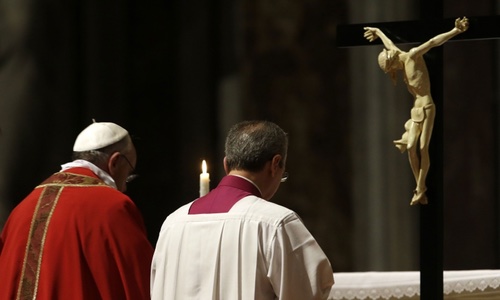
Pope Francis and changing the Lord's Prayer


Pope Francis has announced to the Roman Catholic Church that they have been praying the Lord's Prayer wrong. (Catholics call the prayer the "Our Father," after the first two words of the prayer.)

Francis wants to re-word the phrase, "And lead us not into temptation," because it implies that God might lead us into temptation if God wanted. And as we all know, temptation is bad. Francis suggests that Catholics pray instead, "Do not let us enter into temptation".

Actually, both the traditional phrasing and Francis' rewording miss the point.

Matthew and Luke to do not agree exactly on the words of the prayer. In Matthew 6, the prayer is thus (New Revised Standard Version):
9  Our Father in heaven,
    hallowed be your name.
10     Your kingdom come.
    Your will be done,
        on earth as it is in heaven.
11     Give us this day our daily bread.[c]
12     And forgive us our debts,
        as we also have forgiven our debtors.
13   And do not bring us to the time of trial,[d]
        but rescue us from the evil one.[e]
The brackets are footnotes:
c. Or our bread for tomorrow 
d. Or us into temptation
e. Or from evil. Other ancient authorities add, in some form, For the kingdom and the power and the glory are yours forever. Amen.
Luke puts it this way, a somewhat shorter prayer:
Father,[a] hallowed be your name.
    Your kingdom come.[b]
3     Give us each day our daily bread.[c]
4     And forgive us our sins,
        for we ourselves forgive everyone indebted to us.
    And do not bring us to the time of trial.”[d]
The footnotes are:
a. Other ancient authorities read Our Father in heaven 
b. A few ancient authorities read Your Holy Spirit come upon us and cleanse us. Other ancient authorities add Your will be done, on earth as in heaven 
c Or our bread for tomorrow 
d. Or us into temptation. Other ancient authorities add but rescue us from the evil one (or from evil)
Note that the NRSV, a very recent translation (as translations go) does not use "temptation" at all. Why?

In Greek, the expression is καὶ μὴ εἰσενέγκῃς εἰς πειρασμόν, pronounced kye mē eisenenkēs hēmas eis peirasmon. The last word, peirasmon, does mean temptation and is used to mean that elsewhere in the Gospels. But the NRSV is correct not to use it here. 

In Matthew and Luke, Jesus is teaching his disciples what to expect for the rest of their lives as they follow his will: opposition, including lethal opposition. Jesus has already used peirasmon to mean "trial" in the prarable of the sower who went out to sow in Luke 8: the seeds that fall on the rock are those who “have no root; they believe for a while, and in time of testing (peirasmou) fall away.”

In teaching the disciples the Lord's prayer, Jesus is instructing them what to rely on as the build the Kingdom of God from its inception:

  • God is as close as a father. God is a person, not an impersonal influence.
  • God will provide for their essential needs
  • God will forgive their missteps and sins along the way, but they must be forgiving of others, too.
  • Pray for your work to be done before the time of trial.
  • But trust God to protect them from the demonic powers opposing them.
What is the time of trial?

Luke 4 relates that just after Jesus was baptized by John, he "was led by the Spirit in the wilderness, 2 where for forty days he was tempted by the devil." There, for "tempted," is that pesky word peirasmon again. This time in the desert was a defining time for Jesus, for the temptations show that at stake was whether Jesus would be faithful to his identity, which Luke has just explained was announced by God, "You are my Son, the Beloved; with you I am well pleased" (Luke 3.22). 

In the desert, Jesus cannot both affirm his co-identity with God and yield to Satan's three lures, to care for himself, Jesus, first; to worship Satan, not God; and to test God's ability to save. These are not mere temptations. They are very serious trials for a famished and fatigued Jesus to endure. At stake here is whether Jesus will stay the course, or not.

This is probably the kind of forecast Jesus is warning his disciples about. True, Jesus may be referring in saying "the time of trial" to the end of the age, when he will return to place everything under his feet. But I don't think so. I think Jesus is saying, if I may paraphrase, "Pray that the work God places before you will be done before you face the ultimate temptation, which will be a great trial for you: whether to denounce me and leave the calling I will place before you, to go into the world and make disciples." 

This is not a certain reading, of course. But it's worth noting that Jesus also told his disciples that while they were accepting even death for following him ("Take up your cross and follow me"), even death was not the ultimate trial. Persecution, torture, execution are not trials in themselves, they are admittedly-horrific potential consequences of following Christ. No, the trial in the Our Father prayer is that which leads to abandonment of the Way, to exit the path that Jesus has already trod. The trial is spiritual, not physical-temporal, and Jesus promises elsewhere (i.e., Matt. 24.9-14; Mk. 13.9-13) that those who endure the time of trial without falling away will be saved. 

The apostle James reinforced this point, writing "Blessed are those who remain steadfast under trial (peirasmon), for when they have stood the test they will receive the crown of life, which God has promised to those who love him." Peter wrote, "Beloved, do not be surprised at the fiery trial (peirasmon) when it comes upon you to test you…. But rejoice insofar as you share Christ’s sufferings ..." (James 1.12, 1 Peter 12.13). 

So how to render this troublesome phrase, "lead us not into temptation"? By folding it into the greater theme of the whole prayer. If I were Pope, I'd offer this:

Our Father in heaven,
    your name is holy always. 
Bring forth your kingdom.
Your will be done on earth as it is in heaven.
Give us each day what we need. 
And forgive us our sins,
    as we also have forgiven those have sinned against us.
And do not bring us to the time of defining trial,
    but rescue us from those who oppose you.

This is more paraphrased than I would like. The challenge in translating biblical texts (or any foreign-language texts) is always to translate as succinctly as possible, to stay as true to the original text as one can. But that does risk losing nuance and context, which the author simply assumed the readers would already know. 

By the way, Holy Father, I am available for consultation for a very reasonable fee!

When Jesus forced the issue

The eleventh chapter of the Gospel of John begins with Jesus learning that his friend, Lazarus of Bethany, had fallen ill. Despite the news,...