Saturday, December 9, 2017

Pope Francis and changing the Lord's Prayer


Pope Francis has announced to the Roman Catholic Church that they have been praying the Lord's Prayer wrong. (Catholics call the prayer the "Our Father," after the first two words of the prayer.)

Francis wants to re-word the phrase, "And lead us not into temptation," because it implies that God might lead us into temptation if God wanted. And as we all know, temptation is bad. Francis suggests that Catholics pray instead, "Do not let us enter into temptation".

Actually, both the traditional phrasing and Francis' rewording miss the point.

Matthew and Luke to do not agree exactly on the words of the prayer. In Matthew 6, the prayer is thus (New Revised Standard Version):
9  Our Father in heaven,
    hallowed be your name.
10     Your kingdom come.
    Your will be done,
        on earth as it is in heaven.
11     Give us this day our daily bread.[c]
12     And forgive us our debts,
        as we also have forgiven our debtors.
13   And do not bring us to the time of trial,[d]
        but rescue us from the evil one.[e]
The brackets are footnotes:
c. Or our bread for tomorrow 
d. Or us into temptation
e. Or from evil. Other ancient authorities add, in some form, For the kingdom and the power and the glory are yours forever. Amen.
Luke puts it this way, a somewhat shorter prayer:
Father,[a] hallowed be your name.
    Your kingdom come.[b]
3     Give us each day our daily bread.[c]
4     And forgive us our sins,
        for we ourselves forgive everyone indebted to us.
    And do not bring us to the time of trial.”[d]
The footnotes are:
a. Other ancient authorities read Our Father in heaven 
b. A few ancient authorities read Your Holy Spirit come upon us and cleanse us. Other ancient authorities add Your will be done, on earth as in heaven 
c Or our bread for tomorrow 
d. Or us into temptation. Other ancient authorities add but rescue us from the evil one (or from evil)
Note that the NRSV, a very recent translation (as translations go) does not use "temptation" at all. Why?

In Greek, the expression is καὶ μὴ εἰσενέγκῃς εἰς πειρασμόν, pronounced kye mē eisenenkēs hēmas eis peirasmon. The last word, peirasmon, does mean temptation and is used to mean that elsewhere in the Gospels. But the NRSV is correct not to use it here. 

In Matthew and Luke, Jesus is teaching his disciples what to expect for the rest of their lives as they follow his will: opposition, including lethal opposition. Jesus has already used peirasmon to mean "trial" in the prarable of the sower who went out to sow in Luke 8: the seeds that fall on the rock are those who “have no root; they believe for a while, and in time of testing (peirasmou) fall away.”

In teaching the disciples the Lord's prayer, Jesus is instructing them what to rely on as the build the Kingdom of God from its inception:

  • God is as close as a father. God is a person, not an impersonal influence.
  • God will provide for their essential needs
  • God will forgive their missteps and sins along the way, but they must be forgiving of others, too.
  • Pray for your work to be done before the time of trial.
  • But trust God to protect them from the demonic powers opposing them.
What is the time of trial?

Luke 4 relates that just after Jesus was baptized by John, he "was led by the Spirit in the wilderness, 2 where for forty days he was tempted by the devil." There, for "tempted," is that pesky word peirasmon again. This time in the desert was a defining time for Jesus, for the temptations show that at stake was whether Jesus would be faithful to his identity, which Luke has just explained was announced by God, "You are my Son, the Beloved; with you I am well pleased" (Luke 3.22). 

In the desert, Jesus cannot both affirm his co-identity with God and yield to Satan's three lures, to care for himself, Jesus, first; to worship Satan, not God; and to test God's ability to save. These are not mere temptations. They are very serious trials for a famished and fatigued Jesus to endure. At stake here is whether Jesus will stay the course, or not.

This is probably the kind of forecast Jesus is warning his disciples about. True, Jesus may be referring in saying "the time of trial" to the end of the age, when he will return to place everything under his feet. But I don't think so. I think Jesus is saying, if I may paraphrase, "Pray that the work God places before you will be done before you face the ultimate temptation, which will be a great trial for you: whether to denounce me and leave the calling I will place before you, to go into the world and make disciples." 

This is not a certain reading, of course. But it's worth noting that Jesus also told his disciples that while they were accepting even death for following him ("Take up your cross and follow me"), even death was not the ultimate trial. Persecution, torture, execution are not trials in themselves, they are admittedly-horrific potential consequences of following Christ. No, the trial in the Our Father prayer is that which leads to abandonment of the Way, to exit the path that Jesus has already trod. The trial is spiritual, not physical-temporal, and Jesus promises elsewhere (i.e., Matt. 24.9-14; Mk. 13.9-13) that those who endure the time of trial without falling away will be saved. 

The apostle James reinforced this point, writing "Blessed are those who remain steadfast under trial (peirasmon), for when they have stood the test they will receive the crown of life, which God has promised to those who love him." Peter wrote, "Beloved, do not be surprised at the fiery trial (peirasmon) when it comes upon you to test you…. But rejoice insofar as you share Christ’s sufferings ..." (James 1.12, 1 Peter 12.13). 

So how to render this troublesome phrase, "lead us not into temptation"? By folding it into the greater theme of the whole prayer. If I were Pope, I'd offer this:

Our Father in heaven,
    your name is holy always. 
Bring forth your kingdom.
Your will be done on earth as it is in heaven.
Give us each day what we need. 
And forgive us our sins,
    as we also have forgiven those have sinned against us.
And do not bring us to the time of defining trial,
    but rescue us from those who oppose you.

This is more paraphrased than I would like. The challenge in translating biblical texts (or any foreign-language texts) is always to translate as succinctly as possible, to stay as true to the original text as one can. But that does risk losing nuance and context, which the author simply assumed the readers would already know. 

By the way, Holy Father, I am available for consultation for a very reasonable fee!

Sunday, November 19, 2017

A brief dive into the doctrine of Original Sin


“Nothing is more difficult to understand," Augustine once wrote, "than the nature of ‘the ancient sin." A discussion of original sin is confused since there seems to be no consensus on specifically how to define “original sin.” After all, the New Testament, early church writers, the Greek fathers and Augustine all concurred that Adam’s sin somehow established sinfulness in present humankind.

“Somehow” is the sticking point. If “In Adam’s fall we sinned all” is true, the question is, “How?” The subject of agency – exactly how Adam’s sin is transmitted to subsequent generations - is therefore central to what “original sin” means. The agency question was not considered in the New Testament. It was barely implicit in the early church. Eastern and western thinkers, Pelagius and Augustine looked at the question, Augustine very closely. (No one after Augustine could ignore his development of agency.) Pelagius examined original sin to reject it. Thus, original sin is a doctrinal development of several writers in the east and west, brought to full flower by Augustine.

New Testament: Paul wrote that “sin entered the world” through Adam and that because all persons sin, all persons come to death (Rom 5:12). To Paul, human sinfulness is the direct result of Adam’s original rebellion. Yet Paul developed no theory of participation in or transmission of Adam’s sin. That “all have sinned and fall short of the glory of God” (Rom 3:23), was to Paul so self-evident as barely to need further exposition. For NT writers, sin was violating the Law: “For whoever keeps the whole law and yet stumbles at just one point is guilty of breaking all of it” (James 2:10). The main thing was grace and redemption rather than sin’s origins. (In fact, God’s grace lies at the heart of the later debate about sin.) On the agency by which Adam’s sin is present in living persons, the NT writers were silent.

The Early Church:  Early church apologists were compelled to formulate fuller answers than the evangelical apostles to the Christological question, “Who is Christ?” and the soteriological question, “How does Christ save?” From what does Christ save Gentiles, who were never yoked with the Law? How does he do it? Their answer was that Adam’s sin was archetypal. Justin held that “we have been trained up in wicked ways by our environment.” Because the world was evil when we were born, we could not prevent being tainted thereby. Both Tatian and Theophilus saw Adam’s act as “a type of disobedience of the race.” To Irenaeus, Adam’s disobedience resulted in the loss of humanity’s likeness of God and enslavement to Satan, from which Christ reclaimed persons when they accepted him as Lord. Human participation in Adam’s deed is both inevitable and therefore so is participation in his guilt. However, these writers mostly ducked the question of agency. Irenaeus simply presupposed “some kind of mystical . . . identity” between Adam and all his descendants. Pseudo-Ambrose later wrote that “an inheritance of guilt has been transmitted” from Adam to all, but while this implied agency, it did not describe it.

The axiom until this point was that men and women were simply inherently sinful, slaves to sin (re. Rom. 7:25). Even though they desire the good, they do otherwise (Rom. 7:15). Jesus, being both God and human (the Christological question) saves by his superior power over Satan (the soteriological question). The focus remained a doctrine of Christ rather than a doctrine of humankind.

The Greek Fathers:  Gregory of Nyssa and other eastern thinkers presented an outline of a real theory of original sin, specifically linking natural propagation with the agency of transmission. Basil  used the term, “transmission” of Adam’s sin, as did Ps.-Didymus, who wrote that people are held under sin “by transmission,” with the parents’ sexual union being the agency. Persons are inherently sinful from birth, although this original sin is “involuntary” and therefore purification is called for more than condemnation.

Pelagian Radical Free Will:  To Pelagius, the assumption that human beings cannot prevent thier sinning was insulting to God. He held that people were not “puppets wholly determined by the movements of divine grace.” Human will, he thought, was not inevitably prejudiced toward the bad because of the Fall. There is no “congenital defect in man as he is born,” and people can observe God’s commandments without sinning. Thus, grace is not absolutely required for salvation since grace overcomes sin and it is at least theoretically possible not to sin. Pelagianism was anathematized in 431, but its propagation helped bring about Augustine’s long-term delineation of a doctrine of man, often called the “full-blown Latin” theory.

Augustine:  Before Augustine, Ambrose envisaged “the inherited corruption as a congenital propensity to sin,” conveyed by sexual union, but which “need cause us no anxiety at the day of judgment,” which is concerned only with personal sins. To Augustine, though, Adam’s sin was so grievous that it “resulted in the ruin of the entire race, which became . . . sinful itself, propagating sinners.” Augustine was satisfied that the Church’s traditions, i.e., baptizing infants, supported the reality of original sin. The agency was the “carnal excitement” which accompanied the physical act of generation. Yet, “the essence of original sin consists in our participation in, and co-responsibility for, Adam’s perverse choice,” as J.N.D. Kelly explains it. To Augustine, present persons are completely complicit with Adam. But Augustine used Greek Platonic philosophy, not the theology of revelation of the Bible, to formulate his theory. In a real sense, Augustine’s doctrine of Original Sin is not “biblical,” it is a very imaginative extrapolation of a brief biblical teaching. There is no biblicalreason to adhere to Augustine’s theory to the rejection of all others.

In Platonic terms, Adam was the Idea of humankind. His fallen state, occurring as it did before he had children, is the Idea in which all subsequent persons participate. Guilty Adam represents all humanity; thus all humans are guilty, all merit punishment, all require grace to be saved. Augustine, unlike the Greek fathers, saw no incongruity in seeing humanity’s (even infants’) participation in Adam’s sin as voluntary.

Process theology: Process theology is a very new development in Christian history, being a discipline less than a hundred years old. It rejects reliance on ancient Greek philosophy, mainly Plato and Aristotle, as templates to use interpreting the Bible, and also rejects the theologies of John Calvin and Martin Luther, both of whom affirmed that free will is a delusion and that all events, including human (apparent) choices, are already known to God and since God cannot know anything false, what God knows must be real, therefore predetermined. 

To the contrary, process theology posits that the fundamental reality in the universe is discrete events, and that God's will is always present in shaping events, but not pre-determining them. God produced the universe, but did not reproduce himself in so doing. God created humanity but did not procreate humanity -- both of which is to say that while human beings reflect the nature of God, we do not encompass it altogether. 

The account of Adam and Eve is not seen a literally-true human history, but an inquiry into why is the human condition the way that it is, especially in relation to God. (This view of the biblical story from creation to the end of the Noah story is not original with process theologians but has been mainline Christian interpretation for almost 200 years). 

Human sin is therefore both inevitable and volitional, both at the same time. Particular sinful deeds may be individually volitional, but we are not, contra Pelagius, inherently able to make no sinful decisions and commit no sinful deeds. 

Psalm 51.5 is a good summary: "Surely I was sinful at birth, sinful from the time my mother conceived me." Each one of us is conceived by and born to sinful parents and we literally inherit this sinfulness from them. Sin is a genetic condition because human beings are created beings who are mentally, physically, and spiritually incapable in our very being of avoiding sinful thoughts and deeds. It is impossible not to sin because of the nature of our creation and this concept is called "original sin." 

Conclusion:  Orthodoxy affirms that Jesus really lived, really died and was resurrected to save people from their sins. What does this mean and why and how are people sinful? Ultimately, some sort of “original sin” is necessary to cohere Christian doctrine. At the end of the day, no one theory of original sin answers every question or satisfies every quandary. Love, grace, justice and mercy—all are God’s qualities and all apparently conflict in some way in the considerations of sin and redemption. Ultimately, the choice seems clear: Adam’s sin either decisively affects all humans or it does not. Pelagius and Augustine represent the poles of the argument but their one-sidedness prevents a lengthy stay there. Middle positions (e.g., Ambrose’s) try to have it both ways, which has its own problems. “Original sin” conceptually certainly predates Augustine and was present in several early traditions of doctrine.

Recent paths of Christian theology take a different view, seeing the old-Orthodox view as too heavily reliant on (a) a somewhat literal-historic view of Genesis and (b) Platonic or Aristotelian philosophy. Instead, it sees human sinfulness as simply inherent in the human being to begin with because we are not God. 

Related: Christian theologian Steven Shippee compares the orthodox Christian view of original sin with the Buddhist teachings of the nature of the human being and concludes it's a lot closer than Buddhists generally think. I take no stand on Buddhism's doctrines but Shippee's explication of original sin makes some good points, even though I think he is off target in a couple of important ways. But still a good read

Saturday, November 11, 2017

Four Veterans

Today I recognize and give thanks for the service of four special veterans in my life. My father, Thurman Sensing, now 90, was a Seabee sailor in and after World War 2 aboard the battleship USS Texas and the escort carrier USS Bougainville, both in the Pacific.


Today, Cathy and  I will take Dad to lunch, an annual tradition for us.


Below is my father-in-law, Col. (ret.) George D. Stephens, now 98, who entered the US Army as a private six months before Pearl Harbor. He fought throughout the Pacific campaigns and served during the Korean War as well.


This is our eldest, Lance Cpl. S. M. Sensing, USMC, who deployed to Iraq on the date shown in the photo, shown at Camp Lejeune, NC, with Cathy.


Dr. (Capt.) Thomas Sensing is in surgical residency at Wright-Patterson AFB, Ohio, in the US Air Force Medical Corps. As a retired officer, I administered his oath of commissioning upon his graduation from medical school in 2016, one of the most memorable and fulfilling things in my life.


This is Thomas with his wonderful wife, Dr. Wendy Sensing.


God bless them and all our veterans and their families.

  Bookmark and Share

Saturday, October 7, 2017

God and Las Vegas

Out of the whirlwind:

Some people have been asking how, in a world they say is governed wholly by me, Stephen Paddock was able to shoot hundreds of people this week, killing dozens. They seem to think I was AWOL. Some accused me of actual dereliction of duty, saying that yes, I was present, but simply didn't bother to intervene. I saw everything that happened as it happened, they say. In fact, I knew what would happen even before it happened. When Paddock bought the first rifle of dozens, I already knew what he would do with them.

And yet I did nothing but watch, uninterested.

This is far from the first time such accusations have been made against me. You sing in praise of me that I sit on the throne of heaven, yet you seem to call me to the dock more often than you approach me on the throne. I get indicted every day. I have known church people who accused me in their hearts of unfaithfulness to them because I didn't fix the Powerball lottery so they'd win tens of millions of dollars. I have had high school seniors accuse me of uncaring dereliction when they didn't get accepted to their first college choice. Or grown men when they get fired from their job or even when they don't get a coveted promotion.

Let me get something straight with you: I am not your fixer. Yes, I want to have a personal relationship with you but I want it to go both ways. I already have such a relationship with you on my end, but believe me, I know what being kept at arm's length is like. 

You need to understand something: I am not your buddy, I am not your pal. I am your God, your Creator, your redeemer, your savior and your judge. As I have said before, my ways are not your ways, my thoughts are not your thoughts.

Let me put this bluntly: I operate on a different level than you do. I have a longer view of the horizon than you. I have been around a lot longer than you. So: what have I done to you? How exactly, have I wearied you? I would like an answer.

I don't recall that you were around when I big-banged the universe into existence. Nor were you there to advise me when I set the earth on its course, set the limits of the sea and the moon in your sky. I gave the hawks and eagles their flight. I gave the lion his power and invented how nature renews and reproduces itself. The seasons come, the seasons go because that is the way I set it up. Where were you when I did that? Your world supports your life and the lives of innumerable creatures. Do you think I had nothing to do with that? I set up life itself. It is in me that you live and breathe and have your very being.

But you tell me that I do not know what I am doing.

Very well, let us reason together. Get a backbone and listen. You want to know why I did not intervene in Las Vegas. And my answer is: I did. I did intervene, countless times and in countless years.

I have told you, O mortal, what is good and what I require of you. It is very simple: do justice, love kindness, and walk humbly with me. You seem to scoff at my moral commandments. You think you can order your lives and societies better than I can. You acknowledge me with your lips, but your hearts are far from me. You worship me on your holy days and the next day treat your workers, or customers, or partners, or family members - the list is endless - with scorn or dishonesty. You divide yourselves into tribes or identity groups or political parties, all of them at war with one another. You reject my rules but you cannot live rule-free, so you make up your own.

How has that worked out for you?

Listen closely. Memorize this. Take it to heart, make it your daily ethic. An expert in my commandments once asked my Son what the greatest of all my commandments is. And my Son, being my begotten one, of course knew the answer. He didn't make it up on the spot. I had revealed it centuries before. My Son said, "Love the Lord your God with all your heart and with all your soul and with all your mind. And love your neighbor as yourself."

Is that complicated? No. Is it obscure? No. It is simple. It is direct. Why is it so difficult for you? I know the answer of course. It is because to obey me you must disobey yourselves, and it is in disobeying yourselves that you think obeying me is hard. But believe me, it's not hard to obey me. My yoke is easy. My burden is light. I liberate, not confine. I bring peace, not turmoil.

My teachings have been in your hands for millennia. Millennia! And yet today you ask why I was not on the job in Las Vegas. Where have you been for the last few thousand years?

Oh, believe me, I was at Las Vegas. It was a bitter night for me. But I was there.

There were a man and a woman listening to the concert when the shooting started. They did not know one another. They dived under a table. He was hit, yet he lay across the woman, shielding her with his wounded body.

A young man led 30 people to safety. He was shot doing so. There are many, many other examples. And thousands of people waited for hours on end to give blood.

Oh, you say, that's just human nature. We do not know whether those heroes and heroines even believe in a God. So? Where do you think human nature comes from? Why do you think my grace cannot operate preveniently even in the hearts of those who know me not? I am always leading every event of the world toward the good. But there are many other influences, too, such as the hardness of your hearts and the will to evil, the imperfection of your understanding, the finitude of possibilities in a world of limited resources and capabilities. Yet my will wins through more often than you know.

But why does Las Vegas prove my dereliction? Funny how no one accuses me of indifference over the murder toll in Chicago. But even that is not necessary. Just one child dying of hunger in any remote corner of the world serves just as well. (Although I might argue that it proves your dereliction more than mine.)

So before you interrogate me in the dock for not managing the world the way you think I should, I will suggest you are not actually thinking about it at all.

Shall I answer affirmatively to every prayer? Should everyone who ask me to give them the lottery win? Should every person who prays for me to heal a loved one of auto-accident injuries be granted?

Shall I prevent every illness? Every injury? Why stop there? So much of the harm you suffer comes from your own vanity, your own injustices, your own incapabilities and frankly, your own stupidities. Where do you want me to intervene?

Not long ago a young man atop a tourist center in the Alps was walking and texting. He walked right off the side of the mountain, fell 250 meters and of course did not survive. Could I have intervened? I suppose so; I could have suspended gravity and floated him gently through the air back to the platform. Or I could have made him just bounce at the bottom with no ill effect. Or I could have made it impossible for human beings to walk while texting. One or the other, never both. Or I could have just made sure that smart phones were never invented to begin with.

Here's the thing: You do not get to choose. You are not God. You have no power for miracles so you don't get to tell me how to work them or when or how.

Imagine, really try to imagine, a world in which no one ever makes a bad decision, no one ever gets a cold, no one ever suffers want or need, no relationships are ever broken or even unhappy, no woman ever turns down a marriage proposal, or no man as the case may be, no employee is ever denied a raise or promotion, no business ever fails, no inventions with potential harmful effects are ever conceived, no student ever fails, no one ever suffers harm, injury or for that matter death - or if they do die, no one mourns or grieves or feels devastated by the loss. So there are no hospitals, doctors, no medical science, no funeral homes. There are no criminals, no aggressions, no evil. But there are no doers of good deeds, either, and no charity, no compassion, no kindnesses. There is no despair but no triumph. There are no losers so there are no winners. No one has too little money in retirement because I compel everyone to invest in retirement funds from the first dollar they earn - and the market never falls, unemployment never rises, wages never fall, and I decide what everyone's occupation is, not you. After all, I am the only actually-capable central planner that there ever can be. And that means there are no dictators, no monarchs, no oligarchies, and no democracy, no elections and no politicians to elect anyway because you have no self government. I make all your decisions because I know you cannot possibly decide anything - Any. Thing. - better than I can.

What kind of world is that? That world is Hell, all of humanity living in The Truman Show. If you sometimes don't see the point of this present world, you would never see the point of that one. And neither would I, because the fundamental reality of the universe is love, and love is an act of free will and decision, not robot programming.

More than anything right now, I urge you to understand this: You and all your have constructed is under my judgment. But that has always been so. Two thousand years ago I begot the Second Person of my Trinity as a baby in a manger in Bethlehem. Sure, celebrate it with parties and cantatas and gifts, fine. But remember that his birth was an act of judgment upon the world. Why would a Savior be born if the world did not need saving?

Here is my judgment: that I so loved the world that I gave my only Son, and that anyone who accepts and follows him as the guarantor of life now and for eternity, will never perish. That is my judgment, that my Light has come into your world of darkness, but you love the darkness rather than the Light.

Even so, I will never stop loving you, never stop reaching to you, never stop being who I am. I am your Creator, your Sustainer, your Redeemer, your Savior. And all of these things are my judgment upon you, for I adjudge you in love to be in my image, I adjudge you in love to be adopted as my sons and daughters, I adjudge you to be able to spend eternity in my company, I adjudge you to be able to love me and one another both in this life and the next, I adjudge that you can do all things good and holy through my strength. I adjudge that you are both loved and love-worthy, and I adjudge that you can live with a peace that you will always enjoy even if never fully understand.

I will never redact this, never revoke it, never turn my back on you, never change my mind. And remember, I have a fuller knowledge of what "never" means than you do.

But when necessary to drive a point home, remember this, too: The severest judgment I ever lay upon you is simply to let you have what you want. That never works out well for you.

I have told you, O mortal, what is good and what I require of you: Do justice, love kindness, and walk humbly with me. Love the Lord your God with all your heart and with all your soul and with all your mind. And love your neighbor as yourself.

The triumph of human life is that it really is so simple as that. The tragedy of human life is that even the simple things can be very difficult.

Bookmark and Share

Saturday, August 19, 2017

Confederate monuments: part 2, the myth of "noble Lincolnism"

In part one of this series I offered a reflection on the significance of Confederate monuments past and present, and perhaps some insight into why they have become such a flash point today. I wrote that perhaps, 
... we can assess both the war and its memorials with some dispassion – although higher passion seem to be the order of the day now.

First, let us dispense with all the “Lost Cause” nonsense Southern apologists invented after the war.
But there is another shoe to drop. I think I'll call it "noble Lincolnism," the idea that Abraham Lincoln and by extension the Union cause were morally pure and wholly admirable. In fact, Abraham Lincoln was a racist bigot and it is by no means unfair to say he was a white supremacist through and through. So:

Second, let us dispense with all the nonsense that Lincoln and the Union army were moral paragons who fought to free the slaves. 


Why do we consider this man great?
In her book, Team of Rivals, about Abraham Lincoln's presidency, Doris Kearns Goodwin made a most astonishing claim: 
"Armies of scholars, meticulously investigating every aspect of [Lincoln’s] life, have failed to find a single act of racial bigotry on his part." -- Doris Kearns-Goodwin, Team of Rivals: The Political Genius of Abraham Lincoln, p. 207. 
Some armies of scholars they must have been to have overlooked what Lincoln said in 1858:
"I will say then that I am not, nor ever have been in favor of bringing about in any way the social and political equality of the white and black races, that I am not nor ever have been in favor of making voters or jurors of Negroes, nor of qualifying them to hold office, nor to intermarry with white people . . . . I as much as any man am in favor of the superior position assigned to the white race." -- Abraham Lincoln, First Lincoln-Douglas Debate, Ottawa, Illinois, Sept. 18, 1858, in The Collected Works of Abraham Lincoln vol.3, pp. 145-146.
That Lincoln deeply opposed slavery cannot be gainsaid. It is laughable that he thought African Americans (they could truly be called that, then) should or even could gain legal, social or moral equality with whites. However, that did not distinguish him from about 99 percent of American whites, North or South, of his day. It was chattel slavery Lincoln opposed bitterly. He never made the leap that freed slaves should be equal citizens of the Republic. He did not think they could and did not think they should. 

In fact, in his first inaugural address, Lincoln endorsed the a proposed 13th amendment to the Constitution, called the Corwin Amendment after Ohio Republican Thomas Corwin. This amendment, which was never ratified, specifically forbade altering the Constitution in any manner that would enable the Congress to interfere with slavery "within any state." The Corwin amendment's wording was ridiculous, but its intent was clear: slavery was to be enshrined in the Constitution forever. Here is what Lincoln said:

I understand a proposed amendment to the Constitution--which amendment, however, I have not seen--has passed Congress, to the effect that the Federal Government shall never interfere with the domestic institutions of the States, including that of persons held to service. To avoid misconstruction of what I have said, I depart from my purpose not to speak of particular amendments so far as to say that, holding such a provision to now be implied constitutional law, I have no objection to its being made express and irrevocable.
Observed John A. Lupton, Associate Director and Associate Editor for The Papers of Abraham Lincoln Project, 
By tacitly supporting Corwin's amendment, Lincoln hoped to convince the South that he would not move to abolish slavery and, at the minimum, keep the border states of Maryland, Virginia, Tennessee, Kentucky, and North Carolina from seceding.
The amendment obviously never proceeded, but why would Lincoln endorse such a measure? He uttered the answer plainly:
The Union must be preserved, and hence all indispensable means must be employed.
Preserving the Union was more than Lincoln's policy goal. It was his fetish, a religious-type quest. The South's argument in favor of its secession was based on a contract view of the Constitution. The Constitutional contract, they claimed, had been broken, hence they could withdraw from the Union if they wished. Lincoln's theoretical foundation for destroying the Southern states to compel them to stay within the union was based on his elevation of the Declaration of Independence and other founding documents above the Constitution. Lincoln said this explicitly in his first inaugural address:
The Union is much older than the Constitution. It was formed, in fact, by the Articles of Association in 1774. It was matured and continued by the Declaration of Independence in 1776. It was further matured, and the faith of all the then thirteen States expressly plighted and engaged that it should be perpetual, by the Articles of Confederation in 1778. And finally, in 1787, one of the declared objects for ordaining and establishing the Constitution was "to form a more perfect Union." 
But if destruction of the Union by one or by a part only of the States be lawfully possible, the Union is 'less' perfect than before the Constitution, having lost the vital element of perpetuity.
The Union, he held, was a binding covenant between the states, not a contract, and that covenant could neither be negated nor nullified.

There is no doubt that for Lincoln preserving the Union was vastly more important than the rights of blacks, including their liberation. In his first inaugural, Lincoln endorsed enforcement of the Fugitive Slave Act, which as I explained in part one was a contributing cause for the South's secession because several free states refused to enforce it. In the first inaugural:
One section of our country believes slavery is 'right' and ought to be extended, while the other believes it is 'wrong' and ought not to be extended. This is the only substantial dispute. The fugitive-slave clause of the Constitution and the law for the suppression of the foreign slave trade are each as well enforced, perhaps, as any law can ever be in a community where the moral sense of the people imperfectly supports the law itself. The great body of the people abide by the dry legal obligation in both cases, and a few break over in each. This, I think, can not be perfectly cured, and it would be worse in both cases 'after' the separation of the sections than before. The foreign slave trade, now imperfectly suppressed, would be ultimately revived without restriction in one section, while fugitive slaves, now only partially surrendered, would not be surrendered at all by the other.
Every Civil War historian knows that Lincoln did not commit the US Army to battle against the Southern states to free the slaves. Freeing the slaves was of little consequence in his mind. Writing to influential New York editor Horace Greeley in August 1862, Lincoln explained why (Lincoln's italics):
As to the policy I "seem to be pursuing" as you say, I have not meant to leave any one in doubt. 
I would save the Union. I would save it the shortest way under the Constitution. The sooner the national authority can be restored; the nearer the Union will be "the Union as it was." If there be those who would not save the Union, unless they could at the same time save slavery, I do not agree with them. If there be those who would not save the Union unless they could at the same time destroy slavery, I do not agree with them. My paramount object in this struggle is to save the Union, and is not either to save or to destroy slavery. If I could save the Union without freeing any slave I would do it, and if I could save it by freeing all the slaves I would do it; and if I could save it by freeing some and leaving others alone I would also do that. What I do about slavery, and the colored race, I do because I believe it helps to save the Union; and what I forbear, I forbear because I do not believe it would help to save the Union. I shall do less whenever I shall believe what I am doing hurts the cause, and I shall do more whenever I shall believe doing more will help the cause. I shall try to correct errors when shown to be errors; and I shall adopt new views so fast as they shall appear to be true views.
What about the Emancipation Proclamation? 


There were actually two proclamations. The first was issued in September 1862, the second on Jan. 1, 1863. It is the second one that historians usually refer to as "the" proclamation. Here is the National Archives' explanation of the scope of the order:
President Abraham Lincoln issued the Emancipation Proclamation on January 1, 1863, as the nation approached its third year of bloody civil war. The proclamation declared "that all persons held as slaves" within the rebellious states "are, and henceforward shall be free."  Despite this expansive wording, the Emancipation Proclamation was limited in many ways. It applied only to states that had seceded from the Union, leaving slavery untouched in the loyal border states. It also expressly exempted parts of the Confederacy that had already come under Northern control. Most important, the freedom it promised depended upon Union military victory.  Although the Emancipation Proclamation did not immediately free a single slave, it fundamentally transformed the character of the war. ...
It did indeed transform the character of the war. Even so, the idea that Lincoln changed the emphasis of the war from preserving the Union intact to freeing the slaves because of elevated ideals is highly problematic - in fact, rebutted using Lincoln's own writings.

Here is the timeline:
  • July 1862 -- the first draft of the first emancipation proclamation is written. Lincoln's cabinet advises him that he must wait to release it until the Union army has won a significant victory, else the issuance will be seen as a desperate act to shore up support for the war amidst fading fortunes on the battlefield. The proclamation is shelved, awaiting such a victory. 
  • August 1862 -- Lincoln writes in his own hand the letter to Horace Greeley, quoted above, stating that freeing the slaves is a matter of indifference to him.\
  • September 1862 -- On the 17th, Union and Confederate forces fight near Antietam creek, Md. It was the bloodiest one-day battle of the War with almost 23,000 soldiers of both sides killed, wounded or missing. Lee turned his army back toward Virginia. Despite the spectacular ineptitude of Union Gen. George B. McClellan in allowing Lee's army to escape, Lincoln decides that the outcome is sufficient to issue the proclamation drafted in July, and he does so on the 22nd. 
The September proclamation was not one of action. It was a warning to the seceded states that he would order the emancipation of all slaves in any state that did not end its rebellion against the Union by January 1, 1863. None did, so in January Lincoln issued what basically amounted to an "execute" order of the September proclamation.

The relevant part of the September proclamation to this discussion is that it specifically said that the purpose of abolishing slavery was to restore the Union. In it, the federal government promised to help states pay for the "gradual abolishment of slavery within such State or States---that the object is to practically restore, thenceforward to be maintain[ed], the constitutional relation between the general government, and each, and all the states ..." (link).

Lincoln was politically compelled to change the focus of the war effort to emancipation because Northern support for the war was melting away. Its costs in lives, treasure and time was magnitudes more than anyone ever imagined. By the end of 1862 there was an active peace movement in the North that grew stronger even after the Proclamation was issued.

There was serious (though ultimately unfounded) concern in Washington that Britain would openly side with the South because of the Union blockade of Southern ports cut off Southern cotton to the backbone of England's economy, textiles. Jeff Davis's government made the same miscalculation, but at the time both North and South thought the threat was very possible.

Issuing the Proclamation was a mainly political act that was first of all intended to signal Great Britain that to side with the CSA was to ally with a slavery state and take sides against the slaves' proclaimed, but not yet accomplished, liberation. This Britain would never have done (and economically did not need to do anyway).

The second thing the Proclamation did was turn the North's casus belli from political to holy. Lincoln did not become an abolitionist until he understood that the the North would never suffer the abattoir of the Civil War merely to preserve the Union, but it would bleed profusely "to make men free," as Julia Ward Howe's hymn urged.

Remember, Lincoln wrote his letter to Horace Greeley after the first proclamation had been written, which spins it somewhat differently than Lincoln the great humanitarian liberator. Clearly, considering both the first proclamation and the letter to Greeley, written so close together, Lincoln saw abolition as a means to achieve his never-changed goal: the Union of states must be preserved. Abolition was never an end in itself. It was not abolition for the sake of abolition nor even for the sake of slaves!

In the movie Gods and Generals, there is a scene where Union Col. Joshua Chamberlain (Jeff Daniels) tells his brother, also a Union officer, that if they both have to die to free the slaves, then so be it, even though abolition was not an original aim of the war.

It is the Northerners kind of war that Americans have waged more utterly than any other. As military historian T. R. Fehrenbach wrote in This Kind of War, "Wars fought for a higher purpose must always be the most hideous of all." War is such an awful thing that it must be entered into for only the most transcendental purposes. Hence, any war - as opposed to a punitive expedition, such as Panama, 1989 - that Americans engage in must be a crusade, because only crusades can justify the costs and the suffering. War is to be waged only reluctantly, even sadly, but waged ferociously.

Gen. Douglas MacArthur said, "In war there can be no substitute for victory," because when war is entered into for supreme purposes, to stop short of victory is to betray that purpose. In American Holy War, the political end is secondary to the military victory. Political structures are imposed by Holy War's victorious conclusion, they do not determine the conclusion. The role of politics is to pick up the pieces when total victory has been won.

This was Lincoln's insight: that absent a morally transcendent cause, the North would not continue the war. He provided the cause, but to him it was all smoke and mirrors, indeed it was politically-calculated trickery. There was indeed a powerful, morally-centered abolitionist movement in the northern states. But their cause was never Lincoln's cause.


And so he led the American nation deeper into an abyss of bloodshed that ultimately took the lives of two percent of its population, the equivalent of 6,460,000 dead today. Why anything about the Civil War is glorified or memorialized is quite beyond me, and I find it utterly incomprehensible that Abraham Lincoln is considered a great president.

Update: Joel W. emails,
I think you were too harsh on Abraham Lincoln. He was a great president: He kept the Union together, which was his main goal. The United States today would not be the country it is if the country had split during the Civil War. I believe that the United States, for all its faults, is the greatest country in the world, and possibly in history. If we had become two countries, we would not be as great.

Although I had not done as much research as you, I realized long ago that Lincoln's main goal was the preservation of the Union, not the emancipation of the slaves, and certainly not the elevation of the former slaves as full citizens.

One point you did not mention was that until he was assassinated, he was hated by many - in the North. (And most of the South, of course). Once he was killed, he became a martyr - and was elevated to the high status that many see him in today. If John Wilkes Booth had not done his work, it is possible that Lincoln could have ended up being impeached, rather than Andrew Johnson.Who knows? Johnson, a Democrat, had much harsher views of the ex-slaves than even Lincoln did.
I do not take much issue with any of Joel's points. Lincoln was a complex man. But for perspective, would we expend 6.5 million American lives today to keep California in the Union, or any other set of secession-minded states there is?

Lincoln was more than willing to see no end of bloodshed to preserve the Union, he said it and proved it. In his second inaugural, Lincoln pointed out, accurately, "Neither party expected for the war the magnitude or the duration which it has already attained." Then he claimed that the war and the Union cause was God's will! And so the war must be continued unabated:
Fondly do we hope, fervently do we pray, that this mighty scourge of war may speedily pass away. Yet, if God wills that it continue until all the wealth piled by the bondsman's two hundred and fifty years of unrequited toil shall be sunk, and until every drop of blood drawn with the lash shall be paid by another drawn with the sword, as was said three thousand years ago, so still it must be said "the judgments of the Lord are true and righteous altogether."
These are not the words of a moderate man. Of course he could not foresee in April 1861 the slaughterhouse that the war would become. But in March 1865, he said that did not matter, that even if he had seen clearly the ocean of blood to be spilled, he would have spilled it anyway, God's will be done!

How can we possibly ascribe a moral cause to a president who --
  • firmly declared the inferiority of black Americans, 
  • stated he was indifferent and unconcerned whether they remained slaves or not,
  • as president spoke in favor the terms of the Fugitive Slave Act,
  • as president spoke in support of a Constitutional amendment that would have forbidden any kind of federal interference in slavery by the states,
  • issued an impotent emancipation proclamation only when it was clear that Northern support for the war merely to reunify the states would not last,
  • stated at the inception of his second term that he would never be dissuaded from his goal no matter the cost in human suffering, dying and physical destruction of American territory?
The Civil War ended legalized chattel slavery in the United States. But that was not why the North went to war. Abolitionists, a growing domestic peace movement, and Union generals in the field forced Lincoln's hand to declare abolition a war aim. It did not spring from his moral compass.

I would say that the North accomplished a mission, abolition, that it did not really set out to do but failed to accomplish the mission, reunify the country, that it did set out to do. Can anyone look at our country today and honestly say that "The Union has been preserved"?

Slavery could not have survived as an institution in the South. Alternative histories are always highly speculative, but a lot of prominent Southern figures realized this beginning as early as 1850 simply by assessing the economic realities of the slave trade and cotton production. For example, many Southerners pointed out that the South grew cotton, shipped it to the North where it was milled and made into clothing, and then the South bought the clothing to wear. As one Southern industrialist (there were not many) tried to explain, the South sold raw cotton to the North at a nickel a pound and then bought it back at double or more! (Lowell, Mass., had more looms than the entire South.) Many tried to diversify the South's economy but they were silenced by the pro-slavery PC codes of the day.

Britain's economy was at the time based heavily on its textiles industry, which was the most advanced in the world - so advanced the design of its machines were actually state secrets. Before the War, this industry was heavily reliant on Southern raw cotton. Both Lincoln's and Davis's governments thought that Britain's loss of supply of Southern cotton would be so severe that Britain would have to take active measures to restore the supply.

But Britain had not become the pre-eminent economic power in the world because it was run by fools. Britain's industrialists and government were much more aware of the weakness of their supply chain, and well before the Civil War. They started large cotton production operations of Egypt and India before the Civil War. By 1861, the quantity and quality of this cotton, especially Egyptian cotton, were so high that Britain managed the reduction of Southern cotton imports well.

Economically, in 1861 the South's problem was not wealth. It was actually far wealthier than the North. Its problem was getting capital because the South's wealth was highly illiquid. More than three-fourths of the South's Net Asset Value was in land and slaves; some historians say as high as 90 percent. Neither land nor slaves could be sold for cash quickly. This was a major impediment to industrializing the South and improving its infrastructure, although the South did make devoted attempts to do both in the 1850s and achieved great increases. But the North did more.

King Cotton turned out to be a tyrant monarch. At the end of the 1840s raw cotton prices had plunged to less than 5 cents per pound. But the next decade saw prices surge to almost 11 cents per pound. Profits from slave-labor cotton and sugar (where the South led also) convinced almost all Southerners that they could never face a financial threat. The 1850s was the era of King Cotton for the South, but for all the money being made, almost none was invested in materiel that could ensure the seceded states could ensure their success by force of arms.

In short, the South never actually prepared for secession even though it had been a popular topic for many years. The South imagined that secession would inevitably be successful and peaceful.

I do not encourage Gone With the Wind-ism, but this is not a bad half-minute summary:


Thursday, August 17, 2017

Confederate monuments: So what? Now What?

Part one of a series on this topic

So what? Now what?

One of the bishops of The United Methodist Church has told of his son’s soccer coach. If one of his players made an outstanding play and then unduly celebrated, the coach would rejoin, “So what? Now what?”

Meaning, now that you’ve done that, what do you do next?

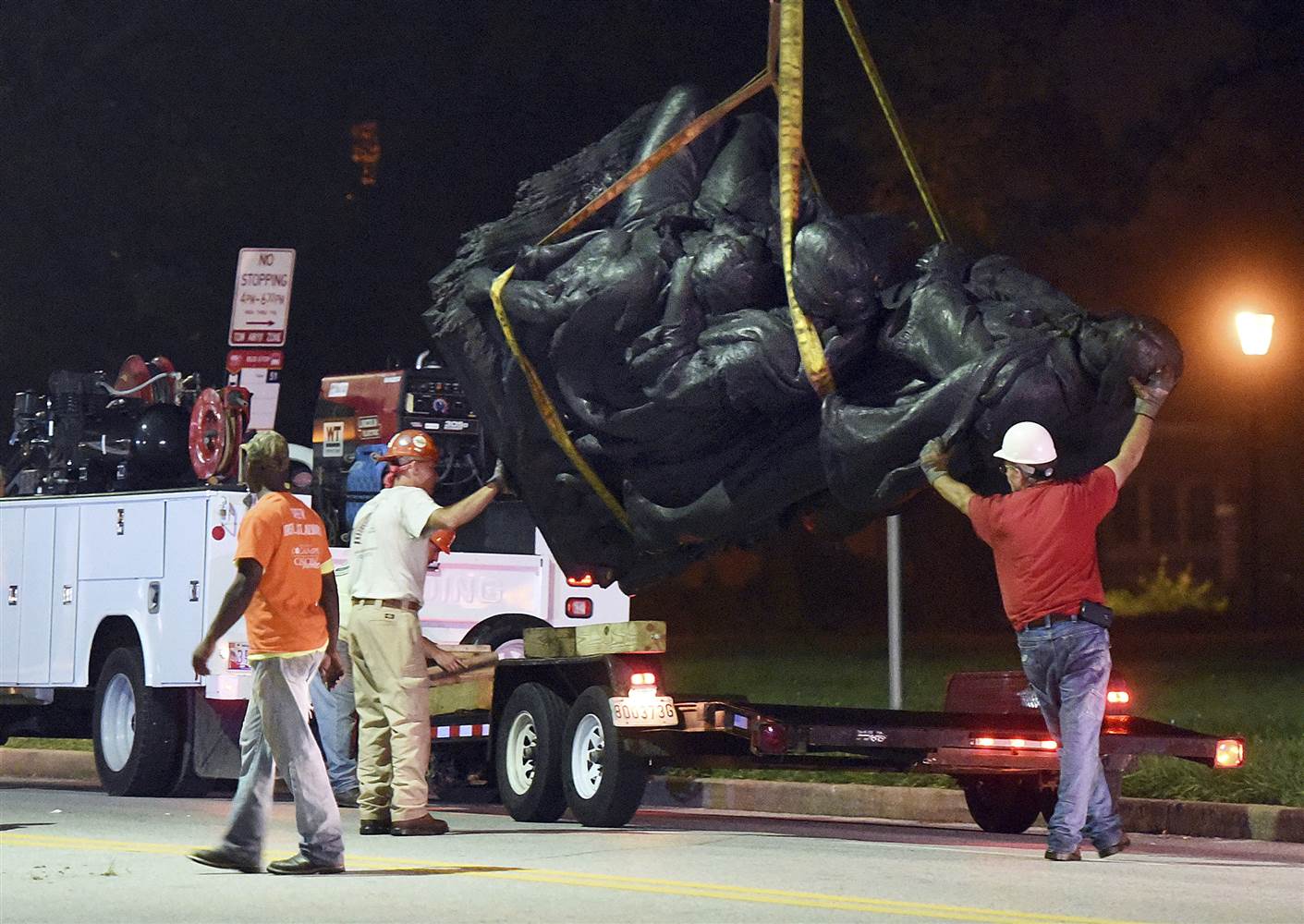
Workers remove a monument dedicated to the Confederate Women of Maryland
early Wednesday, after it was taken down in Baltimore.
Photo by Jerry Jackson / The Baltimore Sun via AP
In his book The Martian Chronicles, written in the height of the Jim Crow era, Ray Bradbury tells of a day on earth when all the black people board rockets that they’ve had built in secret. They are going to move to Mars. The white people don’t find out until liftoff day. The main character is a white man named Teece. He watches the stream of people heading toward the launch site with dismay and impotence, cursing at them and dismissing them in turns. And then (profanity snipped),

Far down the empty street a bicycle came.
“I’ll be [snip]. Teece, here comes your Silly now.”
The bicycle pulled up before the porch, a seventeen-year-old colored boy on it, all arms and feet and long legs and round watermelon head. He looked up at Samuel Teece and smiled.
“So you got a guilty conscience and came back,” said Teece.
“No, sir, I just brought the bicycle.”
“What’s wrong, couldn’t get it on the rocket?”
“That wasn’t it, sir.”
“Don’t tell me what it was! Get off, you’re not goin’ to steal my property!” He gave the boy a push. The bicycle fell. “Get inside and start cleaning the brass.” …
“You still standin’ there!” Teece glared.
“Mr. Teece, you don’t mind I take the day off,” he said apologetically.
“And tomorrow and day after tomorrow and the day after the day after that,” said Teece.
“I’m afraid so, sir.” “We got to leave now, Mr. Teece.”
Teece laughed. “You got one named Swing Low, and another named Sweet Chariot?”
The car started up. “Good-by, Mr. Teece.”
“You got one named Roll Dem Bones?”
“Good-by, mister!”
“And another called Over Jordan! Ha! Well, tote that rocket, boy, lift that rocket, boy, go on, get blown up, see if I care!”
The car churned off into the dust. The boy rose and cupped his hands to his mouth and shouted one last time at Teece: “Mr. Teece, Mr. Teece, what you goin’ to do nights from now on? What you goin’ to do nights, Mr. Teece?”
Silence. The car faded down the road. It was gone. “What in [snip] did he mean?” mused Teece.
“What am I goin’ to do nights?”
He watched the dust settle, and it suddenly came to him.
He remembered nights when men drove to his house, their knees sticking up sharp and their shotguns sticking up sharper, like a carful of cranes under the night trees of summer, their eyes mean. Honking the horn and him slamming his door, a gun in his hand, laughing to himself, his heart racing like a ten-year-old’s, driving off down the summer-night road, a ring of hemp rope coiled on the car floor, fresh shell boxes making every man’s coat look bunchy. How many nights over the years, how many nights of the wind rushing in the car, flopping their hair over their mean eyes, roaring, as they picked a tree, a good strong tree, and rapped on a shanty door!
“So that’s what the [snip] meant?” Teece leaped out into the sunlight. “Come back, you [snip]! What am I goin’ to do nights? Why, that lousy, insolent son of a . . .”
It was a good question. He sickened and was empty. Yes. What will we do nights? he thought. Now they’re gone, what? He was absolutely empty and numb.
Bradbury’s story continues, but the question remains: “Now they’re gone, what?”

Let us suppose every public statue or monument to the Confederacy is removed as fast as their opponents want. “So what? Now what?” Who exactly will be better off? Black unemployment will be unchanged. The risk of horrific war with North Korea will not be lowered. The near-total breakdown of civility in our political life will not be improved. The inability, indeed, unwillingness, of the parties in Washington to come together to govern well will not increase. Obamacare will continue to fail and there will continue to be nothing on the docket to replace or repair it. Al Qaeda will still attempt to carry out the attacks it recently promised against mass-transportation means in the United States.

What difference will it make, exactly?

It may be answered that deleting the monuments is a worthy thing in its own right. It may be that an “afterward” plan is not necessary to do a thing inherently good and desirable in itself. The presence of such statues and monuments has a meaning much diminished now from what their erectors intended. Black Americans, still living with the after-effects of 200 years or so of slavery in America, are constantly reminded by the monuments’ continuing presence that their status as Americans remains somewhat provisional as long as those statues remain.

In this I will not argue contrary. Practically none of the statuary concerned dates to just after the Civil War. Almost all were erected from the 1890s – 1940s, most completed well before World War II. The main objective in them was to comfort and reassure aging Civil War veterans (of both South and North) that their sacrifices were real, they were remembered, but they were not going to determine the future of a United States. In their day, the monuments served as implements of peaceful reconciliation – and it took decades of time and veterans’ old age before even that could occur.

Of course, no Civil War veterans are alive today and even Boomers like me are five generations removed from their Civil War ancestors. I had lineal ancestors who fought on both sides. A multi-great uncle of the CSA’s 11th Tennessee was KIA at Stones River and another g3-uncle of the 45th Pennsylvania lost both his legs at Chancellorsville. Another of my g2-grandfathers has the distinction of being the only American POW in history ever to be broken out of POW camp by his wife, a woman who personally brained a Union soldier who attempted to rape her in her Nashville home.

So, for me there is a personal connection, at least of sorts, to the War and to its monuments today. It is not a strong one. The great majority of Americans today, descended from immigrants arriving after the Civil War, have no personal connection to the War or to the monuments that memorialize it.

But black men, women and children in the country do have a personal connection to the war because they continue to live now with its consequences and legacies, regardless of whether they are descended from persons living in either North or South before or during the war.

Perhaps, though, with both whites and black people more emotionally distant from both the War and its aftermath, we can assess both the war and its memorials with some dispassion – although higher passion seem to be the order of the day now.

First, let us dispense with all the “Lost Cause” nonsense Southern apologists invented after the war.

There are some hard truths about the CSA. I am a Nashville native and grew up here. My family's roots in Middle Tenn. go back to just after the Revolutionary War. I have mentioned my ancestral-family members who fought (and some died) for the CSA on both my mom's and dad's side (also for the Union on my dad's). Alexander Stephens, vice president of the CSA, was my wife's great-great grandfather's brother.

I take no back seat to anyone for Southern heritage and upbringing.

Like probably most native Southerners of my generation, I was raised being taught that the real reasons for the Southern states' secession was to preserve states’ rights and that the northern economic lobby was choking the South's economy with high tariffs on Southern goods.

Slavery? Well, it was in the mix somewhere, but slavery was not the real reason for secession.

It is a lie, pure and simple.

The states’ rights and tariffs arguments are entirely absent from Southern apologia until after the Civil War. In 1860 and before, no one in the South was using those topics to justify secession. Furthermore, in 1860 federal tariffs on Southern goods were lower than they had been since 1816.

It was the Southern politicians who had actually attacked the concept of federalism and state rights when, some years before the Civil War, some non-slave states defied the Fugitive Slave Act and declared that when slaves were brought into those states by the masters, they could be declared legally manumitted by state law. Southern politicians fought that tooth and nail and applauded the Dred Scott decision of the US Supreme Court, which denied Dred Scott, a black man, the right to sue for his freedom in US courts even if he resided in a free state. (Seven of the Supreme Court's judges in the case had been appointed by pro-slavery presidents from the South. Five of the seven were from slave-holding families.)

Nor was the North's industrial power significant at all in the secessionists' decisions. In 1860, Southern goods accounted for 75 percent of all American exports' dollar value ("King Cotton" being the main export) and the market value of the slaves across the South was greater than the entire Net Asset Value of the combined industrial base of the North.

The North's industrial revolution had begun in the 1840s, but was hardly in full speed in 1860. The war great accelerated it, leaving the North economically ascendant afterward, but before the war the South was the dominant economic section of the country (and it was economically wrecked by 1865).

Why did the Southern states secede? To protect slavery, period.

Read the 11 seceded states' actual acts of secession, beginning with South Carolina's, and you will see that slavery was the sole reason for secession. South Carolina's act makes this very unambiguous: protection of slavery was the only topic presented as driving secession. Same with Mississippi. And the others.

There were four sections of S.C.'s secession act. The opening section claims and justifies the right of the state to secede in the first place. Then:
The next section asserts that the government of the United States and of states within that government had failed to uphold their obligations to South Carolina. The specific issue stated was the refusal of some states to enforce the Fugitive Slave Act and clauses in the U.S. Constitution protecting slavery and the federal government's perceived role in attempting to abolish slavery.
 The next section states that while these problems had existed for twenty-five years, the situation had recently become unacceptable due to the election of a President (this was Abraham Lincoln although he is not mentioned by name) who was planning to outlaw slavery. The declaration states the primary reasoning behind South Carolina's declaring of secession from the Union, which is described as: 
... increasing hostility on the part of the non-slaveholding States to the Institution of Slavery ...
Then  the final section was simply the declaration of secession. There are no issues presented to justify secession except slavery. Note the contempt of "states right" in the secession act, in its denunciation of "... the refusal of some states to enforce the Fugitive Slave Act... ." The other 10 seceded states' enactments are not significantly different.

The Confederate States of America was founded to do one thing only: to preserve the power of one class of people to literally own as chattel property another class of people. There is no other reason the CSA existed.

That would be bad enough on its own. But it's worse. David Goldman, an economist (Ph.D., London School of Economics), has some facts and thoughts (read the whole essay):
Southern slaveholders were rapists. We know this because only 73% of the DNA of African-Americans is African; the rest is Caucasian with a small fraction of Native American. Most of the admixture of DNA, a McGill University study concludes, occurred before the Civil War, that is, when slaveholders and their white employees could use female slaves at will. Keep that in mind the next time Foghorn Leghorn sounds off about the honor of Southern womanhood. To own slaves is wicked; to rape female slaves and sell one's children by them is disgusting in the extreme. Yet that is what the Old South did, and the DNA evidence proves it.

That is the "heritage" that CSA flag defenders are really defending; I hope, truly, that most of them do not know that.

Southerners must not defend the indefensible

To defend the Confederate States of America is to side with the abjectly, morally indefensible. To use the CSA's battle flag or national colors as a symbol of Southern pride should be deeply, deeply offensive to modern Southerners, who are the most racially harmonious people in the nation (by no means has the year of Jubilee arrived, but jeepers, just compare to practically any Union-states- heritage city).

Have Southerners nothing to display as an emblem of regional heritage and pride but the flag of a irredeemably corrupt and thankfully temporary regime?

God save us.

Endnotes

1. You can read all of Bradbury's chapter here. Be advised that there is rough language and that the book, written in 1950, envisions no change in race relations between 1950 and the year of its setting, 2003. But then, the narrative is not really about 2003 or Mars at all. 

 2. The number of Southerners who display the Confederate flag in any way is vanishingly small. So why we are letting this particular issue practically control the national public agenda sort of escapes me. That we have a president who practices public buffoonery, and a media apparatus that long ago went full ideologue, does not help matters. 
Next installment: "The issue isn't the issue." "the myth of 'noble Lincolnism'."

A world without nuclear weapons - what would it look like?

 From Pope Leo this week, according to the National Catholic Reporter : " Pope Leo quotes Bob Dylan song in book foreword calling for n...