Tuesday, June 23, 2015

Why the Confederate battle flag must go

By now you are probably aware of the increasing (and increasingly strident) calls for the Confederate battle flag to be removed from South Carolina's state capitol grounds (where, lest we forget, it was originally placed in 1962 by act of the almost-wholly-Democrat legislature and signed into law by then-governor, later US Senator Fritz Hollings, D.-SC.)


As a matter of federalism, of course, SC has the right to fly the flag if its representatives want. But, as Paul advised in 1 Cor. 6., just because one has the right to do something does not mean it is beneficial.

My friend Bill Hobbs linked in FB to this article about the flag kerfuffle: "The ludicrous, self-defeating hypocrisy of flying the Confederate battle flag." It's not a short read but it is worth the time. My thoughts are below.

The CSA's flags should not be displayed except in historical settings such as museums or re-enactments. 

There are some hard truths about the CSA. I am a Nashville native and grew up here. My family's roots in Middle Tenn. go back to just after the Revolutionary War. I have ancestral-family members who fought (and some died) for the CSA on both my mom's and dad's side (also for the Union on my dad's). Alexander Stephens, vice president of the CSA, was my wife's great-great grandfather's brother. My maternal grandmother's grandfather, CSA, has the singular distinction of being the only American POW, before or since, ever busted out of POW camp by his wife. He was never recaptured.

So I take no back seat to anyone for Southern heritage and upbringing.

Like probably most native Southerners of my generation, I was raised being taught that the real reasons for the Southern states' secession was to preserve states rights and that the northern economic lobby was choking the South's economy with high tariffs on Southern goods.

Slavery? Well, it was in the mix somewhere, but slavery was not the real reason for secession.

It is a lie, pure and simple.

The states rights and tariffs arguments are entirely absent from Southern apologia until after the Civil War. In 1860 and before, no one in the South was using those topics to justify secession. Furthermore, in 1860 federal tariffs on Southern goods were lower than they had been since 1816.

It was the Southern politicians who had actually attacked the concept of federalism and state rights when, some years before the Civil War, some non-slave states had started declaring that when slaves were brought into those states by the masters, they could be declared legally manumitted by state law. Southern politicians fought that tooth and nail and applauded the Dred Scott decision of the US Supreme Court, which denied Dred Scott, a black man, the right to sue for his freedom US courts even if he resided in a free state. (Seven of the Supreme Court's judges "had been appointed by pro-slavery presidents from the South, and of these, five were from slave-holding families.") 

Nor was the North's industrial power significant at all in the secessionists' decisions. In 1860, Southern goods accounted for 75 percent of all American exports' dollar value ("King Cotton" being the main export) and the market value of the slaves across the South was greater than the entire Net Asset Value of all the industrial base of the North.

The North's industrial revolution had begun in the 1840s, but was hardly in full speed in 1860. The war great accelerated it, leaving the North economically ascendant afterward, but before the war the South was the dominant economic section of the country (and it was economically wrecked by 1865). 


Why did the states secede? To protect slavery, period.

Search for the 11 seceded states' actual acts of secession, beginning with South Carolina's, and you will see that slavery was the sole reason for secession. South Carolina's act makes this very unambiguous: protection of slavery was the only topic presented as driving secession. Same with Mississippi. And the others.

There were four sections of S.C.'s secession act. The opening section claims and justifies the right of the state  to secede in the first place. Then:
The next section asserts that the government of the United States and of states within that government had failed to uphold their obligations to South Carolina. The specific issue stated was the refusal of some states to enforce the Fugitive Slave Act and clauses in the U.S. Constitution protecting slavery and the federal government's perceived role in attempting to abolish slavery.

The next section states that while these problems had existed for twenty-five years, the situation had recently become unacceptable due to the election of a President (this was Abraham Lincoln although he is not mentioned by name) who was planning to outlaw slavery. The declaration states the primary reasoning behind South Carolina's declaring of secession from the Union, which is described as:
... increasing hostility on the part of the non-slaveholding States to the Institution of Slavery ...
Then  the final section was simply the declaration of secession. There are no issues presented to justify secession except slavery. Note the contempt of "states right" in the secession act, in its denunciation of "... the refusal of some states to enforce the Fugitive Slave Act... ." The other 10 seceded states' enactments are not significantly different.

The Confederate States of America was founded to do one thing only: to preserve the power of one class of people to literally own as chattel property another class of people. There is no other reason the CSA existed.

That is the "heritage" that CSA flag defenders are really defending; I hope, truly, that most of them do not know that.

We Southerners must stop trying to defend the indefensible

To defend the Confederate States of America is to side with the abjectly, morally indefensible. To use the CSA's battle flag or national colors as a symbol of Southern pride should be deeply, deeply offensive to modern Southerners, who are the most racially harmonious people in the nation (by no means has the year of Jubilee arrived, but jeepers, just compare to practically any Union-states- heritage city).

Have we Southerners nothing to display as an emblem of regional heritage and pride but the flag of a morally corrupt and thankfully temporary regime?

God save us.

Update: This Atlantic article decisively refutes the idea that the Confederacy was founded for any reason other than preservation - indeed, expansion - of slavery, using the words of the CSA's founders themselves: "What This Cruel War Was Over."

Monday, June 22, 2015

Charleston victims wield power of forgiveness

Charleston victims wield power of forgiveness

Did you see the families of the shooting victims in Charleston, S.C., confront the accused killer at his bond hearing Friday?

Did you see the video — them pleading with Dylann Roof through tears?

They said they forgave him — the very soul who, days earlier police said, held the weight of the gun, pulled the trigger and, having seen the mess of blood spurting from one writhing victim, continued to another. And another. And another. Until nine lay dead on the seats and the floor of a Christian house of worship.

The shooter did not slow to notice; their blood was the same color as his.

And did you see? One after another, the relatives of the slain, begging Roof to turn to God. One after another, they prayed for his soul. One after another, they forgave him.

It was neither expected nor explicable, that forgiveness. Such forgiveness is unseen in the animal world, is illogical in the rational world, is nonsensical to common human nature. Such forgiveness is humanity at its most human, or perhaps its most divine.
Bookmark and Share

Monday, June 15, 2015

The Civil War did not start over slavery


It's occurred to me that an awful lot of people do not understand that the reasons that Southern states seceded and the reasons the Civil War was fought are not the same.

As I have posted, the South seceded to protect and even expand the institution of slavery, and for no other reason.

But South Carolina did not fire on Fort Sumter to protect slavery. After the CSA was formed in Feb 1861, "Its conservative government, with Mississippian Jefferson Davis as president, sought a peaceful separation, but the United States refused to acquiesce in the secession," according to History.com.

Had the war not broke out in Charleston harbor, President Lincoln would have made sure it broke out somewhere. His correspondence and public utterances make it clear that he was absolutely determined, even including war, that the Union would not be sundered.

There was at the time, and remained for three or four years after the Sumter battle, a substantial peace movement in the North that urged the Southern states be permitted to depart in peace. Lincoln adamantly refused this position, stating that the Union of states was unalterable and no state, once admitted, could separate itself from the Union. (This was, btw, explicitly contrary to the position of one Thomas Jefferson, but let it pass.)

In his First Inaugural address, after the CSA had been formed, Lincoln made this explicitly plain:
I therefore consider that. . . the Union is unbroken; and. . . I shall take care that the laws of the Union be faithfully executed in all the States. Doing this I deem simple duty on my part; and I shall perform it. I trust this will not be regarded as a menace, but only as the declared purpose of the Union that it will constitutionally defend, and maintain itself.
But of course this was a threat, raw and naked, and all his contemporaries understood it that way.

South Carolina seceded on Dec. 24, 1860. Why did they wait until April 12, 1861, to fire on the fort? Because they did not want war. Jeff Davis even sent a delegation to see Lincoln to negotiate the transfer of Fort Sumter to the CSA. The delegates were authorized to set an amount to pay the US government for the fort. Lincoln refused to see them and sent them home.

As late as the day before the battle, Confederate Secretary of War Leroy P. Walker directed that if Anderson and his men evacuated the fort, they would not be hindered by force. Anderson actually told CSA military emissaries on April 11 that he intended to evacuate on April 15, a date that was accepted by the Confederate commander. (Anderson also admitted that he had only a few days' provisions on hand.)

But with a US Navy task force to reinforce and resupply Sumter having arrived and sitting at the harbor's entrance, Confederate Gen. P.G.T Beuaregard knew that dates and timetables meant nothing any more. He sent word to Anderson that the fort would be fired on beginning at 4.30 a.m. the next morning.

By no stretch of the most active imagination can it be credibly maintained that the South fired on Fort Sumter to protect slavery. Having declared itself to be part of an independent nation, S.C. worked for four months to convince the Union to abandon a fortress sitting in command of the harbor's approaches. The state and its new nation would either be sovereign over its territories or they would not. And as long as the fort was staffed by Union troops, they would not. This is how the CSA's leaders understood the situation. They could no more accept a Union-garrisoned fort in Charleston harbor that George Washington would have agreed to permit a British fort in New York harbor after 1781.

There is a widely accepted, though not universally agreed-on analysis of April 1861 that,
... the situation at Sumter presented Lincoln with a series of dilemmas. If he took action to maintain the fort, he would lose the border South and a large segment of northern opinion which wanted to conciliate the South. If he abandoned the fort, he jeopardized the Union by legitimizing the Confederacy. Lincoln also hazarded losing the support of a substantial portion of his own Republican Party, and risked appearing a weak and ineffective leader.

Lincoln could escape these predicaments, however, if he could induce southerners to attack Sumter, "to assume the aggressive and thus put themselves in the wrong in the eyes of the North and of the world." By sending a relief expedition, ostensibly to provide bread to a hungry garrison, Lincoln turned the tables on the Confederates, forcing them to choose whether to permit the fort to be strengthened, or to act as the aggressor. By this "astute strategy," Lincoln maneuvered the South into firing the first shot.
Even in the North, there was widespread acknowledgment that Lincoln was the one who began the war, including among members of Congress (many of whom approved). After the battle, The New York Evening Day-Book editorialized:
We have no doubt, and all the circumstances prove, that it was a cunningly devised scheme, contrived with all due attention to scenic display and intended to arouse, and, if possible, exasperate the northern people against the South…. We venture to say a more gigantic conspiracy against the principles of human liberty and freedom has never been concocted. Who but a fiend could have thought of sacrificing the gallant Major Anderson and his little band in order to carry out a political game? Yet there he was compelled to stand for thirty-six hours amid a torrent of fire and shell, while the fleet sent to assist him, coolly looked at his flag of distress and moved not to his assistance! Why did they not? Perhaps the archives in Washington will yet tell the tale of this strange proceeding…. Pause then, and consider before you endorse these mad men who are now, under pretense of preserving the Union, doing the very thing that must forever divide it.
The Civil War began because of the singular determination one man, Abraham Lincoln.

Interesting trivia:

1. The surrender ceremony was held April 14, but the barrage had lasted 34 hours. No one was killed on either side during the battle.

2. The South did not take Anderson or his men prisoner. In fact they ordered a 100-round artillery salute to be fired to honor them. But a cannon malfunctioned in firing the salute barrage, killing a cannoneer, the only fatality of the whole sad affair and the first fatality of the Civil War.

3. Maj. Anderson was himself a former slave holder. He served the rest of the war in Union service.

4. Fort Sumter was not even completed when S.C. seceded.

5. After an overnight awaiting high tides, a South Carolina vessel sailed Anderson and his men to the Union ships where they were transferred to Union hands without incident.

6. The United States flag was raised again over Fort Sumter on April 14, 1865, exactly four years after it had been lowered. The officer raising the flag was Robert Anderson, then a medically-retired major general.

7. Below, Fort Sumter as seen from The Battery in Charleston, where the CSA guns were (my photo from 2010).


Bookmark and Share

Tuesday, June 2, 2015

Yes, Jesus did talk about homosexuality

One of the favorite tropes of the wing of the UMC (and not just the UMC) in promoting marriage between same-sex persons, or ordination of practicing homosexuals, is that Jesus never condemned homosexuality and in fact never even mentioned it.

Well, the list of acts we today consider illegal or immoral that Jesus never mentioned is long indeed. "Arguments from silence" are logically unsupportable and inherently deficient. Jesus never talked about whether democracy was superior to monarchy, either. He never talked about whether interest should be charged on loans nor what rate would be usurious. So to say, "Jesus never said homosexuality is unacceptable" is not a serious argument.

Nor is it a true one. There are multiple answers rebutting the claim. One was explained by Vanderbilt Prof. Amy-Jill Levine, a world-class New Testament scholar (and a supporter of the pro-homosexual agenda). She explained in class one day that in both testaments, Jewish prophets spoke to issues that did not accord to obedience to the Law and didn't spend time mentioning popular conduct or attitudes that did accord with the Law. The Law, she said, was clear that homosexual acts were forbidden; Jesus's silence on the topic simply means that the first-century Judeans were not in defiance of the Law on the matter. (That is not to say that there was no one committing homosexual acts then, just that there was popular understanding and strong social mores that the acts were forbidden by the Law.)

When Jesus did speak to sexual relations between persons, it was in such a manner that excluded homosexual acts from permissibility.

Porneia is the word used in the Gospels in which Jesus explained how a husband and wife were permitted to divorce. It used to be translated simply as "adultery," but porneia actually encompasses a broader range of sexual immorality. For example, Paul used the word in 1 Cor. 5 to refer to incest. In non-biblical Greek usage, porneia was used by Greek authors to refer to a wide range of sexual conduct of both heterosexual and homosexual kind, often referring to pagan temple prostitution. But porneia definitely was used to refer to homosexual acts, though not only them.

It simply is not credible that Jesus, a faithful first-century Jew and expert on Jewish Law, would have used the word in a way that excluded homosexual acts, or that his teaching on marriage (the context in which he spoke about divorce) indicated anything but exclusion of same-sex "marriage." Example, Matthew 19:
3 Some Pharisees came to him to test him. They asked, “Is it lawful for a man to divorce his wife for any and every reason?”

4 “Haven’t you read,” he replied, “that at the beginning the Creator ‘made them male and female,’5 and said, ‘For this reason a man will leave his father and mother and be united to his wife, and the two will become one flesh’? 6 So they are no longer two, but one flesh. Therefore what God has joined together, let no one separate.”

7 “Why then,” they asked, “did Moses command that a man give his wife a certificate of divorce and send her away?”

8 Jesus replied, “Moses permitted you to divorce your wives because your hearts were hard. But it was not this way from the beginning. 9 I tell you that anyone who divorces his wife, except for sexual immorality [porneia], and marries another woman commits adultery.”
Jesus very clearly defined marriage solely as between a man and a woman. There is no wiggle room in his meaning. The idea that same-sex "marriage" could credibly be included in how Jesus spoke about marriage in this or other passages simply cannot be sustained. The use of porneia shows definitively that homosexual acts were proscribed by Jesus, though illicit heterosexual acts were as well.

To Jesus, sexual relations were licit only between a man and a woman who were married to one another, and no other sort of marriage was even imagined, much less implicitly endorsed.

Thursday, April 9, 2015

Top Gun for churches!

Remember this scene from the iconic mid-1980s movie, Top Gun?


Only the top Navy crews were selected for this advanced training, but they were routinely defeated in mock combat missions by the instructor pilots and crews. At the end of the course, the students were leagues beyond where they began.

An initiative by the Tennessee Conference called Healthy Congregations may be thought of as Top Gun for churches. Even if a church is the best of the best, Healthy Congregations will make it better. 

Westview UMC will have its first Healthy Congregations session Sunday afternoon, May 3, following our special Cinco de Mayo fellowship meal. 

Healthy Congregations is training, it is not a program. Its basis that churches (like any human organization) are systems of relationships among their members. The chief way that congregations are unhealthy, or not, is the ways in which they handle anxiety and conflict. 

Anxiety and conflict are in themselves neither healthy nor unhealthy, but the way that they are handled and resolved is one or the other. 


Is is not anxiety per se that inhibits church health, but how its members relate to one another in handling and coping with that anxiety. 

After all, a lack of anxiety in a church is not necessarily a good thing. Quick, name one human organization that is permanently free of anxiety!

This:


A church that is always free of anxiety is probably terminal and may already be dead!

Healthy Congregations training helps congregations make healthier decisions, be focused on their vision, receive inoculation against unhealthy conflict, and keep a healthy process of dealing with conflict. It is a better way of understanding people’s interactions and how to improve them for the betterment of the church. 

Healthy Congregations is not a program that requires maintenance or a committee to manage it. It evokes no new annual nominations or elections and requires no supervisor.

For Whom: The entire church.

When: Each session is scheduled individually. At least 3½ hours is needed, five hours are better; the decision is up to the church. A meal may be included in addition to the training time. 
Facilitators: Facilitators are of the Tennessee Conference and have been trained and resourced by the National Healthy Congregations organization.
What is included? Below are the six training options. Workshop 1 will be the first session. The other options are available if a church wishes to schedule additional training in the future.
·        Workshop 1: Creating Healthy congregations helps churches to accept and deal with differences and disagreements, and change in a very healthy and productive way while maintaining a focus on their strengths and mission.
·        Workshop 2: Healthy Congregations respond to anxiety and change by identifying and dealing with anxiety in the church, the management of conflict, and the development of flexibility and creativity while managing the conflict.
·        Workshop 3:Healthy Congregations helps leaders increase their ability to manage anxiety in themselves and in a congregation through how they function as leaders rather than through programs and techniques. These include developing leaders with immunity to processes that tear down the fabric of the church community.
·        Workshop 4:Healthy Congregations strengthens relationships with members through healthy forgiveness, truth telling, connecting, and graciousness encouragement and care.
·        Workshop 5:Healthy Congregations develop generous people by looking at broad perspectives around stewardship and tying it into emotional processes.
·        Workshop 6:The Spiritual Care of Healthy Congregations focuses on members’ spiritual holiness and health, hospitality, and their “beginning again as a way of life.”
All of the workshops use realistic video scenarios to illuminate the lessons and learning. Many attendees nod their heads throughout!

Here is the national organization's video introduction.


Please reserve Sunday, May 3's afternoon for this valuable, important training! I guarantee you will be glad you did at the end of the first workshop!

Thursday, March 12, 2015

A physicist says why he believes in God

Gerald Schroeder is a scientist with over thirty years of research and teaching experience. He earned his Bachelor’s, Master’s, and Doctorate degrees at the Massachusetts Institute of Technology(MIT). His doctorate thesis was supervised by physics professor Robley D. Evans. After five more years teaching in the MIT physics department Schroeder moved to Israel, where he joined the Weizmann Institute of Science. He later joined the Volcani Research Institute and ran a research laboratory at The Hebrew University. He holds Doctorate degrees in both Physics and Earth Sciences.


If we need an atheist for a debate, we go to the philosophy department. The physics department isn't much use. -- Robert Griffiths, winner of the Heinemann Prize in mathematical physics

More apologetics posts here.

Bookmark and Share

Sunday, February 22, 2015

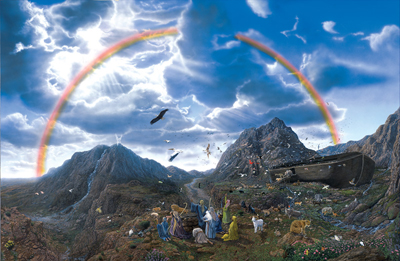
First Sunday of Lent: God, Noah, Us

Genesis 9:8-17                                                       
   8Then God said to Noah and to his sons with him, 9“As for me, I am establishing my covenant with you and your descendants after you, 10and with every living creature that is with you, the birds, the domestic animals, and every animal of the earth with you, as many as came out of the ark. 11I establish my covenant with you, that never again shall all flesh be cut off by the waters of a flood, and never again shall there be a flood to destroy the earth.”
   12God said, “This is the sign of the covenant that I make between me and you and every living creature that is with you, for all future generations: 13I have set my bow in the clouds, and it shall be a sign of the covenant between me and the earth. 14When I bring clouds over the earth and the bow is seen in the clouds, 15I will remember my covenant that is between me and you and every living creature of all flesh; and the waters shall never again become a flood to destroy all flesh. 16When the bow is in the clouds, I will see it and remember the everlasting covenant between God and every living creature of all flesh that is on the earth.” 17God said to Noah, “This is the sign of the covenant that I have established between me and all flesh that is on the earth.”


The story of Noah and the ark is the capstone of the first several chapters of the Bible and makes little sense without those chapters as prologue. The chapters relate that over the generations after Adam and Eve left the Garden of Eden the human race had become thoroughly corrupted and sinful.  So perverse did humanity become that in the sixth chapter of Genesis we read that, “The LORD was grieved that he had made human beings on the earth, and his heart was filled with pain.”
So God decided to clean the earth of its corruption by flood. There was a good man, Noah, whom God told to build an huge ship. Noah was to put aboard a male and female of every species. All this Noah and his family did, and God set loose flood waters which covered the whole earth. “Everything on dry land that had the breath of life in its nostrils died” (Gen 7:22).
After a few months the waters subsided and the ark was grounded. Noah and the animals went forth, Noah worshiped God and God promised:
“Never again will I curse the ground because of man, even though every inclination of his heart is evil from childhood. And never again will I destroy all living creatures, as I have done. As long as the earth endures, seedtime and harvest, cold and heat, summer and winter, day and night will never cease” (Gen 8:21-22).
In other words, after the flood nothing about humankind had changed and the world would continue on the same way it had before.
There are some serious questions raised by the Noah story that have no easy answers. Pastor Nathan Nettleton wrote that it would be difficult to find a church person who had never heard of Noah's Ark. Yet it would be almost as difficult to find anyone who can actually explain what the story’s relevance is to us here and now. He wrote,
“Many could perhaps tell you that God sent a flood to wipe out the world, and that a man named Noah built a big lifeboat and took his own family and breeding pairs of every kind of animal on board so that, after the flood, God could make a fresh start for life on earth beginning with them. Beyond that, this story is usually reduced to just an animal story for kids, or used as another battleground for those who want to fight over whether every story in the Bible is factual historical account of an actual event.”
For me, the story, taken at its face reading, is not wholly favorable about God’s goodness. It seems to present God as a marauding tyrant. He causes a flood that destroys all life except for one family safe aboard the ark. Yes, Genesis says that humanity was entirely corrupt and Noah alone was righteous. But even so, God’s destruction of all humankind seems, shall we say, extreme, especially when he also killed all the animals, who presumably could not have been corrupt. In this story, God often seems neither good nor loving on the whole and hardly worthy of worship. This place is not the only place in the Jewish scriptures where God's management of the world is presented harshly. The entire book of Job, for example, bluntly questions both God's competence and goodness.
I personally can spiritually function in a universe governed by a God who might not know quite everything, or who might not be able to control everything, but if God is not totally, wholly, purely good, then there is no choice but despair. If God is not wholly good, we are in the hands of a cosmic trickster no matter what creeds we recite or what claims we make about Jesus or anything else.
In the Noah story, I am shocked at what seems to be God’s murderousness. I am unwilling blithely to say that the people then deserved drowning in the flood. I know my own sin and I know that the sins of humanity in the last hundred years reduce the corruption of Noah’s generation to that of amateurism.
However, despite the shock of God's violent judgment, the story emphasizes God’s goodness over any other characteristic. There is repeated attention to the boarding of the ark, to lists of people and animals and birds that are saved, and to the chronology of the event. Attention centers on salvation rather than on judgment, on what God does to preserve creation.[1]
But so deeply embedded in human beings is sin that at the end of the Noah story, humankind is not changed. The human race, symbolized by (in fact, consistingof) Noah and his family, get off the ark no different than when they went aboard. Noah planted a vineyard, made wine and passed out drunk. When he woke up he condemned one of his children and all that child’s descendants to slavery. There is not the slightest indication in the Noah story that anything about humankind will be different after the flood than before.
It is not human beings whom the flood changes, so what then was the point of the whole drill? This question has vexed Christians for centuries and given employment to legions of religion professors and their doctoral candidates. Unless something has changed at the end of the flood story, then we are left with God as an impulsive mass slaughterer. That is a God whom we would fear, but not love, revere or worship.
So: what is different after the flood, what has changed as a consequence of the flood?
God. God has changed, God is different. I do not mean that God is different in power or character after the flood than before. Indeed, God says plainly in Malachi 3.6, “I the Lord do not change.” But there is a change nonetheless.
God makes promises to humanity after the flood, but human beings make no promises to God in return. God vows never to allow such a catastrophe to overtake the earth again but God neither solicits nor expects any kind of vows from human beings.
Nonetheless, God describes limits on how he will deal with human sin. Since destroying sinners, deserved though the destruction is, didn't destroy sin, God declares he will not repeat it in the future. (The Malachi verse in full supports this: “I the Lord do not change. So you, the descendants of Jacob, are not destroyed.”)
Having grieved at the state of humankind before the flood, God vows henceforth to endure human wickedness. God decides to bear the human condition of sin and corruption in himself, for the human race is incapable of escaping its sinfulness.
At the end of the Noah story, God has decided to work within human sin and perversity. God promises to stick with the world, come what may in the way of human wickedness. God makes this promise, not in spite of human failure, but because of it. The way into the future cannot depend on human ability; sinfulness so defines humanity that, if human beings are to live, their very existence must be undergirded by the divine promise. Hence, because of human sinfulness, God promises to do all that is necessary to redeem creation.
Noah’s story asks, why does God stand for human sin? It answers: because God promises to save the world, not destroy it. God commits his holy self to enter into the human world of pain to absorb it into God’s self. Hence we have the words of Paul in his letter to the Romans (chapter 3):
23 since all have sinned and fall short of the glory of God; 24 they are now justified by his grace as a gift, through the redemption that is in Christ Jesus, 25 whom God put forward as a sacrifice of atonement by his blood, effective through faith. He did this to show his righteousness, because in his divine forbearance he had passed over the sins previously committed; 26 it was to prove at the present time that he himself is righteous and that he justifies the one who has faith in Jesus.
So it turns out that the world is not governed by a murderous God after all, but one who is indeed purely good and faithful, even to the point of death on a cross, that the world would be saved by love and not destroyed by violence.

Next week: The only way out of a sinkhole


[1]New Interpreter’s Bible, “Genesis,” by Terence Freitheim

Wednesday, February 18, 2015

An invitation

Invitation to Lenten Discipline
Dear brothers and sisters in Christ:
The early Christians observed with great devotion 
 . . . the days of our Lord’s passion and resurrection,
 . . . and it became the custom of the church that before the Easter celebration 
 . . .  . . . there should be a forty-day season of spiritual preparation.
During this season, converts to the faith were prepared for Holy Baptism.
It was also a time when persons who had committed serious sins 
 . . . and had separated themselves from the community of faith
 . . . were reconciled by penitence and forgiveness.,
 . . . and restored to participation in the life of the church.
In this way the whole congregation was reminded
 . . . of the mercy and forgiveness proclaimed in the gospel of Jesus Christ
 . . . and the need we all have to renew our faith.
I invite you, therefore, in the name of the Church,
 . . . to observe a holy Lent:
 . . . by self-examination and repentance;
 . . . by prayer, fasting and self-denial;
 . . . and by reading and meditating on God’s Holy Word.
To make a right beginning of repentance,
 . . . and as a sign of our mortal nature,
bow in silence before God, our creator and redeemer.


Bookmark and Share

Saturday, February 14, 2015

How to have fun on young people

First, get a couple of stacks of these:


Yes, young people, this is an actual bill of US currency.

After you late-middle-age or older folks (like me) have obtained a stack or two of twos, do this (no link, sorry, FOFB):
On my way home from work, I stopped at Taco Bell for a quick bite to eat. I have a $50 bill and a $2 bill. I figure with the $2 bill, I can get something to eat and not have to worry about irritating anyone for trying to break a $50 bill.

Me: 'Hi, I'd like one seven-layer burrito please, to go.'

Server: 'That'll be $1.04. Eat in?'

Me: 'No, it's to go.' At this point, I open my billfold and hand him the $2 bill. He looks at it kind of funny.

Server: 'Uh, hang on a sec, I'll be right back.'

He goes to talk to his manager, who is still within my earshot. The following conversation occurs between the two of them:

Server: 'Hey, you ever see a $2 bill?'

Manager: 'No. A what?'

Server: 'A $2 bill. This guy just gave it to me...'

Manager: 'Ask for something else. There's no such thing as a $2 bill.'

Server: 'Yeah, thought so.'

He comes back to me and says, 'We don't take these. Do you have anything else?'

Me: 'Just this fifty. You don't take $2 bills? Why?

Server: 'I don't know.'

Me: 'See here where it says legal tender?'

Server: 'Yeah.'

Me: 'So, why won't you take it?'

Server: 'Well, hang on a sec.'

He goes back to his manager, who has been watching me like I'm a shoplifter, and says to him, 'He says I have to take it.'

Manager: 'Doesn't he have anything else?'

Server: 'Yeah, a fifty. I'll get it and you can open the safe and get change.

Manager: 'I'm not opening the safe with him in here.'

Server: 'What should I do?'

Manager: 'Tell him to come back later when he has real money.'

Server: 'I can't tell him that! You tell him.'

Manager: 'Just tell him.'

Server: 'No way! This is weird. I'm going in back.'

The manager approaches me and says, 'I'm sorry, but we don't take big bills this time of night.'

Me: 'It's only seven o'clock! Well then, here's a two dollar bill.'

Manager: 'We don't take those, either.'

Me: 'Why not?'

Manager: 'I think you know why.'

Me: 'No really, tell me why.'

Manager: 'Please leave before I call mall security.'

Me: 'Excuse me?'

Manager: 'Please leave before I call mall security.'

Me: 'What on earth for?'

Manager: 'Please, sir..'

Me: 'Uh, go ahead, call them.'

Manager: 'Would you please just leave?'

Me: 'No.'

Manager: 'Fine -- have it your way then.'

Me: 'Hey, that's Burger King, isn't it?'

At this point, he backs away from me and calls mall security on the phone around the corner. I have two people staring at me from the dining area and I begin laughing out loud, just for effect.

A few minutes later this 45-year-oldish guy comes in.

Guard: 'Yeah, Mike, what's up?'

Manager (whispering): 'This guy is trying to give me some (pause) funny money.'

Guard: 'No kidding! What?'

Manager: 'Get this. A two dollar bill.'

Guard (incredulous): 'Why would a guy fake a two dollar bill?'

Manager: 'I don't know. He's kinda weird. He says the only other thing he has is a fifty.'

Guard: 'Oh, so the fifty's fake!'

Manager: 'No, the two dollar bill is.'

Guard: 'Why would he fake a two dollar bill?'

Manager : 'I don't know! Can you talk to him, and get him out of here?'

Guard: 'Yeah.'

Security Guard walks over to me and......

Guard: 'Mike here tells me you have some fake bills you're trying to use.'

Me: 'Uh, no.'

Guard: 'Lemme see 'em.'

Me: 'Why?'

Guard: 'Do you want me to get the cops in here?'

At this point I'm ready to say, 'Sure, please!' but I want to eat, so I say, 'I'm just trying to buy a burrito and pay for it with this two dollar bill."

I put the bill up near his face, and he flinches like I'm taking a swing at him. He takes the bill, turns it over a few times in his hands, and he says, 'Hey, Mike, what's wrong with this bill?'

Manager: 'It's fake.'

Guard: 'It doesn't look fake to me.'

Manager: 'But it's a two dollar bill.'

Guard: 'Yeah? '

Manager: 'Well, there's no such thing, is there?'

The security guard and I both look at him like he's an idiot and it dawns on the guy that he has no clue and is an idiot.

So, it turns out that my burrito was free, and he threw in a small drink and some of those cinnamon thingies, too.

Made me want to get a whole stack of two dollar bills just to see what happens when I try to buy stuff.

Wednesday, February 4, 2015

Was Jordanian pilot burned to death to ensure his salvation?


The murder of Jordanian pilot Muadh al-Kasasbeh by dousing him with fuel, then setting him alight, is garnering fierce reaction in the West. Barbaric, vicious, inhuman and all manner of like accusations have been slung.

But it could be that ISIS burned al Kasabeh to death as an act of religious mercy. Dying by fire, not set by one's own hand, confers martyrdom on the victim. According to the Muslim site Islam Question and Answer,
The one who dies by burning is a martyr, because of the report narrated by Ahmad (23804), Abu Dawood (3111) and al-Nasaa’i (1846) from Jaabir ibn ‘Ateek (may Allah be pleased with him), according to which the Messenger of Allah (blessings and peace of Allah be upon him) said: What do you regard as martyrdom?” They said: Being killed for the sake of Allaah. The Messenger of Allaah (S) said: “Martyrdom is seven things besides being killed for the sake of Allaah. The one who dies of the plague is a martyr, the one who drowns is a martyr, the one who dies of pleurisy is a martyr, the one who dies of a stomach disease is a martyr, the one who is burned to death is a martyr, ...
 There has been over the centuries a great deal of discussion about what kind of death by burning exactly qualifies. The site quotes a scholar as saying that "in general," one who dies by burning is a martyr but that with very few exceptions (such as a firefighter), no such victim specifically can be so thought.

Muslims know all this, of course, which is why the outcry in the Muslim world at the killing has not been over its method but that it occurred at all.

Here is another example of the connection between death by burning and entry into paradise. "Honor killings" in the Arab/Muslim world are unfortunately all too common. The victim is a female (not necessarily a grown woman) who, in the opinion of her male relatives, has brought shame and dishonor upon the family by doing deeds such as adultery, fornication, being raped, flirting with a man or even becoming too westernized.

Burning the woman to death is a very common means of killing her. Example headlines:

"Yemeni girl, 15, 'burned to death by father'"

"A Father Burned His 13-Year-Old Daughter to Death for Walking Home With a Boy."

"Honor killing in Scotland: Muslim burns ex-wife to death for being “too Westernised"

"Man burns daughter to death in suspected honor killing"

There is nothing in the Quran that commands or even justifies honor killings, and Arab culture is certainly not the only culture that evokes such murders, but that burning is so common is almost certainly related to Mohammed's teaching that such a death confers martyrdom. Since martyrs are guaranteed paradise, killing by burning is thought to be less cruel, eternally, than by other means. This accounts, I believe, why in my readings of Jordan's responses to the pilot's death, I have seen condemnation that al-Kasasbeh was murdered, but not of the fact that he was burned. Jordan actually has a large number of honor killings each year, too, and burning is no less common there than elsewhere in the Arab world.

However, burning women to death is not even solely an Arab custom. "Bride burning" in India, usually over dowry issues, remains a huge problem there, accounting for at least 2,500 deaths per year.

Update: MEMRI has just published excerpts of a fatwa (Muslim religious ruling) issued by ISIS that states in part:
"Q: What is the ruling on burning an infidel with fire until he dies?"

"A: The Hanafi and Shafi'i schools [of Islam] hold that burning is completely permissible. They interpreted the saying of the Prophet that 'Only Allah shall torture with fire' as [a call for] humility. [The scholar] Al-Muhallab said: 'This ban is not [an actual] prohibition, but rather a means for [advocating] humility.'

"[Shafi'i scholar] Ibn Hajar, may Allah have mercy on him, said: '[This saying] indicates that it is permissibile to burn, as the Companions did. The Prophet blinded two men from 'Arina [whom he judged to be apostates and criminals] with a branding iron. Khalid bin Al-Walid, [one of the Prophet's Companions], also burned apostates with fire.'

"Some scholars hold that burning with fire is essentially prohibited, but is permissible while acting in retribution, as the Prophat did with the two men of 'Arina. He blinded them with an iron as an act of retribution, as is mentioned in authentic [hadith]. And this is the most prominent among the proofs."
This statement does not directly state that the murdered pilot is a infidel, but that is clearly the implication (MEMRI did not publish the entire fatwa). If ISIS did indeed hold that al-Kasabeh was an infidel then his murder by fire was "retribution" for his sorties against ISIS.

Bookmark and Share

Friday, January 30, 2015

Yes, Virginia, there really was a Jesus of Nazareth

23 Historical Things We Know For Certain About Jesus. | Historical Jesus studies

It is not trivial that many of the historians cited here are not Christians, and in some cases claim no religion at all.

The neo-atheists' claim (not all of them say it) that Jesus is an invented character just doesn't hold up. "Explanations must explain," and denial of one explanation does not itself constitute another explanation. And the thing to be explained is why the Church came into being when it it did, on the basis that it did. For the Church has claimed since the mid-first century that it was founded by the shock and awe of Jesus of Nazareth having been executed then raised from the dead. The skeptics promoting the theory that all of that is a "later legend" invention are still faced with the incontrovertible fact that (a) the Church had a definite beginning in time and place that is not disputed, and (b) that the Church has always claimed its founding was due to one specific thing: the death and resurrection of Jesus.

So the later skeptics do not persuade when they offer no historically rooted explanation of why, absent the resurrection, the Church even started. But I have not seen any such explanation except, perhaps, his disciples tried gamely to carry on with Jesus' ethical and religious work but soon found that there was some extra "oomph" needed to keep it going. And even that lacks historical evidence.

I was talking to a US Marine Corps veteran one time and we briefly discussed the story of the founding of the Marine Corps. Marine lore has it that the Corps was founded in a bar, Tun Tavern in Philadelphia, to be exact. It was there that the first Marine Corps recruitment drive was held.

Now here is the question: Let us suppose that I, playing the part of a skeptic, say that the USMC was not actually founded at Tun Tavern, and that Tun Tavern probably never actually existed in the first place. Yet the USMC undeniably exists.

If I expect anyone to believe me, then wouldn't I also have to explain why would the USMC later make it up, and why? The Corps already would still exist if it had been founded elsewhere, elsewhen. What is gained by suppressing the true founding and inventing Tun Tavern?

And critically, would I not have to provide actual historical evidence of the USMC's real-though-suppressed founding? Otherwise, there's nothing but the smokescreen of an argument clinic.

The same question applies to the stories about the resurrection of Jesus. Later-legend theorists can't just present us with their own counter claim that the resurrection is a later invention. They need to provide what the suppressed reasons were for the founding of the Church, why they were suppressed and why this particular legend was substituted.

And they have to do it all by presenting compelling, historically-rooted proofs. But they don't because they can't.

Bookmark and Share

Thursday, January 29, 2015

Out: Islamophobia. In: Christianophobia!


Sociologists: 'Christianophobia,' Anti-Christian Hostility Infects Powerful Elite Subculture
A small, but elite group of Americans demonstrate signs of anti-Christian hostility, sociologists David Williamson and George Yancey claim in their new book, So Many Christians, So Few Lions: Is There Christianophobia in the United States? ... In the minds of many of the respondents Christians are ignorant, intolerant and stupid individuals who are unable to think for themselves. The general image they have of Christians is that they are a backward, non-critical thinking, child-like people who do not like science and want to interfere with the lives of everyone else. But even worse, they see ordinary Christians as having been manipulated by evil Christian leaders and will vote in whatever way those leaders want. They believe that those leaders are trying to set up a theocracy to force everybody to accept their Christian beliefs. So, for some with Christianophobia, this is a struggle for our society and our ability to move toward a progressive society. Christians are often seen as the great evil force that blocks our society from achieving this progressive paradise.
In other words, they are completely typical progressives (that is, Leftists) who, in their characterization of Christians described above, perfectly summarize how progressive orthodoxy enforces on its own side (see Chait, Jonathan). Moreover,
...unlike other types of intolerances, those who exhibited Christianophobia do not tend to think that they are intolerant. Usually those who do not like blacks or Muslims admit that they are intolerant but simply try to justify their intolerance. Those with Christianophobia tend to deny that they are intolerant but rather that they are fairly interpreting social reality. Envisioning themselves as fair and free of intolerance allows them to blame those they detest rather than recognize how their emotions have distorted their intellectual judgments.
And yet they call themselves the "reality-based community."

Wednesday, January 28, 2015

Prominent Atheist Professor says Intelligent Design is Plausible

Prominent Atheist Professor of Law and Philosophy Thomas Nagel Calls Intelligent Design Scientific and Constitutional to "Mention" in Science Classes
Prof. Thomas Nagel has published an important essay entitled, "Public Education and Intelligent Design", in the Wiley InterScience Journal Philosophy & Public Affairs, Vol. 36, issue 2, on-line at < http://www3.interscience.wiley.com/journal/118493933/home>  His paper is a significant because it encourages all intelligent, educated, informed individuals to consider that intelligent design may be a valid scientific approach to understanding how DNA and the complex chemical systems of life came to attain their present form. Prof. Nagel's article is well worth the price (fee for access US $29.95).  He is a self-declared atheist who earned his PhD. in philosophy at Harvard, has been a professor at U.C. Berkeley, Princeton, and for the last 28 years at New York University, and has published ten books and more than 60 articles.

Prof. Nagel tells us that he "has for a long time been skeptical of the claims of traditional evolutionary theory to be the whole story about the history of life" (p. 202). He reports that it is "difficult to find in the accessible literature the grounds" for these claims.

Moreover, he goes farther. He reports that the "presently available evidence" comes "nothing close" to establishing "the sufficiency of standard evolutionary mechanisms to account for the entire evolution of life" (p. 199).

He notes that his judgment is supported by two prominent scientists (Marc Kirschner and John Gerhart, writing in the Oct. 2005 book Plausibility of Life), who also recognized that (prior to offering their own theory, at least) the "available evidence" did not "decisively settle[]" whether mutations in DNA "are entirely due to chance" (p. 191). And he cites one Stuart Kauffman, a "complexity theorist who defends a naturalistic theory of emergence," that random mutation "is not sufficient" to explain DNA (p. 192).
This is basically the same rationale that the 20th century's leading philosophical atheist, Antony Flew, used finally to reject atheism and declare he was a deist. He said,
There were two factors in particular that were decisive. One was my growing empathy with the insight of Einstein and other noted scientists that there had to be an Intelligence behind the integrated complexity of the physical Universe. The second was my own insight that the integrated complexity of life itself—which is far more complex than the physical Universe—can only be explained in terms of an Intelligent Source. I believe that the origin of life and reproduction simply cannot be explained from a biological standpoint despite numerous efforts to do so. With every passing year, the more that was discovered about the richness and inherent intelligence of life, the less it seemed likely that a chemical soup could magically generate the genetic code. The difference between life and non-life, it became apparent to me, was ontological and not chemical. The best confirmation of this radical gulf is Richard Dawkins' comical effort to argue in The God Delusion that the origin of life can be attributed to a "lucky chance." If that's the best argument you have, then the game is over. No, I did not hear a Voice. It was the evidence itself that led me to this conclusion.
Exactly.

Bookmark and Share

Friday, January 16, 2015

Why "moderate" Muslims do not persuade

Tenn. Muslims condemn Paris massacre, stand for freedom
Paul Galloway is executive director for the American Center for Outreach, based in Nashville, which was established to bring the Muslim voice to the Tennessee political stage.
An open letter in response:

 Fine words, but what, Mr. Galloway, are you and your fellow Muslims in Tennessee going to do about the ongoing violence of Islamists? It's abundantly clear that verbal renunciations mean nothing to Daesh, al Qaeda, the Taliban and their ideological-religious allies. So you may shout your disapprovals from the tallest tower and they do not care. And because Muslims who want to kill me don't care what you say, why should I? You wrote,
In reality, the [Charlie Hebdo] attack itself insulted the honor of Prophet Muhammad more than any speech or image attempting to mock or insult him ever could.
How, exactly, did it insult Mohammed? Muslim writer Tarek Fatah, writing in the Toronto Sun, wrote of his own imam who said in Friday'a assembly,
... that in reacting to insults we should take the example of Prophet Muhammad himself and follow in his footsteps. 
The problem with that suggestion is that while there were indeed times when Prophet Muhammad forgave those who mocked him, there were others when he ordered them killed.
So did the Kouachi brother embarrass Mohammed, or did they emulate him? What do you base your answer on? Don't answer, "The Quran," because the Quran can be used to justify either answer - and according to the classical Muslim Quran exegete, Ismail ibn Kathir, the verses of the Quran that permit or command violence abrogate and supersede those that exhort forgiveness or mercy. In this he is joined by scholars Abu Al-`Aliyah, Ar-Rabi` bin Anas, Qatadah and As-Suddi and countless others, in fact, by every Muslim scholar and imam and ayatollah alive today.

This is the reason you are losing the argument with Muslims murderers: you and they alike know that the "verses of the sword" abrogate the verses of forgiveness or mercy. On this there has been universal Muslim agreement going all the way back to Mohammed himself. So when "moderate" Muslims write of follow Mohammed's example of peaceableness or cite Sura 2.256, "Let there be no compulsion in religion . . .," they are engaging frankly in propaganda because all of those verses are superseded according to the Muslim doctrine of abrogation, followed by all Muslims everywhere, including yourself, which simply states that when verses in the Quran seem to contradict one another, the chronologically-later verses win.

The verses of the sword are later than the verses of peace. The terrorists know this. And so do moderates. And that's one reason terrorists win the argument - 1,400 years of Muslim exegesis is on their side, not yours. The other reason they win, of course, is that they simply kill anyone who opposes them, including moderates.

Then you wrote,
I'm also deeply frustrated that despite well over a decade of American Muslims, along with Islamic scholars around the world, publicly and consistently condemning all forms of terrorism, that people still don't seem to know where we stand.
We do know where you stand: NATO = No Action, Talk Only. After your decade of condemning terrorism, terrorists are stronger than ever. I do not blame you or your fellow Tennessee Muslims for the Paris attacks. Rather, I consider you and them irrelevant to the entire discussion.

As I said, Muslim terrorists do not care what you think or say and in fact, they will kill you just as readily as anyone else. So why exactly should I pay attention to your denunciations at all? Your disclaimers do not matter. And now to your most ridiculous claim:
It is becoming increasingly clear that anti-Muslim bigots are the mirror image of Muslim terrorists.
This is where your op-ed revealed your voice as a decidedly unserious one. Tens of thousands of people, Muslims and non-Muslims alike, have been murdered at the hands of Muslim extremists. Since 1950, millions of Arab Muslims have died at the hands of other Arab Muslims, though most of them for political reasons rather than religious. But Daesh, al Qaeda et. al. are doing their best to catch up.

Please, Mr. Galloway, identify the "anti-Muslim bigot" terrorist organizations that are killing Muslims as a matter of religious devotion. Please tell me how many Muslims and non-Muslims have died at their hands.

You wrote of the need to "undermine the forces that seek to divide us," then said,
America, by virtue of our Constitution, our nation's legacy of religious freedom and our unique and inherent pluralism, all make us particularly well suited to this task.
Do you therefore agree that Islam should be subordinated to the secular nature of Constitutional government? Do you agree that sharia law can never be the supreme law of the land in the United States? Do you agree therefore that Islam in America does and shall always enjoy exactly the same rights, no more no less, than Methodism, Roman Catholicism, Mormonism or Judaism?

Words are cheap, Mr. Galloway, and another decade of bemoaning disclaimers will only cheapen them further still.

 Bookmark and Share

Tuesday, January 13, 2015

Islam, jihad and you and me

I am starting an evening series this Wednesday, Jan. 15, on the subject of jihad in Islam, what it is, what it means, and what are its implications. I am using almost exclusively Muslim sources.

I came across this series by Methodist pastor David Trawick called, "Islam: It's History, Theology & Today," which is of broader scope than the series I am writing, so everyone should give it a look, to. It is audio only, however.

Click here.


Sunday, January 4, 2015

Peeling back atheism's veil

Contrary to popular belief, atheism is not primarily an intellectual revolt; it is a moral revolt. Atheists don’t find God invisible so much as objectionable. They aren’t adjusting their desires to the truth, but rather the truth to fit their desires…It is a temptation even for believers. We want to be saved, as long as we are not saved from our sins. We are quite willing to be saved from a whole host of social evils, from poverty to disease to war. But we want to leave untouched the personal evils, such as selfishness and lechery and pride. We need spiritual healing, but we do not want it. Like a supervisory parent, God gets in our way. This is the perennial appeal of atheism: it gets rid of the stern fellow with the long beard and liberates us for the pleasures of sin and depravity. The atheist seeks to get rid of moral judgment by getting rid of the judge.
Dinesh D'Souza in What's So Great About Christianity

I have had a number of occasions to have long conversations with self-described atheists. I can tell you that every single one of them fit D'Souza's quote to a tee. They were really rejectionists more than atheists, for they certainly believed in God. They just hated him.
---------------------

By far in this era, the primary reason - so far out in front that it leaves the rest so far behind there's no point on even figuring what's second - is the rejection in America today of any sort of connection between morality and sexuality. "If it feels good, do it" is the overwhelming mantra of the modern age.

The easiest way to justify sin is to deny that there is a creator to provide reality with a nature, thereby denying that there is any inherent order and purpose in the universe. Aldous Huxley admitted that this is a common reason for skepticism:  
I had motives for not wanting the world to have a meaning; consequently I assumed that it had none and was able without any difficulty to find satisfying reasons for this assumption…. Those who detect no meaning in the world generally do so because, for one reason or another, it suits their books that the world should be meaningless. …  
For myself as, no doubt, for most of my contemporaries, the philosophy of meaninglessness was essentially an instrument of liberation. The liberation we desired was …liberation from … a certain system of morality.  We objected to the morality because it interfered with our sexual freedom…. There was one admirably simple method in our political and erotic revolt: We could deny that the world had any meaning whatsoever. Similar tactics had been adopted during the eighteenth century and for the same reasons. (Ends and Means, 270-273)
Thomas Nagel, American philosopher, currently University Professor of Philosophy and Law at New York University:
I want atheism to be true and am made uneasy by the fact that some of the most intelligent and well-informed people I know are religious believers.  It isn't just that I don't believe in God and, naturally, hope that I'm right in my belief.  It's that I hope there is no God!  I don't want there to be a God; I don't want the universe to be like that.  My guess is that this cosmic authority problem is not a rare condition and that it is responsible for much of the scientism and reductionism of our time.  One of the tendencies it supports is the ludicrous overuse of evolutionary biology to explain everything about human life, including everything about the human mind… This is a somewhat ridiculous situation… [I]t is just as irrational to be influenced in one’s beliefs by the hope that God does not exist as by the hope that God does exist. (The Last Word, pp. 130-131)
Quoted by fellow philosopher Edward Feser.


Perhaps Werner Heisenberg, who won the Nobel Prize in Physics for creating quantum mechanics, explained the divergence between biology and physics (with regard to God) best when he wrote:
“The first gulp from the glass of natural sciences will turn you into an atheist, but at the bottom of the glass God is waiting for you.”
With the phrase “the bottom of the glass,” Heisenberg is referring to the study of the most fundamental aspects of reality…which are investigated by physics.
Link.

Bookmark and Share

A world without nuclear weapons - what would it look like?

 From Pope Leo this week, according to the National Catholic Reporter : " Pope Leo quotes Bob Dylan song in book foreword calling for n...