Sunday, August 8, 2010

Atom bombings and their context

Along with my essay, Hiroshima Day, this post forms a necessary background to my essay on on why the World Council of Churches gets it wrong in its call for prayer services for Aug. 6 and Aug. 9 to commemorate the atom bombings of those cities on those dates in 1945.
Bill Quick cites the Japan Times' claim that there was "No rationalization for Nagasaki attack." Says the Times,
If the incineration of Hiroshima was justifiable as a means to end the war and save American lives -- a thesis that even most liberal Americans accept -- what was the justification for the destruction of Nagasaki three days later before Japan had a chance to grasp the message from the first nuclear attack?
Hiroshima after the bombing
First, it is not true that most American liberals (an inapt term for the topic at hand, but let it pass) accept that even the Hiroshima bombing was justified. Even so, it would be helpful to examine the context the two atom bombings took place in, especially from the Japanese perspective.
At the time of the bombing, Japan was ruled by a cabinet consisting of nine men, most of whom were members of the Army or Navy (there was no independent Japanese air force or marine corps). 


Emperor Hirohito's role in the workings and edicts of the cabinet was strictly prescribed by ancient tradition plus severe restraints emplaced on royal authority as Japan had westernized in the latter half of the 19th century. Hirohito attended cabinet meetings but did not speak. The emperor's real role was to approve the decisions taken by the cabinet, and the decisions of the cabinet had to be unanimous by law and tradition. 

Militarists dominated the cabinet in 1945 although there were civilian members who wanted to sue for a negotiated peace. However, all cabinet members were concretely agreed that no peace could be acceptable that did not leave intact the office and symbols of the emperor. Unless that guarantee could be given by the Allies, even the peace-inclined cabinet members were agreed the war should continue. (However, there was never any agreement in the cabinet what other acceptable terms should be.)


It didn't take long for the cabinet to learn what type of weapon had destroyed Hiroshima on Aug. 6. Japanese physicists realized before Nagasaki's destruction that an atom bomb had been used and had informed the cabinet. Although the cabinet realized the bomb added a new dimension to the war, they did not change their basic perceptions on whether or how to continue the war simply because America possessed and used atomic bombs. 

One reason was that the destruction of the two cities, while horrific, was by that stage of the war not unusual. As the Times article points out, mass destruction of cities had already become the norm in the war:
Before the nuclear genie was let loose, mass killings had already become a feature of the war for all sides. 
On a single night, for example, nearly 200,000 citizens burned to death when U.S. bombers doused Tokyo with jellied petroleum in March 1945. Indeed, in the months before the nuclear bombings, half a million Japanese had already died and 14 million rendered homeless in U.S. firebombing raids on cities.

The Anglo-American firebombing of Dresden in February 1945 left some 39,000 Germans dead in an air campaign Churchill acknowledged amounted to "terror bombing." Hitler's massacres of Jews, and Japanese atrocities in China, reflected a similar disdain for civilian life.

By the time Hiroshima and Nagasaki were reduced to smoldering ruins, 50 million people in the world had already been killed in conflict since 1939.
The point about Japanese atrocities in China is well taken. When Japanese forces conquered Nanking, for example, they killed at least 200,000 civilians and probably as many as 300,000 over a six-week period (or so) beginning in mid-December 1937. The scale of the deaths in Hiroshima and Nagasaki was not exceptional by that time of the war. The cabinet already realized that atom bomb or not, Japan's cities would be reduced to ash by American bombers. The atom bombs made the task easier but not more certain.

But the threat to the integrity of the emperor and his office was not simply from the Allies. Japan's security arm, the Kempei Tai, had a domestic enforcement arm very similar to that of the Nazi Gestapo. Kempei Tai intelligence had for months been assessing that there was a real and growing threat of revolution in Japan because of worsening subsistence of the people. American submarines and B-29s emplaced and enforced a ruthless blockade of Japanese ports, cutting off access by sea from Japanese holdings in mainland Asia. Bombers also devoted thousands of sorties to the destruction of rail and road egress from Japanese port cities to the country's interior.

These operations made Japan's populace suffer terribly from the interdiction of foodstuffs from Asia. The main effort was actually named "Operation Starvation" and was begun in April 1945. So severe were its effects that,
After the war, the commander of Japan's minesweeping operations noted that he thought this mining campaign could have directly led to the defeat of Japan on its own had it began earlier.
By the time of the atom bombings, actual starvation had not begun in Japan, but the population was experiencing the same privation as if from severe famine. Adults in some parts of the country were consuming fewer than 1,000 calories per day; on July 30, 1945,
Food shortages lead the government to call on the civilian population of Japan to collect 2.5 million bushels of acorns to be converted into eating material. The average Japanese is presently surviving on a daily intake of about 1680 calories, or 78 percent of what is considered the minimum necessary to survive.
The Kempei Tai was well aware that more than a few revolutions in world history had begun from lack of food and was concerned that the emperor might become personally at risk when children and infants started dying and adults became desperate. The cabinet was regularly briefed by the Kepei Tai on this concern.

What the atom bombings did more than anything was provide the Japanese cabinet - and not all of them - with the excuse to surrender rather than the direct reason. Although American and Japanese historians continue to debate the issue, my readings lead me to conclude that the bombings were seized on by Hirohito and like-minded cabinet members as the handle to end the war to avoid revolution. According to Mitsumasa Yonai, Japan's civilian navy minister,

“It may be inappropriate to put it in this way, but the atomic bombs and the Soviet entry into the war are, in a sense, God’s gifts,” Yonai said nearly a week after an American B-29 dropped the world’s first atomic bomb on Hiroshima on August 6, 1945. ...

“Now we can end the war without making it clear that we have to end the war because of the domestic situation,” said Yonai, who was among the six-member inner Cabinet, led by Prime Minister Kantaro Suzuki.

“I have long been advocating the conclusion [of the war], not because I am afraid of the enemy’s attacks or because of the atomic bombs or the Soviet participation in the war,” he said. “The most important reason is my concern over the domestic situation.”
This statement was uttered before Hirohito directed the cabinet to end the war on Aug. 14. Hirohito took the unprecedented and then-shocking step of personally speaking to the cabinet, rather than sending written communications, and directing the cabinet to end the war. Hirohito made recordings to be broadcast to the nation on Aug. 15. During the evening of Aug. 14, some militarist generals attempted a coup to seize the recordings and take the emperor into what they termed protective custody, convinced that he had fallen under sway of traitors in the government.

(Hirohito's reputation was remade after the war as the savior of his nation but there is little reason to believe he was neutral between the peace advocates and war advocates. Hirohito was a staunch militarist, who along with other militarists in the government,
... waited, instead, until the foreign enemies gave them a face-saving excuse to surrender in order to prevent the kokutai from being destroyed by antimilitary, antiwar pressure from within Japan. ... It didn’t matter how many hundreds of thousands died as long as the monarchy remained intact.
Hirohito was just as concerned about revolution as anyone, maybe more so since his neck was literally on the line in the question.)

It may still be reasonably debated whether the Nagasaki bombing was too hasty. But it isn't clear that without a second atomic bombing fairly soon that the Japanese would have capitulated as readily as they did. In fact, one reason the American authorities hit Nagasaki only three days after Hiroshima was to deceive Japan that there was no shortage of atomic bombs. In fact, the two dropped were the only two that existed. Additional atom bombs would not be ready until September, but then would be produced rapidly enough to support the Air Force's regular use of them through most of the fall.

In 20-20 hindsight it can be reasonably argued that Japan would have surrendered without the bombings, but many crucial facts we know now were opaque to both sides at the time. There is no doubt that many hundreds of thousands, if not millions, of solders and civilians across the Pacific and Asian areas would have died from the war had it continued; discussion of prospective American and Japanese casualties from an invasion of Japan don't consider that hundreds of thousands of other nationalities were perishing every month at Japanese hands in lands still under Japanese control.

However the war would have ended absent the second bombing, or absent it coming so soon, I don't see how it could have ended as quickly or cleanly as it did and it probably would not have ended so absolutely or bloodlessly. The bombings left intact the organs of the Japanese government, which alone were able to order the far-flung Japanese forces to lay down their arms. Had either invasion or domestic uprising or their combination fractured the unity of the central government, America might have been forced to fight each Japanese unit across the Pacific and Asia to neutralize them and there may have been Japanese guerrilla wars for years in Japan and elsewhere by Japanese soldiers. We'll never know, of course.

Saturday, August 7, 2010

Legalize polygamy?

In the wake of federal Judge Vaughn Walker's ruling that overturned California's Proposition 8, that defined marriage solely as the union between a man and a woman, I think it would be useful to ask why not legalize polygamy (or polyandry, for that matter).

Understand: I am not advocating this. But if the US Supreme Court upholds Walker's ruling, as many observers think it will by 5-4 vote (Kennedy being the swing), the the inevitable - indeed, unavoidable - consequence will be that the state has no authority to regulate marriage. That being the case, it will not be possible to offer a legally sustainable argument that gay marriage is okay but polygamy is not.

Polygamy has in fact has vocal though few advocates in the United States for years. The Mormons began practicing polygamy shortly after moving to Utah in the 1840s, continuing with ecclesial endorsement until 1890, when church president Wilford Woodruff ended the practice its sanction. But the practice continued until for new few years afterward. (Presumably, existing polygamous marriages were grandfathered.) Some Mormon advocate re-sanctioning polygamy today (and here).

A post at Blogcritics on "Legalizing Polygamy and Polyandry" states the obvious: "that polygamists and polyandrists see the recognition of same-sex marriage as being a justification for their cause... "

I personally do not foresee a large movement toward polygamy (or "plural marriage," as its advocates call it). But my question remains: once the Court has struck down the states' authority to regulate marriage, what is there to stop it? Nothing.

I'll give the last word to the Chinese:


Above is the ideogram for "two women under one roof," which means "trouble" in Chinese. This may be an urban legend, though. "Yin & Yáng and the I Ching" says that no such symbol actually is used in China, although there are authentic ideograms for one woman under a roof and three under a roof, thus:


Interesting that three women under one roof has such purely negative connotations. And probably informative, too.

Friday, August 6, 2010

What makes marriage, marriage?

A secular discussion of same-sex marriage

With the ruling this week by federal Judge Vaughn Walker that overturned California's Proposition 8, that defined marriage solely as the union between a man and a woman, I think it would be useful to examine the question, "What makes a thing a thing?"

More to the point, what makes marriage, marriage? That is a basic dispute in the issue. I take the position in this post that "homosexual marriage" is a self-contradictory expression that cannot be sustained as an intellectually coherent concept.

The Problem of Universals and defining what is marriage

On the one hand, traditionalists insist that marriage is the legal and sexual union of a man and a woman for the purpose of bringing forth the next generation. That some husbands and wives do not conceive children for whatever reason is accidental to this definition and therefore does not obviate it. Along the way there are certain socially recognized, and usually legally enforceable, rights and obligations that go along with spousal status, such as property rights. Marriage is therefore definitionally impossible for between members of the same sex. Usually, but not always, this argument is buttressed from religious grounds.

On the other hand, proponents of same-sex marriage insist that it is the fulfillment of love and affection they have for one another to which childbearing is incidental. They claim that homosexual relations are just as valid an expression of love as heterosexual; therefore, homosexual relationships should receive the same legal recognition as traditional marriage. Sometimes, but not often, this argument is also buttressed from religious grounds.

Now, the particulars of these arguments I'll address below. First, I want to discuss this question: "what makes a thing a particular thing?" This problem is one of the oldest if philosophical inquiry. It is called, "The Problem of Universals."

Individuals have two kinds of knowledge of things: experiential and intellectual. Experiential knowledge arises from our senses - sight, sound, smell, etc. Intellectual knowledge of things is ideas or concepts formed from seeing experiencing many things and categorizing them into abstracted concepts.

Experiential knowledge gives us knowledge about a particular thing - the keyboard I am typing on, for example, but in intellectual knowledge we primarily use a concept. A true concept of, say, books, tells us nothing about the particular characteristics of the next book we pick up, but it tells us how we will know it is a book at all.

The ancient Greek philosopher Plato took the view that there was a realm of unchanging Ideas to which the physical world conformed so as to give each physical thing its identity. A particular object is endowed with a lesser, impermanent reality of its Ideal as it comes into momentary being, and loses it as it passes away. (Plato's work heavily influenced medieval thinkers, who called the realm of Ideas Universals.)

Aristotle, not long after Plato, disagreed with the notion of Ideas and thought that the forms (as he called them) exist only in the particular things and have no existence apart from or separate from them.

So the problem of universals was this: Since the nature of a universal concept was different in detail from any particular occasion of it, do universals actually give us any knowledge about the world?

In the 11th and 12th centuries, three positions got staked out:

Nominalism (Roscellinus): only the particular or individual is real. Universal terms are merely a word or a name, a flatus vocis , or "breathing of the voice," entirely subjective and mental, which serves as a sign for common objects.

Universalism (William of Champeux): Individuality is only an accidental variation or modification of universal essence.

Conceptualism (Abelard): a kind of moderated realism. Universal concepts are more than mere names and are actually abstractions of general characteristics objects possess in common. These natures do actually exist, but only in the objects which possess them. "Tree" as a universal category is an isolation of the mind of common features present in all trees. But "tree" does not exist as a universal being on its own. Universals are indispensable forms of knowledge we need to know the world.

What the two sides of the same-sex marriage are doing is arguing from two different understandings of what make a thing a thing, or what makes marriage marriage. The "pro" side seems to me to be arguing from the nominalist side, that marriage has no reality in the abstract apart from married couples themselves. Hence, objections from traditionalists that calling the same-sex couples in San Francisco married does not make them so is met with derision from the pro side. In their view, calling them married is exactly what does make them married.

OTOH, most traditionalist arguments I've seen seem to cleave to the Universalist line, that marriage has a definition - that is, a reality - independent of persons who are married. Marriage, truly to be marriage, must conform to this Universal. If not, it is not even a decent imitation and does not share in the Universal reality of marriage.

I tend toward a Conceptualist position. "Marriage" is not simply the name given to any relationship between adults, but only to certain kinds of them. As ordained by God or evolved through millennia (take your pick) there are certain characteristics and behaviors that marriage partners have always exhibited in common.

The Conceptualist advantage is that it does not require every example to conform to the abstraction in every detail, as the Universalist position does (its real weakness as an argument), and as the Nominalist position holds as irrelevant.

A Conceptualist argument of marriage could examine the history and results of marriage for literally back to the stone age and identify certain essentials of marriage that have not changed throughout history:

  • Marriage has always, in all times, cultures and place, been the union of a man and a woman. There is no reason to doubt that homosexuals have also lived in all those cultures, but there is no evidence that their relationships have ever determined the nature of marriage.

  • The affirmation of love and affection of the spouses for one another has only rarely been a cause for marriage in human history. Until recently even in in the West (including America), the emotional feelings that spouses had for one another was not considered very important; what was important was their social or economic similarity, and their compatibility in a myriad of other ways. Marrying because of love is a latecomer to the scene and is not really the norm in most of the world's people now. There are billions of people living in cultures today in which brides and grooms hardly have met before their wedding day.

  • The very fundamental purpose of marriage has been and remains the propagation of the next generation. Look at it this way: just as "a hen is an egg's way of making another egg," marriage is the means by which parents become grandparents. While it is biologically possible for children to be born outside the marital bond (obviously), it is empirically provable that what biologists call "survival advantages" of those children is so relatively low that non-marital childbearing is literally a dead end.

  • Hence, marriage is self-perpetuating, self-referent upon itself and self-defining. Marriage throughout human history has never needed to be defined by relying on something else. However, same-sex "marriage" has no existence or meaning apart from male-female marriage. Male-female marriage is self-perpetuating within itself; same-sex marriages cannot self-perpetuate within themselves at all. In fact, if not for male-female marriage, same-sex marriage cannot even occur at all. Self-perpetuation is the critical element of marriage without which a same-sex relationship, no matter how affectionate, fails to be marriage.

  • Elements of marriage such as property rights and the like do not centrally define what marriage is. Indeed, the historical and present record shows that such matters have varied widely across human cultures and experience. The wife as an equal partner is a modern development, but its lack in other times and places does not obviate the essential character of marriage, the procreation of the next generation. The various legal and social rights and recognitions that pertain to married couples are the result, not the cause, of marriage, intended to buttress its central purpose. Therefore, they are added or discarded inasmuch as they do so, though not without other influences as well. Thus, the legal rights and social claims of married partners are incidental, not essential, to defining what marriage is.

  • Marriage is therefore a social institution, not a merely personal one. All society has a vested interest in the propagation of the next generation and the health thereof. As the saying goes, we are always only one generation from extinction. As a social institution, marriage is defined in aggregate, not in particular. This fact argues against a Nominalist position that if two same-sex persons obtain a marriage license, that they are in fact married. It also shows why the pro side's snark that many male-female married couples never have children is irrelevant: out of any random 100 heterosexual marriages, the overwhelming majority will conceive children of their own, within the marriage bond, but out of any 100 same-sex unions, exactly zero will do so. Hence, the lack of children in a small minority of male-female marriages is accidental to marriage as a social institution and the purpose it serves, but the inability of same-sex unions to have children within the bond is inescapably central to their relationship.


All of which is to say that the accidental characteristics of marriage - love, affection, property and other rights - spring from what marriage is rather than define what marriage is. Therefore, whatever relationship homosexuals may have with one another, and whatever legal rights civil authority may confer upon them, marriage is inherently - indeed, metaphysically - the province only of men and women united in matrimony.

Because the state of marriage is a matter of of social concern and justifiable public interest, society has the right to regulate it as it would regulate other matters of equal (or even lesser) concern. Consider that marriage today is less regulated than getting a driver's license, yet no judge finds it unConstitutional that blind or 12-year-old persons can't get licenses.

But this is simply to recognize that the advocates of gay marriage have no philosophical or rationalistic basis. Theirs is a political claim and nothing more. But, having failed to advance their cause through legislative or executive support, they have turned to the last refuge of political scoundrels: activist courts and judges.

Endnote: Dana Mack, writing in the WSJ, "Now What for Marriage?":
[T]here is a great deal of social-science evidence connecting marriage and the active engagement of two biological parents with child well-being. And there is simply no other way to view the age-old, universal institution of marriage than as rooted in the biological family. Marriage, like all cultural institutions, evolves; and it may look very different in different cultures. But the institution's common denominator across time and cultures has been its dedication to the offices of reproduction. The great 20th century cultural anthropologist Bronislaw Malinowsky stated that while marriage is as old as human life, it has never been primarily a romantic, or even an economic, bond. It has been principally an arrangement for bearing children.

Hiroshima Day

The first atomic weapon used in warfare explodes over Hiroshima, Japan, Aug. 6, 1945

August 6 is the anniversary of the atomic bombing of Hiroshima in 1945. It and the subsequent atom bombing of Nagasaki led quickly to the capitulation of the Empire of Japan, ending World War II. The history leading up to the bombings is compelling and has been the subject of intense debate here in the United States as well as the occasion for condemnation of America after the war by various factions both domestically and abroad.

My purpose here is not to assess those debates or accusations, but simply to relate the history and its context of the American decision to drop the two atom bombs and of Japan's decision to surrender afterward. How connected, exactly, was Japan's surrender to the bombings? The answer is surprising. The atom bombings, it turns out, did not cause Japan to surrender so much as it gave them an excuse to do so honorably (honorably in their minds, that is).

(It must be considered, though, that throughout most of 1945, a half-million civilians were dying monthly at the hands of the Japanese in the Asian and Pacific lands Japan still occupied. Any criticism of the decision to drop the atom bombs must take this genocidal monthly death toll into account.)

Syndicated columnist Austin Bay posted the text of a letter written by James A. Michener to a friend in October, 1995. Michener was serving in the US Army Air Corps in the Pacific when the bombs were dropped. He wrote ,

Never once in those first days nor in the long reconsiderations later could I possibly have criticized Truman for having dropped that first bomb. True, I see now that the second bomb on Nagasaki might have been redundant and I would have been just as happy if it had not been dropped. And I can understand how some historians can argue that Japan might have surrendered without the Hiroshima bomb, but the evidence from many nations involved at that moment testify to the contrary. From my experience on Saipan and Okinawa, when I saw how violently the Japanese soldiers defended their caves to the death I am satisfied that they would have done the same on Kyushu. ...

[I]f you are unlucky enough to become engaged in [war] you better not lose it. The doctrine, cruel and thoughtless as it may sound, governs my thought, my evaluations and my behavior. I could never publicly turn my back on that belief, so I have refused opportunities to testify against the United States in the Hiroshima matter. . . . I know that I was terrified at what might happen and d----d relieved when the invasion became unnecessary. I accept the military estimates that at least one million lives were saved and mine could have been one of them.
I have known a few men who served in the armed forces in the Pacific who completely agree. My father-in-law, an Army officer in 1945, veteran of eight combat amphibious assaults in the Pacific, is convinced that he is alive because the atom bomb canceled the invasion of Japan. My father was assigned to the Pacific Fleet in 1945 and wound up on an aircraft carrier, serving a battle station as a 40-mm antiaircraft gunner. Carriers were primary kamikaze targets.

There are two essential books to understand what happened and why. One is a little-known work of Japanese historians, written eight years after the bombing, Japan's Longest Day . Their focus is on the period between the Nagasaki bombing and the radio address of Emperor Hirohito in which he announced that the war had not turned in Japan's favor. The authors painstakingly document the fact that even the atomic bombings did not persuade all the Japanese high command to surrender. A coup was actually attempted by an army general, who sent troops to occupy the emperor's palace grounds, take the emperor into protective custody and seize the recordings of his statement to be broadcast. The coup failed, of course, but as Wellington had said about Waterloo, it was a close-run thing.

The second book is an award-winning book, Downfall: The End of the Imperial Japanese Empire, by Richard B. Frank. A very comprehensive history, Frank documents the Japanese plan for defending against American invasion of the home islands, using Japanese documents and records. But his best contribution is the way he shows the context in which the Japanese bombings occurred.

Frank shows that the most destructive weapon used against Japan in 1945 was blockade, which robbed Japan of raw materials, petroleum and most vitally, food from the Asian mainland. The blockade was enforced by submarines and B-29 bombers, which laid mines throughout the Sea of Japan, concentrating on the approaches to Japan's harbors. Japan's industries were surprisingly resilient to aerial bombing but could not function when their raw materials were so successfully interdicted.


The remains of Nagasaki, destroyed by an atom bomb on August 9, 1945

Frank shows that within a day of the first bombing, Japanese scientists had correctly identified the weapon's type. Even so, no one's first thought was of surrender. The death tolls of the bombings and the extent of their physical destruction were neither remarkable nor unusual by that stage of the war. As far back as March, B-29s had killed far more people in one night of bombing Tokyo than died in either Hiroshima or Nagasaki. While the Japanese high council did understand that the atom bomb was an unstoppable weapon, well, so were the vast fleets of American bombers already pulverizing Japan's cities. (The high council, eight men who advised the emperor, ruled Japan without challenge. The Diet was toothless by 1945.)

The emperor and his government were united in a collective, non-negotiable condition for capitulation - that the emperor and his office must remain intact, along with the ancient symbols of his divine authority – something akin to the British crown jewels and scepter; the closest American equivalents are the original copies of the Declaration of Independence and the Constitution. The emperor's line had continued unbroken for 2,600 years and his imperial regalia had been passed down from time immemorial. Together they defined the national polity. Japan Zone explains ,
According to the historical chronicles of ancient Japan, the Kojiki (Record of Ancient Matters, AD712) and the Nihon Shoki (Chronicle of Japan, AD720), the sun goddess Amaterasu Omikami presented the sanshu no jingi or Imperial Regalia to her grandson, Ninigi no Mikoto. He in turn passed them on to his descendants, the emperors, the first of whom was Emperor Jimmu. The regalia, a mirror, a sword and a curved jewel are symbols of the legitimacy and authority of the emperor. These creation myths also form the foundations of the indigenous Shinto faith.
At the insistence of General Douglas MacArthur, who knew Japan, its history, and culture intimately, America covertly promised to leave intact the emperor's throne and regalia long before the atom bombings. The Allies issued Japan the Potsdam Declaration on July 26, 1945, directing Japan to surrender or "face prompt and utter destruction." Only two days later Japan's government rejected the ultimatum out of hand. On July 31, Emperor Hirohito told the Lord Keeper of the Privy Seal, Koichi Kido (a member of the high council) that the imperial regalia would have to be protected at all costs.

Despite the secret guarantees, none of the high council agreed to surrender before the atom bombings occurred. Japan's prosecution of the war never let up. The Truman administration and military commanders began to wonder whether, short of actual invasion, Japan could be brought to surrender. (Several of the high council never agreed to surrender even after the atom bombings.)

Until 1995, very large amounts of American records from the months before the bombings remained classified. These records included minutes of meetings of very high-level American civilian officials and military officers. The more conspiracy-minded of historians claimed that the decades-long classification of these records were meant to conceal the enormous rifts within the government over using the atom bomb, and that the hawks of the government and armed forces had succeeded in quashing objections.

However, when the records were released in the '90s, no such rift was evident. While it is true that a number of officials and generals expressed dismay or reservations later (often years later), they never uttered objections before the bombings.

So why were the files classified so long? The answer is mundane: they showed that not only were US intelligence services intercepting and decoding Japanese communications, they were doing the same with the communications of almost 30 other countries, many allied with the United States, including our closest ally, Britain,

These interceptions included those of non-belligerent nations that still maintained embassies in Tokyo. Their communications to their home governments in 1945 were nearly unanimous that Japan would not capitulate. It would fight to the bitter end.

Another thing that the files revealed was that a serious rift over US policy and plans against Japan was developing before the atom bombings, but not over the atom bomb or its use. The rift was over the prospect on invading Japan. And the neutral nation's diplomatic messages were part of the reason.

American planners' estimates of casualties on both sides following an invasion were shockingly high. The recent bloodbath of the battle for Okinawa evoked a split among the American joint chiefs of staff over the prospect of invasion. Half the service chiefs became opposed to invasion because the human toll was unacceptable. Richard Frank concludes in an online essay that this rift was not quite fully set by the end of July but that, absent Japan's capitulation in August, the president would have decided not to invade the Japanese home islands and would have ordered other means to force surrender.

What could those other ways have included? Even if Hiroshima and Nagasaki had not been destroyed by atom bombings, they would not have been spared destruction by massive, conventional bombing. The air campaigns against Japanese cities and lines of communication - rail lines, roads, bridges and the like - would have continued, even though by mid-1945 they were mostly destroyed. Japan's cargo fleet was mostly sunk. Japan had no navy left to speak of. What it did have was thousands of airplanes, millions of soldiers and militia and near-limitless stocks of ammunition, held in reserve to oppose invasion.

Hence, American strategy, absent invasion, could only have consisted of two things:

1. More atom bombings. The atom bombings of Japanese cities would not have stopped with Hiroshima and Nagasaki. Manufacture of atom bombs was scheduled to ramp up to at least two per month before autumn and other target cities had already been identified.

2. Tightening the already-choking blockade. It's worth remembering that as late as World War One, blockade as a war measure was condemned as inhumane and even criminal because its effects spread across all the people of the blockaded country, without regard to age, sex, or status as soldier or civilian. Cut off from Asian mainland food stocks, the Japanese were coming dangerously close to actual starvation by late spring 1945. The per capita, daily calorie intake had fallen to significantly less than the minimum required and was declining steadily. Even after the war, typhoons so damaged Japan's rice fields in October 1945 that massive US food aid was required to prevent mass starvation. Had the war still been going on then, as it would have without the atom bombings, the Japanese death toll would have been very high.

As you can see, though, such a "strategy" is no strategy at all. It is a spasm. Had President Truman not ordered the atom bombings, the US military could have done nothing but intensify conventional bombing and blockading. Hence, Japan could not possibly have been brought to a gentler end of the war than the ending that occurred. Had fighting continued after early August 1945, additional civilian deaths would certainly have numbered in the many hundreds of thousands and probably in the millions by the end of the year.

More likely, though, is that without the atom bombings, Japan would have become embroiled in civil war, which also would have been lethal beyond estimate. Japanese records show that the overriding fear of Japan's high council was the destruction of the emperor's office and line, and the most serious threat thereto was revolution by the Japanese people themselves. The American blockade was so punishing the people that Japan's internal security service, the Kempei Tai, had soberly concluded that revolution was becoming ever-more possible. Even the most hawkish of the council were petrified by this prospect, realizing that people who were literally starving could never be reasoned with to endure obediently to their deaths, especially as they watched their children suffer. The council also had no way to ensure that army units would remain loyal to the emperor once the people took to the streets - the soldiers were hungry, too.

Hence, the atom bombings provided an opening for a face-saving way to end the war. Petrified by the prospect of civil revolution, the high council could preserve its honor (as it understood it) by claiming that the atom bomb was a new weapon of such power that resistance was no longer preferable or possible. This was indeed the tack they took. Not every member of the high council agreed even so; some were willing to risk that the American invasion would come before a domestic revolution broke out and that once US troops were ashore, the people would unite to fight the enemy.

Finally, Emperor Hirohito himself broke the impasse, speaking directly to the high council, which had never been done before. He declared that "the time has come when we must bear the unbearable....[so I] give my sanction to the proposal to accept the Allied [Potsdam] Proclamation," that had directed Japan to surrender or face utter destruction.

The atom bombings, then, provided the opening rather than a fundamental reason to accept the Allies' terms. With the assurance that the Americans would neither abolish the emperor's office nor claim the imperial symbols as war prizes, surrender became the only guarantee that the national polity could continue. Hence it was less undesirable than continuing the war, which would have only invited more destruction and then revolution.


Update, 8/19/2023: This video on YouTube came out just four days ago. 
 

Thursday, August 5, 2010

The Kit-Kat Jesus

According to The Telegraph, this is, "A Kit-Kat which supposedly contains an image of Jesus."
"I was amazed. I just took a bite and then I saw the face of Christ in it," the finder told the NU.nl Dutch website. Other witnesses were less impressed. "It looks more like Darth Vader," said one.


Here is an image from the Shroud of Turin, reputed to be the burial shroud of Jesus.


And here is Darth Vader.


I report, you decide. Shroud of Turin gets my vote,.

Monday, August 2, 2010

Learning the hard way

There is probably no more difficult lesson to learn than that life is not about you.


Friday, July 23, 2010

Why Petraeus won't matter

Let me be clear up front: there is no better general for the command of Afghanistan than Gen. David Petraeus. I worked with him when we were both field-grade officers in the Pentagon. And, if the 'Stan is the main effort today in what used to be called the War on Terror, then there is no better general to take Petraeus' place at US Central Command than Gen. James Mattis.


Mattis and Petraeus go together like peas and carrots. They jointly wrote the U.S. Army / Marine Corps Counterinsurgency Field Manual (though Petraeus usually gets sole credit). There are not two senior commanders anywhere as well versed and expert in counterinsurgency (COIN) as these two.

And they will fail.

They will fail not through lack of effort or of insight or because of poor planning and execution. One would be surprised if every operation and campaign they plan is executed much less than magnificently well. There is nothing that they carry with them into Afghanistan that will fail them, nor will they fail their troops.

They will fail because COIN is a tactic, not a strategic objective, and the United States has no strategic objectives regarding Afghanistan. The generals will be conducting COIN for COIN's own sake, not really to achieve something else. As far any anyone can tell, President Obama's only national objective regarding Afghanistan is to pull American forces out by the end of next year. That's not a strategic objective. It's an admission of aimlessness.

This is not to beat up on Obama. I would make exactly the same criticism of President G. W. Bush until the day he left office. This is one time that Obama could, with integrity, claim that he had been left a mess to clean up. Bush never set clear national strategic objectives for Afghanistan qua Afghanistan. From the outset, Bush enumerated the US's objectives almost exclusively in terms of fighting al Qaeda, which had made the country its base and practically its client.

According to US Army Lt. Col. G.K. Herring of the US Army War College, Bush named six national strategic objectives in warring against Afghanistan ("The War in Afghanistan: A Strategic Analysis"): They were (quoting Herring):

1. ... to disrupt, and if possible destroy, the al Qaeda network in Afghanistan.

2. The United States also sought to convince, and if necessary compel, the Taliban to cease
their support for terrorist organizations; the al Qaeda network in particular.

3. In addition, the Bush Administration sought to demonstrate that the United States was not
at war with the Afghan people or the Islamic religion.

4. The Bush Administration also sought to demonstrate U.S. resolve in this war on terrorism.

5. The strategy also included an objective to build international support for the war in
Afghanistan.

6. The final objective of the Bush Administration was to stabilize Afghanistan following the
fighting there.
The intent was to avoid creating a vacuum in a notoriously turbulent, unstable nation. When the fighting was over, the Administration wanted to establish conditions that would foster security and stability in Afghanistan. Moreover, the Administration wanted to eliminate the conditions that promoted terrorism and support for terrorism. The Administration’s overall intent was to prevent the re-emergence of al Qaeda in Afghanistan and the use of Afghanistan as a sanctuary for terrorist organizations.
Of these six, only the first and the last actually matter now. And I am not persuaded that the first objective, disrupt or destroy al Qaeda in Afghanistan, matters anymore since al Qaeda's core  has moved to Pakistan where it operates mostly unhindered.

We are eight years into this war and neither of the only two important objectives have been accomplished. Nor is there a realistic prospect that they will be. The Taliban have not thrown in the towel inside the country. The prospect of stabilizing Afghanistan are dim, indeed, since the government there does not operate despite corruption. It operates by corruption. Hamid Karzai is no friend of the United States, but then, neither is any potential  successor.

The fact is that the Obama administration, like Bush's before it, does not know what it is trying to do in Afghanistan.

So why did we invade to begin with? Because the attacks of 9/11, planned, funded and commanded inside Afghanistan, left us no choice. If the US was to defend itself, and importantly, to be seen as defending itself, it had to attack its enemy where the enemy was, and that meant going into Afghanistan. We hoped thereby to cut off the head of the snake by killing and isolating al Qaeda's high command from the most of the rest of its organization and allies around the world.

In that we were significantly successful. However, we were (and are) like the proverbial dog chasing a car - once it catches it, what does it do with a mouthful of bumper? Probably no one in the Bush administration expected the Taliban government to fall so quickly, just as there was likely little understanding that al Qaeda was not nearly as dependent on its Afghanistan base as we thought. No doubt, al Qaeda was disrupted. That there has been no repeat of 9/11 is strong evidence for it, but this cannot be laid solely to the credit of invading Afghanistan (or in my view even primarily to it). The shadow wars of international intelligence, counter-finance and covert operations outside Afghanistan are just as credit worthy, and the truly massive effort al Qaeda mounted against US forces in Iraq sucked lives and resources from al Qaeda that it has never recuperated.

Der Spiegel explores American prospects in Afghanistan in some detail, including this nugget that I think is quite accurate:
The Americans and their allies are winning all the battles, and they are losing the war. This week, the global public is now being prepared for a major, supposedly decisive offensive against Kandahar, the home of the Afghan Taliban. The corresponding rhetoric is reminiscent of the situation reports submitted by the failing generals in Vietnam. And it doesn't take an oracle to predict that a hailstorm of bad news will soon be coming from Kandahar, proving, once again, that this war -- whether it's called a battle against terrorism, counterinsurgency or a peacekeeping operation -- cannot be won.

The majority of the Afghan people, complete with their corrupt, incompetent government in Kabul, no longer seem to have an interest in the success of the Americans and their allies. In fact, today it seems that the Afghans would like nothing more than to see all of the foreigners disappear from their soil and go back to where they came from, even if it comes at the cost of a new Taliban government.
How will the Afghan war end? It won't. It will sputter along for all the foreseeable future, with combat waxing and waning until eventually this president or one of his successors simply tires of it all and leaves the Afghans to their self-inflicted fate. The country has known naught but war since the Soviets invaded on Dec. 25, 1979. The warlords there no longer really know the purpose of their fighting, all they know is the fighting itself. And it will not be long before the same shall be said about the United States.

Update: Two responses via email. First from an active-duty Army lieutenant colonel who has served in Afghanistan and commanded a combat battalion in Iraq:
I think your article is spot on. I do think our national strategic objective is a combo of 1) terrain denial to AQI from AFG, 2) elimination of AQI wherever, and 3) advancing human freedom as a way of permanently keeping down AQI. I think however that accomplishing all three objectvices is a gerenational endeavor. As such we need to acknowledge that, announce it to our citizens and to the world and set “timelines” and shape expectations accordingly and then Charlie mike. Otherwise we need to drop objective #3 and bpt work with strong but dirty allies who keep their fokls oppressed and hope that over time we can nudge them to some semblance of democratic freedom that fits their culture.

I think the moral thing to do is to keep all three objectives and know this will take a long time at some cost. But I do not think the American people have the will to see this thru – ours is not exactly a culture of discipline and focused patience. However, the enemies’ culture is.
Second from a U.S. Marine Reserve field grade infantry officer with both combat and civilian years in Iraq, and who has known Gen. Mattis personally for many years.
Unfortunately, I think you nailed it...lack of goal and corruption color everything. Optimally, we extricate our forces with the least amount of damage -- tangible and intangible -- as possible. I trust Petraeus will do that, and keep realistic goals. The only point I don't agree with (based on my folks who have been and have first-hand knowledge) is that I don't think we have lost the Afghani public. At least those beside those who hate ANYONE from outside their square mile of turf.
I'd love to be more optimistic, but just don't see evidence to be.

Thursday, July 22, 2010

"De-baptized?"

In the "news of the weird" category comes this report: "U.S. Atheists Reportedly Using Hair Dryers to 'De-Baptize'."


American atheists lined up to be "de-baptized" in a ritual using a hair dryer, according to a report Friday on U.S. late-night news program "Nightline."

Right: hair dryers, the nemesis of God!

Leading atheist Edwin Kagin blasted his fellow non-believers with the hair dryer to symbolically dry up the holy water sprinkled on their heads in days past. The styling tool was emblazoned with a label reading "Reason and Truth."

Kagin believes parents are wrong to baptize their children before they are able to make their own choices, even slamming some religious education as "child abuse." He said the blast of hot air was a way for adults to undo what their parents had done.

Okay, let me get this straight: they are atheists so therefore must believe that baptism is itself a ritual devoid of content. The application of water by priest or pastor in the Trinitarian formula, the invocation of the Holy Spirit and so forth - all these things have nothing real behind them. They are as devoid of divine presence as, say, hitting a golf ball on Sunday morning.

If they really are atheists, that's what they have to believe about the efficacy of baptism. So if baptism both symbolizes and accomplishes nothing real, then how can s-called "de-baptism" do so? There are only two choices here:

1. Baptism is nothing and means nothing. It's a zero, a null set. Therefore, de-baptism is nothing and means nothing. You cannot subtract from zero or take away from an empty set. So exactly what is the point?

2. Baptism does have some reality to it, so by going through motions with this hair dryer, that reality is presumed removed from the life of the de-baptized.

So which of these two, mutually-exclusive conclusions does someone standing before the dryer affirm? If baptism is not real, it can have no hold on you. But if baptism is real, at least in some way, then it cannot be revoked by human word or deed, since baptism is the work of the Holy Spirit with the priest or pastor as effective, but not original, agent. In most Christian theology of baptism, someone can no more be de-baptized than a Jewish man can be de-circumcised.

But all's well that ends well.

Ironically, Kagin's own son became a fundamentalist Christian minister after having "a personal revelation in Jesus Christ."

Bet he's baptized now.

Could be worse


I write like
Stephen King


I Write Like by Mémoires, Mac journal software. Analyze your writing!


I never thought of myself as a horror writer, but thanks heavens I don't write like James Fennimore Cooper.

Sunday, June 20, 2010

Some notes about reaching the unchurched

I once attended a seminar at Hendersonville 1st UMC on connecting with non-religious people. Some of the points made I found somewhat dubious, such as the claim that "Jesus broke away from his religious tradition for a higher good," which I addressed in more detail here.

But here are some points worth thinking about:

  • Do we present Christianity as a system of beliefs or a way of life? John Wesley said that one may affirm the truth of one, 20 or 100 creeds and yet have no saving faith at all. Faith that saves is not "believing beliefs," not the mere assent to propositions. It is, said Wesley, a conviction wrought in one's heart that in Jesus Christ, all that is necessary for our salvation has been accomplished and that there is no life apart from him.
  • Don't present Jesus as the answer to problems but as the lover of souls. The deepest need of human souls is not problem solving, but the search for meaning. If you have never read Man's Search for Meaning by Viktor Frankl, I urge you to order it and read it as soon as you can.
  • Do we have a passion for Christ, or a passion for the church? When we substitute passion for the church rather than for Jesus, we start to prize order, routine and predictability. Jesus said (John 3):
    "The wind blows where it chooses, and you hear the sound of it, but you do not know where it comes from or where it goes. So it is with everyone who is born of the Spirit."
    The Spirit-led church will often appear unpredictable! As I preached last May,
    We will never thrive with top-down leadership, where the pastor and committees decide what the ministries of the church will be, then nominate and elect members to carry them out. We will thrive with ministries that emerge from Spirit-led disciples who are mostly self-organizing.
    Unchurched people are not looking for organizational excellence, but a church that is trying, for all its imperfections, to be "worthy of the calling to which it has been called." That means our passion must be for Jesus, not one another.
  • We should be about attraction, not promotion. This is linked closely with communicating Jesus as a lover of souls. What is it about our faith life and practice that will attract people of our community and make them commit to it along with us, rather than simply participate in an event? Church promotion gains only participants, and very temporary ones at that. If we understand that we should attract people to commitment, not mere participation, then our own self understanding will change.

Saturday, April 24, 2010

A Good Shepherd Isn't Who You Think

My message for April 25:

Why don’t we still have stables at the church?

The first church I served was founded in 1844, but the Union army destroyed the building during the Civil War. At war’s end, the people bought another tract of land and built a new church. It being 1865, they built a stable and carriage shed in the rear to protect horses and carriages from the elements when the people were at church.

The stable and shed are no longer there.

The sanctuary originally had narrow, wooden benches with no backs, a common feature of churches back then. In the early 1900s, high-backed pews were installed, decreasing seating capacity by almost 100. Soft pew cushions were added about 25 years ago.

No one knows what happened to the benches.

The church was originally lit by oil lamps. It was not electrified until FDR’s Rural Electrification Administration gave assistance. Since the mid-1930s, the church has used electric lights.

The oil lamps are nowhere to be found.

A man in his 80s told me he used to come early on winter Sundays as a lad to light the coal heaters in the sanctuary. A few years after getting electric lights, the church converted to electric heat.

The coal heaters are long gone.

The transoms over the stained-glass windows could be opened for ventilation when they were installed in 1916. Decades later the church added air conditioning.

The transoms were then soldered shut.

Some years before I arrived, the church converted a Sunday School room to a nursery. Before then, mothers were expected to look after their small children at church or stay home with them.

Though the stables had long disappeared when I arrived, the church had no parking lot. It did have a small, graveled-over area that was itself overgrown with grass. People parked on it and on the lawn.

One especially soggy November a woman visitor pointed out to me that she had apparently ruined her shoes walking through the mud from her car. I related this conversation to our lay leader, who was a woman also, but she replied that muddy shoes were a small price to pay to worship God when the early Christians worshiped at risk of death.

The problem is, of course, that there were dozens of churches in the community where one could worship just as well without ruining one’s shoes. Not long afterward, the church built a 100-space, paved, curbed and lined parking lot with a sheltered drive-up.

Each one of these changes - electric lighting, central heating and cooling, adaptation to autos - was, in its time, very controversial among the members, some of whom resisted them vigorously.

Would you like our church to take out the cushioned pews, uninstall the air conditioning, disable the microphones and return to kerosene lighting? Of course not – but it’s important to realize that what we think of as normal and common-sense practice was once widely seen as radical, new-fangled, faddish and unnecessary.

They are universal features now because churches learned that if they did not adapt, people would go elsewhere. When a significant percentage of churches began to accommodate cars instead of horse and carriage, people who drove cars went to them. Churches that held onto stables either closed or made the shift. Same with efficient cooling: people migrated away from open-window churches to air-conditioned ones until the holdout churches understood they’d have to get cool or close.

Today, the “textual generation” is being replaced by the “audiovisual, web-connected generation.” The former learns mainly by reading. But people not much younger than me learn mainly by looking and hearing. The younger someone is, the truer this is. People in their teens and 20s also expect to absorb information by more than one means at a time and interact with one another while they are doing it.

Today, churches are turning to use of multimedia during worship at a rapid pace. Overall, this is less controversial than tearing down the stables was. But like stabled churches had to do, we have to realize that this is the way that society is moving. Churches must adopt this technology or the next generation will simply go elsewhere.

I find this an exciting opportunity, not a daunting challenge. For the first time in literally all the centuries of the Christian era, we actually have a new means to connect the Good News of Jesus Christ with people in ways that have never been possible before. This should fill us with enthusiasm, not timidity!

Update, Dec. 2011: The Baptist Press says its surveys and studies show that American churchgoers are just as "digitally engaged" as the general population.

As long ago as 2007, three-fourths of churches reported that they "regularly use some kind of visual enhancement" of their worship services.

Thursday, April 1, 2010

Why crucify Jesus?

The events of Jesus's last week in Jerusalem, referred to nowadays as Holy Week or Passion Week, began in triumph for Jesus as he entered the city being greeted as a nationalistic hero by some of the people who turned out to welcome him by laying their cloaks upon the road in his path, waving palm fronds and calling out praises.

Yet before the week was out, Jesus had been brutally beaten almost to death by the Romans, then force-marched to a place just outside the city called The Skull, or in Greek, Golgotha. There Roman soldiers nailed Jesus to a cross, upon which he died a short time later.

"Three Crosses" by Rembrandt

But what exactly was Jesus's capital offense? Crucifixion was used by the Romans only for that worst of all possible crimes: sedition or active resistance against the Roman imperium -- mutiny, in other words.  Under Roman law, Roman citizens could not be crucified unless convicted as mutinous or treasonous soldiers. However, any non-Roman under Roman rule could be executed for insurrection or rebellion against Rome.

Absent conviction of a crime against the rule of Caesar, Jesus might have been executed, but not by crucifixion. The Romans made sure to carry out crucifixions in very public, well-traveled places where the intense suffering of the the victim would serve as a warning to others not to get any bright ideas. Those convicted of capital offenses considered less serious than sedition died a quicker and more private death by ordinary hanging or by beheading.

That Jesus was crucified rather than simply killed proves that the Roman prefect, Pontius Pilate, found him guilty of an offense against Rome itself. But what?

There are no notes from the trial of Jesus before Pilate. The accounts of the Gospels were written down many years later, decades, in fact. I read them not as verbatim accounts of the procedures but as dramatic accounts to tell the story of Jesus's death and how it came to occur.

But these the accounts of Jesus's arrest, hearings, trial and execution are not mainly theological explorations, either. The Gospel's writers seem to have possessed historical nuggets of the most important events and then tried to fill in some gaps by integrating what several threads of traditions said. Thus, we can understand that the Gospels' detailed conversations between Jesus and Pilate are not so much transcripts of what was said as dialog that is intended to show how and why one event moved to another.

Some historical facts are not disputed. The Sunday before Passover, probably between 30-33 c.e., Jesus and his disciples arrived in Jerusalem. The crowd that greeted them joyfully soon dissipated. Jerusalem would have been packed with Jewish pilgrims from Judea and across the Mediterranean world, come to the city to celebrate passover and make sacrifices at the Temple. Having been under Roman (hence pagan) occupation for many decades, and the pagan Greeks before that, the Jews' nationalistic fervor ran high during the holy season, so high, in fact, that Pilate abandoned his government's center in Caesarea, about 75 miles northwestward, and came to Jerusalem along with a couple of thousand soldiers. Whether Jerusalem was actually a tinderbox looking for a fuze, who knows today, but Pilate certainly thought so then.

Pilate was a very violent ruler. He had little compunction about sentencing people to death. Many hundreds of Jews, if not more, had already died by his command, some put to the sword, others nailed to a cross. The first-century Jewish historian Philo wrote that Pilate was not much worried about niceties of the law such as a proper trial for the accused. Pilate was known to be very suspicious of crowds, having already loosed his soldiers against at least two large crowds of Jews, in one instance killing a large number. The Gospels record without commentary a time when Pilate sent his cavalry, swords swinging, into a group (of unspecified size) of men gathered to make religious sacrifices, killing the lot.

That Pilate was eventually fired by his direct boss, the governor of Syria, for being too violent speaks volumes, since Roman rule anywhere was lethally unforgiving of resistance. Pilate was sent back to Rome where he disappears from credible historical accounts.

The level of collusion between the Jewish high council (the Sanhedrin) and Pilate is unclear. It was mediated by the high priest, Caiaphas, in any event. All four Gospels present Jesus as being hauled before the Caiaphas - at his house, not at the Temple - and three say that there were other Jewish leaders present; Luke calls them "the elders of the people, both the chief priests and teachers of the law." Whomever they were, they were not the Sanhedrin properly convened (it never met at night anyway) and they are only presented as an echo board for Caiaphas.

(As a side historical note, there were two Sanhedrins during that time. There was the priestly Sanhedrin, which is who the Gospels refer to, and there was the Pharisaic Sanhedrin, which had vacated the Temple grounds in 27 in protest over the corruption of the priesthood.)

What did Caiaphas have against Jesus? The synoptic Gospels indicate that Caiaphas's principal charge against Jesus was blasphemy, of which Jesus was undeniably guilty based on the facts as they were at the time, since the only proof of his divinity that Jesus could offer was his later resurrection from the dead. Mark records that early in his ministry, Jesus was accused of being in league with the devil, for which his miracle working was proof. This was a charge tantamount to sorcery, mentioned in the Jewish Scriptures only to denounce it (2 Chron. 33:6 and Nahum 3:4).

Matthew 26 records that after he was arrested and was brought before Caiaphas,
Then the high priest said to him, "I put you under oath before the living God, tell us if you are the Messiah, the Son of God." 64 Jesus said to him, "You have said so. But I tell you, From now on you will see the Son of Man seated at the right hand of Power and coming on the clouds of heaven." 65 Then the high priest tore his clothes and said, "He has blasphemed! Why do we still need witnesses? You have now heard his blasphemy. 66 What is your verdict?" They answered, "He deserves death."
I think the Gospel of John's explanation, which differs from the others', gives important insights to the dynamics of Caiaphas's relationship with Pilate, showing that the high priest was primarily concerned with preserving the lives of the people. John presents a more nuanced case of Caiaphas against Jesus that makes Caiaphas more concerned with politics with Pilate than internal affairs of religion. Chapter 11 records that Caiaphas was deeply fearful of Pilate's propensity to violence (for excellent reasons, as we have seen). The chapter also says that Caiaphas was willing to plot Jesus's death in order to prevent Pilate from slaughtering the crowds who followed Jesus and then turning his soldiers loose to ravage the country itself. There was Roman precedent for this. A few years after after Jesus was born, a would-be revolutionary named Judas the Galilean led a rebellion against Rome centered in the city of Tzippori (Sepphoris) in Galilee. This was before Pilate became prefect, but the Roman response was crushing. According to Tacitus, the Roman Syrian governor sent two legions who laid waste to the entire city, crucified up to 2,000 men and sold the rebels' families into slavery. The shock of this savagery would have been vivid in Caiaphas's mind. It was the sort of thing, or worse, that he reasonably feared Pilate would render to Judea if Jesus continued unchecked.

(Modern historians dispute Tacitus's account. They agree that the Romans killed or executed all the rebels but not that Sepphoris was burned, since modern archaeology finds no evidence of it. Herod Antipas, tetrarch of Galilee, mounted a major rebuilding project to recover from the damage the Romans did inflict. As the result, the city became larger and wealthier than ever.)

The crowds Jesus drew were particularly worrisome because they signified that Jesus was gaining a growing following. What if, with the masses supporting him, Jesus attempted to claim the throne of David, to which he was by descent from David entitled? The last king of the Jews had been Herod the Great, who had died in 1 BC. He was never accepted by the Judeans as a proper king by lineage because there was question of whether he actually was Jewish at all. When he died, the Romans did not name a successor, instead dividing Judea and territories east of the Jordan river among his three sons and daughter. Their title was "tetrarch," meaning basically "ruler of one-fourth." Herod Archelaus was the main ruler, of Judea proper, and Herod Antipas was awarded Galilee and Peraea. Jesus, though, could have claimed proper inheritance of a unified throne since he was of the line of David. And Jesus had a large following. A power play for the throne could have only bloody results.

That Jesus had said and done nothing to demonstrate such intention would have been of no comfort to Caiaphas; as we say nowadays, "absence of evidence is not evidence of absence." What insurrectionist or revolutionary announces his goals before the optimum time? Jesus knew that such suspicions were harbored against him. In Mark 14, when Jesus is arrested, he demands directly, "Am I leading a rebellion that you have come out with swords and clubs to capture me?"

Caiaphas certainly knew that Pilate was deeply suspicious of crowds and had already dealt bloodily with more than one. To both the Jewish leaders and the Romans, a Jew with messianic intentions was foremost a political figure and in the minds of many Jews (and certainly Pilate), a potential military leader as well.

On Thursday evening of what would become known as Holy Week, Jesus was arrested by Temple police in Gethsemane, just outside Jerusalem. His disciples, who were with him, fled, leaving Jesus isolated. Judas Iscariot, one of the Twelve, traitorously brought the authorities to Jesus to apprehend him.

The simplest narrative of events from then is John's. After being arrested, Jesus was taken to Annas, Caiaphas's father in law. Whereas in the synoptic gospels Jesus appears before a council of some kind and is found guilty of blasphemy at a drumhead court, in John no such council is present nor is there any sort of trial. Jesus, remaining bound, speaks only to Caiaphas, who instead of pronouncing him guilty of some crime, "questioned Jesus about his disciples and his teaching." Jesus doesn't play along. An official present slugged him on the face for responding insolently to the high priest.

Caiaphas quickly sent Jesus to Pilate. John relates a long dialog between Jesus and Pilate after Jesus's Jewish captors charge Jesus with nothing more specific than that he was a criminal. Talking to Pilate, Jesus admits that he is a king, although he says, "my kingdom is not of this world." Pilate seems to seize on this confession (of sorts) as a challenge to Rome, but nothing comes of it. Insisting that he finds nothing about Jesus justifying execution, he orders Jesus flogged. Finally, Pilate caves and orders the crucifixion.

For someone whom Caiaphas feared would decimate the whole country because of Jesus, Pilate seems awfully peaceable when he had the chance to get rid of Jesus. He had to be cajoled, even threatened, into it. In John, the Jews present tell Pilate that to release Jesus would be the same as opposing Caesar. Now Pilate is the one being accused of incipient treason!

But Pilate might have been trying all along to shift the blame for Jesus's execution from himself onto the Jewish leadership. It was Passover week, remember, when passions ran high. Jesus still had thousands of devotees who were unaware that he had been arrested overnight. Might they riot in protest? It was a real danger as Matthew explicitly records the chief priests realized; it was the reason they decided not to snatch Jesus during the daytime. If a riot there might be, Pilate might have thought, best to preemptively divert its rage away from the Romans and onto Caiaphas and company. Pilate would not be able to sit it out, but reporting to Rome that the people were rebelling against their own religious authorities, not Caesar, was infinitely better than the other way round.

But while Pilate was trying to play Caiaphas, the high priest, knowing well Jesus's popularity among the masses (as well as his allies among some members of the Sanhedrin, Nicodemus, for example) may well have been trying to set up Pilate to take the heat for him, also. Both men seem to have wanted to put the monkey on the other's back. This would help explain why Caiaphas gave Jesus such a cursory hearing before trundling him over to Pilate and the resistance to executing Jesus that Pilate gave right back to Caiaphas.

Caiaphas finally played his trump card. The Roman Caesar was Tiberius, who had checked out of affairs of state in 26 c.e. He moved to isle of Capri to living a life of debauchery as only wealthy Romans could. He had left running the empire to Praetorian Prefects Lucius Aelius Sejanus and Quintus Naevius Sutorius Macro, neither of whom stayed loyal to Tiberius.

Not long before Jesus' trial, Tiberius had returned to Rome after learning that Sejanus was actively plotting actual sedition and usurpation against him. Tiberius had Sejanus executed and began executing Sejanus' partners and political appointees by the dozens. Pilate owed his office to Sejanus but escaped the purge probably because his appointment was made in the very earliest days of Sejanus' rule, well before Sejanus began plotting against Tiberius.

Even so, Pilate must have known that his own political, and probably physical survival depended on demonstrated devotion to Tiberius. This was Pilate's political Achilles' Heel and it was there that Caiaphas aimed a nearly-explicit threat: if you free Jesus we will report to Rome that you failed to defend Caesar against an insurrectionist, a pretender to the still-vacant throne of Herod the Great, who was a Roman vassal we did not recognize as legitimate in the first place, but that does not matter anyway, for, "We have no king but Caesar," Pilate. How about you?

It is a grievous error to blame "the Jews" categorically for Jesus's death, but there is no way to get around Caiaphas's deep involvement. As for Pilate, his intelligence sources would have kept him informed of Jesus for quite awhile. Pilate would not have been caught flat-footed when Jesus appeared before him early Friday morning. The Gospels describe no prior collusion between Caiaphas and Pilate concerning Jesus, but I have to think that they may have already outlined the kabuki dance that began when Jesus appeared before Pilate, who was undoubtedly frustrated that his interrogation of Jesus elicited no actionable confession. Not being given the open-and-shut case that he probably presumed he would have, Pilate, over Caiaphas's protest, ordered a sign affixed to Jesus's cross identifying him as "King of the Jews," a sign probably intended to implicate Caiaphas directly in Jesus's death, for who else could have made such a charge?

Despite their differences, both Caiaphas and Pilate came to see that executing Jesus was win-win for them. By giving up Jesus to Pilate, Caiaphas would prevent the Jesus movement from getting out of hand before it was too late to prevent the unspeakable horror of Pilate's superior in Syria from sending a legion or two to teach Judea to stop raising up such troublesome sons. When Caiaphas conversed with Jesus at his house, he may well have been trying to cut a deal with Jesus that would preserve Jesus's life at the price of Jesus agreeing to stop working all those miracles and raising such a following - in other words, to live the ordinary life of an ordinary man, get married, settle down and play nice. It is almost impossible to believe that turning Jesus over the Pilate to be killed would be an easy decision for any high priest, this one included. Whatever Caiaphas  talked to Jesus about (if he actually talked with him at all), Jesus certainly swatted the approach away with finality. Faced with such intransigence, Caiaphas saw no recourse but to hand Jesus over to Pilate and make sure that Pilate never gave him back.

As for Pilate, his win would be to stop the Jesus movement cold by the very simple, effective expedient of killing Jesus. After all, he could not continue to send taxes and goods to Rome by destroying the country that produced them. And his loyalty to the vengeful Tiberius would not be challenged.

Jesus, it seems, had become too threatening to be allowed to live. Both Caiaphas and Pilate had the motive and the opportunity that week to stop him but only Pilate had the means to stop him permanently. There was a meeting of minds between Caiaphas and Pilate, and Jesus got caught in the middle. But here's the kicker: Jesus cooperated with what they had planned for him because he understood that his own fate was inextricably linked to the collusion between them. That Jesus could have effectively defended himself seems of little doubt; there are many clues in the Gospels of what he might have said. But instead, he let himself be found guilty by default. And so he carried a cross to Golgotha and the world has never been the same.

Wednesday, March 17, 2010

Hurricane season! Oh, no!

This morning's email included a nugget in the Tennessee Conference listserv with a link to this alarmist forecast: "Hurricane season may be ‘extreme’."
AccuWeather.com is predicting that the 2010 Atlantic hurricane season will be much more active than last year's, and poses an “above-normal” threat to the U.S. coastline.

“This year has the chance to be an extreme season,” said Joe Bastardi, the center’s Chief Long-Range Meteorologist. "It is certainly much more like 2008 than 2009 as far as the overall threat to the United States' East and Gulf coasts."
Every year the hurricane centers swing into action before the official start of the hurricane season to tell all the coast-dwellers that they're in terrible danger. Or something like that. Dire hurricane warnings are de rigeur for this time of year. But disaster-preparedness planners find these warning singularly un-useful. For example, in 2008 similar warnings were issued (and 2008 was an active season as things turned out) but the AP explained that they are of little use.
It's a lot like Groundhog Day — and the results are worth just about as much.

"The hairs on the back of my neck don't stand up," ho-hums Craig Fugate, director of emergency management for Florida, the state that got raked by four hurricanes — three of them "major" — in 2004. When it comes to preparing, he says, these long-range forecasts "are not useful at all."

The AP contacted the emergency management agency in every coastal state from Texas to Maine and asked whether these seasonal forecasts play any role in their preparations for the hurricane season. Their response was unanimous: They're a great way to get people thinking about the upcoming season, but that's about it.
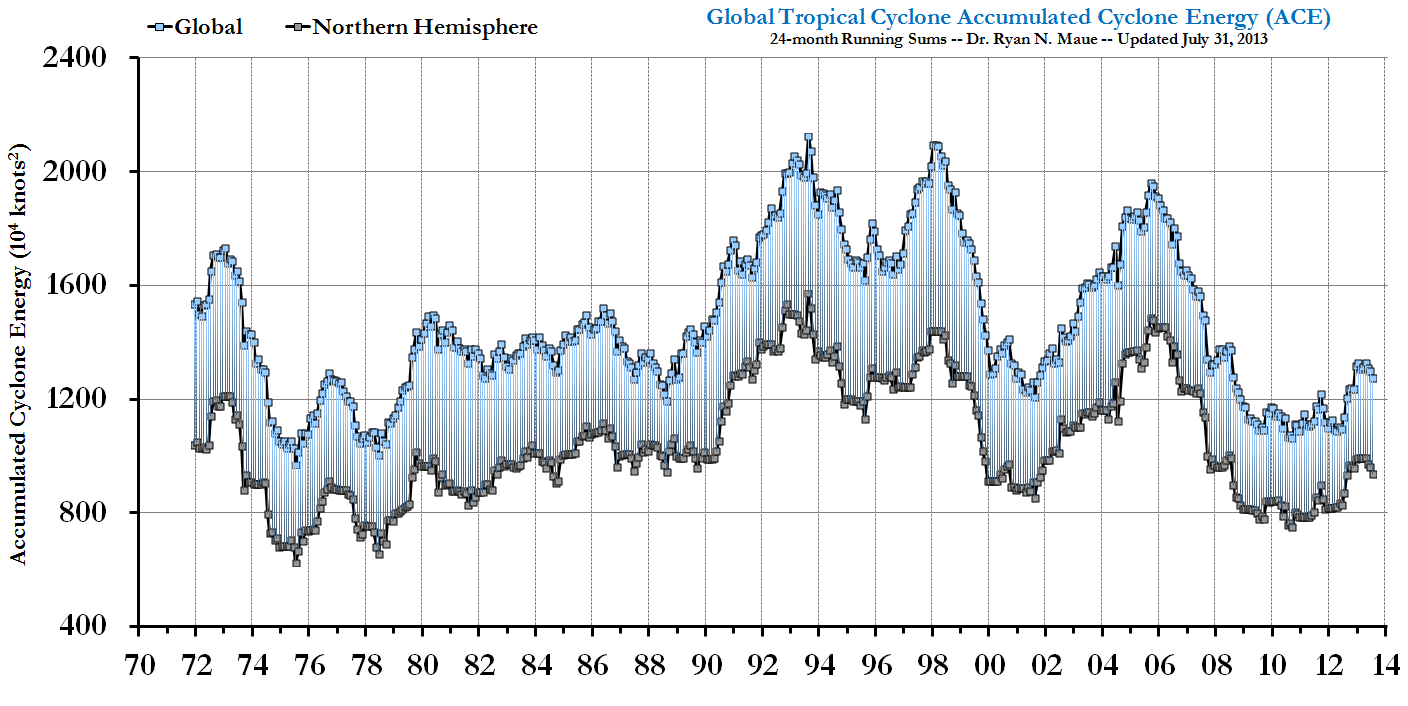
The forecast for 2009 was for an above-average hurricane season, but in fact no hurricanes made landfall in North America and only one tropical storm (the level of storm below intensity of a hurricane) made landfall. In fact, hurricanes have been decreasing over the last several decades.

This is a chart of the aggregate, global intensity of hurricanes since 1974. This chart is from Climate Audit website, where we learn that, "Global hurricane activity has decreased to the lowest level in 30 years." Click image for a larger view. The chart displays data using "a well-accepted metric called the Accumulated Cyclone Energy index or ACE for short."

Remember when the "consensus" was that global warming would make hurricanes worse? For example,
According to the 2007 Fourth Assessment Report of the Intergovernmental Panel on Climate Change (IPCC-AR4), it is "more likely than not" (better than even odds) that there is a human contribution to the observed trend of hurricane intensification since the 1970s. In the future, “it is likely [better than 2 to 1 odds] that future tropical cyclones (typhoons and hurricanes) will become more intense, with larger peak wind speeds and more heavy precipitation associated with ongoing increases of tropical [sea surface temperatures].”
And again:
The Effect of Global Warming

Two factors that contribute to more intense tropical cyclones-ocean heat content and water vapor-have both increased over the past several decades. This is primarily due to human activities such as the burning of fossil fuels and the clearing of forests, which have significantly elevated carbon dioxide (CO2) levels in the atmosphere. CO2 and other heat-trapping gases act like an insulating blanket that warms the land and ocean and increases evaporation.
Finally:
[A]re storms getting stronger, and if so, what's causing it? According to a new paper in Nature, the answer is yes — and global warming seems to be the culprit.
But now the consensus has evaporated. Last year the NOAA announced,

“There is nothing in the U.S. hurricane damage record that indicates global warming has caused a significant increase in destruction along our coasts.”

Original NOAA paper here. To be accurate, the paper focuses on the dollar amounts of hurricane-induced damages rather than the meteorological intensity, but it does specifically rebut the notion that global warming has increased intensities and this increased losses. In fact, hurricane intensities have actually decreased since the mid-19th century (click on pic for larger view):


So why the record low intensities? Climate Audit explains:
During the past 2 years +, the Earth's climate has cooled under the effects of a dramatic La Nina episode. The Pacific Ocean basin typically sees much weaker hurricanes that indeed have shorter lifecycles and therefore — less ACE . Conversely, due to well-researched upper-atmospheric flow (e.g. vertical shear) configurations favorable to Atlantic hurricane development and intensification, La Nina falls tend to favor very active seasons in the Atlantic (word of warning for 2009). ... Through March 12, 2009, the Southern Hemisphere ACE is about half of what's expected in a normal year, with a multitude of very weak, short-lived hurricanes. All of these numbers tell a very simple story: just as there are active periods of hurricane activity around the globe, there are inactive periods, now for almost 3 years.
And I'll give them the last word:
Under global warming scenarios, hurricane intensity is expected to increase (on the order of a few percent), but MANY questions remain as to how much, where, and when. This science is very far from settled. ... The perceptible (and perhaps measurable) impact of global warming on hurricanes in today's climate is arguably a pittance compared to the reorganization and modulation of hurricane formation locations and preferred tracks/intensification corridors dominated by ENSO (and other natural climate factors). Moreover, our understanding of the complicated role of hurricanes with and role in climate is nebulous to be charitable. We must increase our understanding of the current climate's hurricane activity.

Oh, there has been no global warming at all since at least 1998. But that's a topic for another post.

Tuesday, March 2, 2010

Greece's annual rocket war

Two villages in Greece spend a year making 50,000 homemade rockets, sort of like overbuilt bottle rockets, and then on one night of the year they fire them at each other. The objective is to ring the bell in each other's church tower - while mass is being held.


I lived in a small farming village in Germany from 1983-1986. New Years Eve there was a rocket and fireworks extravaganza at the stroke of the New Year. Two of my neighbors, one on each side, shot rockets toward each other's open, second-floor windows for 20 minutes. In the street, rocket duels went on from one end of the street to another for more than a half hour.

A world without nuclear weapons - what would it look like?

 From Pope Leo this week, according to the National Catholic Reporter : " Pope Leo quotes Bob Dylan song in book foreword calling for n...