Thursday, October 15, 2009

Some thoughts on health care

The Social Principles of the United Methodist Church declare, "Health care is a basic human right." The Principles offer the weakest of justification for the claim, citing only Psalm 146, which "speaks of the God 'who executes justice for the oppressed;/ who gives food to the hungry./ The LORD sets the prisoners free;/ the LORD opens the eyes of the blind.'" I have looked in vain online for a philosophical argument, as opposed to mere assertion, that health care is a human right. haven't found any yet, but I keep looking. However, here are some representative sample of the "pro" side that I have found so far.

As far as I can tell, when someone says that health care is a human right, what s/he really means is, "I want all the health care I want to be given to me free."

Amnesty International merely cites the Universal Declaration of Human Rights, which lists health and health care (both) as human rights, and pretty much lets it go at that. But Amnesty offers no explanation of why health care is a right rather than, say, an achievement. It simply is a right, and that's that. Same for The Opportunity Agenda.

People's Weekly World is, as the name indicates, overtly Marxist, but let's see whether it can offer an actual argument in favor of the position. Umm, nope. It simply cites FDR's proposal of a Second Bill of Rights, which includes, "The right to adequate medical care and the opportunity to achieve and enjoy good health," and let's it go at that.

Roosevelt did make an argument, albeit a very brief one, postulating that the original Bill of Rights, being oriented on political freedom, was no longer adequate for an industrial America. And yet his argument was only pragmatic, claiming that, "People who are hungry and out of a job are the stuff of which dictatorships are made." Which is pretty interesting, seeing as how FDR once fancied himself a strongman ruler if not actual dictator (he actually drew up legislation for Congress to authorize him to rule by edict, but he never sent it to the Hill).

I think that history, however, would show that "people who are hungry and out of a job" bring down dictatorships as often as they enable them. Say, France, 1789 and the downfall of the French monarchy. It wasn't hunger that caused dictatorial rule to return later to France, but chaos. And again: Russia, 1917, the overthrow of the Czar and the establishment not of dictatorship but of proto-democracy, well, until the Bolsheviks got the upper hand. Germany: Hitler was not elected chancellor- twice! - by hungry, jobless Germans, though his elections in 1933 and 1936 did take place in the depression. It was improving prosperity in Germany, combined with runaway nationalism and anti-Judaism, that enabled the Nazis to consolidate their power. Nor did jobless, starving Japanese demand the bushido government that took them into World War 2, although starving Japanese in 1945 would almost certainly have overthrown that government in 1945 had it not surrendered to the Allies first.

However, FDR didn't stop at health care in his Second Bill of Rights. He listed all sorts of ingredients for his rainbow pie. For example, the right of every farmer "to raise and sell his products at a return which will give him and his family a decent living." Growing plants is now a human right? How can there be a "right to sell" without a corresponding obligation for someone else to buy? And just how shall "decent living" be defined? All of FDR's Bill is chock-full of inexactitudes like these, such as, "The right of every family to a decent home." Just what does that mean?

Well, continuing to march: we turn to Ryan Dashek, writing in The Daily Cardinal, that, "Health care is a human right, not a costly luxury." Again, no explanation of why this is so, just assertion and a litany of presumed benefits that would come from nationalized, single-payer health care. Nor, for that matter, is there the slightest recognition that health care is going to be costly whether we classify it as a luxury or not. (The failure to distinguish between cost and price is very common among universalism advocates.)

Well, the National Economic & Social Rights Initiative lets the cat out of the bag.

When visiting a doctor, clinic or hospital, patients should not have to pay. Health care funds should be collected independent of the actual use of care, to avoid creating a barrier to care. Services must be provided based on clinical need, not payment, regardless of the financing mechanism used.
This is so economically uninformed that I hardly know where to begin its rebuttal. It treats medical care as a resource rather than a service. It absolutely makes the bean counters and accountants in charge, not doctors or patients because medical care is going to allocated somehow ("rationed," as we say) and the main important question is how it shall be done.

Contrary to what the NESRI thinks, access to medical care will never be unlimited. I have personal experience with government-run health care. It was a CHAMPUS-run clinic that opened in Fayetteville, NC, while I was stationed at Ft Bragg. (CHAMPUS was the military health-insurance program used when treatment at actual military facilities was not available. It's called Tricare today.) The object was to encourage family members of military members to use this clinic rather than go to the base hospital. The Army contracted with a civilian company to staff and run the clinic.

Being a contract, there was a dollar amount to pay for a specified number of patient treatments. The clinic was overutilized (or underfunded, take your pick). So the company, as allowed by the contract, reduced the number of days the clinic was open and the number of hours per day it was open. Otherwise, it would have continued on until say, the end of July, and then been shuttered until October.

Like Mr. Dashek, NESRI does not understand that price and cost are not the same. Making health care free for patients does nothing to reduce its cost. All it does is shift the small-minority costs to the provider that are presently borne by most, but not all of the patients. But the costs will neither disappear nor be reduced. It will still cost the doctors and hospitals the same to provide the care as before.

What "free" (in scare quotes because, you know, TANSTAAFL), health care will do is increase demand without increasing supply. That always leads to shortage whether we're talking about medical care, gasoline, hotel rooms or any other good or service. Without price movements to bring demand and supply back into alignment, reductions will follow in access to or quality of care or both.

Here's an illustration: I visit many hospitals and occasionally those visits are to emergency rooms. There is a sign in waiting and admission areas I have seen many area emergency rooms. It says something like this: If your illness or injury is not a true emergency, you will be directed to a routine-care facility.

Why that sign? Because federal law requires that emergency rooms cannot charge patients for treatment if the patient says he cannot pay or is uninsured. I don't object to the law, but emergency rooms have become choked with uninsured supplicants for free treatment who are not suffering a medical emergency. I have seen this many times in person over the years. But emergency rooms are called that for a reason, and if you fill your treatment bays with patients who, though ill or injured to some degree, are not facing an actual medical emergency, you are in fact decreasing access (rationing) care for true-emergency patients.

That's what happens when you make medical care free. It will always become over-demanded and under-resourced. Costs will rise and will not be recuperated by monetary price. Hence, price will be paid in other coin, and that coin will always include availability and quality.

Any economist understands this. Pity that so few others do.

Endnote: Philip Barlow, Consultant neurosurgeon at Southern General Hospital, Glasgow, explains why, "Health care is not a human right."

Philip Niles says that the real question is not whether health care is a human right, but "How much health care is a human right?" Good question, since health care is finite.

Friday, October 2, 2009

We are under authority

Every year the Tenn. Conference Board of Ministry (BOM) interviews, in person, candidates for probationary service as pastors, called commissioned ministers, and serving commissioned minister who are ready for ordination either as deacon or elder.

The BOM also sends a member to the seminaries where most Tennessee Conference candidates matriculate to talk to the Methodist students about going before the BOM. Candidates are interviewed by the entire BOM twice, first for commissioned status and later for ordination. These interviews take two days.

When I was still working toward my M.Div. At Vanderbilt, the BOM's representative visited and spoke to us for some time. One of the things he talked about has stuck with me all the years since. I can't quote him exactly after so long, but this is very close to what he told us:
One of the things you need to understand about going before the BOM is that there are some things we are flexible on and some things we are not. We are not necessarily of one mind on things such as the theology of worship, for example, but there are other things for which we will be entirely inflexible.

One of those things is baptism of infants. I need to let you know as clearly as I can that if you do not unambiguously affirm to the BOM that you will baptize infants, you will not be commissioned or ordained. Believe me when I say that the BOM makes no exceptions for any reason.

Despite the fact that we always emphasize this fact when we send BOM members to talk to seminary students, every year there are always about two candidates who appear before the BOM and say that they cannot bring themselves to baptize infants. And they always seems to think that they have a compelling or new argument in their favor that will convince us to approve them. Or they think that their candidacy record is so strong in other areas that the BOM will excuse them for not affirming they will baptize infants.

They are always wrong. I need to be very clear: there is no argument you can possibly present that will justify your unwillingness to baptize infants in the United Methodist Church. And the strength of the rest of your candidacy will not be relevant to this issue.

Ministers of The United Methodist Church baptize infants, period. If you cannot do that, save yourself a lot of time and trouble and withdraw from candidacy now.
You can see that this was an unusually blunt advisory, but as he indicated, it needed to be. And yet when I went before the BOM, one of the seminary students who was sitting at my table on that day told the BOM he would not baptize infants. And the BOM voted "no" on his continuation.

It behooves us now and then to remember that, as the centurion told Jesus, we are under authority in the church. Even if we were an independent congregation, not affiliated with any denomination, we still could not simply make up our own rules and call ourselves a church. The New Testament can't be ignored nor can the guidance of the Holy Spirit.

As United Methodists, we are bound by the UM's Book of Discipline, which sets forth the doctrinal standards of the Church and many matters of local-church governance and organization. For example, the Discipline directs that every charge shall have certain committees and be structured certain ways. (A charge is one or more congregations who have the same pastor.) We cannot decide to ignore the Discipline in these matters or in others where the Discipline is directive.

The Discipline is not directive in every part; some of its sections say "should" rather than "shall." Even so, it is the Discipline that makes us a United Methodist Church rather than a generic Protestant one. Our challenge is to remember that we are under authority when it seems burdensome, for it is no merit to do obey instructions that are pleasant to us.

Sunday, September 27, 2009

Christianity is just spinach

In his Letter From Birmingham Jail, Dr. Martin Luther King, Jr., wrote of American churches,
So often the contemporary church is a weak, ineffectual voice with an uncertain sound. So often it is an archdefender of the status quo. Far from being disturbed by the presence of the church, the power structure of the average community is consoled by the church's silent--and often even vocal--sanction of things as they are.
Though Dr. king's context was the civil rights struggle, I have to wonder whether the same critique can be made today in other contexts. In many ways Dr. King's critque still does ring true - we are still today archdefenders of the status quo, it's just the the status quo has changed. I don't know of any churches who would support returning to Jim Crow, but I think that in areas other than civil rights we are still "a weak, ineffectual voice with an uncertain sound" in many ways.

Most urgently, we are a weak voice in the basic foundation of the Christian Gospel. As one Christian writer observes:
... you could attend church for decades and never here a single examination of whether any propositions required by Christianity are true. There is no logic being taught in the church. There is no linking of Christian doctrine with anything verifiable in the external world.

Children are not stupid. They understand the difference between the way that things are approached in the schools (logically and empirically) and the way that things are approached in the feminized postmodern relativist universalist church (emotions and intuitions). They understand the difference between a physics experiment and a praise hymn. And they know when they are being sold a myth.

The basic problem here is that Christianity has been re-interpreted from being an objective religion based on knowable truth to being a subjective religion based on the felt needs of the subjects in the church pews. The solution to this problem is for the church to treat Christianity as a set of claims about an objective reality. Christianity must be place in the same category as physics and chemistry.

You cannot expect people to be bold in talking about things like sin and Hell when it is no fun to do so. If Christianity is not a knowledge tradition, then it is not worth being any sane person’s time and effort. If Christianity is a personal preference, then it is the same as any other personal preference – it must serve the needs of the person who adopts it.

No one eats spinach, unless they like the taste of spinach. If Christianity is not knowledge, but is just a personal preference, then Christianity is spinach. Some people will like it, and they’ll eat it. But most people won’t like it, and they won’t eat it. ...
The Gospel is dangerous, and therefore must be tamed and put in its place. Its threat to the status quo must be eliminated. And so churches, ably accompanied by their pastors is so many cases (I plead guilty, too) pick up a stool and a whip and set about being the tamer of the Lion of Judah.

I received an email awhile back from Pastor Youngsik Kim of Yerang Mission in South Korea. Yerang is a Christian missionary and aid mission that smuggles Bibles, food and clothing into North Korea. It also helps establish churches in China.

Pastor Kim told man who escaped the Stalinist prison we call North Korea, made it to the South and became a Christian there. He volunteered to work with Yerang Mission and go back to North Korea to establish an underground church. Part of his training regimen was to spend two months at a base camp in China – yes, China – to learn theology and the Bible. The daily training at the base camp takes 10 hours, and for the rest of the day Yerang Mission teaches them how to pray and sing hymns, and information about South Korea.

Did you catch that? Ten hours of intensive religious training per day, then prayer, music and history education.

The North Korean man completed his training, went back to North Korea and established an underground church. “While he was managing an underground church in North Korea, he brought Bibles and Christian books to North Korea,” crossing the border between China and North Korea several times a year.

Then he was caught by Kim Jong Il’s secret police, who tortured him. They promised him he would live if he revealed the names and locations of his fellow missionaries, but he chose to die rather than betray them. As the soldiers led him to be shot in public, he cried out, “Believe in Jesus Christ! Only Jesus is the true God!” until he was executed in the field.

Religion professor Telford Work responded to this story. He said that American Christians have changed the historic meaning of Christian "witness" into something like a protest demonstration. However, he says,
A much more typical image has the Church in the proactive, initiating position, breaking down the gates of hell. The real center of human history is not the state, not the individual, not “The People,” not even history, but Israel-Jesus-Church. It is the other human institutions that are on the defensive, rebelling and passing away and being renewed. And: They. Are. Going. Down.

That's how the faith is supposed to work, and that is how these Koreans are acting. Like their weak Lord, they are strong, for God is with them to humiliate the principalities and powers already defeated at the cross. Yes, evil is real and pervasive and still powerful, as they know better than I. But it is on the run – as long as the Church is really chasing it. And they are in hot pursuit.
Is that what we of the "flaccid western churches," as Work describes us, are doing? I fear not.

Albert Mohler identified one of the main traps American Christians have laid for ourselves - that moralism is the Gospel. But it's not.
[O]ne of the most seductive false gospels is moralism. This false gospel can take many forms and can emerge from any number of political and cultural impulses. Nevertheless, the basic structure of moralism comes down to this -- the belief that the Gospel can be reduced to improvements in behavior.

Sadly, this false gospel is particularly attractive to those who believe themselves to be evangelicals motivated by a biblical impulse. Far too many believers and their churches succumb to the logic of moralism and reduce the Gospel to a message of moral improvement. In other words, we communicate to lost persons the message that what God desires for them and demands of them is to get their lives straight. ...

Add to this the fact that the process of parenting and child rearing tends to inculcate moralism from our earliest years. ...

Writing about his own childhood in rural Georgia, the novelist Ferrol Sams described the deeply-ingrained tradition of being "raised right." As he explained, the child who is "raised right" pleases his parents and other adults by adhering to moral conventions and social etiquette. A young person who is "raised right" emerges as an adult who obeys the laws, respects his neighbors, gives at least lip service to religious expectations, and stays away from scandal. The point is clear -- this is what parents expect, the culture affirms, and many churches celebrate. But our communities are filled with people who have been "raised right" but are headed for hell.
Christianity as we practice it is doing terrible things to our children. When all is said and done, most children reach their high school graduation thinking that God has put them on earth to be good boys and girls. They may have some growing pains, some difficulties now and then, but if they listen closely and go to Sunday School they may, just may, have a chance at becoming . . . a nice person.

Is that what Jesus died to do?

Thursday, September 24, 2009

Home alone?

Is the universe teeming with life or are human beings home alone? There are solid scientific reasons that the latter may be the case. Two astronomers explain why in "Home Alone in the Universe." Science writer Fred Hereen used the same title later for his longer treatment.

Wednesday, September 23, 2009

Interview with a former atheist

In my sermon for Sept. 13, the introductory message of my science and religion series, I explained why an educated, reasonable and scientifically-literate man or woman can believe both the scientific explanations of the beginning of the universe and the teaching of Genesis 1:1, "In the beginning, God created the heavens and the earth." In it I mentioned the story of Antony Flew.
Probably few people here are familiar with the name of Antony Flew. A British philosopher, he is a retired Oxford professor, and was a leading academic champion of atheism for more than fifty years. (He was also the son of a Methodist minister!) In 2004, at age 81, he renounced his atheism and gave an interview to Christian scholar Gary Habermas, entitled, with Flew's approval, "Atheist Becomes Theist - Exclusive Interview with Former Atheist Antony Flew." In it he stated,
... that "the most impressive arguments for God’s existence are those that are supported by recent scientific discoveries" and that "the argument to Intelligent Design is enormously stronger than it was when I first met it".
Flew also affirmed that the "decisive" forms of argument in favor of God's existence "are the scientific" ones. Flew, however, professes no Christian faith, saying his idea of God is much like Aristotle's - a god who caused the universe but since then has had pretty much had nothing to do with it. Flew's type of belief in a deity is called theism.
Here is the text of the interview by Habermas of Flew. Flew was one of the most respected and leading voices of intellectual-academic atheism until 2004, so his explanation of his turn to belief in deity can't be readily dismissed.

Thursday, September 17, 2009

Crash test clarity

This car crash test by the Insurance Institute for Highway Safety hits (heh) a little close to home for me. The IIHS offset crashed a 2009 Chevy Malibu into a 1959 Chevy Bel Air. As the video shows, despite being made of heavy gage steel, the Bel Air folded up like tin foil. The impact would have killed its driver instantly, while the Malibu's driver would have suffered a slight knee injury.


Why does this hit close to home? Because I survived with practically no injury a 70 mph, one-car crash of my 2004 Malibu in Interstate 40 in December 2007.

Hard rain, a shallow left turn, I-40 West at Tenn. mile marker 171, near Dickson, 1:30 Saturday afternoon. I pretty quickly figured out that my control inputs were not doing any good. Looking through the windshield at other westbound traffic behind me was one clue. (Fortunately, the nearest traffic was 200 yards or so away.)

In one gestalt moment, I realize that I am wrecking at interstate speed and surely will not survive.

"Jesus, it's your automobile."

There were two or three high-speed revolutions on the road surface. All I heard was whizzing of the tires skidding across first the pavement and then the grass. The windshield went opaque from water and thrown mud. I hear two loud bangs and the car suddenly stops. I am surrounded by pine trees. I smell and see smoke. The car's on fire! Seat belt off, pull the door handle. Nothing happens. The door's jammed. I see shattered glass all over me and feel cold air against my face. The driver's side window is shattered. Even if the door worked, it wouldn't open more than two inches because of the trees. Great: I lived through the crash to burn to death.

But the smoke smells different than smoke from burning petroleum or rubber. It smells explosive. Then I see the deflated air bags and realize they are the smoke's source. Relax. I feel no pain. The front of the car is buckled upward. Nothing penetrated the passenger compartment, which did not deform.
I drive a 2005 Volvo S-60T now, a make whose safety is legendary. I tried to find another used Malibu but the prices were out of reach. It's a popular car for excellent reasons.

Wednesday, September 16, 2009

Doctor shortages and health-care price controls


Last September, Paul Howard reported in in City Journal of "a 2006 survey finding that as many as half of all physicians have either stopped accepting new Medicaid patients or limited the number they’ll see because reimbursements are so low."

And today Investor's Business Daily reports the results of a new survey of physicians: "45% Of Doctors Would Consider Quitting If Congress Passes Health Care Overhaul."

The reason for both these phenomena - one actual, one potential - is the direct result of price control.

The fundamental rule of economics is that someone is able to buy only if someone else is both able and willing to well. This is true no matter what kind of economic system is at work, from command-economy totalitarianism such as the old Soviet Union's or to a full free-market economy such as America's used to be.

However one might describe the economic system of American health care, "full free market" ain't it. Probably the best description of how we get medical care is that it is brokered to us: "Health care does not equal health insurance."
The costliness of health care rests largely on the fact that its provision became brokered long ago by insurance companies. We buy "coverage" from insurance companies instead of medical care from providers. The insurance company is intermediate between the consumer and the provider. Unlike say, stock brokerages, which have to compete with each other for consumers and so lower both costs and price, health insurance companies operate in monopolistic fashion. The competition between health-insurance companies is so low that there are no competitive pressures to reduce price, only internal costs. The result? Lower reimbursements to providers and higher premiums to consumers.
We have almost a doubling effect of price controls in play here. First, the government, command rations medical care by controlling the prices its insurance programs will pay, especially Medicaid but also Medicare. Then we have health-insurance companies effectively price controlling medical care because they often, if not usually, tell doctors that they won't pay more (or much more) than the Medicare rate. As Healthsymphony.com puts it, Medicare is such an important part of the health-care economy "because of the precedence set by its claims payment practices."

The inevitable result of price controls, no matter by what mechanism implemented, is shortage of the price-controlled good or service. That doesn't mean that the service is scarcer, that is, physically rarer. Medicaid's low payments schedules have not reduced the total number of doctors. It has produced a shortage of medical care available to patients by halving the number of doctors who will accept Medicaid payments.

The distinction between scarcity and shortage is crucial to think through reforming health care. Presently, we have shortages of care (not uniform shortages across the country or across all medical disciplines) because of:

  • price controls by Medicare and Medicaid and
  • second-level price controls by health-insurance companies that follows the precedence set by Medicare.
Shortages are phenomena of prices. When prices paid by consumers (and insurance programs are the actual consumers in America, not you and me) are not synchronized with costs of providers, then you get things like a shortage of Medicaid-providing doctors even though there is no scarcity of doctors.

Well, there may be no supply-scarcity doctors who could treat Medicaid patients but that doesn't mean that there's not an overall scarcity of doctors. The NYT's John Tierney reports,

The A.M.A. may be one of the most trusted voices by the public in the health-care debate, but some economists argue that it helps perpetuates one of the largest problems with the American system: a cartel that limits the number of doctors. Mark J. Perry, an economist at the University of Michigan, argues that “we would probably go a long way to solving our ‘health care crisis’” if the “medical cartel” hadn’t prevented medical schools from expanding to meet students’ demands for more places. ... whereas medical schools shrunk instead. As a result, their rejection rates rose, frustrating students who wanted to be doctors. The result was fewer doctors to care for the growing population... .

Ms. [Shikha] Dalmia, a senior analyst at the libertarian Reason Foundation, says “that the net effect of A.M.A.-type restrictions hasn’t been to make better quality doctors available to more people, but to reduce existing options, especially in rural and other under-served areas.” She concludes: 

Obama and his fellow Democrats blame the current health care mess on the free market. But a free market can’t exist when a cartel with the ear of the government is allowed to control a key input for its own self-aggrandizement. If the president is serious about lowering health care costs instead of advancing an ideologically driven government takeover of the industry, he should be doing everything in his power to disband it–not cozy up to it.
The link to Ms. Dalmi's article is here.

So on the one hand we have price controls mandated by the government. Price controls always create shortages even if there is no actual scarcity of supply. But on the other hand we have an actual supply scarcity of medical-care providers (see Ms. Dalmia's article for more). 

What is the effect? MSNBC tells it straight:

As Massachusetts' experience shows, extending health care to 50 million uninsured Americans will only further stress the system and could force many of those newly insured back into costly emergency rooms for routine care if they can't find a primary care doctor, health care observers said.
Massachusetts, home of the nation's most ambitious health care law, has seen the need for primary care doctors shoot up with the addition of 428,000 people to the ranks of the insured under a 2006 law that mandates health care for nearly all residents.
To keep up with the demand for primary care doctors, the country will need to add another 40,000 to the existing 100,000 doctors over the next decade or face a soaring backlog, according to Dr. Ted Epperly, president of the Kansas-based American Academy of Family Physicians.
"It's like giving everyone free bus passes, but there are only two buses," he said.
The need for more primary care doctors comes as the country's shortage of all doctors is expected to worsen, according to a study by the Association of American Medical Colleges, which found the rate of first-year enrollees in U.S. medical schools has declined steadily since 1980.
If current patterns persist, the study shows the country will have about 159,000 fewer doctors than it needs by 2025.
That last prediction should have read, "the country will have about 159,000 fewer doctors than it needs by 2025 unless adjustments are made to the way that doctors are paid." The presumed supply scarcity of physicians does not have to occur. It is not inevitable.

But that's not all - we also have a supply scarcity of private health-insurance companies, even though there are more than 1,000 such companies operating in the country today. The reason is that health-insurance companies are restricted from operating across state lines. So there is a supply scarcity of insurance put into effect by law. 

The upshot of this hodgepodge is:

  • patients are not the real medical-care consumers, insurance companies are.
  • market corrections relative to supply, demand, price and costs simply do not occur. Instead, we have rationing by government price mandates, amplified by private insurors.
  • Non-competition by insurance companies for premium-paying patients means that patients are basically  caught in monopoly markets and have no recourse to rising premiums except to pay them or reduce coverage.
  • Supply scarcity means that doctors don't compete, either. Instead patients have reduced choices of doctors except in a small number of locations. The number one question patients have to ask before selecting a doctor is neither how good the doctor is nor what are his prices, but whether s/he accepts the patient's insurance plan.
  • Supply scarcity also means that patients pay non-financial prices for medical care. Stories are legion of lengthy waiting times in doctors' offices for scheduled appointments and long waiting time to get an appointment in the first place. (For some reason, though, I rarely have waited more than 15 minutes past my appointment time to see my own doctor. Seems to be a very competently-run office.)
So, a thought experiment - suppose these things all happened reasonably close together (ain't gonna happen, that's why it's a thought experiment rather than a proposal):
  1. Insurance companies could compete across state lines. Remember what Karl Marx (no friend of free-market capitalism he) said, that when greater competition becomes possible, it quickly becomes necessary.
  2. Medicare lifted payment limits to doctors, but with these provisions: First, doctors must post in their offices their price schedules for the medical services they provide. Second, patient co-pays cannot be waived by the doctors.
I am not an economist, but my understanding of the dismal science makes me conclude that the first option would result in greater coverage choices of insurance by consumers at lower costs. The second would buttress patients, not insurance companies, as consumers and result in a leveling of price, demand and costs. Doctors would have to answer first to patients for prices rather than simply accept whatever payment schedule the insurance companies laid down. This would be even stronger if medical savings accounts programs were expanded so that all Americans could take advantage of them.

As for the supply of medical-care providers (who might not necessarily be actual M.D.s) I think that these two influences would cause the supply to be increased.

Update: See also, "Understanding the Causes of Health care Inflation."

Monday, September 14, 2009

Why God must exist

Many years ago I was on an online religion forum (so long ago that the Internet really wasn't yet there) where a self-described atheist said that he would believe in God if only some evidence existed.

I replied, "Since the universe already exists, you either have to accept the universe itself as evidence or admit you are asking for evidence greater than the universe."

But has science has relegated God to the status of an unnecessary hypothesis in matters of cosmology - the study of the universe and how it came to be? Can an educated, scientifically-literate person agree with the Bible's proposition that, "In the beginning, God created the heavens and the earth?"

In classical terms, my conclusion is based on the "cosmological theory" of God's existence - that the universe, having come into being (having been created, in other words) must have had a cause. And it is entirely rational to call that cause the creator of the universe, for which a very good name is God.

Christians and Jews were not the only ones to come to this conclusion. Aristotle argued at length for the very same reasons. He called the universe's originator the "Unmoved Mover." Aristotle's reasoning was picked up by Thomas Aquinas and by Moses Maimonides, the greatest Jewish philosopher of the medieval period. Maimonides offered several arguments for God's existence, all of them some variation of a cosmological argument.

This argument is very powerfully buttressed by the discoveries and conclusions of modern-day astrophysics. Another argument in favor of God's existence is called the ontological argument. This argument attempts to prove God's reality basically by arguing that the term, "God," is nonsensical unless it has an existing referent rather than an imaginary one. Probably the most famous proponent of the ontological argument is Anselm of Canterbury, 1033-1109. Ontological arguments
proceed from premises which are supposed to derive from some source other than observation of the world — e.g., from reason alone. In other words, ontological arguments are arguments from nothing but analytic, a priori and necessary premises to the conclusion that God exists. In his Proslogion, St. Anselm claims to derive the existence of God from the concept of a being than which no greater can be conceived. St. Anselm reasoned that, if such a being fails to exist, then a greater being — namely, a being than which no greater can be conceived, and which exists — can be conceived. But this would be absurd: nothing can be greater than a being than which no greater can be conceived. So a being than which no greater can be conceived — i.e., God — exists.
(Anselm's contemprary, Guanilo, argued in reply that Anselm's argument was absurd. As Anselm had cited the Psalm 14, "The fool hath said in his heart, there is no God," Guanilo snarkily titled his essay, "Reply on Behalf of the Fool," but though it was clever, it did not actually address Anselm's argument since Guanilo apparently misunderstood what Anselm was getting at.)


It is important to understand that Anselm said in his work that by "proof" of God's existence, he meant to demonstrate that it was reasonable to believe that God existed, not that is was therefore undeniable. In the twentieth century, Charles Hartshorne presented the ontological argument this way:
1) God can be analytically conceived without contradiction.
2) Therefore God is not impossible.
3) By definition God cannot be contingent.
4) Therefore God is either necessary or impossible.
5) God is not impossible (from 2) therefore, God is necessary.
Now, in this argument, "necessary" does not mean "required." A necessary entity's existence does not depend on something else. "Contingent" means that the entity's existence depends on the prior existence of something else. In the ontological argument, God's existence is not dependent on any other thing. As Anselm pointed out, if there is an entity, however powerful, whose existence is contingent on something else, we would definitionally say that entity is not God. It would fail to be that "than which no greater can be conceived."

Non-contingency is one of the key points in the very idea of God. Over the centuries, many philosophers have tried to knock down the ontological argument, but, as atheist Bertrand Russell observed, it is much easier to say that ontological arguments are not valid than it is to explain why.

We reason that a non-contingent entity is possible. But we observe that contingent entities actually exist. The contingency of the things we encounter in everyday life is empirically self evident. In my undergraduate days, one of my philosophy professors observed that the cosmological argument and the ontological argument together made an extremely powerful case for the existence of God.

William Lane Craig recently put the cosmological argument this way, which I am paraphrasing. Suppose you are walking through the woods and come upon a perfectly spherical, transparent ball a couple of feet in diameter. You would not decide the ball was a necessary entity - that it existed without dependence on any other entity. You would immediately think it is a contingent entity, that its existence and location did indeed depend upon something else. "Who made it? How did it get here?" are entirely reasonable questions because it would be impossible to declare, with any sort of intelligence, that the ball simply popped into being in and of its own. No one would or could claim that the ball created itself. And, says Craig, if you expand the ball so that it is the size of the universe, the problem does not change.

So why are we so willing to assume that the universe itself simply "big banged" itself into existence when we deny that anything else does so? And if the universe simply appeared, just popped into being, why do other such appearances not happen routinely? Why, for example, don't spherical balls (or whatever) just pop up in my front yard or yours from time to time? But they don't.

In fact, the entire universe itself consists only of contingent events that bring forth only contingent entities. But somehow, we are nonetheless willing to say that the universe is necessary, that it exists independently of other another entity. I believe that it is neither intellectually coherent not congruent with empirical science to think that the universe, which consists solely of contingent entities and contingent events, is even so somehow itself necessary rather than contingent. No, the universe itself and entire must be seen as empirically contingent; its existence depends on another entity.

Since it is possible for God to exist as a necessary being, as explained above, the existence of the contingent universe means that God is also required. Therefore, God exists. However, I must side with Maimonides that arriving at this conclusion shows only that a creator exists, which we call God, but it tells us nothing about the nature of that God. For that more is required, which will be later.

A podcast of William Lane Craig's presentation, followed by two attempted rebuttals, is here, recorded at a formal philosophy conference.

Monday, September 7, 2009

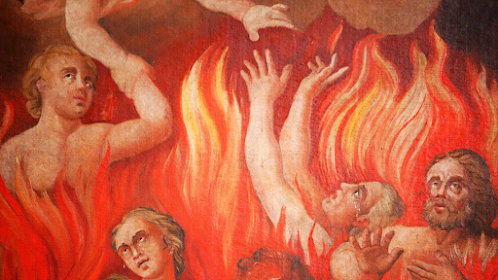
Can we really believe in Hell?


Hell is such a grim topic that an icebreaker is called for. So let’s loosen up a little before we do a swan dive into the lake of eternal fire.

What is the difference between heaven and hell?

In heaven, the lovers are Italian, the cooks are French, the mechanics are German, the police are English, the administrators are Swiss. In hell, the lovers are Swiss, the cooks are English, the mechanics are French, the police are German, and the administrators are Italian.

Because of the resurrection of Jesus, Christians know that death is not the end of their existence. At some point, God will bring creation to its final fulfillment and, just as Christ was raised from the dead, human beings will be resurrected into eternity. Heaven is used to describe eternal life in the actual presence of God, while hell is used to describe eternal life apart from God’s presence. Hell was described by Jesus as the final destiny of Satan and his cohort after the final triumph of Christ over evil, as well as the place where unsaved souls spend an eternal sentence of punishment for their sin.

By asking, “Can we really believe in hell?” I mean this: There are numerous explicit references to Hell in the Scriptures. Should we take them seriously? If so, how may we understand them? What does the Bible mean by Hell, anyway? Should we include hell within the umbrella of our Christian faith?


For some persons this is a non-issue. Some persons consider the whole question cut and dried: those who believe in Christ enjoy eternal life with God, and those who don’t believe are adjudged into Hell. But many others of true Christian faith have real difficulty with Hell, myself included.

The problem is this: God is supremely good and supremely powerful. According to First Timothy 2:3-4, God wants everyone to be saved. And God alone is savior. Through Isaiah God said, “. . . for I am God, and there is no other. I . . . am the Lord, and apart from me there is no savior” (Is. 45.22; 43.11).

These things being true, there would appear to be nothing to prevent God from simply exercising his divine power to bring everyone into heaven whether they are already “saved” or not. So the paradox is this: how can we reconcile an eternal hell with God’s power and God’s desire that all be saved?

A usual answer has been to point out that God is totally good, totally pure and totally just. Thus, God’s inherent goodness and purity do not allow unredeemed sinners in his presence, and God’s justice requires that a penalty be paid for sin. However, Jesus’ ministered to the worst sinners of his day, proving that divine goodness does quite well in their presence. Jesus’ teachings reflect that God’s justice is not the tit-for-tat human kind, but a supremely forgiving justice in which we actually do not get what we deserve. Furthermore, an eternal sentence of punishment for a mere 70 - 90 years or so of sin is not justice, it is mindless torture.

We know that God is always at work in the affairs of human beings to bring us into fellowship with God to the greatest degree possible. God’s grace is the only source of salvation.  Grace is a gift. We cannot earn it, nor does God coerce us. We have to accept it. Randy Maddox, past president of the Wesley Theological Society, put it this way: “Without God’s grace, we cannot be saved; unless we respond, we won’t be saved.” Sadly, experience shows that some persons resist this gift of grace and either defy God or deny that God even exists, right up to the day they die. What becomes of them, then?

God does not stop being God simply because we die. If God loves us in this life, God certainly loves us in the next. If God wills to save in this life, he certainly wills it in the next. The hard question is not whether God’s will to save disappears after we die. The hard questions are:

Why would anyone be more “savable” after death than now?

Why would God’s grace be more likely to penetrate our resistance to it after we die than now?

Why would someone be more receptive to God after death than before?

The case for universal salvation presupposes that either human nature or God's nature, or both, are radically different on the other side of human mortality. Persons either become so enlightened in the afterlife that no matter how corrupted by sin they were in life, they nonetheless accept the full grace of God that they had always rejected before – or God is for some reason able to act more powerfully upon us after we depart this life than while we are still living. I can find no biblical basis for either position. In fact, we would have to ask a couple more questions: Why would dying makes us smarter? Why would dying give us better judgement? It can’t. The Bible clearly teaches that death is destructive, not creative.

The Bible treats physical death as a gateway event. The book of Hebrews teaches that we don’t get a “do-over” in life. We get one life, one death, and after that, the judgment, followed by eternity.

Is it possible that dying has a “fixing” effect on our eternal destiny? Here’s an analogy. I once learned how to develop photographic negatives and make prints therefrom. It’s not difficult, although with today's digital cameras it's a vanishing art. Once the negatives have been developed, you make a print by placing a negative frame in a vertical projector. You focus the image on the bottom plate and turn off the lights. Then you place a sheet of photo paper on the bottom plate and expose the paper for a calculated time. Then you immerse the paper a chemical solution that brings the image forth. Finally, you place the paper in another chemical solution known as the “fixer.” The fixer sets the image permanently.

I wonder whether while we live we are “developing,” but death “fixes” us where we are, as far as salvation goes. Even if God’s will to save continues after we die, perhaps it is more difficult, not less, for us to be saved then than now – not because God is less powerful, but because we are less responsive. Freshly poured concrete can be molded, but hardened concrete cannot. It may be that death “hardens” us so that we cannot respond to God’s saving grace.

If God’s salvation is coercive, then this wouldn’t matter. But the Scriptures tell us that God saves from love. Love’s nature is invitation, not compulsion. Jesus called people to follow him, but forced no one. So I am brought to confront Hell as a real possibility. What, then, is Hell?

At one level, we can understand hell as a useful idea. The concept of hell helps us to understand that there is a moral order to creation. The ideas of hell and heaven reinforce human understanding of justice, for if evil is finally destroyed, or at least separated from God’s presence, we can see that what we do in this life has ultimate meaning. Human actions have cosmic significance, and our struggles for justice, mercy and righteousness have divine sanction. Asbury Seminary professor Jerry Walls wrote,
The doctrines of heaven and hell are the supreme articulation of the claim that we can neither evade responsibility for our actions nor the motives behind them. They represent the epitome of the notion that we never serve our ultimate self-interest by doing what is immoral, just as we always serve our ultimate self-interest by our steadfast commitment to do what is right.
When the Bible speaks of hell (or heaven), it uses highly symbolic speech. The theologically conservative Nelson’s Bible Dictionary says,
Because of the symbolic nature of the language, some people question whether hell consists of actual fire. The reality is greater than the symbol. The Bible exhausts human language in describing heaven and hell. The former is more glorious, and the latter more terrible, than language can express. 
So while the Bible does describe hell as a place of fire and burning, we need not take it literally to take it seriously. The New Testament word translated as hell is “Gehenna,” which was a real place outside Jerusalem where pagan Canaanites had once burned their children in sacrifice to their god Molech.

In Jesus’ day Gehenna was the depository of all the filth and garbage of Jerusalem, “including the dead bodies of animals and executed criminals. To dispose of all this, fires burned constantly. Maggots worked in the filth. When the wind blew from that direction over the city, its awfulness was quite evident. At night wild dogs howled and gnashed their teeth as they fought over the garbage.

“Jesus used this awful scene as a symbol of hell. In effect he said, ‘Do you want to know what hell is like? Look at the valley of Gehenna’” (Nelson’s). So hell may be thought of a “cosmic garbage dump,” the exact antithesis of heaven.

I have come to understand hell not as a place, but as a state of ongoing rejection of God. C. S. Lewis described hell as the “skid row” of creation, where souls have become so intoxicated by sin that they no longer even try to break the chains that bind them there. Their dilemma is that they are captive there because they choose to be. They would rather have a delusion of freedom than salvation. Their delusion, wrote Lewis, is that if they glorified God, they would lose their personal identity, but their choice has really ruined their human greatness. Hell, Lewis said, is “the greatest monument to human freedom.”

The apostle Paul wrote of the self-imposition of godlessness in the first chapter of Romans:
18 For the wrath of God is revealed from heaven against all ungodliness and wickedness of those who by their wickedness suppress the truth. 19 For what can be known about God is plain to them, because God has shown it to them. 20 ... So they are without excuse; 21 for though they knew God, they did not honor him as God or give thanks to him, but they became futile in their thinking, and their senseless minds were darkened. 22 Claiming to be wise, they became fools; ... they exchanged the truth about God for a lie and worshiped and served the creature rather than the Creator (1.18-22 excerpted). 
Hence, Pope John Paul II stood on solid Scriptural ground when he wrote that hell “is not a punishment imposed externally by God but a development of premises already set by people in this life. The very dimension of unhappiness which this obscure condition brings can in a certain way be sensed in the light of some of the terrible experiences we have suffered which, as is commonly said, make life ‘hell.’” Hell “is the ultimate consequence of sin itself, which turns against the person who committed it. It is the state of those who definitively reject” God’s mercy.

The closest analogy to hell I can think of is that of addiction. There was a twenty-nine-year-old woman named Latisha Lewis in the news who confessed that she murdered ninety-year-old Ella Gilbert, whom she did not know, to steal money to buy drugs. Addiction can become so powerful that it overwhelms the faculty of reason and distorts our will beyond self-control. Latisha Lewis’s tragedy is that she became an addict by her own free will. The first hit of narcotics she ever took was her choice.

So I think of hell as a sinner’s crack house, a state of being that is hopelessly beyond self help. It is a perversion of the will so strong that God is not even hoped for, much less sought. Salvation may be technically possible because God’s grace is still offered, but effectively impossible, because it is not even recognized. "The gates of hell," wrote C. S. Lewis, "are locked only on the inside."

This kind of hell is a photographic negative of heaven – isolation rather than fellowship, apathy rather than love, loneliness rather than caring, conflict rather than community, desolation rather than richness. The torment of hell is not chiefly that these things are unbearable (even though they are); the worst torment is that even if hell’s addicts want to escape, they will not or cannot accept God’s grace to do so. Their torment springs from their own self-centered incapability to let God in, and all that results from it.

Hell is thus not a sentence of God imposed on sinner, because God desires all to be saved. Hell is God’s recognition that he has been rejected. Even though God’s grace continues to be offered without ceasing, its acceptance becomes evermore unlikely as the addiction to godlessness becomes evermore concrete.

If this theology of hell works for you as it does for me, then there are still steps to take. One is that the prospect of eternal punishment need not figure prominently in the Gospel of love. The center of the Gospel is not that God wrathfully seeks to condemn all who fail to meet narrowly defined criteria. God is love and desires with great liberality all to be saved, even to the extent that in all eternity, God never gives up seeking out his children. But it avoids what Methodist Professor David Lowes Watson admitted is the pitfall of universal salvation, that evangelism is really a pointless exercise if everyone winds up in heaven, anyway. On the contrary, the reality of hell makes a decision for Christ in this life vitally important. “Who is Christ?” becomes not merely one important question among others, it becomes the central question of human affairs. Evangelism is the crucial mission of the church.

This understanding also places a great burden upon us if we are to love God in return for the love God has given us. David Lowes Watson wrote,
When even a cursory thought is given to the countless millions in the world who are hungry, who are suffering, who languish under injustice, or are ravaged by war, the prospect of anyone celebrating personal salvation . . . borders on the obscene. There are still too many of Christ’s little ones who are hungry, too many who lack clothes, too many who are sick or in prison. There are too many empty places [at God’s banquet table]. The appropriate attitude for guests who have already arrived is to nibble on the appetizers and anticipate the feast which is to come. To sit down and begin to eat would be unpardonable . . . especially since the host is out looking for the missing guests, and could certainly use some help
Jerry Walls wrote that God has both the ability and the desire to preserve and perfect his relationship with human beings. God created in us aspirations for divine fellowship. Being good, God does not leave those aspirations unsatisfied.
The doctrine of heaven is the claim that our deepest aspirations can be satisfied in a perfected relationship with God and other persons. However, a loving God does not force this relationship upon us; indeed, he cannot do so if we are truly free. So we can, if we prefer, destroy our own happiness by rejecting the only true means to that happiness.

“And the sea gave up the dead that were in it, Death and Hades gave up the dead that were in them, and all were judged according to what they had done.”

Monday, August 10, 2009

Life after death - or life again after death?


"What happens when we die?" is the central question of most religions. Certainly it is the central focus of the New Testament, for it is on the answer to this question that everything else about Christian religion depends - ethics and morals, for example, the question of our duties and obligations in this life.

The reason for this is summarized by a verse from the book of Hebrews: "And just as it is appointed for mortals to die once, and after that comes judgment ..." (v. 9.7). Which is to say that each of us survives the death of our bodies in a personal sense and that we are the judged by a wholly righteous God for how we lived this physical life and what we did. The passages emphasizing this point are so numerous that I hardly feel compelled to point them out. Start with Matthew 25, for example.

It would be pretty hard to find a church man or woman - or child, for that matter - who does not know that the church teaches that death is not the end of existence for human beings. Do what we teach and what we believe accord with what the Bible teaches?

Death is an enemy of God, so powerful an enemy that Paul wrote death is "the last enemy [of God] to be destroyed." And this will not happen, says Paul, until after "every rule and every authority and power" that is an enemy of God has already been destroyed.

For about 2,000 years Christians have been waiting for Christ to "put all things under his feet" and vanquish injustice, conflict, estrangement and death. In the meantime, we are born and live and die. Because the first Christians expected Jesus to return very soon, they became distressed when some of them died before Jesus had done so. Apparently, these believers thought that they would be saved by Christ only if they were still alive when Jesus returned.

In response to this fear, Paul wrote (1 Thessalonians 4:13-17),
But we do not want you to be uninformed, brothers, about those who are asleep, that you may not grieve as others do who have no hope. 14 For since we believe that Jesus died and rose again, even so, through Jesus, God will bring with him those who have fallen asleep. 15 For this we declare to you by a word from the Lord, [1] that we who are alive, who are left until the coming of the Lord, will not precede those who have fallen asleep. 16 For the Lord himself will descend from heaven with a cry of command, with the voice of an archangel, and with the sound of the trumpet of God. And the dead in Christ will rise first. 17 Then we who are alive, who are left, will be caught up together with them in the clouds to meet the Lord in the air, and so we will always be with the Lord.
This is one of the passages some Christians use to support the idea of the Rapture, popularized by the recent "Left Behind" novels, but that topic is outside the scope of this post. On topic, here are some key things this passage points out:

1. Note the future tense of the passage: Paul is prophesying what will happen, not something that had happened or is already going on. Hence, the salvation of the dead is a future event.

2. Because Jesus died and was raised from the dead, we are enabled to look forward to the same grace, including persons who have died.

3. Those left alive at the eschaton (the return of Christ) have no advantage in salvation over those who have died. In fact, "the dead in Christ will rise first," noting again the future tense.

Clearly, we should take to heart that we should not worry whether those who die in Christian faith will be saved. Death of the physical body is no impediment to the saving grace of Christ. So, on the basis of this passage and its correlates in the New Testament, we are able to say with certainty that, as Paul later wrote, "For if we live, we live to the Lord, and if we die, we die to the Lord. So then, whether we live or whether we die, we are the Lord's" (Romans 14:8).

This really is the fundamental teaching upon which everything else is commentary.

And yet, the early Christians' question has not gone away. We do await the return of Christ, but in the meantime - and we've had a lot of meantime since Jesus' day - what is the status of the dead?

The earliest Christians were Jews in Judea and pagans outside Judea, plus some diaspora Jews living in Gentile cities such as Corinth, Greece. (The concerns about the status of the dead seems to have arisen from the converted Gentiles rather than the Jews.) Because Jesus was a Jew and the earliest Jewish followers of Jesus still considered themselves Jews, they would have instructed the Gentile converts of Jewish thought about the fate of the dead.

In that way, the Jewish Scriptures are not comforting about the grave. Here are some relevant passages.

Psalm 115:17 - The dead do not praise the Lord, nor do any who go down into silence. (Hence, according to my close friend, Rabbi Daniel Jackson, we should avail ourselves of every opportunity to praise God in this life - while we still can! See for example Psalm 34.)

Ecclesiastes 9:5 - For the living know that they will die, but the dead know nothing, and they have no more reward, for the memory of them is forgotten.

Psalm 39:13 - Look away from me, that I may smile again, before I depart and am no more!

Job 7:21 - Why do you not pardon my transgression and take away my iniquity? For now I shall lie in the earth; you will seek me, but I shall not be.

Isaiah 40:7 - The grass withers, the flower fades when the breath of the Lord blows on it; surely the people are grass.

Ecclesiastes 7:2 - It is better to go to the house of mourning than to go to the house of feasting, for this is the end of all mankind, and the living will lay it to heart.

There are many other examples. The main thrust of the Jewish Scriptures on this subject is that death is the dissolution of the body and the end of the joys and meaning of this life. From the earliest days, the souls of the dead were thought to be consigned to Sheol, "the pit," an abode of the dead in which they are the merest shadows of their former selves. Sheol was thought literally to be in the depths of the earth and was specifically a punishment place for the wicked: "The wicked shall return to Sheol, all the nations that forget God" (Psalm 9:17), even though there is a thread in the Old Testament that it was the destiny of all who die. However Sheol as envisioned was never presented as a place to look forward to. The Psalmist, for example, repetitively prayed for deliverance from Sheol, which is to say deliverance from death.

Though the Jewish Scriptures view death entirely negatively, they are also are enormously encouraging that being dead is not the final destiny of human beings. A consistent thread throughout the Old Testament is that the righteous will be exempted from death - more precisely, the permanence of death. In the same way that the psalmist prayed for deliverance from Sheol, he praised God for (prospectively) doing so.

Psalm 86:13 - For great is your steadfast love toward me; you have delivered my soul from the depths of Sheol.

Psalm 16:10 - For you will not abandon my soul to Sheol, or let your holy one see corruption.

Again, there are many other passages in the Jewish Bible - which was the only Bible the first Christians had - that echo this hope of deliverance from permanent death. The Jews professed great hope that the grave was not their final fate (at least not of the righteous), though death itself was viewed with abhorrence. At some time in the future, God will deliver the righteous from the corruption of death and restore them to life even more filled with God's presence than ever before.

Over time, this belief developed into a doctrine of the resurrection of the dead. Concurrently, a popular Jewish belief developed that the souls of the righteous dead awaited the day of resurrection in the "bosom of Abraham" while the souls of the unrighteous were consigned to a hot, dry place where they suffered from thirst and loneliness.

Jesus may have even believed this himself. In his parable of the wretched Lazarus and an unnamed rich man (Luke 16:19-31) the soul of Lazarus is located next to Abraham while the rich man's soul suffers from thirst and "agony in these flames." The Bosom of Abraham is not heaven, but a sort of halfway house for the righteous awaiting the resurrection.

By Jesus' day this was the majority, but not universal, belief among Jews. The Sadducees rejected this belief because it did not appear in the Books of Moses (Genesis through Deuteronomy). It was, however, firmly affirmed by the Pharisees, who were extremely influential among the Jews because of their studiousness of the Torah and devotion to faithful living as Jews under foreign occupation. Jesus, being sympathetic to the Pharisees even though often at odds with their practices, also affirmed the doctrine of resurrection (being its first practitioner, this is hardly surprising!).

Now we are ready to tackle the question, "What is the status of the dead until Christ returns?" On this question, the Church has responded in three major ways.

First: those who have died in Christ endure a Sheol-like place, without the punishment, until the eschaton, when Christ will raise them to new life. This is reflected in the Revelation of John, where the evangelist writes (6:9-11),
9 When he opened the fifth seal, I saw under the altar the souls of those who had been slaughtered for the word of God and for the testimony they had given; 10they cried out with a loud voice, ‘Sovereign Lord, holy and true, how long will it be before you judge and avenge our blood on the inhabitants of the earth?’ 11They were each given a white robe and told to rest a little longer, until the number would be complete both of their fellow-servants and of their brothers and sisters, who were soon to be killed as they themselves had been killed.
Revelation is, of course, an apocalyptic book, written in highly visionary language. It would be a stretch to claim that its visions and beliefs were typical across all Christians of the day. Even so, there is a a good indication of belief here that the dead are basically "warehoused" until the fulfillment of the eschaton.

This belief did not survive in the Western wing of the church long. When Emperor Constantine gained control of the entire Roman Empire in the early 300s,he made Christianity the empire's official religion. The number of church people rocketed, leading to the formation of what know now as the Roman Catholic and Eastern Orthodox churches. (These churches already existed, of course, but not in the full bureaucratic splendor they had to adopt to deal with explosions of numbers in the fourth century.) And this notion of "warehoused" souls of the dead did not survive in the Roman Catholic Church after its transformation into a bureaucratic church.

However, in the Eastern church the doctrine did survive and continues to this day. In their thought, the souls of the dead simply await the day of resurrection. The souls of the saved await in a pleasant abode of light and the souls of the unsaved suffer in darkness. But salvation is not finally accomplished until the resurrection and judgment.

Second - the souls of the dead pass immediately into heaven, purgatory or hell.

The church before Constantine was necessarily concerned foremost with literal survival. The two worst persecutions it suffered were in the 250s and very early 300s. These were quite severe. While important doctrinal issues did arise and were dealt with before Constantine, the explosion of converts after 300 more firmly established the institutionalization of doctrine and practice.

In this light, the 4th-century church was faced with two predominant tasks. One, how shall the life of Christians be ordered according to Christian principles? Two, what shall be the authority of priests and bishops in doing so?

At the 4th century's inception, about 10 percent of the empire was Christian. At century's end, about 10 percent was not Christian. To deal with this explosion of adherents, and to teach them the basics of Christian faith, the church developed its systems of catechism and sacraments, not from scratch, though, since both already existed. But they became deeply entrenched as a way of ordering the lives of the legions of new converts. They enabled the church not to have to "reinvent the wheel" over and over to cope with the influx.

The sacramental system also established the church (meaning the Pope and the priesthood) as the gateway to salvation after death. Two sacraments in particular were key to that purpose, baptism and penance.

From the earliest days, and continuing until now, the Catholic Church has held that baptism remits the guilt of original sin. And baptism also remits the guilt of volitional sins committed up until the moment of baptism. But sins committed after baptism had to be remitted another way. That is done through the sacrament of penance.

Penance consists of confession to a priest and the faithful carrying out of deeds he prescribes to remit the sins confessed. The nature of these deeds is not the issue here; suffice it is to say that baptism followed by faithful practice of confession and penitential submission were seen to guarantee that one could die with all, or almost all, sins remitted.

Long, long before the Protestant Reformation of the early 1500s, Catholics were taught that for those who died within the grace of Christ, mediated through the Church, there were one of two immediate destinies. First, if someone died with no sins left unremitted then that person's soul would fly directly to heaven. But heaven was exclusively for the sin free. The souls of those dying with some sins still unremitted went directly to purgatory where penance continued until all sins were worked off. (The only exit from purgatory led to heaven.) Not all sins can be worked off in purgatory. Based on 1 John 5.16-17, the souls of those who died either unbaptized or with unremitted "mortal" sins went directly to Hell, from which there is no exit or escape.

Protestants who adhere to this belief discard the notion of purgatory but affirm the ideas of immediate reward in heaven or punishment in Hell (although a large number of Protestants don't really believe anyone goes to Hell).

This teaching did not actually become official dogma of the Roman Catholic Church until the Catholic Counter-Reformation that began in the mid 1500s. Its pronouncement as dogma seems to have been impelled, at least in part, by Martin Luther's doctrine of "soul sleep."

Third - "Soul sleep." In the Eastern church's doctrine of a sort of afterlife waiting room, the souls of the dead are aware and in either pleasant or suffering circumstances, depending on their state of grace at death. And they know it.

In the doctrine of soul sleep, promulgated by Martin Luther and a feature of some Protestant denominations, the soul survives the death of the body but with no awareness. Think of its state as a sort of deep unconsciousness. It endures neither reward nor punishment, but simply awaits resurrection at the eschaton.

One step further than this is the idea that the human person consists of a fully integrated being of body and soul and that the soul dies along with the body. In this idea the person concerned is re-created at the resurrection by God.

"How are the dead raised up, and in what body do they come?"

Its seems clear to me from the New Testament that the apostles Paul and John did not even consider, much less affirm, the second of the above doctrines, that the souls of the dead go right away either to heaven (even with detour) or Hell. Both apostles were Jews and their apostolic calling did not change that identity as far as they were concerned. Although the concept of the soul going to heaven exists among Jews today (at least some), it's not clear that this was so 2,000 years ago or before. Heaven was seen as the place of God and his heavenly beings, not of mortals. John echoed this idea thus, "No one has ascended into heaven except he who descended from heaven, the Son of Man" (John 3:13). In this understanding (and I am reluctant to argue with John!), mortals do not go to heaven. Instead, heaven comes to us. Hence, Revelation 21:1,
Then I saw a new heaven and a new earth, for the first heaven and the first earth had passed away, and the sea was no more. And I saw the holy city, new Jerusalem, coming down out of heaven from God, prepared as a bride adorned for her husband.
There were some exceptions. Paul, for example, wrote,
I know a man in Christ who fourteen years ago was caught up to the third heaven—whether in the body or out of the body I do not know, God knows. And I know that this man was caught up into paradise—whether in the body or out of the body I do not know, God knows— and he heard things that cannot be told, which man may not utter. (2 Corinthians 12:2-4)
And the prophet Elijah was taken directly to heaven.
And as they still went on and talked, behold, chariots of fire and horses of fire separated the two of them. And Elijah went up by a whirlwind into heaven (2 Kings 2:11).
For both Paul and John, the destiny of the dead is to be raised up in the general resurrection, after which comes eternal life with God.

Paul observes in 1 Corinthians 15 that "flesh and blood cannot inherit the kingdom of God, nor does the perishable inherit the imperishable." In the resurrection, we are not raised as the bodies we enjoy in this life. "The dead," Paul writes, "will be raised imperishable, and we shall be changed. For this perishable body must put on the imperishable, and this mortal body must put on immortality."

So, "If there is a natural body, there is also a spiritual body. ... Just as we have borne the image of the man of dust [Paul is referring to Adam], we shall also bear the image of the man of heaven [the risen Christ]." And so in Philippians Paul wrote that Christ "will transform our lowly body to be like his glorious body."

While neither Paul nor another apostle actually denounce the idea that at death our souls go either to heaven, neither do they promote or affirm it. They do emphasize resurrection into eternal life, but this is always presented as a future event.

Since that is the actual hope of Christian faith, the status of the dead awaiting the resurrection seems seemed to be of no concern to the apostles. After all, "If we live, we live to the Lord, and if we die, we die to the Lord. So then, whether we live or whether we die, we are the Lord's."

Good enough.

Postscript: What about Jesus' words to the thief on the cross, Luke 23:43? Here is the verse in its context:
39 One of the criminals who were hanged there kept deriding him and saying, "Are you not the Messiah? Save yourself and us!" 40 But the other rebuked him, saying, "Do you not fear God, since you are under the same sentence of condemnation? 41 And we indeed have been condemned justly, for we are getting what we deserve for our deeds, but this man has done nothing wrong." 42 Then he said, "Jesus, remember me when you come into your kingdom." 43 He replied, "Truly I tell you, today you will be with me in Paradise." (NRSV)
There are a couple of points here. First, the term, "Paradise" is extremely rare in the New Testament, appearing only here and two other places. One is the Pauline passage I quoted above and in Rev. 2.7, where Jesus gives permission to the faithful "to eat from the tree of life that is in the paradise of God."

"Paradise" is used in other Greek literature, referring to a cultured park or on occasion an orchard. The word was probably borrowed from the Persians where it had the same meaning.

"Paradise" does not mean heaven. In its use of Jesus' day, Paradise would have meant something close to the Bosom of Abraham in the spiritual sense, a pleasant place where one awaited the final redemption of God. The Essenes, who left us the Dead Sea Scrolls, described Paradise as a land across the sea where breezes were gentle and weather mild. (Think of Hawaii without the high costs or crowding.)

In any event, whatever Paradise meant 2,000 years ago, it did not mean the resurrection or the final fulfillment of the Kingdom of God. And we are clued into that by the thief's plea and Jesus' response.

The thief's supplication is not oriented on that same day, but to the future. He pleads to Jesus, "Remember me when you come in your kingdom." (Some translations say "into" rather than "in," but I think "in" is correct.) On the face of it, this plea makes no sense at all. Jesus is dying on the cross right next to the thief. If Jesus is merely a man, then the thief has lost his mind!

But if the thief understands that Jesus will survive crucifixion in some sense and return to establish his divine kingdom, then the question does make sense. And so the thief begs Jesus to remember him when that day comes. But clearly, the thief expects nothing on crucifixion day except death. In his plea, he is looking forward to the end of the age, the eschaton, when Jesus as Lord brings all unholy things into submission and the righteous are brought into eternal life.

And it is in this sense that Jesus answers him: "Truly I tell you today you will be with me in Paradise." In the Greek manuscript, there are no commas or any other punctuation. But English syntax demands them. So where to put the comma?

Consider: "Truly I tell you, today you will be with me in Paradise."

Now compare to, "Truly I tell you today, you will be with me in Paradise."

There is a difference in meaning, is there not? On the basis of what "Paradise" probably meant in that day, Jesus would have meant the former. An expanded way to phrase the answer would be, "Truly, I tell you: today we will both die and I will take you to Paradise where I will remember to redeem you when I come in my Kingdom's power." This also would be consonant with the meaning of Paradise in Rev. 2, where Paradise is the state of being from where the redeemed enjoy the fruit of the tree of life and then enter into eternity, this being highly poetic language, of course.

Paradise cannot have meant heaven because Jesus was clear in his own prophecies about his passion that he would "be three days and three nights in the heart of the earth" (Matthew 12:40) which is certainly not heaven. And on the first Easter Jesus told Mary Magdalene, "I have not yet returned to the Father."

However, the meaning of Paradise is, at bottom, deeply ambiguous and without exactitude. Jesus' answer to the thief simply assures him that he will be redeemed when Jesus comes in his Kingdom. (If Jesus had simply replied, "Okay," we would not be wondering what he meant.)

Like the thief, we still await that day.

Tuesday, August 4, 2009

Joining the Crackberry Legion

I broke down late last week and retired my Palm Treo 755P in favor of a Blackberry Tour, left. (I use Verizon.) It is an improvement over the long-in-the-tooth Palm, but for my purposes not really a huge improvement. A data plan is required with the Blackberry, of course, while it was not with the Palm. I did not have one before nor did I wish for one. Besides, the Tour is a 3G phone while the Palm was not. So the Palm was slow using the Internet during the very rare times I logged on.

I played with the touchscreen Blackberry Storm for some time in the store, but it seemed clunky to me, slow to respond to commands. The larger screen would have been nice (the Tour's is a little smaller than the Palm's) but the Tour seemed more usable.

I was much concerned about getting my data moved from the Palm to the Tour. The Verizon guy told me he could transfer my contacts using their SIM-card data transfer gizmo, but not the calendar, tasks or memos. However, according to the Blackberry web site, the desktop software included with the Tour had a "device switching" function that would transfer all of that, either from a Palm OS or a Windows Mobile OS (or, needless to say, from another Blackberry).

Blackberry lied. When got the phone I discovered that yes, there is such a selection on the Blackberry desktop menu, but there are two show stoppers.

First, it's in a foreign language (click image for larger view). I discovered that Blackberry's site has no number for tech support, referring you instead to your service provider. So I called Verizon, where the collective response from the several different persons I was bounced to was, "Huh?"

Second, a Google search of the problem (not translating, but the data transfer) did result in useful info that finally solved the problem. I learned that the device switcher won't work with Palm desktops newer than version 4.X while mine was v. 6.7. So, said the Blackberry forum I was reading, sync the Palm with the existing desktop, uninstall the desktop and install v. 4.X. Then re-sync the Palm device with the older version of the desktop, then run Blackberry's device switch.

Well, not quite. The last step did not work since the Blackberry device switch function was still (of course) in Sanskrit or whatever and besides, it still wouldn't import when I guessed which buttons to click.

There was, however, salvation of the transfer. The Blackberry desktop's sync function will sync with Yahoo's calendar, contacts and tasks. And Yahoo will sync with Palm 4.X (though not with later versions). So I synced between the Palm desktop and Yahoo, then between the Tour and Yahoo. Voilá, my Tour had all my data.

Well, not quite. The Palm's contacts, calendar and tasks came through cleanly, but not the memos. It seems Yahoo has no memo function. It does have a notepad function, but the Tour has no equivalent and nothing on the Yahoo notepad will sync over to the Blackberry. I have a lot of memos on the Palm and so far have been stymied as to how to transfer them over.

The other concern was my password safe. On the Palm I used a free, and excellent, Palm program called YAPS (Yet Another Password Safe). This little jewel will export all its data into a Palm memo and will import from the same. You can copy and paste this memo from the Palm desktop into Windows notepad and with a little manual tweaking convert it into a CSV file.

Alas, this does you no good in importing it into Blackberry's Password Safe. It won't import a CSV or any other file. I had to enter all my password information manually into the Tour. I'm not complaining; I understand the imperative for security here, and limiting ways to access the data is a big part of that. 'Twas a pain, that's all.

The Tour is still too new to write a review. I haven't used it long enough. Overall it is certainly more capable than the Palm. The Palm is a touchscreen phone, although best touched with its included stylus rather than a finger, and the Tour uses the (in)famous Blackberry trackball centered at screen's bottom. This means I can operate the Tour one-handed (well, I have to) which does work better than one-handed operation of the Palm, which is possible but clunkier than on the Blackberry.

I considered selling my Palm on eBay but the 755P's listed there are not selling for much. So I am keeping it as a backup phone just in case. Since I can always re-sync it with Yahoo, should I require its use again I'll have all my data at hand.

What I really wanted, of course, was the Palm Pre, but it's available only on Sprint. Checking Sprint's coverage map for my area and my business-related travel areas showed that once you get off the interstate, you're pretty much out of Sprint's calling area. Verizon is supposed to get a Pre or a Palm device like it some time next year, so I'll take a look at it then.

A world without nuclear weapons - what would it look like?

 From Pope Leo this week, according to the National Catholic Reporter : " Pope Leo quotes Bob Dylan song in book foreword calling for n...