Thursday, March 3, 2005

A history of Arab terrorism


Copyright © 2005 Donald Sensing

It was in the latter third of the twentieth century that "terrorist" became strongly associated with "Arab" in the West. The words were welded in the 1972 Olympic Games at Munich. Images broadcast worldwide of armed, hooded Palestinian terrorists peering from the balcony of Israeli athletes' apartments were powerfully fearful. The terrorists, members of the Black September faction of the Palestine Liberation Organization, took eleven Israelis hostage and brokered a deal with German authorities to be flown by helicopter to a NATO air base. There, an airliner was to fly them all to Cairo.


The German police thought there were five terrorists. Five snipers were assigned to kill the terrorists before they boarded the helicopters. But there were eight terrorists. Nonetheless, the police attempted to carry out their plan. A brief firefight ensued that ended badly. All the Israelis died, along with five terrorists and one German policeman.
For many years afterward, the images and narrative from the Munich games defined Arab terrorism in much of the West.
Three stages of Arab terrorism
Terrorism has been used by peoples and nationalities around the world throughout history, but the terrorism carried out by Muslims has for several decades has either been done by Arab Muslims (i.e., all nineteen hijackers of Sept. 11, 2001) or has been inspired by Arab sponsors or teachers (Abu Sayyef terrorists in the Philippines). Hence, the problem of Muslim terrorism is almost exclusively a problem of Arab terrorism.
Modern Arab terrorism has gone through three stages. The first was a revival of strict Islamic devotion. Islamism, as the movement came to be called, was originally a reform movement calling secularized Arab governments and societies to return to the basics of pure Islam as the reformers defined it. Islamism began in Egypt in the early 1920s. It was and still is fundamentally religious in nature. It was not originally violent but became violent fairly soon; Islamists believed that they were obligated to strike those who defied Islam as Islamists perceived it. For many decades afterward, and still significantly today, the targets of Islamist terrorists were Arab governments. Islamism's goal was the institution of strict Islamic law, sharia, in Muslim countries and the rooting out of all non-Muslim influences in the ordering of societies.
The second stage of Arab terrorism was born by the displacement of Palestinian Arabs from their homes by the United Nations' establishment of the state of Israel in 1948. When it became obvious that Israel would not be defeated in conventional battle, as the wars of 1948 and 1956 proved, armed Palestinian groups arose to fight the Israelis. [1]
These groups were essentially secular-political in outlook rather than Islamic; nationalism was a strong ideal in the Middle East at the time. For example, the famed Palestine Liberation Organization, PLO, was founded in 1964 as an umbrella Palestinian nationalist organization, not a religious one, to coordinate the tactics and strategy of several existing violent and political groups. While the PLO used terrorism to fight Israel, it did not overlay Islamism atop its agenda. Palestinian-based terrorism, ultimately supported by Syria, Iraq, Saudi Arabia and many other Arab governments, has always been the most active Arab terrorism, even after Osama bin Laden founded al Qaeda, whose attacks, while more lethal and sensational, have not been nearly as numerous as those of Palestinian-based groups. [2].
Black September's attack in Munich was a variant of anti-Israel violence, not an attack upon the West generally nor even Germany specifically. The attack's basic goal was to force Western governments to pay attention to Palestinian grievances.
By the end Soviet war in Afghanistan many thousands of Arab men had embraced Islamism and jihadism. Arab terrorism reached its third stage in the early 1990s. Henceforth, Islamist terrorism would be directed not only at insufficiently Islamic governments or Israel, but also directly at the West, especially the United States.

Why did they attack us?
In the aftermath of the attacks of Sept. 11, 2001, many Americans, shocked that they would be so suddenly and brutally attacked, asked, “Why do they hate us?” It seemed that the question was asked mostly by a sector of Americans who already had some answers readily at hand, namely, that we were attacked because America was a cultural and economic imperialist power that was at best resented by the Third World and more commonly hated. The barely-unspoken presumption was that we got what was rightfully coming to us.
Anatol Lieven wrote in the London Review of Books that America is “a menace to itself and to mankind.” MIT’s Professor Noam Chomsky repeatedly characterized the United States as the world’s major terrorist state. At the other end of the ideological spectrum was the Rev. Jerry Falwell, a nationally-known, politically active, Baptist pastor in Lynchburg, Virginia. Falwell claimed on a broadcast of The 700 Club only two days after 9/11 that the attacks were God's judgment on America for abortion, feminism, homosexuality and liberal organizations such as the ACLU. (He retracted on CNN on September 14.) Such statements from the far Left and far Right are representative of the verbal vitriol that American and western European figures have hurled at America to “explain” the attacks [3].
It took months for non-superficial explanations to appear in the mainstream media. Why so long? At an address at Hillsdale College, journalist Brit Hume said in April 2003 that “the idea that those who attacked America were themselves illegitimate – indeed, even evil – is not the kind of thing that springs to the minds of the people responsible for Newsweek cover stories. What springs to their minds is that we’ve done something wrong.” With our own citizens and other Westerners saying such things, and finding an amplifier in the media, it became easy to believe that non-Westerners of the world must really despise us.
With less intensity, the explanation of Arab terrorism as springing from poverty and hopelessness found support on both sides of America’s political aisle. “We fight against poverty,” President George W. Bush said in a speech in Monterrey, Mexico, “because hope is an answer to terror. ... We will challenge the poverty and hopelessness and lack of education and failed governments that too often allow conditions that terrorists can seize.”
Former Vice President Al Gore argued that the anger underlying terrorism in the Islamic world stemmed from “the continued failure to thrive, as rates of economic growth stagnate, while the cohort of unemployed young men under twenty continues to increase.”[4]
The problem with this explanation is that it does not explain. Its root is the immiserization thesis of Marxism, as redefined in the 1950s by Paul Baran, a Polish-born American economist and a Marxist. Baran took Marx’s idea that capitalism immiserates workers and applied it to the worldwide economy. America, a capitalist nation, automatically makes the rest of the world poorer and more miserable. About twenty years later, Immanuel Wallerstein wrote an elaborate intellectual reinforcement of Baran’s thesis, and their revisions of Marxist theory really define Marxism today. [5]
However, disciplined research rebuts the idea that poverty, in itself, breeds terrorism. Many commentators have noted that the nineteen hijackers of 9/11 hailed from the privileged classes of Egypt and Saudi Arabia; ringleader Mohammed Atta held advanced university degrees, for example.
Professor Alberto Abadie of Harvard University's John F. Kennedy School of Government completed extensive research on the relationship between poverty and terrorism, published in November 2004. He told the university's newspaper, "In the past, we heard people refer to the strong link between terrorism and poverty, but when you look at the data, it's not there. This is true not only for events of international terrorism but also for the overall level of terrorism, both of domestic and of foreign origin." [6] He summarized his conclusions in his paper succinctly,
I fail to find a significant association between terrorism and economic variables such as income once the effect of other country characteristics is taken into account. ... The estimates suggest, however, that political freedom has a non-monotonic effect on terrorism. This result is consistent with the observed increase in terrorism for countries in transition from authoritarian regimes to democracies. In addition, the results show that certain geographic characteristics may favor the presence of terrorism. [7]
Another study rebutting a linkage between poverty and terrorism was done by Alan B. Krueger, professor of economics and public policy at Princeton University, and Jitka Malecková, professor of Middle Eastern studies at Charles University in Prague. In June 2003, The Chronicle of Higher Education published their paper, “Seeking the Roots of Terrorism." Krueger and Malecková concluded,
Instead of viewing terrorism as a response . . . to poverty or ignorance, we suggest that it is more accurately viewed as a response to [the terrorists’ own] political conditions and longstanding feelings of indignity and frustration that have little to do with economic circumstances. We suspect that is why international terrorist acts are more likely to be committed by people who grew up under repressive political regimes. [8]
Asking, "Why do they hate us?" really misses the point. It is more fruitful to ask why the political repression of the Arab people by Arab governments leads their more privileged members to attack us.
Even before the United States launched offensive operations against Afghanistan on October 7, 2001, President Bush was taking pains to point out that America was not making war against Islam itself, but against those who wage war against us or support the terrorists.
Arabs account for only about twenty percent of Muslims worldwide. There are tens of millions more Muslims in Indonesia than in all the Arab lands combined. There are enormous numbers of non-Arab Muslims who are not unified in rage against America. Islam today is much greater than Arab Islam.
However, it is impossible to speak meaningfully about Islam without being immersed in Arab history. Since the conquest by Arabian armies of northern Africa, the eastern Mediterranean coast and lands to the east and north, the rise and fall of Arab culture has been almost identical with the rise and fall of Islam itself. Islam did not wipe clean everything Arabic that came before it, but it did alter or subsume everything. It was among the Arabs that radicalized Islamic revivalist movements began, and it was from them that it has spread to other Muslim areas.

Muslim expansionism and Western response
Within a mere eighty-one years after the death of Mohammed, Islam came to dominate land masses from the Arabian Peninsula to the Atlantic Ocean. Muslim armies stormed into Europe from the east and the southwest. Spain fell under Arab domination in 713 and was not fully freed until 1492. In 732, an Arab army under Abd er Rahman marched toward Paris; it was defeated near Tours by Charles Martel.
By the tenth century, the best army and navy in Europe were Muslim, under the command of Abd ar-Rahman III of Spain. “The cultural achievements of his caliphate . . . [were] unmatched by any Christian or Muslim state. The period of his reign (and really until 1031) marks the Golden Age of both Arab and Jewish culture in Spain.” [9]
The Muslim Ottoman Turks penetrated into eastern Europe as far north as Poland, and into Russia all the way to St. Petersburg, where there is still today a large, active mosque.
Arab naval raiders reached England, the west coast of Europe and even Iceland. For hundreds of years Islamic civilization was the historical pinnacle of world history in almost every category and was far more religiously tolerant than Christendom, especially for Jews and sectarian Christians. The West was almost constantly on the defensive; the cultural and religious survival of Europe was, as Wellington would later describe Waterloo, a close-run thing.
It was fashionable for awhile after Sept. 11's infamy to blame the East’s hatred of the West on the Crusades. The Crusades were a series of eight major invasions by European armies of near-Eastern lands that occurred intermittently from 1095-1291. Their main focus was wresting Jerusalem from Muslim control, in which they were successful for awhile. The Crusaders established kingdoms in Syria and Palestine, but these were small and penetrated no more than about fifty miles into Arab lands.
At their end, as Princeton University's Professor Bernard Lewis has pointed out, the Crusades ended in the defeat of the Crusaders; the Crusades were a Muslim victory. By 1300, Muslim armies were so decisively victorious in the Middle East that European armies did not return for five hundred years, when they were much more successful due to technological advantage and their own modern economies.
The present-day effects of the Crusades are debated among historians. Karen Armstrong made a strong case in Holy War: the Crusades and Their Impact on Today's World that Europeans after the Crusades saw Islam as "the irreconcilable enemy of Western civilization" and that the "hatred and suspicion" of the Christian West by Muslims engendered by the Crusades "still reverberates," including specifically in the 9/11 attacks.
Osama bin Laden has repeatedly referred to Western powers, especially the United States, as "Crusaders." He has called the American military response to Islamist terrorism a new Crusade against Islam. Yet he has not said that his campaign of terror is intended to avenge the Crusades. His objective is to inculcate Islamism in Muslim countries today, not seek revenge for a series of battles beginning almost a millennium ago.
Professor Thomas Madden wrote in “Crisis” in April 2002 that although scholars are still working out the truth about the Crusades, "much can already be said with certainty":                
For starters, the Crusades to the East were in every way defensive wars. They were a direct response to Muslim aggression – an attempt to turn back or defend against Muslim conquests of Christian lands. ...
With enormous energy, the warriors of Islam struck out against the Christians shortly after Mohammed’s death. They were extremely successful. ... The old Roman Empire, known to modern historians as the Byzantine Empire, was reduced to little more than Greece. In desperation, the emperor in Constantinople sent word to the Christians of western Europe asking them to aid their brothers and sisters in the East.
That is what gave birth to the Crusades. They were not the brainchild of an ambitious pope or rapacious knights but a response to more than four centuries of conquests in which Muslims had already captured two-thirds of the old Christian world. At some point, Christianity as a faith and a culture had to defend itself or be subsumed by Islam. The Crusades were that defense. [10]
After the last Crusade was vanquished, the Islamic caliphate counter-attacked. In 1480, Sultan
Sultan Mehmed II
Mehmed II captured Italy's easternmost town, Otranto, and razed it. He intended to use it as a port for the conquest of Italy itself. The danger was so great that Rome was evacuated, but Mehmed died and nothing came of his plans. The overland route into Europe, through the Balkans, was repeatedly invaded by Muslim armies; one under Suleiman the Magnificent was defeated at Vienna not by European arms but by a rainstorm that negated his use of artillery.
Yet by the end of the seventeenth century, the tide had turned. After the Ottoman army was decisively defeated at Vienna in 1683, Islam began a retreat that many say has not yet ended, a retreat encompassing not only the military realm, but the commercial, economic, political, scientific and social.
The Muslim eclipse and the Muslim response
The Muslim world began to be eclipsed by the West well before its final siege of Vienna and has lived in the West’s shadow ever since. It is historically ironic that the Islamic spearhead against the West for hundreds of years was the Ottoman regime, headed not by Arabs but by Muslim Turks. Yet today the Turks are formally allied with Europe and the United States in NATO and Turkey is the best example of democracy to be found among Islamic nations.
Beginning about 330 years ago, wrote Bernard Lewis,
Muslims began to feel threatened by the rise and expansion of the great Christian empires of Eastern and Western Europe. The old easy-going tolerance, resting on an assumption not only of superior religion but also of superior power, was becoming difficult to maintain. The threat that Christendom now seemed to be offering to Islam was no longer merely political and military; it was beginning to shake the very structure of Muslim society. [11]
With varying degrees of enthusiasm, the Muslims’ ruling and intellectual classes across the near-Eastern lands began to understand that no longer could they merely observe what was happening in Europe, they had to imitate Europe in order to have any chance of competing with it. The list of things the Turks and later the Arabs adopted from Europe is long, but two of them bear particular weight today. The first is the triplet concept of nationhood, citizenship and patriotism, which were never native to the near-eastern Muslims. Even today they have not sunk in very far. The Arab culture is generally oriented around the tribe and the clan, loyalty to which still defines the second level of how most Arab societies are organized today. (The first level is Islam.) 
Abdul Gamel Nasser
The attempt to adopt these triplet concepts finally resulted in pan-Arabism, a movement for the unification of the Arab peoples at a political level. Closely related to Arab nationalism – the ideology that all Arabs are one people, united by language, culture and history – pan-Arabism was first pressed about a century ago. It found renewed vigor in the 1950s as a means to defeat Israel on the one hand and on the other to strengthen Arab culture and identity against the West. Its primary spokesmen in those days were Syrian and Egyptian, both countries being ruled by secular parties. Egyptian President Abdul Gamel Nasser (1918-1970) was a tireless worker for pan-Arabism. In fact, he led Syria and Egypt to merge into a single state in 1958 called the United Arab Republic. But the UAR dissolved only three years later after a coup in Syria.
The inability of pan-Arabist-inclined governments to generate economic growth, coupled with the stunning defeat of both Egypt and Syria by Israel in 1967's Six Day War, led to pan-Arabism's decline as an ideal. The highly westernized and charismatic Nasser could not succeed in making pan-Arabic nationalism work, and the concept pretty much died along with him. [12]
The second European concept adopted with varying strength across Arab lands was political also. The Arabs generally began to reclaim political autonomy only in the early 1900s. Having been dominated by European countries, they adopted variants of European economic models. But they did so at exactly the wrong time: when European socialism was first burgeoning but before its inherent weaknesses became evident. Canadian journalist David Warren grew up in Pakistan, an Islamic state. He wrote that Arab leaders most often,
... became socialists of one kind or another, for in the world of only a few decades ago, that very Western ideology of ‘socialism’ could still be presented as the coming thing, as a ‘scientific’ thing, the cutting edge of progress. Most came to believe that the best way to modernize their societies was through central planning, and that their own class was in effect the socialist vanguard. [13]
But political-economic socialism requires a coherent national order. The post-colonial Arab leaders attempted to make Western-style nations of peoples whose historical social structure was ancient nomadic Bedouinism. Their socialist and nationalist plans, wrote Warren, became “a catastrophe. ... None of [their] five-year plans ever worked. And the only thing that did work was the elites clinging to power, trying to Westernize or modernize their societies with increasing frustration.”
The economic stagnation of Arab countries was coupled with increasing Westernization of Arab elites. According to Warren, in recent decades the leadership of the Arab countries was “quite well acquainted with the broad cosmopolitan world of modernity,” [14] and had been educated in European universities.  “And while they remained Muslim, at least nominally, they were also secularized [and] tended, unconsciously or even consciously, to look upon their own religious inheritance as backward, inferior, incapable of competing.”
The self-immiserization of the Arabs
It was not the West that immiserated the people of the Arab lands; it has been their own governments, usually meaning dictators, attempting to imitate the West. They failed because the patina of westernization they adopted was unsuitable for their native culture and was incomplete in any event: the Arabs never adopted a capitalist system, but attempted to make European-style socialism work anyway. But even in Europe, socialism is capitalist at heart. [15]
In America, power follows money. One makes a lot of money and then uses the money to gain power. In the Near East, money follows power. One uses or gains power in order to garner wealth. This is exactly the model Saddam Hussein followed, for example, although much more brutally than most Arabs had done before, and it has been what the House of Saud has done since Franklin Roosevelt’s concordance with it in World War II imbued it with international legitimacy.
The enormous infusion of dollars into oil-producing Arab states followed the Arab oil embargo after the 1973 Yom Kippur war. Without raising production, the Arab states tripled their oil revenues,[16] especially Saudi Arabia, whose money is the irrigation stream of Arab terrorism today.
Petrodollars have not resulted in as much improvement of the lives of ordinary Arabs as might be expected, given the enormous revenues oil has garnered. The vast majority of oil dollars have stuck to the fingers of the ruling classes. Oil’s effect has been to depress severely every other economic activity in the Arab lands. For that reason, some Arab writers have called the oil economies, “golden manacles.” The net export of non-petroleum products out of all the Arabs countries combined is less than that of Finland. The non-oil component of the combined gross domestic products of the Arab oil states is less than that of Israel.
Westernization has, however, resulted in some improvements in the material life of the Arab peoples. The Western idea of a comprehensive education system has taken root in almost every Arab country, although women are still generally very limited in what they may study. Over the decades, Arab cities began to show clear Western influences, especially in improvements in infrastructure and sanitation. Western architecture is prominent, if not actually dominant, in some new Arab cities, especially in the oil states.
Even so, Arab leaders could not use Western means to achieve Western-like successes without giving real power to the people. This they did not want to do. Arab culture is very strongly patriarchal. There is no tradition of gender, social or economic egalitarianism, though women's rights wax and wane across different Arab lands. This is critical, because in the Arab lands today, the concentration of wealth and the concentration of political power are in the same hands, unlike the West from late medieval times on, where commerce led wealth to be concentrated in the hands of those who had no inherited political position. But in the Arab countries, there are no economic centers to challenge the ruling despots because the despots are the economic centers.
Many Arab scholars know these things, of course. In 2005 the Arab Human Development Report was issued under United Nations’ auspices by a group of Arab social scientists. Thomas Friedman summarized it thus: [17]
The report notes that most Arab states today resemble "a 'black hole,' which converts its surrounding social environment into a setting in which nothing moves and from which nothing escapes." All political parties, institutions, courts, intelligence services, police and media are centralized in the hands of the Arab leader - that's why the "modern-day Arab state is frequently dubbed 'the intelligence state.' " What all these states have in common, the report says, "is that power is concentrated at the tip of the executive pyramid and that the margin of freedom permitted (which can be swiftly reduced) has no effect on the state's firm and absolute grip on power." But without a majority of people behind them, all of these Arab regimes lack legitimacy. …
The chain constricting freedom, the report notes, "completes its circle in the political realm, squeezing Arab public life into a small and constricted space. ... This complicated process has led Arab citizens, including some among the intelligentsia, to a state of submission fed by fear and marked by denial of their subjugation."
All these things, developing over time, were fertile ground for a religious reactionary movement among the masses.
The religious reaction
Beginning in the 1970s, large movements of young Arabs occurred from the rural areas to the cities because of a population explosion after World War II. (Middle Eastern countries have a very young population, which is one reason Iran today is a socio-political and religious powder keg.) Gilles Kepel, head of the post-graduate program on the Arab and Muslim worlds at the Institut d’Etudes Politiques in Paris, explains [18] that this generation was the first mostly literate one as well. Because they could read and decipher religious texts Islamist propaganda was soon directed their way. Says Kepel,
Yet the younger generation, in facing the challenges that confronted them in this strange environment, could hardly draw on their newly acquired written culture. Because they had acquired this cultural capital, they had ‘great expectations’ – which were not met – and this led to social deprivation on quite a new scale.
Such experiences were all the more bitter in the 1970s, as this was also the first generation to reach adulthood without any living memory of the colonial era. As a result, they tended to take the political elite in power at its word. The latter, young people believed, was accountable for what it had delivered (or, in most cases, not delivered). This created a huge feeling of disarray, of relative deprivation, of social frustration – and, in consequence, a desire to find a language which would be able to decipher the evils of society, and to bring about an alternative.
Because Arab oil wealth enriched some Arab states and not others, a great economic divide came to be opened for the first time among the Arab masses. The overall effect of Westernization has been, as Kepel noted, to leave many Arabs in a state of relative deprivation. They are overall better off than they were, say, before World War II, but relative to their political masters, the West and even from one Arab nation to another, they see themselves as getting the short end of the stick.
"Relative deprivation" is a term of art among religious historians. Among very religious communities, whether Islamic, Jewish or Christian, relative deprivation often leads to eschatological fervor. Eschatology is a religious hope for an ideal, religiously pure time. And this soil was also fertile for the work of Islamic revivalists who had begun about 80 years ago to challenge Westernization on religious grounds. They increasingly succeeded because they had the intellectual-religious tools necessary for the task.
Their eschatology was that the Westernization of their Arab cultures had corrupted the Arab cultures and was apostate to Islam. By rejecting Westernism and practicing strict Islam, their societies would recover their authenticity and pure Islam would be recovered, yielding ideal societies. As Ian Buruma wrote in “The New York Times Magazine” (Nov. 5, 2004), "The religious revolution that now stalks the Muslim world has come as a reaction, in part, to the failure of modern secular politics."
There were other crucial contributing factors. Khaled Abou El Fadl, professor of Islamic law at UCLA's School of Law, wrote that the classical period of Islamic civilization was marked by a high degree of discourse, a tolerance for disputation and a firm grounding in moral philosophy and principled thinking. Terrorism in classical Islamic jurisprudence was unconditionally condemned: "Regardless of the desired goals or ideological justifications, the terrorizing of the defenseless was recognized as a moral wrong and an offense against society and God." But classical Islam has disappeared. Continues Prof. El Fadl,
Much has changed in the modern age. Islamic civilization has crumbled, and the traditional institutions that once sustained the juristic discourse have all but vanished. The moral foundations that once mapped out Islamic law and theology have disintegrated, leaving an unsettling vacuum. More to the point, the juristic discourses on tolerance towards rebellion and hostility to the use of terror are no longer part of the normative categories of contemporary Muslims. Contemporary Muslim discourses either give lip service to the classical doctrines without a sense of commitment or ignore and neglect them all together.
There are many factors that contributed to this modern reality. Among the pertinent factors is the undeniably traumatic experience of colonialism, which dismantled the traditional institutions of civil society. The emergence of highly centralized, despotic and often corrupt governments, and the nationalization of the institutions of religious learning undermined the mediating role of jurists in Muslim societies. Nearly all charitable religious endowments became state-controlled entities, and Muslim jurists in most Muslim nations became salaried state employees, effectively transforming them into what may be called "court priests." The establishment of the state of Israel, the expulsion of the Palestinians and the persistent military conflicts in which Arab states suffered heavy losses all contributed to a widespread siege mentality and a highly polarized and belligerent political discourse. Perhaps most importantly, Western cultural symbols, modes of production and social values aggressively penetrated the Muslim world, seriously challenging inherited values and practices, and adding to a profound sense of alienation. [19]
At first, Islamists' enemies were other Arabs – the political classes who had tried to institute Westernization in the first place. The first significant group of Islamists was the Muslim Brotherhood in Egypt.
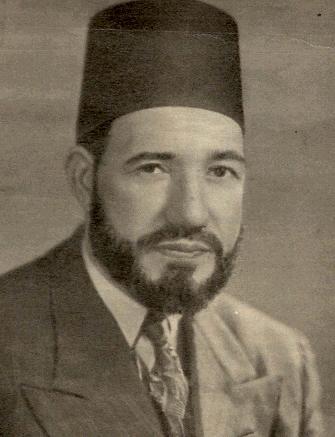
Hasan al-Banna
The Muslim Brotherhood was founded in 1928 by Hasan al-Banna, a 22-year-old elementary school teacher, as an Islamic revivalist movement. Al-Banna emphasized that Islam was a comprehensive way of life. Over the next twenty years the Brotherhood’s ideology came to encompass religion, education and politics. It became terrorist inside Egypt not long after its founding and was outlawed. A Muslim Brother assassinated Prime Minister Mahmud Fahmi Nokrashi in December 1948. Al-Banna himself was killed by government agents in Cairo in February, 1949.
The Egyptian government legalized the Brotherhood again in 1948, but only as a religious organization; it was banned again in 1954 because it insisted that Egypt be governed under sharia, or Islamic law. The brotherhood attempted to assassinate Nasser four times and four of its members assassinated Egyptian President Anwar Sadat in 1981.
The Brotherhood’s slogan is, “Allah is our objective. The Prophet is our leader. Quran is our law. Jihad is our way. Dying in the way of Allah is our highest hope.” The Brotherhood served as a model for subsequent revivalist movements and is theologically aligned with Saudi Wahhabism. The Palestinian terrorist group Hamas is an outgrowth of the Muslim Brotherhood.
The Islamist movement and its terrorist wings need to be distinguished from secular Arab movements. One way to do so is by looking at their respective targets. Until the rise of al Qaeda, Islamist terrorism was directed mostly inward, toward secular-leaning Arab governments. In contrast, terrorism directed against Israel was done primarily by Arab secular-nationalist groups such as the Palestine Liberation Organization. From its beginning, the PLO was oriented toward the reclamation of land and homes lost to Arabs by the founding of the state of Israel in 1948.  An example of secular-based terrorist group operating against Israel is the al-Aqsa Martyr Brigades, a homegrown group behind the rash of suicide bombings against Israelis in the second Intifada of 2002-2004. The Brigades are affiliated with the al-Fatah faction of the PLO. However, as Iran’s Islamic revolution solidified its grip, its mullahs began sponsoring Islamist terrorist groups against Israel, Hezbollah being a principle example.
Today anti-Western terrorism is the near-exclusive province of al Qaeda, founded by Osama bin Laden and headed by him.[20] By the time of al Qaeda's advent, Islamism "defined Islam as the exact antithesis of the West, under the guise of reclaiming the true and real Islam. Whatever the West was perceived to be, Islam was understood to be the exact opposite." [21] Bin Laden broke new ground in two ways: first in the boldness and scope of his attacks and second in that he was uninterested in traditional internal Muslim bickering. Any Muslim was welcome who wished to fight America, the West, or the apostate rulers of Muslim countries.
Osama bin Laden's strategic objectives
Converted to Islamism by fighting in Afghanistan, Osama bin Laden became the most die-hard jihadi of all. Unfortunately, he had hundreds of millions of dollars of family wealth to back him up. Bin Laden used a great deal of it before his access to it was cut off.
The new mission in life that bin Laden adopted can be stated simply: pure Islamic rule and life for Islamic lands, followed by re-establishing a unified, Muslim caliphate reflecting the old Muslim empire at its peak. After that, the rest of the world is to be converted to Islam by peaceful means if possible, by war if necessary.
The first imperative: eject America. Bin Laden, being a Saudi, turned attention first to his home country even though he no longer lived in it. No matter where pure Islamism might be established, Islamism as a renewal movement would fail if never established in Saudi Arabia. Saudi Arabia was the native land of Mohammed; bin Laden frequently referred to it as "the land of the Two Holy Mosques" (one being Mecca itself, the holiest site in all Islam, the other being in Medina).
 The Soviets had hardly withdrawn in defeat from Afghanistan than there was an enormous influx of American and other Western military forces into Saudi Arabia after Saddam Hussein invaded Kuwait in 1990. After the Gulf War, a substantial American military presence remained in Saudi Arabia. Their presence was objectionable to bin Laden for two reasons. First, the Westerners defiled the holy land of Mohammed because they were non-Muslim infidels. Second, their presence proved the impotence, and hence the religious apostasy, of the ruling House of Saud. A pure Islamic nation would have no need of infidel troops to defend itself. As far as he was concerned, the Americans were invaders of Saudi Arabia; he told The Independent of Britain in 1996 that "our country has become an American colony." Bin Laden became convinced that America was in conspiracy with "Zionists" to destroy Islam.
Bin Laden was also convinced that Mohammed's native land must be trod only by Muslims, never by non-Muslims. True Islam in Saudi Arabia could not be achieved with the kufr (unbeliever) army stationed there; hence the American presence must be expelled and not just America’s military presence. All non-Muslim Americans must leave.
Bin Laden's first grievance, though, was against the ruling House of Saud, whom bin Laden (and many clerics in Saudi Arabia, for that matter) considered apostate to Islam. Not only had it invited the American army into the kingdom - the most serious charge Osama held against the royals - bin Laden has been emphatic that the Saudi regime is corrupt and oppressive of the Saudi people, although, of course, he blamed the United States for all this. In his 1996 fatwa(religious judgment), "Declaration of War against the Americans Occupying the Land of the Two Holy Places," bin Laden said of the House of Saud:
The latest and the greatest of these aggressions, incurred by the Muslims since the death of the Prophet (Allah's blessing and salutations on him) is the occupation of the land of the two Holy Places - the foundation of the house of Islam, the place of the revelation, the source of the message and the place of the noble Ka'ba, the Qiblah of all Muslims - by the armies of the American Crusaders and their allies. . . .
 [T]he competition between influential [Saudi] princes for personal gains and interest had destroyed the country. Through its course of actions the regime has torn off its legitimacy:
 (1) Suspension of the Islamic Shari'ah law and exchanging it with man made civil law. . . .
 (2) The inability of the regime to protect the country, and allowing the enemy of the Ummah [Muslim people] - the American crusader forces- to occupy the land for the longest of years.
There followed a long list of grievances against the Saudi regime, particularly emphasizing its un-Islamic rule, the wealth-corruption of its princes and accusations of being a puppet of the USA.
Yet Osama seems indifferent whether the Saudi royals convert to pure Islam, as bin Laden defines it, or are destroyed. In a November 1996 interview with "Nida'ul Islam," bin Laden said, regarding Saudi Arabia,
There are several choices for the regime [of which] the most important of these is to bring back Islamic law, and to practice real Shura [consultative government].
The regime may resort to this choice after finding itself in the position of a morsel of food for the Americans to take, after the enmity has been stirred with their people. These people today feel that the Americans have exceeded their limits both politically and economically, the regime now knows that the public are aware that their sovereignty is shared. This was particularly evident in the recent period through the American press statements which give justification to the American occupation which only exists to rob the wealth of the people to the benefit of the Americans. This option is dependent on the agreement of the people who hold the solution and have the ability to effect change, at the forefront of these would be the honest scholars.
As for the other option, this is a very difficult and dangerous one for the regime, and this involves an escalation in the confrontation between the Muslim people and the American occupiers and to confront the economic hemorrhage. Its most important goal would be to change the current regime, with the permission of Allah.
Abd-al-Bari 'Atwan, editor in chief of the London-based Al-Quds al-'Arabi newspaper, said after another interview with bin Ladin, conducted by Jamal Isma'il in Afghanistan and broadcast on Middle East television,
I felt that the man had his own vision and special strategy. This strategy is based on his concept of the region. The first point in this strategy is that the US Administration or the US forces, which he considers occupation forces in the Gulf and Arabian Peninsula, are a prelude to a comprehensive Israeli-Jewish hegemony over the region with the aim of looting its wealth and humiliating its Muslim people. One senses this as the essence of his creed and strategy.
Therefore, he believes that expelling these US forces from the Arab world is a top priority. He believes that the regimes should be reformed or, more correctly, changed. The regimes immune to reform should be changed, the sharia should be applied properly, and a just Islamic system should be set up in the Islamic and Arab states, particularly the Gulf states. This is a summary of his strategy. Currently, he does not want to fight the regimes. That is what he told me. He wants to fight the Americans, who are protecting these regimes.
So while bin Laden does not specifically seek to destroy the House of Saud, he thinks it will be necessary if the House does not reform. If the royals are brought down violently, bin Laden thinks it will be by popular uprising, a revolution resulting from the long-suffering Saudi people deciding to suffer no more. His 1996 fatwa makes clear that he expects this general uprising to do two things in sequence: expel the Americans from Saudi Arabia, then force reform of the Saudi regime or its replacement. The result will be the institution of a true Islamic society - as bin Laden understands such a society to be.
Because bin Laden thinks that US forces entered Saudi Arabia not as allies but as conquerors, he is convinced that America will not vacate Saudi Arabia on its own. It must be expelled violently. This task, he says in the fatwa, is the primary duty of every true Muslim. [22]
The greatest threat to Islamism
Yussuf al-Ayyeri, one of Osama bin Laden's closest associates since the early 1990s, was killed by Saudi security forces in Riyadh in June 2003. He wrote a book published by al Qaeda entitled, The Future of Iraq and the Arabian Peninsula shortly before his death. In it al-Ayyeri explained succinctly America's greatest threat to Islamism: "It is not the American war machine that should be of the utmost concern to Muslims. What threatens the future of Islam, in fact its very survival, is democracy."
Iran-born author Amir Taheri summarized the book thus for the New York Post:
Al-Ayyeri then shows how various forms of unbelief attacked the world of Islam in the past century or so, to be defeated in one way or another.
The first form of unbelief to attack was "modernism" (hidatha), which led to the caliphate's destruction and the emergence in the lands of Islam of states based on ethnic identities and territorial dimensions rather than religious faith.
What Al-Ayyeri sees now is a "clean battlefield" in which Islam faces a new form of unbelief. This, he labels "secularist democracy." This threat is "far more dangerous to Islam" than all its predecessors combined. The reasons, he explains in a whole chapter, must be sought in democracy's "seductive capacities."
This form of "unbelief" persuades the people that they are in charge of their destiny and that, using their collective reasoning, they can shape policies and pass laws as they see fit. [23]
Modernity is precisely what bin Laden and his allies are fighting against, for modernity carries within it the idea that human societies should be able to shape their culture as they please. But such is anathema to radical Islamism, which wants to make strict sharia, Islamic law, the sole rule of society.
The problem of science
Equally threatening to Islamism as the Western democratic tradition is the Western idea that truth about the very nature of reality and humankind’s place in the cosmos can come from human investigation – science –  rather than divine revelation. Experimental science is a European invention, although the Muslims came close to inventing it near the end of their golden age. In fact, the Turks built a great observatory near Istanbul in 1577 that was the equal of any in Europe. But the sultan ordered it razed to the ground on the insistence of the Chief Mufti. That event ended decisively near-Eastern Muslim science down to the present day. Science education in Arab lands today is limited in scope and is more engineering than research science.
Modern science has had a much more difficult time being accepted in Muslim lands than elsewhere in the world. In an article, “The Religion of Modern Science: Roots of modern God-free thinking,” published in the western-based Islamic Journal, Muslim author Harun Yahya wrote of Western scientific absolutists who “regard modern science as absolute and true religion, and want to impose this view to all humankind. . . . However, the question is not that whether Islam is in line with science or not, but whether science is in line with Islam. What needs to be approved is science, not Islam.” [24]
There are many points of contention and conflict between Arab Islam and the West, but the chief religious contention between Islamists and the West is not really between Islam and Christianity but between Islam and Western scientific-materialism.
Because of the supremacy of the sciences in western thought, Western culture has become caught in a cycle of ever-increasing changes. Western societies contend with an exponentially increasing pace of cultural changes. The pace and kinds of changes that we adapt to (with greater or lesser difficulty, to be sure) are exactly the changes that Islamists correctly believe would destroy basic structures of their society which they believe are the divinely-commanded.
In their view, certain social structures (chiefly the status and role of women) are absolutely essential, required by Allah's command as revealed in the Quran. Without those structures, a society is wholly corrupted. We see them as hopeless religious fanatics; they see us as godless and degenerate.
The tension between Islam's historic traditions and modern pressures of scientific modernity is found throughout the Muslim world. Many Arab intellectuals know that their countries have fallen behind most of the rest of the world. They want to gain the benefits of technological society, but without the cultural baggage that comes with it. They want to modernize their societies but not westernize them. Their vision of modernization is mostly technological, such as communications, medical science, education, transportation, and consumer goods.
These twin desires – keep the West out but bring modernity’s trappings in – are in perpetual tension. Not even the strictest mullahs are willing to give up their cell phones and hearing aids in their dream of a throwback Muslim society. As for the so-called Arab street, enormous numbers of them want to live in the West, and many millions of them have emigrated from Arab lands to do so. Before America invaded Iraq, seventy-five percent of the world’s refugees were from Muslim countries.
But the Arabs’ state their revulsion for the West more strongly than they really mean. So, wrote Victor Davis Hanson, [25]
The best way to get America and the West out of millions of Islamic lives is not to burn effigies of George Bush in the Arab Street, but would be for Arab governments to prohibit immigration to the West, to stop importing Western material goods, and to bar decadent Westerners from entering Arab countries.
Any takers? The bitter truth is that the Middle East wants the West far more than the West the Middle East.
Whether political or religious fervor primarily motivate anti-Western terrorism is unclear, and does not really matter. The bifurcation of politics and religion is a Western notion, not a Muslim one. In any event, their aim is to cleanse the Arab lands of Westernism and institute their own version of pure Islamic society. The paradigms of success are Iran and Taliban-ruled Afghanistan; even the very conservative Saudis are too Western for them.
The Old is New Again
The war that radical, violent Islamists are waging against the West springs from the fact that Islamism and Westernism are fundamentally incompatible. But both are too deeply embedded in both sides' culture, social systems, politics and religion to be very easily altered. Compared to this centuries-old struggle, the Cold War was a brief respite. Rather than the new millennium inaugurating a golden age of human progress and well-being, what was old is new again. History has returned.
Update, December 2025: If, as Victor Davis Hanson, wrote, the Islamists want "to get America and the West out of millions of Islamic lives," then today their goal has been to de-westernize the West and make it Islamic. This is well underway in Europe, where this Christmas season Muslims in Germany and Belgium have stampeded through cities' outdoor Christmas markets and have caused many to be canceled or barricaded. This happened in Brussels this week:


Footnotes:
1. There was anti-Jewish violence in Palestine dating all the way back to the 1920s, but the organization of essentially terroristic, anti-Israel factions among the Palestinians really dates from the establishment of Israel as an political entity. In 1952, for example, "there were about 3,000 incidents of cross-border violence" and from 1951-1955 almost 1,000 Israelis died in such attacks, according to the Israeli government.

2. Islamist terrorist groups operate there now whose direct patrons are Syria and Islamic Iran. There are excellent reasons to believe that Islamist terrorist groups became dominant before 2000; their influence and proven murderousness may have been a key reason Yasir Arafat turned down breathtaking concessions offered by Israel during the Wye River negotiations sponsored by the Clinton administration. By 2004 Arafat's own officers openly acknowledged the Islamist groups' power. In 2002 an officer of Fatah, founded by Arafat in the 1950s, openly told the Jerusalem Post, "We can't ignore the role of Hamas and Islamic Jihad in the resistance against Israel. On the other hand, we can't turn a blind eye to the broad popular support that they enjoy among the Palestinians" (Apr. 19, 2004).

3. The difference between the Right and Left is that the Right said the attacks were divine judgment against America because of individual Americans' increasingly immoral character, while the Left said the attacks were the justified and inevitable response by the oppressed to America's imperialistic economic and foreign policies.

4. Alan B. Krueger and Jitka Mlecková, “Seeking the Roots of Terrorism,” http://chronicle.com/free/v49/i39/39b01001.htm

5. Lee Harris, “The Intellectual Origins Of America-Bashing,” Policy Review, Dec. 2002.

6. "Harvard Gazette," Nov. 4, 2004.

7. Alberto Abadie, "Poverty, Political Freedom, and the Roots of Terrorism," October 2004.

10. Thomas F. Madden, “The Real History of the Crusades.” Crisis, April 1, 2002.

11. Bernard Lewis, What Went Wrong. Perennial Press, 2002

12. During 1991's Gulf War, I was a career Army officer, assigned to the US Army’s main operations center below the Pentagon. There I read a State Department message summarizing what a very senior Egyptian government official had said to an American diplomat. One thing stuck in my mind. “Egypt is the only true Arab nation state,” said the official. “The rest are all tribes with flags.” This particular official insisted that American ideas about Arab unity were nonsense.

13. “Wrestling With Islam,” http://www.davidwarrenonline.com/Miscell/index02.shtml

14. “When Pakistan was created, its founder, Mohammed Ali Jinnah, famously declared, ‘You are free, free to go to your temples, you are free to go to your mosques or to any other places of worship in this state of Pakistan. You may belong to any religion or caste or creed – that has nothing to do with the business of the state.’” (Zahir Janmohamed, Washington Post, June 25, 2003; Page A23

15. However, the modern West treated Middle Eastern lands as backward places to be conquered or enlightened (The French and British from 1798-1948) and/or as holding resources to be gained through commercial exploitation (America, Britain and France from the 1930s until now). In fact, Arab “countries” are mostly a Western imposition, except for Egypt, and much of the troubles there arose from the fact that the national boundaries of Arab countries were drawn by European rulers.
    For much of the Cold War America used Arab nations, along with Turkey and Iran, as a bulwark against potential Soviet expansionism toward the oil fields of Iran, Iraq and Saudi Arabia. It was not an unreasonable fear, but it slewed our relationship with the region in utilitarian ways, which many Arabs saw as another form of colonialism.
    Today, however, the great majority of Iranians today are too young to remember pre-Islamism days and are rejecting the harsh, oppressive rule of the ayatollahs. The ayatollahs have not made the people’s life better than under the shah; in many ways it is worse, especially in the regulation of personal minutiae. Of the Iranians, “the majority want a sweeping transformation. They do not want to be told what to think, what to wear, what to read, what to watch and how to behave, and they are frustrated at the glacial pace of change.” (New York Times, June 16, 2003). In many ways, this statement defines the frustration felt by masses of Arabs with their own governments.

16. Raphael Patai, The Arab Mind. Hatherleigh Press, 2002.

17. Thomas L. Friedman, “Arabs Lift Their Voices.” New York Times, April 7, 2005

18. Gilles Kepel, “The Trail of Political Islam.” http://www.opendemocracy.net/debates/article-5-57-421.jsp

19. Khaled Abou El Fadl ,"Islam and the Theology of Power." Islam for Today, http://www.islamfortoday.com/elfadl01.htm

20. Al Qaeda, however, is not a unitary organization with a rigid, vertically-organized chain of command. It is a conglomerate of sometimes disparate groups with like aims, willing to use like means, enjoying the fruits of bin Laden’s core staff’s work, and oriented on common enemies, mainly Saudi Arabia’s ruling royals and America.

21. El Fadl, op. cit.

22. The United States removed most of its armed forces from Saudi Arabia after 2003's invasion of Iraq. But some American military remain there, as well as thousands of American civilians who live there. So American infidels still corrupt the soil of the Land of the Two Holy Mosques.

23. Amir Teheri, “Al Qaeda’s Agenda for Iraq.” New York Post, Sept. 4, 2003

25. V. D. Hanson, “Winning After All.” National Review, June 2003, http://www.nationalreview.com/hanson/hanson062003.asp

Friday, June 4, 2004

The danger of the "Ideal Time"

Orginally published in June 2004 elsewhere

The ideological eschatology of the Western Left

Eschatology is the theology of last things, the time when history reaches its final fulfillment. Of the world's great religions, only three are eschatological: Judaism, Christianity and Islam. Christianity sprang from Judaism and Islam claims to be the true faith of revealed religion that Judaism and Christianity corrupted.

In all three religions the establishment of the end time is the establishment of the ideal time. It is when the present world is either destroyed so that perfect world can take its place, or the present world's corruption is excised and creation is purified and restored. Usually in Jewish thought, the ideal time has been the restoration of a free, independent Israel living righteously within the Sinai covenant. Jesus' disciples persistently asked Jesus when he was going to bring it about, to which Jesus basically replied, "God only knows."

The establishment of modern Israel did not fulfill this vision fully. The dream of the original Zionists was threefold: to establish and Jewish state that was (a) politically free within its borders, (b) independent of foreign control and (c) extant over all the lands of biblical Israel. To date, Israel has never achieved all three simultaneously.

Hence, there have been 12 attempts by Jewish terrorists to destroy the Muslim al-Aqsa mosque and Dome of the Rock, which sit atop the ruins of the ancient Jewish Temple. These Jewish eschatologists believe that there is a prophetic necessity to the rebuilding of the Temple, so the Muslim edifices there must be removed. This restoration dream is shared by many American evangelical Christians.

In Islam and most strains of Christianity, the ideal time is established after judgment of the dead and the living. The Apostles Creed (dating not to the apostles but to the end of the second century) says that Jesus will "return to judge the living and the dead." In Islam, of course, judgment is the sole prerogative of Allah, but many (maybe most) Muslims believe that Jesus will be assigned the task by Allah and will judge humanity as Allah's agent. In both Christianity and Islam, the ideal time includes no sinners, who are either excluded from entering the ideal community of righteousness or are simply destroyed. In either event, it is too late to convert once the judgment has begun.

When all three eschatologies are taken to the extreme, adherents deny the goodness and value of the present world. After all, why work to increase the value, beauty or goodness of the present world and its institutions if everything that now exists will be wiped away or transmuted by God anyway?

In more moderate practice, however, the desire for an ideal time is positive. It affirms what common sense and a glance at this morning's headlines reveal: there is something seriously wrong with the present order. Hence, it can impel adherents to avoid complacency in the face of evil, to work for the improvement of the human condition so better to prepare persons to face the coming judgment. Indeed, most Christians have held through two millennia to the idea that the Kingdom of God, preached by Jesus, is just as much a present spiritual state of community as a coming physical reality. The Kingdom is within us now, although we can never achieve it fully on our own efforts. Nonetheless, we must do the best we can.

In Christian history this understanding has led on the one hand to the monastic movements that sprang up in the early Middle Ages. Monasteries were strict communities of faith, set apart from the world (although not so separatist that their leaders eschewed commerce with the world). On the other hand it led to the 20th century's liberationist theologies, which paradoxically came to eschew eschatology altogether and focused solely on the reform and even overthrow of present political orders. (It can be argued, though, that liberationism was as much a product of The Communist Manifesto as the Bible.)

But eschatology becomes evil when its adherents see only their own purity and others' sin. When they see the present state of affairs - always of others' affairs - as wholly corrupt, godless and faithless, then it is a short step to religious radicalism, what we have come to call religious fascism. Examples given: the mullahcracy of Iran and Taliban Afghanistan, the latter internally cruel to the point of murder, oppressive and ruthlessly class-ridden, a sort of real-world Animal Farm , only infinitely bloodier.

If the eschatologists are both radicalized and evangelistic rather than monastic, then the result is holy war, jihad. Holy war focuses on destroying sinners, not converting them.

That is the state of al Qaeda and a great deal of the Muslim faithful today. Al Qaeda is actively jihadist, while many millions of other Muslims are sympathetically so. They seek to attain the ideal time - the true Islamic society. Never mind that millions of other Muslims have a different understanding of what Islamic society should be. The radicalized eschatologist simply can wrote them off as apostate and make war against them as readily as against infidels.

Non-religious westerners are just as liable to eschatological fervor as religious people anywhere. Marxism is an eschatological ideology (a godless religion in its own right, really). The ideal time is when "the workers control the means of production" after the capitalists have been violently overthrown. Lee Harris explained the basic tenets of Marxism, and its fundamental flaws, in his excellent essay, "The Intellectual Origins of America-Bashing." Suffice it to say here that Marx considered revolution by the oppressed both essential and inevitable for true socialism to be established. This was a political version of Judgment Day, when the wicked capitalists would be judged and destroyed so that the pure in heart (the heavily romanticized working classes) could attain the Ideal Time.

This appealing but basically foolish ideology held power in the USSR for 70 years, abandoned long before its end by almost all the working classes themselves and most of the ruling class. Soviet communism became a shell game in which commissars and higher ranks lived large and the masses merely lived. Its Ideal Time, however, was hammered home by the propagandists as just around the corner. True Communism was always coming soon, a state in which material production was so great that all human needs were met without shortage. Greed would therefore disappear and the inherent but capitalist-suppressed natural nobility of men and women would emerge. They would be transformed into true communists - altruists who worked each day for the good of the people, not for crass, selfish profit.

But, as Soviet army officer Victor Suvorov came to realize, in a True Communist society, who would stoop to volunteer to shovel manure?
But who will be busy in the sewers? Is it possible that there will be anybody who will say, 'Yes, this is my vocation, this is my place, I am not fit for anything better?'
Of course not. Despite this basic, and indeed obvious flaw, the Soviet promise of its Ideal Time enraptured enormous numbers of Western elites who should have known better.

The old USSR has gone the way of the dodo and hardly any die-hard true believers remain in its former states. But they remain in droves in the West, convinced that Western economic-political systems remain irredeemably corrupt. Having shunned Christian faith for some decades, Western ideologues also discarded a key thing that has prevented Christian eschatologists from experimenting with Taliban-style social orders: the New Testament formally denies the possibility of the self-perfectibility of the human person. (Christian oppressions and brutalities done for other reasons were bad enough, but only rarely, and on small scales, did Christians ever attempt to enforce an Idealized community by force or coercion.)

So the philosophical and ideological origin of the modern Left: Rejecting the idea of a divinely shaped world yet to come, but believing, all evidence to the contrary, that human beings are fundamentally good, most Western ideological eschatologists found a natural fit with Marxism-Leninism: the present order must pass away, and we can build something better on our own. The violent destruction of the present order, if necessary, had a natural fit with Marxism from the beginning.

The Left, rejecting as a basic tenet of its faith the major features of Western societies, came to romanticize heavily non-Western, non-capitalist cultures, especially those of the Third World. The village society became idealized, always assumed to be populated by selfless, caring people whose spirits (never souls, which might need saving!) were uninfected by the crass materialism of capitalism. This was their Eden, the Ideal Time from humankind had sprung; Marxism-Leninism provided the framework for transforming Western societies into a New Jerusalem. Over time, and not a very long time, the Left idealized anyone who opposed the West, no matter how cruel, oppressive or personally repulsive he might be: Castro, Che, Mao, Saddam and others. And now Osama.

That such figures murdered by the thousands or millions dismayed some of the Left, to be sure. But again, Marxist theory provided a way to rationalize the deaths: building the Ideal Community might well require bloodshed, and besides, such violence and oppressive structures were understood to be mere temporary expedients en route to the Ideal Time, when the inherent goodness of human beings would finally flower and coercion would no longer be necessary.

It must be pointed out that the Left, especially the Hard Left, was always mostly from the privileged classes of Western societies. In their dreams of an Ideal Time, they always remained in power. They saw as natural allies anyone who wished to overthrow the Western order, even if (especially if?) by hard violence. They were apparently oblivious to the fact that the others never saw them as allies, not even Stalin, who had moved firmly in eastern Europe to kill or imprison the homegrown communists there before they could get the foolish idea that they would have some say in the newly established workers' paradise.

The romantic thrall much of the Left has today with Islamism is little different than its swoon over Stalin, and no more moral. The Left never had the chance to enjoy the benefits of Stalin's rule and so never really understood that he considered them "useful idiots" to be eliminated if the Soviets ever occupied their countries. Likewise today, the Left, convinced of its own moral purity, fails to understand that al Qaeda views them with contempt equal to Stalin's, and considers them nothing more than infidels to be dealt with when the time comes.

Fortunately, though, there are some of the Left (or at least of liberals) who recognize the peril (linklink, for example) and we may pray others will awaken, too.

Update: Also read, "Mephisto," on Belmont Club. Also, I recommend reading "The Ideological War Within the West," by John Fonte, whichn helps illumine these concepts. Fonte "suggests there has arisen a conflict within the democratic world between liberal democracy and transnational progressivism, between democrats and what he calls post-democrats." Well worth the time.

See also, "Six fatal shortcomings of the modern Left," by Paul Berman, an old-style Leftist, Dissent Magazine, Winter 2004.

Thursday, March 11, 2004

Passion of the Christ followup

I've said pretty much all about The Passion of the Christ that I want to say, except for this post. The front part of this post is a slightly edited email from Joseph Spiezer. I comment afterward.
A couple of points on the "Passion." Beliefnet has an interesting and well written article by Steven Waldman, the point of which is that Jews and Christians are watching two different movies when seeing the film. Jews see centuries of antiSemitism, Christians see an opportunity to experience God’s love. As a Jew, I really do understand the emotional bond that the movie seeks to convey for Christians. But let me explain my concerns about the movie:

1. Anti-semitism. Mel Gibson belongs to a church which rejects Vatican II. Vatican II said that Jews were not to blamed for the death of Jesus, and that antiSemitism was to be contrary to Catholic teaching. After Vatican II, the Church went so far as to say Jews were not to be targeted for conversion. After centuries of antiSemitism, in which normative Christianity viewed Jews as having murdered and rejected Christ, Vatican II is quite literally a Godsend to my fellow Jews and me. Since Gibson rejects Vatican II and all that followed, the natural concern is that he believes that the ideas that Jews are fundamentally evil and followers of Satan and therefore that is the message of the movie.

2. Anti-Judaism. Nothing is more important to me than my children. They represent the continuity of my life, the passing of my ideals. To the extent that missionaries of any religion try to change the values and religion of my children, they are violated me in the most gruesome and painful way possible. This idea, that Judaism is somehow inauthentic, since it does not accept the truth of the movie, is what I am most afraid of. The notion that missionaries will become reinvigorated not to seek to encourage fellow Christians to develop a more spiritual relationship with God, but to seek to convert my children to their religion. It is not so long ago, in the history of time, that the conversions were not through argument, but through force. The story of Pope Leo XIII, and the kidnaping of Edgardo is well known to Jews.

3. Not a concern, but my hope for the future. The difference between is really much more fundamental than Jesus. The basic difference is Christians believe in Original Sin, which breaks the relationship between man and God, a break which is only mended through the life and death of Jesus. For Jews, there is no break, hence no need for a Messianic Savior in the sense that Jesus is for Christians. Thus, Jews could not have rejected Jesus, because the whole concept of repairing a break doesn’t make any sense. If we can understand that basic concept, that really we have different starting points, that it makes no sense to try and convince each other of the logic of our arguments since we have different axioms, then perhaps we can get to the point where we can appreciate each other’s insights and beauties with being afraid of each other.
Joe, thank you for these thoughtful and indeed collegial points, which I am happy to post for everyone to consider. I'd like to make a few points.

Your observation that Christians and Jews seem to be viewing two different movies on the same screen is a good one. From my conversations with a few other Jews, it is obvious to me that Jews almost instinctively identify many threads of anti-Semitism that pass right by most Christians. I have either posted or linked to identifications of many of these elements in past posts.

I should say that few American Christians will pick up on the latent anti-Semitism. Some Jews have said they are much more concerned about the movie's effects on overseas audiences than domestic ones. The relevant images and dialogs will be much more evident to Euro audiences than American. European Christians have a deeply-rooted anti-Judaism that few Americans can understand.

See, for example, Jared Keller's review (via Bill Hobbs) of The Passion in which Jared writes,
My appreciation for His sacrifice - for His willingness to suffer physical torture, and inconceivable spiritual torment for the sake of my salvation - is now visceral, thanks to Mel Gibson. I put Jesus on that cross. He bore my sin, and lowered Himself for me - for humanity. Had I lived in that place, at that time, I would likely have been one of the throng shouting for his death.
But Jared is entirely blind to the anti-Semitic scenes of the movie:
What about anti-semitism?

There is none to be found. Caiaphas is certainly portrayed as amoral, but his corruption springs from his lust for political power - not his ethnicity, or his religion. During Jesus' first appearance before the Sanhedrin, there is a great deal of disagreement among the priests, with many storming out in protest over Jesus' treatment. The Jews are never portrayed as some sort of monolithic group.
What Jared does not see is the caricaturist portrayal of the High Priest, the overdone robes of the priests, the money-grubbing-on-his-knees Judas (not a biblical scene), how Judas is driven to suicide by demon-children dressed as Jews, the priestly elite bribe the people to denounce Jesus, the near-total absence of Jewish clothing worn by Jesus, and so on. Yet Jared, and I think a large majority of American Christian viewers don't recognize these things and focus less on such aspects of characterizations and dialog, and more on the deep meaning for Christian faith of Jesus' suffering and death.

Hence, the primary reason Christians and Jews see two different movies on the screen is that Christians tend to see the movie as a theological drama while Jews tend to see it as an historical drama. The vast majority of Christians I have discussed the movie with can identify at least a few of the anti-Semitic scenes, but are by far struck much more strongly by the soteriology of the movie. As I have written, the movie's most powerful effect on me was a demand that I examine my life through the lens of the Christ's teachings and their relationship to his death.

As for Original Sin - I don't think that many Christians actually do believe in it, though it remains a doctrinal point of the Roman Catholic and many other churches. The Augustinian theory of O.S. simply is not tenable in this age. Hence, most Christians argue that the reconciling work of God is not really repairing a break due to O.S., but is understood in other ways.

That being said, the earliest proponents of Original Sin were actually Jews, not Christians, especially Paul. What many Jews (IMO) fail to recognize is that the New Testament writings of the apostles are Jewish writings, for all the apostles were Jews before they followed Jesus, and remained Jews until they died. In fact, no kind of decisive break between Judaism and Christianity occurred until after the destruction of the Temple in 70, long after the apostolic letters had been written.

Furthermore, a nascent backing of O.S. is found in the Jewish Scriptures, Psalms 51:5 for example, "Surely I was sinful at birth, sinful from the time my mother conceived me."

My point is that I don't think that Jewish and Christian thought about the human condition is quite as far apart as I think Joe is indicating. If the fundamental issue is human sin - as the long line of Hebrew and Jewish prophets all agree, as did Jesus - then only real point of departure of Christianity and Judaism is how sin is overcome.

For Jews, at least throughout the biblical eras (I am not as well acquainted with modern Jewish theology) the answer was Covenant. Beginning with Noah, God had made covenants with human beings. The covenants with Abraham and much later with the children of Israel at Sinai focused divine covenant upon the Hebrew people. By faithfully keeping the covenant the nation would be saved.

Christians also see their salvation as coming through divine covenant, except it is through neither the Sinai covenant or the Mosaic covenant, but the new covenant prophesied by Jeremiah (see Jer. 31). It is arguable that Jeremiah was trying to invigorate the Sinai covenant rather than foretell a successor or refinement to it. But in either event Jesus specifically tied his death to the new covenant at the Last Supper.

So for the Jews, the covenant of salvation is something akin to an agreement, a sort of meta-contract. But Christians understand the covenant of salvation is a person, Jesus the Christ, the Son of God. Hence, said the Pharisee Paul, whomever believes in his heart Christ was raised by God from the dead and confesses with his mouth that Jesus is Lord, shall be saved. For this faith is accounted to us as righteousness.

For Jews, Passover commemorates not merely an historical event but a deeply theological one. The Exodus was the principal way the YHWH identified himself to the children of Israel: "I am the LORD your God, who brought you out of Egypt, out of the land of slavery" (Exod 20:2) is how God began the Ten Commandments, which are the very heart of the law. And while Christians understand the importance of the Exodus and deliverance, very few can comprehend the deep meaning of the Passover commemoration that Jews attach to the holy day.

Similarly, even Jews who understand the soteriology and christology of Christian faith really don't grasp the deep meaning to Christians of the person of Christ, whom we profess to be "one and the same" with God, "For in Christ all the fullness of the Deity lives in bodily form."

Now, having gone through that stemwinder, I have some closing thoughts about the movie again. I find that as more time passes since I saw the movie, I am more disappointed in it. Part of this disappointment no doubt comes from the fact that a lot of the scenes come from Catholic traditions that are rather opaque to me. That's not Gibson's problem, though; it's his movie, not mine.

Rather, there is nothing in the movie that cuts to what I believe is the crux of the unjust execution of the innocent Jesus: that it was Roman law and Jewish religion conspired at some level to deliver Jesus to the cross. For in all the world until that time, the Roman legal code was the best the world had ever seen, and across the entire ancient world Judaism was highly respected even by pagans as the finest of religious faith there was.

Jesus was put to death not by the worst that humanity had to offer, but by the best. The movie, though, concentrates on Christ's suffering without delving into the suffering's broader context. Furthermore, it is Jesus' death, not his suffering, that is the central element of the passion story, yet the movie so overwhelms with scenes of torture that Jesus' death is presented practically as an afterthought.

Yet the movie does seem to edify most Christian believers who see it, including me, so I still assess it as a worthy experience. There are many sequences that are exalting and deeply moving. But there are so many places where the movie is deeply flawed, and some, in fact, where it outright contradicts the Gospels. All this is to say that my disappointment is that The Passion of the Christ could have been a contender for something truly extraordinary, but sadly falls short.

Thursday, February 26, 2004

My review of "Passion of the Christ"

My senior year in college I took a one-month, concentrated English course on movies and movie criticism. We watched four or five movies every day, including mandatory viewing of every Alfred Hitchcock film ever made (except his final one, which he had not yet made) and had to write scholarly papers on two movies. Most of the films were silent, many of them very obscure, including some Eastern European silent flicks.

Despite all this training, I confess that I am not a skilled movie reviewer. Roger Ebert's job is safe from me. So what follows about The Passion of the Christ is less a real review, really, than my impressions and thoughts.

I tried hard to dismiss all the buzz, pro and con, that we've been force fed for months, especially in the last two weeks. Maybe I succeeded. So here goes:


  • Jesus' mother, Mary, is a meta-narrator of the movie. In fact, the events are almost told through her eyes. She is present at every moment of Jesus' suffering. She is also the only character except Jesus who knows, theologically, what is going on. Hence, she alternates between shock and grief at what is happening to her son, and acceptance of its necessity. I found very powerful and moving a scene when Jesus falls while carrying the cross, evoking a flashback memory of Mary. At the end, when Jesus is lowered dead from the cross into her arms, Gibson reproduces Michelangelo's Pieta, one of the most sublime works of sculpture in Western art.

  • Is it anti-Jewish? Well, neither my son nor I (he is 18) left the theater angry at Jews or thinking that "the Jews" were - or are - responsible for Jesus' death. Anger simply is not an emotion I experienced during or after the movie, and I saw and heard no indication that any other viewer did.

    That being said, the Jewish hierarchy is presented almost uniformly flat-charactered. In Jesus' arraignment just after he is arrested, two or three members of the Sanhedrin, the Jewish high council, protest vehemently that the proceeding violates both Jewish law and common sense. They are quickly marginalized by the others. After some reflection, I have to agree substantially (not completely) with one of my former professors, Dr. Susan Bond, who told The Tennessean, referring to the visual presentation of Jews in movies,
    Historically, Jesus movies have done a very bad job of this by caricaturing the Jews. One of the ways you know who the bad guys are is that you see the guys with the big hats, guys with too many jewels on their robes. Mel managed to make the religious leaders in this movie even more grandiose than in other movies, which I would interpret as an anti-Jewish spin on it. He made the additional artistic decision of giving them all bad teeth, and making them less physically attractive as a distinct group. ...
    OTOH, these are also stock ways that movie makers help the audience identify the antagonists to the hero; the Jews who sympathize with Jesus or who attempt to show him compassion are visually more appealing than those who oppose him. The Roman soldiers are visually as repulsive as Jesus' Jewish foes - except for one who is compassionate toward Mary. He's a handsome fellow.

    It also needs to be recognized that Jesus himself is not visually presented as a Jewish man - he wears no fringes that I saw (as the Gospels explicitly say he did), no headcovering, has no phylacteries, worn by every male Jew more than 13 years old.

    While I see why critics claim anti-Judaism on Gibson's part, I think it is just as likely that he simply used a stock movie-maker's paradigm to help the audience keep track of the sides, even if a little crudely or insensitively done. Does that mean he thinks the audience is too stupid to keep track on its own? Well, yeah. Directors generally think that. (Alfred Hitchcock said that actors and the audience alike were "cattle.")

    (However, a writer in Christianity Today, an evangelical magazine, observes, "... concerns about The Passion stirring anti-Semitic attitudes in the American movie-going public have been largely misplaced, but I do not for a minute hold these fears to be misbegotten or disingenuous." Read the whole thing.)
     
  • Is the movie accurate to the Gospels? On the whole, yes, in the main events: Jesus was arrested, tried, condemned, probably flogged, condemned and crucified. But the movie conflates the Gospel accounts together and dramatizes them strongly. Gibson tried to make a single, coherent film narrative out of four accounts that don't always match.

    Gibson obviously picked some scenes and not others from the Gospels. The result is a movie that, while generally according with the Gospels, isn't really a movie of the Gospels. Gibson is Catholic, as critics have endlessly reminded us, and Catholic tradition about the passion influences the screenplay quite a bit: the Gospels, for example, do not relate Mary following Jesus along the Via Dolorosa but some Catholic tradition does. Again, it makes for some compelling drama and I have no problem with it, but it is not in the Gospels. Neither do the Gospels relate that Caiaphas the high priest himself went to Golgotha as he does in the movie. The scene where Caiaphas personally accosts Jesus on the cross is not in the Gospels, although Matthew says other priests were there:
    41In the same way the chief priests also, along with the scribes and elders, were mocking him, saying, 42‘He saved others; he cannot save himself. He is the King of Israel; let him come down from the cross now, and we will believe in him.a 43He trusts in God; let God deliver him now, if he wants to; for he said, "I am God’s Son."
    However, one authority of the Jewish practice of the day whom I trust emailed me that the presence of Caiaphas himself at the cross was quite unlikely because the high priest was never to contact corpse uncleanness (even by accident, I might add),

    In addition to including scenes in the movie that aren't in the Bible, Gibson does omit some things that are: Judas does hang himself, but does not fall and burst open upon the rocks, for example, and the centurion at the crucifixion does not proclaim, "Surely, this man was the son of God" (a really curious omission, I think). At Jesus' death we do see the earthquake that splits the veil in the Temple, but the Gospels do not say the Temple itself was wrecked as the movie shows. Nor do see the dead of Jerusalem come forth from their tombs. The crowd around the cross disperses before Jesus cries out to Elohim, but in the Bible the crowd debates the meaning of what Jesus is saying.

    So IMO, the quote attributed to the Pope about the movie, "It is as it was," is problematic because it presumes we know with certainty exactly how it was in the first place.

    I personally did not care for the satanic figure who hovered over many of the scenes, though I know what Mel was trying to do dramatically with it. There are a lot of other invented sequences, a necessity since a movie made strictly according to the Gospels' narrative would be pretty short. Hence, this movie is not a documentary of any kind. It is Mel Gibson's imaginative retelling of the passion story.

    The movie ends with a very brief resurrection scene. While I found the scene very powerful, it is not biblical. So as not to ruin its impact for you, I'll not describe it here. It is a wonderfully imaginative scene, but strays from the book.

  • The flogging scene was overdone and dramatically overshadows even the crucifixion. Three Gospels say Jesus was flogged but provide no details. In the movie, Jesus' beating begins with rods, severe enough in themselves, but they are discarded at a count of 32. Then the Roman flagellum is used, which shreds his flesh. However, the Gospels don't agree on the context of the flogging. If the flogging was done after Jesus was condemned by Pilate, then using the flagellum would have been expected, because the Romans generally wanted prisoners to die quickly on the cross. The scourging alone would half kill a man.

    But if a man was not condemned, just sentenced to be punished, a flagellum would not have been used because it was potentially lethal itself. Matthew and Mark agree that Jesus was flogged before being sentenced to die, but John says he was condemned after being flogged. Gibson's movie goes along with John, but he has to account for the discrepancy of the Gospels. Hence, when the soldiers see that Jesus isn't properly subdued by the rods, they turn to the flagellum. The centurion enters and halts the flogging precisely because Jesus was not condemned. By then, however, Jesus has been flogged to a bloody rag of a human being.

    Luke says, though, that Pilate said he would have Jesus flogged, but the crowd insisted he be crucified. So Pilate caved and sent him straight to die without being flogged.

    A longstanding Christian tradition says Jesus received 39 lashes. The precision of the figure springs from the fact that Jewish law (Deut. 25:3) forbade more than 40 lashes; by stopping the count at 39, the possibility of a missed lash was accounted for. But Jesus was flogged by the Romans, not the Jews. Roman law had no count limit. We do not really know how many lashes Jesus really received; in the movie it is close to 100.

  • David Whidden wrote that this movie badly needs a prequel. I somewhat agree. It does appear to me that Mel presumed that viewers would know Jesus' story before the point his movie begins. Yet this assumption is not justified, I think. Huge numbers of Americans do not.

    What viewers never discover within the movie is just why some Jews were so enraged by Jesus as to call for his death at Roman hands, apart from Jesus claiming he is the son of God - but this happens after he is arrested, not before. Clearly, the Sanhedrin (most of it, anyway) believes he has committed blasphemy, but crucifixion for that? Even Pilate rolls his eyes at that one.

    In fact, Jesus had a substantial record of challenging the Jewish power structure of the day; he called some Pharisees, a socially powerful laity group, children of hell one day, certainly not something that would make them feel kindly toward him. Jesus drew large crowds as well; Pilate had sent cavalry to ride into other leaders' crowds with swords swinging. The details of all that are more than I want to go into in this post, but there is reason to believe there was a fear on the part of the high priest and others that Pilate would see Jesus as an insurgent leader and falsely think he was sponsored by the hierarchy. They seemed to fear that Pilate's well-known bloodthirstiness would fall upon them and the people because of Jesus. (John's Gospel is clear that a large number of ordinary Jewish people, not just the hierarchy, were hostile to Jesus because he claimed divine identity. Luke 4:18-29 relates that even the people of his own synagogue tried to throw him off a cliff - because he promised God's blessings not only for Jews but equally for Gentiles.)

    Again, though, none of this presents in the movie, and I believe that lack is a major shortcoming. Just why do they want Jesus dead? We aren't really told. (Pilate kills him just to placate the Sanhedrin.)

    Remember, though, that Gibson is emphasizing not the historical explanation for Jesus' death but a theological one. Jesus' death is presented more as a self-sacrifice than a murder. He is undergoing his passion deliberately. Arising from the ground along the road to Golgotha he tells Mary, "Behold, I am making all things new." However, this saying of Jesus comes from Revelation 21:5, not the Gospels, and refers to the coming again of Christ into the world. This isn't a criticism per se, just a clue that the historical question is not of primary interest to Gibson. A theological interpretation of Christ's suffering and death is.
  • I found the use of flashbacks very effective. Several times in his suffering, a glimpse of something reminds Jesus of an event in his ministry. A Roman sandal, for example, takes him back in memory to his foot washing of his disciples recorded in John's Gospel. Some of the flashbacks are of Jesus' moral teachings, such as to love one's enemies, not just friends. Others are of his teaching about himself. I thought the sequencing and selection of the flashback scenes were exquisitely well done; they deeply moved me.

  • About the violence: apart from the overdone scourging, there are scenes where Jesus is beaten by Temple police en route to the Sanhedrin, they even throw him off a bridge and Jesus is painfully stopped just short of the ground by his chains. Neither the blows nor the fall are biblical, although it's believable that his captors struck him since Jesus' disciple Peter had offered armed resistance. But the bridge toss isn't credbile at all and serves no purpose other than to bring Jesus face to face with a disciple hiding under the bridge. What's the point? None. Gratuitous violent scene? Unquestionably.

    Jesus is struck and spat upon at the Sanhedrin hearing. That's biblical. Roman soldiers strucks and whipped him along the Via Dolorosa, en route to die. Not specifically biblical but completely credible. These blows are not very graphic. The crucifixion is graphic and indeed illustrates why even Roman political leaders worked for decades to abolish the practice. Said Seneca,
    Can anyone be found who would prefer wasting away in pain dying limb by limb, or letting out his life drop by drop, rather than expiring once for all? Can any man by found willing to be fastened to the accursed tree, long sickly, already deformed, swelling with ugly wounds on shoulders and chest, and drawing the breath of life amid long drawn-out agony? He would have many excuses for dying even before mounting the cross (Dialogue 3:2.2).
    What the movie does not show, though, is just why crucifixion was so, well, excruciating. Painful with the nails and all, no doubt, but why were even its ancient advocates agreed it was the worst death a person could suffer?
    The crucified person could not exhale properly and this eventually would lead to painful muscle cramps. Furthermore, adequate exhaling required the crucified to lift his body by pushing up on the feet and rotating his elbows. This, of course, resulted in searing pain in both feet and hands. ... On the cross every breath would be an agonizing affair and finally in combination with exhaustion would lead to asphyxia. This also explains why the legs of the crucified were often broken, as was the case with the two robbers who were crucified with Jesus (John 19:31-33;). ... Without the support of their legs, the crucified were unable to raise up their bodies, which in turn made it impossible for them to exhale properly thus greatly speeding up death, often within minutes. All of this means that the seven sayings of Jesus were uttered with great difficulty, for speaking takes place during exhalation. [link]
    There can be no question that hanging on the cross was the greatest suffering Jesus endured, yet the movie mostly glosses over his cross agony. Yet, as Gibson has said, unblinkingly showing Jesus' suffering is a major dramatic intention of the movie.

    Roger Ebert says that the movie is the most violent film he has ever seen. I simply don't see how. Saving Private Ryan was by far more violent and more graphically, revoltingly violent in my view; Ryan had a far more powerful effect on me emotionally than The Passion. In fact, I think Sam Peckinpah's The Wild Bunch (1969) was considerably more violent. Other commentators have mentioned last year's Kill Bill as more gratuitously violent than The Passion, but I have not seen it.

  • Where does the movie leave me? One day in class, Dr. Bond told of a classmate in her undergraduate days who had never been to church, never read the Bible. She loaned him a Bible and advised him to start with the Gospel of Mark, it being the shortest and simplest to read. She said that he told her later that he opened Mark not long before bedtime and became so engrossed in it that he couldn't put it down. He read through the passion with increasing dismay at what was happening to Jesus.

    When he read of Jesus' death on the cross, he said he was too shocked to continue. He put the book down and went to bed.

    But, he said, he discovered the story did not end there. The next morning he learned that death did not conquer Christ.

    Tonight, as the credits rolled (we stayed until they ended) I was filled with a deep sadness - indeed, shame - at the profound deficiency of my own discipleship. Gibson has said that the movie's answer to the question, "Who killed Jesus?" is, "We all did." That is not what I felt at the end. Instead, I felt a deep sense of having betrayed the great trust given me by Christ, a enormous awareness of my own sin and sinfulness and my total reliance on God's gracious mercy.
    Ah, holy Jesus, how hast thou offended,
    that we to judge thee have in hate pretended?
    By foes derided, by thine own rejected,
    O most afflicted!

    Who was the guilty? Who brought this upon thee?
    Alas, my treason, Jesus, hath undone thee!
    'Twas I, Lord Jesus, I it was denied thee;
    I crucified thee.

    Lo, the Good Shepherd for the sheep is offered;
    the slave hath sinned, and the Son hath suffered.
    For our atonement, while we nothing heeded,
    God interceded.

    For me, kind Jesus, was thy incarnation,
    thy mortal sorrow, and thy life's oblation;
    thy death of anguish and thy bitter passion,
    for my salvation.

    Therefore, kind Jesus, since I cannot pay thee,
    I do adore thee, and will ever pray thee,
    think on thy pity and thy love unswerving,
    not my deserving.
    "Ah, Holy Jesus," Johann Heerman, 1630

    Update: I meant to include this little episode: As my son and I entered the theater, we met a classmate of his coming out. She had just seen the movie. She told my son that she had read the Gospels but did consider herself a Christian. But she said the movie made her understand for the first time what Jesus' story meant.

    Update: The United Methodist Church's General Board of Discipleship has published a special web site devoted to issues related to The Passion of the Christ. The GBOD's site is called, "The Passion - Opportunities for Discipleship." A review published by the UMC's communications agency is here.
  • Tuesday, January 27, 2004

    Why I will vote for Joe Lieberman

    The Tennessee primary is next month. Tennessee has an open primary; voters may vote in any party's primary without reference to how they are registered. I am a registered voter, naturally, but have no party affiliation. Both parties have, at one time or another attempted to enlist me in local politics, but I always refuse to affiliate myself openly with any party.

    (You will search my site in vain for any endorsement of re-election of President Bush, or the election of another contender. I have been asked more than once to join "Blogs for Bush" but I always decline.)

    I'll vote for Lieberman in February's primary. And no, I am not endorsing him for the office of president here. I well recognize that he has no chance of being nominated. I see no point in voting in the Republican primary because I cannot - even on secret ballot - put my stamp of approval on the Bush administration, which is what a vote in the uncontested Republican primary would do.

    I will vote for Lieberman to protest both the Bush administration and the un-impressiveness of the rest of the Democratic field. As much as the prospect of a second Bush terms disturbs me, the prospect of any of other party's present frontrunners occupying the White House gives me insomnia.

    Take Dennis Kucinich, for example, who was interviewed by Sean Hannity on his radio show as I was driving today. Kucinich accepted Sean's invitation to be on Hannity and Colmes tonight.

  • Kucinich said that we are fighting the Taliban in Iraq.

  • He said last year that President Bush has revoked President Ford's Executive Order 12333, which forbids assassination of heads of state, but when pressed about it by Hannity, Kucinich said he would have to check to see whether it was true. (Maybe he should have checked on it before saying it?)

  • Kucinich said that the US Declaration of Independence obligates a president to defend America but then said that it forbids America from taking the offense against another country, even one that has made war against us.

  • He said that President Bush directed the bombing of civilians in Afghanistan but the only example he could cite was the accidental aerial attack of a wedding party that killed about three dozen people - a tragedy, to be sure, but hardly proof of a presidential order to bomb civilians.

  • When asked forthrightly whether he would have ordered the actions against Afghanistan and al Qaeda the US began in October 2002, Kucinich said that because Osama bin Laden was a "non-state actor" the situation was "complicated," and that instead of the course of action the US took, he would have sought an "international coalition" to track down those responsible for the attack.

  • To his credit, Kucinich unambiguously denounced the idea, broached by his rival Howard Dean, that President Bush was warned in advance by some Saudis about the attacks of Sept. 11, 2001.

    Of course, Kucinich isn't a frontrunner, for which the Republic may be eternally thankful.

    Update: John Cole's words resonate with me pretty well:
    ... I refuse to let this administration and Karl Rove treat me the way the Democratic party treats African-American voters. I DO have options. I have a lot in common with moderate to conservative Demorats ...

    ... I feel like I have been sold down the river when it comes to this hideous spending. The Farm Bill? The Education Bill? Medicare prescription drug plan? Marriage Promotion? Drug Testing in Schools? Faith Based Initiatives?

    You know, when Bill Clinton pandered, he at least had the decency to be straight forward about it. And, I might add, Bill Clinton, despite what you may think his role was in the process, did sign a balanced budget at the end of the day. Chew on that, Mr. Delay.
    Yep.
  • Saturday, January 17, 2004

    Brutalities of the Confederate Home Guard

     I never read the book Cold Mountain, so I went to the movie last night with an uncluttered mind, knowing only that the story line was of a Confederate soldier who deserts to make a long trek home to his beloved. This man is named Inman, played by Jude Law. Nicole Kidman plays the heroine, Ada Monroe, who loves Inman and waits faithfully for him to return. The movie opens on July 30, 1864, with the Battle of the Crater at the Union siege of Petersburg, Va., which Cold Mountain accurately presents as an unmitigated disaster for the Union side. 

    As a result of the battle, his own near-death experience from a nasty neck wound, and of Ada's letters explaining how difficult life is for her, Inman deserts to make his way back to Cold Mountain, NC, and Ada. There is a lot to like about the movie and a lot I found to scorn, but this is not a movie review post.

    The dramatic conflict of the movie revolves around the heroine's antagonist, Marshall Teague. Teague heads the local Home Guard, a paramilitary outfit empowered by the state government to deal with Confederate army deserters and civilians who gave them aid, even their family members. Desertion was the huge problem, especially in 1864 and 1865. More than 13,000 North Carolina Confederate soldiers deserted during the war. The privations of the war on the home front put many soldiers' families in truly desperate circumstances. All in all, tens of thousands of Confederate soldiers deserted to care for their loved ones. (Many returned to their units, however, and were generally forgiven once they did.) 

    Teague and his small band of enforcers, chartered by the state, ruthlessly track down deserters. For selfish reasons, Teague leans hard on Ada. At one point Teague and his men saber to death a man in his own front yard for suspicion of harboring deserters. They torture his wife, expose the deserters and shoot them down on the spot. Such killings continue in the movie. 

    I am sort of a stickler for historical accuracy in movies that derive the context from history. I found the Home Guard portrayals very offputting. (Other Home Guard detachments of the state hound Inman as he makes his way home.) I had never read of such brutalities being done by during the war by Confederate states to their own people, and reacted to this part of the move - and a major part it is - with scorn. This, I thought, was a fatal flaw of the story. While I had no doubt that Confederate authorities did try to capture deserters, I dismissed the idea that Home Guard "brownshirts" ever had the authority simply to shoot down deserters on the roadside or savage Southern civilian families. So I Googled "confederate home guard" today. And discovered Cold Mountain is accurate. Consider:

    Allen Lowery was born 1795 in Robeson County, NC. He died 9 Mar 1865 in Robeson County, NC from Shot to Death by the Robeson County Home Guard and was buried in Lowery family cemetery near Pembroke, NC. ... Allen and his son (William) was killed by the Robeson County Confederate Home Guard, because they where believed to have helped Union soldiers during the Civil War.
    According to historian Milton Ready of the University of North Carolina-Asheville,
    To help enforce conscription, find deserters and collect taxes, the "Guard for the Home Defence" was formed. The Home Guard, as it came to be known, is depicted in [Cold Mountain] as a sort of Confederate Gestapo ... "A lot of the people in the Home Guard belonged to extended families and a lot of the people who didn't want to pay or who harbored deserters were in different families," Ready says. "They used the Civil War to settle personal debts that went back years."
    And not just in North Carolina. In the northern Alabama hill country there remained strong pro-Union sentiment throughout the war in . (Not just in Alabama, of course; my own state of Tennessee was highly pro-Union in the east.) With the advent of Confederate conscription in 1862, the men there were subject to arrest by the Home Guard for not responding to the callup. Large numbers fled to the hills, leaving their families behind. But the Home Guard persecuted the families. The family of John Phillips, for example, suffered severely. Phillips related,
    “They commenced robbing my family of the support I had left for them, they drove off my cattle and took my horses and mules, also my corn. They event went so far as to pour what meal my family had out in the floor and fill the sacks with meat. They event took their cups, saucers and plates, not leaving anything for their sustenance.”
    Such brutalities led many of the men to make their way to Union lines and enlist in the Union Army. One such man was named Henry Tucker, who rather foolishly decided when on leave from Union service to visit his family in Alabama.
    Henry Tucker ... was arrested by the Home Guard at his home in Marion County and tortured to death. He was tied to a tree, castrated, his eyes removed and his tongue cut out before he was literally skinned alive. He is buried at Hopewell Cemetery, south of Glen Allen, Ala. But Tucker’s vicious death was avenged. Home Guard leader Stoke Roberts who personally directed the torture of Tucker, was eventually caught by a group of unionists near Winfield. They took a long iron spike and drove it through his mouth and out the back of his head and nailed him to the root of a big oak tree.
    Alabama men who remained hiding in the hills were tracked down and often killed on the spot.
    Three sons of Solomon Curtis were all killed in Winston County. Joel Jackson Curtis was killed in 1862 for refusing to join the confederate army. George Washington Curtis, home on leave from the union army, was killed by the home guard in his yard while his wife and three children watched. Thomas Pink Curtis, the probate judge of Winston County, was arrested near Houston by confederate authorities in 1864 and taken to a bluff on Clear Creek where he was summarily executed with two shots to his right eye.
    This is a repellant aspect of Southern history that is underreported. I wish a competent historian would undertake a disciplined study of the Home Guard. Some historians estimate that 100,000 white Southerners served in the Union Army; with brutalities committed by the Home Guard against many of their families, it seems that the war was a civil war not merely between North and South, but just as much between Southerners.

    Tuesday, December 23, 2003

    Should we nuke Mecca?

    The calculus of revenge: if the terrorists surpass 9/11, how should we respond? 

    Dean Esmay was not the first one to suggest American strike catastrophically against the Arab world in revenge for another 9/11-type, or worse, attack against America. But Dean’s proposal is probably the bluntest I’ve seen
    U.S. Sister City Program
    It works like this: You bomb one of our cities and we unleash 10,000 times the explosives on our "sister city" as a response.

    Sister Cities:

    New York City - Mecca
    Washington D.C. - Medina
    Los Angeles - Riyadh
    Chicago - Damascus
    San Francisco - Tehran
    Seattle - Tripoli

    And so on... You get the idea.
    I simply do not understand why this seems acceptable to some people. It is a shockingly immoral proposal. Simply making war is never the purpose in itself of war. That is, simply inflicting destruction upon the enemy or the enemy’s people is never a just end in war.

    Some may respond that I invoke just conduct of war only upon our own side, that the Islamists reject our Just War model and feel no compunction or moral restraint in the wholesale slaughter of American noncombatants.

    Their objections are correct. We are self-restrained, our enemy is not. That’s what makes them terrorists. But we are not to become terrorists in response.

    (I recognize that Islam is uniquely vulnerable to the kinds of attacks Dean proposes. Unlike Christianity (or Judaism, too), Islam is a religion of place. One of the five fundamental duties of all Muslims is to make a pilgrimage to Mecca at least once. If Mecca was atomically removed from the earth, would it even be possible to be a faithful Muslim? Perhaps Muslims would adapt in the same way the Jews adapted to the multiple destructions of their Temple in Jerusalem.)

    Nonetheless, with the domestic threat alert is at its highest since May. Sober warnings have come from the mouth of Homeland Security Secretary Tom Ridge that al Qaeda is " ‘anticipating near-term attacks that they believe will either rival or exceed’ the events of Sept. 11."

    So let us accept Dean’s first premise, that an American city might suffer a catastrophic strike by al Qaeda that would kill many, many thousands of citizens. Imagine an atomic truck bomb in an American metropolis. Imagine 30,000 dead and 60,000 injured, or more.

    What should America do in response?

    I reject a nuclear response that seeks simply to lash out at presumed enemies and make Arabs suffer for suffering’s sake. Killing just to kill would not be warranted even under such grievous circumstances.

    Such an attack must evoke a severe American response, but the first question is whether al Qaeda’s attack would mean that we should change our basic strategic aims, the foundation upon which everything else depends: 
    ... to inculcate far-reaching reforms within Arab societies themselves that will depress the causes of radical, violent Islamism. This task shall take a generation, at least; President Bush has said on multiple occasions that the fight against terror will occupy more presidencies than his own.
    I say that a K-strike against America would make this objective more urgent, not negate it ("K-strike" being shorthand for "catastrophic strike," borrowing from old military abbreviations). 

    Therefore, the American response to such an attack must do two things: 

    1. Dramatically reduce, hopefully eliminate, the possibility of such an attack being repeated, 
    2. At least not harm the furtherance of the basic American strategic goal in the Middle East. 

    There are a lot of  measures the US could and should take if we are attacked by an attack of 9/11's destruction or worse. But draining the swamp that breeds Islamist alligators will remain the foremost goal, even as we intensify efforts to kill the alligators. 

    Update: A correspondent responds that Mutual Assured Destruction is moral and he wonders whether I even understand it, which I found rather amusing since I was trained as nuclear target analyst at the height of the Cold War. 

    For anyone who thinks that a nuclear attack by the US, even in response to one against us by terrorists, could possibly be sane, much less proper, I tell you bluntly: you aren't thinking at all and I am profoundly grateful you aren't setting national defense policy. 

    Do you think that nuking any Arab city would make al Qaeda stop attacking us with every destructive means at their disposal? How many millions of innocents are you prepared to immolate before you try something else? Except then there will be nothing else to try. 

    No one anywhere in the world would take our side on this. No one would rationalize the destruction of a third-world city and its people as their getting just desserts. There is no act we could take that would isolate us more, enrage the entire world at us more, make more uncountable new enemies, and convince billions of ordinary people around the world, not just Muslims, that America must be destroyed. 

    I add that the correspondent, like me, professes Christian faith and I have to wonder whether he has considered how America's use of nukes against an Arab city would harm the cause of Christ in the world. Far from convincing the Muslims that their faith is bankrupt, it would cause untold millions of people in the second and third world to abandon the Church altogether. Christians in the third world, already under severe persecution in many places, would suffer immensely and the Church would be outlawed in places it is now gaining converts. 

    People need to take off their blinders and try to think strategically. A nuclear response by us would completely destroy countless innocent lives - or do you actually condemn all Muslims, of any age or disposition? It would also destroy every alliance we have in the world. NATO would dissolve. The UK would withdraw all support wholly; Blair's government would fall immediately, to be replaced by the most virulent anti-Americans in England. We would lose all basing rights in every country in the world - Japan, Korea, Europe, Kuwait, Qatar, Jordan, Turkey, Central Asia, all the rest. Americans across the world, including Europe, would be dragged from their homes or attacked on the streets and killed; scores of our embassies gutted. Muslim populations in Europe and the Americas would riot relentlessly. 

    Every Iraqi would turn completely against us; our forces there would come under constant attack from everyone, and in Afghanistan also. Pakistan would turn wholly Islamist. The entire Muslim world, not just Arabs, would be convinced that what bin Laden has been claiming is indeed true - that the US wishes either to colonize or destroy Muslim nations and destroy Islam itself. Tens of millions of new fanatics would sign up for al Qaeda's jihad against us. 

    I can't begin to list the nations that would sever diplomatic relations with us and expel our diplomatic staff, even the UK. All the intelligence relationships with the UK and other European nations - the most valuable we have - painstakingly built up since World War I would be aborted instantly. Same with Asia-Pacific countries. China would begin militarizing faster than ever. Russia would re-target American cities because its people would demand it. 

    The world's economy, including America's, would plunge into the deepest depression in history with the consequences too horrific to imagine - social dislocations, fall of governments (their replacements rabidly anti-American), civil wars on every continent except, maybe, North America and Australia. 

    Not only is MAD today a "strategy" of failure, it would be the means of our self destruction.

    Tuesday, September 9, 2003

    Why planned economies cannot succeed

    In 1964, the general secretary of the Communist Party of the Soviet Union (CPSU) was Leonid Brezhnev. He promised that year that the USSR would achieve "true communism" by 1980. In Marxism-Leninism, true communism was a state in which material production was so great that all human needs were met without shortage. Greed would therefore disappear and the inherent but capitalist-suppressed natural nobility of men and women would emerge. They would be transformed into true communists - altruists who worked each day for the good of the people, not for crass, selfish profit. 

    Yes, the idea of true communism is just plain crazy, but it held huge numbers of the world’s people in its iron grip for many decades. Soviet Army officer Viktor Suvorov wrote in his book, The Liberators, of how the fatal flaw in the theory was exposed to him. 

    One day as a cadet, as punishment, he was made part of a work detail to service a set of dachas in the countryside near Kiev. The dachas, country estates, were owned by the people, that is by the Communist Party of the Soviet Union, that is to say they were owned personally by the party officials who used them. Suvorov and the others of his work detail were taken under armed guard inside the huge, guarded park where the dachas were.

    We all suddenly stopped dead in our tracks without any order being given, we were so staggered by the unprecedented picture before us.

    In a woodland clearing surrounded by the young fir trees, buildings of amazing beauty were scattered about in picturesque disorder. Never before or since, either in any fairy tale film, nor exhibition of foreign architecture, have I ever met such a turbulent, passionate and rapturous fantasy of colours, such an amazing intermingling of nature, in light, colour, elegance, taste, simplicity and originality. I am no writer and it is beyond my powers to describe adequately the sheer beauty of that place. . . .
    The personal dacha of former Soviet General Secretary Mikhail Gorbachev

    It was winter and snow covered the land. The punishment detail was taken to a cesspool full of raw sewage from the dachas. They were ordered to spend the day carting the sewage in wheelbarrows to an orchard and spread it as fertilizer.

    The work was cold, wet and very dirty. They found themselves covered in the sewage. Suvorov tried to explain to an artillery cadet that class differences were only a temporary, albeit necessary, condition of the transition to a true communist society, in which human generosity would flower and selfishness would disappear.
    "Listen, artillery, life is hard for us now, but the time will come when we too will live in paradise, like this - under communism. That will be the life! Eh? . . .

    "What I am saying is that the time will come when we too will live insuch heavenly gardens, in the same beautiful towns with lakes, surrounded by hundred-year-old pine trees, and apple orchards."
    But the artilleryman is unimpressed with the vision (I might point out that the native intelligence and common sense of artillerymen around the world is head and shoulders above others’). He responds:
    "And who, in your view, will carry the sewage under communism?"

    The question [wrote Suvorov] was so simple and it was put in such a mocking tone, it was like being pole-axed. . . . Before, everything had been absolutely clear: everyone works as he wants and as much as he wants, according to his ability, and he receives whatever he wants and as much as he wants, i.e., according to his needs. . . .

    You want to be a teacher? Right then, every kind of work is honored in our society. You want to be a wheat farmer? What work can be more honourable than to provide the people with bread? You want to be a diplomat - the way is open!

    But who will be busy in the sewers? Is it possible that there will be anybody who will say, ‘Yes, this is my vocation, this is my place, I am not fit for anything better?’
    Finally, Suvorov hit upon the answer: "Everyone will clean up after himself!" The other man responded, "Take Kiev, for instance, and see how much of its one and a half million inhabitants arranges his own sewerage system, in his free time, and cleans it and maintains it in good order." He continued,
    "Who, under communism, will bury the corpses? Will it be self-service or will amateurs carry out the work in their spare time? There is plenty of dirty work in a society and not everyone is a general or a diplomat. Who will carve up the pig carcasses? And who will sweep the streets and cart off the rubbish? . . . Will there be any waiters under communism? . . .

    "And finally, for someone who at present has not the slightest idea about how to set about sewage-cleaning, like Comrade Yakubovskiy himself for instance [the owner of the dacha - DS], has he any personal interest at all in the arrival of that day, when he will have to clean up his own crap all by himself? . . .

    "What, exactly, does an ordinary, run-of-the-mill Secretary of the District Party Committee stand to gain from this communism? Eh? Plenty of caviar? But he’s got so much caviar already that he can even eat it through his [rear end] if he wishes. A car? But he has two personal Volga cars and a private one as well. Medical care? Food, women, a country house? But he already has all these things. So our dear Secretary of the most Godforsaken District Party Committee stands to gain bugger-all from communism!

    "And what will he lose? He will lose everything . . . . He will lose his country house, his personal physicians, his hirelings and his guards. [So for party officials] communism has long since ceased to be of any interest to them at all."
    And that is precisely why planned economies cannot work: when the people of the society are serfs to be told what to do (and they have to be, otherwise the economy cannot be "planned") the directors always keep hold of their power. There is no reason to give it up.

    If the sewers are to be shoveled, and the other necessary but dirty jobs done, it can only be done by compulsion or by offering a reward high enough to make it worth someone’s while. That doesn’t mean that the voluntary worker will be paid a lot; I know that the garbage collectors in my town are not driving new Lincolns. It does mean that a true free-market the wage offered will have to be raised until there are takers.

    The Soviet state never eliminated poverty. Until its end enormous numbers of its peasantry, the kulaks, lived in conditions barely materially better than under the Czar’s reign. And they were no more free, since the communist government forbade them to leave the land.

    Endnote: The federal minimum wage is $5.15 per hour. Would there be any sewer shovelers who would voluntarily accept that wage if true free-market forces prevailed? I am wondering - and some smart readers please leave a comment - whether the federal min-wage law actually keeps the poor down because it sets a legal wage ceiling, not a floor, above which employers don’t really have to pay.

    A world without nuclear weapons - what would it look like?

     From Pope Leo this week, according to the National Catholic Reporter : " Pope Leo quotes Bob Dylan song in book foreword calling for n...