I left the following as a comment on a FB friend's post. He is a somewhat progressive Methodist minister whose post was about how the Bible does or does not inform us on our obligations regarding immigrants illegally entering the United States. (That the same obligations would apply regarding those entering legally is not ever brought up, of course.)
Below was my sole comment, which FB deleted because it "violated" Facebook's nebulous, never-public and ever-changing "community standards," which means it somehow presented a point of view that FB does not want to permit.
See what you think. This is the verbatim, unedited comment except that I have deleted the name of the FB friend who posted it, nothing else.
I am not disagreeing with you. But I am going to point out what a quite progressive pastor of my conference said at a ministers' meeting some years ago, I do not recall the context but I do recall her response. It was, "We are all biblical fundamentalists; it just depends on the topic."
There are definitely teachings, requirements, and admonitions in the Tanak about how the people of Israel were to interact with resident aliens. Should we adopt ALL of them as in force for our modern day and time? For example, there are clear, unambiguous mandates that marriages of Jews to foreigners is strictly prohibited. Can we go all fundamentalist with that today?
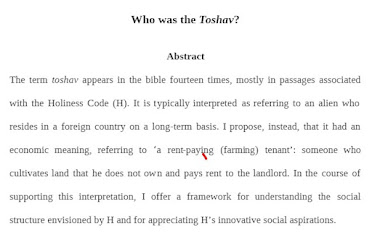
Then there are modern-day Jewish scholars of biblical Hebrew who say that the term "resident alien" is a mistranslation of the Hebrew word "toshav."
So what exactly are the "community standards" that this violates? What are the biblical-interpretation credentials of the FB "fact checker" who yanked the comment (or more likely, what algorithm of FB's scanning software got triggered)?
There is no logic or rationality to how or why of Facebook's cancel culture.
Got to admit that in my military career I never personally knew a private who was sent on a military snipe hunt for turn blinker lubricant. Junior enlisted soldiers - and airmen, sailors and Marines - are sent off on such snipe hunts by slightly more senior and experienced troops. Some of the non-existent items they are sent to retrieve are tent locks, range fans to blow the fog off the rifle range, 50 feet of chow line, left-threaded kanootin valves, a can of radio squelch, bayonet extensions and the like. It's a sort of rite-of-passage thing for noobs. So Pvt. Snuffy is told to see the supply clerk for the item.
The supply sergeant has been around and he immediately understands what's happening, so he says, "I just issued my last propellant regenerator to base piece, try them." So off Snuffy goes to base piece, where he is informed they gave it to the mess section to clean. And the mess section had it just an hour ago, but they sent it to the maintenance section for repair. And around and around and around he goes, never, of course, finding such an item.
Of course, some clever young troops figure out the score pretty quick and realize that they can take a whole day just walking around uselessly while the rest of their section are up to their elbows in grease working on some truck or tracked vehicle.
A perennial-favorite snipe hunt is to send Snuffy off for a box of grid squares. Now, a grid square is a real thing. Military maps are printed with terrain features overlaid with thin lines forming boxes, representing to scale one kilometer squares. The squares are numbered by their easting and northing, so it makes perfect sense to refer to grid square 1436. Even new privates know this, so when some authority figure - a soldier of a rank or two higher - invents a need for a box of grid squares and sends him off to get it, then he does.But the grid squares are printed on the maps; they are not separate items. So there is no such thing as a "box of grid squares."
Usually. But in the artillery . . .
When I was a second lieutenant in Korea, I was an artillery battery fire direction officer when my battery took duty at fire base Four Papa One at the DMZ. One day Pvt. Snuffy, a mechanic, comes to our bunker and says that the Chief of Smoke (an E7, Sgt. 1st Class, whose duty position was Chief of Firing Battery) had sent him to get a box of grid squares.
Now an E7 has no business starting this nonsense. These kinds of practical jokes are played by E4's on E2s, not on E2s by E7s. I looked at the buck sergeant who was the fire direction chief, he looked at me, and we both said almost simultaneously, "Wait right here."
In those days, artillery ballistics computation was not much computerized. We computed firing data manually, using "charts and darts," as we said. We had two large, inclined tables. On one we mounted a large map of the potential targets areas. To keep the map clean we laid over it a sheet of unmarked, transparent plastic that was manufactured gridded in the same scale as the map. We would notate targets and other pertinent data on the plastic overlay and derive terrain information from the map. The other inclined table had no map, just the overlay plastic over white paper. This chart was used only to compute direction data for firing. All the targets were marked on it as well.
The plastic overlays got scuffed and worn from constantly being written on, erased, and written on again. After about three days they had to be replaced. So we had a bountiful supply of used overlays. We'd keep them for several days then burn them all together. And all the overlays were gridded into squares.
So my sergeant and I went to the back of the bunker and retrieved a used overlay. Using scissors, we carefully cut out 12-15 of the grid squares from an unused section. We put them in an empty pencil box, marked it "Grid Squares" with a Magic Marker, and gave it to Snuffy without the slightest hint of irony. He thanked me profusely, since he had been sent from the motor pool to the mess hall to the CP section to the base howitzer to the ammo section and finally to us, all with the stern admonition from the Smoke, "Don't come back here without the grid squares." Now, he had them. He was a happy young man.
I was told by another NCO the next day that Snuffy, innocent as a lamb, went back to Smoke and gave him the box, saying, "Lieutenant Sensing said he can give you all the grid squares you want." And that the look on the Smoke's face when he opened the box to find - sure darn enough, grid squares - was worth taking a burst of six to see.
Yesterday while taking my daily deck break, I paged through what was available on the Fire TV we use out there. I spotted Groundhog Day, a cult classic movie starring Bill Murray and Andie MacDowell, now acclaimed as one of the best films of the 1990s. The movie was about one-fourth done and even though I have it in my collection and have watched it a fair number of times, I clicked it on.
And it struck me powerfully that this movie is about its lead character, Bill Murray as TV weatherman Phil Connors, living in Hell every day and not even knowing it - until he does.
He and his producer, Rita (Andi McDowell) and cameraman Larry (Chris Elliott) are sent to Punxsutawney, Penn., on Feb. 2 to cover the annual appearance of the famous groundhog, Punxsutawney Phil, and its prediction of six more weeks, or not, of winter. Phil Connors (not coincidentally having the same name as the groundhog) considers the assignment beneath him. He is a jerk from beginning to end and deliberately delivers a sarcastic report of "six more weeks of winter."
Leaving town, they are unexpectedly forced to return to Punxsutawney because of a snowstorm. But the next day he awakens to his radio alarm clock playing exactly the same song, "I Got You Babe," with exactly the same dialog by the announcer duo as the day before. When he hears them say it is Groundhog Day, he looks out the window to see there is no snow on the ground.
Henceforth, Phil awakens every morning to discover it is Feb.2, Groundhog Day once again, the very same day it was when he woke up the last morning, and the same Feb.2 it will be the next time. Apparently forever.
For the first several of relived days, Phil decides to hit on women, steal from an armored car to buy a Mercedes, and generally sate his fleshly desires. He even hits on his producer, Rita. But she tells him he is a jerk and rebuffs him.
This where is struck me that Phil is in Hell. An apparent eternity of repeated Feb.2s, all identical, stretch before him. Nothing he does changes that. He comes to realize he can do anything he wants and no matter how criminal or virtuous he is, the alarm will awaken him again to yet another same old Feb. 2.
Driven finally to despair, Phil commits suicide - day after day after day, only to wake up afterward on Feb. 2 all over again. He is living in damnation: sure, certain, and unending.
Or, as Lewis pointed out as well, "Hell is getting your own way - forever."
Finally, with no purpose in living one day repeated eternally, but knowing he will, Phil begins to do good things for other people. And, knowing that Rita never knows what a jerk Phil was to her on the previous repeated Feb. 2, he sets about trying to seduce her by appearing genuinely caring and compassionate.
In that he almost succeeds. He does convince her to come to bed, though both are lying on it still fully clothed, and he tells her to go to sleep, promising, "I won't touch you - much." She does sleep, but when the radio alarm blares at 6 a.m. the next morning, Rita is not there. It is Feb. 2 once again.
Finally, Phil devotes his repeated days to living for others and not for himself. He becomes a beloved figure of the town - at least on that endlessly-repeated day. Moreover, he intentionally sets about becoming literally a different man so that Rita might come to love him as much as he has come to love her.
But how many years of repeated Feb. 2s does it take for him to do that? According to National Post,
The screenwriter’s initial plan was to have Connors trapped in the time loop for several millennia. The original script contains a final confession by Connors to his love interest Rita that “I’ve been waiting for you every day for ten thousand years.”
However, director Harold Ramis years later told The New York Times that Phil spent 33 or 34 years of repeated days, and people who worry about such things have generally accepted that.
Finally he succeeds in romancing Rita. She finally does love him and willingly returns with him to his hotel room. She had been there before, several thousand days ago in Phil's reference, when Phil's manner became so revolting she had slapped him hard and walked right out. But on this trip, Phil makes no advances at all. He yields control of his love to the one whom he loves.
She goes to bed with him, but importantly, they are both fully clothed just as they had been decades before. This time, though, Phil has not merely suppressed his fleshly desires. He has discarded them as he became filled with other-centered love. And so the night passes.
As usual, Phil is awakened by the radio alarm clock blaring the same tune it has blared for 34 years worth of Feb. 2s. But the announcers' dialog afterward is different. Phil opens his eyes and suddenly realizes the radio is not playing the same old thing. And then he sees Rita still lying next to him.
Phil has escaped Hell and entered Heaven. If, as Lewis said, the gates of Hell are locked only on the inside, Phil discovered that the key to the gates are his heart, mind, body and spirit, and how they all are embodied in love.
Can we really believe in Hell?
One thing to realize is that Hell is not a future abode of the damned. Human beings are born damned to begin with. Jesus himself said so in John 3, beginning with verse 16, which we usually recite by itself, thus omitting the basic rhetorical point. Here is the whole quote (italics added):
16 “For God so loved the world that he gave his only Son, so that everyone who believes in him may not perish but may have eternal life.
17 “Indeed, God did not send the Son into the world to condemn the world, but in order that the world might be saved through him. 18 Those who believe in him are not condemned; but those who do not believe are condemned already, because they have not believed in the name of the only Son of God. 19 And this is the judgment, that the light has come into the world, and people loved darkness rather than light because their deeds were evil.
If Groundhog Day can be seen as a metaphor for Hell and Heaven, neither of them is an afterlife. Phil's damnation is not that he dies and goes to Hell. He is in Hell on earth, in this life. His Hell is that even when he dies he is resuscitated to live that same day all over again. Phil's Hell is in this life, but so is the Heaven to which being filled with a pure love of others and of Rita brings him.
The producers, writers, and director of Groundhog Day did not set out to make a Christian analog. In fact, IIRC, director Ramis professed and practiced Buddhism and saw the cycles of repeated days as an analog to reincarnation. One can also see Hindu overtones in such reincarnation - it is Phil's karma for being such a jerk, for which it takes countless repetitions for whim to work his way to Nirvana. For sure, there is no external Savior in the movie as there is in Christianity. Phil does, finally, save himself, which we Christians have always held is literally impossible.
Yet to say there is no precise correspondence between the movie and Christian faith is not to say there is none at all. Most cogently, Phil's damnation does not begin later, it is already in place when the movie begins.
Hence, Pope John Paul II stood on solid Scriptural ground when he wrote that hell “is not a punishment imposed externally by God but a development of premises already set by people in this life. The very dimension of unhappiness which this obscure condition brings can in a certain way be sensed in the light of some of the terrible experiences we have suffered which, as is commonly said, make life ‘hell.’” Hell “is the ultimate consequence of sin itself, which turns against the person who committed it. It is the state of those who definitively reject” God’s mercy.
The Kingdom of Heaven is among us now
If Hell is a real thing in this world - not a place but a state of being - then is Heaven also? Jesus thought so:
Once Jesus was asked by the Pharisees when the kingdom of God was coming, and he answered, “The kingdom of God is not coming with things that can be observed; 21 nor will they say, ‘Look, here it is!’ or ‘There it is!’ For, in fact, the kingdom of God is among you.” Luke 17.20-21
The Greek of the final sentence may also be translated as "... the kingdom of God is within you," which I think is the better phrasing.
But what is the kingdom of God? What is it that is among or within us? Nothing more (but certainly nothing less) than what transformed Phil Connors from living hellishly to heavenly. And what was that?
Once, Jesus was talking with some Pharisees, "... and one of them, a lawyer, asked him a question to test him."
36 “Teacher, which commandment in the law is the greatest?” 37 He said to him, “‘You shall love the Lord your God with all your heart, and with all your soul, and with all your mind.’ 38 This is the greatest and first commandment. 39 And a second is like it: ‘You shall love your neighbor as yourself.’ 40 On these two commandments hang all the law and the prophets.”
Quite simply, the difference between living in Hell and living in Heaven is love. When Groundhog Day opens, Phil is clearly an unlovely man. And he stays that way for countless years of repeated days. Every day an impoverished, homeless man asks him for help, and every day Phil scorns and rejects him. He is a jerk to Rita and to cameraman Larry. He mocks the townspeople and ridicules their way of living.
Yet viewers can discern his scorn and hatred is really self directed. He does not love others because he does not even like himself. As for Rita, the future altar of his servanthood love, he tries for many years to seduce her in bed for his own pleasure. Only when he discerns that there is literally nothing but eternal misery in hating and using others does he start to crawl, slowly and uncertainly, out of Hell toward Kingdom living.
He has learned the hard way that to discover who he is, he must deny himself. He has to face the abyss looming before the Self, or, as David Hart put it,
And so, at the end of modernity, each of us who is true to the times stands facing not God, or the gods, or the Good beyond beings, but an abyss, over which presides the empty, inviolable authority of the individual will, whose impulses and decisions are their own moral index.
Yet to believe in nothing greater than oneself is destructive of mind and spirit and ultimately of body and soul. That is why first the Jews and later Christians emphasized self denial. For denying the Self is to renew Identity, to discover who one actually is.
Not that this is easy, though, nor perfectly achieved even by the most devoted. As Herman Melville's fictional Preacher Mapple put it in Moby Dick,
Then over time and not without difficulty, we may arrive at the fullness of love, when the Self is dethroned and we then come to know and live what we have come to be - someone whose heart is daily renewed in love because in the love of God, we fall into love every day with those whom God loves.
God abides in those who confess that Jesus is the Son of God, and they abide in God. 16 So we have known and believe the love that God has for us.
God is love, and those who abide in love abide in God, and God abides in them. 17 Love has been perfected among us in this: that we may have boldness on the day of judgment, because as he is, so are we in this world. 18 There is no fear in love, but perfect love casts out fear; for fear has to do with punishment, and whoever fears has not reached perfection in love. 19 We love because he first loved us. 20 Those who say, “I love God,” and hate their brothers or sisters, are liars; for those who do not love a brother or sister whom they have seen, cannot love God whom they have not seen. 21 The commandment we have from him is this: those who love God must love their brothers and sisters also. 1 John 4.15-21
Love is the key to the gate out of Hell. It is locked only on our side.
The Greek Philosopher Aristotle taught that the happiness for which human beings strive is not about pleasure, contentment, or satisfaction, but is rather an act. It is specifically the activity of moral and intellectual virtues in human life that is the fulfillment, happiness, and ultimate goal of human life (what Aristotle calls “telos”). This kind of philosophy, then, is not predicated upon something that will result in the future, but in the completion of the act itself, in the moment, for its own sake.
This is the conclusion that Phil finally reaches after all of his mistakes and detours through destructive philosophy. Reaching the understanding illustrated by Aristotle, he begins to cultivate precisely those moral and intellectual virtues. He learns to play the piano and make ice sculptures, he learns a generosity of spirit in helping others, and comes to the humbling realization that there are some things he cannot control when he comes up against the brick wall of the homeless man who dies on Groundhog Day every time, no matter what Phil does.
It is the structure of the plot itself that causes this character development, and the audience can see at the end that the story was leading to this point from the beginning: when every day is the same, it finally forces Phil to realize that the ultimate meaning in his life is never to be found over the hill in some distant future, but rather in the dedicated activity of building the habit of virtue, in the present moment, every single day. It takes him years of the same day to come to this realization, but it turns out that the time loop was ultimately a blessing, as it is only when he learns the true meaning of life and happiness that he wakes up on February 3rd, finally knowing how to live.
There’s nothing better for a lesson in moral virtue than falling into a cosmic temporal wormhole in a small Pennsylvania town.
As the dust settled twenty years ago and rescuers began clearing the wreckage in New York, they came upon a startling scene. Amid the ruins, rescuers came upon a perfectly formed Roman cross, made of the iron of I-beams of World Trade Center building six when it collapsed.
Word quickly spread. Within a day, work teams entering the wreckage started going to the cross first, praying before it or leaving notes on it.
On October 3 it was moved to a pedestal on the WTC plaza on Church Street. In October 2006 the cross was moved the St. Peter's church, which faces WTC plaza, bearing a plaque which read, "The Cross at Ground Zero ‑ Found September 13, 2001; Blessed October 4, 2001; Temporarily Relocated October 15, 2006. Will return to WTC Museum, a sign of comfort for all."
On July 23, 2011, the cross was blessed by Rev. Brian Jordan during a short ceremony and then was taken by a flatbed truck back to the scene of the attacks, where it was emplaced in the National September 11th Memorial and Museum.
“There has never been any unitary organisation of Western culture apart from that of the Christian Church,” explained the medieval historian Christopher Dawson in Religion and the Rise of Western Culture, written shortly after World War Two. “Behind the ever-changing pattern of Western culture there was a living faith which gave Europe a certain sense of spiritual community, in spite of all the conflicts and divisions and social schisms that marked its history.”
The West, in short, was Christendom. But Christendom died. If you live in the West now, you are living among its ruins. Many of them are still beautiful — intact cathedrals, Bach concertos — but they are ruins nonetheless. And when an old culture built around a sacred order dies, there will be lasting upheaval at every level of society, from the level of politics to the level of the soul. The shape of everything — family, work, moral attitudes, the very existence of morals at all, notions of good and evil, sexual mores, perspectives on everything from money to rest to work to nature to the body to kin to duty — all of it will be up for grabs. Welcome to 2021.
Nothing but a new Great Awakening can save America. Sadly, we have had an awakening of sorts, but in the form of an immanentized apocalypse—climate change—and the substitution of Woke cultishness for the old awareness of sin and redemption. Mr. Johnston has done a great service with his comprehensive survey of our follies and their consequences. His indictment of America’s national decline and its causes in economics, culture, and politics is incisive and convincing, and his overreach in history and philosophy is a minor distraction in the construction of his case. His belief that America has the wherewithal to restore itself shines through, especially in his concluding chapters. During the 1930s we sank into Depression and isolationism, but emerged as the most powerful nation on earth and the leader of the Free World in the 1940s. We languished in what Jimmy Carter called a national malaise during the 1970s but came roaring back with the Reagan Revolution. We have yet to see which spirit will move us.
Leader: Gracious God, in humility we ask your blessings as we remember a day of great violence twenty years ago.
People: You are the everlasting God, whose love extends to all generations. Blessed be the name of the Lord!
We remember with sadness the thousands who died on September 11, 2001, men and women of wealth, blue-collar workers, military members, government employees, airline passengers and crew - all the people who perished in flames and pain.
We are thankful for the bravery of police officers, firefighters and others who selflessly went into danger to rescue the stricken, and lost their lives or suffered injury in their service.
Continue, O Lord, to give comfort to the families of those who died, grace to those who still struggle with anguished memories or the effects of injuries.
May your Spirit rest upon each one who endured that day, and let the assurance of your presence be strong with them always.
We pray for the people of our land and lands far away, who have suffered or died in the wars of the last twenty years.
We pray for our military and their families, who have lost their lives, endured separation and hardship and for many of whom the war will never truly end.
We pray for our enemies as you commanded us to do. May the grace of the Lord Jesus Christ fall upon everyone who wishes us harm. May we never take your favor for granted, but strive always to abide humbly in your service.
Help us Lord, to love our enemies and do good to them.
Guide us, O Holy One, to be a nation of holy people. We confess we are not at peace among ourselves or with many peoples across the globe. Lead us of your Churches to move on to Christian perfection in this life.
We renew our commitment to live as faithful disciples of your Son, our Savior Jesus Christ, and we renew our obligation to you to lead others to do so also.
We repent of our sins and pledge to devote ourselves to your Kingdom above all.
Let there be peace on the earth, O Lord, and let it begin within us and by us starting this day.
Hear us now as we pray together the prayer that our Savior taught us:
What Ms. Cash is saying is that she thinks that the amount of work she does must determine the wage she is paid. But not even Karl Marx thought that! In Capital: A Critique of Political Economy - The Process of Capitalist Production, Marx gave this explanation:
Karl Marx
Some people might think that if the value of a commodity is determined by the quantity of labour spent on it, the more idle and unskilful the labourer, the more valuable would his commodity be, because more time would be required in its production. The labour, however, that forms the substance of value, is homogeneous human labour, expenditure of one uniform labour power. The total labour power of society, which is embodied in the sum total of the values of all commodities produced by that society, counts here as one homogeneous mass of human labour power, composed though it be of innumerable individual units. ...
... The labour time socially necessary is that required to produce an article under the normal conditions of production, and with the average degree of skill and intensity prevalent at the time.
[Following is the key point:]
The introduction of power-looms into England probably reduced by one-half the labour required to weave a given quantity of yarn into cloth. The hand-loom weavers, as a matter of fact, continued to require the same time as before; but for all that, the product of one hour of their labour represented after the change only half an hour's social labour, and consequently fell to one-half its former value.
What Marx was saying is that as efficiencies of production increase per unit of time, the value of the labor of the "old" production correspondingly decreases. When powered looms in England doubled the rate of production, the labor value of the prior manual production decreased by half.
What Ms. Cash and her allies need to understand is what needs to be be said over and over: the actual, real-world minimum wage is $0.00.
When she gets a raise to $15 per hour she will not increase her production of product. When McDonalds figures out that her work can be automated - as has already happened with electronic ordering kiosks replacing human order takers - the wage value of her work will go down, not up. And she should not be surprised when her wage then drops to zero because her old job is being done by a smart machine for an amortized "wage" of less than $15 per hour.
A free nation may be understood as one that is not under occupation or domination of another nation. In that sense the old Soviet Union was a free nation. But it was not was a nation of liberty.
Freedom is a political condition. Liberty or its lack is a way of life condition, the ability of a people to live their lives as they wish, with minimum assistance or interference from the state. America's Founders sought to bring forth both a country free of British occupation and a people living in liberty. As Lincoln later put it, America is "a nation conceived in Liberty." Liberty is enjoyed by persons, not by governments. A government may be free, but only persons can be in liberty.
The Declaration of Independence says that one of the unalienable rights of human beings is the right to the pursuit of happiness. No right to achieve it, only the right to pursue it. However the Founders conceived of happiness, they definitely understood that happiness is personal and that the nature of its pursuit was something for each man or woman to decide how best to achieve. That is what liberty means. Our Founders knew that public liberty required private virtue and that liberty did not mean there should be no restraints, but that’s a topic for another day.
My thesis is that the entire idea of individual liberty was invented by Jesus of Nazareth. Literally no one in the world, Jew or Gentile, had conceived of individual, personal liberty before Jesus.
In Jesus’ day the Jews were neither free nor at liberty. Judea, the rump remainder of the ancient, independent Jewish kingdoms, was under direct Roman occupation. The Romans, however, had little interest in how the Judeans lived day to day. As long as the Jews paid Rome’s taxes and accepted Roman dominion peaceably, the Romans were satisfied. The Romans did not even govern Judea directly but through native authorities.
Because of Rome, the Jews were not free. But their lack of liberty was their own doing. Everyone in the ancient Near East, Jews and Gentiles, was tribal. Like today’s Arab Muslims, the Jews identified themselves first by their religion, then their family, clan and tribe, almost always in that order. These groupings defined the norms of behavior and determined almost everything about how its members lived.
Westerners find it hard to understand the role honor and shame play in Middle Eastern cultures. In 2004, US Marine Maj. Gen. James Mattis, then commanding a Marine division, commissioned a paper for his troops to study called, “Marines are from Mars, Iraqis are from Venus.” Here is how the paper described an Iraqi explaining their sense of honor:
Our sense of honor pervades everything we do. This isn’t the Western definition of honor, it’s more like Hispanic honor of machismo. Perception of manhood is vital and in fact it can be a matter of life and death. A man without honor gets no wife, often no work, and in Iraq he may be shunned or even killed by the own family depending on how grave the offense is. Defending honor is part of our cultural heritage. It is the focal point of everything we do and is jealously guarded. Honor means influence and power, our foremost concern. Less power means fewer contracts, less money, less food, angrier families. We must regain lost honor any way we can, even if it means violently attacking the ones who dishonored us.
Here is a real-world example. In 1982, I was a U.S. Army captain attending the Field Artillery Officer Advanced Course at Ft. Sill, Okla. There were a large number of foreign officers attending. The Arab contingent was pretty large, and most of them were Saudis. But in my section there were two Egyptian lieutenant colonels and one major.
The two light colonels and I became good friends. Their names were Solomon and Osman. They were great guys and real party animals, as Muslim men often are when they reach the decadent, non-Islamic West.
Anyway, one day the entire class of 350 or so was taking a tactics exam in an auditorium-type room. We all sat at long, folding tables and opened the exams when told to start. Needless to say, all the U.S. officers had long ago internalized the credo, "An officer does not lie, cheat, steal nor tolerate those who do." Cheating on this or any other assigned work would end a career!
The first section of the test was multiple choice. To my right rear sat all the Saudi officers in a row. Very soon, we all heard a slue of Arabic, followed by a clear enunciation of the letter, "B." A moment later, more Arabic, then "D." Repeat, ending with "A." And so on.
Throughout the test, the Saudis made no attempt to disguise their verbal collaboration. I was irritated and I was not the only one. But we knew nothing would be done about their cheating for political reasons, and besides, foreign officers' scores did not affect our class standing.
A couple of days later I asked Lt. Col. Solomon why the Saudis were so blatant in their cheating. He broke into laughter and replied, "They were not cheating. The Saudi lieutenant colonel fills the role of the sheikh while they are here. The major next to him was reading his answers to all the rest so they could make sure they did not score higher than him on the test. If they did, it would bring great shame to him and would be dishonorable for the junior officer. Very bad problem, that."
So to be a first-century Jew or Gentile was to live like that. To be a member of, say, the tribe of Benjamin was to be told what your occupation would be, when you could work and when you could not, whom you would marry, where you would live, what you may do and when, how to treat your parents and relatives, how to raise your children, what you must teach them, how you must worship and when and where, how you must dress, what you may eat and when you may eat it, and countless other things.
The very concept of individual liberty was non-existent. If you could go back in time and tell an ordinary Judean that the God-given rights of men and women were the right to life, liberty and the pursuit of happiness, no one would have understood you any more than if you had tried to explain suborbital mechanics or antibiotics.
This was social system into which Jesus was born. And he set about it with a wrecking ball. Consider this passage, Luke 14:1, 7-24:
14 On one occasion when Jesus was going to the house of a leader of the Pharisees to eat a meal on the Sabbath ... . 7 When he noticed how the guests chose the places of honor, he told them a parable. 8"When you are invited by someone to a wedding banquet, do not sit down at the place of honor, in case someone more distinguished than you has been invited by your host; 9 and the host who invited both of you may come and say to you, 'Give this person your place,' and then in disgrace you would start to take the lowest place. 10 But when you are invited, go and sit down at the lowest place, so that when your host comes, he may say to you, 'Friend, move up higher'; then you will be honored in the presence of all who sit at the table with you. 11 For all who exalt themselves will be humbled, and those who humble themselves will be exalted."
Jesus's discourse on jockeying for position illuminates the kind of cultural values that Jesus grew up in 2,000 years ago, and which is still found across most of the Middle East today (and, in his renunciation of those values, helps explain why he made such powerful enemies). Cultures of honor and shame are literally foreign to Western minds. Matters of honor and shame have certainly been powerful in Western history, but such concerns have always been tempered and tamped by Jesus's teachings that "all who exalt themselves will be humbled."
But Jesus refuted those concepts and by so doing he invented individual liberty along three lines of teaching:
1. Jesus denounced the social system of honor and shame that dominated how people lived and related with each other.
2. Jesus directly refuted the idea that blood relationships could determine how an individual lived his life.
3. Jesus insisted that the heart of true religion was not obligations imposed upon a person externally, but was an ethic of love from within.
In an honor-shame system, one’s social standing is determined by how well one conforms to the norms of the group. (Anyone remember their teen-age years?) These are not systems found among today's Jews, whether in Israel or elsewhere. Jesus wasn't denouncing Judaism (duh) but a wider-ranged social order that inhibited righteousness.
Honor-shame systems work differently for men than for women. For men, the focus is on where you stand in the pecking order. To be in debt to someone else, either financially or in obligation, is shameful. To have others obligated to you is honorable. To accomplish is honorable, but if you take too many steps up the ladder at one time, that is shameful.
How the family and clan are shamed or honored by its members is especially important. Hence the sixth Commandment, “Honor your father and your mother.” To bring shame upon one’s elders was literally to risk death. In Matthew 17, Jesus recounts this accusation against him: “The Son of Man came eating and drinking, and they say, ‘Here is a glutton and a drunkard, a friend of tax collectors and sinners.’” Jesus knew what Deuteronomy 21 says,
If someone has a stubborn and rebellious son who does not obey his father and mother and will not listen to them when they discipline him, ... 20 They shall say to the elders, “This son of ours … is a glutton and a drunkard.” 21 Then all the men of his town are to stone him to death.
People accusing Jesus of drunkenness and gluttony were not being merely contemptuous. They were issuing a death threat. Jesus knew it, but he was undeterred. In Luke 9, Jesus told a man, “Follow me.”
But he said, “Lord, permit me first to go and bury my father.” But he said to him, “Allow the dead to bury their own dead; but as for you, go and proclaim everywhere the kingdom of God.”
Here Jesus openly committed mutiny against the entire way that Jewish society was organized and understood in that day. This man says he will follow Jesus after his father dies. If his father had already died, he would have been buried within 24 hours and the man would have already been able to follow Jesus. He is not at liberty to do so now because of externally-imposed constraints.
Jesus responds that the man was trapped in the way of death. Leave the way of death behind now, Jesus says, and proclaim the kingdom of God.
Another [man] also said, “I will follow you, Lord; but first permit me to say good-bye to those at home.” But Jesus said to him, “No one, after putting his hand to the plow and looking back, is fit for the kingdom of God.”
Jesus tells this fellow not even say goodbye to his family. In other words, do not linger in the way things are now, not even to bid it farewell. You can’t plow a furrow backward so don’t even look that way.
That both these conversations took place in the context of family relationships highlights the serious sedition Jesus was mounting against the entire social order of his time. In that day and place, family relationships were absolutely everything. That Jesus was willing to take a chainsaw to the very fundamental way his entire society was organized illuminates how serious he was about a new way of living. At the end of Matthew 12,
While Jesus was still talking to the crowd, his mother and brothers stood outside, wanting to speak to him. Someone told him, “Your mother and brothers are standing outside, wanting to speak to you.” He replied to him, “Who is my mother, and who are my brothers?” Pointing to his disciples, he said, “Here are my mother and my brothers. For whoever does the will of my Father in heaven is my brother and sister and mother.”
Jesus entirely redefined a fundamental fact about not only the basis of the honor-shame system but the whole society itself: the preeminence of blood relationships. True family would no longer be defined by accident of birth. Who one’s father was of no importance any more – this in network of societies, both Jewish and Gentile, where the words, “Name, son of father’s name” or "name of the house of name" was a common way of referring to oneself.
Henceforth, people were to be members of a family of equals in which there was only one Father, God himself.
Men could gain honor or lose it. Women, however, had nowhere to go but down. A woman’s honor was determined by her sexual status, namely:
Was she married? To be a spinster was dishonorable. To be a widow was more unfortunate than dishonorable, though dishonor was attached to it some.
If married or widowed, did she have children? Being childless was dishonorable.
Was she chaste before marriage and virtuous after marriage? Sexual purity and fidelity practically defined honor for women, though, as Proverbs 31 explains, to be married with children and to be industrious with a good business sense was the most honorable status of all for a woman.
Jesus kicked this norm down, too. He denounced sexual sin but he denounced also the idea that a woman’s worth was irrevocably damaged by it. So Jesus openly talked with a Samaritan woman of loose morals at a well one day, explaining that he knew all about her highly-checkered past, but that it didn't matter because her future under God’s grace was more important than her past under sin’s grip.
Luke 7 relates when Jesus went to dinner at the home of Simon the Pharisee. A sinful woman of the city, name and occupation unknown, came to Jesus with a jar of ointment. She stood behind him at his feet, weeping, and began to bathe his feet with her tears and to dry them with her hair. Simon objected that if Jesus really was a prophet, he would have know what kind of sinful woman she was. Jesus rebuked him and told the woman, “Your sins are forgiven ... go in peace.” This unnamed woman’s status of sinful dishonor was only important to Jesus insofar as it impelled her to come to him for forgiveness and a reset.
Jesus simply rejected the rigid behavioral norms of his day in favor of what the apostle Paul later called “a more excellent way.” Jesus redefined the most basic relationships of his day so that circumstances of birth and relationship could not set one’s worth. Each individual was liberated to control his or her own destiny by relating primarily to God, and through God to everyone else.
Which is to say: there is no greater honor than to be adopted by God and be the brother or sister of Christ. It was not being born that mattered in living, it was being born anew. Spiritual rebirth supersedes all other arrangements. Hence, in Christ,
There is neither Jew nor Gentile, neither slave nor free, nor is there male and female, for you are all one in Christ Jesus (Gal. 3.28).
These were not merely new teachings, they were positively revolutionary. No one was bound any longer by conferred status; all were liberated by divine endorsement of their inherent worth as beloved of God. Life in Christ brings personal liberation from every kind of spiritual bondage, including but not limited to politics, self-indulgence, selfishness, self-righteousness, entertainment and even religion itself.
Christ has set us free for freedom’s own sake. It is not through religion that we are freed; it is through the life, death and resurrection of Jesus. We obey the moral commandments of Jewish tradition and the teachings of Jesus, both in order to gain freedom and because we have already been freed.
"It is for freedom that Christ has set us free" (Gal. 5.1): free to love, free to live in joy and peace. Free to be generous in all we have, free to know our worth is God given, not human determined, free to live in ways that please God. We are free to love God and neighbor in the fullest way possible.
There is a tempest in a teapot among many of my ministerial colleagues about what the American bishops of the Roman Catholic Church have just done regarding President Biden and other Catholic elected officials. National Public Radio reports:
After a contentious debate, the U.S. Conference of Catholic Bishops has voted to move forward with a process that could call into question the eligibility of politicians like President Joe Biden to receive Communion.
The bishops voted 168-55 in favor of drafting "a formal statement on the meaning of the Eucharist in the life of the Church," officials announced on Friday afternoon, the final day of their three-day virtual meeting. Six bishops abstained.
Biden's election as only the nation's second Roman Catholic president has prompted renewed debate over denying Communion to Catholic politicians who support abortion rights, a position at odds with church teachings.
During their online meeting, bishops held a spirited discussion Thursday before voting on the proposal to direct the bishops' Committee on Doctrine to draft the statement. Such a document, once completed, could include guidelines for denying Communion to public officials.
I say that the reax by my colleagues is a tempest in a teapot not because the issue is not serious but that across the vast spectrum of Americans the bishops' decision has been met with a gigantic yawn, including by the vast majority of non-Catholic clergy.
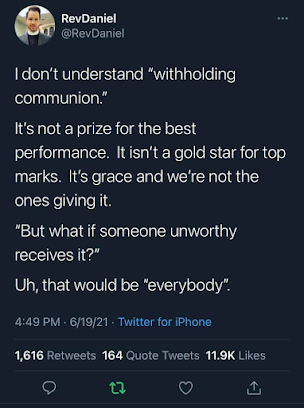
However, many are not happy about it at all. Here is a typical response:
In this post, I am arguing neither for nor against denial of Communion as a practice in the RCC. I am making no judgment whether denying it to President Biden, et. al., should be done or not. My two main points are:
The RCC's theology of this matter has no real cognate in Protestant churches, so arguing against denial from a Protestant basis is like stepping into a boxing ring by yourself, shadow boxing against an opponent who is not there, then claiming victory in a fight you never actually fought.
It is pretty obvious that tweets like this are not really directed at the RCC bishops, for this is not an attempt to persuade the bishops to reverse. This and other, similar tweets and posts are directed toward the posters own in-group to signal that they are defending not a superior theology of Communion, but political figures whose abortion advocacy must be protected. These are not religious or theological tweets or posts, they are political declarations hiding behind religious language.
That said, I do not personally take issue with RevDaniel's implied theology of Communion here. The problem is that he is using a very Protestant argument against Catholic bishops, who if they ever read this will know immediately that RevDaniel knows almost nothing about the Catholic theology of the Eucharist (Communion).
First, RCCs very emphatically believe that no one is worthy of receiving the Eucharist; their catechism says so very precisely. Communicants, those who receive the sacrament, are not worthy of the sacrament but are made eligible by obeying the commandments of Scripture regarding the sacrament. The formal Catholic teaching, or catechism, of the Eucharist includes:
1384 The Lord addresses an invitation to us, urging us to receive him in the sacrament of the Eucharist: "Truly, I say to you, unless you eat the flesh of the Son of man and drink his blood, you have no life in you."
1385 To respond to this invitation we must prepare ourselves for so great and so holy a moment. St. Paul urges us to examine our conscience: "Whoever, therefore, eats the bread or drinks the cup of the Lord in an unworthy manner will be guilty of profaning the body and blood of the Lord. Let a man examine himself, and so eat of the bread and drink of the cup. For any one who eats and drinks without discerning the body eats and drinks judgment upon himself."218 Anyone conscious of a grave sin must receive the sacrament of Reconciliation before coming to communion.
1386 Before so great a sacrament, the faithful can only echo humbly and with ardent faith the words of the Centurion: "Domine, non sum dignus ut intres sub tectum meum, sed tantum dic verbo, et sanabitur anima mea" ("Lord, I am not worthy that you should enter under my roof, but only say the word and my soul will be healed.").
The key sentence for this post is, "Anyone conscious of a grave sin must receive the sacrament of Reconciliation before coming to communion." What the bishops are insisting is that abortion on demand is a grave sin, and its political advocates and enablers would be partaking of the Eucharist in an unworthy manner unless they complete the steps of Reconciliation. Those steps are Confession, receiving Absolution from a priest, and doing the Penance assigned.
We Protestants need to understand that the sacraments of the RCC are a system and are closely interrelated. This is not much true in my denomination, the United Methodist Church. Our two sacraments of baptism and Communion are related, but not much interrelated.
Besides, even we UMC ministers formally (though not in practice) "fence" the Communion table in the first paragraph of the litany by saying,
Christ our Lord invites to his table all who love him, who earnestly repent of their sin and seek to live in peace with one another.
And then we require confession! (Though the confession is a scripted prayer said by the whole congregation, not privately to a pastor.) But read that sentence carefully: We formally (again, not in practice) invite to Communion only those who love God, who repent of sin (which is what the RCC bishops are demanding in the present controversy, only they really mean it) and who want to live peacefully with one another.
Barring persons from the Communion table has never been part of the UMC's theology, doctrine, or practice, so our verbal fence around the table is mostly symbolic and also a call for each person to examine themselves. However, before we get our Protestant backs up, we should consider that formally, we are not much different from the RCC in qualifying who may receive the sacrament. It's just that the RCC is far more likely to mean it.
These are not religious or theological tweets or posts, they are political declarations hiding behind religious language.
Update: An email from a practicing Catholic, Joseph S., points out that the denial of Communion (to one who has sinned and is unrepentant) is intended to protect that person from compounding his or her sin by receiving the sacrament in an unrepentant state. So, yes, denial of Communion is aimed at correction but also at protection. In this way denial of Communion is an act of pastoral care and Christian love.
Update: Have done some more reading on this general topic, not about the Biden-Communion controversy. There have been for a long time, decades if not centuries, debates within Catholicism about the Eucharist being served to persons still in grave sin, such as divorced Catholics whose marriage was never annulled by the Church and who have since remarried. Catholic doctrine (and some Protestant denominations) consider that to be adultery, which is a state of grave sin. These have been serious debates of varying intensity over the years/decades, and were not tied to politics. A strict interpretation has held that Catholics still in grave sin (politically tinged or not!) should not receive the Eucharist. Some also say that such persons should not be allowed to serve in public ministry such as being a lector, who are lay persons reading Scripture of litanies during worship. So, even within the RCC, eligibility to receive the Eucharist has long been a very complicated issue on matters other than abortion for at least several decades. However, this present controversy could have far-reaching outcomes on Communion and matters other than abortion. As lawyers say, the bishops' lopsided vote on the abortion-Biden matter could set a precedent for other issues unrelated to abortion but still related to the sacrament. We should all pray for the Holy Spirit to be heard and heeded!
Also, the whole concept of denying Communion to a church member is widely misunderstood among non-Catholics to be a form of priestly punishment upon a sinful church member. That is not so. In fact, the emphasis of denial is that the person concerned should be encouraged and assisted to repent and reconcile by their own volition to enable them to approach the altar to receive the body and blood of Christ. Grudging repentance is not repentance at all. It is submission to power, not an acceptance of divine love and its return to God by the communicant. But the Church's goal is to help bring its members to, or back to, a state of loving God and neighbor with all their heart, soul, strength, and mind, and to receive Eucharist in that state, not in mere submission to priestly authority.
The responsibility is on the communicant, God and the Church being his/her helper. I am far from certain that the publicity of the recent vote regarding the president and other Catholic politicians is very helpful, and I have to imagine that among Catholic clerics there is no little discussion of that.
I took this photo in 2008 at the Vietnam War Memorial, near the Lincoln Memorial.
There is one Sensing whose name is engraved on the wall, Capt. John L. Sensing, US Army. I never knew him, but we are some ordinal of cousin, since all Sensings (in the South, anyway) descend from one Jakob Sensing, who immigrated to North Carolina from Germany in the 1730s. One of his sons, a Revolutionary War veteran, took his veteran's land grant in Tennessee. So here we are.
Capt. Sensing was a helicopter pilot, flying an OH-6 Cayuse aircraft (right) in the Thua Thien Province when his bird was hit by an RPG near Firebase Ripchord, April 30, 1970. He was serving in B Troop, 2/17 Air Cavalry.
Also killed on the helicopter were SP5 Robert E. Masseth and SP4 David W. Staton.
In 2019, Capt. Sensing's cousin, Dave Davidson, posted a moving tribute to him on Facebook and included this photo of John:
God rest you all, John!
In 2010, Debbie Masseth sent this:
My son sent me this article [from where it was originally posted] and it gave me chills. Robert E. Masseth was my brother-in-law and my son is his name sake. My husband, David Masseth passed away with cancer this summer. We did not get a lot of information about his brother other then he was killed in a helicopter crash on April 30, 1970.
In just the last two or three years, the US government, mainly the Defense Dept., has released videos of what used to be called UFOs, now called UAPs, Unidentified Aerial Phenomena. These include tracking and targeting video taken by US Navy jet fighters trying to intercept UAPs.
The most recent video release was in the past week. It is video taken from the bridge of USS Omaha of a UAP that shows apparent "transmedium" capability, meaning it travels through air or water with equal ease and speed - an ability massively beyond the capability of any technology we know of. Here is the video. As some commentators have noted, the bridge crew's voices also recorded betray no shock or astonishment, but more like "this again."
An explosive report featured on CBS News’s “60 Minutes” featured several former U.S. military officials who talked about what the U.S. government knows about unidentified aerial phenomena — UAP —more commonly referred to as UFOs.
The segment comes ahead of a report that the military is supposed to deliver an unclassified report to Congress by next month. Former Director of National Intelligence John Ratcliffe said in a recent interview that the findings will shock people because “frankly, there are a lot more sightings than have been made public.”
Read the linked article, but here two 60 Minutes reports on the topic (both dated May 16, 2021). The first segment is about six minutes long, the second about 13 minutes:
I wrote in 2013 of former Canadian defense minister Paul Hellyer, who served in that role (equivalent to the US secretary of defense) in the 1960s. He stated unambiguously that UFOs are non-terrestrial craft, directed by extra-terrestrial, highly intelligent beings. That makes Mr. Hellyer the most senior person I have ever heard of who claimed this.
But that might change with the release of the Pentagon report next month.
Finally, here is a mere 92 seconds of President Obama on a late-night talk show saying he cannot talk about the subject.
Was he jesting, or answering seriously, hoping it would be taken as jest? You decide.
6 So when they had come together, they
asked him, "Lord, is this the time when you will restore the kingdom to
Israel?"
7 He replied, "It is not for
you to know the times or periods that the Father has set by his own authority.
8 But you will receive power when the Holy Spirit has come upon you; and you
will be my witnesses in Jerusalem, in all Judea and Samaria, and to the ends of
the earth."
9 When he had said this, as they
were watching, he was lifted up, and a cloud took him out of their sight. 10
While he was going and they were gazing up toward heaven, suddenly two men in
white robes stood by them. 11 They said, "Men of Galilee,
why do you stand looking up toward heaven? This Jesus, who has been taken up
from you into heaven, will come in the same way as you saw him go into
heaven."
You have probably heard the expression, "an elephant in the living room." The source of this saying apparently was a substance-abuse counselor, who said that families in which there is a drug user are living with an elephant in the living room: It moves around, takes up an enormous amount of space, makes loud noises, bumps into them, knocks things over, smells bad - yet the family members are usually in denial and pretend it isn't there.
The story of Jesus' ascension is sort of an elephant in the living room of North American Christianity. Clergy of mainline churches like the UMC know what dominates this story but we usually pretend it isn't there. In previous years on Ascension Sunday, I ignored the elephant, too, but today I'm coming clean. What dominates this story is Jesus' bodily ascension into Heaven.
A miracle, in
other words. That's the elephant.
The 21st-century
Western mind pretends the miracle isn't there. We search for the moral of the
story or its implied meaning and ignore the miracle. Lay people are taught, by
implication, to do that in our secular school systems and colleges. Clergy are
taught to do that in mainline seminaries and divinity schools. Almost every mention of
biblical miracles in my classes at Vanderbilt Divinity School was to show how
the event itself wasn't really important and wasn't the real point of the
story, anyway. Don't dwell on the miracle - with the unspoken implication being
that the miracle didn't really happen or that the event was really an
ordinary event that occurred in unordinary circumstances and was mistaken for a
miracle. Besides, the people who wrote the Bible were educated for their day,
but not for ours, and did not enjoy the benefit of the scientific method as a
way of understanding reality.
But we have to
face the elephant in the living room of 21st-century, North American
Christian faith, the fact that the entire Christian religion inescapably rests
on miracles. And whatever other points the Ascension stories may have for us in
our day, the central part of the story is that Jesus ascended bodily into
Heaven.
In defense of
modern scholarship, though, I readily agree that in miracle stories, including
those of Jesus' healing, the miracle is not the only point of the
stories, and sometimes not even the main point. For example, Jesus healed the
servant of a Roman centurion whose faith in Jesus was so profound that Jesus
exclaimed, "I have not found anyone in Israel with such great faith"
(Matt 8:10). That's the real kicker of the story, not the healing, which takes
place entirely offstage.
But there are
three miraculous events of Jesus' life in which the miracle is so central to
defining who Jesus was - and who he is today - that explaining them away cuts the heart from our faith.
The first is
Jesus' miraculous Incarnation as the unique Son of God. I do not refer to the
virgin birth. I mean that, as Paul wrote, "In Christ all the fullness of
the Deity lives in bodily form," (Col 2:9), which cannot be said about any
other person past or present. That Jesus was fully God and fully human is an
essential miracle of his very existence that cannot be intellectualized away
without surrendering the essence of who Christ is, what he means and what he
does.
Second is that
Jesus was dead, buried, and on the third day rose from the dead. The
resurrection is the hinge of Christianity, about which everything
else rotates. Everything about our faith depends on it. Once its affirmation is
abandoned, Christian faith becomes pointless, another fact that Paul
recognized. He wrote the Corinthians that if there is no resurrection, 'Let us eat and drink, for tomorrow we die' (1 Cor. 15.32).
The third miracle
is the Ascension.
The Reverend
Robert Hansel described most classical art of the Ascension. "We see Jesus
dressed in gauzy, flowing robes and he appears to be floating weightlessly on a
couple of insubstantial‑looking white clouds. The clouds are being lifted up by
some smiling, chubby cherubs. It seems like some kind of pre‑technology
elevator or a circus levitation act. Even though we understand that what we're
seeing is artistic and poetic, we just have to smile at the apparent silliness
of the whole thing. Jesus lifting off like a rocket? Peter Pan with pixie dust?
Come on! Isn't this whole idea of Ascension dated and embarrassing ‑ something
we'd be better off simply leaving out of contemporary Christian theology?"
The modern mind
replies, "Yes."
Yes, we all know
that people do not fly unassisted through the air and that precious few of us
have seen angels, although we can all imagine circumstances when that would be
greatly improved if one showed up now and then. And we know that wherever
Heaven is, it isn't directly over our heads, as hundreds of spaceships have
proven.
And having
affirmed all that, we are left with the cold, hard fact that Jesus isn't here
any more, and neither is his body.
The suffering,
death, resurrection, appearances and ascension of Jesus Christ form a single
narrative. In religious terms, they use poetic imagery and mythical literary
language to describe the central events of the most important person in all
history. Religious language is used best for religious experience. But there is
also a very practical matter addressed, an important one for a faith that
claims to be grounded in real events of actual history, as ours does. That is,
What happened to Jesus' body?
Matthew records
that this question was of foremost concern to Jesus' opponents after he was
buried and the tomb turned up empty. Disbelieving that Jesus was raised from
the dead, the question of what happened to Jesus' body was both obvious and
urgent.
The story of
Christ's ascension leaves us with much the same question, too. Namely, if Jesus
didn't ascend into heaven, where is his grave? For he is no longer walking
around, continuing his ministry. A crucial historical fact of Christianity is
that Jesus' body is missing. Peter preached to the people of Jerusalem on the
day of Pentecost, "Jesus God raised up, and of that all of us are
witnesses. ... I may say to you confidently of our ancestor David that he both
died and was buried, and his tomb is with us to this day."Jesus' tomb is still here, too, but unlike
David's tomb, there's no body there. So for people who dismiss the Ascension
story from a scientific-technical point of view as I once did, I have to ask:
If
Jesus was not raised from the dead and seen by the Mary and the other women and
the disciples, why did they disciples devote the rest of the lives to preaching
that Christ is risen, even to the point of suffering brutal death for their
witness, save one apostle, John, who died imprisoned? And why did anyone
believe them and endure similar fates by the thousands?
Accepting
for the sake of argument that Christ was raised from the tomb but denying that
Christ ascended into heaven, then what happened to his body? In a religion with
two thousand years of raising innumerable monuments to even the most obscure
saint or martyr, where is the church or reliquary or plain granite obelisk
claiming to stand on Jesus' final resting place?
If Jesus is not
here, and he is not ascended, what happened to him? And more importantly, what
will happen to us?
For Christ's
resurrection to be decisive, it had to be permanent. After all,
Lazarus was also raised by God's power, through Jesus. Note that we call
ourselves "Christians," not "Lazarites." Lazarus'
resuscitation was a temporary reprieve from the grave and therefore of no value
to our salvation.
The Ascension of
Christ is a critical element of Jesus's story, and therefore of our salvation.
But we are a scientifically minded, technically trained people, and unlike the
uneducated, superstitious masses of earlier centuries, we know better than to
believe in fairy tales like the Ascension story. At least, that's how I used to
think, including for quite a while after I became committed to Christ. But I
think now that we cannot gut the story of Jesus of its miraculous content,
leaving holes in the narrative, and expect something sensible to remain. If
Jesus didn't heal the sick in inexplicable ways, then what did he do? Just
preach? There have been countless thousands of extraordinary preachers since
Jesus' day. Quick, name two, not including Billy Graham ... or Donald Sensing.
So preaching itself gets no monuments dedicated to you.
Thomas Jefferson
was a man of the Enlightenment and the age of Rationalism, a deist rather than
a traditional Christian. He took scissors to the New Testament, cutting out the
verses that mentioned miracles. What was left was perhaps morally inspiring,
but not exceptional. As you may recall me saying before, any religion founded
only on Jesus' teachings would be simply an admirable form of orthodox Judaism.
That's no bad thing, but that is not what brings us here each Sunday. The
disciples knew this, even said so explicitly. Paul wrote the Corinthians that
if Christ is not raised than we are still in our sins and have no hope.
Reverend Hansel again:
Whatever we may think of the poetic
imagery, the Ascension tells us finally and completely who Jesus really is. The
picture of Jesus returning to God the Father enables us to let go of previous
and incomplete pictures of Jesus. Certainly Jesus is the baby in the manger at
Bethlehem, but that's not who he is now. Yes, he is the great teacher of the
Sermon on the Mount, but we know much more than just a record of his words. We
know that he hung and died on the cross, but that's not where he is today. We
believe that he rose victorious from the empty tomb, but he's not just hanging
around like some sort of wandering ghost.
Ascension adds a final and critical
photograph to the album of who Christ is and what he does. He is ascended -
once more with the Father, enthroned forever as the ruler and judge of all
human history. This is the final picture and a very important one indeed
because it puts all the other pictures in perspective."
http://www.explorefaith.org/Homily04.28.02.html)
There is a lot
more to the Ascension story than the Ascension itself, but without the
Ascension itself, there isn't much else about the story that matters.