Showing posts with label Religion. Show all posts

Sunday, February 11, 2024

Let's hear it for hypocrites!

A few weeks ago I attended a seminar on how to connect with non-religious people. That's the new term for describing the folks we used to refer to as the unchurched. The presenter had arranged for four self-described non-religious people to form a panel for us. Curiously, to be called "non-religious," all but one attended a Christian church and the fourth followed Buddhism. In the Q&A they tried to clarify that what they meant, by calling themselves non-religious, was that they rejected the in institutions of religion, the formally-organized structures of denominationalism, and by strong implication, the basic tenets of historic Christian religion as well. Jesus, it seems, is whomever you wish him to be, rather than a first-century Jew of a particular context and religious heritage. (I wrote about that issue here.)

But at one point the panel and other attendees generally agreed that one of the main reasons the unchurched are well, unchurched is because church people are such hypocrites. I personally think that is maybe the oldest excuse in the book and I am morally certain that one day in Corinth a man approached Saint Paul and told him, “Well, Paul, the reason I won't join your new church here in Corinth is because there are so many hypocrites in it.”

And Paul probably replied, “Come on anyway. We always have room for one more.”

The hypocrisy excuse for staying away from church has got to be the oldest there is. Which only proves what Mark Twain observed, "When you don't want to do something, any excuse will do." And to borrow one of Yogi Berra's malapropisms, if people don't want to come to church, nobody's going to stop them.

But I say, "Hooray for hypocrites!" If you're a hypocrite, you're just my guy or gal. To reverse what Marc Antony said about Caesar, I come to praise hypocrites, not bury them. I am unashamed to admit that I am a Christian hypocrite, and furthermore, I hope every one of you are also.

"Hypocrite" is derived from the Greek, "hypókrisis," or "play acting." It was the description for actors in the Greek theater and refers even more specifically to the masks that certain actors wore to denote different roles, multiple roles being quite common in ancient Greek theater. Members of the chorus - a sort of on stage narrator group - also often wore masks to correspond with the mood, emotion or tome of what they were singing or narrating.

So a hypocrite is literally a "mask wearer," one who hides who s/he really is. It is, as the Greek denotes, play acting. Jesus had a lot to say about play actors, and none of it good. The Jewish prophets spoke against those who made sacrifices one day and cheated their neighbors the next. Isaiah 29.13 says, “The Lord says: ‘These people come near to me with their mouth and honor me with their lips, but their hearts are far from me. Their worship of me is made up only of rules taught by men'.”

The Wailing Wall in Jerusalem, part of the Western Wall of the Jewish Temple that was destroyed in 70 c.e. by the Romans. The Western Wall is all that remains of the Temple. Today, Jews of all religious convictions go there to pray. I prayed there, too, the same day I took this photo in October 2007.


Jesus preached stoutly against religious hypocrisy. For example, he said: "And whenever you pray, do not be like the hypocrites; for they love to stand and pray in the synagogues and at the street corners, so that they may be seen by others."

That is, Jesus denounced making a show of praying in public to gain status with others for being pious. We might call it, “competitive piety.” Jesus said to pray in private. Prayer should be meant for God to hear, not for others to see. 

The apostle Paul weighed in, too, in Romans 2.1: “Therefore, you have no excuse, every one of you who judges. For in passing judgment on another you condemn yourself, because you, the judge, practice the very same things.”

The Bible offers many examples of the hypocrisies of a people of God, some examples are:

• Professing love of God while holding bitterness toward persons (1 Jn 4.20)
• Going merely through the motions of worship (Mt. 15.7-9)
• Claiming the name of Christ without giving Christ true allegiance (Mt. 7.21-23)
• Putting on religious airs in front of others (Mt. 6.1)
• Professing faith in Christ while not doing the ministries of the church (James 2.14-26)
• Placing money and things above God and persons (Lk. 16.13)
• Not admitting of sinfulness (1 Jn 1.10)
• Using the Scriptures to advance a personal agenda rather than God's (2 Peter 2.1-3)
• Complacency in God's grace of forgiveness (1 Peter 2.16)
• Not showing Christ in us by the way we live (Titus 1.16)
• Seeking the esteem of other persons over obeying Christ (Lk 16.15) 

No matter how you cut it, the teachings of the Bible and of Jesus personally are harsh on hypocrites. So how can I say that I am here to praise hypocrites, not to denounce them? In fact, if non-religious people think you're a hypocrite, you're just my guy or gal.

Why? Because hypocrisy requires the hypocrite to believe in something or someone outside himself. Hypocrisy requires an aspiration to something higher or better than oneself. That is the meaning of the folk saying, "Hypocrisy is the tribute vice pays to virtue." Hypocrisy is an imperfect, deficient attempt to be better.


Thankfully, I have known very few non-hypocritical people. They were insufferable. They were entirely self-centered, self-directed, self-oriented, self-focused and just plain purely selfish. They recognized no cause, entity or belief higher than themselves, their own desires, wants or needs. You can see, I'm sure, that it is impossible for such people to act hypocritically because they are always looking out for Number One in every situation. They never pretend they are acting in someone else's interests. They don't seek others' approval because they don't fundamentally care about others or what they think.

Very, very rarely is this kind of person found in a church. The church-attending hypocrites over which the seminar attendees clucked-clucked so sadly are not actually hypocritical in the usual meaning of the word: "a pretense of having a virtuous character, moral or religious beliefs or principles, etc., that one does not really possess." Yes, they fall short of what they intend, but their striving is real, not phony, and they try to do better. If they are hypocrites, then so was St. Paul.
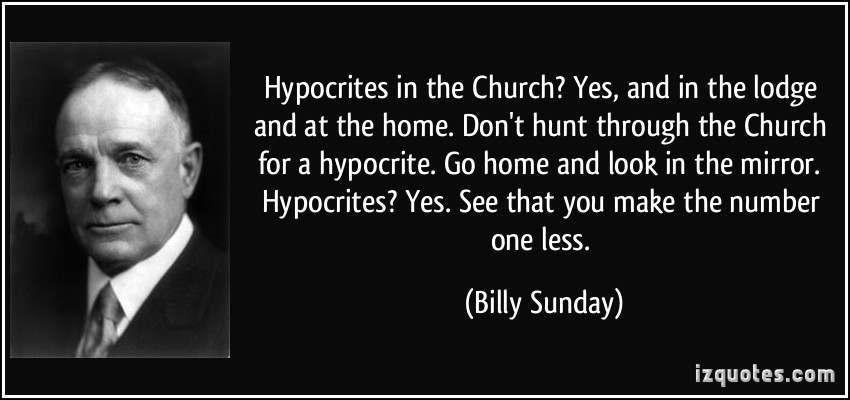
Not that I have already obtained this or have already reached the goal; but I press on to make it my own, because Christ Jesus has made me his own. Beloved, I do not consider that I have made it my own; but this one thing I do: forgetting what lies behind and straining forward to what lies ahead, I press on towards the goal for the prize of the heavenly call of God in Christ Jesus.
It is deceit that makes hypocrisy what it is. Absent this deceit, there is no hypocrisy, just error or human frailty. That's what the hypocrisy-excuse people don't understand - or pretend not to understand - about church people. What may appear to be church people's hypocrisy is almost always just simple failure to meet the standards of our faith rather than deceit. Why? Because the standard is so high.

For example, Jesus admonished, “But I say to you that everyone who looks at a woman with lust has already committed adultery with her in his heart” (Matthew 5:28).

Or, “You have heard that it was said, ‘You shall love your neighbor and hate your enemy.’ But I say to you, Love your enemies and pray for those who persecute you … .” (Matthew 5:43-44).

There are many such examples. To attempt but fail to meet such a difficult standard is not hypocrisy.

When I tried to play football in high school, Coach Keaton was clear that to gain a place on the starting squad meant achieving a high level of performance. So, when I, a sophomore, could not run the 40-yard dash in under 4.5 seconds, did Coach Keaton yell at me, “You hypocrite!”? Of course not. He simply shrugged and said, “Work harder.” 

Jesus does not denounce us for trying and failing – if we really are trying. And I think he’s a little more compassionate than Coach Keaton was because while Jesus will tell us to work harder, he will also be our personal trainer – providing we are willing to be trained and submit to the training regimen.

All churches, including my own, are filled with Christians in training and worse yet, they all have Christians in training as pastors. Jesus told us to be perfect as our Father in Heaven is perfect. That sets the bar incredibly high. So, if in training to clear that bar we are dismissed by non-Christians as hypocrites, then I say be of good cheer. Rejoice and be glad and let’s have many more just like you!

Vice is easy, virtue is hard. It's no hypocrisy to fall short of a very high standard and such an excellent goal. And I would suggest that people accusing us of hypocrisy have yet to see the log in their own eye, choosing the easy way over the hard way, and pretending it is virtue. So, who are the hypocrites? Well, we always have room for one more.

We should not take religious hypocrisy less seriously than the Bible does, but "Christians are just hypocrites" is merely an excuse to reject the Gospel more than a reasonable observation. The church is a human institution. Name one large human institution that has always lived up to its standards. Law? Medicine? Banking? Politics? No, not even one. 


I also say that we badly err when we try to justify the church. We are not called to offer people the church. We are to offer them Christ. And we should offer Christ as Jesus did, in love of and care for the soul. After all, Paul’s reminder to the church in Corinth two thousand years ago applies to us today:
26 Brothers and sisters, think of what we were when Christ called us. Not many of us were wise by human standards; not many were influential; not many born with a silver spoon. 27 But God chose the foolish things of the world to shame the wise; God chose the weak things of the world to shame the strong. 28 God chose the lowly things of this world and the despised things—and the things that are not—to nullify the things that are, 29 so that no one may boast before him. 30 It is because of him that we are in Christ Jesus, who has become for us wisdom from God—that is, our righteousness, holiness, and redemption (1 Cor. 1.26-30)
And so to anyone who wishes to accuse me of religious hypocrisy, I can only reply as Paul did: 
I have not yet obtained perfection; but I am moving on to perfection because Christ Jesus has made me his own. Friends, I have not reached that goal, but I am not letting my past control me. I press on to what lies ahead, towards better fulfilling heavenly call of God through Jesus Christ.
So however we fall short of the standards of our faith, and fall short we certainly often do, we nonetheless seek a "more excellent way" and strain forward to what lies ahead, pressing on towards the goal.

Sunday, November 26, 2023

Christ the King Sunday

John 18:33 37

33 Pilate then went back inside the palace, summoned Jesus and asked him, “Are you the king of the Jews?” 

34 “Is that your own idea,” Jesus asked, “or did others talk to you about me?”

35 “Am I a Jew?” Pilate replied. “It was your people and your chief priests who handed you over to me. What is it you have done?”

36 Jesus said, “My kingdom is not of this world. If it were, my servants would fight to prevent my arrest by the Jews. But now my kingdom is from another place.”

37 “You are a king, then!” said Pilate. Jesus answered, “You are right in saying I am a king. In fact, for this reason I was born, and for this I came into the world, to testify to the truth. Everyone on the side of truth listens to me.”

Today is the last Sunday after Pentecost, known as Christ the King Sunday. It is the final Sunday of the Christian year. Advent, the opening of the Christian year, begins next Sunday. 

Christ the King Sunday was celebrated for the first time in 1925, inaugurated by Pope Pius XI. World War I had ended only seven years before, a war brought on by demagoguery and allegiances to ideologies which killed and injured many millions. Pius watched as Mussolini’s Blackshirts marched past the Vatican. He knew about Hitler’s rising star in Germany. 

 Pius could read the writing on the wall. It was time, he thought, to forestall the coming future, to place something in the way of the coming tragedy which he saw taking shape. He believed it was essential to proclaim openly that the world had lost its sense of what leadership was and what it meant to rule. He wished to give people an alternative to fascism and Nazism and their false god of socialist ideology.

And so Pius originated a new festival day in the church, that of Christ the King. What would Pius say if he could observe events of the twenty-first century? 

It is one Sunday before Advent and I am writing about Jesus standing before Pontius Pilate, who sentenced him to death. We are about to begin the season of Advent to anticipate Jesus’ birth. Today’s passage seems out of place, more suited to Easter week in the Spring than in November.

Christ the King Sunday is the last Sunday of the Christian year. It reminds us that the end of the story is that Christ’s reign is established forever: “And of his Kingdom there shall be no end,” says Luke’s Gospel. One week from now is New Years for the Church. 

If Christ is king, then there are two crucial questions: what kind of king is he? And over what kind of kingdom is Jesus sovereign? Jesus stands in front of Pilate, the personal representative of the most powerful ruler on earth, the Roman emperor Tiberius Caesar. Pilate has been told that this man Jesus is called the king of the Jews, a kingship that the Jewish hierarchy strenuously denies. Jesus has not refused the title of king, though. Not only that, but he talked and taught and preached about his Kingdom more than any other topic. Kingship seems to have been a title Jesus was comfortable with.

So Pilate asks, “Are you the King of the Jews?” 

Pilate wants to know whether Jesus’ kingship, whatever it was, represented a threat to Roman rule. The chief priests had told him it did. They had emphasized to Pilate the political implications of Jesus being acclaimed as the Messiah who would bring the Jewish people to freedom. They had accused Jesus of treason. Pilate wanted to know was whether Jesus was just a harmless religious dreamer, or a dangerous insurrectionist bent on leading a rebellion. 

Historians say that Pilate was not terribly competent as governor. But he ran a good intelligence operation, and he knew about the Jewish people’s hope for a messianic king. Jesus, bedraggled, beaten, and exhausted as he stood before Pilate, could not have seemed very threatening, but Pilate wanted to make sure. 

But Jesus won’t cooperate. Pilate asks, "Are you the king of the Jews?" and Jesus answers basically, "Is that your idea or are you just repeating rumors?" It is a response that challenges Pilate to make up his own mind. 


Jesus’ response to Pilate echoed what Jesus had asked the disciples on the road one day: “Who do the people say I am?” In other words, what are the rumors? Then point-blank to the disciples: "Who do you say I am?" 

Peter replied, “You are the Christ, the Son of God.” It is sadly not an answer that Pilate can give.

On the other hand, Jesus throwing the question back to Pilate might have been a good defense strategy. Pilate is both judge and jury. Jesus acknowledged there was a lot of hearsay about him and then forced Pilate to consider what he actually knows about Jesus. Pilate must make up his own mind.

That is the same challenge Christ the King Sunday makes us face. We have heard a lot of things about Jesus: he healed the sick, he told some parables. We’ve even heard he is the son of God. But are each of us convinced of that, or do we merely repeat what others have told us without thinking them really true? 

Americans are fairly anti-monarchical. We’re not quite sure what “king” might mean for us. We get our notions about it from Hollywood, mostly – a bunch of sycophants standing around some English monarch muttering, "Yes, m’lud." So we tend to dismiss the royal character of Jesus as ancient metaphor with no contemporary significance. But doing so downplays the cosmic authority Jesus has. There is a great deal more to Christ than human decency. He is much more than a friendly fellow who is reliable and kind, tells interesting stories and is nice to children. Human affairs and the destiny of the universe itself are in his hands.

Asking Pilate what he thinks about him was no academic question for Jesus. It was a matter of life and death for him. There were only two possible answers Pilate could give: either Jesus was a pretender to the throne who must he stopped, or he was truly a king requiring recognition.

So Jesus answers: What have you heard about me, and what do you say for yourself?

 The answer matters. In a way, we of the church are sitting in Pilate’s seat now. Each day the same question sits before us all. Each day we can desert our Christian calling. Or we can tame it and make it safe and comfortable. We can turn inward and make our churches social clubs for the saved or a fortress for the spiritually pure. We can make up our minds that Jesus is a convenient reason to get together to feel good about ourselves or to have a nice place for family activities.

Or we can make up our minds that Jesus is the son of living God, crucified and risen, who takes away the sin of the world and demands that to follow him we have to deny ourselves. And we could understand that to believe that fact obligates us to be the presence of Christ in the world now, to live as and lead others to become disciples of Jesus Christ. 

Each day we have to make up our minds. 

So there Jesus stands with Pilate. It is quite a contrast: Pilate, the representative of the most powerful empire the world had ever seen, confronted by a man with no armies, no palaces, no courts, but who claimed kingship, nonetheless. What kind of king, what kind of kingdom? Well, not one like Pilate knew, not of Pilate’s world. Pilate beheld a man said to be king, but who said his kingdom was not like those of the rest of the world. 

And so it is not. Jesus tells Pilate that if his kingdom were like Pilate’s, his subjects would be fighting Pilate’s soldiers even as they spoke. But they were not. The kingdom over which Christ is sovereign is a kingdom where the ordinary rules of power politics and the social order don’t apply. The kingdom of Jesus Christ is not a place, but a community of persons enveloped by God’s grace. It is a kingdom that transcends place and time, class, nation and worldly status.  

Pilate cannot even imagine such a kingdom. He doesn’t even ask Jesus to explain what he means. Finally he orders Jesus crucified. Pilate’s sentence is the logical end of the way of the world, using systems built on competition or conquest or power, intended to make subjects of people. But Jesus has no subjects because only kings of the fallen world have inferiors whom they can rule. Jesus called his disciples friends, not subjects. Jesus’s kingdom will not be brought about the way Pilate knows, by conquest and domination. Pilate’s only contribution will be ordering his soldiers to hammer nails through the hands and feet of the man Pilate rejects as king, ironically guaranteeing that Christ’s Kingdom will be established for eternity. 

Standing before Pilate, Jesus looks forward to a world ruled by love, perfectly expressed in the self sacrifice of his life. It is a love confirmed by God raising Jesus up from death. “My kingdom is not of this world,” Jesus says. The kingdom of Christ is one-part heaven and one-part earthly. It is a kingdom that is within us and among us when we confess Christ as risen Lord. Yet it is not fully here, it is always in the process of becoming and fulfilling. It is a kingdom of people who know Christ as savior.

Jesus’ kingdom is populated by people empowered by the Holy Spirit to live together as God intended from the beginning. Its citizens are transformed by Christ’s resurrection into a community of faith, hope and love. We of Jesus’ kingdom reject the standards of this world that say that for every winner there must be a loser, for every gain there must be loss. 

Paul wrote that if life in Jesus is not anchored in eternity, then we are pitiful creatures. But Jesus’ kingdom isn’t only the sweet by and by. If Jesus’ kingdom is nowhere at all but some angelic realm, what good is that now? Jesus said he came to grant life more abundant – here, today, now. 

 That is the truth Jesus came to testify. We are born into world systems which just do not work the way God intended. We cannot always act the way God wants us to act. The only way out is to get a visa to a new place to live: the kingdom of God. You don’t have to move your home, just your soul. But be forewarned. The entry fee is high. You have to believe something clearly incredible: that, as the apostle Paul wrote, in Jesus dwelled God bodily, that Jesus really died and really was raised from the dead. Merely agreeing to a proposition won’t do. Jesus said that if we believe in him, we’ll act like it. We will do what Jesus would do if Jesus were here.

The church stands in front of the world. If it is to be true to its Lord, it must say, “Our way of living is not your way of living.” We act in contrast to the way the world works. We have no armies, no palaces, no courts of law, but we claim dominion over the world, nonetheless. We are a kingdom not of this world. 

In this kingdom, God comes into our lives to renew our redemptive purpose, heal our wounds, and sustain our place in our community of faith. He sends us to carry each other’s burdens, to meet one another’s difficulties, to rise above despair and anxiety. He calls us to himself, to seek his face in our hearts and the hearts of others. So we gather as citizens of Christ’s kingdom and pray for the Holy Spirit to touch us, to lift us up, and send us out of the church into the world where we live and work. There we will be part of Jesus’ ministry to the world which began so long ago, with only a choir of angels singing to shepherds far from town, and which Pilate thought could be ended by nails in a cross and a stone rolled over a rocky tomb.

But it did not end, for Christ is the risen King! 

Sunday, June 11, 2023

Why you matter

Do you matter? And if so, why? I read a physicist’s answer to that question once. He said that when the universe formed 14 billion years ago, matter and antimatter collided and burst into energy, then reformed into matter and antimatter and then did it all over again until, for reasons yet unknown, there was no more antimatter. The universe, he said, is made up of all the matter that was left over after all the antimatter had been destroyed. The difference in amounts between matter and antimatter was no more than one percent.

You matter, he said, because you are matter.

Well, maybe, but I doubt that answer is very consoling in the dark of the night. Here is a story, a parable if you will, of one evening on a Chicago commuter train.


It was about 10 o’clock one weeknight when three young tough guys, full of swagger and threat, boarded a car. There were not many riders aboard at that hour – a young woman clutching a grocery sack, a tired-looking, middle-aged laborer leaning against a support bar, not even looking up, a few others. As a leopard sees which gazelles are weak, the young punks scanned the car for prey.
 
They saw an older man, maybe 70 or so, in a gray coat and tie, not Brooks Brothers but not off the Goodwill rack, either. He was seated in the next section, reading a folded newspaper. And so, laughing loudly and shuffling noisily, the punks approached. The leader stood before the suited man and punched his newspaper.

“Hey man!” he yelled. “You’re sitting in my seat!”

When the man looked up, the young punkster was somewhat surprised that his face and eyes registered alert awareness, but not fear. So the punkster glared at him more threateningly.

The gray man spoke. “Well, I’d better move, then.” He pulled his paper back, folded it with care, placed it under his arms, and stood. “Pardon me,” he said kindly to the punk leader, and placing the back of his right hand gently on the young man’s sleeve, he pressed lightly to the side and stepped across the car. There he turned and sat, unfolded his paper, looked at the punkster, smiled slightly and said, “Please, have your seat.” Then he set his eyes on the newsprint and said no more.

The young punk stood there for a moment, slightly shrugged and sat down. The two gangster sidekicks with him sat on either side. “Well, what a bunch of losers we wound up with tonight!” said one, much too loudly and to no visible effect on the dozen people in the car. Then he stared at the gray man for a long moment. “And I think you’re the biggest loser of all.”

The gray man returned the gaze and shortly simply said, “Very well.” Then he began reading again.

The punk leader leaned forward. “Hey man, I’ll give you a real reason to be afraid!” Several people nearby glanced nervously. “You hear me?”

The gray man folded his paper into his lap. “No,” he said, “you may give me a reason to be concerned. But not a reason to be afraid.” Then the gray man did the most unexpected thing. He stood, stepped to stand in front of the sidekick and said, “Excuse me, but I’d like to sit there for a moment.” The sidekick snorted, “Man, stuff you!” or something like that, which evoked a comment from the gray man to the punk leader, “Would you mind, only for a moment?”

“Shee,” the punkster said. “I ain’t afraid of you.” To the sidekick he said, “Get up.” Wordlessly, the glaring young man arose and the gray man sat. “Well?” said the punkster. “I ain’t got all night.”
Looking directly at the punkster, the gray man said, “I am no match for you and I know it. If you want to wipe up the floor with me I can’t stop you. But you don’t know what to about me because you live with fear and I don’t.”

“What you mean?” came the answer. “I said I ain’t afraid of you! You talking stuff, that’s all, old man.”

“I know you are not afraid me of me, nor should you be. You are not afraid of anything inside this car. But I didn’t say you were afraid. I said you are full of fear. Not of anything in here. You fear what’s out there.” He waved his hand toward the darkness outside.

“Oh, yeah?” the punk retorted. “What do you think is out there that I am so afraid of?”

“Nothing,” the gray man said simply. “That nothing is all there is. That when you have finished walking down the path of life, there will not remain even a footprint to show your passing.” The punkster stared at the gray man, working his jaw, his eyes flashing. The gray man continued. “Nothing fills your soul because nothing matters. And that is your fear – buried so deep inside you that you hardly know it’s there, the fear that you don’t matter, either, not at all.”

It is the unique invention of Judaism, passed on to Christianity, that individual human beings matter personally to God. No other religion in the world teaches that.

One might think that Islam says that Allah cares for and about human beings just as Judaism and Christianity say, but no, not even close. A Muslim author wrote, for example, “The Quran states that Allah is as ‘near to man as the jugular vein’” but this is not an assurance of comfort but of threat. In Islam, Allah remains unknown, unrevealed by the Quran, which consists of admonishments and commands but says almost nothing about Allah himself. Allah is entirely separate and unconnected to human affairs except through the giving of strict laws. Allah remains a mystery; he does not make personal, self-revealing approaches to mortals nor seek fellowship with them. Muslim jurist Samuel Solomon wrote that Islam is not a personal religion at all. Islam claims no knowledge of a self-revealing and self-bestowing of God.[1]Allah commands, Allah judges, but the Quran says Allah loves only those who obey him and explicitly says he does not love non-Muslims.[2]Allah demands not human love but submission, willing or unwilling, either will do. As one Muslim author states, “We can know nothing about the nature of God except through [his] commands … .”[3]

In none of the Eastern religions is there the notion that individuals matter in any transcendent way.  The present life is viewed as a curse from which escape is desirable but almost impossible to achieve. Nirvana, for example, is “achieved by the extinction of desire and of individual consciousness,” to escape the cycle of life, death and reincarnation. If escape is achieved, all personal identity is lost and one’s soul merges with universal consciousness. But the gods, for the eastern religions that have them, do not care whether you achieve this, nor do they interact with human beings.

All the rest of the world’s religions are varieties of nature religions with hundreds of variants from Wicca to Voodoo in which the idea of a personal deity for whom individual persons matter is not included.

Outside of Judaism, in the ancient world of Jesus’ day the Greek pantheon of gods and goddesses reigned supreme except for vestiges of Babylonian and Persian religions. However, in all of them the god's interacted with humanity in unpredictable, often capricious ways. Mortals were tools of the gods to achieve their own ends when the gods bothered to notice mortals at all. The gods were not moral exemplars whose characters were spotless and pure. Murder, incest and rape were all attributed to the Greek gods, whose main attributes were power and immortality, not goodness. As for the ancient Greeks, as Tina Turner would later sing, “What’s love got to do with it?” A pupil of Aristotle wrote: "It would be eccentric for anyone to claim that he loved Zeus."[4]

Alone against all these religions of the pointlessness of human life stood Judaism and its daughter Christianity. Alone they made divine love for individual human beings the centerpiece of belief. This love, though, is not the mushy, vapid sentimentalism that our pop culture sings about. The love of God for us, and our love for God in return, is instead a steadfast, bi-directional loyalty in covenant relationship. It is commitment, conviction and enduring trust that no matter what, this committed loyalty will never weaken. Isaiah explained it in God's words in chapter 46:

I will be your God throughout your lifetime—
    until your hair is white with age.
I made you, and I will care for you.
    I will carry you along and save you.

Jesus explained it this way in the Sermon on the Mount:
Matthew 10:29-31
Are not two sparrows sold for a penny? Yet not one of them will fall to the ground outside your Father’s care. And even the very hairs of your head are all numbered. So don’t be afraid; you are worth more than many sparrows.

Jesus told a story about a man who had two sons. One day the younger son demanded his inheritance immediately. The father gave it to him and the young man moved far away, where he promptly wasted all his fortune on "riotous living."

Then he started back home, broke and hungry, determined to beg his father to accept him as a hired hand on the farm.

But while he was still a long way off, his father saw him and was filled with compassion for him; he ran to his son, threw his arms around him and kissed him.

The son said to him, 'Father, I have sinned against heaven and against you. I am no longer worthy to be called your son.’

But the father said to his servants, 'Quick! Bring the best robe and put it on him. Put a ring on his finger and sandals on his feet. Bring the fattened calf and kill it. Let's have a feast and celebrate! For this son of mine was dead and is alive again; he was lost and is found.' So they began to celebrate.

The father is God, of course, and the son is you and me and anyone else we think doesn’t matter. The story is especially for every person like the Chicago punkster who fears he doesn’t matter. Paul Harvey related one day what actually happened in Spain some years ago. A man and his son, Pablo, had a bitter falling out. Pablo packed and left, vowing never to come back. For five years the father never heard from his son. The ache and regret and self-reproach was more than he could bear. Then one day a friend told him that he was sure he had seen Pablo in Madrid one day in a market.

The father took a train to Madrid and went straight to the newspaper office. There, he bought a full-page ad that said simply, "Pablo, I love you with all my heart. I forgive everything and beg you forgive me. Meet me Friday in front of the main library at 9 a.m. Love, your father."

Friday morning the father walked to the library with heart pounding. His son was waiting for him there, along with seventeen other young men, all named Pablo.

Yet these stories, as near the heart of the why we each matter to God as they are, only illustrate rather than define why you and I matter. At the center are not heart-warming stories but the bloody horror of the cross. That we matter to God is a guarantee sealed literally in blood. “For God was in Christ, reconciling the world to himself,” and no longer counts our sins against us.[5]And since it took crucifixion to do that, then Jesus endured the cross.

If you were the only sinner in the world, the only one ever, Jesus would still have carried that cross to Golgotha and died upon it, just for you alone.

That is why you matter.


[1]http://www.answering-islam.org/Books/Spencer/God/chap2.htm
[2]http://www.answering-islam.org/Quran/Themes/love.htm
[3]Ibid
[4]http://faculty.gvsu.edu/websterm/Gods&men.htm
[5]2 Corinthians 5:19

Sunday, July 3, 2022

The Theology of America

There are certain occasions when events on the secular calendar give us the opportunity to pause and reflect on religion in America. The Fourth of July is an obvious occasion. I want to take this day to reflect on the religious underpinnings of our country and explain why I believe there is an actual theology of America and what it means.
I think that the theology of America was best summarized by Thomas Jefferson in his 1774 essay, "A Summary View of the Rights of British America." There he stated, "The God who gave us life gave us liberty at the same time. The hand of force may destroy but cannot disjoin them."
Editorialist James Freeman wrote that based on the standards of our day, “Thomas Jefferson was a religious nut.”
   Jefferson was a big believer in religious liberty, but he certainly wasn't shy about mentioning God in official proceedings. In the final paragraph of the Declaration of Independence, Jefferson asks twice for God's help in creating the country. And the Declaration was not the only work of Jefferson's in which he gave credit to a higher power. . . .
   In his Notes on Virginia of 1782, Jefferson writes: "Can the liberties of a nation be thought secure when we have removed their only firm basis, a conviction in the minds of the people that these liberties are of the gift of God?"
If we disregard the Founders’ religious faith, we have no answer to the question, Where do our rights come from? Jefferson's religious ideas, shared by representatives from the thirteen colonies, are the reason we have a United States and the reason that We the People are in charge.


However much it is claimed that Jefferson and most of the other Founders were more secular than religious, there is no escaping that Jefferson's writings are permeated with God consciousness. It's true that Christ does not figure into his political writings, but God does, and frequently. What gave Jefferson and his fellow revolutionaries the right to be so, well, revolutionary? Whence came their idea that the people should rule instead of a king or a parliament of nobles? How could they claim that the right to life, liberty and the pursuit of happiness was "unalienable," meaning beyond the rightful power of any government either to grant or deny? Why did they talk about human rights to begin with and where do rights come from?
According to Thomas Jefferson and his fellows, the ultimate answer to all those questions was simple: God. Only cynics say that the religious convictions of the Founders were not central to their determination to risk their lives, their fortunes and their sacred honor for a single claim: that all human beings are created equal and that they are endowed by their Creator with certain rights that may not be rightfully denied them. And yes, the Founders did exclude African-Americans from this claim, but let us also acknowledge that Jefferson, among others, said explicitly that God's righteous day of reckoning and judgment upon slave-owning America would come. And it did.
The whole justification for the American revolution was that the divine rights of the people trumped the divine rights of kings that European monarchs claimed to have. Human rights come from God, not government. When the British government usurped them, it was the God‑given right of the people of America to cast off the that government and form their own. That is what the Declaration of Independence says, and that is what the Founders did. Freeman wrote, "If you could sum up Jefferson's political views in one sentence, you would say: He believed that God and reason allow people to rule themselves."
One of the genius things our Founders did was create a civil society in which enormous numbers of different Christian denominations and nowadays, different religions, find a home. Our history has seen times of sectarian strife, but it never descended to open combat as it has in, say, Northern Ireland. A lot of Protestants were suspicious of whether Catholic John F. Kennedy would cleave to the Vatican rather than the Constitution, but their fears were unfounded. In 2004, orthodox Jew Joe Lieberman ran for president and then was the nominated candidate for vice president and no one worried whether he would cleave to Jerusalem rather than the Constitution.

The American ideas of freedom and liberty are drawn from religion. Jefferson was saying that human liberty is inherent in the creative acts of God in bringing forth humankind to begin with. Creation was not a static event, it is a dynamic process of bringing forth the image of God in humankind and the world at large. The creation stories in the book of Genesis show that the realms of the divine and creation overlap. God is powerful, but creation has power too; a certain degree of independence and freedom is built into creation by God's very acts of creating.
In the original paradise, the Garden of Eden, Adam and Eve were given the run of the garden and meaningful work to do. They were free agents of their own will. Yet there were limits. God commanded them that they could eat the fruit of any tree except one. Their freedom had its limits. When they crossed that limit, they were less free, and Genesis relates that as generations passed, humankind became steadily even less free.
Eventually the story leads to Egypt, where the Hebrews found themselves in chattel slavery to Pharaoh. They had no freedom at all.
The twin images of slavery and freedom shape the entire theology of both Jews and Christians. Always God is a liberator. The central story of the Jews is that of Moses leading the children of Israel from slavery in Egypt to freedom in the Promised Land. At their start, slavery. At their ending, freedom. But neither the slavery nor their freedom is the high point of the story. The high point is what happened at Sinai. The high point, the defining moment, was when God gave them the Law.
The Law of Moses defined freedom in two ways. On the one hand, the law defined what was forbidden. On the other, it stated what was obligatory.
There is always a tension between the forbidden and the mandatory. But the Bible seems clear that human freedom is found somewhere between the limits of what may not be done and what must be done. With no limits there is no freedom because there is no orientation on God. Without obligations there is no justice, without prohibitions there is no community. The surest way for persons or societies to fall into bondage is to ignore prohibitions and obligations. Falling into slavery is easy, staying free is hard.
The apostle Paul said that creation itself is in bondage to decay, an amazing statement for a pre‑scientific man to make. Science today confirms that the universe is running down and cosmologists now seem convinced that the universe will keep expanding forever, until the time comes when energy states will be even, and nothing will ever change.
As for we men, women and children, we are born slaves to this decay. At the end lies the grave. We know that. We fear death because our mortality looms over everything we do. Human customs and culture are shaped by the end of life in ways we cannot even uncover, to degrees we do not recognize. Such is our slavery to the fear of death.
Christians have tended to think of Jesus' gift of life as some sort of afterlife, but Christ is concerned about far more of our lives than what happens after they end. Christ frees us not only from the fear of personal death but from our slavery to a death‑shaped culture. With death overcome, the family of God is empowered to inaugurate a new order of living and a new kind of life.
Jesus explained in the Gospel of John (8:34‑36), "Very truly, I tell you, everyone who commits sin is a slave to sin. 35The slave does not have a permanent place in the household; the son has a place there forever. 36So if the Son makes you free, you will be free indeed."
Through Christ, we are freed from sin and from servitude to the things of this world which inhibit godly living: greed, jealousy, anger, resentment, racism, selfishness – all the hundreds of things we put under the general label of sin. We are freed from sin and the fear of death.
So liberated, we should be able to live positively in ways not possible before. Justice, the right ordering of things in human affairs, is the result of this spiritual freedom. So the fuller Law of the Hebrews recognized this fact. Deuteronomy 10:12‑13 and 17‑18 says to the nation of Israel:
12 So now, O Israel, what does the LORD your God require of you? Only to fear the LORD your God, to walk in all his ways, to love him, to serve the LORD your God with all your heart and with all your soul, 13and to keep the commandments of the LORD your God and his decrees that I am commanding you today, for your own well‑being. 17For the LORD your God is God of God's and Lord of lords, the great God, mighty and awesome, who is not partial and takes no bribe, 18who executes justice for the orphan and the widow, and who loves the strangers, providing them food and clothing.
Those are some of the divine obligations people have as they live in community. Yet our nation's founding documents make no mention of the obligations and responsibilities, they seek to ensure only our rights. In fact, Jefferson wrote that the whole purpose of government is to secure the rights that God gave us. He ignored codifying the obligations God lays on us.
I think that is a good thing. I shudder to think what our civil life would be like if our Constitution required things of the people rather than limited the power of government. It is always too easy for the law, whether civil or religious, to cease being a guide and become a slave-master. George Washington warned that even democratic "Government is not reason; ... it is force. Like fire, it is a dangerous servant and a fearful master."
In both our civil and religious life, we would do well to remember Paul's admonition to the Corinthians, 1 Cor 10:23: "‘Everything is permissible' – but not everything is beneficial. ‘Everything is permissible' – but not everything is constructive.'" The absence of limits in America's founding documents is not an oversight. The Founders expected the people to understand the limits of libertine anarchy on the one hand and political slavery on the other.
John Adams wrote in a letter to his wife, "We have no government armed with the power capable of contending with human passions unbridled by morality and religion. . . . Our Constitution was made only for a moral and religious people. It is wholly inadequate to the government of any other."


Justice William O. Douglas wrote in a majority opinion of a Supreme Court case, "We are a religious people whose institutions presuppose a Supreme Being."
The Constitution guarantees our rights, but not our liberty. It is our religion under the providence of the God of the Bible that secures our liberty. Liberty is maintained by faith in powers greater than government, by living out God’s call to know the truth of freedom in God’s way of life. When we make government the object of our faith, when we decide that our liberty depends on government, we will live under political bondage.
Various commentators of the American religious scene point out that America is becoming less and less religious. A lower percentage of Americans regularly attend church or synagogue than in past times.
But the fact is that Americans are still just as religious as before, it's just not Jewish or Christian religion they are practicing. Increasing numbers of people are turning to forms of spirituality that are private and personal, not public and social. These forms of religion are, at their base, selfish and self‑centered. While this is certainly their right, I fear that over time the obligations of freedom will be ignored, and the justice of our freedom will be degraded. Self‑centered persons do not prosper, and neither do self‑centered societies or nations. Paul warned the Galatian Christians (Gal 5:13‑14):

13 For you were called to freedom, brothers and sisters; only do not use your freedom as an opportunity for self‑indulgence . . . For the whole law is summed up in a single commandment, "You shall love your neighbor as yourself."    
                                                      
Freedom is God's will. Certain rights are God‑given and cannot be rightfully denied by human authority. God's gift of freedom carries the obligation to live godly lives under his guidance and to love our neighbor as ourselves. Our rights and our obligations reinforce one another, guard one another, preserve one another. Together they comprise our freedom.

Saturday, May 14, 2022

A Methodist Conference May Not Separate - Unless It Does

US Conferences Can’t Leave the United Methodist Church, Rules UMC's Judicial Council (Link)

While the denomination’s Book of Discipline has provisions for individual churches wishing to leave the United Methodist Church with their properties, there’s nothing within church law that would allow an annual conference — one of the United Methodist Church’s 53 regional networks of churches and ministries within the United States — to do the same, according to the denomination’s Judicial Council.

The Judicial Council ruled Tuesday (May 10) that only the General Conference, the denomination’s global decision-making body, can determine the process and conditions for annual conferences to disaffiliate from the United Methodist Church.

And the General Conference hasn’t done that.

“There is no basis in Church law for any annual conference to adopt stopgap policies, pass resolutions, take a vote, or act unilaterally for the purpose of removing itself from The United Methodist Church,” Decision 1444 reads.

I am an ordained, retired UMC minister. In the UMC a conference is basically the same as a Catholic diocese - a defined geographical area with the churches therein under the leadership of a bishop. An "annual conference" is simply a convention of clergy and elected lay delegates of the conference, meeting once per year. The Judicial Council is exactly right that there is no provision in the UMC's canon law, The Book of Discipline, that permits a conference to depart the denomination. However, individual congregations have been permitted to depart the denomination, with conditions, since 2019. 

Consider, though the U.S. Supreme Court's 1869 case, Texas v. White. Chief Justice Salmon Chase wrote in the majority opinion that no provision in the Constitution permits a state to secede. Yet Chase wrote that states may nonetheless secede in two ways. One was by consent of the other states (Chase did not say how) and the other was simply that it declares secession and makes it stick.

In other words, a state may not secede from the Union - unless it does! And that is exactly where we are in the UMC with US domestic conferences and their potential departures. A conference may not depart the denomination - unless it does. (Overseas conferences already have existing ways to leave the UMC.)

For the record, I do not support any conference attempting to withdraw, and I cannot imagine how such a motion in my own conference would even come before the delegates for a vote. However, I have read that two or three US conferences have taken some steps toward separation. 

If a conference decides to withdraw from the denomination and is not compelled to remain, then its withdrawal becomes fait accompli. And since compulsion will not, of course, be by physical force, that leaves only persuasion or court order. Persuasion will not work, it is too far gone for that. And courts' histories on accepting cases about a church's or denomination's internal affairs is that they don't. The courts deal with US law, not UMC canon law.

There are legally enforceable real-property trust clauses that would have to dealt with for a departure. Briefly, conferences hold their real property in legal trust for use by the denomination. But if a conference does not contest them, there is nothing else to stop it. 

On May 1 of this year, the Global Methodist Church formally began as a new denomination. Its main founders are former United Methodist laity and clergy who would have remained in the denomination at least until the announced UMC General Conferences had taken place. A General Conference is the only body that has authority to set denominational policy, rules, and procedures. 

One was scheduled for May 2020, at which the first item of business was to have been a vote on a "Protocol" shepherded by the UMC's bishops to permit and fund "breakaway" churches and conferences, disabling the trust clauses so that those churches could keep their real property. (There were other matters, but I want to keep it simple here.) 

However, the meeting venue canceled the 2020 GC because of Covid. Some time later, the GC was rescheduled for late August of this year. Then in March of this year, "the Commission on General Conference announced it was postponing the meeting again — this time to 2024. Though COVID-19 numbers have dropped in the United States, the commission said, delegates living outside the country are having trouble getting visas to travel to the in-person gathering."

And so the GMC's organizers and backers went forward. That said, despite the Judicial Council's recent ruling, conferences are already leaving the UMC. But they are doing it one church at a time, over time. As I said, The Discipline does specify how local churches can sever from the UMC, and they are doing it at an increasing pace. In Florida, for example (not where I live) more than 100 individual churches have left the UMC, which is 20 percent of all the churches in the conference. We will probably see this at an increasing pace. 

So, by the time of the 2024 GC, votes relating to departing the denomination may be more pro forma than substantive, although funding will still be addressed (probably vigorously).

See also:

Bishop Schnase offers prophetic assessment of UMC

Death throes of the Blue Model church

Thursday, September 2, 2021

Two must reads


Click here.

“There has never been any unitary organisation of Western culture apart from that of the Christian Church,” explained the medieval historian Christopher Dawson in Religion and the Rise of Western Culture, written shortly after World War Two. “Behind the ever-changing pattern of Western culture there was a living faith which gave Europe a certain sense of spiritual community, in spite of all the conflicts and divisions and social schisms that marked its history.”

The West, in short, was Christendom. But Christendom died. If you live in the West now, you are living among its ruins. Many of them are still beautiful — intact cathedrals, Bach concertos — but they are ruins nonetheless. And when an old culture built around a sacred order dies, there will be lasting upheaval at every level of society, from the level of politics to the level of the soul. The shape of everything — family, work, moral attitudes, the very existence of morals at all, notions of good and evil, sexual mores, perspectives on everything from money to rest to work to nature to the body to kin to duty — all of it will be up for grabs. Welcome to 2021.


Click here.

Nothing but a new Great Awakening can save America. Sadly, we have had an awakening of sorts, but in the form of an immanentized apocalypse—climate change—and the substitution of Woke cultishness for the old awareness of sin and redemption. Mr. Johnston has done a great service with his comprehensive survey of our follies and their consequences. His indictment of America’s national decline and its causes in economics, culture, and politics is incisive and convincing, and his overreach in history and philosophy is a minor distraction in the construction of his case. His belief that America has the wherewithal to restore itself shines through, especially in his concluding chapters. During the 1930s we sank into Depression and isolationism, but emerged as the most powerful nation on earth and the leader of the Free World in the 1940s. We languished in what Jimmy Carter called a national malaise during the 1970s but came roaring back with the Reagan Revolution. We have yet to see which spirit will move us.


Sunday, March 7, 2021

Shadow Agendas & Thorns in the flesh

I remember Chevy Chase on Saturday Night Live doing the Weekend Update skit. At one point he said, “We have some partial sports scores for you: 24 to 17, 14 to 9, 17 to 12, 21 to 18.” 

The scores, of course, are only half the story. Likewise, in reading the letters of Paul we get only half the conversation. We do not have the letters or reports from the churches to Paul. So, we must infer the issues Paul was trying to resolve.

The Corinthians had heard other evangelists; Paul called them “super apostles.” Those men made grandiose claims about their authority and accomplishments. Self-exalting braggadocio was a high art form in the Roman world; humility as a virtue was a Jewish notion, not a Roman or Greek one. It appears that the Corinthian Christians doubted Paul's apostolic credentials because he wouldn't boast about himself. Paul responded that even though he could not match the super apostles’ oratorical skill, he knew what he was talking about.

 So Paul wrote back:

I will not brag about myself, except of my weaknesses. I could boast if I wanted without being foolish, for I would be telling the truth. But I won't, so that people won't think better of me than of the Christ who is in my witnessing and living, even though I've been given amazing revelations (2 Cor. 12.5b-7). 

Paul replies that he could brag of a great deal if he was so inclined, and all of it true. Then he explains why he won't play that game: It's not about him, it's about Christ. I don't want people to think more highly of me, says Paul, than of Jesus, about whom I witness and for whom I live. 

I once heard someone explain a concept that some behavioral psychologists call "shadow agendas." Shadow agendas are the things people devote their time, attention or money to that are hidden from almost everyone they know. Shadow agendas may start innocently enough, but then come to be the true orienting focus of one's life, the purpose of living for which other aspects of life are shuffled to support and conceal. Paul told the Corinthians that he had no shadow agenda. Paul refused to use the Gospel to promote himself, saying, basically, "I refuse to boast about myself because Jesus is more important than I am. I am the messenger, but I am not the message." He won’t use his apostolic mission to promote himself over Christ, to exalt himself using Christ as cover. 

Paul continued this way:

That's why, to keep me properly humble, a thorn was given me in the flesh, a messenger of Satan. Three times I prayed to the Lord about this, so that it would not vex me, but he said to me, "My grace is all you need, for my power is perfected in your weakness." 

So I will boast all the more gladly about my weaknesses! The power of Christ fills me more strongly because of them. Once I learned this, I stopped letting my weaknesses rule my life – I don’t even pay attention to the insults, hardships, persecutions and setbacks I suffer serving Christ. For my weaknesses are really another way to be strong (2 Corinthians 12.8-10).

The word translated "thorn" also could refer to a sharp stake used for torture, which seems better to fit Paul’s context than thorn. Paul understands this thorn, or stake, has served to keep him humble before God.

Paul doesn’t say what the thorn was. It evidently doesn’t matter; anyone who engages seriously in doing the work of Christ will likely find he or she has one, too. I have come to understand the thorn in the flesh is whatever tends to hinder or damage your effectiveness as a disciple. 

I knew a man in Virginia who had come to the unshakable conviction that Christ was raised from the dead and that Christ was Lord of his life. But he stopped growing in faith because of his profane language. He thought that unless he stopped swearing, God would not accept his service, his faith or even his prayers. Another man said in a Sunday School class that he felt the same way about smoking cigarettes. Both these men admitted that they had stopped growing in faith because they felt that their vices, their thorns in the flesh, were so ungodly that all those men did was sort of mark time, waiting for the day when God would remove the thorns, like magic. 

 But how realistic is it that a disciple's life will have no thorns? That would be like a football player telling the coach, "I'll play football as long as I don't take a hit." The coach might answer, "If you're going to be in the game, you're going to take hits. The only way not to take hits is to sit on the bench."

It is probably overbroad to say that if someone has never felt a thorn in his flesh, then the devil co-opted him or her long ago. But it’s probably not very overbroad to say that. Ranchers don't round up cattle in the corral, they chase the ones running free. In the same way, the devil doesn't chase folks he's already rounded up. He goes after the ones God's got. 

Now the devil knows that he's not going to get many Christians to renounce their Christian faith. But tempting us to follow our own shadow agendas instead of Jesus's agenda will do just as well. 

I heard a story of four Methodist people – a minister, a Sunday School teacher, a committee chairperson and a church attendee – who were riding in a car together on a two-lane highway. It was raining. As they went around a bend a big truck hit them head on. The next thing they knew, they were standing before Jesus on judgment day. 

The pastor winked at the other three and whispered to them, "Piece of cake." He stepped forward and said, "Lord, I was an ordained minister in the church. I preached every week! I consecrated bread and wine and baptized men, women and babies!" 

"Lord," the next person said, "I taught Sunday School for twenty years."

"Lord," said the third, "I did a lot of church work and served on committees."

"Lord," said the fourth person, "I went to church on Sundays when I could have stayed home."

 And the Lord replied, "Do you think that bullet points on your religious resume would impress me? You, preacher, was the real point of your preaching to make yourself look good to move up to a big-steeple, prestige church or was it to bring people to confess me Lord? You, Sunday School teacher and you, church worker and you, pew sitter – were you just doing religious jobs to hold up an institution, or were you bringing souls to salvation? 

"All of you – was your reputation among others the main concern of your church life, or were you willing to look foolish on my behalf? Did you surrender your own desires to my will or did you use me to get your way? Did you trust that my grace was sufficient for your weaknesses or did you use your weaknesses as excuses to keep me at arm's length? Was maintaining your personal religious comfort level most important or did you risk everything you held dear to lead other people to me and my kingdom?

"You know," the Lord continued, "everything about me was out in the open. No secrets. Every teaching I uttered, every miracle I did, every prayer I prayed, every parable I taught, every step I took, the bread I broke, the wine I blessed, the cross I carried, every nail through my body –  all had one purpose, completely transparent, out in the open: to show that God loved the world so much that he gave his only Son, and that anyone who believes in him will never perish, but have everlasting life. 

"That was my only agenda, and that's all there was to it. I hid nothing. I was born for it, I lived for it, I died for it. And God proved it was true by raising me from the dead. All I asked was that you make me number one in your life. Number one. Not your advisor but your Lord. Not just fit me in when it was convenient or suited you. My requirements of you were very simple: to live for me every day and to tell others about me, to invite them to be with me forever.

"That was my agenda. What was your agenda?"

In Europe there is a cathedral which has following engraved words:

Thus speaketh Christ our Lord to us.

You call Me Master, and obey Me not.   

You call Me Light, and see Me not.

You call Me the Way, and walk Me not.

You call Me Life, and live Me not.

You call Me Wise, and follow Me not.

You call Me Fair, and love Me not.

You call Me Rich, and ask Me not.

You call Me Eternal, and seek Me not.

If I condemn thee, blame Me not.

During this Lenten time of spiritual self-examination, each of us should ask, "Do I have a shadow agenda that I use my faith to prop up? What do I want from church – respectability, stability, a place to get my way? Or do I want to learn how to deny myself even to the point of following Jesus to Golgotha? Am I taking hits for Jesus or am I sitting on the bench? Is the devil chasing me because I'm running free for Christ?"

Paul struggled with such questions, so do I and so should we all. Here was his insight: once Paul was honest about his weaknesses, he realized that they didn't really matter to Jesus. The devil at his strongest cannot match Christ at his weakest. "My grace," said the Lord, "is all you need." Our weaknesses are a door into which Christ can pour his grace and overcome them, if only we go ahead and serve God despite our weaknesses. "Once I learned this," said Paul, "I stopped letting my weaknesses rule my life ... For my weaknesses are really another way to be strong."

Perhaps this sounds inspiring, but I find it daunting:

No shadow agendas, only Jesus.

No sitting on the sidelines.

No hiding behind our weaknesses.

In other words - no excuses.

For each one of us and all of us as a church, our questions are: 

  • Will the grace of Christ penetrate us all the way through? 

  • Do we want mainly to be known as church people or do we want mainly to live as and lead others to become Jesus' disciples? 

"My grace is all you need," said our Lord, "for my power is perfected in your weakness."

A world without nuclear weapons - what would it look like?

 From Pope Leo this week, according to the National Catholic Reporter : " Pope Leo quotes Bob Dylan song in book foreword calling for n...