Showing posts with label Foreign events. Show all posts

Sunday, February 22, 2026

War, Iran, and Just War Theory

As you probably know by now, there is a greater concentration of US armed forces in the Middle East today than at any time since 2003. Yet there has been no attack by any country there against America. There have been over time threats and attacks against US warships in the region prior to the military buildup, but with little consequence. 

From the Wall Street Journal, free link to article:
https://www.wsj.com/world/middle-east/iran-middle-east-us-military-7400d800?st=du2MWT&reflink=desktopwebshare_permalink

The American forces are, of course, directed toward Iran. Last June, President Trump ordered US Air Force B-2 bombers to bomb Iran's nuclear-weapons production facilities, specifically those used to process uranium and related materials. This was done with great success, though whether those facilities can be reconstituted is uncertain. 


In early January, massive demonstrations against Iran's dictatorial regime began by Iranians began across the country. They continued for more than a month, although the regime suppressed them with increasing brutality; Britain's The Guardian reports 30,000 or more were killed. It was during those demonstrations that the American naval buildup began in the region. In early January 2026, Trump stated the U.S. was "locked and loaded and ready to go" to support protesters. No such action was taken, but the American buildup continued.

Presently, the US and Iran have delegations in Oman negotiating over the future of Iran's nuclear program. 

Iran and the United States have differing views over sanctions relief in talks to curb Tehran’s nuclear ambitions, a senior Iranian official told Reuters on Sunday, adding that new talks were planned in early March as fears of a military confrontation grow.

Iran and the U.S. renewed negotiations earlier this month to tackle their decades-long dispute over Tehran’s nuclear programme as the U.S. builds up its military capability in the Middle East, fuelling fears of a wider war.

Iran has threatened to strike U.S. bases in the Middle East if it is attacked by U.S. forces.

“The last round of talks showed that U.S. ideas regarding the scope and mechanism of sanctions relief differ from Iran’s demands. Both sides need to reach a logical timetable for lifting sanctions,” the official said.

“This roadmap must be reasonable and based on mutual interests.” Iran’s Foreign Minister Abbas Araqchi said on Friday that he expected to have a draft counterproposal ready within days, while U.S. President Donald Trump said he was considering limited military strikes.

The prospect of American war against Iran is real, though its probability can't be assessed with any degree of assurance. This essay is my assessment of the prospective war in the context of Just War Theory (JWT henceforth), a theological inquiry in Christianity going back at least to Saint Augustine, 354-430. It's most robust treatment was by St. Thomas Aquinas, 1225-1274, whose exposition was so thorough that it still forms the basis of modern theory. I have written over the years quite a bit about JWT in different contexts.

Today my main points are that going to war justly requires that at least these questions to be answered in the affirmative, below.

  1. Is there just cause for the war?
  2. Is the war authorized by proper authority?
  3. Is it wise, as far as we can discern, to wage the war?
  4. Is there a just objective to waging war?

First, though, there is the question whether the bombings last June of Iranian nuclear production constituted "war," or were they military violence of a kind other than war. I think the answer is straightforward, for here the key point is not what President Trump wanted to do (destroy those facilities) but the means he used to do it. And the means were exclusively military and violent, though of course there was no other way.

Throughout history, to attack another country with military forces has been seen unambiguously as an act of war. Just imagine that the evening of Dec. 7, 1941, the Japanese government messaged President Roosevelt that the air raid against Pearl Harbor should not be construed as as act of war, but only as a warning to the US not to inhibit Japan's imperial plans in the Far East. "We are prepared to do more," Japan might have said, if the United States did not comply. What do you think Roosevelt's response would have been?

And that leads to a second key point: President Trump ordered the air raids, so he does not get to call it war or not-war. That is Iran's decision. To expect that Iran's regime and their Revolutionary Guard (IRGC) to think of the strikes as anything other than war is fantasy thinking. However, that is no change of status for them. Successive ayatollah regimes there since 1979 have affirmed they are at war with the United States, which they nickname "the Great Satan" of the world. 

And Iran has been carrying out war against us. Since the 1979 Islamic Revolution, Iran and its network of proxy groups are responsible for the deaths of more than 1,000 American soldiers and civilians. These deaths have occurred through direct attacks, embassy bombings, hostage-taking, and, most prominently, through the training and arming of militants in Iraq, Syria, and Lebanon. A partial list is here. 

One thing we must understand, then, is not whether we should go to war with Iran, but that we have been at war with Iran since 1979, which they have prosecuted in both word and deed. The question is, then, do we continue with the status quo or do we prosecute the war with means directed toward an end that we select? 

1. Is there just cause for war? 

Since just cause (meaning justifiable cause) is a basic tenet of JWT, it must be addressed. However, as I explained just above, we already are at war with Iran, which it initiated based on Shia Islam eschatology. When presented with such a fait accompli, asking whether we should recognize and act on that fact has no basis. On Dec. 8, 1941, President Roosevelt did not ask the Congress to declare going to war with Japan, but simply to declare that the state of war already existed. 

The question, then, is what is the justifiable conduct of the war we are already in. That is a question of our objective to end the war and of the means we use to do so: What constitutes a level of violence inflicted upon Iran's regime and armed forces that is would effectively deter them from attacking Americans or especially developing and using atomic weapons? 

That is, from the Trump administration's view, the very point of the negotiations with Iran in Oman today, to achieve that goal without military force - but with its threat looming always in the background. The American objectives to end the war must be tightly defined to enable planners and assessors to determine what must be done to achieve them, though certainty will not be possible. 

2. Is the war authorized by proper authority?

The US Constitution clearly grants to Congress, and only to Congress, the authority to "declare war." However, the Constitution does not define  what constitutes a declaration. As then-Senator Joe Biden accurately explained in 2001, the Congress has declared war when the Congress thinks it has. Hence, he said, an Authorization for the Use of Military Force meets Constitutional muster as a declaration of war.

I happen to be a professor of Constitutional law. I'm the guy that drafted the Use of Force proposal that we passed. It was in conflict between the President and the House. I was the guy who finally drafted what we did pass. Under the Constitution, there is simply no distinction between a formal declaration of war, and an authorization of use of force. There is none for Constitutional purposes. None whatsoever. 

Constitutional lawyers over the decades have held that varying kinds of enabling acts, such as monetary appropriations for military action, have also amounted to Constitutional satisfaction and, at least, consent of the Congress to action ordered by the president, in whom the Constitution grants authority to conduct warfare.

Since the dawn of the American republic, the Congress and the presidents have generally agreed that the president may order US forces into combat against another nation, solely on his own authority, if and only if there is:

  1. Imminent danger of attack from the other power, so imminent that time taken for Congressional deliberations would hinder defense against it, or,
  2. To protect actual threat against US citizens abroad, or to rescue them from actual danger.  

At this time, neither of these are the case versus Iran, otherwise justified though it may be. My conclusion is that if President Trump or his successor decides to elevate military actions against Iran, Congressional authorization must be granted. 

3. Is it wise, as far as we can discern, to wage the war?

With war already a fact, the question is how to wage it wisely. However, this question is really one of setting the national objectives and predicting their consequences. But that will always be broadly uncertain and as cannot be well answered except retrospectively. But doing nothing or taking indecisive actions would be profoundly unwise. 

The question of wisdom must be faced because JWT has long held that waging war futilely is it self unjust, no matter the justification of other tenets of JWT. And that leads directly to the doctrine of proportionality, which so many people think means that we may not respond to an attack with more force than the attacker used. It absolutely does not mean that. 

As I explain in my essay, What does "Just War" mean?, 

The doctrine of proportionality is simply stated that the means of conducting the war must be proportionate to the goal for which the war is waged. Another way of looking at it is that while the just ends desired do not justify any means to attain them, they absolutely justify some means. The tenet of proportionality, then, is to assess what the justified means are, then employ those means and not the unjustified ones. ...

Hence, proportionality means that one cannot use more force than necessary, but must use all the force that is necessary.  It is critical to understand that proportionality does not mean, and never has meant, anything like a tit-for-tat response. 

4. Is there a just objective to waging war? 

At a minimum, a just objective to the war must be cessation of hostilities by Iran upon US persons and  facilities. That means to do that range from settling treaty agreements in Oman to using military force against Iran and its  proxy militias. I personally am sure that Iran will not ever cease its warfare against the US and our interests (and allies) unless the ayatollah regime is ended and the IRGC is destroyed. 

That is exactly is the reason that Congressional and public debate must be entered into sooner rather than later. Actively warring against Iran may be the right thing to do (or maybe the least-bad option) but it must be the right way politically, strategically, and tactically. And IMO, that starts with explanations to the public of what is at stake and sober discussions in the Congress. What I do not affirm is that this or a successor president should wage this war on his own authority only. 

Related: 
Why Iran is betting on war, from the Financial Times. 


Sunday, January 11, 2026

Has Iran reached its pivot point?

I am adding updates at the end.

I would hope that by now, readers are quite aware of the massive, nationwide popular protests and other actions by the people of Iran against the ruling Shia Muslim regime, headed by Ayatollah Khamenei. It began about 14 days ago, impelled at the start by the massive devaluation of Iran's currency, the rial, plunging the nation into severe inflation. 

But that devaluation was merely the "presenting issue" for the protests, leading now to millions of Iranian citizens taking to the streets across the entire nation to denounce the regime and in some places, burn government buildings. But presenting issues are never the issue, they are just the straw that breaks the camel's back. The fundamental issues relate to the decades of harsh, violent oppression of the Iranian people by the hardcore Islamist regime. Recall that just last month, there was the Kish Island marathon race where hundreds (maybe more) of women refused to wear head covering, defying strict Islamic dress codes that have seen increased public defiance since at least 2022. 

Just a few days ago, the regime blocked internet across the country. Elon Musk has made Starlink available to them, and almost all reports from the anti-regime movement are sent that way.


So what is the fundamental issue?

The popular rebellion springs from two basic conditions that have been building and reinforcing resentment against the ayatollah-led national government for many years. First is that in religious demographics, there has been a massive shift away from Islam in general, Shia Islam specifically. 

while we we commonly think of Iran as a Shia Muslim nation, independent studies, not under control of the regime, belie it. From, "Iran’s secular shift: new survey reveals huge changes in religious beliefs," published in 2020:

Our results reveal dramatic changes in Iranian religiosity, with an increase in secularisation and a diversity of faiths and beliefs. Compared with Iran’s 99.5% census figure, we found that only 40% identified as Muslim.

In contrast with state propaganda that portrays Iran as a Shia nation, only 32% explicitly identified as such, while 5% said they were Sunni Muslim and 3% Sufi Muslim. Another 9% said they were atheists, along with 7% who prefer the label of spirituality. Among the other selected religions, 8% said they were Zoroastrians – which we interpret as a reflection of Persian nationalism and a desire for an alternative to Islam, rather than strict adherence to the Zoroastrian faith – while 1.5% said they were Christian.

What accelerating changes have come in the last five years cannot be determined confidently, but the 2020 World Values Survey showed that Shia Islam adherents were down by 32% from the prior survey. As it also points out, 

Official figures often inflate Muslim numbers due to laws penalizing apostasy, leading to undercounts of atheists, agnostics, and other faiths, with significant numbers of Iranians identifying as non-Muslim or secular in independent studies. ... Conversion from Islam is illegal and apostasy can carry the death penalty, distorting official data. Independent surveys reveal a growing secular or non-Muslim segment within Iran, challenging state narratives.

So it is no surprise that the passing years have brought rapidly increasing discontent with the nation being ruled according to very strict, unforgiving dictates of Muslim sharia law, and increasingly lethal dictates at that. 

The pre-protest status quo was very harsh. According to a US Dept. of State report released by the Biden administration in 2022: 

According to numerous international human rights NGOs and media reporting, the government convicted and executed dissidents, political reformers, and peaceful protesters on charges of “enmity against God” and spreading anti-Islamic propaganda. Authorities carried out hudud punishments such as amputation of fingers (for theft), flogging, and internal exile. The government denied individuals access to attorneys and obtained false confessions through torture in some cases. It reportedly detained and held members of religious minorities incommunicado. In his July report on human rights in Iran, the UN special rapporteur on the situation of human rights in the Islamic Republic of Iran (UNSR) expressed alarm at “the disproportionate number of executions of members of minority communities, in particular the Baluch and Kurdish minorities,” who together accounted for 35 percent of the 251 individuals executed between January and June. The Abdorrahman Boroumand Center for Human Rights in Iran (ABC) reported there were 576 executions in 2022, including 71 in December, an increase from 317 executions in 2021 and 248 in 2020. On November 16, Amnesty International reported that authorities were seeking the death penalty for at least 21 persons, many for “enmity against God.” The Human Rights Activists News Agency (HRANA) stated that during the year, the government arrested 140 individuals, imprisoned 39, issued travel bans against 51, summoned 102, raided the homes of 94, and brought 11 to trial for their religious beliefs. Government officials, including the Supreme Leader, routinely engaged in egregious antisemitic rhetoric and Holocaust denial and distortion.

The report goes on to document repeated, violent human rights oppression by the Iranian government against vast swaths of citizens, particularly related to religion and enforcement of sharia law. 

Today's protest/rebellion

With the sudden devaluation of the rial, the "enough is enough" was reached. Over the last two weeks, street protests began and spread, slowly at first and then rapidly and widely, now taking place in every province in the country. Calls for the end of the regime began and spread, along with demands that governing the country be returned to Iran's historic monarchy, headed now by Shah Reza Pahlavi, who, according to The Times of Israel, is ready to return. 

The US-based son of Iran’s ousted shah says he is prepared to return to the country and lead a transition to a democratic government.

“I’m prepared to return to Iran at the first possible opportunity. I’m already planning on that,” Reza Pahlavi says on the Fox News show “Sunday Morning Futures” with Maria Bartiromo.

He adds: “My job is to lead this transition to make sure that no stone is left unturned, that in full transparency, people have an opportunity to elect their leaders freely and to decide their own future.”

But that may not be a great idea. As the NY Post reports, 

Pahlavi may be the figurehead of the monarchists, but he does not represent the majority of the 92,000,000 people of Iran or the millions of Iranians in the diaspora. President Trump has been right to state that it would be inappropriate for him to meet with him as president, as Pahlavi has proven to be a divisive rather than unifying figure. ...

What appeal Pahlavi may have is not due to any personal accomplishments — he has not created any successful businesses or built any institutions. Also, he does not have a revolutionary infrastructure inside or outside of Iran. He does not even appear to have a fully paid office staff.

His prominence stems from a sense of nostalgia for pre-revolutionary Iran, constant promotion by Persian-language media such as Iran International and reported cyber operations and diplomatic support by elements of the Israeli government.

Today's status quo 

Multiple news outlets have reported that, as predicted when the regime shut down internet access across the country three days ago, the regime has resorted to violence to crush the demonstrations. The BBC reports that as of now, many hundreds, perhaps thousands, of Iranian protesters have been killed by Iranian police, Revolutionary Guard, and army forces. The UK Guardian also reported, "The streets are full of blood" and, 

Video emerged of riot police breaking into a hospital treating wounded protesters in the western province of Ilam on 4 January, shocking Iranians, who were outraged at the beating of patients and doctors.

The BBC reports that 10,600 people have been arrested and imprisoned so far, a figure that is surely below the real number. Hospitals are reported to be overwhelmed by the number of shot Iranians brought there. 

Bodies outside a medical
centre in Tehran, from Reuters.

The Guardian report said,

A demonstrator who gathered in the Tajrish Arg neighbourhood detailed how snipers were firing at crowds, saying that he saw “hundreds of bodies” in the streets.

A picture of two Irans began to emerge.

During the day, state TV and official government bodies projected an air of normalcy, airing pro-government demonstrations and footage of people going about their business in neighbourhoods that were free of any protest actions.

At night, videos of protests raging through the streets leaked to the rest of the world, brought out at great effort by activists and shared with the Iranian diaspora abroad. Videos showed protesters braving the crackdown, with thousands marching through the streets across the country despite facing what appeared to be live fire from authorities.

What will the next day or two bring? 

Ayatollah Khamenei has proclaimed the protesters as "enemies of Allah," which carries an automatic death sentence. Multiple Iranians have reported that the regime's forces have been firing indiscriminately into the crowds. 

That level of deadly force may quell the rebellion. OTOH, it may make the public conclude that it's now or never to overthrow the regime, concluding quite reasonably that to try again later will bring mercilessly forceful responses much more quickly than this time.  

Will the United States strike Iran? 

CBS News reports, 

President Trump was briefed on new options for military strikes in Iran, a senior U.S. official confirmed Sunday.

Mr. Trump appeared to lay out his red line for action on Friday when he warned that if the Iranian government began "killing people like they have in the past, we would get involved."

"We'll be hitting them very hard where it hurts," he said at the White House. "And that doesn't mean boots on the ground, but it means hitting them very, very hard where it hurts." ... 

 The New York Times and The Wall Street Journal, citing anonymous U.S. officials, first reported Saturday night that Mr. Trump had been given military options but hadn't made a final decision. The WSJ reports that Trump will receive further options on Tuesday.

The U.S. has not moved any forces in preparation for potential military strikes. ...

Mohammad Bagher Qalibaf, Iran's parliament speaker and a hardliner who has run for the presidency in the past, warned Sunday that the U.S. military and Israel would be "legitimate targets" if the U.S. strikes the Islamic Republic.

"In the event of an attack on Iran, both the occupied territory and all American military centers, bases and ships in the region will be our legitimate targets," Qalibaf said, according to the Associated Press. "We do not consider ourselves limited to reacting after the action and will act based on any objective signs of a threat."

Would US military intervention be justified? I says yes. But that does not mean it would be wise. And I would say as well that, unlike the limited strike against select Venezuelan targets to support the capture of its president, Nicolás Maduro, military action against Iran would require prior Congressional authorization. 

But it should also be realized that Congress need not "declare war" against Iran. It need only recognize that the United States has been at war with Iran almost since the beginning of the post-Shah regime in 1979. While we have not declared war with Iran, it has definitely made war against us. And to ensure the success of replacing the regime there now may be worth the risks of direct US operations. After all, since 1979, Iran and its proxy groups have killed more than 1,000 Americans, including U.S. service members, diplomats, and civilians in various attacks worldwide, many of which occurred in the Middle East. See here for the list, which is not short.

There is another major factor, however, that mitigates against direct US military action. It is that the central key to whether the regime stays in power is the loyalty of the Islamic Republic Guard Corps, IRGC. The IGRC has two major functions: internal security through its Gestapo-equivalent arm, the Basij, and overall control of Iran's military and foreign policy, especially subverting western nations. On that function, "On 22 November 2020, Hussein Salami, the IRGC Commander-in-Chief, acknowledged: 'Today, the power of the Islamic Revolution has removed America from its strategic base. Today, the Basij discourse has spread in Yemen, Lebanon, Syria, Iraq, Latin America, and parts of Africa' " (link). 

However, as retired Army officer and strategy analyst Robert Maginness observes, 

This creates a decisive tension. On one hand, the IRGC has every reason to defend the regime that enriched it. On the other, prolonged instability, sanctions, and economic collapse threaten the very assets the Guards control. At some point, self-preservation may begin to compete with ideological loyalty.

That is why Iran’s future may depend less on what protesters do in the streets—and more on whom the IRGC ultimately chooses to back.

I think that there is surely awareness within the Trump administration that while Iran's regime must fall, it must fall at the hands of Iran's people, not the United States. Otherwise, the new government, whether run by the Shah or a democratic vanguard of the people, will not be seen by other nations as legitimate, and probably not by a significant number of Iranians - remember, the vast majority of Iranians are not joining the rebellion. 

I anticipate that US action will be mostly covert and directed toward two main objectives. First, advisory, material, and financial support to the revolutionists, especially in organization and establishing internal command and control. We will also enable communications that do not use the internet. I do not rule out that we will supply them weapons. 

Second, actions to decrease the IRGC's effectiveness in the near term, such as jamming communications and inserting counterfeit messaging into their comms systems. Axios reported late Jan. 11 that,

U.S. officials said most of the options that will be presented to the president at this stage are "not kinetic."

Such options include steps to deter the regime, like announcing an aircraft carrier strike group is heading to the region.

The officials said cyberattacks and information operations against the Iranian regime are also being considered.

The focus will be on increasing the capabilities of the revolutionists and decreasing the ability and the willingness of the IRGC to support the regime. There is no guarantee of success, of course. And it will almost certainly prove much more difficult than anticipated. 

Let us hope, however, that the people of Iran may persevere and replace the regime there on their own accord, and with as little loss of life as possible. For if they do not succeed, countless more will be killed by the regime nonetheless. That is their new reality, and I have to believe that they know it. 

Update, Jan. 12:

The revolutionists may well be doubling down. Link to video: https://x.com/Tendar/status/2010465996042064329 

Hudson.org, Jan. 9: "The Ayatollah’s Regime Is Crumbling."

Update, Jan. 13: 

1. The value of the rial has now dropped like an anvil tossed from a hot air balloon. 


A good, short analysis is here, bottom line:
Iran’s currency collapse is the final non-kinetic phase transition before irreversible regime fragmentation. This is an extinction-level internal systems failure. ...

Regime Forecast:

No currency = no supply chain = no governance = no control

The currency didn’t just collapse

The state did
2.
How does an authoritarian regime die? As Ernest Hemingway famously said about going broke – gradually then suddenly.

The protesters in Iran and their supporters abroad were hoping that the Islamic regime in Tehran was at the suddenly stage. The signs are, if it is dying, it is still at gradual.

The last two weeks of unrest add up to a big crisis for the regime. Iranian anger and frustration have exploded into the streets before, but the latest explosion comes on top of all the military blows inflicted on Iran in the last two years by the US and Israel.

But more significant for hard-pressed Iranians struggling to feed their families has been the impact of sanctions.

In the latest blow for the Iranian economy, all the UN sanctions lifted under the now dead 2015 nuclear deal were reimposed by the UK, Germany and France in September. In 2025 food price inflation was more than 70%. The currency, the rial, reached a record low in December.

While the Iranian regime is under huge pressure, the evidence is that it's not about to die.

Crucially, the security forces remain loyal. 
More at the link, of course.


Tuesday, June 24, 2025

What does "Just War" mean?


Just War Theory (JWT henceforth) forms the basis of modern international law regarding the causes, conduct, and conclusion of warfare. JWT is not a modern concept, however. It has sprung over many centuries of thought in the Christian traditions to resolve the tensions between the teaching of Christ and the realities of national affairs in a fallen world. For example:


The principal influence on JWT were Saint Augustine, AD 354-430, and St. Thomas Aquinas of the 13th century. Of the two, Aquinas remains the more influential and all work on JWT since him builds on his work. 


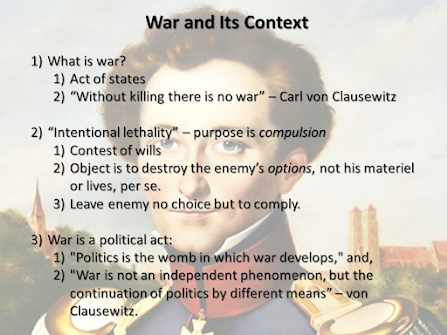
But what is war? The question seems self-evident, but modern Conventions such as The Hague and Geneva Conventions are careful to define. For centuries, war has been understood to be an act of nation-states, not of combat between non-state combatants, no matter how well armed and organized. Understand, however, that armed conflict between a nation state and a non-state combatant does qualify as war under the Conventions and other relevant treaties. 

War is an act of deliberate destruction of an enemy's lives or physical assets. Absent "intentional lethality," there is no war regardless of what armed forces may otherwise do. Historically, however, the purpose of those operations has not simply to kill, but to compel submission by the enemy. As the US Army's World War 2 Gen. George S. Patton said, "Battles are won by frightening the enemy. You frighten the enemy by inflicting death and wounds." 

Europe's most celebrated theoretician of war is Prussian Gen. Carl von Clausewitz, 1780-1831, whose book, On War, is still studied around the world. One of his central tenets is that, "Politics is the womb in which war develops," and therefore, war is "the continuation of politics by different means.” 

Today's conventions clearly recognize that principle. 


In theorizing about war, these are the underlying visions of warfare that are used, usually more than one is used. 


As you can see, a nation's leaders may use moral principles to decide that employing the armed forces is justified under the various Conventions and the leaders' own national principles. But they may also see that while war is morally justified, it would be unwise and would likely have unacceptable outcomes. 

And that  leads to what are the bases, or templates, for which war might be made? I will let my slides speak for themselves:


Just War Theory JWT is a holistic view of war with a focus on attaining justice, limiting suffering, and encompassing all three of:

  • The cause of war
  • The conduct of war
  • The termination and aftermath of war
So, let's look at the basic details:


Just War Theory, along with international conventions and accords, forbid wars of conquest or aggression. The basic principle is that a nation may justly go to war to defend against aggression or to protect such aggression against third parties. However, Europe's history, culminating in the 30 Years War of the early 1600s, led to rejecting protection of third parties as an excuse to go to war. The Peace of Westphalia established national, geographic boundaries as the demarcation of nations (warring of parties), not language, tribal identity, or ethnicity. And the Peace deliberately set the internal affairs of a nation as immune from interference, especially war, by other states. 

This has formed a foundation for "governance" (if one may use that word) for war ever since, and is reflected strongly in the United Nations charter. The UN charter does explicitly allow for international alliances outside the UN that may establish war making for defensive purposes, with NATO being a primary example. 


Just War Theory holds as a matter of principle that making war therefore must be undertaken to establish a more just peace than pertained prior to the conflict. And the war may not itself be of greater evil than that it seeks to prevent. 

That war may not justly be waged absent reasonable prospect of success is important. It relates directly to the tenets of just conduct of war, and especially the greatly misunderstood principle of proportionality, about which more later. 

The Principle of Proper Authority

Just War Theory mandates that nations may go to war only with proper authority to do so. There is no international agreement on what that may be as a universal standard. The UN Charter permits specific kinds of war without UN consultation, but requires UN Security Council approval for other wars. (President Truman, for example, gained UNSC approval for the Korean War.) 

The UN Charter also recognizes that nations make security arrangements and treaties outside the UN structure. The most famous example is Article 5 of the NATO Charter, which requires every NATO member nation to respond militarily if any NATO member is attacked and Article 5 is invoked.
 
However, the only authority that can declare the United States is at war is the US Congress, not the UN. Treaties do not overwhelm the US Constitution. The UN cannot make American war legal or illegal, but it can make it legitimate in eyes of world. 

The US Constitution distinguishes between declaring war, which can be done only by Congress, and making war, which is the purview of the executive. As then-Senator Joe Biden accurately explained in 2001, the Congress has declared war when the Congress thinks it has. Hence, he said, an Authorization for the Use of Military Force meets Constitutional muster as a declaration of war.
I'm the guy that drafted the Use of Force proposal that we passed. It was in conflict between the President and the House. I was the guy who finally drafted what we did pass. Under the Constitution, there is simply no distinction ... between a formal declaration of war, and an authorization of use of force. There is none for Constitutional purposes. None whatsoever. 
Constitutional lawyers over many decades have held that varying kinds of enabling acts, such as monetary appropriations for military action, have also amounted to Constitutional satisfaction and, at least, consent of the Congress to action ordered by the president, in whom the Constitution grants authority to conduct warfare.

Just Conduct of War

Let me begin by reiterating that warfare is intentional lethality and destruction. Just conduct of war means that there must be limits to both. And that is where the principle of proportionality comes in. 

The doctrine of proportionality is simply stated that the means of conducting the war must be proportionate to the goal for which the war is waged. Another way of looking at it is that while the just ends desired do not justify any means to attain them, they absolutely justify some means. The tenet of proportionality, then, is to assess what the justified means are, then employ those means and not the unjustified ones.

The centering question of the doctrine of proportionality is deciding the violence necessary to achieve the war's objectives while not using excessive violence to do so. To employ too little violence is as disproportionate as to employ too much. It is unjust to wage war ineffectively even for a just cause.

Hence, proportionality means that one cannot use more force than necessary, but must use all the force that is necessary. It is critical to understand that proportionality does not mean, and never has meant, anything like a tit-for-tat response. 

In this, as in most of the just conduct tenets, huge gray areas of uncertainty abide. The combatants must do the best they can.  

The doctrine of Discrimination of violence means that weapons may not be employed with little or no regard to the nature of the target. Specifically, non-combatants may not be deliberately targeted and in fact, warring parties must use all achievable means to avoid it. But as warfare of the past 100-plus years has showed, it is permissible to bomb enemy factories even though factory workers are not members of the military. 

However, an international standard called Common Article 3 governs combat between state and non-state combatants. Its states that civilians' presence at a location does not automatically make that location off limits from attack. As Human Rights Watch explained during 2006's Hezbollah war, 
It, too, can be targeted if it makes an “effective” contribution to the enemy’s military activities and its destruction, capture or neutralization offers a “definite military advantage” to the attacking side in the circumstances ruling at the time. 
Other Categories
  • There are Hague Protocols on chemical and biological weapons. In this, United States policy since at least the 1960s has been in compliance. It is that the US will not use bioweapons, period, and will not be the first to use chemical weapons, but retains the right to respond likewise against an enemy's use of them. (As for nukes, US policy has not changed since they were invented: We have atomic weapons, and if you do not want us to use them, then do not attack us. Other nuclear-armed nations have basically the same stance.) 

  • Use of civilians as hostages or “human shields” is prohibited. 

  • Hospitals, other categories (such as houses of worship) may not be attacked. 

  • No “false flagging,” such as marking combatant vehicles with the insignia of the International Red Cross. 

  • Honorable surrender is defined, required to be honored. Pretense of surrender is prohibited for any reason. 

  • Militarization of protected structure removes its protection. A hospital, for example, may not be bombed, but if a combatant places anti-aircraft weapons atop it, it may legally be leveled without warning. 

  • The Conventions specify permissible treatment of POWs and refugees, including prohibitions of torture and other actions. 

  • Retribution actions are permitted, but very narrowly. For example, if a combatant nation executes 20 POWs because two of them had attempted escape, the those soldiers' nation may execute in retribution POWs that it holds, but only up to a point. 
The Conventions also specify occupying power obligations and define the distinction between lawful and unlawful combatants. Unlawful combatants are not afforded all the protections of lawful combatants. 

And the Conventions define and require the responsibility of moral action and accountability for all sides. That is, a warring nation is required to bring to discipline any member of its armed forces who commits a war crime.  

Just Ending of War

Here, there are three guiding principles:
  • Enduring peace 
  • Restraint of the victor 
  • Reconciliation among warring parties
What is the future of JWT, especially in its relation to international accords? I close with a link to an article by Jeff McMahan, professor of philosophy at Rutgers University and author of The Ethics of Killing: Problems at the Margins of Life and Killing in War. Click here: "Rethinking the ‘Just War,’ Part 1" (part 2 is linked at the end of that article).

Monday, March 3, 2025

"I stand with Ukraine" means what, exactly?

Ukraine has only two choices

I am not going to dwell on the now-infamous, televised meeting that Ukraine's President V. Zelensky had with President Trump last Friday in the Oval Office. It is the outcome of the meeting that matters now. Why the meeting went the way it did does matter, but it is not my subject here. 

There are now only two paths forward for Ukraine, and therefore for the United States, NATO, and the EU nations who have supported Ukraine. I note that very quickly after the Oval office meeting adjourned, many progressives and Democrat figures posted memes like this one. 


Yet no one who posted this meme explained what exactly it means. As I asked at one such post, "If a Ukrainian in the war zone read your post, 'I stand with Ukraine,' what exactly would you want her to think you mean? How would you describe the ways her life and future will be better?" 

So let's take a look at the two - and only two things "I Stand With Ukraine" can mean. There are no other choices. 

First, though, I want to explain my creds in what I will write. I am a retired Army artillery officer with command and war-planning experience and responsibilities from battalion level to corps level and at the Pentagon, including at the Army Operations Center there. I have written operation plans and planning documents for actual shooting wars. I had the highest security clearances, including for nuclear and chemical target analysis, custodianship of actual atomic weapons, and decryption of Nuclear Control Orders. I am a graduate of the US Army Command and General Staff College. During part of my Pentagon tour I served on the personal staff of the Secretary of the Army. Now to continue:

Here are the only two things "I Stand With Ukraine" can mean:

ONE. I want the Ukraine war to continue on indefinitely in the same way it is going now. That means that I want more and more Ukrainian military and civilian personnel to die, more Ukrainian infrastructure to be destroyed, and countless more Ukrainians to refugee out of their country. 

TWO. I want the combat and killing to end and an enduring peace to be achieved, even if it means the status quo antebellum is not reestablished. 

The first thing operations and strategy planners do when going to work is to ask one simple question: "What is the status quo?" That is, what are the realties that exist now that we have to take into account? What is the situation and its implications? Regarding the Ukraine war, here are the important realities:

First, Russian forces have taken control of considerable Ukrainian territory (map source: BBC):

Zelensky has said - over and over since the war began - that he will accept no end of the war that does not include ejection of Russians from the territories they occupy in eastern UKR. In fact, he stated that point strongly in the now-infamous Oval Office meeting with Trump

Putin, however, insists that those territories are Russian home soil, not Ukrainian. In fact, it is true that they are large majority, ethnically Russian. Putin either does not know or does not care that the reason for that is that Stalin ejected and murdered Ukrainians living there and moved Russians in. Putin has threatened to use nuclear weapons to keep possession of those territories (although he has not repeated the threat very recently). 

Both sides have lost enormous numbers of personnel and military equipment. I would say that if Putin and co. are both willing and able to suffer even more such losses, they could push westward enough to set the terms for an armistice. That is a big if, though.

As for UKR, it simply does not have the human resources to recover the occupied territories, no matter how well armed they may be in the attempt. They did attempt it in 2023, when their military was much better manned (and womaned) and they failed miserably. After four months of a weak offense against Russian positions, UKR's army was on pace to recover the occupied territories - in 16 more years. Even Time magazine reported that UKR insiders near Zelensky said they all knew this, but that talking to Zelensky about it was a waste of time. 


That is the status quo, meaning both sides will continue to attack each other, but with no real changes on the map resulting. Again: this is what Zelensky stated very specifically he wanted to continue. And that is what Trump was trying to end and what Democrats also want to continue, apparently forever.

What was the reaction from Europe? Occupy Democrats posted this on Feb. 28:


Note that most of the Euro leaders simply said, "We stand with Ukraine," without saying exactly what that means. By default, it means they are choosing Option One: continuing, inconclusive warfare with more death and destruction and no end in sight. The relatively few nations that stated they wanted peace did not define what steps are necessary to achieve it or what acceptable terms are for peace. For example, Prime Minister of the Netherlands Dick Schoof: "... We want a lasting peace and an end to the war of aggression started by Russia." 

Well, duh. We all want peace, even Zelensky has said that. It is worth noting, however, that Zelensky demands peace with "security guarantees," but he has never addressed what those guarantees would be, how they would be accomplished, or who would guarantee them. 

I wonder, though, how aware these national leaders are of their own populations' attitude toward supporting Ukraine, which is both (a) Ukraine needs more support, but (b) not from my country:


So, to those who insist they "stand with Ukraine," please choose which option you mean. Do you mean you want the war to continue indefinitely? If so, why? Is there a time limit for supporting the status quo that once expired would turn you to wanting an end to the war? Or is there a limit to how many more Ukrainians may be violently killed that would change your mind? Or do you just want the combat to continue with no end? 

Or do you want the war to end as soon as possible? If yes, how? What would be your plan to end it? I echo what the Army Chief of Staff used to remind us at the Pentagon when we made plans: "Hope is not a method and wishes are not plans." What actions would Ukraine, the US, and Euro/NATO nations need to take to bring UKR and Russia to at least an armistice/ceasefire, even with more permanent details to be worked out afterward? President Trump did at least state them while no one else has. 

Finally, hating Trump is merely cheap virtue signaling. It is neither a method nor a plan. But if you feel better about hating Trump than you feel bad about Ukrainians getting killed with no end in sight, then you are morally bankrupt and God forbid you have any say in what happens. 

Links and pertinent info:

NATO's empty promise to Ukraine

Ukraine: Zelensky is a true hero, but does he have a clue? 

What Is America’s Strategic Interest In Ukraine?

What if Putin nukes Ukraine?

Ukraine on Fire documentary

 From Oliver Stone in 2016, so obviously not including recent events. But it does explain that no one's hands are clean, including America's. As for its sub-head, "Russian Aggression or American Interference?" well, as the saying goes, embrace the power of "and."

NATO RIP - Ukraine, Europe etc. Ukraine is probably going to RIP NATO into bits

10 Hard Facts About Ukraine and NATO, by retired Colonel and Army War College graduate Kurt Schlichter. 

Ten bad takeaways from the Zelenskyy blow-up, by renowned historian Victor Davis Hanson.

A view by the German editor-in-chief of Asia Times: Europe’s dangerous delusion of defense without the US - Europe can dream about strategic autonomy but the reality is it wholly lacks the military means to defy Trump’s Ukraine peace plan

Friday, February 21, 2025

The aftermath of Hamas murdering children

On Feb. 20, Hamas handed over to Israel the corpses of four dead Israeli hostages, including two small children, but only after using them for propaganda. 

Before handing over the remains, Hamas staged a parade of the bodies through streets of Gaza, proudly and cruelly displaying them  to cheering Gazan crowds. As the Wall Street Journal observed, 

Hamas put their coffins on a stage in front of a huge propaganda poster of Israeli Prime Minister Benjamin Netanyahu. A crowd looked on and milled around, and “triumphant music” played, according to one news report. Mr. Netanyahu was depicted with fangs, dripping blood above the faces of the four dead hostages, smiling in photographs from happier times. “The War Criminal Netanyahu & His Nazi Army Killed Them with Missiles from Zionist Warplanes,” the poster claimed.

The coffin propaganda underlines the challenge of deradicalization for any postwar plan for Gaza.

Israeli medical staff conducted autopsies on the returned hostages. One was Oded Lifshitz, 84. The other three were Kfir and Ariel Bibas and their mother, Shiri. The Israeli government then announced: 

A. The bodies of the two children, one taken hostage at 4 years old and the other at 9 months, are injured in ways completely consistent with being brutally murdered, mainly by manual strangulation, and inconsistent with being killed by an air strike, as Hamas claims. 

Update: It is also confirmed that after the two boys were strangled, their bodies were pounded with rocks to make them appear to have been killed by an air raid. Details here, if you can stomach them.

B. The body of Shiri is in fact not Shiri at all. Hamas gave a corpse to Israel of a dead woman whose identity is unknown. 

Update: Hamas has now returned the actual remains of Shiri, whose identity has been so confirmed by Israel. 

What Hamas did drew sharp rebukes from very senior Arab Muslim authorities. 


And in yesterday's WSJ, author Bernard-Henri Lévy had this and other things to say about Hamas. 

Once, children were gassed as they descended from the trains. Hamas waited. Damn those who try to drag us into the false game of moral equivalency. These two breaths cut short, this double death of innocence, is Hamas’s abomination alone—and it is unforgivable.

Were the two muftis sincere in their condemnations? I think so. The muftis know very well that Muhammed specifically forbade the intentional killing of children, even in warfare. (That is no doubt why Hamas lied about Kfir and Ariel being killed by an Israeli airstrike. Hamas openly celebrated that they were dead but lied about how they died. Why one and not the other?)

Islam holds that there are two inarguable sources of commandments that must be obeyed with no exceptions. One of course is the Koran. The other is the Hadith, which is a collection of sayings of Muhammed. The Hadith is equal in status to the Koran. 

In a well-known hadith, Muhammed instructed his companions during military expeditions, "Do not kill children, women, or the elderly, and do not attack those who are not fighting." (Reported in Sahih Muslim, Sunan Abu Dawud, and other collections)

Another narration states, "Do not kill a child, nor a woman, nor an old man, nor destroy crops, nor kill those who are in their places of worship." (Sunan Abu Dawud)

Islamic jurisprudence distinguishes between combatants (those actively engaged in fighting) and non-combatants (those who are not involved in hostilities). Children, by their very nature, are considered non-combatants and are protected under Islamic law.

The deliberate targeting of children, whether in warfare or otherwise, is considered a grave sin and a violation of Islamic law.

The looming question now is, "In light of these Hamas atrocities, what happens (eventually) to Hamas and the future of Gaza and its people?" 

On Feb. 4, President Trump raised a lot of eyebrows by declaring that Gaza should become an American protectorate, the Gazan people should be resettled elsewhere, and then the US would rebuild Gaza as a sort of "Middle East Riviera." Political and media commentators scornfully denounced the idea right away. On Feb. 6, I commented on Facebook:

When the Israelis withdrew from Gaza in (IIRC) 2004-2005, they actually offered to do much the same thing as Trump said, although on a smaller scale. Hamas seized power shortly afterward and killed every Gazan who got in their way.

But could it happen now? I think this is less a real proposal than Trump's way of signaling to Egypt, Saudi Arabia, and other Arab states that the status quo antebellum must not be restored. Trump's real message, I think, is, "The perpetual warfare between Israel and Hamas stops now." And yes, it has been perpetual; I visited the southern Israeli town of Sederot in 2007 on the same day it received a rocket bombardment from Gaza.

What Trump did was describe a wealthier, peaceful future for Gaza and the next step is to simply ask, "If not that, then what? Because more years of war is not on the table."

The Wall Street Journal's editorialists said much the same thing, but with more historical context and detail. 

President Trump’s idea that the U.S. might remove and relocate some two million Palestinians from Gaza and then “own” and rebuild the strip isn’t going to happen soon, if ever. But the idea, however preposterous, does have the virtue of forcing the world to confront its hypocrisy over the fate of the Palestinian people.

What was the Arab powers' reaction? It was that they got Trump's message, at least in part. 


Egypt led the response, probably because Hamas was a child of the Muslim Brotherhood, an Egyptian Islamist, insurrectionist movement dating to the 1920s. Egypt's government finally defeated the Brotherhood only in 2013, although the Brotherhood cannot be said to be fully neutralized yet. That Hamas and the Brotherhood are so closely linked is doubtless the reason that when the present war between Gaza and Israel began, Egypt publicly announced it was sending a tank battalion to its border with Gaza with orders to shoot on sight anyone crossing the border without prior permission. Egypt also strongly reinforced its border wall.

So it is no wonder that Egypt's immediate response to Trump's declaration was that it would refuse to resettle any Gazans, even temporarily, and that Hamas must have no role governing postwar Gaza. 


And now the rest of the Arab world understands that Hamas has committed atrocities that directly violate the commandments of Muhammed. Of course, the Arab elites already knew that, but Hamas handled the return of the dead hostages, especially the two dead children, so stupidly that it could not be ignored or shrugged away. 

I think a corner has been turned. If, as I wrote at the time, Trump's real message was "this is the last war Hamas will fight, ever," then I think the Arab powers are taking it seriously, regardless of the rest of what Trump said. The stupid parading of the four dead hostages to celebrate their deaths and the obvious lie that Hamas did not kill the children have forced Arab elites and rulers to take Trump's declaration seriously, even if not literally. 

So has a corner been turned? We can hope so, but at this point only the steering wheel has moved. The war is not over. But at least the Arab powers are finally confronting the fact that when it ends, the ending must be permanent this time. And that is progress. 

Friday, October 13, 2023

War and the reshaping of societies

 Let me emphasize at the outset that my assessment of the looming Israeli invasion of Gaza is intended to be descriptive, not prescriptive. I am not proposing what Israel should do, but what it may do as the coming days and weeks unfold, even if Israel does not actually intend it now. 

Israeli artillery firing

Having formed a "unity government" for the war, Israeli PM Benjamin Netanyahu has stated clearly that the permanent end of Hamas as the principal war aim. That this objective requires a land invasion of Gaza is also clear. But what can it take to destroy Hamas? Netanyahu has said that killing its terrorists fighters is a specific goal, but Hamas is not merely an organization. It is also an ideology. How does Israel end with not only the present Hamas organization destroyed, but also the ideology?

America's Civil War and World War 2 may provide a clue. 

But first, what is Hamas' ideology? 

It is very simple: Kill Jews, kill Jews, kill more Jews. Specifically, Hamas (and Lebanon's Hezbollah) has said publicly and often that it has at least the following goals:

1. The elimination of the state of Israel and establishment of a Muslim nation "from the Jordan river to the Mediterranean Sea." Jews must vacate this land entirely or they will be killed. 

2. In the meantime, and as a tactic to attain that goal, Hamas has said before and again very recently that Jews must be killed. Last Saturday, Hamas military commander Mohammed Deif announced,  “Operation Al-Aqsa Deluge.” Al-Aqsa is the name of the mosque atop the Temple Mount in Jerusalem. Deif said that the mass killings of Israelis were a mere “first strike,” with much more yet to come. 

Photos: New York Times

Deif was not ambiguous, emphasizing, 

“I say to our pure mujahedeen: This is the day that you make this criminal enemy understand that its time is up. ‘Kill them wherever you may find them.’” 

The last sub-quote is directly from the Quran, Suras 2:191 and 4:89. Someone might object that Deif is being very selective in his quotes of the Quran (he used other such verses) because there are verses of peace and tolerance in the Quran. For that, please read the explanation of the Muslim principle of Naskh, or abrogation, at the end of this post. 

Hamas is making total war against Israelis. It only goal is to kill Israelis. It does not merely hope, but actually believes that doing so will bring the cessation of Jews living in Hamas' future Palestinian state.

It is also worth noting that mainline Islamic exegesis of the Quran and Hadith is (and has been since Mohammed's day) that any Muslim killed while fighting for Islam is brought immediately into Allah's paradise. This is not a fringe view; it was stated plainly by Mohammed himself. As Muslim scholar Tajuddin B. Shu`aib explained:

[F]or Muslims to wield weapons in a war in which Islam itself is defended is literally an act of worship. The Muslim jihadi has the right to expect reward proportionate to his sacrificial worship. In military jihad, the ultimate sacrifice is to die, which deserves the ultimate reward, immediate entry by the slain jihadi's soul into Paradise. This doctrine springs from the words of Mohammed himself, who during the battle of Badr told his soldiers, "I swear by the One in whose hand Mohammad's soul is, any man who fights them today and is killed while he is patient in the ordeal and seeks the pleasure of Allah, going forward and not backing off, Allah will enter him into Paradise.“

Lessons from the Civil War and World War 2

As I noted in, "Confederate monuments: So what? Now What?," the only meaningful ideological difference between the CSA and the Union states was over slavery. What the CSA's ideology was hardly needs explaining. (I should note again that President Lincoln was adamantly anti-slavery, but ending slavery was not why he went to war with the CSA.) 

After more than two years of indecisive, though bloody fighting, the Union's strategy took a linchpin turn when Gen. U.S. Grant was appointed commander of the US Army and he unleashed Gen. William Tecumseh Sherman to invade the South. Sherman stated his goal very plainly:

 "War is the remedy that our enemies have chosen, and I say let us give them all they want."

"This war differs from other wars, in this particular. We are not fighting armies but a hostile people, and must make old and young, rich and poor, feel the hard hand of war."

Sherman's tactics were ruthless, but they did do what he set out to do. His and Grant's maneuvers and battlefield victories made it very plain not only to the Confederacy's leadership (especially Gen. R.E. Lee) that they could not win the war, it was also crystal clear to ordinary men and women throughout the South, including those never actually touched by the fighting. Slavery was ended by the war and it is worth noting also that no state has attempted to secede since then. 

When the United States entered World War 2, it knew that invading enemy-occupied nations and territories was unavoidable. In 1943, Gen. D.D. Eisenhower was named Supreme Allied Commander of European operations and was given this simple directive: "You will enter the continent of Europe and in conjunction with other Allied nations, undertake operations aimed at the heart of Germany and the destruction of her armed forces.” 

 Based on what the Israeli government has said about its objectives in its present war, Eisenhower's directive could be lightly modified to state Israel's objectives in invading Gaza. However, as allied forces in WW2 found out, and as Israel undoubtedly realizes, military theorist Carl von Clausewitz nailed it about 200 years ago: "In war everything is simple, but the simplest things can be very difficult."

One of the preludes to the massive landings on Normandy's beaches to "enter the continent or Europe" in 1944 was sustained, large-scale aerial bombing of Germany by American and British aircraft. As the war went on and German (and Japanese) resistance failed to slacken, President Roosevelt decided that the German and Japanese peoples must realize after the war that not only had their armed forces been defeated: the entire nation, as a nation, had been beaten. He and Churchill were well aware that German militarism had survived World War I because its apologists had successfully propagated the myth that the Kaiser's army had not really been defeated, it had been "stabbed in the back" by disloyal factions at home.

Hence, wrote Roosevelt in a letter to Secretary of War Henry Stimson,

It is of utmost importance that every person in Germany should realize that this time Germany is a defeated nation. . . . The fact that they are a defeated nation, collectively and individually, must be so impressed upon them that they will hesitate to start any new war.

So, according to historian Richard B. Frank in his award-winning book, Downfall, the End of the Imperial Japanese Empire:

Viewed in this light, massive urban bombing complemented the aim of unconditional surrender. It was not just a handful of vile men who flaunted vile ideologies; whole populations imbibed these beliefs and acted as willing acolytes. Unconditional surrender and vast physical destruction would sear the price of aggression into the minds of the German and Japanese peoples. No soil would be left from which myths might later sprout that Germany and Japan had not really been defeated. These policies would assure that there would be no third world war with Germany, nor would Japan get a second opportunity.

One notes that Japan and Germany have been well behaved since 1945. But we also have to note that massive, destructive bombing was alone not the reason. It was simply impossible for either country's armed forces to claim that they had prevailed, or at least held their own, on the field of battle. German and Japanese orphans, widows and grieving parents were in almost every other household, and a lie that their armed forces had not really lost could not possibly have found legs to stand on.

Dresden, Germany, 1945

Gaza, 2023

Israel's task is to discern what it will take (a) actually to destroy Hamas as a threat to Israeli lives, and (b) how to make sure that Gazans never again consent to another such organization to operate among them. (Remember, the Gazans elected Hamas to power in 2006, but that was the last time the Gazans had any say.) 

That Israel has today issued warnings to northern Gazans to evacuate within 24 hours was done from humanitarian considerations as well as hoping for military simplicity when Israel invades I have no doubt. That Hamas has said that it will not permit anyone to evacuate underscores Hamas' brutality, but it may also serve to underscore to ordinary Gazans that Hamas is not really their benefactor. (However, as I type, TV news is showing video of long lines of cars moving south along the Gazan coast.)

When Israel incurred into Lebanon in 2006, I observed that the fighting there had come to resemble the combat on Okinawa in World War 2, with well-prepared defensive positions and underground lines of communications. Hezbollah emphasized anti-tank capability, just as the Japanese had learned to do on the Pacific war. 

But combat in both Okinawa and Lebanon was mainly on open terrain, while Gaza is heavily built up. Urban combat is the most brutal and difficult of all conventional fighting for it takes place not only in left, right, front, and rear, as in open country, but also up and down. Hamas has spent years not only fortifying potential defense positions, but also constructing tunnels around Gaza that some estimates say are 300 miles in length altogether. As well, they are certainly booby-trapped with remote detonation. 

The End Game

At this point, both Israel and Hamas must realize that, as Gen. Douglas MacArthur said, "In war there is no substitute for victory." Victory for Hamas can be defined very simply: it survives as an ongoing, at least minimally effective, violent anti-Israel entity as before. Hamas' leaders know that to abandon murderous violence to establish a purely Palestinian state by political measures, rather than violence, means two things: (a) Hamas would not even be Hamas any more, so what is the point, and (b) mere politics will never accomplish that goal anyway. Hamas' true believers would literally rather die than take that course.

As for Israel, its leadership at least knows that Hamas must be ended and no Hamas-by-another-name can be allowed. There is no answer to how long it will take to destroy Hamas or how many casualties it will cost. But neither Grant nor Sherman knew those things ahead of time, either. So Israel must proceed, though it is doing so as Otto von Bismarck reportedly said about going to war, "entering a dark room blindfolded to search for a black cat that is not even there." 

Gaza's residents, whether they know it now or not, must decide in whose hands they literally trust their lives and the lives of their children. Hamas is quite willing to sacrifice them. But they may come to realize that while Israel will not target them, neither will Israel refrain from attacking if Hamas militarizes their refuges. An international standard called Common Article 3 governs combat between state and non-state combatants. Its states that civilians' presence at a location does not automatically make that location off limits from attack. As Human Rights Watch explained during 2006's Hezbollah war, 

It, too, can be targeted if it makes an “effective” contribution to the enemy’s military activities and its destruction, capture or neutralization offers a “definite military advantage” to the attacking side in the circumstances ruling at the time. 

Victory for non-combatants on both sides really means that they live through the war. But tragically, so many have died already and so many more will die to come. 

End Note: The Muslim principle of abrogation. 

The Quran is not arranged chronologically. Its chapters (Suras) are presented according to their length. Even within chapters chronology is confusing. For example, Sura 2, v. 190 was revealed to Mohammed six years after v. 193, and there are other such examples.

The principle of abrogation is followed by all Muslims and Muslim clerics. It is simply that the chronologically-later verses supersede, or abrogate, the earlier ones if there is a conflict (and there are many such conflicts). All the verses of peace are earlier than, and therefore abrogated by, the "verses of the sword." 

The principle of abrogation is mainline Muslim exegesis; the Quran has been understood this way since Islam's beginning. (See "Islam: the requirement of jihad.")

See also "Israel's Darkest Day," by David P. Goldman, with whom I have corresponded now and then over the years. Very thought-provoking essay. 

Update: The Wall Street Journal, "Israel Aims to Destroy Hamas. What Comes Next for Gaza Is Unclear" (free link):

“We will destroy the rule of Hamas,” Israeli Defense Minister Yoav Gallant said Friday after meeting U.S. Defense Secretary Lloyd Austin in Tel Aviv. “We will eliminate the military capabilities of Hamas. We will make sure this threat does not exist on our borders. It will be lengthy. It will be lethal. It will be powerful. And it will be for forever.”

But Israeli leaders have yet to answer another important question: What comes after Hamas? ...

“I don’t give a damn,” said Jacob Nagel, who served as Prime Minister Benjamin Netanyahu’s national security adviser and is in touch with government officials. “It’s much more important to act and finish the problem. And then we can decide what to do.” 

“I used to say: think then act. What happened this weekend changed all the rules of play,” added Nagel. His view is echoed by Israeli military and political leaders across the political spectrum.


A world without nuclear weapons - what would it look like?

 From Pope Leo this week, according to the National Catholic Reporter : " Pope Leo quotes Bob Dylan song in book foreword calling for n...