Showing posts with label Evangelism. Show all posts

Sunday, March 30, 2025

The Right People for the Wrong Crowd

Luke 15 begins:

1 Now all the tax collectors and sinners were coming near to listen to him.  2 And the Pharisees and the scribes were grumbling and saying, “This fellow welcomes sinners and eats with them.” 

When you read the gospels, you discover that wherever Jesus was, there were usually a lot of the riffraff of society right there with him. One of the remarkable things about Jesus is that he accepted and even sought the company of people considered socially undesirable. In fact, Jesus once even invited himself to dinner at a hated tax collector’s house. 

Then, as now, the influential and powerful people didn’t like the wrong crowd and they didn’t like the way Jesus hung out with the wrong crowd. They thought there was a character defect in a man who would welcome sinners and eat with them. 

Usually we set up the Pharisees as the bad guys of the gospels. After all, Jesus criticized them frequently. But I will tell you: the closer my children got to high school the more I became like the Pharisees. I examined their friends closely. I wanted to know who they spent their time with and what they did together. I remember my own parents wanting to know these things and warning me not to keep bad company.

None of us would ever say to our children, “Go downtown and hang out with the drug pushers and shoplifters.” And if our kids did so, we’d certainly think they had gone terribly wrong. We are socially a lot more like the Pharisees than Jesus. We try to keep the wrong crowd at arm’s length or out of sight. 

The Pharisees wanted to avoid the wrong crowd. That’s not inherently a bad thing. The Pharisees believed that the separation of good and bad was necessary for the well being of the community. We believe that, too. It's why we have jails, after all.

But the Pharisees went too far. In their eyes, the people Jesus welcomed were beyond the margins of proper society and were to be scorned and rejected. And Jesus even ate meals with them! The Pharisees objected strenuously. So, Jesus told them parables about three lost things: a sheep, a coin, and a father who had two sons. He started this way:

4 “Which one of you, if he has a hundred sheep and loses one of them, would not leave the ninety-nine in the open pasture and go look for the one that is lost until he finds it? 5 Then when he has found it, he places it on his shoulders, rejoicing. 6 Returning home, he calls together his friends and neighbors, telling them, ‘Rejoice with me, because I have found my sheep that was lost.’ 7 I tell you, in the same way there will be more joy in heaven over one sinner who repents than over ninety-nine righteous people who have no need to repent.”

A shepherd has a hundred sheep counts only ninety-nine. So, he leaves the ninety-nine to find the lost sheep. He brings it home and calls his friends to rejoice with him. "Just so," Jesus concludes, "there will be more joy in heaven over one sinner who repents than over ninety nine righteous persons who need no repentance."

Then he told of a woman who lost a coin and tore her house upside down to find it. When she did, she threw a block party to celebrate. “Just so,” Jesus said, “I tell you, there is joy in the presence of the angels of God over one sinner who repents.” 

This is a play in three acts, and the third act Jesus told was a story of a young man who demanded of his father his share of his inheritance now. Dad gave it to him, and the young man moved far away. But he went broke and wound up slopping hogs for a living, which for a first-century Jew would be as far down the ladder as you could get. He remembered that even his father’s hired men lived better than that. So, he set off for home to ask for a job as a ranch hand. 

But while he was still far off, his father saw him and was filled with compassion; he ran and put his arms around him and kissed him. 21 Then the son said to him, ‘Father, I have sinned against heaven and before you; I am no longer worthy to be called your son.’ 22 But the father said to his slaves, ‘Quickly, bring out the best robe and put it on him; put a ring on his finger and sandals on his feet. 23 Get the fatted calf and kill it and let us eat and celebrate; 24 for this son of mine was dead and is alive again; he was lost and is found!’ And they began to celebrate. 

But the elder son refused to join the party. The father went to him, but the elder son said, 

"Listen! For all these years I have been working like a slave for you, and I have never disobeyed your command; yet you have never given me even a young goat so that I might celebrate with my friends. 30 But when this son of yours came back, who has wasted your property on prostitutes, you killed the fatted calf for him!’ 31 Then the father said to him, ‘Son, you are always with me, and all that is mine is yours. 32 But we had to celebrate and rejoice, because this brother of yours was dead and has come to life; he was lost and has been found.’” 

When we hear these stories, we imagine that we are the lost sheep or the wayward child. Sometimes we feel lost even now since we can still move away from God. We are comforted by the image of a God who keeps looking for us no matter how far we stray. All the tax collectors and sinners were coming near to listen to Jesus. When you are on the receiving end of the God who seeks you out, these parables are good news. 

But we should hear these parables with a cautious ear. Something strange is going on. “Which one of you, having a hundred sheep and losing one of them, does not leave the ninety nine in the wilderness and go after the one that is lost until you find it?” 

Now, our usual reaction to Jesus’ question is a sort of warm, mushy feeling as we envision a kindly shepherd searching high and low and gently bearing the lost lamb back on his broad shoulders. But that’s simply ridiculous! Which of you, having a hundred one-dollar bills in a crowded park, and losing one of them, would leave the other ninety nine on the park bench and go after the one that is lost until you find it? No one!

No shepherd would leave the flock to be easy prey for wolves for the sake of one lost sheep. A shepherd’s livelihood can survive the loss of one sheep, but not the loss of the many which would be killed if he abandoned the flock. It seems silly for the woman to throw a big party for finding her coin. Surely the party cost far more than the value of the coin. 

These parables make no obvious sense. There is no moral lesson for the lost. The sheep and the coin are found not because of anything they do but because someone is determined to find them. A lost sheep doesn’t know it is lost. It’s quite likely to wander away again. The coin is just an inanimate object. The son returns home to a place of honor, which reveals deep rifts within the family. What’s going on here?

Maybe the central point about these stories is not the lost sheep or coin or the wayward son. Maybe the stories tell us practically nothing about the lost ones, but an awful lot about ourselves. Jesus speaks of repentance in the first two stories but not the third. The wayward son is never said to repent, though he does have a carefully rehearsed, syrupy, and probably insincere speech. He starts to give it to his father, but his father interrupts it and tells his servants to prepare a banquet. 

Why does Jesus talk about repentance in the first two parables but not the third? No repentance is even possible for a coin or a sheep. And yet Jesus said at the end of each that all heaven rejoices when a sinner repents. So: who’s the sinner and what’s the repentance? 

For Jews of Jesus’ day “repentance” meant, “a fundamental change.” Who else could that be true of other than the shepherd and the woman? Whatever they had planned for the day got discarded because they lost count of what was valuable to them. So, they made a fundamental change to make the count include everything. Maybe that is what heaven celebrates: those who make a fundamental change about what counts. 

The older son, angered by the mercy of his father and the inclusion of his admittedly dishonorable younger brother, scorns the celebration. After all, the younger brother’s return is not characterized as repentance at all; it might be nothing more than a quest for free meals. The older son followed all the rules, did everything right. He neither asked for nor received dad’s favor. Now he feels cheated. And the father botched being a father because he didn’t remember, apparently, how to count to two sons, not just one. He never tried to find his wayward son, he just waved goodbye and good luck. Unlike the stories of shepherd or the woman, there was no fundamental change by anyone in the third parable. There is no one to admire in this parable. 

Nothing comes together for that highly dysfunctional family even at the end. We do not learn whether the rifts between the father and his sons, or between the brothers, will heal. The only redeeming fact of this story is that the banquet is well justified, because there was one who “was dead and has come to life; he was lost and has been found.” 

[All] The parables end with a party. Jesus doesn’t invite us to be rescued by God, but to join God in recovering the things God treasures. The parables reject the idea that there are certain conditions the lost must meet before they are eligible to be found, or that there are certain qualities they must exhibit before we will seek them out [New Interpreter's Bible]. 

Here is a true story: One winter when I was about twelve years old, two orphaned brothers walked from their temporary foster home to my neighborhood to ride their homemade sled down the steep hill near my house. My neighborhood group was at the hill riding our store bought Flyers. The two orphans’ sled had wooden runners and it tore the snow up. Frankly, we didn’t want to play with them. They were a rough pair, kind of crude and brash and obviously poor. They were the “wrong crowd” for us middle-class kids. I dropped several hints for them to go tear up some other hill with their lousy sled. Lunch time came, so I went home. While my mother was fixing me a sandwich, there was a knock on the front window next to the door. There stood the younger orphan boy, peering inside my house. My mother opened the door. “Can I have a sandwich?” the boy asked.

My mother brought him inside and took his wet outer clothes and put them into the dryer. She sat him at our dining room table and gave him my sandwich. “I’ll make you another one,” she told me. She heated some chicken soup—which she had not offered me—and set it before him. I wasn’t very happy about all this. I didn’t want to come to the table where that beggar sat. I retreated to the kitchen. My mother followed. I told her, “You gave him my sandwich! You didn’t heat any soup for me, but you did for him!”

My mother said, “Don’t be a stick in the mud! Come have lunch.”

Jesus said, “Come, you that are blessed by my Father, inherit the kingdom prepared for you…. . For I was hungry and you gave me something to eat, I was thirsty and you gave me something to drink, I was a stranger and you invited me in.”

Jesus invites us to become shepherds who seek the lost because they are precious to God and are worth being found. Restoration and wholeness become possible when we treat others according to how they are valued by God, not according to what the world says they are worth. The canyons that separate us—good from bad, worthy from unworthy, lost from found—are bridged by a searching love which embraces us all and invites us all to celebrate. 

Jesus asked the Pharisees to join the search and host the party. He wanted them to think about who counts and who’s counting them. He urged them not to write the wrong crowd off, but to be the right people for the wrong crowd. He challenged them to care deeply about all the people they had given up on and to be willing to take risks to find them. We cannot classify people according to what we think they are worth. The value of a single sheep or a lost coin or a wayward child cannot be computed according to conventional market standards. 

We know who the wrong crowd is, but we also need to know, thanks be to God, that we are the right people for the wrong crowd. 

Friday, December 8, 2023

Pearl Harbor Horror and Grace-Filled Reconciliation

Four months after the Japanese navy wreaked massive destruction and loss of life by bombing Pearl Harbor, U.S. Army Lt. Col. James Doolittle led sixteen small bombers on the first bombing mission against Japan. The bombardier on the sixteenth plane was Jacob DeShazer. He released the plane's bombs on Nagoya and the plane flew on to China, where they were captured by the Japanese. They were tortured mercilessly. They contracted dysentery and beriberi because of the deplorable conditions under which they were confined. Three of the crew were executed in October.

The other five men suffered a starvation diet, their health rapidly deteriorating. One died. A year later the four survivors began to receive a slight improvement in their treatment. The Japanese gave them a single copy of the Bible, which DeShazer had never read. DeShazer waited six months to have his turn to read it. He read it cover to cover more than a dozen times. DeShazer credited his survival to accepting the Gospel of Jesus Christ from that lone Bible.

In 1948, DeShazer was sent back to Japan to testify in war crimes trials of his captors. He stayed for thirty years, preaching the Gospel around Japan. He established a church in Nagoya, the city he had bombed. 

One man who learned of DeShazer’s witnessing was named Mitsuo Fuchida. Fuchida had converted to Christianity in 1949 and met DeShazer the next year. Fuchida became an evangelist, preaching in Japan and over much of the world. He lived a few years in the United States before retiring in Japan.

Do you recognize the name, Mitsuo Fuchida? On December 7, 1941, he had commanded the air armada that attacked Pearl Harbor. In 1952, after becoming an evangelist, he said in an interview, “Christianity has opened my eyes, and I hope through Christ to help young people of Japan” to learn to love their former enemy, America. Speaking in 1959 at Memorial Baptist Church in Brooklyn, he said that after the war he had observed American missionaries in Tokyo feeding the starving and teaching the “ways of Christ.” Such forgiveness, he said, made him want to know more of the Christ “they professed to love.” One of his talks was called “From Pearl Harbor to Calvary – My Testimony.” 

Mitsuo Fuchida and Jacob DeShazer

Mitsuo Fuchida, who had bombed Pearl Harbor, died in 1976. The man who had bombed Nagoya, tortured POW Jacob DeShazer, conducted his funeral in Japan.

In October 1999, some American and Japanese veterans of the battle of Pearl Harbor went to Kyushu, where is the port from which the Japanese fleet had sailed to make the attack. The site is now a peace park. These men, once mortal enemies, gathered to plant cherry trees in honor of their reconciliation. Richard Fiske, who survived the sinking of USS West Virginia, said that as the trees grow, they hoped children would understand what the trees and the park represented, “because,” he said, “if we don’t tell our little ones, our future is none. We give ourselves to them. They carry the future.”

Let us pray:

Gracious God, we come before you as part of your global family, thankful for your generous love and abundant blessings. May we honor your holy name by living up to the inheritance of your salvation, as we bear the name of your son, Jesus Christ our savior, with passion for his work of reconciliation of all the world. 

May your vision of peace and justice be realized and enacted among nations finally at rest from war, among families at peace with each other, and hearts that find their rest in you. Lead us to that day when every tear is dried, every life is fulfilled and the law of love is written on our hearts.

We thank you, Lord, for the lives of all those whose sacrifices have made our freedom possible. We beg your grace for our country and your wisdom to guide each of our citizens. Let us not squander the freedom we have been given by those who died to preserve it. 

Remove from human beings the arrogance of power, our trust in anger, our reliance on weapons, and our love of violence. Chasten us with humility and strengthen our trust in you. Make us agents of your peace in all places. Amen.


Sunday, January 22, 2023

Is salvation by Jesus only?


 John 14:1-10:            

   14“Do not let your hearts be troubled. Believe in God, believe also in me. 2In my Father’s house there are many dwelling places. If it were not so, would I have told you that I go to prepare a place for you? 3And if I go and prepare a place for you, I will come again and will take you to myself, so that where I am, there you may be also. 4And you know the way to the place where I am going.” 

   5Thomas said to him, “Lord, we do not know where you are going. How can we know the way?” 

   6Jesus said to him, “I am the way, and the truth, and the life. No one comes to the Father except through me. 7If you know me, you will know my Father also. From now on you do know him and have seen him.” 

   8Philip said to him, “Lord, show us the Father, and we will be satisfied.” 9Jesus said to him, “Have I been with you all this time, Philip, and you still do not know me? Whoever has seen me has seen the Father. How can you say, ‘Show us the Father’? 10Do you not believe that I am in the Father and the Father is in me?”

What is salvation? What does it mean to be saved? What are we saved from, what are we saved to and what are we saved for? 

Salvation can bring forth deep-seated emotions because people correctly see it as a subject where it is pretty important to be right. I will try to be faithful to the scriptural witness and my own convictions without being dogmatic. Let us remember that our knowledge about God is limited, so we must approach questions about salvation and eternity with deep humility. Not only is God’s grace greater than we imagine, it is greater than we can imagine. 

It would be helpful if we could all start from a common understanding of terms. First is the word “salvation” itself. Countless Christians define it simply as “going to heaven” after they die and are often those Christians surprised to learn that many other Christians offer sound arguments that the Bible does not teach that, nor does the Bible teach that salvation is only something attained in the afterlife only. So with such different understandings among the already converted about something so basic, we should be careful not to sow confusion in the minds of people we are trying to lead to Christ. 

For today let us stipulate that salvation means two minimal things:

1. Salvation is to live this life transformed by personal conviction that, as Paul put it in 2 Corinthians 5, “God was reconciling the world to himself in Christ, not counting people's sins against them” and that as proof of his promises, God raised Christ from the dead. This confession frees us from the shackles of sin and death and enables us to live lives worthwhile for now and eternity. 

2. Salvation begins, therefore, in this life and is fully accomplished by God in eternity with him. Salvation thus means that the death of our bodies is not the destruction of our persons, for God will restore us from death to eternal life. 

The New Testament declaration is that salvation is not automatic for human beings. We are born in need of rescue from what the apostle Paul called, “this body of death.” Jesus said in John 3:16-18 that God so loved the world that he sent his only Son and that whoever believes in him shall enjoy eternal life, but that those who do not believe are condemned in the first place. That is to say, we do not start off on neutral ground. We start off hell bound and are delivered from that fate by the grace and power of God. 

This is a hard teaching and frankly there are a large number of church people who in their hearts do not really accept it. So we should not be dismayed that people in general resist it. But hell seemed pretty real to Jesus, so we had best take it seriously. This life matters and what we choose and do here echo in eternity. 

That being so, the question the rich young man asked Jesus is of paramount importance: “What must I do to be saved?” The fellow scoffed at Jesus’ first response, scorned the second response, and didn’t even hang around for the third, which was, “With mortals it is impossible but with God all things are possible.” 

“What must we do to be saved?” The answer is repetitive in the New Testament. The briefest summary was given by Paul in Romans 10:9: “That if you confess with your mouth, ‘Jesus is Lord,’ and believe in your heart that God raised him from the dead, you will be saved.” 

Here is one issue that strikes to the core of people’s level of acceptance, or lack of it, with the Good News of Jesus Christ. It is that one single fact – whether we confess with our mouths that “Jesus is Lord,” and believe in our hearts that God raised him from the dead – seems a mighty slender thread for our eternal destiny to hang on, and that for a supremely loving, supremely good, and supremely powerful God to make it so seems overtly unjust or even petty. 

One thing about us Americans: We have a pretty high opinion of ourselves. In our hearts we think we're acceptable to God just as we are. John the Baptist asked people whether they desired "to flee the wrath to come," but today to speak of the "wrath of God" is to mark oneself as a hopelessly hard-hearted, embittered believer in someone other than a loving God who loves and accepts us just the way we are. Evangelist Tony Campolo told of an airline flight he made sitting next to a twenties-something woman who told him she had never confessed Christ, didn't go to church, but was sure she was heaven bound anyway because she tried to be a nice person. And she probably was a nice person, so how can God possibly refuse her entry into the eternal kingdom? 

 Furthermore, there are still billions of people in the world today who do not confess Christ, and they can't all be rotters upon whom any of us would pronounce damnation. Is God less charitable than we are? Is there no divine mercy for them, at least for those who have never heard the Gospel? 

This is a real obstacle to evangelism, and I think we need to be able to address it. So even if someone accepts that he or she needs salvation how do we address the question: Is salvation through Jesus only? 

Here is how I have thought through the question. 

The woman on the airliner really was a nice person – by her own standards. I am a much better person than she because I am a fantastic person, a fabulous person – well, by my standards. But why should she or I (or anyone) think that our individual standards carry any weight to enter eternity? Eternity belongs to God alone and so only God can admit us into eternity. Eternity is God’s house. Who gets in and who doesn’t is his call, not ours. He alone is God; we are not. God sets the rules he chooses, not the ones we want.

God alone can save. “Turn to me and be saved, all you ends of the earth; for I am God, and there is no other,” God said through Isaiah (45:22). So if God alone can save, then God alone chooses by what means. 

If God wanted people to earn their way into eternal life, then surely it would be possible, yes? Yet the Christian understanding is that salvation is simply impossible to earn because the standard is simply impossible to achieve. “Be perfect,” said Jesus, “just as God is perfect.” That’s the standard and we can’t meet it. Period. So where does that put us? It puts us totally reliant on God’s unmerited favor, which is to say, God’s grace: “With mortals it is impossible but with God all things are possible.” 

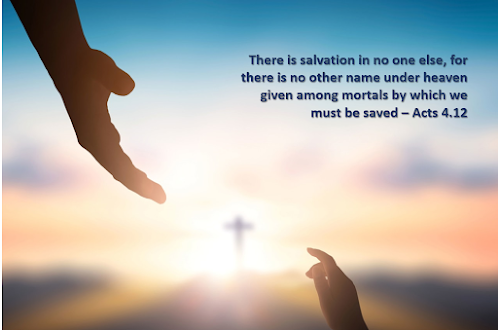
Christians understand God to exist as the Trinity, three persons in distinct, though perfect, unity with one another: God the Father, Christ the Son, and the Holy Spirit.  “I and my Father are one,” Jesus said in John 10:30. Christians have understood since the beginning of the church that yes, God and God alone saves, but that he does so in the person and work of the Son. And so the apostle Peter says in Acts 4:12, “Salvation is found in no one else, for there is no other name under heaven given to mortals by which we must be saved.” And of course, we have Jesus’ words of today’s passage, “No one comes to the Father except through me.” 

“Is there salvation apart from Christ?” No. God’s eternal saving work is done through God’s incarnation as Jesus of Nazareth and his exaltation as the risen Christ. Catholics and Protestants alike have always understood that God could have chosen to save humanity by pardoning our sins in any way he wanted to, but through Christ is the way we know God does do it. 

We know that God is sovereign and can, if God chooses, save anyone he wishes for any reason he wishes in any way he wishes. And maybe God does that every day. Yet we have no revelation from God that he does so. We do have certain revelation that God does save through Christ. So why do we keep looking for God’s Plan B? We already know God’s Plan A. Plan A died on the cross.

Here’s the problem with thinking that surely there is a Plan B that doesn’t involve faith in Christ and all it entails. Blaise Pascal was one of the most important mathematicians of the modern era and a devout Christian. In the 17th century he wrote, “Men despise religion. They hate it and are afraid it may be true.” So how to convince them that Christian faith is not only reasonable but the smart way to bet? Being a mathematician, he looked at the question as one of calculating the odds. 

Life, says Pascal, is a coin toss in which all bets are called in at death. One bet is atheism and the other is Christian faith. At death the coin falls over - heads is God and tails is atheism. Reason alone, says Pascal, cannot decide which is true. So which way to bet is smarter? That is what Pascal is getting at, the smart move.

Agnosticism, he wrote, is actually impossible. An agnostic simply thinks he declines to bet. But you can't decline to bet because you can't decline to die. When the coin falls over agnosticism is indistinguishable from atheism. So everyone is wagering whether they like it or not, whether they even realize it or not. We may either accept the promise of Christ or reject it. Therefore, says Pascal, “If you win, you win everything: if you lose, you lose nothing. Do not hesitate then: wager that [God] does exist.”

I live my life (imperfectly) according to my deep conviction that "Christ has died, Christ is risen, Christ will come again." What if I am wrong? What if all of Christian faith is nothing but wind, that at my death the coin will fall to tails? If so, I won't even know it because there is no heaven, no hell, no nothing after life.

In what way will I have been deprived? How might I have lived my life better? How might I have better found meaning, purpose, mission and worth? Put simply, in what way would I be worse off believing than I would have been not believing? And how can any of that compare with the incomparable payoff if the coin had fallen heads, even if I could not know for sure in advance?

That’s good enough for me. “Christ has died, Christ is risen, Christ will come again.” It may be Jesus only, but only Jesus is more than enough.


Saturday, December 24, 2022

Christmas Eve 2022

Luke 2.8-20

8And there were shepherds living out in the fields nearby, keeping watch over their flocks at night.

9An angel of the Lord appeared to them, and the glory of the Lord shone around them, and
they were terrified. 10 But the angel said to them, “Do not be afraid. I bring you good news of great joy that will be for all the people. 11 Today in the town of David a Savior has been born to you; he is Christ the Lord. 12This will be a sign to you: You will find a baby wrapped in cloths and lying in a manger.”

13Suddenly there was with the angel a multitude of the heavenly host, praising God and saying, 14 “Glory to God in the highest, and on earth peace, goodwill to people whom he favors.”

15When the angels had left them and gone into heaven, the shepherds said to one another, “Let’s go to Bethlehem and see this thing that has happened, which the Lord has told us about.”

16So they hurried off and found Mary and Joseph, and the baby, who was lying in the manger. 17When they had seen him, they spread the word concerning what had been told them about this child, 18and all who heard it were amazed at what the shepherds said to them. 19But Mary treasured up all these things and pondered them in her heart. 20The shepherds returned, glorifying and praising God for all the things they had heard and seen, which were just as they had been told.

Shepherds were in the fields watching their flocks on the eve of the Nativity. When the angel appeared, the shepherds got pretty shook up, terrified, actually, when the glory of the Lord shone around them. 

Nowadays we don’t associate terror with the appearance of God. Terror is something in horror movies. Or terror might be brought about by disaster and impending doom. But God – terror? How can that be?

Maybe the shepherds were terrified at God’s glory not because God is terrible, but because God was about to change things. When they were surrounded by God’s glory and saw the angel, the shepherds knew they were going to be thrown out of their comfort box and yanked into a new thing. They didn’t know what it was, not yet. But they did know that God was doing something big, and it terrified them. 

We usually get all warm and fuzzy about the stories of Jesus’ birth, making them into a big, “Aaahh” moment. But consider for a moment that Jesus’ birth was also an occasion for terror. When the glory of the Lord shone around the shepherds, it revealed them more clearly than the brightest spotlight. There they were for God to see, just as they really were. And it terrified them because they knew that before God all secrets are revealed, and nothing is hidden.

A healthy sense of fear and trembling would be a good thing for us as we consider the nativity. For while it is true that Jesus came into the world to save the world, it’s also true that now we have no excuse before God. When God has put on flesh and walked and lived and slept and spoken and died and lived again, right among us – then we cannot claim we didn’t know God or weren’t aware of what God wanted. If we stopped and thought really hard about Jesus Christ lying in the manger, it would scare us half to death. We would be terrified.

But not for long! Jesus came in love, not in threat. So it’s good to hear the first words of the angel announcing Jesus’ birth: “Do not be afraid.” God is not remote, God is here. That really is good news of great joy.

When the heavenly chorus had gone, the shepherds looked at one another in astonishment and said, “Let’s go!” And off they went to Bethlehem to see the thing which had happened, which the Lord had told them about.

It is the last moment their lives will be the same as before. The door of history is swinging wide, and the shepherds are the hinge. 


They found Mary and Joseph and the baby, lying in the manger, just as the angels had said. We have no idea what transpired during their visit. The story leaps directly to the moment afterward. The shepherds left the manger and went around town, telling everyone what they had heard and seen. 

It reminds me of a young girl whose parents took her out west. One of their stops was the Meteor Crater in Arizona. The girl stood open-mouthed before the great crater, a mile across, a thousand feet deep. Then she exclaimed, “Something must have happened here!”

That’s how it was with the first evangelists, those shepherds who ran around town. They had seen something amazing and enormous in its implications: the wonder of their savior born. So they ran through the dark streets, shouting, “Something happened here!” 

Everyone who heard the news was amazed. Maybe they were amazed that a bunch of shepherds would be running around town shouting about God rather than out in the fields with their sheep. Maybe they were amazed that an angelic singing group had given a private performance that night. They could have been amazed that a little baby could be a savior for the people.

I think they were amazed at the fervor of the shepherds in proclaiming the good news. Something shook the shepherds out of their ordinary religious complacency. It lit a fuse under them to become evangelistic fireballs. What dull lives shepherds led, yet here they were, all excited about a new thing God had done and what it signified.

The story is told of a fifth-grade child who was terribly burned in an accident. The doctors said the boy would be hospitalized for many weeks. After the boy was taken out of the critical-care unit, one of the fifth grade teachers packed up his school books and homework assignments and visited him in the hospital. Two days later the burn ward’s chief nurse called her. “What did you say to Christopher?” the nurse demanded. The teacher started to apologize but the nurse interrupted. “You don’t understand,” she said. “We have been very worried about Chris’ will to live. He was in such despair that we thought he had given up. But now his whole attitude has changed. His spirits are high, he’s taking the treatments and doing much better. I asked him what was different. He said, ‘They wouldn’t send books and homework to a dying boy, would they?’”

When the angels serenaded the shepherds, and when the shepherds saw the infant savior, they suddenly realized that God wouldn’t do this wonderful thing for a people he had written off. The human race is not terminal. God would not send God’s own son to heal humanity if humanity was incurable. So the townspeople were amazed at the transformation of the shepherds and the new life in them. “Let’s go!” exclaimed the shepherds, and off they went to tell everyone of the new hope and salvation found in the manger.

The shepherds returned to their flocks, glorifying and praising God for all the things they had heard and seen, which were just as they had been told. The shepherds went back to work different people because of what they had seen and heard.

It’s easy to overlook that Luke ends the shepherds’ story with the reminder that they saw and heard things which were as they had been told. When our Christmas season is over and we have returned to our usual routines, we need to remember that the gospel we have and the salvation we are given is just that which we have been told. The grace of God isn’t mysterious and incomprehensible—it is just as we have been told in God’s Word. A savior was born in Bethlehem almost two thousand years ago, just as we have been told. 

Like the shepherds, we will soon live in a world when the memory of Christmas is overcome by other events. The shepherds’ sheep still got sick or attacked by wolves. Our cars will still break down and we’ll still have bills to pay. On the outside, everything seems the same. But something big has happened, and now our lives are different. God is with us and the future looks good!


The glory of the Lord has shone around us, and through our doubts and fears there is a voice: “Fear not, for behold, there are glad tidings of great joy. Unto you is born a savior!”


Monday, February 10, 2020

50 Ways to Take Church to the Community

The Lewis Center is an agency of the Tennessee Conference. Here are its 50 Ways to Take Church to the Community. Herte is the link to download the PDF version.

Here is the text pasted:

Churches can no longer open their doors and expect that people will come in. Effective congregations go into the world to encounter those in need of the gospel. These 50 Ways provide tips on reaching beyond the walls of your church with worship, community events, ministries, and service.
Embrace an expansive concept of community
  1. Learn to regard your community as an extension of your congregation. A church’s mission field goes beyond its membership to include all the people God calls it to serve. You are connected to individuals who never set foot in your building.
  2. Know that what’s happening within the church — preaching, worship, music, Bible study — is no longer enough to attract people in an age when church attendance is no longer a cultural expectation.
  3. Don’t sit in your church building waiting for people to come. Be prepared to meet people where they are.
Prepare spiritually
  1. Acknowledge the synergy between the Great Commandment in Matthew 22 (love your neighbor as yourself) and the Great Commission in Matthew 28 (go and make disciples). Evangelistic outreach expresses our love of others.
  2. Remember that Jesus primarily engaged people through everyday encounters, rather than in the Temple or synagogues. He fed people, met their everyday needs, and enjoyed the fellowship of others.
  3. Express love and compassion for your community in big and small ways. Avoid judgmentalism.
  4. Pray regularly for your neighbors and lift up community concerns.
  5. Attend to the faith formation of existing members. Willingness to share faith and reach out to others develops as one grows in faith and discipleship.
  6. Prepare spiritually for the transformation that creative, risk-taking outreach will bring.
Get to know the community surrounding your church
  1. Review demographic data from public, private, and denominational sources, but don’t assume that statistics alone will tell the whole story.
  2. Get out in your neighborhood. Walk the streets. Map the area, and record your observations. Note how the community is changing.
  3. Assess community needs and assets. What are the needs of your context? Who are your neighbors, and how can you serve them?
  4. Be attuned to where God is already at work in your community.
Listen and learn
  1. Know that ministries that truly bless a community often arise out of conversations where you listen for the hopes and dreams of people in your community.
  2. Interview residents of the community. Sit in a park, diner, or coffee house. Ask simply, “What are your challenges, hopes, longings and dreams?”
  3. Get to know the major public officials. They are people with tremendous influence. They need to know of your church’s commitment to the community.
  4. Involve many people from your church in this work. Hold one another accountable to the tasks of engaging and learning from others.
  5. Discern clusters of issues and concerns that arise from these conversations. Ask what issues, suffering, injustices, or brokenness might you address.
Build authentic relationships
  1. Strive for meaningful engagement with others, not superficial gestures.
  2. Make sure you are reaching out to people for the right reasons. If your motive is simply to get them to come to church, people will see right through to it.
  3. Maintain appropriate boundaries, and respect all with whom you engage.
  4. Collaborate with others who are also passionate about the community. Don’t reinvent the wheel if you can partner with someone else serving the community.
Turn your existing ministries outward
  1. Challenge each church group with an inside focus to find a way to become involved with the community outside the church. A choir might sing at a nursing home, or trustees could sponsor a neighborhood clean-up.
  2. Extend recruiting and advertising for church groups and events to audiences beyond your congregation. For example, recruit for choir members in a local paper or community list serve.
  3. Build relationships with those taking part in existing programs that serve the community, such as ESL classes, food pantry or clothes bank users, daycare families, etc.
Reach out through community events
  1. Plan “bridge events” designed explicitly to draw people from the community by providing for them something they need or enjoy — block parties, free concerts, seasonal events, parenting classes, sports camps, or school supply giveaways, etc. Source: Get Their Name by Bob Farr, Doug Anderson, and Kay Kotan (Abingdon Press, 2013)
  2. Hold these events off church property or outside the church walls in venues where people feel comfortable and naturally congregate.
  3. Get the word out through a well-planned publicity campaign.
  4. Encourage church members to invite their friends and neighbors. It is less threatening for them to invite someone to a community event than to worship.
  5. Avoid explicitly religious themes: no preaching, prayers, pressure, or financial appeals that might turn people off or reinforce negative stereotypes about church.
  6. Remember, the event itself is not the purpose. The purpose is to meet people where they are and build relationships. Mingle. Get to know people.
  7. Have a well-trained hospitality team. Make sure guests are enjoying themselves and know their attendance is appreciated.
  8. Gathering people’s names and information about them will permit follow up to those for whom it is appropriate.
  9. Invite those who attend community events to another event — sometimes called a “hand off event” — planned to draw them into a deeper relationship.
Extend your congregation’s spiritual presence beyond church walls
  1. Recognize that many “unchurched” people are spiritually inclined but apprehensive about attending church because they feel unwelcome, distrust institutions, or have been hurt in the past.
  2. Pay attention to the heightened receptiveness to spiritual engagement around religious holidays such as Easter and Christmas.
  3. Offer offsite worship services on special days, such as Christmas Eve, Palm Sunday, and Easter. Select familiar venues where people feel comfortable — parks, restaurants, parking lots, coffee houses.
  4. Offer imposition of ashes on Ash Wednesday in public places.
  5. Partner with other institutions (such as nursing homes, hospitals, or prisons) or commercial establishments (restaurants, bars, shopping centers, or sports facilities) to offer worship services to their constituents or clientele on special days.
  6. Plan creative outdoor events, such as live nativities or “blessing of the animals” services, to help make your church visibly present to the community in creative ways.
  7. Hold your Vacation Bible School in a local park or recreation center. Canvas nearby neighborhoods to invite families.
  8. Reach out to local media. Community outreach is often newsworthy, and reporters are often looking for religiously themed stories around the holidays.
Connect spiritual outreach to community service
  1. Acknowledge that many served through feeding and clothing ministries, justice ministries, weekday children’s services, and other ministries of community service have no other connections with our churches.
  2. Ask if these ministries inadvertently convey an “us and them” attitude or communicate that “you are not worthy of joining us.”
  3. Identify aspects of church life, such as characteristics of the building or how people dress, that may make some feel unwelcome. Are there alternatives that may reduce barriers for some to enter?
  4. Treat everyone as a person of dignity who deserves respect.
  5. Extend genuine hospitality to those you serve.
  6. Focus first on building relationships of understanding and trust.
  7. Consider adding a spiritual or discipleship element to community service activities but without any sense of expectation or requirement. For example, have a service or study following ESL classes for any interested.
  8. Seek to conduct each activity in a way that connects people to God and the church.
Contributors: Robert Crossman, Ann A. Michel, Kim Mitchel, and Lovett H. Weems, Jr.

Thursday, April 18, 2019

What draws people to church services?

A Gallup survey reported just two years ago:


STORY HIGHLIGHTS
  • Three in four worshippers say sermons a major factor in why they go
  • Youth programs, outreach and volunteer opportunities also important
  • Preferring to worship solo is main reason non-attenders eschew services

Belonging to a church, synagogue or mosque provides people with important social benefits that Gallup research shows improve personal well-being. While social benefits are clearly important to majorities of those who worship regularly, what most motivates them to attend is learning more about the tenets of their faith, as well as connecting that faith to their lives. Protestants, who have more control over their church leadership and flexibility in where they worship, place even greater emphasis on the quality of sermons than do Catholics, although both groups rate sermons highly.

Fulfilling these expectations could be critical in order for religious organizations to survive. But to expand their ranks, reigniting the interest of lapsed members should be a priority. Converting those who say they aren't very religious or who don't like organized religion may be futile. But churches and others may find some success with the message that worshipping in communion with others has benefits that can't be achieved worshipping alone -- addressing the No. 1 reason non-attendees give for not attending.
Much more at the link.

There is growing realization today that "attractional" church worship is not working in drawing people wither to long-term attendance or to personal commitment to Christ. "Worshiptainment," as we call it, is a failure in leading people to discipleship.

Commentator Jonathan Miltimore writes,
The poll made me wonder: When and why did music became such a prominent part of evangelical services? And are these churches missing out by focusing on music at the expense of other aspects of church life?

I suspect the former question might be linked to the increasing need for people in our culture to be entertained.

“Americans no longer talk to each other, they entertain each other," Neil Postman famously wrote in his 1985 book Amusing Ourselves to Death. "They do not exchange ideas, they exchange images.”

I’m not suggesting churches need to stop playing music. I’m merely wondering if dedicating nearly half of a church service to musical performances is the most efficient use of time.

One wonders if people in pews would not receive more spiritual nourishment from other church-led activities: An extended reading of scripture? Silent prayer? A longer sermon?
The Gallup survey corresponds to other research I have seen that reports that the fabled and much-derided Millennials are drawn to traditional or orthodox services far more than "contemporary" or attractional services.

I think the real bottom line is this: What are people finding, experiencing, and learning in a church that they cannot find in secular culture?

Pew Research has a lot more, "Why Americans Go (and Don’t Go) to Religious Services."

More Gallup commentary of these trends, "Church Leaders and Declining Religious Service Attendance."

Thursday, June 25, 2015

The only cure for "Great Politics"

Peter Hitchens is the brother of the late Christopher Hitchens, one of the founders of the New Atheist movement whose book, God is Not Great, remains high atop the must-read list for atheists today. I myself read his non-religious works and columns eagerly and found them enlightening. C. Hitchens was indisputably a very smart man, engaging and witty.

Like Christopher, his younger brother b y two years, Peter, became an atheist. But he did not remain there. Years into adulthood, he came to confess Christ, published a rebuttal to God is Not Great and even publicly debated his brother a few times.

Here is his story:
How I found God and peace with my atheist brother: PETER HITCHENS traces his journey back to Christianity | Daily Mail Online
Being Christian is one thing. Fighting for a cause is another, and much easier to acknowledge – for in recent times it has grown clear that the Christian religion is threatened with a dangerous defeat by secular forces which have never been so confident.

Why is there such a fury against religion now? Because religion is the one reliable force that stands in the way of the power of the strong over the weak. The one reliable force that forms the foundation of the concept of the rule of law.

The one reliable force that restrains the hand of the man of power. In an age of power worship, the Christian religion has become the principal obstacle to the desire of earthly utopians for absolute power.
He is right. As militant atheist Friedrich Nietzsche said, once God is dead, humanity will be in the service of Great Politics, which even Nietzsche knew would not be an improvement.
The point, rather, is that Nietzsche saw. However much he (usually) advocated what ought to be most abhorred, he at least recognized that true morality and Christian belief are siblings. Moreover, in tones redolent of Jeremiah he saw the consequences to civilization as a whole when its citizens lose their faith in God. For what will take the place of God will be only a passionate—and largely empty—politics:
For when truth enters the lists against the lies of millennia, we shall have convulsions, a spasm of earthquakes . . . the likes of which have never been dreamed. Then the concept of politics will be completely dissolved in a war between spirits, all authority structures of the old order will be blown into the air—one and all, they rest upon a lie; there will be wars the likes of which have never existed on earth. From my time forward earth will see Great Politics.
Such are the contradictions of atheism. With hope in progress gone, with the lessons of the twentieth century still unlearned in the twenty-first, with technology progressing, in Adorno’s words, from the slingshot to the atom bomb (a remark cited in Spe Salvi), with a resurgence of religiously motivated violence filling the headlines, all that the new atheists can manage is to hearken back to an Enlightenment-based critique of religion. But they find their way blocked, not so much by Nietzsche (whom, as we saw, they largely ignore) but by the ineluctable realities he so ruthlessly exposed. Not Nietzsche, but the history of the twentieth century has shown that godless culture is incapable of making men happier. All Nietzsche did was to point out that no civilization, however “progressive,” can dispel the terrifying character of nature; and once progress is called into question, the human condition appears in all its forsaken nakedness.
We are almost there, folks. This is why evangelism is the only critical task of the Church today.

We have to avoid the natural tendency to do withdraw into ecclesial shells, and rely instead on the supernatural authority and inspiration of God to go into the world and make disciples of Jesus Christ.


Bookmark and Share

Wednesday, January 22, 2014

Mission focus

Here is the focus of the Conference for the coming year. Good areas, and I especially appreciate that it all fist on a single sheet of paper.


Deliberate witnessing planning

Below is a scanned PDF of the handout used at the evangelism training at Brentwood UMC on Jan. 18, 2014, sponsored by Bishop Bill McAllily. The presenter, as indicated, was Dr. Derrick Lewis-Noble. 
When I receive the Word format document of this handout, I will post it, too, or post a link to download it. You should be able to save the PDF below by using the "download" link in the bottom bar or by following the link below to the Scribd page. 

Wednesday, September 11, 2013

Four stages of inviting

Most people go through four stages of inviting people to church, I think. Here are 4,000 words worth of visuals.

Stage 1: Church members who figure that everyone in town knows where the church is and can come if they want to. It's sort of like Yogi Berra said about declining attendance at ball games, "If people don't want to come out to the ballpark, how are you going to stop them?"


Stage 2: Members become willing to invite, but don't want the existing nature of the congregation to change. So they invite only people with whom they are already comfortable - people they already know and who are are similar to them in education, income, lifestyle and age.


Stage 3: Members who realize that similarity with people they invite is much less important than whether the other persons are connected with a church already. These are members who want to be "fishers of people" but are not very interested in fishing in aquariums, or fishing for members of other churches. They know that unchurched people are whom Jesus said to take the Gospel.


Stage 4: At this stage, church members enthusiastically offer Christ with anyone whom the opportunity presents. If the others turn out to already be connected, that's great, and if not, they are invited.


Thursday, May 23, 2013

Are we ready to reach unchurched people?

As we start considering what planning we need to do for our future, one thing we will need to face fully an a real, instrospective questions. One of them is, "Are we, as a congregation (including the pastor!) really ready to reach out to unchurched people and receive them into our wider church life?"

A definition is called for. People who write about evangelism generally refer to "unchurched" people as those who are not part of a Christian fellowship and never really were except perhaps very temporarily. As for people who were longer-term participants in a church but who do not presently attend, I have usually seen them referred to as dischurched. These are awkward constructions, of course, and places labels on people that they may not agree with or like. Nonetheless, I think the distinction is important.

Here are three articles that are relevant to this topic:

15 characteristics of today's unchurched person

How to reach unchurched people who think they don't need God.

9 signs your church is ready to reach unchurched people

Monday, April 8, 2013

Truth and Christian Faith

This is a slightly abbreviated version of my sermon yesterday. It is the first of a series on why and how Christian faith is founded on facts, not myth.

Christianity rests on a single claim. I call it the fulcrum of our faith. All of Christian faith is founded on the Easter proclamation, “He is risen!” Absent that, we got nuthin’.
And nothing is frankly what increasing numbers of Americans think we've got. On Good Friday, the respected polling firm Rasmussen Reports released a poll that showed that the number of Americans who believe that Jesus rose from the dead has dropped 13 percent since only last year. The poll question was the same this year as last, “Do you believe that Jesus Christ rose from the dead?” Last year, 77 percent said yes. This year, 64 percent said yes. Over the last five years, the drop has been steepest among teens and young adults. In fact, one-third of adults under 30 claim no religious affiliation at all (see "Growing Up 'None' ").
Of the 36 percent who did not affirm Jesus’s resurrection, 19 percent rejected it outright, a staggering 12 percentage point jump from last year. Seventeen percent said they weren't sure.
First Peter 3.15 tells us, “Always be prepared to give an answer to everyone who asks you to give the reason for the hope that you have.” Seems like we who know Jesus arose are not doing that very well.
And so my reasons for this sermon series. Christian faith is founded on historical facts, verifiable facts, facts that even non-Christian historians and scholars agree are true. And yet my guess is that only a very small number of typical mainline Protestant church members, including us Methodists, would be able effectively to recount and relate those facts and what they mean in a way that would at least move some of the 19 percent who deny Jesus’s resurrection to the group who at least admits the possibility.
I will be frank – what I seek to inculcate in my flock is greater conviction of the truth of the Christian proclamation that “Christ is risen, he is risen indeed.” Conviction is not mere agreement to a proposition. Conviction is a belief held so powerfully that it transforms the way we live. As Wesley explained, if we say we believe something but it makes no difference in the way we spend our time or our money, then it is belief without conviction. Conviction changes us.
Here is how I plan to proceed:
  • I mentioned a couple of weeks ago that while interrogating Jesus on Good Friday, Pontius Pilate asked him what I think is probably the second-most-important question is the Bible: “What is truth?” This question strikes to the heart of the American church and that is what I will address today.
  • Next Sunday I will talk about the Easter story itself and why it is solidly historical.
  • On April 21 I will then do my best to recount the various alternative explanations that have been offered over the last couple of centuries claiming to show why the Easter proclamation is actually false, even if the apostles thought it was true.
  • On April 28 my topic will be what the apostles meant by resurrection in the first place and what it has to do with us. On May 5 I’ll try to wrap everything up.

Now on to Pilate’s question. What, indeed, is truth?
Truth bears authority, so debates about what is true necessarily are also about what has authority. Here are some expressions we have all used in the contests over truth and authority:
•  “Nobody has the right to tell me . . .” (fill in the blank),
•  “The rule book says that . . .”
•  “I saw on TV . . .”
•  “Research has shown that . . .”
•  “The Bible says . . .”
•  “I read on the internet . . .”
•  “My feelings are . . .”
All these statements are claims of truth and authority. Christianity has a set of claims, too – many claims. There is at least one claim that is extremely offensive. We don’t like being offensive, especially in this sensitive era. The greatest social sin you can commit today is to offend someone’s nationality, ethnicity, educational background, political affiliation, what have you. We are nice people and we want others to think so. So in our commendable urge not to offend anyone we risk watering down the Gospel because we won’t embrace the offensiveness inherent in the Christian proclamation.
Frederica Mathewes-Green, a Christian writer, related that she was invited to appear on a panel in a secular setting to discuss spiritual nurturing in everyday life. She told the assembly that if you were raised in a Christian tradition, then explore it more and learn more about it. It will enrich your life. If you were raised in some other religious tradition, she said, explore and learn about Christianity anyway. Christianity is for everyone and its welcome transcends all earthly boundaries. After she finished, the panel’s moderator looked at her like a naughty kindergartner and told the group, “What Frederica meant to say was that there are many spiritual paths and all should be honored in the spirit of multiculturalism.”
“Wow!” she thought. “I had no idea that was what I was trying to say!”
This incident, she said, illustrates the most offensive part about Christianity. We make exclusive claims. We affirm some things and reject others. For example, we don’t say that whatever you believe is okay, as long as you are sincere. Sincerity does not equal truth. can easily be sincerely wrong. 
The offensive part of Christianity is not that we proclaim Jesus as our Lord, but that we proclaim Jesus is everyone’s Lord. Hindu, New Age, Jewish, Mormon, Moslem, Catholic or Protestant, capitalist or socialist, Asian or African or European, Indian or aborigine, atheist or pagan—it matters not what you think about Christ or whether you even acknowledge Jesus. Jesus is still your Lord and your eternity is in his hands whether you like it or not. (See, "Almost All Religions Are Exclusive.") 
So we try to avoid offense by saying that Christian living will make you a better person, or will give you peace or joy or any other side effect of Christian conviction. These may be true but they are also entirely uncompelling to non-Christians. The real message is simply that Christ preserves us for eternal life with God. We do not follow Christ just to be better or happier people, but to belong to God forever and lead others to belong also.
Nowadays religion is out, but spirituality is in. The difference seems to be that spirituality is highly individual and doesn't take commitment. So people claim they are seeking spiritual development but have no use for religion.
“That’s nice,” we reply. “You’re just seeking truth in your own way.” We sure aren’t going to offend anyone by telling them that if for this life only they are “spiritual,” they are of all people most to be pitied. That’s so intolerant and narrow minded!
Now listen. You can be as spiritual as they come without Jesus. You can be so cosmically conscious that the Dalai Lama looks a reprobate next to you. Spirituality is actually pretty easy. Just get a mantra and affirm yourself. But you won’t be any closer to eternal life with God than before.
Jesus said that if you know him, you know God. More than that, to know God you have to know Jesus. So when we try to proclaim the Gospel, we’re sort of stuck. We have a message that can be inherently offensive, Jesus declaring that he is truth in the flesh and that to get to God you have to go through him. We proclaim this message to a generation of folks who don’t believe there is any such thing as objective truth in the first place, and if there is it is certainly not religious truth, and they shun religion anyway.
At the end of every spiritual quest lies only oneself, just as empty and mortal as ever. We should invite the spiritual seekers to come on our journey and walk along the Jerusalem road with us. At the end of our walk is not us, but the cross of Calvary and beyond the cross is the empty tomb. From the empty tomb emerged not just some spiritually-enhanced version of ourselves, but the flesh and blood embodiment of what God promises us.
We need to think about how to communicate the Gospel to a generation that values visual imagery more than the written word. A generation that wants spirituality but not religion. A generation that is skeptical of any claim to truth and authority, especially religious claims. A generation that is less inclined to join anything than their parents. A generation that is busier than their parents were, and is much more likely to have only one adult heading a household. And we need to reach out to them without diluting the Gospel.
We are a people of the fact of resurrection, not persons of a proposition. We belong to the truth because we belong to the Risen One. Jesus is the truth and life itself. That truth will never change, but how we proclaim it must change. We cannot complacently just water our own garden while outside a drought desiccates the land.
So: What are the facts about Christian faith and why do we say they are facts? We’ll go there next week.

Tuesday, July 17, 2012

Faith retention rates by religion

Found this over at Alan Bevere's site:


It strikes me that only the two oldest Christian denominations, Catholic and Greek Orthodox, have anything like acceptable figures. And they both have clear standards and expectations of their members. We Methodists are not even retaining half. And almost every Christian denomination ranked lower than us has looser standards of faith and practice.

(I also wonder whether the source data also show how many Methodists, for example, stay active in the Christian faith, but in another denomination.)

Understand also that there is no functional, theological or philosophical difference between "nones" and "atheists." Combined, they retain the same percentage as Catholics.

Update: A lot more info about the study at Patheos, including these two observations:
The information comes from the Pew Forum’s U.S. Religious Landscape Survey — and there you can find a “Protestant” category.  53.9% of Americans say that they were affiliated with Protestantism as children, compared to 51.3% now — a drop of 2.5% in absolute value, or a decline of 5% proportionally.  Most of the loss has come from Baptists and Methodists.


Also, while there are more people joining the atheist and agnostic ranks than leaving, it doesn’t bode well for atheists that 60-70 percent of those who are raised atheist renounce their atheism.  If it were so compelling a solution over the long term, one would think the retention rate would be higher.

A world without nuclear weapons - what would it look like?

 From Pope Leo this week, according to the National Catholic Reporter : " Pope Leo quotes Bob Dylan song in book foreword calling for n...